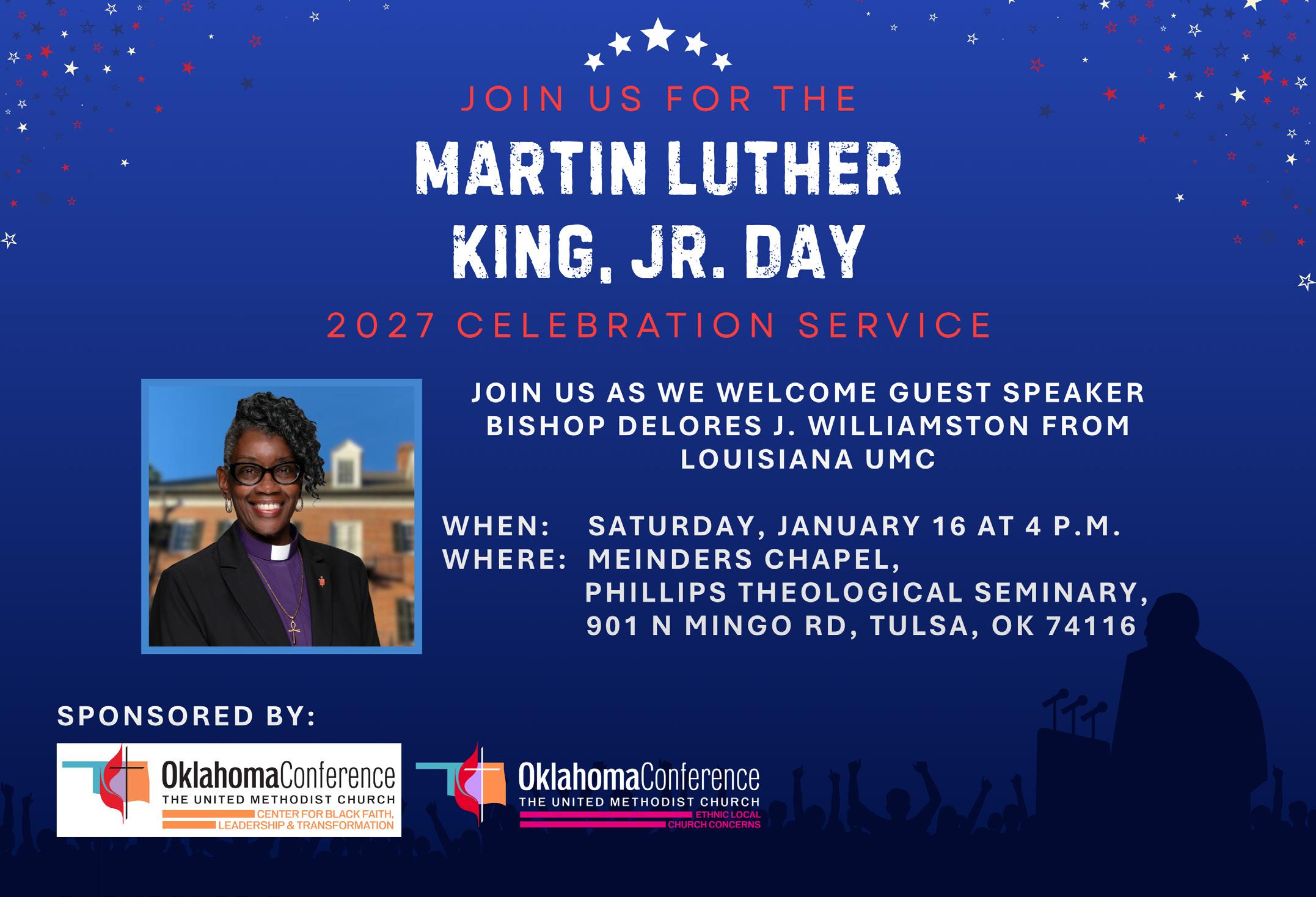
Cookson Hills Indigenous Center is reimagining its ministry and needs your help. Join them from 9 a.m. to 3 p.m. for Re-Tool Time – a day of volunteering to help shape the future of this beloved ministry.
Join the Arkansas Conference Board of Laity from 9:30 a.m. to noon for a Zoom gathering exploring the newly assembled Social Principles. The event features a devotional by Bishop Merrill, a presentation by Neal Christie and four breakout groups covering creation care, political community, economic justice and social community. Register today.
Join a free, practical training on Form I-9 compliance at 1:00 p.m. This session covers everything from proper completion to common mistakes so you can handle employment eligibility verification with confidence. Register here. Aug
Communications Ministry Staff
Scholarships to Exploration 2026 Available!
The Board of Ordained Ministry is offering up to $500 for food and travel expenses for any adult from an Oklahoma UMC church who attends Exploration 2026. Applications are due September 1. Contact nhamilton@okumc. org to apply.
Duke Divinity School will host four fall sessions of Study Leave for Ministry Professionals are available at this fall. Registration is open now with limited spots available.
The OU Wesley Foundation is facing off against Texas Wesley in the Red River Sharedown, a friendly fundraising rivalry that culminates on October 10. Donate to support campus ministry scholarships, free community meals and student programs...and help bring home the trophy! Learn more.
Know someone sensing a call to ministry? Exploration 2026, hosted by the General Board of Higher Education and Ministry, is a national gathering for adults discerning a call to ordained or licensed ministry. Join others on the same journey in Orlando, Florida for worship, learning and community. Learn more here.
from the editor
What does it mean to be a good steward? Not just of money, but of land, of story, of calling, of the gifts we have been given and the ones we will one day leave behind.
This issue is built around the hymn “For the Beauty of the Earth” and like that hymn, it holds more than gratitude. It holds responsibility. The recognition that the beauty we have been entrusted with – our earth, our church, our community, our personal gifts – must be tended. Stewarded. Passed on.
The stories in this issue show what that looks like in practice, and they are as varied as the people who wrote them.
Dr. Terry Koehn writes from his office window at Bartlesville First UMC, where 64 acres of trails, gardens and a lake have become far more than a church campus. They have become a place of healing, community and sacred groundedness for anyone who walks through.
Alan Herndon tells the story of Evelyn, a woman who spent decades in the same church pew and then found a way to keep singing her hymn of grateful praise long after she was gone.
Rev. Heather Nygard-Scherer shares the raw, honest journey of planting a new campus in
Bixby – the roller coaster of saying yes to God when the road ahead is unclear and the personal cost is real.
Rev. Carlos Ramirez offers a practical and inspiring guide to stewardship season, reframing giving not as an obligation but as an invitation to be part of God’s dream for your community.
Rev. Dr. Derrek Belase contributes two pieces this month. In the first, he opens a six-part series on the Order of Deacon, tracing 30 years of history and reminding us that connecting the church to the world is itself a form of stewardship. In the second, he reminds us that when we pool our apportionments together, we can do things no single congregation could do alone – from disaster relief halfway around the world to a scholarship that sends a child to camp right here in Oklahoma.
Together these stories ask the same question the hymn asks: how do we offer our grateful praise – not just in song, but in action, in generosity, in the willingness to tend what God has given us?
I hope this issue inspires you. And I hope it stretches you toward the beauty that is already around you and the responsibility that comes with it.
Jenny Herzberger Interim Editor
For the Beauty And Power of the Earth
By Dr. Terry Koehn, Senior Pastor at Bartlesville UMC
The view from my office window never gets old and is ever new. A generous grassy expanse, often the site of games and inflatables, stretches toward the edge of our as-yet-unnamed lake, rimmed by hackberry, cottonwood, and other trees. The lush greens of spring and summer give way to fall’s golds and winter’s grays beneath skies that shift from azure to crimson to gold as nature calls forth. The seasons are punctuated by geese and crows, rabbits and turtles, walkers with dogs, parents pushing strollers, runners moving swiftly by, and the occasional fishing pole slung over a shoulder. From time to time, one of our faithful “yardeners” cruises past mowing or trimming.
Something is always happening beyond the windows: cold and heat, rain and wind, clouds and sun, but mostly the teeming of created life.
I share this blessing to frame, literally and figuratively, a unique avenue of ministry for Bartlesville First United Methodist Church. Our sixty-four acre campus does far more than provide space for a church building and parking lot. My window view by no means shows it all. More than two-thirds of the property is home to walking trails, the lake, and a community garden. In the past, the grounds also supported an animal ministry with donkeys, horses, and goats. More recently, pollinator plots have provided new benefits for various wildlife.
The trails consist of two loops covering two miles total, and they are open to anyone. Many days, especially when the weather is pleasant, dozens
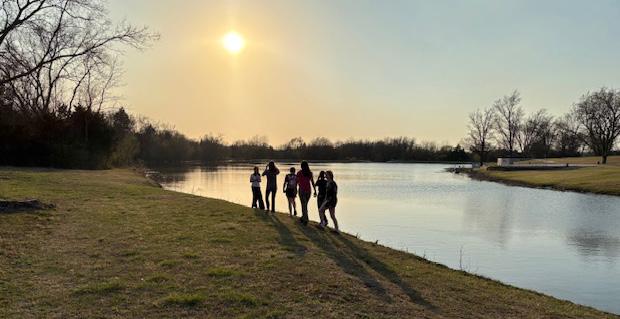
The Dewey FUMC confirmation group gathers at the lake’s edge during the Dewey Dinner, one of many community events hosted on Bartlesville First UMC’s 64-acre campus. Photo courtesy of Bartlesville UMC.
of people—individuals, couples, and families – make use of the maintained, graveled paths. Benches, a pavilion, and adult-sized swings are offered along the way. The community garden, known as The Garden of Eatin’, is an intensively managed compound of raised beds tended by anyone from the community who wants to help, not just church members. With favorable weather, continued composting, and the skills of several Master Gardeners, the produce yield has grown year by year. The 2025 growing season produced more than 8,000 pounds of vegetables to share with local food outreach agencies. The grounds have also become a go-to site for prom, wedding, and senior photos. In these ways, our campus serves as a “third space” for more and more people.
Our grounds also witness to the biblical faith story. The Garden of Eatin’ reminds us that life began in a garden and that tending the earth is part of God’s call to us as human beings. The lighted cross is visible from many angles as people walk or sit, and during Lent we offer a stations of the cross walk along the trail. The outdoor columbaria overlook the lake—the site of our Easter sunrise service – reminding us of the promise of new creation made possible through Christ.
I also want to connect these grounds to my own journey. To do that, I ask you to indulge a brief dip into Greek mythology, specifically the battle between Hercules and Antaeus. In short, the battle can be seen as “brute force” against “life chaos.” Hercules picks Antaeus up and hurls him, but whenever Antaeus touches the ground again, his strength is renewed. The lesson I draw is that both Hercules and Antaeus reside within us. How often do we try to overcome chaos with sheer force of will? How many times do we find ourselves “up in the air” amid upheaval and struggle?
A few years back, I had my own epic battle inside me. It manifested as anxiety-ridden
insomnia. In time, I gained an insight: my brain had become detached from my body. A wise person helped me see that by reconnecting with the stuff of earth – literally – I could find renewed strength. In practical terms, that meant paying attention to my footfalls as I walked the grounds, noticing the sensation of sitting in a chair, mindfully chewing food and truly tasting it, and practicing many other ways of being and staying grounded.
Being connected to earth – being grounded – is still key to finding strength in struggle. Brené Brown, in Strong Ground, describes physical retraining after an injury. Her trainer led her through simple grounding exercises so she could build a more stable base and stronger core. Brown turns those lessons toward leadership, arguing for truthfulness and vulnerability as practices that build resilience. Justin Earley, in The Body Teaches the Soul, likewise reminds us that what we do with our bodies matters. Our bodies train our spirits through simple practices such as breathing and eating. Both authors echo what I have been learning in my own journey with anxiety.
At first, I tried to fight anxiety as if it were an enemy I could defeat with willpower. I tried to think my way into calm. I tried to schedule relief. Eventually I learned that anxiety is not
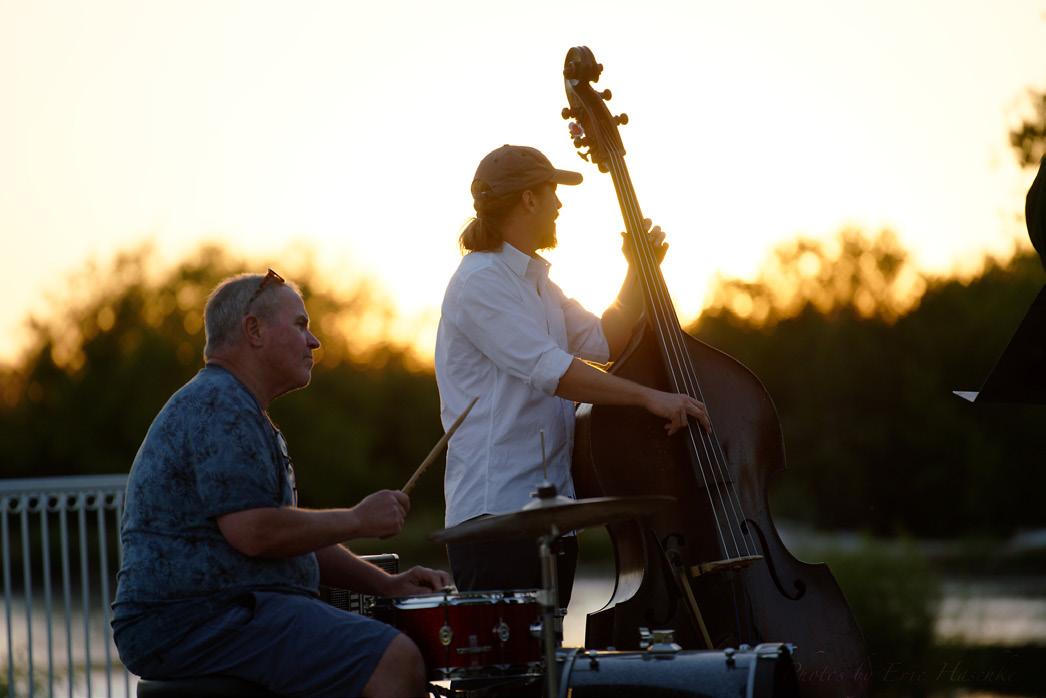
Live music at sunset during Jazz on the Lake, a community gathering on the grounds of Bartlesville First UMC. Photo courtesy of Bartlesville UMC.
defeated by pretending it is absent. It is met by changing the relationship between emotion, attention, and the physical world.
I began to notice what happened when I connected to something stable: the sensation of my feet, the rhythm of walking, the feel of air in my lungs outdoors, the quiet persistence of trees moving in their own time. I learned the difference between distraction and orientation. Distraction pulls us away from the moment. Orientation returns us to the present.
This is why our natural settings – trails and trees, water and garden – are more than an outreach technique. They are a form of contact. Through these gifts we offer a place of groundedness in an increasingly complex and troubled world. Pressures around us continue to mount: political tension, economic uncertainty, climate anxiety, community conflict, and more. The chaos around us affects us within, and we can become disembodied.
In that sense, nature is more than scenery. It can become a companion. Nature does something subtle and profound: it scales things for us. A worry that feels enormous indoors can feel different under a wide sky, or beside water responding to the breeze. Trees do not hurry to prove their strength. Long after I have left this earthly scene, the view from my office window will likely be largely the same.
We hope these church grounds offer more of an entrance than an escape: entrance into the body, entrance into the present, entrance into community, and entrance into the possibility that even when turmoil is real, groundedness can be real too. We invite you to come experience this place for yourself. We pray that God’s Spirit will guide us as we steward these grounds for generations yet to come. “For the beauty of the earth,” indeed – and for its power, as well.
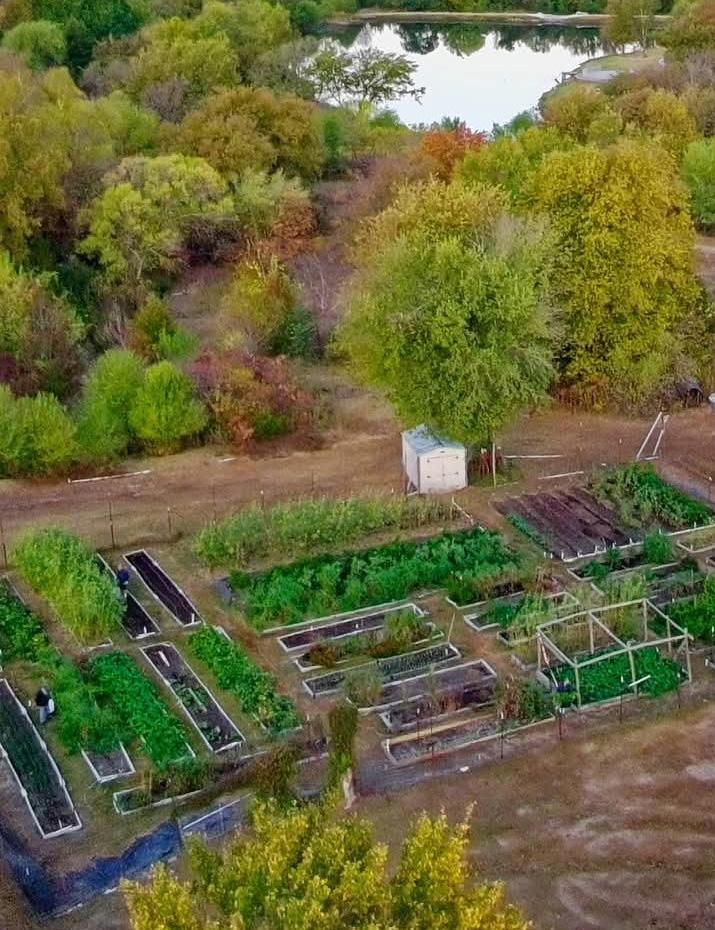
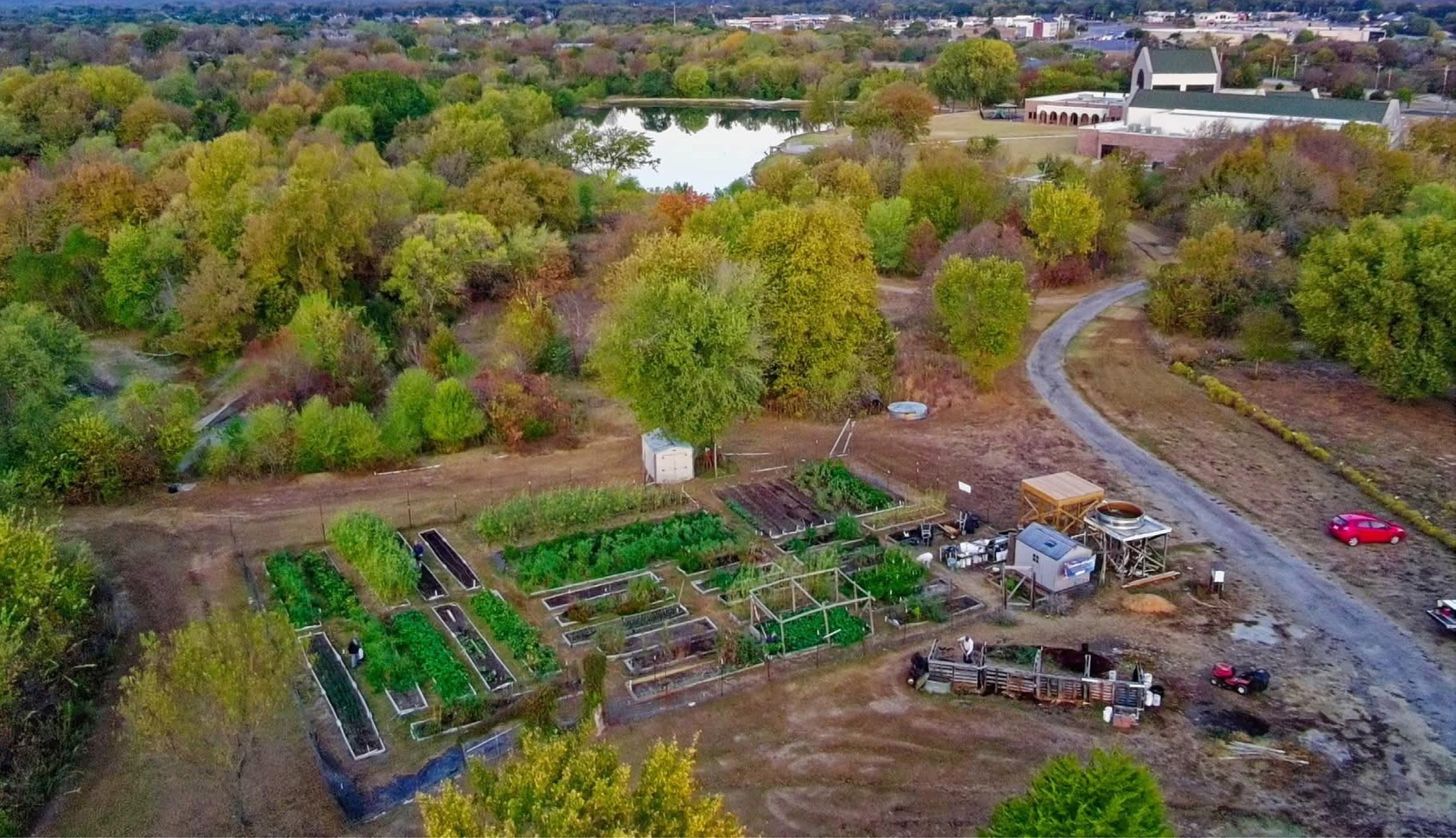
From above, the full picture comes into view: garden, lake, trails and church – 64 acres of sacred space tended for the whole community. Photo courtesy of Bartlesville UMC.
“We have this treasure in jars of clay, to show that the surpassing power belongs to God and not to us.”
2 CORINTHIANS 4:7
GOD DOES WONDERS THROUGH ORDINARY THINGS: EVERYDAY PEOPLE, FAITHFUL CHURCHES, HOPEFUL GENEROSITY. WE TRUST THAT HIS POWER IS WHAT MAKES A DIFFERENCE THROUGH OUR HUMBLE EFFORTS. THE RESOURCES WE STEWARD ARE NOT THE TREASURE. THEY ARE THE VESSELS THAT CARRY POTENTIAL FOR LASTING GOOD.
For the Beauty: A Legacy of Gratitude
by Alan Herndon, Director of Gift Planning at Oklahoma United Methodist Foundation
I would like to share a story with you that has had a lasting impact on my life. One of many beautiful stories of an individual’s generosity that I have walked with through the years.
Her name was Evelyn.
Every Sunday, Evelyn sat in the same pew she had occupied for nearly fifty years. She loved singing the old hymns. She shared with me that her favorite hymn always brought tears to her eyes.
“For the beauty of the earth, for the glory of the skies… Lord of all, to Thee we raise, this our hymn of grateful praise.”
To Evelyn, those words were more than poetry. They were a way of life.
She remembered being baptized in that church as a child. She remembered youth retreats, mission trips, and the day she stood at the altar to exchange wedding vows. She remembered holding her first child in the nursery and later watching her grandchildren sing in the Christmas pageant.
The church had been there in seasons of joy and seasons of sorrow. It had celebrated births and graduations. The church wrapped its arms around her family during the loss of her husband. Through every chapter of life, Evelyn had experienced the beauty of God’s love through the people of her United Methodist congregation.
My several visits with Evelyn would always center around her sharing how important her church community was to her. Her sharing these stories made me think of the verse:
“For the joy of human love, brother, sister, parent, child, friends on earth and friends above…”
Her thoughts drifted to those who had come before her. Faithful people she had never met had built the sanctuary. Others had established scholarships, endowed ministries, and left gifts that made it possible for children to attend camp, youth to serve on mission trips, and families in need to receive help. Their generosity was still bearing fruit decades later.
As we talked about how she might want her legacy to impact others, she wanted to know that what she had to offer would make a difference in her church for future generations.
“How can I offer my hymn of grateful praise to generations I may never meet?”
The “aha” effect happened! Evelyn realized stewardship was not only about funding a budget. It was about gratitude. It was about saying “thank you” to God for a lifetime of blessings. She wanted to ensure that others would experience the same love and grace she had known.
After prayer and conversation with her family, Evelyn decided to include her church in her estate plans through the Oklahoma Methodist Foundation. She designated a percentage of her estate to establish an endowment that would
support ministries for children and youth. It was a meaningful legacy gift for her local church.
After Evelyn passed, her legacy continued.
A few years later, a youth member attended church camp for the first time because scholarships were available. A teenager discovered a call to ministry during a mission trip. A family received support during a difficult season. New generations gathered in worship and sang the same beloved hymn.
Perhaps they never knew Evelyn’s name.
I am sure they experienced the beauty of God’s love because someone before them offered a gift of gratitude.
Somewhere in heaven, joined with the saints who had gone before, Evelyn’s voice was still singing:
“Lord of all, to Thee we raise, this our hymn of
grateful praise.”
Our spiritual discipline of stewardship is not simply about what we give today. It is our grateful response to the beauty God has provided for us. It is our opportunity to ensure that future generations will know the love of Christ through the ministries of The United Methodist Church.
For the beauty of the earth. For the gift of the Church. For the generations yet to come.
Lord of all, to Thee we raise, this our hymn of grateful praise.
If you want to learn more about endowed gifts or other ways you can sustain ministries for current and future generations, I encourage you to connect with your Oklahoma Methodist Foundation. Our team can work with you to design a meaningful gift that aligns with your goals and supports the ministries you care about the most.
Connecting the Church to the World
Stewardship of people, community and God’s call to serve
First in a series of 6 articles highlighting the Order of Deacon in the UMC
By Rev. Dr. Derrek Belase, Director of Connectional Ministries
This year marks not only the 70th anniversary of the ordination of women in the Methodist tradition, but also the 30th anniversary of the Order of Deacon as a clergy order in the United Methodist Church.
For the next six months, the Contact will run a feature article in each edition highlighting the ministry of deacons in the Oklahoma Annual Conference.
Since 1996, 43 deacons have been ordained to this order with 12 currently serving under appointment.
Deacons are ordained clergy in The United Methodist Church who lead ministries that connect the church and the world. Through service, advocacy and leadership, deacons equip people of faith to respond to the needs, hopes and concerns of their communities.
Deacons are ordained to a lifetime ministry of word, service, compassion, and justice. They are called to serve both within the church and beyond its walls, helping the church engage with the world in meaningful ways.
Some deacons serve in local congregations in specialized ministry roles, while others serve in extension ministries such as chaplaincy, social services, education and nonprofit leadership.
The word “deacon” means servant and messenger, reflecting a ministry rooted in action, advocacy and care.
The ministry of the diaconate is based on Acts 6:1–8 where we find deacons instructed to serve the marginalized who are widows and orphans.
Today, deacons lead others to serve whoever has needs.
While there is scant evidence of anything similar to the deacon as an ordained clergyperson throughout much of the history of Methodism, it should be noted that the office of deaconess, a lay order, has been around since the late 1800s.
The office of Deaconess, along with the companion Home Missioners, continues today as the only official lay order of the United Methodist Church. This order is overseen by the United Women in Faith.
Starting in the mid-1940s, The Methodist Church appointed one commission after another to study and reform the church’s understanding and practice of ministry.
From the 1960s onward, these ministry study committees tried to change the way Methodists thought about the diaconate, but quadrennium after quadrennium, the church’s governing conference rejected proposal after proposal.
A first step was taken in 1968 when the General Conference gave the title consecrated lay worker to laypersons who are employed by the church, professionally certified in a specific area of ministry (notably Christian education and church music), and consecrated by the bishop.
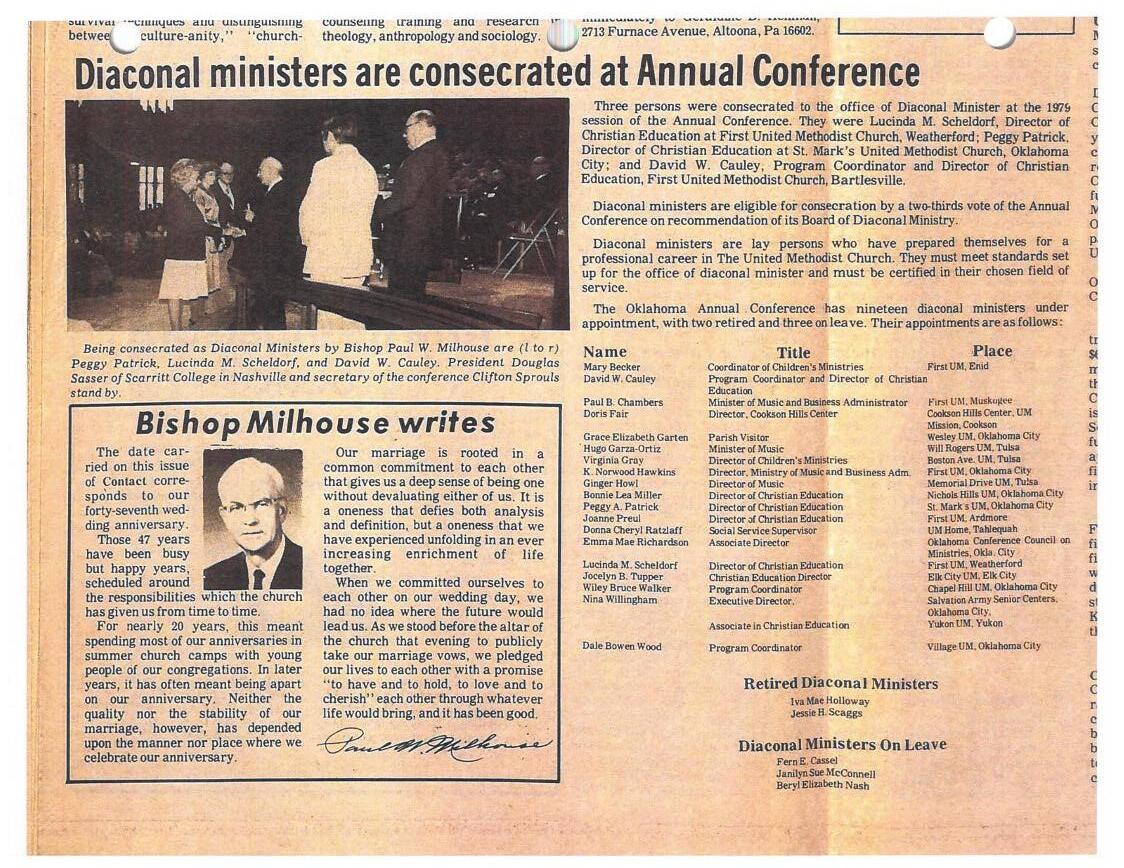
In 1976, a new name – diaconal minister – was proposed, instead of deacon. With the blessing of the General Conference, The United Methodist Church added diaconal ministers to its stable of ministers.
Diaconal ministers were laypersons called of God; employed by the church or an outside agency, either part-time or full-time; and set apart
through consecration for specialized ministries of love, justice, and service. While they did not have to be employed by the church, most were.
The 1977 OKUMC Journal listed 15 consecrated diaconal ministers with one retired and 5 on leave.
The foundational 1982 World Council of Church’s document Baptism, Eucharist & Ministry (BEM), presented to the Faith and Order Conference in Lima, Peru, propelled this matter further.
BEM strongly advocated for an ordained diaconate focused on servant ministry:
Today, there is a strong tendency in many churches to restore the diaconate as an ordained ministry with its own dignity and meant to be exercised for life. As the churches move closer together there may be united in this office ministries now existing in a variety of forms and under a variety of names.
It would involve many more study commissions and another three General Conferences of the United Methodist Church before the 1992 session asked the Council of Bishops to help draft a plan for a permanent diaconate.
1996 would prove to be the conference which would approve the Deacon as a second, permanent and equal ordained order of ministry in the United Methodist Church.
The new paragraph 319 of the 1996 Book of Discipline affirmed that deacons are “called by God to a lifetime of servant leadership, authorized by the Church, and ordained by a bishop.”
This paragraph also stated that deacons “fulfill servant ministry in the world and lead the Church in relating the gathered life of Christians to their ministries in the world, interrelating worship in the gathered community with service to God in the world.”
After approval by the General Conference, the 1,300 active diaconal ministers consecrated since 1976 were given the option to qualify for the new Order of Deacons or to retain their present status; however, the program of diaconal ministry was phased out.
According to the 1997 OKUMC Journal, 24 persons were elected and ordained as Deacons in Full Connection under the transitional provisions for diaconal ministers.
The 2024 General Conference also took significant action related to the Order of Deacon by granting sacramental privileges “when contextually appropriate” for the sake of “extending the mission and ministry of the church and offering the means of grace to the world…”
Stewarding a New Location
By Rev. Heather Nygard-Scherer, Faith Bixby UMC
There are times in our life when the Holy Spirit pulls us into the transforming work of participating in the world in a way that we do not see ourselves being capable of doing.
When we are asked, nudged, compelled into stewarding this work, we have choices to make.
We can talk ourselves out of participating and miss the opportunity to partner in what God is doing. We can reluctantly say yes and then bury ourselves in the details – trying to imagine every possibility and mitigate potential risks – and never actually move forward.
Or we can choose to follow where God is leading without fully knowing what could possibly happen.
Saying yes to the Holy Spirit sometimes feels like riding a roller coaster – both terrifying and thrilling, simultaneously. Planting new churches feels like this.
When I first started hearing the whispers of what
God had planned for Faith UMC Tulsa to expand into Bixby, my first reaction was “No way! I have already walked down the road of church planting and have the scars to prove it.”
But God kept nudging and opening doors, and I eventually had to tell myself to get out of the way of the Holy Spirit. I was an impediment, and I confessed my fears to my congregation but lifted up the signs from God that this was what could be next for us.
God sent Rev. Steven Spradling to push me and to advocate for this project. Rev. Adam Hamilton offered support and encouraged us to create this new campus. Some of the first people who said yes to the Bixby location were musically gifted and could fill a role that was so hard to find in my previous church plant.
After three months of prayer and discussion, the congregation unanimously voted to take on the risk and listen to where God was leading. Ultimately, we realized that God was doing this
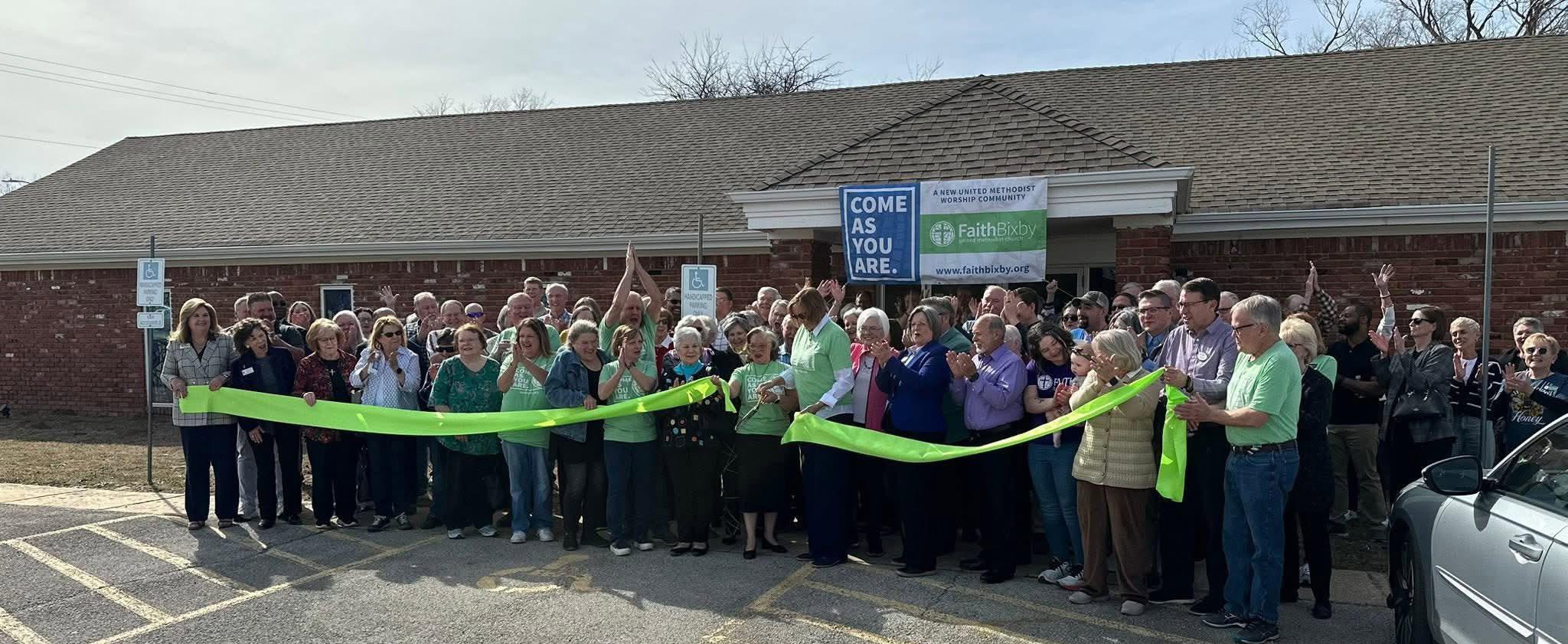
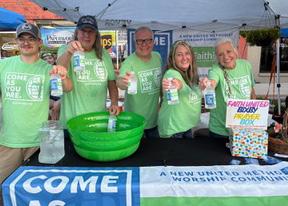
The ribbon cutting celebration for Faith Bixby UMC on February 5, 2026, drew more than 150 supporters to welcome the new United Methodist worship community in Bixby.
regardless. Because we love our church, we started letting God open doors and provide people and resources to create another location. We trusted that if we listened, God would make a way that we could not even imagine.
And we all got to work.
Each year, Faith dedicates the financial surplus over budget to a double tithe to missions. The rest of the money is set aside for the Leadership Team to determine how to spend.
When we understood that God wanted us to start another campus, we set aside a double tithe to the new location as well.
Members of the congregation who were inspired by the vision began to donate to the work of the new location before it even existed. The District Missional Strategy Team worked with my church Business Administrator and me to find and purchase a location. Lay Speaker April Sellers White had been helping the Owasso church plant, and now she was available to help us.
Our staff started creating job descriptions for future employees and purchasing supplies for the new ministry.
We had to shift our Associate Pastor from part time to full time with the added workload.
We all prayed for a church planter.
I went to lots of meetings sharing the story of what God was doing in and through us. This work wasn’t easy, and it had to be done on top of all of the other work that we were doing.
We applied to the New Faith Communities Team, and they supported us with funding that decreases each year for the first five years. We set a goal to add one family a month to the new location for sustainability.
God sent us a new member who was a clergy person from another conference, and she offered to help me. Neither of us realized that
Members of Faith Bixby UMC pass out water at the ribboncutting celebration for their new worship community.
Rev. Dr. Sherri Wood-Powe would become our Bixby location pastor at that time. But the more that we worked together, I knew that was what God had planned. Sherri was harder to convince and told me that she was waiting for the Holy Spirit to lead her. She laughingly said “The Holy Spirit sounds a lot like Heather right now.”
In addition to being Senior Pastor of Faith and acting as planting pastor for Bixby, my personal life was marked with incredible challenges. My father had a medical crisis that moved me into the role of caregiver, and after six months, he passed. My 30-year old son had emergency heart surgery to save his life. My aunt died. I wondered if the forces of evil were trying to stop this new church from coming to fruition.
Because this is powerful sacred work for the kingdom.
My husband and daughter held me together. My incredible staff went above and beyond. They have given countless hours to making this new church happen. Our church believed in the vision and stepped up to the challenge of loving God enough to set aside their fears and to steward this new location into existence.
The work is nowhere near finished, but we have begun.
We are excited to see the powerful things God is going to do in Bixby.
Start With the Why: A Guide to Meaningful Stewardship
When vision and mission are clear, stewardship becomes an invitation, not an obligation
By Rev. Carlos Ramirez, Director of Communications & Strategy
As your church prepares for the stewardship emphasis that many congregations enter in the later part of the year, I would like to share with you a few practices that have worked in the congregations I have served.
Start with a Vision
The first is something I learned early in my ministry, thanks to Rev. Dr. Dan Peil: Have a vision for your ministry.
Maybe visioning is part of what you regularly do in your congregation. Yet, for some of you the visioning process may be a foreign or even weird thing to consider.
Visioning is to enter into a discernment process in order to tune yourself and the congregation as to what God is doing already in the community. Where do you see the moving of the Holy Spirit within the “walls” of the congregation and outside of them? Where do you see momentum, openness and energy? Where are the assets in your community pointing toward? God has given your congregation talents and/or assets that can be used in order to strengthen the larger community on which your congregation sits.
As you do this, don’t fall into the trap of thinking visioning is the process in which you discern the strengths of your congregation and the needs of your community.
When you approach ministry this way, you assume a hierarchical posture where the people of the church will bless our needy community
with their God given talents. But, if we truly believe that God is everywhere and we truly adhere to our basic United Methodist theology of prevenient Grace, then Jesus and the Holy Spirit are already at work in our communities. Jesus is already blessing them. So what are you to do? You are to use your God given talents and join Jesus in the work already started.
Visioning is imagining the ideal final result of Jesus’ work in our communities. How would your community look when Jesus has finished His work in your community?
Establish Your Mission
Once you have your vision, you can work on your mission, which is the daily work you will do in order to accomplish what God has called you to do.
When you have a clear vision and your daily “marching orders” (mission), then your assets, your efforts, your energy, your messaging and your seeking partnerships are focused in order to fulfill God’s calling upon your congregation.
Why are vision and mission important? When your vision and mission are not clear, you end up doing a lot of things. While all of them are
good and even worthy, it can make you feel as if you are just spinning your wheels without accomplishing much.
This process is always evolving because while your vision and mission will not change, the way you go about it may need to adapt to your circumstances.
And, don’t worry – if you have not entered into a visioning process, it is never too late to start.
Make Stewardship an Invitation, Not an Ask
When it comes to the time of stewardship, how do you make it a joy and not a dread?
One of the top reasons people do not trust religious leaders or institutions is the perception that we talk too much about money.
Talking about budgets and giving is not an easy topic. It can become very awkward. However, when your vision and mission are clear, then you are not necessarily asking for people to give to a religious institution, but, instead, you are inviting people to be part of fulfilling God’s dream for your community.
A Four-Sunday Stewardship Framework
I used all of October to talk about stewardship. The first Sunday, I used it to give our pledge cards. I would tell the congregation to take them home, place them where they could see them and pray as to how God is calling you to be part of the dream God has for our community.
The first Sunday, I would give a lot of numbers: the amount of volunteer hours given, the partnerships we have created in our community and the lives impacted weekly through our ministries. All of these numbers tell the story as to how we are fulfilling our God given vision and mission.
The second Sunday I would talk about more internal numbers such as people worshiping with us and last year’s total pledges. I also tried to capture the “mood” of our life as a congregation. I would not hide hardships. It was not about
painting a “rosy” reality. It was about being honest about our feelings as a congregation and our response to our calling.
The third Sunday, I would talk about the dreams we have for the following year. What was the next step God was asking us to take to fulfill our calling? If there was something new to introduce, I would do so. If it was to continue what we have been doing, I would talk about that.
And don’t worry, continuing on the same path is not boring. It means that God has blessed your ministry, and it needs to continue on.
On the last Sunday, I would invite them to bring their pledge cards back. It was a Sunday of thanksgiving for the brothers and sisters that have gone before us and prepared the way for us, as well as the year ahead. We always had communion, and as we walked toward the altar to partake of Holy Communion, we would drop our pledge cards into a basket.
There have been times that I paired this worship series with a book to be read by all groups in the congregation.
The most important thing, for me, was to be clear in the WHY for our congregation – the essence of God’s calling for our congregation. When the WHY is in focus and clear, our work becomes an invitation to God’s work and not just to “be part of our local congregation.”
Not only does this inspire the congregation, but it is a compelling message – an incarnate message – for them to share and to invite people to be part of. When inviting others, they now have an answer to WHY others should join your congregation instead of others or just staying home and watching TV. It is powerful to be able to share that vision and mission.
May God’s calling for your congregation be a source of strength and joy for your community at large.
Faithful stewardship goes beyond the local church
By Rev. Dr. Derrek Belase, Director of Connectional Ministries
Apportionment: The share each annual conference or local church pays to support international, national and regional (annual conference) mission. from “Glossary of United Methodist Terms”
From the beginning of the Methodist movement, followers of John Wesley believed that offering small gifts to a larger pool of resources could transform the world. Today, The United Methodist Church still practices the belief that we can do more when we do it together. That’s why we practice connectional giving – a unique system where congregations come together to support ministries that no single church could do alone.
An example of this came from 1742 when a Bristol society needed to pay off a building loan. A sea captain named Captain Foy proposed that every member give a “penny a week.” The groups, led by class leaders, were initially designed to raise funds, though they quickly evolved into the primary framework for spiritual accountability and discipleship.
This connected approach continues today as we provide disaster relief, fund scholarships, start new churches, support missionaries, and so much more. It stretches our reach, strengthens our response, and deepens our witness in the world.
Each local church in the Oklahoma Conference is asked to pay roughly 10% of their income –equivalent to a tithe – to the annual conference each year. These contributions are used to fund ministries in Oklahoma, the South Central Jurisdiction and throughout the world via the United Methodist Church structure.
Sometimes we pejoratively call these “taxes,” but that misses the point of them completely. The apportionments are a part of our covenant as United Methodists, and they are determined by a vote of all members of each year’s annual conference session.
In Oklahoma, the Conference budgeting process is a collaborative work carried out between the Annual Conference Council (ACC) and the Council on Finance and Administration (CF&A). Conference budgeting is not a one-time annual exercise, but rather an ongoing process of monitoring, evaluation, and stewardship throughout the year.
ACC remains responsible for evaluating ministry priorities and the broader direction of the Conference, while CF&A manages the budgeting process itself and provides financial oversight. Together, both groups work in tandem to develop and recommend the most responsible apportioned budget possible.
The apportioned budget paid by local churches represents only one component of the overall financial resources necessary to support the ministries, operations, and mission work of the Oklahoma Annual Conference.
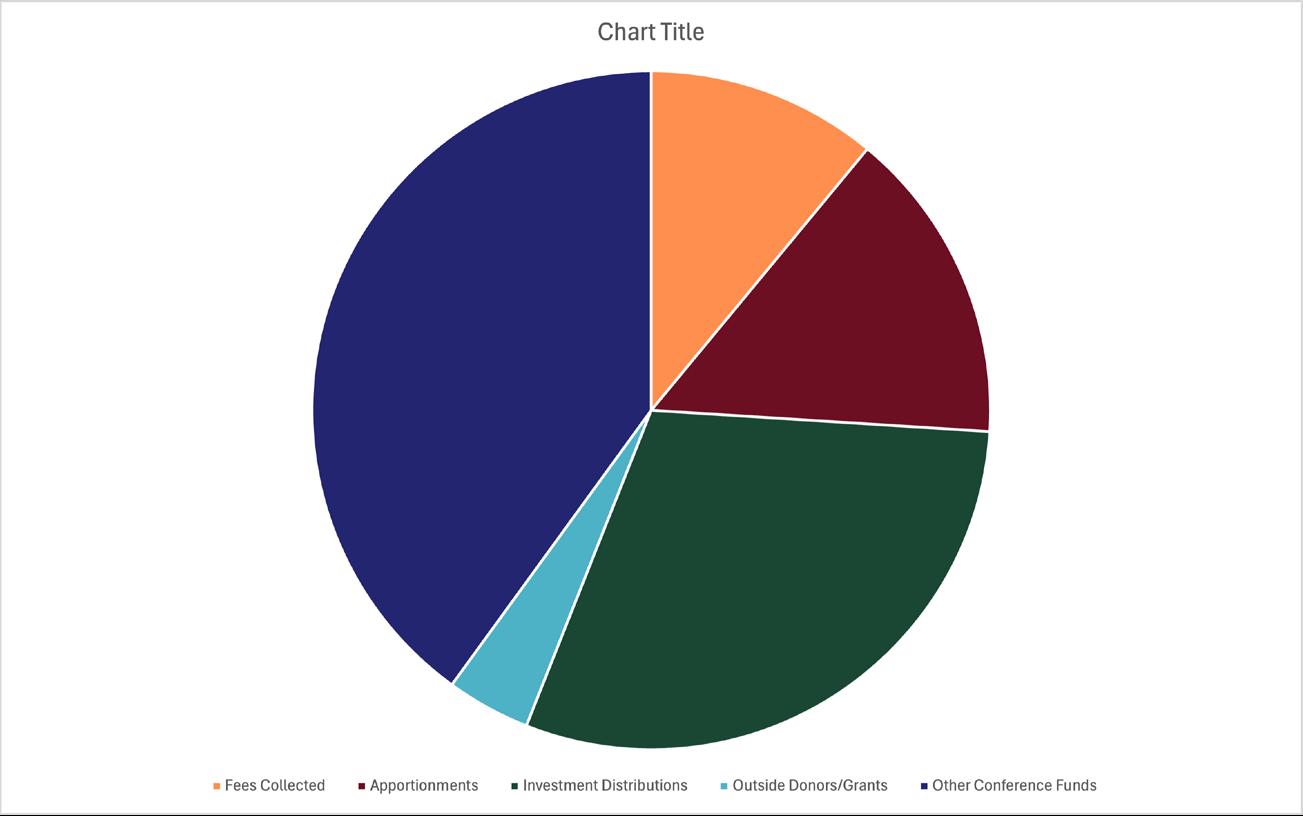
CONFERENCE FUNDING STREAMS
(Based on 2025)
Apportionments paid by local churches make up approximately 15% of the streams of funding utilized by the Oklahoma Conference to fund operations. At the same time, this covenantal giving is an important part of our outreach to the state and around the world.
Each time you put a dollar into the offering plate at your local church, you are supporting ministries of the United Methodist Church and denominational partners literally around the world and as close as your next door neighbor.
For me, connectional giving is not only a part of my professional life as the Director of Connectional Ministry, but very personal. I grew up in a small church in southwest Oklahoma. While we had children and youth in our church, most of them did not choose to attend our camps. In fact, some of them went with the local Baptist church to Falls Creek.
When I was entering sixth grade, my mother told me that I could attend summer camp at Canyon. I was so excited, but quickly realized that no one else from my church would be attending. No problem, she said.
I arrived at Canyon Camp that first day very nervous that I would be the only person there who was alone. What I found was the opposite; there were many people who were there as the lone camper from their local church. And there were adults working at the camp who were from churches with no campers.
That was the connection I had been hearing so much about! I was experiencing it with my very eyes. As I got older, I came to realize that even the campsite itself was a legacy gift which was maintained because of the apportionments, only a small part from my small church in Carnegie.
There are many ways we live out our baptismal vows to support the church. One of those is through the offering of our spiritual and financial gifts. We contribute to the beauty of the earth and all of humanity when we offer those gifts in the service of God’s ongoing creation.
We can see the fruit of those gifts in the “joy of human love: brother, sister, parent, child, friends on earth, and friends above” as we make disciples of Jesus Christ for the transformation of the world.
“How
meet?” “
–
Evelyn, as shared by Alan Herndon, Oklahoma United Methodist Foundation