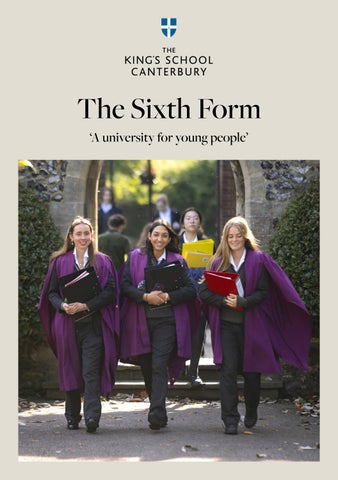
The Sixth Form ‘A university for young people’
Head’s Welcome The Sixth Form should be the best two years of your schooling life: You are able to specialise in subjects you love. You get to pursue your interests to the highest level. You have the opportunity to occupy leading positions in the School. You really begin to gain a strong and confident sense of who you are, what you are all about and what path you want to choose beyond school. It truly is an exhilarating time, and King’s, often described as being ‘like a university for young people’ is a wonderful place to spend these brilliant two years.
Jude Lowson, Head
An introduction from the Head of Sixth Form The Sixth Form at King’s is a warm and vibrant community characterised by the strength of relationships and support to achieve a wide range of individual ambitions. Our stimulating environment with a huge array of co-curricular and super-curricular choices leads to personal development and preparation for life beyond school. Opportunities for leadership, independence and personal responsibility are highly valued, alongside a great sense of fun! Sixth Formers learn to step up in all areas of their lives, supported by a dedicated individual mentor, House Team, passionate teachers and the wider school community. Confidence will grow through challenge and intellectual risk-taking in preparation for important decisions about the future, underpinned by an expert Futures Team who guide you every step of the way.
Laura Holloway, Head of Sixth Form
The Sixth Form at a glance
200+ pupils in each Sixth Form year
90+ pupils join the Sixth Form each year from other schools.
Truly co-ed. 50:50 gender distribution.
Unrivalled breadth. 32 post-16 courses available.
38 different nationalities. A global community.
2026 A Level Results
81% 67% 47 A* - B
of pupils achieved the ‘gold standard’ of AAB or above.
pupils achieved at least 3 A* or A grades
King’s consistently ranks as the highest performing co-educational school for A levels in Kent. It is also one of the highest performing co-educational boarding schools in the country
University Destinations Each year, King’s pupils progress to an outstanding range of universities in the United Kingdom and around the world. Their destinations reflect not only exceptional academic attainment, but also the individuality and breadth of ambition fostered through a King’s education. The majority of pupils take up places at leading Russell Group universities, with numbers progressing to Oxford or Cambridge growing in recent years. Others pursue specialist pathways at institutions of global distinction, such as London musical conservatoires. Across disciplines as diverse as Engineering, Architecture, Medicine, Law, the Arts, and the Humanities, King’s leavers demonstrate both intellectual curiosity and a readiness to contribute to the wider world. In 2026, 18 pupils pursued studies overseas at a range of institutions, including leading US destinations like Brown and NYU, alongside other globally elite institutions like Bocconi.
Post 16 courses King’s offers 32 A Level courses; more choices than any other school in the country. Pupils can pick 3 or 4 of the following: Art & Design
Japanese
Biology
Latin
Business BTEC
Mandarin
Chemistry
Mathematics
Classical Civilisation
Music
Computer Science
Music Technology
Design & Technology
PE Academic
Economics
Philosophy
English Literature
Photography
French
Physics
Further Maths
Politics
Geography
Psychology
Geology
Religious Studies
German
Russian
History
Spanish
History of Art
Sport BTEC
Italian
Theatre Studies
Scan the QR code to read more about the subject choices available
King’s Intelligence Advocacy
Legacy
Humanity
Inquiry
Adaptability
In a world being remade by artificial intelligence, we are clear about what matters most: the qualities that make us human. The evidence points one way. As AI transforms how we work and live, employers and universities alike are looking less for what a young person knows than for how they think, judge, adapt, create and relate to others. These are the deeply human capacities that no machine can replace. They are also the very qualities King’s has cultivated for fifteen centuries. What is new is not the ambition but the language: King’s Intelligence names, clearly and for the first time, what a King’s education has always sought to form. It runs through everything we do, in the classroom and the laboratory, on the Malthouse stage and at Birley’s, in House, and in the life of the Cathedral at the heart of our school. King’s Intelligence is built around five strands:
Advocacy — civility in the heat of argument King’s pupils possess the confidence to speak well and the grace to listen. They learn to use their voice with conviction and wit, to disagree without hostility, and to speak in the service of others as well as themselves.
Legacy — to think in centuries, not terms To belong to the oldest school in the world is to inherit something rare, and to be answerable to it. Our pupils learn to weigh the longer consequence of their actions, and to leave the school, the city and the world better than they found them.
Humanity — growing, becoming, flourishing An education of the spirit as well as the mind. King’s pupils grow in empathy, compassion and service, learn to look out for one another, and ask what they owe to each other and the world. They cultivate an inner life of stillness and reflection, on ground where meaning has been sought for fifteen centuries.
Inquiry — a university for young people King’s pupils strive for deep knowledge, cultivate curiosity and develop the courage to ask better questions. In an age that gives easy answers away cheaply, we teach the judgement to know which questions are worth asking, and which answers are worth trusting.
Adaptability — pioneering as well as traditional King’s has always renewed the fields its pupils enter, from Marlowe remaking English drama to the creators and pioneers of today. Our pupils learn to improvise, to recover when things go wrong, and to meet an ever-changing world with energy and composure. Together, these strands describe the very best of what it means to be human: to think clearly, act wisely, and live well alongside one another.
The King’s Diploma King’s Intelligence comes to life through the new King’s Diploma. Across their time in the Sixth Form, pupils are coached by their mentors to reflect on their growth across the five strands, through their academic work, their co-curricular lives, their service to others, and their moments of stillness, drawing the whole of a King’s education into a coherent story of who they are becoming. The Diploma culminates in a viva: an opportunity for each pupil to give an account, in person and in their own voice, of the person they have become. Led by members of our alumni community, those who have walked the same path and gone on to shape the world beyond, it is a fitting and distinctive rite of passage. Our pupils leave King’s not as finished products, but as thoughtful, generous and resilient people of depth and character, ready to flourish and to lead in a world that will need the very best of what only humans can offer.
King’s, often described as being ‘like a university for young people’, is a wonderful place to spend these brilliant two years.
The SuperCurriculum and Academic Enrichment At King’s, education is conceived as far more than the pursuit of examination success. Our Sixth Form Enrichment Programme challenges every pupil to stretch beyond the syllabus and their core A level subjects, to explore ideas with curiosity and courage, and to cultivate the intellectual independence that defines the very best universities and future leaders. Within this distinctive programme, pupils encounter a culture that prizes scholarship, creativity, and critical thinking in equal measure. They are encouraged to question, to connect disciplines, and to engage with the world beyond the classroom, whether through spirited academic debate, original research, or collaborative projects with peers and mentors. The result is a community of young people who think deeply, write persuasively, and act with confidence and purpose.
The Sixth Form Enrichment Programme at King’s has five distinctive strands: Enrichment (E) Block Timetabled for every Sixth Former, the E-Block is a launchpad for intellectual adventure. Pupils select a pathway that matches their passions - from ab initio and advanced languages and leadership to creative arts, entrepreneurship, or the EPQ. Here, King’s pupils move beyond the curriculum, discover new horizons, and build the qualities most prized by leading universities and employers.
Oxbridge Plus Designed for those who want to delve deeper into their A levels or branch into new disciplines and apply to the most competitive universities globally. This strand combines academic stretch with lively smallgroup seminars that mirror the tutorial style of Oxbridge and other top universities.
Subject Stretch and Academic Societies There are over 30 academic, co-curricular and super-curricular stretch and enrichment opportunities and groups available to pupils through the King’s Wednesday afternoon programme and across the week, ranging from French Literature, History and Politics Society, Socratic Society to Linacre Society for aspiring Medics, Veterinary Scientists and Dentists.
Support ‘Beyond Compare’ with King’s Futures Expert, bespoke and personalised guidance prepares pupils for the most competitive admissions processes worldwide. From admissions tests to interview skills, to crafting an outstanding personal statement – whether to leading universities, degree apprenticeships at top companies or creative pathways, our Futures Department ensures King’s pupils are equipped to succeed.
Extended Project Qualification (EPQ) An unrivalled opportunity to pursue an independent research project or create an original artefact, supported by our experienced staff. The EPQ develops initiative, intellectual independence, and scholarly rigour.
Through the Super-Curricular Programme, King’s Sixth Formers • • • •
Discover passions and pursue them with confidence Develop critical, creative, and independent thinking Hone research, collaboration, and communication skills Gain a distinctive edge in applications to top universities and future careers
Enrichment E-Block
Critical Thinking
Computing & Coding
Leadership & Management
Extended Project Qualification
Law
Finance
Beginners Italian & Advanced Italian (A level)
Beginners Russian & Advanced Russian (A level)
Beginners Japanese & Advanced Japanese (A level)
Advanced French Advanced Mandarin Advanced Spanish (A level or DELF) (A level) (A level)
Advanced German (A level)
Co-curricular Music King’s is one of the UK’s leading schools for music. Pupils benefit from expert teaching, superb facilities, and a culture that celebrates musicianship. Our Symphony and Chamber orchestras perform to standards rarely seen in schools, and our seven choirs are renowned for their range and quality, performing weekly in Canterbury Cathedral. Across the widest sphere of style and interest, music at King’s is ambitious, inclusive and central to school life.
Sport Sport is diverse and inclusive, with opportunities in everything from rugby and netball to fencing, rowing and sailing. All pupils are encouraged to participate, whether competing nationally or trying something new. House sport encourages community spirit, and our excellent facilities support both elite performance and broad participation.
Performing Arts Drama and dance thrive at King’s, centred around the award-winning Malthouse Theatre, equipped to West End standards. Pupils stage bold, professional-level productions throughout the year, supported by outstanding teaching and facilities. The performing arts are a vibrant and integral part of school life.
Art Set beside the River Stour, our Art department offers specialist spaces for design, photography and ceramics. Pupils are inspired by visiting artists and trips to leading galleries, and their work is showcased in exhibitions that highlight creativity, skill and imagination.
King’s Week King’s Week is a unique celebration of pupil talent, held at the end of the academic year. With over 100 events, from concerts and plays to exhibitions, it brings the whole community together and is a highlight of the school calendar.
Trips & Clubs Our co-curricular programme is rich and varied, with clubs ranging from debating to beekeeping, and trips that span the globe, from Iceland to the Himalayas. Pupils develop confidence, curiosity and leadership through activities like Young Enterprise, Model UN, CCF, DofE and our adventurous ‘Running Wild’ programme.
Outreach & Partnerships King’s is deeply connected to the wider community. Pupils lead science workshops for local primaries and support many local initiatives. Fundraising and volunteering are part of everyday life, helping pupils make a meaningful impact beyond the school gates.
Over 650 music lessons
Over 20 sports to choose from
There are over 650 music lessons delivered each week, by a team of over 50 specialist teachers.
King’s Sixth Form has over 20 different sport options to choose from including rugby, cricket, football, fencing, sailing, rowing, badminton, tennis, hockey, netball, lacrosse, golf, and athletics.
Over 25 different ensembles rehearsing weekly, including orchestras and 7 choirs.
18 productions
Over 100 clubs
Last year there were 18 productions in the Malthouse Theatre during King’s Week
King’s Sixth Form has over 100 different clubs and societies to choose from including CCF, DofE, rocket building, beekeeping, Young Scientists Journal, chess and AI and Robotics.
There are six large scale productions each year with over 200 pupils involved both on and off stage.
Mentoring Every pupil has a Mentor at King’s. The Mentor is an academic member of staff who has a full oversight of all that the mentee is achieving in every aspect of their life at school. The Mentor is a facilitator, someone who is trained in coaching skills to enable the mentee to learn to achieve their best here. King’s pupils need to learn the skills necessary for making life decisions. Our aim is to ensure that the pupil leaving us at the end of their 6a year is the best possible version of themselves; the version which has the ability to cope with anything they encounter. The best way that we can enable them in their learning of these skills is to use coach-like language which will instil in the pupils the ability to make balanced, considered decisions over any matter. The focus topics for mentor time will be largely around individual academic and co-curricular decision making. Mentees meet in small groups from their House with peers from their cohort, allowing them to receive personalised coaching that is relevant to their stage of development. They meet once or twice a week as a group, as well having one to one time with their Mentor. A key development in King’s mentoring is the reflective document that each pupil is encouraged to update regularly. Here they set their own targets, they assess their own expectations and they learn how to best guide their own progress. These reflective documents both inform reports which go home to parents and also provide selfreview points of their reports. They inform a self-discipline which can be used through university and beyond.
Pre-Conditions for Subjects at King’s The following courses have pre-conditions. If a course is not listed, it has no specific pre-condition and general entry to King’s Sixth Form will be sufficient to study it. The following subjects do not necessarily require prior study at GCSE to take them at A level: Art and Design, Business Studies, Classical Civilisation, Economics, Geography, Geology, History, History of Art, Music, Music Technology, Philosophy, Photography, Physical Education, Politics, Psychology, and Religious Studies. Pupils who wish to take four full courses over the two years should have a conversation with the Head of Sixth Form about their
Subject
Pre-Condition
Art & Design (including Photography
Grade 6 or above in GCSE Art and Design is recommended, or discussion with the Head of Art if not previously studied.
Biology*
Grade 7 in GCSE Biology, or a strong Grade 7 or above in the biology component of Double Award Science. Mathematics Grade 7 also required.
Chemistry*
Grade 7 in GCSE Chemistry, or a strong Grade 7 or above in the chemistry component of Double Award Science. Mathematics Grade 7 also required.
Classics: Latin & Ancient Greek*
Grade 6 or above in the relevant ancient language at GCSE is required.
Economics*
Grade 6 or above in Mathematics, plus good results (Grade 6+) in English and/or Humanities subjects is required.
English Literature
Grade 7 in English Literature is recommended.
Geography
Grade 7 or above in Geography is recommended.
History
Grade 7 or above in History is recommended; strong performance in other Humanities (English or RS) also considered.
Mathematics*
At least a good Grade 7 in Mathematics is required.
Further Mathematics*
At least a Grade 8 in Mathematics is required.
MFL: French, German, Spanish and Mandarin*
Grade 7 or above in the relevant language is required.
Music*
Grade 7 in GCSE Music and/or a pass in Grade 5 Music Theory is strongly recommended. Pupils should be performing at approximately Grade 6 standard or above on at least one instrument (including voice), though formal performance examinations are not required.
Philosophy
Grade 7 or above in English is recommended; strong performance in other Humanities (History or RS) also considered.
Physics*
Grade 7 in GCSE Physics, or a strong Grade 7 or above in the Physics component of Double Award Science. Mathematics Grade 7 also required.
Physical Education and Sport BTEC*
The ability to perform in one sport to a high standard.
Psychology
Grade 7 or above in GCSE Biology and a Grade 7 in a Humanities subject (English, RS, History or English Literature/Language) is recommended.
Subject Choices for Futures: Degrees and Careers At King’s, pupils are encouraged to choose Sixth Form subjects that play to their strengths, stimulate genuine curiosity, and leave a broad range of university and career pathways open. The best combinations tend to balance intellectual challenge with personal interest and coherence across disciplines. When making these choices, pupils should consider both what they most enjoy and what will best support their future ambitions. Many degree courses expect certain subjects to have been studied at A level, while others value a wider mix of skills and perspectives. It is therefore essential to seek advice from mentors, Heads of Department, and the Futures Department before finalising choices. Most single-honours degrees in the traditional academic disciplines usually require that subject to have been studied in the Sixth Form – for instance, History, English, or the Sciences. Joint-honours courses and many humanities or social-science degrees are more flexible. Of course, certain routes such as Medicine, Engineering, and Architecture have extremely specific subject expectations.
Indicative Subject Pathways Architecture Usually Physics, Maths and then a design-based subject such as Art or DT.
Computer Science Maths and Further Maths (crucial if aiming for a top university). Economics Maths, and ideally Further Maths (particularly for competitive universities). Engineering Maths and Physics, and sometimes Further Maths. Chemistry may also be required for Chemical Engineering. Languages Sometimes more than one modern language. Occasionally a classical language might also be suggested (though rarely required). Law No specific A levels required, though essay-based subjects such as History, English or Religious Studies are advantageous. Medicine, Dentistry and Veterinary Science Chemistry and Biology, plus Maths or Physics. Some medical schools suggest a contrasting humanities subject to complement the sciences, like Philosophy, RS, Literature or History. Philosophy, Politics and Economics (PPE) Maths is often required. History, Politics, Economics or Philosophy are usually advantageous. Psychology Biology is usually required. Subjects with analytical and quantitative elements like Economics, Maths and/or Further Maths (the latter especially for more selective universities) are often recommended). Science/Natural Sciences Two science A levels are required for most degree courses; some will require three.
Top 10 most popular university destinations for King’s pupils 2026 1. University of Durham 2. University College London (UCL) 3. King’s College London (KCL) 4. University of Exeter 5. Imperial College London 6. University of Cambridge 7. University of Bristol 8. London School of Economics (LSE) 9. University of Manchester 10. University of Leeds
Cambridge
Edinburgh, Scotland
Top 10 most popular university courses for King’s pupils 2026 1. Geography 2. Psychology 3. Business and Management 4. Natural Sciences 5. Materials Science and Engineering 6. Law 7. Chemistry 8. Sociology 9. History 10. Philosophy
Sixth Form Journeys We are incredibly proud of all our leavers and what they have gone on to achieve. We include here some examples of recent leavers and the journeys on which they have embarked after King’s, spurred on by all that they learnt in their time at the School.
Florence Otedola Florence, better known as Cuppy, was a boarder at King’s for five years before attending King’s College London to study Business and Economics and later gaining a Music Business Master’s degree from New York University. She has gone on to have a varied and successful career in the music industry. She has DJed across the world, launched Apple Music’s first ever radio show dedicated to Afrobeats, hosted a BBC Radio 1Xtra show, and has recently been appointed as the first ever King’s Trust International Ambassador by His Majesty King Charles III.
Dr Nathan Hudson-Peacock Nathan spent five years as a day pupil at King’s before gaining a First Class degree in Medicine from the University of Cambridge. He then completed his foundation medical training at King’s College Hospital, London. He was Head Academic Scholar during his 6a year at King’s. His career since then is something most of us can only dream of. He is currently, in no particular order, an Emergency Medical Doctor, an Expedition Doctor providing support in desert, jungle, marine, polar and high-altitude environments, an Expedition Photographer, a PADI Divemaster, a renowned Motivational Speaker, who delivered a TEDx talk on the climate health crisis and the Founder of Eco Medics, an award winning non-profit startup tackling sustainability within the healthcare industry.
Edric Wong Edric joined King’s in Shell from a local school in his native Hong Kong. He achieved straight A*s at A level across an incredible five subjects (Chemistry, Economics, Maths, Further Maths and Chinese). Edric continued his academic success at university where he gained a First Class Honours degree in Economics from the University of Cambridge. Following successful stints at Cambridge Investment Banking Society and Cambridge Student Investment Fund, Edric is now a full-time Financial Analyst at Goldman Sachs.
Lucas Lacamp Born in Hong Kong, Lucas was a day pupil at King’s for five years before taking up a place at UCLA to study Political Science and French. A staple of the King’s 1st XV, Lucas continued his rugby in the US, playing with Belmont Shore and earning consecutive American Honours. In 2022, he was called up to the Men’s National Team, making his HSBC World Rugby Sevens debut in Dubai and was selected to represent Team USA at the 2024 Paris Olympic Games. Lucas went on to score tries against Uruguay and host nation France as Team USA finished eighth.
Annabel Steadman Annabel was a bursary recipient at King’s before going on to study Languages and Law at Selwyn College, Cambridge. Two years into her legal training she decided to abandon a career in law in favour of writing. She subsequently gained a Master’s degree in creative writing at Cambridge. In 2020, her debut novel ‘Skandar and the Unicorn Thief’ was published and she found herself on the New York Times and Sunday Times Best Seller Lists. Four further instalments of the Skandar Series are now on bookshelves around the world, with a movie based on the first book expected to begin filming in 2026/27.
Joseph Dingle Joseph joined King’s as a day pupil in Remove (Year 10) having previously been educated in international schools. He soon became one of the School’s leading pupil technicians in the Drama department, honing his skills backstage in the awardwinning Malthouse Theatre. His dedication and hard work certainly paid off, with a well deserved ‘Best Lighting Design’ National School Theatre Award and, following his A levels, a place at the prestigious Royal Academy of Dramatic Art (RADA) to study Technical Skills in Theatre.
Dr Minnie Liddell Minnie studied English, Chemistry, Biology and Spanish in the Sixth Form at King’s before taking up a place at the Royal Veterinary College in London to study Veterinary Medicine. She currently works as an emergency veterinarian at a small animal veterinary hospital in London but has had an incredibly varied career so far, including working for two years in the Maldives for the Olive Ridley Project, a UK charity that works to protect sea turtles and their habitats in the Indian Ocean. She continues to work with the charity today, focusing on education and outreach.
Scan for Sixth Form subject information