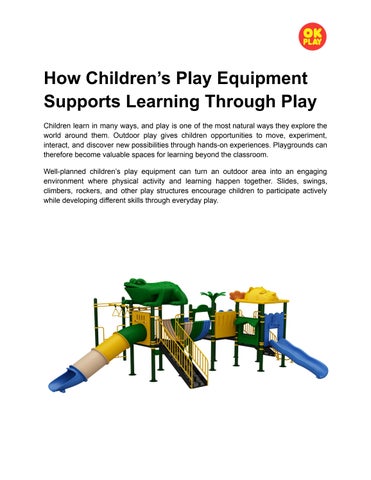
How Children’s Play Equipment Supports Learning Through Play Children learn in many ways, and play is one of the most natural ways they explore the world around them. Outdoor play gives children opportunities to move, experiment, interact, and discover new possibilities through hands-on experiences. Playgrounds can therefore become valuable spaces for learning beyond the classroom. Well-planned children’s play equipment can turn an outdoor area into an engaging environment where physical activity and learning happen together. Slides, swings, climbers, rockers, and other play structures encourage children to participate actively while developing different skills through everyday play.
Learning Through Movement Physical movement is an important part of early learning. Children develop an understanding of their bodies by climbing, balancing, swinging, and moving through different play activities. Childrens play equipment provides opportunities for children to practice these movements naturally. As they navigate different structures, they become more aware of balance, coordination, direction, and body movement. This makes the playground an active learning environment where children can develop physical abilities while simply enjoying themselves.
Encourages Problem-Solving Play often presents small challenges that encourage children to think independently. Deciding how to climb a structure, choosing where to move next, or figuring out how to use a play element can involve simple decision-making. Through children’s play equipment, children can encounter these challenges repeatedly and learn through experience. They can try different approaches, observe what happens, and adjust their actions. These experiences encourage curiosity and help children develop early problem-solving abilities.
Builds Confidence Through Exploration Children gain confidence when they successfully complete activities that initially seem challenging. Climbing higher, balancing across a structure, or confidently using a slide can give children a sense of achievement. Each new experience encourages them to explore further and try different activities. Children’s play equipment creates opportunities for this type of self-directed exploration, allowing children to gradually become more comfortable with new challenges.
Supports Social Learning Playgrounds also provide valuable opportunities for children to learn with and from one another. When children share play spaces, they naturally encounter situations that require communication and cooperation. They may need to take turns, share equipment, wait for others, or participate in group games. Using children's play equipment together can therefore support social development while helping children understand important concepts such as cooperation, patience, and respect.
Encourages Imagination and Creativity A playground does not have to be used in only one way. Children often transform simple play structures into parts of imaginative stories and games. A slide might become part of an adventure, while a climbing structure can become a mountain or a castle. This type of imaginative play allows children to create their own scenarios and express ideas through movement. Children's play equipment provides the physical setting, while children use their imagination to decide how the play experience unfolds.
Develops Observation Skills Outdoor play exposes children to constantly changing surroundings. They observe other children, notice different movements, and respond to what is happening around them. While interacting with children's play equipment, children learn to pay attention to their surroundings and make decisions based on what they see. These experiences can strengthen observation and concentration in an enjoyable, informal setting. Such skills can also support learning activities outside the playground.
Makes Learning Interactive Traditional learning often involves listening, reading, or completing structured activities. Play offers something different because children actively participate in the experience. When children climb, swing, slide, or balance, they learn through direct interaction with their surroundings. Children’s play equipment makes this possible by providing physical activities that encourage experimentation and discovery. Interactive learning can make new experiences more memorable because children are actively involved rather than simply observing.
Supports Different Types of Learners Every child has different interests and ways of engaging with their surroundings. Some children enjoy climbing and physical challenges, while others prefer imaginative or social activities. A variety of children's play equipment allows children to choose activities that suit their interests and comfort levels. Providing multiple play options creates a more inclusive environment where children can explore at their own pace. This variety also keeps playground experiences fresh and engaging.
Learning Beyond the Classroom Schools and educational institutions can use outdoor play spaces as an extension of classroom learning. A well-planned playground can provide opportunities for movement, interaction, exploration, and creative activities throughout the school day. Children's play equipment can complement classroom experiences by giving students a chance to apply skills in a more active environment. Recess and outdoor activity periods can therefore become meaningful opportunities for learning through play.
Creating Engaging Outdoor Play Spaces The value of a playground depends not only on the equipment but also on how the space is planned. Combining different types of play structures can create opportunities for movement, exploration, social interaction, and imaginative play.
Thoughtfully selected children's play equipment can help schools, parks, daycare centres, and residential communities create outdoor environments where children have multiple ways to stay active and engaged. A varied playground allows children to discover activities that interest them while continuing to learn through everyday experiences.
Conclusion Play and learning naturally go hand in hand during childhood. Outdoor play gives children the freedom to move, explore, interact, and experiment, while well-designed children’s play equipment provides the environment needed for these experiences. From improving coordination and confidence to encouraging problem-solving, creativity, communication, and observation, playground activities can support many aspects of development. By creating engaging outdoor spaces with a variety of play options, schools, communities, and families can give children meaningful opportunities to learn while having fun. Create an engaging outdoor play environment where children can move, explore, and learn through play. Explore a range of children’s play equipment and build a space that encourages active, creative, and meaningful childhood experiences.