The Oklahoma Historical Society
The Oklahoma Historical Society (OHS) is a private membership organization and state agency. The mission of the OHS is to collect, preserve, and share the history and culture of the state of Oklahoma and its people. Organized in 1893 by a group of territorial journalists, it has developed into one of the nation’s largest and most innovative historical agencies. Today the OHS operates museums and historic sites; publishes a historical journal, newsletter, electronic publications, books, and brochures; encourages and assists with historic preservation; and maintains several renowned research libraries. The Chronicles of Oklahoma, published quarterly by the OHS, is distributed to subscribers and all OHS members. Each issue contains historical articles, photographs and illustrations, book reviews, notes and documents relative to the preservation of our history, and OHS Board of Directors meeting minutes.
Membership
Membership in the OHS is open to anyone who wants to share the excitement and wonder of state and local history. Annual dues are Basic $40, Family $75, Friend $100, Associate $250, Fellow $500, Director’s Circle $1,000, Partner $2,500, and Benefactor $5,000. Membership includes a subscription to The Chronicles; Mistletoe Leaves, the OHS bimonthly newsletter; and EXTRA!, the OHS email newsletter; as well as other benefits. Membership applications and subscriptions should be mailed to: Membership Coordinator, Oklahoma Historical Society, 800 Nazih Zuhdi Drive, Oklahoma City, OK 73105-7917. Memberships also can be purchased online at okhistory.org/join. Single copies of The Chronicles cost $7 each plus shipping (and tax for Oklahoma residents). Single copies may be ordered by calling 405-522-5214 or emailing museumstore@history. ok.gov.
Reprints
Requests to reprint copyrighted material from The Chronicles of Oklahoma must be submitted in writing to the editor. In some cases, permission also must be obtained from the author of the article for which the reprint is requested.
This publication, printed by Southwestern Stationery and Bank Supply, Inc., is issued by the Oklahoma Historical Society as authorized by Section 19, Title 53, O.S. A total of 2,700 copies have been printed at a cost of $8,645. Copies have been deposited with the Publications Clearinghouse of the Oklahoma Department of Libraries. The Chronicles of Oklahoma (ISSN 0009-6024) is published quarterly by the Oklahoma Historical Society, 800 Nazih Zuhdi Drive, Oklahoma City, OK 73105-7917. Periodicals postage paid at Oklahoma City, OK. POSTMASTER: Send address changes to The Chronicles of Oklahoma, 800 Nazih Zuhdi Drive, Oklahoma City, OK 73105-7917.
Responsibility for statements of facts or opinions made by contributors in The Chronicles of Oklahoma is not assumed by the Oklahoma Historical Society. Copyright 2026, Oklahoma Historical Society
The
Chronicles Oklahoma of
Editor: Anna L. Davis Guest Editor: Patricia Loughlin, PhD
Volume CIV
Number 3
Fall 2026
Contents Introduction to Special Issue BY PATRICIA LOUGHLIN Muriel H. Wright, longtime editor of The Chronicles of Oklahoma, left a legacy that is still felt across Oklahoma. Working over the course of decades for the Oklahoma Historical Society, she laid the groundwork for many of the projects the agency continues today. Dr. Loughlin opens this special issue with an introduction to Wright’s impact on Oklahoma history. 248 Wright’s Thesis: Reimagining the American Frontier in Oklahoma Textbooks BY GRACE R. ELLIS In the early twentieth century, many textbooks were written to follow the popular frontier thesis of Frederick Jackson Turner, which described the conquest of the American West by white Anglo-Americans. Ellis explores Wright, a member of the Choctaw Nation, who foregrounded her numerous textbooks in Tribal nations and reimagined the American past to teach Oklahoma students to understand Tribal nationhood as linked to a much longer chapter of Oklahoma history. 253 Muriel Wright’s Kinship Ties: Indigenous Women and the Politics of Oklahoma History BY BRIANNA THEOBALD Muriel Wright and other women in her family, such as her aunt, Anna Wright Ludlow, were part of the larger Indigenous clubwomen’s network in Oklahoma, producing and consuming historical scholarship. Ohoyahoma clubs allowed women the chance to connect to larger trends in Indigenous history, while helping to preserve a developing knowledge base. Theobald explores these clubs and the kinship ties that “constituted a form of political labor that affirmed and imagined Choctaw and Indigenous ongoing presence and futures in the burgeoning state of Oklahoma.” 284
Volume CIV
Fall 2026
The Choctaw Advisory Council: The Myth of Disestablishment and Oklahoma Choctaw Governance, 1934–1948 BY MEGAN BAKER The formation of the Choctaw Advisory Council in 1934 marked a turning point for autonomy in the Choctaw Nation. Wright’s time as secretary for the council saw the history of various negotiations and legislative works with the federal government recorded in detail and preserved for future generations. Baker’s work traces tribal governance and economic development through the “robust governing arm” of the Choctaw Advisory Council. 311 Afterword: A Family Reflection on History and Legacy BY ALLEN BROOKES WRIGHT SR. Allen Brookes Wright Sr., Wright’s great-nephew, concludes this special edition with a look back on the intersection of history and family legacy. 340
For the Record
344
Minutes of the OHS Board of Directors Quaterly Meeting, May 1, 2026 Minutes of the OHS Board of Directors Meeting of the Membership, May 2, 2026 Minutes of the OHS Board of Directors Organizational Meeting, May 2, 2026
History in Focus
364
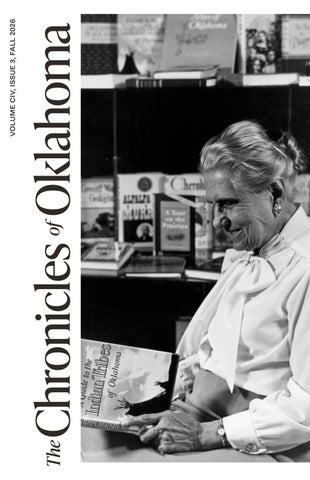
ON THE COVER Muriel Wright views her book A Guide to the Indian Tribes of Oklahoma, n.d. (20911.31, Oklahoma Historical Society Photograph Collection, OHS).
THE CHRONICLES OF OKLAHOMA
Introduction to Special Issue
By Patricia Loughlin* In 1922, Muriel H. Wright traveled with her father to Boggy Depot in the Choctaw Nation, about fourteen miles southwest of Atoka, to visit the original home site of her paternal grandparents. Father and daughter walked the edges of the site together and this experience inspired her article “Old Boggy Depot,” which first appeared in The Daily Oklahoman newspaper with an expanded version as her first published article in The Chronicles of Oklahoma in 1928. Her grandfather, Allen Wright, born Kiliahote, in Mississippi in 1826, came to the Choctaw Nation in Indian Territory at seven years of age. Educated at Spencer Academy, the Choctaw Council sent Wright and four others to Delaware College as part of the Forty Youth Fund, and later Union College 248
and then Union Theological Seminary in New York. He returned to the Choctaw Nation as an ordained Presbyterian minister, married a missionary teacher, and taught at Armstrong Academy. Wright built the family home at Boggy Depot in the early 1860s and later a farm and ranch near Wapanucka. Some twenty years later, Allen Wright published Chahta Leksikon (1880), a Choctaw dictionary for the Choctaw academies and schools. Writing the preface from his home in Boggy Depot, he shared with readers that he wrote the dictionary as “a contribution to the long felt want of the non-English speaking Choctaws, as well as of the non-Choctaw speaking people.” In March 2017, the Chahta Anumpa Aiikhvna (School of Choctaw Language) produced a new Choctaw dictionary. These are just some of the legacies of the Wright family and Muriel H. Wright. A citizen of the Choctaw Nation, she served as the editor of The Chronicles of Oklahoma, the state’s historical journal at the Oklahoma Historical Society (OHS), from 1943 to 1973. Following the family’s commitment to education, she studied at Wheaton Seminary in Massachusetts and took teacher education courses at East Central before serving as a teacher and principal in southeastern Oklahoma. While she was teaching and involved in Choctaw Nation politics, Wright began to write textbooks. As I have argued in Hidden Treasures of the American West (2005), her interpretation of Indigenous histories as Oklahoma history was infused into her numerous books and articles, including A Guide to the Indian Tribes of Oklahoma (1951), and as a leader in the state historical marker program, writing the text for over 500 historical markers in Oklahoma. We dedicate this special issue of The Chronicles of Oklahoma, the state’s quarterly history journal, to the longtime editor Muriel H. Wright. The project draws inspiration from a pre-conference session held in June 2025 at the Native American and Indigenous Studies Conference in Oklahoma City, organized by Matthew Pearce, the inaugural state historian for the OHS. The session was well received and we worked collaboratively to bring together new approaches and innovative scholarship in the special issue. Anna Davis, editor of The Chronicles of Oklahoma, honors the legacy of Muriel Wright by keeping her portrait in her office above the dictionary Wright used as editor. In addition, Davis has been supportive of the Muriel Wright special issue and receptive to innovative approaches and new scholarship on Oklahoma histories. 249
THE CHRONICLES OF OKLAHOMA The three contributors are Grace Ellis, a recent graduate from Yale University with plans to attend a PhD program in the fall, Megan Baker, a citizen of Choctaw Nation and an anthropology professor at Northwestern University, and Brianna Theobald, a history professor at the University of Rochester, and author of the award-winning book Reproduction on the Reservation: Pregnancy, Childbirth, and Colonialism in the Long Twentieth Century (2019). They raise important questions about the production of Oklahoma history textbooks, Choctaw Nation history, the Choctaw Advisory Council, and Indigenous women’s clubs and networks. Taken together, they reassess the myriad ways in which Muriel Wright balanced kinship, politics, historical interpretation, and professional development in her life. As the granddaughter of Chief Allen Wright, she was raised to understand the historical significance of places in the Choctaw Nation through fieldwork with her father and uncle, her role within her tribe as secretary of the Choctaw Advisory Council, and her position as editor of The Chronicles of Oklahoma for the OHS. Grace Ellis is a 2025 graduate of Yale’s American Studies program. She took Ned Blackhawk’s graduate course as a junior and spent several months reading researching primary sources online and taking a research trip to the OHS to read in the Muriel Wright Collection. This work is part of her senior thesis, an examination of Indigenous representation in twentieth-century American history textbooks alongside Wright’s three Oklahoma history textbooks. Ellis is particularly interested in Wright’s textbook projects, and she asks, what can Wright’s authorship reveal about Indigenous histories and how these histories have been taught in public schools? Ellis finds that Wright’s textbooks foregrounded Tribal nations and reimagined the American past as early as 1929, creating maps to teach Oklahoma students to understand Tribal nationhood as linked to a much longer history. Anthropologist and Tribal historian Megan Baker has written extensively on Choctaw sovereignty and Chahta anumpa, or Choctaw language and language revitalization, Choctaw futures, and economic development. Baker’s work traces tribal governance and economic development through the “robust governing arm” of the Choctaw Advisory Council. Baker examines the Choctaw Advisory Council’s work during the mid-1930s until 1949 with respect to the Oklahoma Welfare Act, the sale of Choctaw coal and asphalt lands, and Muriel Wright’s 250
active role in the repurchasing and renovating of the old Choctaw Council House in Tuskahoma. As secretary for the council, Wright took meticulous notes and preserved them in two boxes at the OHS, so that scholar Megan Baker could read and interpret them in the article and larger book project. In her work, historian Brianna Theobald studies Muriel Wright and other women family members, such as her aunt, Anna Wright Ludlow, as part of the larger Indigenous clubwomen’s network both producing and consuming historical scholarship. As Theobald argues, such engagement with the past “constituted a form of political labor that affirmed and imagined Choctaw and Indigenous ongoing presence and futures in the burgeoning state of Oklahoma.” Theobald’s larger project on Indigenous women’s networks in Oklahoma includes Lilah Lindsey, Rachel Caroline Eaton, Anna Lewis, and others, as members of Indian women’s clubs such as the Tulsa Indian Women’s Club and the Ohoyohoma Club. Ohoyohoma’s founders in McAlester saw themselves as launching an Indigenous women’s movement, and they played a role in establishing Ohoyohoma chapters in Ada, Ardmore, Caddo, Durant, and Tulsa. The Wright family legacy continues today in the afterword written by Allen Brookes Wright Sr., Muriel Wright’s great-nephew. As Allen Wright pointed out to me, this year marks two hundred years since the birth of Chief Allen Wright. We present this special issue on Muriel Wright and Indigenous women’s civic engagement and political leadership in Tribal nations in Oklahoma and throughout the United States more broadly.
251
THE CHRONICLES OF OKLAHOMA
Endnotes
* Patricia Loughlin is Professor of History at the University of Central Oklahoma and specializes in the North American West, Native American and Indigenous Studies, and women’s and gender history. She serves as an elected member of the Oklahoma Historical Society board of directors. She has written six books, including Oklahoma Reconsidered: A History (University of Nebraska Press, 2026) with Sarah Eppler Janda. The photograph on page 248 shows Muriel Wright working at her desk inside the Oklahoma Historical Society, 1967 (2010.011.B134.0380, Oklahoma Journal Photography Collection, OHS).
252
WRIGHT’S THESIS
Wright’s Thesis: Reimagining the American Frontier in Oklahoma Textbooks
By Grace R. Ellis* Two stories frame how many Americans imagine Oklahoma. In one, a wagon jolts through the verdant prairie. It carries a settler family to a new life in an unoccupied land, a tract rich with minerals and ripe for agriculture. The family joins the young men who stormed the territory in 1889—the boomers who rushed in once the federal government had “unassigned” land from tribal ownership, and the sooners who crept in early to stake illegal claims. Half a century later, the second story unfolds. A rusty jalopy rumbles across state lines, loose soil billowing out from under its wheels. Landless and now homeless, tenant 253
THE CHRONICLES OF OKLAHOMA farmers leave the Dust Bowl behind. They head west again. The tales that surround the “sooner state” foreground settlers—their comings and goings, their lust for or lack of land. As David Chang notes, “the history of Oklahoma is a history of movement, possession, and dispossession.”¹ Yet Chang spoke to the myth behind “Oklahoma history,” as it is popularly imagined.² The territory was never vacant. Before and after the infamous Land Run of 1889, Native peoples layered affective, racial, and political meanings onto the land—homelands long occupied and governed by Indigenous polities.3 Beginning in the 1830s, the federal government referred to the eastern half of this land as Indian Territory, guaranteeing a home there for the “Five Civilized Tribes.” Since then, tribal citizens have called parts of this eastern territory the Choctaw Nation, the Chickasaw Nation, the Muscogee (Creek) Nation, the Seminole Nation, and the Cherokee Nation.4 Choctaw historian Muriel Wright centered the Five Tribes, and Indigenous peoples more broadly, in the three textbooks she wrote. Her first textbook, The Story of Oklahoma (1929), did not begin when settlers staked their claims in 1889. Wright’s narrative opened “five hundred to one thousand years ago” when “all of the tract of country now included within the bounds of Oklahoma was inhabited by a prehistoric people of the Red Race.”5 Wright began with Indigenous peoples’ presence on the land. This Native presence never vanished, only changed over time. When European explorers arrived, the prehistoric peoples were gone. But, Wright emphasized, “other Indian tribes were living here, some of whose descendants still live in Oklahoma today.” Wright traced Indigenous occupancy from deep in the past up to the state’s present. When Wright published her Story of Oklahoma in 1929, she joined the many commentators who sought to characterize and define a state that had existed for only twenty-two years. Most Oklahoma state history textbooks, and cultural productions in general, sought to legitimize the new state by positioning tribal nations as figments of a disappearing era. Oklahoma historian Angie Debo counted textbook authors among the many “historical investigators and college professors and newspaper and magazine writers [who] began to recreate and popularize the vanished past of the Five Tribes.”6 By framing Indigenous peoples as “vanishing,” these “historical investigators” drew, if indirectly, on a deeper intellectual tradition. 254
WRIGHT’S THESIS Rooted in Frederick Jackson Turner’s frontier thesis, this tradition celebrated Westward expansion as the defining feature of US national development.7 Turner articulated Euro-Americans’ essential qualities by juxtaposing them against an imagined Indigenous antithesis: settlers became the virile heroes of the frontier as Native Americans remained static objects of conquest, doomed for disappearance. According to Turner, Indigenous peoples represented little more than temporary barriers to national progress, indigeneity marking a prefatory stage in a nation’s journey from savagery to civilization.8 Throughout her long career as a teacher, school principal, and historian, Wright engaged with a range of interlocutors, including her peers on the Choctaw Advisory Council and the active intellectual community present in Choctaw women’s organizations, such as the Ohoyohoma Club. Reading Wright’s textbooks in conversation with Turnerian tradition reveals another dimension of her intellectual work, particularly
Inside cover of The Story of Oklahoma and the dedication page, 1929 (Webb Publishing Company, Oklahoma City, Oklahoma).
255
THE CHRONICLES OF OKLAHOMA how she both subtly resisted and accommodated dominant historical discourses. Wright’s textbooks complicate a straightforward story of Indigenous decline, but do not completely reject the Turnerian framework of national development as a trajectory from savagery to civilization. By ascribing the language of “civilization” and “advancement” to Oklahoma Native peoples, Wright asserted their adeptness as modern American subjects and worthiness of the rights associated with state citizenship. Like Turner, Wright chronicled national development in the American West. Yet she contested a foundational dimension of Turner’s original framework. Where Turner centered Euro-Americans, Wright instead contended that Native Americans drove national progress. She asserted, “In the development of a distinct nationality in the American Republic of the United States, the Indian people have had a great part.”9 Moreover, beyond “[having] a great part” in US national development, Native peoples built their own nations. Her phrase, “American Republic of the United States,” was not a redundancy, but rather a crucial specification because her historical works documented the history of plural Indigenous republics within US borders.10 Her Story of Oklahoma emphasized, “each of [the Five] tribes called itself a nation and had its own boundaries, laws, and officers.”11 In her Guide to the Indian Tribes of Oklahoma—the synthesis for which she is perhaps best known—Wright described the histories, as well as the “Present Location” and “Contemporary Life and Culture,” of sixty-seven distinct tribes. As The Guide detailed each tribe’s “Government and Organization,” it suggested overlapping sovereignties: smaller tribal governments, sometimes located within territories originally guaranteed to one of the Five Tribes, within the state of Oklahoma, within the United States.12 Wright’s historical works amount to more than an iteration on Turnerian tradition. She presented an alternative thesis of American national development, foregrounding tribal nations’ long-standing territorial claims and resilient structures of governance. Wright’s thesis can be characterized by two key interventions. First, she foregrounded a continuous Native presence on land, before and after Euro-American settlement. Second, rather than alluding to the inevitability of Indigenous extinction, Wright narrated a crucial instance of nation-rebuilding by describing the relationship between the United States and the 256
WRIGHT’S THESIS
Otoe Chief George Moses Harragarra listens to Muriel Wright read from A Guide to the Indian Tribes of Oklahoma, 1956 (2012.201.B0280.0110, Oklahoma Publishing Company Photography Collection, OHS).
Five Tribes. Her textbooks documented how each of the Five Tribes rebuilt their governments after the federal government forced their relocation to Indian Territory. Importantly, her narrative of tribal nation rebuilding remained confined to the nineteenth century. Wright’s textbooks reinforced the “myth of disestablishment” that Megan Baker describes in this special issue: her Story deferred to the common narrative that the Five Tribes no longer existed as separate republics after Oklahoma statehood (1907). Frederick Jackson Turner laid out his thesis in his 1893 address to the American Historical Association, “The Significance of the Frontier in American History.”13 Wright’s thesis, in contrast, cannot be confined to 257
THE CHRONICLES OF OKLAHOMA one text. Conceptualizing the magnitude of her intervention requires carefully analyzing the history textbooks she wrote. She developed her thesis across three texts: The Story of Oklahoma (1929), Our Oklahoma (1939), and The Oklahoma History (1955).14 Wright’s textbooks have never been the subject of sustained academic study. Though she gained notoriety as a prolific Oklahoma historian and an expert on regional Indigenous nations, her textbooks often receive only a mention in her otherwise long list of publications.15 Wright’s textbooks, however, offer crucial insight into how an Indigenous historian reimagined the American West. Her engagement with broader frameworks of US history is not immediately obvious. Indeed, her textbooks are deeply rooted in the chronology and geographies specific to Oklahoma history. Yet it was precisely through her study of Oklahoma history that Wright worked out her thesis on the American West. She considered Oklahoma an especially revealing case study. After asserting that “Indian people have had a great part,” in constructing American national identity, she emphasized: “This is particularly true in the development of this State, for the story of Oklahoma centers around the story of the Red Man— the Indian or Amerind.”16 She framed Oklahoma as a place where the broader patterns of American national development rang “particularly true.”17 Wright challenged Turner’s notion that the frontier was the “meeting point between savagery and civilization,” where “savagery” mapped neatly onto Native peoples and “civilization” onto settlers.18 By attending specifically to Oklahoma, she reimagined the frontier as a space that centered around the Native peoples who had already built complex societies and governments before settlers arrived.19 This space included those who had been there for millennia and those who came later: the Apache, Wichita, Caddo, Quapaw, Osage, Comanche, and Kiowa tribes, who had occupied the land long before the Five Tribes’ removal, and the dozens of tribal nations that the United States forced from their homelands to Indian Territory in the late nineteenth century. By the time Wright directed her readers’ attention to the Land Run of 1889, her textbook had already documented this expansive Indigenous presence. The people of “American colonial stock” represented only one group that sought a place on the land that became Oklahoma.20
258
WRIGHT’S THESIS Wright’s thesis is remarkable because Turner’s influence proved especially enduring in textbooks. For much of the twentieth century, the most widely adopted US history textbooks reiterated the frontier thesis.21 In 1956, the first edition of the popular American Pageant proclaimed that “The American republic . . . started from scratch on a vast and virgin continent, which was so sparsely peopled by Indians that they could be eliminated or pushed aside.”22 Author Thomas Bailey described “fertile and uninhabited areas,”23 echoing Turner’s assertion that the frontier marked “the hither edge of free land”24—in essence, territory unoccupied and there for the taking. By 1994, Bailey and his new coauthor, David Kennedy, had revised The American Pageant ten times. In their introduction, they changed only two words related to Native peoples. “Pushed aside” became “shouldered aside.” “Fertile and uninhabited areas” became “fertile and relatively uninhabited areas” (emphasis mine).25 Wright’s textbooks not only reveal her thesis: they also underscore its influence. Wright authored an alternative narrative of American national development—and critically, her textbooks disseminated her narrative to tens of thousands of junior high-school students. Today, remaining copies of Wright’s textbooks bear the marks of daily classroom use as readers annotated, underlined, and sometimes carefully marked their names in the upper corner of a page. While Wright’s textbooks do not demonstrate her success in reshaping how Oklahomans understood their history, they do represent her contribution to public discourse on Oklahoman identity in the tumultuous period after statehood.26 Statehood marked the culmination of Congress’s decades-long campaign to disempower the Five Tribes’ governments, dismantle their communal lands, and assert federal control over tribal schools.27 By submitting her textbooks for public-school adoption, Wright influenced history education in an era when Congress prohibited the Five Tribes from selecting curriculum.28 Wright numbered among a generation of Five Tribes educators who sought to shape narratives of Oklahoma history, yet faced significant challenges in doing so as federal and state powers curtailed tribal control over education and as settler mythologies of Oklahoma’s past proliferated. To study Wright’s textbooks, then, is to build on the growing body of scholarship that reveals Indigenous innovation within the limitations that Oklahoma statehood imposed.29 259
THE CHRONICLES OF OKLAHOMA
Interior cover of Our Oklahoma showing hand-written lesson plans, 1939 (photograph by the author).
At stake in Wright’s textbooks is the relationship between schooling and sovereignty. The history of this relationship is particularly complex in Oklahoma. Infamous boarding schools epitomize the federal government’s attacks on tribal sovereignty: in north-central Oklahoma, the Chilocco Indian School sought to eradicate Indigenous culture and facilitate the expropriation of tribal lands.30 Concurrently, each of the Five Tribes operated schools independently from federal oversight throughout the late nineteenth century.31 Tribally controlled schools such as the Bloomfield Academy for Chickasaw Females sought to provide students with the skills necessary to fend off threats to their nation’s autonomy.32 This era of educational independence ended with Oklahoma statehood, when Congress closed down tribal schools or asserted federal authority over them.33 Wright’s textbooks add to the complex history of schooling and sovereignty in Oklahoma. They suggest that after statehood, tribal citizens found new ways to influence education by working within state-controlled domains. Wright was a citizen of the Choctaw Nation, which had long deployed schooling to protect its sovereignty.34 Throughout the nineteenth century, Choctaw leadership envisioned education as a means of training Choctaw citizens to manage their Nation’s interactions with the United States, maintaining “their distinct tribal culture and political identity.”35 After their forced removal to Indian Territory, the Choctaw Nation put treaty funds toward building and managing its 260
WRIGHT’S THESIS own high school, Spencer Academy, among many other neighborhood schools and boarding schools.36 The Choctaw national council funded some Spencer graduates, typically those from affluent mixedblood families, to attend Northeastern colleges, where they learned the rhetorical skills necessary to effectively negotiate with US leaders.37 Among these college graduates was Wright’s grandfather, Allen Wright, who earned his degree from Union College in 1852 and later served as Principal Chief of the Choctaw Nation from 1866 to 1870.38 For decades before statehood, Choctaw-controlled schools aimed to protect the tribe’s future as a “nation within a nation.”39 Born in 1889 in Lehigh, Choctaw Nation, Muriel Wright grew up as the US Congress strong armed Indian Territory toward statehood. Crucial to this effort was an attack on the Five Tribes’ schools. In 1898, the Curtis Act prohibited the Five Tribes from operating their schools independently from federal oversight.40 Resisting this overreach, each of the Five Tribes maintained control over its schools for as long as possible. Nonetheless, in the decade before statehood, “formerly reputable schools deteriorated in the hands of the federal government.”41 Wright’s mother, a non-Native Presbyterian missionary teacher, educated her at home until Wright followed in her grandfather’s footsteps. She left for college in the Northeast.42 While Wright attended Wheaton Seminary in Massachusetts, Congress systematically disempowered the Five Tribes’ governments— allotting their communal lands in severalty, mandating that each
Muriel H. Wright, c. 1910 (13681, Oklahoma Historical Society Photograph Collection, OHS).
261
THE CHRONICLES OF OKLAHOMA nation dissolve its court system, prohibiting the Five Tribes from holding independent elections, and extending the US president the authority to appoint each nation’s principal chief.43 When Oklahoma entered the Union in 1907, the federal government either liquidated tribally controlled schools or brought them under the authority of the Federal Indian Office, preventing tribal administrators from selecting curriculum.44 As many tribal schools shuttered, Indigenous children from across the state enrolled in Oklahoma public schools,45 which only distributed textbooks that the state-controlled Oklahoma Textbook Commission had approved.46 The process of textbook approval thus figured in the broader campaign to erase tribal governance and assert state control over tribal affairs. In the chaotic aftermath of statehood, Wright returned home before finishing her bachelor’s degree. She enrolled at the East Central Normal School in Ada, Oklahoma, to pursue a teacher education course.47 Her career began in the classroom. Starting in 1912, she taught eighthgrade English and history at Wapanucka Public Schools in Johnston County.48 Over the next twenty years, Wright taught and served as principal at several schools near her family’s home in rural Coal County and in Johnston County.49 Wright joined the Five Tribes educators and administrators who transitioned to roles in the new state’s Department of Education, many of them bringing years of experience from working in their own nations’ schools. As Cherokee historian Julie L. Reed writes, “within Oklahoma, the Five Tribes had a legacy of schooling and institution building that helped their citizens mitigate some, though not all, of the
The Wapanucka Public Schools advertisement, 1914 (The Wapanucka Press, November 12, 1914).
262
WRIGHT’S THESIS
The Wapanucka Public School building, n.d. (20801.2, Oklahoma Historical Society Photograph Collection, OHS).
potential damage” that assimilationist education policies inflicted.50 A former member of the Cherokee Board of Education, O. H. P. Brewer, served as an inaugural member of the Oklahoma Textbook Commission. Powerbrokers, such as Brewer, ensured the Five Tribes’ inclusion in Oklahoma history books. Nonetheless, their influence was limited in significant ways, as most textbooks centered on European explorers and framed their claims to land as more legitimate than Native peoples’.51 The state of Oklahoma had existed for less than a year when the Commission adopted its first textbook.52 In A History of Oklahoma, Joseph Thoburn and Isaac Holcomb presented a version of the frontier thesis. Following Turnerian tradition, they suggested that only Euro-American settlers could spur development as they transformed landscapes. Oklahoma history became “remarkable” because settlers rapidly cultivated the land they seized from Native peoples: “in the short space of a third of a century the savage huntsman gave place to the herdsman.”53 Oklahoma history textbooks reinscribed a racialized hierarchy that generalized Indigenous peoples as “savage” and white settlers as “civilized.”54 Under this hierarchy, development required Native occupants to relinquish their territory—to “[give] place 263
THE CHRONICLES OF OKLAHOMA to the herdsman.”55 The Oklahoma Turnerian story endured through the work of historian Edward Everett Dale. A student of Turner, Dale coauthored two textbooks, both approved by the Textbook Commission and widely adopted in Oklahoma public schools.56 For Wright, authoring a textbook meant negotiating a Turnerian historiography specific to Oklahoma, as well as the textbook adoption system that promulgated the frontier thesis to students. By submitting her textbooks for the Commission’s approval, she disseminated her narrative of state history to generations of sixth and seventh-grade students from the 1930s through the 1960s.57 Between 1939 and 1946 alone, Our Oklahoma sold over 75,000 copies.58 Wright’s textbooks reveal her concerted effort to ensure that Native and non-Native students encountered a robust account of how tribal nations laid the groundwork for the modern state. Understanding the post-statehood education landscape clarifies the stakes of Wright’s intervention. Her textbooks reveal how a Choctaw citizen attempted to influence curriculum after the Congress disempowered tribally managed schools, offering a view into contested representations of the Oklahoman past and present. Wright’s thesis countered the notion that rapid “development” unfolded exclusively after the Land Run of 1889. Instead, she chronicled how the Five Tribes built their nations throughout the century before statehood. Wright’s textbooks often referred to “advancement” and “development.” Turner posed these words as the opposite of mythological “Indians,” deploying this rhetoric to argue that only Euro-American colonists could lay claim to land, build nations, and usher in modernity. Wright used Turner’s language to subvert his argument. She traced the state’s development back to Indigenous peoples: to the nations they built and the land they occupied. Wright’s thesis was founded on two core principles. First, she rebutted the myth of Indigenous disappearance by emphasizing Native peoples’ continuous presence before and after Oklahoma statehood. Second, she framed American national development within a relationship between tribal nations and the United States. A tension characterized this relationship, which Wright articulated clearly in her analysis of the Five Tribes’ forced relocation to Indian Territory: the federal government disrupted tribal life, and Indigenous peoples rebuilt their nations. 264
WRIGHT’S THESIS Since its founding in 1907, the Oklahoma Textbook Commission selected texts that would inculcate a sense of state pride, rooted in the insistence that Oklahoma was unlike any other state.59 In the early twentieth century, most state-adopted textbooks expounded on Oklahoma exceptionalism by emphasizing that a great deal of “development” occurred in a very short amount of time. Edward Everett Dale and Morris Wardell’s state-adopted textbook, for example, claimed that “because Oklahoma was for so long a period an Indian territory, it presents a curious picture of a region of ‘arrested development” . . . As a result, when such settlement and civilization at last came, their advance was remarkably rapid.”60 Dale and Wardell asserted that “development” could only begin once settlers arrived en masse in 1889. They taught students that Oklahoma was remarkable because settlers had built the state’s foundations in less than two decades between the Land Run and statehood. Wright, too, appealed to Oklahoma exceptionalism. Her publisher advertised that “the author’s simple and direct style of writing . . . will quicken [children’s] interest in state history and create a feeling of pride in Oklahoma’s future progress.”61 But she did not describe remarkable, rapid development. Reframing state pride within a much more expansive chronology, she argued that Oklahoma was unique because Native peoples had been there for so long. She claimed that the Five Tribes had formed the “first political organizations on the land.”62 Their history “[made] the youthful state of Oklahoma a century old in its political history and the influence of its early advancement is still felt among the citizens of the present state.”63 Decentering settlers, she instead credited tribal nations with the “advancement” that shaped the state up to the present.64 Though Wright often emphasized the Five Tribes’ history in the century before statehood, her Story traced modernity back much further. She maintained that Indigenous peoples had built complex societies long before Europeans arrived in North America. Her textbooks disrupted the Turnerian contention that only colonists had created “advanced” social structures. Wright declared that American Indians “were already advanced in their habits and customs when Columbus came to the new world.”65 In her vocabulary, “advancement” did not measure Native peoples’ proximity to Euro-American ideals. They were “already advanced” before Columbus set foot on the continent.66 By ascribing “advancement” to Indigenous peoples, Wright suggested that 265
THE CHRONICLES OF OKLAHOMA Native culture holds equal value to settler culture. She subtly pushed back against other Oklahoma history textbooks that claimed only the Five Tribes had built complex societies. Dale and Wardell, for example, described a “scale of civilization” in their textbook, relegating all other Oklahoma Native peoples to a lower rung. In her Story, Wright described the “Five Civilized Tribes” as a misnomer, as “other tribes of Indians were civilized and advanced in their customs,” too.67 Wright conceptualized Indigenous presence as a centuries-long phenomenon, extending far into the past and up to the present. Her textbooks began with “the Indians [who] were the first people who called Oklahoma their home.”68 In her 1939 textbook, Our Oklahoma, she included subsections detailing the specific histories of the Apache, Wichita, Caddo, Quapaw, Osage, Comanche, Kiowa, and Ute Tribes. Wright reminded readers that these tribes still occupied space in Oklahoma: “of all the Indian tribes found in Oklahoma when the first explorers came, the Utes are the only people who do not live in the state to-day.”69 Wright deployed a complex chronology, relating the deep past to the present. After detailing Kiowa life “three hundred years ago,” she skipped forward in time to describe their contemporary contributions to American culture: “To-day, some of the best Indian artists in America are Kiowas,” she noted. “Through the work of these Indian artists, Oklahoma has won renown in the field of art.”70 Wright framed Indigenous peoples’ contributions to contemporary culture within the legacy of their centuries-long presence in North America. Her notion of Native presence connected tribal governments to the specific territory they occupied. She visually underscored this connection in a series of maps that appear in all her textbooks. Each map depicted a different point in the century before statehood. Framed by Oklahoma’s eventual boundaries, the maps included the borders specific to each of the Five Tribes. Even as other elements of the maps changed, tribal nations appeared within their respective boundaries. Wright’s cartography documented the Five Tribes’ continuous presence as distinct nations, in stark contrast to other state-adopted textbooks that depicted one generalized “Indian Territory,” at once omitting the Five Tribes and glossing them as occupying one unified region. Wright prompted students to recognize tribal nations’ enduring claim to territory. She published a workbook, designed for students to 266
WRIGHT’S THESIS
“Land Openings of Oklahoma” in T. T. Montgomery, Lotta Mosier, and Imogene Bethel, The Growth of Oklahoma (Economy Co. Publishers, 1935), 140.
fill out as they read her textbook. The workbook included several blank maps with the direction: “name as nations and color the country of the Five Civilized Tribes.”71 Creatively reversing erasure, Wright engaged students in documenting distinct tribal nations by coloring them in. On completing their workbooks, students held a vibrant record that reflected Native peoples’ continuous presence throughout the century before statehood. By highlighting continuity, Wright contested chronologies that relegated Native life to the period before the land runs.72 In 1949, Dale and Wardell’s textbook suggested that Oklahoma history could be divided into two eras: “one is the time of its occupation by the red man; the other is the epoch of the coming of the white man.”73 They contended that the second period produced contemporary Oklahoma. Their chronology suggested that the settlers had essentially replaced Native peoples: the “coming of the white man” signaled the end of “occupation by the red man.” Wright acknowledged that “in the seventeen years after the Oklahoma Opening of 1889, the governments of the Five Civilized Tribes were gradually taken over by the United States.”74 But she never suggested that statehood marked “the end of 267
THE CHRONICLES OF OKLAHOMA
“Map of the Indian Territory, 1837–55” in Muriel Wright, The Story of Oklahoma (Cooperative Publishing Company, 1929), 80.
268
WRIGHT’S THESIS
“Map of the Indian Territory, 1856–66” in Muriel Wright, The Story of Oklahoma (Cooperative Publishing Company, 1929), 140.
269
THE CHRONICLES OF OKLAHOMA
“Map of the Indian Territory, 1866–90” in Muriel Wright, The Story of Oklahoma (Cooperative Publishing Company, 1929), 235.
270
WRIGHT’S THESIS an era,” as Dale and Wardell claimed. She reiterated that, in Our Oklahoma, tribal citizens and settlers continued to coexist.75 Wright conceptualized Oklahoma as a “shared” state.76 She once wrote that within the state’s borders, the “Indians of Oklahoma” had found “their last home in America.”77 After the Land Run of 1889, they “shared with [the American colonials] the land.”78 “Shared” might seem a mild word for the extensive graft, land theft, and legalized debauchery that attended settling the state—a process that Oklahoma historian Angie Debo characterized as an “orgy of exploitation.”79 Wright, however, served up a forceful reminder that tribal citizens still occupied space in Oklahoma, even after each nation’s communal land had been allotted in severalty. To see Oklahoma as a “shared state” was to recognize that the United States’ campaign to eliminate Native peoples had never succeeded.
Wright contended that the Five Tribes’ governments shaped modern Oklahoma. She centered their political history, emphasizing that “the influence of its early advancement is still felt among citizens of the present state.”80 Her narrative of “advancement” did not chart tribal national development across a linear trajectory of growth. She instead described the Five Tribes’ national development as a process of rebuilding, framed by the history of their relationship to the federal government. Her narrative of national development crystallizes in her chapter on Removal. In this chapter, Wright described how the federal government sought to dismantle the Five Tribes’ independence and assert control over their land, and how each of the Five Tribes relied on their leaders to negotiate treaties that secured their claim to territory. Wright emphasized that the United States forced the Five Tribes to relocate to Indian Territory, titling her chapter “Removal of the Five Civilized Tribes to Indian Territory”81—breaking from other textbooks that chronicled the “Migration of Indian Tribes.”82 Other Oklahoma history textbooks suggested that the Five Tribes volunteered to relocate. Thoburn and Holcomb declared, “many of the Indians had become so dissatisfied with the white settlers, who were crowding about them on all sides, that they were not only willing but anxious to move to a place where they would be free from such surroundings.”83 As most 271
THE CHRONICLES OF OKLAHOMA Oklahoma history textbooks elided why the settlers “crowded” the tribes, Wright explained simply: “the white settlers wanted this good land for themselves.”84 She added that though treaties had affirmed that the Five Tribes held claim to their Southeastern homelands, settlers nonetheless occupied the territory and inflicted violence on tribal citizens.85 Wright detailed how each of the Five Tribes’ leaders negotiated treaties with the United States to ensure that their nation would continue to hold land. She stressed, however, that the long, painful history of Removal was shaped not only by how tribal nations related to the United States, but also determined by how tribal citizens related to their own leaders, to each other, and to their land. Wright explained that in the case of the Choctaw Nation, Chief Pushmataha had signed the first relocation treaty in 1820, the Treaty of Doak’s Stand. Nonetheless, she wrote, “the Choctaws did not want to leave their own homes, so very few of them came to his country to live at that time.”86 The Story of Oklahoma documented the tragedy that each tribal nation experienced once the federal government forced their removal: “There was much suffering during the long journey and many Choctaws died and were buried on the way west, called by them ‘The Trail of Tears.’”87 Wright personally knew the tumult wrought by removal. Her grandfather, Allen Wright, had come to Indian Territory in October 183388 when thousands of Choctaw citizens walked “thirty miles in waist-deep swamp water,” without enough blankets, food, or horses.89 She could have elaborated further on the suffering that the Choctaw Nation endured as thousands of Choctaw citizens. Instead, her next sentence turns from suffering to rebuilding: “The Choctaws faced the settlement of their new country and the organization of their government with courage and energy.”90 In Wright’s textbooks, destruction is not the end of the story. She redirected students’ attention to how the Five Tribes rebuilt their nations. Pivoting to Choctaw life in a new land, she titled the next section “The Government of the Choctaw Nation.”91 Wright’s textbooks recorded the loss that tribal nations sustained over a century of forced removal, settler violence, and land theft. But she chose to emphasize how tribal nations recovered from loss and further fortified their self-government. Turner argued that “the existence of an area of free land, its continuous recession, and the advance of American settlement westward 272
WRIGHT’S THESIS explain American development.”92 Wright’s thesis followed a similar logic but made a significant intervention. To her, the existence of Native peoples and their continuous presence on land explained American development. Like Turner, Wright was concerned with “American settlement westward.”93 But unlike Turner’s thesis, her analysis of settlement centered the relationship between the United States and tribal nations. Across her textbooks, Wright’s thesis described a push and pull as tribal nations rebuilt and reinforced their governments even as the United States sought to destroy them. Wright’s textbooks described how tribal nations had structured and adapted their governments in the past. Yet throughout her career, she used tribal history to imagine an Indigenous future in both Oklahoma and America writ large. Wright stressed the importance of education, asserting, “Today the future of the Oklahoman Indian is in education and in the continued progress of Christian civilization, together with the preservation of the best native traditions.”94 At first, her appeal to “progress” and “civilization” seems to repeat Turner, who ascribed these concepts only to Euro-American culture. Wright’s call for “preservation” might read as relegating native traditions to the past. Her next sentence, however, reveals her skill as a rhetorician. She retooled Turner’s language, his “civilization,” “advancement,” and “development,” to assert that Indigenous culture had shaped America and would continue to do so forever. She wrote, “It is through such forces as these that the Indian has contributed and will continue to contribute to real American culture which will flourish and blossom for ages to come.”95 Wright clearly imagined Indigenous contributions to American culture as ongoing. However, it is difficult to parse exactly how she defined the nature of Native contributions to modernity. In her textbooks, Wright described the Five Tribes’ past accomplishments as primarily political. She credited them with laying the foundations for the modern state, writing that “organized government within the State’s borders dates back a century to the establishment of the Indian republics in Indian territory.”96 Wright narrated the past by tracing how a nation’s political structures originated. As she once put it, “one interpretation that may be given the term ‘history’ is the story of the formation of nationalities.”97 Though Wright’s textbooks documented the histories of many distinct Indigenous nations, she described nationality as merging into a single, uniform identity over time, 273
THE CHRONICLES OF OKLAHOMA explaining that “a nationality is found where a people has become homogenous in background and vision—that is when united in culture and spirit.”98 This vision of nationality as homogeneity reinforces the “myth of disestablishment,” foreclosing a future where separate Native nations endure within the United States.99 It is possible that Wright envisioned Native peoples’ contributions to modernity as mainly cultural, rather than political. Yet this possibility leaves open the question: why would Wright spend her career writing histories that centered Indigenous governance if she did not believe tribal nations remained politically significant in the US? Wright’s textbooks ultimately offer limited insight into her own beliefs. They instead document how she negotiated a dominant historical discourse that assumed the inevitability of Native assimilation. Alternately adopting and subverting this assumption, her textbooks can be read as complex rhetoric crafted to advance historical arguments that would have otherwise been extremely contentious.100 Wright’s textbooks reveal her dialogue with Turner’s thesis, how she repeated and gently pushed back against familiar notions of the frontier. By emphasizing the ongoing significance of Native life, she contested the pervasive historiographies that alluded to inevitable Indigenous extinction. Wright’s textbooks developed her own thesis on American national development, characterized by the continuous presence of Indigenous peoples and forged through a relationship between tribal nations and the United States. Wright’s thesis predated the birth of Native American and Indigenous Studies (NAIS) as a field, but it resonates with concerns raised decades later. In the ages to come, scholars and community leaders established NAIS. The year 1970 marked a formative moment for the field, as more than two hundred Native academics and community leaders gathered at Princeton for the first Convocation of American Indian Scholars. This “signal event” challenged Indigenous intellectuals to articulate the foremost issues that tribal nations faced.101 Native representation in school curricula emerged as a key area of concern. At a special session, Eastern Cherokee historian Jeanette Henry shared her findings from reviewing over a hundred US history textbooks.102 Representatives from seven publishing houses had been invited to attend.103 Henry addressed them directly. “How would you like it,” she asked,
274
WRIGHT’S THESIS If you were a Native American, to have forty children in a classroom, and this classroom multiplied in the tens of thousands, all of them learning that the Native American was a savage, without culture or technology, who scrounged among the roots and grasses of the earth, and lived from hand to mouth, from area to area, travelling wherever the whim took him. These are only some of the thoughts put into the heads of our young people about the Natives of this land—our land.104 Textbooks framed Indigenous Americans as an antimodern race doomed for disappearance. In doing so, they obscured contemporary Indigenous claims to territory—“our land,” Henry pointedly reminded the publishers.105 The root of this misrepresentation was clear. Henry directed her audience’s attention to “the philosophy of historiography developed by the historians of the United States.”106 She named a litany of mid-century historians who “[ignored] the role of the Indian in our history.” But she focused her critique on one: Turner’s thesis constituted the “foundation for the idea of American world domination.”107 Henry traced Turner’s influence from “American philosophical and historical thought” to “the writers of textbooks.”108 Challenging the dominant historiography, she argued, would require publishing alternative narratives for academics and schoolchildren alike. Henry believed that textbooks held immense potential. If properly revised, they could tell “the complete and authentic story of our People . . . and in that way the history of this entire country could be enriched.”109 In other words, sites of pervasive erasure could become venues for productive change. Henry’s critique of textbooks figured in the broader discourse now known as the “new Indian history” of the 1970s. This “new history” contended that Turner’s construction of Native peoples as barriers to national development generated deficient narratives of US history. Launching a reparative project, Native historians aspired to tell, as Henry stated, a more “complete and authentic story” that accounted for Indigenous agency, adaptation, and survival.110 Henry urged the Convocation to consider the centrality of pedagogical texts in preserving outdated historiography or advancing recent interventions. A new history could not take root in American culture without a new history education.
275
THE CHRONICLES OF OKLAHOMA Since Henry delivered this critique in 1970, Native American and Indigenous Studies has evolved, but Native representation in curricula often remains problematic. A 2019 report by the National Congress of American Indians found that 87% of state history standards do not account for Native American history after 1900.111 The seventeenth edition of The American Pageant was published in 2020. Authors David Kennedy and Lizabeth Cohen recycled the same tropes that have been present in the text since 1956, claiming that North America was “virtually untouched by a human presence” before European colonists arrived.112 In some ways, Wright’s textbooks anticipated later currents in Native American history. She refused to generalize, attending to the distinct histories of each tribal nation. She described the cocreation of space, chronicling how engagements between the Five Tribes and the US government collided to build a “shared” state. In her textbooks, Wright narrated how the Five Tribes had faced a dire threat to their autonomy during the Removal period and then rebuilt their governments in the aftermath of the crisis. Hers was not only a story about the past: it was a story that left space for a potential prosperous future. Concurrently, Wright’s Story was contingent on the era in which she told it. By mapping the Turnerian language of “advancement” and “development” onto Indigenous peoples, she made her narratives appealing to the Oklahoma Textbook Commission and legible under the representational politics of the assimilation era. Muriel Wright never voiced a critique of textbooks as explicitly as Jeanette Henry later would. Wright’s intervention was subtle, couched in familiar language, and disseminated to generations of students not as a “critique” but as a matter-of-fact tale about what life had been like on the land that became Oklahoma. Wright’s Story demonstrates that the history of Native American Studies can perhaps be understood within a much broader chronology that charts how Native educators, long before the 1970s, contested dominant narratives and imagined alternative futures.
276
WRIGHT’S THESIS
Endnotes
*Grace R. Ellis holds a BA in American Studies with a concentration in Education Studies from Yale University and will begin a PhD in History at Northwestern University in 2026. She studies twentieth-century US and Native American history, with a particular interest in how Indigenous educators developed innovative strategies for challenging settler mythology. The photograph on page 253 shows Muriel Wright reading a book, 1968 (20911.35, Oklahoma Historical Society Photograph Collection, OHS). 1 David Chang, The Color of the Land: Race, Nation, and the Politics of Landownership in Oklahoma, 1832-1929 (University of North Carolina Press, 2010), 8. 2 For additional counternarratives of Oklahoma history, see Alternative Oklahoma: Contrarian Views of the Sooner State, ed. Davis D. Joyce (University of Oklahoma Press, 2007). 3 Chang, The Color of the Land, 3. The Indigenous polities who have occupied the land now known as Oklahoma for millennia include the Apache, Wichita, Caddo, Quapaw, Osage, Comanche, and Kiowa tribes. 4 This paper refers to each nation specifically whenever possible. It refers to the “Five Tribes” when discussing historical patterns that apply to all five tribal nations, as this is the language that the Five Tribes use to describe themselves collectively today. Amanda Cobb-Greetham, foreword to Angie Debo, And Still the Waters Run: The Betrayal of the Five Civilized Tribes, new edition, (Princeton University Press, 2022), x. 5 Muriel Wright, The Story of Oklahoma (Co-operative Publishing Company, 1929), xvii. 6 Debo, And Still the Waters Run, 292. 7 On how Turner’s thesis influenced the institutionalization of history as an academic field, especially the history of the American West, see Ned Blackhawk, “American Indians and the Study of U.S. History,” in American History Now: Critical Perspectives on the Past, eds. Eric Foner and Lisa McGirr (Temple University Press, 2011), 377–80, 387. 8 On the “several debilitating assumptions” about Native peoples that Turner promulgated, see Frederick E. Hoxie, “Introduction,” in The Oxford Handbook of American Indian History, ed. Frederick E. Hoxie, Oxford Handbooks (2016: online edition, Oxford Academic, April 7, 2016), 1-3. For the “myth of Indian extinction,” see Jean M. O’Brien, First and Lasting: Writing Indians out of Existence in New England (University of Minnesota Press, 2010), xvi. See also Ned Blackhawk, The Rediscovery of America (Yale University Press, 2023), 365. 9 Muriel H. Wright, “Contributions of the Indian People to Oklahoma,” The Chronicles of Oklahoma 14, no. 2 (Summer 1936): 156, https://gateway.okhistory.org/ark:/67531/ metadc2192011/manifest/. For the rest of the 1936 article, she described the “more than fifty separate nations and tribes [that] are represented among Oklahoma’s citizens of Indian descent, each nation or tribe having at one time its own language and customs.” Wright, “Contributions,” 157. 10 Wright, “Contributions,” 156. 11 Wright, Story, xvii. 12 She described, for example, Delaware and Yuchi (Euchee) tribes who, after long and arduous histories of forced removal, settled on land originally guaranteed to the Cherokee and Muscogee (Creek) Nations, respectively.
277
THE CHRONICLES OF OKLAHOMA 13 Frederick Jackson Turner, “The Significance of the Frontier in American History,” in The Frontier in American History, ed. Frederick Jackson Turner (Henry Holt and Company, 1950), Hathitrust, https://hdl.handle.net/2027/uiuo.ark:/13960/t8df7t68b, accessed March 12, 2025. Originally published in 1920, “paper read at the meeting of the American Historical Association in Chicago,” July 12, 1893. 14 Wright, Story, 1929; Muriel Wright, Our Oklahoma (Co-operative Publishing Company, 1939); and Muriel Wright, The Oklahoma History (Co-operative Publishing Company, 1955). 15 For Wright’s impact as the editor of The Chronicles of Oklahoma, see Patricia Loughlin, Hidden Treasures of the American West: Muriel H. Wright, Angie Debo, and Alice Marriott (University of New Mexico Press, 2005), 21–49. See also LeRoy H. Fischer, “Muriel Wright: Historian of Oklahoma,” The Chronicles of Oklahoma 52, no. 1 (Spring 1974): 3-29; Linda W. Reese, “‘Petticoat’ Historians: The Foundation of Oklahoma Social History,” in Alternative Oklahoma; and John Rhea, A Field of Their Own: Women and American Indian History, 1830-1941 (University of Oklahoma Press, 2016). 16 Wright, “Contributions,” 156. 17 Wright, “Contributions,” 156. 18 Turner, “The Significance of the Frontier,” 3. 19 By “reimagining,” I invoke two separate discourses: “Imagined” alludes to Benedict Anderson’s argument that nations are constructed through the narratives that historical actors use to describe them. The prefix “re” points to Linda Tuhiwai Smith’s analysis that Indigenous critiques intervene in settler logics “with a view to rewriting and rerighting our position in history.” Benedict Anderson, Imagined Communities: Reflections on the Origins and Spread of Nationalism (Verso, 1983). Linda Tuhiwai Smith, Decolonizing Methodologies: Research and Indigenous Peoples, third edition (Bloomsbury Academic, 2021), 31. 20 Wright, “Contributions of the Indian People to Oklahoma,” 157. 21 Frederick E. Hoxie, “The Indians Versus the Textbooks: Is There Any Way Out?” D’Arcy McNickle Center for the History of the American Indian Occasional Papers in Curriculum Series (Newberry Library, 1984), 2. Susan Sleeper-Smith et al., eds. Why You Can’t Teach United States History without American Indians (The University of North Carolina Press, 2015), 1. 22 Thomas Bailey, The American Pageant: A History of Republic (D.C. Heath, 1956), 2. 23 Bailey, The American Pageant, 1956, 2. 24 Turner, “The Significance of the Frontier,” 3. 25 Thomas Bailey and David Kennedy, The American Pageant: A History of the Republic, tenth edition, (D.C. Heath, 1994), 1-2. 26 Estimate based on pamphlet advertising Our Oklahoma’s second edition, “Our Oklahoma Revised 1949 by Muriel H. Wright Adopted by the Honorable Textbook Commission,” 1949, box 22, folder 29, Muriel Wright Collection, SC1983.018. Oklahoma Historical Society Research Division. Hereafter MWC. 27 On this campaign, see Clara Sue Kidwell, “Terminating the Choctaws” in Beyond Red Power: American Indian Politics and Activism Since 1900, ed. Daniel M. Cobb and Loretta Fowler (School for Advanced Research, 2007). 28 Loughlin, Hidden Treasures, 35–6.
278
WRIGHT’S THESIS 29 See Megan Baker, “I Do What I Do for the Language: Land and Choctaw Language and Cultural Revitalization,” in Allotment Stories: Indigenous Land Relations under Settler Siege, eds. Jean M. O’Brien and Daniel Heath Justice (University of Minnesota Press, 2022). Brianna Theobald, “Family Ties: Muriel Wright, Kinship, and the Politics of Oklahoma History,” presentation, preconference panel, “The Legacy of Muriel Wright,” Native American and Indigenous Studies Association, Oklahoma City, Oklahoma, June 25, 2025. Julie L. Reed, Land, Language, and Women: A Cherokee and American Educational History (University of North Carolina Press, 2026). On Indigenous innovation in education more broadly, see Meredith L. McCoy and Matthew Villeneuve, “Reconceiving Schooling: Centering Indigenous Experimentation in Indian Education History,” History of Education Quarterly 60, no. 4 (November 2020): 487–519. 30 K. Tsianina Lomawaima, The Called it Prairie Light: The Story of Chilocco Indian School (University of Nebraska Press, 1994). 31 Devon A. Mihesuah, Cultivating the Rosebuds: The Education of Women at the Cherokee Female Seminary, 1851–1909 (University of Illinois Press, 1997). See also Steven Crum, “The Choctaw Nation: Changing the Appearance of American Higher Education, 18301907,” History of Education Quarterly 47, no. 1 (2007): 49–68. 32 Amanda Cobb-Greetham, Listening to Our Grandmother’s Stories: The Bloomfield Academy for Chickasaw Females, 1852-1949 (University of Nebraska Press, 2000). First published 1992. 33 On how statehood impacted Choctaw education, see Crum, “The Choctaw Nation,” 65–6. On how the Curtis Act (1898) and statehood (1907) impacted Chickasaw education, see Cobb-Greetham, Listening, 65-73. 34 “Citizen of the Choctaw Nation” is the typical contemporary language used to describe Choctaw citizenship; Wright would have likely described herself as a Choctaw original enrollee, or an enrolled tribal member. 35 Crum, “The Choctaw Nation,” 51. See also Clara Sue Kidwell, “Choctaws and Missionaries in Mississippi before 1830,” American Indian Culture and Research Journal 11, no. 2 (1987): 69. 36 The 1830 Treaty of Dancing Rabbit paved the way for the forced removal of the Choctaw Nation to Indian Territory. The treaty also guaranteed federal funds for Choctaw education. Crum, “The Choctaw Nation,” 49. See also W. David Baird, “Spencer Academy, Choctaw Nation, 1842–1900,” The Chronicles of Oklahoma 45, no. 1 (Spring 1967): 25–43. 37 For the “elitist appearance of Choctaw Nation education,” see Crum, “The Choctaw Nation,” 67. 38 Crum, “The Choctaw Nation,” 54. 39 Crum, “The Choctaw Nation,” 51. 40 On the Curtis Act, see Lambert, The Choctaw Nation: A Story of American Indian Resurgence (University of Nebraska Press, 2007), 48, and Clara Sue Kidwell, The Choctaws in Oklahoma: From Tribe to Nation, 1855–1970 (University of Oklahoma Press, 2007). 41 Loughlin, Hidden Treasures, 27. 42 On Wright’s education, see Loughlin, Hidden Treasures, 32 and Crum, “The Choctaw Nation,” 66.
279
THE CHRONICLES OF OKLAHOMA 43 Clara Sue Kidwell, “Terminating the Choctaws” in Beyond Red Power: American Indian Politics and Activism Since 1900, ed. Daniel M. Cobb and Loretta Fowler (School for Advanced Research, 2007), 127. 44 See Crum, “The Choctaw Nation,” and Cobb-Greetham, Listening, 65-73. 45 A total of 16,371 students from the “Five Civilized Tribes” combined attended Oklahoma public schools in 1930, a year after the Textbook Commission adopted Wright’s first textbook, The Story (1929). Meanwhile, 3,689 students from the “Five Civilized Tribes” attended tribal boarding schools, contract schools, nonreservation schools, and denominational schools—combined. Therefore, roughly 80% of students from the “Five Civilized Tribes” were enrolled in Oklahoma public schools by 1930. Oklahoma State Department of Education, “Thirteenth Biennial Report of the State Superintendent of Public Instruction,” (Oklahoma State Department of Education, 1930) 156, 159. https://digitalprairie.ok.gov/digital/collection/okresources/id/52585, accessed March 30, 2025. 46 True B. Emerson, “Free Textbook Rules and Regulations 1948-49,” Department of Education Collection, Oklahoma State Archives, Oklahoma Department of Libraries, Oklahoma City, Oklahoma. Today, the Oklahoma Textbook Committee selects textbooks for public school adoption. This paper refers to the Textbook Commission, as this is the language that appears in historical sources. 47 Between leaving Wheaton and enrolling at East Central, Wright spent a brief stint with her family in Washington, DC. On her time in DC, see Loughlin, Hidden Treasures, 27-29. On her education at East Central see Loughlin, Hidden Treasures, 32 and Crum, “The Choctaw Nation,” 66. 48 On Wrigh’s teaching career, see Hidden Treasures, 33. On Wapanucka Institute for Girls, see Cobb-Greetham, Listening, 35. 49 Loughlin, Hidden Treasures, 33. 50 Reed, Land, Language, and Women, 125. 51 For more on early Oklahoma history textbooks, see Reed, Land, Language, and Women, 131–32. 52 Debo, And Still the Waters Run, 292. 53 Joseph B. Thoburn and Isaac M. Holcomb, A History of Oklahoma (Doub and Company, 1908), 2. 54 On twentieth-century discourses of “savagery” and “civilization,” see Philip Deloria, Playing Indian (Yale University Press, 1998), 100. 55 Thoburn and Holcomb, A History of Oklahoma, 1. 56 The Textbook Commission adopted Dale and Buchanan’s A History of Oklahoma for use in senior high schools (1930-35): Oklahoma State Department of Education, “Thirteenth Biennial Report of the State Superintendent of Public Instruction,” 1930, 152. Edward Everett Dale and James Shannon Buchanan, A History of Oklahoma (Row, Peterson, and Company, 1924). As this text is out of print and not available via WorldCat, this paper refers only to the other textbook that Dale coauthored: Edward Everett Dale and Morris L. Wardell, History of Oklahoma (Prentice-hall, 1948). On Dale as Turner’s student, see Cobb-Greetham, preface to Angie Debo, And Still the Waters Run, xxii. 57 The Commission approved all three of her textbooks, and several revised editions: “Brief The Story of Oklahoma, Oklahoma History Textbook Submitted to the Honorable Textbook Commission for Adoption,” box 22, folder 27, MWC. A. L. Crable, Secretary
280
WRIGHT’S THESIS State Textbook Commission, “Official Circular of the State Textbook Commission Relating to Textbooks Adopted for Use in Public Schools of Oklahoma, 1939-1944,” Department of Education Collection, Oklahoma State Archives. Pamphlet titled “The Oklahoma History by Muriel H. Wright, 1955, Adopted by the Honorable Textbook Commission,” 1955, box 25, bound volume 28, MWC. 58 “Our Oklahoma Revised 1949,” box 22, folder 29, MWC. 59 On themes of “pride and progress” in Oklahoma state history textbooks see Renard Strickland, “Oklahoma’s Story: Recording the History of the Forty-sixth State,” in Oklahoma: New Views of the Forty-sixth State, ed. Anne Hodges Morgan and H. Wayne Morgan (University of Oklahoma Press, 1982), 211. 60 Edward Everett Dale and Morris L. Wardell, History of Oklahoma (Prentice-hall, 1948), 5. 61 Pamphlet titled “The Oklahoma History by Muriel H. Wright, 1955, Adopted by the Honorable Textbook Commission,” 1955, box 25, bound volume 28, MWC. 62 Wright, The Story of Oklahoma, 1929, xvii. 63 Wright, The Story of Oklahoma, 1929, xvii. 64 Wright, The Story of Oklahoma, 1929, xvii. 65 Wright, The Story of Oklahoma, 1929, 76. 66 Wright, The Story of Oklahoma, 1929, 76. 67 Wright, The Story of Oklahoma, 1929, 76. 68 Wright, Our Oklahoma, 1939, 14. 69 Wright, Our Oklahoma, 1939, 13. Wright’s second textbook, Our Oklahoma, included more references to contemporary Indigenous life in Oklahoma than her first textbook, The Story of Oklahoma. The structure of Wright’s Story more closely followed the first state-adopted textbook by Joseph Thoburn and Isaac Holcomb. Thoburn had “editorially assisted” in the production of The Story, according to the textbook’s title page. No such note appears in Our Oklahoma. It’s possible that, without Thoburn’s editing, Wright had more freedom to make choices that broke from other state-adopted texts—such as emphasizing Indigenous nations’ place in the modern state. 70 Wright, Our Oklahoma, 1939, 13. 71 “The Story of Oklahoma: A Workbook,” 1951, box 24, item, 30, MWC. 72 All of Wright’s textbooks included an additional map, not pictured above. This map visualized the Five Tribes as distinct nations after the Land Run of 1889. This map included the label “Indian Territory” in a semi-transparent font over the labels for each of the Five Tribes in the East, and “Oklahoma Territory” over Western lands labeled with occupation by the Cheyenne, Arapaho, Comanche, Kiowa, Wichita, Caddo, and Osage Nation. “Map of Oklahoma and Indian Territories 1890-91” in Wright, The Story of Oklahoma, 253. 73 Dale and Wardell, History of Oklahoma, 1948, 6. 74 Wright, The Story of Oklahoma, 1929, xix. 75 Dale and Wardell, History of Oklahoma, 1948, 198. 76 Wright, “Contributions,” 157. 77 Wright, “Contributions,” 157. 78 Wright, “Contributions,” 157. 79 Angie Debo, And Still the Waters Run, x1. See also Gertude Bonnin et al, Oklahoma’s Poor Rich Indians: An Orgy of Graft and Exploitation of the Five Civilized Tribes—Legalized Robbery (Office of the Indian Rights Association, 1924).
281
THE CHRONICLES OF OKLAHOMA Wright, The Story of Oklahoma, xviii. Wright, The Story of Oklahoma, 1929, 76. 82 Thoburn and Holcomb, A History of Oklahoma, 1914, 26. See also Frank S. Wyatt and George Rainey, A Brief History of Oklahoma (Webb Publishing Company, 1919), 34. 83 Thoburn and Holcomb, A History of Oklahoma, 1914, 26. 84 Wright, The Story of Oklahoma, 1929, 77. 85 Wright, The Story of Oklahoma, 1929, 77. 86 Wright, The Story of Oklahoma, 1929, 79. 87 Wright, Our Oklahoma, 1939, 89. 88 Wright, Our Oklahoma, 1939, 90. 89 Lambert, Choctaw Nation, 40. On Choctaw Removal, see Devon Abbott Mihesuah, The Roads of My Relations (University of Arizona Press, 2000). 90 John Bartlett Meserve, “Chief Allen Wright,” The Chronicles of Oklahoma 19, no. 4 (December 1941): 314. 91 Wright, Our Oklahoma, 1939, 90. 92 Turner, “The Significance of the Frontier,” 1. 93 Turner, “The Significance of the Frontier,” 1. 94 Wright, “Contributions of the Indian People to Oklahoma,” 161. 95 Wright, “Contributions of the Indian People to Oklahoma,” 161. 96 Wright, Our Oklahoma, 1939, 327. 97 Wright, “Contributions,” 156. 98 Wright, “Contributions,” 156. 99 Megan Baker, “The Choctaw Advisory Council: The Myth of Disestablishment and Oklahoma Choctaw Governance, 1934-1948,” The Chronicles of Oklahoma 104, no. 3 (Fall 2026). 100 Historians have struggled to interpret the work of early twentieth-century Native intellectuals. Wright was part of a generation who, as Philip Deloria writes, “seemed always to speak with words that doubled back upon themselves, refusing to fix in time, space, or concept the phrases that they used: ‘the race,’ ‘the individual,’ ‘progress,’ ‘social evolution, or ‘the tribal.’” Wright can perhaps be best understood when considered alongside her Indigenous contemporaries who “performed to others’ expectations, even while they resisted American ideologies.” Philip Deloria, “Four Thousand Invitations,” American Indian Quarterly 37, no. 3 (Summer 2013): 26-27. 101 Robert Warrior, The People and the Word: Reading Native Nonfiction (University of Minnesota Press, 2005), 144. See also Robert Warrior, “2010 NAISA Presidential Address: Practicing Native American and Indigenous Studies,” Native American and Indigenous Studies 1, no. 1 (University of Minnesota Press, Spring 2014): 3–24. 102 Henry based her claims on 176 American history textbooks that she and other members of the American Indian Historical Society had evaluated. She invited her audience at the Convocation to read the book where the Historical Society published, detailing their findings. Jeanette Henry, ed. Rupert Costo, Textbooks and the American Indian (Indian Historian Press, 1970). Jeannette Henry, “Native Americans in the Textbook Literature,” in Indian Voices: The First Convocation of American Indian Scholars (San Francisco: Indian Historian Press), 367. 103 Henry, “Native Americans in the Textbook Literature,” 365. 104 Henry, “Native Americans in the Textbook Literature,” 367. 80 81
282
WRIGHT’S THESIS Henry, “Native Americans in the Textbook Literature,” 367. Henry levied her critique of Turnerian historiography during a presentation titled, “The American Indian in American History,” before her special session on textbooks. Henry, “The American Indian in American History,” Indian Voices, 106. 107 Henry, “American Indians in American History,” 108. 108 Henry, “American Indians in American History,” 108. 109 Henry, “Native Americans in the Textbook Literature,” 366. 110 On New Indian History, see Frederick E. Hoxie, The Oxford Handbook of American Indian History, 2016, 4-6. See also Frederick E. Hoxie, “Towards a ‘New’ North American Indian Legal History,” The American Journal of Legal History 30, no. 4 (1986): 351–57; and Robert F. Berkhofer Jr., “The Political Context of a New Indian History,” Pacific Historical Review 40, no. 3 (1971), 357–82. 111 National Congress of American Indians, “Becoming Visible: A Landscape Analysis of State Efforts to Provide Native American Education for All,” University of Arizona Native Nations Institute Indigenous Governance Database, 2019, accessed June 12, 2025, https://nnigovernance.cals.arizona.edu/becoming-visible-landscape-analysis-stateefforts-provide-native-american-education-all. 112 The complete paragraph in which this phrase appears reads: “In a broad sense, the land did not feel the hand of the Native Americans heavy upon it, partly because they were so few in number. They were so thinly spread across the continent that vast areas were virtually untouched by a human presence. In the fateful year 1492, perhaps 10 million Native Americans padded through the whispering, primeval forests and paddled across the sparkling waters of the continent north of Mexico. Little did they realize that the historic isolation of the Americas was about to end forever, as the land and the native peoples alike felt the full shock of the European ‘discovery.’” David Kennedy and Lizabeth Cohen, The American Pageant: A History of the American People, seventeenth edition, AP edition (Cengage, 2020), 10. 105
106
283
THE CHRONICLES OF OKLAHOMA
Muriel Wright’s Kinship Ties: Indigenous Women and the Politics of Oklahoma History
By Brianna Theobald* “It was as if the Indian had everything taken away from him—his country, his property, his life, and even his history.” -Muriel Wright
The Choctaw historian Muriel Wright spent at least a few days in the spring of 1942 writing a commissioned historical essay on Choctaw chiefs. In this piece, Wright takes as her subject three early nineteenth-century Choctaw leaders: Apuckshunnubbee, Pushmataha, 284
KINSHIP TIES and Mosholatubbee, the recognized chiefs of the Choctaws’ three districts prior to their coerced removal from the southeast. After providing readers with a general sense of how “the system of old tribal government” worked, Wright introduces each chief by identifying their clan and the English translation of their name. Her discussion of Apuckshunnubbee is very brief, but Wright elaborates on Pushmataha and Mosholatubbee’s skill as warriors, diplomats, and orators. The tremendous pressures under which Apuckshunnubbee, Pushmataha, and Mosholatubbee led their people in the first decades of the nineteenth century are implicit rather than explicit in Wright’s piece, evident in the series of land cession treaties these three leaders signed between 1805 and 1820. Wright characterizes the latter year as “a turning point in Choctaw history”: the Treaty of Doaks Stand signed that fall represented “the first steps in the plan” that would later result in “the establishment of the Choctaw Nation West.” Although Pushmataha opposed Choctaws’ removal from their homelands, he demonstrated political savvy in negotiating for an extensive land base west of the Mississippi River and for the appropriation of funding for the education of young Choctaws—“a fitting memorial,” Wright contends, “to the ancient ideals of their people.” Of the three, however, only Mosholatubbee lived to sign the Treaty of Dancing Rabbit Creek in 1830 and accompany his people on their journey west.1 There is nothing particularly remarkable in this account of a history that has been frequently recounted since at least the late nineteenth century. For the purposes of this special issue, I am less interested in the specific content of Muriel Wright’s 1942 essay than I am in the circumstances surrounding its creation and circulation. In this case, Wright drafted “Choctaw Chiefs” at the request of her aunt Anna Ludlow, who paid her niece $6.50 (equivalent to about $130 in 2026) for the job.2 Ludlow had commissioned the piece so that she might read it at a regular meeting of the Ohoyohoma Club that spring— ohoyohoma being a Choctaw word that translates to “red woman.” Choctaw and Chickasaw women had formed the club, composed of “INDIAN WOMEN, only,” in the coal and railroad town of McAlester two decades earlier. Their stated purpose was “to collect and preserve a true and faithful history of the Indian for the future generation.”3 Recent scholarship has recognized Muriel Wright’s contributions to the historiographies of Choctaw, American Indian, and Oklahoma history, often 285
THE CHRONICLES OF OKLAHOMA by situating her alongside and in conversation with influential settler scholars like Angie Debo.4 Here, I instead position her within a network with which she’s rarely associated: a female, kin-centered network of Indigenous and especially Five Tribes women who shared an investment in the study and production of history. This wider group of women, who directed their intellects and Western educations into a twentieth-century Indian women’s club movement, served as both audience and interlocutors for Wright and other early to mid-century Indigenous historians. In foregrounding these networks, I follow the injunction of Julie Des Jardin, who decades ago urged historians to devote more attention to the consumption of scholarship “among the wider populace outside of the academy, where women were prolific shapers of history.”5 I contend that we should view Oklahoma’s Indian women’s clubs as profoundly, albeit not exclusively, intellectual spaces through which Native women produced as well as consumed history. In this context, Wright’s commissioned article on nineteenth-century Choctaw chiefs appears less as a simple favor for a family member and more as a contribution to a collective intellectual project among a prominent, well-connected group of Choctaw and Chickasaw women. For these women, engagement with the past—whether in commissioned essays, club programs, or historical pageants—constituted a form of political labor that affirmed and imagined Choctaw and Indigenous ongoing presence and futures in the burgeoning state of Oklahoma. At the time Muriel Wright authored “Choctaw Chiefs,” she likely was not an active member of an Indian women’s club, but her ties to these sorts of organizations ran deep. Born in 1889, Wright had been a child of seven or eight when her mother, Ida Belle Wright, had been among the founding members of the Pioneer Club, the first women’s club to be established in the Choctaw Nation. Ida was a white woman who had migrated to Indian Territory for missionary work, but she gained citizenship in the Choctaw Nation through her marriage to Muriel’s father, E. N. Wright. Elected the club’s first president, Ida presided over an integrated group whose membership included Choctaw women, intermarried white women with Choctaw citizenship, and settler women.6 The Pioneer Club joined the newly established Federation of Women’s Clubs for Oklahoma and Indian Territories around the turn of the century, and under the leadership of Pioneer 286
KINSHIP TIES Club cofounder Czarina Conlan (Choctaw/Chickasaw), its members chose to secede from the joint federation and form the Indian Territory Federation of Women’s Clubs in 1903. This act paralleled and was undertaken in the spirit of tribal leaders’ contemporaneous effort to avoid annexation with the more populous Oklahoma Territory upon statehood. Tribal leaders sought separate statehood for Indian Territory to retain a degree of Indigenous autonomy in the face of incessant pressures from white settlers.7 So, too, did Conlan advocate for Indian Territory’s dignity and autonomy when she proclaimed, “With our own wings we fly”—words that, according to some reports, she spoke in Choctaw.8 The Indian Territory Federation of Women’s Clubs proved short-lived, as the two territorial federations merged once again following Oklahoma statehood. But the history in which Muriel’s mother had been a part demonstrated that while women’s clubs often functioned as agents of settler colonialism, as was the case in Oklahoma Territory, they could also serve as vehicles for advancing modern Indigenous women’s needs and objectives for their communities.
John Golombie (left), Czarina Colbert Conlan (center), and Joseph Oklahombi (right), 1921 (4122, Oklahoma Historical Society Photograph Collection, OHS).
287
THE CHRONICLES OF OKLAHOMA Two decades after statehood, tribal governments had not been abolished as many turn-of-the-century observers had anticipated (and claimed), but their authority and influence had been significantly circumscribed, and Indigenous people in Oklahoma had experienced incessant dispossession through graft, violence, and legal machinations.9 The self-serving settler trope of the “vanishing Indian” remained in active circulation. New intertribal organizations like the Society of Oklahoma Indians emerged to challenge these trends, and it was this moment that spurred the birth of the Ohoyohoma Club of McAlester.10 Many of the Choctaw and Chickasaw women who established the group in Mary McClure McAlester’s opulent McAlester home in May 1925 had long-standing ties with white-dominated women’s organizations, but now they joined together to work on behalf of the American Indian, “who,” they pointedly declared, “is not a vanishing race but a returning people.”11 This group, which ultimately included Wright’s aunt Anna Ludlow, her niece Harriet Wright O’Leary James, and her nephew’s wife Melba Wright, named Wright an honorary member. These women’s aims were wide-ranging, but a core mission centered on the curation and production of “true and faithful” Indian histories. This task felt particularly urgent at the time. As Wright suggests in this article’s epigraph, history was yet another facet of Indigenous dispossession. Reflecting on the early 1920s more than a decade later, Wright recalled that “the ignorance on Indian and Oklahoma history was appalling.”12 One Ohoyohoma member concurred that Five Tribes history was almost entirely slighted in Oklahoma public schools at the time of the club’s founding—four years prior to the publication of Muriel Wright’s The Story of Oklahoma, her first textbook covering the state’s history.13 Beyond Oklahoma, too, something of a consensus had emerged among Progressive-era Indigenous intellectuals about the utility of history in advancing Native aims in the present. Perhaps most notably, the Society of American Indians, which folded shortly before Ohoyohoma’s founding, had committed itself to “present[ing] in a just light the true history of the race” and to “preserv[ing] its records.”14 These initiatives arose from a desire to counter erasure—and also to intervene in the fraught, often contradictory, representational milieu of Native romanticization and disparagement that surrounded them. Many Native intellectuals concluded that it was up to Indian people themselves to critique harmful representations, serve as arbiters of 288
KINSHIP TIES
Ida B. Wright, 1937 (2012.201. B1420.0226, Oklahoma Publishing Company Photography Collection, OHS).
Muriel Wright in Choctaw dress, c. 1938 (12685, Oklahoma Historical Society Photograph Collection, OHS).
289
THE CHRONICLES OF OKLAHOMA accuracy, and correct the public record. History could be a tool in shaping settler public opinion in the present, and there was a market for it—even if engaging this market required Native people to navigate external expectations that Native history be relegated to the past. Wright’s relatives, as well as the other Ohoyohoma members, believed that they had a particularly important role to play in the production and dissemination of history—not only as Western-educated Indians intervening in a representational landscape dominated by settlers, but also as women. By the Progressive era, settler-dominated women’s organizations like the Daughters of the American Revolution and the United Daughters of the Confederacy, organizations that included several Wright women, had claimed historical commemoration as women’s work.15 Moreover, women on the margins of academia— white settlers, including Angie Debo, but also Choctaw scholars like Wright and Anna Lewis, who also had close Ohoyohoma ties—were carving a niche for themselves in American Indian and Oklahoma history.16 Furthermore, even as they adopted new methods, Ohoyohoma members understood themselves as upholding an intergenerational gendered legacy of historical stewardship in their communities: their
Anna Wright Ludlow, 1905 (2356, Oklahoma Historical Society Photograph Collection, OHS).
290
KINSHIP TIES maternal ancestors had long served as repositories of familial and cultural knowledge, which they passed from generation to generation. This orientation and sense of obligation come through in these women’s emphasis not on only settler perceptions of Native American history but also on the import of history for future generations of Indians. “Will not a better knowledge” of their peoples’ history in Oklahoma help Indian “children and young people to carry on their part in this world?” Wright asked.17 “A people without a history are a people without pride,” Sudie Barnes, the Ohoyohoma Club’s first president, proclaimed.18 Nor did this mission remain confined to these McAlester women and their kin and immediate correspondents. Representatives of the Ohoyohoma “mother club” quickly spread their ideas throughout eastern Oklahoma, and a host of Ohoyohoma chapters and comparable Indian women’s groups formed throughout the former Indian Territory. The theme of history rings across these groups’ founding documents. The constitutions of most Ohoyohoma chapters repeated the McAlester club’s historical mission verbatim, or nearly so.19 When an intertribal group of women gathered to form the Tulsa Indian Women’s Club in 1930, they announced their intention to “secure, study, and preserve Indian history.”20 Rachel Caroline Eaton, a Cherokee cofounder of the Tulsa club and a professional historian, articulated this purpose through poetry: We, pride of race, would cherish veneration For ancient knowledge, wisdom, legends, lore; Would throw the torch, each future generation To grasp and pass, as in the days of yore. After Eaton’s premature passing in 1938, Tulsa women honored her by adopting her poem as their club “collect.” Eaton’s poem was printed at the start of almost every annual club yearbook for decades to come.21 The relatively few Indigenous women who worked as professional historians in the early twentieth century, women like Eaton, eagerly embraced club work. Wright’s kinship ties with the Ohoyohoma Club of McAlester were especially close, but other Ohoyohoma chapters also granted her honorary membership. She regularly spoke at Indian women’s club meetings, in McAlester and elsewhere, and she 291
THE CHRONICLES OF OKLAHOMA corresponded with club members about family, Choctaw, and Oklahoma history. Meanwhile, the clubs themselves followed Wright’s career and publications.22 McAlester women had an even closer connection with Wright’s contemporary Anna Lewis, whose sister and collaborator Winnie Lewis Gravitt was among the group’s most energetic leaders for more than four decades. Lewis was an honorary member of the McAlester club and became an active member sometime after World War II. By the 1950s, Lewis hosted an annual Ohoyohoma meeting at her home near Tuskahoma. In turn, the club sponsored lectures by Lewis and reviewed her books. One club member pasted the title of Lewis’s Along the Arkansas in a club scrapbook, under the words “My First Choice.”23 The women who peopled the Indian women’s club movement celebrated their connections with accomplished historians, but the clubs themselves—disproportionately composed of educators, librarians, and archivists—speak to the many spaces in which Native history was consumed, produced, and disseminated in the first half of the twentieth century. The Ohoyohoma Club dedicated itself to historical study. Early programs included extensive study of specific treaties, such as Dancing Rabbit Creek, Doaksville, and the Peace Treaty of 1866, as well as such topics as “Tribal Government,” “Early Tribal Missions,” and “The Removal of Southern Tribes.”24 Club members drafted and presented papers on these topics to their peers, building on the scholarly and public speaking skills they had gained in tribally-run schools and private educational institutions in the United States.25 Or, occasionally, they commissioned papers by others, as Anna Ludlow did of Muriel Wright. Others engaged historical themes and advanced historical interpretations through poetry or literature. In the McAlester group, where Choctaw women consistently predominated, programs typically centered on tribal histories, but in cities like Bartlesville, Norman, and Tulsa, members presented their own tribal histories to intertribal audiences—Oklahoma intertribalism in action. McAlester women’s self-designed curriculum centered on Native writers.26 This was a deliberate choice. In kicking off the group’s discussion of Lewis’s Along the Arkansas shortly following its 1932 publication, Ada Hall Railey declared that “much injustice has been done the Indian race by the people who have written about them.”27 Railey and her peers thus read and reviewed works by the nation’s leading 292
KINSHIP TIES Indigenous intellectuals, such as the Seneca anthropologist Arthur C. Parker.28 They especially privileged the work of Oklahoma Indians, many of whom traveled in the same social circles as Ohoyohoma members. In addition to Wright and Lewis, the Osage writer John Joseph Mathews was another favorite author.29 Charter member Mary McClure McAlester, who almost certainly knew Mathews personally, reviewed both Wah’Kon-Tah: The Osage and the White Man’s Road and Sun Down for her fellow club members in the mid 1930s.30 The club also invited the Choctaw writer Todd Downing and the Choctaw journalist Lee Harkins, the latter a cousin of an Ohoyohoma charter member, to lecture to the group on historical topics.31 The group also made a point to stay current on settler scholarship on Five Tribes history. In the first decade of the club’s existence, the most relevant and important such text for the club’s Choctaw members was Angie Debo’s The Rise and Fall of the Choctaw Republic. Published in 1934, the book, which received the American Historical Association’s Dunning Prize, covered a vast chronology and was to date the fullest scholarly treatment of Choctaw history following the US Civil War. The Rise and Fall contains much history of which Choctaw women could be proud. Debo details the Choctaws’ many “triumphs of diplomacy” and writes with near awe of the Choctaw Nation’s institution-building and political development across the nineteenth century.32 But Debo also cavalierly refers to Choctaws as a “vanished society,” and the book’s title betrays its declensionist framework. As the Choctaw scholar Megan Baker has repeatedly argued, in The Rise and Fall, Debo built on the arguments of the ethnographer J. R. Swanton to buttress a narrative of Choctaw decline that has proven frustratingly durable.33 Muriel Wright famously critiqued The Rise and Fall in a scathing thirteen-page review in The Chronicles of Oklahoma. Wright lambasted the book for its “errors in statement, half-truths and refutations that destroy its value as authentic history of the Choctaws.” She did not necessarily challenge Debo’s contention regarding the end of the Choctaw people’s “separate history,” as Wright generally supported Choctaw peoples’ integration into Oklahoma’s leadership and body politic. But she condemned Debo’s choice of title, proclaiming that “The Choctaw republic rose, but it did not fall,” and she insisted that Debo’s methodological and linguistic failures, as well as her prejudices, produced a volume that was far short of the authoritative text that it 293
THE CHRONICLES OF OKLAHOMA
Ohoyohoma logo, 1937 (The M’Alester News Capital, September, 4, 1937).
purported to be.34 Although Wright did not acknowledge her familial connection with key figures in Debo’s narrative, for her, as for many of the Ohoyohoma Club’s members, this history was personal. Fellow historian and honorary Ohoyohoma member Lewis offered a more moderate, but no less pointed assessment in a review in the Journal of American History the following year. Lewis’s brief, matter-of-fact review began with the observation that Debo “has written her history from documents and other printed stories. Had she known more about Choctaws her volume would have been a more comprehensive history of the Choctaw people.”35 As the historian John Rhea has argued, although the nature of Wright’s and Lewis’s critiques differed, their shared “intellectual scrutiny” of Debo’s early work contributed to the non-Native author’s more pointed indictment of American colonialism in later publications.36 But wider networks of Choctaw and Five Tribes women also discussed and debated The Rise and Fall of the Choctaw Republic. According to Wright, her aunt Anna Ludlow referred to Debo’s text as the “Dodo Book.”37 One wonders whether Ludlow shared this view during any of the three programs that McAlester women dedicated to the book in the year after its publication.38 The historical record of these conversations is extremely limited, but the way they chose to organize the programs is telling. In October 1934, Aurelia Markland offered a presentation on “Early Customs of the Choctaws”; the following 294
KINSHIP TIES January, Ada Hall Railey spoke on “Choctaw Heroes”; and in April, Susan Gotcher presented the year’s final program on “The Principal Chiefs of the Choctaw.” In each case, presenters drew from The Rise and Fall, but their themes and topics derived from their collective interests and priorities rather than from Debo’s scholarly interventions and interpretations. In fact, Railey’s paper on Choctaw heroes—possibly the only extant Ohoyohoma paper concerning Debo’s text—does not reference Debo or her book directly. Instead, Railey gleaned content from The Rise and Fall to offer an account of the “outstanding characters” who had been Choctaws’ “leaders” and “heroes” since the early nineteenth century.39 Notably, their chosen program titles betray no interest in engaging with the “fall” portion of Debo’s title. Other Ohoyohoma chapters granted Debo’s text comparable attention in subsequent years. In February 1942, just as Muriel Wright was likely preparing “Choctaw Chiefs” for the McAlester women’s use, a Choctaw member of Tulsa’s recently formed Ohoyohoma chapter reviewed The Rise and Fall at a club meeting, and a “Round Table” discussion followed her prepared review.40 Here, too, the content of this roundtable discussion remains opaque to us all these decades later. The fact of its occurrence indicates the extent to which these Choctaw
Dr. Anna Lewis, n.d. (photograph courtesy of the University of Science and Arts of Oklahoma, Chickasha, Oklahoma).
295
THE CHRONICLES OF OKLAHOMA
News article about a Dr. Anna Lewis lecture, 1932 (The M’Alester News Capital, November 6, 1932).
296
KINSHIP TIES women engaged with this academic study of their people’s history, a text that would have a lasting impact on both Native and non-Native perceptions of the Choctaw Nation. They discussed the book among themselves, in person and, at times, in correspondence, and they created opportunities to share their reactions with Debo herself. On at least one occasion, the Tulsa women invited Debo to be the guest speaker at a “tribal tea” attended not only by women from McAlester’s Ohoyohoma Club but also by Indigenous clubwomen throughout eastern Oklahoma.41 In her prepared remarks, Debo graciously and accurately spoke to the assembled group of Indigenous women as “fellow-laborers in the craft.” She acknowledged that the “drawbacks” and “rewards” she experienced in writing Indian history “are the same ones you find in your noble purpose of advancing the cause of Indian history.”42 In covering the event, one Tulsa newspaper headline captured these Indigenous women’s agency and authority: “Oklahoma Indian Leaders Confer With Author,” it read.43 This study was never solely for personal edification. The contents of club programs were regularly covered, sometimes at great length, in local newspapers, and the group sponsored public programming for Native, non-Native, and mixed audiences. When the McAlester club sponsored lectures by Choctaw historians and writers like Anna Lewis and Todd Downing, events that sometimes attracted a few hundred attendees, they acted as promoters of Native intellectualism and arbiters of Native representation. Viewed as authorities on tribal, Indian, and Oklahoma histories, Native clubwomen within and beyond McAlester spoke at settler-dominated women’s club meetings and civic organizations. At times, they took to the airwaves to spread Choctaw and Indigenous history through the rapidly spreading consumer technology of the radio.44 Anna Lewis’s sister, Winnie Lewis Gravitt, a poet who became the librarian of the McAlester Public Library in 1939, was especially in demand as a public historian. In the early 1940s, for example, Gravitt delivered a lecture on Oklahoma history to the local Lions Club; the expansive lecture covered the history of the Choctaw Nation post-removal, the Sequoyah movement, the lead-up to and aftermath of Oklahoma statehood, all the way through Choctaw participation in World War I.45 In these same years, Gravitt also authored and narrated historical pageants that the Ohoyohoma Club of McAlester performed for the hundreds of Choctaws who attended annual gatherings at 297
THE CHRONICLES OF OKLAHOMA Tuskahoma, events at which Wright and Lewis also contributed historically-oriented programming.46 Indigenous women’s club members also pursued publication of their work. They published in Native outlets like Grady Lewis’s (brother to Anna and Winnie) Tushkahomman, The Red Warrior, and Lee Harkins’s American Indian, and in mainstream venues like The Chronicles of Oklahoma, which for decades was under Wright’s editorial direction. Often, club meetings and collective history projects served as intellectual incubators. Members drafted tribal or family histories—or poems—for their peers’ consumption, which they then sometimes further developed for publication. Even Muriel Wright approached “Choctaw Chiefs” in this way. She authored the piece, commissioned by Anna Ludlow, to be shared with Ohoyohoma members, but she asked Ludlow to “retain the paper in your own hands,” as she hoped to expand on her research for future publications.47 The McAlester group, and most of the comparable groups that emerged in its wake, articulated the specific goal of compiling member-authored papers, and especially family histories, into books to be maintained “for posterity.”48 I have yet to locate one of these compilations, at least some of which I hope are safely tucked away in the private collections of these women’s descendants. But the creation of Indigenous archives was very much on their minds. Indeed, this essay is possible because of the collections that these women, or in some cases their descendants, chose to donate to repositories with which some of them had professional connections: the Oklahoma Historical Society, the Western History Collection at the University of Oklahoma, and the McAlester Public Library in particular. A final component of these women’s public-facing historical work involved historical preservation. Beginning in the Progressive era, settler women in the Daughters of the American Revolution and the United Daughters of the Confederacy, two organizations that also included Ohoyohoma members, promoted the preservation of historical buildings and the commemoration of historical figures through the construction of monuments. In the 1920s, the Oklahoma Historical Society launched, in the words of historian Patricia Loughlin, “a historic preservation movement in Oklahoma,” an effort in which Muriel Wright played a growing role in the coming years.49 In the 1930s, the Choctaw Nation undertook its own preservation initiative when the Choctaw Advisory Council, of which Wright was permanent secretary 298
KINSHIP TIES and the group’s sole female member, carried out a plan to repurchase and restore the Choctaw Council House at Tuskahoma.50 As individuals and as a group, Ohoyohoma members from McAlester answered Wright’s call to contribute financially to the council house’s preservation. In turn, the restored council house in Tuskahoma became the site of several historical pageants that the McAlester women performed in the late 1930s and 1940s, and today it remains the site of the Choctaw Nation’s annual Labor Day Festival.51 A few years before the Council House restoration, however, the Ohoyohoma Club of McAlester carried out its own historical preservation project. In 1930, the women obtained possession of the building that would serve as their clubhouse. This was not just any building. Prior to Oklahoma statehood, this particular building had arguably been the most important courthouse in the Choctaw Nation, a place where outsiders applied for permits to work and reside in the nation and where the fathers, uncles, and husbands of several club members had conducted business.52 Once the Ohoyohoma Club took possession, they solicited the assistance of tribal leaders in fundraising for the building’s restoration.53 They also began delivering lectures to Choctaw and non-Choctaw audiences about the courthouse’s history. And they transformed the building’s interior into a museum of sorts, with the walls lined with portraits of principal chiefs and the regular display of historical artifacts, prefiguring the Choctaw Nation’s longheld vision for the museum that is now located in the restored council house in Tuskahoma.54 The historical narratives that emerged from this body of work do not tell one consistent or monolithic story. In fact, one purpose of this essay is to underscore the extent to which Indian women’s clubs functioned as spaces of genuine discussion and debate—spaces that included but were not confined by the perspectives and interpretations of Native or non-Native professional historians. In general, the McAlester women and their peers in the Indian women’s club movement tended to share Wright’s positive assessment of Christianity and Western education for their people’s advancement; they tended to praise, in other words, the actions of the progressive, often mixedheritage ancestors from whom they had descended. This was a matter of preserving family legacies, but it was also a means of countering the stereotypes and anti-Indian sentiment that prevailed in Oklahoma 299
THE CHRONICLES OF OKLAHOMA popular culture. As the Choctaw anthropologist Valerie Lambert has emphasized, the category of “Indian” in post-statehood Oklahoma had come to be associated with “images of naivete, vulnerability, and incompetence” that did not align with these female civic leaders’ understanding of themselves and their people.55 Instead, these women celebrated the accomplishments of their nation and leaders both preand post-removal. Many of them also celebrated Choctaw and other Five Tribes’ service on behalf of the Confederacy during the US Civil War, even as their histories tended to elide the institution of slavery and the experiences of Choctaw and Indigenous freedpeople.56 These women further celebrated Choctaw and other Native individuals’ contributions to Oklahoma’s development. Above all, they insisted that Oklahoma history was Indian history; the state was and would remain the “Home of the Red Man.”57 Then as now, the collective experience of removal loomed large in both Indigenous and settler accounts of Five Tribes history, and the McAlester women displayed a particular desire to intervene in prevailing discourses surrounding the Choctaw “trail of tears.” Some club members used this phrase without qualification, as Muriel Wright sometimes did in her published work, but others argued that this language was distorting and even harmful. For Ada Hall Railey, “‘The Trail of Tears’ . . . is a description made up by some one of an imaginative
Winnie Lewis Gravitt, c. 1916 (photograph courtesy of the University of Science and Arts of Oklahoma, Chickasha, Oklahoma).
300
KINSHIP TIES mind, and who knew nothing about the actual removal of our people.” She proclaimed that this “and many other common phrases are foreign to our people and have no place in our history.”58 In part, Railey responded to a tendency of contemporary settler historians like Grant Foreman to conflate Five Tribes histories at the expense of distinct tribal experiences. But it’s also the case that Railey, like some of her peers, preferred to understand the Five Tribes as “pioneers,” a means of staking a claim to their new home west of the Mississippi River, even at the expense of the region’s prior Indigenous occupants.59 A poem that Winnie Lewis Gravitt recited at an open meeting of the Ohoyohoma Club held at McAlester’s Aldrige Hotel offers a somewhat different angle on similar questions. Pointedly titled “No Trail of Tears,” Gravitt’s poem describes a “trail of sorrow and shame . . . a trail of woe.” It unflinchingly describes the injustices Choctaws endured: “This is a trail of deep despair, of cruelties without name . . . This is a trail of promises made, of treaties slightly kept.” The poem describes “hardship,” “pain,” and “outrage.” But it does not describe tears, because ultimately, “No Trail of Tears” depicts a “proud race” stepping into an unknown future with courage and stoicism. “This is called a trail of tears, but none were shed the while,” Gravitt concludes, “Tho bitter blood marked each step, and bleached each mile.”60 In this evocative poem, Gravitt advances a historical interpretation of a key event in her people’s history, and her argument reached a broad audience. According to her sister Anna Lewis, an admittedly biased observer, Gravitt “completely stole the show” when she read “No Trail of Tears” at Ohoyohoma’s open meeting. The poem also received the prize for poetry from the Seventh District of the Oklahoma Federation of Women’s Clubs.61 As “No Trail of Tears” suggests, Indian women’s club members at times advanced quite cutting and perceptive critiques of Indigenous peoples’ mistreatment at the hands of white settlers and the US government. But an investment in progress narratives and a desire to represent their people’s history positively sometimes had the effect of muting these criticisms. When Gravitt regaled the McAlester Lions Club with tales of Indian Territory in the last decades of the nineteenth century, for example, she described the influx of outsiders that facilitated Choctaw dispossession but emphasized that outsiders arrived “with the consent of the Choctaw Nation, of course.”62 While 301
THE CHRONICLES OF OKLAHOMA appropriately rendering Choctaw authority explicit, Gravitt also glossed over the many contemporaneous settler machinations that ultimately undermined the Choctaw Nation’s ability to practice this sovereignty.63 Alongside removal, far and away the most common historical subject the McAlester women and other Ohoyohoma chapters tackled in the first half of the twentieth century was, as both “Choctaw Chiefs” and “Choctaw Heroes” suggest, the prominent leaders of their own and other Five Tribes nations. Typically, Ohoyohoma members centered male leaders, including some of their male ancestors, in their public-facing historical work and in their private correspondence. This is in keeping with trends among white women engaging in historical production outside the academy in these years, and it is one indication of the extent to which European and US colonialism had undermined the matrilineal and matricentric practices that had characterized so much of the Choctaw peoples’ long history.64 But for these twentieth-century Indigenous women, recounting the feats of nineteenthcentury Choctaw political leaders was also a means of privileging powerful symbols of Choctaw sovereignty, an effort they further carried out through their extensive study of treaties. The exceptions to such male-centered narratives are equally notable. In her “Contributions of the Indian People to Oklahoma,” published in The Chronicles in 1936, Muriel Wright follows her extensive list of the Native men who had been active in Indian Territory and Oklahoma governance and politics since 1890 with a similarly robust list of the “outstanding” women of Indigenous descent who had contributed to Oklahoma’s civic and cultural life. This list, which includes Ohoyohoma Club cofounder Mary McClure (Mrs. W. B.) McAlester, almost reads as a “Who’s Who” of the Native women’s club movement.65 Comparable lists can be found across Indian women’s historical production deriving from the club movement. Inspired by the Black feminist scholar Britney Cooper’s nuanced analysis of Black women’s clubs and other “race women” from this era, I do not view these writings as “mere lists.” Rather, following Cooper, I have come to understand them as genealogies of Indigenous women’s excellence. The practice of listing certainly perpetuated hierarchies of class and often of blood quantum; it also challenged patterns of Indigenous women’s erasure and disparagement. The audiences for such lists included white settlers, 302
KINSHIP TIES Native men, and Indigenous women themselves. Wright and other Indigenous women’s lists differ from their counterparts in the Black women’s club movement, however, in that these women-centered lists rarely stood alone. The specific colonial context of Indigenous erasure and assaults on sovereignty, coupled with long-standing cultural orientations toward gender balance and complementarity, led these Choctaw and other Indigenous women to engage in the practice of listing “outstanding” Indigenous men as well as women. The Lewis sisters stand out as writers and thinkers who brought a feminist perspective to Ohoyohoma’s historical work.66 This is evident first and foremost in their selection of topics. For example, at the same Ohoyohoma-sponsored event at which Gravitt recited “No Trail of Tears,” Lewis chose to lecture on “Indian women and their part in the early history of Oklahoma.”67 Both sisters took pride in the legacy of Jane McCurtain, who died the year before the McAlester Ohoyohoma Club’s founding. The wife of principal chief Jackson McCurtain, “Aunt Jane” was a prominent Choctaw educator in her own right and a onetime superintendent of Jones Academy, a boarding school founded by the Choctaw Nation in 1891 that remains in existence today. Jane also served as secretary and close advisor to her husband; after his death, she continued to advise Choctaw political leaders, including her brothers-in-law, the principal chiefs Edmund and Green McCurtain.68 For the Lewis sisters, Jane McCurtain was, as Gravitt informed the Lions Club, “the power behind the Choctaws” in the two decades before Oklahoma statehood. Although Jane never held formal political office, Gravitt contended that she “kept on ruling the nation” after her husband’s death in 1885.69 In foregrounding Jane McCurtain’s story, and choosing to emphasize her sometimes behind-the-scenes power, Gravitt and Lewis inserted one Choctaw woman’s authority into what was often, even when told by other Choctaw women, a male-centered story. This interpretation of the past had implications for women’s roles in the present—and the future. Jane McCurtain was one of many Indigenous women whom Gravitt and the Ohoyohoma Club featured in a historical pageant the group staged at the third Iksa (annual gathering) at the newly restored council house in Tuskahoma, where Jane had resided and served as caretaker until her death. When Principal Chief William A. Durant invited the McAlester women to take charge of a portion of that year’s program, 303
THE CHRONICLES OF OKLAHOMA the club chose to perform a pageant entitled “Prominent Indian Women.” Written and directed by Gravitt, the pageant began with Pocahontas and progressed through the stories of Five Tribes women who experienced forced displacement and tribal rebuilding in the nineteenth century. Here, the stage became the list, and on this occasion, an exclusively female one. The “prominent Indian women” represented in this Ohoyohoma pageant supplemented the “great men” histories put forth across this multi-day event and across Native women’s greater body of historical production.70 Ohoyohoma’s “Prominent Indian Women” pageant exemplifies a final feature of so much of Indigenous clubwomen’s historical work: These women’s dedication to the cause of “collecting” and “preserving” Indigenous history was not solely about the past. The circumstances of Choctaw and Indigenous life in Oklahoma had changed significantly from the lives lived by their grandparents’ and great-grandparents’ generation, but Choctaw and Indigenous life continued. Therefore, Indian history was ongoing, and these women understood that they were part of it; they understood themselves as helping to shape it. The pageant that Gravitt authored and narrated before an audience of as many as two thousand Choctaws began with Pocahontas and continued through Jane McCurtain, who had died less than two decades earlier. But it didn’t end there. The pageant’s lineup of prominent historical women proceeded seamlessly into the present, as Ohoyohomans crossed the stage as themselves, other prominent club leaders, artists, and scholars. This pageant about the past carried momentum into the future. Similarly, when Gravitt and her Ohoyohoma peers restored the former courthouse, they not only used their new building as an opportunity to display and educate about their people’s history. The courthouseturned-clubhouse also served as the site of Indian arts and crafts classes, work-relief projects, political meetings, ball games, and an annual Indian Day feast known to draw hundreds of Native guests. Like the Choctaw council house dedicated toward the end of the decade in Tuskahoma, this form of historical preservation reclaimed a powerful symbol of Choctaw sovereignty in a new context—not as a relic of a faded past but as a vital site of Choctaw and Indigenous life in the twentieth century.71 Muriel Wright’s 1942 commission from Anna Ludlow appears, at first glance, as a minor episode in the career of a prolific historian: 304
KINSHIP TIES a family favor, a few pages on nineteenth-century chiefs, $6.50 exchanged between kin. And for Wright herself, it may have been just that. But when we situate this moment within the wider network of Indigenous women with whom Wright was connected, its significance shifts. “Choctaw Chiefs” appears instead as one contribution to an intellectual project carried out by Choctaw and Chickasaw women who had been collectively consuming, producing, and debating their people’s history for nearly two decades. Wright’s historical work circulated not only in scholarly journals and state textbooks but also in club meetings, public lectures, historical pageants, and correspondence with relatives and other Indigenous women. Positioning Wright within these networks not only expands our understanding of Wright’s career and influence. It also expands our understanding of the production of Five Tribes, Indigenous, and Oklahoma history in this mid-century moment, as professional and amateur historians, Indigenous and nonIndigenous women, explored historical questions earnestly and rigorously. This was a moment when Angie Debo could refer, in all seriousness, to a room full of Indigenous women as “fellow-laborers in the craft.”72 For these Indigenous women in McAlester, and in Ohoyohoma chapters and other Indian women’s groups throughout eastern Oklahoma, historical production constituted a form of political labor. They did not always agree with one another’s historical interpretations or conclusions, nor did they always agree with the opinions of contemporary scholarly “experts.” Their many conclusions do not necessarily align with the perspectives of twenty-first-century historians of Native America and Native American Studies scholars, and their emphases and omissions often reified racial and socioeconomic inequalities. But at a moment when tribal governments had been severely circumscribed, when dispossession proceeded through graft and legal machinations, and when the “vanishing Indian” trope remained in active circulation, these women struck a claim to their people’s past, to a history—or rather, to histories, plural—that, as Muriel Wright observed in this essay’s epigraph, often felt as if it had been “taken away” from them.74 In claiming authority over their histories, and, as in the case of the McAlester clubhouse, in reclaiming symbols and artifacts of these histories, they further asserted their people’s continued presence and staked claims to futures yet unwritten. 305
THE CHRONICLES OF OKLAHOMA
Endnotes
*Brianna Theobald is an associate professor of history at the University of Rochester and the author of Reproduction on the Reservation: Pregnancy, Childbirth, and Colonialism in the Long Twentieth Century (University of North Carolina Press, 2019). Her current research explores Indigenous women’s voluntary organizations in Indian Territory and Oklahoma. The photograph on page 282 shows Muriel Wright (left) at an unveiling of an Allen Wright statue, 1957 (13073, Oklahoma Historical Society Photograph Collection, OHS). 1 Muriel Wright, “Choctaw Chiefs,” Muriel Wright Collection [MWC], Box 23A, Folder 58, Oklahoma Historical Society [OHS]. The epigraph is from Muriel Wright to Rev. S. M. Tenney, July 8, 1933, MWC, Box 22, Folder 2, OHS. 2 Muriel Wright to Anna Ludlow, March 2, 1942, MWC, Box 23A, Folder 58, OHS. 3 1940–41 Annual Report, Ohoyohoma Club, in 1940-41 Scrapbook, Ohoyohoma Club Collection [OCC], Outsize Box 1, Western History Collection, University of Oklahoma, Norman, Oklahoma. Known from here as the WHC. 4 See especially Patricia Loughlin, Hidden Treasures of the American West: Muriel H. Wright, Angie Debo, and Alice Marriott (University of New Mexico Press, 2005); and John M. Rhea, A Field of Their Own: Women and American Indian History, 1880–1941 (University of Oklahoma Press, 2021). Rhea’s analysis also includes the Choctaw historian Anna Lewis, another important figure in this essay. 5 Julie Des Jardins, Women and the Historical Enterprise in America: Gender, Race and the Politics of Memory, 1880–1945 (University of North Carolina Press, 2003), 5. 6 On the Pioneer Club’s history, see 1956–1957 Pioneer Club Yearbook, Oklahoma State Federation of Women’s Clubs Collection, Box 3, Folder 2, WHC. The group’s founding and early history was also well-covered in Atoka’s The Indian Citizen. 7 On the Sequoyah movement, see especially Donald Fixico, The State of Sequoyah: Indigenous Sovereignty and the Quest for an Indian State (University of Oklahoma Press, 2024). For his part, Muriel’s father ultimately favored single statehood for Oklahoma and Indian Territories. The Indian Territory Federation of Women’s Clubs has received surprisingly little scholarly attention, but a brief overview can be found in Susan L. Allen, “Progressive Spirit: The Oklahoma and Indian Territory Federation of Women’s Clubs,” The Chronicles of Oklahoma 66, no. 1 (1988): 4-21. 8 Paul Jennings, “Czarina Colbert Conlan: Building in the Hearts of Those to Come,” The Journal for Chickasaw History and Culture (Spring/Summer 2021). Jennings is a descendant of Czarina Conlan. Thanks to Michelle Cooke, senior staff writer with the Chickasaw Press, and another descendant of the Colbert family, for sharing this article with me. 9 See, for example, Angie Debo, And Still the Waters Run: The Betrayal of the Five Civilized Tribes (Princeton University Press, 2022 [1940]); David Grann, Killers of the Flower Moon: The Osage Murders and the Birth of the FBI (DoubleDay, 2017). See also Juliet Larkin-Gilmore, “Hygienic Dispossession: Allotment and the Cherokee and Choctaw Health Drives of 1917,” Western Historical Quarterly 56, no. 4 (2025): 317–34. 10 On the SOI, see Joshua Clough, Resisting Oklahoma’s Reign of Terror: The Society of Oklahoma Indians and the Fight for Native Rights, 1923-1928 (University of Nebraska Press, 2024).
306
KINSHIP TIES 11 Ohoyohoma Club history, circa 1937, in 1925-38 Scrapbook, OCC, Outsize Box 1, WHC. The Ohoyohoma Club of McAlester quickly affiliated with the Oklahoma Federation of Women’s Clubs, but this affiliation and relationship is not a central subject of this short essay. 12 Wright to Tenney, July 8, 1933, MWC, Box 22, Folder 2, OHS. 13 Winnie Lewis Gravitt, “William Wayne Keeler: Chief of the Cherokees,” unpublished manuscript, Anna Lewis Collection, Series 6, Box 1, Nash Library, University of Science and Arts of Oklahoma [USAO]. 14 Lucy Maddox, Citizen Indian: Native American Intellectuals, Race, and Reform (Cornell University Press, 2005), 132. On the SAI, see also Philip J. Deloria, “Four Thousand Invitations,” Studies in American Indian Literatures 25, no. 2 (2013): 23–43. In Oklahoma, the India-Okla society was organized in the early 1920s “to preserve the traditions and history of the Indians of the state.” 15 Des Jardins, Women and the Historical Enterprise. See also Karen Cox, Dixie’s Daughters: The United Daughters of the Confederacy and the Preservation of Confederate Culture (University Press of Florida, 2003). 16 See Rhea, A Field of Their Own. 17 Wright to Tenney, July 8, 1933, MWC, Box 22, Folder 2, OHS. 18 Quoted in “An Invitation to the Choctaws and Chickasaws,” Aug. 29, 1923, https:// www.newspapers.com/image/901973364/?match=1&terms=%22indian%20day%22. 19 As two examples, see the constitution of the Ohoyohoma Club of Durant in 19561957 yearbook, Oklahoma State Federation of Women’s Clubs Collection, Box 12, Folder 3, WHC; and “Foreword,” Overview of Origins of Ohoyohoma Department of Sorosis (Norman), Boyce and Alice Timmons Collection, Box 2, Folder 6, WHC. 20 Constitution, Tulsa Indian Women’s Club, Lilah Denton Lindsey Papers [LDL], Series 3, Box 1, Folder 15, McFarlin Library, University of Tulsa [TU]. 21 See, for example, 1942-43 Yearbook, Tulsa Indian Women’s Club, LDL, Series 3, Box 1, Folder 15, TU. A collect—from the Latin collecta, which translates to “the gathering together of the people”—is a poem, prayer, or pronouncement that articulates a group’s shared set of ideals. 22 Correspondence in the Muriel Wright Collection at the OHS includes these historical discussions, as well as updates about club-related speaking engagements. A scrapbook produced by an Ohoyohoma member, currently stored at the McAlester Public Library, contains several clippings regarding Wright’s publications and career. 23 Lewis’s connections with the Ohoyohoma Club of McAlester are amply demonstrated in a series of scrapbooks produced by club cofounder Louie LeFlore. As an example, the “My First Choice” quote is found in 1925–38 Scrapbook, OCC, Outsize Box 1, WHC. 24 See 1925-38 Scrapbook, OCC, Outsize Box 1, WHC. 25 On the education of this generation of Choctaw women, see especially Steven Crum, “The Choctaw Nation: Changing the Appearance of American Higher Education, 1830-1907,” History of Education Quarterly 47, no. 1 (2007): 49–68. 26 The Ohoyohoma chapter in Norman represents something of an anomaly in this regard. Given the Norman group’s proximity to the University of Oklahoma, and many club members’ professional or educational ties to the institution, this club tended to draw more heavily on the expertise of OU’s non-Native faculty members.
307
THE CHRONICLES OF OKLAHOMA Quoted in newspaper clipping, 1925-38 Scrapbook, OCC, Outsize Box 1, WHC. 1936–37 Yearbook in 1925-38 Scrapbook, OCC, Outsize Box 1, WHC. 29 John Joseph Mathews’s ties with Winnie Lewis Gravitt extended to their college years when both had attended the University of Oklahoma and participated in the Oklushe Degataga Indian Club. Thank you to Gravitt’s grandson Ross Wilson for making me aware of Winnie Gravitt’s participation in the Oklushe Degataga Indian Club, which was later renamed the Sequoyah Club. Mathews’s time at OU is covered in Michael Snyder, John Joseph Mathews: Life of an Osage Writer (University of Oklahoma Press, 2017). 30 1934–1935 and 1936–37 yearbooks, 1925-38 Scrapbook, OCC, Outsize Box 1, WHC. 31 Newspaper clippings, February 1940, 1939-40 Scrapbook, OCC, Outsize Box 1, WHC; Newspaper clipping, April 5, 1941, and Susan Gotcher to Lee Harkins, Sept. 25, 1941, Lee Harkins Collection, Box 1, Folder 3, OHS. Harkins was a regular on the Indian women’s club lecture circuit. 32 See, for example, Debo, The Rise and Fall of the Choctaw Republic, 37, 78. 33 Debo, The Rise and Fall, x. For Baker’s analysis of Debo’s work, see Megan Baker, “Building More than an Economy: Histories of Choctaw-U.S. Laws, Land, and Development in Oklahoma” (PhD Diss: University of California, Los Angeles, 2023). Baker built on these ideas on panels with other Five Tribes scholars at the 2025 meetings of the Native American and Indigenous Studies Association and the Western History Association. 34 Muriel Wright, Review of The Rise and Fall of the Choctaw Republic, by Angie Debo, The Chronicles of Oklahoma 13 (March 1935): 108-20. 35 Anna Lewis, Review of The Rise and Fall of the Choctaw Republic, by Angie Debo, Journal of American History 21 (Dec. 1934), 410. 36 Rhea, A Field of Their Own, ch. 8. 37 Quoted in Rhea, A Field of Their Own, 195. 38 1934-35 Ohoyohoma Club Yearbook, in 1925-38 Scrapbook, OCC, Outsize Box 1, WHC. 39 Ada Hall Railey, “Choctaw Heroes,” Jan. 4, 1935, OCC, Box O-31, Folder 1, WHC. 40 1941-42 Yearbook and News Clippings, Tulsa Indian Women’s Club, in 1941-1942 Scrabook, OCC, Outsize Box 2, WHC. 41 News clippings, October 1951, Ohoyohoma Club Press Book 1953-54, OCC, Outsize Box 3, WHC. 42 Angie Debo, “Indian History from an Author’s Point of View,” 1951, Angie Debo Collection [ADC], Box 20, Folder 19, Oklahoma State University, Stillwater [OSU] 43 “Oklahoma Leaders Confer With Author,” Tulsa Daily World, Oct. 24, 1951. A copy of this article is in ADC, Box 20, Folder 19, OSU. 44 See, for example, Louie LeFlore, Indian Welfare Report, Dec. 7-8, 1947, 1947-48 Scrapbook, OCC, Outsize Box 2. 45 Newspaper clipping, 1941-42 Scrapbook, OCC, Outsize Box 2, WHC. 46 Newspaper clippings, in 1939-40 Scrapbook, OCC, Outsize Box 1, WHC. See also Program, 1940 Choctaw IKSA, Lee Harkins Collection, Box 9, Folder 2, OHS. 47 Muriel Wright to Anna Ludlow, March 2, 1942, MWC, Box 23A, Folder 58, OHS. 48 Ohoyohoma Club history, circa 1937, in 1925-38 Scrapbook, OCC, Outsize Box 1, WHC. 49 Loughlin, 43. On the UDC’s commemorative work, see Cox, Dixie’s Daughters. 50 Megan Baker chronicles this effort in her contribution to this special issue. 27
28
308
KINSHIP TIES 51 “Contributions to Tuskahoma Program on May 31, 1940” and Hampton Tucker to Mary B. McAlester, May 20, 1941, both Hampton Tucker Collection, Box 13A, Folder 1, WHC. On the connections between these mid-century gatherings and today’s Choctaw Labor Day Festival, see Reno Crims, “The LaborDay Festival and the Annual Iksa Meeting, Part 1,” Iti Fabvssa, April 21, 2025, https://www.choctawnation.com/news/iti-fabvssa/ the-labor-day-festival-and-the-annual-iksa-meeting-part-i/. 52 1950–51 Scrapbook, OCC, Outsize Box 3, WHC. On the courthouse, see A. D. Hefley, “Tobucksy County Courthouse,” The Chronicles of Oklahoma 48, issue 1 (Spring 1970): 2538. See also Devon Abbott Mihesuah, Choctaw Crime and Punishment, 1884-1907 (University of Oklahoma Press, 2009). 53 William Semple et al. to “Dear Sir,” Aug. 30, 1926, Hampton Tucker Collection, Box 3, Folder 3, WHC. 54 William Semple et al. to “Dear Sir,” Aug. 30, 1926, Hampton Tucker Collection, Box 3, Folder 3, WHC. For discussions regarding what ultimately became the Choctaw Nation Council Museum, see Hampton Tucker to Governor, Oct. 1, 1925, Hampton Tucker Collection, Box 3, Folder 4, WHC. 55 Valerie Lambert, “The Fall and Rise of the Oklahoma Choctaw Nation: Corporate Discontinuities, Socio-political Indeterminacies and Shifting Ethnicities in America’s Heartland” (PhD Diss: Harvard University, 1999), 51–52. 56 See Alaina Roberts, I’ve Been Here All the While: Black Freedom on Native Land (University of Pennsylvania Press, 2021). 57 This idea was expressed frequently by leaders in the Indian women’s club movement. See, for example, Czarina Conlan, “American Indian Day” and “The Red Man,” Madeline Czarina Colbert Conlan Collection, Box 1, Folder 2, WHC. 58 Quoted in newspaper clipping, 1925–38 Scrapbook, OCC, Outsize Box 1, WHC. Among such other “common phrases” that Railey challenged was “as long as grass grows and water runs,” a phrase that contemporaries (and fellow club members) often attributed—falsely, as Railey concluded from her own primary source research—to the Treaty of Dancing Rabbit Creek. 59 In her forward to the 2022 reprinting of Debo’s And Still the Waters Run, the Chickasaw scholar Amanda Cobb-Greetham critiques Debo’s framing of the Five Tribes as pioneers. “While it pains me to say it,” Cobb-Greetham writes, “she perhaps even understood the citizens of the Five Tribes as pioneers.” See Cobb-Greetham foreword, And Still the Waters Run, xxviii. It is also the case, however, that Choctaw and Chickasaw women in the Ohoyohoma Club, as well as Five Tribes women in comparable groups, sometimes used this language in reference to themselves or their ancestors. In 1939, for example, Ada Railey gave a program on “Pioneer Indian Women.” See 1939-40 Yearbook, in 1939-40 Scrapbook, OCC, Outsize Box 1, WHC. Alaina Roberts has written extensively on Five Tribes individuals’ appropriation of the language and logic of settler colonialism. See Roberts, I’ve Been Here All the While. 60 Winnie Lewis Gravitt, “No Trail of Tears,” Anna Lewis Collection, Series 6, Box 1, USAO. 61 “Indian Women and Their Part in Early Oklahoma History,” newspaper clipping, Anna Lewis Collection, Series 5, Box 1, USAO. 62 News clipping, 1941-42 Scrapbook, OCC, Outsize Box 2, WHC.
309
THE CHRONICLES OF OKLAHOMA 63 I should qualify that while this seems to be the case based on newspaper coverage of this lecture, the newspaper clipping to which I have access did not reprint the entirety of Gravitt’s remarks. 64 The historian Susan Johnson uses the phrase “trafficking in men” to describe how the two white women in their study formed a bond between themselves and accessed a broader scholarly world and reading public through their centering of men—and in their case, specifically the infamous Kit Carson. See Johnson, Writing Kit Carson: Fallen Heroes in a Changing West (University of North Carolina Press, 2020), 5. On colonialism and the disruption of Choctaw gender norms, see Michelene Pesantubbee, Choctaw Women in a Chaotic World: The Clash of Cultures in the Colonial Southeast (University of New Mexico Press, 2005). 65 Muriel Wright, “Contributions of the Indian People to Oklahoma,” The Chronicles of Oklahoma 14 (June 1936), 160. 66 There is a robust interdisciplinary literature on Indigenous feminisms that informs my understanding of Native women’s history but that I have not engaged directly in this piece. For a generative Indigenous feminist analysis from a Choctaw perspective, see Bethany Hughes, “Oka Apesvchi: Indigenous Feminism, Performance, and Protest,” Theatre Journal 72, no. 2 (2020): 127–42. 67 “Indian Women and Their Part in Early Oklahoma History,” newspaper clipping, Anna Lewis Collection, Series 5, Box 1, USAO. 68 See especially, Anna Lewis, “Jane Austin McCurtain,” The Chronicles of Oklahoma (Winter 1933): 1025–33. 69 News clipping, 1941-42 Scrapbook, OCC, Outsize Box 2, WHC. 70 This pageant is described in multiple newspaper clippings in 1939–40 Scrapbook, OCC, Oversize Box 1, WHC. 71 The ideas presented in this paragraph are further developed in Brianna Theobald, “‘History in the Making!’: Choctaw Women’s Archives in the Twentieth Century,” The NAIS Journal, forthcoming. 72 Debo, “Indian History from an Author’s Point of View,” 1951.
310
CHOCTAW ADVISORY COUNCIL
The Choctaw Advisory Council: The Myth of Disestablishment and Oklahoma Choctaw Governance, 1934–1948
By Megan Baker* On October 11, 1934, the Choctaw Advisory Council convened for the first time at the Oklahoma Presbyterian College in Durant, Oklahoma. Established by a resolution of the Choctaw Delegate Convention held on June 5 of that same year, the Advisory Council consisted of eleven members appointed by Chief Ben Dwight. From 1934 to 1948, the Council worked on a range of issues pertaining to the closing of Choctaw government. They advised on lawsuits and claims before US courts, on legislation pertaining to land restrictions, and on legislation creating welfare and economic opportunities for Choctaw people, 311
THE CHRONICLES OF OKLAHOMA most significantly the 1934 Indian Reorganization Act and the 1936 Oklahoma Indian Welfare Act. This work culminated in the reacquisition and transformation of the old Council House and surrounding land at Tuskahoma into an economic development center. Although the Chief and government officials worked on the issues throughout the year, the annual (and sometimes semiannual) Advisory Council meetings were for collective deliberation regarding issues that affected all Oklahoma Choctaws. Functionally, the Advisory Council operated like a legislature and continued Choctaw governance–despite historiographical claims that the Choctaw government ceased to exist following Oklahoma statehood. As the US Supreme Court’s 2020 McGirt v. Oklahoma ruling made explicit, Congress never passed legislation to disestablish the Muscogee (Creek) reservation (or any of the Five Tribes), so their reservation and criminal jurisdiction over it remained.1 As this article will show, the federal government and Choctaw leaders operated as though their government had not been disestablished throughout the twentieth century. Nevertheless, Oklahoma historians argued the opposite. Although a stripped-down version of the robust Choctaw Nation established after removal, the post-statehood Choctaw government made critical decisions that affected thousands of Choctaw people and their descendants. While much of Choctaw treaty territory was allotted to individuals, millions of acres with natural resources were withheld from allotment and slated to be sold separately through congressional legislation. The disposition of the mineral, subsurface rights, and land required extensive consultation and substantial engagement of the Choctaw national government beyond just the chief. The National Attorney and Mining Trustee were especially critical to the disposal of those lands and resolving outstanding lawsuits and claims against the federal government. Refuting the notion that Choctaw government had been “disestablished” by the time Oklahoma became a state, this history of the Choctaw Advisory Council illustrates the fallacy of that claim. While laws declared Congress’s intent to disestablish the Five Tribes and charted out a plan to actualize that desire, the on-the-ground events illustrated that implementation was impossible. The back-and-forth between Choctaw leaders and state/federal officials clearly illustrates that robust governance was in operation and these Choctaw leaders 312
CHOCTAW ADVISORY COUNCIL exercised a great degree of autonomy, especially when compared to the other Five Tribes in the early twentieth century.2 Given that the twentieth-century Choctaw Nation is one of the understudied periods of Oklahoma Choctaw history, this history not only highlights that the Choctaw government was never disestablished by congressional action—the only way that the government-to-government relationship between the US and Indigenous nations could be severed—but their operation as a government entity actually worked towards a Choctaw disestablishment. Nevertheless, in this process of working towards disestablishment in the mid-twentieth century, the experience of governing through the Advisory Council helped to reignite a desire for more autonomous Choctaw governance. This article is divided into two parts. First, it addresses the notion that the Choctaw government had ceased to exist politically. This history illustrates how the historical actors of this period clearly understood that the Choctaw government had not been officially disestablished, refuting the many scholarly monographs and state textbooks that made such a claim.3 Furthermore, while historical actors operated under the assumption that Choctaw governance would end by settling the nation’s affairs, it would not have come into fruition for the act of maintaining a council upheld the values of traditional governance, which was grounded in their distinct Indigenous sovereignty, thereby ensuring governmental continuance. Second, it provides a history of the Choctaw Advisory Council, which has not received scholarly or community attention. In focusing on selling Choctaw communal property while pursuing economic development projects for the wellbeing of all Choctaws, this article shows how the Council sought new avenues for Choctaw political distinctiveness to be brought into the future.
According to the concluding sentence of renowned Five Tribes historian Angie Debo’s career-establishing 1934 first book, The Rise and Fall of the Choctaw Republic, the Choctaw Nation no longer existed. She wrote: “But Congress had determined that the Indian Territory should be joined with Oklahoma. The Enabling Act was passed in 1906 and the new state was admitted to the Union in 1907. With these events the Choctaw Nation may be said to have passed out of existence as a 313
THE CHRONICLES OF OKLAHOMA separate political entity, and the history of the Choctaw people became fused with greater history of the State of Oklahoma.”4 According to this authoritative, canonical text on Oklahoma Choctaws, Oklahoma statehood marked the elimination of Choctaw Nation’s political status, fully integrating them into the US political system. Although Choctaw Nation was never legally disestablished by the 1906 congressional act, historians followed Debo and represented this notion as a fact throughout twentieth-century Choctaw historiography. Historians, Choctaw and non-Choctaw alike, have perpetuated and reproduced the disestablishment claim despite clear evidence to the contrary. In his historical monograph commissioned by the Choctaw Nation, The Choctaw of Oklahoma, James Milligan wrote: “legislation was passed providing for ‘the final disposition of the Affairs of the Five Civilized Tribes in Indian Territory and for other purposes.’ The Choctaw, included in this law, saw the powers of the Chief and the Council dismantled and taken over by the federal government.” Taking the passage and description of this law at face value and assuming that it was implemented, Milligan failed to refute this claim by contrasting it with the actions of Choctaw leadership in the post-statehood period. Choctaw historians have also repeated the disestablishment claim. In her textbooks and public history writing, Muriel Wright mobilized disestablishment as part of an argument that Indian society was “civilized” and worthy of being part of US society.5 As Grace Ellis has shown in this special issue, Wright argued that the Five Tribes formed the “first” political organizations in Indian Territory/Oklahoma, providing an earlier starting point for Oklahoma’s political history and advancement as a society.6 As the granddaughter of Chief Allen Wright, who had been sent to elite East Coast schools, Wright became positioned as an authentic authority on Choctaw history and issues.7 Consequently, by embracing the disestablishment claim in her writing, she lent credence to it. In her important (but abbreviated) history of the twentieth-century Choctaw Nation, Choctaw historian Clara Sue Kidwell described the remaining governmental offices after Oklahoma statehood as a “shadow government to oversee the final disposition of the remaining unallotted land and coal and asphalt deposits in tribal holdings.”8 Trained in the western historical tradition, Kidwell’s work primarily draws on US government documents rather than Choctawproduced ones. In her review of Kidwell’s monograph on Oklahoma 314
CHOCTAW ADVISORY COUNCIL
Angie Debo, 1971 (2012.201.B0156.0276, Oklahoma Publishing Company Photography Collection, OHS).
Muriel Wright, 1965 (12679, Oklahoma Historical Society Photograph Collection, OHS).
315
THE CHRONICLES OF OKLAHOMA Choctaw history from 1855-1970, Choctaw historian Donna Akers argues that instead of engaging in methodologies developed by peer Native scholars such as critical analysis, decolonizing methodologies, use of oral traditions, and the incorporation of indigenous ways of knowing, Kidwell uses a framework that foregrounds “colonialism as “progress.”9 Like Kidwell, Wright’s arguments regarding Indian civilization understand assimilation into US society as a form of progress. Rather than show how Choctaws abided by settler metrics of civilization, scholars need to reconsider actual events and the vast archive of this period to see how Choctaw governance continued into the twentieth century. In stark contrast to the historians who accepted Debo’s disestablishment claim at face value, legal scholars have argued that the twentiethcentury Choctaw Nation was much more than a “shadow government”. Federal Indian law attorneys F. Browning Pipestem and G. William Rice traced how the Five Tribes’ governments remained throughout the twentieth century.10 L. Susan Work’s analysis of the 1976 Harjo v. Kleppe decision showed how the Five Tribes’ governments were never disestablished by congressional statute.11 Rather, the state of Oklahoma and federal agencies chose to interpret the law in a manner that rendered the Five Tribes’ governments as inconsequential. Thinking outside of the western legal frameworks imposed on Indigenous nations due to settler colonialism,12 it is critical to remember that Choctaws’ Indigenous sovereignty exists regardless of the US’s recognition of it. As political theorist Audra Simpson has shown ethnographically, “Indigenous sovereignties and Indigenous political orders prevail within and apart from settler governance.”13 Moving beyond modes of settler recognition of entities, Indigenous governance is not solely defined by settler legal systems that had to recognize Indigenous nationhood in order to come into existence as states. Rather, it exists outside of settler law for Indigenous sovereignty and is derived from historic reciprocal relations with lands and non-human entities.14 Settler law is not the only law of the land; Indigenous sovereignties exist and continue on—regardless of their formal recognition by the settler state. In the case of the Choctaw Advisory Council, Choctaw leaders used this new institution to uphold principles of traditional Choctaw governance, such as ensuring that all Oklahoma Choctaw people were provided for. Nevertheless, returning to the US legal regime, Choctaw sovereignty also endured within it. Although stripped of its courts and legislature 316
CHOCTAW ADVISORY COUNCIL on paper in 1907, the General Council continued to meet until 1911.15 The executive branch also continued its vital work, tackling the complex bastion of Choctaw issues that required careful deliberation that prioritized community needs. Responsible for handling the nation’s affairs and executing deeds, the chief recognized that settling Choctaw affairs far exceeded the capabilities of one individual. This made the executive branch positions of Choctaw National Attorney and National Mining Trustee especially indispensable to the chief. It was only once all lawsuits were settled, reserved tribal land sold, and money disbursed, that the nation could be officially disestablished in accordance with the 1906 Act. Facilitating the resolution of these affairs in accordance with federal law and community interest was the task before the Choctaw Advisory Council. Compared to the other Five Tribes, the Choctaw and Chickasaw Nations required much more engagement with the Office of Indian Affairs (now Bureau of Indian Affairs) or, as it is referred to here, the Indian Office. In a 1942 letter to an impatient Choctaw constituent awaiting a per capita payment derived from the sale of the coal lands, Congressman Wilburn Cartwright indicated that such a payment would be delayed due to the complexity of Choctaw and Chickasaw issues, which required tribal, state, and federal officials working together to resolve issues that had to be settled before issuing per capita payments. He
The last Choctaw Council Senate, c. 1905 (6706.0, Robert L. Williams Collection, OHS).
317
THE CHRONICLES OF OKLAHOMA explained that the delay was in part because “the Choctaws and Chickasaws had a number of lawsuits pending in the amount of $32,000” and “valuable coal property that could have been sold at one time for a fair price, but for some reason was not sold.” In contrast, he described their Cherokee, Creek, and Seminole counterparts as “having someone sign a few papers now and then.”16 Furthermore, while tribal officials were largely beholden to the Department of the Interior, which held the power of appointment, Cartwright also noted that “Choctaw people have a right to recommend and meet, sign petitions, and pass resolutions, which should receive attention.” Intimately aware of the fact that the Five Tribes had not been disestablished, Cartwright and the Indian Office diligently labored to move them along that path.17 But they could not do that without the help of Choctaw people.
In the twenty-eight years between the finalization of allotment in 1906 and the Choctaw Advisory Council’s establishment in 1934, the Choctaw Nation and its individual members navigated ambiguity regarding their government and its limits. While its courts and schools were immediately stripped due to the 1906 Organic Act, the legislative branch, known as the General Council, passed legislation up until 1911.18 From 1922 to 1928, a “Choctaw Committee” helped to organize aid in the settlement of Choctaw business matters, but there is limited information regarding how this committee operated.19 Throughout the 1906 to 1934 period, the Indian Office—particularly its Muskogee field office that managed the affairs of all Five Tribes—was preoccupied with dispersing and managing Indian lands. It worked with tribal officials to manage, sell, and otherwise dispose of the tribally held lands set aside from allotment. But the most time-consuming and cumbersome was the management of individuals’ allotted lands, especially those in restricted status. Managing and resolving widespread issues surrounding individuals’ allotments consequently required the Choctaw government to involve Choctaw people. The Choctaw Delegate Convention was a program organized by William Durant, Ben Dwight, and Thomas Hunter, three Choctaw leaders who previously worked together in the Oklahoma State legislature. At the time, Dwight served as Chief of the Choctaw Nation. Together, they planned a program in which Choctaw people could gather 318
CHOCTAW ADVISORY COUNCIL and discuss Choctaw affairs. Local Choctaw communities would host smaller meetings to elect a delegate to represent them at the Delegate Convention held at Goodland. The Delegate Convention was held over two days from June 5-6, 1934. Described as “well attended by the delegates and visitors,” the delegates passed numerous resolutions regarding Choctaw affairs and property. One of the most significant was a resolution to create an “Advisory Council of the Choctaw Tribe of Indians.” The Principal Chief was designated the authority to appoint the committee’s eleven members. Ben Dwight appointed eleven Choctaw citizens to represent each of the counties that made up the Choctaw treaty territory. These initial appointees were William A. Durant (Oklahoma City, Delegate-at-Large), Victor M. Locke (Pushmataha), Elam Johnson (McCurtain), Thomas W. Hunter (Choctaw), Edgar Moore (LeFlore), George Scott (Haskell), Ben F. Palmer (Latimer), Silas E. Cole (Atoka), Muriel Wright (Coal), James Culberson (Bryant), and Charles Bascomb (Pittsburg). Several of these representatives were full-blooded, monolingual Choctaw speakers who required interpretation during their meetings, especially meetings with federal officials. Initially, council members were uncompensated for their service, but after a 1935 Council resolution, the Department of the Interior recognized the Advisory Council and secured them mileage and a per diem of $5 per day.20 While some served the entirety of the Council’s existence, several switched out. In 1937, Choctaws selected William Durant for President Roosevelt to appoint as Principal Chief.21 Durant took the helm of the Council and appointed Charles J. Townsend to replace him as the Delegate-at-Large. Council members who replaced those who moved out of their district, passed away, or resigned included James B. Davenport, Sam Riddle, Reason Anderson, Davis Folsom, Peter Hudson, Robert Green, Joel Griggs, William Parish, John Folsom, and Czarina Conlan.22 The Council had two Chairmen: Thomas Hunter (1937–45) and Peter Hudson (1945–48). A sergeant-at-arms position was added in 1938; F. W. Isherwood served as the first one and was followed by William Hitcher in 1939. The Choctaw Advisory Council’s inaugural session was held from October 11-14, 1934. Held at the Oklahoma Presbyterian College in Durant, the first day was dedicated to organizing the committee. The Council members elected William Durant as the Council’s permanent 319
THE CHRONICLES OF OKLAHOMA
Choctaw Advisory Council. Muriel Wright is sixth from left, n.d. (23361.11, Oklahoma Historical Society Photograph Collection, OHS).
chairman and Muriel Wright as its permanent secretary. They adopted Robert’s Rules of Order for parliamentary procedure and designated Durant as the Council’s official spokesman in future meetings with state and federal officials. The Council recessed until the next day at 10:00 am, reconvening at the Federal Building in Muskogee. There, they were joined by Superintendent of the Five Civilized Tribes Adrian M. Landman and William G. Stigler, a former member of the Oklahoma Senate and later US House Representative for Oklahoma’s District 2. Commissioner of Indian Affairs John Collier, who was visiting the Muskogee field office, joined in the afternoon along with Judge D. C. McCurtain and Hampton Tucker.23 Chief Dwight opened the second day’s meeting by outlining the two main steps pertaining to Choctaw affairs that required Choctaw opinion: 1) planning for a future welfare program for economic and social assistance, and 2) advocating for legislation necessary to establish and sustain the program. The Council’s next order of business worked towards this end: studying the Indian Reorganization Act to “make suggestions or necessary changes in the wording of the present bill as a basis for future Congressional action to fit the present needs of the Choctaw people.”24 Although they could 320
CHOCTAW ADVISORY COUNCIL not change the recently passed law, reviewing each section of the legislation helped the Council concretize a vision for what could help Choctaw people in the future. After this exercise, Council discussed several requests: increased funding for Jones Academy to accommodate its 250 students, an appropriation to establish a general hospital for Choctaws and Chickasaws in Talihina, continued funding to increase the facilities for Wheelock Academy and its two hundred students, and an appropriation of $75,000 to repurchase, modernize, and fireproof the old Choctaw Council House in Tuskahoma and purchase the surrounding 160 acres. The Council argued that funding for these projects should come from the federal government rather than Choctaws’ account.25 This first meeting laid the foundation for the Council’s fourteen years of work. The first session also revisited an issue deferred during the Old Goodland Convention: the retention of Mining Trustee and Tribal Attorney positions in Choctaw government. The two positions, part of the executive branch of the old Choctaw Republic, were critical to the management of Choctaw affairs, particularly regarding the sale of the coal lands that needed to be sold before Choctaw disestablishment. Since the contracts for National Attorney and Mining Trustee had expired on July 1, their respective positions were held up in the Indian Office until the Council decided on their renewal. National Attorney William Stigler and Mining Trustee Hampton Tucker both explained the significance of their position before the Council. Both were reappointed for another year.26 Every Advisory Council meeting, the National Attorney kept the Council apprised of suits filed in the District Court, settlement claims against various coal and mining companies, and suits that required Council’s approval27 while the Mining Trustee’s reports covered income from coal/asphalt lands and the progress of federal legislation pertaining to their sale. The Advisory Council’s work was critical to the Indian Office’s operations. At the opening of the 1936 meeting, Chief Dwight read aloud Commission Collier’s telegram recognizing the Advisory Council as in compliance with the Goodland Convention resolution and reauthorizing its continuance. Collier’s telegram, the integration of the Advisory Council’s resolutions into policy and legislation, and the Commissioner’s participation in meetings indicated the Indian Office’s understanding that the Council served as a critical voice for the Choctaw people.28 321
THE CHRONICLES OF OKLAHOMA While federal officials and the congressional delegation consulted with the chief and other key individuals as issues arose throughout the year, the Council considered the bigger issues together. After each session, Secretary Wright promptly forwarded passed council resolutions to the Indian Office and the Oklahoma congressional delegation to keep them apprised of Choctaw opinions on government policies and legislation. Over its tenure, the Advisory Council passed a variety of resolutions which included: rejecting the re-opening of the Choctaw rolls (1935);29 expressing sympathy for the passing of family members of individual councilmembers,30 recognizing Choctaw Code Talker Joseph Oklahombi for his WWI service by requesting a monthly pension for him (1938);31 and an increase to the appropriation for building roads within Choctaw Nation (1939).32 While not all forwarded resolutions became Indian Office policy or federal law, this sample reveals the wide range of social and economic issues that the Advisory Council recognized and sought to rectify for Choctaw people. While individuals could go to the Chief, the Indian Office, or their congressmen, Council members served as critical intermediaries. Managing Choctaw affairs was the Advisory Council’s mandate, and over twelve years, they tackled a wide range of issues that moved Choctaw Nation towards legal disestablishment—even if that never came to pass. While the objectives of facilitating Choctaw legal disestablishment seem like a contradiction, the Council understood it as the best way to ensure Choctaw people received what they needed. In his 1937 address to the Advisory Council, Chief Durant stated that “[a]s long as we keep our coal lands, we must keep our government in at least a skeleton form.” The sale of the coal and asphalt lands was a pivotal issue that stymied the legal disestablishment of the Choctaw and Chickasaw33 nations at numerous points, including statehood in 1907 and the Choctaw Termination Act in 1959. While the sale was a massive undertaking that required coordinating congressional legislation, the coal and asphalt lands were viewed as a resource that could alleviate economic hardship experienced by Choctaw people still recovering from the Great Depression. In the same speech, Durant stated that the Council “must take care of what remaining property we have today for the coming generations and when they take our places in this Council, they in turn can take care of our tribal property for their children.”34 For Durant, stewarding land was a critical task with generational reverberations for Choctaw people. 322
CHOCTAW ADVISORY COUNCIL
Map of the Choctaw coal field, 1900 (21563.IO.MI.CO.1, Oklahoma Historical Society Prints Collection, OHS).
Throughout north-central Choctaw Nation, coal was abundant. Initially, coal usage was limited to households and small businesses. But with the 1872 opening of the Missouri, Kansas and Texas Railway, industrial mining became economically viable. Operating on land leased from individual Choctaw citizens, coal companies exported coal from present-day Atoka, Coal, Pittsburg, Latimer, Haskell, and LeFlore counties throughout the US and Mexico.35 Under Chief Coleman Cole’s direction, the national government levied royalties on exported bushels of coal and used the revenue for schools, making it the Choctaws’ first economic development endeavor.36 When Choctaw and Chickasaw leaders were forced to develop allotment plans, they designated the coal and asphalt lands and deposits as common property between the two tribes in the 1897 Atoka Agreement, and segregated the coal and asphalt lands and deposits from allotment in the 1902 Supplemental Agreement.37 By holding onto these tribal properties, their sale became a prerequisite for national disestablishment. Furthermore, coal leases were allowed to continue following Oklahoma statehood, so the Choctaw Nation continued to accrue revenue from those leases. 323
THE CHRONICLES OF OKLAHOMA From 1898 to 1942, royalties from coal and asphalt deposits totaled $7,616,091.92.38 From 1904 to 1929, $1,070 was paid out to 20,739 Choctaws listed on the Dawes rolls (or their heirs) as per capita payments.39 This revenue stream was steady until the discovery of oil in neighboring Creek, Cherokee, and Osage nations. The value of coal and the coal lands consequently plummeted, increasing the challenge of selling the coal lands. Mining Trustee since the pre-statehood Choctaw government, Hampton Tucker’s focus pivoted to selling the coal lands after statehood. He worked with federal officials to put the lands up for public sale in 1916, 1919, 1920, 1925, and private sale in 1925, but by 1938, Choctaws and Chickasaws still jointly owned 376,757.08 acres of coal deposits and 3,040 acres of asphalt deposits. According to the US government appraisal, these deposits were worth $10,041,029.67.40 Given the difficulty of organizing these public land sales, the Advisory Council passed a resolution requesting that the federal government purchase the coal and asphalt lands and pay no less than the appraised value. After negotiations, the federal government ultimately rejected the payment of the full valuation and the delivery of that payment as per capita payments to individual Choctaws.41 Given that Choctaw people were anxiously awaiting the promised coal per capita payments since allotment, the Council moved to hear and consider individual proposals to purchase coal/asphalt lands from 1941 on. In addition to the coal and asphalt lands, timber lands throughout Choctaw territory were also exempted from allotment. As tribal property, they also had to be dispersed before formal disestablishment. This proved challenging on account of theft, which pushed the Council to pass resolutions advocating for policing of those lands by the federal government. The administration and sale of these timber lands were handled by the National Attorney. In 1935, the Council passed a resolution requesting rangers to patrol timber lands and work towards their sale, and another appointing the Choctaw National Attorney as a Special Assistant Attorney General of the US to assist in the preparation and trials of suits regarding coal royalties and timber depredations in the Choctaw Nation.42 While the cost prevented the patrols from actually happening, the significance of protecting the timber lands to Choctaw Nation was clear. The first three years of the Advisory Council were preoccupied with two key pieces of legislation: the 1934 Indian Reorganization Act (IRA) 324
CHOCTAW ADVISORY COUNCIL and its 1936 amendment, the Oklahoma Indian Welfare Act. The IRA proposed to return land to Indian people and provide a pathway to reorganize Indian governments. It initiated Commissioner of Indian Affairs John Collier’s hallmark vision to reform the Indian Office away from its policy focus on assimilation. Prior to his appointment by President Franklin Roosevelt, Collier made a name for himself as an Indian advocate who rejected allotment and other assimilatory policies. As Commissioner, he reversed federal Indian policy by foregrounding Indian self-determination via the re-establishment of tribal governments and their cultural institutions. Buttressed by the 1928 Meriam Report’s finding that allotment was the root cause of Indian people’s impoverishment, Collier’s administration reoriented the federal government’s stance toward Indian governments. He set a new precedent within the Indian Office to consult Native peoples,43 a decision that facilitated the Choctaw Advisory Council’s influence on guiding legislation and policies meant to ameliorate Choctaw issues. Ironically, the Council was invested in disestablishing the Choctaws’ nation status and opposed a governmental reconstitution. Rather, they sought to transform what remained of their government into a corporate entity that could allocate tribal funds to alleviate poverty and establish training programs to help Choctaw people become self-sufficient. The Advisory Council spent much of its inaugural 1934 meeting reviewing and discussing the entirety of the IRA. Representative Thomas Hunter read the bill in Choctaw and English, allowing members to discuss each individual section before voting on the section’s approval. This section-by-section review illustrates how the Council carefully considered the federal government’s plan to settle Choctaw affairs and measured it against their vision. For instance, while discussing Section 4, which considered the creation of a corporation as the entity to reconcile Indian affairs, Chairman Durant noted the need to discuss with Senator Thomas what he meant by the usage of the term “corporation” regarding the reorganization of Choctaw business affairs. Chief Dwight noted that “[w]hat the Choctaws want is self-administration of their affairs; they do not want police powers. They do not have in mind establishing a separate government of their own.” In response, Mr. Palmer moved to include the phrase “or other organizations created under this act” to provide flexibility in winding up Choctaw business affairs. Council then approved this change by vote.44 These discussions 325
THE CHRONICLES OF OKLAHOMA
William A. Durant at the Council House, n.d. (23361.15, Oklahoma Historical Society Photograph Collection, OHS).
326
CHOCTAW ADVISORY COUNCIL indicate the Council’s clear intent of keeping the Choctaw government from returning to its constitutional form and establishing a new organizational form that had yet to be decided. The next day, the Advisory Council was joined by Senator Elmer Thomas, who answered questions and discussed issues the IRA faced as it went through Congress. In Oklahoma, the IRA was wildly unpopular because it not only planned to return land to Indian people (which non-Indigenous Oklahomans opposed),45 but Indian people who had assimilated into Oklahoma society felt that it forced tribal control over their property and lives.46 In response to this feedback, Senator Thomas secured an exemption from six key provisions of the act for Oklahoma Indians. The task at hand became developing a variation of the IRA that catered to the interests of Indian and non-Indian Oklahomans alike. This required Choctaw input. Before Senator Thomas addressed the Council, Chairman Durant explained that Choctaw people preferred “a bill so framed that the Secretary of the Interior would recognize a Choctaw Council in the administration of tribal affairs in a general economic and social welfare program.”47 Thomas clarified that he was “heartily in favor of a general welfare program—hospitalization, education, and rehabilitation of landless and destitute Indians.”48 Later during the session, the Council importantly reminded Thomas that all Choctaw lands and real property (mines, etc.) were owned by the tribe under a fee simple patent. This clarification significantly underscored the legal distinction regarding Choctaw/Chickasaw land ownership from tribes subject to the IRA. It furthermore indicates that the Senator might have overlooked this significant legal distinction. At the end of this session, the Council created a committee composed of Chief Dwight, Chairman Durant, and William Stigler to draft an amendment to the IRA.49 This feedback was then integrated into what would become the 1936 Oklahoma Indian Welfare Act. But since government reconstitution was optional, the Council declared the IRA bill to be “the economic and social salvation of the Choctaw Indians in Oklahoma and will do more than all other legislation towards rehabilitating our people” and unanimously passed a resolution supporting the legislation.50 As Chief Dwight and Chairman Durant had made clear in their annual meetings and their discussion of the IRA, the Advisory Council was adamant that they not become a government again, despite the shift in federal policy encouraging the revival of tribal governments. 327
THE CHRONICLES OF OKLAHOMA After decades of dealing with inefficient government bureaucracy— particularly regarding the sale of tribal property, the Council sought a different path. Rather than continue as a government ward, a corporate form offered greater freedom and leeway in managing Choctaw affairs. Understanding this desire, Congressman Wilburn Cartwright proposed and drafted legislation towards this end in 1935. His HR 9247 proposed to grant Choctaw and Chickasaw citizens “the right, freedom, and liberty to create and organize a commission for the purpose of supervising, managing, and terminating, without restrictions, the remaining and unsettled affairs or estate of said tribes, now under control, supervision, and administration of the Federal Government.”51 It affirmed that Choctaw and Chickasaw citizens were “amply qualified and prudent to supervise, manage, and terminate or to effect a final settlement of the remaining and unsettled affairs or estate of said tribes.”52 Described by Chairman Durant as having “such far-reaching effect,” the bill expressed Choctaws’ discontent with government interference in their affairs. While the Council deferred on passing a resolution regarding it because parts of it conflicted and duplicated provisions of the pending Thomas-Roger bill, the sentiment that Choctaws were capable of managing their own affairs was nevertheless important to the Council.53 Although the Council did not want a new government within the US legal system, their inconsistence on governing through experimental forms like a corporation illustrates the endurance to their distinct Indigenous sovereignty. Senator Thomas’s bill passed in June 1936 as the Oklahoma Indian Welfare Act (OIWA), which initiated a range of welfare programs for economically-depressed Oklahoma natives without requiring them to establish their own government. In Superintendent for the Five Civilized Tribes Adrian Landman’s address at the 1937 annual meeting, he noted that the OIWA-established land acquisition division secured Choctaws land at Gaines Creek, McCurtain, and Wilburton for the welfare programs. Former chief Ben Dwight, hired by the Indian Office as the field clerk responsible for the OIWA organizational program, also delivered a report that detailed the process for creating a tribal corporate organization. Described as “[n]ot a return to old ways,” the organization would have no legal recognition or standing in the eyes of the law. To become an OIWA corporate organization, the Council had to write a constitution and bylaws, receive, vote, and then incorporate 328
CHOCTAW ADVISORY COUNCIL the tribe. As an incorporated organization, they would have the right to sue and be sued; the right to use a corporate seal; power to veto regarding the disposition of tribal property; power to employ consul for tribal rights and claims; power to engage in some enterprises and borrow money to do so; power over land features, operating lands and possibly take over credit associations; common welfare; and serve as the official legal representative of the tribe.54 The Council subsequently established a committee to reorganize Choctaws under the OIWA provisions from a tribal government to corporate organization.55 Aside from the IRA and OIWA legislation, the Advisory Council pushed for legislation to secure other resources to support the welfare of the Choctaw people. After their first session in 1934, council members toured several key institutions of the old Choctaw Republic, including Jones Academy in Hartshorne, the Choctaw-Chickasaw Sanitarium in Talihina, St. Agnes Orphanage in Antlers, the Council House at Tuskahoma, Wheelock Academy in Valliant, and Goodland Indian Orphanage in Hugo.56 They found the hospital at Talihina to be inadequate and got the congressional delegation to secure the funding for building a new two hundred-bed hospital. The facility later opened in January 1938. Importantly, the contract stated that Indian labor was
Hospital at Talihina, 1938 (17471, Oklahoma Historical Society Photograph Collection, OHS).
329
THE CHRONICLES OF OKLAHOMA to be used exclusively, thus providing critical employment for local Choctaws.57 This hospital in Talihina took care of Choctaws until 2000, when a new one was built and is now operated by the Choctaw Nation. The other major set of legislation that the Advisory Council worked on pertained to land restrictions. They were a major part of the lives of everyday Choctaw people, particularly those with 1/2 blood quantum and more. Land restrictions meant that Choctaws with the designation on their allotted lands required federal oversight in the management of that land (i.e. sale, lease) and were exempt from taxation. Those with less than 1/2 blood quantum were not subject to the same restrictions. In 1937, the Council submitted a petition to Congress to enact immediate remedial legislation regarding the taxable lands of restricted Choctaw and Chickasaw members.58 Throughout the Council’s tenure, they consulted with the Indian Office to change regulations regarding land restrictions. When William Stigler was elected to the House of Representative for District 2 in 1944, he brought dedicated attention to Choctaw issues like land restrictions. Most significantly, in 1947, he introduced and ushered the passing of legislation reforming Five Tribes land restrictions; the act that still governs today is named after him.59 One of the Advisory Council’s major projects was the purchase and restoration of the old Choctaw Council House at Tuskahoma. During the October 1935 meeting, Muriel Wright introduced a resolution to announce the Council’s support for the preservation and rebuilding of the Council house. Wright’s resolution also established a three-person committee to develop a plan for the preservation and rebuilding of the Council House on its original site and to purchase 160 acres of nearby land.60 Chief Dwight then appointed William Durant, Victor Locke, and Wright to serve on the committee.61 Zealously led by Wright, the committee embarked on a fundraising campaign for $2,500 to purchase the building from Southeastern State Teachers College and repair it. When the college purchased the building, it planned to tear it down and rebuild it on its Durant campus, 120 miles away, but had not yet done so. The building had fallen into disrepair, but local Choctaws maintained the building as best as they could. In the committee’s vision, the Council House would serve as a “center for welfare work, as a meeting place for the Advisory Council and other patriotic organizations.”62 From 1936 to 1938, Congress made multiple appropriations to rehabilitate the Council house building and purchase the surrounding 330
CHOCTAW ADVISORY COUNCIL
An early photo of the Council House, n.d. (20615.11, Oklahoma Historical Society Photograph Collection, OHS).
The Council House, 1939 (2012.201.b1301.0608, Oklahoma Publishing Company Photography Collection, OHS).
331
THE CHRONICLES OF OKLAHOMA land.63 Although not every appropriation was spent due to various administrative issues, Chief Durant noted that the Council worked hard on the Council House project because they needed it “as a memorial to our Choctaw ancestors.”64 In a letter regarding the old Council House rehabilitation project, Muriel Wright wrote: “[i]t will be a great day when the Choctaw people can realize their wishes and see our last Council House restored on its original site and carrying on in some measure the work for which it was erected so long ago—the welfare and advancement [of] our people.”65 Wright’s hope was realized in June 1938 with a celebratory two-day event. The Council House Re-Dedication program began on June 3 with a 9 a.m. Advisory Council session. It was followed by an Opening of the Dedicatory Program by Chairman Thomas Hunter, an invocation by Reverend Rufus B. Tims, and an address by Chief William Durant. Other Council members, government officials, and prominent community members then presented historical sketches about notable chiefs, traditions, and constitutions. US government officials such as the Regional Coordinator for the US Indian Service, Superintendent of the Five Civilized Tribes, and Project Manager for the Civilian Corps Commission’s Indian Division also addressed the crowd. Music and entertainment were provided by students from Choctaw boarding schools like the Goodland Indian School Band, Jones Academy Glee Club, and Wheelock Academy singers.66
William Durant with a group of Choctaw crafters at the Council House, n.d. (23361.24, Oklahoma Historical Society Photograph Collection, OHS).
332
CHOCTAW ADVISORY COUNCIL After the Council House’s rededication in 1938, the Advisory Council transformed the area into an economic development hub, providing Choctaw people with employment, training, and land. In 1939, Congress appropriated $100,000 for the purchase of land around the Council House and construction improvements, as recommended by the Advisory Council.67 The purchased land was deeded to the United States, held in trust for the Choctaws. Given the success of the Council’s farming operations in Wilburton and McCurtain, which had twenty-two families living and making a profit, Chief Durant sought to do the same at Tuskahoma for twenty families. The families would develop homesteads for commercial agriculture with approximately thirty acres for cultivation and pasture for dairy herd, beef herd, hogs, and/ or poultry. The federal government would furnish instructors for the project.68 With this program, Choctaw families were able to gain skills that enabled them to better provide for themselves. In correspondence with Muriel Wright, Alice McCurtain Scott noted how attending the 1935 council meeting “brought back floods of memories of other councils, and of other faces, happy faces which have long since departed.”69 The Advisory Council represented and
William Durant hosting a meal at the Council House, n.d. (23361.9, Oklahoma Historical Society Photograph Collection, OHS).
333
THE CHRONICLES OF OKLAHOMA maintained a continuity in governance between the old Choctaw Republic (1831-1907) and the contemporary Choctaw Nation of Oklahoma (1983-present). It was a critical institution that advanced Choctaw interests, serving as intermediaries between the people and the federal government. Its council members pushed for legislation that ameliorated land issues and provided economic opportunities for families and individuals. In purchasing and restoring the old Council House, they retained a key part of Choctaw history that continues to be used by the contemporary Choctaw Nation of Oklahoma.70 In direct contrast to historiographical claims that the Choctaw government was disestablished from 1907 to 1983, the Advisory Council’s work illustrates how Choctaws have continuously governed themselves since their 1831 arrival in Indian Territory. In the absence of congressional legislation that disestablished any of the Five Tribes, Choctaws governed themselves with a representative council. While it did not adhere to the legislative branch form described in the 1866 constitution that remained in force,71 it was nevertheless a critical institution that upheld consensus governance and acted on behalf of all Oklahoma Choctaw people. While not to say that this Council was akin to the pre-removal governmental form, it nevertheless upheld the critical philosophical tenet of Choctaw governance: to provide for the holistic well-being of all Choctaw people.72 Consequently, the Choctaw Advisory Council, which operated from 1934-1948, was one of the most critical institutions for Oklahoma Choctaws in the twentieth century. Their sovereignty, derived from their status as an Indigenous polity that pre-dates the establishment of the US, further underscores their continued status. Although the procedure for the Choctaw Advisory Council’s closing is unclear, its legacy is not. It carried on the Choctaw governance principle of providing for all Oklahoma Choctaw people by working to sell tribal property and creating an institution dedicated to the welfare and well-being of Choctaw people. The Choctaw Advisory Council minutes kept by its permanent secretary, Muriel Wright, provide a valuable window into this understudied period of Choctaw history. They reveal how the Advisory Council understood that the Choctaw Nation had not been legally disestablished in 1907. Rather, its members actively worked towards the end of Choctaw legal disestablishment by making recommendations to the Indian Office to settle outstanding 334
CHOCTAW ADVISORY COUNCIL business affairs like lawsuits and the sale of the coal and asphalt lands. Although they worked to this end, Choctaw people themselves rejected the notion that Indian nations should integrate into the United States. Following the 1949 sale of coal and asphalt lands, which eliminated the greatest hurdle to Choctaw legal disestablishment, the Choctaw Nation could begin moving towards disestablishment, now using the language of termination that dominated the 1950s and 1960s. But even then, Choctaw people opposed the termination of the Choctaw Nation as a grassroots movement quickly developed in the late 1960s.73 While the Council was invested in wrapping up Choctaw affairs to end their government so they could become a different entity free from pedantic government oversight, they nevertheless held onto being Choctaw people. Framed in a language of heritage, being Choctaw remained critical. This is especially reflected in their efforts to rehabilitate the old Council House at Tushkahoma and transform it into a site of historical remembrance and Choctaw wellbeing in the present. Generations of Choctaw people have and will continue to benefit from the Council’s legacy as Choctaw Nation continues to govern today.
335
THE CHRONICLES OF OKLAHOMA
Endnotes
*Megan Baker (Oklahoma Choctaw) is Assistant Professor of Anthropology at Northwestern University. She previously served as a Cultural Research Associate for the Choctaw Nation of Oklahoma Historic Preservation department. The photograph on page 311 shows the Choctaw Council House in Tuskahoma, n.d. (614, Oklahoma Historical Society Photograph Collection, OHS). 1 In 2021, Oklahoma courts applied the McGirt ruling to the Choctaw Nation in the case Sizemore v. Oklahoma. McGirt v. Oklahoma, 18–9526. U.S. 1 (2020). 2 Attorney and scholar L. Susan Work has argued that the Bureau of Indian Affairs misinterpreted section 6 of the Five Civilized Tribes Act to unilaterally select the chief who was largely needed to execute deeds that the Bureau of Indian Affairs put forth. Choctaws had the opposite experience. See: L. Susan Work, The Seminole Nation of Oklahoma: A Legal History (University of Oklahoma Press, 2010). 3 In his study of Oklahoma history textbooks, Bradley Gernand found that many official state textbooks published this claim that the Five Tribes’ governments had been disestablished. For more, see: Bradley Gernand, “Supreme Court Ruling Could Rewrite History Textbooks,” Biskinik, September 1, 2020, https://www.choctawnation.com/ biskinik/news/supreme-court-ruling-could-rewrite-history-textbooks/. 4 Angie Debo, The Rise and Fall of the Choctaw Republic (University of Oklahoma Press, 1975). 5 Choctaw historians, many individuals with elite backgrounds, were invested in the political and social spoils of advancing Indian assimilation, and their writing is overrepresented in the scholarship on this major turning point in Five Tribes history. Given that the logic of assimilation ideologically upheld a hierarchy of civilization which deemed Indian societies to be a primitive stage of development rather than coeval with American settlers, such individuals who advocated for assimilation inadvertently—but consequently—advanced the colonial aim of eliminating Indigenous polities so settler society could inherent Indian lands. 6 Reflecting the thinking of her time, Wright did not view the Comanche, Wichita, and Kiowa (whose homelands encompass what is now Oklahoma) to be polities, which scholars now understand them to be. 7 Patricia Loughlin, Hidden Treasures of the American West: Muriel H. Wright, Angie Debo, and Alice Marriott (University of New Mexico Press, 2005). 8 Clara Sue Kidwell, “Terminating the Choctaws,” in Beyond Red Power: American Indian Politics and Activism since 1900, eds. Daniel M. Cobb and Loretta Fowler (School for Advanced Research Press, 2007), 127. 9 Donna L. Akers, “Clara Sue Kidwell. The Choctaws in Oklahoma: From Tribe to Nation, 1855–1970. Foreword by Lindsay G. Robertson. (American Indian Law and Policy Series, Number 2) Norman: University of Oklahoma Press. 2007. Pp. Xix, 320. $34.95,” The American Historical Review 115, no. 3 (2010): 845–46, https://doi.org/10.1086/ ahr.115.3.845. 10 F. Browning Pipestem and G. William Rice, “The Mythology of the Oklahoma Indians: A Survey of the Legal Status of Indian Tribes in Oklahoma,” American Indian Law Review 6, no. 2 (1978): 259–328, https://doi.org/10.2307/20068073. 11 Work, The Seminole Nation of Oklahoma.
336
CHOCTAW ADVISORY COUNCIL 12 For more on sovereignty in settler colonial states, see: Joanne Barker, “For Whom Sovereignty Matters,” in Sovereignty Matters: Locations of Contestation and Possibility in Indigenous Struggles for Self-Determination, ed. Joanne Barker (University of Nebraska Press, 2005). 13 Audra Simpson, Mohawk Interruptus: Political Life Across the Borders of Settler States (Duke University Press, 2014), 11. 14 Nick Estes, Our History Is the Future: Standing Rock Versus the Dakota Access Pipeline, and the Long Tradition of Indigenous Resistance (Verso, 2019); Leanne Betasamosake Simpson, As We Have Always Done: Indigenous Freedom through Radical Resistance (University of Minnesota Press, 2017). 15 “Ledger containing the minutes of the Choctaw Senate from Oct 2, 1911–Oct 14, 1911,” Box 1, Choctaw Nation Collection, Western History Collection (WHC), University of Oklahoma, Norman, Oklahoma. 16 During the post-statehood period, the Bureau of Indian Affairs did not acknowledge Oklahoma Seminole community members and their leaders’ petitions regarding who should serve as chief. Instead, the BIA selected the chief without the consent of Seminole people and forced them to sign legislation they developed without consultation. This experience stands in stark contrast to the Choctaw experience. See: Work, The Seminole Nation of Oklahoma. 17 Letter from Wilburn Cartwright to Henry Jefferson, April 21, 1942, Box 6, Folder 15, US Representative Files, 1946–1942, Wilburn Cartwright Collection, Carl Albert Center (CAC), University of Oklahoma, Norman, OK. 18 “Ledger containing the minutes of the Choctaw Senate from Oct 2, 1911 - Oct 14, 1911.” Box 1, Choctaw Nation Collection, Western History Collection (WHC). 19 LeRoy H. Fischer, “Muriel H. Wright, Historian of Oklahoma,” The Chronicles of Oklahoma 52, no. 1 (1974): 3–29. 20 Resolution, October 8, 1935. Box 1, Folder 2, Choctaw Advisory Council Minutes Collection (CACMC), Oklahoma Historical Society, Oklahoma City, Oklahoma. 21 Many histories of twentieth century Choctaw Nation claim that the US President usurped the authority of the Choctaw chiefs by appointing them. In practice, the President delegated that appointment to the Secretary of the Interior who selected the Bureau of Indian Affairs’ recommendation: the individual selected by the Choctaw people. For more, see: “A New Chahta Homeland: A History by the Decade, 1910-1920,” Biskinik, January 1, 2022, https://www.choctawnation.com/news/ iti-fabvssa/a-new-chahta-homeland-a-history-by-the-decade-1910-1920/. 22 Minutes of Choctaw Advisory Board (handwritten copy), October 4, 1937. Box 2, Folder 2, CACMC; “Minutes,” 1944, Box 2, Folder 8, CACMC. 23 “Minutes of the Choctaw Advisory Council,” March 19, 1936. Box 2, Folder 9, CACMC. 24 “Minutes of the Choctaw Advisory Council,” October 11, 1934, 2. Box 1, Folder 1, CACMC. 25 “Minutes of the Choctaw Advisory Council,” October 11, 1934, 8. Box 1, Folder 1, CACMC. 26 “Minutes of the Choctaw Advisory Council,” October 11, 1934, 9. Box 1, Folder 1, CACMC. 27 Letter from William Stigler to Muriel Wright, June 30, 1936. Box 2, Folder 1, CACMC.
337
THE CHRONICLES OF OKLAHOMA 28 Letter from Commissioner of Indian Affairs to Muriel Wright, February 24, 1936, Box 2, Folder 1, CACMC. 29 “Resolution against the Re-Opening of the Rolls of the Choctaw Nation,” March 19, 1935. Box 1, Folder 2, CACMC. 30 “Resolution 7,” October 4, 1937. Box 2, Folder 2, CACMC. 31 “Resolution 6,” June 4, 1938. Box 2, Folder 3, CACMC. 32 “Resolution 4,” June 1939. Box 2, Folder 4, CACMC. 33 When Chickasaws became party of Choctaws’ communal fee simple land title through their 1837 treaty (also reaffirmed in their 1855 treaty), their political status become tied with their Choctaw brethren who had to sell the coal lands within the boundaries of their treaty territory. 34 “Message of the Chief,” October 4, 1937. Box 2, Folder 2, CACMC. 35 V. V. Masterson, The Katy Railroad and the Last Frontier, Reissue edition (University of Missouri, 1988). 36 Baker, “Building More than an Economy.” 37 “Statement of Hampton Tucker,” 3. Box 13, Folder 1, Hampton Tucker Collection (HT), WHC. 38 “Recapitulation of Royalties Received from Coal and Asphalt Deposits from July 1, 1898, to June 30, 1942.” Box 13, Folder 1, HT. 39 “Statement of Hampton Tucker,” 39. Box 13, Folder 1, HT. 40 Equivalent to $230,816,923.31 today. 41 “Resolution for the Sale of Tribal Coal and Asphalt Deposits,” June 4, 1938. Box 2, Folder 3, CACMC; “Minutes of the Choctaw Advisory Council,” June 17, 1939. Box 2, Folder 4, CACMC. 42 “Minutes of the Choctaw Advisory Council,” October 7-8, 1935, 4. Box 1, Folder 2, CACMC. 43 Peter M. Wright, “John Collier and the Oklahoma Indian Welfare Act of 1936,” The Chronicles of Oklahoma 50, no. 3 (1972), 353. 44 “Minutes of the Choctaw Advisory Council,” October 11, 1934, 3. Box 1, Folder 1, CACMC. 45 Jon S. Blackman, Oklahoma’s Indian New Deal (University of Oklahoma Press, 2013), 58. 46 Blackman, Oklahoma’s Indian New Deal, 61. 47 “Minutes of the Choctaw Advisory Council,” October 11, 1934, 5. Box 1, Folder 1, CACMC. 48 “Minutes of the Choctaw Advisory Council,” October 11, 1934, 6. Box 1, Folder 1, CACMC. 49 “Minutes of the Choctaw Advisory Council,” October 11, 1934, 10. Box 1, Folder 1, CACMC. 50 Box 1, Folder 2, CACMC. 51 U.S. Congress, House, HR 9247, 74th Cong., 1st sess., introduced in House August 23, 1935. 52 U.S. Congress, House, HR 9247, 74th Cong., 1st sess., introduced in House August 23, 1935. 53 “Resolution,” October 7, 1935. Box 1, Folder 2, CACMC.
338
CHOCTAW ADVISORY COUNCIL 54 “Minutes of Choctaw Advisory Board” (official, typed copy), October 4-5, 1937, 3-4. Box 2, Folder 2, CACMC. 55 “Minutes of the Choctaw Advisory Council,” October 4-5, 1937. Box 2, Folder 2, CACMC. 56 “Minutes,” March 19, 1946. Box 2, Folder 9, CACMC. 57 “Message of the Chief,” October 4, 1937, 2. Box 2, Folder 2, CACMC. 58 “Minutes of the Choctaw Advisory Council,” October 7-8, 1935, 4. Box 1, Folder 2, CACMC. 59 “An Act Relative to restrictions applicable to Indians of the Five Civilized Tribes of Oklahoma, and for other purposes,” Public Law 336, US Statutes at Large 61 (1947): 731–34. 60 Resolution providing for the appointment of a committee to preserve and rebuild the last Choctaw Council House on its original site near Tushkahoma, Pushmataha County, and to create a memorial park at that place,” October 8, 1935. Box 1, Folder 2, CACMC. 61 Letter from Ben Dwight to Muriel Wright, October 22, 1935. Box 1, Folder 2, CACMC. 62 Letter from the Choctaw Council House Committee, n.d. Box 1, Folder 2, CACMC. 63 Letter from William Stigler to Muriel Wright, June 30, 1939. Box 2, Folder 1, CACMC; Resolution 5, October 4, 1937. Box 2, Folder 2, CACMC.; “Address of the Honorable William A. Durant,” June 19, 1939. Box 2, Folder 4, CACMC. 64 “Message of the Chief,” October 4, 1937, 2. Box 2, Folder 2, CACMC. 65 Letter from Muriel Wright to Alice Scott, October 21, 1935. Box 1, Folder 2, CACMC 66 “Choctaw Council House Re-Dedication Program,” June 3-4, 1938. Box 2, Folder 4, CACMC. 67 An Act Making Appropriations for the Department of the Interior for the fiscal year ending June 30, 1940 and for other purposes, Public Law 68, U.S. Statutes at Large 53 (1939): 710. 68 “Minutes Choctaw Advisory Council,” June 17, 1939; “Fulfilling Treaties for the Choctaw of Oklahoma Tribe for Rehabilitation Purposes—Tuskahoma, Oklahoma.” Box 2, Folder 4, CACMC. 69 Letter from Alice McCurtain Scott to Muriel Wright, October 12, 1935. Box 1, Folder 2, CACMC. 70 The Council House now serves as the Choctaw Capitol Museum. Listed on National Register of Historic Places, it sits at the heart of the Choctaw Nation’s capital campus where it celebrates its annual Labor Day Festival. For more, see: Reno Crims, “The Labor Day Festival and the Annual Iksa Meeting, Part I,” Biskinik, April 1, 2025, https://www.choctawnation.com/news/iti-fabvssa/ the-labor-day-festival-and-the-annual-iksa-meeting-part-i/. 71 Klepp v. Harjo. 72 Choctaw Nation of Oklahoma Historic Preservation department, “The Role of Choctaw Leaders: Past and Present,” Biskinik, March 2016. 73 Valerie Lambert, “Political Protest, Conflict, and Tribal Nationalism: The Oklahoma Choctaws and the Termination Crisis of 1959-1970,” American Indian Quarterly 31, no. 2 (2007): 283–309.
339
THE CHRONICLES OF OKLAHOMA
Afterword: A Family Reflection on History and Legacy
By Allen Brookes Wright Sr.* For the descendants of Chief Allen Wright, his granddaughter Muriel chronicled not only our family history but also the history of the great state we call home—Oklahoma. For us, Okla and humma represent more than simply a place. They define our collective identity. I was ten years old when Muriel died and remember her only vaguely. What is much clearer to me are the recollections shared by my elders. From them, I learned that her words carried the weight of knowledge, wisdom, and authority. As I reflect on her impressive body of scholarship, I am grateful that contemporary scholars are now revisiting her work and the cultural 340
AFTERWORD moment in which it was written. Historical interpretation inevitably reflects the intellectual frameworks of its time. Reexamining Wright’s scholarship through a modern lens is both appropriate and valuable. I hope this renewed attention inspires other scholars to explore the complex tapestry of peoples and cultures that have shaped Oklahoma. A final personal reflection must be mentioned—her relationship with Angie Debo. My great-aunt, Harriet O’Leary, served as the first woman on the Choctaw Tribal Council and had a profound influence on my own understanding of our family history and tribal relations. Her father, my great-grandfather James Brookes Wright, served as the custodian and guardian of our family archives. I now possess many of his papers, as well as Muriel’s. Muriel and “Uncle Brookes,” as she affectionately referred to him, were very close and collaborated often. Both held strong views regarding Debo and her award-winning work The Rise and Fall of the Choctaw Republic. Muriel’s rebuttal, as well as J. B.’s, required reading for me as I came to better understand Choctaw history and the debates that shaped its interpretation. For that reason, I particularly appreciated the thoughtful treatment these scholars give to the differing views of these two distinguished historians. The essays in this volume examine Muriel Wright’s scholarship from a variety of perspectives. Each author brings a different lens to her work—exploring her role as a historian, her place within Oklahoma’s intellectual and civic life, and the broader historical narratives she helped shape. Some contributors examine the intellectual traditions and assumptions that influenced her writing, while others consider how her interpretations intersect with later scholarship and evolving understandings of tribal history, sovereignty, and identity. Taken together, these essays remind us that history is not static. Each generation revisits the past with new questions and new perspectives. In doing so, scholars not only reassess earlier interpretations but also deepen our understanding of the historical foundations upon which current scholarship rests. Running through much of this work is a larger truth: sovereignty is inherent; it is not granted by any government. Native peoples shaped the land and societies that preceded Oklahoma statehood and helped form the state that exists today. The Supreme Court decision in McGirt v. Oklahoma (2020) reawakened a long-known but often suppressed 341
THE CHRONICLES OF OKLAHOMA truth—that many tribal nations were not erased by statehood. Only through the lens of American governmental assumptions, and the individual perspectives shaped by them, did some believe that tribal selfdetermination had vanished with antiquity. Muriel Wright consistently emphasized the contributions of tribal nations and Native peoples to what was often described in her time as “modern” or “civilized” society. She did so during an era when prevailing scholarship frequently equated assimilation with progress. As a woman working in a male-dominated academic and political world, Wright possessed the political and social skill to introduce important truths into the historical record without provoking the resistance that might otherwise have silenced them. Some may interpret this approach as a compromise. Others may recognize that it allowed her to establish a historical framework upon which later scholarship could build. The continued examination of Muriel Wright’s work reminds us that history is always a conversation between the past and the present. Her scholarship preserved important narratives about Oklahoma and its tribal nations at a time when many of those stories might otherwise have been overlooked or dismissed. That scholars continue to revisit and debate her work today is a testament not only to her influence but also to the enduring importance of understanding the many peoples and histories that have shaped Oklahoma. On behalf of the decedents of Chief Allen Wright, - Allen Brookes Wright, Sr.
342
AFTERWORD
Endnotes
*Allen Brookes Wright Sr. (Choctaw) is the vice president for Advancement at the University of Central Oklahoma, as well as president of the UCO Foundation. Wright is a former senior executive with Devon Energy and Koch Industries, including service as the Vice President of the Fred and Mary Koch Foundation. His public service includes roles in two presidential campaigns as well as serving as chief of staff to US Congressman Frank Lucas. Early in his career, Allen served in assistant/aide roles to Oklahoma Governor Henry Bellmon and Corporation Commissioner J. C. Watts. Wright has a master’s degree in political science from the University of Central Oklahoma, where he was named Outstanding Graduate, and a bachelor’s degree in political science from the University of Oklahoma. In 2013, he was honored as a distinguished alumnus of UCO. A fifth-generation Oklahoman, he is also the great-great grandson of Choctaw Chief Allen Wright (1868-72), who is credited with originally suggesting the name for the state of Oklahoma. The photograph on page 338 shows Muriel Wright on a research trip to Fort Arbuckle, 1930 (12684, Oklahoma Historical Society Photograph Collection, OHS).
343
THE CHRONICLES OF OKLAHOMA
For the Record Oklahoma Historical Society
Board of Directors Quarterly Meeting Friday, May 1, 2026, 1:30 p.m. Call to Order
Compliance with Open Meeting Act. The regular quarterly meeting of the Board of Directors of the Oklahoma Historical Society was called to order by President Duke R. Ligon at 1:32 p.m., on Friday, May 1, 2026, at the Oklahoma History Center, Oklahoma City, Oklahoma.
Pledge of Allegiance Roll Call
Board members present: T. S. Akers, Jack Baker, Randy Beutler, Michael Birdsong, Ken Fergeson, Deena Fisher, Karen Keith, Duke R. Ligon, Carlisle Mabrey, Jonita Mullins, Shirley Nero, Lindsay Robertson, Donna Sharpe, David Sigmon, Kenny Sivard, Barbara Thompson, Jim Waldo, Weldon Watson, Kaitlyn Weldon, and Harold Wright. Board members excused: Billie Fogarty, Patricia Loughlin, and Greg Stidham. Declaration of quorum. Trait Thompson declared a quorum had been met.
Possible Discussion, Revision, and Vote to Approve the Minutes of the January 28, 2026, Quarterly Meeting and the February 25, 2026, Special Meeting
Ken Fergeson moved to approve the minutes of the January 28, 2026, quarterly meeting of the Board of Directors and the February 25, 2026, special meeting of the Board of Directors. Seconded by T. S. Akers, the motion carried unanimously.
344
For the Record Presentation of Service Pin, Brandon Smith, 20 Years
Trait Thompson, executive director, presented Brandon Smith, chief security officer, with his 20-year service pin. Mr. Thompson said a few years ago, the Oklahoma History Center (OHC) switched to a different security model after contracting with the Department of Public Safety (DPS) for many years. The administration and the OHC felt it would be beneficial to have Oklahoma Historical Society (OHS) employees dedicated to security. Mr. Thompson said one of the first people hired was Mr. Smith, who had spent a good part of his career with DPS. Mr. Thompson said Mr. Smith has fit right in here at the OHS. He does a phenomenal job each and every day, has hired a great security team, and is one of the best guys to work with. Mr. Thompson added that one of the things that means the most to him is how much Mr. Smith cares about the people in the organization. Mr. Smith took the time to go to one of Mr. Thompson’s son’s football games. Mr. Thompson was grateful as it meant the world to him. He presented Mr. Smith with his 20-year state service pin. Mr. Smith gave his thanks to Mr. Thompson.
Vote on Elected Replacement Board Member
President Duke R. Ligon spoke about the Board of Directors needing to vote on a member to replace Kathy Taylor, who has resigned from her position in District 1. The member to replace her is Jeffrey Tanenhaus. He was the runner-up in the 2025 election. President Ligon stated there is precedent for nominating the runner-up from the resigning member’s election, if available. Trait Thompson added that the OHS Constitution, Article V, Section 4, states, “if a vacancy should occur among the Directors elected by the Society, the Board of Directors shall fill the vacancy for the remainder of the unexpired term.” He said this is why they will be voting that day, and, as President Ligon mentioned, it was customary to go with the runner-up from the election the resigning member was voted in. Mr. Thompson said, thankfully, Mr. Tanenhaus has agreed to step up and serve in this capacity. Mr. Tanenhaus introduced himself to the Board of Directors. He has been living in Tulsa for ten years and decided to move there after a crosscountry bicycle ride. He found the people in Oklahoma were wonderful. He was originally from New York but found unexpected kindness in the Heartland. He started a tourism company that specializes in walking tours, history, and architecture in Tulsa, which was recently featured in the Wall Street Journal about a week ago. The tours had expanded to Oklahoma
345
THE CHRONICLES OF OKLAHOMA City and would soon expand to Norman. Mr. Tanenhaus had studied a lot about the history of Oklahoma and was excited about the opportunity to serve alongside the rest of the Board of Directors. T. S. Akers moved to accept Jeffrey Tanenhaus as the new member of the OHS Board of Directors to represent District 1. Seconded by Donna Sharpe, the motion carried unanimously.
Treasurer’s Report
Donna Sharpe stated that the OHS has $1,945,272.23 in cash at the State Treasurer’s Office. The OHS has invested $200,299.12 in a Morgan Stanley account. This was originally a $150,000 investment. The OHS has invested $87,588.98 at Federated from an original investment of $150,000. The OHS has invested $16,862,460.80 in the Oklahoma City Community Foundation Endowment Fund. The total cash and invested funds of the OHS amount to $19,095,621.13.
Executive Director’s Report
Review of budget projections and expenditures from the 3rd quarter (January 1, 2026, to March 31, 2026). Amanda Storck, chief financial officer, has provided a new layout of the budget projections and expenditures for the Board’s review. She reviewed the information and stated it better reflected the OHS’s activity as it was broken down into personnel and operations, just as it was in the previous format. Now, the information was broken down by division on the left. Ms. Storck said previously that the Legacy Capital Financing Fund was being budgeted with the divisions and skews the actual budget. Now that it has been pulled out and budgeted separately, the divisions’ budgets can be viewed accurately. Ms. Storck explained that a minus in the variance column means the department is under budget. Whereas a plus means the department is over budget. She provided for the whole year versus a quarterly snapshot of the budget. Ms. Storck noted the minus 80% variance in operations for the OHC, which was due to the funds received for the HVAC upgrade that had not been spent as of yet. Legislative update. Trait Thompson provided the legislative update and shared a slideshow. He first spoke about the OHS receiving a flat budget this year. Mr. Thompson said SB38, the bill to raise the cap on the funds the OHS receives from sales and use tax apportionment, did not advance amid a $571 million budget hole this year, and the legislature was in active conversation about cutting agency budgets by 2% by the end of the session. He said the
346
For the Record budget cuts did not happen, but with the continued increasing expenses and costs of utilities and supplies, the budget will be a challenge. SB169 passed, providing an almost double increase in longevity pay for state employees who have worked for two or more years. SB1263, which required legislative approval prior to certain designation on the State Register of Historic Places, did not advance. SB1962, removing the purchasing exemption from White Hair Memorial and the restoration of historic buildings, did not advance. SB1307, removing prohibition on grants to religious institutions, is still advancing. SB1252, the bill requiring public comments to be allowed at open meetings, did not advance. SB1269, allowing Heritage Preservation Grant Funds to be used for capital improvements and repairs, did not advance, nor did the 5% pay raise for state employees. A bill was signed to provide funding for the State Historic Preservation Office for FY 2026, which was signed into law in January of this year. Mr. Thompson said that, unfortunately, those funds had been held up at the Department of the Interior for several months and had finally been released. Update on staff changes. Mr. Thompson provided an update on the OHS staff changes. David Reed was promoted to site director at Fort Towson Historic Site, Cory Cart was hired as site director at the Oklahoma Route 66 Museum, Michelle Jones was promoted to Human Resources director, Jillian Helsey has moved from administrative assistant of the Oklahoma History Center Museum to chief purchasing officer (CPO) in the Finance Division, Lauren Mattice has moved from CPO to revenue accountant, and Kaleb Davidson has been promoted to full-time as the logistics and pointof-sale coordinator. Mr. Thompson announced that the Finance Division was now back at full staff. Update on the Route 66 Centennial and Mother Road Summit. Mr. Thompson stated that 2026 is all about Route 66 almost all the time at the OHS. He said last week was the second annual Mother Road Summit. The first summit, held in Albuquerque, was started by the US Centennial Commission. This year, the OHS worked with the Oklahoma Department of Transportation, the Department of Tourism and Recreation, the Oklahoma Arts Council, and VisitOKC to bring the summit to fruition. There were over 150 attendees at the two-day conference at the Oklahoma History Center. Mr. Thompson said it began on the morning of Thursday, April 23, with a ribbon-cutting dedication to the new art piece You Are Here, a 23-foottall thumbtack that illuminates at night. This art piece marks the midpoint
347
THE CHRONICLES OF OKLAHOMA of Route 66 in Oklahoma at Wellston. The Oklahoma Turnpike Authority and the Department of Transportation primarily organized the event. Mr. Thompson noted that the guest speaker was Sean McMaster, the administrator of the Federal Highway Administration. Mr. McMaster agreed to stay the next day to be the keynote speaker at the Mother Road Summit at the History Center. Mr. Thompson presented photos from the Wellston event. He then continued to describe the various presentations, guest presenters, and visitors who took part in the summit. Lynda Ozan, deputy state historic preservation officer, Representative Mark Lawson, and Rhys Martin, president of the Oklahoma Route 66 Association, presented together on a panel about preservation. Mr. Thompson mentioned one of the popular sessions featuring Jennifer Wilding from the Kansas City Federal Reserve, who spoke about her Byways Report, which studied Route 66 in Oklahoma. The closing reception was held at the Filling Station in El Reno, a 1930s-era gas station converted into a visitor center. Mr. Thompson then spoke about other Route 66 updates, such as the new landing page for Route 66 resources like archived materials, encyclopedia articles, National Register of Historic Places structures located on Route 66, and more. He added that on May 15, at 6 p.m. in Edmond, there will be a screening of the Green Book Guide to Freedom at Frenzy Brewing, with discussion from Ed Threatt and Lynda Ozan. On May 30, Tulsa is having the Capital Car Cruise and attempting the world record for the longest classic car parade, and then in the evening, at Scissortail Park in Oklahoma City, is a concert and drone show. Mr. Thompson said the concert is comprised of OK3, Bailey Rae, Ricochet, and Kaitlin Butts. He also mentioned the release of the Route 66 documentary film, scheduled to finish at the end of the month. The film will be submitted to air on OETA first and then have public screenings along Route 66 in Oklahoma. The introductory segment of the film was shown in the meeting. Above and Beyond/Excellence Award recipients for March. Mr. Thompson announced the Above and Beyond and Excellence Award recipients for March. The Above and Beyond Award recipients are Sanford Nero, Honey Springs Battlefield; Ed Wade, Oklahoma History Center; and Ray Hawkins, Oklahoma History Center. The Excellence Award recipients are Dani Hendrickson, Will Rogers Memorial Museum; and Mark English, Spiro Mounds Archaeological Center.
348
For the Record Discussion and Possible Action on Changing Venue Fees for the Oklahoma History Center
Sarah Dumas, deputy director of the Oklahoma History Center Museum, spoke about the update to the venue rental pricing. The recommended updates are to raise the cost from $1.00 to $1.50 per guest, to $1.50 per guest for events under fifty, and $2.50 per guest for events over fifty, in reference to the preferred catering fee structure; switch from an afterhours security fee of $150 per hour to an extended rental fee of $350 per hour for any event after 9 p.m.; the introduction of hybrid rental pricing for after-hours events only, which will implement a per-guest pricing for small increases above contracted attendance, $34.50 per person after 100 until the next tier is met, $20.50 per person after 200 until the next tier is met, and so on; and a $600 credit toward wedding rental fees for weddings booked more than twelve months in advance, with a signed contract and deposit required 365 days prior to the event. Ms. Dumas further explained that each update keeps the costs in competition with other venue spaces in the area. Kenny Sivard moved to approve the updated venue fees for the Oklahoma History Center. Seconded by Donna Sharpe, the motion carried unanimously.
Update on a New Grant Cycle for the Oklahoma Heritage Preservation Grant
Angela Spindle, director of strategic initiatives, provided an update on the new grant cycle for the Oklahoma Heritage Preservation Grant. She said this new grant cycle will not change the program or evaluations, but the timing and efficiency. Ms. Spindle presented the schedule and said the new cycle will correspond with the fiscal year. The change will help with the grantees receiving the reimbursements. The new schedule will also be easier for the Finance Division, as the grant cycle will stay within one fiscal year instead of crossing two, which can cause issues. The new schedule will move everything forward approximately four months.
Update on the Collections Committee
Karen Whitecotton, deputy executive director, provided an update from the Collections Committee. She shared a PowerPoint presentation describing some of the collections that have been acquired recently, such as the approximately 330-piece art collection of the Shepherd Sisters, who settled in Oklahoma City. The collection came from the First Presbyterian Church in Oklahoma City. The committee has
349
THE CHRONICLES OF OKLAHOMA been working with some of Patti Loughlin’s students from the University of Central Oklahoma and Dr. Theresa Pac with the art program. The interning students are working on artistic analyses of paintings, cataloging paintings, and conducting research on the Shepherd Sisters for publication. In March, three classes worked on cataloging the Shepherd pieces, where they learned how to unframe, measure, handle, condition, and rehouse each item. Ms. Whitecotton mentioned a few other collections that have been received: The Gordon Kuntz collection (712 pieces), letters returned to Fort Gibson Historic Site after 190 years, the Robert Tucker Collection (postcards), Avis Albin Hawkins collection (eight pencil sketches), Governor Leon Phillips Collection (photo albums), Larry Latham Collection, Dorothea Lange photographs, and much more.
Update on the Route 66 Exhibit at the Oklahoma History Center Museum
Nicole Harvey, director of the OHCM, announced the public opening of the Route 66 Exhibit is May 23. She said the soft opening was scheduled for May 21, and the Board of Directors are invited. Ms. Harvey invited everyone to take a sneak peek at the gallery following today’s meeting. The exhibit would be open for two years. She explained it told the story of the 100 years of Route 66 traveling east to west, with stops along the way. The beginning is “Paving the Way” from 1926 to 1945, “Get Your Kicks” from 1946 to 1965, which was the height of the road, then the bypass and decline from 1966 to 1985, then revitalization from 1986 to 2005, international tourism from 2006 to 2025, and then the centennial in 2026. Ms. Harvey spoke about some of the exhibit highlights, such as the floor being patterned as a road, artifacts of roadside culture, a spotlight on African American travel, and stories of migration and tourism. There is a lot to see, a lot to learn, and a lot to share. She added that an interactive map is being created to highlight each town in Oklahoma. Ms. Harvey made sure to highlight some of the organizations and individuals who helped with the exhibit: the National Corvette Museum, Oklahoma State University-Tulsa, the Coleman Theatre, Jim Ross, Shelley Graham, Craig Kemnitz, Dayna Robinson, Dr. Elizabeth Bass, and the staff who helped on a day-to-day basis.
Update on Legacy Capital Financing Projects
Chantry Banks, director of Museums and Historic Sites, provided a brief update on the Legacy Capital Financing (LCF) projects and shared a PowerPoint presentation. He said projects have begun at several sites across
350
For the Record the state. Fort Gibson Historic Site’s historic barracks stone porch is being restored, along with the windows and doors. Mr. Banks thanked Lynda Ozan and Kristina Wyckoff from SHPO for their help in ensuring everything was accurate with the project, as it is a Save America’s Treasures grant. He said the architect’s drawings for the adjutant’s office would be completed next week, and then the scope of the project will be advertised, then accepting bids for the project. Currently, the interior finishes were being chosen for the office of that space, which will be used for programming. Mr. Banks said new gravel has been laid in the parking lot until the new lot can be installed. He said everything should be completed by the first quarter of 2027. Mr. Banks then spoke about the Henry and Anna Overholser mansion and how the focus would be on the exterior of the property. At Pawnee Bill Ranch and Museum, the design work would be completed by May 20, and work would begin after the Wild West Show. At Hunter’s Home, the comprehensive approval packet would arrive by May 15. Spiro Mound Archaeological Park has a new parking lot plan approved. Mr. Banks mentioned that the Department of Transportation has partnered with the OHS on many of the paving projects, which have saved labor and machinery costs. For LCF project updates, each site is in the process of getting a dedicated page for individual updates.
Oklahoma Historical Society Merchandise Update
Chad Williams, director of Research, provided a merchandise update, as he and the Research staff set up tables at events across the state for outreach. He said the outreach consisted of talking to people about the museum, handing out flyers, discussing research and online resources, and selling products, and this year is heavily Route 66 related. Mr. Williams shared some of the new products the OHS had to offer. He said this was a way to share history through cool products. Trait Thompson added that Mr. Williams and his team do an incredible job, as they are passionate about selling the OHS. He said it has always been one of his philosophies that you cannot wait for people to walk in the doors of the museum to engage with them. Get out and go where the people are, at festivals, parades, events, and set up a booth and show the people what the OHS is all about.
New Business
There was no new business.
351
THE CHRONICLES OF OKLAHOMA Announcements
Oklahoma Historical Society Company Store opens May 3. Resignation of board members, Kathy Taylor and Cheryl Evans. Due to personal conflicts, both Kathy Taylor and Cheryl Evans have resigned from the Board of Directors. Kaitlyn Weldon, recently appointed by the governor in place of Ann Hargis, said a few words about herself. She said she is from Jones, Oklahoma, has a master’s in history, and runs a history blog. Ms. Weldon also works at Rose State College as an adjunct history professor and coordinator for social media and internal marketing.
Adjournment
There being no further business, President Duke R. Ligon adjourned the regularly scheduled quarterly board meeting at 2:57 p.m.
Trait Thompson, Executive Director
352
Duke R. Ligon, President
For the Record
Oklahoma Historical Society
Board of Directors Meeting of the Membership Saturday, May 2, 2026, 10:00 a.m. Call to Order
Compliance with Open Meeting Act. The Board of Directors Meeting of the Membership of the Oklahoma Historical Society was called to order by President Duke R. Ligon at 10:01 a.m., on Saturday, May 2, 2026, at the Oklahoma History Center, Oklahoma City, Oklahoma.
Welcome
President Duke R. Ligon welcomed everyone for coming to the meeting on an early Saturday morning. He and the Board of Directors of the Oklahoma Historical Society (OHS) gave their appreciation.
Announcement of New Board Members
Patricia Loughlin announced the results of the OHS Board of Directors election. The candidates with the highest percentages will have a seat on the Board of Directors for the next three years. The results are Jack Baker with 61% of the District 5 votes; Deena Fisher with 68% of the District 6 votes; Randy Beutler, Kenny Sivard, and Karen Keith with 17%, 17%, and 16% of the At-Large votes, respectively. Also, due to Kathy Taylor’s resignation from District 1 for personal reasons, Jeffrey Tanenhaus, the incumbent from the 2025 election, will serve the remaining term.
Swearing in of New Board Members
President Duke R. Ligon swore in the new and reelected board members. They were Deena Fisher (District 6), Randy Beutler (At-Large), Kenny Sivard (At-Large), Karen Keith (At-Large), Kaitlyn Weldon (At-Large), and Jeffrey Tanenhaus (District 1). Jack Baker was also reelected but was unable to attend the meeting. He will be sworn in at the next Board of Directors meeting in July.
353
THE CHRONICLES OF OKLAHOMA Annual Report to the Membership
Trait Thompson, executive director, took a moment to give thanks and appreciation to Duke R. Ligon for his three years as president of the Board of Directors. Mr. Thompson spoke about how much of an honor it has been to work with President Ligon in this position, as he is a man of significant accomplishment in his life and career. Mr. Thompson said there are many, many other things that President Ligon could be doing with his time, such as running his successful business, focusing his time on the other boards and commissions of which he is involved, or the many other people that seek his advice and counsel. But President Ligon has chosen to put his time and energy into the OHS and that is something Mr. Thompson does not take for granted. The office of president is a position that takes time. Mr. Thompson found President Ligon’s advice, his counsel, and the years of experience to have been personally beneficial. He thanked him for his time as he got to know him and his story. Mr. Thompson thanked President Ligon for all the time and energy he has given on behalf of the OHS. He presented President Ligon with a ceremonial gavel as a gift and token of appreciation. President Ligon was appreciative and thanked Mr. Thompson and the staff for the gift. Mr. Thompson then gave his State of the Society to the membership: “Good morning to the members of the Oklahoma Historical Society and our friends and guests who are also with us today. “I want to thank each of you for your faithful membership in the OHS. Currently, we have over 6,200 members which represent people and families from every part of our great state. It is humbling to know that so many of you put your faith and trust into the work of the OHS with your dollars. As I travel across the state, I always talk about our membership program and I inform those I meet it is one of the best ways that you can support our mission. “Thus far, 2026 has been one of the busiest years yet for the OHS. Two once-in-a-lifetime historic anniversaries have converged upon us this year, and we have been working diligently on both of them. “This year is America’s semiquincentennial, marking 250 years since the Declaration of Independence was signed. And while Oklahoma was not one of the original thirteen colonies or states, we have played a major role in the development of our country since its earliest days. From the establishment of Indian Territory to Indian removal to the great cattle drives, to the coming of the railroads, to the land runs, and to statehood, Oklahoma
354
FOR THE RECORD has been a place of sorrow and sadness, but also a place of triumph and hope. And since 1893, the Oklahoma Historical Society has been at the forefront of documenting and interpreting our complex and fascinating history. “As part of our commemoration of America’s birthday, we have held numerous educational opportunities for our members and non-members alike. We started the year by hosting a couple of former presidents, James Madison and Thomas Jefferson. Both were fabulously portrayed by interpreters from Colonial Williamsburg, and both served to illuminate us on their respective roles in the founding of our country. In the case of Thomas Jefferson, thanks to a grant from Oklahoma Humanities, he was able to visit with over 3,000 students during his time with us. “We have also hosted a teacher in-service day in partnership with Mount Vernon to conduct a deep dive into the agricultural practices of George Washington. The OHS also partnered with several western states including Colorado, Arizona, and Idaho to create an online print-on-demand exhibit entitled ‘Moments That Made Us.’ “The second major anniversary this year is the centennial of Route 66. The OHS has served as the host agency for the Oklahoma Route 66 Centennial Commission since it was created by the legislature in 2019. Consequently, numerous staff members have been involved in planning the commemorative events. On May 30 of this year, the centennial commission will host two of the biggest events not only in Oklahoma but all along the route. During the morning, Tulsa’s capital car cruise will attempt to set the record for the world’s longest classic car parade. In the evening, a concert and drone show will be held at Scissortail Park in Oklahoma City. I am personally excited to drive my 1996 Chevy pickup in the car cruise. There are more centennial activities planned throughout the year. “At the OHS, we have planned our own Route 66 programming this year. First of all, we’ve created a landing page at okhistory.org for all our Route 66 reference materials, articles, YouTube videos, and other resources. Earlier this year, the Will Rogers Memorial Museum opened their fantastic exhibit on the Will Rogers Highway, and in just three weeks, our new exhibit entitled, ‘The Longest Stretch: Route 66 in Oklahoma,’ will open here at the Oklahoma History Center Museum. “I should also note that Dr. Bob Blackburn and I are devoting all the episodes of A Very OK Podcast to Route 66 themes. So far this year, we have
355
THE CHRONICLES OF OKLAHOMA covered Cyrus Avery and the creation of Route 66, Oklahoma’s favorite son Will Rogers, historic architecture on Route 66, and The Grapes of Wrath. “Our new Route 66 documentary film, Crossroads: Oklahoma’s Route 66, is in its final stages of production, and our fantastic director, Bryan Beasley, and the staff at Pantheon Productions are creating something that will be both engaging and informative. Once the film is finished in late May, we will submit it to air on OETA and then schedule screenings at Route 66 venues around the state. I’d like to thank the Inasmuch Foundation for providing the funding for that film, also for the new Route 66 exhibit here at the History Center. “Our team at the Oklahoma Route 66 Museum in Clinton continues to impress visitors from all over the world. It’s not uncommon, when you take a look at their logbook at that museum in any given week, to find multiple countries represented, as well as many, many states. Our new site director there, Cory Cart, has a great vision for the museum and has already made several impressive changes in his short tenure there. In July, the museum will host the Oklahoma Route 66 Hall of Fame induction ceremony. And later this year, we will erect the restored Glancy Motel sign on the museum grounds. “Turning our attention to another great project, I am happy to report that our friends at the OKPOP Foundation raised the $18 million match to the legislative appropriation by the November 15, 2025, deadline. This herculean effort was accomplished thanks to a great deal of work by our staff, longtime stakeholders, and our friends at the Tulsa Community Foundation and George Kaiser Family Foundation. We are now engaged in the process of selecting our architectural firm and exhibit design firm. And once complete, we will solicit our construction management firm. Our goal is to open OKPOP to the public sometime within the first two quarters of 2028. “We continue to make good headway on capital improvements funded by the Legacy Capital Fund appropriated by the legislature. In Claremore, the new three-story building, which will be attached to the Will Rogers Memorial Museum, is scheduled to break ground in August. The building will house staff offices, a greatly expanded area for collections storage, and meeting and event space on the third floor. This building will usher in a new era for the museum, which was originally constructed in 1938. “At Fort Gibson Historic Site, we have started restoration work on the dragoon barracks that was originally constructed in the 1840s. We are completing this work thanks to a $750,000 Save America’s Treasures
356
FOR THE RECORD matching grant from the National Park Service. And this project encompasses stone and window restoration on the exterior and interior rehabilitation for a total of $1.6 million. In a few months, we will be starting work on the Adjutant’s office and then the commissary building. “We are also near the start date for major projects at Pawnee Bill Ranch and Museum. At this important site, we will be performing interior and exterior work on the 1910 mansion. We will also be renovating the museum and making ADA upgrades to the restrooms. Perhaps the most noticeable improvement will be to the driveways and parking lots, which will be completely repaved with curbing added in appropriate areas. “We are also scheduled to begin work imminently at the Henry and Anna Overholser Mansion here in Oklahoma City. Currently, we are preparing for approximately $2 million on restoration work to the exterior envelope of the mansion and the carriage house, which holds the offices for Preservation Oklahoma. “All of this work that we are doing, and all of the events that we are commemorating, is in addition to the hundreds of programs, events, and exhibits you have come to know and love from the Oklahoma Historical Society. I’d like to say we value you, our members, in this endeavor, and we appreciate your continued support. We consider ours a sacred duty as caretakers of our history, and we never take our charge lightly. And with your help, we will continue to do great things. “Thank you and I hope you all have a wonderful day.”
Announcements
There were no announcements.
Adjournment
There being no further business, President Duke R. Ligon adjourned the Board of Directors Meeting of the Membership of the Oklahoma Historical Society at 10:19 a.m.
Trait Thompson, Executive Director
Duke R. Ligon, President
357
THE CHRONICLES OF OKLAHOMA
Oklahoma Historical Society
Board of Directors Organizational Meeting Saturday, May 2, 2026, 10:15 a.m. Call to Order
Compliance with Open Meeting Act. The Organizational Meeting of the Board of Directors of the Oklahoma Historical Society was called to order by President Duke R. Ligon at 10:20 a.m., on Saturday, May 2, 2026, at the Oklahoma History Center, Oklahoma City, Oklahoma.
Roll Call Board members present: T. S. Akers, Randy Beutler, Michael Birdsong, Deena Fisher, Karen Keith, Duke R. Ligon, Patricia Loughlin, Jonita Mullins, Shirley Nero, Lindsay Robertson, Donna Sharpe, David Sigmon, Kenny Sivard, Jeffrey Tanenhaus, Barbara Thompson, Jim Waldo, Weldon Watson, Kaitlyn Weldon, and Harold Wright Board members excused: Jack Baker, Ken Fergeson, Billie Fogarty, Carlisle Mabrey, and Greg Stidham Declaration of quorum: Trait Thompson declared a quorum had been met. Congratulate and Welcome New Board Members President Duke R. Ligon congratulated the new and reelected board members. He spoke about the great opportunity to serve on a board that allows you to meet people from across the state, people you might never have met before. President Ligon said his fellow board members are always a pleasure to work with, accomplished, smart, curious, and, of course, interested in history. They are very intently interested in Oklahoma history and the Oklahoma Historical Society’s (OHS) mission. He said board members are all this, and the fact that they are all very nice people makes the opportunity to serve just extraordinary. He welcomes the new members and appreciates those who were reelected for their service. 358
FOR THE RECORD Election of New Officers for the OHS Board of Directors Treasurer. Lindsay Robertson moved to nominate David Sigmon to the office of Treasurer of the OHS Board of Directors. Seconded by Karen Keith, the motion carried unanimously. Vice President. Donna Sharpe moved to nominate Weldon Watson to the office of Vice President of the OHS Board of Directors. Seconded by Jim Waldo, the motion carried unanimously. President. Randy Beutler moved to nominate Karen Keith to the office of President of the OHS Board of Directors. Seconded by Harold Wright, the motion carried unanimously. Discussion and Possible Consideration of Committee Appointments President Ligon announced the new formation of the Executive Committee/Burkhart Trustees. Karen Keith (President), Weldon Watson (Vice President), David Sigmon (Treasurer), Jim Waldo, Deena Fisher, Shirley Nero, Duke R. Ligon, Donna Sharpe, and Jack Baker. Lindsay Robertson moved to approve the new Executive Committee/Burkhart Trustees. Seconded by Michael Birdsong, the motion carried unanimously. New Business There was no new business. Announcements Karen Keith took a moment to give thanks to the past presidents of the OHS Board of Directors: Duke R. Ligon, Jim Waldo, Jack Baker, and Deena Fisher. She gave thanks for the opportunity and will give her very best. Adjournment There being no further business, President Duke R. Ligon adjourned the Organizational Meeting of the Board of Directors at 10:29 a.m.
Trait Thompson, Executive Director
Duke R. Ligon, President
359
THE CHRONICLES OF OKLAHOMA
Annual Giving Campaign Donors July 1, 2025–June 30, 2026 Donations and memberships make it possible for the Oklahoma Historical Society to chronicle the rich history of the state through its research archives, exhibits, educational programs, and publications. Thank you to all of these generous donors who have supported our mission to collect, preserve, and share the culture and history of the state of Oklahoma and its people.
$50,000+
Cherokee Nation Cultural and Economic Development, LLC National Park Service
$10,000+
BancFirst Charitable Foundation Bruce and Sheryl Benbrook Chickasaw Nation James C. Day Friends of Honey Springs Battlefield Park, Inc. Steven Kamm Kimray, Inc. Kirkpatrick Family Fund Robert Glenn Rapp Foundation
$5,000+
John and Jane Crain Ann Felton Gilliland International Paper Barbara Klein The Lawton Community Foundation Linda and Duke R. Ligon George Records 360
$2,500+
Clyde J. Albright Fund Randy L. Beutler Ken Fergeson Charles and Sharon Johnson Michael and Joan Korenblit Oklahoma Association of Electric Cooperatives Oklahoma Westerners Indian Territory Posse Linda B. Simonton and Tom Rueb Kathy L. Taylor
$1,000+
T. S. and Aeriel Akers Bill and Dana Anderson Bill and Karen Anderson Glenn and Arlene Ashmore Keith Bailey Jack D. Baker Beatrix Barr Lona A. Barrick Lee and Sherry Beasley Lynn J. Bilodeau Robert and Karen Browne Family Fund Jeanie Caldwell
FOR THE RECORD Nancy Ann Calhoun Mickey and Debbie Clagg Sidney Clarke III Tiajuana Cochnauer Carol and Philip Comp Jerry and Nancy Cotton Evelyn Coyle Magda Dimmendaal Downing Holdings, Inc. Gene and Jo Downing Tom and Cheryl Evans Col. Bruce Ewing and Jo Ewing Deena and Tom Fisher William B. French Gerald and Jane Jayroe Gamble John and Virginia Groendyke Jim and Cherrie Hampton Burns and Ann Hargis Rick and Debe Hauschild Richard James Family Foundation Sheila G. Johnson Don and Carol Kaspereit Frank and Cathy Keating Karen Keith Karl and Melinda Kinley Paul and Judy Lambert Rick Lippert W. Carlisle Mabrey III Susan and Press Mahaffey Robert Meinders Wes and Sandy Milbourn Dusty and Barbara Miller Mustang Fuel Corporation Susan Paschall The Peyton Family Foundation
Sharon M. Prior The Puterbaugh Foundation Walter and Melanie Roth J. B. and Patti Saunders Scaramucci Foundation Clyde H. Schoolfield Jr. Logan and Donna Sharpe Dixie Sheridan Mary Sherman Reta Strubhar Dr. John Stuemky Judge Ralph G. Thompson and Barbara Thompson John and Marsha Waldo Weldon and Cheryle Watson Western Trail Historical Society, Museum of the Western Prairie Laurie Williams Harold and Carol Wright Ann Boulton Young
361
UNIVERSITY OF NEBRASKA PRESS
PUBLISHING BOOKS AND JOURNALS SINCE 1941 Visit nebraskapress.unl.edu for more information.
The Oklahoma History Center Museum, in partnership with the Vietnamese American Heritage Community of Oklahoma, is proud to announce Our Journeys, presented by Vietnamese Boat People, a multimedia traveling exhibition on display September 12, through January 4, 2027. Created by New Jersey-based nonprofit Vietnamese Boat People, the exhibition centers the voices of Vietnamese Americans through oral histories, photographs, and interactive elements that explore migration, memory, and resilience across generations. The exhibit debuted in 2025, marking the fiftieth anniversary of the fall of Saigon and the displacement of millions of Vietnamese refugees whose stories continue to shape communities across the country—including here in Oklahoma. Our Journeys is made possible with support from the Henry Luce Foundation, New Jersey Council for the Humanities, the Asian Women Giving Circle, and its Wall of Hope donors. Local support provided by the Asian District Cultural Association (utilizing Oklahoma County ARPA funds), Inasmuch Foundation, The Greater Oklahoma City Asian Chamber of Commerce, Quill Hawk Publishing Company, and the Agnes Nguyen family. The exhibition is included with regular museum admission.
THE CHRONICLES OF OKLAHOMA
History in Focus
Plat of Perryville, Choctaw Nation (HSB.0031, Honey Springs Battlefield Collection, OHS) One of Muriel Wright’s greatest impacts was in the preservation of Oklahoma’s historic sites. Traveling through the Choctaw Nation as a child, Wright had seen many historic sites and cities slowly disappearing. For over forty years, Wright worked on multiple contributions to the state’s historical markers program. She was known to work in the field, drawing maps by hand, and compiling information for places that were almost lost entirely. Perryville was the location of a Confederate depot during the Civil War. On August 26, 1863, it was attacked by Union troops during an evening battle which saw a retreat that crippled the Confederate forces in Indian Territory. Wright drew the town of Perryville as it was known between 1850 to 1873, immortalizing the townsite in the Choctaw Nation. 364
365
THE CHRONICLES OF OKLAHOMA
Full text of Volumes 1–100 of The Chronicles of Oklahoma are available free of charge online on The Gateway to Oklahoma History at gateway. okhistory.org. The tables of contents for Volumes 70–104 can be found online at okhistory.org/publications.
366
Oklahoma Historical Society Officers Karen Keith, President Weldon Watson, Vice President David Sig, Treasurer Gov. Kevin Stitt, Ex-Officio Trait Thompson, Executive Director
Board of Directors T. S. Akers, Oklahoma City*al Jack D. Baker, Oklahoma City*5 Randy Beutler, Weatherford*al Michael Birdsong, Choctaw**al Ken Fergeson, Altus**4 Deena Fisher, Woodward*6 Billie Fogarty, Oklahoma City*al Karen Keith, Tulsa*al Duke R. Ligon, Oklahoma City**5 Patricia Loughlin, Stillwater*al W. Carlisle Mabrey, Tulsa**1 Jonita Mullins, Muskogee*2 Shirley Ann Ballard Nero, Clearview**al
Lindsay Robertson, Norman*4 Donna Sharpe, Checotah*3 David Sigmon, Bartlesville**2 Kenneth Sivard, Idabel*al Gregory R. Stidham, Checotah**3 Barbara Thompson, Oklahoma City*al Jeffrey Tanenhaus, Tulsa*6 James R. Waldo, Oklahoma City**al Weldon Watson, Broken Arrow**al Kaitlyn Weldon, Jones**al G. Harold Wright, Weatherford**6 vacant
*denotes that a director is elected by the OHS membership **denotes that a director is appointed by the governor Number 1234 denotes membership district al
denotes appointed or elected at-large
The Oklahoma Historical Society is governed by a twenty-five-member board of directors; thirteen are elected by OHS members and twelve are appointed by the governor. To ensure statewide representation, two members are elected or appointed from each membership district, and thirteen are elected or appointed at-large.
The Chronicles of Oklahoma Editorial Committee Dr. Heather Clemmer, Southern Nazarene University Dr. Joshua Clough, University of Oklahoma Dr. Brian Hosmer, Oklahoma State University Dr. Sarah Janda, Cameron University Dr. Sunu Kodumthara, Southwestern Oklahoma State University Dr. Michelle Martin, National Parks Service Dr. Natalie Panther, University of Central Oklahoma Dr. Matthew Pearce, Oklahoma Historical Society Dr. John Truden, Sul Ross State University