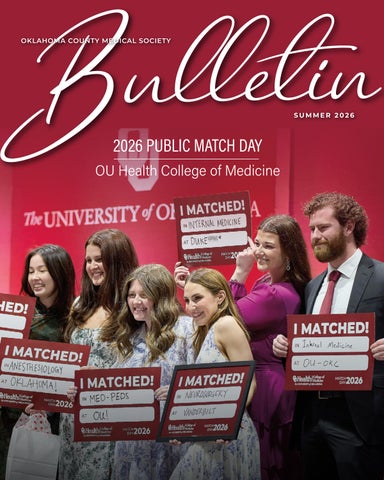
Bulletin OKLAHOMA COUNTY MEDICAL SOCIETY
SUMMER 2026
SUPPORTING OUR LEADING H E A LT H CA R E WO R K F O R C E . Offering luxury concierge real estate services for your professional and personal transactions.
A S t ro n g M ove™
SHERRY STETSON GROUP STETSON BENTLEY REAL ESTATE
405.445.9675
SHERRY@STETSONBENTLEY.COM
Summer 2026 | The Bulletin 1
OKLAHOMA CITY METRO • NORTHWEST OKLAHOMA • TULSA METRO + GRAND LAKE
E T A V ELE R E M SUM Home mortgages designed to let you live in style!
MEET OUR TEAM!
TYLER
LINDSAY
SENIOR VICE PRESIDENT
12201 N. 2026 May Avenue 2 The Bulletin | Summer
MICHAEL
MORTGAGE LOAN OFFICER
405.242.2857 tyler@quailcreek.bank
SENIOR VICE PRESIDENT
405.242.2888 lindsay@quailcreek.bank
•
OKC
NMLS - Quail Creek Bank ( #470269 )
•
quailcreek.bank
Tyler ( #1394493 )
405.242.2872 michael@quailcreek.bank
•
405.755.1000
Lindsay ( #1900178 )
Michael ( #474184 )
•
Forever real real estate Forever estate in inNichols NicholsHills Hills Sanctuary is a private enclave of 14 single-family homes of exceptional quality that adjoin
Sanctuary is a private enclavePark of 14 homes of exceptional quality adjoin the 65-acre Grand Boulevard in single-family Nichols Hills. The development is adjacent tothat Nichols the 65-acre Park in Nichols Hills. Thealong development is adjacent to Nichols Hills Plaza Grand as wellBoulevard as many multi-million-dollar homes Grand Boulevard. Hills Plaza as well as many multi-million-dollar homes along Grand Boulevard. Homes in the development will have a timeless architectural character using cast stone,
plaster,inand stone masonry. overlook a gracious fountain and cast have stone, genHomes thenatural development will haveAll a homes timeless architectural character using erous outdoor living spaces, abundant glass, magical lighting, and lush landscaping that is plaster, and natural stone masonry. All homes overlook a gracious fountain and have genmaintained by the homeowners association. erous outdoor living spaces, abundant glass, magical lighting, and lush landscaping that is maintained by the homeowners association.
Sanctuary occupies what is widely regarded as the last and best site in Nichols Hills, within easy walking distance of parks, offices, and restaurants in Nichols Hills Plaza. Homes range Sanctuary occupies what is widely regarded as the last and best site in Nichols Hills, within in size from 3,300 SF to 4,900 SF. All homes will be constructed concurrently, with the full easy walking distance of parks, offices, and restaurants in Nichols Hills Plaza. Homes range enclave scheduled for completion within the next 36 months.
in size from 3,300 SF to 4,900 SF. All homes will be constructed concurrently, with the full enclave scheduled for completion within the next 36 months.
For more information contact Sanctuary Partners at charlie@sanctuary-nh.com Summer 2026 | The Bulletin 3
For more information contact Sanctuary Partners at charlie@sanctuary-nh.com
Bulletin Summer 2026
Volume 99
Number 2
Four Annual Publications
TABLE OF CONTENTS President’s Page.........................................................6 OCMS Student Scholarship.....................................8 2026 Public Match List...........................................10 Director’s Dialogue.................................................18 Allegory of Hands and Brains...............................21 Law & Medicine/Clinical Decision Support........26 Law & Medicine/AI Federal & State Law.............28 Letter From The Editor...........................................30 Dr. Siddique Elected IDSA Fellow........................31 Laugh With Me........................................................32
EXECUTIVE OFFICE Alison Williams . . . . . . . . . . . . . . . . . Executive Director Rebecca Carr . . . . . . . . . . . . . . . . . . . Associate Director
EDITORIAL BOARD Hanna A. Saadah, MD Editor S.S. Sanbar, MD, PhD, JD Assistant Editor Anureet K. Bajaj, MD H. T. Kurkjian, MD Christopher Jordan, MD Jennifer Morris, MD Betsy M. Nolan, MD Tomás P. Owens, MD Janet G. Rodgers, MD Chittur A. Sivaram, MD Michael D. Taylor, MD William P. Truels, MD Elizabeth A. Wickersham, MD 4 The Bulletin | Summer 2026
313 Northeast 50th Street, Suite 2 Oklahoma City, OK 73105-1830 phone: 405-702-0500 fax: 405-702-0501 email: ocms@okcountymed.org
www.okcountymed.org OFFICERS
Arielle M. Allen, DO . . . . . . . . . . . . . . . . . . . President
Pooja Singhal, MD . . . . . . . . . . . . . . . . . President-Elect David Korber, MD . . . . . . . . . . . . . . . . . . . Vice President Irim Yasin, MD . . . . . . . . . . . . . . . . . Secretary-Treasurer
Bradley J. Margo, MD . . . . . . . Immediate Past President
BOARD OF DIRECTORS Tauseef Ali, MD Alisa Cross, MD Samid Farooqui, MD Betsy Jett, MD Amanda Levine, MD Robert Leonard, MD Adam McConnell, MD Ryan Morgan, DO Anil Patel, MD Nicole Sharp Cottrell, MD Nigam Sheth, MD Mark Shreve, MD Mitchell West, MD
BOARD OF CENSORS R. Kevin Moore, MD
Lisa J. Wasemiller-Smith, MD Basel S. Hassoun, MD
Ashley Weedn, MD . . . . . . . . . . . . . .
OSMA Trustee
Ian F. Dunn, MD, FACS, FAANS . . . Executive Dean University of Oklahoma College of Medicine
Ideas and opinions expressed in editorials and feature articles are those of the authors and do not necessarily express the official opinion of the Oklahoma County Medical Society.
Good Health Requires a Plan
A healthy body doesn’t happen by chance, and neither does lasting wealth. Trust Company Oklahoma: Plan Your Legacy 405.840.8401 | trustok.com
Summer 2026 | The Bulletin 5
From the President
Arielle Allen, do
I
’ve been struggling with what to write for this quarter’s Bulletin article. However, in light of the significant number of physicians that lost their jobs recently from a large hospital system in
Oklahoma, I’ve decided what the hell, I’m going to go ahead and jump onto one of my soapboxes and throw my opinion out there for you all. So here we go.
There is no place for corporate medicine in our communities! Physicians are being aggressively commoditized as a revenue-generating member of a MUCH larger corporation, one that is extremely bloated and top-heavy. Physician employment by large hospital systems only dilutes our voice and reduces our value. And I have so many reasons why I wholeheartedly believe this. Oh, where do I begin? How about I begin with the toll it takes on our mental well-being. With the recent trend focusing on physician wellness and mental well-being, employment by a large hospital system is not likely to help these issues at all. Being a replaceable ‘cog in the wheel’ is not good for anyone’s self-esteem. We go to school for years and years, become masters in our specialties, deal with stressors and difficult decisions on the daily, and work at the highest level of function only to be told we are replaceable? That the system can find another one just like us? What kind of message does that send? That we are not worthy. We are not needed. We are not good enough to keep. How’s that self-esteem doing? 6 The Bulletin | Summer 2026
There were a significant number of physicians let go from their hospital-employed positions recently in Oklahoma. Those professionals that were functioning at the top of their fields, after having trained for years and years, are now unemployed; wondering where their next steps will be, how they will continue to support their families. How were those decisions made, to let go of physicians only to save money? A physician that has been given a notice of termination of employment has significant, life-altering decisions ahead of them. We are the ONLY healthcare professionals that have to literally “start over” when changing jobs. Ever had to get a new Tax ID number? Get recredentialed? Change addresses? Apply for privileges at different hospitals? You know exactly what challenges lay ahead. It’s a six-month process at minimum. No other high-earning healthcare workers have to face this level of financial strain. Certainly none of the employees of large hospital systems that never perform patient care. Again, how’s that self-esteem doing? The decision to terminate physician contracts may very well have nothing to do with whether they are
good physicians or not. Turns out, in a large hospital system, the level of care is not necessarily as important as the bottom dollar. So, it may not matter that you are an amazing physician providing top notch care to your patients; you can very easily be let go because it can save the system money. When only 7 cents out of every healthcare dollar goes to actually paying physicians, aren’t there much more efficient ways of saving a hospital system money? Again, while certain hospital system expenses have ballooned WAY out of proportion, physician dollars have not. In fact, physicians make the same amount of money they did 30 years ago. Don’t even try to account for inflation. Your self-esteem may not be able to handle it! What I am trying to get at is that when we are employed, we can easily lose our own self-worth. Yes, it is difficult to be self-employed. True, private
practice is not easy. But it is doable. Be your own boss. Make your own decisions. Take care of patients as you would want to. Have that level of autonomy that cannot exist in an employment situation. After all, no one understands your field of medicine like you do. Forget following RVUs and making sure to check all of the boxes listed in your contract so you can get that productivity bonus. Your next contract’s checkboxes are guaranteed to change anyways. The goal line will constantly be moving away from your previous goals. If you are considering private practice, look seriously into it. Ask your friendly private practitioner colleagues how it works. You’ll find it IS doable! Remember—we are physicians supporting physicians. No one else is looking out for us.
Summer 2026 | The Bulletin 7
Shaida Kamali Selected For 2026 OCMS Student Scholarship Medicine is so often described in the language of rigor, science, and sacrifice that love can sound out of place. But love is exactly the word I would use for what brought me to this work, and what has carried me through it.
I was born in Kigali, Rwanda, in the quiet that followed the genocide against the Tutsi. To grow up in post-1994 Rwanda was to grow up amid poverty and grief, in the striking absence of elders. An entire generation had been erased, and their wisdom was gone with them. It was also to grow up knowing, early, that survival carried obligation. That absence shaped how I came to understand community: as something fragile, something that must be rebuilt, something worth protecting. My first trip to the United States was for college. I arrived in Oklahoma on a Rwandan presidential scholarship, carrying the hopes of my family, especially my mother, who had been denied the chance to finish her own education because of her ethnicity. When she died during my junior year, I adopted my younger brother and brought him from Rwanda to live with me. At twenty-two, I was still a student myself, navigating grief far from home while raising a child in a country that still felt so foreign. To make a life for the two of us, I rented a room in a senior living home near campus and worked its night shift as an administrative assistant. For years, my brother and I lived among neighbors over sixty-five who drew us into their world with quiet generosity. I watched residents in their nineties play bingo, watch birds, and trade stories worn smooth by retelling. I saw aging up close: its isolation, yes, but also its richness, the dark humor, the hard-won resilience, the particular wisdom that comes only from having lived long and lost much.
8 The Bulletin | Summer 2026
The love I found in Oklahoma came as community. Older adults treated me like a granddaughter. Friends picked up my brother when I was on shift. Mentors believed in me before I believed in myself. That support carried me through years of being a student and a parent at once, and into medical school at the University of Oklahoma, where I now train alongside physicians who inspire me and champion my work. The Oklahoma County Medical Society scholarship belongs to that same tradition of belief. The interview itself left a lasting impression. Drs. Allen, Jett, and Korber listened with genuine care and reflected back a version of my story I often lose sight of amid the demands of training, affirming a path of resilience at
a moment when I needed to hear it. To be seen and encouraged rather than simply evaluated reminded me why I chose this profession and renewed my commitment to it. I left not only with a scholarship but also with a deeper sense of belonging in this community of physicians. The scholarship will ease real burdens, and I am deeply grateful. Most importantly, the manner in which it was offered, with warmth, intention, and genuine belief in my potential, is the gift I will carry longest. It is the kind of generosity that asks to be paid forward. To be my patients’ community, and to give back the love I have received on this journey: that is my purpose.
Launching You into
Private Practice We streamline the process so you can focus on patient care. Logistics Management
Legal Hurdles
Credentialing Support
Budgeting Assistance
METRO-PHYSICIANS.COM
405-272-4978 Summer 2026 | The Bulletin 9
Class of 2026 Public Match List
University of Oklahoma College of Medicine
10 The Bulletin | Summer 2026
IMAGES BY TRAVIS CAPERTON, OU PHOTOGRAPHER
Megan Abraham Family Medicine Integris Health Oklahoma City
Vijay Bhupahiraju General Surgery University Hospitals Jackson, Mississippi
Jessica Allred Internal Medicine Duke University Medical Center Durham, N.C.
Aaron Bickerstaff Urology University of Kansas/Rural Track Pittsburg, Kansas
Fares Alrefai Ophthalmology University of Oklahoma Oklahoma City
Alison Boone Transitional St. Anthony Hospital Oklahoma City Dermatology OU College of Medicine Oklahoma City
Regan Amason Urology University of Oklahoma Oklahoma City
Lettie Clifton Family Medicine Integris Health Oklahoma City Lara Colby Emergency Medicine Johns Hopkins Hospital Baltimore, Maryland Robert Collier Emergency Medicine LSU School of Medicine New Orleans, Louisiana Jarrod Cooper Orthopaedic Surgery University of Texas Health Sciences Center San Antonio, Texas
David Barkyoumb Transitional Medical University of South Carolina Radiology-Diagnostic Medical University of South Carolina Charleston, S.C. Alyssa Bartlett Medicine-Pediatrics OU College of Medicine Oklahoma City Erin Bassett Radiology-Diagnostic University of Illinois College of Medicine Peoria, Illinois Jordan Bays Pediatrics OU College of Medicine Oklahoma City Cierra Bennett Emergency Medicine University of Texas Health Sciences Center Houston, Texas
Kristen Brown Emergency Medicine/Kingwood HCA Houston Healthcare University of Houston Houston, Texas Chase Calkins Internal Medicine University of North Carolina Hospitals Chapel Hill, N.C. Brock Carter Medicine-Primary Yale-New Haven Hospital New Haven, Connecticut
Jessica Cornell Medicine-Preliminary OU College of Medicine Tulsa, Oklahoma Radiology-Diagnostic OU College of Medicine Oklahoma City Dustin Dang Family Medicine OU College of Medicine Tulsa, Oklahoma
Continues on page 12 … Summer 2026 | The Bulletin 11
MATCH DAY Continued from page 11 … Hayley Davidson Internal Medicine Central Iowa Health System Des Moines, Iowa
Hailey Fisher Internal Medicine University of Alabama Hospital Birmingham, Alabama
Noah DeMoss Surgery-Preliminary OU College of Medicine Oklahoma City
Christian Garner Emergency Medicine Los Robles Health System Thousand Oaks, California
Deenna Doan Pathology Baylor University Medical Center Dallas, Texas
Thane Gehring Vascular Surgery Maine Medical Center Portland, Maine
Elliott Druten Orthopaedic Surgery OU College of Medicine Oklahoma City
Hamza Gillan Urology SUNY Upstate Medical University Syracuse, N.Y.
Hallum Ewbank Pediatrics OU College of Medicine Oklahoma City
Anusha Gopalam Internal Medicine University of Minnesota Medical School Minneapolis, Minnesota
Grace Fassina Otolaryngology Stanford Health Care Stanford, California
Jared Gregston Transitional St. Anthony Hospital Oklahoma City Radiation Oncology University of Texas M.D. Anderson Cancer Center Houston, Texas
Taraneh Fazel Neurology OU College of Medicine Oklahoma City 12 The Bulletin | Summer 2026
Azaan Hafeez Transitional Arkansas College of Osteopathic Medicine Ft. Smith, Arkansas Radiology-Diagnostic Integris Health Oklahoma City Karley Hagan Family Medicine UAMS Regional Center Fayetteville, Arkansas Fawaaz Hameed Emergency Medicine University Hospitals Jackson, Mississippi Dan Han Transitional AdventHealth Redmond, Georgia Radiology-Diagnostic Johns Hopkins Hospital Baltimore, Maryland Emma Harper Surgery-Preliminary SSM Health St. Louis University SOM St. Louis, Missouri
Danielle Harris General Surgery Indiana University SOM Indianapolis, Indiana
Brandon Holler General Surgery Mercy St. Vincent Medical Center Toledo, Ohio
Rachel Jillson Obstetrics-Gynecology University of Texas HSC San Antonio, Texas
Matthew Harter Orthopaedic Surgery OU College of Medicine Oklahoma City
Erin Hover Family Medicine CoxHealth Springfield, Missouri
Jade Johnson Pediatrics Phoenix Childrens Hospital Phoenix, Arizona
Chandler Haymore Internal Medicine OU College of Medicine Oklahoma City
Wilson Hoyt Transitional/Transmountain Texas Tech University El Paso, Texas Interventional Radiology University of Illinois COM Chicago, Illinois
Amber Karim Internal Medicine OU College of Medicine Oklahoma City
Kaitlin Hering Family Medicine Integris Health Oklahoma City Julie Hodgden Transitional St. Anthony Hospital Oklahoma City Dermatology OU College of Medicine Oklahoma City Charles Hojjat Transitional University of Central Florida HCA Healthcare GME Pensacola, Florida Dermatology University of Kansas SOM Kansas City, Kansas
Anthony Hui Med-Preliminary University of Kansas SOM Kansas City, Kansas Ophthalmology University of Kansas SOM Kansas City, Kansas Daniel Jackson Surgery-Preliminary University of Arizona COM Tucson, Arizona Cameron Jernigan Family Medicine Integris Health Oklahoma City
Feross Karrit Psychiatry/Community UC Irvine Medical Center Orange, California Taryn Kedzior Orthopaedic Surgery OU College of Medicine Oklahoma City Collyn Kellogg Internal Medicine OU College of Medicine Oklahoma City Sarah Kenney Pediatrics OU College of Medicine Oklahoma City Continues on page 14 …
Summer 2026 | The Bulletin 13
MATCH DAY Continued from page 13 … Marianne Kimmell General Surgery OU College of Medicine Oklahoma City Joseph Kinsinger Anesthesiology University of Alabama Hospital Birmingham, Alabama Gavin Knapp Family Medicine St. Anthony Hospital Oklahoma City Brooks Koenig Psychiatry/Child & Adolescent OU College of Medicine Oklahoma City Supriya Kohli Obstetrics-Gynecology University of Maryland Medical Center Baltimore, Maryland Paul Lasiter Internal Medicine OU College of Medicine Oklahoma City Hunter Lau Psychiatry OU College of Medicine Oklahoma City 14 The Bulletin | Summer 2026
Teresa Le Transitional Baptist Health North Little Rock, Arkansas OU College of Medicine Oklahoma City Alexa Lecrone Family Medicine Integris Health Oklahoma City Joyce Lee Anesthesiology OU College of Medicine Oklahoma City Michael Lee Pathology UC San Francisco San Francisco, California
Evann Mitchell Plastic Surgery (Integrated) University of South Florida Morsani COM Tampa, Florida Christian Moler Psychiatry OU College of Medicine Oklahoma City Amelia Momtazzadeh Internal Medicine OU College of Medicine Oklahoma City Vanessa Moore Internal Medicine Stanford Health Care Stanford, California
Parsa Lessani Pathology OU College of Medicine Oklahoma City
Kayli Nail Janda Internal Medicine Mayo Clinic School of Grad Medical Education Jacksonville, Florida
Matthew Loper Urology Mayo Clinic Phoenix, Arizona
Zane Nassar General Surgery Oregon Health & Science University Portland, Oregon
John Malone Anesthesiology University of Kansas SOM Wichita, Kansas
Emily Nguyen Neurology Oregon Health & Science University Portland, Oregon
Huy Nhan Anesthesiology OU College of Medicine Oklahoma City
Spencer Oslin Neurological Surgery Ohio State University Medical Center Columbus, Ohio
Carter Patterson Ophthalmology Mayo Clinic Rochester, Minnesota
Taylor Niznik Neurological Surgery Vanderbilt University Medical Center Nashville, Tennessee
Cameron Owens Neurology OU College of Medicine Oklahoma City
Alexander Petts Pathology Northwestern McGaw/NMH Chicago, Illinois
Amanda Pan Ophthalmology UT Southwestern Dallas, Texas
Kaitlyn Pixley Neurology University of Texas at Austin Dell Medical School Austin, Texas
Prince Nyako Family Medicine Houston Methodist Hospital Houston, Texas Jacqueline Oh Transitional Baptist Health North Little Rock, Arkansas Dermatology University Hospitals Columbia, Missouri
Dalton Pannell Anesthesiology OU College of Medicine Oklahoma City Camden Parrott Pediatrics OU College of Medicine Oklahoma City
Sarah Power Neurology Rush University Medical Center Chicago, Illinois Kieran Raj Urology University of Kansas Medical Center Kansas City, Kansas Continues on page 16 …
Summer 2026 | The Bulletin 15
MATCH DAY Continued from page 15 … Adaira Reid Obstetrics-Gynecology Barnes-Jewish Hospital St. Louis, Missouri Alexa Sallee General Surgery University of Texas Medical Branch Galveston, Texas Emma Sampson Anesthesiology OU College of Medicine Oklahoma City Luke Santos Psychiatry/Child & Adolescent OU College of Medicine Oklahoma City Mariam Shakir Internal Medicine OU College of Medicine Oklahoma City Lexie Shepard Pediatrics Duke University Medical Center Durham, North Carolina Laramie Snow Knapp Family Medicine St. Anthony Hospital Oklahoma City Joshua Soliz Internal Medicine OU College of Medicine Oklahoma City Karli Spann Anesthesiology OU College of Medicine Oklahoma City Joseph Spear Internal Medicine Baylor University Medical Center Dallas, Texas
16 The Bulletin | Summer 2026
Joseph Stanke Medicine-Primary Prisma Health University of South Carolina SOM Columbia, South Caroline Hailey Swan Psychiatry University of South Florida Morsani COM Tampa, Florida Katherine Swenson Emergency Medicine University of Chicago Medical Center Chicago, illinois Ann Elizabeth Tebow Internal Medicine University of Arkansas COM Fayetteville, Arkansas Sworup Thapa Urology University of New Mexico School of Medicine Albuquerque, New Mexico Michael Ting Internal Medicine Barnes-Jewish Hospital St. Louis, Missouri Grace Townsend Obstetrics-Gynecology University of Minnesota Medical School Minneapolis, Minnesota Raja Ullah Medicine-Preliminary Baptist Health Birmingham, Alabama Radiology-Diagnostic OU College of Medicine Oklahoma City Sydney Verrett Plastic Surgery (Integrated) University of South Florida Morsani COM Tampa, Florida
Sydney Vu Transitional St. Anthony Hospital Oklahoma City Radiology-Diagnostic Integris Health Oklahoma City Austin Watkins Internal Medicine OU College of Medicine Oklahoma City Peyton Wilson General Surgery University of South Florida Morsani COM Tampa, Florida John Woods Psychiatry University of Kansas SOM Wichita, Kansas Caleb Wright Family Medicine Scott AFB Saint Clair County, Illinois Connor Young Surgery-Preliminary University Hospitals Columbia, Missouri Zachary Young Pedicatrics OU College of Medicine Oklahoma City Ryan Zhu Internal Medicine Ohio State University Medical Center Columbus, Ohio Jordan Zimmerman Internal Medicine Barnes-Jewish Hospital St. Louis, Missouri
Summer 2026 | The Bulletin 17
BULLETIN
Alison Williams
DIRECTOR’S DIALOGUE
A
t OCMS, our board and staff strive to ensure that our membership is active, engaged, and united. That mission is not new; it is rooted in our history. Since the early 1900s, notes from Board meetings and The Bulletin publications have shown that physicians in Oklahoma County have come together not only to advance the practice of medicine, but to build relationships, share experiences, and stand united in support of one another and our patients. Those early social gatherings were the foundation of a cohesive and collaborative medical community and it’s imperative that we continue it. This year, we are excited to offer a variety of opportunities to connect professionally and socially. We will kick things off with our Women in Medicine Social on Thursday, August 6. This event is designed to bring together women physicians from across our community in a relaxed, welcoming environment. It is an opportunity to connect, share experiences, and build meaningful relationships with colleagues who understand the unique perspectives and challenges of women in medicine. Later, on August 27, we invite you and your families to join us for a night at an Oklahoma City
18 The Bulletin | Summer 2026
Comets game. This will be a fun, family-friendly event to enjoy time with fellow physicians and their families or friends. In the fall, we are especially excited about our Annual Meeting on November 8, where we will welcome Andrea Palmer as our featured speaker. Dr. Palmer, an OBGYN, will be sharing her courageous journey as she works to bring awareness to the critical issue of physician suicide after losing her husband, Dr. Blake Palmer, in 2022. We hope you will make plans to attend what promises to be a meaningful and impactful evening and support your fellow physicians. We are thankful for the membership of OSMA and our physicians who support the collaboration with OSMA. This allows us to host high-quality events, expand programming, and continue delivering valuable services to our members. Thank you again for your engagement, your leadership, and your commitment to organized medicine. We look forward to seeing you at these upcoming events and continuing to build a stronger, more connected physician community together. Scan for more information on physician counseling resources.
Blood Drives
Hit the road to save a life! SCAN TO SCHEDULE
-OR-
Donors Receive Get Your Sticks T-Shirt & choice of park ticket
877-340-8777 • obi.org
Photo ID required. While supplies last. Summer 2026 | The Bulletin 19
Flatbellies reads like a combination of American Graffiti and Hoosiers put on pages with — Doug Ferguson, lead golf writer for the Associated Press, humor and wit ... I loved it. winner of PGA’s Lifetime Achievement Award in Journalism
Flatbellies succeeds thanks to A. B. Hollingsworth’s engaging characters ... non-golf fans needn’t shy away from Flatbellies. — Mike Snider, USA Today
For more e informatiion, or to purrchasse onlline, visiit
www.fl fla atbellies2 25..com This collector’s edition includes the original novel, then 30 additional pages devoted to backstory, inside scoops and photographs of people, places, and things in the book.
www.flatbellies25.com www.johnalbedo.com www.killingalbertberch.com CG Sports Publishing 20 The Bulletin | Summer 2026
One of the “Top Ten Golf Books of All Time”, as voted by a pa nel of 12 East Coast sp orts writers, with the list published in the Washington Tim es.
LLIES
Allegory of Hands and Brains (I mistrust hands that can’t work the land)
C
an uneducated brains grow wiser and smarter with time, wiser and smarter than our highly educated brains? Can education (which cannot teach wisdom)—by imparting a restrictive and inflated sense of knowing to our brains—be making us unwise, presumptive, narrow-minded fools? To paraphrase Socrates: Fools think that they know; the wise know that they do not know. After a certain patient’s visit, the issue of educated vs. uneducated brains, troubled my mind. I have observed, after many ripe years, that our vulnerable brains succumb to the allure of the belief that we know, rather than concede that we do not know. I have also observed that wisdom only accrues after painful mistakes. Homo sapiens must have been constituted to fabricate answers when they do not have answers—as ancient Greeks fabricated answers by invoking the Gods: -Iris walked on the rainbow to carry messages between heaven and earth. -Prometheus stole fire from Zeus and gave it to humanity.
Hanna Saadah
-Sisyphus, for tricking the gods, was sentenced to endlessly push and re-push a huge boulder up a hill—a boulder that kept rolling back without ever reaching the top. Sisyphus has given us the English adjective, Sisyphean, which is usually applied to impossibly difficult tasks as in Sisyphean struggles. -The Greek god, Atlas, after losing the war to Zeus, was condemned to hold the heavens upon his head for eternity. Atlas has given us the name for the first cervical vertebra, the Atlas bone that supports our heads. Mr. Spark Wise came to my clinic, dressed in overalls, eager to explain that he has become too tired to do his daily farm work. I interrogated him and when I was nearing the end of the clinical history, he grinned and said, “I suspect that you don’t have a suspect in mind.” “A Suspect? What do you mean by a suspect?” Mr. Spark Wise did not lose his grin when he said, “I can tell, that after your interrogation, you still don’t have a diagnosis in mind.” “Oh, I see. By a suspect you meant a suspected diagnosis.” “You got it, doc. The diagnosis that is making me tired, too tired to do my daily farm work, is the culprit. I’d like for you to find it and dispatch it.” “You’re using strong language, Mr. Wise. Were you educated in military schools?” Mr. Wise giggled a reply. “I was home schooled on the farm, doc. I have no formal education and I have no degrees.” Continues on page 23 … Summer 2026 | The Bulletin 21
22 The Bulletin | Summer 2026
ALLEGORY OF HANDS AND BRAINS Continued from page 21 … I could not tell if Mr. Wise were embarrassed about his farm education, or if he were feeling smug not to have been formally educated. After pausing to find a polite exit, I said: “Socrates did not have a formal education and did not have degrees.” “Who’s Socrates?” “He’s a Greek philosopher.” “Philosopher! He wouldn’t be good on the farm, would he?” “I guess not,” I acquiesced. “What did he do for a living?” “He taught people how to think.” “People don’t need to be taught how to think,” retorted Mr. Wise. “A great many people think they are thinking when they are merely rearranging their prejudices,” said William James. “Who’s William James?” “An American psychologist and philosopher.” “Another philosopher who wouldn’t be any good on a farm.” “But not all people would be good on farms,” I countered. “They should be if they don’t want to starve. I mistrust hands that can’t work the land.” “Farmers are trustworthy,” I affirmed, hoping to regain his trust. “There are as many fools among us, farmers, as among you, doctors,” he whispered with apologetic grin. “I cannot disagree,” I said with lowered gaze. “For a highly educated man, you’re humbler and wiser than some doctors that I have so far encountered.”
“I chew when I work because I can spit where I choose.” “Have you had your blood tested?” “I’ve had many blood tests and many doctors. They all said that my tests were basically fine.” “Have you had your heart and lungs checked? “I have seen a heart and a lung doctor; they couldn’t find anything wrong.” “Have you been checked for sleep apnea?” “The lung doctor gave me a sleep-study and said that it was fine.” Looking for polymyalgia rheumatica, I asked, “Do you have any trouble rising from a chair or from a toilet? Do you have shoulder and hip aches?” To show off, Mr. Wise briskly stood up and sat down. Looking for hidden rheumatoid arthritis, I asked, “Do you have joint pains?” “Nope. At age fifty, my shoulders, hips, and joints are fine. But one smart doctor had me do a bone Continues on page 24 …
s To escape our unproductive discussion, I delved into the clinical history: “Mr. Wise. Do you get winded when you try to do your farm work?” “How did you know?” “I didn’t know, but I was trying to figure things out. Are you a smoker?”
Beth Hammack JRB Art at the Elms 405.528.6336 gallery@jrbartgallery.com 2810 N. Walker Ave. Oklahoma City, OK 73103
Summer 2026 | The Bulletin 23
ALLEGORY OF HANDS AND BRAINS Continued from page 21 … density and told me that my bones were slightly thin. He even gave me a medicine to bulk up my bones, but I did not take it.” “Did your blood tests show that you have inflammation, anemia, or low thyroid?” “None of that. I was only told that my iron was slightly low and that I was not anemic.” “Have you had diarrhea or abdominal pains?” “I’ve had loose stools for so many years, but my diarrhea is mild. It aint [sic] so bad.” “Has any medication helped your fatigue?” “Nope. They even tried cortisone and all it did was make my legs swell.” “Does any family member have anything similar to your fatigue?” “Nope. I’ve been getting worse and worse for several years now. All my smart doctors have given up on me. The only reason I came to see you was because you diagnosed my wife’s sister with a low B12 level. She still sings your praises.” After examining Mr. Wise, I asked, “Did you bring your medicines with you?” Mr. Wise handed me his bag of medicines, and a summary of his laboratory tests. I spent careful time examining all the details and asking detailed questions. When I paused in thought, he inquired with a grin, “Have you found a suspect yet?” “All I know so far is that you have slightly low iron, slightly thin bones, slightly loose stools, and chronic fatigue. Slightly low iron and slightly low bone density are uncommon among middle-aged men. Have you been losing weight?” “Oh, I’ve lost a few pounds over the past few years.” “Have you had a colonoscopy?” “I’ve had it twice, with biopsies, and nothing showed.” “Have you had a stomach scope?” “Nope. They wanted to do it, but I refused because my stomach feels fine and my abdominal CAT scan was normal.” “How much bread do you eat?” 24 The Bulletin | Summer 2026
“I’m a bread eater, doc. I eat bread every day.” “Have you ever been told that you have Celiac Disease. Does Celiac Disease run in your family?” “What’s Celiac Disease?” “An autoimmune disease triggered by gluten, which are proteins present in wheat, barley, and rye. Gluten proteins damage the small intestine, and lead to malabsorption and diarrhea.” “Is that your suspect?” “Yes.” “Can it cause diarrhea, thin bones, low iron and fatigue?” “Yes.” “How do you find out if I have it?” “With specific blood tests and with an intestinal biopsy done by a scope through your stomach. I can order the blood tests and ask a stomach doctor to do the biopsy.” “What medicines will you use to treat it?” “Medicines don’t help. The only treatment is to stop eating wheat, barley, and Rye. Industry does make gluten-free breads.” “You’re not going to prescribe any medicine!” “Correct. I will not prescribe medicines because medicines don’t work for Celiac Disease. After the blood tests and biopsy confirm the diagnosis, you will be prescribed a gluten-free diet. “I’ve been sick and desperate for so many years, doc. Are you absolutely sure?” “I will be sure when your blood tests and biopsy confirm the suspected diagnosis. I will even be surer when your fatigue and diarrhea recover after a few months on a gluten-free diet.” “You make it sound so simple, doc. I’m very weary because I’ve seen so many doctors and I am still sick. I’ve had so many tests. I’ve also been told that I have so many diagnoses, but none of the diagnoses turned out to be true. I’ve been repeatedly disillusioned by the medical profession. For several years now, I’ve had mild diarrhea and I’ve been too tired to do my farm
work. You’re going to get me well without giving me medicines? I’m having trouble believing you doc, because all this sounds too good to be true. But because you were able to help my wife’s sister, I’m willing to trust you.
s
Mr. Spark’s specific blood tests and duodenal biopsy confirmed the diagnosis of Celiac Disease. After 3 months on gluten-free diet, he recovered his health. At his three-month appointment, he handed me this hand-written note: Dear Doc, After our first visit, I really thought that you were a quack, like a few doctors that I have seen. I was greatly relieved and much happier when I found out that you were not a quack. The lesson I learned from you was—if things seem too good to be true, they just
s
might be so. God’s miracles of modern medicine all seem too good to be true. I thank God for working through the hands of our good doctors. You were the only doctor who has helped me without giving me medicines. That alone is a medical miracle. I used to say, ‘I mistrust hands that can’t work the land.’ Well, I have changed my mind. I do trust hands that can’t work the land because your hands were the hands that helped my hands work the land. This middle-aged farm boy learned a great piece of wisdom from you. From now on, I shall keep an open mind for what seems to be too good to be true. Never again shall I forget that God is always behind everything good in the world. Gratefully yours, Spark Wise.
ss
Summer 2026 | The Bulletin 25
LAW & MEDICINE AI Federal and State Law and Liability Issues Compiled by S. Sandy Sanbar, MD, PhD, JD, FCLM, DABLM*
E
very clinician, administrator, and health-system leader needs to understand AI (Artificial Intelligence) law, regulation, and liability in 2026. Why? Because physicians using AI in their clinical practice, documentation, diagnostics, or even scheduling workflows, are already operating inside a legal environment that is evolving faster than expected. This essay focuses on what actually matters for the physicians’ day-to-day practice. FEDERAL LAW By 2026, the FDA, FTC, OCR, and CMS have all carved out major roles in AI oversight. 1) The FDA (U.S. Food and Drug Administration) is the Medical Device Gatekeeper. If an AI tool diagnoses, interprets, predicts, or guides treatment, the FDA considers it a medical device. That includes Diagnostic algorithms; Imaging interpretation tools; Clinical decision support; and Predictive analytics. The FDA now allows certain AI systems to update themselves, but only under what is called a Predetermined Change Control Plan (or PCCP), which is a preapproved blueprint for how the AI is allowed to evolve. Manufacturers must also track real-world performance, including accuracy, bias, safety signals, and model drift. So, if an AI tool starts behaving differently in the wild, the FDA expects the vendor to catch it. 2) The FTC (Federal Trade Commission) focuses on Truth in Advertising. It is all about honesty. If a company claims their AI is “bias-free,” “100% accurate,” or “clinician-replacing,” the FTC steps in. The FTC has already issued enforcement actions for: Overstated capabilities, Hidden training data sources, and Misleading safety claims. So, if a
26 The Bulletin | Summer 2026
clinician is evaluating a new AI tool, remember: the marketing language is now legally regulated. 3) The OCR (Office of Civil Rights) & HIPAA Protect Patient Data. Any AI system touching PHI must comply with HIPAA. That means: Data minimization, Proper deidentification, Limits on secondary use, and Business Associate Agreements. The OCR has made it clear that AI vendors handling PHI (Protected Health Information) must meet the same security standards as hospitals. 4) The CMS (Centers for Medicare and Medicaid Services) is the Quiet Influencer. It shapes AI adoption through: Reimbursement; Quality metrics; and Valuebased care programs. And CMS now requires transparency when AI influences: Risk adjustment; Documentation; and Prior authorization. Thus, if the AI tools touches billing, CMS wants to know. STATE LAWS 1) Transparency Laws - States like California, Colorado, New York, Illinois, and Washington now require: Disclosure when AI is used in clinical decisionmaking; Patient notification; and Documentation of AI recommendations. In some states, if AI influenced the physician’s decision, the patient must be informed and documented in the EHR. 2) Data Privacy Laws - Several states now have General Data Protection Regulation (GDPR)-style privacy laws. Patients may have: The right to know how their data is used; The right to opt out of automated decisionmaking; and The right to restrict data sharing with AI vendors. This affects everything from scheduling bots to diagnostic models.
MEDICAL BOARD REGULATIONS - State boards increasingly require: Documentation of AI use; Physician oversight; Ethical training; and Prohibition of unsupervised autonomous AI. Thus, Physicians remain responsible for clinical decisions, even when AI is involved.
• Transparency – Physicians must explain: What the AI does; Its limitations; and Why human oversight matters. • Bias & Equity - Legal frameworks increasingly require: Bias audits; Fairness testing; and Reporting disparities.
TORT LAW & NEGLIGENCE - Some states are beginning to recognize an AI-augmented standard of care, meaning: If AI is widely used and improves outcomes, not using it could be considered negligent. This is a major shift. 1) Physicians Liability can be for: Not using AI when it’s standard; Ignoring AI warnings; Blindly following AI recommendations; and Failing to document how AI influenced the physician’s decision. Documentation is the shield. 2) Hospital Liability can be liable for: Deploying unvalidated AI; Failing to monitor performance; Inadequate staff training; and Poor cybersecurity. This is corporate negligence in the AI era. 3) Vendor Liability - AI companies can be sued for: Defective algorithms; Inadequate warnings; Failure to update models; and Misrepresenting performance. 4) Shared Liability - Courts increasingly divide responsibility among: Clinicians; Hospitals; Vendors; and Data providers. It depends on who controlled the AI and who made the final decision.
CYBERSECURITY & DATA PROTECTION - AI introduces new cyber risks including Data poisoning; Model inversion; and Adversarial attacks. Organizations must: Encrypt data; Monitor for breaches; and Report incidents promptly. Liability includes: HIPAA penalties; State fines; and Civil lawsuits.
AI IN MALPRACTICE LITIGATION - AI is now showing up in courtrooms. • AI as Evidence - AI outputs may be used as evidence to show: The standard of care; Deviation from guidelines; and Missed warnings. • Discovery - Lawyers may request: Training data; Model architecture; Performance metrics; and Bias audits. Courts are still figuring out how transparent AI must be. • Standard of Care - AI can raise or lower the standard of care depending on: Adoption; Reliability; and Outcome improvement. This is evolving rapidly. ETHICAL & LEGAL DUTIES - Clinicians must ensure: • Informed Consent - Patients may need to know when: AI influenced diagnosis; AI was used in triage; and when AI shaped surgical planning.
RISK MITIGATION: What Clinicians Should Do Today? • Governance - Hospitals should have: AI oversight committees; Validation protocols; and Bias monitoring. • Documentation - Clinicians should chart: When AI was used; How it influenced decisions; and Why they overrode it. • Training - Clinicians must understand: AI limitations; Ethical use of AI; and Bias recognition. • Vendor Contracts - Contracts should include Performance guarantees; Bias audits; Liability allocation; and Update requirements In sum, AI is transforming healthcare, but it is also reshaping the legal and ethical landscape. In 2026, clinicians, hospitals, and vendors must navigate a world where: • AI influences care, • Laws demand transparency, • Liability is shared, and • AI Standards of care are evolving. For clinicians, the key is to stay informed, document clearly, and maintain human oversight. *Dr. Sanbar is an Adjunct Professor of Medical Education, University of Oklahoma Health Sciences Center; Executive Director and Past Chairman and Diplomat, American Board of Legal Medicine; and Past President and Fellow, American College of Legal Medicine. He is a health law attorney and a retired cardiologist. Summer 2026 | The Bulletin 27
LAW & MEDICINE Clinical Decision Support: A Novel Evidence-Based Generative AI Compiled by S. Sandy Sanbar, MD, PhD, JD, FCLM, DABLM* On March 3, 2026, Dena O'Leary, M.D., Vice President, Medical Affairs, INTEGRIS Health, noted in part the following message via email: “I am thrilled to share that beginning March 16, 2026, all registered UpToDate® users at INTEGRIS Health will gain access to UpToDate® Expert AI, the newest innovation powered by GenAI and grounded in UpToDate’s trusted evidence-based content.” It is ‘designed by clinicians, for clinicians, and draws only from the trusted, expert-created care recommendations in UpToDate.’ Solution Primary Use
Generative artificial intelligence (AI) and large language models (LLMs) are useful tools for: (1) summarizing research to support evidence-based practice (EBP) for clinicians, (2) clinical decision-making, (3) hospital operations, (4) medical diagnostics, and (5) patient care. They offer novel ways for clinicians to access, synthesize, and apply medical knowledge at the point of care. In 2026, there were more than nine LLMs and gen AI tools including the following:
Evidence Clinical Key Strength Key Limitation Based? Grade?
UpToDate Expert AI Clinical decision support Yes Yes Trusted, evidence-anchored answers Microsoft Copilot Documentation, workflow No No Enterprise security + EHR integrations Google Gemini Summaries, education No No Strong reasoning, multimodal Doximity DocsGPT Clinical writing Partial No Physician specific templates Nuance DAX Copilot Ambient documentation No No Reduces burden; EHR integrated ChatGPT / Claude General reasoning No No Excellent summarization Epic/Mayo/Amazon pilots Documentation, imaging, ops Partial Emerging Deep system integration
UpToDate® Expert AI Introduced on September 24, 2025, UpToDate® Expert AI is a notable development. It is a generative AI system built directly on the trusted, evidence based content of UpToDate, which has been regarded as a gold standard for clinical reference. For practicing clinicians navigating increasingly complex care environments, this new platform offers both promise and important considerations. UpToDate® Expert AI is designed as an evidence-based generative AI system that leverages the extensive medical literature, editorial rigor, and expert authorship that underpin the broader UpToDate ecosystem. 28 The Bulletin | Summer 2026
Narrow scope; subscription Not for diagnosis Not evidence anchored Not CDS Not CDS Hallucination risk Not yet validated
• Expert AI is grounded in UpToDate’s continuously updated clinical content and the contributions of more than 7,600 subject-matter experts. This foundation positions the AI tool as a clinical-grade resource intended to support real time decision making. • The primary function of Expert AI is to provide concise, clinically actionable answers to medical questions posed in natural language. • Expert AI focuses on targeted clinical Q&A, which mirrors the types of queries clinicians routinely make during patient encounters.
• The design of Expert AI reflects a deliberate emphasis on reliability, safety, and alignment with established evidence. What are the Strengths of UpToDate® Expert AI? 1. Expert AI is grounded in evidence based medicine which is compiled by UpToDate’s editorial process that is known for its rigorous literature surveillance, expert authorship, and frequent updates. The responses are not only synthesized quickly but also anchored in vetted, peer reviewed content. The information aligns with current standards of care. And the system aims to reduce the risk of hallucinations and unsupported claims. 2. Expert AI focuses on reliability, accuracy and clarity. It is explicitly designed for point-of-care decision support. Its outputs are structured to be concise, clinically relevant, and free of extraneous detail. Expert AI is customized to stay within the boundaries of UpToDate’s content, reinforcing its role as a dependable clinical reference. 3. Expert AI is built with health-system integration in mind. It supports embedding within electronic health records (EHRs), clinical portals, and institutional knowledge systems. This interoperability allows clinicians to access AI generated insights without disrupting their established routines. 4. The hallmark of gen AI is speed, and Expert AI is no exception. It is marketed as fast, dependable and safe, enabling clinicians to obtain evidence based answers in seconds. This combination of speed and trust is particularly valuable in acute care settings, where prompt decision making is critical. By pairing rapid synthesis with a trusted evidence base, Expert AI aims to reduce cognitive load, streamline information retrieval, and support clinicians in delivering high quality care. What are the Limitations and Considerations? 1. Unlike general purpose AI large language models (LLMs) which are capable of broad reasoning, document drafting, or multi step analysis, Expert AI keeps a narrower scope. Its primary function is clinical Q&A. Therefore, it does not provide comprehensive documentation, predictive modeling, or administrative support. 2. With the traditional UpToDate platform, Expert AI needs institutional or individual licensing, making it less available to small medical practices. 3. Expert AI itself is early in its adoption lifecycle. Real world validation, clinician trust, and workflow optimization will evolve over time. For practicing clinicians, its potential benefits include:
• Faster access to trusted information. • Reduced cognitive burden. • More consistent application of evidence-based guidelines. • Enhanced support in complex or unfamiliar clinical scenarios. Summary UpToDate® Expert AI offers a promising model for integrating generative AI into clinical practice in a way that prioritizes evidence, safety, and workflow compatibility. Its strengths are: evidence based grounding, clinical grade reliability, workflow integration, and speed. This makes it a compelling choice for point of care decision support. However, its narrower scope, subscription requirements, and early adoption stage highlight the need for ongoing evaluation and thoughtful implementation. For clinicians navigating an increasingly complex healthcare environment, Expert AI, albeit narrow in scope, may become a valuable ally by enhancing access to trusted knowledge while preserving the vital role of clinical ability. References 1. Wolters Kluwer. UpToDate: About Us. Accessed 2024. 2. Wolters Kluwer. UpToDate Expert AI Overview. Accessed 2024. 3. Miller DD, Brown EW. Artificial intelligence in medical practice. JAMA. 2018;320(11):1101 1102. 4. Rajpurkar P, Chen E, Banerjee O, Topol EJ. AI in health care: the hope, the hype, the promise, the peril. JAMA. 2022;327(12):1151 1152. 5. Benjamens S, Dhunnoo P, Mesko B. The state of artificial intelligence based FDA approved medical devices. NPJ Digit Med. 2020;3:118. 6. Krittanawong C, Johnson KW, Rosenson RS, et al. Deep learning for cardiovascular medicine. J Am Coll Cardiol. 2019;73(7):989 1000. 7. Shortliffe EH, Sepúlveda MJ. Clinical decision support in the era of artificial intelligence. JAMA. 2018;320(21):2199 2200. 8. Sutton RT, Pincock D, Baumgart DC, et al. Clinical decision support systems: state of the art. Yearb Med Inform. 2020;29(1):103 112. 9. Mesko B, Görög M. A short guide for medical professionals in the era of artificial intelligence. NPJ Digit Med. 2020;3:126. 10. Topol EJ. High performance medicine: the convergence of human and artificial intelligence. Nat Med. 2019; 25:44 56. Summer 2026 | The Bulletin 29
Letter to the Bulletin Thank you Dr. Sanbar for exposing the weaknesses, traps, and hurdles of regulated, legalized AI systems in your two Bulletin articles: 1) Clinical Decision Support: A Novel EvidenceBased Generative AI and 2) AI Federal and State Law & Liability Issues. Turning medicine over to legalized, bureaucratic, AI systems is shameful, pathetic, hazardous, time wasteful, and forces doctors to become triaging subalterns rather than creative thinkers and responsible, decision makers. To avoid bureaucratic suffocation, it will become easier for doctors to triage patients to subspecialists rather than negotiate the traps and hurdles of legalized AI. The three main disadvantages of medical bureaucracy are:
- It does not recognize that its time-wasting and burnout-enhancing harms exceed its benefits. - It thinks it can only simplify by making its systems more complicated; It makes no recognizable effort to make its systems more user-friendly and less confusing.
- The entire medical bureaucracy is currently mired in electronic mud and is sinking in quicksand. There are no health workers that can walk and work effectively without burnout and without mud-soiled shoes.
- The decline and fall of our bureaucratic medical system recapitulates The Decline and Fall of The Roman Empire, (which collapsed because of bureaucratic mismanagement). Our current medical decline is promoted by excessive, oppressive, electronic dictatorships that cause bureaucratic stifling, which suffocates efficiency and creativity. Our enemy is the current, excessive, oppressive, bureaucratic dictatorship. “We have met the enemy and he is us,” said Walt Kelly, in his comic strip Pogo on Earth day in 1970.
Hanna Saadah
30 The Bulletin | Summer 2026
Siddique Elected As IDSA Fellow Bushra Siddique, MD, has been elected an IDSA Fellow by the Infectious Diseases Society of America. Fellowship in the Society is a recognition of, and honor conferred upon those who have achieved professional excellence in the field of infectious diseases. IDSA Fellows are entitled and encouraged to note this recognition on letterhead, business cards, and other materials by using the initials FIDSA for as long as they are a member of the Society. This distinction
indicates that Siddique has progressed beyond the hard work associated with earning a doctoral-level degree. FIDSA is the Society’s way of identifying leaders within its ranks. Dr. Siddique is a 2005 graduate of the Dow Medical College. She is affiliated with Integris Baptist Medical Center and specializes in Infectious Disease, Hospital Medicine, and Internal Medicine.
Modhi Gude, MD, MRCP, FACP, FACE (Former Clinical Professor of Medicine, OUHSC)
Access Endocrine, Diabetes & Thyroid Center (Where Molecular Endocrinology is applied and practiced clinically)
Locations:
Unexpectedly better urgent care. Welcome to the exclusive concierge care approach that’s more personalized for true ease and convenience. Now opening locations throughout the metro.
North
6001 NW 120th Court, Suite 6 Oklahoma City, OK 73162 Phone: 405-728-7329
South
1552 SW 44th Street Oklahoma City, OK 73119 Phone: 405-681-1100
New Patients: Referrals are welcome, by appointment only Comprehensive Diabetes Care | Obesity, Metabolic and Insulin Resistance Syndromes Hypoglycemic Syndromes notably Post-Bariatric Surgery and Insulinomas Thyroid Disorders, mostly Graves’ Disease, Hashimoto’s Disease, Thyroid Cancer and Thyroid Hormone Resistance Syndromes UG Guided FNA Biopsies of Thyroid Nodules Pituitary Diseases, notably Incidentalomas, Growth Hormone Deficiency and Hypopituitarism Adrenal Incidentalomas | Addison’s Disease and Cushing Disease Hypercalcemia notably Hyperparathyroidism | Osteoporosis Primary Aldosteronism | Hypogodanism Rare Endocrine Disorders such as Pituitary Tumors MEN1, MEN2, Acromegaly
You’re good to go. allseturgentcare.org
Open Monday-Friday 8:30 AM-5:30 PM Summer 2026 | The Bulletin 31
Legend Has It After the Second World War, at a formal dinner, Mr. Churchill had too much to drink. Lady Unnamed confronted him by saying: “Mr. Churchill. You are drunk. You are filthy drunk. You are an embarrassment for everyone to see.” Unabashed, Mr. Churchill grinned and said: “Lady Unnamed. You are ugly for everyone to see. But remember, tomorrow, I shall be sober.”
Hanna Saadah
If you have a lighthearted, funny bone-tickling joke you would like to share with our readers for this feature, please send your submission to hannasaadah@hotmail.com and to nightowlokc@gmail.com.
Serving Physicians Since 1987 At Oklahoma Financial Center, we help physicians safeguard income and assets against malpractice, create tax-efficient strategies, build long-term wealth and retirement security, and protect their family and legacy. From just starting out to nearing retirement, we provide guidance tailored to your stage of practice.
Take the Next Step
Securities offered through Kestra Investment Services, LLC (Kestra IS), member FINRA/SIPC. Investment advisory services offered through Kestra Advisory Services, LLC (Kestra AS), an affiliate of Kestra IS. Oklahoma Financial Center and Bluespring Wealth Partners LLC are affiliates of Kestra IS and Kestra AS. Investor Disclosures: https://www.kestrafinancial.com/disclosures 32 The Bulletin | Summer 2026
Karen Cunningham, ChFC® | Shamiah Evans, CFP® 12436 St. Andrews Dr, Oklahoma City, OK 73120 (405) 302-2900 | okfin.com
Comfort • Care • Compassion Early hospice referrals provide patients and families with more time for comfort, dignity and support. INTEGRIS Health Hospice enhances the quality of life for those facing terminal illness, whether at home or in our dedicated Hospice House for inpatient care. Discover the benefits of hospice and palliative care with INTEGRIS Health Hospice.
Scan the QR code to learn more.
integrishealth.org/hospice • 405-848-8884
PRESORTED STANDARD U.S. POSTAGE
PAID
OKLAHOMA CITY, OK
PERMIT NO. 381
Oklahoma County Medical Society 313 N.E. 50th St., Suite 2 Oklahoma City, OK 73105-1830
Address Service Requested
PROVIDER PREFERRED CHECKING
DESIGNED FOR HEALTHCARE PROFESSIONALS
EARN UP TO
3.82
%
APY* HEALTHCARE BANKING
Tiered Rates
Visa® Debit Card
Digital Banking
Tiered rates compounded daily and credited monthly to reward higher balances.
Unlimited fee-free ATM use anywhere, plus 24/7 access for unlimited transactions.
Simple, on-the-go money management with our user friendly mobile & online banking.
MyFirstLiberty.com | 405.608.4500 | jvafadar@myfirstliberty.com IMPORTANT INFORMATION * - One (1) Provider Preferred Checking account per household. Terms apply. Qualification: At least 1 ACH direct deposit, First Liberty Bank Debit Card & be enrolled in e-statements. Fees could reduce the earnings on the account. See our separate fee schedule for details. Member FDIC. *Annual Percentage Yields (APYs) are accurate as of May 1, 2026. Interest rates and APYs are subject to change. **Account offered exclusively to MD, DO, DDS, DMD, OD, DPM, DC, NP, APRN, PA, DVM, PharmD & RPh professionals. Interest compounds daily and is credited monthly. Minimum balance of $1,000.00 to open the account and to earn the stated Annual Percentage Yield for the $1,000 to $49,999.00 tier. One (1) Provider Preferred Checking account per household. Terms apply. Qualification: At least 1 ACH direct deposit, First Liberty Bank Debit Card & be enrolled in e-statements. Fees could reduce the earnings on the account. See our separate fee schedule for details. Member FDIC. 1 - Fees may reduce earnings. Interest rates are subject to change. A minimum balance of $1,000 is required to open and earn interest. Interest rates and APYs are subject to change. 2- Paid Item Fees and Return Item Fees apply to items created by check, in-person withdrawals, and electronic means. Inadvertent overdrafts caused by ATM and one-time debit card transactions are excluded. 3 - Wireless carrier data rates may apply.
NMLS# 1215182