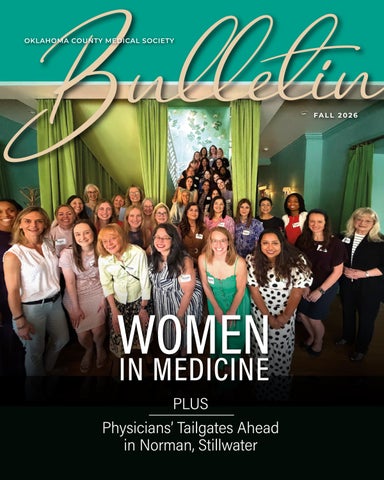
Bulletin OKLAHOMA COUNTY MEDICAL SOCIETY
FALL 2026
TIMELESS DESIGN, BEAUTIFULLY DEFINED.
Design-Build Remodeling Fine Custom Cabinetry Interior Design Custom Cabinetry for New Construction
405-285-1926 EdmondKitchen.com
TWENTY-FIVE YEARS OF EXTRAORDINARY
A Strong Move™
Stetson Bentley Real Estate
ELEVATING THE
REAL ESTATE EXPERIENCE FOR HEALTHCARE PROVIDERS.
TRUST THE PROVEN RESULTS OF ONE OF OKLAHOMA’S TOPRANKED TEAMS. OFFERING LUXURY CONCIERGE REAL ESTATE SERVICES FOR YOUR PROFESSIONAL AND PERSONAL TRANSACTIONS.
SHERRY STETSON GROUP STETSON BENTLEY REAL ESTATE
405.445.9675
SHERRY@STETSONBENTLEY.COM
Fall 2026 | The Bulletin 1
OKLAHOMA CITY METRO • NORTHWEST OKLAHOMA • TULSA METRO + GRAND LAKE
Time Is the Helping You Find a House Manager. You’ve worked hard to build a successful life.
So why are you still managing grocery pickups, coordinating contractors, scheduling appointments, waiting for deliveries, and keeping track of a never-ending family calendar? The most successful people don’t do everything themselves—they build support systems that protect what matters most. A professional House Manager becomes the person who keeps your home running effortlessly behind the scenes, so you can spend more time with your family, your career, your friends, or simply enjoying the life you’ve created. Imagine a home that runs as smoothly as your business.
Housesquire.com 405.237.9342 hello@housesquire.com 2 The Bulletin | Fall 2026
Luxury. More time. Less mental load. Greater peace of mind.
HouseSquire�helps you find the right House Manager for your home—someone you can trust to handle the details, so you can focus on living.
Your home, professionally managed. Your time, reclaimed.
BRYAN PETTY PRESIDENT
KENTON OWENS CAROL FEHRLE
CHIEF LENDING OFFICER
CHIEF OPERATING OFFICER
STRENGTH & MOMENTUM Our future looks bright!
12201 N. May Avenue • OKC • quailcreek.bank • 405.755.1000 • Member FDIC
Fall 2026 | The Bulletin 3
Bulletin Fall 2026 Volume 99 Number 3 Four Annual Publications
TABLE OF CONTENTS
President’s Page........................................................ 8 Collective Strength................................................... 9 Women In Medicine...............................................10 Road To Reduce Risk..............................................12 OCMS Alliance Kitchen Tour...............................13 Tailgate Season........................................................16 History of Language...............................................18 Law & Medicine...................................................... 25 Director’s Dialogue................................................ 27
EXECUTIVE OFFICE Alison Williams . . . . . . . . . . . . . . . . . Executive Director Rebecca Carr . . . . . . . . . . . . . . . . . . . Associate Director
EDITORIAL BOARD Hanna A. Saadah, MD, Editor S.S. Sanbar, MD, PhD, JD, Assistant Editor Anureet K. Bajaj, MD H. T. Kurkjian, MD Christopher Jordan, MD Jennifer Morris, MD Betsy M. Nolan, MD Tomás P. Owens, MD
Janet G. Rodgers, MD Chittur A. Sivaram, MD Michael D. Taylor, MD William P. Truels, MD Elizabeth A. Wickersham, MD
313 Northeast 50th Street, Suite 2 | Oklahoma City, OK 73105-1830 phone: 405-702-0500 fax: 405-702-0501 email: ocms@okcountymed.org
www.okcountymed.org OFFICERS
Arielle M. Allen, DO . . . . . . . . . . . . . . . . . . . President
Pooja Singhal, MD . . . . . . . . . . . . . . . . . President-Elect David Korber, MD . . . . . . . . . . . . . . . . . . . Vice President Irim Yasin, MD . . . . . . . . . . . . . . . . . Secretary-Treasurer
Bradley J. Margo, MD . . . . . . . Immediate Past President
BOARD OF DIRECTORS Tauseef Ali, MD Alisa Cross, MD Samid Farooqui, MD Betsy Jett, MD Amanda Levine, MD Robert Leonard, MD Adam McConnell, MD
BOARD OF CENSORS
R. Kevin Moore, MD Lisa J. Wasemiller-Smith, MD Basel S. Hassoun, MD Ashley Weedn, MD . . . . . . . . . . . . . .
OSMA Trustee
Ian F. Dunn, MD, FACS, FAANS . . . Executive Dean University of Oklahoma College of Medicine
Ideas and opinions expressed in editorials and feature articles are those of the authors and do not necessarily express the official opinion of the Oklahoma County Medical Society.
AVAILABLE NOW! 2 VOLUMES AI IN HEALTHCARE By Dr. Sandy Sanbar
ABLMINC.org 4 The Bulletin | Fall 2026
Ryan Morgan, DO Anil Patel, MD Nicole Sharp Cottrell, MD Nigam Sheth, MD Mark Shreve, MD Mitchell West, MD
Don’t navigate the to-do list alone. Partner with our team to secure your legacy.
TrustOK.com | Intentional Wealth Management | 918.744.0553 Fall 2026 | The Bulletin 5
THANK YOU TO OUR 2026 SPONSORS!
GOLD
Our Blood Institute
BRONZE
INTEGRIS Health McBride Orthopedic Hospital Oklahoma Financial Center OU Medicine PLICO Quail Creek Bank
THANK YOU TO OUR ADVERTISERS! Modhi Gude, MD HouseSquire INTEGRIS Hospice Metro Physicians
EKB Home First Liberty Bank Garage Living
Launching You into
Private Practice We streamline the process so you can focus on patient care. Logistics Management
Legal Hurdles
Credentialing Support
Budgeting Assistance
METRO-PHYSICIANS.COM 6 The Bulletin | Fall 2026
405-272-4978
Soulbird Stetson Bentley Real Estate Trust Co. of Oklahoma
Fall 2026 | The Bulletin 7
From the President
Arielle Allen, do
When I am with my physician colleagues, I experience a profound sense of relief. flawed healthcare system. In these circles, all of this is a shared language. We understand the unique stress that is being a physician. We understand the trauma of carrying medical errors, the pressure of constant evaluation, and the reality of putting our own lives on hold for years of specialized training.
S
omething I have realized over the past several years is that hanging with other physicians isn’t just socializing; it is a critical form of therapy for me. Yes, it is difficult to find time outside of working hours for physician-led meetings and gatherings, but man, I have found that extra time every now and then is well worth it! While I do enjoy social events with my non-medicine colleagues, there is something vital I have found when I am with my physician counterparts. It is a form of validation for me. Medicine is a profession that demands an immense amount of our emotional and mental reserves. Every day, we carry the high-stakes responsibility of patient outcomes, the frustration of administrative burdens, and the weight of quiet sacrifices that few outside the field ever truly see. When I am with my physician colleagues, I experience a profound sense of relief. There is no need to translate the exhaustion of having to constantly apologize to patients about falling behind on time, feeling the incessant burden of your patient results inbox or the moral injury of our incredibly
8 The Bulletin | Fall 2026
This phenomenon relates to the therapeutic concept of universality—the realization that your struggles, doubts, and fears are shared by others. When an individual tells you that you aren’t the only one feeling overwhelmed, it is helpful. But when a room full of highly trained, capable physician colleagues nods in collective agreement, your body and mind finally believe it. This sentence regarding this concept says it all: having a shared identity and experiences can dismantle internal narratives of inadequacy. If you have not yet experienced the mental and emotional reassurance that is found when talking with fellow physicians, I implore you to actively seek this. Whether this is lunching in a doctor’s lounge a couple of times a week, attending a physicians-only meeting at your facility or hospital, or joining a medical society locally or nationally, I truly believe it will provide therapeutic benefit. OCMS has provided that form of therapeutic collective agreement for me. I find meeting and talking with colleagues of all different specialities is beneficial in so many ways. See what OCMS can do for you!
Fall 2026 | The Bulletin 9
WOMEN IN MEDICINE OCMS hosted its Women in Medicine event in August at the Bradford House, bringing together women physicians, residents, and medical students for an evening of connection and conversation. Attendees shared experiences, built meaningful relationships, and strengthened the community among women across all stages of their medical careers. We hope to see even more women at our next event, the Women Physicians Summit, on September 18. For more information about the summit, visit www.okmed.org.
10 The Bulletin | Fall 2026
WOMEN IN MEDICINE
Serving Physicians Since 1987 At Oklahoma Financial Center, we help physicians safeguard income and assets against malpractice, create tax-efficient strategies, build long-term wealth and retirement security, and protect their family and legacy. From just starting out to nearing retirement, we provide guidance tailored to your stage of practice.
Take the Next Step
Securities offered through Kestra Investment Services, LLC (Kestra IS), member FINRA/SIPC. Investment advisory services offered through Kestra Advisory Services, LLC (Kestra AS), an affiliate of Kestra IS. Oklahoma Financial Center and Bluespring Wealth Partners LLC are affiliates of Kestra IS and Kestra AS. Investor Disclosures: https://www.kestrafinancial.com/disclosures
Karen Cunningham, ChFC® | Shamiah Evans, CFP® 12436 St. Andrews Dr, Oklahoma City, OK 73120 (405) 302-2900 | okfin.com Fall 2026 | The Bulletin 11
The Road to Reduce Risk as a Physician By Jeff Kelton, CLCS, Physician Risk Manager, INSURICA
A
s a physician, you likely went to medical school driven by an innate desire to help people— to be a family’s only hope when it came time to save their loved one or deliver their biggest news, whether tragic or joyful. Being a physician comes with a lot of pressure and malpractice is probably the risk that keeps you up at night, the one your training warned you about, the one that feels personal because it’s tied directly to your clinical judgment. However, the risks a physician and their practice face are far more expansive than that.
You Have More Control Over Your Risk Than You May Realize Every practice or physician faces three types of risks:
STRATEGIC
Opening up a new location, acquiring a new operation, starting a new product or service, and many more.
OPERATIONAL
Management, culture, policies and procedures and acquiring new talent.
HAZARDS
Acts of God, motor vehicle accidents, fire, theft, weather etc. Most of these don’t involve a bad clinical outcome but can seriously threaten practice or physician viability whether financially, operationally, or reputationally. And in my experience, most physicians don’t think about them— until something happens. Most insurance conversations only address the third category—hazards. Real risk management starts by looking at all three and how best to address them using five strategies, including insurance. 12 The Bulletin | Fall 2026
“What Insurance Do I Need?” Before I answer that question, this series invites a
mindset shift to stop engaging in the traditional, exhaustive cycle of insurance buying. Rather than starting with insurance (as most do), how can physicians and practices work to mitigate and prevent risk in hopes of buying insurance for what’s left over? That’s control! Insurance is the transfer of risk for a premium. If you want to pay less and positively impact your bottom line, transfer less risk. That means thinking holistically about risk not just malpractice and within your clinical practice, but around and outside it – medical directorships, investment properties, other businesses, staff, cyber, employment decisions, vendors and reputation.
What’s Coming in This Series Over the next few issues, we’ll take a closer look at each of these risk areas individually – what causes claims, what physicians and practice managers can do to reduce exposure, and how coverage actually works when something does go wrong. Our next piece will begin with the topic every physician already has top of mind: MEDICAL PROFESSIONAL LIABILITY – including a look at Oklahoma’s recently changed damages caps and what they mean for you. Followed by… • Cyber Liability & HIPAA Breach Response – the fastest-growing risk in healthcare • Commercial Property & Business Interruption – protecting your building, equipment, and ability to keep seeing patients
• General Liability – the everyday, non-clinical incidents
• Employment Practices Liability – hiring, termination, and harassment exposure amid ongoing staffing pressures The people we trust with our health and futures are among those targeted most often when something goes wrong. My hope with this series is to empower Oklahoma physicians to see the full picture of risk – not just one piece that keeps one up at night. Thank you for the dedication and care you bring to the people of Oklahoma every day.
KITCHEN TOUR
OCMS Alliance Kitchen Tour Slated For October 18
5 Nichols Hills area kitchens showcased in annual fundraiser All are invited to join the Oklahoma County Medical Society Alliance’s Kitchen Tour coming this fall. Now in its 34th year, the Alliance Kitchen Tour raises funds for health-focused organizations serving Oklahoma County. The 2026 Kitchen Tour is scheduled for Sunday, October 18, from 11 a.m. to 4 p.m. Kitchen Tour proceeds will be donated to three local nonprofit beneficiaries: Magdalene House OKC, Healthy
Schools Oklahoma and OCMS Alliance Community Service. Additional event details and tickets are available online at www.ocmsalliance.org. Five homes in and around Nichols Hills will be featured on the tour, showcasing a variety of designs—from modern Mediterranean to traditional grandeur to the best cabana living to golf course homes with amazing views of Oklahoma City Golf and Country Club. Continues on page 14 …
Homes on the 2026 Kitchen Tour
OCMS Alliance Volunteer Group
Fall 2026 | The Bulletin 13
ALLIANCE KITCHEN TOUR Continued from page 13 … The five kitchens showcased on the tour include: • Candi and Don Bullard’s home at 7007 Nichols Road • Laynie and Reese Travis’s home at 6902 Avondale Drive • Ashton and Jeff Cook’s home at 2612 Guilford Lane • Erin and Justin Cowan’s home at 6514 N. Hillcrest Avenue • Tom Travis’ home at 6710 N. Country Club Drive Culinary Kitchen is also a tour stop, offering food demonstrations, tasty samples and all of their kitchen and tabletop goods for sale. As another part of the tour experience, visitors can purchase raffle tickets to win a piece of jewelry generously donated
by Naifeh Fine Jewelry. The piece was custom designed specifically for the Kitchen Tour event. Before the event, tickets are available at Culinary Kitchen, located at 7222 N. Western Ave. in Oklahoma City, and online at www.ocmsalliance.org. Jewelry raffle tickets will be available for purchase prior to the event at Naifeh Fine Jewelry in Nichols Hills Plaza. Event tickets may be purchased on the day of the tour at any of the homes. OCMS Alliance is an organization consisting of physicians’ spouses and physicians. Part of their mission is to “assist local nonprofits that meet a health-related need within Oklahoma County,” and the Kitchen Tour supports this mission.
Modhi Gude, MD, MRCP, FACP, FACE (Former Clinical Professor of Medicine, OUHSC)
Access Endocrine, Diabetes & Thyroid Center (Where Molecular Endocrinology is applied and practiced clinically)
Locations:
North
6001 NW 120th Court, Suite 6 Oklahoma City, OK 73162 Phone: 405-728-7329
South
1552 SW 44th Street Oklahoma City, OK 73119 Phone: 405-681-1100
New Patients: Referrals are welcome, by appointment only Comprehensive Diabetes Care | Obesity, Metabolic and Insulin Resistance Syndromes Hypoglycemic Syndromes notably Post-Bariatric Surgery and Insulinomas Thyroid Disorders, mostly Graves’ Disease, Hashimoto’s Disease, Thyroid Cancer and Thyroid Hormone Resistance Syndromes
Unexpectedly better urgent care. Welcome to the exclusive concierge care approach that’s more personalized for true ease and convenience. Now opening locations throughout the metro.
UG Guided FNA Biopsies of Thyroid Nodules Pituitary Diseases, notably Incidentalomas, Growth Hormone Deficiency and Hypopituitarism Adrenal Incidentalomas | Addison’s Disease and Cushing Disease Hypercalcemia notably Hyperparathyroidism | Osteoporosis Primary Aldosteronism | Hypogodanism Rare Endocrine Disorders such as Pituitary Tumors MEN1, MEN2, Acromegaly
You’re good to go.
Open Monday-Friday 8:30 AM-5:30 PM 14 The Bulletin | Fall 2026
allseturgentcare.org
WI BE
BOOK BEFORE
GET YOUR
L LD IA
THE CO AT R SP EC TE N
FEBRUARY GARAGE 15 2026 READY
GARAGE LIVING OKLAHOMA specializes in custom garage interiors transforming ordinary garages into extraordinary spaces. Get your garage ready for colder weather with durable flooring, custom cabinetry, and smart storage solutions that protect your belongings and create a clean, organized space built to last through every season. Beat the cold. Upgrade your garage. Schedule your complimentary consultation today.
CABINETRY
FLOORING
ORGANIZERS
CAR LIFTS
VISIT OUR INSPIRATIONAL SHOWROOM
11701 N Morgan Rd Unit B1, Yukon, OK 73099 405-591-8304 | garageliving.com/oklahoma
Fall 2026 | The Bulletin 15
16 The Bulletin | Fall 2026
Fall 2026 | The Bulletin 17
a History of
language By Hanna Saadah, MD
(Un-referenced text passages derive from one of these three books: Homo Deus by Yuval Harari, The Language Instinct by Steven Pinker, and Manufacturing Consent by Edward Herman and Naom Chomsky.)
~ Minds Under Pressure ~
My mind has become infested With crowded words Like a tree that is congested With noisy birds My mind is a busy beehive Under pressure Listeners as happy as flowers Make me better. H.S How many hours have been lost & gained when minds, under pressure to verbalize, held their listeners captive? The Old Mariner (In the Rime of the Ancient Mariner by Samuel Taylor Coleridge) held the wedding guest captive because the mariner’s mind was under insurmountable pressure to tell the story of his great suffering. The mariner believed that his suffering was Heaven’s retribution for the senseless shooting of an albatross: “God save thee, ancient Mariner! From the fiends, that plague thee thus! — Why look’st thou so?” — “With my crossbow I shot the Albatross!” … Down dropped the breeze, the sails dropped down, ‘Twas sad as sad could be; And we did speak only to break The silence of the sea … “Water, water everywhere Yet all the boards did shrink Water, water, every where Nor any drop to drink.” 18 The Bulletin | Fall 2026
…
The mariner’s mind was under urgent pressure to tell the story of his great suffering to the wedding guest. The wedding guest was the first man the mariner happened to seize upon when he disembarked. He held the wedding guest with his skinny hand and forced him to listen: He holds him with his skinny hand “There was a ship,” quoth he ‘Hold off, unhand me gray-beard loon’ Eftsoon his hand dropped he He holds him with his glittering eye The wedding guest stood still And listens like a three years’ child The Mariner hath his will
…
~ Pressured Speech ~
Homo sapiens are languaged animals. Our brains spontaneously elaborate thoughts that vie for verbalization, especially when addressing audiences. In his famous poem, IF, Rudyard Kipling cautions Continues on page 20 …
Fall 2026 | The Bulletin 19
A HISTORY OF LANGUAGE Continued from page 19… against the common human frailty—inebriation by audiences or crowds or celebrities or cameras: “If you can talk with crowds and keep your virtue Or walk with kings nor lose the common touch” Loneliness holds our speech hostage. When lonely people find listeners, they captivate them in an avalanche of speech. People who cannot stop verbalizing when they find listeners, may not be aware that their verbalization is holding their listeners captive. Such people often incite unkind criticisms because they are not perceived—as they should be—as minds under pressure to tell their stories.
~ U nki nd Verbosity Criticisms ~
— W. Somerset Maugham (1874-1965), regarding human verbosity and the lack of awareness of annoying verbosity, had the following to say: “Most people have a furious itch to talk about themselves and are restrained only by the disinclination of others to listen. Reserve is an artificial quality that is developed in most of us but as the result of innumerable rebuffs.” — Plato (427 BCE-348 BCE), criticized his unwise Greek society by saying: “Wise men speak because they have something to say; fools, because they have to say something,” —Will Rogers’ (1879-1935) satirical humor, “Never miss a chance to shut up,” reiterates Plato’s aphorism that fools speak because they have to say something— not because they have something to say. —“Power tends to corrupt, and absolute power corrupts absolutely,” wrote Lord Acton to Mandell Creighton on April 5, 1887. —“Language is power… Language can be used as a means of changing reality,” said Adrienne Rich (1929-2012). —Evidence abounds that the absolute power of language, has been, and continues to be, absolutely corrupting, and a means of changing reality. —William Shakespeare in (The Tempest), exasperated with Gonzalo who was a relentless talker, described Gonzalo as a spendthrift of his tongue i.e. wastes words like other spendthrifts waste money. “Fie, what a spendthrift is he of his tongue!” 20 The Bulletin | Fall 2026
~ Say What You Feel ~
William Shakespeare in King Lear criticizes those who say what they ought to say rather than say how they feel: The weight of this sad time we must obey. Speak what we feel, not what we ought to say. The oldest hath borne most. We that are young Shall never see so much, nor live so long. William Shakespeare in Much Ado About Nothing expresses a favorable but cynical view of Benedick, who says what he feels rather than what he ought to say. “He hath a heart as sound as a bell, and his tongue is the clapper—for what his heart thinks, his tongue speaks.”
~ History ~
Language began circa 70,000 years ago, when the Cognitive Revolution enabled Homo sapiens to start talking about things that existed only in their own imagination, and to start projecting their deeply held beliefs on large groups. Deeply held beliefs and stories about ancestral spirits still give Homo sapiens a huge advantage, because such deeply held beliefs and atavistic stories allure hundreds and even thousands to cooperate effectively. The Agricultural Revolution, which began circa 12,000 years ago (58,000 years after the Cognitive Revolution), provided the essential nutrients needed for enlarging and strengthening intersubjective networks. Farming made it possible to feed thousands of people in crowded cities, and thousands of soldiers in large armies. In the first cities of ancient Sumar, circa 6,000 years ago, the temples were not just centers of worship, but also the most important political and economic hubs. The Sumerian gods fulfilled functions analogous to modern-day churches, temples, mosques, and corporations. Today, corporations are fictional, legal entities that own property, lend money, hire employees, and initiate economic enterprises. Compared to their predecessors (the ghosts and spirits of the Stone Age) the Sumerian gods were very powerful entities. (Homo Deus, Yuval Noah Harari.)
About 5,000 years ago, Sumerians invented both writing and money, which made it possible to start—collecting taxes from hundreds of thousands of people, organizing complex societal and military bureaucracies, and establishing vast kingdoms. (Homo Deus, Yuval Noah Harari.) Archaeological evidence shows that violent groupconflicts among humans began 10,000 to 13,000 years ago (after the Cognitive Revolution had widely spread and after the Agricultural Revolution had time to produce massive amounts of food for cities and armies). Anthropologists have noted that tribal chiefs (who moved masses with their speeches) were often both gifted orators and prolific polygynous. (The Language Instinct, Steven Pinker). Before The Cognitive Revolution (which brought about the Agricultural Revolution 58,000 years later or 12,000 years ago), great wars were not possible without common languages that granted group identities to large masses of people, inculcated large masses with group-unifying beliefs, and provided the powerful organizations and motivations necessary for war.
~ The Most Powerful Human Invention ~
Language, hailed as the most powerful human invention, did change the realities of the human race. Before the Cognitive Revolution, there were no powerful city states, no great wars, no organized agriculture, and no cultural beliefs that united humans into competing groups. Common languages were required for human communications, for organized religions, and for organized group actions. Without language—group cultures, war cultures, arms races, scientific progress, great artistic works, pollution, massive destruction, and massacres would not have been possible. If the human race today were to lose its electronic, administrative, and scientific languages— entropy would supervene and our world would come to a standstill. Turning imagination into words, discussing personal thoughts, sharing personal feelings, chronicling history, publishing books & articles have brought new lives to the world we take for granted.
~ Human Gullibility ~
Human gullibility to believe the written & spoken words, makes the media and internet more dangerous. Language is the most abused of all human inventions. Misinformation, omitted information, and propaganda, are common language traps, which beguile unsuspecting masses that cannot help but believe what they hear, what they are shown, and what they read. Some unsuspecting masses remain in denial of ugly historical happenings that have not reached them by language.
~ Personal Beliefs ~
Language gives us personal pronouns that separate me from you and us from them. We build social groups, clans, tribes, religions, kingdoms, and nations on this basis. We shun, isolate, harm, and even kill one another to protect beliefs that define the groups with which we choose to affiliate. The selfishness of our genes pales next to the selfishness of our selfconscious minds and their convictions. (The Deep History of Ourselves, Joseph LeDoux)
~ Reflections Upon Human Speech ~
—The Sophist, Antiphon of Rhamnus (BC 480-411), stumbled across the fact, that by talking about their problems, people sometimes get better. Psychoanalysis was discovered by Antiphon of Rhamnus about 2300 years before Sigmund Freud of Vienna (1856-1939). — Seneca the Younger (4BC-65CE) in ‘Letters from a Stoic’ made the astute remark that “People’s speech matches their lives. Our thoughts and our words proceed from the spirit. We derive our demeanor and expression and the way we talk from the spirit.” —In his book, The Prophet, Gibran Khalil Gibran (1883-1931) paraphrased Antiphon of Rhamnus by saying: “You talk when you cease to be at peace with your thoughts.” —Explaining the difference between hearing (which does not require attention) and listening (which does Continues on page 22 … Fall 2026 | The Bulletin 21
A HISTORY OF LANGUAGE Continued from page 23 … require attention), Yuval Harari, said: “When you talk with someone and you care mainly about what you want to say, you can’t really hear that person. You are just waiting for the moment he or she stops talking, so you can finally get a word in. But when you let go of your own thoughts, you can listen.” (Yuval Harari, 21 Lessons for the 21st century, P-332) —Voltaire said that most people who discourse with passion about certain topics do not really know what they’re talking about. P. B. Shelly in Prometheus Unbound agreed with Voltaire, agreed that members of our race “hold ghastly talk in darkness” (i.e. in ignorance). “What unaccustomed sounds Are hovering on my lips, unlike the voice With which our pallid race holds ghastly talk In darkness?”
22 The Bulletin | Fall 2026
~ Deceptions of Language
AND of Thinking ~
—Exposing language and propaganda deceptions, Khalil Gibran (1883-1931) wrote in The Prophet: “Between what is said and not meant, and what is meant and not said, most of love is lost,” — “Most people barely know themselves, and when they try to listen to themselves, they easily become prey to external manipulations. The voice we hear inside our heads is never trustworthy, because it always reflects state propaganda, ideological brainwashing, and commercial advertisements—not to mention biochemical bugs.” Yuval Harari, 21 Lessons for the 21st Century. — “Something in us has not developed properly over the past thousand years; we are dealing with the remnant of our old brain.” Naseem Taleb, Fooled By Randomness
—”I have not told too many of my colleagues that their decision-making contains some lingering habits of cavemen.” Naseem Taleb, Fooled By Randomness
— “Beware when the great God lets loose a thinker on this planet. Then, everything is in question.” Ralph Waldo Emerson (1803-1882)
— “Our brains are made for fitness, not for truth.” Steven Pinker, The Language Instinct
— “Each great change pushed people to think the thoughts the age needed.” Ian Morris (Why The West Rules – For Now)
— “The problem with thinking is that it causes you to develop illusions.” Naseem Taleb, Fooled By Randomness — “The fact that your mind cannot retain and use everything you know at once, is the cause of biases. One central aspect of a heuristic is that it is blind to reasoning.” Naseem Taleb, Fooled By Randomness — “What is the hardest task in the world? To think,” said Ralph Waldo Emerson (1803-1882) — “A great many people think they are thinking when they are merely rearranging their prejudices.” William James (1843-1910)
—“Five percent of the people think; ten percent of the people think they think; and the remaining 85% would rather die than think.” Thomas Edison (1793-1860)
~ Natural Selection ~
—A painful truth is worth pointing out only if it would promote debate and a change for the better. Given the un-reflective nature of Homo sapiens and their aversion to evidence-based cogitation, it is best to leave that matter to natural selection. It must be that human beings have evolved as non-thinkers because that makes them better followers, which Continues on page 24 …
Fall 2026 | The Bulletin 23
A HISTORY OF LANGUAGE Continued from page 21 … renders the basic human units of family, community, society, and nation so much easier to lead by their naturally selected thinkers, and that, in turn, leads to improved survival. “Most people would rather die than think, and most people do,” affirmed the British Philosopher, Bertrand Russell (1872-1970). —William Shakespeare, in Henry IV calls thought, the slave of life, because our thoughts and words are not only ours; they derive from our eras and the ages we live in. We are the progeny of our history and the products of our times. “But thought’s the slave of life, and life’s time’s fool, And time that takes survey of all the world Must have a stop.” —Truth is just the same as fiction, but it takes longer. If enough people believe a claim and find it useful, it can end up with the label of truth. We have the tendency to treat our beliefs as truths, and convince ourselves that we are right, even when faced with overwhelming contradictory evidence. Emily Harding —The temptation to conscious or unconscious dishonesty in defending our beliefs is in part because, as Kathryn Shultz observes in Being Wrong, “Our beliefs are inextricable from our identities.”
~ Conclusions ~
Language has allowed Homo sapiens to become Planet Earth’s dominant creatures: creative, artistic, intellectual, and spiritual. Language has also allowed Homo sapiens to become Planet Earth’s most harmful creatures: destructive, polluting, deadly, and cruel. This language-dependent Homo sapiens dichotomy is a tragic destiny that defies comprehension. Placing Homo sapiens in George Friedrich Hegel’s famous metaphor may help us comprehend the consequences of language. (The bud disappears when the blossom breaks through, and we might say that the bud has been refuted by the blossom; likewise, when the fruit emerges as the plant’s final truth, we might say that the blossom has been refuted by the fruit). Hegel is suggesting that each developmental stage in nature, replaces and preserves what came before it. We can conceptualize language as the natural 24 The Bulletin | Fall 2026
bud that will disappear when the blossom breaks through. Then when the fruit appears, the blossom may be repudiated by the language fruit, because the fruit is the final truth that emerges from the language blossom. A peaceful Planet Earth is the final fruit, is humanity’s hopeful destiny, is the steady state when language will play unifying and supportive roles in human relations.
~ Language Theory ~
The brain’s essential nutrients, vitamins, elements, and growth factors, all reach the brain via blood, spinal fluid, intraneuronal exchanges, and neurohumoral ways. Spiritual love—Language’s invisible brain food—which is as essential as nutrients, elements, vitamins, and growth factors, reaches the brain via the eyes and ears. The Language’s spiritual-love miracle, educates and empowers the brain to translate ordered shapes (letters) and ordered sounds (words) into meanings. “No humanmade system can match a human in decoding speech.” Steven Pinker, The Language Instinct. Issued by spiritual love—the invisible brain food provided by Language transforms the brain into interpreter of languages and transforms the person into a new person. As Seneca the younger said, “People’s speech matches their lives. Our thoughts and our words proceed from the spirit. We derive our demeanor and expression and the way we talk from the spirit.” Brain health is language dependent. When languages are denied, our brains would subside to entropy, as “leaf subsides to leaf.” … Nature’s first green is gold Her hardest hue to hold Her early leaf ’s a f lower: But only so an hour. Then leaf subsides to leaf. So Eden sank to grief, So dawn goes down to day Nothing gold can stay. -Robert Frost
LAW & MEDICINE
Medicare’s New Pilot Program for Hemp in 2026 Compiled by S. Sandy Sanbar, MD, PhD, JD, FCLM, DABLM*
T
he Centers for Medicare & Medicaid Services (CMS) is launching a new pilot program that will allow certain Medicare beneficiaries to receive specific hemp-derived products as part of their care. This is a major development, especially for older adults who are increasingly turning to cannabis-related products to help manage symptoms such as pain, anxiety, or sleep problems. The program began on April 1, 2026 and will run through selected Medicare Innovation Center models. At its core, the program is designed to help doctors and patients work together to decide whether certain hempbased products might improve a patient’s symptoms or quality of life. CMS explains that physicians must determine whether use is appropriate and must document “required shared decisionmaking (including medication review and followup planning).” This means the doctor and patient must talk openly about the possible benefits, risks, and how the product fits into the patient’s overall treatment plan.
What Counts as an “Eligible Hemp Product”? Not all hemp products qualify. CMS sets very strict rules to ensure safety and legality. According to the document, eligible products must be “federally legal hemp-derived products containing no more than 0.3 percent delta-9 THC” and must exclude inhalable products or anything containing more than 3 mg per serving of other tetrahydrocannabinols like delta8 or delta10 . Products must also come from natural cannabinoids produced by the cannabis plant, not synthetic versions. Safety is a major priority. CMS requires that all products be tested by a third party to confirm accurate cannabinoid levels and to ensure they are free from contaminants and microbial hazards. As the document states, products must be “tested by a third party for potency… and for contaminants and microbial hazards with negative results.” Continues on page 26 … Fall 2026 | The Bulletin 25
LAW & MEDICINE Continued from page 25 … Who Can Receive These Products? Only certain Medicare beneficiaries will be eligible. • First, they must be aligned with a participating organization in one of three CMS Innovation Center models: ACO REACH, the Enhancing Oncology Model (EOM), or the LongTerm Enhance ACO Design (LEAD) Model. • Second, Beneficiaries must also meet specific criteria, such as being 18 or older, not being pregnant or breastfeeding, and not having certain disqualifying medical conditions. The document notes that these conditions are “intended to reduce patient safety risks.” • Third, a physician must determine that the product is appropriate for the patient. This includes reviewing all current medications to avoid harmful interactions and making sure the patient understands the potential benefits and risks. How Will Beneficiaries Receive the Products? Unlike traditional prescriptions, beneficiaries will not pick up these products at a pharmacy or retail store. Instead, CMS requires that eligible hemp products “must be furnished and provided directly by a qualified physician affiliated with the participant organization.” This ensures tight control over product quality and distribution. The program also includes a special incentive called the Substance Access Beneficiary Engagement Incentive (BEI). This allows participating organizations to provide up to $500 worth of eligible hemp products per year to each qualifying beneficiary. • However, Medicare will not reimburse these costs, and • Beneficiaries should not submit claims. • “Medicare does not pay the participant for the products, and beneficiaries should not be asked to submit a Medicare claim.” Why Is CMS Doing This? 1. CMS is exploring whether hempderived products can help improve symptom control, reduce reliance on other medications, and enhance quality of life, especially for older adults. Integrating these products into 26 The Bulletin | Fall 2026
Medicare probably legitimizes the use of marijuana as a medicine, particularly for improving the health-related quality of life of older Americans and seniors. 2. This pilot also supports broader goals in valuebased care. In models like ACO REACH, doctors, hospitals, and specialists work together to coordinate care and focus on what patients value most. CMS explains that valuebased care aims to “focus on quality of care, provider performance and the patient experience” while helping people avoid unnecessary hospital visits and manage their conditions more effectively. Program Integrity and Safety CMS has built strong safeguards into the program. • Participating organizations cannot use the availability of hemp products to attract or retain patients, nor can they enter into financial arrangements that improperly favor certain manufacturers. • Payments must reflect fair market value and cannot be tied to referrals. • CMS also requires ongoing monitoring and can suspend participation if concerns arise. Looking Ahead One uncertainty is how this pilot will interact with upcoming federal law changes. Congress recently approved legislation that will recriminalize certain hempderived products with trace levels of THC. It is unclear how the new CMS rules will comport with forthcoming changes in federal law, and that CMS will adjust its definitions as needed when the new law takes effect later this year.
*Dr. Sanbar is an Adjunct Professor of Medical Education, University of Oklahoma Health Sciences Center; Executive Director and Past Chairman and Diplomat, American Board of Legal Medicine; and Past President and Fellow, American College of Legal Medicine. He is a health law attorney and a retired cardiologist.
BULLETIN
Alison Williams
DIRECTOR’S DIALOGUE
L
ast month, I had the opportunity to attend the American Alliance of Medical Society Executives (AAMSE) Annual Conference, and I came away with a renewed appreciation for the role local medical societies play in strengthening physician communities. The conference reinforced something we have always believed at the Oklahoma County Medical Society: physicians need each other. Medicine has become increasingly specialized, and while expertise within a specialty is invaluable, some of the most meaningful conversations happen outside of it. Bringing together physicians from different specialties, practice settings, and career stages creates opportunities to share ideas, solve problems, mentor one another, and build relationships that ultimately benefit both physicians and patients. Today, physicians face unprecedented challenges: burnout, administrative burdens, workforce shortages. No single physician, practice, or specialty can tackle these issues alone. When we come together through organized medicine, the collective voice becomes stronger. Every OCMS event is an opportunity to strengthen the relationships that make our profession better. We’re also excited to introduce a new networking opportunity in the coming months: Speed Mentoring. Think of it as speed dating—but for professional connections. Students, residents, and physicians will have the chance to meet colleagues from different specialties and career stages through a series of brief, meaningful conversations designed to foster mentorship, collaboration,
and new perspectives. We can’t wait to share more details soon. In the interim, our upcoming events are: • AUGUST 27: Back to School with the OKC Comets Bring your family and enjoy a fun evening at the ballpark as we celebrate the new school year together. • Physician Leadership Academy – class starting September 12. A five-session leadership development program designed for physicians who want to expand their impact beyond clinical practice. Created by physicians for physicians, the Academy provides practical education on leadership, advocacy, business, governance, communication, and the evolving health care landscape. • NOVEMBER 9: From Tragedy to Hope: A Conversation on Physician Mental Health and Healing with Dr. Andrea Palmer. • JANUARY 29, 2027: OCMS Inaugural & Celebration recognizing Dr. Pooja Singhal We hope you’ll join us at one or more of these upcoming events as we continue building a stronger, more connected physician community. Whether you’re looking to network, develop your leadership skills, spend time with colleagues, or simply reconnect, there’s something for everyone. Scan the QR code to register for our upcoming events or apply for the Physician Leadership Academy. We look forward to seeing you there!
Fall 2026 | The Bulletin 27
FANGS JUST WANNA HAVE FUN All Donor Fang-tast s Get Our ic T-shirt
SCAN TO SCHEDULE
2X
irt The T-sh ! Options 28 The Bulletin | Fall 2026
Psst... there’s a secret menu. Ask about our secret menu to see what’s hiding in the shadows. Choose your favorite T-shirt from our expanded collection. Photo ID required. While supplies last.
877-340-8777 • obi.org
Comfort • Care • Compassion Early hospice referrals provide patients and families with more time for comfort, dignity and support. INTEGRIS Health Hospice enhances the quality of life for those facing terminal illness, whether at home or in our dedicated Hospice House for inpatient care. Discover the benefits of hospice and palliative care with INTEGRIS Health Hospice.
Scan the QR code to learn more.
integrishealth.org/hospice • 405-848-8884
PRESORTED STANDARD U.S. POSTAGE
PAID
OKLAHOMA CITY, OK
PERMIT NO. 381
Oklahoma County Medical Society 313 N.E. 50th St., Suite 2 Oklahoma City, OK 73105-1830
Address Service Requested
Banking that values your care and your time. Earn up to
3.82
% APY
*
with Provider Preferred Checking designed for healthcare professionals like you.
Open your account with me today!
Tiered Rates
Fee-Free ATMs
Easy mobile & Digital Banking
Jamie Vafadar NMLS# 799925
jvafadar@myfirstliberty.com 405.252.4476
MyFirstLiberty.com
1 - Annual Percentage Yields (APYs) are accurate as of February 1, 2026. Interest rates and APYs are subject to change. **Account offered exclusively to MD, DO, DDS, DMD, OD, DPM, DC, NP, APRN, PA, DVM, PharmD & RPh professionals. Interest compounds daily and is credited monthly. Minimum balance of $1,000.00 to open the account and to earn the stated Annual Percentage Yield for the $1,000 to $49,999.00 tier. One (1) Provider Preferred Checking account per household. Terms apply. Qualification: At least 1 ACH direct deposit, First Liberty Bank Debit Card & be enrolled in e-statements. Fees could reduce the earnings on the account. See our separate fee schedule for details. Member FDIC. 2 - Wireless carrier data rates may apply. 3 - Paid Item Fees and Return Item Fees apply to items created by check, in-person withdrawals, and electronic means. Inadvertent overdrafts caused by ATM and one-time debit card transactions are excluded.