OBU
FALL 2026
M A G A Z I N E
After the Storm,
the Song How OBU students turned a season of disruption into a defining performance at Carnegie Hall
Give to the Shape the Future Campaign at okbu.edu /shape-the-future
1
ON THE COVER
Alumni and Friends Magazine
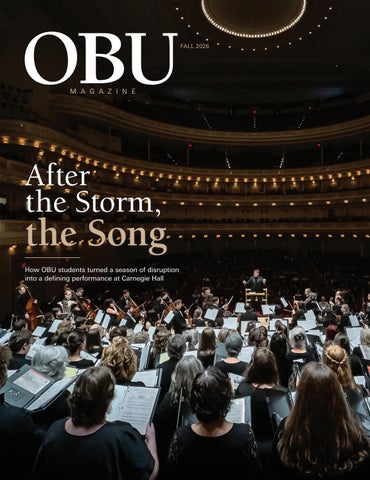
OBU singers join fellow performers on the stage of Carnegie Hall during a oncein-a-lifetime concert experience. The performance marked a defining achievement for OBU’s choral program and the students who brought it to life. Photo by: Mike Violago/MidAmerica Productions
A PUBLICATION OF OKLAHOMA BAPTIST UNIVERSITY FALL 2026
|
VOLUME 20, NUMBER 2
obumagazine.com
IN THIS ISSUE
PRESIDENT
Dr. Heath A. Thomas EDITOR
Paula Gower EDITORIAL DIRECTOR WRITER
Bryan Painter ASSOCIATE EDITOR CREATIVE DIRECTOR / DESIGNER
Chele Marker-Cash PHOTOGRAPHERS
Photo by: Mike Violago/MidAmerica Productions
405.585.5400
3 From the President
4 OBU at Carnegie Hall
Dr. Joshua Chism leads a historic performance 6 The Sound of Excellence A Steinway partnership is elevating music education at OBU
8 Restoring Raley’s Windows
4
Paul Bross Evan Kennemer
14 A Gift that Multiplies Mark Riley shares why investing in students matters
(area code 405)
585.5000
Alumni
585.5413
Career Services
585.5262
Marketing/ Communications
585.5400
President’s Office
585.5801
Switchboard
275.2850
University Advancement
585.5412
OBU Magazine is published by the Marketing and Communications Office, Oklahoma Baptist University, Shawnee, Oklahoma. It is mailed to more than 27,000 alumni, parents and friends of OBU throughout the country and world. To change your mailing address, send an email to update@okbu.edu; or write OBU Magazine, 500 W. University, Shawnee, OK 74804. In compliance with federal law, including the provision of Title IX of the Education Amendments of 1972, Section 504 of the Rehabilitation Act of 1973, and the Americans with Disabilities Act of 1990, Oklahoma Baptist University does not illegally discriminate on the basis of race, color, national origin, sex (including pregnancy), age, disability, military service, or genetic information in its administration of educational policies, programs, or activities, its admissions policies, scholarship and loan programs, athletic or other university administered programs, or employment.
2 obumagazine.com
10 How OBU Shaped a Judge David L. Russell found purpose on Bison Hill 12 Jalee Myers Scholarship recipient invests in leadership and service
CONTACT INFORMATION Admissions
Historic stained-glass windows preserved through restoration
16 The Good Life Savannah Shoffner connects faith and law
8
18 Shape the Future Campaign Updates 22 Philanthropy Report 26 Q&A with Lea Ann Quirk Building lifelong connection through alumni engagement 28 Alumni Connections 30 Pressure Is a Privilege Clay Martin still relies on lessons learned at OBU
32 A Banner Year for Athletics
32
34 No One Wins Alone Celeste Musani’s championship journey to nationals
36 Solar-Powered Stewardship
OBU advances sustainability through conservation and solar innovation 38 Completing the Vision OBU launches its new Doctor of Physical Therapy program 40 A Life Invested in Others Dr. Kenneth Chapman Jr.’s faithful leadership
36
42 Endowed Faculty Chairs Faculty installed in endowed chairs
FROM THE PRESIDENT
Dear OBU Alumni and Friends, In every season of OBU’s story, the Lord has been faithful, using alumni and friends like you to shape lives for His glory. This issue highlights the transformational impact of philanthropy and the many ways faithful generosity continues to strengthen students, programs and the mission of OBU. Every life changed at OBU has a story behind it, and often that story includes someone who chose to give so future generations could experience a Christcentered education. Whether through scholarships, academic programs, campus facilities or spiritual formation, philanthropy remains essential to sustaining and extending OBU’s mission.
“EVERY LIFE CHANGED AT OBU HAS A STORY BEHIND IT, AND OFTEN THAT STORY INCLUDES SOMEONE WHO CHOSE TO GIVE.”
In recent years, we have witnessed God’s faithfulness in remarkable ways across our campus. Shawnee Hall and Thurmond Hall now stand open once again, serving students in renewed and expanded spaces because of the generosity and support of alumni and friends who believe deeply in OBU’s mission. These projects represent more than restored buildings. They reflect lives being shaped, students being equipped and a community committed to investing in the future of Christian higher education. Even as we celebrate what has been renewed, our eyes are fixed on what remains before us: Raley Chapel. For more than 60 years, Raley has been the spiritual heartbeat of this campus. Within those walls, students have encountered the Lord, surrendered to His call and experienced life change that has echoed across generations. Many of you can trace defining moments of faith and calling back to that sacred space. That is why the Shape the Future campaign continues. We are not simply restoring a building. We are renewing a place where future generations of students will worship, grow in their faith and hear God’s calling on their lives. Just as generations before us invested in the students of today, we now have the opportunity to invest in the students of tomorrow. I invite you to continue walking with us as Future Shapers—men and women who believe in what God has done, see what He is doing and are willing to invest in what He will do next. Thank you for loving this university and for faithfully supporting its mission. Together, we are shaping a future grounded in truth, strengthened by community and centered on Christ. With gratitude and hope,
Dr. Heath A. Thomas OBU President
Give to the Shape the Future Campaign at okbu.edu /shape-the-future
3
Photos by: Mike Violago/MidAmerica Productions
One hundred forty musicians from the OBU community and the Chorale Coeur d’Alene from Idaho perform at Carnegie Hall.
WORLD PREMIERE PERFORMANCE
From Raley Chapel to Carnegie Hall A Moment Years in the Making
The first thing was the silence. Then the sound of a breath, a cue, and nearly 140 voices and instruments filling one of the most famous concert halls in the world. For generations of musicians, Carnegie Hall has represented the pinnacle of artistic achievement. On Memorial Day, OBU choir students stepped into that space, transforming months of preparation, years of training and a season marked by extraordinary challenges into a once-in-a-lifetime performance. Led by Dr. Joshua Chism, OBU associate professor of music and director of choral activities, OBU singers joined performers from across the country in presenting Dan Forrest’s “Te Deum,” a large-scale work celebrating and glorifying the Triune God. The concert also featured the world premiere of a newly commissioned composition by Grammy-nominated composer Patti Drennan, written specifically for the Carnegie Hall performance.
4 obumagazine.com
The appearance marked a defining milestone for OBU’s choral program. For the singers who made the trip, it was the culmination of months of rehearsals and preparation for an opportunity many musicians spend a lifetime imagining. “Taking the stage at Carnegie Hall is a monumental milestone for OBU, but the true triumph belongs to our students,” Chism said. “Watching them bring such rigorous, emotionally demanding repertoire to life in a world-renowned venue was nothing short of transformative. This wasn’t just a performance. It was the culmination of months of intense discipline, vulnerability and collective growth.” Music on a National Stage
Inside Carnegie Hall, OBU students stood among musicians from across the country in a space long defined by artistic excellence and expectation. Every detail of the performance carried weight, from the
precision of ensemble sound to the emotional depth demanded by the repertoire. The Carnegie Hall appearance came during a year of transition for OBU’s music programs. Since the devastating tornado that damaged Raley Chapel in 2023, students and faculty have continued pursuing excellence while adapting to temporary rehearsal and performance spaces across the region. Shaped by Challenge and Change
Throughout the academic year, ensembles rehearsed and performed in churches, community venues and partner facilities while work continued on the restoration of Raley Chapel through OBU’s Shape the Future campaign. What could have been a season defined by disruption instead became a testament to resilience, community support and the determination of OBU students and faculty. Experiences such as the Carnegie Hall performance are made possible through the generosity of alumni, friends and supporters whose investments in OBU and its students continue to create transformative opportunities, even amid extraordinary challenges. A Journey Through Community and Preparation
The road to Carnegie Hall included collaborative performances and preparation throughout the spring, including “Sound, Soul and Spirit: An Evening with Dan Forrest” performed at the First Baptist Church in Norman, Oklahoma. Each rehearsal and performance helped prepare students for the scale and intensity of appearing in one of the world’s most celebrated concert venues. A total of 80 people from OBU and the Shawnee community participated in the trip, including 40 OBU undergraduate singers, 15 community singers and alumni, seven faculty and staff members and 18 family members and guests. The performance also included Chorale Coeur d’Alene from Idaho, conducted by Chism in his role as the ensemble’s artistic director.
Beyond the music, the experience reflected the broader mission of OBU’s School of Fine Arts, developing students artistically, intellectually and spiritually through meaningful opportunities. Students represented the university before an international audience while performing music centered on remembrance, hope and faith. A Voice That Carries Forward
When the final chord dissolved into silence, the weight of the moment lingered before the applause began. In that brief pause, the significance of the performance seemed to settle over Carnegie Hall itself. “When I gave the final cutoff, my mind and heart were racing with the electric thrill of the performance,” Chism said. “When I turned to acknowledge the choir and orchestra, thunderous applause began to echo and the audience was rising to their feet.” For the students who made the journey, the experience marked the culmination of months of preparation and a defining musical moment. “Going to NYC and getting to sing at Carnegie Hall was a dream come true,” said Haylee Daniel, a sophomore worship studies major from Marlow, Oklahoma. “It is every performer’s dream to see the Carnegie stage, and getting to actually perform on it was something I never imagined I would do! What a gift the Lord has given me through the OBU music department.” “After the performance, as the singers were filing off and passing by in the wings, the sheer gravity of what we had just accomplished hit me all at once,” Chism said. “I realized I’d witnessed a memory of a lifetime and had the privilege of guiding these students through a defining, unforgettable peak in their musical journeys.” Long after the applause ended, OBU students left Carnegie Hall carrying more than memories of a performance. They carried the confidence that their gifts, refined through dedication and strengthened through adversity, had found a place on one of the world’s most revered stages.
Zachary Ware, a worship arts major at OBU, sings from the stage of Carnegie Hall during a once-in-a-lifetime performance that brought OBU students to one of the world’s most celebrated concert venues.
Restoring the Heart of OBU Music OBU’s performance at Carnegie Hall reflects the strength of a music program long rooted in Raley Chapel. Originally designed with space for a 300-voice choir, the chapel has served for generations as a center for worship, performance and artistic growth. As restoration work continues, the renewed facility will feature improved acoustics, accessibility and functionality, expanding opportunities for student musicians to learn, rehearse and perform. The Carnegie Hall appearance stands as both a reminder of what OBU music has achieved and a glimpse of what its future holds. For more about OBU’s Division of Music, visit okbu.edu/music.
Give to the Shape the Future Campaign at okbu.edu /shape-the-future
5
The Sound of Excellence OBU is pursuing an ambitious partnership with Steinway to elevate music education, equip students with exceptional instruments and expand opportunities for musical excellence.
BRYAN AND LAURA ELMORE
A
piano can fill a room with sound. At OBU, a new partnership with Steinway is poised to do something larger: expand what students can learn, how they can practice and perform and how the university can carry its tradition of music and worship into the future. The Steinway University program will bring a level of access and technology to OBU that few institutions can offer. The university is pursuing the All-Steinway Institution distinction, a rare designation held by about 230 educational institutions nationwide. The designation reflects a commitment to equipping students with Steinway instruments, widely regarded as among the finest pianos in the world. For OBU, the significance reaches well beyond the instruments themselves. It represents an investment in students who will use music in classrooms, churches, concert
6 obumagazine.com
halls and ministries. It gives prospective music students another reason to consider Bison Hill and gives current students resources designed to help them develop their gifts at the highest level. “Becoming an All-Steinway school aligns perfectly with OBU’s long history of excellence,” said Bryan Elmore, who has worked with schools, colleges and universities throughout his career in the piano industry. Elmore’s connection to OBU came through his nephews, who graduated from the university. They encouraged him to share his expertise with OBU leadership as the university worked to strengthen its music program and support the renovation of historic Raley Chapel. “I am honored to serve the Lord by helping OBU continue its tradition of excellence in music and worship,” Elmore said. More Than an Instrument
Steinway instruments are chosen by more than
“I am honored to serve the Lord by helping OBU continue its tradition of excellence in music and worship.” BRYAN ELMORE
97% of the world’s major symphony orchestras and concert artists. Their presence at OBU would place students in daily contact with instruments known for their craftsmanship, consistency and tone. That matters because the instrument is part of the education. Students preparing for careers in music, worship leadership, teaching or performance spend thousands of hours practicing. Access to Steinway pianos gives students the opportunity to learn and perform on instruments comparable to those they will encounter in professional settings. Expanding Opportunity
The impact also can extend to enrollment and the visibility of the university’s music programs. Schools that have achieved All-Steinway status report stronger recruitment, increased music enrollment and greater success in regional and national competitions. The designation also can create opportunities to collaborate with prominent musicians and institutions. At OBU, those opportunities fit naturally within a university where music is woven into academic life, worship and ministry. Beyond the Piano
Through Steinway’s Spirio technology, the next generation of OBU students will encounter capabilities that extend far beyond those of a traditional piano. This technology combines a Steinway grand piano with high-resolution recording, editing and playback capabilities. Students can record a performance, step away from the piano and immediately listen from elsewhere in the room. The recording tools can be used in lessons, rehearsals, composition, coursework and performance preparation, allowing students and faculty to evaluate and refine their work. The technology also can connect OBU with musicians and institutions around the world. Through Spiriocast, performances, lessons, masterclasses and auditions can be transmitted live from one Spirio piano to another. OBU could host or receive private broadcasts, allowing students to learn from guest artists and participate in educational experiences remotely. Students and faculty also can use a catalog of recorded performances for study. MIDI capabilities and cloud-based file sharing allow them to edit and share recordings or incorporate them into other digital work.
An Investment in What Comes Next
The Steinway University program also gives OBU a visible way to communicate its priorities. It can further strengthen instruction and student experience for Bison Hill students. The presence of Steinway instruments tells prospective students and faculty that the university is serious about providing high-quality resources. It tells supporters that investments in the arts can produce lasting opportunities for students. And it reinforces a broader commitment to excellence that reaches across the university. It is about what happens when a university decides that the tools it provides students should match the excellence it expects from them. And for those who believe the arts are worth sustaining, it offers a tangible way to help create those opportunities. One donor expressed that value to Elmore in simple terms: “I contribute to medical research because it extends life, and I contribute to the arts because it makes life worth living.” That idea helps explain why the Steinway initiative matters to OBU. The goal is not simply to put exceptional pianos in practice rooms. It is to give students access to instruments and technology that can help them become better musicians, teachers, performers and ministers. It is to strengthen a program that can attract students, inspire faculty and create opportunities that continue long after a student leaves Bison Hill. Elmore has seen other universities use All-Steinway status to expand their arts programs, launch competitions and increase their regional and national profile. He believes OBU can build on its own tradition of musical excellence in much the same way. As OBU continues investing in its campus and academic programs, the Steinway University initiative becomes another expression of that commitment – an investment in what students can do, where their gifts can take them and how those gifts can be used in service to others. For Elmore, the measure of the effort ultimately is not the name on the piano. It is what students do with the opportunities those pianos create. “This initiative will help Oklahoma Baptist University continue its historic mission of offering its very best to the Lord and to future generations of students,” he said.
Give to the Shape the Future Campaign at okbu.edu /shape-the-future
7
SHAWNEE HALL GRAND OPENING
Light That Endures The glass never shattered.
F
ew features of Raley Chapel capture its soul more completely than its stained-glass windows. For more than sixty years, their vivid colors and carefully crafted imagery have reflected OBU’s commitment to Christian faith, academic excellence and Kingdom service. Today, those beloved windows are undergoing one of the most detailed preservation efforts in university history. When an EF2 tornado tore across OBU on April 19, 2023, it left widespread damage across Bison Hill, including Raley Chapel. Yet the stained-glass windows remained remarkably intact. While the building around them was impacted, they continued to tell their story through light and color. In the hands of artisans at Willet Stained Glass Studios in Winona, Minnesota, each pane is being dismantled piece by piece, cleaned, strengthened and rebuilt so the windows can carry their message of faith, learning and perseverance for generations to come. For alumni who walked into Raley Chapel as freshmen during Welcome Week, worshiped there and crossed its stage at commencement, the restoration represents far more than construction. It is the renewal of one of the spiritual and emotional centers of OBU. “Raley Chapel’s history is not just a chronicle of events, but a narrative of faith, perseverance, and the unyielding commitment of a university to its spiritual and cultural mission,” OBU President Dr. Heath A. Thomas said. “It continues to be a cherished landmark, echoing the values that have defined OBU for generations. The revitalization of this chapel can be symbolic of OBU’s vibrant future.”
The tornado came. The chapel suffered. The windows held.
8 obumagazine.com
A Dream Takes Shape
For more than 60 years, the 200-foot spire of Raley Chapel has risen above Shawnee as a symbol of the university’s mission. Dedicated in 1962 and named for longtime OBU President Dr. John Wesley Raley, the chapel became the physical expression of a dream Raley carried from the beginning of his presidency in 1934. “The building must be more than steel and stone,” Raley told messengers to the Baptist General Convention of Oklahoma in 1944. “It must, in fact, be a part of each one of us. The spire of our faith, a faith which in this physical expression we would ever keep before our youth.” That dream moved closer to reality on Feb. 20, 1959, when trustees, students, pastors and townspeople gathered in bitter cold with gold shovels tied in green and gold ribbon to break ground. Three years later, the doors opened to one of the defining landmarks in Oklahoma Baptist life. Through the years, Raley Chapel hosted worship services, concerts, lectures, commencements and performances by artists including Marilyn Horne, Peter Nero, Jimmy Webb and John Denver. Thousands of students experienced “The Walk” to the chapel as freshmen before returning for graduation beneath its towering ceilings. Windows That Teach
Designed by artist Ruth Dunn in collaboration with Dr. and Mrs. Raley, the eleven windows stretch across the chapel walls as a visual testimony to faith, education, history and human achievement. They do not simply decorate the building. They teach. One window traces Oklahoma history through Coronado, La Salle, the Trail of Tears, land runs and Will Rogers. Another celebrates worship through imagery inspired by Psalm 150. Others explore literature, theology, science, medicine, world missions, Baptist history, business, government, music and fine arts.
Each window invites closer inspection. A pink rosebud hidden inside a treble clef honors Helen Thames Raley. A small black doctor’s bag recognizes Dr. George S. Baxter. Together, the windows form a theological and educational mosaic that mirrors the university’s mission and identity. Another features the OBU seal with an open Bible at its center, surrounded by symbols representing the university’s academic divisions and the motto Veritas Eruditione Religioneque (“Truth through learning and religion”). Now, every section is being painstakingly restored.
The stained glass restoration stands among the campaign’s most meaningful priorities because the windows embody the heart of what Raley envisioned.
The Raley stained glass windows – illustrate Christian faith intersecting with scholarship. – celebrate worship and creativity alongside science and missions.
Preserving a Legacy
– connect Oklahoma history At Willet Stained Glass Studios, a company whose roots stretch back to the 19th century, each window panel to biblical truth and human is removed for inspection and photography. Specialists discovery. create detailed “rubbings,” precise templates documenting original lead sizes and glass placement before the panels are – continue speaking to students long disassembled. after sermons end and ceremonies Every piece of glass is cleaned by hand. Each section is conclude. examined for stress, deterioration or previous repair work. New lead came strips are selected to match the historic profiles exactly. Panels are then reassembled, soldered, puttied for weatherproofing and reinforced with steel bracing before final inspection and crating for return to Shawnee. The work is slow because it must be. Not every panel moves through the studio at the same time. Some remain in pre-production while From glass dulled by time, to the careful work of the artist’s hands, to color restored in full light, these images others are already being trace the enduring life of Raley Chapel’s stained glass. glazed or prepared for shipment. The process reflects the philosophy that has guided Willet’s In morning sunlight, colors spill across chapel walls as they work for generations: preservation without compromise. did in 1962. Freshmen still pause beneath the soaring ceilings. That mission aligns closely with the broader restoration of Graduates still gather beside the windows before stepping into Raley Chapel through OBU’s Shape the Future campaign. their futures. And within every panel is the testimony of endurance. The Shining Into the Future tornado came. The chapel suffered. The windows held. Though the tornado left the chapel standing, the damage Now they are being restored with the same care and forced the longest closure in the building’s history. The conviction that guided their creation more than sixty years ago. restoration now underway seeks not merely to repair what was Raley once envisioned a chapel that would stand as “the damaged but to prepare the chapel for decades of ministry, spire of our faith.” Today, as craftsmen rebuild each panel, that worship and learning. enduring vision still shines through the glass.
Give to the Shape the Future Campaign at okbu.edu /shape-the-future
9
From
BISON HILL
to the Federal Bench
B
y the time David L. Russell arrived on the OBU campus in 1959, he was, by his own admission, As Raley “about as green as you could get.” Chapel rose He was 17, having skipped his final year of high school, at the heart and had attended 11 different schools before graduating from of campus, McLoud High School. Born in Sapulpa and frequently on the a young move, Russell came to Bison Hill searching for direction. What David L. he found instead was transformation. Russell was “I was very fortunate at OBU to have bright, capable and discovering inspirational teachers,” he said. the faith and At the same time Russell was finding his footing, the calling that university was undergoing its own defining transformation. would shape Rising at the center of campus was Raley Chapel, a bold his life and vision of President John Wesley Raley, becoming reality. career. Groundbreaking began the same year Russell enrolled. “At first it seemed to overwhelm the campus,” he recalled. “It always has had a massive presence.” That presence soon became more than architectural. It COUNSELING LAB, FIRST FLOOR became symbolic.
10 obumagazine.com
A Chapel and a Calling
In Russell’s memory, Raley Chapel is inseparable from the OBU experience. “It was a big deal,” he said. “Chapel life was an integral part of being at OBU. To have that kind of facility mattered to everyone.” The first chapel service was held in November 1961 during his student years, and although construction continued in phases, the building quickly became the spiritual and cultural center of campus as envisioned. “In my mind, when I think of OBU, I think of Raley Chapel,” Russell said. “It is the standard there.” That standard was more than physical. It was spiritual. “You were associated with so many good Christian people,” he said. “The leadership was Christian, devout and knowledgeable. My faith grew.” Professors Who Changed a Life
If Raley Chapel shaped the environment, faculty shaped Russell himself. “I had three or four teachers at OBU that literally affected my life,” he said. Government professor Corbitt Rushing was among the most memorable. Philosophy professor Gregory Pritchard introduced him to Plato and Socrates. English professor Dr. William Doster challenged students with readings ranging from National Review to The New Republic to The Atlantic Monthly. “He exposed all of us to things we weren’t aware of,” Russell said. Those experiences sparked a shift. “I had no political interest at all,” he
said. “I started getting that at OBU and became very involved in politics thereafter.” Even OBU President Dr. James Ralph Scales left a lasting impression, forming a friendship with Russell that continued beyond graduation. A Path to the Bench
Russell left OBU in 1962 after three years, entering law school early at the University of Oklahoma College of Law and earning his juris doctorate at 22. His career spanned military service in the U.S. Navy JAG Corps during Vietnam, state government work, and service as a United States attorney. Then came an unexpected call. “One day my secretary came in and said there’s someone on the line saying the president is calling,” Russell recalled. “I thought it was a joke.” It was President Ronald Reagan calling to inform him of a federal judgeship nomination. “He could not have been more gracious,” Russell said. Confirmed by the U.S. Senate in 1981, Russell served more than three decades on the federal bench, including as Chief Judge of the U.S. District Court for the Western District of Oklahoma. Among his most notable cases was the Oklahoma City bombing, where he accepted the guilty plea of Michael Fortier and helped appoint defense counsel for Timothy McVeigh and Terry Nichols. Even so, he never lost sight of his beginnings.
A Debt Repaid
“In my mind, when I think of OBU, I think of Raley Chapel.
Russell is direct about his ongoing support of OBU. “I think I owe the university,” he said. That gratitude has become tangible through the Lynn and Elizabeth Russell Scholarship and ongoing gifts to the OBU Annual Fund, which supports scholarships, academic resources and student life. “It’s just part of repaying my debt for what OBU did for me,” he said. For Russell, giving back is not optional but essential. “Perhaps they can experience Raley as I experienced it,” he said of today’s students, “and look back and see it as a symbol of the university, its education and its rebirth.”
It is the standard there.”
A Life of Impact
Russell received OBU’s Profile in Excellence Award in 1987 and later received an Alumni Achievement Award, along with statewide recognition for judicial service. Yet he returns less to accolades than formation. “OBU shaped me in so many ways,” he said. “I feel fortunate to have gone there.” From a 17-year-old student searching for direction to a federal judge presiding over nationally significant cases, Russell’s journey traces back to a campus in Shawnee and a chapel rising at its center. Raley Chapel once seemed to “overwhelm the campus.” In time, it became something more enduring: a place where faith and learning meet, where lives are shaped, and where a calling began that carried him far beyond Bison Hill. And yet, in many ways, never far from it.
Returning to Raley
Years later, Russell returned to Raley Chapel as a chapel speaker following the Oklahoma City bombing. “It was a homecoming for me,” he said. “An emotional experience.” His connection to OBU has remained strong, deepened further as he has followed the chapel’s damage and restoration after the tornado. “For it to be damaged as it was and to see its rebirth,” he said, “I’m very anxious to come back and see it.”
STUDENT STUDY ROOM, SECOND FLOOR When David L. Russell arrived at OBU in 1959, Raley Chapel was still taking shape. Over time, it would become one of the most enduring symbols of his OBU experience.
Give to the Shape the Future Campaign at okbu.edu /shape-the-future
11
Glorieta Adventure Camps New Mexico
I When Scholarships Carry Dreams n a calling that
Some dreams seem close enough to see but too far away to reach. For Jalee Meyers, OBU was that dream. She wanted a Christ-centered education. She wanted a campus where faith shaped every classroom, every friendship and every opportunity to serve. She could picture herself at OBU long before she knew whether she could afford to attend. The answer arrived in the form of a scholarship. Receiving the Founder’s Scholarship did more than reduce the cost of college. It transformed what she believed was possible. “When I first received the scholarship, it meant more than you could imagine,” said Meyers of Shawnee. “I had always wanted to go to OBU, but financially, it never seemed doable. This scholarship was one of the first steps the Lord used to bring me to my dream school.” The scholarship opened a door. What happened after she walked through it tells the rest of the story. Instead of spending every available hour working simply to stay enrolled, Meyers immersed herself in campus life. She became vice president of the Asian Student Association, secretary of Pi Sigma Phi and Volunteer Action chair on the Student
12 obumagazine.com
Government Association cabinet. She joined the Campus Activities Board, participated in intramural sports and became part of the inaugural President’s Leadership Class. Those experiences filled her year with friendships, leadership opportunities and service that stretched far beyond the classroom. “Practically, I would’ve had to turn down many opportunities because my time would’ve been filled with work rather than being fully bought into oncampus activities,” she said. “Although I do still have a job, it is a job that I am extremely passionate about rather than one where I am seeking the highest pay.” Her leadership journey began almost immediately. During her freshman year, Meyers joined the first President’s Leadership Class because she wanted to learn from OBU President Heath Thomas and Janis Rasnic, director of the PLC, while growing as a leader herself. She discovered leadership is less about titles than awareness. “PLC has taught me the importance of awareness,” she said. “I must be aware of my strengths and weaknesses, the gifts He has entrusted to me and those I lack.”
“I wouldn’t be at OBU if it weren’t for scholarships.” Scholarships don't just open doors. They make dreams possible. One lesson from Ricky Dickson, OBU Business School executive-in-residence and former CEO of Blue Bell Creameries, continues to influence her. He said, “Leadership is knowing who you are, smothered in confidence in whose you are.” That perspective followed her beyond campus. At Immanuel Baptist Church, Meyers serves as an intern with the student ministry, planning events, mentoring students and leading a small group for ninth-grade girls. The role has shown her that ministry often begins with listening. One conversation especially remains with her. A teenage girl began sharing struggles that sounded remarkably familiar. As the conversation unfolded, Meyers recognized her own past in the student’s experiences. “The Lord basically gave me a chance to look my past self in the eye and speak truth to her,” she said. “I was able to encourage her that the Lord could bring deliverance and reassure her of her value and identity as being a daughter of the King.” Although she studies accounting and finance, Meyers has discovered her education reaches well beyond spreadsheets and budgets. The organizational skills she has developed have helped with ministry planning and event budgets, but the greater lesson has been understanding that every profession offers opportunities to reflect Christ. That conviction became even clearer during the summer she spent serving as a day camp counselor at Glorieta Adventure Camps in New Mexico. While many pursue internships focused solely on their careers, Meyers sensed God leading her in another direction. Each day she led Bible studies, guided campers through activities, shared meals and built friendships with children ranging from kindergarten through middle school. The conversations became the highlight of the summer. “I didn’t realize how much someone could go through even at such a young age,” she said. “Helping students understand the love their Creator has for them and how He delights in us was so awesome.” She watched children wrestle with difficult circumstances and heard professions of faith that reminded her why investing in young lives matters. The experience strengthened her desire to remain missionminded wherever God leads, whether in business, ministry or a place she cannot yet imagine. She admits she does not know exactly where that path ends.
“Truthfully, I don’t know what my future looks like vocationally,” she said. “I am trusting that the Lord will open doors that need to be opened and close the ones that I don’t need to step through.” Looking back at her early college experience, she also recognizes the professors and mentors who have invested in her beyond academics. They met with her for coffee, checked on her personally and encouraged her through seasons of growth and uncertainty. When she thinks about her OBU experience, she does not begin with awards or leadership positions. She remembers one night during Welcome Week when she sat down with a group of students she had never met. What began as simple introductions turned into conversations about faith, fear and the lessons God was teaching each of them. They came from different places, backgrounds and majors, yet they discovered a deeper bond. “We were all united under one thing: Christ,” she said. That moment captures what a scholarship made possible. It brought Meyers to OBU. It allowed her to stay. It gave her the freedom to lead, to grow, to serve and to help others encounter Christ. “I wouldn’t be at OBU if it weren’t for scholarships,” she said. “Through the generosity of others, I’ve been blessed with a strong Christian community and a Christ-centered education far beyond what I could’ve hoped for myself.”
Give to the Shape the Future Campaign at okbu.edu /shape-the-future
13
A Gift That
MULTIPLIES The C.W. Riley Memorial Honors Scholarship invests in students whose education at OBU becomes a lifelong legacy of stewardship shaped by faith.
A
student opens an email. Another receives a letter. No stage, no spotlight, no applause. Only a quiet moment that marks the beginning of something larger than itself. At OBU, that moment often signals more than admission or recognition. It signals formation beginning to take root. The C.W. Riley Memorial Honors Scholarship is part of that work, setting in motion a chain of influence that reaches far beyond a single recipient. Funded by Mark Riley, owner of Riley-Walker Funeral Service & Crematory, the scholarship honors his late father, C.W. Riley. It reflects an investment in people, in their calling, character, and capacity to influence others. A quiet but intentional act of belief that says, “You matter, and what you will do with your life matters even more.” That belief carries a ripple effect. “I’ve always believed that when you invest in a student, you’re investing in far more than one life,” Riley said. “You’re investing in every life they will touch.”
“When you invest in a student, you’re investing in every life they will touch.”
Removing Barriers, Creating Space
For many students, the path to OBU is shaped by both MARK RILEY calling and constraint. They Owner, Riley-Walker Funeral arrive eager to grow and follow Service & Crematory God’s leading, but often carry financial uncertainty. Scholarships like the Riley Honors Scholarship do more than remove barriers. They create space to focus, to serve, and to discern direction with clarity.
14 obumagazine.com
“Finances should never be the reason a student can’t pursue God’s calling,” Riley said. “If we can remove the obstacle, we should.” In that space, transformation happens. In classrooms where curiosity becomes conviction. In residence halls where ideas and faith are tested. In chapel where students are formed for lives of purpose. Formed in Community
Recipients are recognized not only for academic achievement, but for how they engage the world. They are thinkers and leaders, but also servants, students who understand that what they receive is meant to be shared. “These students aren’t just high achievers,” Riley said. “They are young men and women with the potential to lead, to serve, and to make a lasting difference.” That mindset is shaped in community and reinforced by those who came before them. Every scholarship at OBU carries a story shaped by someone who chose to invest in another generation. Alumni remember professors, mentors, and donors who made their education possible. They remember what it felt like to be seen. “Someone invested in me along the way,” Riley said. “This is one way I can make sure that same opportunity exists for someone else.” And so the cycle continues, as those who are shaped by generosity begin to extend it. A Ripple That Multiplies
The C.W. Riley Memorial Honors Scholarship reflects a legacy that does not end with one student. It affirms that Christ-centered education shapes individuals and communities, and that equipping one student extends impact far beyond campus. When a recipient becomes a teacher, pastor, counselor, engineer, or business leader, the influence
From left, Dr. Ben Myers, director of the OBU honors program, is joined by OBU students Zadyn Joplin and Thomas Gage, and Mark Riley, owner of Riley-Walker Funeral Service & Crematory. Riley presented each student with the C.W. Riley Memorial Honors Scholarship in honor of his late father.
multiplies across classrooms, churches, organizations, and communities. What begins as a gift becomes something larger. “It bridges present generosity with future multiplication,” Riley said. This is the quiet power of philanthropy. “You may never meet the student you help,” he said, “but you can trust God will use their life in ways you may never fully see.” A Legacy That Continues
Over time, that quiet work builds something lasting, a network of lives shaped by generosity and committed to extending it. At OBU, that network continues to grow. Students who receive scholarships often carry forward the same spirit of giving, serving on campus and later investing as alumni through mentoring, leadership and support. It becomes a cycle of stewardship. “Everything we’ve been given is from the Lord,”
Riley said. “Stewardship means asking how we can use those gifts to serve others.” The scholarship invites students into that calling early, reminding them their education is meant not only for personal advancement, but for the good of others. Philanthropy, at its best, is not about dollars or recognition. It is about people, believing in students you may never meet and trusting God with outcomes you will never fully see. The return is not financial, but transformational. That is the legacy of the C.W. Riley Memorial Honors Scholarship. It begins quietly, in a moment most will overlook. But it unfolds over a lifetime, shaped by generosity, grounded in faith, and extended through a commitment to invest in others. And it is a reminder that the most meaningful gifts are the ones that continue long after the moment they are given.
Give to the Shape the Future Campaign at okbu.edu /shape-the-future
15
The
Good Life How Savannah Shoffner discovered the intersection of law, faith and excellence at OBU
“OBU helped me re-situate my thinking about what a career should be by showing me how faith could be meaningfully integrated into every part of life, even and especially work. I realized that I only have one life and I want every part of it to be for God.”
16 obumagazine.com
When Savannah Shoffner arrived at OBU, she knew she loved learning and wanted her faith to matter. What she did not know was how God would fit those pieces together. Today, the 2023 OBU graduate is also a graduate of Notre Dame Law School. Along the way, she served as a Blackstone Legal Fellow, became managing senior editor of the Notre Dame Law Review, worked in Notre Dame’s Religious Liberty Clinic and published legal scholarship in the Harvard Journal of Law & Public Policy. This fall, she began a federal clerkship with Judge Patrick Bumatay of the U.S. Court of Appeals for the Ninth Circuit and plans to return to the Washington, D.C., office of Sidley Austin, where she previously interned. Yet Shoffner insists the most important lessons she learned were not about legal writing or constitutional law. They were about becoming a person capable of handling success without being defined by it. For that, she credits OBU. “OBU helped me re-situate my thinking about what a career should be by showing me how faith could be meaningfully integrated into every part of life, even and especially work,” said Shoffner, who earned degrees in mathematics and history. “I realized that I only have one life and I want every part of it to be for God.” That perspective would shape her professional ambitions and her understanding of what it means to live well. Faith and Formation
At OBU, Shoffner encountered a philosophy that challenged her to think beyond earning a degree or securing a career. Through Western Civilization courses, Honors classes and conversations, she explored culture, history, philosophy and faith in ways that would leave a lasting mark on her life and work. “OBU helped me understand the value of educating the whole person,” she said. “One element of that is knowing our heritage - where our institutions came from, why they are important and why they should be protected.”
That understanding has also shaped how Shoffner thinks about giving back as an OBU donor. “I am so grateful that I had the opportunity to come here and be exposed to professors and to literature. I still enjoy diving into literature, and it has become part of the air that I breathe,” she said. “I want future generations to have that same opportunity. I believe we have a responsibility to those who come after us to help ensure that continues for generations to come.” “I genuinely believe that institutions that spread the gospel, teach good values and train up the next generation save lives and save souls. So, I am very happy to be a part of that,” Shoffner said. Her experience at OBU continues to shape her in tangible ways, particularly through the study of history. “When I took Civ, I realized that God gave me joy in history and writing,” she said. “It made me come alive in ways that other subjects did not.” As she explored the relationship between faith, society and government, Shoffner became fascinated by attorneys who devote their careers to religious liberty and the Constitution. “I was excited because that kind of work seemed to be the intersection of faith and joy and gifting that I was looking for,” she said. Discipline and Calling
As a member of the OBU women’s soccer team, Shoffner also learned discipline, perseverance and resilience. “I often did not enjoy it at the time, but Coach Mike White’s high standards pushed me to work harder than I thought I could and to stop making excuses for myself,” she said. That discipline would prove invaluable in law school. “Law school is a lot of pushing through and doing things you do not want to do in order to get something incredibly valuable in the end,” she said. “If I had not been pushed to
exercise self-discipline through soccer, I would not have been ready for the workload.” During her undergraduate years, Shoffner also developed a spiritual routine that remains central to her life. Whether balancing classes, soccer practices or shifts at the Recreation and Wellness Center, she made time each morning to study Scripture. “Every single day, no matter how busy you feel, you just force yourself to do it,” she said. “That time has become my lifeline, putting everything else back into perspective and helping me stay connected to God.” History, Law and Purpose
Shoffner’s legal scholarship offers one of the clearest examples of how her OBU education continues to influence her work. Recently, she co-authored an article in the Harvard Journal of Law & Public Policy examining constitutional questions involving grand juries. The project emerged from an ongoing political debate over Alaska’s grand jury system and required extensive historical research. Her undergraduate honors thesis focused on medieval legal reforms under William the Conqueror and Henry I of England. What began as a fascination with history later became directly relevant to legal scholarship. “When I was asked to work on the Alaska article, I was asked to go as far back into the history of the grand jury as I thought was relevant,” she said. “It was a dream come true.” “On any given project, you start off doing a huge amount of research and then you slowly whittle it down to what’s important,” she said. “It takes practice to deal with that amount of information and shape it into a coherent argument.” But for Shoffner, law has never been solely about intellectual achievement. The Good Life
As she prepares to begin her clerkship
“The good life is measured not by prestige or accomplishment, but by faithfulness, virtue and service.”
and later join Sidley Austin, she hopes to continue writing, publishing and contributing to important constitutional and appellate cases. “Law can sometimes be a dehumanizing profession,” she said. “There are incessant temptations to give in to the ‘golden handcuffs’ and pursue wealth and fame at the expense of character.” OBU, she believes, offered an alternative vision. The university introduced her to what philosophers have long called the good life – one measured not by prestige or accomplishment, but by faithfulness, virtue and service. “OBU helped me see a picture of a different life,” she said. She hopes to pursue excellence while remaining humble, to advocate boldly while staying grounded in prayer, to invest in others while pursuing demanding professional goals and to use her gifts in service rather than selfpromotion. Ultimately, Shoffner’s ambitions extend beyond becoming a successful attorney. “I hope to be a lawyer the way that Christ would be a lawyer,” she said. But the deeper legacy of her OBU education is found elsewhere. It is found in a graduate who learned to connect faith and vocation, scholarship and service and excellence and humility. It is found in a young attorney entering one of the nation’s most influential professions with a clear sense of purpose and a commitment to honor God in every season. For Shoffner, the good life is not found in prestige or power, but in pursuing excellence while following Christ faithfully.
Give to the Shape the Future Campaign at okbu.edu /shape-the-future
17
PHILANTHROPY REPORT
GENEROSITY
Because of you, OBU is equipping students to lead with faith, serve with purpose and impact the world for Christ.
Dear OBU Alumni and Friends, This OBU Magazine shares stories of those who accepted an invitation to be part of what God is doing at OBU through philanthropy. Through gifts of time, wisdom, knowledge and resources, they have changed lives for Christ’s Kingdom on Bison Hill and throughout the world. Throughout Scripture, God entrusts His people with opportunities greater than themselves. The question is never simply, “What has God entrusted to us?” but “What will we do with it?” The stories in this issue begin with those questions and end with the same answer. Someone recognized an opportunity to invest in something far greater than what they could do alone because they believed that the next generation was worth preparing, equipping and sending into the world for Christ. For more than a century, the OBU family has answered that question faithfully. Because someone gave, students discovered their calling. Because someone sacrificed, leaders were equipped to serve. Because someone believed, lives were transformed and OBU graduates carried that impact into churches, classrooms, hospitals, businesses, mission fields and communities across the globe. Now, that same invitation has been extended to us. We have been entrusted with an extraordinary opportunity, not simply to preserve what generations before us built, but to strengthen it for generations still to come. The restoration of Raley Chapel is not simply about restoring a building. It is about restoring and strengthening the spiritual heart of a university where students encounter Christ, wrestle with His calling, and prepare to serve His Kingdom. Long after Raley’s walls are restored, the lives formed within them will carry the hope of Christ into the world. Each generation is given an opportunity. I believe this is ours. This is our opportunity to shape the students whose lives will be transformed here, the communities they will serve, and the Kingdom impact they will carry to world. The stories in this magazine are more than stories of generosity. They are invitations - some already accepted and others still open. Invitations to become part of something bigger than ourselves. Invitations to join generations of alumni and friends who understood that what God does through OBU is always greater than any one person.
ALUMNI IMPACT TO DATE
5.6 M
$
TOTAL RAISED
My invitation to you is simple: Join us. Join us in strengthening the heart of Bison Hill by Restoring Raley. Join us in shaping a future that will extend far beyond our own generation. Join us in investing in students whose lives will influence countless others for Christ. Together, we have the privilege of participating in a Kingdom legacy that will outlive us all. I hope you’ll accept the invitation. Thank you to those of you who already have. What a privilege to be part of this with you. With much gratitude and expectation, Julie Paul Vice President of Advancement and Alumni
YOUR IMPACT
+ 4,500 donors gave $ 46,500,000
1,649
TOTAL NO. OF DONORS
TO DATE
Thank You FOR SHAPING THE FUTURE OF OBU.
PHILANTHROPY REPORT
“Because of your support, I am able to pursue my calling and make an impact for His kingdom.” LILLY SCHROEDER OBU Senior
ACADEMICS
Thank You
$
Throughout the Shape the Future campaign, the impact of your support can be seen across Bison Hill – in academics, scholarships, campus life and facility improvement. Your remarkable generosity has carried this campaign beyond its original vision. Now, together, we turn toward restoring the heart of Bison Hill – historic Raley Chapel – and completing Phase I of the Shape the Future campaign.
3.7M+ TOTAL GIVEN
FACILITY IMPROVEMENT
$
18.3 M+ TOTAL GIVEN
SCHOLARSHIPS
$
5.7 M
INCLUDING
8.2 M+
+
TOTAL GIVEN
$
Shawnee Hall COMPLETED
CAMPUS LIFE
$
14 M
+
4.3 M+
$
Thurmond Hall COMPLETED
TOTAL GIVEN INCLUDING
11.7 M+
$
Campus Life Enhancements
2.3 M+
$
Tom Elliff Center for Missions
Together
88,000+
$
Wood Science
PHASE I COMPLETED
5.8M+
$
Raley Chapel IN PROGRESS
Raley Chapel
WE CAN FINISH THIS CHAPTER.
PHASE I GOAL
$
42M
“THE RESTORATION OF RALEY CHAPEL IS MORE THAN AN ACT OF PRESERVATION – IT IS AN INVESTMENT IN OUR FUTURE.” DR. HEATH A. THOMAS, OBU PRESIDENT
PHILANTHROPY REPORT
Investing for the Future Every gift to the endowment helps build a lasting source of support for OBU and the generations who will follow. 14.4% GROWTH OVER TWO YEARS
ENDOWMENT GROWTH
GIVING The campaign is one chapter in a larger story of philanthropy at OBU. Here’s a look at the broader, enduring impact of giving across the university.
184.9 M+
$
190M 180M 170M
MAY 31, 2026
MAY 31, 2025 $
172M
7.5 % growth
MAY 31, 2024 $
161.6M
160M 6.4 % growth
150M
TOTAL SCHOLARSHIPS Investing in students. Building futures.
32.5 M+
$
FY25-26
28.2 M+
$
BUDGETED
SCHOLARSHIPS
4.3 M+
$
ENDOWED / FUNDED SCHOLARSHIPS
“
I wouldn’t be at OBU if it weren’t for scholarships.” JALEE MEYERS OBU Junior
Read Jalee’s story on page 12.
FROM GIFT to GROWTH TULSA ROYALTIES In 1999, the Lawrence Pietz Revocable Trust donated mineral interests encompassing 900 acres to OBU, with a contribution investment value of $1.5 million. Since then, those interests have generated significant financial returns for the university. The returns from the past two years are shown below.
ORIGINAL GIFT
RETURNS ON ORIGINAL GIFT
1999
1.5M
2024 —
$
2025 —
1.44M | $ 1.40M | $
97% of original gift value 93% of original gift value
Use of 2025 Contributions These funds are making an enduring impact through wise stewardship, supporting projects like:
483,452
91,400
$
150,000
$
ENGINEERING STARTUP and SCHOLARSHIPS
$
SOFTWARE
480,000
$
CONSTRUCTION
DEBT RETIREMENT
60,000
$
COURSE DEVELOPMENT
A legacy gift. A growing return. A lasting impact.
136,358
$
FUTURE USE
PHILANTHROPY REPORT
FY26 GIVING SNAPSHOT Because of your generosity, lives are changed and the mission of OBU lives on.
7,592,183.56
2,649
5,672
TOTAL GIVING
TOTAL DONORS
TOTAL GIFTS
$
1,338.54
$
AVERAGE GIFT SIZE
GIVING BY CONSTITUENCY FRIENDS OF THE UNIVERSITY (87.5%)
ALUMNI (12.5%)
$6,641,344.22
$950,839.34
2,001 FRIENDS (everyone that's not an alum) 3,914 gifts | $1,696.82 average gift size
648 ALUMNI 1,758 gifts | $540.86 average gift size
ANNUAL FUND
Supports scholarships, classrooms and labs, and the everyday expenses that enhance the student experience.
172,473.20
$
337 DONORS
BISON BACKERS
A community of donors investing in OBU and the lives of its students.
VOICES OF IMPACT “OBU shaped me in so many ways. The people who went there were good people. I feel fortunate to have gone there. Giving is just part of repaying my debt for what OBU did for me.” JUDGE DAVID RUSSELL, OBU Class of 1963
Read Judge Russell's story on page 10.
“OBU helped me understand the value of educating the whole person. I want future generations to have that same opportunity. I believe we have a responsibility to those who come after us to help ensure that continues for generations to come.” SAVANNAH SHOFFNER, OBU Class of 2023
Read Savanah's story on page 16.
MISSIONS & MINISTRY Prison Divinity Program
$269,856.59 40 DONORS
Tom Elliff Chair and Center for Missiology
$65,440.37 10 DONORS
GO Trips
$240,836.10 812 DONORS PRISON DIVINITY COMMENCEMENT
465 GAVE TWO YEARS IN A ROW!
FY25 FY26
$ 800,958.00 $ 1,234,800.65
$2,035,758.65 TWO-YEAR TOTAL
Thank you for your generosity.
Your giving makes a difference today and leaves a lasting impact for generations to come.
Keeping Alumni Connected to the Mission Lea Ann Quirk’s story reflects a broader reality at OBU: alumni remain connected long after graduation through relationships, generosity and shared purpose.
L
ong before she returned to Bison Hill as OBU’s executive director of the alumni association, Lea Ann Quirk learned what it meant to invest in a place that shapes lives. As a student, she found community in late nights at Kerr, live “News30” broadcasts and walks across campus that still feel familiar today. Professionally, she spent nearly two decades building alumni connections and advancement programs at the university of Oklahoma. Since returning to OBU in 2021, the 2002 graduate has helped alumni rediscover their ties to the university that helped form them while encouraging a new generation of Bison to stay connected for life.
26 obumagazine.com
You’ve experienced OBU both as a student and now as executive director of the alumni association. How has your understanding of alumni engagement and giving evolved over time? As a student, I experienced OBU through relationships, traditions and a strong sense of community. I loved my time here, but I probably didn’t fully understand all the people and resources working behind the scenes to make everything possible. Now, serving in this role, I see alumni engagement and giving in a much deeper way. It’s about helping future generations experience the same life-changing environment. I’ve come to understand that generosity is about much more than money. It’s mentorship, encouragement, showing up, opening doors for students and helping keep OBU’s mission strong for years to come.
“Alumni are living proof of the mission. They are future shapers in action.”
alumni stay connected, it creates momentum and stability for the institution and helps ensure future students can continue experiencing what makes OBU special.
For alumni who feel disconnected or unsure how to get involved, what would you say to encourage them to re-engage with OBU? I would tell them it’s never too late to reconnect. Alumni engagement is not one-size-fits-all, which is why we strive to offer a variety of programs, services and events that provide multiple avenues for connection. For some people, reconnecting may mean attending an event or returning to campus for The Weekend. For others, it might mean serving on the OBU Alumni Board or traveling with us through the Traveling Bison program. For legacy families, it could mean bringing children to campus for a Bison Day or encouraging students to participate in annual events such as Super Summer or Generation Why. For others, it may simply mean keeping contact information updated and reading our monthly e-newsletter, The Graze. Some alumni also choose to give financially to support campus priorities and invest in current students. Whatever the avenue, we want alumni to know there is still a place for them here. Once a Bison, always a Bison.
From your role today, what are some of the most meaningful ways you’ve seen alumni give back beyond financial contributions? Some of the most meaningful examples come through relationships. I’ve seen alumni lead students to Christ, mentor students, help graduates find internships and jobs, volunteer at events, recruit prospective students and simply stay present and engaged. Sometimes an alum showing up to encourage a student or share their story can have a lasting impact. Those moments matter deeply. One of the beautiful things about OBU is that our alumni genuinely want the next generation to succeed.
Why is alumni engagement so critical to the long-term mission and future of OBU? Because alumni are living proof of the mission. They are future shapers in action. They carry OBU into churches, schools, businesses, ministries and communities around the world. An engaged alumni base strengthens the university through advocacy, mentorship, networking, philanthropy and student recruitment. When
Looking ahead, what is your vision for building a culture of generosity among the next generation of OBU graduates? My hope is that we continue helping students understand from day one that being part of OBU is lifelong. I want students to see generosity not as pressure, but as participation in a community that has already invested in them. That culture starts with connection and belonging. If students graduate feeling deeply loved, supported and transformed by their OBU experience, generosity becomes a natural next step. I also want our graduates to feel proud to tell others they are OBU alumni. I can’t tell you how many doors have opened for me simply because I was willing to share my OBU story and connection with others. OBU alumni are everywhere, and those connections often become incredibly meaningful. God often uses those relationships in ways we never expect, opening opportunities, encouraging us professionally and personally, and reminding us that the OBU community truly stays with you for life. My vision is for future generations of Bison to stay connected, stay engaged and continue strengthening the herd for those coming behind them.
Give to the Shape the Future Campaign at okbu.edu /shape-the-future
27
OBU ALUMNI
OBU Traveling Bison 2026 Discover Egypt and the Nile Valley
Where
CONNECTION INVESTMENT —— B E C O M E S ——
Across the world, alumni gatherings tell the same story: relationships that last, generosity that grows, and a shared commitment to the future of OBU – where connection often becomes investment.
CAB Reunion
“
It was incredibly rewarding to see our Alumni Board come together through the Bison Serve project at Hope Pregnancy Center of Shawnee. The day was a wonderful reminder that OBU alumni don’t just care deeply about the university – they care deeply about serving others. It was a joy to watch board members live out the values that make the OBU family so special.” LISA ROTH, ’92 OBU Alumni Board Past President Oklahoma Baptists at SBC in Orlando
28 obumagazine.com
“
Every time I participate in an Alumni event, whether by stepping back onto campus or attending one of our gatherings, I am reminded of how OBU invested in my own life and calling. That enduring legacy is why I choose to give back monthly, ensuring we continue to equip and support the next generation of faith-driven leaders.
OBU Night at the Thunder Senior Sendoff
JEREMY SMITH, ’00
Oklahoma City Food Tour
Bison Serve
“
Engaging with OBU students and alumni provided me a deep appreciation for the university’s mission and future. Paired with my passion for higher education, I wanted to support the Engineering program during OBU’s Giving Day.”
The Weekend
KAREN LACY Traveling Bison Traveler 2025 Footsteps of Paul Tour
Give to the Shape the Future Campaign at okbu.edu /shape-the-future
29
PRESSURE PRIVILEGE
HOW OBU SHAPED AN NFL REFEREE, LEADER AND MAN OF FAITH
IS A
On NFL Sundays, Clay Martin works in a role where preparation, judgment, and leadership are tested on every play. Tens of thousands fill stadiums. Millions more watch from home. Every decision is analyzed, every announcement amplified, every call replayed from multiple angles. As an NFL referee and crew chief, Martin operates at the highest level of his profession. Yet when he reflects on what prepared him for these moments, his mind returns to OBU – days spent around the Noble Complex, Raley Chapel and Shawnee Hall. “The investment that so many on Bison Hill made in me is humbling,” Martin said. “Professors, game workers, cafeteria workers, admissions, etc. There was an intentional effort by many different stakeholders to help me connect with others while growing as a student and athlete.” That investment helped shape the foundation he still relies on today.
30 obumagazine.com
“The investment that so many on Bison Hill made in me is humbling.” CLAY MARTIN
A Tulsa native, Martin arrived at OBU as a talented basketball player. By graduation in 1999, he had become one of the most accomplished point guards in school history, helping lead the Bison to three NAIA National Tournament appearances, including a national runner-up finish in 1997. He became OBU’s career leader in assists and steals and was inducted into the Athletics Hall of Fame in 2011. But records and awards are not what he remembers most.
“Preparing, improving, helping others be at their best, managing adversity and communicating effectively,” he said. “Coach Hoffman and Coach (Robert) Davenport modeled these attributes, and I draw on lessons from Bison Hill every NFL season.” The pressure is significant, but Martin embraces it. “I’ve heard it said that ‘pressure is a privilege,’ and I agree,” he said.
PEOPLE BEFORE ACCOLADES
GROUNDED BY FAITH AND GRATITUDE
Among them was Dr. Ronda Hall, who helped him build confidence while pursuing a Spanish minor. “She gave me confidence in getting out of my comfort zone while exploring a foreign language and created an environment where I could grow from failure,” Martin said. Dr. Linda McElroy “Dr. Mac” also served as both professor and adviser. “Her passion for her job, attention to detail and ability to connect with students were contagious,” Martin said. “Her heart for serving others is an attribute all her students learned from her.” As an education major, Martin credits Dr. Jeanne Akin with modeling the lasting influence teachers can have on young people. “She taught and modeled the impact teachers can have on young people, an impact that extends well beyond the classroom,” he said. Hall of Fame coach Bob Hoffman also left a lasting imprint. “Coach impacted my life then and continues to do so today,” Martin said. “Servant leadership, getting the best out of others and using athletics to glorify God… his impact on me is significant.” Those lessons extended beyond basketball. “It didn’t take long to figure out that when everyone uses their strengths to the best of their ability, the team wins,” Martin said. “He taught me that being great at little things leads to championship opportunities.”
His ability to handle that pressure is rooted in a faith strengthened at OBU. Psalm 119 remains a guide — reminding him to treasure God’s Word and to trust it as a lamp for his path. “Managing adversity and scrutiny is part of my life,” Martin said. “Having Scripture I can turn to helps me pause and pray instead of rush and react.” “My time at OBU allowed me to grow significantly, but also taught me that I needed to grow up,” he said. “It helped me recognize my arrogance and selfishness and work toward humility and selflessness.” That perspective shapes every leadership role he holds. “In all of my roles today, putting the needs of others ahead of my own and getting the best out of them is paramount.” Looking back, gratitude remains central. “Many people gave to OBU so that leadership can use those resources to continue improving Bison Hill,” Martin said. “I feel that almost every Bison has a story about how their time at OBU impacted their life,” he added. Whether mentoring students, leading coaches or officiating in the NFL spotlight, Martin carries lessons first learned on Bison Hill. That’s why he and his family remain committed to helping future students experience the same community. “I’m thankful that our family can do the same to hopefully help create an experience that Bison students are proud of,” he said. Seeing campus today, he recognizes continued momentum. “I’m proud to see the magnificent changes and improvements under Dr. (Heath) Thomas’ leadership,” Martin said. “OBU remains committed to a Christ-centered education where students can grow, connect and shape the future.” If he could speak to his younger self, his message would be simple. “I’d tell him to be grateful for those who invested in him,” Martin said. “Many of the lessons he’s going to learn will become the foundation for the rest of his life.”
LESSONS BEYOND BASKETBALL Today, Martin serves as athletic director for Jenks Public Schools while also leading NFL officiating crews. Though the settings differ, he sees the same principles at work. “Leading an NFL crew is simply amazing,” Martin said. “Although it’s unique, it’s quite like being on a team.” Preparation, communication, accountability and trust remain central.
Give to the Shape the Future Campaign at okbu.edu /shape-the-future
31
MEN’S BASKETBALL – NCAA DII Elite Eight • 31 Wins
SPIRIT TEAMS – Multiple National Championships
By the final buzzer in Pittsburgh, OBU’s historic men’s basketball season had become bigger than the court itself. Across dorm rooms, classrooms, chapel services and packed watch parties on Bison Hill, students witnessed something rare: a spring semester defined by championships, national rankings and record-breaking performances.
THE YEAR OF THE
BISON 31 Men’s Basketball Wins & NCAA DII Final Four National Champion Spirit Teams 13 Track & Field National Qualifiers with a 4x100 School Record and High Jump Record First D2CCA All-Region Honors in Women’s Basketball Highest-Ranked Softball Team in Program History
32 obumagazine.com
Victories came on hardwood courts, cheer mats, track surfaces and softball diamonds, helping establish OBU as one of the nation’s most successful NCAA Division II athletic programs in 2025-26.
MEN’S BASKETBALL OBU men’s basketball led the charge, finishing 31-4 and advancing to the NCAA Division II national semifinals, becoming the first Great American Conference men’s program to reach the Final Four. Under GAC Coach of the Year Jason Eaker, the Bison captured the conference regular-season title, won the NCAA Central Regional championship and advanced through the Elite Eight to Pittsburgh. Led by GAC Player of the Year and All-American Terry Coner Jr., OBU set a Division II-era program record for wins and completed the most successful season ever by a men’s team in Great American Conference history.
SPIRIT TEAMS OBU spirit teams continued their national dominance at NCA College Nationals, capturing multiple championships. Team Green repeated as All Girl Advanced national champions, Team Gold won the All Girl Intermediate title and Team White repeated as Spirit Rally national champions. The dance team added a national championship in Team Performance. In STUNT, OBU defeated Jessup University 30-29 to win its second national championship in three seasons. Head Coach Jessica Wolverton (Stiles) was named College STUNT Coaches Association Division II Coach of the Year.
TRACK AND FIELD Track and field added another historic chapter at the NCAA Division II Outdoor Championships. Jamora Horace became OBU’s first female NCAA national champion, winning the high jump with a school-record leap.
TRACK AND FIELD – School Records and All-Americans
OBU’s 4x100 relay team – Dwayne Fleming, Caden Peevey, Kobe Brown and Gage Spencer – broke the school record in 39.85 seconds. The women recorded the best national finish in program history, placing 12th, while the men finished a program-best 17th. Thirteen athletes qualified for nationals, the most in OBU’s Division II era, with multiple athletes earning All-American honors and school records.
MEN’S CROSS COUNTRY Men’s cross country qualified as a team for the NCAA Championships for the first time, ending the season ranked No. 25 nationally.
VOLLEYBALL Volleyball finished 22-9 and captured the GAC Tournament championship as the No. 5 seed, earning the program’s second tournament title in three seasons and a berth in the NCAA Tournament.
WOMEN’S BASKETBALL Women’s basketball celebrated a milestone season as Jaedyn Getman became the first player in OBU’s Division II era to earn DII Conference Commissioners Association All-Central Region honors after averaging nearly 20 points and 8.6 rebounds per game.
SOFTBALL Softball finished 41-14 and reached No. 14 in the National Fastpitch Coaches Association rankings, the highest ranking in program history. Greenlee Wells earned GAC Player of the Year and NFCA First Team All-American honors while helping lead one of the most successful seasons the program has produced.
A SEASON TO REMEMBER Individually, each achievement stood out. Together, they elevated OBU athletics to national prominence. The Bison proved they could compete with anyone in Division II – and left a legacy that will last.
“
Philanthropic support is essential to OBU Athletics. Every gift helps fund travel, equipment, uniforms, and maintenance and improvement of athletic facilities – resources that directly impact our training and performance. We work intentionally to steward those dollars well and find creative ways to maximize every investment in our programs. Our student-athletes are striving for a world-class experience on par with what students receive in OBU classrooms and labs. Whether on the field or in academic spaces, that level of excellence is only possible through strong support and the resources that sustain it.” ROBERT DAVENPORT OBU Director of Athletics
Give to the Shape the Future Campaign at okbu.edu /shape-the-future
33
No One Wins
Alone
Built through discipline, trust, and the people who never let go.
For most fans, the routine lasts just a few minutes. For the athletes performing it, the journey begins months earlier. Every moment at the National Cheerleaders Association College Nationals is earned through hours of practice long before anyone steps onto the competition floor. Success depends on trust, discipline and teammates who know they can count on one another when the music starts. That is what Celeste Musani remembers most. Musani helped the Bison continue a championship tradition at the NCA College Nationals. The championships were unforgettable, but for Musani, they represented something much bigger than a trophy. “They’re the result of showing up every day,” she said. “Motivation can only take you so far. Most of it is discipline.” That lesson has shaped the junior’s time at OBU. Musani came to OBU from Sherman, Texas, where she attended a small Christian school through middle school and her freshman year of high school before transferring to Sherman High School. “I was quiet, kept my head down and did what I could to fit in,” she said. More than academics, she wondered where she would fit and whether she would find a place to belong. Joining the cheer team became the first step. FINDING HER PLACE
What began as an opportunity to try something new quickly became an environment where she learned to trust teammates and believe in herself. Every practice required communication. Every stunt depended on teammates doing their jobs. Every routine demanded that each athlete put the team ahead of individual recognition.
34 obumagazine.com
Cheer also reinforced the values her parents had taught her. “My mom and dad raised me to always be kind and do my best in whatever I was doing,” she said. Although she grew up in church, Musani said high school was when her faith became personal rather than simply part of her family’s routine. As she grew spiritually, some friendships naturally changed and she found herself surrounded by people who encouraged her faith. Those experiences helped prepare her for choosing a college. Musani knew she wanted to continue cheering, so she attended recruiting clinics at several universities while exploring where she might fit academically and personally. At OBU, she met cheerleader Lorna Darling.
“I will forever thank God for the opportunity to go to OBU.” “The light of God shined so brightly through her that day,” Musani said. She left campus with that same sense of authenticity from the coaching staff. Rather than focusing only on what she could contribute on the competition floor, the coaches took time to know her as a person. They asked about her goals, her interests and the kind of community she wanted to be part of during college. When her recruiting letter arrived, the decision already felt clear. “I will forever thank God for the opportunity to go to OBU,” she said. LESSONS BEYOND THE MAT
Musani is a psychology pre-counseling major with an art minor and serves as vice president of the Student Government Association in 2026-27. She previously served as deputy events coordinator. Balancing those responsibilities with a nationally competitive spirit program has reinforced lessons she first learned in cheer. On the mat, teammates depend on one another to execute every routine safely and successfully. Missing a count or hesitating during a stunt affects everyone, not just one athlete. The same principle applies in the classroom, student leadership and everyday campus life. Musani said the relationships she has built with teammates have become one of the most meaningful parts of her OBU experience. Those relationships proved important during her sophomore year. Like many college students, Musani encountered a season that tested her emotionally. “I felt like my spark was gone,” she said. She kept showing up for class, practice and her responsibilities. Over time, she said God used teammates, friends and mentors to remind her she wasn’t walking through those challenges alone. Looking back, Musani believes those relationships strengthened her just as much as any championship experience. Her coaches also played an important role. Coach Jessica Stiles, Coach Kylie Lindsey and Coach Lindsay Smith invested in her beyond practices and competitions, caring about her growth as a student and as a person.
Musani believes professors, coaches and staff members genuinely want students to succeed. As vice president of the Student Government Association, Musani helps plan campus events while representing the student body. The role has strengthened skills she first developed through cheer, including communication, adaptability and working with people who bring different ideas and perspectives. Still, when asked what has shaped her most during college, she quickly returns to athletics. The national championships are meaningful because of everything required to reach them: months of practice, countless repetitions, learning from mistakes and trusting teammates. Those are the moments that stay with her. CARRIED BY COMMUNITY
One campus event brought those lessons into even sharper focus. During Cornerstone, the celebration marking the rebuilding of Raley Chapel, students gathered outside the chapel before walking together as part of the evening’s program. As a student leader preparing to dismiss the crowd, Musani paused and looked across the gathering. “I realized how many people truly do seek a community to thrive with,” she said. “In that moment, everyone there was unified in such a special way.” She realized the same spirit that allows a cheer team to succeed also shapes life across campus. People encourage one another, celebrate together, help carry one another through difficult seasons and pursue shared goals while growing individually. For Musani, those experiences have become the defining part of her time on Bison Hill. The championships will always be part of her story, along with opportunities to lead, grow and prepare for her career. But when she reflects on her years at OBU, what stands out most isn’t a trophy or a title. It’s the people who walked beside her. The teammates who became friends. The coaches who invested in her. The mentors who encouraged her faith. The community that reminded her she belonged. For Musani, that may be the greatest lesson athletics has taught her. No championship is won alone, and the most meaningful successes in life rarely are either.
Give to the Shape the Future Campaign at okbu.edu /shape-the-future
35
Alumni Leading Energy Innovation Two OBU alumni are helping the university reduce energy costs through conservation, solar innovation and long-term stewardship.
W
hile their efforts are distinct and their professional paths unrelated, John Bernard, a 1982 OBU graduate, and Tony Capucille, a 2002 OBU graduate, are both giving back to the university that helped shape them, one through conservation and resource stewardship, the other through renewable energy. Together, their separate contributions support OBU’s long-term sustainability efforts and create new opportunities for energy savings across campus. Bernard and Energy Conservation
Bernard is chief sustainability officer at Cenergistic, a national energy conservation company that helps organizations across 48 states reduce energy consumption and reinvest savings into mission priorities. OBU partnered with Cenergistic in 2021 to launch a campuswide energy conservation program that continues to generate measurable cost savings and environmental benefits. “My company works on the demand side of energy,” Bernard said. “We help partners like OBU lower their energy consumption and recover dollars that were going to utility companies. That allows OBU to reinvest more into students and other strategic priorities.” The partnership has focused on behavioral and operational changes designed to reduce energy
36 obumagazine.com
use across campus. Through energy conservation practices and set point modifications, the program has helped OBU reduce utility costs while encouraging responsible stewardship of resources. “This is part of a multi-pronged approach in energy conservation,” OBU President Dr. Heath Thomas said. “We have our solar efforts in partnership with Brightwell, our behavioral and set point modifications that have saved us about $845,000 in the past five years and then our geothermal investments. Those began in 1996 and as we think about residential housing in the next phase of OBU, the geothermal projects are going to be absolutely essential. So these are the three prongs that I am excited about.” Bernard’s path to OBU began in Sacramento, California, influenced by alumni and mentors who encouraged him to pursue music. At OBU, he studied under faculty whose investment shaped both his faith and character. “The musical training and foundation from OBU equipped me both for a successful business career and a life spent mentoring and developing musicians in the local church,” Bernard said. After earning a Bachelor of Music at OBU, Bernard completed additional degrees in accounting and business administration and earned his CPA certification in 1986. He built a career in finance and
“As a university rooted in faith, we believe we are called to be diligent stewards of the resources and the world we have been given. This partnership with Brightwell is a natural extension of our values.” DR. HEATH A. THOMAS OBU President
“We have yet to see the full impact of this program, but we have seen God move mightily thus far.” DR. BRUCE PERKINS Director of the Prison Divinity Program
$4.2 Million operations before joining Cenergistic, where he now helps schools and universities implement sustainable energy programs. “John Bernard was instrumental in forming the partnership between OBU and Cenergistic,” said Dave Gilmore, OBU energy specialist. “The program is helping OBU conserve energy and lower our impact on natural resources as utility rates continue to rise.” Capucille and Solar Supply
The university recently completed a major campuswide solar initiative in partnership with Brightwell, an energy development company cofounded by Capucille that focuses on supporting nonprofits. These projects expand the university’s renewable energy capacity and support its commitment to responsible resource management. Solar panels are now fully installed atop several campus buildings, including the Kemp Marriage and Family Therapy Clinic, football laundry facility, Science Annex, Recreation and Wellness Center, Noble Complex, Village Apartments, Taylor Residence Center, The Lodge and The Coates Building. Featuring 1,789 high-efficiency solar modules, the combined arrays are projected to produce approximately 1.5 GWh of clean energy annually. In addition to generating renewable energy, the project is expected to save OBU more than $4.2 million over the next 30 years.
Capucille explained that Brightwell was built for organizations exactly like OBU. “We connect nonprofits with energy systems that meaningfully reduce operating costs, keeping more of their resources focused on their core mission,” he said. “By pairing these organizations with impact investors who want their capital to do good, we remove the largest barrier for most nonprofits: outof-pocket capital costs. Investors fund the system upfront in exchange for tax credits and incentives that nonprofits typically can’t access. That allows OBU to reduce its energy costs, delivering savings and impact for the next 30 years and beyond. It’s a way to be a good steward of resources without taking on any risk to do it.” This project reflects lessons learned during his time at OBU. “My professors didn’t just teach academic content, they invested in what it means to live well,” he said. “That experience shaped how I approach both business and purpose.” The solar systems utilize net metering, allowing excess electricity generated on campus to be returned to the OG&E grid. The university receives credits for that energy that can be applied during periods of higher electricity demand. The long-term operational savings created through the project will help support student scholarships, academic programs and the goals of OBU’s Shape the Future campaign.
Projected energy savings over the next 30 years
1,789 Solar Modules
Installed across multiple OBU campus facilities
$845,000
Utility savings through conservation efforts in the past five years
Give to the Shape the Future Campaign at okbu.edu /shape-the-future
37
Advancing
the VISION W
hen OBU began expanding its graduate health sciences offerings, university leaders envisioned a comprehensive portfolio of programs preparing professionals to serve patients and communities across a broad range of needs. The planned launch of a new Doctor of Physical Therapy (DPT) program marks the next major milestone in bringing that vision to life. The university recently announced the doctoral program, which is expected to welcome its first cohort in fall 2027, pending accreditation milestones. It will join OBU’s growing portfolio of graduate health sciences programs, which includes the Doctor of Occupational Therapy, Master of Science in Physician Associate Studies and Master of Science in SpeechLanguage Pathology. For OBU, the program represents more than another academic degree. It reflects the university’s ongoing commitment to preparing servant leaders equipped to meet critical health care needs with professional excellence and compassionate, faith-shaped care. Meeting a Growing Need
The program arrives at a time of increasing demand for physical therapists nationwide. According to
38 obumagazine.com
OBU’s new Doctor of Physical Therapy program marks a major milestone in building a comprehensive graduate health sciences portfolio. the U.S. Bureau of Labor Statistics, employment for physical therapists is projected to grow 11 percent between 2024 and 2034, much faster than the average for all occupations. Physical therapists help patients recover from injury, surgery and illness while improving mobility, managing pain and supporting long-term wellness. Their work spans hospitals, rehabilitation centers, outpatient clinics, nursing facilities and home health agencies. OBU’s program is designed to prepare graduates for those settings with strong clinical training and a commitment to serving others. Experienced Leadership
Dr. Shelly Weise will serve as program director for the DPT program. Her experience includes more than three decades of clinical practice and physical therapy education. Weise has practiced physical therapy since 1993 in settings including acute care, home health, outpatient services and long-term care. Since entering higher education in 1999, she has helped prepare future physical therapists and has served as a program director for 15 years.
“As the demand for physical therapists continues to outpace the available workforce, particularly in underserved communities, OBU’s DPT program will help address this critical healthcare need by educating prepared graduates who remain committed to compassionate care.” DR. SHELLY WEISE, OBU DPT Program Director and Professor
Her background aligns closely with the program’s emphasis on patientcentered care and real-world clinical preparation. A Hybrid, Accelerated Model
The curriculum will combine academic instruction, clinical education and professional development throughout the twoyear program. Students will study the scientific foundations of physical therapy while developing the skills needed to evaluate patients, design treatment plans and support recovery. OBU also plans to emphasize a faith-integrated approach to care that recognizes the dignity and value of every individual. The program will utilize an accelerated hybrid format designed to provide flexibility while maintaining rigorous academic and clinical standards. Students will complete portions of their coursework online while participating in scheduled oncampus sessions focused on hands-on instruction and skill development. The accelerated timeline will allow students to complete the doctoral degree in two years, helping graduates enter the workforce more quickly while still receiving the depth of preparation expected of doctoral-level practitioners. Learning Through Clinical Experience
Clinical education will remain central to the program. Throughout their studies, students will participate in supervised clinical rotations across a variety of health care settings. These experiences will allow them to apply classroom concepts in real-world situations while developing clinical reasoning, technical competence and professional judgment. Faculty mentorship will also play a significant role in the student
experience. Advisers will provide academic guidance, professional mentoring and support throughout both the instructional and clinical phases of the program as students prepare for licensure and professional practice. Expanding OBU’s Health Sciences Mission
The launch of the DPT program marks another milestone in OBU’s broader investment in graduate health sciences education. In recent years, the university has developed programs aimed at preparing professionals for some of the nation’s most in-demand health care fields. The addition of physical therapy expands opportunities for students interested in rehabilitation, mobility and long-term patient wellness. The program also reflects OBU’s continued effort to adapt its academic offerings to emerging professional needs while remaining anchored in its Christian mission. As health care systems face growing challenges associated with aging populations, chronic conditions and increased demand for rehabilitation services, physical therapists are expected to play an increasingly important role in patient care. OBU leaders believe graduates of the new program will be well-positioned to meet those needs. Looking Toward 2027
The university has already received approval for the program from the Higher Learning Commission. The next step involves pursuing accreditation through the Commission on Accreditation in Physical Therapy Education, known as CAPTE. Graduation from a CAPTEaccredited program is required for eligibility to sit for the licensure examination necessary to practice
physical therapy in the United States. OBU plans to submit its application for candidacy in November 2026. While accreditation remains a multi-step process, university officials are continuing preparations for the program’s inaugural class, including curriculum development, clinical partnerships and student support systems. For OBU, the announcement marks both an ending and a beginning. It closes a chapter in the university’s effort to build a comprehensive suite of graduate health care programs while opening new opportunities for students called to careers helping others regain strength, mobility and independence. As the university looks toward fall 2027, the DPT program marks a major milestone in a broader vision – preparing skilled health care professionals who serve with excellence, compassion and faith.
Building the Future of Health Sciences Graduate health sciences programs have become a growing area of academic investment at OBU. The Doctor of Occupational Therapy (OTD) program launched in spring 2026, while the Master of Science in Speech Language Pathology (MS-SLP) launched in fall 2026. Pending accreditation, these will be followed by the Master of Science in Physician Associate Studies (MS-PAS) in spring 2027 and the Doctor of Physical Therapy (DPT) in fall 2027.
Give to the Shape the Future Campaign at okbu.edu /shape-the-future
39
THE MANY FORMS OF GENEROSITY
From left, B.J. Glover, Dr. Kenneth Chapman Jr. and OBU President Dr. Heath Thomas are pictured during the ceremony recognizing Chapman as the 2026 inductee into OBU’s Kingdom Diversity Hall of Fame.
A Life Invested in Others From OBU to classrooms, churches and campuses nationwide, Dr. Kenneth Chapman Jr. has devoted his career to helping students grow in leadership, purpose and faith.
I
n a calling that has stretched across classrooms, churches and campuses, Dr. Kenneth Chapman Jr. has spent his career investing in people by building programs, shaping institutions and opening doors for students to grow in both their faith and their opportunities. That investment, rooted in what Chapman describes as Kingdom Diversity, has defined his work as an educator, pastor and higher education leader. It also led to his selection as the 2026 inductee into OBU’s Walter O. Mason Jr. Kingdom Diversity Hall of Fame, an honor recognizing individuals whose lives reflect a commitment to diversity grounded in the biblical vision of Revelation 7:9. The recognition came during a ceremony held April 12 on OBU’s campus, where friends, colleagues and community members gathered in the Geiger Center to celebrate a body of work that has consistently focused on strengthening communities and expanding opportunity. The award-style event, complete with remarks and shared fellowship, offered a moment to reflect on the lasting impact of Chapman’s leadership.
40 obumagazine.com
“I am truly humbled and honored to receive this award,” Chapman said. “It is dedicated to all the students, colleagues and friends whose lives we have touched on this journey to glorify God. Receiving this award not only affirms the work we did years ago, but it also reaffirms that when we do any work in any space according to God’s will and his way, then it will be successful. Kingdom diversity has always been about sharing the love of Jesus and living out the word of God.” Building Pathways
Throughout his career, Chapman’s work has centered on creating pathways for students, for institutions and for communities of faith. His professional journey includes leadership roles at OBU, Oklahoma State University, the University of Oklahoma and Dallas College, reflecting experience across public, private and faith-based higher education. He currently serves on the instructional faculty at Texas Christian University’s Neeley School of Business, where he teaches and mentors students preparing for leadership. In that role, as in others
before it, Chapman’s focus remains consistent: equipping the next generation with both knowledge and purpose. A Lasting Influence at OBU
His time at OBU stands as a particularly formative chapter. As the university’s inaugural assistant dean of students and diversity, Chapman led campuswide efforts centered on Kingdom Diversity, a concept he defines as the pursuit of unity in Christ that reflects the diversity of God’s creation. The work was both practical and far-reaching. Chapman helped revive the United Students of Color and other student organizations, strengthening community and connection on campus. He expanded international student services and increased support systems for students arriving from around the world, ensuring they were not only welcomed but equipped to succeed. He also helped establish the OBU Gospel Choir, creating a space where worship and cultural expression could intersect, and become a visible and lasting expression of the community he sought to build. Chapman’s influence extended beyond student life into the strategic direction of the university. As chair of the Strategic Committee on University Relations, he worked to develop partnerships with churches and ministry leaders, strengthening ties that supported the university’s mission. His efforts also included helping recruit faculty from a wide range of backgrounds and disciplines, further shaping the academic environment. In those roles, Chapman’s work often carried an underlying theme of stewardship, not only of resources but of relationships and influence. His approach emphasized investing in people and building structures that would continue to serve long after his direct involvement. Leadership Rooted in Faith
He also played a key role in moments of institutional recognition and change. Chapman helped honor the legacy of Eric A. Mayes, the first African American graduate of OBU and longtime pastor of Unity Baptist Church in Oklahoma City. In addition, he led the committee responsible for proposing Martin Luther King Jr. Day as an official university holiday, marking the first time in OBU’s history that the university formally closed in observance of the day. Taken together, those efforts reflect a pattern of leadership that seeks to strengthen both identity and mission, ensuring that institutions not only grow but do so with intentionality and purpose. “Every day, my goal is simple,” Chapman said. “Live boldly for Jesus Christ and allow my actions, words and decisions to all reflect back to our Lord and Savior. Kingdom diversity work is less about an individual and more about a community of believers embracing what God has blessed us
with to bring Him glory and benefit humanity. Empowered by the Holy Spirit, the church and Christian higher education can be leaders in demonstrating what Kingdom diversity truly is in the life of the believer.” Continuing the Work
“Every day, my goal is simple: Live boldly for Jesus Christ.”
Chapman’s journey began in Del City, where he was born and raised. He earned a bachelor’s degree in public relations and mass communications from the University of Central Oklahoma before completing both a Master of Education and a Doctor of Philosophy at the University of Oklahoma. Those academic experiences helped shape a career that would consistently bridge disciplines by connecting communication, education and ministry in ways that serve both individuals and institutions. Outside the classroom, Chapman continues his work in ministry as executive pastor at Life Changing Christian Faith Fellowship in Frisco, Texas. There, he focuses on preaching and teaching, equipping believers and demonstrating the love of Christ through faithful service. He and his wife, Kimberley, are raising five children, four sons, Kenneth III, Kole, Karter and Karson, and a daughter, Kenley, in a family environment grounded in the same principles that guide his professional life. For OBU leaders, Chapman’s induction into the Kingdom Diversity Hall of Fame reflects a life that aligns closely with the award’s purpose. Established to recognize individuals whose lives demonstrate a commitment to diversity and God’s love, the honor points to influence measured not only in achievements but in lasting impact. B.J. Glover, OBU’s vice president for university culture, said Chapman’s work exemplifies those values. “Chapman was an outstanding recipient for this award,” Glover said. “Not only did he meet every qualification we required, but his life’s work embodies the qualities we seek to honor through this recognition.” In many ways, Chapman’s career reflects a broader understanding of philanthropy, one not limited to financial contributions but expressed through time, leadership and intentional investment in others. Whether in higher education or the church, his work has consistently focused on helping people grow and communities flourish. That vision, shaped by faith and carried out through action, continues to define Chapman’s legacy, one marked by unity, service and the ongoing work of Kingdom Diversity.
Give to the Shape the Future Campaign at okbu.edu /shape-the-future
41
Investing in Those Who Invest in Students Six endowed faculty appointments highlight the enduring partnership between faithful donors and Christcentered education at OBU.
“
——
O ——
Endowed positions are among the most enduring expressions of investment in OBU’s mission and students.” —— ——
n Bison Hill, the impact of faithful generosity is seen not only in buildings and programs, but also in the faculty who shape students every day. Endowed chairs and professorships are among the most enduring expressions of that investment. Established through donor gifts and sustained through the university’s endowment, these positions provide ongoing support for outstanding professors while strengthening OBU’s commitment to academic excellence and Christ-centered education. This spring, six OBU faculty members were installed into endowed positions, each carrying forward both a legacy of generosity and a calling to teach, mentor and lead. Each appointment reflects a partnership across generations—donors who believed in the mission of OBU and faculty who now steward that vision in the classroom. The following faculty profiles appear in the same order as the individuals pictured above. ___________ The Witness to Win Professorship of Evangelism, held by Dr. Stephen Stallard, represents a newer investment with a forward-
42 obumagazine.com
looking purpose. Established through the generosity of the Witness to Win Foundation and the Mathena family, the professorship is a key element of the Shape the Future campaign. Stallard joined OBU in January 2026 with experience in pastoral ministry, church planting and seminary teaching. His role focuses on equipping students and churches with practical, gospel-centered training in evangelism. ___________ In business and leadership, Dr. Jeff Paul was installed as the Albert J. Geiger Chair of Business. The chair honors a longtime supporter known as “Mr. OBU” for his service and leadership, including his tenure as chair of the Board of Trustees. Paul, an OBU graduate, also serves as dean of traditional undergraduate education. His career includes more than two decades of experience in higher education and business, with a focus on leadership and organizational behavior. ___________ In the sciences, Dr. Patrick Marsh was installed as the W.B. Blackstock Family Chair in Science Education, a position rooted in a shared commitment to discovery and learning. The chair honors W.B. Blackstock, an oilman with a
lifelong interest in the natural world, and his wife, Clara Mae, an elementary school teacher. Marsh serves as chief of science and support for the National Oceanic and Atmospheric Administration’s Storm Prediction Center. He brings that expertise directly into the classroom. Since joining OBU in 2023, he has taught courses in Earth science, environmental science and data science, connecting academic study with real-world application. ___________ Dr. Micah Meek, installed as the Floyd K. Clark Chair of Christian Leadership, reflects another example of generational impact. The chair was established by OBU graduate Al Clark in honor of his father and their shared commitment to Baptist higher education. Meek serves as dean for online, nontraditional and graduate education and as associate professor of Christian ethics. His work explores moral development and conscience, helping students think deeply about faith and practice. ___________ For Dr. B.R. Dunk, the Paul Dickinson Chair of Business marks a full-circle journey. Dunk first attended OBU in 1998 before launching a 20-year career in Seattle, where he worked in project management and cybersecurity, helping lead enterprise initiatives and contributing to the launch of the first Android platform. Sensing a call to teaching, Dunk returned to OBU to pursue graduate study, eventually earning a doctorate and joining the
faculty in 2024. His work now focuses on artificial intelligence, emerging technologies and cybersecurity, equipping students for a rapidly changing field. The chair he holds was established in 1987 by Paul Dickinson, an Ardmore business leader whose investment continues to influence students decades later. ___________ That same legacy is evident in the work of Dr. Annie Keehn, installed as the Lawrence C. and Marion V. Harris Chair of Education. An OBU alumna, Keehn leads the Henry F. McCabe Family School of Education while co-directing the Master of Arts in Teaching program. The chair, endowed in 2007 by alumnus Larry Harris, honors both his life and that of his late wife. Harris, who enrolled at OBU in 1937, was deeply involved in campus life as a student leader and athlete. Keehn, a former teacher and administrator, now invests in future educators. Her research centers on trauma-informed practices, preparing graduates to lead with both skill and compassion. ___________ Together, these six faculty members embody the purpose of endowed positions: investing in people who, in turn, invest in others. At OBU, this generosity continues to shape the university’s future, ensuring students are taught, mentored, and formed by faculty committed to academic excellence and a Christ-centered mission.
Give to the Shape the Future Campaign at okbu.edu /shape-the-future
43
500 W. University Shawnee, OK 74804 CHANGE SERVICE REQUESTED
RESTORING FAITH. P R E S E R V I N G L E G A C Y. P R E PA R I N G F O R G E N E R AT I O N S .
RALEY CHAPEL Raley Chapel reopens Fall 2027. We can’t wait to welcome you home.