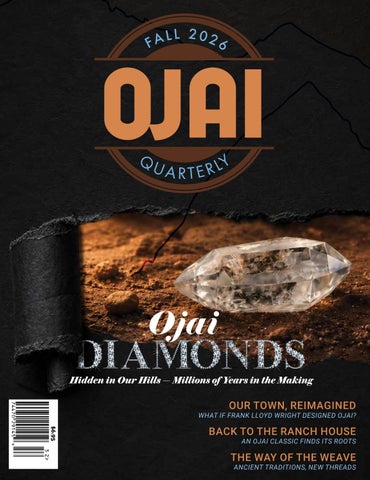
LL 2026 A F
$6.95
Ojai Hidden in O ur Hills — Millions of Years in the Making
OUR TOWN, REIMAGINED
WHAT IF FRANK LLOYD WRIGHT DESIGNED OJAI? $6.95
BACK TO THE RANCH HOUSE
AN OJAI CLASSIC FINDS ITS ROOTS
THE WAY OF THE WEAVE
ANCIENT TRADITIONS, NEW THREADS
There's no place like home. Let me find yours.
ROOM TO BUILD DREAM HOME
Hidden behind the gates of Rancho Matilija sits a stunning 3-acre lot with magnificent 360 degree mountain views. Surrounded by mature trees and wildlife, this lot offers a beautiful connection to nature while still being conveniently located near all the amenities, recreational parks, hiking trails, Lake Casitas, fishing and all the outdoor adventures you may be looking for as well as easy access to Ventura, LA and Santa Barbara. Don’t miss this opportunity to build your dream home with endless possibilities in this serene and picturesque setting. This gated, private community offers beauty, peace and vision to the person looking for a one-of-akind property.
PROPERTY DETAIL MOUNTAIN VIEWS
www.donnasallen. co m
donna4remax@aol.com
DONNA SALLEN
805.798.0516
CHARM & QUIET
Welcome to this charming cottage in the Historic neighborhood of Taormina. Hidden on a cul-de-sac this three bedroom, three bathroom home oozes with charm at the same time offers modern amenities throughout. Lovely living room with large fireplace opens to the dining room. Updated kitchen and bathrooms, light-filled rooms with views from nearly every window. You will enjoy spending time in the enchanting gardens while listening to the birds in this private sanctuary. This neighborhood has direct access to wonderful trails and Ojai’s nature preserve; yet minutes to downtown Ojai. Private and peaceful.
PROPERTY DETAIL MOUNTAIN 3 BEDROOMS
3 BATHROOMS
FRUIT TREES
w ww.donnasallen.c o m
VIEWS
donna4remax@aol.com
Real Estate Sales Backed by Local Expertise
Thank You Ojai For V Gold for & Bronz Thank You Ojai For Voting Us Best of Ojai Four Years in a Row, Gold for Property Management in 2025 & Bronze for Best Real Estate Office!
Thinking of selling? Let’s position your home for today’s market. When it’s time to buy or sell, work with a team that knows how Ojai homes perform—on the market and over time. Our background in property management gives our clients an edge in pricing, positioning, and negotiation.
• Sales & Brokerage • Property Management OjaiBelong.com 4
We don’t just list homes, we manage them. OQ / FALL 2026
THE GLASS HOUSE 1465 FOOTHILL ROAD, OJAI • $6,500,000 Perched along Ojai’s iconic Foothill Road, this glass-walled architectural sanctuary is defined by light, serenity, and expansive 270° views. Built in 2017 and thoughtfully re-imagined in 2022, the 3,154 ± sqft single-level home pairs minimalist design with seamless indoor-outdoor living. A 1,117 ± sqft pavilion with showcase parking, wellness studio, and sauna—along with additional creative retreats—completes a private compound set on 1.87 ± acres with pool, spa, and unforgettable Pink Moment sunsets.
520 FOOTHILL ROAD • OJAI • $4,750,000
GABRIELA & ELIAS CESEÑA 805.236.3814 | 805.640.5904 THE NEXT LEVEL OF REAL ESTATE SERVICES
liveinojai.com DRE 01983530 | 02228705 TRUST • INTEGRITY • RESULTS
© 2026 Berkshire Hathaway HomeServices California Properties (BHHSCP) is a member of the franchise system of BHH Affiliates LLC. BHHS and the BHHS symbol are registered service marks of Columbia Insurance Company, a Berkshire Hathaway affiliate. BHH Affiliates LLC and BHHSCP do not guarantee accuracy of all data including measurements, conditions, and features of property. Information is obtained from various sources and will not be verified by broker or MLS. Buyer is advised to independently verify the accuracy of that information. If your home is currently listed, this is not a solicitation for your listing. Awards based on 2024 production of approximately 50,000 sales associates in the Berkshire Hathaway HomeServices Global Network.
1104 FOOTHILL RD • OJAI • SOLD — $5,200,000
Local you can know & trust
Sold
435 Gridley Road, Ojai 5 BED | 3.5 BATH | 3,236 SQFT. SOLD FOR $2,900,000
Sold
Active
In Escrow
854 Thomas St, Oak View
1317 Meadowbrook Road, Ojai
25 Hill Street, Oak View
4 BED | 4.5 BATH | 3,941 SQFT. SOLD FOR $2,750,000
4 BED | 2 BATH | 1,481 SQFT. LISTED FOR $1,200,000
3 BED | 2 BATH | 1,448 SQFT. LISTED FOR $750,000
Represented Buyer
CLINT HAUGAN Global Real Estate Advisor Cal DRE 02019604 805.760.2092 clinton.haugan@sothebysrealty.com clintonhauganhomes.com © 2026 LIV Sotheby’s International Realty. All rights reserved. All data, including all measurements and calculations are obtained from various sources and has not and will not be verified by Broker. All information shall be independently reviewed and verified for accuracy. LIV Sotheby’s International Realty is independently owned and operated and supports the principles of the Fair Housing Act.
Join Us!
OPEN HOUSE & all-school showcase Saturday, November 7th • 1–4 pm “Education in the true sense is helping the individual to be mature and free, to flower greatly in love and goodness.” J. Krishnamurti Education and the Significance of Life
RSVP OAKGROVESCHOOL.ORG/OPEN 220 West Lomita Ave, Ojai
OAK GROVE SCHOOL The Art of Living and Learning
OQ / FALL 2026
9
CELEBRATING 40 YEARS
BUILDALLEN.COM | 805.884.8777 | LICENSE #503300
OJAI QUARTERLY p.17 Editor’s Note
COVER AGNES SMEDLEY Ojai’s Radical Voice ARA’S FINAL MOVEMENT 50 Years of Music. One Last Season. BOCCALI’S AT 40 From Soil to Table, 40 Years On RESTORING THE NORTH FORK Water Returns to Bear Creek SUMMER 2026
p.18 Contributors
American Mosaic O UR NATI O N AT 250
p.19 p.26
Ojai Podcasts & 2 Degrees
ojai diamonds Story by Bret Bradigan
ART OF HEALTH p.23
Barbara Hirsch & the
Hospital Sculpture Garden
Art by Uta Ritke
Arts Section
Story by Robin Gerber
p.49 Artists & Galleries
p.65 Yesterday & Today Section
p.91 Healers of Ojai p.34
WAGING ART
p.109
Storytelling Festival’s Resilience
Calendar of Events
in Face of Grant Cuts Story By Jesse Phelps
p.38
p.54
HAWKS’ WARNING
RANCH HOUSE REDUX
Book Tells Fictional Tale of Real Ojai Conservation Win
New Crew Brings Back
Story By Kit Stolz
Old Style to Classic Spot Story by Ilona Saari
FEATURES & departments p.80
OJAI, REIMAGINED Our Town, As Imagined by Frank Lloyd Wright Story by Mark Lewis
p.92
p.110
WAY OF THE WEAVE
NOCTURNAL SUBMISSIONS
Basketeers Knit Past,
Last Temptation of Bono
Future Together
Story by Devo Cutler
Story by Sami Zahringer
OJAI QUARTERLY Living the Ojai Life
FALL 2026 Editor & Publisher
Bret Bradigan
Director of Publications
Bret Bradigan
Business Development Manager Linda Snider
Creative Director
Uta Ritke
Ojai Vortex/Hub Administrator
Julia S. Weissman
Contributing Editors
Mark Lewis
Jerry Camarillo Dunn Jr.
Jesse Phelps Columnists
Chuck Graham Ilona Saari Kit Stolz Sami Zahringer Circulation
John & Michael Nelson Nelson Distribution, LLC CONTACT US: Editorial & Advertising, 805.798.0177 editor@ojaiquarterly.com The contents of the Ojai Quarterly may not be used, reproduced or transmitted in any form or by any means without the written consent of the publisher. SUBSCRIPTIONS: To subscribe to the OQ, visit ojaiquarterly.com or write to 1129 Maricopa Highway, B186 Ojai, CA 93023. Subscriptions are $32.95 per year. You can also e-mail us at editor@ojaiquarterly.com. Please recycle this magazine when you are finished. © 2026 Bradigan Group LLC. All rights reserved.
IG: #OjaiQuarterly #Ojai #OjaiVintage #tbt 14Courtesy of Joe Sohm / Visions of America
OQ / FALL 2026
Kitchens
Vanities
Showers
Fireplaces
Slab Floors
PROUDLY SERVING THE OJAI VALLEY FOR OVER 30 YEARS
www.pacificstoneworksandtile.com OQ / FALL 2026
31 Peking St., Ventura, CA 15
O Q | E D ITO R’ S N OTE
WHERE TO START LOOKING “It’s not what you look at that matters. It’s what you see.”
— Henry David Thoreau
There is something wonderfully humbling about discovering that you have been walking over diamonds. Not actual diamonds, as it turns out, but the tiny, double-terminated quartz crystals hidden in the mountains surrounding Ojai — geological marvels formed millions of years ago and largely unnoticed by the generations of hikers, riders and wanderers who have passed above them. That is the idea at the heart of our cover story. And, in a way, it is the idea at the heart of this magazine. Ojai rewards attention. Live here long enough and you can begin believing you know the place. Then someone like mountain biker Greg Resnick bends down beside a trail and shows you what you’ve been stepping over all these years. Suddenly the familiar landscape contains another world. Our job at the Ojai Quarterly, as Ojai’s oldest continuously published magazine, is to keep bending down and looking. To find the people, places, histories, ideas and occasional oddities hiding in plain sight — and bring them into the light. This issue is full of them. Robin Gerber takes us inside a hospital courtyard where sculpture has become part of healing. Jesse Phelps reminds us of the ancient human magic of sitting together and telling stories. Kit Stolz revisits the unlikely alliance of people and red-tailed hawks that helped save Besant Meadow from development. Devo Cutler follows the thread of basketry from Chumash tradition into the hands of contemporary makers, where weaving becomes memory, meditation and repair. Ilona Saari returns us to the Ranch House, where food, gardens, art, conversation and Ojai’s philosophical past still share the same table. Mark Lewis gives us the tantalizing and plausible question of what this town might look like if Edward Libbey had handed it to Frank Lloyd Wright. And Sami Zahringer, naturally, brings Bono to Ojai in search of humility. Even a perfect life needs comic relief. Hemingway suggested in “For Whom the Bell Tolls” that a perfect life might be lived in only four days. I’ve always loved the audacity of that idea. Not because four days are enough, but because they can be — if they contain the right elements. Beauty. Friendship. Good food. Art. Laughter. Nature. Curiosity. Work worth doing. Stories worth hearing. Something to protect. Something to make with your hands. Something old enough to humble you. Something new enough to surprise you. You could assemble those four days here in Ojai. In fact, you could assemble a life well lived from them. Ojai provides these raw materials in astonishing abundance. But, like those clear quartz crystals weathering quietly from the mountains, they don’t always announce themselves. You have only to develop the eye for them. Consider this issue a good place to start looking.
OQ / FALL 2026
17
OQ | C ON T RI BU TO R S
18
DEVO CUTLER
ROBIN GERBER
CHUCK GRAHAM
is a poet, photographer, and recovering exec. Devo mentors artists and writes about healing through art. Her Peabodynominated doc “Not Afraid to Laugh” celebrates humor’s power.
is the author of four books and a playwright. Check her out at RobinGerber. com
MARK LEWIS
UTA RITKE
ILONA SAARI
is a writer and editor based in Ojai. He can be contacted at mark lewis1898@gmail.com.
is following the tug of curiosity, shaping clean visuals with a touch of delightful weird. Find her at utaculemanndesign.de and utaculemann.art
is a writer who’s worked in TV/film, rock’n’roll and political press, and as an op-ed columnist, mystery novelist and consultant for HGTV. She blogs for food: mydinnerswithrichard. blogspot.com.
RYAN SCHUDE
KIT STOLZ
is a photographer & educator from Oak View. You can find his most recent photos in the book “Also On View: Unique and Unexpected Museums of Greater Los Angeles” by Todd Lerew.
is an award-winning journalist who has written for newspapers, magazines, literary journals, and online sites. He lives in Upper Ojai and blogs at achangeinthewind.com.
SAMI ZAHRINGER
His work has appeared in Outdoor Photographer, Canoe & Kayak, Trail Runner, Men’s Journal, The Surfer’s Journal and Backpacker.
is an Ojai writer and award-winning breeder of domestic American long-haired children. She has more forcemeat recipes than you.
OQ / FALL 2026
OQ | oja i p odca st Much of the origins of New Age spirituality can be traced back to Jiddhu Krishnamurti (18951986), who first moved to Ojai in 1922. His famous oak grove talks have reached hundreds of thousands of people. “Truth is a Pathless Land” is one of his most important essays, wherein he renounced his role as “World Leader.”
IN BRIEF: OJAI TALK OF THE TOWN PODCASTS
JANET YANG ON BRIDGING CHINA & HOLLYWOOD “I think the secret sauce is relevance and heart,” says Academy Award-winning producer and former Academy president Janet Yang, whose career has bridged Chinese and American cinema, from championing Hong Kong filmmakers to working on Empire of the Sun and The Joy Luck Club. She also reflects on representation, cultural translation and what makes stories travel across borders. (Ep. 291)
MARIE MCKENZIE GOES DEEP ON FEAR-FACING
ROGER KELLAWAY, ON JAZZ & LIVING LIFE IN THE POCKET
“I was … asking myself what else I was afraid of,” says Ojai artist Marie McKenzie, who answered by learning to freedive and immersing herself in California’s kelp forests. Her Ocean Garden paintings grew from that plunge — part personal reinvention, part meditation on beauty and conservation. (Ep. 294)
“I grew up studying classical music for 12 years, and I wasn’t studying for it to be my life. I was interested in improvising,” says Grammy-winning pianist, composer and arranger Roger Kellaway, whose six-decade career spans jazz, film, television and collaborations with many of the music world’s greats, including Duke Ellington, Sonny Rollins and Dizzy Gillespie. (Ep. 296)
RACHEL LANG: REACHING FOR THE STARS FOR INSIGHT, WISDOM & CIVIC SERVICE “Astrology isn’t fortune telling,” says Rachel Lang, astrologer, author and Ojai City Council member. For Lang, planetary cycles offer a framework for understanding patterns in our lives — a fascination that began
at 14, when she discovered astrology was “so much more than your sun sign.” In this wide-ranging conversation, the former filmmaker and marketing professional — who grew up in an artistic, civic-minded family,
QUEEN OF EXISTENTIALISM
& HER OJAI SOJOURN
2
talks about intuition, purpose, relationships, timing and why astrology, at its best, is less about prediction than about helping people understand the choices and possibilities already in front of them. (Ep. 292)
TWO DEGREES
of SEPARATION BETWEEN
OJAI
ONE: Simone Lucie Ernestine Marie Bertrand de BeauTWO: As Mark Lewis wrote in the Fall 2022 Ojai Quarterly, voir was, among other things, a French existentialist “Simone de Beauvoir slipped into Ojai via Creek Road in a little yellow car driven by her protégé Nathalie Sorokine Moffatt.” philosopher, writer, teacher, social theorist and femSorokine was one of those students who claimed abuse. She inist. She is perhaps best known for her landmark later married Ivan Moffat, son of the actress, poet and leg1949 book, “The Second Sex,” and for her lifelong endary bohemian Iris Tree. On Feb. 28, 1947, the two women intellectual and romantic partnership with Jeanheaded to Tree’s East End home, where they spent the night Paul Sartre. She also led a complicated love life en route to San Francisco. Beauvoir was crossing America on that included relationships with at least two teenage a lecture tour, filling notebooks with impressions that would female students, both of whom later described SIMONE DE BEAUVOIR become “America Day by Day.” For one fleeting night, one of their treatment by Beauvoir in disturbing terms. (1908-1986) the 20th century’s most influential thinkers belonged to Ojai. OQ / FALL 2026
19
We know Ojai.
Royal Oaks - 5 Bedrooms, Upscale Finishes Throughout, Media Room, Wine Cellar, Tasting Room, Gym/Massage Room, Pool & Spa, Putting Green, Well, Six-Car Garage, Bocce Court, Views, and So Much More RoyalOaksRanchOjai.com
Corral Canyon Ranch - 277+ Acre Ranch in Cuyama Valley with 5 Recently Renovated Houses, Equestrian Facilities, Fenced Pastures, Hay Fields, Riding Trails, Stunning Views Surrounded by Los Padres National Forest. 29443hwy33.com $4,250,000
Hitching Post Hideway - Three-bedroom, two-bathroom condo with large primary suite with two closets and dual-sink vanity, two private patios, fireplace, wood floors, and community pool and clubhouse. $924,000
1.25-Acre Lot in East End Ojai Bordered by Seasonal Creek with Topa Topa Mountain Views, Paved Road to Property, One Share of Senior Canyon Water, and Room for Horses or Hobbies $795,000
Nora Davis
BRE License #01046067
805.207.6177
nora@ojaivalleyestates.com
We’re lifelong residents.
Casa Vista Linda - Set amid serene grounds, this Marc Whitman-designed home blends Old-World charm with modern comfort. Custom fireplaces, walnut finishes, expansive terraces, and resort-style amenities only begin to describe this beautiful Ojai retreat just minutes from the village. CasaVistaLindaOjai.com $9,850,000
Ferrara Oaks - Oaks West 3-bedroom, 3-bathroom home with vaulted ceilings, natural light, mountain views, large primary suite, Saltillo tile, guest bedroom with en suite, and large patio minutes from downtown Ojai, Lake Casitas, and hiking trails. $1,259,000 FerraraOaks.com
This downtown triplex with two units completed in 2024 offers a rare opportunity for an investment property, sharing the property with family or friends, or living in one unit and renting the others for rental income. $1,695,000 509NorthBlancheStreet.com
Three-bedroom Cape Cod-inspired home one block from Ojai Avenue close to farmers markets, shops, restaurants, wine tasting, spas, hiking trails and more. $1,100,000
The Davis Group ojaivalleyestates.com
an Ojai tradition since 1964
Open Every Day 9:30 - Sunset
34
302 W. Matilija Street | 805-646-3755 OQ / SUMMER 2021
OQ | a rts & l i teratu re
26 26 sculptural healing
34 Waging ART as funding sources retreat
Donor Brings Art to Ojai Hospital’s Hidden Healing Garden By Robin Gerber
Storytelling Festival’s Resilience On Stage Come October 22-25 By Jesse Phelps
38 hawks’ calling
48 artists & galleries
Raptors Bond at Heart of Novel About Saving Ojai Meadows By Kit Stolz
The People, Places That Make Ojai an Arts Destination
OQ / FALL 2026
23
Explore Ojai Valley’s History, Art and Culture Thursday – Sunday 10am – 4pm 130 W. Ojai Ave. 805 640-1390 OjaiValleyMuseum.org
24
OQ / FALL 2026
OQ / FALL 2026
25
26
OQ / FALL 2026
O ja
et G cr
arden
of BY ROBIN GERBER P H OTO S B Y RYA N S C H U D E & ST E V E A L B I STO N C R E AT I V E
A
s I enter the Libbie Agran Sculpture garden, set in an interior courtyard of Ojai’s Continuing Care Center, intriguing modern sculptures beckon from a landscaped path. Meant as a space for healing and renewal, this art-filled garden is an amenity not often found in hospital settings.
Deeper into the garden, John Tyler’s kinetic sculpture “Improvisation” dances in the breeze, and a woman with a walker is as mesmerized as I am. Standing eleven feet tall, its stainless steel ‘arms’ balance on delicate edges as they turn horizontally and vertically.
On one side sits Ivan McLean’s “Mother of Re-invention,” a giant gleaming brushed steel sphere set on its edge with a gaping hole in the center. The piece seems to rotate as I walk by. Reinventing itself?
This sculpture oasis, set amid the Center’s healing work, grew from the passion of two women who met half a century ago in Los Angeles. In the 1970s, Barbara Hirsch ran a high fashion store, AIX-
OQ / FALL 2026
i
27
cessories, in Venice, California and made much-coveted jewelry. Libbie Agran was a constant customer, having been introduced to Barbara by friends.
where Barbara chaired the effort to decorate rooms with original art from California artists.
me,” Libbie explained, “because I met some of the artists from whom I later purchased sculptures.”
Both women frequented local art events, and Barbara arranged curated tours to art studios through the Venice Family Clinic’s fundraising effort, ARTWALK.
After more than two decades in L.A., Libbie gave up her thriving portfolio management practice and moved to a property overlooking the ocean on the Central Coast.
The early 1990s began a period of recognizing the positive effects of art on health. UCLA ran a small hotel for patients’ families called Tiverton House,
Barbara and her husband came to Ojai, where she organized weekend art tours for Libbie and other friends to meet local artists. “Those trips were important to
In Los Osos, with views of Morro Bay, Libbie and her husband had a half-acre terraced backyard with trees, fountains and a small Moroccan house for tea and reading. For the next two decades, the couple bought large sculptures from dealers and artists they met in their travels. “We entertained in the back yard almost every weekend,” Libbie says, “so each sculpture was loved and
28
OQ / FALL 2026
cherished. We never planned what to buy, we just saw something and fell in love with it.” But Libbie’s time in Los Osos came to an end in 2023 when her husband suffered a heart attack and stroke. They had to move back to LA for medical care. Libbie needed to figure out what to do with the sculptural treasures they had so enjoyed. She planned to give them away but wanted to keep them together because they represented so many happy times. “The local museum in San Luis Obispo wanted them,” Libbie remembers, “but I didn’t feel they had room. Cal Poly wanted them, but they were too far away.” Then, another idea began to form. Libbie made plans to meet her Ojai friend, Nancy Pepper, at the Ojai Valley Inn to celebrate Libbie’s birthday, and Barbara joined them. Libbie revealed her husband’s illness, which had been confidential up until then. She told her friends of her plan to leave Los Osos. Nancy asked what she planned to do with her sculpture garden. Libbie paused, then astonished her friends when she said, “I’m giving them to Barbara for the hospital.” Barbara jumped to the challenge of figuring out how to move and place the 12 sculptures. Donors contributed to a matching gift by Ken Hirsch and Dr. Rebecca Long to cover the $25,000 cost to move and install the pieces; renowned art curator Carl Schlosberg sited the sculptures; and the hospital took on the job of creating signage. As Barbara says, “It was a real partnership.” AMONG THE 12 SCULPTURES DONATED BY LIBBIE AGRAN ARE (LEFT PAGE) “SPHERE,” THIS PAGE TOP, A GLASS PLANT REMINISCENT OF DALE CHIHULY AND ABOVE, “I AM LIGHT XIII.” PHOTOS BY STEVE ALBISTON CREATIVE OQ / FALL 2026
At the CCC, the garden, open to the public, is visible from the physical therapy rooms, several patient rooms and from the 29
BARBARA HIRSCH ON SITE AT THE HOSPITAL’S SCULPTURE GARDEN, PHOTO BY RYAN SCHUDE, LEFT IS A DIAGRAM/MAP OF THE GARDEN
dining and activity rooms. “You can see the joy people experience,” Barbara says, “as they walk around or sit among the sculptures. Art gets people talking, lifts their mood.” Viewing art also improves cognitive function. Even patients with neurodegenerative conditions like Alzheimer’s show distinct positive reactions to art. 30
Pieces like Russ Vogt’s “Nine Reeds” remind people of play. When Vogt’s piece was in Libbie’s garden, she remembers having people over to slide the bright multi-colored pieces off the slim, sevenfoot metal “reeds” and reassemble them in patterns they chose. “Art was part of our life,” Libbie says, “just like good food. I believe that the way you deal with the tougher and happier things in life is to support them with art.”
Barbara visits the CCC garden often. She would like to use George Jercich’s multicolored glass “Century Plant,” which appears to be growing from the garden’s soil, to celebrate Ojai’s centenarians. Libbie visits her sculptures as often as she can. Wistful, she says, “I miss them. But I am thrilled to see everyone enjoying them.”
OQ / FALL 2026
Local Loyal As a nonprofit healthcare system, we answer only to the community we serve. Everything we do at Community Memorial Healthcare is guided by a simple principle: what is best for our community. As a nonprofit organization, resources are reinvested locally into patient care, advanced technology, innovative programs, modern facilities, and the exceptional people who provide care every day. Over the last 10 years, Community Memorial Healthcare has returned more than $450 million in community benefit to Ventura County — supporting programs, services, and investments that improve health, expand access, and strengthen our community. Together with the support of donors through our two Foundations, we’re helping ensure that exceptional healthcare remains close to home for generations to come. Providing exceptional care isn’t just our mission — it’s our commitment to the community we are privileged to serve.
Learn more about our outstanding care at mycmh.org
Camarillo ~ Fillmore ~ Oak View ~ Ojai ~ Oxnard ~ Port Hueneme ~ Santa Paula ~ Ventura
Where Ojai Gets Growing AnnuAls • PerenniAls • shrubs • Trees • housePlAnTs • PoTTery • CACTi & suCCulenTs • CAliforniA nATives & WATer-Wise PlAnTs • non-GMo veGeTAbles • berries & CiTrus PlAnTs • CerTified orGAniC soil & ferTilizers
Start Your Garden Now!
Flora Gardens Nursery & Garden Shop 245 Old Baldwin Rd. • Ojai, CA 93023 Open Daily 9 - 5 Monday-Saturday, 10 to 5 Sunday (805) 640-0055 FOLLOW US AT FLORAGARDENSOJAI 32
OQ / FALL 2026
3rd Fridays Join us for Live Music, Community, Wine and Nibbles | Mon 10-5 | Tues-Thurs 11 - 5 | Fri 10-7 | Sat-Sun 10 - 6
Margo Lande CERAMICS
Rose Rabinov GLASS
Ted Gall
SCULPTURE
Leah Messina PAINTING
Vera Maguire CERAMICS
WOODWORKING
Julie Wellings CERAMICS
JEWELRY
Susan Florence PAINTING
40+ Local Juried Artists 20+ Mediums
Handmade One-of-a-kind Bespoke Unique Original
David Blackburn
Sharon Curtis
GIFTS
Don Earl LEATHER
Susan Dunbar JEWELRY
Yolanda Bergman MOSAICS
Joan Sharron MIXED MEDIA
Rae Taney JEWELRY
Ventura and Santa Barbara Counties’ Artists | 238 East Ojai Ave. Ojai, CA 93023 | (805) 646-5682 | OVAArtsgallery.com
Krotona Institute of Theosophy Serving the Ojai Valley and surrounding areas for over 100 years At Krotona School, ancient wisdom becomes a practical resource for modern living—helping students cultivate resilience, purpose, and spiritual insight. Together we explore life’s core questions, the inner self, our shared connection with all beings, and the transformative practices of contemplation and meditation. Our Library and Bookshop feature an outstanding collection on theosophy, world religions, philosophy, and metaphysics, along with a curated selection of metaphysical gifts and meaningful souvenirs.
The more we can attain realization of our true Self, the more we can work together harmoniously for understanding and peace.
The peaceful gardens and grounds offer spaces for reflection and renewal and may serve as a memorable venue for special events. Please keep us in mind. Library and Research Center: 2 Krotona St, Ojai CA 93023 • Quest Bookshop: 47 Krotona St., Ojai CA 93023 • School of Theosophy: 46 Krotona St., Ojai CA 93023 • Krotonainstitute.org
OQ / FALL 2026
33
STORY TELLING FESTIVAL
Brings Comedy, Cultural Understanding to Ojai Despite Arts Funding Cutbacks BY JESSE PHELPS 34
OQ / FALL 2026
I
t was, perhaps, a less contentious time in the United States of America when Kara Martin discovered the Ojai Storytelling Festival through her then-job inspiring tiny humans at a school on the Ojai Valley’s East End. “I was teaching at Monica Ros when the festival started,” she says. “Our director heard about it, so we took our classes to see the performances. Donald Davis, one of the superstars of storytelling, was there that first year. He reminded me so much of my grandpa, who was also an epic storyteller.” Martin felt a thrill watching her class engage with the magic of the spoken word. She knew immediately that she’d discovered what would become an important piece of Ojai’s social fabric, a forum with the power not just to capture the imaginations of the valley’s youth, but to restore a sense of wonder to the adults in the room. “I haven’t missed one since,” she says. Excited as she may have been at the time, she had no way of foreseeing a future timeline in which, nearly a quarter century later, she would hold the reins of the festival as its second executive director — just in time for the federal government to institute major cuts to arts funding. Martin succeeded founder (and fellow ex-teacher) Brian Bemel in the position in 2021. Now, as she and her hardworking volunteer staff gear up for the festival’s 26th edition over the weekend of Oct. 22-25, she knows that, despite unprecedented financial challenges, the verbal
festivities will offer an entertaining mix of fun and culture for people of all ages — just as they always have. “It’s a full and exciting calendar from Thursday through Sunday this year,” she says. “We’ve got a diverse lineup, including Israeli performer Noa Baum. As the daughter of a diplomat, her stories weave personal wartime experiences with folktales. And Sufian Zhemukhov, a first-generation Russian immigrant, addresses topics with a delightful, surprisingly comedic delivery. The way he conveys cultural misunderstandings lends a lot of humor.” Other headliners throughout the weekend include: Lipbone Redding, a New York-based songwriter and performance artist known for his unusual ability to vocally imitate a range of musical instruments; Kevin Kling, a Minnesotan playwright, performer, and regular contributor to National Public Radio’s “All Things Considered”; Mary Hamilton, a Kentuckian who specializes in folk tales and ghost stories; and Geraldine Buckley, an Irish ex-pat and former prison chaplain with an amazing array of life adventures to share. Things kick off at the Ojai Art Center on Thursday afternoon at 3:30 p.m. with “Meet the Tellers.” That’s followed by Story Slam!, in which six local finalists compete for the coveted title of “Top Storyteller.” On Friday morning, the festival moves briefly over to Libbey Bowl, where two separate programs — divided by primary and upper grade levels — cater to the valley’s schoolkids.
OQ / FALL 2026
35
Youth-focused events, Martin stresses, are not just a critical component of the festival weekend, but a year-round priority. “Right now, it’s more important than ever to make sure our kids have access to arts education. The events are a fun way to share cultural perspectives that broaden their horizons,” she says. The festival’s performers will visit local schools, both public and private, before the weekend’s paid events kick off. It also runs programming throughout the year for both adults and youth, including school assemblies and storytelling programs for local elementary and private schools. This festival season, Baum kicks off Friday’s Art Center events with a workshop for aspiring storytellers, called Stories Old & New: A Path to Healing and Resilience. She’s followed by events with Kling, Hamilton and Redding together, then Buckley, all preceding the evening’s main shows — Laughing Night, which Martin says is the festival’s most popular, and Spooky Stories. Saturday’s full lineup of showcase events is capped by the festival’s only adults-only show, Naughty Tales. “This year, five of the six storytellers are performing in Naughty Tales — more than usual — because each tale was short enough to include all of them,” Martin says. Saturday and Sunday mornings feature workshops by storytellers and story swaps. The Art Center also hosts a Sunday champagne brunch with Ojai local vocal heroes Madrigali performing Renaissance-era songs a cappella. “Most shows,” Martin says, “are on the Art Center patio, except the Saturday evening show, which is in the main theater.” Like too many non-profit artistic endeavors in 2026, the Ojai Storytelling Festival is doing everything it can to persevere in the wake of slashed arts funding. That includes having a previouslyapproved $25,000 National Endowment for the Arts grant pulled unexpectedly by the Department of Government Efficiency. While that was a particularly difficult pill to swallow, Martin says, she hopes increased individual support can help bridge the gap. “High attendance numbers and donations will both be critical to making up the financial shortfall this season,” she says. “It’s a good thing we have such a strong following here in the community and beyond. People travel from all around, because they know the storytellers are always going to bring it. There will be joy, there will be laughter, there will be all the feels.”
36
ABOVE: EXECUTIVE DIRECTOR KARA MARTIN WITH DAUGHTER AND ASSISTANT TARYN. MIDDLE: NOA BAUM AND ASL INTERPRETER MATTHEW BARCH. BOTTOM: JOSH GOFORTH AT LIBBEY BOWL IN 2025, KEVIN KLING, COMING IN 2026
Local eateries, including Bonnie Lu’s, Radio Roma, Highly
Likely, Yume Burger, Ojai Beverage Company, Rainbow Bridge, and Ojai Coffee Roasters, also chip in to feed and provide gift cards to the storytellers.
“This is a labor of love for our entire storytelling community,” Martin says. “I can’t give enough thanks to all our many
volunteers and partners who constantly display their generosity and make it all possible. It’s going to be an incredible event.
Because this year’s lineup features an unusually high number of
funny storytellers, the whole weekend promises to be particularly
comedic. I think we could all use a little extra laughter right now.” To learn more, buy tickets, donate, or get involved, visit ojaistoryfest.org.
OQ / FALL 2026
i a j O
r o t S
g n i l l e yt
l a v i t s Fe
Voices from around the world. Stories that bring us together.
October 22-25 Bring the whole family! There's something for everyone! 2026
OjaiStoryFest.org
info@ojaistoryfest.org
OQ / FALL 2026
37
38
OQ / FALL 2026
CALLED HAWKS
BY THE
A mysterious bond with a pair of red-tailed hawks inspired Richard Handley to lead the fight that preserved one of Ojai’s last great wetlands—and later became the heart of his novel, “The Hawks Are Not Dying.” BY KIT STOLZ
R
ichard Handley has traveled and worked all over the western hemisphere. He grew up in La Jolla, went to Santa Barbara for college, and spent years at Mammoth in the Sierra Nevada as a young man, with extensive travels later to Baja California and Mexico to surf, as well as trips through Central America, to Guatemala, Nicaragua, and Costa Rica.
But it was his time in Ojai in the early 1980s that Handley features in his recently published novel “The Hawks Are Not Dying.” In an interview, he admitted that the events in the novel parallel his formative experience battling — with a great deal of support from his late wife Ellen Hall and many other notable Ojaians — a prominent developer of shopping centers.
Not to mention lengthy jaunts to Alaska, the Hawaiian islands, and sea travel in French Polynesia, and time spent more recently teaching in missionary schools in Sumatra, Malaysia, Indonesia, and Nepal. Handley has been to 38 countries.
At stake was the future of 58 acres near the entrance to Ojai. It’s the story of one sprawling wetland — and all its countless residents, from dozens of bird species to enormously tall trees — forever saved from concrete and stucco and fluorescent lights. It’s now known as Besant Meadow.
OQ / FALL 2026
39
In the novel, a new arrival in town named John August rents a house in Meiners Oaks, not far from the present-day Besant Meadow (which is located on Hwy 33 west of the “Y” and south of St. Aquinas Church). In 1980 the area, once intended as a site for Oak Grove School, was a little-used-by-humans wetland, often seen flooded in winter. August, his character, works as a stonemason, but as the story begins he loses his girlfriend to an aggressive and mercenary local attorney, and finds himself all but alone with his dog Charlie, at loose ends in life, and unhappily so. As he walks around the grassy meadow in the evenings, he can’t help but notice a grove of tall eucalyptus trees, and the resident hawks making their home high above the land. “It felt comforting to have this large open meadow so near the house where nothing had changed for many years,” Handley writes. “It was as if the meadow existed in a state of eternal grace, with no indication of any owner or restricted entry. He studied the enormous girth of the eucalyptus trees, wondering how long they had been planted and for what purpose. The luxuriant green 40
tree canopy exuded an aura of mystery and as he relaxed among the trees it felt as if he’d entered a protected sanctuary where the outside world had no power to penetrate.” Not long after Handley (and his lonely fictional counterpart John August) began visiting the eucalyptus grove, back in 1980, he had the sense the hawks were watching him. At work building a stone wall a few miles up the highway he saw a familiarlooking pair of hawks circling him, high above, seemingly keeping a watch. Curious. From a story in the local paper he learns that a developer plans to turn this grove and meadow into a shopping mall. August sits down to write a letter to the Audubon Society, to see if he can stir up some opposition to the development. “He was just sitting down at the kitchen table and gathering his thoughts when a loud screech disturbed the growing silence,” Handley writes. “Out on the porch he looked up to see a red-tail hawk perched in the crown of the pine tree in his front yard. Charlie sat on the lawn staring up as the hawk let out a series of calls, ruffling its wings, lowering its head and scrutinizing them both.”
“They know where we live,” thinks his character. “This is getting strange.” In the interview, Handley says that at that time he was riding his bike out to a worksite in Upper North Fork Springs and would often see the pair of hawks watching him. “I’m riding my bike down (Highway) 33 and there they are,” he said. “I come home and they fly out to the (nearby) Valley Oaks. They would come to my house at night.” In the novel, in an early chapter called “Hawk Language,” his character takes cues from the hawks watching him. Handley declares that — as unlikely as it might sound — this happened just as he described in the book, with the hawks following him, circling him and seeming to be all but calling out to him, to draw him closer to their imperiled homes in the trees. “There was no mistaking it. The hawks were attempting to communicate with him,” he wrote. “He’d never experienced anything like this but considered that perhaps he was being asked to enter into some kind of covenant with them.”
OQ / FALL 2026
HANDLEY, BACK IN OJAI AFTER YEARS OVERSEAS Handley came to an afternoon interview at Farmer & the Cook in a T-shirt and jeans, with a friendly clean-shaved look, wearing a cap emblazoned with “Jesus Saves” over a little cross. “Covenant” is a biblical word that comes naturally to him, but so does the word “chakras.” Handley speaks easily of spiritual matters, and yet seems open to all the different sorts of spirits around him, even if they might be a bit “woo,” in his words. Lanky, cheerful, and quick to smile, Handley exudes a willingness to act, a kind of upbeat forthrightness. Without a trace of ego he declares that he wishes to devote his life in service to others. He offers as an example his work in the missionary schools in Australia, which over the years meant a great deal of menial administrative work, even cleaning toilets. “I’m actually a missionary, believe it or not,” he told an audience who gathered at the Ojai Retreat in January to see him speak about “The Hawks Are Not Dying.” “I work with aboriginal Christians in Australia,” he said. “It’s a bit different than working to save the environment, but it’s a challenge and that’s what we do, my wife and I. I won’t go on and on about it, but the aboriginal people there have the highest rate of incarceration, the highest rate of suicide, the highest rate of drug abuse and domestic violence, and the lowest life expectancy. They’re pretty hammered, so we’re there to help them.” Handley had to leave Australia this spring when, after completing a doctoral degree in theology, his student visa ran out. He has come back to Ojai with his wife, but they hope in time to return to his missionary work Down Under. In Ojai in 1980, he poured his life into a different sort of service: organizing a resistance to the planned meadow development. Handley grew up in the famously beautiful town of La Jolla, before it became chic, and spent much of his childhood exploring the nearby undeveloped hills there away from the beach known as the Muirlands. Even as kids, he and his friends “monkeywrenched” the suburban developments chewing into the open land, he said. “It seemed he had been running away from the juggernaut of bulldozers all his life,” Handley wrote in his novel. “As a child, he had stuffed dirt clods down the exhaust pipes of D-8 cats cutting swaths through the wildlife arteries in his beloved foothills.
PHOTOS OF RICH HANDLEY IN VARIOUS CONTEXTS, INCLUDING, TOP, RAITAEA, FRENCH POLYNESIA IN 1983 AND MIDDLE, FAIRBANKS, ALASKA IN 1980; ALONG HIS FAVORITE BENCH IN THE OJAI MEADOWS PRESERVE
OQ / FALL 2026
41
RICH HANDLEY, RIGHT, WITH WIFE RIO AND GRANDSON CURREN
He felt suffocated by the onslaught of development and now his beloved spaces were being threatened again.” For nine years after college Handley lived in Mammoth, in the Eastern Sierra. While working for the Forest Service, he had seen a broad sunny meadow in Old Mammoth turned into condominiums. When the builder turned to developing yet another block of condos in the meadow, Handley worked hard with a friend from 1977-1979 to organize a local opposition, but could not stop the development. “Somehow this builder got a permit to build condos in a wet meadow, a meadow that actually had an active trout stream running through it,” Handley said in the interview. “He just dammed up the trout stream. It blew my mind to see bulldozers there.” Handley left Mammoth “completely disappointed” in what happened in a few short years, as the town became a huge ski resort, losing a great deal of its beauty and charm and wildness. He vowed not to let it happen again. “Over my dead body,” he declared, thinking of Besant Meadows in Ojai. “No way. This is not going to happen.” HOW THE EFFORT TO SAVE BESANT MEADOWS CAME TOGETHER He could hardly have chosen a better community to try and organize against a new shopping center, less than a mile away from the existing Vons shopping center at the “Y.” Although he didn’t know many names or faces at the start of the conflict, in fact Ojai already had an active local preservation group, Citizens to Preserve the Ojai, led for a time by a teacher from Nordhoff High School, and later for many years by Stan Greene. After hearing Handley speak to the 42
City Council, another prominent member of CPO, Winnie Hirsch, invited Handley to join their weekly meeting at an upstairs back office belonging to a bank. As they were talking, the long-time member and five-time mayor of the Ojai City Council, Jim Loebl, joined the meeting. “Jim Loebl showed up, and he was the mayor at the time,” Handley recalled. ‘And he said, “Yeah, you know we don’t have the votes to stop this.” In the novel and in real life, the Audubon Society did respond to Handley’s letter by appearing before the City Council to call for an Environmental Impact Report from the developer before voting. And Handley joined in an effort to elect a new city councilperson, to vote to block the planned shopping mall. Handley and his first wife, Ellen Hall, were involved in the creation of the Ojai Valley Land Conservancy — which now manages Besant Meadow — in the 1980s, with other notable Ojaians. They included Carla Bard, the first woman to chair the statewide Water Resources Control Board, feisty activist Pat Weinberger, and other well-known citizens. Handley gives a great deal of credit to Hall, who served as the first executive director of the OVLC from 1990-1995, for bringing the organization together. Handley himself served as the second executive director, followed by
Jim Engel, who was the first to build the organization up to support paid positions. Art Vander, an enthusiastic docent who has led walks nearby for years, in a story on an OVLC webpage, complimented “Rich Handley and others who were far-sighted enough to think, ‘Hey, maybe we could restore this land to its previous condition.’” Today Handley says he often visits the Besant Meadow in the company of his grandson Curren, age seven, and his wife Rio. They like to sit on a bench by the pool in the preserve to watch the birds dart and flutter by. Dozens of species of birds have been seen at the preserve, and Handley considers the spot a “vortex” for wildlife of all sorts, including himself. “I love it,” he said simply. Although Handley takes pride in taking the lead (with the hawks) in the organizing of opposition to the shopping center that led to the preservation of Besant Meadow, and thinks he was “called” to the struggle, just as he was later called to be a missionary, he readily admits he was just one of many Ojaians in the extended fight. “I can’t really take credit,” he said. “I’m just one person, and it takes a village. But it does take someone with free time on their hands.” OQ / FALL 2026
ECO STONE CARE REFINISH
RESTORE
ECO STONE CARE REFINISH
RESTORE
FAMILY-OPERATED BUSINESS SERVING OUR COMMUNITY FOR OVER 40 YEARS
REPAIR
$100 OFF ANY JOB OVER $500
REPAIR
MAINTAIN THE INTEGRITY & BEAUTY OF YOUR STONE
SPECIALISTS IN RESTORATION AND REPAIR OF MARBLE, QUARTZITE, LIMESTONE, SINTERED STONE, GRANITE, SLATE AND SALTILLO PAVERS
COMPLETE RESTORATION AND REFINISHING OF COUNTERTOPS, SHOWERS AND FLOORS
CALL FOR A FREE CONSULTATION! (805)218-5558 LICENSED & BONDED | CA LICENSE: #474478
CATHERINE & PIERRE HANNON ecostonecareph@gmail.com | ECOSTONECARE.COM OQ / FALL 2026
43
44
OQ / FALL 2026
Located in the beautiful East End of the Ojai Valley Open Studio | Oct 10-12 from 10-5 | 4436 Reeves Rd | sandytreadwell.com
OQ / FALL 2026
45
Leslie Clark
I’ve painted people in wild places all over the world, but I always return to the Ojai ranch where I grew up…
46
Studio open for the Ojai Studio Artists Tour October 10 11 12 & by appointment https://shop.nomadgal.com leslie@nomadgal.com 805 216 1743 OQ / FALL 2026
iwaplan.com
LOCAL & INDEPENDENT FIDUCIARIES
Financial Planning Built Around People, Not Products. Independent fiduciary guidance tailored to your goals and your future. Schedule your complimentary consultation today:
(805) 646-3729
OFFICES IN DOWNTOWN OJAI & VENTURA OJAI
VENTURA
205 S Signal St, Ojai, CA 93023
196 S Fir St, Ste 140 Ventura, CA 93001
(805) 646-3729
(805) 339-0760
Integrity Wealth Advisors. is a Registered Investment Adviser. This material is solely for informational purposes. Advisory services are only offered to clients or prospective clients where Integrity Wealth Advisors and its representatives are properly licensed or exempt from licensure. OQ / FALL 2026
47
Garden - Home Baby - Jewelry
327 E Ojai Avenue
Women’s Clothing Jewelry
109 North Montgomery St OJAI
Men’s Clothing Home - Kids - Baby
109 North Montgomery St OJAI
OQ | A RT i sts & GA L L ERIES Perhaps it was potter and “the Mama of Dada” Beatrice Wood’s influence, going back nearly 90 years. Maybe it even goes back further, to the Chumash people’s ingenious and astounding artistry with basketry. It’s clear that Ojai has long been a haven for artists. The natural beauty
FIRESTICK GALLERY
Firestick Pottery provides classes, studio/kiln space and a gallery abundant with fine ceramics. 1804 East Ojai Avenue. Open from 10 am to 6 pm every day. Gallery Open to the Public. FirestickPottery.com 805-272-8760
NUTMEG’S OJAI HOUSE
Featuring local artists, including William Prosser and Ted Campos. American-made gifts and cards, crystals, and metaphysical goods. 304 North Montgomery nutmegsojaihouse.com 805-640-1656
OVA ARTS
40+ local artists with unique contemporary fine arts, jewelry and crafts. 238 East Ojai Ave 805-646-5682 Mon 10 a.m. to 5 p.m. Tues-Thurs, 11 a.m. to 5 p.m. Fri 10 a.m. to 8 p.m. Sat-Sun 10 a.m. to 6 p.m. Third Fridays - 5-7 p.m. with Live Music, Wine & Community OVAArtsgallery.com
JOYCE HUNTINGTON
Intuitive, visionary artist, inspired by her dreams and meditations. It is “all about the Light.” Her work may be seen at Frameworks of Ojai, 236 West Ojai Ave, where she has her studio. 805-6403601 JoyceHuntingtonArt.com
framed so well by the long arc and lush light of an east-west valley lends itself to artistic pursuits, as does the leisurely pace of life, the sturdy social fabric of a vibrant community and the abundant affection and respect for artists and their acts of creation. Come check it out for yourselves.
CANVAS & PAPER
paintings & drawings 20th century & earlier Thursday – Sunday noon – 5 p.m. 311 North Montgomery Street canvasandpaper.org
LESLIE CLARK
Nomad paintings from traveling the world or home on the ranch in Ojai. Studio open by appointment leslie@ nomadgal.com shop.nomadgal.com 805-216-1743
KAREN K. LEWIS
DAN SCHULTZ FINE ART
Paintings, prints & drawings. 515 Foothill Road, Ojai. Viewings by appointment. 805-646-8877 KarenKLewisArt.com
Plein air landscapes, figures and portraits in oil by nationally-acclaimed artist Dan Schultz. 106 North Signal Street | 805-317-9634 DanSchultzFineArt.com
CINDY PITOU BURTON
MARC WHITMAN
LISA SKYHEART MARSHALL
TOM HARDCASTLE
Photojournalist and editorial photographer, specializing in portraits, western landscapes and travel. 805-646-6263 798-1026 cell OjaiStudioArtists.org
Lisa Skyheart Marshall paintings and prints inspired by flowers, birds and insects. Open Studio: October 10, 11, and 12, 10 a.m.-5 p.m. OjaiStudioArtists.org or SkyheartArt.com
Original Landscape, Figure & Portrait Paintings in Oil. Ojai Design Center Gallery. 111 W Topa Topa Street. marc@whitman-architect. com. Open weekdays 8 a.m. to 5 p.m.
Rich oils and lush pastel paintings from a nationally awarded local artist. 805-895-9642
Ojai
Celebrating 40 Years
Serving the Ojai Valley since 1986 3277 E. OJAI AVENUE
Monday–Tuesday: Open at 4 PM Wednesday–Sunday: Open at 11:45 AM 805.646.6116 50 boccalis.com
BOCCALI VINEYARD WINE TASTING
Saturdays & Sundays | 12–5 PM boccalivineyards.com OQ / FALL 2026
OQ | W I NE & DIN E
54
54
52-63
meanwhile, back at the ranch
food, beverages & more
New Plans, New Energy Honor Ranch House’s Storied Legacy By Ilona Saari
Ojai’s Essential Restaurants, Products By Staff OQ / FALL 2026
51
Ojai’s premier food festival 30+ restaurants vineyards gourmet foods Proceeds support Ojai valley charities Visit our website to see which Ojai charities we supported in 2025 Come hungry Feast well Do good
Sunday 2 pm 5.30pm
October 25 2026 Ojai
th
OQ / FALL 2026
www.tasteofojai.org
53
54
OQ / FALL 2026
Meanwhile, Back at the Ranch
Krishnamurti is back in the house! The Ranch House that is... his portrait once again graces the cocktail lounge, his spirit lingering in the gardens, reconnecting Ojai’s beloved legacy restaurant with the philosophy and history that helped define it. BY ILONA SAARI
A
s a born-and-raised New York girl, Eastern philosophy wasn’t exactly on my dance card. During confirmation class at my family’s church, our minister, an ecumenical believer, took us pre-teens to neighborhood Protestant and Catholic churches as well as the town’s Synagogues to meet their clergy and learn a little about each faith. While there were no mosques in Bayside, Queens, our wonderful minister did teach us a bit about Islam and Buddhism ... however, Enlightenment wasn’t exactly a priority at age 12. Beyond the Beatles pilgrimage to India and a friend’s move to India in the 1970s to study with a guru, my education in Eastern culture remained limited. That changed when I moved to Ojai after a detour for some years in L.A.
OQ / FALL 2026
55
Living in this “Shangri La,” I entered a whole different world of thought. I wandered Meditation Mount and often hiked the peaceful grounds of the Krotona Institute of Theosophy. I browsed crystal shops and metaphysical bookstores. And, it was here in Ojai I was first introduced to two remarkable figures whose influence still echoes through the valley: J. Krishnamurti, the prominent Indian philosopher; and Beatrice Wood, the renowned ceramic artist and the “Mama of Dada” art movement — the spiritual parents of the Ranch House, Ojai’s iconic culinary sanctuary. This legacy is not lost on the
restaurant’s owner, Angie Edelson, and Director of Operations, Sean Kelly. Before Alice Waters, the mother of farm-to-table cuisine and her restaurant, Chez Panisse, there was Alan Hooker and his vegetarian restaurant, the Ranch House. Founded over 60 years ago, it became a gathering place for thinkers and artists such as Krishnamurti, Beatrice Wood, and writer/philosopher Aldous Huxley, whose photograph also hangs in the restored lounge, along with a sampling of Wood’s original drawings. Shards of Wood’s pottery dishes created for the Ranch House have been artistically sculpted into a large mosaic located on the restaurant’s grounds.
“The Ranch House is a living mosaic where the branches of the past are interfaced with our present. We are stepping back into our roots to move forward. Inspired by the legendary Alan Hooker, the pioneer of garden-to-table dining and surrounded by historic art of Beatrice Wood, our mission is to breathe new life into a local treasure.” Angie Edelson & Sean Kelly 56
ABOVE: MIKE SAIJO’S 2014 MIXED-MEDIA PORTRAIT OF J. KRISHNAMURTI, CREATED FOR HIS “WE ARE SPIRITUAL MACHINES” EXHIBITION AT OJAI’S FORMER PORCH GALLERY, NOW HANGS IN THE RANCH HOUSE COCKTAIL LOUNGE. ABOVE RIGHT: THE GROUNDS ALSO CONTAIN A BEATRICE WOOD MOSAIC OQ / FALL 2026
As in life, change is inevitable even for a restaurant. Alan Hooker and his wife, Helen, eventually added meat, fish and poultry dishes made from recipes he created. Wine, beer and whiskey followed. As the reputation of the restaurant’s food and exquisite botanical setting grew, the Ranch House became a dining destination for the famous, travelers and tourists, as well as local Ojaians ... and remains so today. In this latest Ranch House chapter, Angie, who grew up in Italy, brings her talent as an artist, designer, restaurateur and a creative cook. She and Sean, a former Philadelphian and rock musician, also a cook, and an experienced restaurateur, have joined forces to create an inspired new menu that honors Alan Hooker’s garden-totable fare, along with fresh fish, local meats, poultry, and vegetarian and vegan options. Also on the menu will be a selection of new, authentic, madefrom-scratch Italian pastas: a blend of Ojai and Italian inspired entrees — call it Ojai-Talian. The Ranch House’s new experience extends throughout the day.
JACKIE DEMOSS AND CHRIS DIAZ ARE THE RANCH HOUSE’S CO-EXECUTIVE AND EXECUTIVE CHEFS & TIFFANY BAKER IS THE BEVERAGE DIRECTOR OQ / FALL 2026
Mornings begin at the take-out café offering coffee, espresso and fresh citrus drinks to get your ‘juices’ going. Hungry? Grab a house-made pastry or fresh baked bread and butter, or choose a focaccia sandwich, a panini, or try the sourdough pizza ... whatever you choose, take it out to enjoy in your office or home, or sit and sip, chew and meditate in the restaurant’s beautiful gardens. Perhaps bring your computer to finish a spreadsheet or work on your 57
LEFT: CHARCUTERIE PLATE. ABOVE: OJAI FORAGER PIZZA, WITH WILD MUSHROOM, CHEESES & ARUGULA
great American novel, or just hang out a while and rub elbows with your neighbors or meet a tourist or two. Dinner has also changed. Gone is the prix fixe menu, replaced by new moderately priced selections that feature those appetizers, salads, pasta-meatfish-poultry entrees, and fermented sourdough pizzas, plus house-made desserts executed by two talented young executive chefs, both bringing their own cooking expertise to this new Ranch House menu. Chris Diaz, an Ojai native, started cooking at age 14 at the popular O Hi Frostie burger stand and made his culinary bones as a line cook, graduating to sous chef in various local restaurants, including the Ranch House and the Ojai Valley Inn & Spa. He has now returned to the Ranch House as one of its Executive Chefs. Jackie DeMoss started cooking at 15 58
for her family after her dad passed away. Encouraged to pursue cooking as a career, Jackie has worked in catering and as a line chef in various restaurants in Ventura, as she studied the culinary arts at Oxnard College. She’s thrilled to be in Ojai as the Ranch House’s coExecutive Chef.
“The Ranch House remains a melting pot for art, cuisine, travelers, seekers, thirsty souls, and unique experiences.” Angie Edelson & Sean Kelly Live music has returned as well — from rock to jazz to blues to mellow, including special musical events — filling the gardens once again with music that will soothe your soul or enliven your spirit. The restaurant’s recent launch included an entire day of music, food and local crafts and vendors, a mini-Ojai Day, call it Ranch
House Day that offered a taste of the good times to come. Plus, the new cocktail lounge is open to all, welcoming thirsty wayward travelers, tourists and locals alike. Drop in for a glass of wine or beer, or have a cocktail or mocktail with a pizza, maybe a charcuterie board or an appetizer. All beverages are curated by the restaurant’s new beverage director, Tiffany Baker, who has worked in hospitality as a bartender and mixologist in various restaurants in Ojai, including the Deer Lodge and the Lavender Inn. All these ingredients are what make the Ranch House special. It was never merely a restaurant. It has always been a gathering place, part garden, part sanctuary — a place where food, conversation, creativity, and contemplation share the same table. Krishnamurti would approve. OQ / FALL 2026
Sold
10829 10883 Oak Knoll Road, Ojai 4 BED | 5 BA | 4,923 SQF T. SOLD FOR $5,9 0 0,0 0 0
ACTIVE
1450 Grand Avenue, Ojai
414 Andrew Drive, Ojai
603 Crestview Drive, Ojai
3 BED | 3 BA | 3,7 1 5 SQF T. LISTED FOR $2,995,0 0 0
4 BED | 3. 5 BA | 2,492 SQF T. LISTED FOR $2, 825,0 0 0
4 BED | 3 BA | 2,4 80 SQF T. LISTED FOR $2,495,0 0 0
Erik Wilde Global Real Estate Advisor DRE 01461074 805.830.3254 erik.wilde@sothebysrealty.com erikwilde.sothebysrealty.com © 2026 LIV Sotheby’s International Realty. All rights reserved. All data, including all measurements and calculations are obtained from various sources and has not and will not be verified by Broker. All information shall be independently reviewed and verified for accuracy. LIV Sotheby’s International Realty is independently owned and operated and supports the principles of the Fair Housing Act.
60
OQ / FALL 2026
• BOOKS
• LEGO
• SCIENCE TOYS
• PLAYMOBIL
• MUSICAL TOYS
• PUZZLES
• KITES
• ART TOYS
• PLANES FAMILY OWNED & OPERATED SINCE 1979 221 E. Matilija Street in Downtown Ojai (805) 646-2585 Open Monday - Saturday, 10 - 5:30 Sundays from 10 - 3
OQ / FALL 2026
61
Proudly serving our small-batch, fresh roasted coffee to the community for 28 years!
337 e. ojai ave. ojai, ca
OQ / FALL 2026
www.ojaicoffeeroasters.com
63
PRESENTS
OJAI, CALIFORNIA: SEP TEMBER 18-19, 2026
VIRTUAL AUCTION • RAFFLE • LIVE MUSIC • BEER • WINE • FOOD TRUCKS
INFO & TICKETS
Photo by Caden Crawford
SCAN QR CODE
OVLC.ORG/MOUNTAINFILM
A FUNDRAISER FOR THE OJAI VALLEY LAND CONSERVANCY THIS EVENT IS SPONSORED BY
OQ | y ester day & today
100 68 Way of the weave
80 the wright stuff
92 Ojai’s diamonds
Two Ojai Artists Tie Together Ancient Craft with Modern Art By Devo Cutler
What if Libbey Had Hired Frank Lloyd Wright to Design Ojai? By Mark Lewis
The Hidden Treasures Beneath Our Feet By Bret Bradigan
109
100
110
calendar of events Ojai Day, Festivals, Music & More!
Victoria, grazed The Culinary Delights of Canada’s Very English City By Jerry Dunn Jr. OQ / FALL 2026
nocturnal submissions Last Temptation of Bono By Sami Zahringer 65
ARE YOU READY TO SWITCH TO AN APPROPRIATE SOUTHERN CALIFORNIA LANDSCAPE?
FIRESTICK POTTERY Creative Workspace Open to Public
HOLISTIC, REGENERATIVE GARDENS Organically improving gardens through water catchment systems, composting, compost teas & extracts and mulching
OPEN 10-6 DAILY 1804 E. OJAI AVE 805 - 272 - 8760
Native and Mediterranean garden specialists
805-640-1827 • www.greengoddessojai.com
GALLERY WORKSHOPS POTTERY PARTIES FREE TOURS Women’s & Men’s Contemporary Apparel
318 East Ojai Avenue • Ojai, CA 93023 Wednesday - Saturday 11am - 5pm Sunday 12pm - 4pm Monday 11am - 5pm Closed on Tuesday
firestickpottery.com
805-633-9097
@miloplusmimi 66
facebook/Milo+Mimi OQ / FALL 2026
THE OJAI PINK MOMENT ESTATE 2259 McNell Road | Offered For $7,495,000 Listed by: Luke Ebbin, The Ebbin Group
CONTEMPORARY MEETS CLASSIC OJAI 803 Country Club Drive | Offered For $4,595,000 Listed by: Luke Ebbin, The Ebbin Group THEEBBINGROUP.COM
805.400.3424
OQ / FALL 2026
DRE 01488213
67
“ T H E B U T T E R F LY C O U N T S N OT M O N T H S B U T M O M E N T S , A N D H A S T I M E E N O U G H .” — R A B I N D R A N AT H TAG O R E
The Way of the
A HEALING DANCE WOVEN BY TIME
STORY & PHOTOS BY DEVO CUTLER-RUBENSTEIN 68
OQ / FALL 2026
CAROL SHAW-SUTTON AND JMY JAMES KIDD TALK WORKS IN PROGRESS AT THE OJAI MEADOWS PRESERVE — BASKETS AS CONTAINERS OF SHARED KNOWLEDGE
A
long a pond in the Ojai Meadows Preserve, ducks and meadowlarks search the restored wetland for their morning meal, carrying it back to their young. Centuries before this pond existed, the valley’s water and mud, bulrushes and cattails provided Indigenous people with materials for baskets — to gather food, carry precious water, protect seeds and sustain their communities. Through inherited knowledge, close observation, and trial and error, Chumash weavers learned which plants could be gathered, split, dried, and coiled. They also sealed tightly woven vessels with asphaltum — a naturally occurring petroleum, or bitumen, found in coastal seeps. Archaeological evidence suggests Chumash basketmakers used this waterproofing technique for approximately 4,000 years, into Spanish colonization. Basketry offers a deceptively simple place to consider what survives. Every basket is shaped by human hands — from those left in caves thousands of years ago to Gucci basket totes, Grandmother Alice’s wicker chair, and a World Market laundry basket. Whatever its origin or purpose, a basket asks two enduring questions: What do we hold precious, and how will we carry it forward?
PROTECTING VESSELS THAT HOLD OUR PAST Baskets are time travelers. Basketry predates metalwork, pottery and written language; Chumash basketry, for example, is not merely ancient. It survives as living art rooted in relationships
among people, plants, water, soil, seasons and place. At the Ojai Valley Museum, Executive Director Wendy Barker carefully unwraps three pear-shaped Chumash water vessels from acid-free paper and protective boxes. “Found in a cave in the Sespe Wilderness behind Ojai, they survive intact in some places and fragmented in others,” she says. Their organic forms recall a culture working closely — and insistently — within the natural world. Barker’s own textile studies inform her care for the collection. Another museum basket tells the story of Candelaria Valenzuela, a renowned Sespe Chumash weaver of the late nineteenth and early twentieth centuries, who created the “diaper basket” as a gift to a neighbor after the birth of twins. An object of service became a vessel of memory: the babies grew; the hands of the maker disappeared; the basket remained. The names of many Mission-era weavers were lost, yet ancestral baskets, plant knowledge, and recorded testimony preserved enough tradition for contemporary Chumash artists and other weavers to study, revive, and teach it. The art form is not static. Ojai Chumash elder Julie Tumamait-Stenslie has described deliberate cultural burns: carefully tended fire that clears accumulated growth and encourages young, supple shoots needed for difficult-to-procure materials used in woven arts. The future of basket reeds depends on care for the water, soil, and gathering places where they grow. Development and pollution can cause habitat — and then a plant — to disappear. The living practice and cultural sciences held within
OQ / FALL 2026
69
it are also threatened. Most traditional Chumash baskets are coiled, each turn returning toward its beginning while expanding outward. That spiral — part structure, part rhythm, part hand-dance — bridges ancestral function and the contemporary work of Ojai artist Carol Shaw-Sutton and her student, Jmy James Kidd.
CAROL SHAW-SUTTON: VESSELS OF TIME “Respair” is a medieval word that fascinated globally renowned Ojai-based fiber artist and teacher Carol Shaw-Sutton. It means hope returning after despair. For Shaw-Sutton, it also suggests joyous repair: the possibility that a wound can be restyled into something carrying resilience, beauty and strength. In her home studio and backyard, she creates large and small works, while her workshops immerse students in traditional and innovative fiber arts. She recently opened a second studio at Vita Studios, 38 Main Street in Ventura, where her woven works hang from a ceiling grid. She delights in joining Ojai visionary Michael Addison’s growing cultural enclave at the nexus of the Ojai Valley and Highway 33 as it pours toward the sea. Shaw-Sutton’s wisdom spans more than 50 years of teaching locally and internationally. She began knitting as a child after a backyard barbecue exploded, burning her hand, wrist, and face. The burns isolated her for a time, but knitting — undertaken partly to restore the use of her hands — drew her into a circle of older women who knit. She says, “Knitting connected me to the use of my hand and connection to ancient textile traditions.” Later, skin grafts became, in her young mind, another texture of change and beauty. Repeated motion and the flow of textiles helped her see beauty in disciplined practice. Stitch by stitch, knot by knot, “getting it right” became a form of attention. The repetition was not monotonous but meditative, even fun. Her sense of time changed as she worked. Shaw-Sutton wondered: How can I do this for the rest of my life?
ABOVE: CANDELARIA VALENZUELA, (CIRCA 1847-1917) RENOWNED CHUMASH BASKET WEAVER MIDDLE: SHAW-SUTTON SHARES HELPFUL HINTS WITH WEAVER DENISE DISHAROON AT A BACKYARD SESSION BOTTOM: DETAIL OF SHAW-SUTTON COILING A BASKET OUT OF RAFFIA
70
Basketry was introduced to her as a Brownie, and curiosity matured into passion. Summer treks with her teacher parents included lessons about the land’s original people, powwows, art museums and national forests. Joshua Tree’s sandy cactus deserts contrasted with Yosemite’s sturdy mountains, imprinting on her a love of interwoven textures and patterns. She felt drawn to Indigenous gatherings and art made from “the materials of place.” She studied basket-weaving techniques without
OQ / FALL 2026
copying sacred or culturally specific designs. Observation joined curiosity; curiosity joined experiment — embracing weaving techniques from many cultures. Her revelatory moment arrived beneath trees, watching wind move through branches, leaves fall, and twigs redraw the air. Weaving appeared to her as “pure movement.” A basket was no longer a static object sitting obediently on a table. It could rise, hang, climb, breathe, dance, or challenge space with energetic spirals suspended from the ceiling. The work asks us to be both inside and outside a basketobject. Leaves sewn onto netting offered another lesson. Even held in place, a leaf continued changing: green turning sauterne yellow with chartreuse undertones, then beige and brown. Shaw-Sutton became absorbed by tensions between permanence and impermanence, strength and fragility, order and chaos, growth and decay. Her willow, wood, feathers, pigment and waxed linen become vessels, shelters, skins and open structures through which light and air move. A branch remains visibly a branch even when it suggests a rib, canoe, nest, organ, or unfamiliar scaffolding. Her own art led to teaching others, including heading up the Fiber Program at the CSULB College of Art before moving to Ojai in 2014. After one of our conversations, Shaw-Sutton stepped onto the hot summer asphalt outside Vita Studios and stopped beneath a large tree. Two fallen magnolia leaves lay at our feet, their veins marked by muted colors of age and dehydration. She picked them up and held them before us. “Look at the colors,” she said. “Aren’t they beautiful?” Writer and critic Betty Park has described Shaw-Sutton’s objects as intuitive and mythic: traditional at the root yet highly original, forms offering many stories rather than one fixed interpretation. They invite us into “an unknown land that feels like home.” In the monumental “Our Bones Are Made of Stardust,” willow, pigment, and waxed linen form an approximately 18-by-10-by-10foot structure. Its woven thickets spiral like branches, nerves or the interior scaffolding of a body, carrying bone and branch outward toward the cosmos. Her four Spirit Canoes, made from lashed willow and waxed linen, become “personal vessels of memory” that store “hour by hour, day by day, week by week, the rhythms of life.” Their cargo is time itself. During her 2026 Art in Nature residency at Taft Gardens and Nature Preserve in Ojai’s west side, Shaw-Sutton carried that inquiry into a public
ABOVE: JMY JAMES KIDD WITH HER BASKET BODIES. “BASKETS CAN BE PLAYFUL MEDITATION OR POWERFUL TRANSFORMATIVE TOOLS,” SHE SAYS (PHOTOS BY ELIZABETH HERRING)
OQ / FALL 2026
71
landscape. Artists and activists became tree huggers, protecting trees around a giant, felted, knot-by-knot creature — a garden monster, perhaps, or a threat to our national forests made physical. Bodies, trees and fiber, formed one protective ring against an encroaching metaphoric foe.
JMY JAMES KIDD: WHEN THE BASKET BEGINS TO DANCE Baskets are themselves teachers, leading us back to the wisdom of the natural world. And when a weaver shares what they have learned — a technique, a question, a way of seeing or listening to the materials — that knowledge is carried forward. The roles of teacher and student become fluid: each person brings experience, curiosity and discovery to the process, passing an ancient tradition from hand to hand and generation + generation. Jmy James Kidd came to basketry through movement. Her background as a dancer and choreographer led her into felting to reclaim old clothes. Weaving and spinning were an intrinsic part of creating dance costumes for community spaces such as Pieter Performance Space and as co-founder of AUNTS with close dancer friend Rebecca Brooks. She understands what materials must do for performers to move freely and expressively. With characteristic humor, she noted that while living in New York City, she stumbled into costuming for dancers, especially her own troupe. It paid better than years of dance training. Years later, looking at her accumulation of fabrics, tools and remnants, concern about synthetic materials, microplastics and unrecyclable waste led James Kidd to realize, “I was overly resourced.” That realization moved her toward natural fibers, spinning with yarn and fiber rush, and hand processes. Then she found Shaw-Sutton and basket weaving. Basketry engaged a different part of her brain. A line could curve outward from her hands and become volume. She was drawn to fiber rush as a natural material in part because it was easy to imagine ribs, body openings, and tension between the woven strands suggested skin. A basket related to anatomy not merely as something carried by the body, but as another body moving beside it. She says, “I am still new to the practice though it feels ancient in my body … I have (crafted) some small baskets with material from my house including morning glory vines and willow from the creek.” ABOVE & MIDDLE: MORE EXAMPLES OF SHAW-SUTTON’S WORK WITH COILS AND TEXTURES (PHOTO BY TOM GROTTA) BOTTOM: JMY JAMES KIDD WITH MEADOW BASKET
72
After a breast-cancer diagnosis and double mastectomy, James Kidd entered a Shaw-Sutton workshop in Ojai. “I took Carol’s day-long basket weaving workshop, and it was like I already knew OQ / FALL 2026
how to do it. Of course, I came to it from weaving, spinning, and dancing where there are many crossovers, and there is still much technical skill I need to learn, but it was like basket weaving pulled everything I already did into a tangible, material form.” Basket forms emerged through conversation and mentorship at the sidelines — woven with tears, glee, gratitude and a dancer’s understanding of anatomy. Human-scale structures spiraled and moved with her. Combining baskets with dancing opened new possibilities for her life in Ojai and her artistic expression. James Kidd was a guest editor for Cancer Dancer. “This was part of an online platform called Critical Correspondence, which is dance writing … conversations with dancer people.” This multimedia project helped ShawSutton gather dancers’ writing, images, videos and practical resources for dancers, caregivers and others living through cancer.
BASKETS BECOME TEACHERS & WEAVING HEALS “Dancing, especially with others, helped me feel like myself,” she writes. During recovery, Kidd created “Weaving Dance” for the Ojai Valley Museum’s 2025 exhibition “Hands, Head and Heart: Fiber Art of the Ojai Valley,” for which Shaw-Sutton helped gather the participating artists. “As in weaving, so much of dance making is problem-solving,” Kidd wrote in her program notes. The work used tension, momentum, and patterns of bodies to embody weaving. “Strength is in the spiral,” James Kidd says with reverent conviction. A coiled basket returns toward its center while continuing outward. Each turn attaches to what came before, yet enlarges the form. She speaks of human beings as containers made of concentric spiraling, holding organs, breath, memory, inherited stories, grief, humor, and movement while continually reshaped by what passes through us. In a later maypole work, dancers crossed paths as ribbons accumulated into pattern. Choreography became collective basket making: bodies became the spokes; movement became the weave. The form could not be created by one dancer alone. Here the teacher-student relationship becomes the living heart of the story and history of basket weaving. Shaw-Sutton’s woven sculptures imply motion; James Kidd places woven ideas into moving bodies. Shaw-Sutton teaches plant material to rise into space or linger where time can give it a new shape. James Kidd lets that open space travel across a stage — a moment of memory affecting the viewer. Between them, fiber becomes choreography, and choreography leaves behind a woven trace.
THE REAL COOPERATIVE WORK Shaw-Sutton’s teaching appeared again in “Unraveling Narratives,” the 2026 Studio Channel Islands exhibition curated by Elana Kundell and Peter Tyas. As the nation approached the Declaration
ABOVE: SHAW-SUTTON AT HER 2026 TAFT GARDENS ART IN NATURE RESIDENCY BOTTOM: AUTHOR LINDA SASLOW HOLDS HER MOTHER’S BLUE-RIBBON BASKET FROM THE NEW MEXICO STATE FAIR
OQ / FALL 2026
73
THREE CHUMASH BASKETS FROM THE OJAI VALLEY MUSEUM: PHOTO DEVOFOTO ARTS
of Independence’s 250th anniversary, the exhibition joined fiber processes with questions of identity, history and activism. Here basketry crosses from craft into commentary on our times. Kundell, a longtime admirer of Shaw-Sutton, described fiber as “a material of human existence,” an ancient craft that enabled survival and civilization, and “a beautiful metaphor for our interdependence.” The exhibition looked beneath official stories toward the lives of humans, animals, and the earth — toward grief, erasure, and the possibilities remaining while we are “weaving together while falling apart.” Among the artists was Lydia Tjioe Hall, a former Shaw-Sutton student at California State University, Long Beach. Hall’s small house forms — made from wire, stoneware, glass, wool and needles — carry added force after the 2025 Altadena fire destroyed her home. A vessel traditionally promises shelter. These open, fragile structures ask what a home can contain after the physical evidence of a life has been altered or taken away. That question returns us to a slim book found in the Ojai Library: Rumi’s One-Handed Basket Weaving, in versions by Coleman Barks. In the title poem, a dervish who has lost a hand is discovered secretly weaving palm-leaf baskets with unseen assistance — a force the dervish-prophet called god. The poem concludes that in giving up anxiety over a separate identity, real cooperative work begins. Cooperation is the hidden structure of every basket. No strand is knotted alone. No strand stands alone. Each holds the basket together. Strength comes from crossing, returning, and sustaining a practice of yielding and supporting. The same is true of mentorship, friendship, cultural survival, and care for the land. A basket is not only a container; it is a model of interdependence.
74
This may be what basketry offers a culture dazzled by speed, automation, and frictionless technology. Handwork returns us to embodied knowledge: wrap, pull, knot; choose, bend, fasten; over and under; return and begin again. The work records hours that might otherwise disappear and reminds us survival is not an individual accomplishment. Survival exists in preserving memory, tradition, and knowledge, but “Whimsy is our salvation,” ShawSutton suggests. Her playful constructions do not ignore a distressed world; they offer another way to enter it. A basket may climb a wall, become a canoe for memory, encircle a threatened tree, or move with a dancer. When an expected form fails, imagination tries another shape. That is how baskets carry us toward thriving — the marvel of textural patterns and the survival of wisdom in the reeds we weave and the stories each basket contains. The cultural burns described by Tumamait-Stenslie remind us that tending can include change. Fire, approached with knowledge and intention, clears what has accumulated, returns nourishment to the soil and encourages young growth needed for weaving. The scar is not the end of the land’s story. Beneath it, another season is already being built. Art does not erase the experience of trauma; it gives the artists something to do with them. The body carries its scars into the dance. The basket carries the memory of wind that once moved through its green, now-aged fibers. This may be where nature becomes nurture: in the decision to care for what follows. Preserving a basket as an object is not enough without sustaining the people, knowledge, and relationships around it. Survival, in the metaphor of a basket.
OQ / FALL 2026
The Ivy rst opened its doors on Ventura Blvd in Studio City in 1993 and closed in 2011 as so many corporate stores were opening, and it didn't feel right for The Ivy a nymore. But now we discovered the magical town of Ojai and thought that this would be the perfect place for The Ivy to re-open. Our wide range of items includes antiques, ne estate jewelry, sterling silver, European porcelains and pottery, linens, and exceptional antique furniture from around the world. As always at The Ivy, tabletop a ccessories abound in ne dishware, crystal, and silver to nish off your table in style. Come see our newly expanded showroom featuring exclusive, very modern, and unusual furniture, art, rugs, and accessories. If you need to nd the elusive "perfect" gift, The Ivy in Ojai is the one-stop-shop for all your needs. Come join us, after all: 'Everyone shops at The Ivy.'
theivyinc.com 805.272.8912
OJAI VALLEY TRAIL RIDING COMPANY Guided Trail Rides on the Ventura River Preserve
For more information and pricing please call us at
805 890 9340 Reservations needed
OPEN 7 DAYS A WEEK
ojaivalleytrailridingcompany.com
36
76
ojaivalleytrailridingcompany
ojaivalleytrailriding 2023 OJAI VISITOR
OQ / FALL 2026
Valley of the Moon Crystals
901 W. Ojai Ave., Ojai, CA 93023
310-456-2442
www.valleyofthemooncrystals.net
Frameworks of Ojai custom picture framing
archival quality friendly service Buddhas to Birthday Cards
OJAI HOUSE m
a
and a Huge Selection of Crystals
est. 2000 ...
um
Bumperstickers to Beeswax
ys tical empori
INTUITIVE READERS DAILY Tarot Readers Spiritual Counselors Astrologers Chair Massage & Energy Healing
Hours: Monday ~ Friday 10 - 5 Saturday 11 - 3, or by appointment.
OPEN DAILY 11-6
304 N. Montgomery Street, Ojai, CA
(805) 640-3601
2 blocks north of Ojai Avenue & A World Apart!
805.640.1656 • OjaiHouse.com •
nutmegs_ojai_ OQ / FALL 2026
236 w. ojai ave, #203, ojai, ca 93023 frameworksofojai@gmail.com 77
78
OQ / FALL 2026
221 E Matilija St. Ste J, Ojai (805) 646-4911
www.ojaivalleyrealestate.com Guided by Experience. Grounded in Ojai
15667 Ojai Rd. Santa Paula 2 Bedroom / 2 Bath / 1,118 sq ft $875,000 Nestled along a tranquil creek in a truly picturesque waterfront setting, this charming 2-bedroom, 2-bath home offers a rare escape into nature. Surrounded by towering trees and the soothing sounds of flowing water, the property feels like a private retreat tucked away from the bustle of everyday life. Contact Jessica McCrea 805-699-8645
270 Valley Rd., Oak View 3 Bedroom / 2 Bath / 1,677 sq ft $975,000 Step outside to discover a truly special backyard retreat. Featuring your own private nature trail leading to a serene sitting area with breathtaking views. It is the perfect place to enjoy morning coffee, evening sunsets, or quiet moments surrounded by nature. Contact Jessica McCrea 805-699-8645
Real Estate Sales ~ Property Management ~ Notary Public
Carol Blanton Broker 805-798-2246 DRE#01013216
Holly Humphrey Dale Hanson Alexandra Bendorf Kyle Townley Realtor Realtor/Notary Broker Associate Realtor 805-290-8379 805-646-7229 805-798-4160 805-270-0519 DRE#00875307 CA DRE#01229522 DRE#01892408 DRE# 02389050
OQ / FALL 2026
Bruce Bendorf Realtor 805-331-7050 DRE# 02254074
2025 Realtor of the Year
Jessica McCrea Broker 805-699-8645 DRE#01193756
79
R E DESIGNING What if Edward Libbey had hired Frank Lloyd Wright to turn Nordhoff into Ojai?
STORY BY MARK LEWIS AI-GENERATED IMAGES BY CRAIG WALKER VIA CHATGPT
IT COULD HAVE HAPPENED. 80
OQ / FALL 2026
OJAI
Frank Lloyd Wright was probably the most famous architect in America in 1915, the year the Ohio glass magnate Edward Libbey started looking for a designer to transform the dusty, ramshackle hamlet of Nordhoff into a beautiful showplace soon to be renamed Ojai. OQ / FALL 2026
81
FRANK LLOYD WRIGHT
And, as it happened, Wright was in Los Angeles in the early part of that year and looking for work. Libbey was not personally wedded to the various Spanish styles he eventually employed here. He might have gone in a different direction by turning Wright loose to reconceive Nordhoff in his own way.
EDWARD LIBBEY
World Heritage Site. If Libbey had sought out Wright early in 1915 and hired him, Ojai rather than Hollyhock House might have been his first Mayan Revival masterpiece, and might even have snagged that UNESCO honor for itself.
It didn’t happen, of course. After touring San Diego’s world’s fair in 1915, Libbey hired the San Diego firm Mead & Requa to do for Ojai what other architects had just done for Balboa Park: Hispanicize it. And most of us are happy with the results, which are both aesthetically pleasing and historically significant.
Sixty-seven years after his death, Frank Lloyd Wright is still the most famous architect America has ever produced. So, it’s fun to contemplate an alternative history in which Libbey hired Wright rather than Mead & Requa. We got the idea from Ojai historian Craig Walker, a son of the noted Mid-Century Modern architect Rodney Walker, who designed many fine homes in the Ojai Valley.
But Wright too visited San Diego’s fair in 1915, and he came away with an entirely different inspiration. His was derived not from the fair’s Spanish Colonial Revival buildings, which he disliked, but from an exhibition of plaster copies of ancient Mayan monuments. They reawakened his longtime interest in pre-Columbian architecture and influenced him to pivot from his very successful Prairie School style toward a new Mayan Revival style.
“I was looking at photographs of Wright’s Prairie Style Robie House in Chicago, which he designed around 1906,” Craig Walker says. “It’s very modern, almost like something that could have been designed in the 1940s or ‘50s. It occurred to me that Libbey, with his great wealth and his home base in the Midwest – Wright’s stomping grounds – could just as easily have hired Wright to design Ojai’s new downtown district.”
He used that style to shape his next major project, the Hollyhock House in Los Angeles, which has been designated a UNESCO
Walker used ChatGPT to create an AI image of downtown Ojai
82
OQ / FALL 2026
as designed by Wright in the same manner as Hollyhock House. (See the illustration on pages 80-81.) The OQ joined forces with Walker to create a narrative to go with his images. Our story begins with a world’s fair, but not the 1915 one in San Diego. Twenty-two years earlier, both Edward Libbey and Frank Lloyd Wright were deeply involved in the legendary World’s Columbian Exposition in Chicago. History remembers it as the White City. It gave the world Cracker Jacks, the Ferris Wheel, Pabst Blue Ribbon Beer — and the City Beautiful Movement, without which Ojai as we know it would not exist.
component that was not in fact white and did not ape the neoclassical Beaux-Arts style preferred by the fair’s supervising architect, Daniel Burnham.
CHICAGO IN THE 1890s
Wright had seen images of Mesoamerican ruins in a book his mother gave him when he was young.
was the world’s fastest-growing metropolis, which created plenty of work there for architects. Among them was young Frank Lloyd Wright (born 1867), who worked for the pioneering modernist Louis Sullivan. When Chicago was tapped to host a world’s fair celebrating the 400th anniversary of Columbus’ “discovery” of the New World, Sullivan saw an opportunity for the U.S. to shed its habit of reviving old European design concepts, and to instead embrace a new and truly American style. Wright heartily agreed with Sullivan, and he was pleased to assist his boss on the design of the fair’s polychromatic and modern-looking Transportation Building. This was the only White City
The Chicago fair sprawled far beyond its White City core. Among its subsidiary elements that caught Wright’s eye was a Mayan architecture display comprising plaster casts of Yucatan ruins. These remnants of a vanished world provided fairgoers with a thrilling reminder that the Western Hemisphere had birthed ancient civilizations comparable to Greece and Rome.
“I remember how, as a boy, primitive American architecture — Toltec, Aztec, Mayan, Inca — stirred my wonder, excited my wishful admiration,” Wright later wrote. Now, as a young architect, he could inspect a three-dimensional version. Those plaster casts made a deep impression on him. To Wright, the Mayan relics nodded less to the distant past than to a nearer future, when designers like himself might create a modern architecture indigenous to the New World.
THE ROBIE HOUSE, CHICAGO OQ / FALL 2026
83
The Mayan exhibition was not the only exotic-seeming architectural innovation on display at the fair. There was also a full-scale replica of an 11th century Japanese temple, which greatly impressed Wright and influenced the development of the Prairie School style that would soon make him famous. Presumably he was less impressed by the fair’s California State Building, which introduced the rest of America to the relatively new Mission Revival style. Taking his cue from Sullivan, Wright opposed all revivals of European styles, whether they harked back to ancient Greece and Rome, or to California during its Spanish mission era. Wright wanted to create something new and completely American. (Albeit somewhat Japanese.)
CALIFORNIA STATE BUILDING, CHICAGO 1893
Daniel Burnham would surely have approved: It was white in color and neoclassical in design. But that was as close as Toledo ever got to becoming a White City. The proposed Ohio Centennial world’s fair never happened.
One fair building which represented a new and very American design was the popular Libbey Glass Pavilion, built by Edward Libbey’s associate Michael Owens. Visitors could order a glass knick-knack and watch it being made. It is unknown whether Wright visited this pavilion, or if so, what he thought of it. But Edward Libbey loved it, if for no other reason than it made him a lot of money.
BACK IN CHICAGO
Libbey spent a lot of time at the fair, where he lived above the store, as it were, in an apartment built into his glass pavilion. Unlike Wright, but like most of the 27 million people who toured the fair that year, Libbey was enormously impressed by the White City’s neoclassical tableau. He was equally impressed by the idea behind it: that uplifting architecture and intelligent design could elevate cities into urban utopias.
We should note here that Burnham was no mere stick-in-themud traditionalist. He was perhaps the most accomplished urban planner in American history. He was among the Chicago architects who pioneered the modern skyscraper. The structures he personally designed include New York’s Flatiron Building and Washington, D.C.’s Union Station. Burnham, in other words, was no slouch. Rejecting his generous offer took guts, and an almost absurd amount of self-confidence. But Wright did reject it, and his faith in himself was soon rewarded.
This idea gave birth to the City Beautiful Movement, which would have a profound influence on American culture. Two examples: The White City inspired 1890s Chicago resident L. Frank Baum to create the Emerald City in his 1900 novel “The Wonderful Wizard of Oz.” And carpenter Elias Disney, who helped build the White City with his hammer, passed on tales of its wonders to his son Walt, who eventually built his own version and called it Disneyland. And Libbey? He too sought to create his own version of the White City. First, he waved his magic wand at Toledo, Ohio, where his glass company was headquartered. He joined an effort to host a world’s fair there in 1903, to celebrate Ohio’s centennial as a state. Alas, Toledo proved too big a city for one man to transform. Libbey settled for creating the Toledo Museum of Art, of which 84
Frank Lloyd Wright was forging his own path, after turning down an offer most young architects would have jumped at. After the Chicago fair closed in 1893, Daniel Burnham offered him an all-expenses-paid scholarship to study at the Ecole des Beaux-Arts in Paris, followed by two years of further study in Rome, followed by a guaranteed job in Burnham’s firm.
In his studio next to his home in the Chicago suburb of Oak Park, Wright concocted a new approach to designing houses for wealthy clients who wanted something different. To the expert eye, Wright’s Japanese and Mesoamerican influences are evident in these buildings, with their flat roofs, horizontal lines, and rectangular massing. His clients saw only that they were beautiful, functional, and utterly original. By 1900 Wright was at the center of a group of like-minded Chicago architects collectively known as the Prairie School. His many clients included his Oak Park neighbors Edwin and Martha “Mamah” Cheney. Mamah was brainy, beautiful, and bohemian, a combination Wright found irresistible. Soon, the gossip in Oak OQ / FALL 2026
Park was that Frank and Mamah were having an affair.
valley,” he wrote.
The apogee of his Prairie School period came in 1909 with the Robie House, located in Chicago’s Hyde Park neighborhood. (This is the house that inspired Craig Walker to use ChatGPT to see what downtown Ojai might have looked like if designed by Wright.) Before its construction was complete that year, Frank and Mamah scandalized Chicago by running off to Europe together, abandoning their spouses and children.
At the end of 1914, he left Wisconsin for Los Angeles, where he would pass the winter. Still devastated, Wright needed to get away from the Midwest for a while. He also needed to dig up some new clients. The highly publicized scandal of his illicit affair with Mamah rendered him persona non grata in many corners of polite Chicago society. Perhaps L.A. took a less Victorian attitude toward such things.
When Wright returned to Chicago a year later, he was still hounded by the press over his relationship with Mamah. Her husband granted her a divorce, but Wright’s wife refused to do the same for him. So, he and Mamah, whom he proclaimed his “soulmate,” chose to live together without benefit of clergy. Wright secretly designed and built another Prairie School masterpiece for them to share – Taliesin, located in a small town in his home state of Wisconsin, far from prying eyes. But the newspapers soon found out about it and dubbed it the “love bungalow.”
His host in L.A. was his eldest son, Lloyd, also an architect, who worked for the pioneering California modernist Irving Gill. Two decades earlier Gill worked alongside Wright on the Transportation Building in the White City under the direction of Louis Sullivan. More recently, in the run-up to San Diego’s world’s fair, Gill had expected to be named its chief architect. But he was aced out by Bertram Goodhue, apparently because the fair’s organizers preferred Goodhue’s exuberant Spanish Colonial Revival approach to Gill’s less ornamental, more modernist approach.
Their notorious affair remained mostly a Chicago-area scandal until Aug. 14, 1914. Wright was in his Chicago office that day when he received a shattering phone call. His cook had gone crazy and set Taliesin on fire. When the people inside tried to escape, the cook was waiting for them outside with an axe. The first three people he butchered were Mamah and her two children by Edwin Cheney. Four other people also were killed that day, after which the cook tried to kill himself by swallowing hydrochloric acid. The acid ruined his throat and stomach, leaving him to slowly starve to death in jail.
Wright, we can safely assume, sympathized with Gill. When he entered the Balboa Park fairgrounds in early January 1915 and spied Goodhue’s Spanish Baroque-style California Building looming at him with its florid Churrigueresque tower, he no doubt curled his lip. But when he entered the building, it was a different story.
This story had everything a newspaper could ask for: a demented axe murderer; a tawdry love affair that tore apart two socially prominent families; a beautiful murder victim who strayed from the path of righteousness and was slaughtered along with her innocent young children; a genius artist type — Wright — who openly flouted society’s rules by abandoning his wife and six children, and in the view of many reaped what he had sown. The tragedy was front-page news across the nation. (In 2026, the Taliesin killings still rank as the worst mass murder in Wisconsin history.) Heartbroken, Wright buried Mamah at Taliesin and rebuilt the part of the house that burned. “Taliesin should live to show something more for its mortal sacrifice than a charred and terrible ruin on a lonely hillside in the beloved
Under its rotunda he encountered the “Story of the Family of Man” anthropological exhibition, which included plaster copies of Mayan monuments from Mexico and Guatemala. They were accompanied by Carlos Vierra’s splendid murals depicting the ruins of Tikal and other lost cities of the Yucatan. Wright was entranced, just as he had been at the Mayan exhibit in Chicago 22 years earlier. He would incorporate Mesoamerican motifs prominently in his upcoming project, Tokyo’s Imperial Hotel, one of the great triumphs of Wright’s career. But it would be a year before that contract was finalized, and meanwhile Wright needed more projects in his pipeline. When architects socialize, they tend to gossip about what big-dollar design commissions currently are up for grabs and who is in the running for them. Gill might have mentioned an interesting job he knew about up in the Ojai Valley, where his former partner Frank Mead and his former draftsman Richard Requa were pursuing an opportunity to give the town of Nordhoff a complete makeover.
OQ / FALL 2026
85
Wright might also have heard about this opportunity from another old architect friend from Chicago, Myron Hunt, who was associated with the Prairie School there before he moved to Pasadena. Hunt had designed a Craftsman-style bungalow in Nordhoff in 1908 for a wealthy client from the Midwest who wintered in Southern California. That client also spent part of each winter in Pasadena, where he presumably crossed paths with Hunt from time to time. The client had big plans for little Nordhoff, inspired by City Beautiful dreams born in Chicago’s White City back in 1893. The client’s name? Edward Drummond Libbey.
LIBBEY HAD STARTED buying up property in downtown Nordhoff several years earlier, with a view to one day making the town as pretty as the surrounding scenery. If he could not turn Toledo into a City Beautiful, he could at least turn Nordhoff into a Village Beautiful. By 1915 he had amassed enough acreage to make his move. But what move, exactly? Once again, a world’s fair would provide the inspiration. Ah, but which one? California was home in 1915 to not one but two rival world’s fairs, both celebrating the recent opening of the Panama Canal. San Diego, as previously mentioned, opted to emphasize the state’s Spanish colonial heritage in its California Pan-
ama Exposition, for which Goodhue invented a new-yet-old style of architecture to match the theme. But San Francisco’s competing Panama-Pacific International Exposition opted for the neoclassical style popularized by Daniel Burnham in Chicago more than two decades earlier. Which style did Libbey personally prefer? Clearly, it was San Francisco’s. That was the style he chose for his Toledo museum. And it was San Francisco’s fair, not San Diego’s, that he publicly endorsed: “All citizens of the United States take pride in the great success of the Panama-Pacific International Exposition, in that it typifies the highest ideals of all our people, east, west, north ,and south,” Libbey said. “We join in the toast to a greater America and a more enlightened world.” Moreover, the most impressive building in downtown Ojai in 1915 was the neoclassical-style Ojai State Bank, a stately brick pile that boasted imposing Greek columns on either side of its front door. Libbey could have surrounded it with new buildings in a similar style to create a neoclassical Nordhoff. But, as it happened, Libbey’s good friend Harry Sinclair recently had hired the San Diego firm of Mead & Requa to design him a house on Fairview Road, not far from the one on Foothill that Myron Hunt designed for Libbey. This was the accidental connection that cemented Nordhoff ’s future as a Spanish-style town. Requa supervised the construction of Sinclair’s house, a job that frequently brought him to the Ojai Valley in 1915, just when Libbey was kicking into gear on his Nordhoff makeover project. Naturally, Libbey solicited Requa’s opinion about that project. And Requa was a San Diego architect, and the biggest thing in his world in 1915 was what was hap-
OJAI, DANIEL BURNHAM’S STYLE, A LA THE WHITE CITY
86
OQ / FALL 2026
HOLLYHOCK HOUSE
pening in Balboa Park: the birth of the Spanish Colonial Revival style. Libbey and Sinclair visited the San Diego fair at least twice in the first half of 1915, possibly with Requa tagging along. The upshot: Libbey hired Mead & Requa to design a Spanish-style Nordhoff, which would soon be renamed Ojai. “Libbey decided to adopt the Mission style for Ojai because it fit with our historical cultural roots, was part of the modern architecture of the time, and seemed to fit in with the natural beauty of the Ojai Valley,” Craig Walker says. But it’s fun to speculate about what this town would look like today if Libbey went in a different direction. He might have hired Hunt to design a Craftsman-style village here. Or he might have hired Wright to design … what? A Prairie School village? No. By 1915, Wright was done with his original signature style. Nor would he have done anything along the lines of what Mead & Requa created here. Wright still despised the various Mission and Spanish revival styles, and he probably would have refused to undertake any project based on them. After his visit to Balboa Park, he began to pivot toward a new style: Mayan Revival. At this point, a major “what if?” suggests itself. During his visits to the fair, Libbey would have encountered the same Mayan monument replicas that so impressed Wright, along with Vierra’s colorful murals. What if Libbey was as impressed by this exhibit as Wright was? Libbey’s idea for Nordhoff was to create a new town there from scratch. Why not a Mayan Revival town? That would have been the bolder choice. But Libbey went with Mead & Requa, and so the die was cast. In 1916, as Mead & Requa began transforming Nordhoff into Ojai, Wright started designing a performing arts complex for the oil heiress and theater enthusiast Aline Barnsdall, to rise on a hill in East Hollywood. Only part of it was ever built. Barnsdall dubbed the main building Hollyhock House, after her favorite flower, which Wright used as a decorative motif. The house was completed in 1921, while Wright was away in Tokyo working on the Imperial Hotel. At around the same time, Mead & Requa also were working on hotels. Theirs were in Ojai: The El Roblar and the second Foothills Hotel. Both, of course, were Spanish style. Libbey had made his style choice in 1915, and he never looked back.
FRANK LLOYD WRIGHT apparently visited Ojai just once in his very long life. The date was March 29, 1942. The Ojai newspaper reported that the “famed
architect” visited Mr. and Mrs. Willard Hall Francis “while passing through the valley.” Francis was a young architect who had just built a house high up on North Signal Street for himself and his wife. Wright was his idol, and he borrowed many of the master’s touches while designing his own home. “Francis worked for Wright’s architect son Lloyd Wright for four years,” Craig Walker wrote in his book “Ojai by Design: Fine Architecture of the Ojai Valley.” At Lloyd’s request, “his famous father visited Francis’s Ojai home and ‘took possession of the house,’ according to Francis’s widow, who said the master signaled his approval by placing a small tile at the front door.” “Famed architect” was putting it mildly. If Wright had been probably the best-known architect in America back in 1915, by 1942 he was arguably the most famous architect in the world. At 74, he was writing his autobiography and preparing to begin the design work on his last major project, the Guggenheim Museum in New York. (This project would occupy him until his death in 1959, a few months before the museum opened.) To reach the Francis home, Wright had to run the Spanish-revival gantlet that lined both sides of Ojai Avenue. Thanks to Libbey, this style of architecture now completely dominated the town formerly known as Nordhoff — so much so that in 1924, when the Krotona Institute of Theosophy hired the Mayan Revival specialist Robert Stacy-Judd to design its new Ojai Valley headquarters, that architect felt obliged to conform to the prevailing Spanish style. By 1942, both the Mission and Mayan Revival styles were considered old hat. But so many Spanish-style buildings had been built in earlier years that by default they now comprised the house style of Southern California. Recognizing this, San Diego in 1935 opened another world’s fair in Balboa Park, and hired none other than Richard Requa to restore the old buildings from 1915 and design some new ones to go with them.
OQ / FALL 2026
87
Requa had learned how to tackle this sort of project while working for Libbey in Ojai, the first instance of someone using Spanish-revival architecture as the unifying theme for an entire town or city. Requa later had replicated this approach to create the brand-new town of Rancho Santa Fe, after which Santa Barbara and other Southern California towns started jumping on the bandwagon. But Ojai was first. During his 1942 visit to Ojai, Wright cannot have been thrilled by the sight of Requa and Frank Mead’s handiwork. He still detested what he called this “fraudulent” style of architecture, especially the ubiquitous red-tile roofs “which give back the sunshine stained pink,” as he famously complained. Did he realize that in Ojai he had stumbled across the Ur version? Certainly, he did not linger here to bask in all that pink-stained sunshine. The item in The Ojai implied that Wright only paused here long enough to visit Willard Francis and his wife. Then he continued on his way, never to return. The irony is that Requa and Mead were not all that far from Wright in terms of philosophy. Had Wright visited the 1935 San Diego fair, he might have been surprised to note that Requa incorporated Pueblo Revival touches in its design. And Pueblo architecture, unlike Wright’s Mayan Revival style, was truly indigenous to the American Southwest. Requa inherited his interest in the Pueblo style from Mead, a noted crusader for Native American rights who shared Wright’s organic approach to architectural design. “A house should be an absolute expression of the soil,” Mead once said. “It should be an intrinsic part of the landscape, a harmonious note in the whole geographical song. It should never strike out from its environment, but should appear as simple and natural a product as the foliage.”
THESE DAYS all the buildings Frank Lloyd Wright ever designed are treasured as icons of modern American culture. Prominent among them is Hollyhock House, still standing in East Hollywood. Its Mayan Revival bones are obvious, but ironically it also bears faint traces of the Spanish Colonial Revival design approach. (No red roof tiles, though.) Aline Barnsdall lived there less than a year and later gave it to the City of Los Angeles. Expensively restored, it now is open to the public for tours. In 2019, it became the first and thus far the only building in L.A. to be declared a UNESCO World Heritage Site.
himself embraced as a particularly fine example of a building inspired by his own work. There’s also the Humane Society of Ventura County facility on Bryant Street, designed by Wright’s grandson Eric Lloyd Wright. So, did Ojai miss out when Libbey went with Mead & Requa instead of trying his luck with Wright? Some modernist-minded architects would say so. But most folks in town probably prefer what we have now to what we theoretically might have had instead. And Craig Walker agrees. “Yes, Libbey could have hired Wright to design something more uniquely American as the theme for Ojai,” Walker says. “Or he could have gone – like Daniel Burnham – for a more European style. But focusing on the Mission and Spanish Colonial Revival styles was the perfect fit for Ojai, for historical reasons, and because Frank Mead and Richard Requa were masters of those styles. And we have continued in that same vein over the years, just as Libbey intended.” Ojai today looks more Spanish than ever. That neoclassical bank building? Torn down in 1960 and eventually replaced with something more Hispanic looking. Walker also cites the example of the Y shopping center, “which was built in 1960 in the Mid-Century Modern style, and eventually underwent a Mission-style makeover. Same thing with the Ojai Valley Hospital, and other local buildings.” As a proud son of Rodney Walker, Craig obviously is a fan of the Mid-Century Modern style. And of course he’s a fan of Frank Lloyd Wright as well. But he’s still content with Libbey’s 1915 choice of Mead & Requa. “Though we can all admire the work of the other architects, our Spanish architecture is Ojai, and should remain so,” he says. “That’s what we are, and what we have been for 110 years.”
We in Ojai can’t boast of a Frank Lloyd Wright house, but there are plenty of distinguished modernist houses in the valley – including several designed by Richard Neutra or Lloyd Wright, both of whom helped the elder Wright with the Hollyhock House project. And we still have the Willard Hall Francis house, which Wright 88
OQ / FALL 2026
Tile for Days
TILE AND STONE SHOWROOMS EST.1977
VENTURA . SANTA BARBARA . SANTA MARIA . SAN LUIS OBISPO . TILECODIST.COM
DR. DREW EGGEBRATEN, DDS
Dr. Andrew Eggebraten, USC Graduate and his family
GENERAL & FAMILY DENTISTRY “We specialize in biomimetic principles. Biomimetic dentistry is the reconstruction of teeth to emulate their esthetic and natural form and function. It is the most conservative approach to treating fractured and decayed teeth — it keeps them strong and seals them from bacterial invasion. By conserving as much tooth structure as possible, we can eliminate the need for many crowns and root canals.”
FOR A BETTER SMILE! 110 E PORTAL STREET OAK VIEW, CA 93022 PHONE: 805 649 1137 WWW.DREWEGGEBRATENDDS.COM 90
OQ / FALL 2026
OQ | HEA L I NG A RTS JACALYN BOOTH Certified Colon Hydrotherapist Ojai Digestive Health With more than 30 years of experience in healing modalities, Jacalyn brings a deep level of caring to the art of colon hydrotherapy. Professional, nurturing, experienced. OjaiDigestiveHealth.com 805-901-3000
LESLIE BOUCHÉ, C.HT. Cert. Hypnotherapist Find your calm center. Release negative thinking, emotional reactivity, anxiety, fear and unhelpful behaviors. Improve sleep and comfort. Safe, loving, rapid change. It’s time to feel better! leslie@lesliebouche.com LeslieBouche.com | 805-796-1616
DR. NANCY DOREO is a naturopathic doctor and chiropractor specializing in Applied Kinesiology. Modalities include: IV therapy, Homeopathy, Flower Essences, CranialFacial Release, Gentle Manipulation, Acupuncture Meridians, Massage Therapy. DrDoreo.com 805-777-7184
LAURIE EDGCOMB Lic. Acupuncturist since 1986, voted best in Ojai! Natural medicine including Microcurrent, nutritional and herbal consultation, Facial Rejuvenation. LaurieEdgcomb.com 805-798-4148
DR. JOHN R. GALASKA Quintessential Mind-Body Practice. Hypnosis based on Neuroscience, boosted by EEG. Neurofeedback & Biofeedback for anxiety and insecurity. Early childhood issues. Peak performance for Arts & Sports. Strengthen Vegal Tone. Face-to-Face or online. BeCalmOfOjai.com 805-705-5175
NUTMEG’S OJAI HOUSE Functional Art for Heart & Home - American Made Fair Trade - Psychic Tarot and Astrology Readers, Energy and Crystal Healings daily by appt. Walk-ins welcomed: Open daily 11 a.m. to 6 p.m. 304 N. Montgomery Street NutmegsOjaiHouse.com | 805640-1656
SECURE BEGINNINGS Pre-birth to 3; pre/post-natal wellbeing; infant/toddler development; parent education/support. SecureBeginnings.org info@securebeginnings.org 805-646-7559
VIBRANT WELLNESS MASSAGE We bring a specialized massage that takes a holistic approach to treating stress in the body, all from the comfort of your home or office. With skillful hands & intuitive heart each session will unlock your inner Vibrant Wellness. VibrantWellnessOjai.com 916.204.9691
MICHELLE BYRNES Elemental Nutrition Nutrition & Wellness counseling focused on anti-aging, detoxification, personalized nutrition, & weight loss. For more information, visit elementalnutritioncoach.com 805-218-8550
LAUREL FELICE, LMT Offers Swedish, deep tissue, reflexology, reiki, cranialsacral and pre and post natal massage with a reverent and joyous balance of hands and heart. laurelfelice54@gmail.com 805-886-3674
LLOYD MOSS that is right in front of you • Clarify what truly matters to you • Break through what’s been holding you back • Take action with purpose and confidence
JULIE TUMAMAITSTENSLIE Chumash Elder Consultant • Storyteller • Spiritual Advisor • Workshops Weddings & Ceremonies JTumamait@hotmail.com 805-701-6152
TO ADVERTISE HERE: please call or email Bret Bradigan at editor@ojaiquarterly.com or 805-798-0177
OQ / FALL 2026
91
Ojai The Hidden Quartz Crystals of Nordhoff Ridge
STORY BY BRET BRADIGAN
92
OQ / FALL 2026
For most people, the slopes of Nordhoff Ridge look like little more than weathered sandstone, loose shale, and chaparral baked beneath the California sun. Hikers pass through them on their way to Chief Peak. Mountain bikers race over them, and trail runners barely glance at the rocks beneath their feet. Greg Resnick sees something different. He stops often. He kneels. He studies the ground with the practiced eye of someone who has spent decades learning how mountains reveal their secrets. Then, almost imperceptibly, a tiny flash might catch the light. Occasionally, he will find a startlingly clear crystal no larger than the end of a finger. To Resnick, a geotechnical engineer and 30-year resident of Ojai and Ventura County, it is an “Ojai Diamond.” It isn’t actually a diamond, of course. It is a small, doubly terminated quartz crystal — a rare geological curiosity that formed millions of years ago
inside the ancient sediments that now make up much of Nordhoff Ridge and the Juncal Formation. It is a diamond in the same sense as the famous Herkimer Diamonds in upstate New York, which are also doubly terminated quartz crystals. These crystals are also found in deposits in the Ouachita Mountains of Arkansas. They are significantly more rare than actual diamonds. Diamonds, however, are hardened by hundreds of millions of years of geologic pressure. They are a 10 on the Mohs scale, which measures hardness, while the Ojai quartz “diamonds” are 7.5. By comparison, an emerald rates 7 and rubies at 9. For more than thirty years, Resnick has quietly searched for these crystals in the mountains surrounding Ojai. He has found them beneath Topa Topa Bluff, on Sisar Canyon trails, along Pratt and Gridley routes, in the Matilija watershed, and on the climb toward Chief Peak. They appear most often after a rain washes away a layer of sediment, exposing new surfaces. Yet despite their existence in one of Southern California’s most beloved hiking landscapes, remarkably few local residents have ever heard of them. That may be changing. “Back in the early to mid-1990s … I was riding by myself up to Nordhoff Ridge and there was a car parked there. And there were two people there, and they were walking around, intently looking at the ground,” he said. “I asked them what they were looking for, and they told me — doubly terminated quartz crystals.” Resnick was hooked. Even with experience, though, it was rare to find the Ojai “diamonds,” perhaps as few as one in 50 or more quartz crystals “are actually a double terminate,” he said. OQ / FALL 2026
93
“There is a lot of other secondary crystals up there.” He would ride with a group and it became part of the routine. “We’d spend ten, 15 minutes at the top of Sisar, and we’d be looking for them.” Eventually, Resnick says, this practice “became kind of a meditation. Me and another engineer, we had these engineering brains that wouldn’t turn off. We got to a point where we would start spending an hour or two hours up there looking for them, and we started spreading out from Sisar and Nordhoff and started looking all along the road, and we started finding more.” A MOUNTAIN THAT WAS ONCE AN OCEAN Nearly everything visible in the Ojai Valley was shaped by worlds that no longer exist. The towering sandstone faces above the valley floor were once buried beneath an ancient sea. Long before the Topa Topas rose into the sky, fine sediments accumulated layer by layer on an ocean bottom. Over immense spans of time — 55 million years or more in the Eocene — those sediments hardened into rock before being uplifted, folded and fractured by the tremendous tectonic forces that continue to shape California today. The Juncal Formation consists of sedimentary shales and sandstones that ranges from north of the Santa Ynez range to the Topa Topas, averaging about 3,300 feet in depth to more than a mile-thick near Romero Canyon.
WHAT MAKES IT AN “OJAI DIAMOND”? • Quartz, not diamond • Naturally doubly terminated — a point at both ends • Forms freely inside cavities in rock rather than growing from a base • Typically 7–7.5 on the Mohs hardness scale • Comparable in form to New York’s famous Herkimer “diamonds” Somewhere within that improbable sequence of events, tiny quartz crystals formed inside cavities within the sedimentary rock, called vugs. These Ojai “diamonds” are unusual because they are doubly terminated — their crystal points developed freely on both ends rather than growing outward from a solid base. To collectors, these formations are prized. To geologists, they tell a story about the conditions under which they formed. Tony Thacher, farmer, lifelong resident and UC Berkeley-trained geologist, finds fascination in the creation of the Ojai Valley’s transverse ranges. “We’re on a tiny sliver of land between Pacific and North American plates, which was subducted under the North American plate and moved north (from northern Baja-San Diego area),” he said. “Our two counties, Santa Barbara and Ventura, are like an irregularly shaped marble that rotated, as I tell people, from
94
OQ / FALL 2026
Jolla, Reno, Boulder — before his education eventually led him into geological engineering. He would later spend decades working as a geotechnical engineer in Ventura County. “I engineer the earth,” he explains simply. His profession revolved around foundations, landslides, earthquakes, groundwater, soil mechanics and the hidden forces beneath construction sites. Hotels, commercial buildings, roadways and major developments all depended upon understanding what lay below the surface.
GREG RESNICK WITH CRYSTAL COLLECTION
8 o’clock to 12 o’clock, more than 90 degrees. Our transverse ranges, that’s why they run the wrong way.” The Ojai Valley’s famous east-west orientation, which gives us maximum sun exposure and a spiritual context, is a result of this tectonic twist. And the area is still being formed. “Ventura is rising faster than the Sierra Nevada even, going up by centimeters, up dozens of miles over millions of years,” Thacher said. “It keeps getting eroded of course. Still, with global warming and rising sea levels, we’ve got a fighting chance of keeping our beaches.” Although similar crystals are famously associated with New York’s Herkimer Diamonds, comparable occurrences are uncommon, particularly within sedimentary formations like those surrounding Ojai. That rarity is one reason Resnick believes the crystals deserve greater recognition — not as a commercial treasure, but as another remarkable chapter in the valley’s natural history.
THE ENGINEER WHO COULDN’T STOP LOOKING Resnick’s fascination with mountains began long before he ever arrived in Ojai. Born in Point Loma, his childhood unfolded across an unusually varied landscape. His family moved frequently — Maui, Aspen, La
While most people admired mountains from the outside, Resnick spent his career thinking about what existed underneath them. It was almost inevitable that he would eventually become captivated by unusual rocks. He has an extensive collection of geological oddities, including fossils, petrified wood and varieties of crystals, including dozens of Ojai diamonds, ranging from the size of a grain of rice to a spark plug. His interest in mountain biking only accelerated that curiosity. Hours spent exploring remote trails exposed him to formations that few people ever stopped to examine. Eventually he began noticing tiny quartz crystals weathering out of otherwise ordinary-looking rocks. One discovery led to another. Then another. Soon he was deliberately searching for them. “The first ten years, it was very casual, as I was busy doing other things,” he said. Then he moved from Ventura to Ojai and bought an e-bike. “It was no longer a grueling two-hour mountain bike ride” to get to the diamond fields. “And now being retired I can really start looking.” Unlike prospectors searching for something valuable, Resnick wasn’t motivated by money. He was captivated by discovery. Every crystal represented another clue — a tiny geological messenger carrying information across millions of years.
HIDDEN IN PLAIN SIGHT Perhaps the most surprising aspect of the story isn’t that these crystals exist. It’s that so few people know about them. Ojai has earned an international reputation for natural beauty. Thousands of visitors climb toward Chief Peak each year. Countless hikers traverse Nordhoff Ridge, Pratt Trail, Gridley Trail, and the Matilija backcountry. Most never notice what lies beneath their boots. Resnick believes that’s partly because the crystals are small, often hidden inside weathered rock, and require patience to recognize. Once someone develops an eye for them, however, the landscape begins to change. The mountain seems to reveal another layer of itself.
OQ / FALL 2026
95
Even people immersed in the world of crystals can find Ojai quartz remarkably elusive. Taylor Spoerlein, owner of Ojai’s Crystal Corner, says she has searched extensively around the Ojai Valley without finding any quartz crystals herself. “I’ve found zebra jasper, but I haven’t found quartz yet,” she said. She has, however, seen evidence that others are finding them. Spoerlein said people have come into the store to show her crystals they’ve found in Matilija Canyon. “Very tiny, 8 to 12 millimeters,” she said. Someone else showed her smoky quartz found on Sulphur Mountain. But those who do find local quartz appear reluctant to part with it. “They won’t sell,” she said. “They keep them for their private collection.” There is also an ethical dimension. Like archaeological artifacts or wildflowers, these formations exist within a larger ecosystem. Collectors have long debated how much should remain undisclosed in order to protect fragile locations from overuse. Resnick himself spent decades saying little publicly about the crystals. Only recently has he begun considering whether the story deserves wider attention. “I don’t need to hoard everything. At some point I want other people to know about it. That means more eyes on it and lets more people enjoy it,” he said. “I only hope if they find some, they let me see it.” 96
Spoerlein finds that secrecy — and the sudden possibility that Ojai may have a crystal identity of its own — part of the appeal.
into the area.” That stands to reason, she said. “You think of the technology in watches, for example. Quartz transmits and purifies energy.”
“I think it’s exciting and fun. Ojai isn’t known for crystals (hunting). I like that this is happening and that he’s kept it a secret … people come from all over looking for crystals from Ojai.”
Resnick himself approaches the crystals primarily through the lens of science. His fascination lies in understanding how they formed and why they appear where they do.
SCIENCE MEETS WONDER In almost any other town, this would simply be a geology story. In Ojai, it inevitably becomes something more. For generations the valley has attracted artists, mystics, scientists, philosophers and seekers of every description. It is a place where conversations about plate tectonics sometimes share the same coffee table as discussions of meditation retreats, sacred landscapes and invisible energy. Crystals naturally occupy both worlds. To geologists they are elegant expressions of chemistry, temperature, pressure and time. To others they represent beauty, symbolism or spiritual meaning. The two perspectives often coexist without requiring agreement. For Spoerlein, the Ojai diamonds have particular significance because of the very characteristic that makes them geologically unusual: their points at both ends. “Clear, double-terminated quartz crystals are energy generating. They are known as master crystals, amplifying energy.” And for someone who works with crystals in a valley long associated with spiritual seeking and healing, the presence of the quartz suggests another intriguing connection. Spoerlein believes these quartz deposits might “coincide with the shift in energy people feel when they come
Yet he also appreciates why others respond differently. There is something undeniably compelling about holding an object that began forming tens of millions of years before human beings walked the Earth. Whether one sees geology, artistry or something more mysterious depends largely upon the observer.
LOOKING MORE CLOSELY Perhaps the greatest gift these small crystals offer has little to do with mineralogy. They encourage attention. Modern life rewards speed, while mountains reward patience. To find one of these tiny quartz points requires slowing down enough to notice details most people overlook. The search itself becomes an exercise in observation. That may explain why the story resonates beyond geology. Even lifelong residents occasionally discover that Ojai still contains surprises. Its familiar trails conceal unfamiliar histories, and its mountains still hold unanswered questions. The rocks preserve stories written long before there was an Ojai Valley, long before Chief Peak became a landmark, long before hikers, mountain bikers or geologists ever climbed these slopes. The crystals are simply one chapter in that much older narrative. They remind us that discovery is not reserved for distant expeditions or unexplored continents. Sometimes it waits quietly beside a welltraveled trail. Sometimes it has been there all along. And sometimes all it takes is one person willing to stop, kneel, and look a little more closely. OQ / FALL 2026
Walk-ins welcome!
Give the Gift of Serenity
with Gift Certificates for any Occasion!
Reflexology Massage
Full body, foot or chair massage 60 minutes - $65 Combo
Oriental Oil Body Massage 60 minutes - $63
Hot Stone Therapy
Shady Lane
Grand Avenue Park Road
AA Relaxing Station
Montgomery
Signal Street
60 minutes - $95
Bamboo Creek Spa
Ojai Avenue
Open daily from 10 am to 10 pm (except Tuesday open 11 am to 8 pm) 1002 East Ojai Avenue, Suite B, Ojai • (805) 299-5899 • www.BambooCreekSpa.com Our Arcade location • AA Relaxing Station • 323 E. Matilija Street, #112 OQ / FALL 2026
97
Rooted in Ventura Trusted Across California Bringing Clarity, Care, and Strategy to your Ojai Valley real estate journey.
Ojai is more than a destination; it’s a sanctuary where life slows down and perspective becomes clear. Buying or selling a home here requires an agent who understands both the quiet rhythm of the valley and the strategy needed to protect your interests.
Roylin Downs
Luxury Collection Specialist 805-850-5443 DRE#01065591
©2026 BHH Affiliates, LLC. An independently operated subsidiary of HomeServices of America, Inc., a Berkshire Hathaway affiliate, and a franchisee of BHH Affiliates, LLC. Berkshire Hathaway HomeServices and the Berkshire Hathaway HomeServices symbol are registered service marks of Columbia Insurance Company, a Berkshire Hathaway affiliate. Equal Housing Opportunity. Information not verified or guaranteed. If your home is currently listed with a Broker, this as a solicitation. 98 OQis/ not FALLintended 2026
As a Chairman’s Circle Gold producer and Luxury Collection Specialist, I bring a refined level of service to buyers and sellers navigating their next move. My work is built on a unique harmony of tradition and innovation. THE HEART OF A TEACHER I’m a RamseyTrusted Pro. I lead with integrity, education and a commitment to helping you make confident financial decisions. THE POWER OF TOMORROW As the region’s first AI Certified Agent, I use predictive technology and innovative marketing strategies to position your home in front of the right buyers.
www.RoylinSells.com OQ / FALL 2026
99
Grazing Our Way Across
VICTORIA,
British Columbia BY JERRY CAMARILLO DUNN, JR.
100
OQ / FALL 2026
A
hh! . . . now we knew we were tucking into an authentic, iconic, traditional English afternoon tea: There were plates of finger sandwiches.
My wife, Merry, and I sat in the white-columned tearoom at The Empress hotel, a stately dowager that has stood facing the Inner Harbor in Victoria, on Canada’s Vancouver Island, for 118 years. Built in the grand style of a French chateau, with gables and spires, it was opened by the Canadian Pacific Railway in 1908 and is itself an icon of Victoria. The harbor sparkled in the afternoon sunshine outside the windows, while at our table a three-tier tower of plates
was filled with teatime goodies. There was a Coronation Sandwich with curried farmhouse chicken on brioche, a Honey and Dulcey Tart (with honey from the hotel’s beehives), and a Truffled Egg Éclair with ancient-grain mustard and chives. Not to mention freshly baked raisin scones, served with clotted cream and strawberry preserve. (These are a tradition: The “Scone Master” has been with the hotel for almost half a century, working from a recipe 113 years old.) Serving more than 250,000 cups (!) of tea a year, The Empress has perfected the art. Our server, Manon — from Montreal, with a French accent and a warm, welcoming manner — proffered a menu of 18 teas. Reading the descriptions, I couldn’t help but think of the over-the-top language sometimes favored by wine
OQ / FALL 2026
101
buffs. The Empress Blend boasted “components from Assam (thick, malty and full bodied), Kenya (floral-like with a golden coppery infusion), and China (burgundy depth with light, oaky notes).” Not surprisingly, it was delicious. Merry chose a more humbly described herbal tea called Waterfront Mint, a refreshing blend of peppermint, ginger, and rose hip. At six feet, five inches tall, I’m not so much a bull in a china shop as a giraffe in an English tearoom, but I could appreciate the delicate refinement of the hotel’s Royal China tea service. Ringed in red flowers with a crown in the middle, the plates and cups are decorated with fourteen layers of color and hand-painted in 22-karat gold. Their design dates to 1939, when King George VI and Queen Elizabeth (the Queen Mother) planned a dinner for 250 guests at the hotel and decided this was the pattern they wanted — so they had a full set shipped all the way from England. Tea at The Empress is easygoing and fun, yet a veddy British affair. Our hotel was named for Queen Victoria, who, in addition to ruling Great Britain for more than six decades, held the title Empress of India. The city bearing her name is British Columbia’s capital, and for Americans is handily located just 75 miles northwest of Seattle by ferry.
Victoria has the highest number of restaurants per capita in Canada, but only 92,000 residents. “We’re a city that walks like a town.” – FOOD TOUR GUIDE BRENDA QUINN
The English arrived in 1843, and 102
OQ / FALL 2026
near the hotel we saw their mark in the neo-Baroque Parliament Buildings, which have turquoisegreen domes and more than 100 stained and leaded glass windows. REFLECTING ANOTHER CULTURE, Victoria has the second-oldest Chinatown in North America, after San Francisco. We headed there one afternoon in a steady drizzle, aka “summer” in British Columbia. Chinese first came to Vancouver Island in the 1850s to work in gold diggings, salmon canneries, and logging camps. In winter they returned to Victoria, where Chinatown’s stores, gambling parlors, brothels, and opium dens welcomed the workers (and their hard-earned cash). What the men saved was sent home to support their families. THE EMPRESS HOTEL’S CLASSIC FORMALITY — REFLECTED IN ITS ARCHITECTURE AND AFTERNOON TEA SERVICE — IS BALANCED BY THE QUIRKINESS OF THE Q BAR, WITH ITS OFFBEAT PORTRAITS OF QUEEN VICTORIA
Merry and I had booked a walking food tour with guide Brenda Quinn, who informed us that Victoria has the highest number of restaurants per capita in Canada, but only 92,000 residents. “We’re a city,” she noted, “that walks like a town.” To our surprise, just one restaurant on the tour was Chinese. Chinatown and its environs turned out to be unexpectedly diverse, with an award-winning Indian restaurant, a French bakery owned by an Irish woman, and our first stop: Maiiz Nixtamal Eatery and Tortilleria. (Nixtamalization turns dried corn kernels soaked in limewater into hominy that’s ground into dough for fragrant, soft, flavorful tortillas.)
OQ / FALL 2026
103
As we sat down, Brenda leaned my way. “Try the fungus tacos!” Huh? . . . Fungus?! Known as huitlacoche, it grows on immature corn kernels and has a smoky, earthy, slightly sweet flavor — safe to eat, tasting a bit like mushrooms, and a delicacy in Mexican cuisine. My taco was garnished with red onions and cilantro. “When you fold a taco,” said Brenda with a wry smile, “you eat one end and the other end mocks you.” Indeed, as I bit into one side of my taco, various contents popped out the other side onto my plate. But it was delicioso, definitely among my Top Ten Tacos of a Lifetime. Our group followed Brenda to Pinhalla — one side a pizza parlor, the other a vast hall of flashing, bonging pinball machines. Brenda issued each of us two tokens, which I plunked into a carnival-themed game called “Fun House” and had a blast. Then we scarfed slices of cheese pizza made, Brenda opined, “with a great marinara for a pizza parlor.” We walked on to Café Malabar, which two South Indian chefs started as a pop-up in the public market. Thriving in its new location next to Chinatown, Café Malabar was chosen by Air Canada as one of the top five new restaurants in the entire country. Our group first sampled Potato Masala with coconut chutney, then 104
TOP: A GROUP MEETS AT THE CHINATOWN GATE FOR A WALKING FOOD TOUR THAT INCLUDES A SURPRISING MIX OF CUISINES. ABOVE: STOPS INCLUDE PINHALLA FOR PIZZA AND PINBALL (!), AND MAIIZ NIXTAMAL EATERY AND TORTILLERIA FOR TACOS ON SOFT FRAGRANT TORTILLAS MADE IN THE BACK ROOM. OPPOSITE: AWARD-WINNING CAFE MALABAR SERVES FLAVORFUL INDIAN DISHES, ZINGY WITH PEPPER, CLOVES, CINNAMON, GINGER AND CHILIS
OQ / FALL 2026
COMPASS POINTS GETTING THERE: From Seattle, the Victoria Clipper ferry (www.clippervacations. com) makes a three-hour, non-stop run to Victoria, with water and island views. VISITOR INFORMATION: www.tourismvictoria. com. The capital of British Columbia, Victoria is located 75 miles northwest of Seattle by ferry. Summers are fresh, dry, and sunny; winters are cool, cloudy, and rainy. WHERE TO STAY FAIRMONT EMPRESS (www.fairmont-empress. com) This classic hotel defines the character of the city, honors its heritage but isn’t stuffy or antiquated, and boasts recent multimillion-dollar renovations. Travel & Leisure’s #1 City Hotel in Canada, it has 431 rooms and suites. Fairmont Gold offers a luxury hotelwithin-the-hotel; its many amenities include a lounge with lavish breakfasts, all-day snacks and beverages, and evening canapés. Afternoon Tea is synonymous with The Empress, while the restaurant serves elevated Pacific Northwest cuisine with fresh regional ingredients. Health club, sauna, indoor pool, spa with extensive treatments. FOOD TOUR HIP & HIDDEN CHINATOWN + OLD TOWN TOUR (https:// offtheeatentracktours.ca) Other itineraries available.
OQ / FALL 2026
105
a Kerala Egg Puff — flaky pastry filled with spiced egg and served with a chili-tomato dip. Both were subtle and tasty, reflecting the chefs’ love for the vibrant flavors of Kerala, an Indian region famous for its spice markets. Then Brenda led us through Fan Tan Alley, named for an old Chinese gambling game. Along this narrow passage in the 1800s stood opium dens and six gambling halls. (Oddly, until 1908 opium was legal in Canada but gambling was not. To hamper police officers during gambling raids, the alley had secret trap doors and a locked gate at each end.)
LEFT: CAFE MALABAR OFFERS VISITORS A LESSON IN INDIAN SPICES. MIDDLE: NAMESAKE SPECIALITIES AT DUMPLING DROP ARE FLAVORED WITH HOUSEMADE CHILI OIL, CILANTRO AND ONIONS. BOTTOM: RESTAURANTS LINE FISGARD STREET, THE HEART OF CHINATOWN
Next we dropped by Dumpling Drop, a vest-pocket restaurant with a touching origin story. When Tarn Tayanunth found out her mother had early-onset Alzheimer’s, she looked for something the two of them could do together. Her mom, Toom, loved making dumplings. And they did — so many that they began delivering them around town. Business soared during Covid, and today they have two locations. Our group tried a classic deep-fried vegan dumpling, topped with house-made chili oil, cilantro, and crispy onions. Mmm-mm. After even more stops — at a Japanese rice-ball emporium, a craft beer brewery, and a chocolate shop — I barely had the strength to tap my phone and summon an Uber to take Merry and me back to the hotel. We headed up to our room, possibly for a nap — and maybe a little snack later.
106
OQ / FALL 2026
WE CAN MAKE YOUR HOUSE A HOME
20% OFF
20% OFF
Any Loloi or Ashley Stark Home Area Rugs
Any Hunter Douglas® Window Coverings
With this ad. Expires 11/30/26
With this ad. Expires 11/30/26
Proudly serving the Ojai Valley, Ventura County and surrounding areas for over 50 years
M-F 10am-5pm Sat by Appointment Only Sun Closed
Chisum’s Floor Covering Contractors License # 242944
OQ / FALL 2026
118 Bryant St Ojai (805) 646-2440 chisumsfloorcovering.com 107
Full Service Fitness Facility
The once-calmed mind is vast. - Alan Watts
Let us help you undo the clutter.
Ojai Self StOrage www.ojaiselfstorage.com
Authorized Dealer U-Haul 805-646-5334 404 Bryant Circle Ojai Self Storage 805-646-8742
108
Cycling . Pole Dance . Yoga . HIIT . Kickboxing Female Weight Training . Dance . Senior Fitness Circuit Training . Pilates . Personal Training Water Shiatsu (Watsu) . Nutrition Counseling
406-Q Bryant St. 805 -646-2233 INFO@BRYANTSTGYM.COM CHECK US OUT
OQ / FALL 2026
OQ | EV ENTS CA L ENDA R SEPTEMBER - OCTOBER - NOVEMBER annual events
OJAI STUDIO ARTISTS TOUR | OCTOBER 10-12 | OjaiStudioArtists.org SEPTEMBER 19
Mountain Film on Tour Date: Saturday Times: Gates open at 5 p.m. Films start at 7:15 p.m. Location: Ojai Valley School’s Lower Campus sports field, 723 El Paseo Road Contact: Nathan@OVLC.org The 12th annual Mountain Film brings together the best outdoor films to benefit the Ojai Valley Land Conservancy. Advance tickets are $35, $25 for OVLC members. OCTOBER 10-12
OJAI DAY | OCTOBER 17 | OjaiDay.com
beings in a language beyond words. OCTOBER 17
Ojai Day Date: Saturday Time: 10 a.m. to 4 p.m. Location: Libbey Park Contact: OjaiDay.com 805-646-5581 Activities include bounce houses, face painting, cultural activities, animal education, live music, car and trailer shows, food trucks and more.
Ojai Studio Artists Tour Dates: Saturday to Monday Times: 10 a.m. to 5 p.m. Locations: More than 60 artist studios in the Ojai Valley. The event is headquartered at the Ojai Valley Museum, 130 West Ojai Avenue Contact: OjaiStudioArtists.org Kickoff event Friday, Oct. 9 at the museum from 5 to 7 p.m.
OCTOBER 22-25
OCTOBER 14 Jacob Collier — The Light For Days Tour Date: Wednesday Time: 8 p.m. Contact: 805-646-5581, ext. 120 Concerts@OjaiValleyMusic.org Jacob Collier continues to push the boundaries of what’s creatively possible, with the mission of uniting and inspiring human
OCTOBER 25
Ojai Storytelling Festival Dates: Thursday to Sunday Times: Multiple Events Locations: Ojai Art Center & Libbey Bowl Contact: OjaiStoryFest.org This decades-old Ojai tradition begins with a Meet the Tellers reception Thursday, 3:30 to 5 p.m. at the Ojai Art Center. Taste of Ojai Date: Sunday Time: 2 to 5:30 p.m. Location: Libbey Park Contact: TasteofOjai.org More than 30 of Ojai’s finest restaurants and wineries will be featured. “Come hungry. Feast well. Do good.” OQ / FALL 2026
PUMPKIN PATCH | THROUGH OCT. 31 | Boccalis.com THROUGH OCTOBER 31 SATURDAYS & SUNDAYS
Boccali’s Pumpkin Patch Times: 10 a.m. to 6 p.m. Location: Boccali’s Pizza & Pasta 3277 East Ojai Avenue Contact: 805-646-6616 Boccalis.com. Seven days a week. An Ojai tradition since 1976. NOVEMBER 5 - 9
Ojai Film Festival’s 26th Anniversary Dates: Thursday to Monday Times: Varied Locations: Varied Contact: Info@OjaiFilmFestival.com 805-640-1947 Since 2000, the Ojai Film Festival has celebrated cinema with dozens of screenings and special events. NOVEMBER 14-15
Holiday Home Tour & Marketplace Dates: Saturday & Sunday Times: 10 a.m. to 4 p.m. Locations: Varied Contact: Info@OjaiFestival.org 805-640-2094 Ojai homes decorated for the holidays along with the Holiday Market at Libbey Park. Fundraiser for the Ojai Music Festival and its BRAVO music education programs. For more information visit OjaiFestival.org. 109
OQ | NO C TU RN A L S U BMI S S I ONS
A Housewife’s Log
THE LAST TEMPTATION OF BONO BY SAMI ZAHRINGER
The world’s most self-aware rock star arrives in search of ego reduction — and discovers the locals have turned humility into a blood sport. Ojai is transformative in myriad ways. Nobody knows this more than celebrities, who flock here in their gilded dozens seeking the simplicity and humility it is impossible to find in their glittering worlds of yes-men and absolutely-women. The latest pilgrim is Bono, whom everybody knows has a humility problem. There are many unkind jokes about him. To wit: “What’s the difference between Bono and God? God doesn’t walk the streets of Dublin thinking he’s Bono.” Oh, Bono is well aware he has a humility problem. Bono comes to Ojai because he has heard it is a place where local people don’t bother celebrities so he can really get down and explore his humble side, or even just find it. Indeed, we Ojaipudlians are so very unbothered by fame here that we are sometimes actively hostile to it just to show how very unimpressed we are. Bono hired me, a local person for nigh on these last 25 years, to 110
be his guide to gettin’ all down and humble in the Ojai ‘hood. Only Ojai doesn’t have so much a ‘hood as a hand-crafted, natural straw, wide-brim ‘hat with tonal lambskin. “Have you heard stories of other top celebs getting humble in Ojai?” he asked in the same voice which had once heartbreakingly asked the world “Who’s Going to Ride Your Wild Horses?” as well as sneezing “Achtung, Baby.” “Hahaha!” I laughed wryly and also locally, and taking Bono by his soft hand, we walked Shelf Road and I related what I knew. I told him Ojaipudlians are commonly seen veering far out into traffic in order to avoid walking past people like your Anne Hathaways or your Tom Hardys, recoiling as if they’d just walked past a chicken-processing plant. But Bono wanted to know specifics so I told him about the time Taylor Swift came to Ojai for a wedding. Searching for organic bone-broth made from grass-fed, regularly massaged, frequently OQ / FALL 2026
ARTWORK BY UTA RITKE
into his crusty collection cup muttering random observations and unique syllable groupings, dustily thrust a rumpled $5 note at her, patted her arm, and mumbled she could get a free shower and a hot meal at the Episcopal Church. Ms. Swift accepted the $5 wordlessly, removed her enormous sunglasses and with her impossibly pretty blue eyes stared deep, deep into the rheumy, bloodshot peepholes of Mumbly Bill for long seconds. Some mysterious understanding, deep and ancient, passed between pop-star and mumbler and the unlikely pair wandered slowly away down the street, deep in conversation.
read-to cows, she chanced upon local shop/cafe “Farmer and The Cook.” She entered wearing enormous sunglasses, a baseball hat, and a trench coat, this being the international standard uniform for the celeb affecting a desire to be left alone. A silent, unspoken pact swept through the locals at FaTC, who set about performing supreme indifference at levels previously only recorded when King Charles was ignored by several dozen penguins on an official visit to Chester Zoo. When Ms. Swift enquired as to the provenance of a certain jarred brown liquid, Meg from the post-office cut her off by aggressively asking about heirloom avocados and Matty, the plumber, elbowed her aside crying “OMG you guys have finally restocked the spicy micro-greens!” Ms. Swift, radiating deep identity-frenzy from behind her Ray-Bans reeled in confusion out into the sunlight of El Roblar Ave. Even there, Mumbly Bill who sits outside all day drooling
(Moments later, some mysterious, deep misunderstanding would pass between Taylor and Mumbly and she was forced to roundly slap him squarely on his face and knee him triangley in his oblong groin. But I didn’t tell Bono that last part. I also didn’t tell him Mumbly Bill has a semi-automatic weapon he calls his Peace-Maker and a chihuahua he calls his Trouble-Maker which has such greasy, bacon-smeared fur it looks like Shelly Duvall in a thunderstorm. I definitely didn’t tell him he thinks bisexuals are just Democrats who want to vote twice. Better just to let Bono think Mumbly Bill is a harmless, wise, old Ojai elder with squinty eyes and a grizzled mountain-man aura that attracts the simple beasts of the field. No need to tell Bono the simple beasts are horse-flies.) “THAT’S the level of non-recognition and near disdain I’m looking for,” cried Bono! “Unencumbered by the shackles of fame, I too want to meet a wizened charismatic local with rheumy joints and rheumatic eyes and share a soul sandwich and deep life wisdom that will be easily quotable on talk shows! Tell me more, Sami!” So I told Bono of Anglo-Indian literary superstar Salman Rushdie’s humbling experiences in Ojai. Mr. Rushdie wanted to be introduced to Ojai’s desperados, the more drug-addled and smelly the better, for a truly debasing awakening. I obliged.
OQ / FALL 2026
111
OQ | NO C T U RN A L S U BMI S S I ONS
Humbling happened, and some arrests, and an extended hospital stay but that’s OK because it was literary.
but have a weakness for meatloaf and Sunny D vodka shots.” — that sort of thing.
Through an unwise combination of equal parts nostalgia and turpentine-huffing, the muddle-headed, erudite genius decided to recreate scenes from his internationally acclaimed magic realism novel Midnight’s Children and tried to fly off the Post Office tower at the stroke of midnight. As in the novel “the decision made a hole in him, a vacancy in a vital inner chamber” but also a real hole in him where he had plummeted onto one of the corner’s new safety bollards. He ended up in a full body cast at Ojai Community Hospital for several months where he wrote his latest novel “Broken Doves.” Immobile as he was, he had to type it with his tongue which is probably why it is so erotically charged. It angered some French-Canadians. Encouraged by his clear enthusiasm, I told Bono about Ojai’s annual Humility Competition where locals compete to determine the Ojaipudlian who is least attached to their ego. We love not being attached to our ego here.
All that concentrated humility is a dangerous thing and in the heat of July can prove explosive. This year things took a turn for the worse when Ms DuPing, in a rogue outburst that was clearly an infraction, told Miss Bratfisch ‘“I am as absolutely nothing compared to the dirt on your flip-flops!”
I told him of the last contest in July, where the current champion, sack-cloth-clad meditation teacher, Wolf Sagecloud, who through his daily practices claims to “have transcended competition” went up against bestselling mindfulness author, Gilberta DuPing; and a young pretender called Tiffany Bratfisch who had invested her trust-fund in the Wellness industry, underwriting a company that produced Omega 4-5-7-8 oil, thereby filling the gap in the Omega 3-6-9 market. It was lawnlike in flavor. Miss Bratfisch claimed she could “still totally manifest extraordinary success and riches by utilizing an abundance mindset and choosing what to attract but she deliberately opts not to because of humility.” I explained to Bono something of the competition elements. How, for example, in the swimsuit round, judges score contestants on submissive posture as they solemnly say self-deprecating things about their own love-handles and dimpled thighs. In the Humility That Dares Speak Its Name round participants each endure a grueling declamation of their own short-comings. It’s an advanced humility practice whereby what starts out looking like a brag is rapidly undercut by self-abasement which crucially must be believable. “I have the heart of a dancer, you see, but am cursed with the body of a knitter!” they might ruefully declare. Or “I possess the exquisite senses of an epicurean 112
At that, Mr Sagecloud rushed the stage like a hissing potato, threw himself onto the floor in an ecstasy of humility, and yelled, “I am less than the microscopic bacteria living inside that dirt!” Miss Bratfisch then screamed “Oh yeah? Well I’m not even the twinkle in that microscopic daddy-bacteria’s eye living in the dirt on those flip-flops!” Within minutes, all three contestants were wrestling on the ground, frantically weeping, and shouting over each other to prove who had the lowest self-esteem. When the dust had settled, the judges disqualified Mr Sagecloud and Ms. DuPing for unruly and aggressive humbleness and awarded Miss Bratfisch the trophy — a battered tin egg-cup — by default. However, Miss Bratfisch made the rookie mistake of accepting her award with the words “I’ve worked so hard for this! I’m just so proud that my humility is finally being recognized!” and was promptly also disqualified. The contest was declared null and void and for a few uncomfortable moments nobody knew what to say or what to do with their hands. The judges, having adjudicated the radically humble before, were prepared. They had planted somebody in the throng to shout a loud slur about pickleball players and a flock of young e-bikers-for-hire flew dangerously through the throng radiating their hideous youth to the outrage of all, and before long everybody was happily fighting again. This is how Ojai clears its throat. By now Bono was rapturous. “This is the place for me!” he sang, pausing only to make a note of that as a possible new Grammy-winning song. “But first things first, Bono”, I cautioned him wisely, and also locally. “You must fling aside the leather trousers of entitlement and the alpaca socks of self-absorption, move out of the El Roblar and into the very rudest dwelling in the river bottom that your personal assistants can find. Immediately start fixing yourself simple repasts such as off-brand beans right from the OQ / FALL 2026
tin. You must cancel your LA appearances as new brand-ambassador for Fly By Night Fragrance for Men (Marketed to the sort of men who aspire to smell like the post-gig towel of drum-god Danny Carey of Tool but apparently Danny has embraced a fructo-pescatarian lifestyle and his sweat doesn’t smell the same at all any more. They were hoping Bono and his hot-leather groin-musk with top notes of boiled carpet and Orange Tic-Tacs might also sell well with the hommes.) “You must sleep naked in a burlap sack, like a latter-day womb from which you will emerge reborn, flayed pink and mewling, newly humbled, ready to take up the lowly sisal reins of humility and ride the donkey of diffidence into your new life of abasement and self-flagellation!” I counseled wisely. “The relief ! The relief ! I can’t wait for the sweet relief ” Bono cried, weeping openly and clutching my hands in his wet, snotty ones, and quadrupled my humility-finding fee on the spot. “But what are your thoughts and ideas and feelings and notions?” I asked Bono, careful to speak the language of celebrity and throw many words at things. “Well, I think my fundamental problem is that I just take myself too seriously. It’s time to get out of my comfort zone. Do something that I am not already phenomenally talented at and allow the world to laugh if it wants. I think I want to cut my teeth in small town theater. I want the fear and the growth that fear will bring. I also want to be seen to be wanting the fear: Look, there’s Bono not at all using his extensive showbiz contacts but humbly learning his craft.” Long story short, I, by means of small-town jiggery-pokery, procured for Bono the lead role in a brand new, local play which has been called “important” and “compelling” by the playwright’s parents and her old English teacher. It’s the story of a chiropractor/soldier-of-fortune on the run who has been wrongly accused of industrial scale goat-theft and has disguised himself as a woman in a sleepy wee town to avoid the Feds. He becomes a simple but beloved dry-cleaning lady called Susan. However, when a rival dry-cleaning firm “The Lint Brothers” moves to town with unscrupulous business practices and starts dumping chemicals into the lake, causing the fish to develop suede tails, Susan knows she is the only one who can take them down … Bono, on securing the role, immediately read the Stanislavsky Method of method acting. He was particularly struck by how Leonardo DiCaprio prepared for his role as a frontiersman in The Revenant by
eating raw bison liver and sleeping in animal carcasses. To that end, Bono committed to fully understanding the perils Susan faces as a single woman in a small town standing up to what she suspects is bigger than a money-laundering front — and is in fact a money-dry-cleaning racket that goes all the way to the very top of Big Washing. He insisted that one of the Lint Brothers simulate an attempted rape on him so he could fully inhabit Susan’s primal fears. Even though it wasn’t in the script, Bono knew he had to get into Susan’s mind so he spent a morning shrieking “You brute!” at Steve from the Westridge deli counter — the actor playing the skinnier Lint — scratching and gouging his eyes and whacking him over the head with coat-hangers. The violence was necessary, he argued, so that he could feel the complex rush of power, relief, and pity when Steve went down in a shower of blood and bone and coat-hanger fragments. By fully immersing himself in Susan in this way, Bono has also, unexpectedly, developed complicated feelings about Harry Styles. In the same vein, Bono has paid careful attention to costuming. “I want to pull focus to what’s beneath the surface and not what’s on it, you know? But what a woman wears in our society is politically and socially charged and a crucial angle to explore,” he insisted, not that humbly if I’m honest. In a pivotal scene he, as Susan, tries on different outfits and stares at herself in the mirror. Can Susan get away with a croptop and shorts?* Is she empowering herself or leaving herself open to objectification? Bono has also made the significant choice to wear his hair an inch shorter and with a few more layers, but will the critics then say he is trying too hard as a woman competing in the male-dominated dry-cleaning business? These are questions Bono, an international male superstar, has never had to ask himself, so you can imagine he has had to dig deep for this role. It’s all immensely humbling but somehow also seems to be strangely re-aggrandizing, as fellow cast-members have grimly noted. Early reviews of the show contain phrases such as “Bono’s performance seems to define the meeting place between self-flagellation and contempt for the audience,” and “WTAF?” This is just the sort of humbling Bono expressly asked for when he arrived in Ojai but the sounds of smashing flower vases and roaring imprecations I have just heard emanating from his dressing room have given me misgivings that my promised bonus might now be in some doubt… * Bono decided against it and went with the empire waist.
OQ / FALL 2026
113
EAST END SPANISH BEAUTY
On nearly 8 usable acres in Ojai’s coveted East End, this exceptional Spanish Revival estate offers privacy, craftsmanship, and panoramic mountain views. Designed by architect Gary Heathcote, the 5,444-square-foot single-level home features 4 bedrooms, 4.5 bathrooms, soaring ceilings, a dramatic central courtyard, and seamless indoor-outdoor living. Amenities include water purification, spa, detached studio, healing garden, glamping tent, private hiking trail access, professionally designed Mediterranean landscaping and a three-car garage. 5180ReevesRdOjai.com Offered at $6,875,000 LesterCookRealEstate.com lester@lestercookrealestate.com @lestercookrealestate (818) 642-7412 DRE# 01991090 ©2026 BHH Affiliates, LLC. An independently operated subsidiary of HomeServices of America, Inc., a Berkshire Hathaway affiliate, and a franchisee of BHH Affiliates, LLC. Berkshire Hathaway HomeServices and the Berkshire Hathaway HomeServices symbol are registered service marks of Columbia Insurance Company, a Berkshire Hathaway affiliate. Equal Housing Opportunity. Information not verified or guaranteed. If your home is currently listed with a Broker, this is not intended as a solicitation.
EIGHT ACRES DOWNTOWN WITH VIEWS
Nestled in Stewart Canyon between North Signal Street and Foothill Road, this hidden 8.3 acre wonderland is an ideal canvas for your dream project. With breathtaking views of the valley, downtown, and mountains to the south, it offers multiple sites for a main residence, guest house, studio, pool, pool house, barn and stables. Enjoy privacy, the Pink Moment and easy access to Shelf Road and Pratt Trail. The property boasts mature oaks, native shrubs, a stream, and vibrant spring flowers. 380ValleyViewRdOjai.com Offered at $1,100,000 PattyWaltcher.com pattywaltcher@mac.com @pattywaltcherrealestate (805) 340-3774 DRE# 01176473
©2026 BHH Affiliates, LLC. An independently operated subsidiary of HomeServices of America, Inc., a Berkshire Hathaway affiliate, and a franchisee of BHH Affiliates, LLC. Berkshire Hathaway HomeServices and the Berkshire Hathaway HomeServices symbol are registered service marks of Columbia Insurance Company, a Berkshire Hathaway affiliate. Equal Housing Opportunity. Information not verified or guaranteed. If your home is currently listed with a Broker, this is not intended as a solicitation.
IMMACULATE UPPER OJAI LUXURY ESTATE Set on 10+ private acres with unobstructed Topa Topa Mountain views, this exceptional Ojai estate blends luxury living with retreat-style versatility. The 5,200-square-foot Architectural Digest-recognized residence includes a custom Tiny House, two geodesic domes, seamless indoor-outdoor entertaining spaces, and wellness-focused features including medical-grade air filtration and an EMF-shielded primary suite. Resort-style amenities include a saltwater pool, pickleball and basketball courts, putting green, gym, orchard, solar with Tesla batteries, gated access, and extensive fire-mitigation infrastructure. 13202OjaiRoad.com PattyWaltcher.com pattywaltcher@mac.com @pattywaltcherrealestate (805) 340-3774 DRE# 01176473
Offered at $8,880,000 LesterCookRealEstate.com lester@lestercookrealestate.com @lestercookrealestate (818) 642-7412 DRE# 01991090
©2026 BHH Affiliates, LLC. An independently operated subsidiary of HomeServices of America, Inc., a Berkshire Hathaway affiliate, and a franchisee of BHH Affiliates, LLC. Berkshire Hathaway HomeServices and the Berkshire Hathaway HomeServices symbol are registered service marks of Columbia Insurance Company, a Berkshire Hathaway affiliate. Equal Housing Opportunity. Information not verified or guaranteed. If your home is currently listed with a Broker, this is not intended as a solicitation.