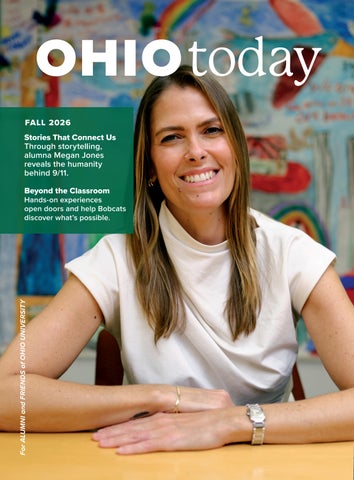
OHIO today FALL 2026 Stories That Connect Us Through storytelling, alumna Megan Jones reveals the humanity behind 9/11. Beyond the Classroom
For ALUMNI and FRIENDS of OHIO UNIVERSITY
Hands-on experiences open doors and help Bobcats discover what’s possible.
PR E S I D E NT ’ S M E S SAG E
A New Year, a New Season of Growth Dear Bobcats, Here in the heart of fall semester, Ohio University is embracing an exciting season of growth, innovation and opportunity. Across our campuses, we are investing in the people, places, and programs that advance our mission and strengthen our impact for students, Ohio and the world. This year also marks an important milestone in the implementation of our Dynamic Strategy. Having completed the second year of this ambitious roadmap, we are now building on that progress in year three while planning the priorities and measurable outcomes that will guide years four through six. The momentum you see across the
University today is a direct result of our shared commitment to learning, discovery, engagement, and creating a workplace where people can thrive. That momentum is visible in several transformative projects. The new Heritage Translational Research Center expands our capacity for groundbreaking research and collaboration, accelerating discoveries that improve health outcomes and strengthen our position as a leading research university. We also welcomed students to McDavis Hall, now home to more than 500 Bobcats and a centerpiece of our efforts to enhance the student experience.
B OB C AT B E A C ON S OF E X C E L L E NC E FROM PRESIDENT LORI STEWART GONZALEZ Ohio University’s Center for Community Impact has joined the Division of Research and Creative Activity, further aligning community engagement with research, creative activity, and strategic partnerships. As the University’s hub for communityengaged learning and scholarship, the center helps connect faculty expertise, student learning, and research with communityidentified priorities, strengthening Ohio University’s ability to address real-world challenges and expand its impact across Ohio and beyond. And the new Marching 110 Complex provides one of our most beloved traditions with a dedicated home worthy of its extraordinary talent and legacy. The stories in this issue reflect that same spirit of progress. You’ll read about investments in virtual production technology that are preparing students for emerging careers, experiential learning scholarships that are expanding opportunity, and research that is improving lives. You’ll also celebrate milestones including the GRID Lab’s 20th anniversary and the inspiring work of alumna Megan Jones, BS ’01. What connects all these stories is our commitment to creating opportunity, advancing discovery and delivering value for the people and communities we serve. Thank you for the many ways you strengthen this institution through your engagement, advocacy and support. The enduring pride and dedication of our Bobcat family continue to shape Ohio University’s future. OHIO Forever,
Lori Stewart Gonzalez President
Recently, Athens — the home of Ohio University — was named the No. 1 college town in the Midwest and a top-10 college town nationally, celebrated for its unique blend of academic excellence, vibrant arts and culture, outdoor recreation, affordability, and strong sense of community. The honor reflects the special connection between Ohio University and Athens that has enriched the Bobcat experience for generations. In research, Ohio University scientists have achieved a promising breakthrough that could help improve treatments for growth hormone disorders. Researchers from the Heritage College of Osteopathic Medicine and the Russ College of Engineering and Technology recently filed a patent based on a discovery that reveals, for the first time, how a pioneering growth hormone drug works at the molecular level. The finding could lead to the development of more effective therapies for patients around the world. Together, these accomplishments reflect Ohio University’s commitment to advancing discovery, expanding opportunity and preparing students to lead in an everchanging world.
F E AT U R E S
10
24
Care Closer to Home
Reality, Reimagined
A $10 million award positions OHIO to expand access to health care in rural communities across the state.
Virtual reality and next-generation production tools are changing how Bobcats learn, create and prepare for careers.
16 Touring Campus Transformation
30 The Power of Experience
From new research facilities to a home for the Marching 110, see what’s taking shape across campus.
From Northern Ireland to Costa Rica, Bobcats discover how learning beyond the classroom changes lives.
22
36
The Many Faces of Rufus Follow the evolution of OHIO’s beloved Bobcat mascot and the traditions that shaped the look.
Stories That Endure At the 9/11 Memorial & Museum, alumna Megan Jones shares the human stories behind a defining moment in history.
D E PA RTM E NTS 06
Green Scenes
44
OHIO Time Machine
20 years of the GRID lab
52
In Memoriam
56
Last Word
57
Still More
46
Bobcat Tracks
Class Notes, Bobcat Sightings, Future Bobcats, Alumni Authors
Visit ohio.edu/magazine for multimedia stories that complement this issue.
FALL 2026
Table of Contents
02 03
YOU R O H I O
FAVORITE OHIO PROFESSORS From journalism and history to science, economics and beyond, Bobcats shared the professors who challenged them, encouraged them and left a lasting impression. Some alumni remembered favorite classes; others recalled mentors whose influence shaped their careers and lives. Read more responses and add your own on the OHIO Alumni Facebook page: @OHIOalumni.
FALL 2026
What’s New at OHIO U 1
2
3
GIFT CREATES HANDS-ON LEARNING OPPORTUNITIES
NURSING’S BIGGEST CLASS YET
INVESTING IN THE FUTURE OF MEDIA
Made possible by a major gift from Kokosing, Inc., the Kokosing Teaching Laboratory opened this spring in the Russ College of Engineering and Technology. Located in the Charles R. and Marilyn Y. Stuckey Academic and Research Center, the lab gives students hands-on experience tackling real-world construction challenges, from building structures to improving infrastructure.
Ohio University’s School of Nursing graduated its largest class of nursing students from the Athens campus in 2026, and now the graduates are moving into new careers. During Spring Commencement, 124 graduates of the Bachelor of Science in Nursing program on the Athens campus proudly received their degrees. These new Bobcats are ready to make a difference everywhere.
A transformational $1.3 million commitment to the Scripps College of Communication will support the Lyon Studio, the LED Wall, and other high-use student production spaces. The newly established Robert S. Lyon Media Entertainment Technology Fund includes $300,000 in funding over the next three years, along with a $1 million estate commitment, helping prepare students for tomorrow’s media careers.
What’s New
04 05
FALL 2026
The “Most Exciting Band in the Land” has gained recent national recognition: first as one of the nation’s top 10 college marching bands by College Raptor; and in August, the Ohio University Marching 110 earned the 2026 Readers’ Choice Award for Best College Marching Band from USA Today. PHOTO BY ANDERS SALING, BSVC ’28
Green Scenes
06 07
ILLUSTRATION BY AARON HARDEN, BFA ’06
CHAMPIONING SUCCESS ON AND OFF THE FIELD Alumni can join Ohio University Athletics in supporting the future of the OHIO football program, thanks to the launch of “Stand Up for OHIO Football,” a fundraising initiative focusing on facility upgrades and renovations, player development and recruitment, and nutrition.
This initiative is possible thanks to a foundational gift from former Bobcat student-athlete and longtime OHIO University leader Donny and Tricia Harrison, whose commitment and leadership helped bring the initiative to life.
“This transformational initiative positions OHIO Football to continue building a championshipcaliber program while creating meaningful opportunities for our student-athletes to grow and succeed on and off the field,” Director of Athletics Slade Larscheid says. “Stand Up for OHIO Football will provide critical support for future generations of Bobcats by investing in facilities, recruitment, development and the overall student-athlete experience. In addition, our goal is to mirror the success of Stand Up for OHIO Football and launch future initiatives for all sports.”
“The landscape of college football is rapidly evolving,” Harrison says. “Our student athletes need and deserve our support in this moment, and I am confident with your help we can continue to elevate our position as a nationally leading, student-focused, championship program.” OHIO Football enters the 2026 season with seven straight bowl victories and a 2024 Mid-American Conference championship, and you can help keep the momentum going. Visit ohio.edu/stand-up to get a look inside and give your gift.
FALL 2026
Sports Admin Program Celebrates 60 Years Ohio University’s Sports Administration program is celebrating a historic milestone: 60 years of excellence as the first program of its kind in the world, holding top rankings for more than a decade. SportBusiness has ranked the program in at least the top three globally every year since its inception in 2012, including number one rankings in 2012 and 2013, 2015-2018, 2020 and 2021, and 2025. “Being the oldest sport management program in the world, we naturally have a large alumni base that is extremely well accomplished at the highest level of sport. Having such a strong base like that provides our students with excellent opportunities for networking, jobs, projects, practical experience and engagement with the program,” Lamar Reams, Robert H. Freeman professor and chair of the Department of Sports Administration, says. “When you combine that strong alumni base with very well accomplished faculty and support from our partners and the University, it positioned us to regularly be ranked as the top program.” Built on innovation and experiential learning, 100% of the program’s students engage in hands-on opportunities. From the New York Capstone to major sporting events, students gain real-world exposure that prepares them for their future careers.
OHIO’S AI-FOCUSED MBA RANKS AMONG THE NATION’S BEST Ohio University’s Online Master of Business Administration (MBA) in Artificial Intelligence has been ranked 11th in the nation in the 2026 Best Online MBA in Artificial Intelligence rankings by MastersInAI.org. The recognition places Ohio University among the top online MBA programs in AI across the country and second in the state of Ohio, highlighting the University’s leadership at the intersection of business education and emerging technology. The ranking lands as AI programs in business education are growing to prepare students for the evolving workforce. “This ranking reflects Ohio University’s commitment to preparing leaders for the rapidly evolving world of business and technology,” says Kari Lehman, vice provost for OHIO Online. “As AI continues to transform industries, organizations need professionals who can not only understand these technologies but also apply them strategically to drive innovation and create value. By offering this program fully online, we make these opportunities accessible to working professionals everywhere.” MastersInAI.org evaluated qualifying programs nationwide using a standardized, data-driven methodology. Eligibility was limited to AACSB-accredited programs offered primarily online with a defined focus on artificial intelligence. OHIO’s Online MBA in Artificial Intelligence is designed to equip working professionals with the skills to understand, implement and manage AI technologies.
Green Scenes
08 09
Ohio University awarded $10 million to expand rural healthcare workforce and access across Ohio Ohio University has received $10 million through the State of Ohio’s Rural Health Transformation Program to expand the rural health workforce and improve access to care across the state. OHIO will lead Health Workforce Ohio, a statewide strategy to recruit, train and retain health professionals in rural communities. Co-leaders include The Health Collaborative and the Ohio Association of Community Health Centers, which will chair an 11-organization statewide steering committee. Partners will connect employers, schools, training providers and community organizations to strengthen workforce pipelines and develop local solutions.
“Access to quality health care should not depend on where you live,” says Ohio University President Lori Stewart Gonzalez. “This landmark investment positions Ohio to become a national leader in rural health workforce innovation and reflects a powerful commitment to the people and communities that are too often underserved. Ohio University is proud to help lead this work, convening partners from across the state to build stronger workforce pipelines, expand access to care and create lasting solutions that will improve health outcomes for generations of Ohioans. Together, we have an opportunity to transform rural health across our state.”
LOCAL SOLUTIONS FOR LASTING IMPACT Strategies include expanding student career exploration, apprenticeships and work-based learning; strengthening telehealth and digital health training; reducing career-entry barriers; and upskilling current workers, particularly in nursing, behavioral health, allied health and community-based care. The initiative also seeks to modernize rural health infrastructure, expand care access and support innovative delivery models through data, shared resources and stakeholder engagement. Created in July 2025 through the federal One Big Beautiful Bill Act, the Rural Health Transformation Program provides one-time funding for long-term improvements in rural health systems. Ohio’s work centers on five priorities: preventive health and chronic disease management, sustainable access to care, workforce development, innovative care delivery and health technology innovation. The Centers for Medicare & Medicaid Services have indicated the program may continue for five years.
FALL 2026
ADDRESSING RURAL HEALTH DISPARITIES According to the Ohio Department of Health’s Ohio Chronic Disease Atlas 2025, rural Ohioans experience higher rates of chronic disease, less access to specialty care and poorer health outcomes than urban residents. The program will address these disparities through coordinated, community-based solutions that increase preventive care, behavioral health services and workforce capacity.
COLLABORATION ACROSS OHIO More than 85 healthcare, education and workforce organizations are expected to participate. OHIO collaborators include the Heritage College of Osteopathic Medicine, College of Health Sciences and Professions, and Voinovich School of Leadership and Public Service. “The scale of collaboration behind Health Workforce Ohio is unlike anything I’ve seen,” says Ohio University Vice President of Health Affairs and Senior Strategist for Health Partnerships Ken Johnson. “This
initiative has brought together an unprecedented coalition focused on a common goal: strengthening Ohio’s health workforce. Rick Hodges deserves tremendous credit for helping bring this vision to life, along with many other partners who have contributed along the way. Healthcare’s biggest challenges require collective action, and Health Workforce Ohio is proof of what is possible when organizations come together with a shared purpose.” Healthcare employers, educational institutions, training organizations and community partners can find funding and partnership information at healthworkforceohio.org. This project is supported by the Centers for Medicare & Medicaid Services (CMS) of the U.S. Department of Health and Human Services (HHS) as part of a financial assistance award totaling $10,000,000 with 100% funded by CMS/HHS. The contents are those of the author(s) and do not necessarily represent the official views of, nor an endorsement by, CMS/HHS or the U.S. government.
Green Scenes
10 11
Defying Density, with Concrete Results Competing against students from universities across the Midwest, the Bobcats brought creativity, collaboration and plenty of engineering knowhow to the challenge. The results? Top-five finishes in several events, a second-place showing for the concrete Frisbee and one very memorable race across the water. Photography by Ben Siegel, BSVC ’02
FALL 2026
PHOTO BY BEN WIRTZ SIEGEL, BSVC ’02
Green Scenes
12 13
Crafting a canoe is a skill-building endeavor, for sure. But have you ever tried constructing a working canoe out of concrete? This spring, Ohio University students took part in an innovative challenge against students from other colleges and universities in the Midwest and sailed through the competition. OHIO students worked throughout the year to prepare for the annual American Society of Civil Engineers (ASCE) Eastern Great Lakes Symposium. Held at Youngstown State University, this year’s symposium drew 35 OHIO students. During the event, students built canoes out of concrete, designed and constructed bridges and houses, and even fashioned a Frisbee from the same unlikely material. “Our students did very well. We placed in the top five in several of the competitions,” says Issam Khoury, who
FALL 2026
is a professor of civil and environmental engineering in the Russ College of Engineering and Technology. Khoury is also the director for the Ohio Research Institute for Transportation and the Environment (ORITE). For the canoe-building competition, students make canoes out of concrete that they then put to the test in a race. The specifications for how the canoes are to be built are changed every year. Each build comes with its own challenges, and some of the creations don’t float correctly or take on water fast. The OHIO concrete canoe faced its share of obstacles, but in the end, it floated and won one of its races, thrilling the crowd of OHIO students watching the event. OHIO’s concrete Frisbee performed well too: the students engineered a disc that flew true, held together on impact, and landed the Bobcats a second-place finish.
The day also featured competitions focused on surveying, building a steel bridge to hold a prespecified weight, and building a two-story wood house. Khoury is the advisor for the ASCE student organization that was part of the competition and said students worked hard to prepare for this year’s event. “We start in August when the students first come back to school, and we work continuously until the competition is held in April.” Khoury says. Most of the students involved are studying in the Russ College Engineering and Technology, but the competition also draws students from other academic areas. “They get to learn to work in a group, and they also get to meet with students from other universities and see how they thought about the different projects.” Khoury says. —Nick Claussen, BSJ ’92
Green Scenes
14 15
TOURING OHIO’S ATHENS CAMPUS TRANSFORMATION For a preview of your next trip to campus, or a glimpse from your corner of the world, take a tour with us to see major construction projects recently completed or underway across the Athens campus.
FALL 2026
NORTH GREEN COLLEGE GREEN
EAST GREEN
As you drive along South Green Drive, past Peden Stadium and the Ohio University Golf and Tennis Center, the scenes are familiar at first. Then, off to the left, across the greenspace once used by the Marching 110 for occasional rehearsals, steps rise to a wide patio and a wall of glass windows flanked by brick on either side. Beckoning students to relax, oversized outdoor furniture offers space to sit and enjoy Athens in the fall. Inside, students can enjoy ping-pong or sit on cozy couches at OHIO’s newest residence hall. McDavis Hall opened its doors just in time for the entering Fall 2026 class. With architecture designed to complement buildings on South and East Greens, McDavis fits so well in the space that it is almost difficult to imagine the view from South Green Drive before this development. Only small patches of red earth where grass has not yet established itself give away the newness of the building.
OHIO Impact
MCDAVIS HALL
SOUTH GREEN 16 17
NORTH GREEN PATTON ARTS CENTER
COLLEGE GREEN
EAST GREEN
McDavis Hall is one of several major construction projects recently finished or under way on OHIO’s Athens campus that are together transforming various corners of campus and elevating living and learning space for future generations of Bobcats. As a preview of your next trip to campus or a glimpse into Athens today, take a tour with us.
Serving as the centerpiece for a total reimagining of the academic space serving students in the arts, the Patton Center will feature an art gallery and a 400seat theater that will be the future home to countless performances, bringing cultural opportunities to the region and delivering essential experience to students in theater, music, dance and more.
NEXT STOP: THE PATTON CENTER FOR ARTS EDUCATION
The Patton Center will provide a major upgrade from Baker Theater in Kantner Hall and the Forum Theater in the RTV building, in size and technological capability. The new state-of-the-art theater is situated adjacent to other arts classroom facilities to drive student participation and collaboration, including the newly renovated and renamed Levy Ceramic Studio.
Continue along South Green Drive past the intramural fields, until it turns left and becomes Mill Street. Then take your first left on Stewart Street and your first right on Union. You’ll want to circle the parking lot across from Jefferson and adjacent to Patton Hall to see the framework coming together for the Patton Center for Arts Education in the Chaddock + Morrow College of Fine Arts, planned to open in 2027.
The addition is part of a larger reenvisioning of art, design and performance space that also includes technology improvements for graphic design students and more.
FALL 2026
UNION GREEN: NEW MEDICAL, BIOMEDICAL & ENGINEERING RESEARCH FACILITIES Continue along Union Street past College Green. You’ll have to make the turn to avoid the one-way section of Union Street, so feel free to stop at your favorite Uptown haunt. Then, continue along West Union past Union Street Diner. If it has been a while since your last visit to Athens, there’s a lot to see here. As you approach the Factory Street intersection, off to your right is the Russ Research Opportunity Center. Opened in 2025, this new facility has quickly become known on campus as “the RROC” (pronounced “rock”). Over the past year, the Russ College of Engineering and Technology has consolidated research labs across a variety of fields into this new and improved facility, bringing technology and research assets together so that these can be more easily shared across research projects. The Union Street location of the RROC also positions engineering research adjacent to the Heritage College of Medicine for possible biomedical collaboration as well as interdisciplinary applied research projects. Later this fall, OHIO will also open the doors to the $75-million Heritage Translational Research Facility just across Factory Street from the Heritage College’s primary classroom building and a short walk from the RROC.
SOUTH GREEN
RUSS RESEARCH OPPORTUNITY CENTER
UNION GREEN OHIO Impact
TRANSLATIONAL RESEARCH FACILITY 18 19
For those less familiar with research terminology, the word “translational” describes research that translates basic science discoveries into treatments, devices and practices that improve public care and population health. In addition to serving the Heritage College, the facility will support several established, health-related institutes at OHIO including the Ohio Musculoskeletal and Neurological Institute (OMNI), the Diabetes Institute, the Institute for Molecular Medicine and Aging and the Appalachian Institute to Advance Health Equity Science. The Translational Research Facility includes several uniquely constructed lab spaces for discipline-specific work, including a state-of-the-art vivarium, a monitored facility for animal housing and care, that was funded in part by a rare $8 million capital grant from the National Institutes of Health. This significant 2024 NIH award resulted in the Heritage College receiving more NIH funding than any other osteopathic medical school in the nation in 2024.
A NEW HOME FOR THE MARCHING 110 Once you pass this new and growing research corridor, you arrive at South Shafer Street. Take a left; just ahead on your right you can’t miss the fresh green turf of the new Marching 110 Band Complex and Hurley Field. In the band’s 100-plus-year history, this fall is the first time the Marching 110 has had a designated practice facility on campus. In previous years, they’ve practiced in various locations across campus, sometimes accepting less-than-ideal conditions. The new complex features a dedicated practice field with durable turf as well as the Kanold Family Pavillion, which offers shade, instrument storage and restroom facilities for members of the Marching 110 — which was recently named the best college marching band in the nation by USA Today (see page 6).
FALL 2026
GREEN
MARCHING 110 BAND COMPLEX AND HURLEY FIELD
WEST GREEN
During home game days this fall, the Marching 110 will march along South Shafer Street from the new practice field to Peden Stadium, bringing us back to the beginning of our tour of recent and ongoing campus transformation.
CAMPUS TRANSFORMATIONS MADE POSSIBLE THROUGH BOBCAT GENEROSITY These projects are funded through many types of philanthropic support: estate gifts, project-based cash gifts, multi-year corporate pledges and smaller gifts that add up to make a real difference. In the Chaddock+Morrow College of Fine Arts, the Patton Center for Arts Education was made possible through an estate gift from Violet Patton and significantly supported by the college naming gift from Jeffery Chaddock and Mark Morrow. Just next door, a gift from Dave and Cathy Levy provided support for renovations to studio space in ceramics, now named the Levy Ceramics Studio.
OUPD
In the Union Street corridor, the Russ Research Opportunity Center was supported with funds from the Fritz J. and Dolores H. Russ estate gift, and the Heritage Translational Research Center was supported with a significant gift from the Osteopathic Heritage Foundation. Marching 110 alumni Shawn and Tracey Hurley made a foundational gift to fund the practice field, and band parent June Konold enabled the expansion of the project to include the Konold Family Pavilion and Patio. The band complex was primarily funded through private gifts. “These are more than new buildings and new facilities. Together, these projects are transforming our student experience and expanding our research capabilities, and each of these projects was made possible in whole or in part by philanthropic support,” says Greg Simmons, vice president for advancement and CEO of the Ohio University Foundation. “At a time when many universities are pausing projects, we have been able to continue important development and elevate our student experience thanks to our donors and partners.” —Robin Oliver, Vice President for University Communications and Marketing
OHIO Impact
20 21
THE MANY LIVES OF OHIO'S BOBCAT
DISCOVER HOW THE BOBCAT MASCOT THAT HAS INSPIRED GENERATIONS OF STUDENTS AND ALUMNI HAS GROWN ALONGSIDE OHIO.
STA
RT
THE SEARCH BEGINS
THE BOBCATS ARE BORN
Ohio University launched a campuswide contest, inviting students to choose a new nickname representing University pride.
Student Hal Rowland's winning suggestion,
1925
Ohio University's enduring athletic nickname.
1925 FALL 2026
HELLO, RUFUS
A complete redesign introduced the modern mascot and University's Bobcat the name Rufus.
BREAKING NEW GROUND Dana (Hudson) Kelly became the first woman selected to portray Ohio University's beloved Bobcat mascot.
2006
1995
A MORE COLLEGIATE BOBCAT
A NEW BOBCAT ERA BEGINS
A professionally redesigned mascot debuted with a modern look, replacing the well-worn costume after years of service.
A redesigned costume debuted for football season, giving Ohio's mascot a refreshed appearance for a new decade.
1983
1990
A FRESH NEW LOOK
BOBKITTEN JOINS THE FAMILY
Mr. Bobcat received an updated appearance, reflecting changing mascot design trends and growing school spirit.
Howard Hall introduced Bobkitten, who appeared alongside Mr. Bobcat at events for more than two decades.
1968
1967
MEET MISTER BOBCAT
A BIRTHDAY WORTH CELEBRATING
The first bobcat mascot costume debuted, bringing the University's new symbol to life at athletic events.
Students celebrated Mr. Bobcat's third birthday, highlighting the mascot's growing popularity and campus traditions.
1960
1963 Infographic
22 23
Reality, augmented
The future of media technology is here, and it’s in students’ hands. Corey Rogier sits in a small consultation room in a health care setting, absorbing life-changing news: He has Huntington’s disease. To his right, a registered nurse explains treatment options. To his left, a nurse practitioner tries to answer questions about his future and the future of his young child. Rogier feels a hand on his right shoulder. Another hand squeezes his left hand. Then he slips off a virtual reality headset and he’s back to being Corey Rogier, master’s student in public health at Ohio University. “I felt sad, even though it was just a scenario,” Rogier says, still wearing the haptic vest and glove that allowed him to feel the comforting hands on him. “Bedside manner is important, and it is integrated in courses, but seeing it through the goggles was a unique situation. Honestly, it didn’t feel like it was scripted.” Rogier, BS ’24, MPH ’27, has just participated in a cinematic virtual reality experience created by OHIO360, a collaboration between the Scripps College of Communication and the Voinovich School of Leadership and Public Service. This scenario is one of some 35 cine-VR experiences and counting that help teach service-oriented skills like empathy to public employees in the fields of healthcare, law enforcement and more. Cine-VR takes the components of cinematic movie-making — scripts, sets, actors, lighting, blocking — and records it with a 360-degree camera, embedding the viewer in the scene itself.
FALL 2026 SPRING 2026
OHIO Impact
24 32 33 25
Scripps Professor Eric Williams, who is one of several leaders in OHIO360, shoots a training video for law enforcement officers in Schoonover Center. Officers will later experience the video in VR. PHOTO BY ZOE CRANFIL
“It’s always like, ‘Wow, I will remember this. I think if this happens in real life, I’ll know how to react,’” says Sherleena Buchman, PHD ’16, associate dean of curriculum and academic affairs in the School of Nursing. She has seen cine-VR work as a great learning tool and has helped inform the scripts for the experiences currently used in nursing courses. “To my knowledge, nobody else has done anything like this,” Buchman adds, pointing to OHIO’s leadership in haptic cine-VR. OHIO has plans to introduce the cine-VR nursing experiences to the online graduate nursing and public health programs, and in 2027 a new academic certificate will be offered, titled Extended Realities in Healthcare.
Training clients in law enforcement
OHIO360 grew out of an initiative in which OHIO’s Game Research and Immersive Design (GRID) Lab produced cine-VR content to be used as continual professional training modules for Ohio law enforcement departments. This content is now in its third season of production. The GRID Lab is outfitted with state-of-the-art hardware and software to create ultra-realistic experiences. In one of the law enforcement training scenarios, a distressed teenage girl is standing on top of a bridge abutment; it looks like she is about to jump. Anyone wearing a VR headset to observe this scene will immediately look down – the perspective is nearly 50 feet above the water. A police officer is on the bridge, slowly approaching the girl. The officer employs techniques to de-escalate the situation, create trust and talk the girl down.
John Born vividly remembers the first time he donned a headset and took in this particular cine-VR experience. “It made my hands sweat,” he recalls, “It is as real as it gets without being there.” And Born, BSJ ’85, MS ’92, has been there – he was a state highway patrol officer for 26 years, and he eventually served as director of the Ohio Department of Public Safety. Now a visiting assistant professor and executive in residence at the Voinovich School, Born was the one to make the initial connection between the GRID Lab and law enforcement agencies. “It’s an extraordinarily effective training,” Born asserts. And trainees agree: Early surveys show that more than 80% say they prefer to be trained this way over traditional forms of training. Born appreciates the ability to frequently add new trainings because a professional can put on a headset, and 12-15 minutes later they have completed a session — no need to travel off site for a 2-hour tutorial. New clients are coming on board, now that OHIO has proven itself in this leading-edge field. OHIO360 has contracted with the Ohio Department of Administrative Services to create experiences for employee training, and with the Forensic Nursing Network to develop experiences to co-train health care and law enforcement professionals using domestic violence scenarios.
VR training simulation supplements cine-VR experiences
The GRID Lab has recently released a VR experience app that is a callback to OHIO360 cine-VR script featuring the teenage girl on the bridge. She is a human
FALL 2026
trafficking victim. Instead of cinematic VR, however, it is an interactive digital crime scene viewed with a VR headset and guided with hand-held controllers. The first person-based 360 experience trains law enforcement to go through the crime scene where the trafficking occurred. The assignment is to identify and select evidence. Scores are assigned to the quality of evidence selected, from an appointment calendar to a cell phone to DNA samples. Athens and Ohio University police continually tested the project, helping to refine the experience. It is serious, but gamified. “We wanted to gamify it in a way in which you can win and lose” to bring a pass/fail aspect to the training, says William Hamilton, BS ’26, a lead developer on the project.
“It’s the best of what the GRID Lab does, which is make something interactive, immersive and doing it with students,” Hamilton adds. He turned his experience at the GRID Lab into an internship with NASA to create a digital approximation of the moon for the Artemis Project. “I can say 100% that I only got that NASA position because of the work that I’d done at the GRID Lab … Same tools, same workflows.”
From Hollywood to Athens
Across College Green, another initiative at OHIO uses a shared technological ecosystem, but to a different end. Inside the RTV Building, students have access to a 21-by-12-foot LED wall capable of displaying massive, photorealistic digital environments in real time — no
OHIO Green Impactscenes
26 27
need to scout locations. The LED screen provides a background that seamlessly blends with a traditional foreground set and actors. At any given moment, the wall may display an underwater seascape, an alien spaceship — or Court Street, for that matter. “We’re still in the business of movie magic,” says Brian Plow, associate professor of media arts and studies. While the LED wall is not immersive or 360 in nature, it still qualifies as cutting-edge cinematic technology. “We were looking at, what can we do with this space? How can we be competitive?” Plow says, recalling the impetus for acquiring the wall in 2025. The space he is referring to is the former Studio C, renamed Bob Lyon Studio after the WOUB and longtime broadcasting alumnus. “We developed this idea for virtual production. It’s this integration of live action and virtual assets that happens live in camera.”
The studio, the LED screen and the technology that supports it are all part of the Scripps Digital Cinema Initiative, kickstarted with funding from Lyon, the Charles and Lucille King Family Foundation and the Scripps College of Communication. Today the college is home to two LED screens at a price tag of $575,000 — the Esports Arena in Scripps Hall boasts a smaller version used for live esports broadcasting. The Esports Arena is a working production space where students apply what they learn by running multiple broadcasts each week. “Esports jobs aren’t at the mouse and the keyboard, as we like to say; the jobs are going to be in the broadcast booth, behind the camera and doing announcing,” says Jeff Kuhn, director of esports.
FALL 2026
The wall allows students to place announcers and broadcasters inside digital versions of the environments where players compete. The larger LED wall, along with two advanced digital cinema cameras and computing technology in the Advanced Visualization Lab on the third floor, changes filmmaking by replacing traditional green-screen techniques with real-time digital environments. Instead of actors pretending to stand in a herd of wild animals or a postapocalyptic city while editors add backgrounds months later, filmmakers can immediately see the final environment through the camera. Plow describes this as more than just a green screen on steroids: it’s flipping the production pipeline. Instead of creating worlds in post-production, students create worlds in pre-production in the Advanced Visualization Lab. This technology is increasingly common throughout the entertainment and media industries. Plow points to its use in large Hollywood studios for film and television, but also in corporate media studios, professional athletics and esports. Central to the college’s mission, the wall is preparing students for jobs using this latest technology. Meg Sharp, BSMAS ’24, apprenticed with Plow in 2022. From her office in the GRID Lab, she learned the software Unreal Engine and made recommendations for how to incorporate virtual production into the curriculum. “The fact that … it was a paid apprenticeship was a big deal,” Sharp says, “I was learning the cutting-edge tools used in the industry. That changed the trajectory of what I do.”
That trajectory included an internship at a virtual production studio when Sharp completed the OHIOin-LA Program, and now a job as a creative technician at OHD Studios, a full-service video production facility in Columbus. She credits her early success in the field to the apprenticeship with Plow. “It was a lot of learning and problem solving and creative technical thinking and trial and error. And those are all skills that I use every day at my job,” Sharp says. Back in Athens, students are developing these technical and professional skills using the LED wall for a wide range of projects: WOUB’s Gridiron Glory used the space to create a custom virtual media-day set for high school football players, OHIO Athletics has filmed hype videos on the set, Brick City Records shoots music videos there and the student ad agency NEXT produced promotional content for the global tech corporation Siemens. In short, the LED wall represents a major investment by the University to give students the opportunity to create content on par with what Hollywood studios create, using the same tools. “It moved us into the current ‘state of the art’ in media production,” Plow says. “The more we can bring people together over an exciting opportunity, the more we model our educational ecosystem after what happens in the industries we send our students out into.” — Mary Reed, BSJ ’90, MA ’93
OHIO Impact
28 29
An experience
BY E X PA N DING ACCE S S TO E X P E R I E N T IAL L E AR NING , OH I O I S G IVING MOR E ST U D E N TS T HE CHANCE TO P U T T H E I R E D UCAT ION INTO P R AC T I C E AND D IS COVE R WH E R E I T CAN TAK E T HE M.
FALL 2026
like no other Long after graduation, Bobcats remember the moments that changed them: A professor who saw their potential. A first research presentation. A study-away course that made the world feel both larger and more knowable. That first internship that turned uncertainty into purpose.
“At OHIO, learning means doing,” President Gonzalez says. “This investment is about removing barriers to experiences, so that any student can take what they are discovering in the classroom and apply it in ways that prepare them for success after graduation.”
For generations, these defining OHIO experiences have widened perspectives and deepened the sense of connection alumni carry with them for life. But for some students, transformative opportunities have come with a cost they could not easily absorb: a plane ticket, conference registration, a month of living expenses, a passport or a program fee.
The students featured here put their dreams to work: They navigated unfamiliar cities, crossed language barriers and met new people who became part of their story. They returned with clearer purpose and renewed appreciation for others’ points of view. Their experiences remind us that talent and dedication are ubiquitous at OHIO, and opportunity should be too.
President Lori Stewart Gonzalez has put new resources into play in addressing that problem. Through a $500,000 investment in experiential learning support, announced as one of the first major actions tied to OHIO’s Dynamic Strategy, the University has expanded access to the internships, research, study abroad, community engagement and leadership experiences that prepare students for life after graduation. In the 2025-26 academic year, these awards totaled $194,505, with $183,405 supporting students on the Athens campus and $11,100 supporting students on OHIO’s regional campuses. The investment reflects a central priority of OHIO’s Dynamic Strategy: learning that reaches beyond the classroom and prepares every student for success. By promoting experiential learning awards, the University is helping more students pursue internships, research, study abroad and leadership experiences connected to their fields.
OHIO Impact
30 31
“IT WAS ONE OF THE GREATEST EXPERIENC ES OF MY LIFE. I WOULDN’T TRADE IT FOR A NYTHING. I THINK A B OUT IT EV ERY SINGLE DAY, A ND IT WA S JUST SO, SO AMA ZING.” — Makenna Leo nard
For starters, the awards meant a change in math. Emily Stokes had been interested in the Law, Justice and Culture spring break course in Northern Ireland, but study abroad still felt out of reach, the kind of thing she would need “to win the lottery” to afford. Without funding, she says, she probably would have spent spring break working. Hazel Chmiel’s award covered “almost 100%” of her flight to Costa Rica. Makenna Leonard used her award for a plane ticket to Spain, housing and the metro rides that got her to a bilingual school outside Valencia. For Cierra Willis, an affordable housing advocacy trip to Washington, D.C., would have been inaccessible without the funds. Alyssa Mirisola, a psychology major at OHIO Lancaster, says the national Alpha Phi Omega conference in Philadelphia was “all things possible because of the scholarship.” When her award email arrived, “I literally started jumping up and down at my job,” she says. Throughout their experiences, the students learned what classroom examples cannot always provide: They saw abstract ideas come to life.
FALL 2026
In Northern Ireland, Stokes met former IRA prisoners, British soldiers and residents whose families had lived through the Troubles. As a journalism strategic communication major, she already knew that one source is never the full story. But in Northern Ireland, she stood on one side of a wall and heard one version of the conflict, then crossed to the other side and heard another. Her takeaway? “No truth is one united truth,” she says.
Kathleen Hinkel came back from her trip to Taiwan with her own insights into healthcare. Hinkel visited Taipei and Taichung with a group of her fellow speech language pathology majors and came away knowing more about how she wants to run her own practice someday. She says the practitioners she met in Japan were “so intentional” in their approach, and she came away with a list of similar ideas she’ll employ when she has her own practice.
The Northern Ireland experience prompted Landon Wicks, a senior anthropology major in the Honors Tutorial College, to ask questions that will inform his research moving forward: “How do people try and reconcile? Do they even reconcile? How are these things remembered and memorialized?” he says.
Leonard’s lessons were more growth-oriented. In Valencia, she worked with third through sixth graders preparing for English-speaking exams, and she noticed that the school did not emphasize relationship-building the way she had learned to value it through Patton College. The contrast clarified the kind of teacher she wants to be. It also pushed her personally. “I’m a planner,” she says, but in Spain she learned to move through a non-touristy city with limited Spanish and “stepped out of my comfort zone.”
Chmiel, a public health major from the Athens area, saw access built into the healthcare system. In Costa Rica, she learned about teams that travel to rural communities instead of waiting for patients to reach a hospital. “They do so much to reach the people who can’t come to them,” she says. The model made her think about community health workers in Appalachia and about what trust can do where distance and cost can shape whether people seek help.
Leonard says the stretch was well worth it: “It was one of the greatest experiences of my life. I wouldn’t trade it for anything. I think about it every single day, and it was just so, so amazing.”
OHIO Impact
32 33
Mirisola’s classroom was a convention center. She attended learning labs, professional dinners and service activities with APO members from around the country. The conference gave her tactics for recruiting and retaining members, and she says she left with new contacts, practical ideas for membership and “a lot more confidence as a Bobcat in professional settings.” The conference was a catalyst for learning, she says. “I’m so grateful for the opportunity and very happy that I went.” Willis spent her time in Washington with a group from Habitat for Humanity, stretching her environmental science background to advocate for affordable housing in southeastern Ohio. The focus on policy has expanded her vision of the future. “I had never considered a future in public service or policy,” she says. “Now I really want to see how I can connect science to policy and people and benefit those communities.” And of course, there were the people the students met along the way. Stokes and Wicks both say they still think about Adrian, a Derry tour guide who
sat inside a simulated prison cell and told students what he had survived. (“I’m not a big crier,” Wicks says, “But I’ll admit it got me a bit.”) Chmiel remembers a bus driver who spoke only Spanish, shared family photos and helped her after storms scrambled flights. Leonard remembers the teacher who noticed she was lonely, started joining her for lunch and later invited her home for paella. Mirisola left Philadelphia with phone numbers from new friends and a wider sense of what APO could mean. Willis shared Bobcat pride with students from other universities doing similar advocacy. Hinkel found comfort in the hospitality her hosts extended. “The world feels so big sometimes,” she says. “But then you go on these trips, and you meet someone and they are so open to sharing everything with you and getting to know you but also wanting to hear about your life.” Across these experiences, the lessons stick. Stokes carries Northern Ireland into how she thinks about reporting and justice. Wicks has already started incorporating that experience into his senior thesis. Chmiel talks about Costa Rica with future health
FALL 2026
sciences students. Leonard brings Valencia into the classroom she hopes to lead. Mirisola brings the confidence she gained in Philadelphia back to Lancaster, more comfortable claiming a place in the room. Hinkel and Willis will carry what they found in their experiences to graduate school in the fall. These moments add up to something far more valuable than the cost of the trip itself. That fact was not lost on Willis. “We would not have been able to get there without OHIO,” she says. “I just feel so much more grateful for Ohio University and the things that they do here. It’s a family and we all support each other.” The Student Experiential Learning Fund helps more Bobcats get to these learning moments. A gift to the fund helps remove financial barriers and allow a life-changing experience to come within reach. Visit ohio.edu/experience to learn more about the fund and the opportunities for students.
OHIO Impact
34 35
FROM ATHENS TO GROUND ZERO:
How OHIO alum Megan Jones educates the world about 9/11 through storytelling What does it really mean to “Never Forget?” Does it mean remembering the date? The act of terrorism? The nearly 3,000 lives lost? The smoke, the sirens and the images that have become etched into history? For Megan Jones, BS ’01, it means remembering the people. As Vice President for Education Programs at the 9/11 Memorial & Museum, Jones spends her days helping millions of students, teachers, families and visitors understand one of the darkest days in American history. But she believes the most effective way to teach the story of Sept. 11 isn’t through statistics, timelines or casualty figures, but through the people whose lives were forever changed and the humanity that emerged in the aftermath. “For me, above anything else, the story of 9/11 is a human story,” Jones says. “It’s about humanity. It’s about, yes, the darkest of humanity, but it’s also about the best of humanity.” That philosophy comes to life inside the museum’s education center, where vibrant artwork created by children lines the walls below the ground where
the Twin Towers once stood. Crayon drawings of firefighters sit alongside paintings of the memorial pools and handwritten messages of hope. It is an unexpectedly colorful space in a place so closely tied to tragedy. Just beyond the classroom space are preserved artifacts that show the impacts of the day but, more importantly, tell the stories of the people who were there, including firefighters, office workers, survivors and families. Through those experiences, students and visitors learn about Sept. 11 through the people who lived it. “You can say that 2,977 people were killed on 9/11, and that’s a very large number,” Jones says. “But when you tell the story of a 24-year-old young man who was just at work at his first real office job in New York and decided to help evacuate people and get them to safety and then run back up the stairs to help strangers, then it becomes more real.” For Jones, storytelling is at the heart of her work. It is how she helps people from around the world, including generations who were not yet born when the attacks occurred, understand not just what happened on that day, but who was affected, how people responded and the impacts still felt today.
FALL 2026
OHIO Impact
36 37
EMBARKING ON CURIOSITY
Jones’ path to educating the world on one of the toughest topics to consider was not straightforward. Her curiosity about teaching history and exploring new perspectives, however, laid the foundation for her career. Jones graduated from Ohio University in 2001. Although initially reluctant to attend her parents’ alma mater — they met at OHIO and often spoke about Athens and the University — she quickly changed her mind. “I did the college tour with one of my friends from high school — my mom took us down, and I knew immediately that it was going to be the place for me. And so that was it, and it really was some of the most special years of my life.” Jones fondly remembers living in Brown Hall, joining Chi Omega and forming friendships that continue today. She studied political science and sociology, expecting to attend law school. But while interning in Cleveland, she organized a courthouse visit for her younger siblings and their classmates and discovered she preferred introducing young people to complex ideas. “I had so much fun talking to them about the process and organizing their field trip,” she says. “I thought, ‘What about education?’” After earning a master’s degree in educational leadership and teaching, Jones moved to Washington, D.C., hoping to work on Capitol Hill. Instead, volunteering at the National Archives led to a job as an education specialist, where she discovered how primary sources could transform history education. “I loved that job — working with primary sources and thinking about how to integrate those sources into the classroom,” she explains. She later managed visitor programs at the U.S. Supreme Court, where navigating difficult conversations required neutrality and care. “We always did this thing where you would wear your Megan Jones hat, and then you had to wear your government hat,” Jones adds. “You had to be so neutral and thoughtful about everything you said.”
During that time, she began considering what might be the most difficult history lesson in America to teach, and how to approach it. Her thoughts returned to 9/11. The attacks had touched Jones’ own family. Her cousin worked across the street from the World Trade Center and witnessed the first plane strike the North Tower. Trapped in the dust cloud, he disappeared for several days before his family learned he had survived. He rarely discussed the experience until one day he unexpectedly shared his story with Jones, leaving a lasting impression. Her cousin died in 2012, around the time Jones began wondering how future generations would learn about Sept. 11. Then she saw a job posting for the museum, which had not yet opened. “We had just bought a house in Virginia,” she says. “I thought, ‘That would be absolutely crazy.’”
SHE APPLIED ANYWAY
Jones became one of the first education employees hired before the museum opened in spring 2014. On her first day in January 2014, she walked into the makings of a museum with borrowed construction boots on, staring at an education space that at the time was nothing more than white walls. “There was nothing in here,” she explains. “That’s really when it hit me — the awesome responsibility that we had in creating every education program for this institution from the beginning.”
TANGIBLE STORYTELLING
At the start of her role, much like the museum itself, Jones and her team had to build an educational program from the ground up. They knew they needed field trips for students, programs for New York City public schools, professional development for teachers and programs for teenagers, in addition to finding ways to educate global populations and, perhaps most challenging, students visiting the museum who would have no personal memory of that day.
FALL 2026
OHIO Impact
38 39
Jones quickly understood that at the heart of educating all those different types of people was one thing in common: tangible storytelling.
the story of Ladder Company 3 and the firefighters who were on that truck that day, including their captain, Patrick “Paddy” Brown.
“They need to understand what happened that day first and foremost,” she says. “How can you remember something that you didn’t live through? We always say, ‘Never forget.’ They don’t know what they’re not supposed to forget.”
“We start with an observation,” Jones says. “Then we tell the story of a particular person or group of people connected directly to that artifact.”
According to Jones, museum tours are inquiry-based rather than simply didactic. Rather than beginning with lectures, museum educators ask students to observe and ask them, “What do you notice?” Standing in front of Fire Truck Ladder 3, students might point out the damage or burned portions of the vehicle. Those observations become an opening into
The same process happens throughout the museum. An artifact becomes a story. The story becomes a person. The person becomes a way for students to understand the larger events of Sept. 11. “It’s not just something that happened and then time moved on,” she says. “It’s something that continues to affect the world that we live in today.” But Jones’ goal isn’t simply to help students understand
FALL 2026
what happened. She wants them to make their own meaning from it. “What’s really important to me is not to tell why 9/11 is important or why it matters, my goal is for students to discover for themselves why it’s important. Because when you can make meaning for yourself, that’s more impactful than someone just standing in front of you and saying, ‘Well, this was an important day because...” The museum’s approach to tangible storytelling extends to its volunteers, who help bring history to life through the artifacts and personal stories they share with visitors. Longtime University supporter Mark Morrow has spent 13 years working in New York City with the team that leads tours and helps visitors understand the museum. As a volunteer, he guides visitors through the museum, giving brief talks about key artifacts that convey the story of 9/11 and the World Trade Center. He shares a particularly meaningful experience from this 25th anniversary year. The names of those who died on 9/11 are on bronze parapets around the pools, arranged using a system of “meaningful adjacencies”—by relational and shared location versus alphabetically. Recently, Morrow assisted a woman who was looking for her sister’s name. “She said, ‘This was my sister, and I’ve never been able to come here.’” Morrow escorted the woman to the area where her sister’s name is, then offered to step back and escort her to the family seating area when she was ready. “I said, ‘I’ll give you a moment, but I’ll be right back there.’ And she said, ‘No, please stand beside me if you’re okay with that.’ I said, ‘Absolutely.’” “She stood there, and you could hear her fighting back the tears, and she finally looked at me and she said, ‘I’m ready,’” Morrow recalls, referring to the reading of the names in the family area. He reflects on his experience of being selected to serve at the museum’s family desk for five out of the 13 years he has been there. “This year’s anniversary, because it was 25, I’m honored.”
EDUCATING A GENERATION WITH NO MEMORY
As time moves further from Sept. 11, teaching about it becomes more challenging. For students born after the attacks, 9/11 is not a memory — it’s history. Jones believes educators must acknowledge that difference rather than assume students understand the day’s significance. Students must understand both the events of Sept. 11 and their lasting effects. “9/11 didn’t exist in a vacuum,” Jones says. “It’s not just something that happened and then time moved on. It’s something that continues to affect the world that we live in today.” The museum’s education programs help students explore those effects, while encouraging them to confront difficult questions rather than avoid them. “I’ve always been someone who has tried to address the most uncomfortable things because I think, you know, even as a teacher, if you don’t address the hard history, you’re going to have students who still want to have answers and will find them,” she says. That is especially important when students can turn to social media for answers. “If they don’t come to the classroom with curiosity, they’re going to go find it somewhere else,” Jones says. “And that can be very frightening with how much misinformation and disinformation is out there.” The museum also works with educators through professional development programs and its annual Summer Institute, which brings teachers from across the country together to study 9/11 history, explore museum pedagogy and consider how storytelling can foster classroom conversations. Teachers hear from museum experts and people with firsthand connections to 9/11, including first responders, survivors and family members. The institute is designed to multiply that impact: Teachers equipped with the knowledge and resources to tackle difficult history can bring those lessons to dozens or hundreds of students.
OHIO Impact
40 41
“Because they’re the ones on the front lines that are going to be asked the questions and are going to, you know, are really a part of our charge as educators is to pass this history to the next generation,” Jones says. Jones also relies on teachers to help the museum understand classroom needs. Their feedback informs lesson plans and professional development because, as she puts it, she can guess what is happening in classrooms — but doesn’t necessarily know. That relationship keeps the museum connected to the realities of teaching difficult history nearly 25 years after the attacks.
BRINGING THE MUSEUM TO THE WORLD
Jones knew that not every student or visitor could travel to New York and stand among the artifacts of the museum. So she began looking for ways to bring the stories out to the public in a more accessible way. It began modestly in 2016 with a single webinar featuring Ada Dolch, a principal whose school sat just one block from the World Trade Center. On Sept. 11, Dolch evacuated hundreds of students through the dust cloud while her own sister remained trapped inside the North Tower. Afterward, instead of turning inward, she helped inspire the creation of a school for girls in Afghanistan, even naming the garden there in memory of her sister. “Ada is so incredibly inspiring because she always talks about how she could be angry or mad but instead tries to educate,” Jones says. That first program drew about 30,000 participants. The next year, prerecorded stories allowed more schools to participate while educators answered questions live online. According to Jones, attendance climbed to 100,000. Today, the museum’s annual program features survivors, first responders, family members and people who were themselves children or students when the attacks occurred. Their stories are filmed professionally and made available for free through the museum’s website around the anniversary of 9/11.
Students can watch the stories wherever they are and submit questions through a live chat, connecting them with Jones and her colleagues at the museum. More than 5 million students have participated in the program, reaching more than 65 countries. “The idea was to connect students with people who were there,” Jones says. The program has also found audiences far beyond traditional classrooms. Libraries have screened the films for the public, as well as movie theaters and communities across the globe. This year’s speakers included sons of a firefighter killed in the attacks — one who followed in his father’s footsteps, joining the New York Fire Department (FDNY) and eventually earning the same rank on what would have been his father’s 70th birthday — and daughters who lost their fathers before choosing careers in public service themselves. Their stories illustrate what Jones hopes students remember: not simply how people died, but how others chose to live afterward. The museum has also expanded its virtual offerings, including live virtual tours for students in grades three through 12 who cannot travel to New York. The tours use cameras to bring students into the museum and follow the same storytelling approach as an inperson visit. The goal is to ensure geography does not determine who gets to learn from the museum’s stories.
DISCOVERING THE WHY
After years spent helping millions understand one of history’s darkest days, Jones still returns to the question she asks students: Why does it matter? “I used to start always with, ‘Why are we even here? Why are we in history class?’” she says. “The ‘why’ is the most important question.” She believes each student must discover their own answer, and her role is to create opportunities for that discovery.
FALL 2026
For Jones, remembering Sept. 11 is about more than tragedy. It’s about recognizing our shared humanity.
At the museum, artifacts offer a tangible connection to the past, while educators help bring those stories forward.
“I often think about the people who were trapped in the towers and faced with a ‘choiceless choice,’ circumstances no person should ever have to experience. The attacks were an attack on humanity. Yet within that horror, people also demonstrated extraordinary courage, compassion and selflessness and I think that these stories can inspire us to be the best versions of who we are — I think everyone’s capable of that.”
“I’m just here to help bring out the story,” Jones says. “But they are the story. They’re the tangible story.” Now 25 years after the attacks, Jones hopes these stories help a new generation recognize what connects us.
Jones believes these stories remain relevant even to those who were not alive when the attacks occurred.
“You hope it doesn’t take something like this to see it,” she says. “But I think remembering 9/11 and telling these stories and sharing these stories can help us see that at our core, despite all differences, we’re all human and we are all connected.”
“I think 9/11 gives us an opportunity to explore our inner humanity and how really we are all more connected than we are different,” she says.
For a generation with no firsthand memory of Sept. 11, that may be one of the most important things to remember. —Samantha Pelham Kunz, BSJ, BA ’17; MAA ’21
OHIO Impact
42 43
TIME MACHINE
Innovation, 20 Years On
The GRID Lab has grown from its experimental start to an experiential powerhouse, sending more than 300 students into jobs at Microsoft, Disney, NASA and beyond. “Humble beginnings” might be an understatement. The Game Research and Immersive Design (GRID) Lab got its start as a public arcade in a storefront on Court Street. Twenty years later, the facility has a home on College Green, more than 300 alumni, and $9 million in grants for 40 projects.
One of the GRID Lab’s biggest successes is the Ohio Peace Officer’s Training Academy (OPOTA), an awardwinning Cinematic Virtual Reality (cine-VR) training experience for law enforcement agents. OPATA produces real-world scenarios that provide training in de-escalation for domestic disputes, mental health crises and similar situations. The project won an FBI
FALL 2026
National Academy Associates Science and Innovation award in 2023. It just finished its third season and is training more than 30,000 law enforcement officers. During an anniversary open house in April, visitors were invited to the GRID Lab’s Scripps Hall space to experience cine-VR facilities, a mixed reality obstacle course, a motion capture lab, an immersive audio studio and isolation booth for sound recording; and Virtual, Augmented and Mixed Reality (XR) labs. It was a long way from that arcade on Court Street, and John Bowditch, the GRID Lab’s director and game design and development professor in the J. Warren McClure School of Emerging Communication Technologies, has been there every step of the way. He says the lab has never lost its commitment to experiential learning.
“A requirement for every project we take on is that students must be involved through paid experiential learning opportunities,” he says. “We typically have at least 20 students on payroll each semester working on various projects.” To date, the lab has been a home for more than 300 student employees, who gain professional, hands-on experience in virtual reality and game development, computer animation, media production, and immersive audio production, and they go on to careers in thriving industries. “Many of the students who work for the GRID lab do very well in early job placements across industries, including entertainment, defense, theme park design, and healthcare simulation,” Bowditch says.
OHIO Time Machine
44 45
Class Notes
* denotes accolades featured at ohio.edu/news or in the media
B O B C AT S P O T L I G H T
Alumna Debbie Antonelli honored with Distinguished Alumnus Award Alumna Debbie Antonelli, MS ’88 in sports administration*, is recognized for her achievements in sports administration with the 2026 Charles R. “Doc” Higgins Distinguished Alumnus Award. Antonelli has won two Emmy Awards COURTESY OF DEBBIE ANTONELLI and has worked with ESPN and CBS as a men’s and women’s basketball analyst. She was also awarded the Curt Gowdy Media Award from the Naismith Memorial Basketball Hall of Fame in 2024. Now in the 39th year of her career, Antonelli dedicates her life to her family and philanthropic leadership. “I am humbled and overwhelmed to receive this distinguished recognition from my colleagues at Ohio University, especially as we mark 60 years of this incredible program’s notoriety and worldwide impact. The Sports Administration program created a launching pad for my career and taught me many things, including the value of networking and relationships,” says Antonelli, who solidifies her legacy as an OHIO alumna with her dedication. “It is an honor to join the list of gamechangers and sport pioneers through six decades in the name of Dr. Higgins. I would like to thank the Ohio University Sports Administration leadership for recognizing both myself and my family.” Read more about Antonelli at ohio.edu/antonelli-award.
FALL 2026
Bobcat Tracks
46 47
FALL 2026
Kevin Pinson, BSJ ’92, in Badwater Basin at Death Valley National Park. Kevin was celebrating his 30th anniversary with his wife, Amy. Ohio University alumnus Randall Best, BSINDT ’82 and his son Royce Best, BA ’11, took on the UK and France. They are seen here in front of the Eiffel Tower in Paris.
Jessica Rovniak, BS ’13, and Joe Skyrm, BSC ’14, got married on Oct. 25, 2025, in Brooklyn, New York. They made sure to get this photo with friends and family, many of whom represent multiple generations of fellow OHIO alumni.
Anne M. GruberMcCarthy, BSC ’93 represents Bobcats with an OHIO flag at Cape Hope, the southernmost tip of Africa in South Africa.
Kurt Anderson, BA ’72, made sure to take an Ohio University flag with him on a recent trip to Italy. Anderson proudly displayed the OHIO “Proud Alumni” flag in Tuscany, at the Roman Colosseum and other destinations across Italy.
Bobcat Tracks
Patricia Trumpeter Lovell, BSRS ’82 and her twin sister Priscilla (Polly) Trumpeter Moss, BSC ’81 celebrate OHIO in the only way they can after losing their OHIO flag bicycling through Austria. Here they are hiking in Garmisch Partenkirchen, Germany.
48 49
FALL 2026
R
VE
TE
EN SO
..
ERVE R S
TE
LU
B
DA
I LY T
HOU M
MNI
AY
ES
T
A WA
•
AT
ET
H
I AT I O N
O W.
A
OC
GR
IO UNI
IA
YE
ST
OH
MA
T
McGee Brown’s devotion to OHIO runs deep. She has served on the University’s Board of Trustees, the Foundation Board, and received the Alumni Association’s Medal of Merit in 2001. A member of the Ohio Women’s Hall of Fame, she continues to mentor students and young leaders, carrying a legacy of justice, service and lasting impact across the state and beyond.
A I LY T H O U
T
Beyond the bench, McGee Brown has been a transformative leader across corporate, civic and educational institutions. She founded the Center for Child and Family Advocacy at Nationwide Children’s Hospital, a nationally recognized model for responding to child abuse and family violence. McGee Brown is widely recognized for her leadership and commitment to improving outcomes for vulnerable populations.
•
Leading the lineup of this year’s awardees is the Honorable Yvette McGee Brown, BSJ ’82, who has been named OHIO’s 2026 Alumna of the Year. A first-generation college graduate, McGee Brown made history in 2011 as the first African American woman to serve on the Supreme Court of Ohio. Before reaching the state’s highest court, she spent nearly a decade as a judge on the Franklin County Court of Common Pleas — the first African American woman elected to that bench — where she created the Family Drug Court and the SMART Program to address substance abuse, truancy and family instability.
TD
AR
PHOTO BY RICH-JOSEPH FACUN, BSVC ’01
Since 1940, the Ohio University Alumni Association has honored Bobcats who reflect the very best of OHIO — excellence in their fields, service to their communities, and a lifelong devotion to their alma mater. Each Homecoming, the Alumni Awards celebrate how alumni lead, connect, and make a difference in the world.
A TH
... SO DEP
Yvette McGee Brown Named 2026 Alumna of the Year
R
Y ALUMN
SS
A Justice for the Ages:
T SI
R
D
Alumna of the Year Hon. Yvette McGee Brown, BSJ ’82 ••• Medal of Merit James Dru Joyce II, BGS ’78 Alex Sheen, BBA ’07 ••• Distinguished Service Award Chris Bellamy, BBA ’99 Valerie Biggs Hill, BSC ’78 Steven Krebs, BSISE ’92 Dan Squiller, BSEE ’79, MA ’84 (2025 Recipient) ••• Charles J. & Claire O. Ping Recent Graduate Award Bradley Fain, BSSPS ’13 Allie LaForce, BSJ ’11
Honorary Alumni Award Dr. John Kopchick ••• Kermit Blosser Ohio Athletics Hall of Fame Torrie Albini, BSSPS ’09 Donald Caldwell, BSEd ’73 Douglas Grebe, BBA ’99, BS ’99 Germane Lindsey Jr., BSS ’12 Josh Sorge, BSEd ’96, MSPE ’99
LEARN MORE ABOUT THE ALUMNI AWARDS AT: ohio.edu/alumni/events/homecoming/alumni-awards Bobcat Tracks
48 49
Remembering Fellow Alumni
1940s Melba Eloise (Pickenpaugh) Gschneidner, BSHEC ’49 Joan (Algeo) Riser, AB ’49
1950s Carolyn J. (Cummins) Kirkwood, BSED ’50 James L. Morris, AB ’50 Marian R. (Rentz) Keller, BS ’51 Robert M. Fearn, BSCOM ’52 Helene L. (Berman) Karpa, BFA ’52 Virginia A. (Zoll) Mathews, AB ’52 James B. Bailey, BSCOM ’53 William L. Chovan, BSED ’53 John S. Doller, BS ’53 Joyce Elaine (Furrey) Conner, AA ’54 Vincent J. Marchetti, BSAE ’54 Nancy F. (Wilson) Orcutt, BSED ’54 David L. White, AB ’54 Marcia E. (Baron) Grossman, BSED ’55 Ila L. (Elliott) Leatherman, BSED ’55 Virginia Gail (Norris) Mingus, BSED ’55, MED ’68 Roger C. Williamson, BS ’55 Beverly Sheffler (Sheffler) Ashbrook, BSED ’56
Rodney D. King, BSJ ’59
Stephen Austin Hoverman, BBA ’66
Joseph M. Murtha, BSED ’59
Lynn (Pomeroy) Marsh, AB ’66
Patricia (Ward) Schuneman, BSED ’59
Harold E. McCune, BSME ’66 Robert J. McGill, BFA ’66, MFA ’69 Howard H. Shanker, BBA ’66 Philip L. Sheridan, BS ’66, AB ’67
1960s Elmer P. Gates, BSCOM ’60
Mary Ann (Culkar) Drobnick, BSED ’67
Robert Eaman Memmott, BS ’60
David A. James, BSJ ’67
Douglas A. Scherrer, AB ’60
Gerald S. Kapusta, BSED ’67
David M. Weis, MED ’60
Clewell W. Smith, AB ’67
Edward J. Gates, BSCOM ’61
James P. Smith, BBA ’67
Wayne A. Mietty, BS ’61
Charles D. Swope, BBA ’67
Charles E. Zumkehr, AB ’61
G. Douglas Voelz, BSED ’67, MED ’70
Jerry L. Coulter, MFA ’62
Patricia A. (Badgero) Badgero, AB ’68
Letitia J. (Scheid) Curless, BSED ’62
Robin P. Ewart, AB ’68
Kenneth K. Ricks, BSCE ’62
Robert W. Kelly, BBA ’68
Nancy M. (Ashworth) Sheets, BFA ’62
Stephen J. Short, BARCH ’68, MARCH ’70
Vincent L. Shuster, BSCOM ’62
Joseph Tarver Allen, BSED ’69
Kay (Kennard) Walla, BSED ’62
Daniel G. Barnes, BBA ’69
Cheryl L. Bolen, BSEE ’63
Richard A. Ellis, BS ’69
Sally Jeanetta (Partin) Jones, BFA ’63
Gregory McMurray, BS ’69
George M. Mudrie, AB ’63, BSED ’73 Wilfred C. Platt, MA ’63
William V. Monnett, BSED ’69 Daniel J. Wade, BSED ’69, MSED ’81
Margie (Coss) White, BSED ’63
Lawrence A. Wills, BSCE ’69
David P. Michael, BBA ’69
Frank A. Zammataro, BS ’63 Douglass L. Custis, BSJ ’64
Martha J. (Richards) LeBoeuf, AA ’56
Jack W. Gaston, BS ’64
1970s
Roberta Jean (Young) Motz, MFA ’56
Frank N. Iden, BBA ’64
Andrew K. Franks, BS ’70, MA ’75
Dorothy Limerick (Limerick) Bailey, BSED ’57
Bette (Cable) Parker, BSED ’64
Robert W. Fraser, BSIT ’70
Ralph Stephen Quatrano, MS ’64
James V. Canfield, PHD ’71
Geneva L. (Dials) Current, BSED ’58
Frances E. (Kearns) Sayre, BSED ’64
Stephen Laposki, BSED ’71
Greta Glugoski, BA ’58
William N. Cowden, BBA ’65
Gary S. Petok, AB ’71
Barbara J. (Havemann) Klein, BS ’58
Ralph Michael Sherlock, BSED ’71
Richard Lloyd Price, BSME ’58
Lee Alexander Davidson, BSEE ’65, MS ’67
Michael P. Anastas, BSJ ’59
James F. Dean, BSJ ’65
Albert J. Meek, MFA ’72
Donald Irvin Brown, BSCOM ’59
Donald Hoovler, BA ’65
William T. Newman, BFA ’72
Denis M. Chandler, BSCOM ’59
Joyce Elaine (Kinghorn) Nyerges, BSED ’65
Sheila A. Sullivan, BSED ’72
Bonnie J. (Swan) Boroff, BS ’66
Stephen J. Crotzer, AA ’73
Robbin Gardner, BS ’66
Paula S. Harsch, BSED ’73, MED ’84
Marlene (Berensci) Condron, BSJ ’59 Sharon F. (Freese) Hinshaw, BSED ’59
FALL 2026
William V. DePue, BSED ’72
Patrick J. Crosbie, BSCHE ’73
Stephen W. McKinley, BFA ’73 Joyce C. (Baumann) Minnick, BSED ’73 Lynne M. (Groenke) Porter, BSHEC ’73
1990s Melissa C. Brown, MS ’90 Timothy Scott Misner, BS ’90
Edward Tarpeh Roberts, BGS ’73
Nicole Anne (Heiligenberg) Morrison, BSC ’91
Keith O. Applegate, BBA ’74
Jeffery Allen Vincent, BSEE ’91
Terry L. Etter, BSC ’74
Lisa Kyle Mattimore, AB ’92
Martha J. Evans, BMUS ’74
Mark Alan Ridgeway, BSED ’92
Thomas L. Koger, BBA ’74
Susan Lance Troutner, MED ’94
Patrick G. O’Neill, BSC ’75, MA ’79
Terry Lee (Smith) Borah, AA ’97
John F. Reinhart, BGS ’75
Douglas S. Ferguson, BBA ’98
Richard A. Helmuth, BGS ’76
Gary Allen Purse, PHD ’98
Scott H. Ballou, BSC ’77
Nicholas Robert Konior, MA ’99
James D. Craft, BBA ’77 Jean (Servedio) DuScheid, BSN ’78 Nancy M. Haag, AB ’78 Cora Lisa (Clouston) Kline, BSED ’78 David P. Bell, PHD ’79 Robert C. Calvert, BSRS ’79, MSPE ’80 Charles O. Moeser, MBA ’79 Simon A. Moldaver, MA ’79
1980s T. Michael Echstenkamper, BSC ’80 Michael Oldfather, PHD ’80 Gregory P. Pfouts, BSJ ’80 Joseph A. Kobilarcsik, BBA ’81 Kevin M. Riccitelli, DO ’81 Lois M. Holder Anderson, BSED ’82 Kathleen B. (Boyle) Jurewicz, BS ’82 Anthony A. Laudano, BBA ’82
2000s Nadia Ann (Fortman) Hartman, BA ’02 Holly D. Markins, AAS ’06, MSW ’10 Bonnie Joan Millhouse, AAS ’06 Sara E. (Heck) Bennett, BSED ’08, MED ’13
2010s Mathew D. Galli, BBA ’11 Edith B. Johnston, BTAS ’11 George M. Lecky, BSJ ’11 Christine Michelle (Peddicord) McGeorge, BSN ’13 Elizabeth S. (Kollai) Fritsch, MHA ’19 Kathryn Soraya Gardner, BS ’19, MA ’21
Clifton T. Marr, MED ’82 Craig Leroy Shoemaker, BSCHE ’82, MSCHE ’84 W. Kevin Gildow, BBA ’84 Anna Lois Means, BS ’84
Nancy S. (Simmons) Beebe, MM ’75, Athens, Ohio; assistant professor, Nov. 19
Faculty/staff
Mark Alan Berryman, Athens, Ohio; associate professor of cell biology, Feb. 18 Donna J. Brown, The Plains, Ohio; former employee, Jan. 6 Lisa Rene (Butcher) Cantrell, BSED ’93, South Point, Ohio; student success advisor, Ohio University Southern, March 22 Robert E. Cooley, BBA ’86, Athens, Ohio; director of golf and head men’s golf coach, Jan. 18 William M. Cooper, Millfield, Ohio; custodial worker, Jan. 29 Dennis L. Dalen, The Plains, Ohio; professor emeritus of theater, Nov. 28 Henry H. Dean, Monroe, Ohio; retired director of residence halls housekeeping, Feb. 14 Jean Drevenstedt, Athens, Ohio; professor emerita of psychology, March 22 Roger Grossenbacher, Lancaster, Ohio; former employee, March 26
Daniel L. Adams, The Plains, Ohio; retired building maintenance specialist, Dec. 4
Mildred A. (Millie) Gwilym, BSED ’76, MED ’88, Nelsonville, Ohio; former employee, Jan. 4
Paul C. Barrett, Jacksonville, Ohio; former golf instructor, April 9
Timothy P. Hartman, PHD ’77, Athens, Ohio; associate professor emeritus of marketing, Jan. 31
William Ray Damschroder, BBA ’85 Catherine A. (Hill) Hill Tapia, BSC ’85 Larry L. Hungerford, PHD ’85 Allen L. Fisher, AAS ’86
In Memoriam
52 53
Remembering Fellow Alumni
Jerry D. Jackson, BSED ’70, MED ’77, Concord, North Carolina; former men’s basketball coach, Ohio University Zanesville, Jan. 13
Michael Schor, Egg Harbor Township, New Jersey; associate professor of instruction, Ohio University Eastern, Jan. 28
Ellen Pappas Jones, Glouster, Ohio; administrative assistant, Jan. 7
William Tyrone Sells, BSED ’65, MED ’67, Athens, Ohio; director emeritus of intramural and club sports, Nov. 14
Lane N. Tracy, Wake Forest, North Carolina; professor emeritus of management systems, April 13 Robert C. Trocchia, BSED ’61, Bremen, Ohio; former music instructor, Ohio University Lancaster, April 21
Clyde Bernard Killian, PHD ’94, Dubuque, Iowa; assistant professor Margaret Ellen Shields, Albany, of physical therapy, Feb. 21 Ohio; records management assistant, Jan. 8
Robert B. Watkins, BSEE ’68, MS ’72, Athens, Ohio; retired operating systems programmer, Dec. 8
Carolyn M. (Wade) Koker, Kingston, Ohio; office management Terry T. Sinnott, Nelsonville, Ohio; assistant, Dec. 30 cook, Feb. 6
Roberta K. Wheatley, New Marshfield, Ohio; cook, Jan. 17
George Douglas Lowther, Albany, Ivan K. Smith, Athens, Ohio; relief maintenance specialist, Ohio; professor emeritus of March 15 environmental and plant biology, March 12 Larry Duncan Rees, Huntington, West Virginia; former photography instructor, Ohio University Southern, Dec. 28
Charles D. Wilson, BBA ’70, Athens, Ohio; associate director of lab animal resources, April 8 —Includes individuals who passed away between Nov. 1, 2025, through
W. Gene Stoppenhagen, PHD ’68, Lancaster, Ohio; professor emeritus of physics, Jan. 13
FALL 2026
Apr. 30,2026. Information provided by the University’s Office of Advancement Services and staff research.
MISSION STATEMENT OHIO Today Magazine informs, celebrates and engages alumni, faculty, staff, students and friends of Ohio University.
Ohio University President
Editor in Chief
Gregory Simmons
Sarah Filipiak, BSJ ’01, BS ’23 Director, Content Strategy & Publications Art Director
Sarah McDowell, BFA ’02 Contributors
Anders Saling, BSVC ’28 Eli Burris, BSJ ’16 Nick Claussen, BSJ ’92 Zoe Cranfil
Lori Stewart Gonzalez
Vice President of Advancement and President/CEO of The Ohio University Foundation
Bryce Canyon
ALUMNI TRAVEL
OUAA Executive Director
Jennifer Shutt Bowie, BSJ ’94, MS ’99 Vice President for University Communications and Marketing Robin Oliver Senior Director of Communications
Dan Pittman, BSJ ’03
Printer The Watkins Printing Co.
Chris DeVille, BSJ ’06 Rich-Joseph Facun, BSVC ’01 Ashim Faiaz Talukdar, MFA ’28 Sarah Filipiak, BSJ ’01, BS ’23 James Hamilton Aaron Harden, BFA ’06 Samantha Pelham Kunz, BSJ, BA ’17; MAA ’21 Kyle Linder, BFA ’17 Sarah Heigle Logue, BA ’00, MA ’16 Karsten Moran Ohio University Mahn Center for Archives and Special Collections Robin Oliver Dan Pittman, BSJ ’03 Jackie Reau, BSJ ’92, MSA ’12 Chance Reed, BS ’28 Mary Reed, BSJ ’90, MA ’93 Skylar Seavy Alex Semancik, BSJ ’22 Clara Smith, BA ’27 Sage Spirk, BS ’28
OHIO Today Magazine is published two times a year. Its digital companion is ohio.edu/ magazine. Both are produced by University Advancement, with funding from The Ohio University Foundation. Views expressed in them do not necessarily reflect the opinions of the staff or University policies. Editorial office address: OHIO Today Magazine, Ohio University, P.O. Box 869, Athens, OH 45701-0869. Send questions, comments, ideas and submissions to the above address, via email to ohiotoday@ ohio.edu, or by calling 740-566-0344. Make address changes at ohio.edu/alumni or by mail via Ohio University, Advancement Services, P.O. Box 869, Athens, OH 457010869. Send details for the “In Memoriam” section to the latter or advinfo@ohio.edu. Copyright © 2026 by Ohio University. Ohio University is an equal access, equal opportunity and affirmative action institution.
Hailee Tavoian Ben Wirtz Siegel, BSVC ’02
@OHIOAlumni
Masthead
SCAN THE QR CODE OR VISIT
ohio.edu/alumni/get-involved/ experiences/travel
54 55
L AST WORD With Jackie Reau
Hustle is one of the most powerful gifts a university can give a student. It is the disciplined pursuit of opportunity, the willingness to show up prepared and deliver more than what is asked. I learned hustle walking up a brickpaved hill in Athens, Ohio, and it has shaped every chapter of my career since. When I arrived at Ohio University in 1988 from Toledo, I was a first-generation student ready to study public relations. The E.W. Scripps School of Journalism gave me both a roadmap and the community to do so. Professors opened doors. Alumni answered calls. Management at The Post trusted me to sell advertising. Every opportunity was a chance to practice the principle I would later build a company around: Show up prepared, deliver more than what was asked and follow through every single time.
PHOTO COURTESY OF JACKIE REAU
Jackie Reau, BSJ ’92, MSA ’12, has built a career and a life around showing up for others. In this Last Word, she reflects on the hustle, generosity and mentorship that began for her in Athens. Through the Bobcat Network, OHIO’s online networking platform, students and alumni can create
That is why I believe so deeply in Bobcats Help Bobcats. Through Match Day, juniors and seniors are paired one-to-one with alumni mentors for four guided milestone meetings. A student gains clear goals, real-world insights and someone cheering for them. Alumni mentorship also matters because confidence is often built in conversation. A student may need help seeing how a first internship can become a career, how to ask better questions, or how to keep going when the path is unclear. We do not have to have every answer. We simply show up, listen, share honestly and remind students that a Bobcat is never building a future alone. Go Bobcats. —Jackie Reau, BSJ ’92, MSA ’12
similar connections.
FALL 2026
OHIO Distinguished Professor John Sabraw’s Telluric brought together painting, sculpture and video at the Kennedy Museum of Art, exploring the relationship between art, sustainability and the landscapes of Southeast Ohio. The exhibition featured Appalachian coal and pigments made from remediated acid mine drainage, marking a milestone year for the museum’s 30th anniversary. PHOTO BY JAMES HAMILITON
Still More
NONPROFIT ORG U.S. POSTAGE
P A I D Advancement Services Ohio University P.O. Box 869 1 Ohio University Drive Athens, Ohio 45701-0869
THERE’S NO PLACE LIKE ATHENS
C O LU M B U S , O H I O P E R M I T N O. 4 4 1 6
Anyone who has spent time on Ohio University’s campus knows just how much Athens contributes to the college experience. Athens was named a top 10 college town in the nation and the best college town in the Midwest in recent rankings from Poets and Quants and RentCafe. PHOTO COURTESY OF VISIT ATHENS COUNTY