OHIO SOYBEAN NEWS
A PUBLICATION OF THE OHIO SOYBEAN ASSOCIATION
SEPT. | OCT.
IN THIS ISSUE
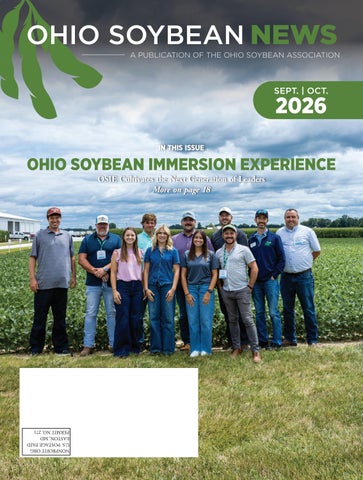
OHIO SOYBEAN IMMERSION EXPERIENCE OSIE Cultivates the Next Generation of Leaders More on page 18
NONPROFIT ORG U.S. POSTAGE PAID EASTON, MD PERMIT NO. 271
OHIO SOYBEAN
NEWS
6|
ASA Young Leader Program
7|
OSA Pushes Biodiesel Production Tax Credit
8|
OSA Federal Legislative Visits
16 |
Airable Update: Asphalt Release Agent
17 |
Fire Foam Reimbursement Program
18 |
OSIE Cultivates the Next Generation of Leaders
20 |
International Year of the Woman Farmer
22 |
Cultivating Partnerships in Nigeria
24 | 26 |
by Melina Kopczewski
International Year of the Woman Farmer
by Madison Corbi
Fertilizer on a Budget by Taylor Dill, Manbir Rakkar, and Greg LaBarge
Bringing Agriculture to Life with the Imagine Ag Exhibit
The Tradition Continues … Tune in to listen to the Ohio Ag Net team. www.ohioagnet.com
MORE ON PAGE 20
A LETTER FROM THE
President
President
Bennett Musselman, Pickaway County
Vice President
Bennett Musselman
Dustin Converse, Union County
Ohio Soybean Association President Pickaway County Soybean Farmer
Dave Green, Crawford County
Treasurer Secretary
Adam Vonderhaar, Preble County
Growing up in the countryside, trick
had several staffers tell me how useful
or treating looks a little different.
a day like that is. Many of them don’t
My family has been camping at Deer
come from a farming background so
Creek State Park Campground (locat-
getting an opportunity to talk face-to-
ed in Fayette and Pickaway Counties)
face with Ohio farmers helped build
for as long as I can remember. Every
their understanding of agriculture in
fall, Deer Creek hosts a huge Hallow-
our state and highlight the challenges
een camping event where they close
and opportunities facing our industry.
the campground roads to traffic, and trick-or-treaters go from camper to camper collecting candy. It’s such a unique experience and something I always looked forward to growing up. My wife Liza and I have continued the tradition with our boys, along with my parents, siblings, cousins and friends. It’s become one of those things we all look forward to every year. Even though I’m on the other side of the candy exchange as an adult, I still look forward to snagging a Reese’s Cup or two from my sons’ bags…for safety and quality assurance, of course! Advocacy work is full of tricks and
Other times in advocacy, you’re less successful, like the current struggle to get a new Farm Bill across the finish line. While the Ohio Soybean Association and the American Soybean
of learning about ag policy and farm technology (see more on page 11). I 4 | September-October 2026
Trustees Trish Cunningham, Union County David Clark, Warren County Justin Esselburn, Wayne County James Lipstraw, Sandusky County Matt Lutz, Crawford County Jeff Magyar, Ashtabula County Scott Metzger, Ross County Jeremy Price, Putnam County Ryan Rhoades, Marion County Bob Suver, Clark County Jennifer Wilson-Oechsle, Van Wert County Tim Zimpfer, Shelby County Jonathan Zucker, Marion County
American Soybean Association Board Representatives
phasizing to Congress how important an updated Farm Bill is, movement
Staff Credits
has been slow-going. But through all the highs and lows, our members perservere, much like me as I walked from camper to camper waiting to find that first Reese’s Cup. Wishing you only treats and no tricks for your harvest!
over the summer when we brought brids in London, OH, for a full day
Rusty Goebel, Williams County
Rusty Goebel Scott Metzger Ryan Rhoades
Association have been diligent in em-
treats. One day, you’re successful, like state legislative aids to Beck’s Hy-
Chairman
Bennett Musselman OSA President Pickaway County Soybean Farmer
Kirk Merritt - Publisher Julia Brown - Editor Mackenzie Joseph - Staff Writer Lauren Gerig - Art Director Ohio Soybean News is published six times a year by the Ohio Soybean Association, 918 Proprietors Rd., Suite A, Worthington, OH 43085. Phone: 614-476-3100. Comments and statewide news articles should be sent to the above address. Advertising space reservation must be made by the first of the month preceding publication. In consideration of the acceptance of advertisement, the agency and the advertiser must, in respect of the contents of the advertisement, indemnify and save the publisher harmless against any expense arising from claims or actions against the publisher because of the publication of the content of the advertisement.
For Advertising Sales Contact: Kristin Flowers - (614) 323-9320 kristin@ohioagnet.com
For Address Corrections Contact:
Ohio Soybean News at 918 Proprietors Rd., Suite A, Worthington, OH 43085. Web address: www.soyohio.org E-mail: cdeboard@soyohio.org
FROM YOUR FIELDS TO FIREFIGHTERS’ HANDS The more we discover about soybeans, the more valuable they become. One innovative product, SoyFoam™, creates a new, sustainable use for your crop that protects firefighters and the planet. See how your Soy Checkoff is unlocking new markets for soybeans at unitedsoybean.org
© 2025 U NITED S OY BE A N B OA R D
February 2026 | The North Dakota Soybean Grower
15
Scan here!
If you are passionate about farming and ready to connect with agricultural industry leaders and grow your leadership skills, the American Soybean Association Corteva Agriscience Young Leader Program is for you! ASA and Corteva Agriscience are now accepting applications for the 2027 Young Leader Program. Phase I of the 2026-27 Young Leaders program will take place Nov. 30 - Dec. 3 at Corteva’s Global Business Center in Johnston, Iowa. The program continues March 1 - 4, 2027, in New Orleans, LA, in conjunction with the annual Commodity Classic Convention and Trade Show.
Soybean growers — both individuals and couples—are encouraged to apply for the program, which focuses on leadership development, communication skills, emerging agricultural trends and issues, and building a strong network of industry peers. The program is designed for growers who are early in their leadership journey, regardless of age. Spouses and partners are encouraged to participate and play an active role in all aspects of the program, even if they are not employed full-time on the farm. ASA and Corteva will work with the 26 state affiliates and the Grain Farmers of Ontario to identify the top producers to represent their states as part of this program. Learn more about the program and how to apply at the QR code. For questions, email kmerritt@soyohio.org.
OSA Pushes Biodiesel Production
Tax Credit
Biodiesel and renewable diesel are domestically produced and commercially available fuels that provide an opportunity to meet the nation’s energy needs. These fuels play a vital role in diversifying our energy supply by fueling the ground transportation, rail, and marine fleets. Both biodiesel and renewable diesel are “drop-in fuels” that are sustainably made from fats and oils, such as soybean oil, for diesel engines. When blended with petroleum diesel, these fuels improve performance by adding lubricity, higher cetane values and reducing greenhouse gas emissions.
one of the only states in the top ten without in-state biodiesel production. This disconnect displays a significant economic opportunity. Now is the time to capitalize on this industry buildout to bring production to Ohio. As the industry continues to expand, Ohio should position itself to capture investment in new production facilities rather than relying on fuel produced elsewhere. To do so, we must find a way to compete with other states who are providing additional incentives to entice fuel producers to build and operate in their states.
Presidents Trump’s American Energy Dominance agenda is driving new opportunity for American farmers and fuel producers. Earlier this year, the administration released the Set 2 Renewable Volume Obligations (RVOs), which represent a substantial increase over the volumes established in Set 1. These higher RVOs are driving greater demand for biomass-based diesel and encouraging increased production across the country.
As this industry continues to grow, the Ohio Soybean Association is pushing the Ohio General Assembly to act, and a biomass-based diesel production tax credit is the most effective way to do so. Since Ohio has no production currently, any foregone revenue from such credit is easily offset by new economic activity and job creation. Also, bringing value-added production facilities closer to farmers improves the value of Ohio’s crops at a time when farmers are facing a significant economic crisis.
States are seeing current biomass-based diesel facilities increase production capacities, as well as others exploring new construction opportunities. The administration’s move to increase biomass-based diesel volumes will create new jobs and new economic prosperity. For Ohio, this presents a unique opportunity-but only if the state takes proactive steps to attract new investment. In 2024, Ohio consumed more than 56 million gallons of biodiesel, ranking among the top ten states for biodiesel consumption. Despite this strong demand, Ohio remains
Ohio has the resources and market demand to become a leader in biomass-based diesel production. By adopting policies that encourage investment, the state can attract new production facilities, support farmers, create jobs, and strengthen its domestic energy security. A biomass-based diesel production tax credit is a practical investment that will ensure Ohio remains competitive while capitalizing on the economic and environmental benefits of this rapidly growing industry.
September-October 2026 | 7
OSA FEDERAL
LEGISLATIVE VISITS
OSA board leadership and ASA directors took to the Hill in Washington D.C. to discuss policy priorities. OSA met with the offices of nine U.S. Representatives and both U.S. Senators from Ohio. These discussions focused on the U.S. Mexico Canada Agreement (USMCA), renewable fuels, input costs, and the importance of passing a robust 5-year Farm Bill this year. The USMCA is the gold standard trade agreement, and OSA strongly supports its full renewal while preserving duty free market access, science-based trade rules, biotechnology provisions, and strong dispute resolution mechanisms. At a time of high input costs and low farm margines, farmers need markets. USMCA helps facilitate a strong market with Canada and Mexico. Since the enactment of USMCA, the value of U.S. agricultural exports to these two countries have increased 47% compares to 18% for the rest of the world. Canada is a top market for U.S. soybean meal – a number that is expected to grow as crush capacity increases in states like Ohio. OSA also thanked members for their work in championing an increase in renewable volume obligations (RVOs) under the Renewable Fuel Standard (RFS) that the Administration released earlier this year. Increasing RVOs ensures continued demand for biodiesel and renewable 8 | September-October 2026
fuels, benefiting both soybean growers and rural economies. However, OSA urged Congress to press Treasury to finalize 45Z tax guidance as soon as possible. Input costs are at the top of farmers’ minds. In meetings, OSA emphasized the fact that farmers are paying more than ever to grow their crops, and declining revenues are creating a business environment that is not sustainable. For example, over the past 5 years, fertilizer prices have increased by 95%. OSA will continue to engage on issues that will decrease the costs of inputs for farmers. Lastly, OSA urged Congress to pass a comprehensive Farm Bill that provides strong crop insurance and farm safety net protections, market development funding, and agricultural research investments. With rising input costs and market uncertainty, a well-structured Farm Bill is essential for supporting farm sustainability and ensuring a reliable food supply. These meetings with policymakers emphasize the vital role that farmers play in shaping policy that impacts farm operations across the U.S. OSA will continue to work with members of Congress to ensure Ohio’s soybean farmers remain competitive and have the support that they need to progress in a changing agriculture landscape.
OSA WITH REP. JIM JORDAN
OHIO SOYBEAN FARMERS WITH SENATOR BERNIE MORENO
OFFICE OF REP. BOB LATTA
OSA WITH SENATOR JON HUSTED
OFFICE OF CONG. MICHAEL RULLI
OFFICE OF REP. SHONTEL BROWN
OSA WITH REP. DAVE TAYLOR
OSA WITH REP. MARCY KAPTUR
September-October 2026 | 9
UNDERSTANDING AG TECH Ohio Policy Professionals See Innovation in Action
What does the future of farming look like? For a group of Ohio policy professionals, the answer was found in the fields of London, Ohio. The Ohio Soybean Association (OSA), in partnership with Beck’s Hybrids, hosted Understanding Ag Tech: Ohio Policy Professionals, giving legislative and agency staff a firsthand look at the research, technology, and innovation shaping modern agriculture. Throughout the day, attendees heard from farmers, researchers and industry experts about how new technologies are helping improve efficiency and how farmers are safely using pesticides and seed treatments. “Events like this provide an opportunity for policy professionals to experience agriculture firsthand and better understand the issues impacting Ohio’s farmers,” said Kiley Holbrook, OSA Policy and Demand Manager.
Attendees also participated in hands-on demonstrations of seed production, UAVs, autonomous equipment, and precision agriculture technologies, while touring Beck’s Practical Farm Research (PFR)® program to see how research supports on-farm decision-making. By connecting policy professionals with Ohio farmers and agricultural innovators, the event strengthened understanding of the technology and research driving the future of agriculture.
The program featured a farmer panel with Chad Warner, Ohio Soybean Council Vice Chairman; Bennett Musselman, OSA President; and Adam Vonderhaar, OSA Secretary, who discussed the realities of farming, including changing markets, rising costs, weather challenges, and the value of research-driven innovation.
OSA Election Guide
Election Day is just around the corner, and the Ohio Soybean Association (OSA) is here to help you prepare. This fall, OSA will provide a nonpartisan election guide with information on candidates and races important to Ohio agriculture. Simply scan the QR code to access the guide and stay informed before heading to the polls. Looking to learn more about OSA and the work that the organization does? Visit 10 | September-October 2026
our website to see updates on how we are working on behalf of Ohio’s soybean farmers, view our top policy priorities, or become a member.
Voting is an important way to make your voice heard and help shape the future of agriculture in Ohio. Whether you’re researching candidates or getting ready to cast your ballot, OSA has the tools and resources to help you make a plan to vote.
SCAN HERE
FOR THE GUIDE!
“WE CHOOSE U.S. SOY BECAUSE IT IS CULTIVATED TO MEET TRUE SUSTAINABLE STANDARDS.” Nhu Ngo of Vietnam-based Janbee Joit Stock Company on a tour of a U.S. Soy farm.
YOU GROW THE WORLD’S MOST SUSTAINABLE SOY. WE GROW DEMAND FOR IT. USSEC builds preference for U.S. Soy by bringing international buyers directly to American farms, where they can meet growers firsthand and see the care, consistency, and sustainable practices behind every harvest.
SCAN TO SEE HOW USSEC SHARES U.S. SOY’S SUSTAINABILITY WITH CUSTOMERS AROUND THE WORLD.
Celebrating 35 years of the national Soy Checkoff Dear U.S. soybean community, For U.S. soybean farmers, the decision to come together 35 years ago and form the national Soy CheckoffSM was a defining moment that would reshape American agriculture for generations. Through collective investments into food, feed, fuel, industrial, exports and sustainable production, U.S. soybean production has grown from 1.8 billion bushels in 1990 to over 4 billion today. Because of what farmers have built together over 35 years, we’ve been able to create entirely new markets from the ground up like biodiesel, expand exports around the world to 90 countries and develop tools that protect yield on the farm. The partnership between farmers and the Soy Checkoff traces back to a pivotal moment in American agriculture. For many soybean farmers, the drought of 1988 exposed the need for a national checkoff.
Soon after, farmer leaders on the American Soybean Association voted overwhelmingly to pursue one, making investments available for international and domestic marketing as well as dedicated research into new uses. USB Secretary and Minnesota soybean farmer Tom Frisch believes the opportunity for every soybean farmer in the country to pool their resources and make a collective impact remains just as important 35 years later. “We need to continue to work together as U.S. soybean farmers and not isolate ourselves. We, as U.S. soybean farmers, need to champion our industry every day, every month, every year,” says Frisch. Qualified State Soybean Boards (QSSBs) have been there every step of the way, serving as the connective tissue between national strategy and on-the-ground reality. “When I view QSSBs, they are at the grassroots level navigating concerns and opportunities with their farmers across
USB Past Chairs gather for a photo in the Soy Checkoff booth at Commodity Classic 2026 in Austin, Texas.
USB Past Chair Sandy Ludeman participates in a Soy Checkoff town hall in 1992.
USB is formed from the publication of the Soybean Promotion and Research Order under the 1990 Farm Bill.
the state. They are in touch with their local agriculture community about what’s happening in their backyard,” says USB Past Chair and Mississippi soybean farmer Philip Good. As the Soy Checkoff thinks about the next 35 years, every investment made aims to grow demand, improve resiliency of the soybean crop and bring additional revenue back to the farm. “The Soy Checkoff isn’t just about dollars invested from the half-million U.S. soybean farmers — it’s about giving them the power to shape their own future and deliver lasting impact,” says Indiana farmer and USB Treasurer Don Wyss. One example of how powerful this partnership has proven to be is the advancement of high oleic soybean research and farmer adoption. We’ve seen over a million acres of high oleic across states like Indiana, Ohio, Missouri and the Delmarva region with QSSBs helping promote premiums of $0.75 to $1.25 per bushel. And there’s potential to reach 5-7 million acres a decade from now. High oleic soybeans have returned nearly $400 million in premium payments to farmers — a direct return on the $130 million checkoff investment through 2025. Another great example of partnership is the lower Mississippi River dredging project which added an additional $461 million in revenue to U.S. soybean farmers. Through
checkoff investment in research, analysis and design, which kickstarted deepening the lower Mississippi River from 45 to 50 feet allowed for an increase of 500,000 bushels per ocean vessel and saves 13 cents per bushel of freight. This investment spanned collaboration with USB, the Soy Transportation Coalition, U.S. Soybean Export Council, the American Soybean Association and multiple QSSBs. “Investing in the research and engineering side of that project was a new venture for us, but it encouraged strategic thinking of how we can use checkoff funds in unique ways to improve all soybean farmers’ bottom line,” says Good. As the United Soybean Board celebrates its 35th Anniversary we are proud of the work we’ve accomplished for every single U.S. soybean farmer. With our continued partnerships with the QSSBs we look forward to what this next chapter brings for the U.S. soybean industry. Together we can continue to deliver sustainable soy solutions to every life, every day. Here’s to the next 35 years of the U.S. soybean industry!
Brent Gatton USB Chair Kentucky
COME VISIT US AT
Farm Science Review SEPTEMBER 22-24, 2026 We are located at the corner of Friday Ave. & Tractor St.
BOOTH 441
Get paid to add cover crops to your fields through Farmers for Soil Health.
© David Ike
Building soil health on your farm can be one of your most important investments. Planting cover crops can: • Sustain crop yields over time • Improve water infiltration
• Prevent soil erosion • Reduce nutrient leaching
Take advantage of incentive payments and technical assistance available to add cover crops to your field this year. Visit farmersforsoilhealth.com/enrollment to get started.
Airable Research Lab and Warsaw Chemical
Partner to Commercialize Soy-Based Asphalt Release Agent Airable Research Lab, a division of the Ohio Soybean Council (OSC), and Warsaw Chemical have partnered to commercialize BIO-SLIDE 30, a soy-enhanced asphalt release agent designed to reduce asphalt adhesion on truck beds, pavers, rollers, and other paving equipment. Developed through soybean checkoff-funded research, BIO-SLIDE 30 offers the paving industry a renewable, cost-competitive alternative to conventional asphalt release agents while creating a new market opportunity for U.S. soy. Warsaw Chemical will manufacture and distribute the product to customers across North America. “This partnership demonstrates how soybean checkoff investments move innovative technologies from research and development into commercial markets,” said Airable’s Chief Executive Officer Barry McGraw. BIO-SLIDE 30 was developed by Airable to address a common challenge in asphalt paving operations: preventing hot mix asphalt from sticking to equipment and tools. The formulation contains 30% biobased content while avoiding d-limonene and quaternary ammonium compounds found in some conventional systems. These compounds have been linked to adverse effects on both human health and the environment. Testing under elevated temperatures demonstrated strong initial release performance, sustained effectiveness across multiple heating cycles, and stable coating integrity under demanding operating conditions.
16 | September-October 2026
“Every successful commercialization helps create new market opportunities for U.S. Ssoy,” said Ashtabula County soybean farmer and Airable President Jeff Magyar. “BIO-SLIDE 30 is another example of how soybean innovation can solve real-world industry challenges while creating value throughout the supply chain.” Warsaw Chemical brings decades of manufacturing expertise and established customer relationships to the partnership, positioning the product for broad adoption across the asphalt paving industry. “We’re excited to partner with Airable Research Lab to bring this technology to market,” said Phil Gaida, a business development and product manager with Warsaw Chemical. “Customers are looking for solutions that combine performance, reliability, and sustainability, and BIO-SLIDE 30 delivers on those priorities.” The launch of BIO-SLIDE 30 reflects Airable Research Lab’s mission to accelerate the development and commercialization of soy-based technologies that create new opportunities for soybean farmers and sustainable solutions for the industry. More information about BIO-SLIDE 30 and Airable Research Lab is available at www.airablelabs.com.
Ohio Soy-Based Firefighting Foam
Reimbursement Program
The Ohio Soybean Council is helping Ohio fire departments transition to safer, more sustainable firefighting products through its Soy-Based Firefighting Foam Reimbursement Program. Eligible departments can receive 50% reimbursement, up to $1,000, toward the purchase of SoyFoam™ TF1122, a PFAS-free, soy-based firefighting foam from Cross Plains Solutions. SoyFoam™ TF-1122 is the first and only firefighting foam to earn GreenScreen Certified Gold™ status. It is also 100% fluorine-free, made with ingredients grown by U.S. farmers, and certified readily biodegradable, providing an environmentally responsible alternative.
Funding is available on a first-come, first-served basis, with one application per department each year. For purchasing information, contact Pat Butler at 269-438-1653 or pkfoamsolutions@gmail.com (Lucas, Fulton, and Williams counties), or Chuck Stiver at 330-421-2714 or cstiver@ nextgenbiosolutionsllc.com (all other Ohio counties).
To receive reimbursement, departments should submit their receipt and proof of payment to the Ohio Soybean Council by emailing mcorbi@soyohio. org or mailing materials to 918 Proprietors Road, Suite A, Worthington, OH 43085.
MADE FOR OHIO. MADE FOR YOU.
Patrick Knouff, Shelby County
The Field Leader program from the Ohio Soybean Council and the soybean checkoff shares practical research, helpful insights, and local results you can count on, giving you the knowledge to lead every acre.
Learn more under the “Ohio Field Leader” tab at OCJ.com.
Brought to you by Ohio soybean farmers and their checkoff. checkoff.
Ohio Soybean Immersion Experience
Cultivates the
Next Generation of Leaders
Every soybean farmer who contributes to the soybean checkoff is investing in something bigger than their own operation. Those farmer-led investments fuel research, market development and innovation that create new opportunities for soybean growers in Ohio and around the world.
The Ohio Soybean Immersion Experience (OSIE) was created to help beginning farmers see that impact firsthand. Through a three-phase program, participants gain a behind-the-scenes look at how the soybean checkoff works, explore the soybean value chain and build relationships with the farmers, researchers and industry leaders shaping the future of agriculture. The inaugural class brought together nine beginning farmers from across Ohio: Andrew Blausey (Ottawa County), Will Harrison (Wood County), Chloe Heidlebaugh (Hancock County), Travis Lichtensteiger (Van Wert County), Sean McKay (Franklin County), Meghan O’Reilly (Geauga County), Logan Pence (Delaware County), Jacob Renner (Preble County) and Greg Vorwerk (Henry County). Together, they set out to better understand the industry they help support and discover how soybean checkoff investments create value far beyond the farm gate.
Understanding the Checkoff
The experience began in January at the Ohio Soybean Council office, where participants explored the foundation of the soybean checkoff. They heard from Ohio Department of Agriculture Director Brian Baldridge about the future of Ohio agriculture, discussed market outlooks and agronomic research with industry experts and stepped into the role of Ohio Soybean Council board members by evaluating mock checkoff investments. The goal was simple: help participants understand how soybean farmers direct checkoff dollars into projects that strengthen markets, improve profitability and create new opportunities for the industry. For Meghan O’Reilly, the experience revealed just how many organizations work together behind the scenes to support soybean farmers. “I got to learn about organizations that I didn’t even know existed and see how each one plays a role in supporting farmers and creating opportunities for soybeans,” O’Reilly said.
Following the Soybean Journey By March, the classroom discussions turned into handson experiences as participants traveled across Ohio to follow the soybean value chain. From livestock feed and food production to renewable fuels and soy-based innovation, each stop demonstrated another way soybean checkoff investments create value. Participants visited Hamlet Protein to learn how soybean meal supports livestock nutrition, explored new soy-based products at Airable Research Lab, saw soybean oil’s role in food production at T. Marzetti and learned how biodiesel continues to expand markets for Ohio soybeans at Benchmark Biodiesel.
OSIE PARTICIPANTS AT THE OHIO SOYBEAN OFFICE DURING PHASE 1.
The tour concluded with visits to Bluegrass Farms and Consolidated Grain and Barge, where participants saw how soybeans move from Ohio farms to domestic and international customers. For Chloe Heidlebaugh, those experiences connected the crop growing in Ohio fields to the products and markets it supports every day.
OSIE PARTICIPANTS AT HAMLET PROTEIN
18 | September-October 2026
“Coming here and actually seeing the soybean checkoff in action and where my product is going was really rewarding,” Heidlebaugh said. “It was eye-opening to see how many different ways our soybeans are being used after they leave the farm and how those investments are creating demand for what we grow.”
“The best part was the connections,” said Kansas participant Sam. “Meeting farmers from another state and learning about their operations gave me a new perspective.”
OSIE PARTICIPANTS VISIT AIRABLE RESEARCH LAB
By the end of the program, participants walked away with much more than a better understanding of the soybean checkoff. They developed relationships with researchers, processors, fellow farmers and industry leaders while gaining a broader perspective on the opportunities and challenges facing the soybean industry. “OSIE is about helping beginning farmers understand how their soybean checkoff works while building the relationships they’ll rely on throughout their careers,” said Julia Brown, Ohio Soybean Council director of communications and education. “The connections participants make during this experience are just as valuable as the knowledge they gain.” Ohio Soybean Council Chairman Jerry Bambauer believes those experiences will prepare participants to become the next generation of industry leaders.
OSIE AT BENCHMARK BIODIESEL
Building Future Leaders The program concluded in Indianapolis during the United Soybean Board’s summer meeting, where participants experienced the soybean checkoff on a national scale.
“Serving on the Ohio Soybean Council has shown me how important it is to have informed farmers around the table making decisions for the future of our industry,” Bambauer said. “OSIE gives beginning farmers the opportunity to see those decisions up close, understand the impact of the soybean checkoff and develop into the leaders who will one day help guide organizations like ours.”
They observed farmer leaders from across the country making investment decisions on behalf of soybean growers and connected with organizations including the American Soybean Association, U.S. Soybean Export Council, World Initiative for Soy in Human Health and Clean Fuels Alliance America. A visit to Beck’s Hybrids highlighted seed innovation and the partnerships helping shape the future of agriculture, while discussions around biofuels and high oleic soybean oil demonstrated how research continues to open new markets for U.S. soybeans. One of the highlights of the trip was connecting with Kansas’ Emerging Leaders Program, which inspired the creation of OSIE. The joint experience gave beginning farmers from both states the opportunity to exchange ideas, discuss common challenges and build relationships that extended well beyond the three-day program.
OSIE VISITS CONSOLIDATED GRAIN AND BARGE (CGB)
For Sean McKay, a farm educator, the experience reshaped the way he thinks about agriculture and strengthened the work he does to connect people with their food system. “It changed the way I view and understand commodity agriculture,” McKay said. “It gave me a deeper appreciation for the crop, the farmers who grow it and the people working to move the industry forward. The more I understand how our food system works, from the farm to global markets, the better I can help others understand it too.” Those relationships were equally meaningful for the Kansas participants.
September-October 2026 | 19
International Year of the Woman Farmer:
Inspiring the Next Generation By Melina Kopczewski
Melina Kopczewski is an incoming senior at The Ohio State University studying Environmental Policy and is currently the communications intern for the Ohio Soybean Council. She grew up on her family’s soybean seed and gravel farm in Pickaway County, Ohio, where she developed a passion for environmental policy, as well as agricultural education and communication. Melina plans to pursue a master’s degree and continue a career in Agricultural outreach.
Back in May 2024, the United Nations declared 2026 as the International Year of the Woman Farmer, recognizing and spotlighting the vital roles women play across the global agriculture industry. According to the United Nations, the initiative aims to “increase investments in closing gender gaps and promote female leadership across agrifood value chains.” Around the world, governments, communities, and individuals are celebrating the contributions of women in agriculture. In January, the U.S. Senate passed Senate Resolution 592, supporting the designation of 2026 as the Year of the Woman Farmer and recognizing the essential role women play in feeding communities, strengthening rural economies, and shaping the future of American agriculture. One of those women is Cindy Layman (Hardin County), who has served on the Ohio Soybean Council, spoken on panels at women’s conferences, and raised her two daughters in 20 | September-October 2026
agriculture, watching them pursue their own paths in and beyond the industry. “I encourage women in general to get involved-you don’t necessarily have to grow up on a farm,” Layman said. “Whether your interests are in nutrition, plants, finance, accounting, research, or equipment, there is such a wide array of career opportunities in agriculture.”
CINDY LAYMAN, HARDIN COUNTY
Layman has also served on the Ohio Soybean Council Scholarship Committee, where she has been able to experience firsthand the impact of investing in the next generation. “Through the interview process, I have been able to see the quality and enthusiasm of these young people,” Layman said. “It gives me hope in the future.”
ADELE FLYNN WITH HER DAUGHTERS ON THEIR FAMILY FARM IN LORAIN COUNTY
Another leader helping shape the future of Ohio agriculture is Ohio Soybean Council board member Adele Flynn (Lorain County), who also serves as an Ohio Farm Bureau trustee. Alongside her leadership roles,
Flynn and her family have raised their three children, including two daughters, on their family farm, encouraging each of them to find their own place in agriculture. “Our kids love the farm and agriculture. They’ve been involved their whole lives,” Flynn said. That passion, however, did not always look the way she expected. Flynn’s oldest daughter wasn’t interested in showing beef cattle, but after discovering a love for showing goats, she eventually found her own passion in the industry. Flynn said, “Giving in a little bit and letting her find her own path brought her back to agriculture.” Her experience is a reminder that supporting the next generation means giving young people the freedom to explore their own interests while encouraging them to stay connected to agriculture. Whether their passion lies in production agriculture, communications, education, research, or advocacy, the industry is stronger when they are empowered to find their own place within it.
Her story reflects something I have witnessed in my own family. I have watched my aunt repair a broken-down combine, replant crops after drought, and pioneer new ways to diversify our operation. I have watched my mom work in agricultural education, communication, and extension. Above all, I watched my grandparents encourage their six grandchildren, including five granddaughters, to explore the many opportunities agriculture has to offer.
“Giving in a little bit and letting her find her own path brought her back to agriculture.” As I was growing up, my grandparents had a special tradition. Each year, they would rotate which grandchild got to spend the day with them at Farm Science Review. We were allowed to take the day off from school, get a special treat on the way there, and spend quality time with grandma and grandpa. I didn’t realize it at the time, but I was creating memories with my grandparents while also being exposed to the importance of agriculture.
I have learned many lessons growing up on a farm, but one of the greatest lessons I have learned is that representation matters. It is not about comparing women’s abilities to men’s. It is about making leadership visible so that the next generation can imagine themselves in those roles. It is about the little girl riding her MELINA WITH HER GRANDFATHER ON THEIR FAMILY FARM IN PICKAWAY COUNTY IN 2007 AND 2025. bike while watching her aunt load seed or walking through the Ohio State Fair with her grandmother as she educates visitors about agriculture, seeing herself doing those same things one day.
MELINA IN 2003 AT THE OHIO STATE FAIR LAND AND LIVING EXHIBIT
As we celebrate the International Year of the Woman Farmer, I hope we also think about how we can inspire the next generation. Invite your daughter, granddaughter or niece to ride in the combine, help sew mini seed bags, attend a commodity meeting, or simply spend time learning alongside you. I was that little girl once, and my hope is that another little girl will one day choose to contribute to this industry because someone took the time to show her that she belongs here, too. September-October 2026 | 21
Cultivating Partnerships IN NIGERIA
by Madison Corbi
OSC Demand & Market Development Director
An Ohio soybean farmer is talking protein with overseas customers. Traveling to Nigeria this past June, Logan County soybean farmer Bill Bayliss championed Ohio and U.S. soybeans as a sustainable protein source and supported educational programs for leaders in the livestock industry. Nigeria is part of one of the fastest-growing regions in the world—Sub-Saharan Africa. According to the U.S. Soybean Export Council (USSEC), Nigeria’s population is 244 million and is projected to reach 404 million by 2050, making it one of the few countries expected to account for a significant share of global population growth over the coming decades. As the population grows, so does the need for affordable protein. Nigeria’s poultry and aquaculture sectors are expected to grow by a combined 40% over the next five years. To capitalize on the growing protein demand, U.S. soybean farmers are educating the livestock industry on the benefits of U.S. soybeans and soybean meal. Bayliss attended the NigeriaNOW! Conference in Lagos, Nigeria this past June. The conference focused on highlighting the advantages of integrating U.S. soybean meal into Nigerian feed production to enhance animal performance and increase feed efficiencies. Conference attendees heard from livestock professionals, nutritionists, researchers and U.S. soybean farmers. Topics included U.S. soybean production updates, soybean crop quality reports, market outlooks, nutritional research and national food security. 22 | September-October 2026
“This is my second time attending this conference in Nigeria and my third time in the country on behalf of U.S. Soy,” says Bayliss upon his return to the states. “We are meeting with CEOs of major livestock producers to discuss American agriculture, supply chains and opportunities for growth.” In addition to the conference, U.S. Soy’s presence is felt year-round through a program called the Soy Excellence Centers (SEC). Funded by soybean farmers and their checkoff, the SEC is a targeted workforce development program for mid-tier employees in emerging markets. The Centers provide foundational and intermediate training in areas such as poultry, aquaculture, feed milling, swine production, crush plant operations and soy foods. This programming helps growing markets tackle protein challenges and stimulates demand for U.S. soy products. “I have been involved with the SECs since they were founded in 2019,” notes Bayliss. “Nigeria has always been a part of the program and a region dear to my heart because we can see the difference we are making.” In 2024, Nigeria imported 62,000 metric tons (2.2 million bushels) of U.S. Soy for the first time in six years. Monetary exchange, tariffs and government policies create some challenges for U.S. Soy to enter the market. But with programs such as the SECs, U.S. Soy is making memorable steps back into the country.
CONSOLIDATED
GRAIN AND BARGE CO.
Creating Partnerships in Agriculture.®
You are a farmer, mechanic, investor, buyer, and seller -Rooted in the soil, driven by the American dream, guided by generations of grain. At CGB, we understand your hard work hinges on grain marketing. Our expert insight and professionally managed pricing tools help protect what you grow, including: • Knowledgeable, Dedicated Merchants • Premium GrainsSM Opportunities for Non-GMO Corn and Non-GMO Soybeans • Mobile App & Web Based Account Access • Managed & Formula Priced Market Solutions Pricing Tools with Weekly Updates • Accurate and Efficient Grain Settlements & Offer System • Farm Pick-Up Trucking Service • Corn, Soybean, and Wheat Terminal Bids
CGB Riverside Cincinnati, OH
CGB Aurora Aurora, IN
CGB Waterloo Waterloo, IN
Call us today! 1-800-877-7401 grainmarketing@cgb.com • www.cgbgrain.com
FERTILIZER ON A BUDGET:
Nitrogen & Sulfur
By: Taylor Dill, Manbir Rakkar, and Greg LaBarge The crops we grow require more nitrogen than any other of the essential nutrients. Nitrogen is so important to the plant that if there is a nitrogen deficiency, often that will mask other nutrient deficiency symptoms. According to Liebig’s law of minimums, the crop is limited by the scarcest nutrient or “limiting factor”, and nitrogen is often the most limiting factor because of the crop demand. Nitrogen management decisions are top priority. Evaluating the economic impact of every pass across the field and pound of nutrient applied for yield and profit becomes more important with narrow margins. Which leaves us with the question of how can we pencil rising nitrogen costs and yield potential? Thankfully, soybeans fix nitrogen LIEBIG'S LAW OF MINIMUMS. THE MOST from the atmosLIMITING FACTOR WILL CAUSE LOSS. phere via rhizobia a micro bacteria found in the soil. These rhizobia attach to roots and create nodules at a very early vegetative stage, with only two to three trifoliates (V2/V3). Applying nitrogen reduces natural nodulation. Some states in the Mid24 | September-October 2026
west have investigated nitrogen application at later growth stages but results have not been consistent in producing an improved yield. In a time of volatile nitrogen prices, an additional nitrogen application to a leguminous crop is not recommended. Corn on the other hand, needs nitrogen applications because the soil does not provide enough. On average, the modern corn hybrid nutrient use efficiency is 0.7 pounds of nitrogen will make one bushel of corn, which is a 30% improvement from older varieties. In short, corn does not need as much nitrogen as it used to create the same yield. So, applying more nitrogen should equal greater yields? That is not the case, corn yield will eventually plateau as you apply more nitrogen. Furthermore, this nutrient is incredibly unstable in the soil and water. Corn will take up two forms of nitrogen - nitrate and ammonia- but environmental conditions like flooding, high temperatures, and dry weather influence how nitrogen changes forms. Therefore, timely applications of nitrogen are necessary to enhance plant uptake, reduce environmental loss, and ultimately reduce economic loss. Appling liquid nitrogen just before a big rain event will lead to nutrient loss, or applying urea in hot weather without a stabilizer will lead to volatilization. Applying around the V4 (four leaves) to V6 growth stage is optimal. Now, for the most important question, how much can I apply and be profitable? Currently, there is a multistate nitrogen rate calculatormaximum return to nitrogen (MRTN) calculator. This calculator was built by agronomists and soil scientists over a decade with corn yield response to nitrogen data being
on the price point that was selected. The tool also demonstrates the percent of maximum yield at the rate that was calculated, which in this case would be 95% of maximum yield. The data backed tool shows the agronomics and economics of one of the costliest inputs on the farm and has value especially with volatile markets and input prices. The tool can be found at www.cornnratecalc.org. Sulfur fertilizer is commonly sold alongside nitrogen fertilizer in corn and as an upfront or foliar fertilizer in soybeans. Commonly, sulfur is applied because of an assumed nutrient deficiency or potential of deficiency because of the reduction in acid rain. SELECTION TOOL FOR THE MRTN CALCULATOR. SELECT THE STATE YOU FARM IN, YOUR While rain has become less acidic, soil CROP ROTATION, THE SOURCE OF FERTILIZER, THE PRICE POINTS FOR FERTILIZER, AND with at least 1% organic matter often THE CORN PRICE. contains enough sulfur that will mineralize and become available during the growing season. entered yearly from the states involved. You select the state The exception is sandy to coarse textured soils, that do not you are in, your crop rotation, and then set the price of possess the organic matter needed to mineralize sulfur or nitrogen and corn price. can lose sulfur quickly due to leaching. Sulfur deficienThe tool calculates the MRTN to a specific pound per cy is characterized by pale yellow new growth. Sulfur is acre, in the current example if 28% UAN is $0.90 a not mobile in the plant and therefore deficiency stays in pound, the MRTN rate is 143 lbs/acre. There is a suggestyoung leaves in soybean and corn, unless the deficiency is ed profitbale N rate range along with a net return based severe. In any year without financial flexibility, adding a nutrient that can be obtained by your soil is an economic loss. Placing nutrients where known deficiencies are is most likely to bring yield gain. Across Ohio, on-farm and small plot sulfur trials on both corn and soybean have not found consistent yield gains from sulfur applications without a nutrient deficiency present. Overall, do not undersell what your soil can already produce for you!
OUTPUT CHART FROM THE MRTN TOOL. SHOWING RATES OPTIONS WITH POTENTIAL RETURNS BASED ON YIELD AND PRICE.
September-October 2026 | 25
BRINGING OHIO AGRICULTURE TO LIFE THROUGH THE The 2026 Ohio State Fair introduced visitors to a new way of experiencing agriculture through imAGine Ag, a 75,000-square-foot interactive exhibit that showcased the innovation, technology and people behind Ohio’s food, fuel and fiber systems. The Ohio Soybean Council (OSC) was proud to support this landmark effort, joining Ohio Farm Bureau and agricultural partners from across the state to create one of the largest collaborative agriculture education initiatives ever featured at the Ohio State Fair. The exhibit connected thousands of fairgoers with the story of modern agriculture and the farmers who make it possible. Through hands-on experiences, visitors explored how agriculture has evolved and how today’s farmers use science, technology and stewardship to produce the products people rely on every day. The exhibit highlighted topics including crop production, precision agriculture, weather, animal care, career opportunities and the many challenges facing farm families. For Ohio soybean farmers, imAGine Ag provided an opportunity to share the story of one of the state’s most important crops. Visitors discovered how soybeans are transformed into food ingredients, livestock feed, renewable fuels and hundreds of everyday products that touch their daily lives. The seven anchor experiences within imAGine Ag—including Storied Seasons, Crop Invaders, Harvest Hero, Weather Wonder Lab, Creature Comforts Trail, Buckeye State AgQuest and Seasons of Innovation—gave visitors of all ages an engaging look at agriculture’s past, present and future. In addition to the mAGine Ag exhibit space, OSC was exhcited to partner with the Ohio Department of Agriculture and the Ohio Proud Showcase, where live cooking demonstrations helped bring Ohio agriculture from the field to the plate. The Ohio Soybean Council partnered with chef and registered dietitian Joseph Goldman to demonstrate the versatility of soybeans through two café-inspired “mirror recipes” that used the same core ingredients to create two distinctly different dishes. Fairgoers learned how soy-based ingredients, including an orange soy vinaigrette and edamame, can elevate everyday meals while showcasing the nutritional value, flavor and 26 | September-October 2026
AG EXHIBIT
versatility of soybeans. The demonstrations gave visitors practical ideas they could recreate at home while strengthening the connection between Ohio farmers and the food on their tables. OSC was honored to be part of imAGine Ag and help share the story of Ohio agriculture with thousands of fairgoers. From interactive exhibits to hands-on cooking demonstrations, the experience created meaningful connections between farmers and consumers while showcasing the innovation, stewardship and dedication that continue to shape agriculture across the state.
Specializing in Post Frame structures
Call us today for a custom quote!
855-MQS-3334 mqsstructures.com
No matter what generation farmer you are, the next one is always the most important.
Every farm here was built on generations of hard work. That’s why the Ohio Soybean Council is always hard at work making sure the next generation to operate your farm has every opportunity to make it a better one. Whether we’re driving innovation, expanding markets or educating classrooms — we’re investing in what matters most: creating a solid foundation for the next generation to operate your farm.
Brought to you by Ohio soybean farmers and their checkoff.
VISIT SOYOHIO.ORG TO SEE HOW WE’RE WORKING FOR YOUR TOMORROW