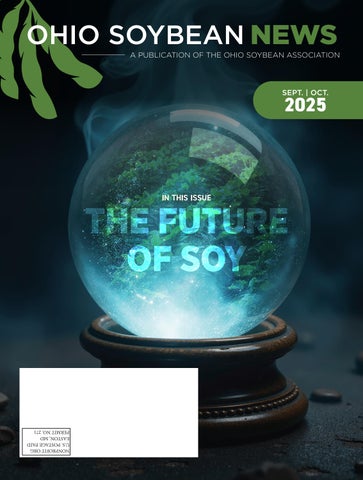
OHIO SOYBEAN NEWS
A PUBLICATION OF THE OHIO SOYBEAN ASSOCIATION
SEPT. | OCT.
IN THIS ISSUE
NONPROFIT ORG U.S. POSTAGE PAID EASTON, MD PERMIT NO. 271
FROM INVESTMENT
TO PRODUCTIVITY
The Soy Checkoff invests in research to increase farm productivity, earning a nearly $6-to-$1 return1 on that investment. This translates to increased yields, improved quality, and enhanced global competitiveness.
Learn more at unitedsoybean.org/bettertogether 1 ROI: Kaiser, H.M. 2024. An Economic Analysis of the United Soybean Board and Qualified State Soybean Boards’ Demand- and Supply-Enhancing Programs. Cornell University. © 2025 United Soybean Board
OHIO SOYBEAN
NEWS
6|
Advocacy in Action: OSA Visits
11 |
Growth in Offshore Aquaculture
12 |
Bridging Fields: Exploring Global Agriculture and the Role of U.S. Soy in China
14 |
Building Global Soy Connections
16 |
International Marketing Highlights: Summer 2025
20 |
AI in Farm Business: Opportunity Meets Caution
21 |
Improve Energy Efficiency and Comfort with US Soy
22 |
AI-Driven Tools for Maximizing Soybean Yield and Profitability
24 |
Which Predictions from “The Future State of Soy” are Coming True?
Washington D.C.
The Tradition Continues … Tune in to listen to the Ohio Ag Net team. www.ohioagnet.com
Soy in 2025: AI, The Future, and More STARTING ON PAGE 16
A LETTER FROM THE
President
President
Rusty Goebel, Williams County
Rusty Goebel
Vice President
Ohio Soybean Association President Williams County Farmer
Bennett Musselman, Pickaway County
Treasurer
Dustin Converse, Union County
Secretary or many years, the letters AI in agriculture referred to artificial insemination. But in the last five years or so, a new I-word has taken over – intelligence. As farmers, we know that data can we a useful tool. We look at the information from last year’s crop to determine what we need to adjust this year. But now programs and platforms will automatically collect that data and translate it into recommendations for future years. Dr. Laura Lindsey at The Ohio State University is part of a multi-state checkoff-funded research project to evaluate typical agronomic practices against AI-generated practices. Once it’s widely available, farmers will be able to compare their own agronomic decisions against the AI-suggested decisions, seeing if there are ways that AI believes practices can be improved for either profit or yield. You can learn more about this project on page 22. AI’s application in ag goes beyond agronomics as well, helping growers to be efficient in the business side of farm management. In addition to his work on AI applications in the field (see page 27), OSU’s Dr. John Fulton also sees the immense potential for AI to 4 | September-October 2025
make bookkeeping faster and easier. The U.S. Department of Agriculture’s National Institute of Food and Agriculture is offering grants to kickstart the use of AI in agriculture, including intelligent decision support systems. But for all the good AI could do for our industry, there are already cautionary tales about how AI could hurt us as well. Earlier this year, Delta Airlines announced the use of AI-driven dynamic pricing to set ticket prices based on many factors including demand for flights, market conditions and learning from past pricing. The same technology could be applied in ag retail, meaning that the same bag of seed could cost something totally different if it is purchased tomorrow. It will be fascinating to see how AI impacts our industry in the coming years. If we can figure out how to use it to control the weather, I’d be all for it.
Trish Cunningham, Union County
Chairman
Patrick Knouff, Shelby County
Trustees
David Clark, Warren County Dave Green, Crawford County Justin Esselburn, Ashland County Jeff Magyar, Ashtabula County Scott Metzger, Ross County Jeremy Price, Putnam County Ryan Rhoades, Marion County Andy Stickel, Wood County Bob Suver, Clark County Adam Vonderhaar, Preble County Jennifer Wilson-Oechsle, Van Wert County
American Soybean Association Board Representatives Rusty Goebel Scott Metzger Ryan Rhoades
Staff Credits
Kirk Merritt - Publisher Julia Brown - Editor Mackenzie Joseph - Staff Writer Lauren Gerig - Art Director Kim Lemmon - Production Manager Ohio Soybean News is published six times a year by the Ohio Soybean Association, 918 Proprietors Rd., Suite A, Worthington, OH 43085. Phone: 614-476-3100. Comments and statewide news articles should be sent to the above address. Advertising space reservation must be made by the first of the month preceding publication. In consideration of the acceptance of advertisement, the agency and the advertiser must, in respect of the contents of the advertisement, indemnify and save the publisher harmless against any expense arising from claims or actions against the publisher because of the publication of the content of the advertisement.
For Advertising Sales Contact:
Rusty Goebel Williams County Farmer Ohio Soybean Association President
Kristin Flowers - (614) 323-9320 kristin@ohioagnet.com
For Address Corrections Contact:
Ohio Soybean News at 918 Proprietors Rd., Suite A, Worthington, OH 43085. Web address: www.soyohio.org E-mail: cdeboard@soyohio.org
wishh.org
Advocacy in
In July, the Ohio Soybean Association (OSA) conducted an advocacy trip to Washington D.C., focusing on key agricultural issues, including trade, the Farm Bill, biofuels, and MAHA (Make America Healthy Again).
Mike Carey (R-15th), Rep. Troy Balderson (R- 12th), Rep. Michael Rulli (R-6th), Rep. Max Miller (R-7th), Rep. Marcy Kaptur (D-9th), Senator Jon Husted (R-Ohio) and Senator Bernie Moreno (R-Ohio).
OSA board members and staff engaged with lawmakers on Capitol Hill, including representatives from the offices of Rep. Bob Latta (R-5th), Rep. Jim Jordan (R-4th), Rep. David Taylor (R-2nd), Rep. Shontel Brown (D-11th), Rep.
One of the most crucial issues discussed was urging the timely passage of a new Farm Bill by the end of the year. Federal budget reconciliation included several of OSA’s topline Farm Bill priorities. However, passing a new farm bill remains a top priority as farmers need the certainty of a 5-year farm bill to make appropriate business decisions and investments. Areas that OSA is advocating for consist of preserving and improving the farm safety net, expanding markets, and protecting research and promotion programs, as well as conservation programs. During the trip, OSA talked with members about the current trade climate. OSA urged offices to encourage the administration to quickly pursue agreements with priority countries before the reciprocal tariffs go into effect. This proactive approach would help open new market opportunities for U.S. agriculture while reducing the risk of immediate retaliatory tariffs. U.S. soybean farmers will face increased competition from South America, as soybean exports from other origins will not be subject to the same duties. Retaliatory tariffs will decrease our competitiveness in the global market.
continued on page 8
6 | September-October 2025
Change the seed. Change the game. WIT
H AN
E
*Aggregate data averaging leading competitor brand means from 2024 OVT and FIRST Trials from DE, IA, IL, IN, KS, MI, MN, MO, ND, NE, OH, PA, SD, and WI. 208 trials and 2,561 data points. Distributed by BASF. Always read and follow label directions. XITAVO is a registered trademark of M.S. Technologies, L.L.C., West Point, IA. The transgenic soybean event in Enlist E3® soybeans is jointly developed and owned by Corteva Agriscience and M.S. Technologies, L.L.C. Enlist E3 and the Enlist E3 logo are trademarks of Corteva Agriscience and its affiliated companies. ©2025 BASF Corporation. All rights reserved.
ADVANTAGE
TH
IO
OV
R
N
AVERA G E
E COMPET
IT
From page 6 Additionally, OSA addressed recent uncertainty in domestic food markets including soybean oil. Removing the domestic edible oil market would cause an immediate and significant decline in soybean oil prices. OSA reminded offices that soybean farmers provide safe and healthy products for consumers. FDA has recognized the health benefits of soybean oil through a scientific review process. Its review supports the claim of replacing saturated fats with unsaturated fats found in soybean oil to reduce the risk of coronary heart disease. OSA board members and staff also joined the Soy Transportation Coalition (STC) in their meeting with the U.S. Maritime Administration. During the meeting, farmer leaders from several soybean producing states talked about the development of the new Portsmouth Agricultural Intermodal Export Facility in Virginia. There was discussion about how this strategic project can strengthen Ohio’s soybean industry and expand access to diversified export markets for soy products.
OSA FARMER LEADERS MEET WITH REP. MAX MILLER (R-7TH)
OSA FARMER LEADERS MEET WITH SENATOR BERNIE MORENO
Ohio farmer attendees participated in a Soy Issues and Policy Forum hosted by the American Soybean Association as part of the trip. Overall, the trip provided a crucial platform for Ohio farmer leaders to effectively address their concerns and express support on the vital issues currently facing the soybean industry.
STORE NOW. PROFIT LATER.
OSA FARMER LEADERS MEET WITH REP. SHONTEL BROWN (D-11TH)
Thinking about a new bin or drying system? Don't wait any longer. The farmers who get top dollar for their crop are the ones with on-farm storage. Give your local dealer a call today!
OSA MEETS WITH THE OFFICE OF REP. MICHAEL RULLI (R-6TH)
CALL CBR EQUIPMENT TODAY! PROVIDING SALES & SERVICE TO CENTRAL OHIO (419) 560-6799 8 | September-October 2025
OSA LEADERS MEET WITH REP. DAVID TAYLOR (R-2ND)
Brought to you by Ohio soybean farmers and their checkoff.
America’s soybean farmers are at the heart of our nation’s future. By supporting clean fuels, you’re not just fueling vehicles. In 2025, clean fuels will utilize 13.6 billion pounds of soybean oil.
Visit cleanfuels.org and learn how clean fuels can secure a stronger future for U.S. agriculture. Materials supported by United Soybean Board, soybean farmers and their checkoffs.
Committed to Ag Committed to You
Federal Crop Insurance Expansion
Last year, the Ohio Soybean Association submitted a formal request to the USDA Risk Management Agency (RMA) seeking the expansion of counties in Ohio where soybeans are insurable under the Federal Crop Insurance Program. Last week, RMA released a notice of program expansion to the three additional counties requested by OSA. Starting in the 2026 crop year, soybean acres will be insurable in Belmont, Monroe, and Noble counties.
Financing Available For: • Farm Operating
• Lot Loans
• Farm Real Estate
• Home Construction
• Farm Equipment
• Home Purchases
• Livestock Facilities • Home Improvement
As soybean acreage continues to expand in Ohio, it is essential that our growers have access to this vital safety net. This expansion means greater security for farmers, smarter risk management options, and stronger rural economies. OSA thanks USDA RMA for their support of Ohio’s soybean producers and continued investment in rural resilience.
AgCredit.net |
800-837-3678 NMLS# 460334
Growth in Offshore Aquaculture By Dusty Sonnenberg, CCA Field Leader, a project of the Ohio Soybean Council and Soybean Check-off fter nearly a decade of work by the Soy Aquaculture Alliance, Ocean Era, a marine research and development company, has been awarded a historic permit for their Velella Epsilon demonstration project, allowing a single net pen in open ocean waters off Florida’s coast. This first-ever permit in U.S. federal waters is a major milestone for U.S. aquaculture. The Soy Aquaculture Alliance has supported Ocean Era and offshore aquaculture growth. Recently, the soybean checkoff invested in community advisory panel projects to improve acceptance of open-water aquaculture. In 2025, the Soy Aquaculture Alliance granted Ocean Era a research award to maximize soybean meal and soy protein concentrate in marine aquaculture. “This is going to be a major step forward for us in the aquaculture industry,” said Jerry Bambauer, an Ohio soybean farmer and chair of the Soy Aquaculture Alliance. “We have tried for about 10 years to get permits on the coastal waters of the U.S.” Concerns about hurricanes, ecosystem disruption, and fish escapes remain, but Ocean Era is developing new technology to address them. “From what I understand, they have devel-
oped a pen that actually can be closed up and sunk when the big storms come, and when it’s over, it comes back up,” said Bambauer. “It is pretty much indestructible in this process.” This isn’t the first open water aquaculture attempt in the U.S. “A number of years ago, off the coast of Hawaii, they were raising fish in this manner, and they had several pens out in the ocean,” said Bambauer. “They did not have much pushback there. One of the neat things about it was that the sport fishermen loved the pens because any of the food that got out attracted all kinds of fish. One of the aquaculture operators said that when they went to check the pens, there would be anywhere from 6 to 12 boats out around the pens, sport fishing. It was to the point that one morning they got a call, and when they had moved the pens, the fishing boats were calling to ask where they had moved the pens. They had a good relationship between the aquaculture pens and the sport fisherman.” Ohio soybean checkoff investments in the Gulf make sense, Bambauer says. “We are working as the Soy Aquaculture Alliance to try and get a higher percentage of soy into the aquaculture diet. Regardless of whether it is
shrimp, fish, or whatever they are feeding, we are trying to get more of our product in their feed ration.”
“We are working as the Soy Aquaculture Alliance to try and get a higher percentage of soy into the aquaculture diet."
-Jerry Bambauer
Incorporating soy into fish diets brings challenges. “There are some challenges when it comes to how the fish digestive system reacts to high levels of soy meal,” said Bambauer. “In our soy product, we are modifying the soybean meal through either fermentation or enzymes, and we can increase the protein content. It increases the cost of the product, but it is much more friendly to the aquaculture organism. We have a product that we developed in Ohio called EnzoMeal, which is the modification of soymeal with enzymes. We had it licensed in India. Unfortunately, with the pandemic, it just never really got going. Now we are working with a company that is moving to Vietnam with a factory there. If that happens, we will have a great opportunity to get U.S. soy into Vietnam, and we will get paid royalties for them using our process.”
September-October 2025 | 11
Bridging Fields:
Exploring Global Agriculture and the Role of U.S. Soy in China By Lauren Thornhill,
Agriscience Education Student, The Ohio State University
Lauren Thornhill, an Agriscience Education student at The Ohio State University, recently joined the U.S. Future Ag Leader Delegation to China, organized by the U.S. Heartland China Association and supported by the U.S. Soybean Export Council (USSEC). We caught up with Lauren to learn about her experience and the insights she gained.
In early June, I had the incredible opportunity to travel to China with the United States Heartland China Association. Alongside peers, I explored Chinese agriculture firsthand, building relationships and learning about a culture both ancient and rapidly evolving. This journey gave me valuable insights into my future career in agricultural education and outreach. We began in Zhengzhou at the Henan Modern Agricultural Experimental Demonstration Base, which focuses on herbs used in traditional Chinese medicine—a reminder that agriculture includes health, tradition, and culture. Next, we visited the South-to-North Water Diversion Project, which moves over 12 trillion gallons of water across 700 miles. Having seen drought in the Midwest, I was fascinated by how China tackles water scarcity on such a massive scale. One of the most eye-catching stops was Muyuan, a pork company using multi-story pig high-rises. Piglets start at the top and move down as they grow—an efficient use of space in a land-limited country. This challenged me to think creatively about adapting livestock systems for future needs. We also toured a poultry operation partnered with a crocodile farm. With 3 million hens, they use aged-out
12 | September-October 2025
birds as crocodile feed and repurpose manure as fertilizer, marketing eggs, meat, and crocodile products. At Mixue, a popular beverage company, we learned how they produce coffee, bubble tea, and ice cream at low cost. Their branding and global expansion show how agricultural goods are tied to consumer habits and cultural tastes. Throughout the trip, we sampled traditional Chinese dishes like Peking duck, dumplings, noodles, and fish. I saw how cuisine drives demand: fresh seafood and whole chickens are common in Chinese grocery stores, unlike typical U.S. cuts. Soy-based foods are staples, adding to demand for U.S. soybean exports. This deepened my understanding of how cultural preferences shape markets and global trends. This experience gave me a new outlook on agriculture. From space-saving systems to integrated operations, I saw how environmental pressures and consumer values drive innovation. More importantly, the trip showed the value of international relationships. Sitting across from Chinese industry leaders reminded me agriculture is a global conversation. Thanks to the U.S. Heartland China Association, I learned to think globally and act locally. I hope to use the knowledge and connections I gained to help strengthen agriculture for future generations.
Ohio Soybean Council Supports Groundbreaking Agricultural Export Facility in Virginia New export opportunities are on the horizon for Ohio and U.S. agricultural products. With a $26 million dollar investment underway, the Wisconsin-based DeLong Co., Inc. broke ground on Phase I of a new agricultural export facility in Portsmouth, Virginia. This state-of-the-art facility will be the first on the East Coast capable of receiving unit trains and transloading agricultural products directly into export containers, offering significant new export capacity for soy-based commodities. The Portsmouth Agricultural Intermodal Export Facility broke ground on May 29, 2025, and is scheduled to be operational by early 2026. Phase I includes 15,000 metric tons (551,000 bushels) of storage, inbound capabilities for 90-car unit trains and trucks,
and outbound access to global markets through the Port of Virginia. Once completed, the facility is expected to handle between 15,000 and 20,000 containers annually, with primary export markets including Vietnam, Indonesia, Thailand, Taiwan, and China, key customers of U.S. Soy. Soybean meal will be the primary commodity exported from the site, along with whole soybeans and distillers dried grains (DDGs). Products will be sourced locally and throughout the Midwest, received via truck and rail, and loaded into containers for overseas shipment. The DeLong Co. is the largest U.S. exporter of containerized agricultural products and was named the Port of Virginia’s 2024 Shipper of the Year.
OSC is also exploring additional funding to support Phase II of the facility, which will further expand storage and throughput capacity. Completion of Phase II is expected by fall 2027 or early 2028. Funds would be used to support pre-engineering, design and permitting. This project represents an important step in diversifying the U.S. soybean supply chain and increasing marketing opportunities for U.S. soybean products. By supporting infrastructure that enhances access to containerized exports on the East Coast, the Ohio Soybean Council continues its commitment to expanding global market reach and diversifying the U.S. agriculture supply chain.
September-October 2025 | 13
Building Global Soy Connections This summer, Erie County farmer and Ohio Soybean Council (OSC) board member Carl Krueger traveled to South Korea to talk to customers about his operation, meet with soy food producers and interact with participants of a checkoff-funded education program. All in partnership with The US Soybean Export Council (USSEC) and their “Daily for Tomorrow” U.S. Soy campaign. The trip, made possible with support from the Ohio Soybean Council, emphasized the value of U.S. soybeans in global food systems and highlighted OSC’s continued investment in international outreach. While in Seoul, Krueger presented certificates to graduates of the Korea Soy Food Masters Program, a leading educational initiative led by USSEC
that receives direct funding from OSC. The program equips chefs, dietitians, and food industry professionals with training on the use, nutrition, and sustainability of U.S. soy foods such as tofu, soy milk, and soy sauce.
Krueger also toured the U.S. Soy Campaign House, an interactive public exhibit in Gwanghwamun open from June 5–19. The exhibit showcases the sustainable farming practices of U.S. soybean growers and the positive role of soy in nutrition, skin health, and the environment. USSEC’s regional office expects to interact with over 11,000 people during the campaign. Throughout the trip, Krueger was interviewed by several major Korean news channels, sharing his perspective as a U.S. soybean
14 | September-October 2025
grower and discussing the long-standing partnership between American farmers and Korean food and beverage companies. He also visited several of Korea’s leading soy milk production companies that are beginning to adopt the U.S. Sustainable Soy logo, signaling increased market alignment with sustainable sourcing and transparent supply chains. “These types of programs and visits are made possible through the support of the Ohio Soybean Council,” Krueger said. “Being able to personally present awards, speak to the media, and visit food manufacturers helps build trust and long-term relationships that benefit both Ohio farmers and our international partners.”
Stay tuned for more updates as OSC-supported efforts continue to expand the reach and reputation of U.S. soybeans around the world.
We put soybeans first because you put performance first. At Asgrow® brand, not only are we all about the beans, we’re all about your success as well. That’s why we offer localized products with leading genetics, weed management systems and maximum profit potential – all developed by soybean experts who put soybeans first.
DISCOVER HOW IT’S ALL ABOUT THE BEANS.
Asgrow.com
ALWAYS READ AND FOLLOW PESTICIDE LABEL DIRECTIONS. Asgrow and the A Design,® Asgrow,® Bayer and Bayer Cross are registered trademarks of Bayer Group. ©2025 Bayer Group. All Rights Reserved.
INTERNATIONAL MARKETING HIGHLIGHTS ummer This summer, the Ohio Soybean Council (OSC) has been actively engaged in global outreach to strengthen trade relationships, highlight the value of Ohio soybeans, and support international market growth. Through strategic partnerships and hosting influential delegations, OSC is working to ensure Ohio’s farmers remain connected to expanding global opportunities. Here’s a look at this summer’s international marketing highlights.
Vietnam Delegation, June 4–5
In collaboration with Ohio Corn & Wheat, the U.S. Grains Council, and the U.S. Soybean Export Council, OSC welcomed a VIP delegation from Vietnam led by their Ministry of Agriculture and Environment. The group included representatives from Vietnam’s feed and hardwood industries, as well as various import organizations.
16 | September-October 2025
A key highlight of the visit was the signing of a Memorandum of Understanding (MoU) by OSC Chairman Bill Bayliss and Director General Duong Tat Thang of Vietnam’s Department of Animal Health and Production. The agreement aims to foster greater cooperation, strengthen trade relations, and promote mutual agricultural development.
South Korea, June 9–13
OSC board member Carl Krueger traveled to Seoul to talk to customers about his operation, meet with soy food producers and interact with participants of a checkoff-funded education program. All in partnership with USSEC and their “Daily for Tomorrow” U.S. Soy campaign. He presented certificates to graduates of the OSC-supported Korea Soy Food Masters Program, toured the U.S. Soy Campaign House exhibit, and met with producers adopting the U.S. Sustainable Soy logo. Check out more on page 14!
Morocco Trade Team, June 16–20
Reaching into North Africa, OSC hosted five representatives from Morocco’s National Table Egg Association in partnership with USSEC. These poultry industry professionals visited the farms of OSC board member Bob Suver (Springfield) and Vice Chairman Jerry Bambauer (New Bremen), as well as logistics facilities including Consolidated Grain and Barge in Cincinnati, The Andersons, and Hanson Mueller in Toledo. Discussions focused on the advantages of U.S. soy in poultry nutrition and Ohio’s strong positioning for exports via access to multiple transportation corridors.
Uganda | World Aquaculture Safari 2025, June 21–27
Representing OSC and the World Initiative for Soy in Human Health (WISHH), Darke County farmer Chad Warner traveled to Uganda for the World Aquaculture Safari. The event brought together aquaculture leaders from across East Africa, including Uganda, Kenya, and
Tanzania. With a rising middle class creating demand for affordable protein, local fish farmers are seeking efficiency—making U.S. soy a valuable solution. Warner participated in two WISHH farmer panels, the highest-attended sessions of the conference, sharing insights from his farm and the importance of quality crop care. The trip also included site visits to a feed mill, catfish farm, and fish processing facility.
USAPEEC Annual Meeting, June 23–25
OSC staff member Madi Corbi and Ohio farmer Dave Dotterer attended the USA Poultry Egg and Export Council’s annual meeting in Montreal. Dotterer represented the United Soybean Board (USB). Attendees reviewed key trends in global poultry trade, with discussions focusing on market disruptions, disease challenges, and evolving tariff landscapes. Strategic planning sessions emphasized the need for innovation, expanded global outreach, and data-driven decision-making, including the use of AI and the development of a new five-year roadmap for industry growth.
September-October 2025 | 17
Wind Tunnel
Using a to Improve Pesticide Application in Soybeans By Erdal Ozkan, Ph.D.
Professor and Extension State Specialist, Pesticide Application Technology Dept. of Food, Agricultural and Biological Engineering, The Ohio State University Most people have never seen a wind tunnel, but we have used one in innovative research to help soybean growers apply pesticides more efficiently. This project, funded in part by the Ohio Soybean Council (OSC), aims to match sprayer technology with soybean canopy characteristics to improve pesticide deposition, especially in the lower canopy where pests and diseases like aphids, white mold, and Asian Soybean Rust often thrive. Our research focuses on two key questions. First, do row spacing and plant population affect spray deposition? Second, what spray technology best ensures effective pesticide delivery? Field studies showed that canopy density and unpredictable weather introduce significant variability in pesticide deposition data. To eliminate those factors, we conducted controlled experiments using a wind tunnel. The wind tunnel at Ohio State University’s Wooster campus is 56 feet long and includes a 24-foot test section. It produces uniform airflow and features a moving spray boom that simulates field conditions. The tunnel is large enough to accommodate full-sized potted soybean plants at two different row spacings, 15 inches and 30 inches. Only two colleges of agriculture in the United States have wind tunnels, and ours is uniquely suited for this type of research. 18 | September-October 2025
Tests were conducted using different nozzle types and wind speeds of zero, 2.5, 4.5, and 9 miles per hour. Water-sensitive cards placed at various heights within the canopy captured droplet coverage, while stainless-steel discs at the tunnel’s exit measured airborne spray drift. Soybeans were tested at the R5 to R6 growth stages to simulate realistic canopy conditions. Preliminary results show that nozzle selection plays a major role in both reducing spray drift and improving pesticide coverage. Even among different nozzles, there were clear differences in how well spray penetrated the soybean canopy, especially in the critical middle and lower regions where pests are most often found. Further details, including how row spacing affects deposition and how application timing influences effectiveness, will be presented in Part II of this series. Additional experiments planned for this summer will continue to build on these findings. This research, conducted in collaboration with the USDA Agricultural Research Service Application Technology Research Unit and supported by the Ohio Soybean Council, is the first of its kind. It demonstrates how advanced engineering tools can deliver practical solutions to help soybean growers make more informed decisions about pesticide application.
No matter what generation farmer you are, the next one is always the most important.
Every farm here was built on generations of hard work. That’s why the Ohio Soybean Council is always hard at work making sure the next generation to operate your farm has every opportunity to make it a better one. Whether we’re driving innovation, expanding markets or educating classrooms — we’re investing in what matters most: creating a solid foundation for the next generation to operate your farm.
Brought to you by Ohio soybean farmers and their checkoff.
VISIT SOYOHIO.ORG TO SEE HOW WE’RE WORKING FOR YOUR TOMORROW
Opportunity Meets Caution By John Fulton
Artificial Intelligence (AI) has potential to transform the business side of farming, offering tools that could boost productivity, improve decision-making, streamline operations, and summarize financial and production data for end-of-season analyses. A 2025 strategic guide by StartUs Insights noted that farmers using AI have reported up to 25% higher yields, 50% fewer pest losses, and a 150% return on tech investments. AI can quickly analyze spreadsheets, summarize seasonal performance, and even model “what-if ” scenarios to guide farm operation and financial decisions. It’s also making legal work more accessible in terms of drafting contracts, succession plans, and lease agreements.
20 | September-October 2025
AI’s role in communication is growing as well. It can help farmers write professional emails to landlords, summarize lease terms, and track renewal deadlines. When it comes to profitability, AI tools can visualize performance across fields, detect cost anomalies, and forecast cash flow, all while generating reports for lenders or stakeholders. But despite the promise, challenges remain in using AI within for farm business. Many farmers face a lack of in-house expertise and uncertainty about where to implement AI effectively. Data privacy is another concern. AI systems rely on large datasets, and protecting sensitive farm and customer information is critical. Farmers need to be aware of uploading personal and sensitive data into available tools. While AI can quickly analyze or
summarize, entering sensitive data can make the data available to others. Bias in AI models is also a risk. Most tools are trained on large data sets from the internet and other publicly available agriculture data. Building trust in AI means improving transparency, ensuring fairness, and creating systems that reflect the realities of all farmers. Farmer need to use AI with caution to make sure it provides accurate responses, and trust can be built on how to effectively use within the farm business. AI isn’t a silver bullet but with thoughtful implementation, it can be a tool to support the farm business. It can help farmers analyze data faster, improve documentation, and enhance communication, ultimately supporting decisions and improving operations.
Improve energy efficiency and comfort with U.S. Soy By U.S. Soy Staff Crank up the air conditioning. Or the furnace. Open the windows. Or close them. Grab a fan. Or a blanket. One critical factor in maintaining comfortable indoor temperatures gets minimal attention. The insulation hidden inside the walls keeps heat outside in the summer and inside in the winter. U.S. Soy contributes to an energy-efficient, environmentally friendly option: spray foam insulation.
“It’s better for our resources to come from above the ground than from below the ground,” says Tom Decker, owner of Chicago Green Insulation, a spray foam insulation company launched in 2013. Decker offers the soy-biobased Heatlok® closed-cell insulation made by Huntsman Building Solutions, which incorporates renewable soybean oil to reduce petroleum content. He believes the environmental, economic and social benefits combine for superior insulation.
Closed-cell spray foam insulation provides stronger air and moisture barriers than other types, bonding tightly to surfaces. It seals cracks and gaps and reduces dust and pollen, cutting energy use and improving comfort. One customer noted that after installing spray foam with soy in their 1950s-era home following fire damage, it was dramatically more comfortable. Decker helps Chicagoland customers access incentives for using energy-saving products, including tax credits and insurance claims. “I call it ‘top-shelf ’ spray foam — a class above the others,” he says. “This product is not just for high-end neighborhoods. I get really passionate about installing this in middle and lower-income areas, because they benefit most from lower heating bills.” Conforming to Code Decker says demand is high. Illinois adopted the 2021 International Energy Conservation Code, which has higher standards for resistance to heat flow and air leakage. “Spray foam insulation is pretty much the only way to meet these higher standards,” he says.
“I call it ‘top-shelf’ spray foam — a class above the others,”
“More discerning buyers want every value-add they can make to the universe with their choices,” he says. Illinois is one of the largest U.S. soybean-producing states, so using soy-based insulation supports other family-owned businesses in the region. Building Sustainably with U.S. Soy Spray foam insulation with soy is just one way U.S. Soy supports sustainability in construction and renovation. Soy ingredients can be found throughout buildings — in roof coatings, sealants, plywood, paint, stains, and carpet backing. Soybean oil, soy flour and other components replace petroleum-based chemicals and formaldehyde with renewable resources. That’s part of the reason spray insulation with soy fits into Decker’s business.
Benefiting Budgets Spray foam with soy offers long-term cost benefits. Decker says customers can save up to 60% on heating and cooling costs.
“I think of Chicago Green Insulation as a social enterprise,” he says. “Like solar and wind, soy foam insulation is coming into acceptTom Decker, owner of Chicago ance. We’re moving into a golden Green Insulation era of making business further the values we have for our community Although soy is just one option, it and our world.” makes up most of his business.
“While the initial installation costs may be higher, it is actually less expensive over time due to the energy savings,” he explains.
Decker says he gets calls every week asking, “Do you use spray foam containing soy?” He proudly answers that he does.
And in the process, Decker contributes to less fiddling with thermostats, windows, fans and blankets in the quest for indoor comfort.
September-October 2025 | 21
Maximizing Soybean Yield and Profitability
AI-Driven Tools for
By Laura Lindsey With funding from the North Central Soybean Research Program, researchers across the Midwest are testing a new tool to evaluate farmers’ normal agronomic practices against artificial intelligence (AI)-generated practices. The project is led by Dr. Shawn Conley at the University of WisconsinMadison and Dr. Paul Esker at Penn State University. The AI tool, called ‘Agroptimizer’, uses field location, soil type, tillage practice, seed, nitrogen, and pesticide costs, and projected soybean selling price to generate recommendations that maximize soybean yield and profitability. As an example, a farmer
Scan for more!
22 | September-October 2025
normally plants around May 10 at 160,000 seeds per acre. However, Agroptimizer recommends planting around April 30 at 100,000 seeds per acre, applying a foliar fungicide, and 50 pounds of nitrogen per acre to maximize yield. The tool gives a ‘strong indication’ that this set of practices will result in an additional 10.7 bushels per acre and an additional $132.90 per acre. To maximize profitability, the tool recommends the earlier planting date along with the lower seeding rate and foliar fungicide application but no nitrogen fertilizer. The tool gives a ‘moderate indication’ that this set of practices
would improve yield by 9.3 bushels per acre and $133.90 per acre. Recommendations are field-specific, so the AI recommended practices vary depending on the field location. Currently, the Agroptimizer tool is in a proof-of-concept stage and being evaluated in on-farm trials across the Midwest region. In collaboration with Ohio State University Extension educators, the Agroptimizer tool is being evaluated in five Ohio counties this year. Be sure to look for results in the 2025 eFields report! (The 2025 eFields report will be available in early 2026 at https://digitalag.osu.edu/efields.)
The Agroptimizer tool is available at: agroptimizer.com. After creating an account, you can use the tool for free to compare your normal farming practices to the AI-generated practices.
wishh.org
SOY 2025 IN
Which Predictions from
“The Future State of Soy” are Coming True?
In December 2023, the Ohio Soybean Council (OSC) with the help of Aimpoint Research (now The Directions Group) released a forward-looking report titled The Future State of Soy. It aimed to map out the shifting landscape of soybeans through 2040, predicting how global markets, renewable fuels, technology, sustainability, and consumer trends would reshape the U.S. soybean industry. Now, in 2025, how accurate were those projections? Let’s revisit the report’s core forecasts and measure them against today’s reality, and how the Ohio Soybean Checkoff is working in these spaces.
1
Global Soybean Power Shifts: Brazil’s Ascent Continues
Prediction: Brazil would eclipse the U.S. as the dominant global soybean producer and exporter, thanks to aggressive expansion and infrastructure improvements. Reality: Spot on. Brazil has expanded soy acreage and production by over 20% since 2023 and continues to increase its exports to China and other BRICS countries. While Brazil dominates in China, U.S. Soy, including Ohio-grown beans, is increasingly meeting demand in Europe, diversified Southeast Asian, and emerging North African markets. OSC supports trade missions and market access initiatives to position Ohio farmers for long-term competitiveness.
24 | September-October 2025
2
Renewable Fuels: A Double-Edged Opportunity
Prediction: Soy-based biodiesel and renewable diesel would present a major growth opportunity, especially in California and emerging LCFS (Low Carbon Fuel Standard) markets. Reality: Mixed but mostly accurate. Production capacity of Renewable Diesel has increased 84% from 2020-2024 and soybean oil usage is up from 12.33 to 15.37 billion pounds. However, rising feedstock competition from crops like canola and camelina and tight margins have capped upside. Soybean meal surpluses remain a challenge, especially as demand for animal feed flattens.
3
Electric Vehicles and Jet Fuel: Fueling Change Differently
Prediction: Declining gasoline demand, driven by EVs and remote work, would threaten diesel markets, but jet fuel could be a major new avenue for soy. Reality: Jet fuel demand is rising, and soybean oil is becoming a viable feedstock for Sustainable Aviation Fuel (SAF). The Council has proactively supported studies into SAF potential.
4
Consumer Trends: Soy’s Image Problem Persists
Prediction: Soy would lose its health halo, but interest in nutrition and clean-label foods would rise. Reality: This trend has intensified. Soy continues to face skepticism around seed oils, inflammation, and ultra-processing—concerns often not supported by scientific evidence. Myths about GMOs and hormone disruption also persist despite decades of research showing soy is safe and nutritious. The Ohio Soybean Council is partnering with groups like the Soy Nutrition Institute and the Center for Food Integrity to share credible, science-backed information and help restore consumer confidence in soy’s health benefits.
5
Sustainability: Still Center Stage, But Complicated
Prediction: Climate-conscious consumers, investors, and food companies would demand greater accountability on emissions and regenerative practices. Reality: Absolutely. Scope 3 emissions are now central to corporate sustainability strategies, and many food companies are pushing suppliers to quantify carbon savings. Yet, carbon markets are unstable, and farmers face confusion over standards, data reporting, and ROI. Through its checkoff, the Ohio Soybean Council has invested in pilot programs that measure carbon intensity at the farm level and support farmers in implementing regenerative practices.
6
Technology and Data: Still Underleveraged
Prediction: Data and digital agriculture would enable traceability, efficiency, and premium pricing if farmers could overcome adoption barriers. Reality: Partially realized. While data tools and precision agriculture are more accessible, adoption remains uneven. Barriers include cost, technical support, and inconsistent ROI. However, companies are investing in data infrastructure to reward low-carbon and sustainable practices, and banks are beginning to factor farm data into risk models. OSC is working with The Ohio State University on ways to make data management easier – and more useful – for farmers, including the use of artificial intelligence.
7
Emerging Feedstocks: Soy Faces More Competition
Prediction: Alternative oilseeds like camelina, canola, and pennycress would begin to challenge soy for renewable fuel market share. Reality: On the horizon. Canola and camelina are gaining traction due to their higher oil content and flexibility in rotation. While soy remains the dominant U.S. oilseed, incentives for alternative crops could start shifting marginal acreage away from soy by 2026. Many of the projections from The Future State of Soy have come true, but it is not just the industry that adapted. The Ohio Soybean Council’s checkoff-funded initiatives have empowered farmers to lead the response, turning foresight into action across energy, exports, sustainability, and technology. The report accurately predicted global power shifts, renewable energy trends, consumer skepticism, and the growing importance of data and climate accountability. While some changes, such as soybean meal management and full technology adoption, are still evolving, others like Brazil’s growth and the impact of electric vehicles on fuel demand are already reshaping the industry. For U.S. soybean producers, the message is clear: agility, innovation, and strategic investment are essential. The future is not just approaching— it is already here, and Ohio is helping shape it. September-October 2025 | 25
the
Will YOUR state be in the running for most responses by soybean acreage?
of our A cropping system intensification survey for soybean farmers and agronomists.
We would appreciate 15-20 minutes of your time for a survey on soybean production (agronomic & weed control practices), perspectives on intensification (including double & intercropping), & economics.
If you do choose to participate, we appreciate your feedback and all information will be kept confidential to the extent allowed by applicable State and Federal law. No names, contact information, precise locations, or computer IP addresses will be collected. By completing the survey, you are agreeing to allow the use of your responses for research purposes. If you do not wish to complete the survey, your refusal to do so will have not any effect on your relationship with the universities or entities listed. To opt out of taking the survey, simply do not complete the survey. Response volume updates by state and more information are available at https://bit.ly/soy-survey-info. If you have questions or concerns about this study, you may contact Dr. Rachel Cott (785-532-5402, email rveenstra@k-state.edu), Dr. Elizabeth (Beth) Yeager (785-532-4935, email eyeager@k-state.edu), or Dr. Thomas (Tommy) Butts (765-494-0598, email buttst@purdue.edu). If you have questions about your rights while taking part in the study or have concerns about the treatment of research participants, please call the Kansas State University Committee on Research Involving Human Subjects at 785-532-3224, email (comply@k-state.edu) or write to: Committee on Research Involving Human Subjects – K-State, 1601 Vattier St., Fairchild Hall #203, Manhattan, KS 66506-1100. To report concerns anonymously online, visit https://www.k-state.edu/internalaudit/anonymous-hotline/.
Scan this QR code to take a 15-minute online survey. Multiregional project funded by the Soy Checkoff
26 | September-October 2025
Using Drones to Spread Cover Crops By John Fulton and Alex Thomas Drone technology has quickly evolved in recent years and impacting how Ohio farmers manage their fields, especially when it comes to establishing cover crops. Once limited to spraying fungicides, drones are now being used to broadcast granular products like cover crop seed, offering a flexible, efficient, and timely solution for interseeding into standing corn and soybeans. Drone spreaders can cover 20 to 40 acres per hour and access fields that are wet, small, or surrounded by obstacles; conditions that often limit traditional ground or aerial equipment. This flexibility allows growers to apply cover crops earlier in the fall, giving seeds more time to emerge and generate biomass prior to frost. Recent research from Ohio State University highlights the importance
of proper calibration and timing of application. Drone spreader technology can automatically adjust hopper gate openings based on flight speed and route spacing, but calibration is essential to ensure accurate application rates. The research indicated that spinner disk speed significantly affects spread width and uniformity of spread. A speed of 1050 RPM provided the most uniform spread results while maintaining a 60 lbs/ac target rate. Timing also plays a critical role in seed deposition. OSU research found that while corn can intercept some seed, the timing of application, whether at full canopy, 50% green, or full dry-down, did not significantly affect how much seed reached the soil. In soybeans, 100% green canopies funneled seed between rows. This funneling effect was not measured
at 50% green canopy or at full-dry down. The take-home message was waiting until 50% green canopy or after in soybeans until spreading cover crops if trying to maximize emergence within the rows. To maximize success, drone applications should follow USDA-NRCS seeding rate guidelines, including a 20% increase to account for reduced seed-to-soil contact. Most cost-share programs also require adherence to specific planting windows, which in Ohio can range from July 15 to November 15 depending on the species. As drone technology continues to evolve, it offers a promising tool for expanding cover crop adoption and improving soil health across Ohio farms. Thanks to the Ohio Soybean Council for helping fund this project.
September-October 2025 | 27
Specializing in Post Frame Buildings
Garages Work Shops
Barndominiums Livestock Barns & More!
mqsstructures.com 855-MQS-3334