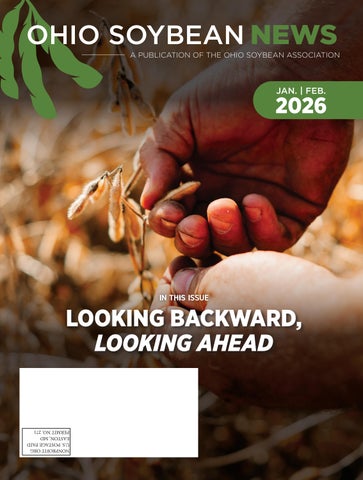
OHIO SOYBEAN NEWS
A PUBLICATION OF THE OHIO SOYBEAN ASSOCIATION
JAN. | FEB.
IN THIS ISSUE
LOOKING BACKWARD, LOOKING AHEAD
NONPROFIT ORG U.S. POSTAGE PAID EASTON, MD PERMIT NO. 271
OHIO SOYBEAN
NEWS
8|
2025 Legislative Round Up
11 |
Ohio Farmers Celebrate the Passage of House Bill 10
13 |
Soybean Innovation Drives Ohio Farmer’s Leadership Vision
14 |
Rooted in Excellence: Celebrating Tom Fontana
17 |
GrowNextGen Delivers Real Agriculture to Ohio Classrooms
18 |
2025 Research Round Up
20 |
Planting Professionals: Investing in Ohio’s Future Ag Professionals
22 |
Checkoff Dollars at Work: Turning Research Into Real-World Results
26 |
Looking Backward and Looking Ahead by Dusty Sonnenburg
The Tradition Continues … Tune in to listen to the Ohio Ag Net team. www.ohioagnet.com
2026 ASA President Hails from Ohio MORE ON PAGE 5
A LETTER FROM THE
President
Thank you to the 2025 Ohio Soybean Association Board of Trustees for your year of service! President
Bennett Musselman
Rusty Goebel, Williams County
Ohio Soybean Association President Pickaway County Soybean Farmer
Vice President
Bennett Musselman, Pickaway County
Treasurer Happy New Year! As the new president of the Ohio Soybean Association (OSA), I thought I’d take this first column to introduce myself. I farm soybeans, corn and wheat with my family in Pickaway, Madison, and Franklin Counties. Off the farm, I work with Leist Mercantile, where I provide risk management services to local farmers. My wife Liza and I are raising our two sons on the family farm, instilling in them the values of hard work, stewardship and community service. My first real exposure to soybean-specific advocacy was through the American Soybean Association Corteva Agriscience Young Leader Program in 2021. Since then, I’ve been on countless trips to Columbus and Washington, D.C., advocating on behalf of farmers for the issues that make a difference for family farms like mine. The good news is you don’t even have to leave the warmth of the farm office to make your voice heard by our legislators. This year, OSA is proud to launch a new advocacy tool to help our members have easier access to state and federal legislators. You can access this new tool at www.soyohio.org/ OSAaction. Taking action is as easy as entering your contact information. The Voter Voice platform will send advocacy messages to the appropriate recipients based on your state/congressional district. Remember to enter 4 | January-February 2026
your home address, not your business address. The advocacy messages will be pre-written to make the process quicker, but if you have the time, we encourage our members to add their own personal touch to each message. As you explore the new advocacy tool, consider these tips on being an effective advocate: •
Tell your story. Explain how legislators’ work in Columbus and D.C. does or could affect your farm or business.
•
Share your opinion respectfully and concisely.
•
You’re the expert in your issues. Offer to be a resource going forward on topics of importance to soybean growers.
I hope this new platform will make advocating from your farm a little easier in the coming year. I know not everyone has the time to take trips to see our policymakers in person, but everyone’s voice deserves to be heard. Wishing you all a great 2026!
Bennett Musselman OSA President Pickaway County Soybean Farmer
Dustin Converse, Union County
Secretary
Trish Cunningham, Union County
Chairman
Patrick Knouff, Shelby County
Trustees
David Clark, Warren County Dave Green, Crawford County Justin Esselburn, Ashland County Matt Lutz, Crawford County Jeff Magyar, Ashtabula County Scott Metzger, Ross County Jeremy Price, Putnam County Ryan Rhoades, Marion County Andy Stickel, Wood County Bob Suver, Clark County Adam Vonderhaar, Preble County Jennifer Wilson-Oechsle, Van Wert County
American Soybean Association Board Representatives Rusty Goebel Scott Metzger Ryan Rhoades
Staff Credits
Kirk Merritt - Publisher Julia Brown - Editor Mackenzie Joseph - Staff Writer Lauren Gerig - Art Director Kim Lemmon - Production Manager Ohio Soybean News is published six times a year by the Ohio Soybean Association, 918 Proprietors Rd., Suite A, Worthington, OH 43085. Phone: 614-476-3100. Comments and statewide news articles should be sent to the above address. Advertising space reservation must be made by the first of the month preceding publication. In consideration of the acceptance of advertisement, the agency and the advertiser must, in respect of the contents of the advertisement, indemnify and save the publisher harmless against any expense arising from claims or actions against the publisher because of the publication of the content of the advertisement.
For Advertising Sales Contact: Kristin Flowers - (614) 323-9320 kristin@ohioagnet.com
For Address Corrections Contact:
Ohio Soybean News at 918 Proprietors Rd., Suite A, Worthington, OH 43085. Web address: www.soyohio.org E-mail: cdeboard@soyohio.org
ROSS COUNTY FARMER TO LEAD AMERICAN SOYBEAN ASSOCIATION IN 2026
Ross County farmer Scott Metzger will represent Ohio and soybean growers across the country in 2026 as he takes the helm as president of the American Soybean Association (ASA). Alongside his family in Williamsport, Metzger farms more than 3,100 acres of soybeans, corn and wheat on a multi generational family farm. Drawing on his day-today experience managing a diverse operation, he works to make sure farmers’ perspectives are represented in every policy discussion that impacts their livelihoods. “I’ve always believed that when farmers work together, we can shape a stronger future for agriculture,” Metzger said. “Serving as ASA president is an opportunity to represent the interests of soybean growers from Ohio and across the country.” Metzger has long been active in both state and national soybean organizations. Serving on the Ohio Soybean Association (OSA) Board since 2016, he has served in all leadership roles including president in 2019. Throughout his tenure on the OSA board he was instrumental in elevating OSA’s policy priorities, building relationships with elected officials and strengthening the voice of Ohio Soybean Farmers. He has also served on the Ohio Soybean Council (OSC) board. Throughout his time serving Ohio soybean farmers, he has worked to advance research, education, and increase demand to strengthen Ohio’s soybean industry. At the national level, he has held
several key positions within ASA, including treasurer, secretary and vice president, helping to guide discussions on trade, biofuels, and the farm bill. A graduate of The Ohio State University with a degree in Agronomy and Agricultural Business, Metzger also completed the Ohio Farm Bureau’s AgriPOWER and the ASA DuPont (Corteva) Young Leader Program. Pickaway County farmer Bennett Musselman, OSA president, said Metzger’s experience will be an asset to farmers nationwide. “Scott has an incredible ability to bring people together — from the farm to the policy table,” Musselman said. “His perspective and dedication will serve soybean farmers well.”
“Scott has an incredible ability to bring people together - from the farm to the policy table,” -Bennett Musselman, OSA President As ASA president, Metzger will focus on representing soybean farmers’ interests at the national level and advancing initiatives that support the industry’s continued growth and competitiveness. January-February 2026 | 5
FROM YOUR FIELDS TO FIREFIGHTERS’ HANDS The more we discover about soybeans, the more valuable they become. One innovative product, SoyFoam™, creates a new, sustainable use for your crop that protects firefighters and the planet. See how your Soy Checkoff is unlocking new markets for soybeans at unitedsoybean.org
© 2 02 5 U NI TE D SOY BEA N BOA R D
OSA 2026
State Policy Priorities In December, the board of trustees met to set OSA’s policy priorities for 2026. Farmer leaders discussed driving innovation, expanding and protecting market opportunities, and strengthening global relationships for the soybean industry. Among the organization’s priorities for 2026 will be to advance the future of biofuels and expand the bioeconomy through policy that supports cutting-edge biomanufacturing right here
in Ohio. At the same time, OSA will protect soy’s use in food applications. From seed oils to consumer products, the organization will promote domestic markets for Ohio’s soybean growers. OSA will also support international trade partnerships that open new markets and reinforce existing ones, creating lasting value for Ohio’s farmers.
Scan me!
Scan the QR code to view our full list of 2026 policy priorities.
YOUR PATH TO THE LATEST FARMING TRENDS The Ohio Soybean Council and the soybean checkoff developed Field Leader to stay on top of the latest research and practices. Learn more by clicking the "Ohio Field Leader" tab at OCJ.com
Brought to you by Ohio soybean farmers and their checkoff.
January-February 2026 | 7
LEGISLATIVE
ROUND UP
In a year marked by policy shifts and budget negotiations, the Ohio Soybean Association (OSA) has emerged as a powerful voice for Ohio’s agricultural community. From renewable energy to infrastructure, OSA’s advocacy helped shape legislation that supports farmers, strengthens rural economies, and promotes sustainable growth. Here’s a look at how the policy priorities set by OSA’s farmer board of trustees resulted in key victories and ongoing efforts that define OSA’s impact in 2025.
Fueling the Future: Generating Demand Through Renewable Energy Advocacy OSA played a pivotal role in advancing the 45Z clean fuel production tax credit package. By pushing for the removal of the Indirect Land Use Change (ILUC) penalty and ensuring feedstocks were limited to North American sources, OSA helped secure a more favorable framework for domestic soy-based biofuels. Additionally, OSA’s coalition work led to a proposed 67% increase in the Renewable Volume Obligation (RVOs) for biomass-based diesel—up to 5.61 billion gallons for 2026. The new proposal also includes a 50% reduction in credits for import-based renewable fuels, a move that prioritizes domestic production. OSA continues to support this proposal through extensive advocacy efforts and stakeholder engagement. 8 | January-February 2026
Protecting Pro-Agriculture Tax Policy When state legislators proposed to eliminate sales and use tax exemptions for agricultural drain tile and grain bins, OSA sprang into action. A call-to-action campaign enabled farmers to have a strong voice opposing the change. Ultimately, legislators reversed course, preserving this critical cost savings for Ohio farmers.
Championing Infrastructure Investment OSA joined a statewide coalition to support Issue 2, which renewed the State Capital Improvement Program (SCIP). This program provides essential funding for local governments to repair roads, bridges, and other infrastructure. Voters approved the measure in May, ensuring continued investment in Ohio’s rural economy.
Sustaining Water Quality Improvement with H2Ohio OSA championed continued funding for H2Ohio, a program aimed at improving water quality through agricultural best practices. The program’s investment in farmers has proven a more effective approach to get results as opposed to imposing one-size-fits-all regulations.
2025 OSA PRESIDENT RUSTY GOEBEL SHAKES HANDS WITH U.S. SECRETARY OF AGRICULTURE BROOKE ROLLINS
Investing in Youth: 4-H and FFA OSA supported increased funding for the Agriculture 5th Quarter Program, which bolsters FFA chapters across the state. The budget boost reflects a commitment to keeping agriculture education in Ohio’s schools and cultivating the next generation of agricultural leaders.
Safeguarding Animal Agriculture In response to the threat of Highly Pathogenic Avian Influenza (HPAI), OSA backed budget provisions to secure necessary funding for prevention and response efforts. The program received full funding, reinforcing Ohio’s preparedness and biosecurity for the poultry industry which represents an important customer for Ohio soy growers.
Growing the Bioeconomy Through a letter-writing campaign, OSA rallied Ohio farmers and ag professionals to urge the Ohio General
Assembly to prioritize bioeconomy competitiveness. The initiative highlights the state’s potential to lead in renewable materials, soy-based bioproducts, and innovation in the US economy.
Regulatory Win: Pesticide Policy Historically, immediate family members and employees on a farm could apply pesticides under the direct supervision of a licensed pesticide applicator without being licensed themselves. OSA fought against a law change that would eliminate that flexibility for our family farms. OSA worked to fix this unfortunate change through direct advocacy efforts with members of Ohio’s General Assembly. From budget battles to ballot victories, OSA’s work in 2025 underscores its role as a tireless advocate for Ohio agriculture. As policy landscapes evolve, OSA remains committed to protecting farmer interests, promoting innovation, and building a resilient future for the state’s agricultural economy. January-February 2026 | 9
OSA Thanks Retiring Board Members for Their Service The Ohio Soybean Association (OSA) extends its sincere appreciation to Patrick Knouff of Shelby County and Andy Stickel of Wood County, who retired from the OSA Board of Trustees at the end of 2025. Both have been dedicated leaders and strong advocates for Ohio’s soybean farmers throughout their years of service. Patrick Knouff has contributed greatly to the growth and success of Ohio’s soybean industry through his leadership and commitment. In addition to his service on the OSA Board, he has been involved in numerous state and national soybean organizations, including past leadership roles with the Ohio Soybean Council and the Soy Transportation Coalition. Patrick manages
Are you a rural small business owner or an agricultural producer? Schedule a FREE solar assessment with SOPEC. • • • • •
more than 2,000 acres of soybeans and corn, along with a herd of heifers and a small show pig operation. A graduate of The Ohio State University, he has been active in the OSU Alumni Association, Ohio Farm Bureau, and Grace Lutheran Church. Andy Stickel has also been a valued voice for Ohio agriculture. He farms soybeans, corn, wheat, alfalfa, tomatoes, and beef cattle, and has been involved with the Wood County Beef Producers Board, Great Lakes Family Farms Co-op Board, and Wood County Farm Bureau. Andy holds bachelor’s and master’s degrees from Kansas State University. OSA thanks Patrick and Andy for their leadership, service, and lasting contributions to Ohio’s soybean community.
STORE NOW. PROFIT LATER. Thinking about a new bin or drying system? Don't wait any longer. The farmers who get top dollar for their crop are the ones with on-farm storage. Give your local dealer a call today!
25% USDA REAP grant available Bonus depreciation to reduce tax liability Lower electricity bills Zero-emission on-site power Creates prevailing-wage solar jobs
CALL CBR EQUIPMENT TODAY! PROVIDING SALES & SERVICE TO CENTRAL OHIO (419) 560-6799
OHIO FARMERS WIN RELIEF WITH
Passage of House Bill 10 In a significant legislative turnaround, Ohio’s General Assembly passed House Bill 10 this November, reversing controversial pesticide certification changes introduced in the state’s budget bill earlier this year. The move marks a major win for family farms and agricultural operations across the state, many of which faced burdensome new licensing requirements that exceeded federal requirements. The original budget legislation mandated that anyone applying pesticides in Ohio be certified, eliminating the long-standing provision that allowed non-licensed individuals—often family members or farm workers—to apply pesticides under the direct supervision of a licensed applicator. It also expanded licensure requirements to include several pre-application actions, further complicating compliance. These changes were intended to align Ohio law with federal pesticide regulations updated in 2017. However, the state’s version went beyond federal requirements, potentially forcing thousands of Ohio farmers into an unnecessary certification process. Crucially, federal law does not prohibit
supervised application by non-licensed individuals—a nuance overlooked in the budget bill. Recognizing the impact on Ohio’s agricultural community, the Ohio Soybean Association (OSA) sprang into action. Throughout the budget process, OSA engaged in extensive dialogue with legislators, agricultural groups, and the Ohio Department of Agriculture. Despite these efforts, the final budget language failed to address the supervised application issue. Undeterred, OSA continued its advocacy, championing an amendment to House Bill 10 as a corrective measure. Bill sponsor State Rep. Roy Klopfenstein embraced the idea. An amendment was added that reinstates the ability for non-licensed individuals to apply pesticides under the supervision of a licensed applicator. This approach ensures compliance without imposing undue burdens on farm families. “Farmers use pesticides with the utmost care, and the changes to pesticide licensing regulations made in the state budget bill this summer would have created an undue burden for pesticide applicators that went beyond federal requirements,”
ROY KLOPFENSTEIN, CHAIRMAN OF THE OHIO HOUSE AGRICULTURE COMMITTEE.
said Rusty Goebel, OSA Chairman and soybean farmer from Williams County. “We are pleased to see the passage of House Bill 10, which will bring Ohio into compliance with federal regulations without overcomplicating the process.” This legislative win underscores the power of grassroots advocacy and the importance of aligning state policy with practical realities on the ground—especially when it comes to protecting the backbone of Ohio’s rural economy.
January-February 2026 | 11
2026 MEMBER BENEFITS FRIEND OF OSA: $50 Subscriptions to Ohio Soybean News and Ohio’s Country Journal Monthly Leader Letter enewsletter EXCLUSIVE retail discounts from Dynamic Green Products and Gear Head Lubricants
STUDENT/ YOUNG ADULT: $10 Includes all Friend of OSA Benefits, plus eligibility for $1,000 OSA Scholarship. This three-year membership offer is open to any individual ages 18-24. Date of birth is required on all applications to confirm eligibility.
FARMER 1-YEAR: $100
FARMER 3-YEAR: $285
Includes Friend of OSA benefits, plus: Biodiesel Bucks – save up to $100 on 500 gallons of biodiesel at participating retailers 2 free Ohio State University SCN soil tests ($80 value) 10% Off Ag Clarity from BAMWX American Soybean Association membership & benefits $100 Commodity Classic Registration Discount Eligible for $5,000 Soy Scholarship Cabela’s Gift Card Purchase 10% discount
Includes Farmer 1-Year Membership benefits, plus: 25% off residential property roof rejuvenation from Roof Maxx Soybean Seed Coupon – Save $200 at participating companies (100 bag minimum) New Seed Companies for 2026! American Soybean Association membership & benefits $100 Commodity Classic Registration Discount Eligible for $5,000 Soy Scholarship Cabela’s Gift Card Purchase 10% discount
BECOME AN
OSA MEMBER For more Information visit: soyohio.org/membership Name:
Company/Farm:
Address:
City:
County:
State:
Cell:
Phone:
Email:
Total Farm Acres:
Occupation: Farmer
Other
Farmer Membership 3-Year: Level: $285
Payment Method: Check: (Payable to OSA) Card Number: Name on Card (Print):
Zip:
Mastercard:
Home:
Total Soybean Acres: Farmer 1-Year: $100
Friend of OSA: $50
VISA:
Discover:
EXP Date:
Code:
Signature:
Detach and Mail to Ohio Soybean Association 918 Proprietors Road, Suite A, Worthington, OH 43085
Student: $10 AMEX:
Soybean Innovation Drives Ohio Farmer’s Leadership Vision By Jen Del Carmen
United Soybean Board Contributor Steve Reinhard has built his career around two core passions - agriculture and education. Since 2008, the Bucyrus, Ohio, farmer has represented soybean growers through the Ohio Soybean Association and the Ohio Soybean Council. In 2016, he expanded his service nationally when he joined the United Soybean Board (USB). “Back in the 90s, I worked as an agriculture education instructor and FFA advisor before serving in the Ohio House of Representatives,” Reinhard recalls. “When my term ended, I wanted to continue helping others see the value of agriculture.” That path led him to soybean leadership, where he found an opportunity to blend farmer representation, innovation, and education. Reinhard was especially drawn to research and new product development. Early in his leadership tenure,
he worked closely with The Ohio State look at emerging and underdeveloped University’s Ohio Bioproducts Innova- markets, along with continuing to tion Center (OBIC), which connects diversify soybean products.” university research to commercial He views service on behalf of the Soy use. “When I saw the work happenCheckoff as mutually beneficial. “I’ve ing with biobased plastics and other learned how other farmers operate soybean-derived products, it just made and often bring those ideas home,” sense to get involved on behalf of he says. “Serving is an investment - in farmers,” he says. my farm, in other farmers, and in the Since then, innovation driven by soy- future of soy.” bean checkoff investments has accelerated. Reinhard “Serving is an investment - in points to advancements my farm, in other farmers, and from partners like Airable in the future of soy.” Research Lab and Clean -Steve Reinhard Fuels Alliance America as examples of how soybean research is expanding market opportu- USB CEO Lucas Lentsch says Reinnities. “High oleic soybean oil contin- hard’s leadership reflects what drives the checkoff’s success. “Every farmer, ues to grow and improve,” he notes. “Ford uses soybean components in car regardless of where they farm, helps shape the Soy Checkoff, which begins parts, Goodyear uses soy in tire techwith local input,” says Lentsch. “With nology, and we’re seeing biofuels and sustainable aviation fuel gain momen- leaders like Steve Reinhard serving tum. Soybeans are even being explored on the United Soybean Board, we’re ensuring that the voices and priorities for new wound care applications.” of Ohio soybean farmers are reflected As USB chair, Reinhard focused on in our national strategy. His leadership collaboration. His approach emhighlights how farmers are advancing phasized encouraging shared goals, the soybean industry while staying ensuring balanced participation, and rooted in their communities. Strong keeping farmers aligned during both representation from states like Ohio challenges and opportunities. “Deis essential to the continued success of veloping and maintaining markets is the checkoff.” essential,” he says. “We also have to January-February 2026 | 13
IN EXCELLENCE Celebrating Tom Fontana After more than two decades at the Ohio Soybean Council (OSC), Tom Fontana is retiring as Director of Research and Education, leaving behind a legacy defined by scientific excellence, collaboration, and a tireless commitment to Ohio’s soybean growers. For farmers, educators, researchers, and students alike, his influence has been transformative.
today. His ability to connect people, ideas, and innovation has had a lasting impact on the soybean industry in Ohio and beyond. We’re deeply grateful for his years of service and wish him all the best in his well-deserved retirement,” said Kirk Merritt, Executive Director of the Ohio Soybean Council.
Throughout his career, Fontana has been the driving force behind OSC’s research and education programs, overseeing countless projects that advanced soybean production, improved sustainability and strengthened Ohio’s position as a national leader in agricultural innovation. His efforts have connected researchers, farmers, industry partners, and students, ensuring that science and education work hand in hand to move the soybean industry forward.
“Tom’s collaborative spirit and unmatched ability to bring people together have left an indelible mark on the Ohio soybean industry, farmers, and the next generation of industry leaders. His legacy will continue to inspire all of us,” said Jennifer Coleman, Director of Communications at The Directions Group. Coleman worked with Fontnafor many years while at OSC, giving her a unique perspective on his leadership and impact.
In recognition of his outstanding contributions, Fontana received the 2025 Ohio Soybean Council Outstanding Achievement Award, honoring his exceptional efforts in promoting and growing the Ohio soybean industry.
A cornerstone of Fontana’s legacy is his work with GrowNextGen, OSC’s innovative education initiative that brings real-world science and agriculture into K-12 classrooms across Ohio. Under his leadership, the program has reached thousands of teachers and students, connecting them with the science behind modern farming and
“Tom’s leadership and vision have shaped the research and education programs that define the Ohio Soybean Council
14 | January-February 2026
food production. Fontana’s guidance helped expand the program’s reach and deepen its impact, inspiring the next generation of scientists, educators, and agricultural leaders.
getting to know Tom and grew professionally because of his guidance,” said Dr. Laura Lindsey, professor at The Ohio State University (OSU).
“GrowNextGen has reached hundreds of thousands of students and teachers in science classrooms across Ohio. Tom has led this project since its inception. He has been an excellent steward of checkoff dollars and deserves the thanks of all Ohioans. He is also a wonderful friend and colleague. Happy retirement, Tom,” said Jeanne Gogolski, retired CEO of EducationProjects.org, the company that helped develop the GrowNextGen program.
“Thank you, Tom, for your support, mentorship, and guidance for the soybean research and extension community at The Ohio State University to bring the most timely information back to Ohio soybean producers. Your work behind the scenes also helped our team gain recognition regionally and nationally, and for this we are indebted,” said Dr. Anne E. Dorrance, retired professer at OSU.
In addition to his work in research and education, Fontana has overseen the Ohio Soybean Council Foundation (OSCF) Scholarship Program, providing financial support and recognition for the next generation of agricultural leaders. Since 2008, the OSCF Scholarship Program has awarded more than $500,000 in scholarships, helping students pursue higher education and training in agriculture, science, and related fields. Through his leadership, Fontana has ensured the program continues to make a meaningful difference for young people pursuing careers in agriculture.
Through all his efforts, Fontana’s work has ultimately been in service to Ohio soybean farmers, supporting their success and the growth of the industry. “Tom has been an exceptional ambassador for Ohio soybeans, combining deep expertise with genuine passion. His dedication, professionalism, and ability to connect with people across the country have made him one of the most respected educators and advocates in the industry,” said Keith Kemp, Preble County soybean farmer and former OSC Chairman.
“Tom’s insight, integrity, and unwavering commitment to Ohio agriculture have made him a trusted partner to farmers, researchers, and industry leaders alike. His guidance and support have strengthened programs across the state and helped ensure the continued growth and success of Ohio’s soybean industry,” said Steve Reinhard, Crawford County soybean Jennifer Coleman, farmer and former OSC Chairman. Director of Communications at The Directions Group As he looks ahead to his next chapter, Fontana leaves Fontana’s contributions extend beyond formal programs. behind a strong legacy of research, education, and outHe is known not only for his expertise but also for his reach that will benefit future generations of agricultural warmth, humor, and steadfast support of colleagues. His innovators. His OSC family extends heartfelt thanks for mentorship has guided countless young professionals and his years of service, leadership, and friendship. researchers, helping them navigate challenges and seize Congratulations, Tom, on your retirement and your wellopportunities in an evolving agricultural landscape. earned Outstanding Achievement Award. Your legacy will “I really appreciate everything Tom has done for my continue to grow, just like the soybeans you have champiprogram at Ohio State, especially his support of graduate students. My current and former students have all enjoyed oned for so many years.
“Tom’s collaborative spirit and unmatched ability to bring people together have left an indelible mark on the Ohio soybean industry, farmers, and the next generation of industry leaders. His legacy will continue to inspire all of us.”
January-February 2026 | 15
OHIO SOYBEAN INDUSTRY DINNER CELEBRATES LEADERSHIP & SERVICE IN 2025 Ohio’s soybean community gathered on December 15 for the annual Industry Dinner at the Nationwide Conference Center, an evening dedicated to celebrating progress, partnership, and service across the state’s agricultural industry. This year’s program opened with remarks from Ohio Department of Agriculture Director Brian Baldridge, who highlighted the strength of Ohio agriculture and commended farmers for their leadership in innovation, sustainability, and market growth. Master of Ceremonies Dale Minyo welcomed guests and guided the evening’s program, which featured updates from both the Ohio Soybean Council (OSC) and Ohio Soybean Association (OSA). OSC Chairman Bill Bayliss (Logan County) opened the Council’s portion, emphasizing the checkoff’s continued focus on expanding markets, driving research, and supporting new technologies. Committee updates followed, beginning with Todd Hesterman (Henry County), chair of the Communication and Education Committee, who highlighted another successful year for GrowNextGen and its outreach to teachers and students. The program recognized Erica Hitzhusen, an 8th grade science teacher at 16 | January-February 2026
Worthingway Middle School, as the 2025 GrowNextGen Teacher Leader of the Year for her outstanding leadership in agricultural education and her work to connect students with real-world science and farming experiences. Tyler Miller (Crawford County), Demand Committee chair, shared progress in expanding domestic and international soybean utilization, including growth in biofuels and livestock sector partnerships. Jeff Magyar (Ashtabula County), Research Committee chair, detailed the year’s advances in plant and product research, including expanded work at Airable Research Lab and collaborations with universities and industry partners. Turning to Association updates, OSA President Rusty Goebel (Williams County) reflected on the organization’s achievements in advocacy, membership growth, and engagement with policymakers. Bob Suver (Clark County), Policy Committee chair, outlined key 2025 legislative efforts, while Membership Committee Chair Jennifer Wilson-Oechsle (Van Wert County) discussed outreach to young and beginning farmers. A highlight of the evening was the presentation of the 2025 Outstanding Achievement Award to Tom Fontana, honored for his decades of leadership in research, education, and program development benefiting Ohio’s soybean farmers. The organizations also recognized retiring board members: Andy Stickel(Wood County) and Patrick Knouff (Shelby County) from OSA and Scott Metzger (Ross County) and Steve Reinhard (Crawford County) from OSC. Executive Director Kirk Merritt closed the evening by thanking staff, board members, and partners for their service and reaffirming both organizations’ commitment to advancing Ohio’s soybean industry in the year ahead.
Delivers Real Agriculture to Ohio Classrooms Virtual field trips, bioproduct labs, and teacher workshops connected students to modern farming in 2025, with more opportunities ahead for farmers to share their expertise. GrowNextGen brought Ohio students inside working farms this year through virtual field trips showcasing autonomous equipment and AI-powered decision-making. The program’s one-period labs had students producing biodiesel and bioplastics.
together. Whether it’s biodiesel, food products, or even lip balm from soy, those are the moments that stick.” Virtual field trips brought 6,974 students inside Ohio agriculture this year. The Anthony Thomas chocolate factory tour alone attracted 281 classrooms with 5,353 students, where they learned how soy lecithin serves as an essential emulsifier in chocolate production. Throughout the year, VFTs covered everything from spring planting to harvest. During the precision ag virtual field trip, students heard directly from experts about agriculture’s digital transformation,
Science teachers gained confidence in teaching soil and water quality through field-tested protocols, with a 91% increase in their confidence in performing these skills after attending a GrowNextGen workshop. Whitney Short, a Pettisville teacher, knows what resonates: “Students love making something they can see come
WHERE YOUR INVESTMENT GOES STUDENTS SEEING REAL FARMS: 6,974 through virtual field trips FUTURE CONSUMERS EDUCATED: 17,926 at community events CAREER PIPELINE BUILDING: 530 teachers reaching 190,965 students over the curriculum’s shelf life
learning how data drives modern farming systems and how AI helps farmers make better decisions. Teacher surveys confirm the lessons work equally well in chemistry, environmental science, and biology classes at both middle and high school levels, reaching far beyond traditional ag classrooms. Short reaffirms that teachers see results that matter: “GrowNextGen provides resources where students do real science centered on agriculture. Students take what they’ve learned and use it in college or careers.”
GET INVOLVED IN 2026 HOST A VIRTUAL FIELD TRIP
30-45 minutes during planting, harvest, or ag operations. GNG handles facilitation - your data and decisions bring it to life.
JOIN AN INDUSTRY DINNER Connect with teachers at regional events where you can share your farming story and build relationships with educators in your community.
Contact Jane Hunt at connect@grownextgen.org and we’ll connect you with teachers ready to learn from Ohio’s farming professionals. January-February 2026 | 17
RESEARCH ROUNDUP 2025:
TURNING OHIO SOYBEAN SCIENCE INTO Across Ohio, soybean farmers are benefiting from cutting-edge research partnerships between The Ohio State University and the Ohio Soybean Council (OSC). From smarter nutrient use to drones, digital
tools, and long-term soil health insights, these projects are tackling real-world challenges with practical, field-tested solutions. Here are six research efforts making a difference for growers in 2025.
SMARTER PHOSPHORUS USE FOR SOYBEAN FIELDS Researchers: Manbir Rakkar, Greg LaBarge, Leonardo Deiss Ohio State scientists are digging deeper into how soybeans use phosphorus (P) already in the soil to help farmers apply nutrients more efficiently. Long-term studies across Ohio show that many soils with a history of heavy fertilizer use can continue feeding crops for several years without new P applications. That means some fields may already have enough “legacy” phos-
phorus to meet soybean needs, saving farmers input costs and reducing runoff risk. By tracking how organic and inorganic P move and interact in different soils, this team is refining fertilizer recommendations that keep yields high and waterways clean.
BATTLING WHITE MOLD IN SOYBEANS Researcher: Horacio López-Nícora, Department of Plant Pathology White mold continues to be a top disease threat to Ohio soybeans, especially in cool, wet seasons. Dr. López-Nícora’s team is studying how this fungus spreads and the best timing for control. Their field research confirms that fungicide applications are most effective when applied just before or at early flowering,
before symptoms appear. The team is also using scouting and imaging tools to spot early signs of infection - tiny mushroom-like apothecia on the soil surface that signal disease risk. This work helps farmers act quickly and protect yields before white mold takes hold.
MANAGING WEEDS IN ULTRA-EARLY PLANTED SOYBEANS Researcher: Laura Lindsey, Department of Horticulture and Crop Science Ultra-early soybean planting can improve yields—but pre- and post-emergence herbicide combinations that also creates weed control challenges. Dr. Lindsey’s perform well under cold, wet conditions when early research is testing herbicide programs that protect planting occurs. Results will help farmers identify these early stands, focusing on problem weeds like weed control programs that minimize pressure while waterhemp and giant ragweed. Her team is evaluating maintaining yield in these high-risk planting windows. 18 | January-February 2026
AI DRONES HELP DECIDE WHEN TO REPLANT SOYBEANS Researchers: Sarni Khanal, Laura Lindsey When poor weather leads to thin soybean stands,
adjust seeding rates
deciding whether to replant can be tricky. Ohio State
in real time. This
researchers have created a drone-based tool that uses
“FieldVision” pro-
artificial intelligence to count plants, detect gaps, and
totype could soon be available as a mobile app, helping
generate replanting maps. Tested at the Molly Caren
farmers make data-driven replanting decisions quickly
Ag Center, the system connected directly to planters to
and confidently.
BUILDING SOIL RESILIENCE WITH LONG-TERM NO-TILL Researchers: Aline de Camargo Santos, Manbir Rakkar Decades of Ohio State research show how conservation
and greater
practices like no-till and diverse rotations strengthen
resilience to
soil health and stability. By comparing long-term plots
flooding and drought. The results reinforce the payoff
in Hoytville and Wooster, this team is documenting
of consistent soil-friendly management—healthier
increases in soil organic carbon, improved structure,
soils that support reliable soybean yields year after year.
BATTLE FOR THE BELT: CORN & SOYBEANS GO HEAD TO HEAD Researchers: Laura Lindsey, Osler Ortez, OSU Extension Agronomy Team The Battle for the Belt project continues to capture farmers’ attention across Ohio by comparing corn and soybean planting dates side-by-side. This on-farm and research-station study helps answer one of the biggest questions growers face every spring—which crop should I plant first, and when is it too early or too late? Using multi-year, multi-location data, the team tracks how planting date affects yield, emergence, and soil condi-
tions. In 2025, new weather and soil sensors provided even better insight into how timing affects performance. Results show that, in most Ohio conditions, soybeans planted earlier than corn can gain a small but consistent yield advantage when managed carefully for frost and weeds.
The partnership between the Ohio Soybean Council and The Ohio State University continues to drive innovation that reaches all corners of Ohio agriculture.
From soil science to smart technology, these projects remind us that every acre of soybeans is a chance to learn, adapt, and improve—one field at a time.
January-February 2026 | 19
A NIG HT FOR CFAE S ST UDE N T S
Investing in Ohio's Future Ag Professionals
The Ohio Soybean Council (OSC), supported by the soybean checkoff, is committed to cultivating the next generation of leaders who will shape the future of Ohio agriculture. That commitment was on full display during the recent Planting Professionals Etiquette Dinner, hosted in partnership with Ohio State University’s College of Food, Agricultural, and Environmental Sciences (CFAES) Career Development Office, Ohio Ag Net, and Ohio’s Country Journal. This unique event guided CFAES students through the finer points of professional dining — but more importantly, it provided an opportunity to build confidence, communication skills, and meaningful connections with agricultural leaders.
“The Ohio Soybean Council is proud to invest in students who represent the future of our industry,” said Bill Bayliss, Logan county farmer and chairman of the Ohio Soybean Council. “Events like this help young profes-
20 | January-February 2026
sionals learn how to communicate effectively, network with confidence, and represent Ohio agriculture with professionalism. Through the checkoff, we’re working to ensure the next generation is well-prepared to lead and strengthen our state’s agricultural industry.”
Marlene Eick, senior director of leadership development at the Ohio Farm Bureau, led the evening’s etiquette training. As students enjoyed a threecourse meal, Eick offered practical advice to help them navigate professional interactions with confidence and ease. The dinner brought together nearly 200 students and 50 agricultural professionals from across Ohio, including representatives from commodity organizations, agribusinesses, government agencies, and CFAES faculty and staff. Students were encouraged to engage in meaningful conversations, ask questions, and learn from those who have already built successful careers in the industry.
“For many students, especially those early in their college journey, this event is a chance to explore career paths and develop essential leadership skills,” said Adam Cahill, director of career development at CFAES. Attendees also had the opportunity to sign up for a complimentary membership in the Ohio Soybean Association (OSA), providing access to scholarships, leadership programs, and professional development opportunities supported by OSC. Through investments made possible by the soybean checkoff, the Ohio Soybean Council continues to ensure that the next generation of Ohio agricultural professionals is wellequipped, well-connected, and ready to lead a strong and sustainable future for the state’s soybean industry. Learn more about OSA and OSC scholarship opportunities at SoyOhio.org.
United Soybean Board LAUNCHES WEBSITE TO SUPPORT LIVESTOCK NUTRITION AND HEALTH
Scan the QR code to learn more about CAN.USSOY.ORG
Today, new soybean research and commercial learnings are available that evolve soy use as a feed ingredient in poultry, swine, dairy and beef diets. To share these important insights, the United Soybean Board is launching a new website called U.S. Soy Center for Animal Nutrition and Health (U.S. Soy CAN) to provide the latest research and information to livestock industries. “Given that poultry and livestock represent the largest consumers of soybean meal, U.S. Soy CAN provides the industry with a much-needed central resource to share information as it becomes available,” said Todd Hanten, USB farmer-leader from South Dakota who oversees the health & nutrition portfolio, and also raises cattle and grows soybeans, corn, wheat and hay. “As a livestock farmer, it’s critical that we have the latest feed ingredient research at our fingertips to inform animal nutrition decisions.” U.S. Soy CAN was developed to serve the animal-ag industry as a technical resource for nutritionists, veterinarians and animal scientists while also providing producers with practical decision-making tools that can help them optimize the value of U.S. soy in animal diets. U.S. Soy CAN features a general home page along with species-specific pages for the poultry, swine and dairy industries. Each page features the latest
research results, diet formulation recommendations, decision-making tools, articles, interviews, podcasts, webinars, presentations and much more. These pages also share upcoming industry meetings and events. Initially, U.S. Soy CAN will focus on soy-related animal nutrition and health benefits, but will expand to include other sustainable soy applications as research is completed, and the evidence grows. Academia and industry leaders are encouraged to add content, both research outcomes and commercial learnings, to help share the growing value of U.S. Soy to animal agriculture audiences. “It is our hope that poultry and livestock producers, nutritionists and veterinarians utilize this site as their go-to resource for soy-related information,” said Dr. Nathan Augspurger, senior director, Animal Nutrition and Health at the United Soybean Board. “U.S. Soy CAN is a resource for better understanding, not just the nutritional benefits of soy, but also the value-adding health benefits that impact the immune system’s ability to respond to health and environmental challenges.” Check out the new website and to stay up to date on the newest research outcomes and news by signing up for the U.S. Soy CAN general newsletter and/or species-specific (poultry, swine, dairy) newsletters.
January-February 2026 | 21
Your Checkoff Dollars at Work
TURNING RESEARCH INTO REAL-WORLD RESULTS Every year, soybean farmers face new challenges—resistant weeds, emerging pests, unpredictable weather. But they’re not facing them alone. Through the United Soybean Board and state soybean checkoffs, farmer-led investments are turning research into real-world results that strengthen productivity, protect profits, and prepare for the future.
From nematode management and weed resistance to better planting decisions and yield protection, checkoff funding powers an impressive network of science-based organizations working together to keep farmers ahead of the curve. Here’s a look at six of them—and the resources they offer to help you make confident decisions in the field.
Crop Protection Network (CPN)
Explore resources: cropprotectionnetwork.org
The Crop Protection Network brings together extension specialists, scientists, and educators from across the U.S. and Canada to provide unbiased, research-based information on crop diseases, insects, and pest management.
including soybeans. Their online Yield Loss Calculator and Severity Estimation Tool offer real-time insights into economic and disease impact, helping growers prioritize management decisions.
Farmers can tap into CPN’s comprehensive library of free digital guides, bulletins, and tools—all designed to help diagnose, manage, and prevent yield loss in crops
Science for Success
Learn more: soybeanresearchinfo.com/science-for-success
Science for Success unites soybean extension specialists from land-grant universities representing more than 90% of U.S. soybean acres. Their goal: translate university research into management practices that work in real fields. Through multistate trials, webinar series, and educational videos, the team explores topics like seeding
The SCN Coalition Soybean cyst nematode (SCN) is the leading cause of soybean yield loss in North America—but the good news is, it can be managed. The SCN Coalition, a partnership of university pathologists, agronomists, and industry experts, is dedicated to giving farmers the tools and strategies to fight back. Their message is simple: test your fields, know your numbers, and rotate resistance. The coalition’s website features a wealth of management resources, videos, and the interactive SCN Profit Checker, which estimates 22 | January-February 2026
CPN also connects farmers to extension specialists through timely blog updates, e-newsletters, and social media posts. Their “I See Dead Plants” podcast and YouTube video library (now over 150 videos strong) deliver trusted crop protection tips straight from university experts.
rates, planting dates, fertility, and fungicide use—helping farmers make data-driven decisions. Each year, the Science for Success webinar series covers timely issues from planting to harvest, and past recordings are available anytime on YouTube. The group also mentors the next generation of agronomists through graduate student tours and training, ensuring tomorrow’s experts stay connected to farmers’ needs.
Check your SCN strategy: thescncoalition.com potential yield and revenue losses due to SCN using data from over 25,000 university plots. Through bold outreach campaigns, field demonstrations, and social media engagement, the coalition keeps SCN awareness front and center—helping farmers protect yield potential today and tomorrow.
Soybean Research & Information Network (SRIN) The Soybean Research & Information Network serves as a central hub for checkoff-funded soybean research, making it easy for farmers to find the latest results and recommendations. At soybeanresearchinfo.com, growers can search a vast database of pest and disease reports, field trial data, and
GROW (Getting Rid of Weeds) Herbicide resistance continues to challenge row-crop farmers nationwide, and GROW is helping tackle the problem from every angle. This scientist-led network of more than 30 university and USDA weed experts focuses on integrated weed management strategies that go beyond chemistry.
CHECKOFF IN ACTION Your Checkoff, Your Results Every dollar invested through the soybean checkoff helps farmers tackle the biggest challenges in production agriculture. Whether it’s managing SCN, reducing herbicide resistance, or improving yield through smarter decisions, these programs prove that farmer-driven research delivers measurable, lasting value.
best management practices—all updated regularly. The site’s monthly e-newsletter consolidates content from partner organizations like CPN, Science for Success, and GROW, putting fresh, research-based insights right in your inbox. SRIN’s mission is to make research practical, accessible, and actionable—helping farmers apply the science funded by their own checkoff dollars. Visit: soybeanresearchinfo.com
Plan your strategy: growiwm.org GROW’s most popular tool, the Weed Management Planner, helps farmers compare chemical and non-chemical tactics—like crop rotation, cover crops, tillage, and harvest weed seed control—and see how each practice affects key problem weeds throughout the growing season. “The goal is to help farmers strengthen their systems,” says Virginia Tech weed specialist Dr. Michael Flessner. “Every change has ripple effects, and these charts make it easy to spot what works and what doesn’t.”
Access tools: iwilltakeaction.com Take Action: Herbicide Resistance Management Take Action is a farmer-driven education campaign that unites weed scientists, agronomists, and commodity groups to help farmers slow herbicide resistance and preserve future technologies. Their flagship Herbicide Classification Chart, created by Michigan State weed scientist Christy Sprague, remains one of the most trusted tools in the industry. Updated each year, the chart groups herbicides by mode of action, helping farmers rotate products effectively to prevent resistance. The Take Action website also features weed fact sheets, educational webinars, and printable tools for herbicide planning—making it easy to stay ahead of resistance before it becomes a costly problem.
January-February 2026 | 23
from our friends at
agrimer™ eco-coat
Nature-Derived Seed Coating for Sustainable Agriculture
agrimer™ eco-coat polymer is Ashland’s latest nature-derived seed coating polymer, developed using the company’s Transformed Vegetable Oils (TVO) technology platform from Soybean. This “Ag to Ag” innovative solution reintroduces soy back into farming. It has been designed to help agricultural growers achieve superior dust-off reduction, improved actives retention, and lower use-levels, all while supporting sustainability and regulatory compliance.
Unlike conventional microplastic-based coatings, agrimer™ eco-coat polymer is inherently biodegradable, microplastic-free, and offers biocompatibility with beneficial organisms. Its advanced formulation ensures strong adhesion to seeds, minimizing dust-off, a critical measure of coating integrity that impacts regulatory compliance, worker safety, and pollinator health. The product’s efficacy is validated through Heubach Dustmeter testing, where agrimer™ eco-coat consistently outperforms traditional polymers like styrene-acrylate and PVOH in reducing dust-off and retaining active ingredients.
A key differentiator is agrimer™ eco-coat polymer's biocompatibility. Tests show that seeds coated with this polymer maintain higher viability of beneficial microbes like Rhizobia, supporting biological efficacy and sustainable farming practices.
Field trials demonstrate that seeds coated with agrimer™ eco-coat polymer maintain excellent plantability, ensuring smooth flow through high-speed precision planting systems and consistent crop emergence. The polymer preserves seed shape and flowability, reduces friction, and minimizes skips and doubles during planting, directly contributing to operational efficiency and yield potential. (TM) TRADEMARK, ASHLAND OR ITS SUBSIDIARIES, REGISTERED IN VARIOUS COUNTRIES (C) 2025, ASHLAND
In North America, as well as all regions in the world, agrimer™ eco-coat polymer is positioned to help growers meet evolving regulatory and sustainability demands while improving crop care outcomes. January-February 2026 | 25
LOOKING BACKWARD &
Looking Ahead By Dusty Sonnenberg
CCA, Field Leader, a project of the Ohio Soybean Council and Soybean Check-off It has been said that the only thing constant is change, and the more we learn, the less we know. I am constantly reminded that things in our industry are always changing, and we learn more every day. As a farmer, certified crop advisor, and in the role of Field Leader, I have the unique opportunity to travel across the state to learn from other producers, researchers, and industry representatives. The way we manage soybean production has changed in recent years. The 2025 planting season started with an earlier than “normal”. The great soil moisture conditions and relatively warm soil temperatures in early April created the opportunity for farmers to take the information we have learned from The Ohio State University’s Battle for the Belt project and get seed in the ground a few weeks sooner than we would have con26 | January-February 2026
sidered in years past. The adoption of earlier planting dates, and lower seeding rates have resulted in higher yields and lower input costs. New uses for soybeans also made headlines. SoyFoam firefighting foam was demonstrated at a number of local fire departments and at the Farm Science Review. This soy flour product is better for the environment, firefighters and farmers as it is biodegradable and does not contain the forever chemicals and PFAS that have been found to cause cancer. It also creates more demand for soy. A soy-based asphalt rejuvenator trade named BIORESTOR® was demonstrated to township trustees, county engineers and municipal road superintendents. The product was developed using soybean oil and is applied to asphalt pavement, penetrating the asphalt matrix and bring back
flexibility to the aged and brittle asphalt. Compared to petroleum-based products, BIORESTOR is better for the environment and creates more demand for soy. Looking to the future, the use of micronutrients, plant hormones and biologicals will play a larger role in soybean production. More research is needed in these areas. A mentor of mine, Les Widmer, was an early innovator in their use in specialty crop and cash grain production. He spoke about the need to understand how micronutrients and hormones could help plants mitigate stress and influence reproductive characteristics and ultimately final yield. Biologicals also impact the soil biome and rhizosphere where the plant root hairs interact with soil microbes to nourish the plant. There is an entire world below the soil surface that we still have a great deal to learn about.
Specializing in
POST FRAME Structures
GIVE US A CALL TODAY FOR MORE PRICES AND INFORMATION!
855-677-3334 MQSSTRUCTURES.COM
WE HELP MAKE SURE YOURS HAS A FUTURE. Every farm here was built on generations of hard work. That’s why the Ohio Soybean Council is always hard at work making sure the next generation to operate your farm has every opportunity to make it a better one. Whether we’re driving innovation, expanding markets or educating classrooms — we’re investing in what matters most: creating a solid foundation for the next generation to operate your farm.
Brought to you by Ohio soybean farmers and their checkoff.
VISIT SOYOHIO.ORG TO SEE HOW WE’RE WORKING FOR YOUR TOMORROW