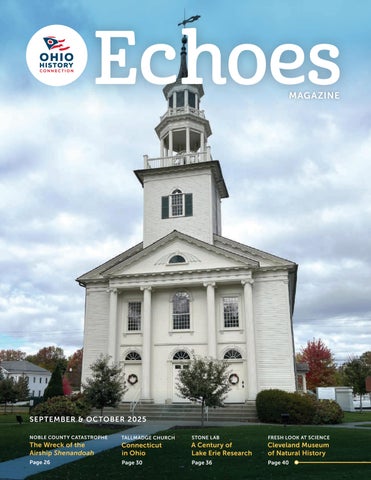
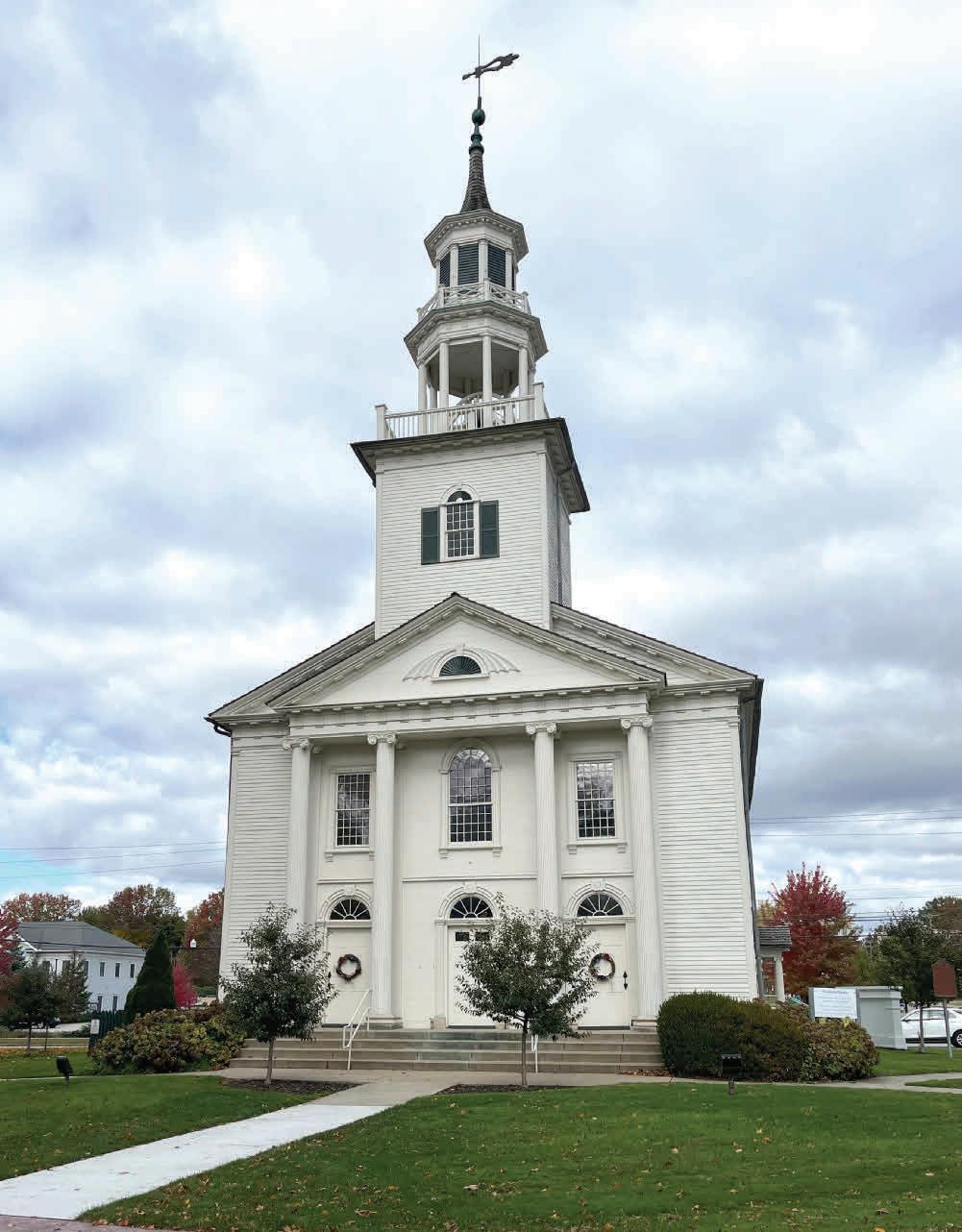
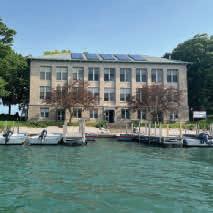
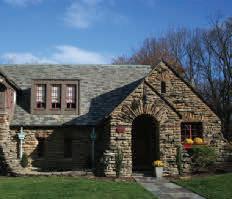
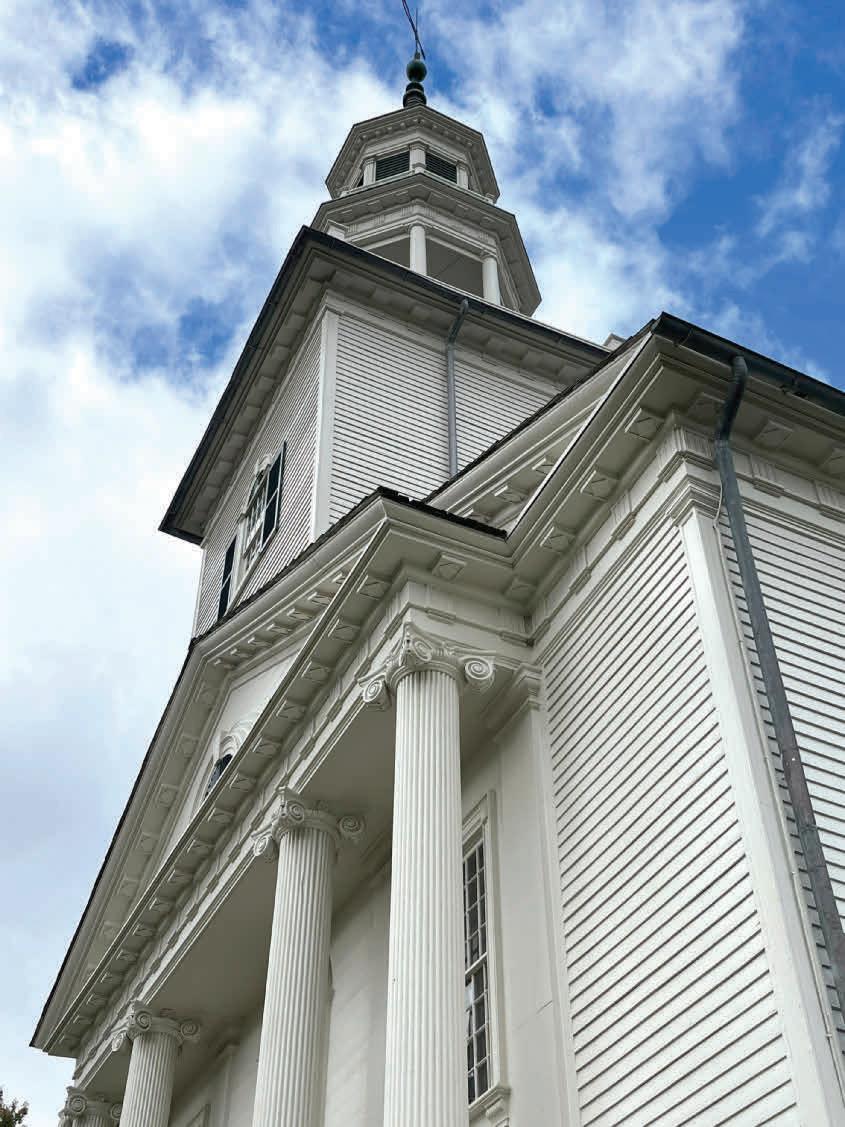
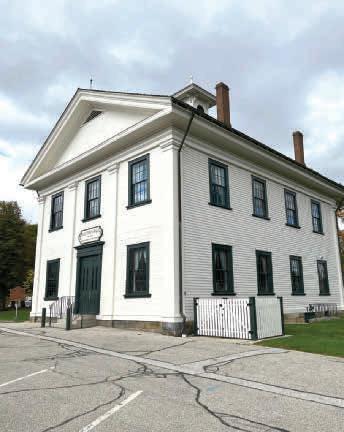
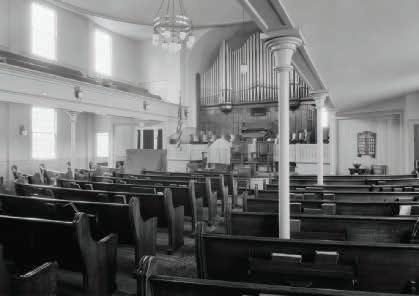
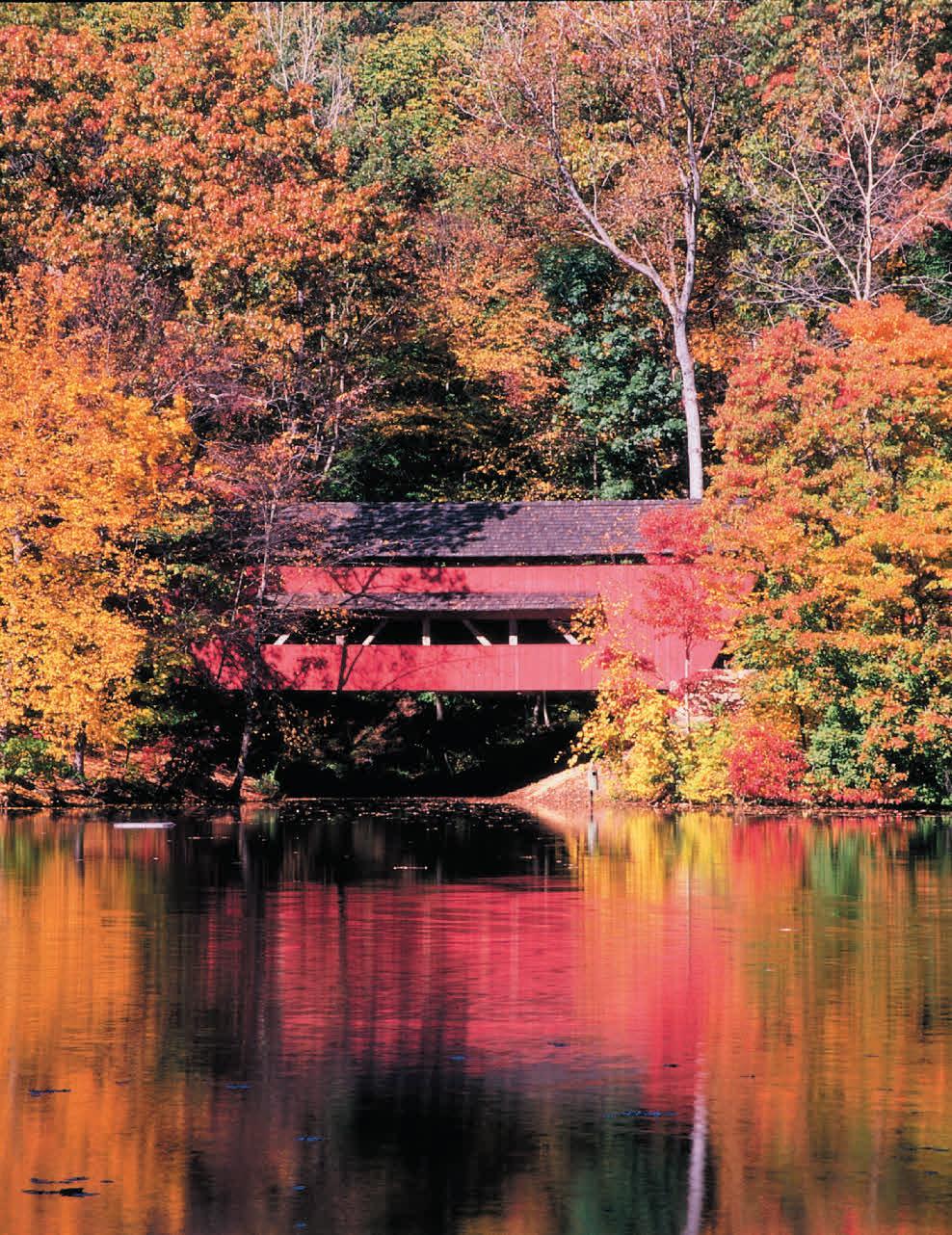
Cover: Summit County’s landmark Tallmadge Church was completed 200 years ago by Connecticut-born architect and master builder Col. Lemuel Porter. See page 30.
Photo by Tom Wolf
Vol. 64, No. 5
CHIEF MARKETING OFFICER
Jerry Dannemiller
EDITORS
Bill Eichenberger
Tom Wolf
CONTRIBUTORS
Brielle Coleman
Becky Dawidziak
Omar Elbadawy
Randy Edwards
Gabe Klecker
Bill Livingston
Greg Sanders
Robin Yocum
DESIGN
Lydia Stutzman | Lydiary Design
ADVISORY BOARD
Donna DeBlasio
Youngstown State University
Jamie Evans
The Filson Historical Society
Stephen George Ohio History Connection
Shirley Green University of Toledo
Alex Hastie
Ohio v. the World
George Ironstrack
Miami University
Katherine Jellison
Ohio University
Daniel Rivers
The Ohio State University
Truda Shinker
Ohio History Connection
George Vourlojianis
John Carroll University
Echoes Magazine (ISSN 0012-933X ) is published bimonthly and distributed by the Ohio History Connection as a benefit of Ohio History Connection membership.
Editorial Offices: Ohio History Connection, Ohio History Center, 800 E. 17th Ave., Columbus, OH 43211-2474
Phone 844.836.0012
Email echoes@ohiohistory. org
Postmaster: Please send address changes to: Echoes Magazine, Ohio History Connection, Ohio History Center, 800 E. 17th Ave., Columbus, OH 43211-2474 Entire
A Tragic Collapse— The Wreck of the Airship USS Shenandoah
A Landmark of the Western Reserve— Tallmadge Church Celebrates 200 Years
A Century of Freshwater Biology Research— The Ohio State University’s Stone Lab Turns 100
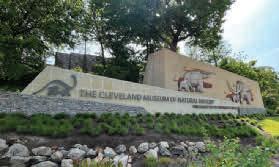
Natural Wonders—The Cleveland Museum of Natural History Goes Immersive
IN EACH ISSUE
Contents From Our Editors What’s Your Story? In the News
From Our Director Historic Sites & Museums At the Ohio History Center
Online Events
Featured Events & Exhibits I Wish I’d Been There Young Eyes on the Past
A Tragic Collapse
THE WRECK OF THE AIRSHIP USS SHENANDOAH
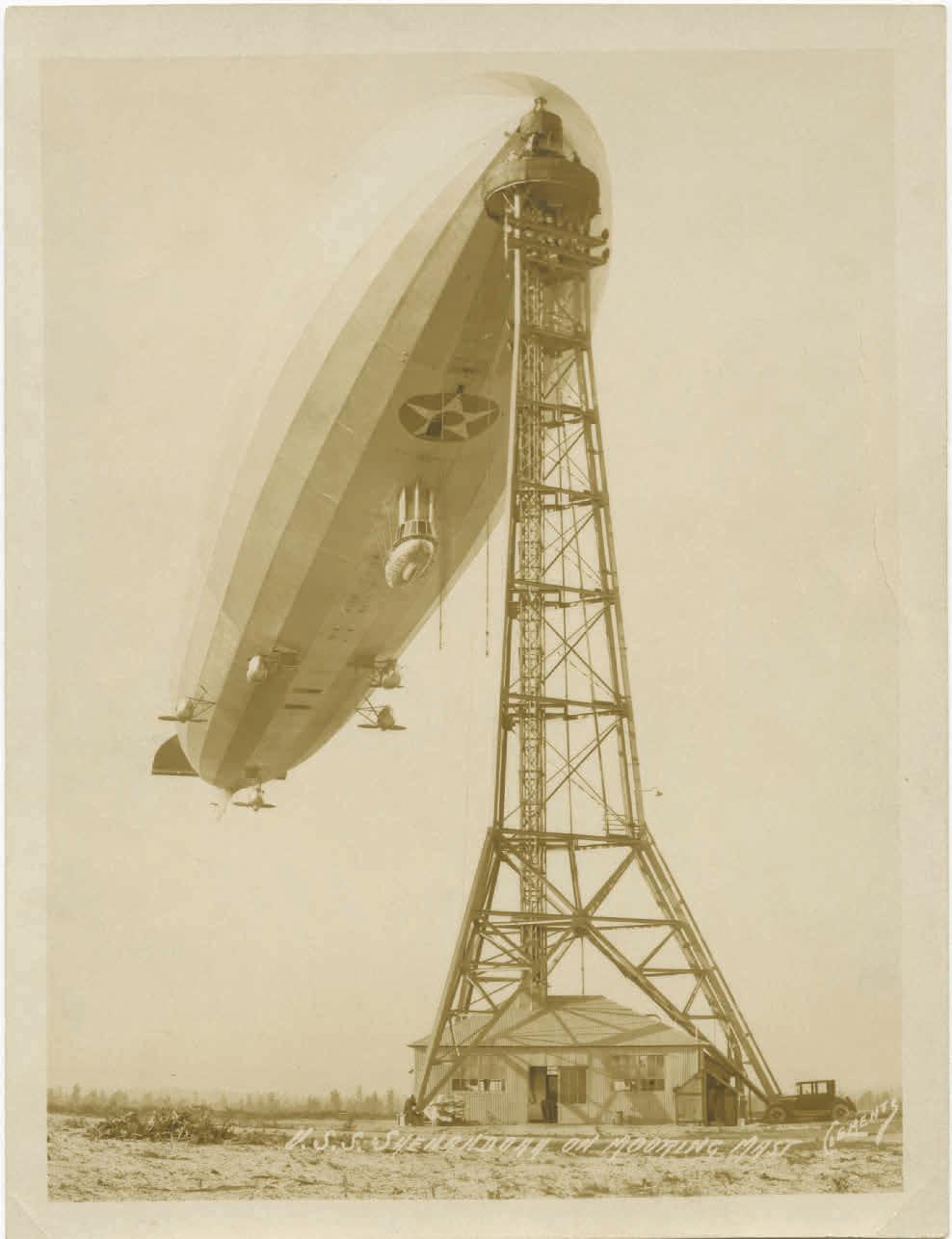
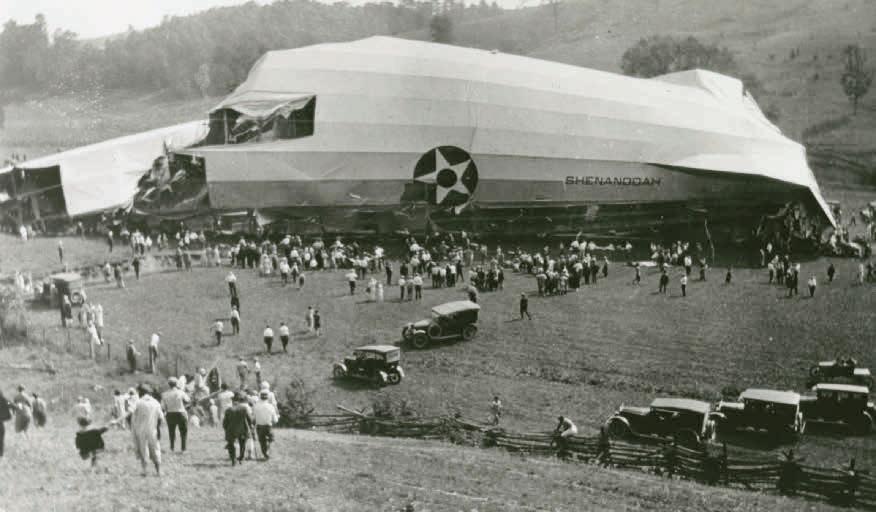
In September 1925, the USS Shenandoah —the first lighterthan-air rigid airship engineered and constructed in the United States and the pride of the U.S. Navy air program—fell from the sky into the hills of Noble County. The crash of the massive airship was the Roaring Twenties’ equivalent of the Space Shuttle Challenger and Columbia disasters.
A Landmark of the Western Reserve
TALLMADGE CHURCH CELEBRATES 200 YEARS
A reminder of northeast Ohio’s New England heritage, Tallmadge Church stands on Tallmadge Circle, a green at the center of Tallmadge. From Tallmadge Circle, roads led to and from the four sides and four corners of Tallmadge Township, a plan conceived by Rev. David Bacon, who arrived from Connecticut in 1804 with dreams of a Congregationalist utopia.
A Century of Freshwater Biology Research
THE OHIO STATE UNIVERSITY’S STONE LAB TURNS 100
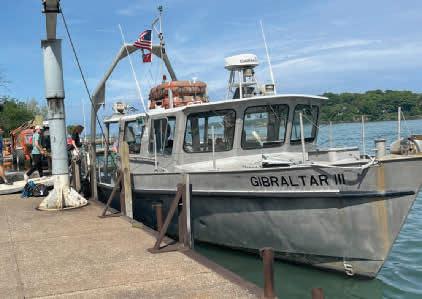
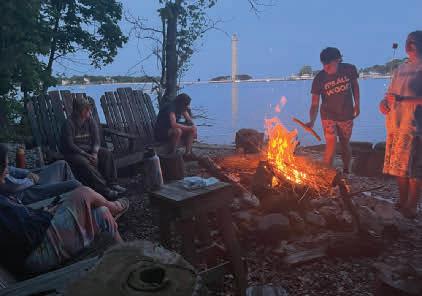
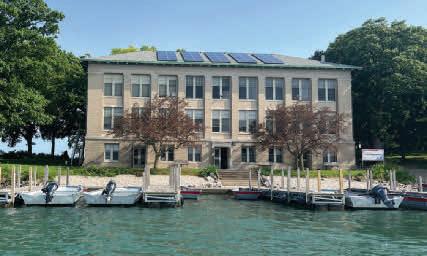
Stone Lab has been the epicenter of Lake Erie-related research and education since 1925. Drawing leading scientists from throughout the region, it has proved to be a perfect location for observing the changeable ecology of the lake.
Natural Wonders
THE CLEVELAND MUSEUM OF NATURAL HISTORY GOES IMMERSIVE
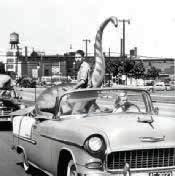
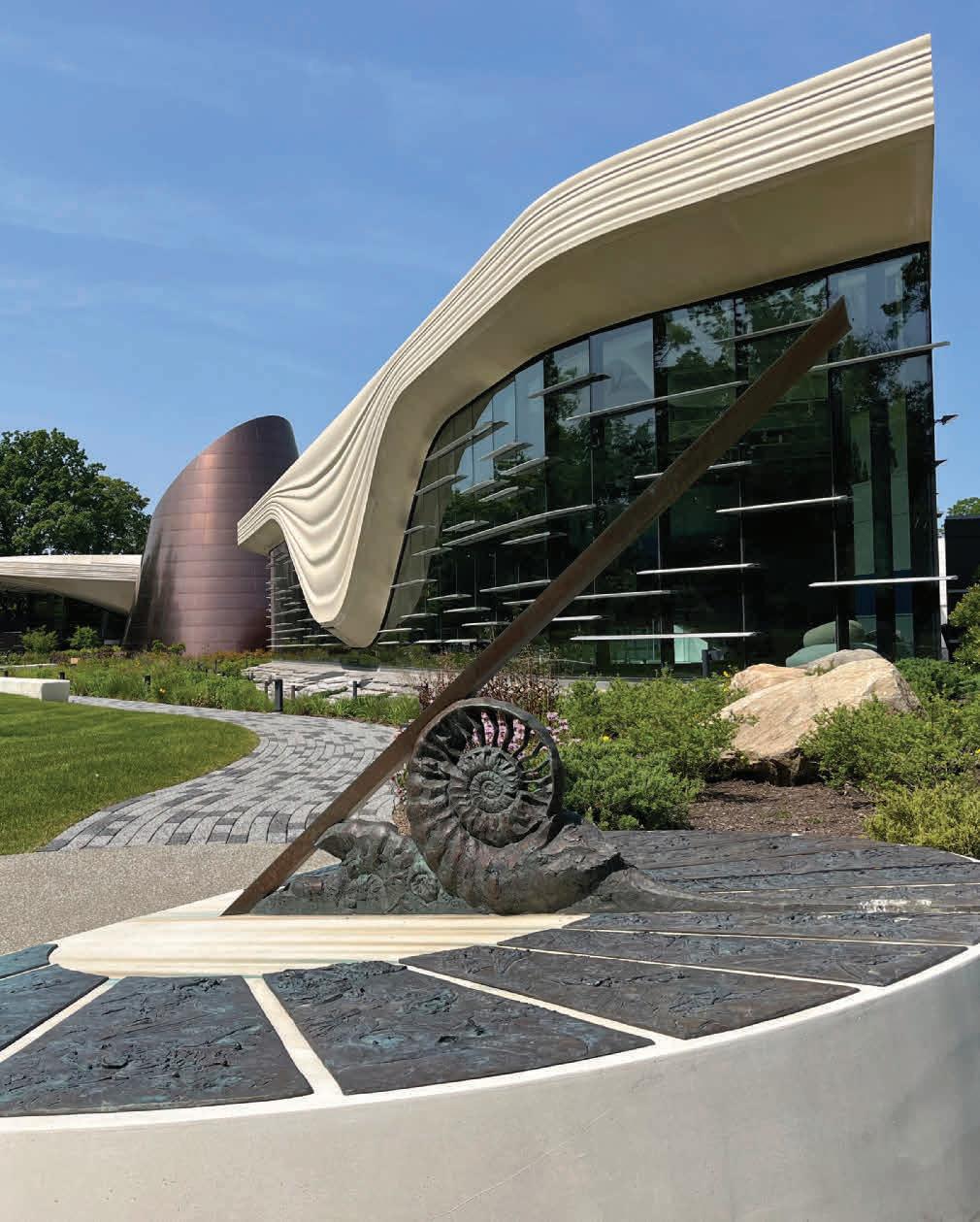
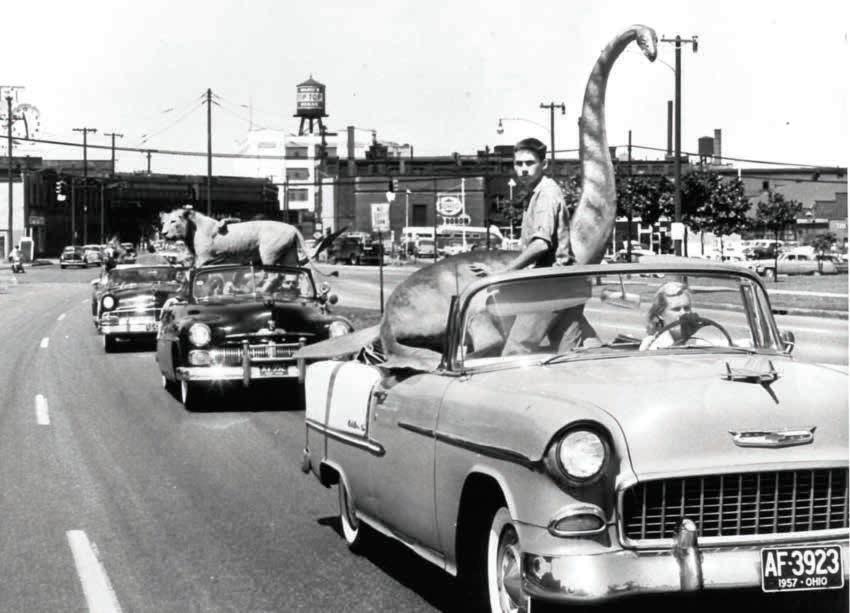
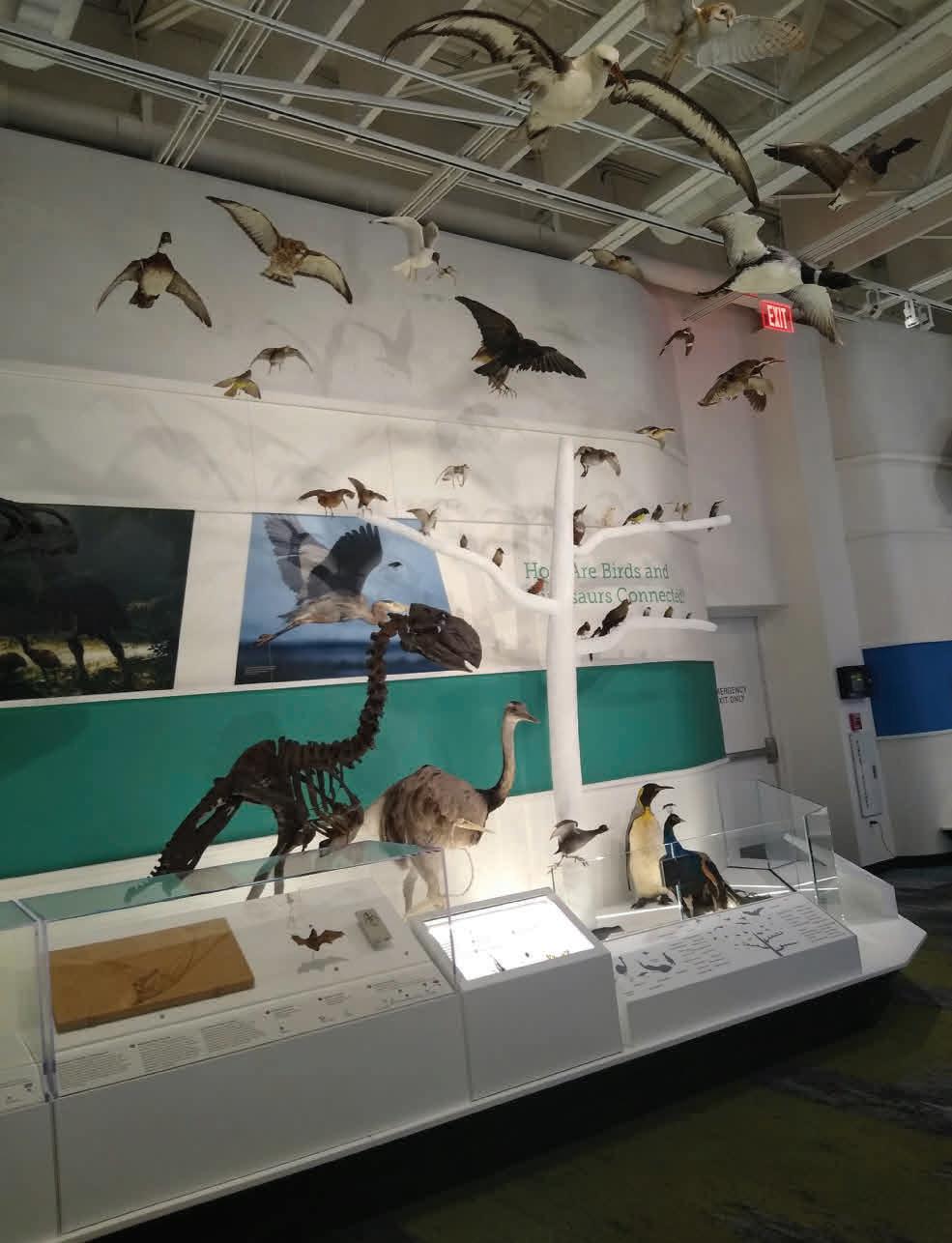
The Cleveland Museum of Natural History recently underwent the largest renovation in its history, a $150 million makeover with a new museum model in mind. Instead of a dinosaur hall or rock room, exhibits are arranged in a manner that explores and explains how all science fits together.
FROM OUR EDITORS
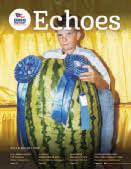
On the cover of our July & August issue, we ran a photograph of a proud young man posing with a massive watermelon—in fact, the champion watermelon at the 1991 Ohio State Fair.
We found the photograph at the Ohio Memory website (ohiomemory.org) but were unable to unearth any information about the young man or his prize-winning watermelon.
That’s when one of our readers, Stan Purdy, stepped in. He emailed us a short note that explained, “The winner pictured (on your cover) is Whey Meranda, who grew up on a grain and livestock farm near Georgetown, Ohio, in Brown County with his parents, Art and Bonnie Meranda, and his four brothers, Tad, Seth, Craig and Brent.
“Whey was 11 years old at the time and won the Grand Champion ribbon for his watermelon. A Columbus restaurant bought his watermelon at the (state fair) auction for $3,100.” What an exciting note!
Purdy continues, “Whey and his brothers were all active in 4-H, starting at age 9, and grew prize pumpkin, watermelon and cantaloupe. His older brother, Seth, in 1986, won three championship ribbons at the 1986 Ohio State Fair for his melons.
“Shortly after the fair, Seth was contacted by Late Night with David Letterman inviting him to appear on the television program. Seth appeared on Aug. 20, 1986, and was a great guest. He used his prize money from his championship melons to buy a four-wheeler and, although he was a responsible operator, he had an accident that landed him in Children’s Hospital in Cincinnati.
“Somehow, Letterman heard of Seth’s accident and called him during the show and wished him well and asked if he could do anything for him. Seth responded that he liked John Wayne movies. In no time, Seth received videos of True Grit, McLintock! and The Cowboys.”
Another attentive reader, Ron Meyer of Fresno, Ohio, emailed us with a question we hope never to receive because it means we’ve made a mistake.
On page 38 in our July & August feature about the Archaic Period, we ran a painting of Indigenous people spearing beaver.
Meyer correctly pointed out that “the people in the illustration have more modern accoutrements—powder horns, a hatchet with what appears to be a metal blade, and a spear which seems to have a metallic point.”
Brad Lepper, senior archaeologist for the Ohio History Connection’s World Heritage program and the story’s author (who had nothing to do with the illustration), was also quick to point out our error. He says, “The image is of Indigenous people of the Contact Period. It was painted from life in the early 1800s. (It) has nothing to do with the Archaic Period other than the fact that the men in the painting had distant ancestors who lived during that period.”
The painting, from the Wisconsin Historical Society, is attributed to Peter Rindisbacher (1806–1834), who documented Indian and frontier life in the American and Canadian West.
Hard as we try, errors do sometimes occur.
What ’s “
In every issue of Echoes Magazine, we feature the stories of Ohio History Connection members and other Ohioans to stoke memories and shed light on our shared past.
For this issue, we asked, Tell us about your city’s ethnic neighborhoods.”
Here are some of your responses:
CLEVELAND
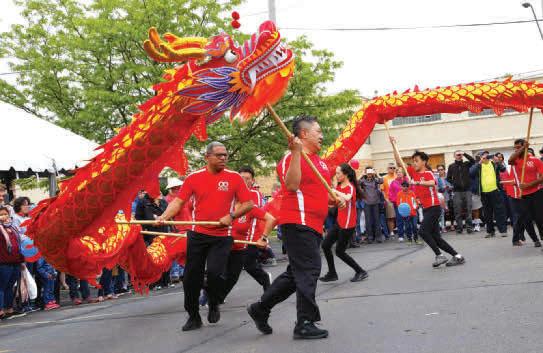
AsiaTown in Cleveland started forming in the 1860s, when Chinese railroad workers settled in the area. It was called Chinatown for decades and really hit its stride from the 1930s to the 1960s. As Korean and Vietnamese communities grew, so did the neighborhood’s flavor—literally and culturally. With all the new influences, the name shifted to AsiaTown to reflect the mix. What makes AsiaTown awesome is that it still feels real. No fancy chains and few shiny new buildings—just cozy, family-run spots with handwritten signs taped on the door and food that’s seriously good, authentic, flavorful and not watereddown for tourists. You’ll find herbalist shops, salons, shops packed with Asian goodies and grocery stores that feel like treasure hunts. And the vibes? So good. The Cleveland Asian Festival in spring and Lunar New Year celebrations bring the whole area to life. AsiaTown sits just east of downtown, between I-90 and East 55th, stretching from Perkins to St. Clair, with the historic Chinatown and its unique architecture on Rockwell Avenue.
—Amy Crawford, South Euclid
Your Story?
NEIGHBORHOODS
TOLEDO
Toledo’s North End, notably “The Point,” from Lewis, Sylvania and Phillips near Haverhill, to streets named with high numbers moving north and east toward Maumee Bay, is traditionally known as a Polish neighborhood. Besides festivals and a large number of Polish-named students graduating from Woodward High School, the North End has been known for decades as the neighborhood that wins the annual Toledo contest for the bestcared-for home sites. This is not because they have particularly wealthy inhabitants—not at all—but because they are always simply well cared for. In Detroit, Hamtramck was in earlier years known as “Poletown,” but today with migrations to Troy and other cities, it is more diverse, and Troy is more known for its Polish ancestry. In Cleveland, common belief was, especially in the days of Ghoulardi on television in the 1960s, Parma was a Polish neighborhood, though more accurately it was Ukrainian.
—David Keck, Howard
BEREA
Many nationality groups migrated to Berea to work in the sandstone quarries in the mid-1800s. One group clustered in the north end of town and established St. Adalbert Parish, the first Polish nationality Roman Catholic church in Ohio, in 1873. In the past, this 10-block community thrived, with a meat market, corner grocery store and the Polish Village Tavern along Berea Street, which runs north-south through the neighborhood. I’m an 83-year parishioner of St. Adalbert Church and a Polish Village Tavern patron. I bought penny candy at Golinski’s corner grocery store while walking home from St. Adalbert Parish School in the ‘50s. And my folks bought meat at Wilchek’s meat market.
Only the tavern remains, and townspeople know that Polish sausage and pierogies will always be on the menu there. In recent years, the city recognized this area with special street signs designating these neighborhood streets as “Polish Village Historic District” thoroughfares. Indeed, the Poles have left their mark in Berea.
—Dennis Kushlak, Berea
WHAT’S YOUR STORY?
We want to know your stories, so in every issue of Echoes Magazine we ask you a question, then run selected answers in the following issue. Here’s the question for November & December:
This November marks the 75th anniversary of Ohio State’s storied “Snow Bowl,” a 9–3 loss to Michigan played in 10-degree weather with winds gusting up to 28 miles per hour. Snow fell at a rate of two inches per hour. What’s the most memorable sporting event you’ve ever attended in Ohio? Your answer can be, but doesn’t have to be, weather-related. It could be a memorable upset. A crazy play to decide a game. A lopsided defeat. High school. College. Professional. Have at it!
Email your story responses (50 to 150 words) by Sept. 15 to echoes@ohiohistory.org or, if you follow us on Facebook, send us a Facebook message.
You must show your digital or physical membership card at Ohio History Connection museums and attractions to enjoy free admission.
Misplaced your card? Email membership@ohiohistory.org or call 800.686.1545.
Traditional Chinese dragon dance during Cleveland’s Asian Festival.
DOWNTOWN CLEVELAND
In the News
HISTORIC PRESERVATION
Gov. DeWine Announces State Support for 39 Historic Preservation Projects
In June, Gov. Mike DeWine and other state officials announced the award of more than $66 million in tax credits to support the preservation and revitalization of 47 historic buildings in 13 communities across the Buckeye State.
The awards are a part of the Ohio Historic Preservation Tax Credit program, which encourages private investment in preserving and rehabilitating incomeproducing historic structures by providing financial incentives for their redevelopment. The program is administered by the Ohio Department of Development in partnership with the Ohio History Connection’s State Historic
Preservation Office.
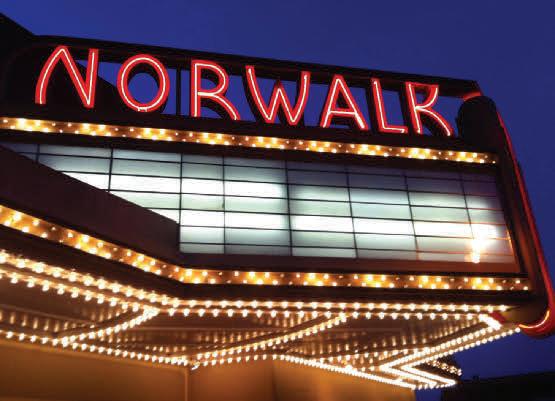
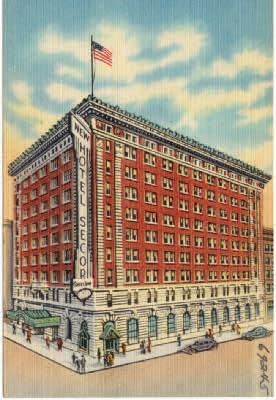
The 39 projects are in Akron, Canton, Cincinnati, Cleveland, Dayton, Logan, Toledo, Urbana and Warren, plus four communities new to the program this round: Massillon, Marysville, Norwalk and Trotwood.
“As Ohio’s cities and neighborhoods continue to grow and modernize, it’s essential that we honor and preserve the legacy that already exists,” says Gov. DeWine. “These buildings are more than brick and mortar—they reflect the history of our communities and the generations of the past. Thanks to these tax credits, these buildings will contribute to Ohio’s future as well.”
$518 MILLION IN PRIVATE INVESTMENTS
In total, 39 projects will be awarded $66,145,922 in tax credits to preserve 47 buildings. The
projects are expected to leverage approximately $518 million in private investments.
“Many of the structures that will be renovated through this program are currently vacant and underused, but they all hold so much potential,” says Lt. Gov. Jim Tressel. “As these buildings are turned into homes, businesses, offices and manufacturing facilities, these sites will most certainly spark additional investment and revitalization in the surrounding areas.”
“Historic buildings tell Ohio’s story— with these tax credits we’re writing the next chapter,” says Lydia Mihalik, director of the Ohio Department of Development. “Through the Ohio Historic Preservation Tax Credit Program, we’re preserving what makes Ohio’s communities unique while supporting modern needs like housing, small business and the arts.”
The Ohio History Connection’s State Historic Preservation Office determines whether a building qualifies as historic and that the rehabilitation plans comply with the United States Secretary of the Interior’s Standards for Rehabilitation, a set of standards for
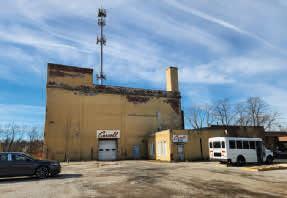
Norwalk’s 1941 Norwalk Theatre will be rehabbed, to reopen as a 600-seat arts and performance venue.
Toledo’s 1908 Hotel Secor will become 112 market-rate apartments.
best practice in historic preservation used nationwide to foster work that’s sympathetic to historic properties. Developers are only issued the tax credit once project construction is complete and all program requirements have been verified as having been met.
PROGRAM CREATED IN 2007
This is the 34th round of state historic preservation tax credits awarded since the Ohio Historic Preservation Tax Credit program was created in 2007. Since its inception, the program has stimulated more than $10.9 billion in private investment in preserving and rehabilitating historic properties across the Buckeye State, most listed in the National Register of Historic Places.
“The rehabilitation of historic buildings through the Ohio Historic Preservation Tax Credit Program and related federal historic tax credit program can revitalize Main Streets, help the environment—because nothing is greener than using what’s already built—and create jobs, with the added bonus of preserving local history,” says Deputy State Historic Preservation Officer Mariangela Pfister, who heads the Technical Preservation Services department of the Ohio History Connection’s State Historic Preservation Office.
Find a list of all 39 projects recently awarded state tax credits at ohiohistory.org/round34. Learn more about state and federal tax credits for the preservation and rehabilitation of income-producing historic properties in Ohio at ohiohistory.org/taxincentives
Prefer a physical membership card? Please check the box when you renew, as we no longer send them out automatically, though we’re happy to provide them on request.
FROM OUR DIRECTOR
Are you ready for 2026?
It’s hard to believe, but it’s just around the corner.
If you’re like me, you’ve been spending a good deal of time, energy and creativity planning for the 250th anniversary of our country, or America 250. On July 4 next year, the United States will celebrate 250 years since the signing of the Declaration of Independence.
In Ohio, we’ll spend the entire year reflecting on the contributions of Ohio and Ohioans over the last 250-plus years. I have the honor of serving on the America 250-Ohio Commission, led by our friend Todd Kleismit, former Ohio History Connection director of community and government relations, and I’m leading the Homecoming Picnic initiative.
WHAT DOES ALL THIS MEAN?
It means a lot of extra history and community content is going to be happening at organizations and venues all over Ohio. Each month there’s a theme that will feature Ohio history content and events.
Starting in February, there will be a statewide film festival, Ohio Goes to the Movies, with film screenings across the state. Each film will have a tie to Ohio, and if you visit ohiogoestothemovies. org, the Ohio Goes to the Movies website, you can find the Ohio Movie Database with an impressive list of Ohio actors, movies, directors and more.
For the past two years, localities have signed up as America 250Ohio communities and are planning their own events and projects, including hosting Homecoming Picnics around the state. There is a series of curated trails around several themes that can help you explore our state’s stories. There will be a Buckeye Train ride out of Dennison and Columbus, including a car and air show.
WHAT ELSE?
This commemoration will certainly include parades, fireworks and, of course, picnics, but it also will include opportunities to see, learn, explore and connect. Make sure to check out the murals project; the fourth-grade history pass if you have a current or upcoming fourthgrader; the marking and mapping of Revolutionary War veterans’ graves; tree plantings in every county; and much more.
With the support of the State of Ohio and private partners in philanthropy, all this programming will be available to you throughout 2026. The goal is to bring people together around our shared and diverse histories. While Ohio is 223 years old next year and our country is 250, we’ll also explore the longer history of this place and learn about what connects us.
To stay up to date, visit america250-ohio.org or follow America250-Ohio on social media.
Megan Wood | Executive Director & CEO, Ohio History Connection
COLLECTIONS
Miriam F. Wood Covered Bridges Collection Now Open for Research
by David A. Simmons
Throughout the 19th century, covered bridges existed largely on a practical level. Designed and erected as utilitarian structures in a larger highway system, they had none of the romanticized imagery that today has become associated with them. But even with the passage of time, they exist on multiple levels, dependent on the perspective of the viewer. A civil engineer will immediately default to technical data, intent on assessing the viability of a bridge, while the hobbyist will find significant personal gratification in a bridge’s symbolic associations.
Twentieth-century Ohio was blessed by being home to two individuals who spent a lifetime cataloging the deeper meaning of the state’s covered bridges: John Diehl and Miriam Wood. Both brought their own individual perspectives to the effort. Diehl had an engineering degree from the University of Cincinnati and systematically gathered exhaustive information on each known bridge, while Wood took advantage of her Capital University history training
to develop an archival research approach to the topic.
NOW AVAILABLE
The Ohio History Connection Archives & Library is fortunate to house the collections on covered bridges assembled by both individuals (Diehl’s is MSS 1615 AV), and, after more than 130 hours of archival processing, Miriam Wood’s extensive collection, identified as MSS 8799 AV, is now available to the public.
Miriam F. Wood was born in Vinton County in 1929 and credited childhood trips through rural Ohio with sparking her lifelong interest in covered bridges. A longtime resident of Columbus, she began formally researching covered bridges in 1953 and eventually became nationally known as the authority on Ohio’s spans. She authored two major volumes on Ohio covered bridges: The Covered Bridges of Ohio: An Atlas and History (1993) and Covered Bridges: Ohio, Kentucky, West Virginia (2007), the latter co-authored with me. In addition, she was a founding member of the Southern Ohio Covered Bridge Association (now the Ohio Historic Bridge Association) and edited its newsletter, Bridges & Byways, for six decades, producing innumerable articles and countless newspaper articles.
In Ohio, county government— specifically the commissioners along with the surveyor or engineer—have historically determined the design, construction and maintenance of covered bridges. Consequently, Ohio’s 88 counties provide the overall organizing principle for large portions of the collection.
RESEARCH, PHOTOS AND PAPERS
The collection’s 13 boxes are divided into three series: research files, photographs and professional papers. The research files include Wood’s extensive notes made while
poring over county commissioners’ journals in hopes of documenting every covered bridge ever built in the state, surely among the collection’s major historical contributions. Photograph materials include those of Depression-era photographer Clark L. Tenney and of Anita Knight, a gifted amateur photographer and another founding member of the Southern Ohio Covered Bridge Association. Wood’s professional papers embrace her correspondence with leading covered bridge experts, most notably John Diehl himself and Seth Schlotterbeck Sr., a one-time bridge supervisor in Preble County.
Taken with the Diehl collection, Miriam Wood’s newly opened collection will provide future researchers with unparalleled opportunities to explore Ohio’s rich covered bridge history.
You can explore the collection in person in the third-floor Archives & Library Research Room at the Ohio History Center in Columbus.
—David A. Simmons is a historian and an expert on historic bridges of all types. A volunteer in the Ohio History Connection’s Archives & Library, he is retired from the Ohio History Connection, where he worked first in the State Historic Preservation Office and later on the staff of, and as editor of, Timeline magazine.
Questions about your membership? Need to update your address? We’re happy to help!
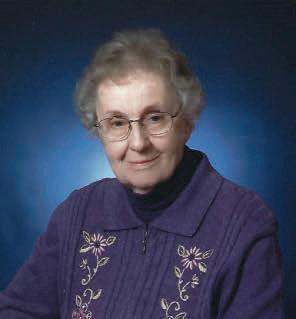
Miriam F. Wood, 1929–2021
COURTESY HOWARD WOOD
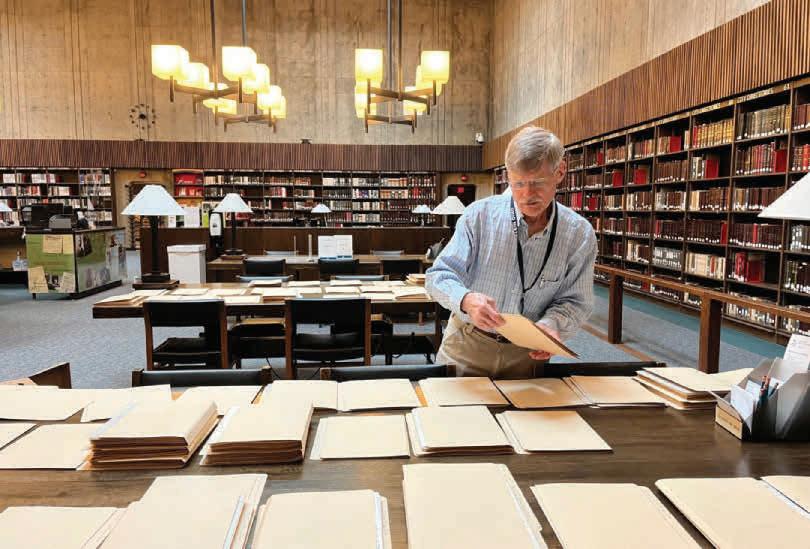
Author David A. Simmons with the Miriam F. Wood Covered Bridges Collection in the Archives & Library Research Room at the Ohio History Center in Columbus.
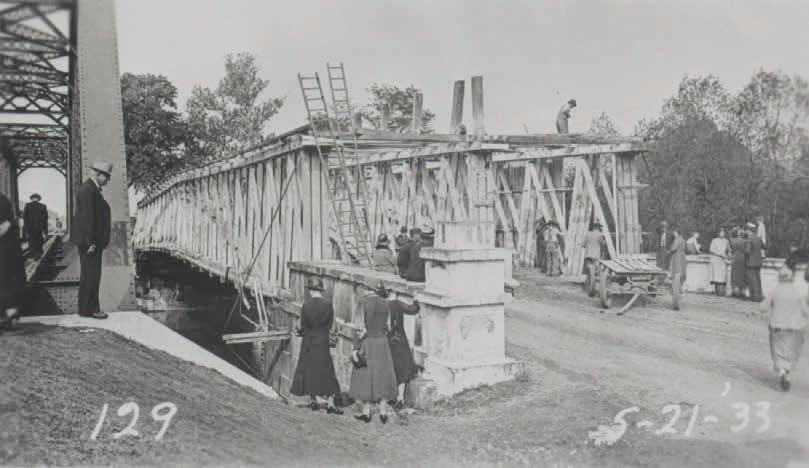
This Miriam F. Wood Covered Bridges Collection photograph by Clark Tenney captures the Seymour Covered Bridge in Ross County as the double-barreled bridge was being demolished in 1933.
HISTORIC PRESERVATION
Recent Ohio Additions to the National Register of Historic Places
AKRON • SUMMIT COUNTY
HOMEIER-UNIVERSAL MOTOR COMPANY BUILDING
816 E. Market St.
This three-story fireproof automotive warehouse, sales and service building of the 1920s also has a one-story retail auto sales building. The largest of three historic Ford dealership buildings remaining in Akron, it is associated with the history of automobilerelated commerce in the city and with Akron’s role in the national automotive industry and tire manufacturing, as home of B.F. Goodrich Co., General Tire and Rubber Co., Firestone Tire and Rubber Co., Goodyear Tire and Rubber Co., Mohawk Rubber Co. and Seiberling Rubber Co. Completed in 1920, the building was initially advertised as a mechanized garage for automobile storage. By 1925, it was jointly occupied by Cranmer-Perrine Furniture Co. and Homeier Whorley Motor Co. Later it was wholly occupied by Homeier’s successor, Homeier-Universal Motor Co., a prominent local Ford dealership. Located on Akron’s east side near Goodyear Tire headquarters, it served as the anchor for HomeierUniversal’s larger network of sales and service centers throughout the city until 1935.
CINCINNATI • HAMILTON COUNTY
CINCINNATI HEBREW DAY SCHOOL
7855 Dawn Rd.
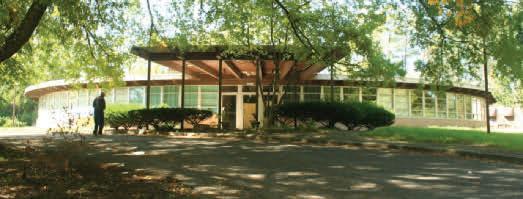
The 1964 Cincinnati Hebrew Day School building is a locally significant example of mid-20th-century modernism. Designed by Cincinnati architect Benjamin Dombar, it reflects the organic architecture promoted by his mentor, Frank Lloyd Wright. Dombar and his older brother, Abrom, also an architect, were disciples of Wright and lived and worked at Wright’s Taliesin in Wisconsin, as well as at Taliesin West in Arizona during the 1930s and 1940s. Like several of Wright’s educational buildings, the one-story school is circular in plan, with a brick foundation wall surmounted by a band of aluminum windows. Classrooms are on the perimeter of the circle. They open onto a corridor that rings a round multipurpose room 60 feet in diameter at the center of the building. Planned for use as a dining room, gymnasium, auditorium and worship space, it is capped by a dome.
CINCINNATI • HAMILTON COUNTY
JOSEPH G. STEINKAMP HOUSE
916 Suire Ave.
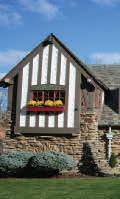
Cincinnati architect Joseph G. Steinkamp (1868–1948) designed this 1928 English Tudor-style house as his home. The interior features terrazzo floors, cathedral ceilings with hand-stenciled beams, mahogany paneling, wrought iron and brass chandeliers and wall sconces, and tile from Cincinnati’s famed Rookwood Pottery. According to his 1948 obituary,
Steinkamp and his younger brother, Bernard—in business for almost 50 years—were involved in the design of St. William Church in Price Hill, the Mercantile Library and American Building downtown and all of Xavier University’s buildings to that date except the student union (both brothers attended Xavier in the 1880s). Additionally, they designed several large apartment buildings for Cincinnati developer Thomas J. Emery’s sons, influencing the character of Walnut Hills, Clifton, Avondale and other neighborhoods. As a member of Cincinnati’s Building Code Commission, Joseph Steinkamp was involved in creating the city’s building code.
COLUMBUS • FRANKLIN COUNTY
MOUNT VERNON AVENUE
HISTORIC DISTRICT
Roughly bounded by Mount Vernon Ave., Monroe Ave., Atcheson St. and 22nd St.
About two miles east of downtown Columbus on both sides of Mount Vernon Avenue, this historic district is significant for its association with the capital city’s African American heritage from the 1880s to 1980s. The 61 commercial and residential buildings that make up the district served as a center for the Bronzeville neighborhood, offering retail businesses, restaurants, professional services, entertainment, culture and autonomy in a larger city that could, at times, be unwelcoming. The buildings date from as early as 1888, when the Hildreth Block at 366 N. 20th, later known as the Macon Hotel, was constructed, and as late as the 1970s to early 1980s, when the Mount Vernon Plaza Urban
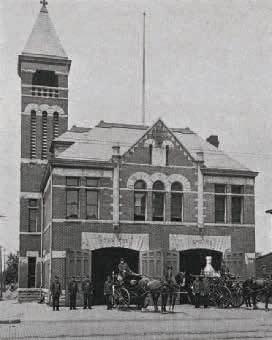
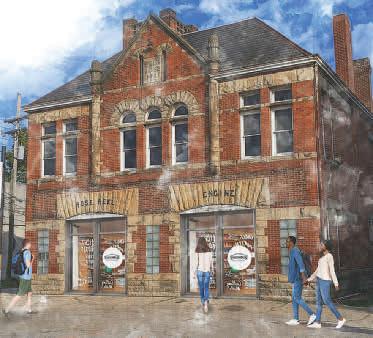
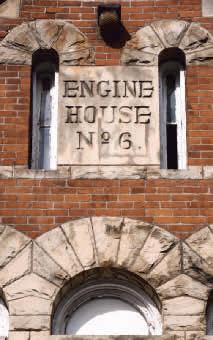
Renewal project was completed, and 1983, when a supermarket addition to the 1888 Engine House #8 opened as the home of Singletary PlazaMart.
WARREN • TRUMBULL COUNTY
EAST MARKET STREET SCHOOL
585 E. Market St.
Built in 1899, this two-story Colonial Revival-style school designed by Cleveland architect George F. Hammond (1855–1938) is little changed, with period hanging light fixtures and a handsome Colonial Revivalstyle staircase and woodwork. Before building it, Warren’s Board of Education held an election for two seats on the school board. Carrie Harrington and Harriet Taylor Upton won, the first time that women had been elected to Warren’s school board. Both became part of the building committee. Upton, also a nationally prominent suffragist, said that it was the first time a woman—let alone two—had ever been involved in such a large construction project locally. When it opened, two classrooms were devoted to mentally and physically disabled students, equipped similarly to those at state institutions of the time. The program continued until 1960, when the school became Market High, offering an individualized approach to education, with work-study programs and special training. Recognized as the only school of its kind in Ohio, Market High drew national attention and operated there until 1972.
CONESTOGA
$60,000 Gift Benefits Tribal Youth Internships
Conestoga, a fundraising support group for the Ohio History Connection, has presented a $60,000 check to the Ohio History Connection to support creation of a Tribal youth internship program at Newark Earthworks and Fort Ancient Earthworks & Nature Preserve. The two Ohio History Connection sites are part of the Hopewell Ceremonial Earthworks, Ohio’s first UNESCO World Heritage Site.
COLLABORATION WITH TRIBAL PARTNERS
The initiative will enable college-age Native Americans to participate in a paid summer internship program at the two sites. Conestoga’s gift will support gatherings with Tribal leaders and evaluation of student housing needs and other preparatory work so that everything is in place for a successful launch of the internship program, anticipated within two years. The program will be in collaboration with some of the Ohio History Connection’s more than 40 Native American Tribal Partners.
The $60,000 gift was made possible through the support of Conestoga members and other supporters of Ohio’s first UNESCO World Heritage Site. Including this year’s gift, Conestoga has made gifts totaling $162,000 to support the Hopewell Ceremonial Earthworks.
Laura Ecklar of the Conestoga Fund-Raising Committee says, “This gift is almost entirely a reflection of donations from individuals— Conestoga members and friends who are committed to supporting the Ohio History Connection’s initiatives. This year, we were honored to receive a gift of $2,500 from the Wyandotte Nation, as well as $750 from Friendship Village of Dublin. But the remainder of our gift was provided by individuals.”
In addition to Ecklar, members of this year’s Conestoga Fund-Raising Committee included Debbie Duncan, Joanne Figge, Judy Krasnoff, Ann Lowder, Joanne Lynn, Heather Ness, Carolyn Owens, Emily Prieto and Carole Williams.
$969,000 SINCE 1986
Since its founding in 1986, Conestoga has made annual gifts to the Ohio History Connection totaling more than $969,000.
While Conestoga’s primary mission is to raise private-sector funds for Ohio History Connection programs, Conestoga also provides a variety of opportunities for its more than 170 members to attend programs, visit historical sites and socialize with friends of Ohio history.
A Conestoga membership ($100/ single or $150/duo) includes a one-year Plus-level Ohio History Connection membership as well as benefits at more than 1,400 museums and attractions through the North American Reciprocal Museum program. (Visit narmassociation.org , for a complete listing.)
Learn more at ohiohistory.org/ conestoga.
Museum of Ceramics
Join me as I visit the sites in the Ohio History Connection network! This month’s trip took me to the Museum of Ceramics in East Liverpool.
From 1840 to 1930, East Liverpool was known as “America’s Crockery City” and produced more than half of the ceramics manufactured in the United States. At the turn of the 20th century, East Liverpool’s ceramics industry was as important to the city’s economy as the steel industry was to Pittsburgh’s.
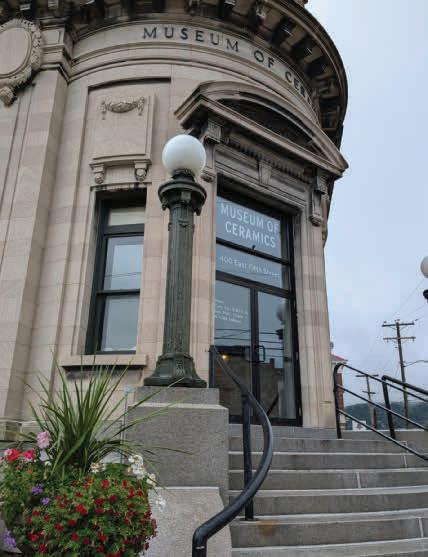
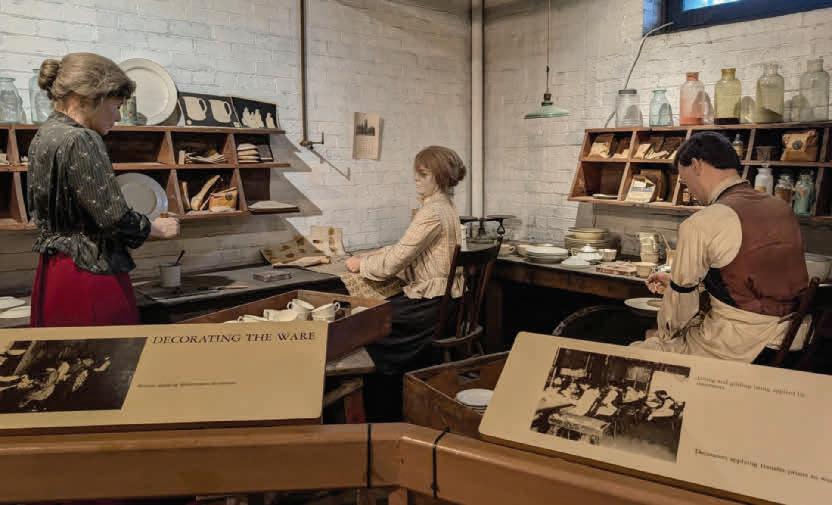
The Museum of Ceramics explores this history through an extensive collection of ceramic wares, photographs, paintings by Roland Schweinsburg and a series of lifesize dioramas that depict pottery production. The museum houses a library and archives and offers art and clay classes. The museum building is also part of East Liverpool’s history— it was formerly the city’s post office, built in the Beaux Arts style in 1909.
Address: The Museum of Ceramics is at 400 E. Fifth St. in East Liverpool. How much time: I’d budget about 90 minutes to explore the museum.
Truda’s Tips: I have a few logistical tips. There’s free street parking right in front of the museum on East Fifth Street. I’m not great at parallel parking, but even I didn’t have any problems! You can also park in the parking lot (only the side closest to the museum) across the street if street parking isn’t available at the time.
Visitors must climb some steps to get to the main entrance of the museum.
However, there’s an accessible ground floor entrance on the East Fifth Street side of the building. There’s an accessible parking space by this entrance that visitors with disabilities are welcome to use.
The door is locked, so visitors using that entrance need to ring the doorbell. A staff member will come down to let you in. From there, you can use the elevator to reach the first floor of the museum.
For all visitors, the best place to start your visit is with the 12-minute video that gives a great overview of local history and the pottery industry. From there, it’s best to go back to the front desk to start your tour of the exhibits. Go all the way around the outer exhibits and then dive into the inner ring of exhibits. Once you’re done on the first floor, head down to the basement exhibits. And then don’t forget to visit the wonderful gift shop before you leave. It features one-of-akind jewelry, books, mugs and more.
Kid-Friendly? Yes, for elementary school-aged kids and up. There’s a lot to see at the Museum of Ceramics, and it might be overwhelming for small children. But I think elementary school-aged kids would find the exhibits engaging, especially the dioramas in the basement. There are also some really interesting pieces of crockery on display, and it would be fun to make a game of who could find the most unusual item in the exhibits.
Lunch: Every good road trip includes a great lunch! The museum staff has a handy list of restaurants on their website (themuseumofceramics. com/here). I chose the Hot Dog
Shoppe, which is a two-minute drive away. It would be an easy walk from the museum, but it was raining the day I visited. The Hot Dog Shoppe is an East Liverpool staple, and it’s easy to see why. The food was fresh, the service was great and the atmosphere was kitschy and fun. I would definitely go back.
Because I had a long drive back to Columbus, I wanted some caffeine before I left town. Steelnative Coffee, just down the street from the museum, features hand-crafted coffees and home-baked goods. The staff recommended the spiced brown sugar iced latte, which was delicious. The shop is lovely and warm—a great place to take a break after a day of exploring a museum! For more information: To learn more about the Museum of Ceramics, you can visit ohiohistory.org/ceramics or themuseumofceramics.com Be sure to note the days and hours of operation. The Museum of Ceramics is closed in January, February and March.
The East Liverpool Downtown Historic District is listed in the National Register of Historic Places as is the nearby C.C. Thompson House, built in 1876 by a local pottery owner. To make an appointment for a tour, which lasts about an hour, call 330.385.2550, or call or text 330.831.4880 or 724.622.8935.
And, for a look at some still-locallymade ceramic wares, cross the Ohio River to Newell, West Virginia, where Homer Laughlin China Co. still manufactures the popular Fiesta Ware and operates a Fiesta Factory Outlet Store (fiestafactorydirect. com/pages/outlet-stores).
Want to make a day of it?
The Museum of Ceramics is in Columbiana County. Discover everything the area has to offer at visitcolumbianacounty.com
—Truda Shinker is the Ohio History Connection’s department manager for membership.
East Liverpool’s 1909 Post Office, a notable example of Beaux Arts architecture, is now the Museum of Ceramics.
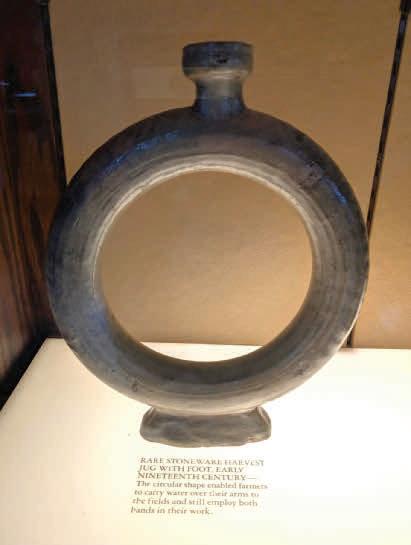
This rare early-19th-century stoneware harvest jug let farmers carry water over their arms to the fields and still employ both hands in their work.
A Museum of Ceramics diorama depicts East Liverpool pottery decorators at work.
LOCAL HISTORY
Ohio, National Groups
Meet in Cincinnati
Sept. 10–13
The Ohio Local History Alliance is partnering with the American Association for State and Local History’s annual conference taking place in Cincinnati Sept. 10–13. The joint conference will take the place of this year’s Ohio Local History Alliance Annual Meeting, typically held in October each year. This year’s four-day conference in the Queen City focuses on the theme The American Experience, and features innovative sessions, workshops, panel discussions, museum tours and networking opportunities for everyone in the history and museum field, from volunteers to executive directors. It includes a track of sessions hosted by the Ohio Local History Alliance, so you’ll find familiar faces from the Buckeye State among those from across the country. You can find the Ohio Local History Alliance sessions in the program for the Cincinnati conference at aaslh.org/2025annual-conference. Look for the Ohio Local History Alliance logo in the session description section beginning on page 29.
Next year, the Ohio Local History Alliance Annual Meeting will be in Columbus, on Oct. 2–3, 2026. Save the date!
GRANTS
Kettering Family Philanthropies Grant Benefits Hopewell Ceremonial Earthworks
Hopewell Ceremonial Earthworks has received a grant from the Kettering Family Philanthropies for outdoor maintenance equipment at the Ohio History Connection’s Fort Ancient Earthworks & Nature Preserve.
Located in Warren County, Fort Ancient is one of eight 2,000-yearold earthworks sites built by American Indians in Ohio that collectively make up the Hopewell Ceremonial Earthworks, Ohio’s only UNESCO World Heritage Site. The eight Hopewell Ceremonial Earthworks locations collectively constitute the single greatest concentration of monumental ancient landscape architecture in the world. All eight are unparalleled works of human creative genius with vast, precise dimensions incorporating complex sun and moon cycles.
The grant will provide for updated and additional equipment to help maintain Fort Ancient’s 126 acres, including hiking trails, and provide year-round access to thousands of visitors each year.
American inventor Charles F. Kettering (1876–1958) was the founder of Dayton Engineering Laboratories Company (Delco)
and head of the General Motors Research Laboratory for 27 years. Born in Loudonville, Ohio, he lived most of his life in Dayton. Kettering was involved in many philanthropic projects during his lifetime, a legacy that the Kettering family adopted and continues through Kettering Family Philanthropies. Located in Dayton, this umbrella organization manages two private foundations that support a wide variety of charitable causes of interest to the Kettering family.
GRANTS
Greater Columbus Arts Council Awards $695,000
The Greater Columbus Arts Council has awarded $695,000 to the Ohio History Connection, including $680,000 in unrestricted operating support and a $15,000 Capacity Building grant. The grants are made possible through funds that the Greater Columbus Arts Council receives from the City of Columbus through the hotel/motel bed tax and the arts and culture ticket fee, as well as funds from Franklin County. Operating Support is directed to “keystone” arts and cultural organizations with three-year adjusted revenue budgets of more than $500,000. According to the Greater Columbus Arts Council, these organizations are firmly established, well-managed and have a significant impact and broad community engagement.
Award amounts are determined based on a formula of application scores applied to three-year adjusted revenue averages. Applications are scored on financial management; organizational leadership and planning; commitment to inclusion, diversity, equity and access; and artistic innovation and engagement. The Greater Columbus Arts Council board of trustees approved a total of $13,340,848 through its two largest grant programs for 2025, including 22 Operating Support grants totaling $12,637,222 and 18 General Support grants totaling $703,626.
OHIO HISTORY CONNECTION
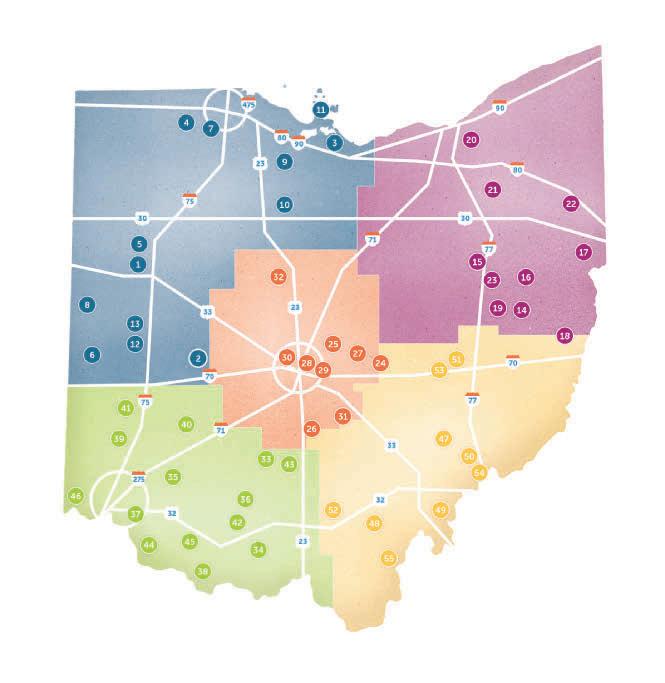
Historic Sites & Museums
Ohio History Connection members enjoy free regular admission to these Ohio History Connection sites.
Before traveling, visit ohiohistory.org/ sites to confirm hours and any special requirements.
There are many other fascinating historyrelated museums and attractions in Ohio— far more than we can show you here.
Find more at ohio.org/things-to-do. Choose “Historic Attractions” or “Museums,” then get out and explore!
NORTHWEST OHIO
Armstrong Air & Space Museum
Cedar Bog Nature Preserve
Cooke-Dorn House
Fallen Timbers Battlefield Memorial Park
Fort Amanda Memorial Park
Fort Jefferson Memorial Park
Fort Meigs
Fort Recovery Museum & Monument
Hayes Presidential Library & Museums
Indian Mill
Inscription Rock Petroglyphs
Johnston Farm & Indian Agency
Lockington Locks
NORTHEAST OHIO
Custer Monument
Fort Laurens
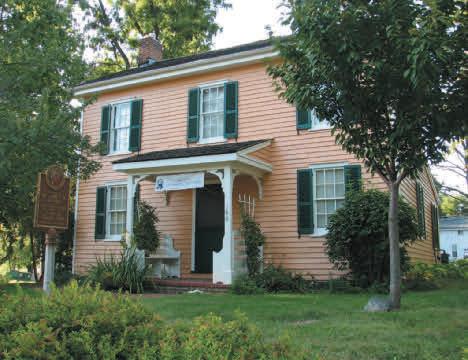
McCook House
Museum of Ceramics
Quaker Yearly Meeting House (Open by Appointment) & Free Labor Store/Benjamin Lundy House (Preservation in Progress • Not Open)
Schoenbrunn Village
Shaker Historical Museum
Tallmadge Church
Youngstown Historical Center of Industry & Labor
Zoar Village
CENTRAL OHIO
Flint Ridge Ancient Quarries & Nature Preserve
Hanby House
Logan Elm
Newark Earthworks
Ohio History Center & Ohio Village
SOUTHWEST OHIO
Adena
Davis Memorial Nature Preserve
Fort Ancient Earthworks & Nature Preserve
Fort Hill Earthworks & Nature Preserve
Harriet Beecher Stowe House
John Rankin House
Miamisburg Mound
National Afro-American Museum & Cultural Center
Paul Laurence Dunbar House
Serpent Mound
Poindexter Village African American Museum (Preservation in Progress • Not Open)
Shrum Mound
Wahkeena Nature Preserve
Warren G. Harding Presidential Sites
Story Mound
U.S. Grant Birthplace
U.S. Grant Boyhood Home & Schoolhouse
William Henry Harrison Tomb
SOUTHEAST OHIO
Big Bottom Memorial Park
Buckeye Furnace
Buffington Island Battlefield Memorial Park
Campus Martius Museum
John & Annie Glenn Museum
Leo Petroglyphs & Nature Preserve
National Road & Zane Grey Museum
Ohio River Museum (Closed for Construction)
Our House Tavern
Mansion & Gardens
& EXHIBITS AT THE
Ohio CenterHistory PROGRAMS
SPEAKING OF HISTORY…
From Entertainment to Enlightenment
SAT., SEPT. 20 • 11 A.M.–NOON
Ohio History Center, Columbus
Join magician, actor and author Rory Rennick for a captivating talk exploring his journey from magic and mystery to uncovering hidden histories in playing cards. Rennick is the world’s leading authority on Henry “Box” Brown and the foremost expert on African diaspora and Black-imaged playing cards— holding the largest known collection and publishing the only research of its kind. Expect surprises along the way! Included with museum admission. Ohio History Connection members enjoy free admission. 800.686.6124 or ohiohistory.org/entertainment
SPEAKING OF HISTORY…
United: The Hidden Story of the Humble Duplex
SAT., OCT. 18 • 1–2 P.M.
Ohio History Center, Columbus
See an original short film from director Anita Kwan and the Affordable Housing Alliance of Central Ohio that shares the story of how the modest duplex emerged as a symbol of middle-class strength and mobility in Columbus, then became targeted and often outlawed throughout the region as segregation divided the country. Today, a new generation is reclaiming this architectural icon and reviving it as a tool for growth, wealth and individuality. Join us for a screening and discussion with staff from the Affordable Housing Alliance of Central Ohio and our State Historic Preservation Office. Included with museum admission. Ohio History Connection members enjoy free admission. 800.686.6124 or ohiohistory.org/united
Fright at the Museum
SAT., OCT. 25 • 6–9 P.M.
Ohio History Center, Columbus
Explore the spooky (but not too spooky) side of Halloween with a family-friendly night featuring dangerous collections, vintage horror movies and stations where you can learn about the origins of Halloween traditions. Make-andtake your own little brown (paper) bat or October-leaf bookmark and do the Twist to Monster Mash on the lawn of the Lustron house, then head for a Halloween dance party that wraps up the night. Perfect for families with young children. Tickets go on sale Sept. 22: $18, $14/age 4–12, Free/age 3 & under. Member tickets go on sale Sept. 15: $13/ Ohio History Connection member, $9/ member age 4–12. Premium members receive free tickets for everyone covered by the membership. 800.686.1541 or ohiohistory.org/fright
FEATURED EXHIBITS
Village Visions
OPENS OCTOBER 18
Explore the history of Ohio Village and collaborate with us to create the next chapter.
Hide and Seek—Finding Young People in the Archives
ONGOING
In the third-floor Library Lobby Gallery, see items from our archival and history collections that are associated with young Ohioans over time, including original documents, toys and a Cozy Coupe car.
Indigenous Wonders of Our World—The Hopewell Ceremonial Earthworks ONGOING
Learn about the eight 2,000-year-old Hopewell Earthworks in Ohio named World Heritage Sites by UNESCO,
$10/ages 4–12.
History Connection members and ages 3 & under enjoy free admission.
including mathematical similarities among them and their alignments to the solstices and the 18.6-year lunar cycle.
Making Ohio Home—Early Ohio Immigrant Experiences ONGOING
Explore stories of seven representative immigrants who helped grow Ohio’s population from 45,365 in 1800 to more than 4.1 million in 1900.
1950s—Building the American Dream ONGOING
Peek in the closets and snoop in the drawers of a real, fully furnished Lustron steel house made right here in Ohio. From the contents of the cupboards to the news on TV and the toys in the yard, this hands-on exhibit is a fascinating journey back in time.
World War I Display ONGOING
See equipment, weapons, uniforms and memorabilia.
Welcome Lobby Display Cases ONGOING
In the Welcome Lobby cases, see Dressing Ohio—From Workroom to Wardrobe, featuring garments from Ohio History Connection collections, and Columbus Women on the Move— Traveling the World in 1936–1937, with selected items from the Women’s Travel Collection.
Museum
OPEN WEDS.–SUN. 10 A.M.–5 P.M.
CLOSED LABOR DAY, MON., SEPT. 1
CLOSING AT 4 P.M. SAT., OCT. 25, TO REOPEN AT 6 P.M. FOR FRIGHT AT THE MUSEUM (SEE COLUMN 1)
Archives & Library
WEDS. 12:30–3 P.M.
THURS.–FRI. 10 A.M.–3 P.M.
CLOSED LABOR DAY, MON., SEPT. 1
SCHEDULE YOUR PERSONALIZED RESEARCH APPOINTMENT: ohiohistory.libcal.com
Passionate about preserving history for future generations?
Consider including the Ohio History Connection as a beneficiary in your estate plans. Our staff can help you choose options that best fit your needs. Call 800.647.6921 to learn more.
MEMBER VIP
Get to Know the Hopewell Ceremonial Earthworks
TUES., SEPT. 23 • 3–4 P.M.
Online—Attend From Anywhere! Ohio’s Hopewell Ceremonial Earthworks, a UNESCO World Heritage Site, includes eight separate monumental earthworks that were built by ancient American Indians between about 1 and 400 A.D. They include the Great Circle and Octagon Earthworks in Newark, Fort Ancient Earthworks near Lebanon and the five earthworks that make up Hopewell Culture National Historical Park in and around Chillicothe. In this program, learn why these ancient earthworks are on the World Heritage List from Dr. Brad Lepper, senior archaeologist for the Ohio History Connection’s World Heritage Program. $10, Free/ Ohio History Connection member with required advance registration.. 800.686.1545 or ohiohistory.org/ knowhopewell
Presidential History Book Club
WEDS., SEPT. 24 & OCT. 29
NOON–1 P.M.
Hayes Presidential Library & Museums, Fremont, and Online—Attend From Anywhere! 4 Read and discuss books about the American presidency at this free book club open to all. SEPT. 24: Ascent to Power, by David L. Roll, a continuation of the August discussion. OCT. 29: Nothing Like It in the World, by Stephen E. Ambrose. Attend in person or online. You’re welcome to bring your lunch. For online login information, email admin@rbhayes.org 800.998.7737 or rbhayes.org
VOICES FOR TRUTH LITERATURE DISCUSSION SERIES
Escapism or Activism?
WEDS., OCT. 8 • 7–8 P.M. Harriet Beecher Stowe House, Cincinnati, and Online via Zoom— Attend From Anywhere! 4 Gothic authors have often used what can be
an escapist genre for insightful social criticism. Get into the Halloween spirit by listening to the voices for truth in short stories by authors of three American Gothic tales that are suggested readings for this program: William Faulkner, “Pantaloon in Black” (1940); Ralph Ellison, “King of the Bingo Game” (1944); and Ursula K. Le Guin, “The Wife’s Story” (1982). Leading the discussion are Dr. John Getz, Xavier University professor emeritus, and Dr. Kristen Renzi, Xavier University professor of English. Donation, Free/ Ohio History Connection member. Call ahead for Zoom link. 800.847.6075 or stowehousecincy.org
MEMBER VIP
Archival and Archaeological Collections from Fort Ancient Earthworks & Nature Preserve
TUES., OCT. 28 • 3–4 P.M.
Online—Attend From Anywhere! October is Archaeology Month. Join Matt Benz and Sara Polk of the Ohio History Connection’s collections staff to learn about objects, manuscripts and audiovisual material relating to Fort Ancient in Warren County, one of the many remarkable archaeological sites in the Ohio History Connection’s site system. $10, Free/Ohio History Connection member with required advance registration. 800.686.1545 or ohiohistory.org/fortancientcollections
Events & Exhibits
Many programs and events at Ohio History Connection museums and attractions require advance registration. To register, call the number or visit the website listed with each program.
Our online calendar offers more up-to-date information about programs and events at Ohio History Connection museums and attractions. Find it at ohiohistory.org/calendar Questions? Call 800.840.6127
Ohio’s nearly 800 local historical societies, historic preservation groups and related organizations offer lots more opportunities to get out and explore places associated with national, state and local history in the Buckeye State. Find events online at ohio.org/festivals-and-events . Under “Category,” choose “History and Heritage.”
STATEWIDE
2026 History Fund Grant Application Deadline
TUES., SEPT. 9
The History Fund is a competitive matching grants program for nonprofits and local government entities in Ohio, like local historical societies, public libraries, genealogical societies, university archives and special collections, historic preservation groups, archaeological societies, county records management offices and incorporated “friends” groups of the above. Applications for History Fund grants to be awarded in 2026 are due Sept. 9. For details and application forms, visit ohiohistory.org/historyfund or call 614.298.2000 or 614.298.2341.
CONFERENCE
American Association for State and Local History and Ohio Local History Alliance WEDS., SEPT. 10–SAT., SEPT. 13 Cincinnati 4 See page 14.
CENTRAL OHIO
CENTRAL OHIO
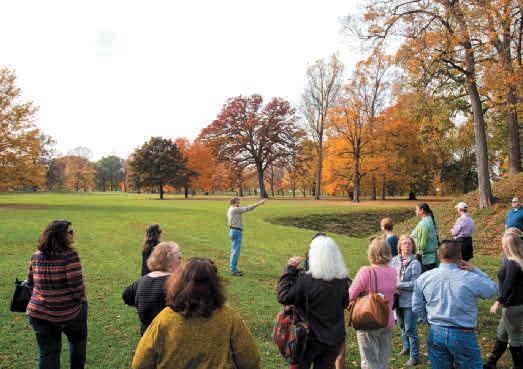
HOPEWELL CEREMONIAL EARTHWORKS Great Circle Earthworks Tour with Dr. Brad Lepper
FRI., SEPT. 5, OCT. 3 & NOV. 7 • 12:30 P.M.
Begins at the Great Circle Museum, 455 Hebron Rd., Heath 4 Tour the ancient Great Circle Earthworks, one of eight sites that make up Ohio’s Hopewell Ceremonial Earthworks, with Dr. Brad Lepper, senior archaeologist for the Ohio History Connection’s World Heritage program. Free. No registration required. 800.589.8224, 740.344.0498 or hopewellearthworks.org
HOPEWELL CEREMONIAL EARTHWORKS Octagon Earthworks Tour with Dr. Brad Lepper
FRI., SEPT. 19, OCT. 17 & NOV. 21 12:30 P.M.
Begins at the Octagon Earthworks Visitor Center, 125 N. 33rd St., Newark Tour the ancient Octagon Earthworks, one of eight sites that make up Ohio’s Hopewell Ceremonial Earthworks, with Dr. Brad Lepper, senior archaeologist for the Ohio History Connection’s World Heritage program. Free. No registration required. 800.589.8224, 740.344.0498 or hopewellearthworks.org
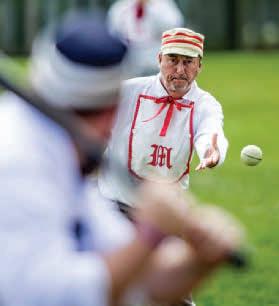
VINTAGE BASE BALL
Ohio Village Muffins vs. Local Club
SAT., SEPT. 20 • 10 A.M.
Hilliard Historical Festival, 4162 Columbia St., Hilliard 4 800.686.6124 or ohiohistory.org/muffins
The Underground Railroad in Westerville
SAT., SEPT. 20 • 1–4 P.M.
Hanby House, Westerville 4 Join us on the lawn of an Underground Railroad site, the Hanby House, to learn about the people and places that were part of the Underground Railroad in Westerville. The house will be open for tours, and presentations will take place throughout
the afternoon. Free and open to the public. 800.600.6843, 614.891.6289 or westervillehistory.org
VINTAGE BASE BALL
Ohio Village Muffins & Diamonds Club Match
SUN., OCT. 5 • 2 P.M.
Thompson Park, Upper Arlington 800.686.6124 or ohiohistory.org/ muffins
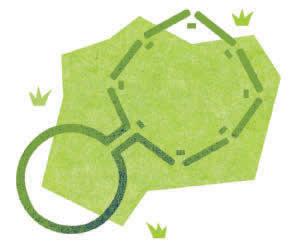
Octagon Earthworks, 125 N. 33rd St., Newark 4 The northernmost moonrise is a celestial event that occurs every 18.6 years. Ancient American Indian architects designed the earthen walls of Newark’s Octagon Earthworks—now part of Ohio’s Hopewell Ceremonial Earthworks, a UNESCO World Heritage Site—with this 18.6-year lunar cycle in mind. Built about 2,000 years ago, the earthen gateways and avenue that connect the Observatory Circle to the Octagon align perfectly with the northernmost moonrise. The close connection Indigenous peoples have with the land and sky is truly evident when you witness this event in person. The evening will begin with a talk introducing the Hopewell culture and the period in which the earthworks were created, plus a brief explanation of the 18.6-year lunar cycle. After the talk, we’ll journey into the center of the Observatory Circle to see the moon rise at its northernmost point, aligned with the earthen gateways and avenue that connect the Circle to the Octagon. Please dress for the weather, wear comfortable walking shoes and bring a blanket or folding chair. Limited to 200 participants. Free with required advance registration at ohiohistory.org/ moonrise. Ohio History Connection member registration opens Sept. 1. Non-member registration opens Sept. 8. Questions? 740.344.0498 or ohiohistory.org/moonrise
NORTHEAST OHIO
McCook History Day
SAT., SEPT. 6 • 10 A.M.–2 P.M.
McCook House, Carrollton 4 Learn about the Civil War during History Day at the McCook House, a landmark associated with the “Fighting McCooks” of Civil War fame. Civil War re-enactors will be on hand, including Akron’s 29th Ohio Volunteer Infantry. 11 A.M.: See a re-enactor portray Harriet Tubman. NOON: Hear Dr. Mandal Haas speak about the Civil War and answer questions. 1 P.M.: Enjoy music by Carroll County dulcimer band Sweet Pickin’s. Homemade pie and ice cream will be served. Bring your lawn chair. Free with required advance registration: 800.600.7172, 330.437.9715 or ohiohistory.org/mccook.
Schoenbrunn Lantern Tours
FRI., SEPT. 12 & SAT., SEPT. 13 7:30–9:30 P.M.
Schoenbrunn Village, New Philadelphia
Follow a candle-lit path to see what life was like in this 1770s Moravian mission on the Ohio frontier on the eve of the American Revolution. $10, $8/senior, $5/age 7–17, Free/Ohio History Connection member or age 6 & under. 800.752.2711, 330.808.4815 or ohiohistory.org/schoenbrunn Walkabout Town
SAT., SEPT. 13 • 7–8 P.M.
McCook House, Carrollton 4 Meet Carrollton historian John Rutledge in front of the landmark McCook House for a guided downtown walking tour. On this walk around one block to Carrollton’s square and back, Rutledge will share information about buildings that are or were. Come early to explore this historic small town with two museums, restaurants, shops and an old-fashioned ice cream parlor. Free. 800.600.7172, 330.437.9715 or ohiohistory.org/mccook
Civil War School Day
FRI., SEPT. 19 • 9 A.M.–2 P.M.
Zoar Village, Zoar 4 On this special day open to all public, private and homeschool students, learn about life on the battlefield and how the Separatists of Zoar and citizens of the Union lived during the Civil War. Meet Civil War legends, watch cavalry and
artillery demonstrations, participate in hands-on activities and tour Zoar’s museum buildings. Tickets are $10/ student, $10/adult and Free/age 5 & under. One adult per group admitted free. Advance registration requested. Call 330.874.3011 or email tshrum@ zca.org to make a reservation as a school group or co-op. Registration is also available at historiczoarvillage. com. 800.262.6199, 330.874.3011 or historiczoarvillage.com
Zoar Village, Zoar 4 Ohio’s largest Civil War re-enactment returns. See a recreation of the Battle of Appomattox on Saturday at 2 p.m. and Sunday at 1:30 p.m. Attend a Civil War ball, enjoy food from the Anvil Tavern, see historical demonstrations and meet re-enactors portraying key Civil War figures. All museum buildings and shops will be open during the re-enactment. Reenactor registration and pre-event ticket sales are at historiczoarvillage. com. $10, Free/age 12 & under. 800.262.6199, 330.874.3011 or historiczoarvillage.com
Shaker Soirée—Gala in the Grove FRI., SEPT. 26 • 7–10 P.M.
Shaker Historical Museum, Shaker Heights 4 Enjoy live music, seasonal food and signature drinks among historic apple trees at this fourth annual evening benefiting Shaker Historical Society’s mission to preserve and share the rich history of Shaker Heights. Tickets: $200/Visionary or $100/ Historian. Shaker Historical Society is the Ohio History Connection’s managing partner for Shaker Historical Museum. 800.860.6078, 216.921.1201 or shakerhistory.org
AppleFest
SAT., SEPT. 27 • NOON–4 P.M.
Shaker Historical Museum, Shaker Heights 4 AppleFest is a day of history, culture and fall harvest fun for all ages. Enjoy live music, craft demonstrations, seasonal refreshments, walking tours and family-friendly activities in celebration of the season. Free. 800.860.6078, 216.921.1201 or shakerhistory.org
Fort Laurens Fall School Day
WEDS., OCT. 1 • 9 A.M.–2 P.M.
Fort Laurens, Bolivar 4 Students can celebrate Archaeology Month at this event open to public schools, private schools and homeschoolers of all ages. The Fort Laurens Museum is at the site where Ohio’s only Revolutionary War fort once stood. All activities meet Ohio educational standards. $7/student. One adult per group admitted free, $7/each additional adult. For more information or to register, email fortlaurens@gmail.com, call 800.283.8914 or 330.874.2059 or visit fortlaurensmuseum.org.
Descendant’s Day
SAT., OCT. 4 • 1–4 P.M.
Zoar Village, Zoar 4 Descendants of the German religious separatists who settled Zoar in 1817 and founded the communal Society of Separatists of Zoar in 1819 will gather to celebrate their heritage. This event highlighting the enduring legacy of Zoar’s founding families will be a vibrant blend of remembrance and festivity, with guided tours of historic buildings including the recently acquired Bimeler Cabin, and opportunities to connect with family members and fellow history enthusiasts. Tom Neel, retired director of the Ohio Genealogical Society, will discuss “Finding Your German Ancestors in an English America.” Visit historiczoarvillage.com for more on pricing and registration. 800.262.6199, 330.874.3011 or historiczoarvillage.com
ZOAR FREE SPEAKER SERIES
Katharina von Bora Luther Presentation
SAT., OCT. 4 • 11 A.M.–1 P.M.
School House, Zoar Village, Zoar 4 Historic Zoar Village hosts Raylene Hlavaty in a first-person presentation on the life of Katharina von Bora Luther, wife of Martin Luther. Free, with free parking near the School House. 800.262.6199, 330.874.3011 or historiczoarvillage.com
Zoar Village, Zoar 4 Looking for a frightful way to spend a late-fall evening? Explore this 19th-century village by lantern light and listen as
guides share haunting tales of Zoar, including supernatural encounters by staff, visitors and residents. Recommended for age 12+. Tours begin every 15 minutes starting at 6:30 p.m. $19. Advance timed tickets required: 800.262.6199, 330.874.3011 or historiczoarvillage.com.
Annual Workshop
SAT., NOV. 1 • 11 A.M.–1 P.M.
Fort Laurens, Bolivar 4 Learn everything you need to know about cooking outdoors at our annual workshop presented by experts from Midwest Native Skills Institute. Free with required advance registration: 800.283.8914, 330.874.2059 or fortlaurensmuseum.org.
Nature Trails Into History—
Explore the Past Through Nature
SAT., NOV. 8 • 10 A.M.
Schoenbrunn Village, New Philadelphia Journey through time and discover the Ohio Country as it once was. This 1.5-mile hike for ages 12+ blends the rich history of Schoenbrunn, a 1770s village on the Ohio frontier, with the natural world that shaped it. Explore landscapes familiar to 18thcentury travelers, learn about the vital connection between nature and daily life and discover how forests of the past compare to today’s. The hike will be held rain or shine and may cover uneven or difficult terrains. If postponed due to severe weather, it will take place on Sunday, Nov. 9 (subject to change). $8, $6/senior or Ohio History Connection member. Advance registration required: 800.752.2711, 330.808.4815 or ohiohistory.org/ schoenbrunn.
FEATURED EXHIBITS • • •
Community Quilts
FRI., AUG. 15–SAT., OCT. 11
FRIDAYS & SATURDAYS 10 A.M.–5 P.M. McCook House, Carrollton 4 See hand-sewn and machine-sewn quilts—many of them treasured heirlooms of local families—created by experienced quilters of yesterday and today. Included with museum admission: $5, $3/age 6–12, Free/ Ohio History Connection member. 800.600.7172, 330.437.9715 or ohiohistory.org/mccook
NORTHWEST OHIO
Tree Symposium
FRI., SEPT. 5 • 8 A.M.–3 P.M. Hayes Presidential Library & Museums, Fremont 4 Learn about challenges facing urban forests during the second annual Tree Symposium at Spiegel Grove, an arboretum and presidential site. 8–9 A.M: Check-in, coffee and donuts. 9–9:15 A.M.: Welcome by Christie Weininger, Hayes Presidential executive director. 9:15–10 A.M.: Tapping and Making Maple Syrup, with Deb Nofzinger, Sandusky County Park District program supervisor. 10–10:45 A.M.: Our Changing Climate, with Ross Ellet, meteorologist for 13ABC. 10:45–11 A.M.: Break. 11 A.M.–NOON: Tree tour of Spiegel Grove, with John Havens, Hayes building and grounds superintendent. NOON–1 P.M.: Lunch. 1–1:45 P.M.: Diseases and Pests Affecting Urban Forests, with Thomas deHaas, Ohio State University Extension, Erie County. 1:45–2:30 P.M.: Native Trees in Urban Forests, with Stephanie Miller, regional urban forester for northwest Ohio. 2:30 P.M.: Conclusion by John Havens. $40, $22/ student, lunch included. Advance registration required: 800.998.7737 or rbhayes.org.
History Roundtable with Mike Gilbert SAT., SEPT. 6, 13, 20, 27 & OCT. 11 & 18 • 10–11:30 A.M. Hayes Presidential Library & Museums, Fremont 4 On six Saturdays, local historian and retired educator Mike Gilbert shares his research on a wide range of topics. Prerecorded virtual sessions are offered for those who cannot attend in person. SEPT. 6: The Tragic End—The Assassination of Robert F. Kennedy. SEPT. 13: Turning Point— The Pivotal Third Day of Gettysburg. SEPT. 20: George Washington—The Founding Father and His Legacy. SEPT. 27: The Fabulous Fifties—A Decade of Change and Innovation. OCT. 11: Franz Liszt—The Virtuoso Who Revolutionized Music. OCT. 18: Legend and Lore—The Enchanting History of Witchcraft, Vampires and Werewolves. $25/six-session package or $5/session. Advance registration and payment required. To register, contact Julie Mayle at jmayle@rbhayes.org. 800.998.7737 or rbhayes.org
Base Ball (Yes, Two Words) Played by 19th-Century Rules!
The Underground Railroad in Westerville
SEPT. 20, HANBY HOUSE, WESTERVILLE
Gates and Trees Tour
SAT., SEPT. 6 • 10–11 A.M.
Hayes Presidential Library & Museums, Fremont 4 This one-hour walking tour focuses on the 1871 White House gates that have graced the grounds at the home of 19th president Rutherford B. Hayes since 1928, and the trees around them. $10, $7/age 6–18, Free/age 5 & under. Advance registration required: 800.998.7737 or rbhayes.org.
Spiders, with Richard Bradley
SAT., SEPT. 6 • 10–11:30 A.M.
Cedar Bog Nature Preserve, Urbana
Join us for a talk by Ohio native Richard Bradley, author of Common Spiders of North America. $5, $4/ child, Free/Ohio History Connection member. 800.860.0147, 937.484.3744 or cedarbognp.org
VINTAGE BASE BALL
Ohio Village Muffins vs. Put-in-Bay Mossbacks
SUN., SEPT. 7 • 2 P.M.
Concord and Catawba Avenues, Put-in-Bay 4 800.686.6124 or ohiohistory.org/muffins
Fall Migration
SAT., SEPT. 13 • 10–11:30 A.M.
Cedar Bog Nature Preserve, Urbana
Hear a presentation on Cedar Bog’s fall migratory birds, featuring Tom Hissong, retired Five Rivers MetroParks naturalist. $5, $4/child, Free/Ohio History Connection member. 800.860.0147, 937.484.3744 or cedarbognp.org
Mellow Yellow Walk
SUN., SEPT. 14 • NOON–2 P.M.
Cedar Bog Nature Preserve, Urbana
Naturalists stationed along the
Great Circle Earthworks Tour with Dr. Brad Lepper
SEPT. 5, OCT. 3 & NOV. 7, HEATH
boardwalk will answer questions about the preserve’s yellow-blooming fall plants. Free, with donations accepted. 800.860.0147, 937.484.3744 or cedarbognp.org
TALK & TOUR
Black Holes
FRI., SEPT. 19 • 2–4 P.M.
Armstrong Air & Space Museum, Wapakoneta 4 Join our museum educator in the STEM Inspiration Center at 2 p.m. for a fun, hands-on program using balloons and aluminum foil to explore how black holes form and the science behind them. At 3 p.m., enjoy a guided museum tour. Designed for children accompanied by adults, this program is a great fit for homeschool students. $13, $12/senior, $11/veteran, $7.50/age 6–12, Free/Ohio History Connection member or age 5 & under. 800.860.0142, 419.738.8811 or armstrongmuseum.org
Life in Early Ohio
SAT., SEPT. 20 & SUN., SEPT. 21 9:30 A.M.–5 P.M.
Fort Meigs, Perrysburg 4 This reenactment captures the lives of tradespeople on the Ohio frontier during the War of 1812. The weekend features a full schedule of demonstrations and presentations detailing the skilled work of blacksmithing, soap making, leather working, candle production, tinsmithing, woodworking and other trades. Early bake ovens and 19th-century fashion will be discussed, too. $12, $10/ senior, $7/student, Free/Ohio History Connection member. 800.283.8916, 419.874.4121 or fortmeigs.org
Presidential History Book Club
WEDS., SEPT. 24 & OCT. 29
NOON–1 P.M.
Hayes Presidential Library & Museums, Fremont, and Online–Attend From Anywhere! 4 See page 18.
BOOK TALK
Unnatural Ohio
THURS., SEPT. 25 • 6–7 P.M.
Hayes Presidential Library & Museums, Fremont 4 The book Unnatural Ohio: A History of Buckeye Cryptids, Legends and Other Mysteries by Kevin Moore, curator of artifacts, and M. Kristina Smith, marketing and communications manager for Hayes Presidential Library & Museums, was published by The History Press in 2023. Back by popular demand, Moore and Smith will share more legends from their book, which covers cryptids, ghost stories and UFO-related tales. Copies will be for sale. Free. 800.998.7737 or rbhayes.org
Wreath-Laying at the Tomb of President Hayes
SUN., OCT. 5 • 2–2:45 P.M.
Hayes Presidential Library & Museums, Fremont 4 U.S. military representatives will lay a wreath at the tomb of President Rutherford B. Hayes on the grounds of the Hayes estate, Spiegel Grove, in honor of his birthday, which is Saturday, Oct. 4. Members of the military and Christie Weininger, Hayes Presidential Library & Museums executive director, will speak, and a bugler will play taps. Free and open to the public. 800.998.7737 or rbhayes.org
Boo in the Bog
FRI., OCT. 10 & SAT., OCT. 11
6:30–9 P.M.
Cedar Bog Nature Preserve, Urbana
This family-friendly event features guided tours of Cedar Bog’s boardwalk at night, with jack-o’-lanterns lighting the way and volunteers sharing stories about wildlife. Enjoy food, face painting and crafts in the nature center, plus a campfire with stories and s’mores. $6, $5/student. Ohio History Connection members enjoy a $1 discount. Advance registration required: 800.860.0147, 937.484.3744 or cedarbognp.org.
NASA Food Scientist
Vickie L. Kloeris
SAT., OCT. 11 • 11 A.M. & 1:30 P.M.
Armstrong Air & Space Museum, Wapakoneta 4 Hear a special presentation by Vickie L. Kloeris, a distinguished former NASA food scientist with 34 years of experience in space food systems. As the longtime manager of food systems for both the Space Shuttle and International Space Station, Kloeris brings a wealth of knowledge and insight. She’ll speak in the STEM Inspiration Center at 11 a.m. and 1:30 p.m., with a meet-andgreet after each session. Included with museum admission: $13, $12/senior, $11/veteran, $7.50/age 6–12, Free/Ohio History Connection member or age 5 & under. 800.860.0142, 419.738.8811 or armstrongmuseum.org
TALK & TOUR
Project Horizons
THURS., OCT. 16 • 2–4 P.M.
Armstrong Air & Space Museum, Wapakoneta 4 In 1959, the U.S. Army, Navy and Air Force had control of America’s space program and proposed an ambitious plan: to build a military base on the moon. In the STEM Inspiration Center at 2 p.m., learn about the mission’s development, the challenges of it and why it was ultimately abandoned and explore whether that dream could become a reality today. A guided tour of the museum follows at 3 p.m. Included with museum admission: $13, $12/senior, $11/veteran, $7.50/age 6–12, Free/Ohio History Connection member or age 5 & under. 800.860.0142, 419.738.8811 or armstrongmuseum.org
Fort Meigs, Perrysburg 4 Experience the eerie side of this War of 1812 fort. Follow your guide by lantern-light to five campfires in dark nooks of the fort, where you’ll be met by storytellers who’ll share strange and gripping tales of its past. Advance timed tickets required. No tickets sold at the door. $17, $15/senior, $10/student. 800.283.8916, 419.874.4121 or fortmeigs.org
Boo! on the Moon
TUES., OCT. 28 • 5–7:15 P.M. Armstrong Air & Space Museum, Wapakoneta 4 Grab your costumes and candy bags for this annual Halloween event! The museum’s space galleries will be adorned in an array of ghastly props and eerie décor, and staff members stationed in them will pass out candy and treats to younger visitors. Included with museum admission: $13, $7.50/ age 6–12, $3.75/age 6–12 in costume, Free/Ohio History Connection member or age 5 & under. 800.860.0142, 419.738.8811 or armstrongmuseum.org
Calling All Spirits—Spiritualism in the Victorian Era
WEDS., OCT. 22 • 5:30–9:30 P.M. Hayes Presidential Library & Museums, Fremont 4 Explore the world of 19thcentury American Spiritualism at this special evening in the historic Hayes home. More than an occult parlor game, Spiritualism was a new religion that sought to channel the voices of the dead, link the present with the past and conjure new worldly—and otherworldly— futures. Historian Dave Desimone, director of Black Point Estate and Gardens in Lake Geneva, Wisconsin, will lead this unique event, which is purely historical—there will not be a séance or any attempt to conjure spirits. The program will cover everything from the Fox sisters, often credited with creating the first major wave of Spiritualism in America, to Wisconsin’s Morris Pratt Institute, America’s first school dedicated to teaching Spiritualism. $50. Seating is limited and advance tickets are required: 800.998.7737 or rbhayes.org
Civil War Winter Camp
SAT., OCT. 25 • 10 A.M.–5 P.M. Grounds of Hayes Presidential Library & Museums, Fremont 4 Experience life in a Civil War winter camp like that of the 23rd Ohio Volunteer Infantry, the regiment of President Rutherford B. Hayes. This event will take you inside the camp to see aspects of how soldiers lived during the war. Outside the camp, enjoy military band music, see military demonstrations by the Fifth U.S. Colored Troops and hear a talk about the Civil War service of President Hayes. Re-enactors portraying veterans belonging to the Grand Army of the Republic, or G.A.R.—a Civil War veterans’ organization of which Hayes was a member—will be on hand. As some Civil War veterans may have driven Model Ts to their reunions later in life, Firelands Timeless Ts will offer free Model T Ford rides. Roots Poultry food truck and the Maumee Valley Heritage Corridor root beer stand will sell lunch and snacks. Civil War winter camp tours are outdoors and last about 50 minutes. Please dress for the weather. Tickets ($10, $7/age 7–12, Free/age 5 & under) are required to tour the camp. Band performances, military demonstrations and the Hayes Civil War service talk are free. Hayes Home and Museum tours (free to Ohio History Connection members) require an additional ticket. A 20% discount on site passes that include admission to the Hayes Home and Museum will be available throughout the day. 800.998.7737 or rbhayes.org
FEATURED EXHIBITS • • •
Inside President Hayes’ Library THROUGH JUNE 2026
Hayes Presidential Library & Museums, Fremont 4 A ravenous reader, President Rutherford B. Hayes had more than 8,000 books in his personal library. Explore the authors and titles that shaped and inspired him, among them Shakespeare, Charles Dickens novels and Don Quixote. Others cover issues of the day, such as slavery, Chinese immigration, tariffs and prison reform. The exhibit also features an essay about reading from his college years at Kenyon; correspondence with poets Henry Wadsworth Longfellow, William Cullen Bryant, John Greenleaf Whittier, Oliver Wendell Holmes Jr. and James Russell Lowell; and prints of portraits of authors Hayes collected.
Descendant’s Day
Included with Hayes Museum admission. Ohio History Connection members enjoy free admission. 800.998.7737 or rbhayes.org
Factions & Fraternalism— A History of America’s Presidential Parties THROUGH 2025
Hayes Presidential Library & Museums, Fremont 4 See campaign materials, political memorabilia and artifacts related to voting throughout American history, including campaign pins, handkerchiefs, ribbons and medallions. Also on display is a ballot box that Rutherford B. Hayes and his regiment used to vote in the field while serving in the Civil War, and the 1880 book Conspectus of American Politics, with a fold-out chart showing the evolution of American political parties to that time. Included with Hayes Museum admission. Ohio History Connection members enjoy free admission. 800.998.7737 or rbhayes.org
Life in Early Ohio
Magazine, July & August 2025), on this special Saturday. Enjoy live bluegrass and country music, over 50 vendors with handmade goods, food trucks and old-fashioned fall fun for kids and adults. Free. 800.860.0144, 740.384.3537 or buckeyefurnace.org
VINTAGE BASE BALL
Ohio Village Muffins & Diamonds vs. Local Club
SAT., OCT. 4 • TIME TBA Alexander High School, 6015 Ayers Rd., Albany 4 800.686.6124 or ohiohistory.org/muffins
Buckeye Furnace Fall Festival
SAT., OCT. 4 • 10 A.M.–5 P.M.
Buckeye Furnace, near Jackson Explore Buckeye Furnace, a Civil Warera iron-making complex (see Echoes
Ralph Waldo Emerson: The Sage of Concord
SUN., SEPT. 21 • 4–5:30 P.M.
First Unitarian Church of Cincinnati, 536 Linton St., Cincinnati 4 Attend a staged reading of Ralph Waldo Emerson: The Sage of Concord with Dr. Phil Paradis, whose one-man show, An Evening with Stephen Crane, received rave reviews at Manhattan Repertory Theatre and the Stephen Crane House in Asbury Park, New Jersey. Ralph Waldo Emerson: The Sage of Concord is his newest work. $7, Free/Ohio History Connection member. 800.847.6075 or stowehousecincy.org
A Funky Good Time! Life in the Legendary Funk Lane
SAT., SEPT. 20 • 11 A.M.–3 P.M. National Afro-American Museum & Cultural Center, Wilberforce 4 Musician and producer Deron Bell of Central State University is featured along with many other Dayton funk recording legends in a recent documentary produced by the University of Dayton. During this special program, we’ll be discussing Bell’s “Life in The Funk Lane” and his experience in the music industry. 11:30 A.M.–NOON: Curator-led tour of the museum’s exhibit Rhythm of Revolution. NOON–12:45 P.M.: Line-dancing class with DJ Stan
Brooks, Stan-the-Man. 12:45–1 P.M.: Break. 1–1:30 P.M.: Enjoy lunch and see the documentary Funk: The Sound of Dayton. 1:30–2:45 P.M.: Step into an electrifying, hands-on experience that will dive deep into the soul of Dayton funk music—its powerful roots, cultural influence and unstoppable groove. Join us for an unforgettable session with Bell, a musical journey where you become part of the band! Groove through the evolution of funk, from its golden era to its modern-day influence. This session will be packed with rhythm, stories and surprises. Bring your curiosity, your questions and your love for music. We’ll wrap up with a lively Q&A, where no topic is off the table. 2:45–3 P.M.: Break. 3–3:45 P.M.: Self-guided tours of the museum, which closes at 4 p.m. Advance registration required. $25 ($20/Ohio History Connection member) includes box lunch or $10 ($8/Ohio History Connection member) without box lunch. 800.752.2603 or ohiohistory.org/naamcc
VINTAGE BASE BALL
Ohio Village Muffins vs. Champion City Reapers
SAT., SEPT. 27 • 2 P.M. 2777 Springfield-Xenia Rd., Springfield 800.686.6124 or ohiohistory.org/ muffins
Basket Weaving Workshop
SUN., SEPT. 28 • NOON–4 P.M.
Fort Ancient Earthworks & Nature Preserve, Oregonia, near Lebanon 4 Have you ever wanted to learn to weave baskets? Renata Cauthon, a Cherokee artist, will teach basket weaving at Fort Ancient. Weather permitting, we’ll
SEPT. 20 & 21, FORT MEIGS, PERRYSBURG
OCT. 4, ZOAR VILLAGE, ZOAR
SOUTHEAST OHIO
SOUTHWEST OHIO
OCT. 18, GASLIGHT THEATER, GEORGETOWN
The General Speaks— West Point to Jefferson Barracks work outside. Advance registration required: tinyurl.com/BasketFant. You must also purchase your basket weaving kit ($35) ahead of time: tinyurl. com/MaterialsFant. 800.283.8904 or ohiohistory.org/fortancient
GUIDED WALKING TOUR
Abolitionists and African Americans in Walnut Hills
Starts and Ends at Harriet Beecher Stowe House, Cincinnati Underground Railroad conductors, Olympic gold medalists, internationally famous authors and myriad small businesses have all thrived in Cincinnati’s Walnut Hills neighborhood. On this two-hour guided walking tour, learn about the women and men who’ve invested in this neighborhood over the past 200 years. $15, $7/ Ohio History Connection member. 800.847.6075 or stowehousecincy.org
VOICES FOR TRUTH LITERATURE DISCUSSION SERIES
Escapism or Activism?
WEDS., OCT. 8 • 7–8 P.M.
Harriet Beecher Stowe House, Cincinnati, and Online via Zoom— Attend From Anywhere! 4 See page 18.
Maximum Northern Moonrise Alignment Viewing
SAT., OCT. 11–SUN., OCT. 12 10 P.M.–1 A.M.
Fort Ancient Earthworks & Nature Preserve, Oregonia, near Lebanon This family-friendly event offers an opportunity to see how the 2,000-yearold Fort Ancient Earthworks aligns with
the lunar cycle. Every 18.6 years, the moon reaches the northernmost point at which it rises, and this is the year when that happens. Come to see the moon rise in alignment with the earthworks, marking the end of the current lunar cycle. Moonrise starts at about 10:18 p.m. The moon is expected to break the tree line about 10:30–10:40 p.m. The museum and gift shop will be open until 11:30 p.m. Free. 800.283.8904, 513.932.4421 or ohiohistory.org/ fortancient
The General Speaks—West Point to Jefferson Barracks
SAT., OCT. 18 • 1–3 P.M.
Gaslight Theater, 110 E. State St., Georgetown 4 Hear Dr. Curt Fields as Gen. Ulysses S. Grant speak on the topic “West Point to Jefferson Barracks,” and answer questions from the audience. Earlier, from 10 a.m. to noon, enjoy free tours of the Ulysses S. Grant Boyhood Home & Schoolhouse and visit four Grant murals and two Grant statues, all in Georgetown. Free. 877.372.8177 or usgrantboyhoodhome.org
Deaf Day
SAT., OCT. 25 • 10 A.M.–3 P.M.
Harriet Beecher Stowe House, Cincinnati 4 Stowe House tours on the hour from 10 A.M. to 3 P.M. will be professionally interpreted in American Sign Language. Visitors will encounter the history this house witnessed in two different time periods: 1840, when author Harriet Beecher Stowe lived in Cincinnati as a young teacher and mother preparing to write her blockbuster antislavery novel Uncle Tom’s Cabin, and 1940, when African American proprietor Irene Bacon managed the house as the Edgemont Inn, a boarding house and tavern listed in the Negro Motorist Green Book. $8, $7/senior, $5/child, Free/Ohio History Connection member. 800.847.6075 or stowehousecincy.org
Wilderness Skills
SAT., NOV. 1 • NOON–4 P.M. Fort Ancient Earthworks & Nature Preserve, Oregonia 4 In this outdoor program ongoing throughout the afternoon, learn hunting, fishing, tanning and trapping techniques with instructor Keith Bengtson. Please dress for the weather. Included with general site admission: $7, $6/age 6–17 or 60+, Free/Ohio History Connection
FEATURED EXHIBITS • • •
Trailblazers of Innovation— African American Inventors Who Changed America
ONGOING • WEDS.–SAT. 9 A.M.–4 P.M. National Afro-American Museum & Cultural Center, Wilberforce 4 Discover the stories of Black inventors from Ohio and beyond! This exhibit, designed with help from Wright State University public history graduate students and the National Afro-American Museum & Cultural Center curatorial staff, promises to educate and inspire. ALSO ON EXHIBIT: African Art—Form, Function and Fraught Histories; African Americans Fighting for a Double Victory; Rhythm of Revolution; and Queens of the Heartland, all included with museum admission: $6, $5/senior, $3/age 6–17, Free/Ohio History Connection member or age 5 & under. 800.752.2603 or ohiohistory.org/ naamcc
A Tragic Collapse
My fascination with the crash of the USS Shenandoah began in a history class at Lincoln Junior High School in the Ohio River village of Brilliant, Ohio.
The airship had practically crashed in my backyard, and yet I had never heard of the Shenandoah. Our teacher explained how 14 of the men had fallen to their deaths when the control gondola detached from the superstructure. The ship could have been as high as a mile in the air when the gondola began its descent.
It’s the kind of fact that captures the morbid imagination of a 13-year-old boy, much the way I wondered how long the people in the hull of the Titanic had lived as it made its way to the bottom of the Atlantic. Like I had with the Titanic, I also pondered how something as huge and magnificent as the Shenandoah could be destroyed by nature. At that age, I couldn’t quite get my brain around the stopping power of an iceberg or the strength of a September squall over Noble County.
LIGHTER THAN AIR
The Shenandoah was the first lighter-than-air rigid airship engineered and constructed in the United States. Sept. 3 will mark 100 years since the pride of the U.S. Navy air program fell into the hills of Appalachian Ohio. The crash of the airship was the Roaring Twenties’ equivalent of the Space Shuttle Challenger and Columbia disasters. The wreckage of the massive ship known as the Daughter of the Stars would be spread over the county, where visitors scavenged it like vultures.
This was a terrible blow to the Navy air program and a disaster that easily could have been avoided.
In late 1924, the Shenandoah completed a 9,000-mile cross-country journey, which at the time was the longest trip in history by an airship. The trip was ostensibly to test docking stations, but it was as much a public relations junket as anything.
National Geographic Magazine chronicled the trip in its January 1925 issue, dedicating 47 pages to the story. The trip and subsequent article made the Shenandoah the most popular aircraft in the United States and its commander, Capt. Zachary Lansdowne of Greenville, Ohio, one of its most popular aviators, perhaps second only to fellow Ohioan, WWI fighter ace Eddie Rickenbacker.
Left: The USS Shenandoah tethered to a mooring mast at Lakehurst Naval Air Station in Lakehurst, New Jersey, sometime between 1923 and 1925.
THE WRECK OF THE AIRSHIP USS SHENANDOAH BY ROBIN YOCUM
FIERY CRASHES
While the Shenandoah was the first rigid airship constructed in the United States, it wasn’t the country’s first foray into the field. Shortly after the end of WWI, the United States purchased the R38 from England and the Roma from Italy. Both of the hydrogen-filled vessels met with disaster. Fiery crashes claimed both ships and killed 78 men. The Shenandoah was filled with inert helium, which was much harder to procure, but infinitely safer.
The Navy was positively giddy about its new toy, and in the summer of 1925 ordered Lansdowne to make a six-day public relations tour through the Midwest. The 36-year-old was uneasy about the trip, and he repeatedly warned his Navy superiors of the dangers of late-summer storms in his native Midwest. A cautious navigator, Lansdowne said the storms could be fatal to the massive Shenandoah, and he wanted to push the tour back closer to the Sept. 21 end of summer.
But the tour was important to the Navy, and it had already been postponed by several weeks. Lansdowne’s request for another two-week delay was denied by his Navy superiors, who were anxious to show off the Shenandoah. The first stop on the tour was to be the Ohio State Fair in Columbus. Thus, at 3 p.m. on Sept.
2, 1925, the Shenandoah left the Navy’s air base in Lakehurst, New Jersey, and headed west.
It would never return.
"THERE SHE GOES"
The Shenandoah was more than an eighth of a mile long. No sooner had it crossed the Ohio River at Bridgeport than Lansdowne's fears were realized. After fighting its way west for three hours, the Shenandoah met its end over the hamlet of Ava, Ohio. High winds and updrafts buffeted the ship, toying with it like a cat does a mouse. The control gondola was suspended beneath the airship by cables. As the girders supporting the more than 78-foot-wide hull began to groan, Lt. Lewis Hancock in the gondola said, “There she goes.”
The 14 men in the gondola had about 20 seconds to live. The gondola wrenched free when the Shenandoah broke into two pieces—the 480-foot stern and the 200-foot bow.
Weighed down by three Packard engines, the stern quickly lost altitude with 22 men hanging onto ladders and ropes. It floated west less than a mile before sliding into a farm field on its belly. The nose, however, had no such weight and began floating southwest.
Wreckage of Shenandoah’s aft section, surrounded by sightseers and their automobiles, soon after the airship crashed in southern Ohio.
Eight miles away, farmer Ernest Nichols was walking across his field when he heard men calling to him. When he looked up, there was the bow of the Shenandoah with seven men inside. Nichols grabbed a dangling rope and tied it to a tree, tethering the bow above his property. He then ran to the house, fetched his shotgun and fired two blasts into the ship’s helium gas bags, allowing it to sink to the ground.
Miraculously, of the 43 men aboard the Shenandoah, only the 14 in the gondola perished.
THE RECENT PAST
In historical terms, the crash of the Shenandoah was still in the recent past when I first learned of it in the late 1960s. It had been less than 45 years since the day it fell out of the sky. While the crash was revealed to me in history class, it was not as much history as it was new information. It crashed in the same Appalachian foothills that I explored as a kid.
I went to the little library in Brilliant to scan the encyclopedias for more information. For years we had been drilled in school about Ohio’s connection to aviation with the Wright Brothers, Rickenbacker and John Glenn. Just days after my seventh-grade year ended, Ohioan Neil Armstrong became the first man to set foot on the moon. So how was it that the crash of the USS Shenandoah seemed to be little more than a footnote in our aviation history?
I must admit, my interest was short-lived. I can’t tell you why or when my fascination with the Shenandoah waned, but it wasn’t long after the seventh grade, and I suspect testosterone was the culprit. My interest in reading and history was diverted toward girls and sports.
Then, sometime in the mid-1980s when I was a reporter with The Columbus Dispatch, I was heading south on Interstate 77 near Caldwell when I looked off into a field and saw an American flag and sign marking the spot where the stern of the Shenandoah had come to rest. I was suddenly transported back to my seventh-grade classroom, remembering the time when I first heard about the crash. My interest in the massive airship was renewed. I began collecting newspaper articles and books about the Shenandoah, including tracking down the National Geographic story on its cross-country trip.
I considered writing a book about the crash, but I’m a fan of David Grann, Erik Larson and the late David McCullough. I’ve seen how much work they put into
writing their history books. I’m primarily a novelist, and I prefer to just make up my facts.
However, as the 100th anniversary of the crash loomed, I decided to put my reporter’s cap back on and do a deeper dive into the crash of the Shenandoah and what remains the most important historical event in Noble County history.
The story I wrote on the anniversary of the crash— all 10,000 words of it—is housed on the Ohio History Connection website at ohiohistory.org/Shenandoah I hope you’ll take a look.
Robin Yocum is an Edgar-nominated novelist known for his fiction set in the Ohio River Valley. His latest novel, The Sacrifice of Lester Yates, was released in 2021 by Arcade CrimeWise and was a finalist for the Dashiell Hammett Prize for excellence in crime writing.
LEARN MORE
Want to know more about the crash of the Shenandoah? Check out The Wreck of the Naval Airship USS Shenandoah, by Jerry Copas. Written by a balloon pilot who knows his way around the sky, this book dives into what made the Shenandoah fly—and what made it fall.
Go see it in real life! Take a trip to the Shenandoah Airship Memorial Site in Ava, Ohio. You can stand right where it happened—flags, plaques and all.
Plan your trip at visitnoblecountyohio.com/ussshenandoah-crash-sites
In the mood to watch something? The CourtMartial of Billy Mitchell stars Gary Cooper as Billy Mitchell, the outspoken officer who blamed military leadership for the Shenandoah crash and other air disasters. It’s available on several streaming services including Prime Video, Plex and Apple TV.
WATCH
Scan the QR code to see a short video about the Noble County crash of the airship USS Shenandoah in our newest episode of Echoes Extras.
LEARN MORE
Tallmadge Church was finished in 1825 by Col. Lemuel Porter, a master carpenterbuilder who had come to Ohio in 1818 from Connecticut.
TOM WOLF
A Landmark of the Western Reserve
TALLMADGE CHURCH CELEBRATES 200 YEARS BY GREG SANDERS
In November 1944, the cover of Life magazine’s Thanksgiving issue featured a black-and-white photo of the historic Tallmadge Church in Tallmadge, Ohio.
No one today knows how this came to be, but Carolyn Mackey, past president of the Tallmadge Historical Society, remembers the magazine well.
“It was the worst part of World War II. We got the magazine and there was our church—I’ll never know why—just calming the nation. And that’s what it has always done,” she says.
Tallmadge residents would surely agree that the church on Tallmadge Circle was a fitting choice for Thanksgiving: like the holiday, the old church stands as a symbol of Ohioans’ shared past. For 200 years, its familiar lines have graced the center of this northeastern Ohio community.
Although the landmark building was dedicated in 1825, Tallmadge’s Congregational church, as a religious community, was founded in 1809 by Rev. David Bacon of Connecticut. Bacon had moved west from his home state to preach the Christian gospel to Indigenous Ojibwe and Ottawa peoples near present-day Toledo, and later in northern Michigan. When his missionary efforts proved unsuccessful, he returned to Connecticut’s Western Reserve in northeast Ohio.
Bacon arrived there in 1804 and saw great potential in the land’s “fertile soil, its salubrious air, its beautifully undulating surface, its pure and abundant water, its streams singing in the grand old woods,” according to the memoirs of his son, Leonard.
While serving briefly as a minister in the nearby town of Hudson, Bacon yearned to establish a new community rooted in the Calvinist tradition of Connecticut’s Puritan forebears. Relinquishing his Hudson ministry,
Rev. David Bacon's vision of his ideal community included the township plan. He redrew it to feature 16 sections, with eight roads radiating from a square at the center of the township (now Tallmadge Circle), where the church and academy would stand.
GREG SANDERS
Bacon bought 12,000 acres in Town 2, Range 10, near Hudson—at $1.50 per acre—as a home for his envisioned community.
According to historian Charles Whittlesey, “No emigrants were to receive land who were not professors of the Congregational or Presbyterian church, and two dollars for each 100 acres was to be paid for the support of the gospel. The latter provision was inserted in some of the early contracts and deeds, but in fact never went into effect.”
Bacon’s two-dollar tithe requirement reflected Connecticut’s practice at that time. Prior to 1818, the Congregational church was the established church of Connecticut, and all residents of the state had to pay a tithe to support that church—even members of other denominations.
WAR HERO
The new township was named in honor of Revolutionary War hero Benjamin Tallmadge, from whom Bacon acquired many acres. Known as “Washington’s Spy” for his role in the celebrated Culper Spy Ring during the Revolutionary War, Tallmadge owned 5,611 acres in
To document the landmark church, workers for the Historic American Buildings Survey carefully measured the building in 1934, then created these drawings of it.
the Western Reserve, though like many Connecticut investors, he never lived in the area.
Bacon’s purchase depended heavily on credit, leaving him vulnerable to the economic depression brought on by President Jefferson’s 1807 Embargo Act against trade with France and Britain.
The church building we know today was only a dream in January 1809, when Bacon called the first worship meeting of the Church of Christ in Tallmadge in his cabin. He soon returned to Connecticut, seeking investor-settlers who shared his vision for a new community of faith in the western wilderness—with limited success.
Writing in her 1910 History of the Western Reserve, Harriet Taylor Upton said: “Finally finding himself unable to meet the payments upon the purchase and being unable to compromise with his business-like creditors in the east, he left Tallmadge permanently in May 1812, and died at Hartford, Connecticut, August 17, 1817, a man broken both in body and spirit.”
Among the few Connecticut residents who had accepted Bacon’s invitation was the Yale-educated mathematician Elizur Wright II (often referred to
as Elizur Wright Sr. to distinguish him from his renowned son Elizur Wright III, “the father of life insurance”).
Leonard Bacon wrote that Tallmadge in 1810 was “greatly strengthened, especially by the coming of Elizur Wright, Esq., from Canaan, Conn., who brought with him not only a large family, but more capital and more wealth of culture and information than any who had come before him.”
A CATALYST FOR GROWTH
The arrival of Wright and his wife, Clarissa, provided a catalyst for the church to grow, and eventually to build the house of worship that we know now as the historic Tallmadge Church.
Wright Sr. was Carolyn Mackey’s fifth-greatgrandfather. Carolyn and her husband, Jim, told the story of Wright’s family in the book that they co-authored, The Wrights of Tallmadge. Their book describes the transition that occurred after Bacon’s debts forced him to leave Tallmadge and return to Connecticut:
“Religious worship was often held in Elizur, Sr.’s barn. The first Tallmadge Congregational minister, Simon Woodruff, preached his initial sermon on July 25, 1813 in the barn. Elizur, Sr. even paid half Reverend Woodruff’s $200 salary to assure a local-based preacher. After the preacher was installed on May 18, 1814, he was often absent in his missionary work to ‘destitute places,’ and the Deacons would lead the meetings, select sermons and Deacon Wright and Captain Seward and others would read to the congregation. … In 1816, the church had 37 members as it grew very slowly. In 1819, Elizur, Sr. and his wife formed the first Sunday School with five boys in his class and seven girls in her class. Elizur, Sr. was the second superintendent of the Sunday School.”
As more Connecticut families moved into the township, the congregation outgrew the available meeting spaces. On November 21, 1819, Rev. Woodruff preached a sermon on building a proper meetinghouse, and a month later he announced a meeting to discuss that issue. The long process of building Tallmadge’s Congregational church had begun.
ENTER LEMUEL PORTER
But first a building needs an architect, and fortunately Tallmadge was home to Col. Lemuel Porter, who had excelled in architecture back in
THE WESTERN RESERVE New Connecticut
Did you know that much of northeast Ohio was once part of Connecticut?
England’s King Charles II granted this land to the Connecticut colony in 1662, though other colonies and Indigenous groups also claimed parts of the same region. In 1786, Connecticut—like Massachusetts, New York and Virginia—ceded most of its western claims to the new federal government. However, it kept a 120-milewide section of what’s now northeast Ohio that became known as the Connecticut “Western Reserve.”
The Western Reserve encompassed present-day Ashtabula, Cuyahoga, Erie, Huron, Geauga, Lake, Lorain, Medina, Portage and Trumbull counties, plus parts of Ashland, Mahoning, Ottawa, Summit and Wayne counties.
In 1796, the Connecticut Land Company bought much of the Western Reserve, about three million acres, from the State of Connecticut for $1.2 million, with proceeds benefiting the Connecticut School Fund.
Connecticut kept about 500,000 acres comprising what’s now all of Huron and Erie counties, plus Danbury Township in eastern Ottawa County and Ruggles Township in northwest Ashland County, using it to compensate those who'd suffered loss of property in Connecticut towns by fire at the hands of the British during the Revolutionary War. Hence, this westernmost part of the Western Reserve is still called the “Firelands.” Those who received land grants there were “Sufferers.”
Many of northeast Ohio’s settlers hailed from, or had ties to, Connecticut, having bought land from sellers there or having received or inherited land grants in the Firelands. Even today, there are northeast Ohioans who can trace their roots back generations to Connecticut. Venerable New England-style buildings such as Tallmadge Church still dot the Western Reserve and place names like New London, Greenwich, Lyme and New Haven serve as reminders of this region’s Connecticut heritage.
1826 Map of the Western Reserve including the Firelands
ANOTHER TALLMADGE LANDMARK
Old Town Hall and Academy
Opposite Tallmadge Church on Tallmadge Circle is the Old Town Hall and Academy. This handsome two-story Greek Revival building was completed in 1859 as a hall for public meetings and performances and as the fifth home of Tallmadge Academy. A component of Rev. David Bacon’s vision for Tallmadge, the centrally located academy opened in 1815 and offered higher-level courses than the township’s other schools until 1876. Over time, the building came to house municipal offices. In 1971, the city made the second floor available to the Tallmadge Historical Society, which has occupied the entire building since 1980. Today it houses meeting rooms and a museum of local history. Tallmadge Church, the Old Town Hall and Academy, and Tallmadge Circle were added to the National Register of Historic Places in 1971 as the Tallmadge Town Square Historic District.
Connecticut. Porter based his plans for the church on the classic meeting houses of New England. In later years, he designed the Western Reserve Academy Brick Row and the Whedon Farwell House, both in Hudson. Construction of the church building would be a community effort.
During the following months, plans were made, the location selected, $3,500 was raised by subscription payable in installments in lumber and wheat (at 25 cents a bushel), and a building committee was appointed.
According to The Wrights of Tallmadge, “Monday, Dec. 24, 1821, was designated for a bee to cut and draw timber, and by sunset, timber sufficient for the building was on hand at the appointed site in the center of Tallmadge. … Construction began in August 1822, and the building was completed in August 1825. … At that time, the pews were square, with doors at the entrance, and the high pulpit was at the south end, accessible from the vestibule by a winding stairway. There was no water supply and no heat. In the early years, church members brought small foot stoves from their homes.”
Dedicated in 1825, the old church has undergone many changes over the years without losing its graceful early 19th-century New England character. As described at the First Congregational Church of Tallmadge website, stoves were added in the autumn of 1833. In 1838, the church bell, made at a foundry in New York state, was installed after three months in transit to Tallmadge. In 1849, the pulpit was moved to the north end and the box pews were replaced. The first organ was purchased in 1867 and installed at the south end.
THE CONGREGATIONAL CHURCH IN THE LOCAL COMMUNITY
Inside the church today, you can view historical displays, including one titled “Congregationalists and the Antislavery Movement.”
A portrait of Elizur Wright Jr. appears beside overviews of Harriet Beecher Stowe, Joshua Giddings and John Brown. These Ohioans exemplify the ardent abolitionism of many local Congregationalists in the pre-Civil War era.
In 1833, Wright Sr. became the first president of the Tallmadge Anti-Slavery Society and called for “the unconditional end of the sin of slavery.”
His son, Elizur Jr., was a founder and secretary of the American Anti-Slavery Society. This was no aberration: historian Bertram Wyatt-Brown has called the 19thcentury Western Reserve “probably the most intensely anti-slavery section of the country.” The Wrights of Tallmadge points to a connection between the Wright family and northeast Ohio’s extensive Underground Railroad:
TOM WOLF
“It is a reasonable certainty that both father and son Elizur, Jr. participated in the underground railway to help runaway slaves to escape to Canada. Tallmadge and Hudson were both stopover points that provided rest, food and subsequent transport to reach Lake Erie ports. Of course, the truth is a secret because the financial and prison penalty for aiding runaways was very serious. The daughters and son, James, were often in southern Ohio teaching the black people, so contact was regularly made with new blacks seeking escape to Canada.”
MORAL REFORM
Antislavery was not the only moral reform issue for this congregation. In 1827, nonspeaking Tallmadge resident Colonel Smith raised awareness of the needs of other hearing- and speech-impaired residents.
A meeting of citizens held March 19, 1827, adopted a resolution “to make all attempt to establish a school or asylum for the deaf and dumb.” Rev. John Keys and Deacon Elizur Wright Sr. of the Congregational church, among other committee members, arranged for a school term of six months, tuition to be $6, with Mr. Smith as teacher. The school predated the Ohio School for the Deaf, opened in Columbus in 1829.
20TH CENTURY GROWTH BRINGS A NEW CHURCH
Described in a July 1908 story about Tallmadge Township by E.O. Randall in the Ohio Archaeological and Historical Quarterly as “the quiet little village of Tallmadge” with “two or three hundred contented inhabitants,” Tallmadge grew to a population of 15,273 by 1970, reflecting the simultaneous growth of industry in neighboring Akron.
Following a detailed 1964 study, First Congregational Church began construction of a new church building less than a mile north of its old one on Tallmadge Circle. At that time, the congregation decided that the historic church should be turned over to the Ohio Historical Society—now the Ohio History Connection—for restoration and preservation. In 1972, the old church bell, which had been silent for years, was rung again to mark the Ohio Historical Society’s acquisition of Tallmadge Church.
Today, the 200-year-old church is preserved by the Ohio History Connection in partnership with the City of Tallmadge and is open to visitors by appointment.
REMAINS A SYMBOL
As it has been since 1825, Tallmadge Church is an architectural landmark that embodies the legacy of
A photographer for the Historic American Buildings Survey took this view inside Tallmadge Church in 1934.
pioneer-era Ohio and reflects the New England heritage of the Western Reserve.
Greg Sanders is a freelance writer living in Brecksville.
LEARN MORE
You can view the exterior of Tallmadge Church at any time from the park on Tallmadge Circle. The interior is open by appointment—call the City of Tallmadge at 330.633.0855. Learn more at ohiohistory.org/ tallmadge
Read more about the design and architecture of Tallmadge Church in the Society of Architectural Historians Archipedia, online at sah-archipedia.org.
Ohio’s Western Reserve: A Regional Reader “collects essays and documents from a wide selection of sources—many now out of print and difficult to locate— to provide a highly readable story of the settlement and development of the ‘New Connecticut’ region of Ohio.”
Find a concise history of the Western Reserve in Case Western Reserve University’s online Encyclopedia of Cleveland History at ohiohistory.org/western
Explore Volume One of Harriet Taylor Upton’s 1910 History of the Western Reserve (the overview, with histories of the counties), free online through Google Books at ohiohistory.org/upton
Read Harlan Hatcher’s 1949 book, The Western Reserve: The Story of New Connecticut in Ohio, re-published in 1966 and 1991. It’s available through libraries and used-book sellers or you can check it out online through Internet Archive at ohiohistory.org/hatcher.
LEARN MORE
Cooke Castle has overlooked the entrance to Put-in-Bay harbor since 1865. Built of local limestone, the landmark mansion on Gibraltar Island was the summer home of Civil War financier Jay Cooke. It was named a National Historic Landmark in 1966.
A Century of Freshwater Biology Research
OHIO STATE UNIVERSITY’S STONE LAB TURNS 100
BY RANDY EDWARDS
It’s a humid summer night on Lake Erie’s South Bass Island, and music drifts easily over calm water from the bars in the resort town of Put-in-Bay. A woman vocalist is making a respectable go at Tracy Chapman’s Fast Car, despite competition from a classic rock cover band and whooping yells from bar patrons drowning in Jell-O shots.
A few hundred yards across the water, a dozen college students are building a campfire on a sliver of rocky beach on the lee side of Gibraltar Island, home of The Ohio State University’s Franz Theodore Stone Laboratory, the oldest freshwater biological field station in the United States and a font of student summer memories for a century.
Above their heads, thousands of tiny shadows flit though the fading light, the winged bodies of Hexagenia limbata, the giant mayfly—an aquatic insect so closely linked to Lake Erie’s ecological health that it’s featured on a Stone Lab T-shirt.
It’s as peaceful and natural here as it is raucous and artificial across the bay, and while a five-minute ride in a university skiff is the only thing separating the students from the music and lights of Put-in-Bay, the lure of heavy partying rarely interferes with learning, says Zach Steffensmeier, a lecturer at Stone Lab who teaches aquatic biology and ichthyology there.
“We try to give it a summer camp vibe, but it’s hard work here,” Steffensmeier says. “Students spend long days in the laboratory, the classroom or on one of the lab’s research boats, where we’ll be on the water for eight or nine hours straight.”
A CENTURY OF LAKE SCIENCE
Since 1925, Stone Lab has been the epicenter of Lake Erie- and Great Lakesrelated research and education, drawing leading scientists from throughout the region. Its location in the middle of Lake Erie’s shallow western basin has proven perfect for observing the changeable ecology of the lake and the impact of environmental regulations on the most productive fishery and most volatile ecosystem of the Great Lakes.
“We’ve been out there for 100 years and … we have stumbled on more scientific discoveries simply because we’re there, running back and forth on rowboats and research boats, science cruises going out into the lake,
collecting fish,” says Jeffrey Reutter, Stone Lab’s director from 1988 to 2015.
He offers a couple of examples. In 1988, students and staff made a worrisome discovery while hauling out floating docks for winter storage—a cluster of tiny mollusks, the first confirmed record of zebra mussels found in Lake Erie. In the four decades since, researchers have worked to find ways to limit the damage of the most persistent and destructive exotic invasive species in the Great Lakes.
In 1994, researchers using underwater video to study the speed of zebra mussel colonization on the body of a submerged Volkswagen Beetle documented another troublesome new invader swimming among the mussels. The round goby, a small but hungry Eurasian fish, preys on zebra mussels (good) and the eggs of smallmouth bass (bad).
ENTER JULIUS STONE
For students, a summer at Stone Lab “made the science tangible,” says Jessica Keith, of Bexley, who spent part of one summer on the island about 25 years ago.
“Being physically present in the lake environment allowed us to connect with the subject matter in a much deeper way than we would have gotten in a lecture hall,” she says. “It wasn’t just about what we were learning, but how we were learning it.”
Ohio State scientists first established a beachhead on Lake Erie’s shore in 1895, when they opened the “Lake Laboratory” above a fish hatchery in Sandusky. The research facility moved a few times in its first 30 years, until a self-made industrialist and Ohio State University trustee named Julius F. Stone purchased Gibraltar Island and donated it for use as the new and permanent home for the university’s lake lab.
BATTLE OF LAKE ERIE
Gibraltar, a six-acre outpost of dolomitic limestone with sheer cliffs on one side that reminded European explorers of the more famous “Rock,” earned a celebrated place in Ohio history on Sept. 10, 1813, when a lookout on the island spotted British ships entering Lake Erie from the Detroit River to the northwest. The lookout fired a cannon to alert Commodore Oliver Hazard Perry and the American fleet sheltering in Put-in-Bay, setting in motion the events that led to eventual victory in the Battle of Lake Erie.
In 1864, Philadelphia banker and Civil War financier Jay Cooke bought the island to build a summer estate near
Since 1928 when it was completed, generations of students from Ohio State and other schools have studied the science of Lake Erie and the Great Lakes in Stone Lab’s iconic Classroom Building.
Students from Defiance College in northwest Ohio board the Gibraltar III for a day trip to Stone Lab. The boat is one of the research vessels used to collect data from Lake Erie’s waters.
Students spending part of their summer at Stone Lab enjoy a quiet night at a campfire on the beach, across the harbor from the partying crowds at Put-in-Bay. The Perry’s Victory and International Peace Memorial can be seen across the bay.
his birthplace and boyhood home, Sandusky. Cooke had earned both considerable wealth and political capital by arranging loans and selling bonds to keep the Union army equipped for victory. After the war, former presidents and foreign dignitaries were among the visitors to his 15-room limestone mansion with its four-story crenellated tower, referred to as Cooke Castle.
Cooke lost Gibraltar in the Panic of 1873 (a national economic crisis he helped create through risky investments in railroads), but he regained his wealth— and the island—after a more successful investment in silver mines. He died in 1905, but his descendants remained in control of the island until 1925.
That year, Stone bought the island and donated it to the university. A successful businessman and adventurer, Stone stipulated that the island be used for the Ohio State lab, and asked that it be named for his father, Franz Theodore Stone, an astrophysicist at the University of Königsberg in Prussia, who fled political upheaval in his homeland and scraped a living from the soil as a farmer in Michigan.
“Julius had a lifelong passion for astronomy and physical science,” says Bruce Stone, his greatgrandson, who now serves as president of the Friends of Stone Lab. “In his letters, Julius spoke of the times he would lie on his back in Michigan and his father would point out all of the constellations.”
A CAMPUS GROWS UP
The university accepted the gift and built laboratories, classrooms and dormitories on the site. Since then, the students and researchers at Stone Lab have borne witness to a long list of anthropomorphic assaults on the lake, as well as the attempts to protect it.
More examples: Thomas Langlois, one of the early Stone Lab directors, documenting that deforestation and farm runoff were equal to overfishing as the cause of declines in the big lake fish; Milton Trautman in the 1950s, researching and writing his opus, The Fishes of Ohio, and documenting the loss of the blue pike; C. Lavett Smith, the esteemed curator of fishes at the American Museum of Natural History in New York, who visited the island annually for 45 years to teach fish ecology and ichthyology; John L. Crites describing parasite cycles in yellow perch, white bass and freshwater drum; Kristin Stanford’s research leading to Lake Erie water snake recovery; Noah Wilson Britt documenting the disappearance of the mayfly in 1953; and Ken Krieger’s research into its recovery four decades later.
And, the most pressing and recurring issue in Lake Erie, the algal blooms, fed mostly these days by agricultural runoff, that turn the lake green in midsummer, sometimes turn toxic and in 2014 shut down the water supply for half a million Ohio residents for days. These studies and discoveries will continue, Stone says. “There’s always going to have to be an advocate for the lake. As long as biological sciences are still offered at Ohio State, this is going to be the best place to get a taste for it.”
Randy Edwards is a freelance writer who lives in Columbus.
LEARN MORE
MORE
PBS Detroit’s Great Lakes Now is a monthly public media television program covering crucial issues affecting the well-being and future of the Great Lakes. Visit its home page at greatlakesnow.org/ series to watch episodes such as “Toxic Algae: Lake Erie’s Battle,” “Sturgeon Streams and Plastic Pollution,” “Battling Invaders and Exploring Hidden Habitats” and “Protecting the Lakes from Pollution.”
Dan Egan explores the ecological transformation of the Great Lakes through his book The Death and Life of the Great Lakes, an award-winning historical analysis of Great Lakes ecological change, by studying pollution as well as invasive species and water management systems.
The Fishes of Ohio by Milton B. Trautman, first published in 1957 and reissued in 1982, is an “abundantly documented and profusely illustrated treatise brought to gratifying fruition nearly a third of a century of almost ceaseless labor by an enthusiastic and able field naturalist (Milton Trautman),” according to the Quarterly Review of Biology.
The Great Lakes Sea Grant Program podcast “Teach Me About the Great Lakes” features experts from Ohio State discussing topics about lake ecology, invasive species management and field science at teachmeaboutthegreatlakes.com Waterloop.org is a nonprofit outlet “exploring solutions to sustainability and equity in water.” You can watch Episode 129 of the outlet’s podcast, “Toledo’s Turnaround from Toxic Algae,” at ohiohistory.org/ StoneLab.
LEARN
Both the building and grounds of the newly renovated Cleveland Museum of Natural History are designed to be ecologically friendly.
Photo by Becky Dawidziak
Natural Wonders
THE CLEVELAND MUSEUM OF NATURAL HISTORY GOES IMMERSIVE BY BECKY DAWIDZIAK
Northeast Ohio residents don’t have to dig too deep to discover the awesome and awe-inspiring wonders of natural history, from dinosaur bones and a mastodon skeleton to dazzling gemstones and a moon rock. It’s all in their backyard, in the newly renovated Cleveland Museum of Natural History.
For Joe Tait, the museum’s archivist and librarian, the fascination with natural history in general and prehistoric animal bones in particular started with digging, well, pretty close to his backyard. His grandfather owned a farm near Amboy, Illinois. When workers were building a bridge for a state road that crossed the property, they uncovered a large bone. They turned it over to Tait’s grandfather, who gave it to Tait.
Tait and his family took the fossil to the Cleveland Museum of Natural History for identification, where they found out it was the bone of a prehistoric giant sloth.
“I wanted to trade it for the T-Rex skull,” Tait says. “I finally donated the bone when I went off to college.”
While Tait always loved prehistoric creatures, his experience made him even more excited to learn about them. It was the start of a path that would lead him back to the Cleveland Museum of Natural History, where, on any given day, you stroll past wide-eyed kids with their own fascination with prehistoric creatures, the wonders of nature, animal life of all kinds, the stars and beyond.
TO INTRIGUE, TO INSPIRE
The museum, located on Cleveland’s Wade Oval Drive, is made up of stories that intrigue and inspire. Indeed, every exhibit has a remarkable story, from the smallest butterfly to Happy, the mighty long-neck dinosaur who stands tall as the biggest star in the museum’s new Visitor Hall.
Such new exhibit spaces are one way some of the museum’s stories are being told. The Cleveland Museum of Natural History recently underwent the largest renovation in its history, and this $150 million makeover was done with a new museum model in mind. This design is non-linear, integrating different types of specimens together. Instead of a dinosaur hall or rock room, the exhibits are arranged in a manner that explores and explains how all science fits together.
“It surpassed what we’d hoped for,” External Communications Manager Samantha Guenther says of the extensive renovations, revealed
Volunteers move specimens from Euclid Avenue to the museum’s current location in University Circle in the 1950s.
at last December’s grand opening. “Everything is interconnected in life. So everything is interconnected within the exhibits.”
The goal of this design is to inspire visitors to ask big questions, some of which are literally written on the museum walls, such as “Are We Part of Nature?,”
“How Is Life Connected?” and “How Do Living Things Change?” The exhibits help guests investigate and consider these questions.
“The ultimate goal is to make science relevant and show the visitors’ connections to all disciplines,”
Guenther says. “Visitors are connected to all life on earth, and what they choose to do with that connection is up to them.”
The new Visitor Hall is a free space, a gift back to the community. Each exhibit in this hall has a Cleveland connection, intriguing guests with stories both wellknown and more obscure.
The museum has benefited Cleveland and Ohio both culturally and economically, attracting visitors from around the country and the world. However, its most important contributions are more about education, sparking and encouraging interests in all the scientific
disciplines pursued within its walls, including anthropology, biology, paleontology, astronomy and earth sciences.
“The museum is a resource for the community and provides a connection to science and nature,” Guenther says. “The museum is a trusted beacon.”
While the museum’s renovations allow guests to look at science from fresh perspectives, this esteemed institution has been educating visitors in engaging ways since it opened in 1922. It’s also been a consistent source for landmark scientific discoveries.
THE ELEPHANT IN THE ROOM
The museum originally was in two mansions on Euclid Avenue. Some exhibits fit well in those stately mansions, while others barely fit at all. A mastodon skeleton, for instance, was crammed into one house’s parlor. It looked out of place, to say the least—literally the elephant in the room.
When the museum acquired the land for its current location in University Circle, the specimens had to be moved. This hardly was accomplished in the manner it would be done today. No, the fossils, taxidermied
animals and other specimens were loaded into cars and trucks and driven down the freeway by a caravan of volunteers. So, you might have seen a lion or dinosaur skull staring at you from a passing car.
SAVING BALTO
Every member of the museum team has a favorite story from the museum’s past. For Guenther, and many visitors over the years, this is the heroic tale of Balto.
A diphtheria outbreak struck Nome, Alaska, in 1925. The only way to get the badly needed medicine to the isolated town was by a dogsled relay run. Balto became a national hero as the lead dog of the last team in what became known as the Great Serum Run.
Because of their celebrity status, Balto and his canine teammates were sold to a sideshow in California. A Cleveland man happened to see the dogs’ plight and started a fundraising drive to purchase the dogs and move them to the Brookside Zoo (now the Cleveland Metroparks Zoo). Cleveland schoolchildren donated the little they had, and the residents of Cleveland rallied to save the team. The drive was successful, and Balto and the other dogs were moved to more humane conditions at Cleveland’s zoo.
“It is a story of dog saving man, then man saving dog,” Guenther says. “It’s a story, as a dog lover, that makes you proud of your city.”
When Balto died in 1933, he was stuffed and put on display at the Cleveland Museum of Natural History. Today, like Happy, he’s one of the most popular attractions in the Visitor Hall.
Another specimen that connects not only animal lovers but all of us is “Lucy,” a nickname for Australopithecus afarensis, an ancient primate who was an ancestor to today’s humans.
The year was 1974 and an expedition co-led by Dr. Donald Johanson, a paleoanthropologist at the Cleveland Museum of Natural History, was in Ethiopia. At Hadar, a fossil-dig site in the Awash Valley of the Afar Triangle, the expedition found a 40% complete skeleton of a 3.2-million-year-old humanoid.
At the time, there was much debate over when human ancestors began to walk upright and behave in more human-like ways. Johanson and his team’s discovery pinpointed when humanoids began walking on two legs. It also provided compelling proof that Africa was where humankind began.
“Things blew up and research took a different path,” Tait says.
While Lucy’s bones are currently in the National Museum of Ethiopia, the Cleveland museum retains a cast of the bones as well as a lifelike model of how Lucy most likely looked.
Yet another museum star ruled the prehistoric seas that once covered the Cleveland area. This was Dunkleosteus, a ferocious fish that lived during the Devonian Era (about 382 to 358 million years ago), a time of abundant ancient sea life.
This behemoth bottom-dweller had no teeth. It didn’t need them. Instead, it had bony protrusions in the front of its mouth that sharpened themselves every time it opened and closed its jaws. An apex predator, it probably had a bite force greater than any other fish.
The excavation that led to the discovery of Lucy underway in the 1970s.
Peter Bungart prepares the Dunkleosteus skull at the Cleveland Museum of Natural History in the 1940s.
A
in the new Evolving
the
display
Life Wing of the Cleveland Museum of Natural History shows
way dinosaurs evolved into birds.
Bottom, left: Two rescued foxes play together in the live animal area of the Cleveland Museum of Natural History.
Bottom, right: The newly renovated Cleveland Museum of Natural History welcomes visitors on Wade Oval in Cleveland.
The first fossil of this creature ever found was discovered in 1867 by amateur collector Jay Terrell. Imagine the thrill of finding not just a prehistoric fossil, but a first of its kind. Later, Peter Bungart, another amateur collector, found even more Dunkleosteus fossils. He sold a number of them to the museum. Jesse Hyde, the curator of the museum at the time, called Bungart’s talent for finding fossils “almost magical.”
Why is Cleveland one of the few places this creature’s fossils have been found? When the glaciers came, they scraped away layers of dirt, exposing the layer from the Devonian Era.
RETURN OF THE BALD EAGLE
The museum’s work goes far beyond prehistoric creatures, though. This institution helps local animals and habitats survive and thrive. In the 1970s, the museum had a captive breeding program for bald eagles to restore the then-low population. The program was a success and inspired similar programs for other species.
Today the museum protects tracts of land in northeast Ohio that contain native species, both common and rare. No other natural history museum has such a program that is this ambitious and extensive. The priority is to preserve and restore the protected lands to make them more biodiverse.
“The museum team re-creates the underlying bones of the habitat,” manager of preserve operations Garrett Ormiston says. “For instance, we planted butterfly-host plants.”
“We help protect the downtrodden, the rarest of the rare,” restoration ecologist David Kriska says. “We are a level-three triage hospital for nature. We put plants and animals on life support.”
Some of these rare species include mussels, pitcher plants and Blanding’s turtle. These turtles with banana-yellow necks were stolen from their habitats by people wanting them as pets. The museum is now reintroducing them to one of the protected areas.
“It’s a visionary approach for a museum,” Ormiston says. Every species is cared for and protected on these lands. “We don’t know the importance of every species,” Kriska says. “It’s hubris to say even the lowliest mosquito isn’t important. Mosquitoes are on the main menu of nature’s snack bar.”
The museum not only oversees and protects natural areas near Cleveland, it gives injured wildlife a second chance at life. They’re given homes in outdoor exhibits
attached to the museum. These animals can’t be rehabilitated and released into the wild, so they’re lovingly cared for by museum staff. They range from a talking raven and playful otters to a pack of coyotes and an albino raccoon.
Other rescued animals serve as on-site museum ambassadors, helping educate visitors during programs led by museum staff. These programs help people understand and appreciate misunderstood creatures like snakes, snapping turtles and opossums.
Recognized internationally many times over for its accomplishments, the Cleveland Museum of Natural History is a northeast Ohio gem that shines a light on the connection all life and nature share. And that light, emanating from University Circle, helps illuminate humanity’s place in the vast and incredible story of the natural world.
Becky Dawidziak is a freelance writer, photographer and lifelong resident of Ohio. Her work has appeared in books published by St. Martin’s Press, Rowman & Littlefield and others. She specializes in features about the animals, nature, history and culture of northeast Ohio.
LEARN MORE
LEARN MORE
Cyrus Stephen Eaton was a founder and trustee of the Cleveland Museum of Natural History. Read his biography in the online Encyclopedia of Cleveland History at ohiohistory.org/Cyrus.
Donald Johanson is the paleoanthropologist bestknown for the discovery of “Lucy” in 1974. Read his Britannica biography at ohiohistory.org/Lucy.
The Cleveland Museum of Natural History website includes a feature story titled, “Meet Dunk: Ohio’s Ancient Apex Predator.” You can read it at ohiohistory. org/Dunk.
Watch a brief Today show segment on the museum’s new immersive exhibits at ohiohistory.org/CMNH.
The Cleveland Museum of Natural History was featured in the PBS documentary Bugs That Rule the World. You can watch it at ohiohistory.org/Bugs.
Plan your visit to the Cleveland Museum of Natural History at cmnh.org. Ohio History Connection members, please note that the museum is not an Ohio History Connection site, and you will be charged admission.
I Wish I’d Been There
ALWAYS READY—COLUMBUS ENGINE HOUSE NO. 6 BY DOUG TRACY
As American cities expanded rapidly and buildings grew taller at the end of the 19th century, fire was a constant danger. The first fire departments were mostly made up of volunteers but soon evolved to become established city departments, with firemen paid by the city.
In 1880, the first fire department building in Columbus west of the Scioto River was constructed—Hose House No. 6 at Mill and West Broad streets in Franklinton. I wish I’d been there to see it in operation.
At the time, Columbus was installing a network of fire hydrants throughout city neighborhoods, but the early systems proved unreliable and couldn’t always provide adequate water pressure. As a result, a decision was made to return to using steam pumpers for firefighting, which meant replacing Hose House No. 6 with a much larger engine house with bays for both the hose reel wagon, a steam pumper and more horses.
Construction of Engine House No. 6 at 540 W. Broad St. by D. Spencer & Sons began in 1891 and was completed in 1892. The three-story building featured two bays, a bell tower with a tall steeple, an attic and a stone-walled concrete basement with room for coal bins, storage and a large furnace.
Inside, the north section of the building was used to board the horses, with access to a small pasture at the back of the building. The second floor included a hay loft, offices and a dormitory for the firemen on the Broad Street side of the building.
A VIEW FROM ABOVE
The tall bell tower on the west side of the building served multiple purposes: communicating fire emergencies, providing a high vantage point for spotting fires, and a structure on which to hang and dry canvas hoses after a run. (The spire that once stood atop the bell tower has long since been taken down.)
It’s worth noting that during the 19th and early 20th centuries, engine houses were built approximately every 10 blocks because horses pulling the extremely heavy, fiery and smoky pumpers could only travel about five blocks before wearing down. The steam pumper rig at No. 6 was pulled using three horses, as illustrated by a 1919 photo from the Columbus Metropolitan Library’s archives. In the caption of that photo, the horses are identified as Tom, Piffie and Baldy.
Horses were essential “equipment” for firefighting and were always well cared for. In 1905, Fire Chief Charles J. Lauer proposed to Columbus City Council authorization to spend $7,000 for construction of a twostory horse hospital directly behind Engine House No. 6.
The hospital was envisioned to include five stalls and the assignment of a “competent veterinary surgeon.” Chief Lauer’s proposal was approved by City Council, but unforeseen city budget issues canceled the
Left: Engine House No. 6, 540 W. Broad St., completed in 1892. Note the tall tower, common to all engine houses of the era, which was used to hang fire hoses to dry after a run, to spot fires and to sound alarms. Middle: Conceptual image of the completed Columbus Historical Society museum in Engine House No. 6. Right: Original incised
R.
project. The horse hospital was never built, as the changing times and the imminent automobile age portended the obsolescence of horse-drawn wagons.
NOT ONLY FIRES
The duties of firefighters continued to evolve as the decades passed. Fires weren’t the only emergencies for which they received calls. There were also automobile accidents, poisonings, drownings and personal injuries requiring emergency medical treatment by the first responders on the scene—the firemen—and transport to nearby hospitals.
Recognizing the changing nature of these expanded medical demands, an “emergency service” was started in 1934 at Engine House No. 6, with specially trained firemen using a converted open-bed hose cart. It was an immediate success.
A 1968 article in The Columbus Dispatch Magazine headlined “Firemen to the Rescue” quoted Columbus Sunday Star reporter John Johannon, who wrote of the new emergency service, “In its first year of service, 17 persons who had stopped breathing have been entirely resuscitated.”
In 1938, after six drownings in five days in the quarries and rivers near downtown, Fire Chief Edward P. Welch recognized the urgent need for responders with enhanced medical skills and specialized equipment, including an inhalator. He assigned two units of four men each to Engine House No. 6, to be known as No. 1 Emergency Squad. Drownings were the initial focus of these crews, but it soon became apparent that there were many other emergencies that would benefit from their advanced lifesaving skills.
RIGOROUS TRAINING
Chief Welch championed changes in department instruction, requiring all city firemen to receive emergency lifesaving training. The requirement
quickly became a standard rule for the entire department.
“Columbus was the first city in the United States to have all its firemen trained in first aid,” Johannon reported, and, “It was one of the first to establish an emergency ‘inhalator’ squad.”
In 1940, Chief Welch was quoted as proudly saying, “During the past 24 months, the fire department’s busiest unit—the emergency squad—has written that happy ending 390 times.”
Welch continued, “Columbus is the first fire department in the country to have all members trained in first aid, and, in addition, emergency squad members must have had at least 30 hours in first aid work, are required to be instructors in first aid, and must have taken water lifesaving courses,” adding that, “It’s a far cry from the days when courage and ability to handle a hose line were a fireman’s principal qualifications.”
Doug Tracy is the chair of technology and creativity for the Columbus Historical Society.
Columbus, Ohio Division of Fire: 1822–1976 (Columbus Division of Fire Historical Committee, 1976) is a book of municipal history that covers the department’s early formation, station construction and progression of services—including Engine House No. 6. You can read it at the Ohio History Connection’s Archives & Library as well as at the State Library of Ohio.
The podcast Stuff You Missed in History Class includes an episode titled “The Triangle Shirtwaist Fire and Reform” that explores the 1911 New York factory fire that led to critical reforms in fire safety, professional standards and department structure across U.S. cities. Check it out at ohiohistory.org/Fire2.
“Fire-Horses–The Role of Horses in Early Firefighting,” by Barbara Sheridan, was published in the Oct. 4, 2024, issue of the Horse Journals. In the article, Sheridan honors “the bravery and strength of fire-horses. In those (bygone) days, citizens gathered in awe to witness the magnificent animals spring into action, playing a critical role in saving lives.” Read it at ohiohistory.org/Fire3.
LEARN MORE
LEARN MORE
The documentary Firefighting: Forging American Heroes traces how U.S. firefighters evolved from informal volunteers to organized municipal heroes. It captures the shift tied to stations like Engine House No. 6 in Columbus and documents firefighting in the late 19th and early 20th centuries. Watch the half-hour program at ohiohistory.org/Roots
Read Firefighters: Their Lives in Their Own Words by Dennis Smith. The book features oral histories and looks at the evolution of firefighting as a profession—from volunteer brigades to formal fire and medical services.
The Columbus Historical Society purchased Engine House No. 6 in 2021 for $700,000 with a mix of city and state grants plus generous donations from companies and individual supporters. The rehabilitation is now well underway, with architectural firm Schooley Caldwell and construction company Miles-McClellan leading the way. Phase 1 is on the verge of completion—a milestone that will allow members of the public inside the building for the first time in many years to witness the progress and see the vision for future phases of the project. Learn more at columbushistory.org.
Young Eyes on the Past
THE LANE SEMINARY REBELS–THE FIGHT FOR ABOLITION AND FREE SPEECH
BY OMAR ELBADAWY
In 1834, an impassioned group of students gathered for 18 February nights in Cincinnati to win the hearts and minds of a campus on the pressing question of the day.
Striving to inspire a moral awakening and imbued with a sense of responsibility, the students at Lane Theological Seminary engaged in a series of debates, inquiring not whether slavery should be ended, but how. Led by firebrand Theodore Weld, the Lane Rebels, as they came to be known, deemed it their moral duty to advocate for the rights of the enslaved. Facing censorship, they upheld their freedom of speech as both a right and a responsibility in one of the first tests of academic freedom in the United States.
Research on a previous National History Day topic led me to the Oberlin College Archives a few years ago, where I first learned about Weld and his fellow students’ debates on slavery. Driven by faith and a strong belief in personal moral agency, the students asked for dialogue and employed moral suasion to persuade the public to see slavery as a sin.
Yet at a time when abolitionism was a radical, even fringe, idea, the debates pushed the boundaries of what was considered acceptable in academic discourse. Given their stand for freedom of speech as both a right and a responsibility, I found their story to be a perfect fit for this year’s National History Day theme, Rights and Responsibility in History.
COLONIZATION VERSUS IMMEDIATE ABOLITION
In the early decades of the 19th century, the antislavery movement in America stood at a crossroads, torn between colonization, gradual emancipation and immediate abolition.
On one side, the American Colonization Society, founded in 1816 by Presbyterian minister Robert Finley, aimed to solve the “problem” of the growing free Black population by resettling them to Liberia in Africa, while also hinting at a gradual approach to dismantling slavery by encouraging manumission with fair compensation for slaveholders.
The American Colonization Society drew individuals from seemingly disparate
groups, including abolitionists and slaveholders, who shared the belief that prejudice would hinder the acceptance of free Black people as equals in white America.
On the other hand, figures like William Lloyd Garrison advocated for immediate abolition. Drawing inspiration from the Second Great Awakening, a wave of Protestant religious revivalism that emphasized the individual’s free will to renounce sin, the immediatists viewed slavery as morally wrong—a blight on the republic’s path to righteousness.
ABOLITIONIST CONVICTIONS
For young revivalist Weld, man, as a “free moral agent,” bore the ethical responsibility to reject slavery, which he deemed a profound violation of human rights and divine law. In 1833, when he enrolled as a student at Cincinnati’s Lane Seminary, a theological college headed by minister Lyman Beecher, Weld was the only one with forthright abolitionist convictions.
To challenge the colonizationists’ argument, Weld petitioned to hold a debate weighing the merits
The 32 students from Lane Seminary were first housed in a log structure, hastily built, in a clearing in the wooded land that was Oberlin. The structure, named Cincinnati Hall for Lane Seminary’s earlier location, was 20 feet wide by 144 feet long. A year later, in 1835, the Oberlin Collegiate Institute, with support from abolitionist and philanthropist Lewis Tappan, built its first brick instructional and residential structure, Tappan Hall. Right: John Morgan, who had been dismissed from the faculty of Cincinnati’s Lane Seminary for permitting discussion of abolition in his classroom, was invited to join the Oberlin College faculty. The arrangement was apparently contingent upon Oberlin's guarantee of freedom of speech and a promise to admit Black students.
Left:
of colonization against those of immediatism. The discussions took place on campus after classes ended for the day, thereby not interfering with academic instruction.
The students also organized an antislavery society and immersed themselves in the Black community to provide education and ministry. However, the seminary’s board of trustees, comprising men with substantial wealth and influence in Cincinnati, cracked down on student activities, ordering not only that the antislavery society be abolished, but that students neither hold meetings among themselves nor deliver public lectures on the subject of slavery.
While the students saw it as a responsibility of theological institutions like Lane Seminary to stand for free speech and human rights, the trustees condemned the abolitionist fervor as a distraction that harmed the seminary’s reputation and stability.
FREE INQUIRY
The board’s gag order did not meet a subdued student body but, rather, a resolute group of young men who perceived a clear infringement upon their natural right to free inquiry. Rather than surrendering their principles, the students requested dismissal from the seminary and transferred to the newly established Oberlin Collegiate Institute in Lorain County.
Their actions, especially their advocacy for Black education, were instrumental in shaping Oberlin’s legacy as a bastion of progressivism, underscoring the university’s pivotal role in becoming a catalyst for social change.
Through their writings, speeches and activism, the Lane Rebels influenced national attitudes toward slavery and racial equality, shifting the antislavery movement from a gradual approach to one focused on uncompromising abolition and laying the groundwork for future social reforms in areas such as women’s rights, desegregation and the push for universal education.
This drawing by Charles H. Churchill, professor of mathematics and natural philosophy at Oberlin from 1856 to 1897, depicts Rev. Charles Finney’s tent, used for his revival meetings and for commencements on the college campus. Tappan Hall, the first brick, multi-story college building at Oberlin, is behind the tent.
Omar Elbadawy is a junior at Hawken Upper School in Gates Mills. He has a passion for history and has participated in National History Day since he was in the sixth grade. Aside from learning about the past, he also enjoys analyzing hypothetical future scenarios in “Future Problem-Solving” competitions. He plays both tennis and golf.
Want to go deeper into the bold student rebellion that helped shape Oberlin College’s legacy? Check out these books, films and resources to fuel your curiosity: The Lane Rebels: Evangelicalism and Antislavery in Antebellum America by Lawrence Thomas Lesick is the true story of theology students in 1834 who helped launch one of the first major student protest movements in U.S. history.
Sons & Daughters of Thunder, an Emmy-nominated docudrama about the Lane Rebels and a young Harriet Beecher in 1830s Cincinnati. A story of faith, protest and the fight to end slavery, the docudrama can be rented for $6 at ohiohistory.org/Thunder.
Want to see letters, student rosters or drawings of early Oberlin buildings? Oberlin's archives are a time machine back to 1834—complete with rebellious memos and abolitionist energy. Explore at ohiohistory.org/OC
Visit the restored Cincinnati home of Lane Seminary president Rev. Lyman Beecher, father of Harriet Beecher Stowe. The last remaining building of Lane Seminary, it’s now a museum open to visitors under the auspices of the Ohio History Connection as the Harriet Beecher Stowe house. Learn more at stowehousecincy.org.
Young Eyes on the Past highlights work by Ohio students in grades 4–12 participating in regional, state and national History Day competitions organized annually by the Ohio History Connection and local sponsoring organizations statewide.
LEARN MORE
Reviews
BOOK
The Rankins of Jefferson County, Tennessee, were staunch Calvinists and even more strident abolitionists. John Rankin, a Presbyterian minister, was one of the founders in 1815 of the Tennessee Manumission Society. He was warned by the elders of the Jefferson County Presbyterian Church to forsake his views on slavery or move out of Tennessee.
So to continue preaching against slavery, Rankin moved north across the Ohio River to Ripley, Ohio.
It was in Ripley in 1824 that John learned in a letter that his brother Thomas, a merchant living in Virginia, had purchased a slave. The revelation shook his world and launched him on a lifelong journey to overthrow the institution of slavery.
But first, he would try to save his brother’s soul.
In a series of letters to his brother, published in the aptly named Ripley newspaper, The Castigator, John beseeched Thomas to reconsider his choice to own another human being.
“The love of gain first introduced slavery into the world and has been its constant support in every age,” he wrote in his first letter to Thomas. “It gives energy to the tyrant’s sword, drenches the earth with blood, and binds whole nations in chains.”
Those letters were eventually collected and published in 1826 as Letters on American Slavery, Addressed to Mr. Thomas Rankin. The book, an immediate sensation, was republished numerous times, including in an edition from the newly launched American Anti-Slavery Society in 1833.
John was a leading light in the
Shop our Ohio History Store in person at the Ohio History Center or online at ohiohistorystore.com for this title and more.
Underground Railroad, and over the ensuing three decades he would go on to influence—through both his writings and works—prominent Civil War-era abolitionists such as William Lloyd Garrison, Theodore Weld, Henry Ward Beecher and Harriet Beecher Stowe.
Despite his outsized influence on the abolitionist movement and the eventual end of slavery, Rankin remains an underappreciated figure in 19th-century American history, which is why author Caleb Franz in his biography of Rankin, The Conductor, provides readers with the subtitle, Abolitionism’s Essential Founding Father.
“For whatever reason he (Rankin) has largely been overlooked,” Franz writes in his Introduction. “It is time we elevate him to his proper status in American history.”
Why?
“Without Reverend John Rankin, the abolitionist movement as we understand it would not have existed. We cannot hope to fully understand how slavery was abolished without first understanding the role played by this rural Presbyterian minister … a hero worthy of renown.”
Rankin’s impact began (but by no means ended with) Letters on American Slavery.
“What the Federalist Papers did for the Constitution,” Franz writes, “Rankin’s Letters did for abolitionism. In doing so, Rankin gave abolitionism an intellectual foundation.”
Abolitionist firebrand Garrison credited Rankin as “the cause of my entering the anti-slavery conflict.” Later he would describe Rankin as “my antislavery father.”
Rankin may have provided the movement with an intellectual foundation, but his work came with
enormous risk to him and to his family.
In September 1841, the Rankin family was awakened in the middle of the night by a low whistle. Rankin and his son, Calvin, took up their guns and went outside to investigate the noise. They encountered armed men.
“Both Calvin and the intruder were surprised by each other’s presence,” Franz writes. “Calvin demanded that the man explain himself, but as if by nervous reaction, the intruder shot at Calvin without thinking, grazing his shoulder and putting his shirt on fire.”
John exchanged gunfire with the second intruder, who fled into the woods. The commotion awakened the rest of the family. When sons Lowry and Samuel ran out of the house, they noticed that someone had set fire to the family’s barn. They rushed to extinguish the fire and save their crop of wheat, oats and hay.
In his epilogue, Franz describes the simple monument erected at John and Jean Rankin’s grave, which gave their names, birth and death years and two words: “Freedom’s Heroes.”
Of the monument, Samuel said, “‘Freedom’s Heroes’ is all the epitaph they need.”
—Bill Eichenberger, Echoes Magazine
Preserved as a museum by the Ohio History Connection and partner Ripley Heritage Inc., the John Rankin House welcomes visitors from April through October. Plan your visit at ohiohistory.org/rankin.
The Conductor: The Story of Rev. John Rankin, Abolitionism’s Essential Founding Father by Caleb Franz
Rev. John Rankin and family, 1860s
The Hutchins Covered Bridge is in Alley Park at the south end of Lancaster. Dating to 1904, it originally stood near Amanda in Fairfield County. This photo is from the cover of the book Covered Bridges: Ohio, Kentucky, West Virginia (2007), by Miriam F. Wood and David A. Simmons. See page 8.