MAGAZINE
JULY & AUGUST 2022 TOWERING FIGURE
HALF CENTURY
CARNAL WARFARE
AUDACITY OF HOPE
Cleveland Rabbi Abba Hillel Silver
Wapakoneta’s Armstrong Air & Space Museum
Amish and Mennonites in World War I
Springfield Publisher Daniel Rudd
Page 24
Page 30
Page 34
Page 40
MAGA ZINE
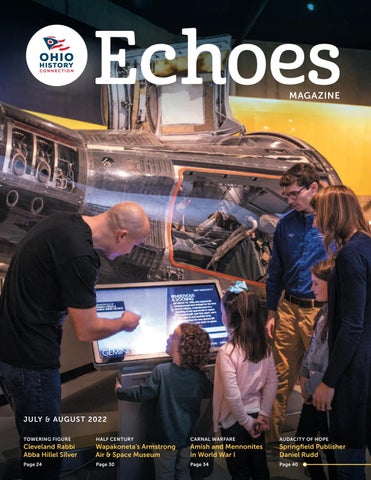
Cover: Visitors learn about the Gemini 8 space capsule at the Ohio History Connection’s Armstrong Air & Space Museum in astronaut Neil Armstrong’s hometown, Wapakoneta. The museum marks its 50th anniversary on July 20. See page 30. Armstrong Air & Space Museum
Contents J U LY & A U G U S T 2022
24
Rabbi Abba Hillel Silver— The Forgotten American Zionist
30
To Educate and Inspire—Wapakoneta’s Armstrong Air & Space Museum Turns 50
34
Carnal Warfare—The Experience of the Ohio Amish and Mennonites in World War I
40
Daniel Rudd and the Audacity of Hope— Ohio Historical Marker Honors Formerly Enslaved Newspaper Publisher
Vol. 61, No. 4 EDITORS
Bill Eichenberger Tom Wolf CONTRIBUTORS
Adam L . Fuller Owen Milnes Nanc y Nall Derringer Annie Nguyen Trevor Rhodes Tom Staf ford ADVISORY BOARD
Donna DeBlasio Youn gstown St ate Unive r sit y
Nishani Frazier Miami Unive r sit y
Rober t G enheimer Cin cinn ati Muse um Ce nte r
Stephen G eorge O hio Histor y Conne c tion
Alex Hastie O hio v. the World
G eorge Ironstrack Miami Unive r sit y
Chester Pach O hio Unive r sit y
Roger Pickenpaugh Historian an d Auth or
Daniel Rivers T he O hio St ate Unive r sit y
Truda Shinker O hio Histor y Conne c tion
I N E AC H I S S U E
2 4 4 6 15 16 18 19 46 48 50
Contents From Our Editors What’s Your Story? In the News Historic Sites & Museums At the Ohio History Center & Ohio Village Online Events Featured Events & Exhibits I Wish I’d Been There Young Eyes on the Past Reviews
Echoes Magazine (ISSN 0012-933X) is published bimonthly and distributed by the Ohio History Connection as a benefit of Ohio History Connection membership.
THANKS TO OUR OHIO HISTORY CONNECTION STRATEGIC PARTNERS:
Editorial Offices: Ohio History Connection, Ohio History Center, 800 E. 17th Ave., Columbus, OH 43211-2474 Phone 844.836.0012 Email echoes@ohiohistory.org Postmaster: Please send address changes to: Echoes Magazine, Ohio History Connection, Ohio History Center, 800 E. 17th Ave., Columbus, OH 43211-2474 Entire contents © 2022 by the Ohio History Connection. All rights reserved. Nothing may be reprinted or electronically reproduced in whole or in part without written permission from the publisher. The Ohio History Connection accepts no responsibility for facts and opinions expressed by the authors.
2 Echoes | JULY & AUGUST 2022
Moving? Contact us at membership@ohiohistory.org or 800.686.1545 to share your new address.
The Ohio History Connection is a
Like us on Facebook, and follow us on Instagram, Twitter and TikTok at @OhioHistory
Rabbi Abba Hillel Silver
24
THE FORGOTTEN AMERICAN ZIONIST Cleveland Rabbi Abba Hillel Silver lobbied politicians including President Harry Truman to support the founding of a Jewish national home. In 1947, he pleaded the case for a sovereign Jewish state to the United Nations Special Committee on Palestine, where, alongside future Israeli prime ministers David Ben-Gurion and Moshe Sharett, he gave an impassioned speech urging the recognition of Israel.
To Educate and Inspire
30
WAPAKONETA’S ARMSTRONG AIR & SPACE MUSEUM TURNS 50 On July 20, 1969, as Neil Armstrong prepared to walk on the moon, Ohio governor James A. Rhodes was preparing to make a trip of his own, to Armstrong’s hometown of Wapakoneta. On July 21, Rhodes “landed” on the Armstrongs’ front yard, where he announced plans for a museum commemorating the moon landing. It opened three years to the day after one of the most important events in human history.
Carnal Warfare
34
THE EXPERIENCE OF THE OHIO AMISH AND MENNONITES IN WORLD WAR I Nonresistance—the practice of not resisting authority, no matter how unjust or violent—has long been a tenet of the Mennonite faith. When the U.S. entered World War I in 1917, Ohio’s Mennonite and Amish congregations expected that they would be exempt from the draft, as they’d been during the Civil War. However, they found themselves thrust into a war they believed unjust, immoral and “of the flesh.”
Daniel Rudd and the Audacity of Hope
40
OHIO HISTORICAL MARKER HONORS FORMERLY ENSLAVED NEWSPAPER PUBLISHER Nineteenth-century Springfield publisher Daniel Rudd believed that the post-Reconstruction federal government was incapable of forging a truly equal society. Changing the name of his newspaper, The Ohio Journal, to the American Catholic Tribune, he urged fellow African Americans to join him in the Catholic Church for a spiritual freedom that civic institutions could not provide.
OHIOHIS TORY.ORG
3
FROM OUR EDITORS Why go to the moon? That’s a question that astronaut Neil Armstrong answered countless times before and after his successful voyage to the moon in 1969. (See page 30.) His July 20 walk on the moon was covered at length and in detail by the national and international press. After Armstrong’s return from outer space, he was feted with a parade in his hometown of Wapakoneta. It wasn’t long after his return that the State of Ohio put up $500,000 to build an air and space museum, a sum matched and exceeded by the good folks of his hometown. Rabbi Abba Hillel Silver’s story is that of 20th-century America, of emigration and of new lives in a new world. He came to the country from Lithuania, and attended public schools on New York City’s Lower East Side, Hebrew Union College and the University of Cincinnati. In 1917, he became rabbi of Cleveland’s The Temple-Tifereth Israel, where he served with distinction for 46 years. (See page 24.) At clevelandjewishhistory.net, Arnold Berger recalls Rabbi Silver’s influence at The Temple-Tifereth Israel: “It was the spring of 1958. The Temple was selling tickets for a major fundraiser, a benefit concert at Severance Hall, home of the Cleveland Orchestra. A trustee noted that sales of lower-price tickets were doing well, but box seats, which cost perhaps three times as much, were selling very slowly. “Then Rabbi Silver spoke, calmly, almost naively. ‘I don’t understand the problem. Why, I made seven calls today and everyone I spoke to bought at least two box seat tickets.’ “Trustees exchanged knowing glances. For they knew that Temple members would respond to a phone call from Abba Hillel Silver the way they might react to a message from On High.” Amish and Mennonite men were faced with a dilemma when America entered World War I: Claim status as a conscientious objector or agree to fight and violate one of the key tenets of their religion. The question of sincerity was at issue from the beginning. (See page 34.) In the 1919 pamphlet “Treatment of Conscientious Objectors in the Army,” Third Assistant Secretary of the Army F.P. Keppel wrote: “It is significant that in all the court-martial cases there were only two instances of an attempt to pose as a conscientious objector after a soldier got into trouble of some other account, and both of these men were agitators and propagandists.” One likes to imagine that Martin Luther King Jr. was familiar with the writings and work of late-19th-century African American journalist Daniel Rudd, editor of the American Catholic Tribune. (See page 40.) Even if not, Rudd preceded King by nearly 70 years when he presaged, “This country is not properly civilized and will not be until men learn to treat each other on their merits and not the color of their skin, their eyes, or their hair.”
4 Echoes | JULY & AUGUST 2022
What’s In every issue of Echoes Magazine, we feature the stories of Ohio History Connection members and other Ohioans to stoke memories and shed light on our shared past. For this issue, we asked,
“ What’s your favorite vacation spot in Ohio?” Here are some of your responses: HOCKING HILLS One of my favorite places to visit over a long weekend in Ohio is Hocking Hills State Park. While it’s stunning in every season, summer and fall are my choice times to visit this park in southeastern Ohio. Summertime hills flaunt waterfalls, wildflowers and hemlocks, while fall hills wave their vivid foliage. Hiking the trail areas around Ash Cave, Old Man’s Cave, Rock House, Conkle’s Hollow, Cedar Falls and Cantwell Cliffs never fails to realign me with nature. There are many places to camp or rent a cabin, with few or exceptional amenities. I am looking forward to visiting this fall to see the new Hocking Hills State Park Dining Lodge currently under construction after the old lodge was destroyed by fire in 2016. Canoeing or kayaking down the Hocking River is also a fun, relaxing experience. A visit to Hocking Hills State Park is not complete without traveling into the town of Logan for some food at Pizza Crossing. If you like crispy-tipped, cupped pepperoni that holds grease like a bathtub, you need to eat there. The Hockhocking Adena Bikeway spans about 20 miles from Ohio University to Hocking College, and taking your bike to this region will provide you with views of the foothills of Appalachia. —Rebekah Manofsky, Blacklick
Your Story?
VACATION DESTINATIONS
PUT-IN-BAY
LAKE HOPE
For a day-trip delight, I choose Put-in-Bay. We’ve done day excursions and weekends at hotels or camping at the gorgeous park. To summarize in a few words, it’s “cold beer, hot music.” We like to stay at the Park Hotel, which was built in the late 1800s and has such a historic feel and smell, and then step out from the front porch to the adult playground where music is everywhere, with great acts that you can dance right in front of. Or, if you wish, head out to the Boardwalk to relax on the deck and watch the gulls fly and the beautiful boats parade by in party fashion. For the price of a high-priced rock concert ticket, you can enjoy an entire day of great music of all styles. l really appreciate the band Mustang Sally. Better than most big-name concert bands, they command the stage and admission is free.
About 20 years ago, our good friends Greg “Woody” and Dee Lowe introduced us to our favorite Ohio vacation destination: Lake Hope State Park. They had been taking their two young sons on weekend trips to this 2,983-acre park, which lies within the Zaleski State Forest in the valley of Big Sandy Run in southeastern Ohio. Once we stayed in the rustic Iron Furnace cabins and hiked around Lake Hope (along with several other families we tailgated with at Ohio State University football games each fall), we were hooked. We loved it so much that our big group has been going every year in late February or early March, just when cabin fever has us all going a little stir-crazy. The only years we missed were when our son was only two months old, when the Ohio Department of Natural Resources closed the cabins to renovate them (the new mattresses and furniture are wonderful upgrades) and the past two years because of the global COVID-19 pandemic. In fact, the last major group outing/vacation was our annual trip in March 2020, a week before everything shut down. We’re hopeful to get together there again in spring 2023. Of course, in March the weather is very unpredictable, and we’ve experienced it all, from sunny and 75, with children frolicking in the water at the Lake Hope beach, to snowy, with children sledding down Parking Lot Hill. Some years it’s rainy and chilly, and that’s the perfect time to visit the Nature Center with naturalist programming. Each visit marks another year around the sun, as young boys and girls from our earliest trips are now grown up. My husband, Paul, and I have watched our 12-year-old son, Nick, grow up there, too, hiking the hilly trails around the lake, playing “Ghost in the Graveyard” and other games in the cabin at night and making tech-free memories that will last a lifetime.
—Lyn Shirk, Marion
PIATT CASTLES AND OHIO CAVERNS My first memory of these man-made and natural limestone marvels in West Liberty goes back to 1976. That year was the U.S. Bicentennial, and my family traveled on weekends from our home in Carroll County to see all things Ohio— the Ohio Canal System & Roscoe Village (Coshocton), productions of Tecumseh! (Chillicothe) and Blue Jacket (Xenia), and the eerie Blue Hole (Castalia). One weekend we went underground to tour the majesty of the Ohio Caverns, and then, after a picnic lunch, drove around the bend to nearby Mac-O-Chee and Mac-A-Cheek, the Piatt Castles. At Mac-O-Chee, I was awestruck by the presence of a towered castle among the cornfields. Around the corner and up a long, tree-shaded drive, I again marveled at the grand home, Mac-A-Cheek. Fortysix years later, I still make an annual pilgrimage up that tree-shaded drive, then down into the underbelly of Ohio. —Ronald A. Stewart, Palm Desert, CA
—Eileen Scahill, Columbus
Eileen Scahill with family at Lake Hope State Park over the years. Courtesy of Eileen Scahill
WHAT’S YOUR STORY? We want to know your stories, so in every issue of Echoes Magazine we ask you a question, then run selected answers in the following issue. Here’s the question for September & October: This is the 100th anniversary of the opening of Ohio Stadium, “the house that Chic (Harley) built.” What’s your first memory of the ’Shoe? Describe it to us. Email your story responses (50 to 150 words) by July 10 to echoes@ohiohistory.org or, if you follow us on Facebook, send us a Facebook message.
OHIOHIS TORY.ORG
5
In the News OHIO STORIES
Lighting the Way This year, one of the most beloved landmarks on Ohio’s Lake Erie shore, the Marblehead Lighthouse, marks the 200th anniversary of when it was first placed in use on a rocky outcropping at the entrance to Sandusky Bay (hence the name Marblehead). Built in 1821 and placed in service in 1822, the lighthouse has been marking the spot—potentially hazardous to boaters and ships—ever since. After two centuries, it’s still in active use, making it a pretty good buy as public works go. A pleasant day trip from many parts of Ohio, the venerable lighthouse is now part of nine-acre Marblehead Lighthouse State Park. The park offers picnic tables and an awesome panorama of Lake Erie from South Bass Island to Sandusky Bay. Marblehead Lighthouse Historical Society operates a related museum in the Victorianera Keeper’s House next door. You can also see a reconstructed 1876 lifesaving station. And, if fossils are your thing, you can see some amazing ones in the rocks that line the shore. HISTORY
Here’s what Ohio Memory, a program of the Ohio History Connection and State Library of Ohio, has to say about Marblehead Lighthouse: “In 1819, the 15th U.S. Congress
6 Echoes | JULY & AUGUST 2022
recognized the need for navigational aids along the Great Lakes, and set aside $5,000 for construction of a light tower at the entrance to Sandusky Bay. Contractor William Kelly built the 50-foot tower of native limestone on the tip of the Marblehead Peninsula. The base of the tower is 25 feet in diameter, with walls five feet thick. It narrows to 12 feet at the top with two-foot-thick walls. “The turn of the 20th century ushered in new technology as well as structural changes, including the addition of another 15 feet to the tower’s height. A clocklike mechanism was installed to rotate the lantern, creating the appearance of a brilliant flash of light every 10 seconds. This system required that the lighthouse keeper crank the weights every three hours through the night to keep the lantern turning. An improved Fresnel lens with prism surfaces created an even more brilliant beacon. ELECTRIFIED IN 1923
“An electric light finally replaced the kerosene lantern in 1923, dramatically increasing the intensity of the signal. During World War II, the lighthouse became strategically important for national defense. The last civilian lighthouse keeper resigned, and the United States Coast Guard assumed responsibility for the beacon in 1946. The beacon
was automated in 1958. With its original finish tattered by time and harsh weather, the exterior of the lighthouse tower was given a fresh coat of new stucco the same year. It was added to the National Register of Historic Places in 1969. “The Ohio Department of Natural Resources has maintained the property surrounding the lighthouse since 1972 and accepted ownership of the Marblehead Lighthouse tower in May 1998. The U.S. Coast Guard continues to operate and maintain the lighthouse beacon. Today’s 300 mm lens projects a green signal that flashes every six seconds and is visible for 11 nautical miles. The distinctive green distinguishes the lighthouse signal from white lights coming from air beacons. “In 2001–2002, the state renovated the tower and Keeper’s House at a cost of $500,000. In 2004, the Fresnel lens was moved to the museum in the Keeper’s House at the light station from the Marblehead Coast Guard Station, where it was previously on display.” WOLCOTT HOUSE TURNS 200, TOO
Three miles from the light on State Route 163 in Marblehead, Ottawa County Historical Society preserves another 200-year-old landmark, the restored 1822 home of the first lighthouse keeper, Benajah Wolcott, now the Benajah Wolcott House Museum. Wolcott employed William Kelly, the same Sandusky stonemason who built the
Toledo Lucas County Public Library Digital Collections
Stereograph of Marblehead Lighthouse about 1883.
PLANNING YOUR VISIT
Learn more about visiting the lighthouse, the adjacent Victorian-era Keeper’s House and the reconstructed 1876 lifesaving station at marbleheadlighthouseohio.org or ohiodnr.gov. (On days when the lighthouse is open, you can climb the spiral cast-iron stairs to the top.) Plan your visit to the nearby Benajah Wolcott House at ottawacountyhistory.org. Find more to explore in this region of Ohio at shoresandislands.com.
Ohio Memory is a collaborative program of the Ohio History Connection and the State Library of Ohio. More than a million vintage photos, maps, documents and other materials from historical societies, museums and related organizations in all 88 counties are at your fingertips at ohiomemory.org.
Wikimedia Commons | Magicpiano
Marblehead Lighthouse, to build his one-story stone farmhouse nearby.
1822 Benajah Wolcott House, Marblehead.
OHIOHIS TORY.ORG
7
THE NEXT 10 YEARS
STUDENT AND TEACHER SUPPORT
Outreach
The Student and Teacher Support Department manages all our K–12 programming, including virtual and in-person immersive experiences, Ohio History Day and Ohio as America. Before COVID-19, we launched a large-scale evaluation of our current educational programming. As part of this, we created a learning statement upon which we would update or build new programming:
by Stacia Kuceyeski The Ohio History Connection’s three strategic priorities for the coming decade are Equity, RelationshipBuilding and Sustainability. Equity and Relationship-Building are central to the Outreach Division’s work. Between creating meaningful collaborations with our fellow cultural institutions, teachers and administrators, and with a variety of communities rooted in identity and geography, our team continually impresses me with their dedication to uplifting those voices that have been traditionally silenced. There are many projects I could discuss that center around Equity and Relationship-Building, but I’d love to step outside our comfort zone and really focus on our third strategic priority, Sustainability.
The Ohio History Connection inspires all learners to use the tools of history to understand ourselves and each other, to experience our world with curiosity and to engage as changemakers in our communities. We made some hard decisions on what programs to keep and which to retire, focusing on those that would make the biggest impact for both our students and our teachers as well as the organization. This year, we began our business planning process to be strategic in areas where our biggest growth opportunities are and in how to best use staff members’ time to provide a wonderful learning experience for thousands of Ohio students while maintaining or increasing revenue opportunities. COMMUNITY ENGAGEMENT
Our Community Engagement Department is a new take on the work the Ohio History Connection has been doing for, in some cases, more than 50 years. Between managing the Ohio Historical Markers program and AmeriCorps, working on professional development for our site system, conducting oral histories and managing our Emerging New American Community Team (ENACT), the department began to feel like a collection of projects as opposed to a cohesive unit. We started working to find the connector between all our initiatives and then outlined measurable engagement activity goals and community impact goals. All of this work helps focus our resources across all our programs to ensure
8 Echoes | JULY & AUGUST 2022
Stacia Kuceyeski directs the Ohio History Connection’s Outreach Division. we’re working toward the same impact and purpose in a sustainable way to: Build capacity for all Ohioans to connect with and honor their stories, ensuring the Ohio History Connection’s work is inclusive and restorative. Community Engagement work is rooted in equity and innovation, grounding the Ohio History Connection’s reputation and relevance in a more complete Ohio history. This quote is part of the Community Engagement Department statement of purpose. Overall, the Outreach Division is looking strategically at the work we do to maximize our opportunities and maintain our programming so we can continue to serve our audiences, moving toward an increasingly sustainable and measurable model.
Right: More than 1,000 students across the state participate in the annual Ohio History Day contests organized by the Ohio History Connection and regional sponsors.
OHIOHIS TORY.ORG
9
HISTORIC PRESERVATION
Recent Ohio Additions to the National Register of Historic Places LORAIN • LORAIN COUNTY Courtesy Jay Jackson
BROADWAY HISTORIC DISTRICT
Left: Jackson in 2021 at the Hopewell Culture National Historical Park garden in Chillicothe, where he volunteers. Right: Jackson at Fort Hill in Hillsboro in the summer of 1953. DONOR SPOTLIGHT
John “Jay” Jackson The photos above, taken decades apart, illustrate the dedication and passion that John “Jay” Jackson has held over the years for earthworks sites throughout Ohio. His interest began at an early age, fostered by his father, who taught him the meaning behind the sites and instilled the respect and awe that Jackson retains for them today. While his interest in American Indian culture and archaeology has spanned his lifetime, Jackson’s retirement in 1998 provided the opportunity to dedicate more time to learning and volunteering. He signed up for archaeology classes at The Ohio State University and later participated in a weeklong seminar that focused on the archaeological methods and history of the earthworks. He began volunteering in the garden at Hopewell Culture National Historical Park in Chillicothe in 2016, where he grows many of the crops Native Americans relied upon. This spring, he was honored at Ross-Chillicothe Convention and Visitors Bureau’s annual Pineapple Awards as Volunteer of the Year for his exceptional service at Hopewell Culture National Historical Park.
10 Echoes | JULY & AUGUST 2022
The human connection made through visiting and learning about the earthworks is what continually draws Jackson to the sites. He connects through the tangible aspects, imagining the people who lived there, the work that they put into creating the earthworks and the ceremonies that occurred there. He imagines the people thousands of years ago, witnessing the same sunset in the same place, and the human connection is made. “It’s such an obvious space that invites ritual,” Jackson says. Jackson’s passion led him to make a charitable gift to the Ohio History Connection through his estate plans, establishing the Fort Ancient and Fort Hill Site Maintenance Endowment. This gift will assist in preserving and maintaining the sites, a vital aspect that’s often overlooked. “That’s what drives me to preserve—not through something grand but through maintenance,” Jackson remarks. His gift will help ensure that the earthworks are preserved for future generations to learn about and visit.
Roughly bounded by Broadway; West Erie Avenue from Washington Avenue & Erie Street Bridge; Washington Avenue; Reid Avenue; West 10th and includes West Fourth, West Fifth, West Sixth, West Seventh, West Eighth and West Ninth streets.
Founded in 1807, Lorain grew into a thriving industrial center along Lake Erie at the mouth of the Black River and Lorain Harbor, becoming the most populous city in the county. Centered on Lorain’s main 19th- and 20th-century commercial corridor, the National Register district includes many one- to four-story commercial buildings plus civic, private, institutional, religious and governmental buildings, with some residential interspersed. Architecturally, the time period represented is about 90 years, running from 1882, when the Italianate-style First National Bank of Lorain was built at 562 Broadway, to 1973, when City Hall, an example of the New Formalism of the 1960s, was completed at 200 W. Erie Ave. After a 1924 tornado devastated downtown, Lorain commenced a rebuilding program, and there are many buildings in the district that were either built or remodeled at that time, giving downtown Lorain an overall early-20th-century look.
commercial, institutional and residential buildings associated with the history of this county seat from 1828 to 1980. Eighty-eight of the 114 properties in the historic district are from its peak period of development, the 1870s through the 1920s. Architecturally, there are examples of Gothic Revival, Italianate, Second Renaissance Revival, Late Gothic Revival, the International Style and Brutalism. Four major buildings completed between 1976 and 1980— the City Hall, two banks and the telephone company—reflect postWorld War II modernism.
TOLEDO • LUCAS COUNTY TOLEDO CENTRAL BUSINESS HISTORIC DISTRICT Roughly bounded by 10th Street, the Maumee River, Monroe Street and Jackson Street.
Encompassing much of the Glass City’s old central business district, the Central Business Historic District reflects Toledo’s development as an important industrial and commercial center from just after the Civil War through the late 20th century, when city-led urban renewal efforts changed the face of downtown. The district reflects the history of community planning and development, commerce and architecture in Toledo. Some buildings in the National Register district are the work of locally and nationally prominent architects, while the remainder collectively reflect the evolution of the city and its architecture over time. Fifteen are less than 50 years old, reflecting the final phase of an urban renewal campaign that began in the 1960s and concluded in 1988. One previously listed National Register historic district, the Madison Avenue Historic District, is within the boundaries of the new, larger historic district.
BELLE VALLEY • NOBLE COUNTY
EXALTATION-ELEVATION OF THE HOLY CROSS CHURCH 100 Walnut St.
This 1915 church on a steep wooded hillside overlooking the village of Belle Valley is significant in the areas of ethnic heritage and social history. The southern Ohio coal fields of Guernsey and Noble counties, including Belle Valley, brought migrants from Slovinky, Slovakia, in search of opportunity as mining expanded in support of Ohio’s booming early-20th-century steel industry. The Byzantine Revivalstyle church with its onion dome is the only physical representation of Slovak ethnic heritage remaining in Belle Valley. Serving both Byzantine Catholic and Russian Orthodox congregations who built it together and worshipped there independently, it was one of the most important local institutions for preservation of Eastern European language and culture in this small, isolated mining town. The dual religious
MARION • MARION COUNTY
MARION DOWNTOWN HISTORIC DISTRICT Roughly bounded by Center, Vine, Pleasant and Orchard streets.
Centered on Marion’s original plat around the intersection of Main and Center streets, the Marion Downtown Historic District includes
All National Register photos courtesy State Historic Preservation Office
services it housed and the building’s iconography were the strongest reminders of the ethnic traditions as well as the religious and political differences of their homeland. The church closed in 1967. ACT NOW
Ohio Open Doors Returns Own an Ohio landmark? Sign up now to become a host site for Ohio Open Doors, a 10-day event Sept. 9–18 when Ohio’s historic buildings and landmarks will open their doors for special tours and events. An Ohio History Connection project, Ohio Open Doors is co-sponsored by the Ohio Travel Association, TourismOhio, the Ohio Arts Council and Heritage Ohio. Deadline for registering your event is Aug. 1. GRANTS AVAILABLE
Events submitted must be free of charge, but small stipends for creating events are available on a first-come, first-served basis to organizations with an annual budget of $50,000 or less, or three or fewer paid staff. New this year are arts-related stipends, sponsored by the Ohio Arts Council, to add an arts component to your event like live music, a storyteller or other performer, or enhanced graphics. HOW DO I SIGN UP?
It’s easy! Complete and submit the form at ohiohistory.org/host for each event you’re hosting, where you can also apply for event stipends or arts stipends. Events will be posted to the calendar shortly after they are received. Questions? Call 614.298.2000.
OHIOHIS TORY.ORG
11
OHIO STORIES
Schoenbrunn, Resurrected Many Ohioans are familiar with the story of Schoenbrunn, a town on the Ohio frontier near present-day New Philadelphia that was settled 250 years ago in 1772 by Moravian Christian missionaries and Christian Delaware Indians and abandoned in 1777. Fewer know the story of how the vanished community returned nearly 150 years later. A MASSIVE EFFORT
It involved an effort by many people and organizations, notable among them members of the Tuscarawas County Historical Society and a local Moravian minister who devoted much of his spare time to making it happen; money given by Ohio schoolchildren and churches; the Ohio General Assembly and the State of Ohio; the Ohio State Archaeological and Historical Society, now the Ohio History Connection; and Ohioans employed by federal New Deal programs during the Great Depression. Efforts had been made to mark the site of Schoenbrunn as early as 1872, its centennial year. In 1920, Tuscarawas County teachers launched an effort to place markers at local historic sites, including the site of Schoenbrunn. Formation of the Tuscarawas County Historical Society followed in 1921. Schoenbrunn means “beautiful spring” in German. While the location of the spring from which its name comes remained known, at the time
Ohio History Connection
Below: Interior, Schebosh Cabin, Schoenbrunn, about 1929.
12 Echoes | JULY & AUGUST 2022
of Schoenbrunn’s sesquicentennial in 1922, no one knew for sure where the town had stood. “For over a hundred years, crops were planted and harvested on the site of the village without anyone knowing exactly where the town had been,” wrote Rev. Joseph E. Weinland in 1930. Weinland (1871–1936), pastor of First Moravian Church of Dover, became one of the champions, if not the champion, of resurrecting Schoenbrunn, according to “Joseph E. Weinland, Rebuilder of Schoenbrunn,” an address by Robert M. Wilkin at a meeting of the Tuscarawas County Historical Society (which Weinland had served as trustee and president) transcribed in the January 1933 Ohio State Archaeological and Historical Society Journal. A KEY PIECE OF THE PUZZLE
Weinland located a key piece of the puzzle, the 1772 “Zeisberger map,” in the Moravian archives in Pennsylvania. David Zeisberger was the Moravian missionary who helped lead the establishment of Schoenbrunn. The hand-drawn plat of Schoenbrunn held clues to the town’s geographic location. Together with physical features of the landscape, below-ground evidence and information gathered in notarized testimonies from local people—some descended from early settlers—it enabled the site of the village to be located with certainty by August 1922. Meanwhile, for the 1922 sesquicentennial, Weinland organized theatrical pageants that shared the story of Schoenbrunn, raising awareness of its significance. Many local people performed in the pageants, and more than a thousand others attended them. Weinland also chaired the Ohio State Archaeological and
Historical Society’s Schoenbrunn Committee, appointed “to have charge of the site and of the securing of a fitting Memorial.” In 1923, he and others took the cause of preserving the site to the Ohio General Assembly, which, through the efforts of local Rep. Joseph H. Ebright, appropriated $10,000 to buy the site of the town—the first of several related land purchases and allocations by the state. Gov. A. Victor Donahey, who was from Tuscarawas County, appointed a Schoenbrunn Memorial Commission. DONATIONS FROM SCHOOLCHILDREN AND CHURCHES
By summer 1923, plans to reconstruct Schoenbrunn were well underway. Ohio schoolchildren were invited to donate on the day before Thanksgiving toward reconstructing the log school, and Ohio’s churches were asked to contribute to reconstruction of the log church. Rebuilding got underway in 1927. In an October report, Weinland noted that the first cabin, named Schebosh for original occupant John Joseph Schebosh, was almost done, and that logs for the schoolhouse had been hewn. Reconstructed using information from the Moravian archives, the schoolhouse was dedicated on July 29, 1928, and the log church replicating one built at Schoenbrunn in 1773 was dedicated on Oct. 21, 1928. Crowds estimated at 5,000 people and 4,000 people, respectively, attended the dedications. ROMANTIC STORY
Weinland spread Schoenbrunn’s story more widely by authoring a booklet, The Romantic Story of Schoenbrunn, the First Town in Ohio, published by the Ohio State Archaeological and Historical Society. In 1929, Prohibition was the law, and in a presentation to members of the Tuscarawas County Women’s Christian Temperance Union, Weinland observed that Ohio’s
Ohio History Connection
Ohio History Connection
Courtesy Curt Teich Archive
Left: Schoenbrunn, about 1929. Top right: Church interior, 1929. Bottom right: School and church, Schoenbrunn, about 1929.
temperance movement was rooted in 18th-century Schoenbrunn, where alcohol was not permitted under a 1772 code of statutes. The women agreed to finance reconstruction of the cabin of Esther, a deaconess at the mission, as a memorial to early temperance leaders. Missionary and teacher David Zeisberger’s cabin next to the church was dedicated in October 1930, and by 1931, more cabins were in place, all named for people who lived at Schoenbrunn in the 1770s according to the Zeisberger map. NEW DEAL
Like many ambitious projects of the 1920s, reconstruction of Schoenbrunn continued into the Great Depression of the 1930s, benefiting from the work of those employed by relief agencies created under President Franklin D. Roosevelt’s New Deal. A Civilian Conservation Corps (CCC) camp was established nearby in 1933. CCC workers built Conner cabin, finished in 1935, and completed many other projects around Schoenbrunn, building stone-and-timber picnic shelters and planting more than 10,000 trees and
shrubs to evoke the forested setting of the 1770s. Photos in Ohio History Connection collections with vintage captions show that young men and women employed by the National Youth Administration (NYA) aided in building a new entrance and road into Schoenbrunn, made and installed signs, and were involved in “restoring” buildings. TWO LAYERS OF SIGNIFICANCE
Today, Schoenbrunn has two layers of history. One is as a frontier village where Moravians and Christian Delaware Indians lived from 1772 until 1777, site of Ohio’s first church and school. The second is as an early, large-scale example of a national trend in the 20th century: reconstructing historic sites to aid in their understanding and appreciation. One of the largest such efforts, Virginia’s Colonial Williamsburg, followed in 1926, championed by another minister, Rev. Dr. W.A.R. Goodwin of Bruton Parish Church. With support from John D. Rockefeller, it opened in 1932.
Occurring simultaneously was a nationwide boom in the number of automobiles, drivers and paved roadways, making travel to onceremote destinations practical and appealing. Schoenbrunn offered somewhere to go and an Ohio history connection, as it still does today. LEARN MORE
Though dated, The Romantic Story of Schoenbrunn by Rev. J.E. Weinland offers an account of the reconstruction in Weinland’s own words as he saw it in 1930. Find it in the Ohio History Connection’s Archives & Library at the Ohio History Center in Columbus. Thanks to Tuscarawas County Historical Society and Kim Jurkovic for a more thorough accounting of this subject in The Chronicler, Vol. 35, No. 2, which aided in details of this story. Plan your visit to Schoenbrunn at ohiohistory.org/schoenbrunn.
OHIOHIS TORY.ORG
13
Left: Opening of the exhibit Bhutanese-Nepali Neighbors, 2017. Right: Ohio Village Muffins and Diamonds Base Ball. THROUGH OCT. 30
Bhutanese-Nepali Exhibit at Zoar On exhibit through Oct. 30 in the Bimeler Museum at the Ohio History Connection’s Zoar Village in Zoar, Ohio, Bhutanese-Nepali Neighbors: Photographs by Tariq Tarey shares the stories of central Ohio’s Bhutanese-Nepali refugees through a series of portraits by Tariq Tarey and accompanying narratives written by Doug Rutledge. The photographs emphasize the Bhutanese-Nepali refugee experience, from living and working in Bhutan; to being forced to leave; to the experience of living in refugee camps in Nepal; to resettlement in Columbus, finding jobs, buying homes and finally becoming American citizens. About 20,000 Bhutanese-Nepalis now live in Columbus and central Ohio. The story parallels the experience of the Zoarites, Separatists from the German states who traveled to the United States in search of religious freedom. They formed a communal society in 1819 known as the Society of Separatists of Zoar. While the Bhutanese-Nepali refugees and Separatist refugees came from very different worlds, their desire to find security and freedom in America— along with the challenges and struggles of resettlement—are similar.
14 Echoes | JULY & AUGUST 2022
Both communities have helped shape the history of our state.
TICKETS ON SALE SOON
Bhutanese-Nepali Neighbors was first exhibited at the Ohio History Center in 2017. Admission to the exhibit is included with Zoar Village admission. Ohio History Connection members enjoy free admission to Zoar Village and the exhibit. A National Historic Landmark, Zoar Village is managed for the Ohio History Connection by Zoar Community Association. Learn more about visiting Zoar at historiczoarvillage.com. Questions? Call 800.262.6195.
Halloween is still a long way off, though just a heads-up that member tickets for All Hallows’ Eve at Ohio Village go on sale Monday, Aug. 29, with tickets on sale to the general public Tuesday, Sept. 6. Christmas is even farther off, though member tickets for Dickens of a Christmas in Ohio Village and Dickens Dinners and Christmas Buffets at the American House Hotel in Ohio Village go on sale to Ohio History Connection members Monday, Sept. 19, and to the general public Monday, Sept. 26. Questions? Call 800.686.6124 or visit ohiohistory.org/village.
VINTAGE BASE BALL
Muffins and Diamonds Seek New Players The Ohio Village Muffins and Diamonds are seeking new players. An educational program of the Ohio History Connection, the Muffins and their sister team, the Diamonds, play base ball (yes, two words) according to the rules and customs of the 1860s. Both teams travel all across Ohio and beyond to represent the Ohio History Connection and demonstrate base ball as played in its formative years. Interested in playing for either team? Contact TheOhioVillageMuffins@ gmail.com, or find them on Facebook at The Ohio Village Muffins.
Holiday Heads-Up
Don’t miss our fascinating monthly Member VIP webinars! (See page 18.) Contact the Membership office if you’d like help in registering.
O HI O HIS TO RY CO NNEC T I O N
Historic Sites & Museums NORTHWEST OHIO 1. Armstrong Air & Space Museum 2. Cedar Bog Nature Preserve 3. Cooke-Dorn House 4. Fallen Timbers Battlefield Memorial Park 5. Fort Amanda Memorial Park 6. Fort Jefferson Memorial Park 7. Fort Meigs 8. Fort Recovery Museum & Monument 9. Glacial Grooves Geological Preserve 10. Hayes Presidential Library & Museums 11. Indian Mill 12. Inscription Rock Petroglyphs 13. Johnston Farm & Indian Agency 14. Lockington Locks
NORTHEAST OHIO 15. Custer Monument 16. Fort Laurens 17. McCook House 18. Museum of Ceramics 19. Quaker Yearly Meeting House (Open by Appointment) & Free Labor Store/Benjamin Lundy House (Preservation in Progress • Not Open) 20. Schoenbrunn Village 21. Shaker Historical Museum 22. Tallmadge Church 23. Youngstown Historical Center of Industry & Labor 24. Zoar Village
CENTRAL OHIO
SOUTHWEST OHIO 34. Adena Mansion & Gardens 35. Davis Memorial Nature Preserve 36. Fort Ancient Earthworks & Nature Preserve 37. Fort Hill Earthworks & Nature Preserve
SOUTHEAST OHIO
25. Flint Ridge Ancient Quarries & Nature Preserve
38. Harriet Beecher Stowe House
26. Hanby House
40. Miamisburg Mound
48. Big Bottom Memorial Park
27. Logan Elm
41. National Afro-American Museum & Cultural Center
50. Buffington Island Battlefield Memorial Park
28. Newark Earthworks 29. Ohio History Center & Ohio Village
39. John Rankin House 49. Buckeye Furnace
42. Paul Laurence Dunbar House
51. Campus Martius Museum
43. Serpent Mound
52. John & Annie Glenn Museum
30. Poindexter Village Historic Site (Preservation in Progress • Not Open)
44. Story Mound
53. Leo Petroglyphs & Nature Preserve
31. Shrum Mound
45. U.S. Grant Birthplace
54. National Road & Zane Grey Museum
32. Wahkeena Nature Preserve
46. U.S. Grant Boyhood Home & Schoolhouse
55. Ohio River Museum
33. Warren G. Harding Presidential Sites
47. William Henry Harrison Tomb
56. Our House Tavern
Ohio History Connection members enjoy free regular admission to these Ohio History Connection sites. Before traveling, visit ohiohistory.org/sites to confirm hours and any special requirements.
OHIOHIS TORY.ORG
15
P R O G R A M S & E X H I B I T S AT T H E
Ohio History Center & Ohio Village
OHIO VILLAGE
Explore Life in the 1890s WEDS.–SUN. THROUGH SUN., OCT. 30 10 A.M.–5 P.M. Get a look at life in the 1890s. Make the rounds of village homes and businesses to catch up on the gossip (most don’t have a phone), poke your head in on the chickens, use chalk to write on slate, pump some water and maybe try one of those newfangled bicycles at Barrington’s. Some days are busy, some are quieter, though someone’s always up to something!
about the dangers lurking in some 1890s cosmetics, and hear the sordid story of food fraud that was common before President Theodore Roosevelt signed the 1906 Food and Drugs Act. While in town, catch up on the latest slang and try your hand at some old-fashioned hooprolling, croquet or bowling on the village green. Included with Ohio History Center & Ohio Village admission. Ohio History Connection members enjoy free admission. 800.686.6124 or ohiohistory.org/village
1890s Independence Day SAT., JULY 2 & SUN., JULY 3 10 A.M.–5 P.M. Hooray for the red, white and blue! Cheer a patriotic procession; applaud Prof. Wurst’s Patriotic Flea Circus and traveling performers; plug your ears when the G.A.R. (Grand Army of the Republic) fires the cannon; vote in our election; and voice your support (or not) for women to gain the right to vote. Shop the Emporium; visit the pharmacy, blacksmith or schoolhouse; and try your skill at stilts, croquet, hooprolling and more on the village green. (Tip: Some activities take place at appointed times. Use our Independence Day weekend schedule at ohiohistory.org/village to plan your visit.) Included with Ohio History Center & Ohio Village admission. Ohio History Connection members enjoy free admission. OHIO VILLAGE
Victorian Mythbusting SAT., JULY 23 & SUN., JULY 24 10 A.M.–5 P.M. Fact or fiction? On this special weekend, we’ll debunk some popular myths about Victorian life. Learn from our pharmacist
16 Echoes | JULY & AUGUST 2022
Peerless City SAT., AUG. 27 • 1–3 P.M. Ohio History Center, Columbus 4 See Peerless City, a film by directors Amanda Page and David Bernabo that explores the rise and decline of Portsmouth, Ohio, once promoted as the Peerless City and “Where Southern Hospitality Begins.” A 1937 Ohio River flood devastated the city, followed by a steep decline in industry, further economic decline, the opioid epidemic and dwindling population. Still, some who call Portsmouth home are determined to bring its reputation back. A handful of citizens started calling it “the Comeback City,” a nickname that conjures the city’s spirit and inspires civic pride. The film is generously funded by Ohio Humanities and the Ohio Arts Council. Included with Ohio History Center & Ohio Village admission. Ohio History Connection members enjoy free admission.
Ohio Cup
Ohio History Center, Columbus 4 Forget the 1890s. Travel back to the 1950s, where you might just be persuaded to buy your own Lustron steel house, discover some tasty(?) foods of the time and take part in a trivia game show. Alcohol included with admission. 21+. Advance registration required. $40, $35/Ohio History Connection member. 800.686.1541 or reservations@ ohiohistory.org
SAT., SEPT. 3 & SUN., SEPT. 4 9 A.M.–5 P.M. Grounds of the Ohio History Center & Ohio Village, Columbus 4 See more than two dozen teams from across the nation compete by 19th-century rules for vintage base ball’s Ohio Cup. Enjoy special activities for kids, including oldtime games and sports, and try your hand at 1860s base ball with our Ohio Village Muffins. Included with Ohio History Center & Ohio Village admission. Ohio History Connection members enjoy free admission. 800.686.6124 or ohiohistory.org/village
OHIO VILLAGE
FEATURED EXHIBITS • • •
PLEASURES OF THE CUP OHIO VILLAGE
SPECIAL FILM SCREENING
Mad for Martinis SAT., AUG. 13 • 7–9 P.M.
Crime and Corruption SAT., AUG. 20 & SUN., AUG. 21 10 A.M.–5 P.M. Visit on this special weekend to explore the seedier side of life in the 1890s. Learn about common crimes. Investigate a crime scene, learn how to track down criminals and see trials in the Town Hall. Explore the pseudoscience of physiognomy, the origin of mugshots and the history of bodysnatching. Included with Ohio History Center & Ohio Village admission. Ohio History Connection members enjoy free admission. 800.686.6124 or ohiohistory. org/village
Indigenous Wonders of Our World—The Hopewell Ceremonial Earthworks ONGOING Indigenous Wonders of Our World looks at eight 2,000-year-old Hopewell earthworks in Ohio: Fort Ancient, near Oregonia and Lebanon; Newark’s Great Circle and Octagon; and Hopewell Mound Group, Mound City, Hopeton Earthworks, Seip Earthworks and High Bank Works, all near Chillicothe. Unique in the world, they’re the focus of a nomination now underway proposing that they be named World Heritage Sites by UNESCO, the United Nations Educational, Scientific and
*Museum admission is $13; $11/ages 60+; $7/ages 4–12. Ohio History Connection members and ages 3 & under enjoy free admission.
by Mary Stuart Andrews of Warren, who worked for the Ohio Woman Suffrage Association, and a suffrage parade banner made in 1910 by Columbus Sign Co.
1950s—Building the American Dream ONGOING Get a look at life in the 1950s. Peek in the closets and snoop in the drawers of a real, fully furnished Lustron steel house made right here in Ohio. From the contents of the cupboards to the news on TV and the toys in the yard, this hands-on exhibit is a fascinating journey back in time.
“““
1890s Independence Day JULY 2 & 3, OHIO VILLAGE, COLUMBUS
Cultural Organization. The exhibit looks at mathematical similarities among them, their enormous scale, and their alignments to the solstices and/or the 18.6-year lunar cycle. An immersive component allows you to experience the astronomical alignments.
Ohio—Champion of Sports ONGOING Ohio—Champion of Sports features more than 70 stories and 35 oral histories covering more than 25 sports ranging from baseball, football and basketball to roller derby, skateboarding and e-gaming. The exhibit showcases the Ohio athletes, coaches, owners and fans at the center of the action and explores sports through the themes of Character, Adversity, Innovation, Identity, Tradition and Victory—values that relate to the human condition—to connect a broad audience to Ohio’s national sports history. You can test your basketball skills at the Wall of Hoops, record a “victory dance” to share with family and friends, and record your own “One Minute Legends” sports story.
Votes for Women— 100 Years of Change ONGOING Votes for Women commemorates the 100th anniversary of the 19th Amendment. Through the voices of Ohio women, explore women’s activism in the suffrage movement and other related social movements—such as voting and citizenship—from the 19th century to the present. Featured are a suffrage parade blouse, jacket and sashes worn in the 1910s
World War I Display ONGOING See equipment, weapons, uniforms and memorabilia commemorating the centennial of World War I.
Creative Ohio—Artists, Artwork & Their Inspiration ONGOING Through pieces from Ohio History Connection collections, explore the artwork, inspiration and creative processes of four Ohio artists—Paul-Henri Bourguignon (1906–1988), Emerson Burkhart (1905–1969), William Hawkins (1895–1990) and Josephine Klippart (1848–1936)—and create your own artistic masterpiece. Support provided by the Erika Bourguignon Charitable Trust NOMINATION DEADLINE
Ohio Local History Alliance Awards MON., AUG. 1 Each year, the Ohio Local History Alliance honors outstanding contributions by individuals and by local historical societies, museums and related organizations to understanding and appreciation of state and local history in Ohio. Learn more and find nomination forms at ohiolha.org.
Some of our Plus members have no children or grandchildren, but love using their Plus admission benefits to bring friends or
relatives along on visits!
OHIOHIS TORY.ORG
17
Ohio History Center Hours
AT T E N D FROM A N Y W H E R E !
Museum WEDS.–SUN. 10 A.M.–5 P.M. CLOSED MON.–TUES.
Ohio Village THROUGH OCT. 30: WEDS.–SUN. 10 A.M.–5 P.M.
Online Events MEMBER VIP
Ohio Quilts from the 1940s to the Present
CLOSED MON.–TUES.
Third Floor Research Room
MON., JULY 18 • 3 P.M. Online—Attend from Anywhere! 4 Hosted by the Ohio History Connection’s Membership Department 4 History Curator and Curatorial Department Manager Becky Preiss Odom will share quilts from our collection and the history of this art form during modern times. Free to Ohio History Connection members with required advance registration: ohiohistory.org/quilts3.
OPEN BY APPOINTMENT ONLY ohiohistory.org/learn/archives-library WEDS. 12:30–3 P.M. THURS. & FRI. 10 A.M.–3 P.M. CLOSED SAT.–TUES.
Plaza Cafe OPEN WEDS.–SUN. 11 A.M.–2 P.M. The Plaza Cafe serves grab-n-go salads, sandwiches, sides and desserts, coffee, tea, juices and Pepsi products. Ohio History Connection members save 10% at the Plaza Cafe.
Presidential History Book Club WEDS., JULY 27 & AUG. 31 • NOON–1 P.M. Online—Attend from Anywhere! 4 Hosted by Hayes Presidential Library & Museums, Fremont 4 See page 21.
MEMBER VIP
Discovering History Through Cooking TUES., AUG. 16 • 3 P.M. Online—Attend from Anywhere! 4 Hosted by the Ohio History Connection’s Membership Department 4 Get a look at how our Ohio Village interpretive staff and volunteers develop our cooking programs. We’ll learn about historic cookbooks, the cooking equipment they use and how they source some of the unusual ingredients, as well as what we can learn about history through food and cooking. Free to Ohio History Connection members with required advance registration: ohiohistory.org/cooking.
Escape of the 28 from Boone County, Kentucky SUN., AUG. 21 • 4–5:30 P.M. Online—Attend from Anywhere! 4 Hosted by Harriet Beecher Stowe House, Cincinnati 4 See page 23.
NOW OPEN
Open 11 a.m.–2 p.m. Wednesday–Sunday SERVING GRAB-N-GO:
• Salads • Sandwiches • Sides • Desserts
• Coffee • Tea • Juices • Pepsi Products
Ohio History Connection
MEMBERS SAVE 10% at the Plaza Cafe!
“““
Evening on the Canal AUG. 6, JOHNSTON FARM & INDIAN AGENCY, PIQUA 18 Echoes | JULY & AUGUST 2022
F E AT U R E D O H I O H I S T O R Y C O N N E C T I O N
Events & Exhibits Many programs and events at Ohio History Connection museums and attractions require advance registration. To register, call the number or visit the website listed with each program. Our online calendar offers more upto-date information about programs and events at Ohio History Connection museums and attractions. Find it at ohiohistory.org/calendar. Questions? Call 800.840.6127.
STATEWIDE APPLICATION DEADLINE
Ohio History Fund Grants TUES., SEPT. 27 Know of a worthy history- or preservation-related project that could benefit from an Ohio History Fund grant? Find application forms and more information at ohiohistory.org/ historyfund or call 800.686.6124 or 614.298.2000.
CENTRAL OHIO CENTRAL OHIO See also Ohio History Center & Ohio Village, pages 16–18. INDIGENOUS WONDERS OF OUR WORLD
Newark Earthworks Open House MON., JULY 25 Open daylight to dusk, with staff on hand to answer questions from noon to 4 P.M. and guided tours of the Octagon Earthworks at 12:30 and 2:30 P.M. 4 Great Circle Earthworks, 455 Hebron Rd., Heath 4 Octagon Earthworks, 125 N. 33rd St., Newark 4 Wright Earthworks, north of Grant Street on James, parallel to State Route 79 in Newark 4 Explore all three segments of the 2,000-year-old Newark Earthworks that served social, ceremonial and astronomical functions for their builders, American Indians of
the ancient Hopewell Culture. The tours don’t require reservations or advance registration. Meet at the large map by the parking lot. 614.297.2653 or ebartlett@ ohiohistory.org
Poindexter Village Drum Circle SAT., AUG. 13 • NOON-4 P.M. Legacy Tree, Poindexter Village, Columbus Elder drummers, community leaders, musicians, neighbors and past residents will gather with African drums and lawn chairs to share stories, song and dance. Enjoy various arts, puppet storytellers and craft tables where you can make and decorate a take-home wood box drum to use during the Drum Circle call-andresponse. Local artist vendors and food trucks will be on hand. Free. 800.752.2603 or ohiohistory.org/naamcc NORTHEAST OHIO
NORTHEAST OHIO
Shaker Soirée SAT., JULY 9 • CHAMPAGNE HOUR 6–7 P.M. • GARDEN PARTY 7–10 P.M. Grounds of Shaker Historical Museum, Shaker Heights 4 This new event is an homage to Shaker Historical Society’s former Gracious Gardens tours and first planned social event, a community garden party in 1948. All guests will have full access to beer, wine, cocktails, hors d’oeuvres and desserts in an intimate garden setting, with cocktail tables and limited seating throughout the evening. Garden party attire encouraged. TICKETS: Garden Party Only: $100 ($40 taxdeductible) includes heavy hors d’oeuvres, desserts, two drink tickets and music. Garden Party + Champagne Hour 6–7 p.m.: $175 ($95 tax-deductible) includes unlimited champagne, three drink tickets, live music and optional behind-thescenes museum tour with the executive director plus Garden Party. Proceeds benefit the society’s programs, exhibits and collections. 800.860.6078 or shakerhistory.org
Antique Show and Artisans Tent
SAT., JULY 30 • 10 A.M.–5 P.M. SUN., JULY 31 • 10 A.M.–4 P.M. Zoar Village, Zoar 4 Shop more than 60 dealers of high-quality country antiques. This annual event is one of the nation’s most prestigious antique shows, with dealers from across the country sharing unique finds with Early Americanstyle enthusiasts and decorators. An Artisans Tent showcases the work of highly skilled, juried artisans. Additional attractions include historic tours. $10, Free/age 12 & under. 800.262.6195 or historiczoarvillage.com
FEATURED EXHIBITS • • •
Bhutanese-Nepali Neighbors: Photographs by Tariq Tarey THROUGH SUN., OCT. 30 Bimeler Museum, Zoar Village, Zoar 4 Experience a modern story of immigration with parallels to the story of Zoar. Learn about the brave journeys that have brought more than 20,000 Bhutanese-Nepali refugees to central Ohio, through 30 portraits by Columbus photographer Tariq Tarey. Included with Zoar Village admission. Ohio History Connection members enjoy free admission. Bhutanese-Nepali Neighbors: Photographs by Tariq Tarey is made possible by the Greater Columbus Arts Council; The Columbus Foundation; the Ohio Arts Council; Jewish Family Services; the Ohio Alliance for Arts Education; United Way of Central Ohio; Puffin Foundation West, Ltd.; and Ethiopian Tewahedo Social Services.
OHIOHIS TORY.ORG
19
Summer Moon Festival JULY 15–17, WAPAKONETA
NORTHWEST OHIO
See Base Ball (Yes, Two Words) Played by 19th-Century Rules! 2022 HOME & AWAY SCHEDULE ohiohistory.org/muffins 800.686.6124
NORTHWEST OHIO
Independence Day 1813 MON., JULY 4 • OPEN TO THE PUBLIC NOON • TOUR DEPARTS 12:30 P.M. FORMAL CEREMONY 2 P.M. ON THE GRAND PARADE Fort Meigs, Perrysburg 4 See for yourself how the American Army celebrated Independence Day during the War of 1812 in Ohio, with an 18-gun salute roaring from the field artillery of Fort Meigs. The day also includes a 45-minute guided tour of the grounds, presentations and demonstrations in military marching and musket firing. Find a full schedule for the day at fortmeigs.org. $10, $8/senior, $5/ child, Free/Ohio History Connection member or age 5 & under. 800.283.8916 or fortmeigs.org
Independence Day Concert
VINTAGE BASE BALL FESTIVAL Sat., Sept. 3 & Sun., Sept. 4 9 a.m.–5 p.m. Included with Ohio Village admission. Ohio History Connection members enjoy free admission.
For the full Ohio Village Muffins schedule visit ohiohistory.org/muffins. ohiohistory.org/village
20 Echoes | JULY & AUGUST 2022
MON., JULY 4 • 2–3:30 P.M. Grounds of Hayes Presidential Library & Museums, Fremont 4 Attend a free outdoor performance by the Toledo Concert Band featuring members of the Toledo Symphony and a variety of patriotic favorites, with cannons fired in sync to Tchaikovsky’s 1812 Overture. Bring a lawn chair or blanket. Food trucks will sell lunch and snacks. Parking is on the grounds. Overflow parking is on the street or in ProMedica Memorial Hospital’s parking lots at 605 Third Ave. Ohio History Connection members enjoy free admission to the Hayes home and museum, open 9 a.m. to 5 p.m. (The library will be closed.) 800.998.7737 or rbhayes.org
Rod Berry Photography
Rod Berry Photography
“““
“““ Armstrong Museum 50th Anniversary Celebration JULY 20, WAPAKONETA
Second Saturdays R 4 Kids SAT., JULY 9 & AUG. 13 • 9:30–11:30 A.M. Hayes Presidential Library & Museums, Fremont 4 Enjoy monthly activities for kids in grades K–3 inspired by the 200th birthday of President Rutherford B. Hayes, which is coming up in October. Each month features a different activity highlighting an important time in the president’s life. These events are openhouse-style, so kids can stop by any time between 9:30 and 11:30 a.m. Free. 800.998.7737 or rbhayes.org
Spiegel Grove Squires Home Games SUN., JULY 10, AUG. 14 & AUG. 28 Hayes Presidential Library & Museums, Fremont 4 See the Squires take on other vintage teams in a game of base ball as played in the 1860s, when the sport became organized with standard rules of play. SUN., JULY 10 AT 1 P.M.: Squires vs. Eastwood Iron Horses. SUN., AUG. 14 AT 2 P.M.: Squires vs. the Ohio Village Muffins. SUN., AUG. 28 AT 1 P.M.: Squires vs. Canal Dover Red Legs. Free. 800.998.7737 or rbhayes.org
Verandah Concerts WEDS., JULY 13, 27, AUG. 10 & 24 6:30–8 P.M. Free Old-Fashioned Ice Cream Social at 6:30 P.M. • Music Starts at 7 P.M. 4 Hayes Presidential Library & Museums, Fremont Enjoy free outdoor concerts on the lawn of the Rutherford B. Hayes home. JULY 13: Grande Royale Ükulelists of the Black Swamp. JULY 27: Common Chords with Robert Jones and Matt Watroba. AUG. 10: Chefs of Dixieland. AUG. 24: North Coast
Nyttend | Wikimedia Commons
Presidential History Book Club WEDS., JULY 27 & AUG. 31 • NOON–1 P.M. Hayes Presidential Library & Museums, Fremont 4 Read and discuss books about the presidency at this free book club. Bring your lunch if you’d like. JULY 27 & AUG. 31: Abigail Adams by Woody Holton. 800.998.7737 or rbhayes.org The Presidential History Book Club meets in person and online. For information on joining virtually, contact Dustin McLochlin at dmclochlin@rbhayes.org.
“““ Touring Grant’s Hometown on Foot JULY 16, GEORGETOWN
Big Band. Bring a lawn chair or blanket. If there are thunderstorms on concert night, the concert will be canceled. Get updates at 419.332.2081, rbhayes.org and on Facebook and Twitter at @rbhayespres.
Wapakoneta Summer Moon Festival FRI., JULY 15–SUN., JULY 17 10 A.M.–5 P.M. Armstrong Air & Space Museum, Wapakoneta 4 A city-wide celebration, the annual Summer Moon Festival commemorates the Apollo 11 mission and Wapakoneta native Neil Armstrong’s history-making first step on the moon, July 21, 1969. Enjoy activities and events downtown and at Armstrong Air & Space Museum. Museum admission $10, Free/ Ohio History Connection member. Other free activities outdoors. 800.860.0142 or armstrongmuseum.org
Armstrong Museum 50th Anniversary Celebration WEDS., JULY 20 • 10 A.M.–5 P.M. Armstrong Air & Space Museum, Wapakoneta 4 Opened on July 20, 1972, just three years after Neil Armstrong’s walk on the moon, the Ohio History Connection’s Armstrong Air & Space Museum is turning 50! Visit on Wednesday, July 20, to enjoy special speakers, rededication of the museum and a ribboncutting for the new Learjet 28 outdoor exhibit. Museum admission $10, Free/ Ohio History Connection member. Other free activities outdoors. 800.860.0142 or armstrongmuseum.org
FORT RECOVERY MUSEUM SPEAKER SERIES
Anthony Shane—A Bridge Between Cultures SUN., JULY 31 • 3 P.M. Nazarene Family Center, 401 E. Boundary St., Fort Recovery 4 Presented by Fort Recovery Museum 4 Hear historian Harrison Frech, author of Anthony Shane, Metis Interpreter: A Bridge between Two Cultures, on the settling of Shane’s Crossing, now Rockford, Ohio. Free. 800.283.8920 or 419.375.4384
The Sixty Years’ War for Ohio— American Revolution SAT., AUG. 13 • 9:30 A.M.–7 P.M. SUN., AUG. 14 • 9:30 A.M.–5 P.M. Fort Meigs, Perrysburg 4 See troops encamped and battle reenactments commemorating events of the American Revolution in the Ohio Country. $12, $10/ age 60+, $7/Student, $2/Ohio History Connection member, Free/age 5 & under. 800.283.8916 or fortmeigs.org
First Lady Lucy Hayes 191st Birthday Weekend SAT., AUG. 27 & SUN., AUG. 28 Hayes Presidential Library & Museums, Fremont 4 We’re celebrating the former first lady’s birthday with a weekend of activities that reflect her interests, from flower arranging to butterflies, birds and other aspects of nature. On both days, enjoy complimentary lemonade and birthday treats plus a butterfly scavenger hunt on the grounds of the estate. SATURDAY: Make a bird feeder, create paper carnations and try more free craft activities from 9 a.m. to 2 p.m.; Kids Days @ Hayes Birthday Tea 10–11 a.m.; hold a real piece of history related to Lucy Hayes from 10:45–11:15 a.m. and 2:45–3:15 p.m.; plus free Victorian fashion talk at 2 p.m. SUNDAY: Hands-on history activity
(included with museum admission) from 12:15 to 12:45 p.m. and flower-arranging class by Mary Snyder of Mary’s Blossom Shoppe from 3 to 4:15 p.m. Learn about the first lady’s love of flower arranging and leave with your own floral creation. $55, $50 Hayes Presidential members, all supplies and tools provided, advance registration required. 800.998.7737 or rbhayes.org
Craft Beers & Cocktails SAT., AUG. 27 • 5–8 P.M. Hayes Presidential Library & Museums, Fremont 4 Sample a variety of craft beers from breweries around the region and enjoy cocktail samples at this annual event on the picturesque grounds of the Hayes estate, Spiegel Grove. Enjoy live music performed from the verandah of the historic Hayes home, and buy dinner from food trucks. Seating is limited, so bring lawn chairs to use if tables on the grounds are full. Get tickets at rbhayes.org.
Fort Meigs After Dark Lantern Tours SAT., AUG. 27 • DOORS OPEN 7:30 P.M. TOUR DEPARTS 8 P.M. Fort Meigs, Perrysburg 4 Explore the War of 1812 fort on a two-hour candlelight guided tour that looks at American Army activities after sunset, including free time; camp and sleeping conditions; reading of the fort’s general orders; the musical endof-day Retreat and Tattoo ceremonies; and the lonely work of sentinels who guarded the sleeping troops. $15, $12/ student or senior, $10/child. Limit 50 participants. Advance registration required. 800.283.8916 or fortmeigs.org FORT RECOVERY MUSEUM SPEAKER SERIES
The Military Conquests of the Lands Between the Appalachians and the Mississippi, 1790–1818 SUN., AUG. 28 • 3 P.M. Nazarene Family Center, 401 E. Boundary St., Fort Recovery 4 Presented by Fort Recovery Museum 4 Hear guest speaker John Eric Vining, author of The Trans-Appalachian Wars, 1790–1818: Pathways to America's First Empire. Books available for purchase and signing. Free. 800.283.8920, 419.375.4384 or fortrecoverymuseum.com
OHIOHIS TORY.ORG
21
History Roundtable with Mike Gilbert SAT., SEPT. 10, 17, 24, OCT. 8, 15 & 22 10–11:30 A.M. Hayes Presidential Library & Museums, Fremont 4 Local historian Mike Gilbert shares fascinating stories of local and national history during this popular series on six Saturdays in September and October. $25/all six programs or $5/individual program. Advance registration required. 800.998.7737 or rbhayes.org
FEATURED EXHIBITS • • •
NEW! Mustering Memory—160 Years of Saluting the Civil War ONGOING Hayes Presidential Library & Museums, Fremont 4 From the aged veterans who walked on the fields of Gettysburg to commemorate its 50th anniversary in 1913, to modern enthusiasts who use vacation time reliving famous battles or scouring Civil War antique shows, this exhibit explores the history of how people have chosen to—and still choose to—remember the Civil War. Featuring items from Hayes collections, the exhibit also shares information about Civil War reenacting and memorabilia collecting. 800.998.7737 or rbhayes.org
SOUTHEAST OHIO
SOUTHEAST OHIO
Nitty Gritty Series SAT., JULY 9 & AUG. 20 • 10 A.M.–NOON Campus Martius Museum, Marietta 4 The Nitty Gritty Series explores finer aspects of chosen exhibits in Marietta’s Campus Martius Museum and Ohio River Museum. Presenters with a special interest in their chosen topic will share their stories and expertise with participants. JULY 9: Civil War Cannons and Mortars and Projectiles. AUG. 20: Modern Hand Quilting. $25. Advance registration required. This program is for adults; students ages 12–18 must have parental supervision. 800.860.0145 or campusmartiusmuseum.org
22 Echoes | JULY & AUGUST 2022
SOUTHWEST OHIO
SOUTHWEST OHIO PAUL LAURENCE DUNBAR 150TH
Dunbar Literary Circle SUN., JULY 10, AUG. 14 & SEPT. 11 • 2–4 P.M. Paul Laurence Dunbar House, Dayton Dunbar Literary Circle meets on the second Sunday of each month. Starting and ending with Dunbar’s poetry, each program is an opportunity for sharing of, and dialogue about, various poetry and its content. Free tours of Dunbar’s home are available from 10 a.m. to 4 p.m. on Fridays, Saturdays and Sundays (last tour at 3:30 p.m.). 937.225.7705 or ohiohistory.org/ dunbar HOPEWELL PEOPLE WERE ROCK STARS!
Lecture 2: Rocks— Clay, Flint, Granite/Gneiss, Obsidian, Pipestone, Slate and Soapstone/Steatite SAT., JULY 16 • 10:30 A.M.–12:30 P.M. Fort Ancient Earthworks & Nature Preserve, near Oregonia and Lebanon Two thousand years ago, Ohio’s Hopewell people were using exotic raw materials from across North America to craft decorations, tools, vessels and weapons. This is the second in a series of three lectures looking at the geologic origins and provenance of 18 unusual raw materials found in artifacts like these from Ohio’s Hopewell earthworks, including Fort Ancient. Guest speaker Todd Stephenson is a retired petroleum geologist. Free with required advance registration. 800.283.8904 or ohiohistory.org/ fortancient ULYSSES S. GRANT BICENTENNIAL
Touring Grant’s Hometown on Foot SAT., JULY 16 • 10 A.M.–NOON Georgetown 4 See Georgetown’s public square through the eyes of a young Ulysses S. Grant, with Brown County historian Ned Lodwick as your guide. Wear comfortable walking shoes and dress for the weather. Meet at the U.S. Grant Boyhood Home, 219 E. Grant Ave., Georgetown. Free, donations appreciated. 877.372.8177, 937.378.3087 or baileyho@frontier.com
ULYSSES S. GRANT BICENTENNIAL
Celtic Music with the Pedigos SAT., JULY 16 • 1–2 P.M. Georgetown United Methodist Church, 217 S. Main St., Georgetown 4 Tap your feet to the Pedigos from Ripley, Ohio, who’ll share their unique style of acoustic music, incorporating a variety of folk music, bluegrass, country and rhythm and blues. Free, donations appreciated. 877.372.8177, 937.378.3087 or baileyho@frontier.com ULYSSES S. GRANT BICENTENNIAL
How Grant’s Tomb Came Back from the Dead SAT., JULY 16 • 2–3 P.M. Georgetown United Methodist Church, 217 S. Main St., Georgetown 4 Hear Frank Scaturro, attorney and public advocate, share how, as a college student, he spearheaded the restoration of Grant’s Tomb in New York City. Free, donations appreciated. 877.372.8177, 937.378.3087 or baileyho@frontier.com
Prairie in Bloom Nature Discovery Hike SAT., JULY 23 • 10:30 A.M.–12:30 P.M. Fort Ancient Earthworks & Nature Preserve, near Oregonia and Lebanon 4 Hike Fort Ancient’s prairie and woods with Ohio Certified Volunteer Naturalist Rick Hoffman and learn about mid-summer plants, bugs and wildlife. Advance registration required. Limited to 12 participants. Included with regular site admission: $7, $6/student or senior, Free/Ohio History Connection member. 800.283.8904 or ohiohistory.org/ fortancient
History Alive at Fort Piqua SAT. & SUN., JULY 30 & 31 • NOON–5 P.M. Johnston Farm & Indian Agency, Piqua 4 Step back to the years 1748–1862, when events at Piqua and people involved in them shaped the course of history. More than 60 reenactors will be on hand for this special weekend, with camps, civilian and military demonstrations and other activities to take you back in time. Tour the Johnston home, visit the Historic Indian & Canal Museum and board the canal boat General Harrison of Piqua for a mule-drawn ride on the
Evening on the Canal SAT., AUG. 6 • 6:30 P.M. Johnston Farm & Indian Agency, Piqua Join us for an evening that’ll take you back to a time when the world moved at four miles an hour at the end of a towrope. Our evening begins in the museum with a tasty picnic-style meal. After dinner, board the 19th-century-style canal boat General Harrison of Piqua for a twilight journey on the historic Miami and Erie Canal that’s always full of surprises for each passenger. Advance registration required—call early to book your passage for this popular oncea-year opportunity. $35, $30/ages 6–12, ($30/Ohio History Connection member, $25/member ages 6–12). 937.773.2522 or johnstonfarmohio.com HOPEWELL PEOPLE WERE ROCK STARS!
Lecture 3: Objects— Bear Teeth, Ivory, Pearls, Shark Teeth and Shells SAT., AUG. 13 • 10:30 A.M.–12:30 P.M. Fort Ancient Earthworks & Nature Preserve, near Oregonia and Lebanon Two thousand years ago, Ohio’s Hopewell people were using exotic raw materials from across North America to craft decorations, tools, vessels and weapons. This is the third in a series of three lectures looking at the geologic origins and provenance of 18 unusual raw materials found in artifacts like these from Ohio’s Hopewell earthworks, including Fort Ancient. Guest speaker Todd Stephenson is a retired petroleum geologist. Free with required advance registration. 800.283.8904 or ohiohistory.org/ fortancient
Adena Pottery Construction SAT., AUG. 20 • 10:30 A.M.–12:30 P.M. Fort Ancient Earthworks & Nature Preserve, near Oregonia and Lebanon 4 Create a finished pot from self-hardening clay using the coil method of construction, smoothing the surface with shell and stone much as Ohio’s ancient Adena people did 3,000 years ago. Instructor Pam
Hall will share educational background and visual examples. Class will be held outdoors, weather permitting. Please dress appropriately. $7, $6/student or senior, Free/Ohio History Connection member + $10 materials fee for all participants. Advance registration required. 800.283.8904 or ohiohistory.org/ fortancient
Escape of the 28 from Boone County, Kentucky SUN., AUG. 21 • 4–5:30 P.M. Harriet Beecher Stowe House, Cincinnati On an April night in 1853, 28 enslaved men, women and children from Boone County, Kentucky, made a desperate flight to freedom. Reportedly inspired by Uncle Tom’s Cabin and their leader Wash Parker, their harrowing journey took them nearly 280 miles, from the Ohio River into Canada. Explore their story with speaker Bridget B. Striker, Boone County Public Library’s local history coordinator. This hybrid program offers both on-site seating or livestreamed online options to those who’ve reserved tickets. $7. Advance registration required. 800.847.6507 or stowehousecincy.org
August Semi-Colon Club SAT., AUG. 27 • 10–11:30 A.M. Harriet Beecher Stowe House, Cincinnati Enjoy a discussion of a variety of readings about Catharine Beecher (Harriet’s older sister, an educator and social reformer), including a chapter from Americanon by Jess McHugh. Discussion led by Dr. Kelley Blewett, Stowe House board member. $5. Advance registration required. 800.847.6507 or stowehousecincy.org
FEATURED EXHIBITS • • • PAUL LAURENCE DUNBAR 150TH
Paul Laurence Dunbar— Diamond of the Gem City THROUGH SUN., JAN. 8, 2023 FRI.–SUN. 10 A.M.–4 P.M. Visitor Center, Paul Laurence Dunbar House, Dayton 4 See a new exhibit exploring Paul Laurence Dunbar’s life, work and legacy. Born in Dayton in 1872, Dunbar became one of America’s greatest poets, whose work later fueled a Black literary revolution. His life was marked by personal triumph and inherited trauma,
Hayes Presidential Library & Museums
historic Miami and Erie Canal. $10, $9/ senior, $5/ages 6–12, Free/Ohio History Connection member. 937.773.2522 or johnstonfarmohio.com
First Lady Lucy Hayes 191st Birthday Weekend AUG. 27 & 28, HAYES PRESIDENTIAL LIBRARY & MUSEUMS, FREMONT
both of which left indelible impressions on the world around him. This exhibit puts that life in context and positions him within a community of African American activists including Alice Dunbar-Nelson, Hallie Quinn Brown, Frederick Douglass and Brig. Gen. Charles Young, framing him not just as a hero, but as a human whose flaws help tell a more complete version of our American story. Free. 937.225.7705 or ohiohistory.org/dunbar
Six Special Exhibits ONGOING • WEDS.–SAT. 9 A.M.–4 P.M. National Afro-American Museum & Cultural Center, Wilberforce 4 On exhibit: African Americans Fighting for a Double Victory; Behind the Mask— Black Power in Comics; Queens of the Heartland; Rhythm of Revolution; and What’s in Your Attic? Selections from Our Permanent Collection, including a special mini-exhibit, Playing with Identity— Selections from the Lillian M. Bartok Black Doll Collection. Included with museum admission: $6, $5/senior, $3/ages 6–17, Free/Ohio History Connection member or ages 5 & under. 800.752.2603 or ohiohistory.org/naamcc
OHIOHIS TORY.ORG
23
Above: Rabbi Abba Hillel Silver behind a cake in the shape of Cleveland’s The Temple-Tifereth Israel, probably in the 1950s. Right: Rabbi Silver about 1925.
Rabbi Abba Hillel Silver THE FORGOTTEN AMERICAN ZIONIST BY ADAM L. FULLER
I
t’s often said that history tends to be told by the victors. If that’s true, it would explain the now relative obscurity of Rabbi Abba Hillel Silver.
Although he was widely known during the pre-World War II period as a preeminent Jewish communal leader who espoused a unique brand of Zionism, his ideas ultimately failed to influence Jewish nationalism. Although a strong advocate for a Jewish state in Palestine, he disagreed with other Zionist leaders about the need for its centrality to diasporic Jewish life. Israel, he thought, should be one of many layers of Jewish identity, but not its focal point. As his biographer, Ofer Shiff, puts it, “In Silver’s view, a sovereign Jewish entity should have been regarded as a basic necessity, like oxygen: when absent it becomes the sole object of interest, but when available, critical though it may be, it is still just a means, not an end in itself.” Silver lived most of his life in Ohio. He spent much of his rabbinical career as the pulpit rabbi of The Temple-Tifereth Israel in Cleveland. Born in Russiancontrolled Lithuania in 1893, he came from a long line of Orthodox rabbis but later discovered Reform Judaism. After his ordainment from Hebrew Union College, he was a rabbi in Wheeling, West Virginia, until he returned to Ohio and founded the successful congregation that still exists today. In addition to being a Zionist, he was a vocal advocate for labor rights and other progressive causes until his death in 1963.
A TOWERING FIGURE Despite losing status as an icon in the Zionist movement, Silver was, nonetheless, a towering figure in its early years. He was instrumental in encouraging Jewish people throughout America to embrace the Zionist dream. Throughout the 1930s and early 1940s, in response to the Holocaust, and as president of the Zionist Organization of America and later the American Zionist Emergency Council, Silver worked to lobby American politicians, including President Harry Truman, to support the founding of a Jewish national home.
All images courtesy of the Western Reserve Historical Society
OHIOHIS TORY.ORG
25
Above: Dinner held by the National Executive Committee of the Zionist Organization of America, 1921. Rabbi Silver is at the upper right table, next to the speaker’s table. At the speaker’s table, Albert Einstein is fifth from left; Chaim Weizmann is fourth from right.
In 1947, he urged the United Kingdom to reverse its 1939 white paper that limited Jewish immigration to Palestine and called for a return to the principles enumerated in the 1917 Balfour Declaration. He pleaded the case for a sovereign Jewish state directly to the United Nations Special Committee on Palestine, where, alongside future Israeli prime ministers David Ben-Gurion and Moshe Sharett, he gave an impassioned speech urging the recognition of Israel.
EMBRACING DIASPORIC LIFE With the establishment of Israel, Silver opposed the notion that statehood would negate the Jewish exile. While many other prominent Zionists held onto the premise that returning the Jewish people to their ancestral homeland would be the solution to centuries of Jewish displacement, Silver believed that there was still much to embrace and even cherish about diasporic life.
26 Echoes | JULY & AUGUST 2022
From his point of view, Jewish identity was not incongruous to their belonging to other societies and their cultures. He thought that for most of the world’s diaspora, the actuality of Israel would be merely the substratum, not the main substance of Jewishness. Being a Jew is not predicated on statehood, but rather on culture, spirituality and bloodline. And unlike the American Zionism of Louis Brandeis and others, Silver did not think diasporic Jews needed to be consumed by concern for Israel’s politics. He ultimately believed that this way of positioning Israel within the rubric of Jewish consciousness was consistent with the core beliefs of classical Reform Judaism, of which he was a rabbi. Reform Judaism centralizes Tikkun Olam, literally translated as “world repair,” as a Jew’s chief obligation. A Jew must work toward ending oppression, helping the poor and fostering peace and cooperation in
the world. Social actions, then, take priority over observing biblical commandments or fulfilling ancient prophecies.
RIGHT OF SELF-DETERMINATION While many within the Reform movement considered Zionism at odds with this vision because they saw Jewish nationalism as myopic and a distraction, Silver argued that the Jewish right of self-determination was one of many significant steps toward a better world because it solves the problem of Jewish persecution. Jews cannot commit to advancing the rights of others, he thought, if their own rights remain unassured. But he also thought that the fate of Jewry rested on constructing a world where everyone would be afforded human rights. As he said in his 1936 Purim sermon, “Any Jew who … does not fight for democratic human life, is underwriting his own suicide.”
Silver’s vision was messianic in that he looked ahead toward a future that universalized human dignity. Consistent with Biblical prophecy, he saw the Jewish return out of exile as a central factor in constructing a holy End of Days for the entire world. The Jewish legacy as a persecuted people, whether in the past or right then from the Nazis, was to Silver a symbol of all inhumanity. Social justice indeed remains the lens through which non-Orthodox Jews understand their obligations. But Silver’s framing of the Jewish state in the broader scope of Jewish-American politics was quickly interrupted by Israel’s ongoing security crisis. On two occasions, Israel has had to fight wars for its existential survival. And on every day since independence, Israel has had to be on its guard in defense of its citizens.
In a pulpit exchange with Rev. Oscar Thomas Olson of Epworth-Euclid Methodist Church, Rabbi Silver greets Mrs. Roodhuyzen outside the church.
OHIOHIS TORY.ORG
27
A UNIQUE FORM OF OPPRESSION
LEARN MORE LEARN MORE
Neither Israelis nor very many Jews in the diaspora have seen themselves as agents of the messianic age in the way that Silver meant it. There is instead a sense among them that Jews experience a particularly unique form of oppression.
In the introduction to their 1977 book, Abba Hillel Silver and American Zionism, editors Mark A. Raider, Jonathan D. Sarna and Ronald W. Zweig place Silver in lofty company: “In his lifetime Rabbi Abba Hillel Silver was among the giants in Jewish life who labored effectively on the world stage for the creation of the State of Israel.” In addition to Silver, those “giants” include “American Zionist leaders such as Louis D. Brandeis, Stephen S. Wise, and Henrietta Szold, and Zionism’s preeminent international figures, Theodor Hertzel, Chaim Weizman, and David Ben-Gurion.” The book includes six essays about Silver and his legacy written by “distinguished scholars and students of American Jewish life and Zionism.”
Their state is delegitimized and demonized, and Jews will always have enemies no matter what they do for social justice. Some blame Israel itself for this, while others view Israel as the Jews’ first outpost of defense. For these reasons, communal disagreements continue over how Israel should be incorporated into Jewish life, yet Silver’s perspective is a relic that is no longer given much credence. Nevertheless, he holds a legacy of being a significant voice in the Zionist cause.
Adam L. Fuller is an associate professor of politics and international relations at Youngstown State University and the author of Israel and the Neoconservatives: Zionism and American Interests and Taking the Fight to the Enemy: Neoconservatism and the Age of Ideology.
Adam Fuller recommends Ofer Shiff’s The Downfall of Abba Hillel Silver and the Foundation of Israel and Abba Hillel Silver’s Messianic Speculation in Israel: From the First Through the Seventeenth Centuries, which was published in 1927. (Second edition printed in 1959 by Beacon Press.) A year before Israel gained statehood, Rabbi Silver urged the formation of a new Jewish state in a speech he gave at the United Nations on May 8, 1947. Listen to an excerpt of the speech at ohiohistory.org/Silver2. Hear Rabbi Silver address the United Nations on May 14, 1948, the day that Israel was established as a state, at ohiohistory.org/Silver.
28 Echoes | JULY & AUGUST 2022
Rabbi Abba Hillel Silver, his wife, Virginia Horkheimer Silver, and Hanoch Nanner with an unidentified man in a boat, Eilat, Israel, probably in the 1950s.
A profile sketch of Rabbi Abba Hillel Silver, with text in German, 1933.
Epigraph dedicating a wing of Jerusalem’s Scholem Library in memory of Rabbi Abba Hillel Silver, 1988
OHIOHIS TORY.ORG
29
Citizens of Wapakoneta, hometown of astronaut Neil Armstrong, matched and exceeded a $500,000 allocation from the State of Ohio to build the Armstrong Air & Space Museum.
30 Echoes | JULY & AUGUST 2022
Ohio History Connection Archival Collections
To Educate & Inspire THE ARMSTRONG AIR & SPACE MUSEUM TURNS 50 BY OWEN MILNES
A
s Neil Armstrong prepared to become the first man to walk on the moon in July 1969, thengovernor James Rhodes was making a trip of his own, to Armstrong’s hometown of Wapakoneta, Ohio.
On July 21, 1969, Rhodes arrived at the Armstrong family’s front yard and from there, he proclaimed the creation of a $1 million museum to commemorate Armstrong’s historic moon landing. The state would come up with $500,000, and the residents of Wapakoneta would match its donation to preserve Armstrong’s legacy, as well as that of all Ohio astronauts to come, says Logan Rex, curator and director of communications at the Armstrong Museum. They beat that goal within a year, raising about $525,000. “There was definitely a feeling of urgency that the people wanted this museum here and they wanted to preserve the legacy of Neil Armstrong, and really all Ohio astronauts—anyone who has dared to defy gravity,” Rex says. The facility broke ground in 1970, and by July 20, 1972, it was open for business. This summer, the museum plans to commemorate its 50th anniversary through a series of in-person and live virtual events and panels spaced out across the year, as well as at a ribbon-cutting at 1:30 p.m. on July 20, with a rededication ceremony at 2 p.m.—the time the doors officially opened in 1972.
ASTRONAUTS AND FROGMEN Key events across the commemoration include speeches from three astronauts—Donald Thomas, Michael Foreman and Douglas Wheelock—as well as from Navy frogmen Clancy Hatleberg, Mike Mallory, John Wolfram and Wes Chesser, who retrieved Apollo 11 from the ocean when it returned to Earth, says Greg Brown, the museum’s historian and collections coordinator.
All images not otherwise credited courtesy of Armstrong Air & Space Museum
OHIOHIS TORY.ORG
31
When it first opened, the museum contained a handful of items, Rex says, including a moon rock, Armstrong’s first airplane and an H1 rocket engine. Since then, the museum has added four crafts Armstrong flew (including the Gemini 8 space capsule), the Apollo 11 moon rock, two space suits, an Apollo space suit and non-Armstrong-related items from a number of the 26 Ohioans who’ve left Earth’s orbit.
TO EDUCATE AND INSPIRE Brown says the museum is more than just Armstrong’s artifacts and the accolades he’s received in the last 50 years—it also has an aim to educate and inspire the next generation of potential astronauts and show them how exciting it can be to do something for the first time. “Our museum is not just a repository of old artifacts,” Brown says. “We are a living, thriving, changing institution that tries to continually educate and inspire.” That aim for education comes straight from Armstrong himself, says John Zwez, the museum’s second director and its first audiovisual technician. Zwez was the second person hired at the museum, and was subsequently hired to serve as its second director at the recommendation of Armstrong’s mother, Viola Armstrong. Over the years, he saw the museum accumulate trophies and awards from Neil, someone he says he knew quite well. Zwez was there the day the museum opened. He estimates that about 10,000 people came through the doors, with more than 100,000 coming per year for the first few years.
100,000 people you have more of a diverse crowd that would travel all over to come to the museum to see the moon rock and to see the story of Neil Armstrong’s first steps on the moon.”
MORE HANDS-ON EXHIBITS Before Armstrong died in August 2012, he told Zwez— who now sits on the museum’s board of directors—that he wanted to push the museum as a tool to encourage the next generation to get interested in space travel and exploration through more hands-on exhibits. The museum offers a range of educational opportunities across scientific disciplines. One such program is the STEM Inspiration Center. “The STEM Center helps us to achieve the goals that Neil had talked about earlier,” Zwez says. Brown and Zwez say Armstrong was nothing if not a team player who always praised the many individuals who helped him become the man who first walked on the moon. “We would talk about it very often,” Zwez says. “He would always make sure that people knew that he was only the person who had the luck to step on the moon and land on the moon. And there were thousands of individuals across the country who made that possible for him to do.”
MARKING THE GOLDEN ANNIVERSARY The main focus of the 50th celebration is giving back to the community, as well as to those who helped found the museum, Rex says.
“People from around the world would come to the museum,” Zwez says. “They still do, but when you have
The Armstrong Museum in July 1972, just after construction. The absence of grass makes the site resemble the lunar landscape it attempted to evoke. 32 Echoes | JULY & AUGUST 2022
Guests walking down the long "runway" into the newly built museum.
The museum is hosting an exhibit celebrating its 50-year history, Brown says. Opened on May 6, it features narratives and photos documenting construction and showcasing the 1972 opening. There will be a panel discussion at 3:30 p.m. July 20 about the museum’s design, history and construction, Rex says. The Air & Space Museum was designed to resemble what the architects at the time envisioned a futuristic moon base to look like. “There’s really no building in the country that looks quite like us,” Rex says. For the people of Wapakoneta, Neil Armstrong’s daring to defy gravity is a milestone they’ll never forget. The fabric of the Armstrong family is interwoven throughout the community. “There’s this deep connection to the moon landing,” Rex says. “People remember exactly where they were, who they were with, what they were wearing. It’s so ingrained into people’s memories that they have this deep connection to it. “It’s probably one of the most important events in human history, and they got to be a part of that.”
LEARN LEARN MORE MORE Plan your visit to the Ohio History Connection’s Armstrong Air & Space Museum at armstrongmuseum.org. Interested in further pursuing this subject? The staff at the Armstrong Air & Space Museum recommend these resources:
BOOKS First Man: The Life of Neil A. Armstrong, by James R. Hansen Carrying the Fire: An Astronaut’s Journeys, by Michael Collins A Man on the Moon: The Voyages of the Apollo Astronauts, by Andrew Chaikin
MOVIES Armstrong (2019), narrated by Harrison Ford First Man (2018), starring Ryan Gosling & Claire Foy Apollo 11 (2019), by CNN Films
Owen Milnes is an award-winning journalist from Canton, Ohio. He is a proud alumnus of The Ohio State University’s journalism program, where he worked on The Lantern for two years while minoring in history. He currently covers commercial real estate for Columbus Business First.
Left: Looking eastward, the museum with freshly planted trees and shrubs and only a gravel driveway and road connecting it to the main street, about 1972. Above: Aerial view of Armstrong Air & Space Museum during the summer of 2021.
WATCH Scan this QR code with your phone’s camera to watch a short companion video and get a 50thanniversary look inside the Ohio History Connection’s Armstrong Air & Space Museum in Wapakoneta.
A family discovering the amazing history of the Gemini 8, located in the museum’s Early Space Gallery.
OHIOHIS TORY.ORG
33
Bethel College Archives
Mennonite Church USA Archives
Mennonite Church USA Archives
Top: Mennonite conscientious objectors peeling potatoes at Camp Funston in Kansas. Bottom left: Mennonite conscientious objector Chris Graber (1895–1986). Graber, from Washington, Iowa, was stationed at Camp Pike, Arkansas, in July and August 1918, then transferred to Fort Riley, Kansas, where he served through the end of World War I. Bottom right: Louis Irvin (left) and another unidentified conscientious objector at Fort Riley, Kansas, about 1918. 34 Echoes | JULY & AUGUST 2022
Carnal Warfare THE EXPERIENCE OF THE OHIO AMISH AND MENNONITES IN WORLD WAR I BY TREVOR RHODES
O
n Sept. 24, 1918, George S. Miller, a Mennonite soldier from Wayne County, was kidnapped from his bunk bed at his camp and taken into a kangaroo court by his fellow soldiers to be beaten.
After breaking his nose, a group of non-commissioned officers took him to the shower, forced him naked and scrubbed him with dry brushes until his skin was peeling. They attempted to drown him in a tub, letting him up for air only occasionally. Finally, they threw him back into his bunk, naked, with no bedding or clothing, where he was found by another officer. His offense? He was a conscientious objector. Nonresistance—the practice of not resisting authority, no matter how unjust or violent—had long been a tenet of the Mennonite faith. The Ohio Mennonite population had practiced nonresistance since before its immigration to Ohio in the early 19th century.
LIBERTY OF CONSCIENCE In the aftermath of the Napoleonic Wars, the first Anabaptists arrived in Ohio to survey a future home “where they would have liberty of conscience,” away from the militarism and nationalist fervor sweeping Europe. The Eastern Amish Mennonite Conference explicitly wrote this tenet into its statement of faith: “We are opposed to carnal warfare because Christ and his Apostles taught a defenseless doctrine both by precept and example.” By 1916, their numbers in America swelled to 80,000. The largest concentration in Ohio was within Holmes and Wayne counties, with numerous congregations stretching from Lancaster County, Pennsylvania, to Elkhart, Indiana. With the United States’ entry into the war, Mennonite congregations expected that they would be exempt from the draft, as they had been during the Civil War. There had been little consideration that they might be forced into the draft; no institutional response from the Mennonite populations existed when the Selective Service Act was passed on May 18, 1917. Although exemptions could be made for “noncombatants,” President Woodrow Wilson hadn’t yet defined “noncombatant service” or offered an opinion on whether military service could fall under that definition. The Mennonite and Amish population suddenly found itself thrust into a war it believed unjust, immoral and “of the flesh.”
OHIOHIS TORY.ORG
35
Bethel College Archives
Mennonite Church USA Archives
Conscientious objectors at Camp Pike, Arkansas, 1918.
While the Eastern Amish Mennonite Conference, the governing Amish and Mennonite body in Ohio, scrambled to draft a legislative response, local Mennonite communities wrestled with draft boards and within congregations over nonresistance. Church leaders coached their young men on nonresistance, a fact draft boards bemoaned in their registration records.
USING RELIGION AS A CLOAK Many of these fights took place in the local newspapers. In August 1917, Capt. James B. Taylor, chair of the Wayne County local draft board, wrote in local newspapers in Orville and Wadsworth, Ohio, “It is not right [for these Mennonites] to use religion as a mere cloak to avoid supporting the government.” To which, Pastor W.S. Shelly shot back, “If the world will ever be safe for democracy and humanity the church must first discover that there is something more religious than to pierce a man’s heart, gouge out an eye, or blow off a man’s leg or arm in the name of God.” Spiritual leaders visited the camps to reconvert lapsed Mennonites to the cause, much to the chagrin of military leaders. Rudy Yoder of Holmes County recalled his father’s advice as he left for Camp Jefferson: “Remember that we are not to fear those who can kill the body but are not able to kill the soul.”
36 Echoes | JULY & AUGUST 2022
However, not all congregations agreed that nonresistance applied to the draft. In June 1917, Clayton Welty, son of Salem deacon Andrew Welty, left Bluffton College to willingly enlist as a Marine. He was excommunicated from the church, and FBI agents investigated the matter. By the end of the war, many other congregation members had been expelled, both deacons and pastors had resigned and the membership had plummeted. This was a common refrain for Mennonite communities in World War I—a crisis of faith that tore apart families, sometimes violently. Because of their German ancestry and heritage, Mennonite populations were targeted by anti-German demonstrations and abuse. John Thut of West Liberty recalled waking up one morning to find the Oak Grove Church defaced with yellow painted stripes and U.S. paper flags pasted onto every window of the church. He also witnessed a mob rough up a Mennonite bishop, forcibly shearing him with a horse clipper for refusing to buy Liberty Bonds. Others, such as David Rohrer, a West Liberty resident, were kidnapped and threatened with lynching. Many others were arrested for “pro-German” sentiments, such as teaching the German language or writing anti-war editorials.
Bethel College Archives
Conscientious objectors marching with brooms instead of rifles.
FORCED AGAINST THEIR WILL Those forced into the military against their will had the worst experiences. By spring 1918, conscientious objectors (particularly Mennonites with German heritage) had become synonymous with pro-German traitors. More than 1,500 Mennonites or Amish were court-martialed, with many of them serving prison time even after the war’s end. However, that was the least of these men’s worries. More dangerous were the hazing rituals that put nonresistors in harm’s way. The most infamous case of hazing within the Mennonite community was that of George S. Miller, but his was not the only one. Aaron Lehman, Aldis Gerber and Sam Eicher were three Ohio residents who stated in interviews that they were denied food or water because of their refusal to follow orders. Another, Earl Gerber, was threatened with a gun. Many conscientious objectors related similar roughhousing as well as threats of violence against their person. Even on farm furlough—the destination of most of the Wayne County and Holmes County conscientious objectors because of their faith— David W. Basinger said that they were threatened with violence.
Patriotic propaganda, circa 1918.
There were also those who died in the camps from the Spanish influenza due to the cramped conditions and insufficient medical treatment. Abuse from soldiers may have contributed as well—a pamphlet circulated late in 1919 or early 1920 details the death of Frank Burke of Chicago, who developed pneumonia after a cold water treatment during a hazing ritual and was kept in poor confinement and denied medical treatment. Mennonite noncombatant John Brubaker also died of exhaustion in April 1918 after he was overworked. Ultimately, the lessons of the Great War would be carried by the very generation forced into it. After the war, Mennonites like J.C. Meyer founded direct challenges to Mennonite leadership, committing to the “church of the future.” By 1941, both the government and church had put practices in place for Mennonites to serve in alternative services rather than the armed forces if called for the draft. Generations later, in 1990, John R. Burkholder would write in an article in the official Mennonite Church journal that, “A more comprehensive social ethic, biblically grounded but also indebted to Gandhi, King and others, is being created by the present generation of Mennonites.”
OHIOHIS TORY.ORG
37
Bethel College Archives
LEARN MORE MORE LEARN
A Red Cross canteen in Newton, Kansas.
To that list we can add the thousands of Mennonite and Amish men and women who experienced that trial by fire firsthand during the Great War.
Trevor Rhodes is the writer for the Ohio History Connection’s Ohio as America social studies curriculum. He has a master’s degree in history from the University of Nebraska at Kearney and publishes in criminal justice history on topics ranging from French executioners and medieval trials to the temperance movement in Ohio. When he isn’t furiously writing or surrounded by books, you can find Trevor in the kitchen whipping together a new dish or listening to his favorite podcasts. He lives in Mount Vernon with his wife, son and three cats.
38 Echoes | JULY & AUGUST 2022
At the website Anabaptist Historians (anabaptisthistorians. org), you can read “Voices of Conscience” by Simone D. Horst, a blog detailing a 2018 traveling exhibit mounted by the Kauffman Museum in North Newton, Kansas. In the blog, Horst examines “our complicity in our country’s glorification of war and the military industrial complex,” which is, she writes, “important to deepen the understanding of Anabaptist pacifism, its roots, and its implications today.” Horst says the exhibit paints with a broad brush: “The global nature of World War I also inspired conscientious objection in other countries, and the stories of COs in countries such as Great Britain, France, Russia, and Japan are also highlighted.” In 1971, Anabaptist Lloy A. Kniss looked back at his service in the Great War in his brief (74 pages) memoir, I Couldn’t Fight: The Story of a CO in World War I. Kniss writes that he “believes our church needs to learn again to suffer for the faith when it becomes necessary.” You can read scholar Donald Eberle’s essay, “The Plain Mennonite Face of the World War One Conscientious Objector,” which appears online in the Journal of Amish and Plain Anabaptist Studies at ohiohistory. org/plain. In his essay, Eberle explains that “One hundred and thirty-eight Mennonites, most of them plain, were court-martialed for refusing to accept noncombatant service” during World War I. “But in a counterintuitive way, conscription also strengthened the Mennonite Church. The young Mennonite men realized the tension between their religious beliefs and the expectations of them as citizens of the United States. They almost invariably reported that whatever suffering they endured because of their nonresistant stand ultimately strengthened their faith.”
Bethel College Archives
A syndicated editorial cartoon that ran in a Hillsboro, Kansas, newspaper cautioning disloyal Americans “to beware.”
OHIOHIS TORY.ORG
39
Daniel Rudd & the Audacity of Hope
OHIO HISTORICAL MARKER HONORS FORMERLY ENSLAVED NEWSPAPER PUBLISHER BY TOM STAFFORD
N
o one’s more associated with the phrase “the audacity of hope” than Barack Obama. But on the
audacity scale, the first African American president may run a distant second to a once-enslaved newspaper publisher for whom an Ohio Historical Marker was unveiled last Dec. 5.
In 1888, believing the post-Reconstruction United States federal government incapable of forging a truly equal society, Daniel Rudd changed the name of his Springfield-based newspaper from The Ohio Journal to the American Catholic Tribune. And in that paper, Rudd urged African Americans to join him in the Catholic Church and—with their combined strength—achieve a spiritual freedom that a civic institution couldn’t provide. From this distance of history, Rudd’s vision that “the Catholics of the Colored race should be the leaven (or yeast), which would raise up their people not only in the eye of God, but before men” seems wholly romantic—and for an obvious reason. His plan rested on the impractical premise that Black Protestants would convert in large numbers to Catholicism. But if the modern mind can forgive Rudd for believing that with God, all things are possible—another reality comes into focus: The civil rights movement of the 20th century succeeded because it was able to unite Black Protestants and Catholics within a larger faith-based coalition of the kind Rudd had envisioned.
A DOUBLE MINORITY At 83, Betty Grimes, a cradle Catholic, was adamant that Rudd’s historical marker be placed in front of St. Raphael Catholic Church in Springfield. While it would be for all to see, Grimes had two target audiences in mind: Catholics, who “need to recognize the Blacks who did things in our church,” and Blacks, “who are always shocked that I’m a Catholic.”
40 Echoes | JULY & AUGUST 2022
University of Notre Dame Archives
Daniel Arthur Rudd (1854–1933). OHIOHIS TORY.ORG
41
Participants in the fourth Colored Catholic Congress, 1892.
Rudd biographer Gary Agee describes Black Catholics as a double minority in relation to Grimes’s two target audiences. They are a racial minority among American Catholics and a denominational minority among Black Christians, who are overwhelmingly Protestant. Rudd was keenly aware of this in 1899, when he used his newspaper to organize The National Colored Catholic Lay Congress. Its primary purpose, he wrote, was “to have our people realize the church’s extent among them.” “We are hidden away,” he wrote. “Let us stand forth and look at one another.” One reason Rudd wanted to create a space in which Black Catholics could find strength in their numbers involved the sense of alienation they felt from other Blacks. As Rudd put it: “Every Colored Catholic must, at times, feel that his Colored brethren look upon him as an alien.” This double-minority status made all the more appropriate Rudd’s use of the word “yeast” to inspire his fellow Black Catholics. “Gather them and let them exchange views on questions affecting their race, then uniting on a course of action,” he wrote, and “they must inevitably become … the bearer of their race.”
42 Echoes | JULY & AUGUST 2022
WE STOOD THERE IN AWE In Orlando, Florida, in 2017, Betty Grimes experienced some of what Rudd hoped she would. “They were really from all over the world,” Grimes says of the people attending that year’s gathering of the National Black Catholic Congress. “There were people from Africa and Jamaica and the Islands. There were people from the United States and from France and England. And the pope sent an emissary.” In a voice still energized five years after the event, she continues: “You saw the Knights of Columbus in their capes and hats and plumes, the whole nine yards. And there was an auxiliary, and they wore blue and white, which are the Blessed Virgin’s colors. “They were all Black. And it was just … we stood there in awe.” The “we” included her now 60-year-old son, Dano, whose experiences in Catholicism mirror that of many Black Catholics: largely positive, with some scarring exceptions.
Public Domain
“As much as I love St. Raphael’s Catholic community, there have been times when it’s been a little disparaging,” he says. Though not as abrupt as his mother’s accounts of segregated theatres and not being served at a Woolworth’s food counter, they were dispiriting, especially at a church. “You’d go to share the communion and the ‘peace be with yous’ and people would basically avoid putting their hand out,” he says, bringing the words “alien” and “alienation” to mind. And while he remembers being welcome when he joined the local Knights of Columbus, he eventually brought in an uncle who was a member of a Black lodge, by want of numbers alone. “You just didn’t feel like you belonged there.”
HOLY WATER AND HOME COOKING
Though not holding the religious title described with the same word, Deacon Norm Horstman played the role of the “small f” father in the faith family’s gathering. As a final act in decades-long service to St. Raphael’s, Horstman championed the cause of the historical marker. And while characteristically downplaying his own role, he offered what religious leaders most often do: a confession, followed by a hope. His confession was that “both the (Catholic) Church and the nation failed” Rudd and African Americans. His hope is a professed belief that the leavening Rudd spoke of—that same yeast—“is still alive, still working, still fermenting” in the cause of equality. And that the Ohio Historical Marker will serve as a lasting testament to Rudd’s hope.
Tom Stafford
The holy water and homemade soups weren’t, of course, served up at the same time. But the timehonored combination of the Holy Spirit and home cooking warmed the St. Raphael’s community on a chilly dedication Sunday. A Mass in a sanctuary— built during Rudd’s lifetime—gave way to remarks made by biographer Agee in the fellowship hall.
health therapist and, finally, as a go-to person at Springfield’s Federally Qualified Health Center.
And after the city’s mayor and other dignitaries were introduced, the majority white parish celebrated members of its Black church family. Hazel Carter was as warmly applauded as a 99-year-old should be. The holder of a doctorate in education, Pamela Young brought with her a particular passion for Rudd’s fights to integrate the Springfield schools. But the event was a homecoming for Young as well. While introducing her mother, who was down from Cleveland for the weekend, Young announced that both were born in Rudd’s hometown of Bardstown, Kentucky. Young found extra meaning in her birth being an even 100 years after Rudd’s and found her voice faltering when mentioning that her late husband’s birthday falls a day after Rudd’s. Like Young, Blontas “Winkie” Mitchell remarked on Rudd’s persistence over his years in finding a variety of ways to advance the cause of equality. Though she did not compare herself to him, Mitchell is revered in her parish for the faithfulness and devotion she has shown during her career in helping children Black and white in a variety of roles: as nurse, social worker, mental
Friends and parishioners Winkie Mitchell (left) and Pamela Young (right) both feel a deep attachment to the work of Black Catholic newspaper editor Daniel Rudd, who belonged to their Springfield, Ohio, parish when he founded the American Catholic Tribune.
OHIOHIS TORY.ORG
43
Public Domain
Left: The title page of From Slavery to Wealth: The Life of Scott Bond, by Daniel Rudd and Theophilus Bond. Scott Bond was a successful African American entrepreneur after the Civil War. By the time of his death, he owned and farmed 12,000 acres, raising livestock and operating a large mercantile store. Above: A story in the Memphis Appeal-Avalanche on March 10, 1892, recounts the work of a white mob that removed three African Americans charged with rioting from the Memphis jail, then shot them to death in an open field. Events like this inspired Daniel Rudd to found the American Catholic Tribune, the first Black-owned and -operated national Catholic newspaper, in part to fight for civil rights.
Tom Stafford spent 35 years as a
LEARN MORE LEARN MORE
reporter at the Springfield News-Sun, 20 of those writing more than 1,000 local history stories for weekly publication. He continues to write a Sunday column for the paper in retirement and does freelance reporting for WYSO in Yellow Springs.
Stafford recommends these books and articles if you’re interested in further pursuing the subject: Calling a Church to Justice and A Cry for Justice: Daniel Rudd and His Life in Black Catholicism, Journalism, and Activism, 1854–1933, by Gary B. Agee. The author also wrote an article about Rudd in 2017 for Timeline magazine, titled “How Long, Lord, How Long? Daniel A. Rudd, Black Catholic Journalist.” For a broader treatment of the subject, read Cyprian Davis’s The History of Black Catholics in the United States. Daniel Rudd, a 13-minute online audio podcast, is available at americancatholichistory.org/ Daniel-Rudd/. Learn more about the National Black Catholic Congress at nbccongress.org.
44 Echoes | JULY & AUGUST 2022
OHIO HISTORICAL MARKERS
The Cincinnati Federation Clubhouse (Hamilton County). Home of the Cincinnati Federation of Colored Women’s Clubs, whose members continue to work for betterment of the community, the building provided meeting space as well as housing for African American women arriving during the Great Migration. The clubhouse was added to the National Register of Historic Places in 1980 and remains in active use today. The federation’s motto is “Lifting as We Climb.”
Dr. Ellamae Simmons (Knox County). The first African American woman physician to specialize in asthma, allergy and immunology in the country. She broke color and gender barriers throughout her life, including helping to integrate the Army Nursing Corps during World War II and, after the war, opening educational and housing doors at The Ohio State University. Simmons lived to 101. Her motto was: “The goal will be met, so long as we persevere.”
Macedonia Settlement Cemetery (Lawrence County). One of several cemeteries associated with Ohio’s first Black church and the Macedonia Free Black Settlement. Burials include freedom seekers assisting the Underground Railroad, Civil War soldiers and the Polley family, whose children, kidnapped and sold into slavery, became the subject of a major court case.
Toni Morrison (Lorain County). The woman who studied at Howard and Cornell and became an internationally acclaimed author famously said that she was slow at shelving books in the Lorain Public Library “because I kept reading the books instead of putting them back.”
“Telling the Whole Ohio Story” By Tom Stafford
“It is the historian’s task to make the past speak, to highlight what has been hidden, and to retrieve a mislaid memory.” — Father Cyprian Davis in his introduction to The History of Black Catholics in the United States Because the COVID-19 pandemic postponed the in-person dedications of so many Ohio Historical Markers, Laura Russell remembers the December 2021 dedication of Daniel Rudd’s marker in Springfield as being even “a little more joyful” than usual. The historical markers coordinator for the Ohio History Connection adds that, in recognizing an extraordinary African American, the Connection’s Community Engagement Department is spreading the joy to more Ohioans. “We’ve been trying to be much more inclusive, and last year we did a special call for applications” from African American and five other under-represented communities. “After 65 years in which the Ohio History Connection has approved about 1,750 markers,” she says, “it was time to rebalance the program. I think it’s a great thing, because now we’re telling the whole Ohio story.” During the past two years, these markers have been dedicated in recognition of African Americans who’ve contributed to Ohio’s story:
Cory United Methodist Church (Cuyahoga County). During the height of the civil rights movement, the church hosted such notables as W.E.B. Du Bois, Martin Luther King Jr., Malcom X and Thurgood Marshall. The marker inaugurated the Cleveland Civil Rights Trail in cooperation with the Cleveland Restoration Society.
Maurice Rocco (Butler County). A jazz musician born in Oxford, Rocco made a reputation playing boogie-woogie riffs while standing at the piano. His career propelled him from regional radio to Hollywood movies and collaborations with Duke Ellington and Lena Horne.
Aminah Brenda Lynn Robinson (Franklin County). A Columbus artist and visual historian, her work in rendering the history of her family and community earned her a MacArthur Fellow award in 2004.
Upcoming markers that celebrate Ohio’s African American stories include Wings Over Jordan Choir (Cuyahoga County); Big Walnut Country Club (Franklin County); Pilgrim Baptist Church (Butler County); Village of Rumley (Shelby County); James Warren Rankin and Ohio’s Martin Luther King Jr. Holiday (Hamilton County). In addition, markers in Greene, Fayette, Pickaway, Hocking and Athens counties will trace Col. Charles Young’s historic ride to Washington, D.C. For more information on the Ohio Historical Markers program, contact Laura Russell of the Ohio History Connection at 614.297.2360 or lrussell@ohiohistory.org. Explore more than 1700 Ohio Historical Markers throughout the Buckeye State at remarkableohio.org.
OHIOHIS TORY.ORG
45
I Wish I’d Been There
FR ACAS AT THE HOLIDAY INN—ELVIS COSTELLO THROWS DOWN WITH BONNIE BR AMLET T BY NANCY NALL DERRINGER
Elvis Costello devotes a chapter in his memoir to events of a single night (early morning, more precisely) in Columbus, Ohio— March 16, 1979, a date people who know the performer well refer to as “the Ray Charles incident.” It’s not a long chapter in Unfaithful Music & Disappearing Ink, his respected and well-reviewed account of his life, perhaps because by its 2015 publication, the English singer/ songwriter had been asked about the story many times. And had apologized for his behavior that night, many times. His penitence seems sincere and abject, and nothing he’s done publicly since then has suggested otherwise. However, it’s the sort of offense that today likely would have ended his career just as it was getting started.
bonniebramlett.com
Costello doesn’t offer a blow-by-blow in his account. Others describe a classic barroom brawl between Costello and Bonnie Bramlett, a fellow musician who
Bonnie Bramlett on stage with Stephen Stills in 1979.
46 Echoes | JULY & AUGUST 2022
was at that time on the downward slope of her own career. She’d flowered in the early ‘70s as half of Delaney & Bonnie, whose laid-back sound seemed to capture a mood as the hippies washed the dirt from between their toes and began experimenting with vegetarian recipes. By 1979, she and Delaney had been divorced for years and she was a featured backup vocalist for Stephen Stills. DECOMPRESSING AT THE BAR The two acts had separate shows that Thursday night, Stills at Veterans Memorial Auditorium downtown and Costello at the smaller Agora, across from the Ohio State campus. But they both had lodgings at the Holiday Inn on Town Street, and all were decompressing in the hotel bar afterward. Allan Jones, a writer for the British music magazine Uncut, has some accuracy issues in his account of the incident—Columbus is described as “an inconspicuous, mediumsized midwestern city on Highway 40, halfway between Cincinnati and Cleveland”—but gets the gist mostly correct: Drunken trash talk between Costello’s and Stills’s crews quickly escalated into something far worse. Costello allegedly began spitting racial slurs aimed at Americans in general; at Joe Lala, a member of the Stills band; and finally, after being challenged by Bramlett, at two titans of American pop music, James Brown and Ray Charles.
This was too much for Bramlett. She took a swing at Costello, and the Stills roadies piled on. In his book, Costello describes “everyone collapsing into a heap of flailing limbs that only ended when the barman came around the counter with a raised baseball bat and we were all obliged to bow to its superior authority.” Costello went upstairs to sleep it off. Bramlett got on the phone. A FEEDING FRENZY FOR THE PRESS By the time a press conference about the incident took place in New York two weeks later, Costello had to know he’d instigated something far worse than a barroom slugfest. Accounts of the fight had appeared in Rolling Stone and the Village Voice, and the press was out for blood. Costello’s records were being pulled from radio airplay. Threats of violence were circulating. Costello showed up for the presser in a polka-dot suit. His defense? That accounts of his remarks were “misquoted out of context.” He’d just been poking what he considered has-been American rockers with the sharpest stick he could think of. Also, that he loved and respected both James Brown and Ray Charles. And wasn’t a racist. Things went downhill from there. Kurt Loder, the former Rolling Stone writer, described the event as “ just incredible.” In the years since, Costello has made it clear what a drunken lout he was in 1979, how sorry he was for taunting Bramlett and company, and how firmly he rejects racism. In his memoir, he asks, “Does anything else that I’ve done in the other 59 years and 525,550 minutes (of my life) suggest that I harbor suppressed racist beliefs?”
Associated Press
It’s impossible to look back on this incident and not think what might have become of Costello had it occurred 40 years later. The angry young man mellowed into a beloved and respected musician. Readers can find on YouTube a video of him singing Penny Lane in the East Room of the White House in 2010, a tribute to Paul McCartney, who was seated next to the Obamas. It’s as lovely a moment as the White House has produced in recent years. Perhaps Ray Charles should have the last word. Asked to respond to the incident, he said: “Drunken talk isn’t meant to be printed in the paper.”
Nancy Nall Derringer is a Columbus native, now a writer and editor in Detroit.
+++++++++ LEARN MORE LEARN MORE In his memoir, Unfaithful Music & Disappearing Ink, Elvis Costello revisits his row with Bonnie Bramlett and the Stephen Stills crew in a short chapter, “What Do I Have to Do to Make You Love Me?” Of the evening, Costello writes, “It was absurd that I should have ended up in a slanging match with the Stephen Stills tour party, as at seventeen, I had nothing but admiration for the man.” He describes Ray Charles and James Brown as two of the greatest musicians who ever lived.
Elvis Costello, the original bad boy of punk rock, at a news conference in New York City on March 30, 1979.
English music writer Allan Jones chronicles the late 1970s and early 1980s new wave scene in Can’t Stand Up for Falling Down: Rock ‘n’ Roll War Stories, including a recounting of the Bramlett, Stills and Costello dust-up at the Holiday Inn in Downtown Columbus. Jones writes of the “ludicrously ill-judged remarks about Ray Charles for which the American press crucified him.” But Costello is just one character in a book that “includes
stories of self-importance and rock excess in the company of stars such as David Bowie and Lou Reed.” Watch Elvis Costello’s White House performance of Penny Lane in tribute to Paul McCartney at ohiohistory.org/Costello.
OHIOHIS TORY.ORG
47
Young Eyes on the Past D I M S U M D I P L O M AC Y— C H I N AT OW N S I N A M E R I C A BY ANNIE NGUYEN
They’re nestled in the centers of many major American cities. What might catch your eye are the bright colors, pagoda roofs, curved eaves and ornamental ironwork of a different kind of neighborhood: Chinatowns. While Chinatowns have the same bustling environment as their urban counterparts, there’s a hint of exoticism that dates back to the frontier times of American history. My family loves to visit the many Chinatowns around the country. The cuisine and energy of the Chinatown restaurants and shops appeal to us because we’re able to experience a taste of the Chinese culture and the cultures of other Asian countries.
Library of Congress
When my family and I visited our favorite restaurants in Philadelphia’s Chinatown, I discovered a historical
marker on a nearby building that stated: “Philadelphia Chinatown. Founded in the 1870s by Chinese immigrants, it is the only ‘Chinatown’ in Pennsylvania. This unique neighborhood includes businesses and residences owned by, and serving, Chinese Americans. Here, Asian cultural traditions are preserved and ethnic identity perpetuated.” In history class, I learned that the first Chinese immigrants to America faced bigotry from the rest of the country when they arrived; yet as I glanced toward my surroundings, the Chinatown was bustling with visitors, including many non-Asians, who were entering the various dim sum restaurants, bubble tea shops and karaoke bars.
After scouring the archives of the Chinese Historical Society of Southern California, the California public and university libraries, and databases to find sources of firsthand experiences and academic resources for my topic, I discovered that there’s limited documentation on the first Asian American experiences in the United States.
EXPLORING PAST PREJUDICE
TANGIBLE HISTORY
As a first-generation immigrant and an Asian American, I wanted to explore how past prejudice toward Asian Americans evolved into today’s acceptance. To tie my interest to the History Day theme of Debate and Diplomacy, I decided to focus on the Chinatowns and their impact on the diplomatic relationship between Chinese immigrants and the rest of America from the time of their immigration.
Therefore, today’s Chinatowns serve as the tangible history of how the first Chinese Americans navigated through life in an unfamiliar new place; these archaeological sites reveal the stages of ostracization, assimilation and strategic business that deeply impacted the diplomatic relationship between the Chinese American community and the rest of America.
This view of Mott Street in New York City’s Chinatown about 1914 shows buildings and street life, with vignettes of Chinese New Yorkers engaged in various activities that characterized daily life there.
48 Echoes | JULY & AUGUST 2022
I conducted an interview with author K. Scott Wong, a historian at Williams College in Massachusetts, to gain insight into the relationship between America and its Asian community and to hear his personal experiences as a descendant of one of the first Chinese immigrants.
The discovery of gold in California in 1848 spurred a surge of immigration, as Chinese men (mostly) wanted to try their luck to escape the problems of their motherland. The immigrants would eventually account for 10% of California’s population and 25% of its workforce. As their ethics created a reputation for hard work at low wages, other manual labor
Tragically, pursuing these jobs came with the utmost discrimination from the white laborers, who believed that the Chinese were stealing their jobs. The laborers started AntiAsian movement clubs, which not only posed the threat of physical attacks on the immigrants but also influenced the federal government to pass the Chinese Exclusion Act, which prohibited further Chinese laborers from entering the country. This ostracization drove the immigrants away from their jobs and left them homeless as they were refused housing. Chinatowns grew as a survival method from racist treatment. In the neighborhood, regional associations helped the community find jobs, maintained temples and housing facilities, and assisted with burials. FROM OSTRACIZATION TO ACCEPTANCE
the motif of a theme park in mind, they hired white architects to renovate the neighborhoods and to send a message that Chinatowns were open for visitation. The outside community would also be invited by the restaurateurs to Chinese banquets with dishes that were modified for Anglo tastes. The shift in appearance and the cuisine with the “American perspective” made the neighborhood seem attractive yet authentic, and the non-Chinese’s Chinatown experiences demonstrated how nice it was not only to interact with the Chinatown businesses and shops but also with the neighborhood itself and the Chinese American community. Through my National History Day journey and my production of the documentary Dimsum Diplomacy: Chinatowns in America (ohiohistory. org/China4), I learned that the first Chinese immigrants’ strategy and vision were imperative to create rapport with the rest of the country.
The immigrants began to congregate in the cities near these associations, but unfortunately, this concentration made the Chinatowns notorious for overcrowding and unsanitary conditions.
Today, America embraces its Asian American community, and millions of tourists visit American Chinatowns across the country each year.
With strategy, however, Chinese American business leaders realized that they could use the aspects of the Chinatowns to their advantage and transform the relationship between the Chinese immigrant population and the rest of America from ostracization to acceptance.
rising senior at Western Reserve Academy in Hudson. She believes that her love for food and travel inspired her to research the diplomacy behind the cuisine of Chinatowns. Annie is the chief editor of her school’s nonfiction literary magazine, and she loves to spend her time performing microbiology research in the lab or planting herbs in the greenhouse. She plans to major in biology and English.
The business leaders altered the physical appearance of the buildings and the menus of the restaurants in Chinatowns to create an environment that appealed to immigrants and the community at large, and to properly showcase Chinese culture. Keeping
Library of Congress | Carol M. Highsmith, Photographer
employers such as railroad, mining and lumber companies preferred to hire the Chinese as their workers.
Annie Nguyen is a
The Chinatown gate in Philadelphia.
LEARN MORE LEARN MORE
In 2005, Harvard University Press published K. Scott Wong’s Americans First: Chinese Americans and the Second World War. Chapters in the book include “Chinese America Before the War,” “Chinatown Goes to War” and “The ‘Good Asian’ in the ‘Good War.’” The last chapter discusses the Chinese American movement “Into the Mainstream” after the war. In his introduction, Wong writes that scholarship on Chinese American immigrants is sparse and his book is an effort to capture some of that history before it’s too late. Visit the PBS web page featuring The Story of Chinatown at ohiohistory.org/ China. The page has a succinct history of Chinese immigrants in America. It’s part of PBS’s Chinatown Resource Guide, a treasure trove of information about Chinese immigrants in America. The resource guide includes a list of related books for adult and young readers. Writer and editor Braden Goyette wrote “How Racism Created America’s Chinatowns,” in 2014 for the HuffPost. You can read it at ohiohistory.org/China2. In January 2020, the now-defunct Explore Mode website posted a video on YouTube titled The Origins of Chinatowns. You can view it at ohiohistory.org/China3. OHIOHIS TORY.ORG
49
Reviews
Shop our Ohio History Store in person at the Ohio History Center or online at ohiohistorystore.com for these titles and more.
BOOK
A History of Hate in Ohio, Then and Now by Michael E. Brooks and Bob Fitrakis In her Introduction to A History of Hate in Ohio, Columbus State Community College assistant professor Marilyn K. Howard points out a deficiency in American education, arguing, “Many people, even those who are college educated, are surprised to learn that slavery, racism, prejudice, and discrimination exist north of the Mason-Dixon Line. Indeed, racial segregation is primarily a Northern construct.” A History of Hate is divided into two sections, Then and Now. The first section, written by Michael Brooks, focuses on “the less known history of racism, intolerance, and bigotry in early Ohio history (from the colonial era through the 1960s).” While high-profile examples of white supremacy “such as the Ku Klux Klan and the Black Legion figure prominently in this story, there are historical undercurrents of racism
and intolerance that are arguably even more pernicious in the state’s past and present.” Bob Fitrakis, on the other hand, “examines organized white supremacy in the late twentieth and early twenty-first centuries in Ohio,” with the emergence of the Aryan Nations and its offshoots in the 1970s, documenting “the growing interconnections between the Klan and neo-Nazi groups, two white supremacist traditions that once had little overlap.” Brooks writes in Then about the “Struggle for Control of the Ohio Country,” “Ohio’s Black Laws,” “Nativism and Ohio in the Nineteenth Century,” “Ohio in the Jim Crow Era” and the “Civil Rights Era and the Reemergence of the Klan in Ohio.” Fitrakis begins his Now section with a question: “Why does it seem that ever since the August 2017 torch-lit neo-
Nazi march and rally in Charlottesville so many racist roads lead to Ohio?” In central Ohio, Fitrakis points out, “Andrew Anglin heavily promoted the Charlottesville ‘Unity on the Right’ event on his white supremacist website” and Cincinnati’s James Condit Jr. introduced “neo-Nazis, white identifiers, and oldline pro-Confederates” named in a Charlottesville civil suit to their lawyer and later went on YouTube “raving about the Criminal Zionist World Order.” Fitrakis concludes his piece with a cautionary word: “The COVID-19 virus, George Floyd’s death, and the Black Lives Matter demonstrations opened up a historic dialogue about white privilege, racism and inequality. There remain, however, deeply embedded racist sentiments across Ohio and other states.” —Bill Eichenberger, Echoes Magazine
BOOK
Pursuing John Brown: On the Trail of a Radical Abolitionist by Joyce Dyer This is a beautiful, sprawling, odd bird of a book that even its author, Joyce Dyer, isn’t sure how to describe: “It’s difficult to know what to call Pursuing John Brown. It’s a work of nonfiction, of course, but what sort? In some ways it resembled a biography. Although it’s not always strictly chronological, the book accounts for most of the years John Brown lived on Earth. But I never set out to capture every detail of John Brown’s life …. “At one point I thought it was a travel book. Returning to physical places a person once occupied always seems such a private and mysterious act, a way of finding something out that reading alone can’t supply.” At the outset, Dyer confides, “It was shame that first drove me to John Brown, I suppose.” Dyer had lived in Hudson, Ohio, for nearly 40 years without really thinking about one of the town’s most well-known citizens, John Brown. The shame, Dyer explains, arrived when a travel writer,
50 Echoes | JULY & AUGUST 2022
Robert Sullivan, opened a book reading at The Learned Owl Book Shop by looking directly at Dyer and asking, “Do you know where his house was?” to which she replied, “Whose house?” Pursuing John Brown features nine evocative, personal “reveries” leading into the book’s several chapters, with titles such as “Trains Don’t Stop for Passengers in Hudson Anymore,” “It Was Difficult Being Alone with This Man” and “Ready to Receive Meaning.” The reveries capsulize the author’s journey in pursuit of Brown. Dyer follows in the footsteps of John Brown in chapters such as “A Warehouse and a Storefront Church in Springfield, Massachusetts,” “The Engine House at Harpers Ferry” and “Across All of Iowa.” She visits the National Great Blacks In Wax Museum, the Case-Barlow Farm associated with the Underground Railroad and Brown’s homes in Richfield.
In her afterword, Dyer writes of John Brown as her friend. “He’d given me a different imagination and a better conscience, and I feared that I’d given him nothing. All I really had was my book. So I’d give him that.” Many people Dyer encountered during the research and writing of her book thought John Brown a terrorist, an insurrectionist, a stain on the history of Hudson. The author grapples with the subject throughout Pursuing John Brown, but especially near book’s end, when Dyer writes, “If I placed all of his indiscretions on one of the weighing pans of a balance scale, and all the acts of kindness toward his family and the human family on the other, the fulcrum would tilt toward the second basin—for it had greater weight.” —Bill Eichenberger, Echoes Magazine
Douglas C. Swanson Jr.
Listed in the National Register of Historic Places, Marblehead Lighthouse was built in 1821 and was placed in service in 1822. The oldest lighthouse in continuous operation on the Great Lakes, this year it marks two centuries of service on the rocky shore of Lake Erie near aptly named Marblehead, Ohio. See page 6.
OHIO HISTORY CONNECTION 800 E. 17th Ave. Columbus, OH 43211-2474 ohiohistor y.org
NON-PROFIT ORG. U.S. POSTAGE PAID COLUMBUS, OH PERMIT No. 1157
ADDRESS SERVICE REQUESTED
NOW ON EXHIBIT OHIO VILLAGE PRESENTS
Enjoy sights and sounds of Christmas Past!
Saturdays 5:30–9 p.m. • Sundays Noon–5 p.m.
I-71 & 17th Avenue, Columbus 800.686.6124 800.686.1541 ohiohistory.org/wonders
Advance timed tickets required. No on-site ticket sales.
ohiohistory.org/dickens