MAGAZINE
JULY & AUGUST 2025 BLUE-RIBBON HISTORY
INTERVIEW
BRAD LEPPER
LEADED GAS AND FREON
175 Years of Ohio’s State Fair
Megan Wood with Doris Kearns Goodwin
Ancient Ohio’s Archaic Period
One Ohio Chemist’s Two Dangerous Inventions
Page 24
Page 32
Page 36
Page 40
MAGA ZINE
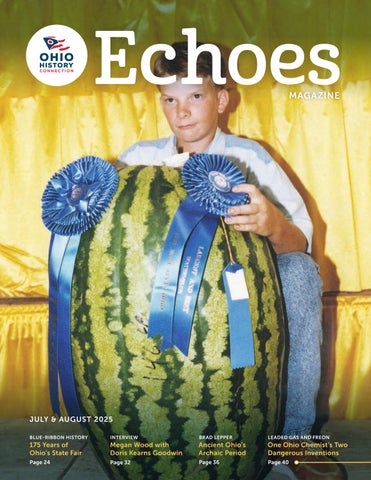
Cover: Winner of the blue ribbon for largest and best watermelon at the 1991 Ohio State Fair. Ohio History Connection Archival Collections
Vol. 64, No. 4 CHIEF MARKETING OFFICER
Jerr y Dannemiller
Contents J U LY & AU G U S T 2 02 5
24 A Celebration of Agriculture and American Culture— Ohio’s State Fair
EDITORS
Bill Eichenberger Tom Wolf
32 Where We’ve Been, Where We’re Going—
Ohio History Connection CEO Megan Wood Talks with Historian and Author Doris Kearns Goodwin
CONTRIBUTORS
Mar y C asey-Sturk Brielle Coleman Tim Feran G abe Klecker
36 Hunters & Gatherers—The Archaic Period 40 Unintended Consequences—
Thomas Midgley and His Dangerous Inventions
Brad Lepper Clare Park Mark Roth
I N E AC H I S S U E
DESIGN
Lydia Stutzman | Lydiary Design ADVISORY BOARD
Donna DeBlasio Youn gstown St ate Unive r sit y
Nishani Frazier Miami Unive r sit y
Rober t G enheimer Cin cinn ati Muse um Ce nte r
Stephen G eorge O hio Histor y Conne c tion
Alex Hastie O hio v. the World
G eorge Ironstrack Miami Unive r sit y
Chester Pach O hio Unive r sit y
Roger Pickenpaugh Historian an d Auth or
Daniel Rivers T he O hio St ate Unive r sit y
Truda Shinker O hio Histor y Conne c tion
2 Contents 4 From Our Editors 4 What’s Your Story? 6 In the News 7 From Our Director 15 Historic Sites & Museums 16 At the Ohio History Center 17 Online Events 18 Featured Events & Exhibits 46 I Wish I’d Been There 48 Young Eyes on the Past
Echoes Magazine (ISSN 0012-933X) is published bimonthly and distributed by the Ohio History Connection as a benefit of Ohio History Connection membership. Editorial Offices: Ohio History Connection, Ohio History Center, 800 E. 17th Ave., Columbus, OH 43211-2474 Phone 844.836.0012 Email echoes@ohiohistory.org
THANKS TO Our Ohio History Connection Strategic Partner:
Our Ohio History Day Sponsor:
Postmaster: Please send address changes to: Echoes Magazine, Ohio History Connection, Ohio History Center, 800 E. 17th Ave., Columbus, OH 43211-2474 Entire contents © 2025 by the Ohio History Connection. All rights reserved. Nothing may be reprinted or electronically reproduced in whole or in part without written permission from the publisher. The Ohio History Connection accepts no responsibility for facts and opinions expressed by the authors.
Moving? Contact us at membership@ohiohistory.org or 800.686.1545 to share your new address.
The Ohio History Connection is a
2 Echoes | JULY & AUGUST 2025
Like us on Facebook, and follow us on Instagram at @OhioHistory
A Celebration of Agriculture and American Culture
24
OHIO’S STATE FAIR This year marks 175 years since the first Ohio State Fair in 1850, though thanks to a four-year hiatus during World War II and cancellation of the 2020 state fair due to the COVID-19 pandemic, this year’s fair is Ohio’s 170th. Author Tim Feran looks at how the Ohio State Fair has evolved over the years.
Where We’ve Been, Where We’re Going
32
OHIO HISTORY CONNECTION CEO MEGAN WOOD TALKS WITH HISTORIAN AND AUTHOR DORIS KEARNS GOODWIN Our Executive Director and CEO Megan Wood talks with renowned presidential historian, public speaker and Pulitzer Prize-winning author Doris Kearns Goodwin about the value of history and Goodwin’s newest book, An Unfinished Love Story: A Personal History of the 1960s.
Hunters & Gatherers THE ARCHAIC PERIOD
36
In the second installment of our four-part series on ancient Ohio, Ohio History Connection curator and archaeologist Brad Lepper looks at life in the land we now call Ohio from about 8,000 to 800 B.C.
Unintended Consequences
40
THOMAS MIDGLEY AND HIS DANGEROUS INVENTIONS An Ohio chemical engineer, Thomas Midgley (1889–1944) of Worthington, holds the dubious distinction of having been responsible for two of the 20th century’s more dangerous inventions: leaded gasoline and Freon. Both seemed like good ideas at the time.
OHIOHIS TORY.ORG
3
FROM OUR EDITORS Historians get all warm and fuzzy over words like “archives” and “primary sources,” ones that Gen Z kids—so-called “digital natives”—might find “mystifying or even boring,” says presidential biographer Doris Kearns Goodwin. “I don’t know what it’s going to be like a couple hundred years from now when history is completely digital,” Goodwin told Ohio History Connection Executive Director and CEO Megan Wood in a conversation last November at the Ohio Statehouse. (See page 32.) “But there’s nothing like the paper that was used in the past to record things.” In her most recent book, An Unfinished Love Story: A Personal History of the 1960s, Goodwin revels in the letters, diaries, documents and memorabilia from her husband’s archive. History’s hard copies, they can be held in your hands. Richard “Dick” Goodwin was a presidential speechwriter and advisor closely associated with John F. Kennedy, Lyndon B. Johnson, Bobby Kennedy and Eugene McCarthy. “Dick would joke that all 300 boxes in his archive could be contained on a cellphone today,” she says. “When he was working on the JFK campaign, he lugged around a huge suitcase that he called his ‘Nixopedia,’ which was full of every statement Richard Nixon made so that JFK could counter them in a debate.” Maybe the digital record will be more permanent but less personal. If so, will the next generation of historians be as stoked by reading the internet as today’s historians are by holding a handwritten letter? F The first Ohio State Fair was held 175 years ago this October. (See
page 24.) Here are some fun facts! Did you know: That Ringo Starr was the only Beatle ever to play the fair? That Liza Minnelli played there in 1974? Even more stunning, that Dave Brubeck, Oscar Peterson, John Coltrane, Dizzy Gillespie and Thelonious Monk performed at the fair in 1965 as part of the Ohio Valley Jazz Festival? F What did Thomas Midgley know and when did he know it?
That’s the question science writer Mark Roth asks in his story about star-crossed chemical engineer Thomas Midgley, inventor of both leaded gasoline and Freon. (See page 40.) Yeah, two of the deadliest inventions of the 20th century. But at the time? Midgley was praised for his invention of leaded gas. It prevented engine knocking and ushered in the era of more-efficient automobiles. And he was praised for Freon, too, a refrigerant that was light-years safer than its predecessors: ammonia, sulfur dioxide and methyl chloride, which were toxic, flammable or both! F Brad Lepper, senior archaeologist for the Ohio History
Connection’s World Heritage program, writes in this issue about Ohio’s Archaic period on page 36. It’s the second in a series of four articles on ancient Ohio that will appear in Echoes Magazine. Stay tuned for stories about the Woodland and Late Prehistoric periods.
4 Echoes | JULY & AUGUST 2025
What’s In every issue of Echoes Magazine, we feature the stories of Ohio History Connection members and other Ohioans to stoke memories and shed light on our shared past. For this issue, we asked,
“ Tell us about your city’s oldest marketplace.” Here are some of your responses: WEST SIDE MARKET, CLEVELAND Though Ohio City has roared back to life over the past quarter century, the neighborhood just across Cleveland’s Lorain-Carnegie Bridge has been anchored for more than a century by the West Side Market. I grew up in Youngstown, and Cleveland was always, to me, the Big City. I’ll never forget the thrill of seeing the skyline or, even better, Lake Erie, come into view as we made our way to the old Cleveland Stadium for a Browns or Indians game. But it wasn’t until after college that I began to explore the city more deeply, and it wasn’t until I met poet David Citino in the mid-1990s and read Paperwork, his collection of prose essays, that I learned about the West Side Market. In his essay “The Poet in the Kitchen,” Citino wrote, “To get to my high school, Saint Ignatius, I took a bus and the Rapid Transit train from my home near West 140th. I got off at the West 25th Street station, then walked through the West Side Market on 25th, past stalls of swinging cheeses and sausages, salamis and hams gleaming like stalactites in a great cave, and joints of meat, hog jowls and snouts, squid, and gleaming fish whose baleful eyes seemed to turn to regard me as I passed by.
Your Story? “The train ride that transected the west half of the city took me from newer times to olden, and the market aisles and stalls represented, even to the young man I was becoming, a place whence my parents and grandparents came. Traveling and food were visible, auditory, olfactory, and gustatory manifestations of history.” “The Poet in the Kitchen” was included in Books That Cook: The Making of a Literary Meal, a wonderful anthology published in 2014 by New York University Press. —Will Charles, Youngstown SECOND STREET MARKET, DAYTON I grew up going to Dayton’s Second Street Market. I remember going with my parents, after my Saturday morning ballet class, and visiting the “rice and bean lady” or the “meat pie man.” We would always stop to watch the ceramicist sculpting his next vase at his booth. Then we’d run into family friends and neighbors as we got our freshly baked bread and my balloon animal on the way out.
BEST SMELLS, SOUNDS, PEOPLE, FOODS Going to the North Market in Columbus or the West Side Market in Cleveland is less about the grocery trip and more about the experience. The smells, the sounds and the people are all unique in the best way, and the food is nothing like what you’ll get at any other store.
It is awesome to see so many families with kids attend this market and participate in the learning together. My kids find the market a fun place to visit every Friday night because they get to play with other kids and pick from so much food to buy. Some of their favorite products are the flavored honey sticks from KP Honey Farms, strawberry lemon shake ups from Weathervane Kettle Corn and pickles from The Crazy Cucumber.
Restaurant-quality food with roots in several countries and authentic ethnic dishes are what make these markets really flourish, and I struggle not to empty my wallet whenever something new catches my eye (or nose)! Baked goods, meats, flowers— you name it, they have it, and with the best quality a person could ask for. Fresh, real food with none of those artificial preservatives … it’s an amazing experience for your senses. Fantastic for an outing with friends or a date with your partner, it’s a trip that you’ll regret not taking.
The Canal Market District has such a strong sense of community—it is somewhere that we feel like we belong, and the reason that we will continue to make our visits a weekly tradition for years to come.
—Micah Troyan, Columbus
—Bailey McCoy, Newark
CANAL MARKET DISTRICT, NEWARK
WHAT’S YOUR STORY?
The Canal Market District is more than just a farmers market. To me, it has been a regular place that I bring my family to connect with the people who grow food, and to our community. Canal Market District is special because of the vendors who know us by name and are always eager to share about
—Lila Sauer, Dayton NORTH MARKET, COLUMBUS I remember when I was a kid, my dad and I would have dinner at North Market before going to the Columbus Children’s Theatre to see a play. My dad is a teacher, so his students often had roles in the productions. At North Market, our favorite spot has been Momo Ghar—especially after watching Diners, Drive-ins and Dives on TV, but now we also love Hoyo’s Kitchen and their spicy mango chicken. —Leah Cashin, Columbus
the unique and quality products they have grown in their gardens or crafted in their kitchens. We have the best fruit at our market, from fresh strawberries to unique varieties of peaches that you can’t find at a grocery store.
We want to know your stories, so in every issue of Echoes Magazine we ask you a question, then run selected answers in the following issue. Here’s the question for September & October: WPA | OHIO HISTORY CONNECTION ARCHIVAL COLLECTIONS
Later, as I got older, I began going by myself and meeting friends for coffee or lunch. Still, I ran into familiar faces, now adding some of my classmates who worked at the various vendors. This market will always be a community hub on Saturday mornings and now acts as a place of nostalgia when I’m home from college.
PUBLIC MARKETS
Cleveland has its Little Italy and its Slavic Village. Toledo has its Polish and Irish enclaves. Cincinnati has its Over-theRhine. What’s your favorite ethnic neighborhood (or neighborhoods) in your town or city? What have the neighborhoods added to the culture and food where you live?
Email your story responses (50 to 150 words) by July 15 to echoes@ohiohistory.org or, if you follow us on Facebook, send us a Facebook message.
View north from Fourth and Cherry streets toward Central Market in Columbus, August 26, 1939. OHIOHIS TORY.ORG
5
still used in shipping foods and medicines today.
In the News
MORE INVENTORS
Alice H. Parker (1895–1920) invented a gas heater that led to modern gas forced-air central heating systems. David Nelson Crosthwait (1898–1976), “king of HVAC,” designed heating systems for Rockefeller Center and Radio City Music Hall in the 1930s and became the first African American named a Fellow of the American Society of Heating, Refrigerating and Air-Conditioning Engineers. Iula Carter (1926–2021) of Dayton invented a portable potty chair during the baby boom; and baby boomer Lonnie Johnson, born in 1949, invented the Super Soaker water gun.
COLLABORATIVE EFFORT
Wright State University public history graduate students and the National Afro-American Museum & Cultural Center curatorial staff collaborated in creating the new exhibit, which “is designed to educate and inspire visitors of all ages,” says curator Hadley Drodge. ON EXHIBIT
New Exhibit Spotlights Black Inventors and Their Inventions Trailblazers of Innovation—African American Inventors Who Changed America, a new permanent exhibit at the Ohio History Connection’s National Afro-American Museum & Cultural Center in Wilberforce, shines a spotlight on Black inventors whose inspirations continue to have an impact on our lives today.
Among the featured inventors are chemical engineer Norbert Rillieux (1806–1894), whose evaporator revolutionized the sugar industry; Thomas Martin (1842–1872), who improved fire-suppression systems for buildings; Clevelander Garrett Morgan (1877–1963), whose inventions include the gas mask and three-way traffic signal; and Cincinnati native Frederick McKinley Jones (1893–1961), who during World War II invented portable refrigeration equipment
Other inventors and their inventions are also featured in the exhibit, which is organized around five broad themes: Guiding Lights, Bathrooms and Hygiene, Water Fun and Function, Fire Safety and In-Venting Comfort. PLAN YOUR VISIT
NATIONAL AFRO-AMERICAN MUSEUM & CULTURAL CENTER
NATIONAL AFRO-AMERICAN MUSEUM & CULTURAL CENTER
Hands-on “Connect the Pipes” game in Trailblazers of Innovation. 6 Echoes | JULY & AUGUST 2025
The National Afro-American Museum & Cultural Center is at 1350 Brush Row Rd. in Wilberforce. Hours are Wednesday through Saturday, 9 a.m. to 4 p.m. Trailblazers of Innovation is included with museum admission: $6, $5/senior, $3/age 6–17, Free/ Ohio History Connection member or age 5 & under. Other exhibits also included with museum admission include African Art— Form, Function and Fraught Histories; African Americans Fighting for a Double Victory; Rhythm of Revolution and Queens of the Heartland. Questions? Call 800.752.2603 or visit ohiohistory. org/naamcc.
OHIO HISTORY AT THE OHIO STATE FAIR
Members Enjoy Two Free Fair Tickets! Ohio State Fair attendees will once again be able to get a side of Ohio history with their corn dogs and deep-fried Twinkies. All fairgoers will be able to visit the Ohio History Center for free with their daily admission tickets July 23 through Aug. 3, 10 a.m. to 5 p.m. The Ohio History Center Museum will be open to members as always. HOW TO CLAIM YOUR TWO FREE TICKETS
And like last year, Ohio History Connection members will enjoy discounts on Ohio State Fair tickets. Just show your Ohio History Connection membership card at the fair ticket booth and receive two free admission tickets. You must claim your two free tickets in person at the fair ticket booth, and you must show either your Ohio History Connection membership card or digital membership card. The offer isn’t valid for tickets purchased online or in advance. Lost your card? Contact the Membership Department at 800.686.1545 or membership@ohiohistory.org to get a replacement. PLAN YOUR TRIP
Visit ohiohistory.org/statefair for all the latest information about Ohio History Center state fair programming, parking, discounts and more. We hope to see you there!
FROM OUR DIRECTOR On a cool April morning in Marietta, we broke ground on the new Ohio River Museum. The project is a partnership with the Washington County Public Library, which is moving its local history and genealogy collections into a portion of the new facility. The Northwest Territory Museum Society operates the Ohio River Museum and the nearby Campus Martius Museum on behalf of the Ohio History Connection. The Ohio River Museum was founded in the 1950s in collaboration with the Sons and Daughters of Pioneer Rivermen, whose collections make up the museum exhibits. Several years ago (more than I care to admit), we gathered with all our partners to decide how we could best move forward together. After much work and study, it was decided that instead of expanding the existing museum, we’d be better off building new above the revised 100-year flood plain. A project like this requires a lot of time to bring together the right partners and professionals to secure the necessary funding and to finalize design and construction drawings. Thanks to support from the State of Ohio and a grant from the U.S. Department of Agriculture—secured by former U.S. Representative Bill Johnson—this project has moved from a great idea to an actual construction site. When the building has been completed and exhibits have been installed, the new Ohio River Museum will represent the history of Washington County, including an updated museum experience about life working and living on the river. The building, which will also be used by the community, is an investment in the future of Marietta, the region and the state. One thing that will remain the same is the National Historic Landmark W.P. Snyder Jr. Docked near the museum, it’s the nation’s last intact steam-powered stern-wheeled towboat and the Ohio History Connection’s largest and only floating artifact. My family always enjoys a trip to Marietta for the history, the river views, the food and the environment. I encourage you to take a trip to see the Campus Martius Museum. While you’re in town, catch a show at the Peoples Bank Theatre, hit The Castle historic house museum, wander through Mound Cemetery and visit the Start Westward national memorial. Stay tuned in 2027 for news about completion of the building.
Megan Wood | Executive Director & CEO, Ohio History Connection
You must show your digital or physical membership card to get free admission at Ohio History Connection museums and attractions. Please call 614.686.1545 or email membership@ ohiohistory.org if you’ve misplaced your card.
OHIOHIS TORY.ORG
7
Players for the Ohio Village Muffins sport 1860s-style uniforms.
OHIO CUP AUG. 30–31
Take Me Out to the Ball Game! by Jim Tootle and Teresa Valencia Two teams take the field in 1860s uniforms with a scorekeeper and umpire dressed in period attire. An atmosphere of excited energy charges the crowd as a game of base ball begins. Players field the ball bare-handed as strikers run the bases. You feel like you’re being transported back in time as you watch the game. These men and women take the field for love of the sport, its history and to share their passion with the crowd. STEP BACK IN TIME
Collectively, these extraordinary volunteers make up the Ohio Village Muffins and Diamonds, a vintage base ball program of the Ohio History Connection. Continuing the 19th-century practices of spelling “base ball” as two words, using wood bats and flying a 33-star 1860 American flag at the games enables players and spectators to step back in time and experience the “Grand Old Game” as it was played 165 years ago.
8 Echoes | JULY & AUGUST 2025
Started in 1981, this program has shared the love and fun of baseball history with thousands of spectators across Ohio and beyond. During games, vintage teams emphasize sportsmanship and polite behavior. Players do their best but are congenial toward the opposing team; a batter will often tip his hat to an opposing player who makes an outstanding defensive play to put him out. If an umpire doesn’t have a clear view of a play, he’ll simply ask the players involved whether the runner was safe or out. Games conclude with teams exchanging three cheers and congratulatory handshakes. Vintage base ball connects people. There are numerous examples of fathers and sons, and mothers and daughters, playing together as teammates. The games spark conversations among children, parents, grandparents, friends and strangers as they share baseballrelated memories and stories. 25 TO 30 TEAMS PLAY IN OHIO CUP
The regular season culminates each year with the program’s signature event, the Ohio Cup Vintage Base
A pitcher for the Ohio Village Diamonds.
Ball Festival. This colorful and educational sporting event began in 1992 at Ohio Village with four teams playing on Muffin Meadow, the home grounds of the men’s and women’s teams. Over the years, the program’s signature event has grown to 25 to 30 vintage teams from Ohio and around the country. For many of our visiting teams, the road trip to Columbus to play in the Ohio Cup is the highlight of their season. The Ohio Cup games are played in an atmosphere much like a family reunion, with members of the participating teams reconnecting with old friends and making new ones. The Ohio Cup is an annual Labor Day weekend gathering of teams playing the national pastime according to the rules, equipment and customs of 1860. This year’s Ohio Cup is Sat., Aug. 30, and Sun., Aug. 31. Due to construction in Ohio Village, all Ohio Cup games will be played at the Westerville Sports Complex, 325 N. Cleveland Ave., Westerville. Spectators are welcome and admission is free. Teams will play both days from 9 a.m. to 5 p.m.
OHIO HISTORY
Happy 100th, Goodyear Blimp! Ohio’s world-famous Goodyear Blimp celebrated its 100th anniversary on June 3, which marked 100 years since the inaugural flight of its first branded blimp, Pilgrim. Starting with Pilgrim in 1925, Goodyear Blimps have appeared at events from the Olympics to the Super Bowl; been featured in famous songs, movies and television shows; generated millions of dollars for charities and communities; and even aided the U.S. military during WWII. A batter for the Cincinnati Buckeyes at the annual Ohio Cup Vintage Base Ball Festival.
Visit ohiohistory.org/ohiocup for more on the Ohio Cup and ohiohistory.org/muffins for the Ohio Village Muffins and Diamonds season schedules. NEW VOLUNTEERS ARE WELCOME
Goodyear Blimps (currently there are four—three in the U.S. and one in Europe) are housed at bases at Wingfoot Lake in Suffield, Ohio; Carson, California; Pompano Beach, Florida; and Essen, Germany. HANGAR BUILT IN 1917
Built in 1917, the hangar at Wingfoot Lake is the oldest airship facility and one of the oldest active aircraft bases in the world. It serves as a
Another hangar, the historic Goodyear Airdock in Akron, was added to the National Register of Historic Places in 1973 through the Ohio History Connection’s State Historic Preservation Office. Built in 1929 as the construction facility for two U.S. Navy rigid airships—the USS Akron (1931) and USS Macon (1933)—it’s been recognized with an official Ohio Historical Marker, too, and has been designated a National Civil Engineering Landmark by the American Society of Civil Engineers. VISITING MORE THAN 100 CITIES
In celebration of its centennial year, the Goodyear Blimp is flying to more than 100 cities across North America and Europe. Fans can look for the blimp’s next appearance and keep up with the latest blimp news at Goodyearblimp.com. This vintage Tichnor Brothers postcard pictures a Goodyear Blimp over Sherwin-Williams Plaza at Cleveland’s 1936–1937 Great Lakes Exposition. NEWBERRY LIBRARY | JOHN L. MONROE COLLECTION OF EXPOSITION POSTCARDS
Our vintage base ball program is always eager to welcome new volunteer members. Interested in becoming part of the Muffins and Diamonds “family,” in either a playing or non-playing role? Contact Ohio History Connection Volunteer Coordinator Teresa Valencia at tvalencia@ohiohistory. org for details.
According to a fact sheet Goodyear published this year, the company has built more than 325 airships. The overwhelming majority were produced for the U.S. Navy and U.S. Army during World War II. Only 31 have been officially christened Goodyear Blimps.
maintenance and construction facility for Goodyear’s blimp fleet. In 2018, the Wingfoot Lake hangar was awarded an Ohio Historical Marker recognizing its contributions to lighter-than-air aviation in general and its military significance during World War I and World War II. The first class of airship pilots was trained at Wingfoot Lake.
Our Membership Office is here for
YOU! Questions about your membership? Need to update your address? We’re happy to help! membership@ohiohistory.org 800.686.1545
OHIOHIS TORY.ORG
9
OHIO HISTORY CONNECTION ARCHIVAL COLLECTIONS
OHIO HISTORY CONNECTION | BEN BAUGHMAN
Left: A White Motor Co. truck at the Ohio Bell Telephone Co. about 1920. Right: The 1919 Ohio Bell Telephone Co. repair truck made by White Motor Co. of Cleveland now on exhibit at the Ohio History Center Museum.
COLLECTIONS
Vintage Ohio Bell Truck on Display by Benjamin Baughman An early 20th-century Clevelandmade truck now on exhibit at the Ohio History Center in Columbus brings back a name that will have a familiar ring to many people of a certain age in the Buckeye State: Ohio Bell. The Ohio History Center has recently added a 1919 Ohio Bell Telephone repair truck manufactured by White Motor Co. of Cleveland to its transportation exhibits. Restored by Ohio Bell Telephone Co. in the early 1970s, the truck was donated to the Ohio History Connection in 1985. IT STARTED WITH A SEWING MACHINE
The history of White Motor Co. begins with a man named Thomas Howard White. Born in 1836 in Massachusetts, White invented a hand-operated single-thread sewing machine. He dubbed it the “New England Sewing Machine” and formed a company in Massachusetts to sell his invention. In 1866, he relocated to Cleveland, and 10 years later founded the White Sewing Machine Co. By 1878, White’s new sewing machine production company reached $2.5 million in sales, making it second only to the
10 Echoes | JULY & AUGUST 2025
Singer Manufacturing Co. in total sewing machines sold. THEN STEAM-POWERED CARS
In 1899, Thomas White’s son, Rollin White, patented a method of powering vehicles via steam that led to his development of the White Steamer automobile. The White Steamer quickly proved a success, especially among society’s elite, prompting White to branch off from his father’s company to create the White Motor Co. in 1906. In the 1910s, the White Motor Co. moved away from steam-powered automobiles and began manufacturing gasolinepowered trucks and tractors. During World War I, the company produced more than 18,000 trucks for the U.S. military; by the war’s end, White Motor Co. was responsible for fabricating nearly 10% of all trucks manufactured in the United States.
for installing new telephone poles or repairing damaged telephone lines. The White Motor Co. trucks operated by Ohio Bell were designed to carry ladders, shovels and other tools and were typically driven by a team of telephone repairmen. During the Great Depression, the White Motor Co. suffered financially, re-emerging in 1934 as the White Motor Corp. From there, the company continued to manufacture trucks and buses and, with the onset of World War II, again produced vehicles for the U.S. military. Following several mergers with other manufacturing companies, the White Motor Corp. filed for bankruptcy in 1980 and soon after sold its manufacturing plant in Cleveland to Swedish car company Volvo. PLAN YOUR VISIT
SERVICED MORE THAN 500,000 PHONES BY 1920
One of the companies that utilized White Motor Co. trucks during this time was Cleveland’s Ohio Bell Telephone Co. Originally known as the Cleveland Telephone Co., the Ohio Bell Telephone Co. managed more than 500,000 telephones by 1920, mostly in northern and central Ohio. As their network of telephone lines expanded, so too did the need
You can see the Ohio History Connection’s Ohio Bell Telephone Co. repair truck in person at the Ohio History Center Museum in Columbus Wednesday through Sunday, 10 a.m. to 5 p.m. Ohio History Connection members enjoy free admission. Questions? Call 800.686.6124 or visit ohiohistory. org/center. —Benjamin Baughman is a history curator for the Ohio History Connection.
HISTORIC PRESERVATION
Recent Ohio Additions to the National Register of Historic Places FAIRBORN • GREENE COUNTY
ALBERT KRUMM APARTMENTS HISTORIC DISTRICT 200–350 E. Emerson Ave., 222–456 Wallace Dr., 300–345 Williams St., 300 June Dr. The 44 Colonial Revival-style buildings in this complex were built in 1942 and 1943 by developer Albert Krumm Inc. to accommodate the sudden influx of war workers as part of the national defense program and war production at Wright and Patterson Fields during World War II. Federal Public Works Administration funds assisted the communities of Fairfield and Osborn (now Fairborn) with water, sewer, housing and schools to support the demand for growth. The buildings were constructed by Loving Builders Inc., a Columbus contractor whose president, William E. Loving, was a partner in Albert Krumm Inc. The district includes 38 fourplexes; one 10-unit apartment building; one 14-unit apartment building; a rental office with a detached maintenance garage; an office-laundry-garage building; and one auto garage. The complex was later renamed the Fairborn Apartments. TOLEDO • LUCAS COUNTY
EAST TOLEDO MAIN STREET HISTORIC DISTRICT Main St., bounded by Front St. and Starr Ave., between Euclid and Platt streets
This commercial corridor in East Toledo offered a variety of goods and services to Toledoans living in adjacent neighborhoods. The neighborhoods and commercial corridor both burgeoned in the late 1800s and early 1900s thanks to the industries flourishing along the Maumee River to the west, which separates East Toledo from downtown. Buildings in the district date from 1878 to 1965 and are in a range of architectural styles of the time. In 1929 and 1930, five blocks of them on the southwest side of Main Street were moved back 15 feet to create head-in parking. This engineering feat foreshadowed the impact that automobiles would have in the decades that followed, ultimately driving shoppers away from traditional downtowns and neighborhood commercial areas like this one to suburban shopping centers and enclosed shopping malls with generous parking lots. YOUNGSTOWN • MAHONING COUNTY
WEST FEDERAL STREET YOUNG MEN’S CHRISTIAN ASSOCIATION 962 Martin Luther King Jr. Blvd. Opened in 1931, the West Federal Street YMCA was a community center and neighborhood anchor during a time when racial discrimination excluded African Americans from many hotels, restaurants and other establishments. It was built with contributions from more than 100 individuals and corporations. The largest was from philanthropist Julius Rosenwald (1862–1932),
president and chair of retailer Sears, Roebuck & Co., who gave $25,000— about $490,000 today. Rosenwald made similar grants for 24 African American YMCAs nationwide, including Ys in Columbus, Cincinnati, Dayton, Toledo and Youngstown. (Two of Ohio’s remain—the second is in Dayton.) When the West Federal Street YMCA opened, local YMCA officials called it “the finest of its kind in America.” Designed by Youngstown architects Barton E. Brooke and Harold R. Dyer, the four-story Jacobethan-style building has a two-story gym wing at the rear. Interiors feature oak woodwork and ornamental wrought iron, with ceramic tile floors and wainscoting. In addition to offering recreation and sports, entertainment, social events and opportunities to learn about Black history, the West Federal Street YMCA was listed in the Negro Motorist Green Book—a directory of hotels, restaurants, recreational and cultural centers and other establishments where African Americans were welcome to stay and eat safely during segregation. Closed after being consolidated with Youngstown’s Central YMCA in 1974, it’s one of the few Green Book sites remaining in Ohio. • Rosenwald also made grants for about 5,000 (yes, 5,000!) schools for African Americans in the rural South. Read more about the Rosenwald schools and YMCAs in the blog post Julius Rosenwald and the African American YMCAs of Pennsylvania by Jenna Solomon of the Pennsylvania State Historic Preservation Office at ohiohistory.org/rosenwald.
OHIOHIS TORY.ORG
11
Buckeye Furnace Join me as I visit the sites in the Ohio History Connection network! This month’s trip took me to Buckeye Furnace in Wellston. Buckeye Furnace was built in 1851 during southeast Ohio’s heyday of iron production. One of more than five dozen blast furnaces that dotted the Hanging Rock Iron Region in the mid-1800s, Buckeye Furnace once employed as many as 200 men and used 100 teams of oxen. Today, visitors can explore the original blast furnace, as well as replicas of other buildings used in the process of producing iron. A small museum and lovingly curated gift shop are in the replica company store. The museum features exhibits on iron production, the community that supported the furnace and the importance of the iron industry
to the 19th-century American economy. Iron made in rural blast furnaces like this one is credited with helping the Union win the Civil War. Address: Buckeye Furnace is located at 123 Buckeye Park Rd in Wellston. How much time: I’d budget 60 to 90 minutes to explore the museum and walk up the short trail to explore the furnace buildings. Truda’s Tips: Start in the museum, across from the parking lot. There you’ll be able to peruse the exhibits, shop for a souvenir, use the restroom and pick up a brochure about the site. Additionally, plan to spend some time chatting with the staff—it will enhance your visit and really bring the site to life.
Lunch: Buckeye Furnace has a beautifully shaded picnic area with tables and charcoal grill boxes near the parking lot. I would highly recommend bringing your own lunch. For more information: To learn more about Buckeye Furnace, visit ohiohistory.org/buckeyefurnace. Be sure to note the days and hours of operation. The grounds of Buckeye Furnace are open year-round during daylight hours. However, the museum and gift shop are open only May through October. —Truda Shinker is the Ohio History Connection’s department manager for membership.
Be sure to wear comfortable shoes and dress for the weather. You’ll spend most of your time outside.
An early-20th-century view of Buckeye Furnace.
12 Echoes | JULY & AUGUST 2025
Kid-Friendly? Yes, for elementary school-aged kids and up. Buckeye Furnace has a lot to offer elementary school-aged kids. The museum includes objects they can touch, places to sit down and a great gift shop that features fun kid stuff. The path up to the furnace buildings follows a gentle slope and provides a perfect opportunity for running. The site would be challenging for very young children, and some of the buildings are not stroller-friendly.
Dozens of rural charcoal-fired blast furnaces like this one were used to make iron in southeast Ohio’s Hanging Rock Iron Region, contributing to the Union victory in the Civil War.
Buckeye Furnace, near Wellston.
Ironworkers traded at the Buckeye Furnace company store.
The 1851 Buckeye Furnace company store.
Stairs between the engine house (left) and casting house.
OHIOHIS TORY.ORG
13
The Ohio History Connection recognizes these donors who gave $1,000 and above from October through December 2024:
William & D’Arcy Abraham Roger D. Braun Jacqueline A. Brown Martha M. Callihan Chester Family Foundation Margaret & Joseph Conway Charitable Fund Michael & Sharon Curtin Fund Jerry & Jill Dannemiller
Herrnstein Family Fund at The Chillicothe-Ross Community Foundation Richard F. Hillis HMB Men’s Club David A. & Helen P. Horn Charitable Trust Huntington Bank Kathy Jones
Jerome G. & Bette C. Dare Fund
Anthony Joseph & Leslie Meyers-Joseph
Dayton Foundation
Suhas & Patty Kakde
James & Janet Dicke II
Eben Kent
Thomas & Lynn Dotson Family Fund
Claudia & Peter Kinder Charitable Fund
Debra Duncan & Steve Hankison Edmonds Family Fund of the BNY Mellon Charitable Gift Fund
John & Maryline Kulewicz
Patricia S. Eldredge
Yvonne Mason
Cindy & Jon Elsasser Advised Charitable Fund
John C. Matesich III
Fifth Third Bank Columbus Fox Foundation, Inc. James Ginter James & Jennifer Hadden Aggie Haslup & Teresa Stanonik Alex & Sarah Hastie Janice & William Haueisen Clyde & Janet Henry
Marion Community Foundation
Elaine Merchant Jennifer Miller Montei Foundation Betty D. Montgomery Charles R. & Ann Moses D. Wesley and Dolly Newhouse Kraig & Christine Noble Pansing Foundation
Mark & Sue Real John V. Richardson Charles F. & Alice G. Salt Foundation of The Columbus Foundation Suzyn J. Schwebel Epstein & Bruce Epstein Priscilla Schwier Fund Lana Smith Kathleen R. & Richard M. Sollmann Teresa M. Stankiewicz & Richard J. Furnstahl Erik R. Stoddard James D. Strider Ralph W. & Joan S. Talmage David H. Timmons Susan Tomasky & Ronald J. Ungvarsky Family Fund Dennis & Sara Trachsel Foundation Henry A. True Trust James A. Vaughan Waddell Foundation Hugh N. Westwater & Linda Larrimer Susan Woerner Donald & Ellen Yerks Melody & Todd Young S. Fredrick & Suzanne Zeigler
Fred & Janet Pfening Charitable Fund
Your support is an important part of our Ohio History Connection budget. It helps us serve all Ohioans, including Echoes Magazine readers. Will you make a donation to our most urgent needs?
14 Echoes | JULY & AUGUST 2025
Richard T. Prasse
Scan this code, call 614.297.2310 or visit our secure form at ohiohistory.org/give.
O HI O HIS TO RY CO NNEC T I O N
Historic Sites & Museums Ohio History Connection members Before traveling, visit ohiohistory.org/ enjoy free regular admission to these sites to confirm hours and any special Ohio History Connection sites. requirements.
There are many other fascinating historyrelated museums and attractions in Ohio— far more than we can show you here.
Find more at ohio.org/things-to-do. Choose “Historic Attractions” or “Museums,” then get out and explore!
NORTHWEST OHIO 1. Armstrong Air & Space Museum 2. Cedar Bog Nature Preserve 3. Cooke-Dorn House 4. Fallen Timbers Battlefield Memorial Park 5. Fort Amanda Memorial Park 6. Fort Jefferson Memorial Park 7. Fort Meigs 8. Fort Recovery Museum & Monument 9. Hayes Presidential Library & Museums 10. Indian Mill 11. Inscription Rock Petroglyphs 12. Johnston Farm & Indian Agency 13. Lockington Locks
NORTHEAST OHIO 14. Custer Monument 15. Fort Laurens 16. McCook House 17. Museum of Ceramics 18. Quaker Yearly Meeting House (Open by Appointment) & Free Labor Store/Benjamin Lundy House (Preservation in Progress • Not Open) 19. Schoenbrunn Village 20. Shaker Historical Museum 21. Tallmadge Church 22. Youngstown Historical Center of Industry & Labor 23. Zoar Village
SOUTHWEST OHIO 33. Adena Mansion & Gardens 34. Davis Memorial Nature Preserve
CENTRAL OHIO
35. Fort Ancient Earthworks & Nature Preserve 36. Fort Hill Earthworks & Nature Preserve 37. Harriet Beecher Stowe House
SOUTHEAST OHIO
24. Flint Ridge Ancient Quarries & Nature Preserve
38. John Rankin House
47. Big Bottom Memorial Park
25. Hanby House
39. Miamisburg Mound
48. Buckeye Furnace
26. Logan Elm
40. National Afro-American Museum & Cultural Center
27. Newark Earthworks 28. Ohio History Center & Ohio Village
41. Paul Laurence Dunbar House
29. Poindexter Village Historic Site (Preservation in Progress • Not Open)
42. Serpent Mound
30. Shrum Mound
44. U.S. Grant Birthplace
43. Story Mound
49. Buffington Island Battlefield Memorial Park 50. Campus Martius Museum 51. John & Annie Glenn Museum 52. Leo Petroglyphs & Nature Preserve 53. National Road & Zane Grey Museum
31. Wahkeena Nature Preserve
45. U.S. Grant Boyhood Home & Schoolhouse
54. Ohio River Museum (Closed for Construction)
32. Warren G. Harding Presidential Sites
46. William Henry Harrison Tomb
55. Our House Tavern OHIOHIS TORY.ORG
15
P R O G R A M S & E X H I B I T S AT T H E
Ohio History Center Ohio History at the Ohio State Fair WEDS., JULY 23–SUN., AUG. 3 10 A.M.–5 P.M. Ohio History Center, Columbus Planning to go to the Ohio State Fair? While at the fair, stop in to see the Ohio History Center Museum! This year, the Ohio History Center will be a full Ohio State Fair entry point, including State Fair ticket sales and security screening. And like last year, Ohio History Connection members will save on Ohio State Fair tickets (see page 7). From July 23 to Aug. 3, the Ohio History Center Museum is free to Ohio History Connection members, as always, though the full State Fair security screening is required whether you’re visiting the fair or not. (The Archives & Library is closed July 23– Aug. 3.) Questions? Call 800.686.6124 or visit ohiohistory.org/statefair. For a full list of daily events at the Ohio State Fair, visit ohiostatefair.com/events.
Once Upon Ohio SAT., AUG. 16 • 10 A.M.–3 P.M. WITH MEMBER EARLY ENTRY FROM 9 TO 10 A.M. Ohio History Center, Columbus Celebrate a day of Ohio children’s literature for young children and their families! This special day features stories by Ohio authors and illustrators, with engaging elements such as songs, rhymes and movement to foster early literacy and language development. Get creative with book-themed activities, bookmark coloring, creating your own story and more! Share in the fun by dressing up as your favorite storybook character! Advance timed tickets recommended (and required for member early entry from 9 to 10 a.m.), available to Ohio History Connection members starting July 7 and to non-members July 14. $16, $14/age 60+, $10/age 4–12, Free/
16 Echoes | JULY & AUGUST 2025
Ohio History Connection member or age 3 & under. 800.686.6124 or ohiohistory. org/OnceUponOhio Thank you to Once Upon Ohio sponsor Ohio’s 529 Plan College Advantage. FEATURED EXHIBITS • • •
St. Clair’s Defeat Revisited— A New View of the Conflict HURRY! ENDS SUN., AUG. 17 In this traveling exhibit by Ball State University anthropologists and 11 Tribal humanities scholars, discover the complex history of the 1791 Battle of the Wabash, or St. Clair’s Defeat, near Fort Recovery, Ohio, then explore its aftermath for the nine Tribal Nations that orchestrated what’s been called “the worst defeat of U.S. forces by Native Americans in U.S. history.”
Hide and Seek—Finding Young People in the Archives ONGOING In the third-floor Library Lobby Gallery, see items from our archival and history collections that are associated with young Ohioans over time, including original documents, toys and a Cozy Coupe car.
1950s—Building the American Dream ONGOING Peek in the closets and snoop in the drawers of a real, fully furnished Lustron steel house made right here in Ohio. From the contents of the cupboards to the news on TV and the toys in the yard, this hands-on exhibit is a fascinating journey back in time.
World War I Display ONGOING See equipment, weapons, uniforms and memorabilia.
Welcome Lobby Display Cases ONGOING In the Welcome Lobby cases, see Dressing Ohio—From Workroom to Wardrobe, featuring garments from Ohio History Connection collections, and Columbus Women on the Move— Traveling the World in 1936–1937, with selected items from the Women’s Travel Collection. (See Echoes Magazine, March & April 2024, page 11.)
Ohio History Center Hours Museum OPEN WEDS.–SUN. 10 A.M.–5 P.M. CLOSED INDEPENDENCE DAY, FRI., JULY 4 OPEN MON.–SUN. 10 A.M.–5 P.M. DURING THE OHIO STATE FAIR (See page 7.) CLOSED LABOR DAY, MON., SEPT. 1
Indigenous Wonders of Our World—The Hopewell Ceremonial Earthworks
Archives & Library
ONGOING Learn about the eight 2,000-year-old Hopewell Earthworks in Ohio recently named World Heritage Sites by UNESCO, including mathematical similarities among them and their alignments to the solstices and the 18.6-year lunar cycle.
CLOSED JULY 23–AUG. 3 DURING THE OHIO STATE FAIR
Making Ohio Home—Early Ohio Immigrant Experiences ONGOING Explore stories of seven representative immigrants who helped grow Ohio’s population from 45,365 in 1800 to more than 4.1 million in 1900.
WEDS. 12:30–3 P.M. THURS.–FRI. 10 A.M.–3 P.M.
SCHEDULE YOUR PERSONALIZED RESEARCH APPOINTMENT:
ohiohistory.libcal.com
Plaza Cafe TUES.–FRI. 9 A.M.–2 P.M. SAT. 10 A.M.–3 P.M. CLOSED SUN. & MON.
Ohio Village CLOSED FOR CONSTRUCTION REOPENS IN 2026
Museum admission is $16, $14/age 60+, $10/ages 4–12. Ohio History Connection members and ages 3 & under enjoy free admission.
AT T E N D FROM A N Y W H E R E !
Online Events MEMBER VIP
Get to Know the Ewing and Graham Photography Collections TUES., JULY 22 • 3–4 P.M. Online—Attend From Anywhere! Meet audiovisual archivist Daniel Willis and learn about two of our early-20thcentury photography collections, the Albert J. Ewing Collection and the A.B. Graham Collection. Ewing was born in 1870 in Washington County, near Marietta. From 1896 to 1912, he was a traveling photographer in southeastern Ohio and central West Virginia. Educator and agriculturalist Graham founded the national 4-H movement. His photographs depict rural environments and schools around Ohio between 1900 and 1920. $10, Free/Ohio History Connection member. Advance registration required. 800.686.1545 or ohiohistory.org/ photocollection
Presidential History Book Club WEDS., JULY 30 & AUG. 27 NOON–1 P.M. Hayes Presidential Library & Museums, Fremont, and Online—Attend From Anywhere! 4 Read and discuss books about the American presidency at this free book club open to all. JULY 30: Heirs of the Founders, by H.W. Brands, a continuation of June’s discussion. AUG. 27: Ascent to Power, by David
Serving Grab-N-Go Snacks & Meals Ohio History Connection Members Save 10% at the Plaza Cafe!
L. Roll. Attend in person or online. You’re welcome to bring your lunch. For online login information, email admin@rbhayes.org. 800.998.7737 or rbhayes.org MEMBER VIP
Get to Know the Library & Archives TUES., AUG. 19 • 3–4 P.M. Online—Attend From Anywhere! Ever wondered what’s available in the Ohio History Connection’s Library & Archives at the Ohio History Center in Columbus? Join Elizabeth Zeitz, library services manager, for an overview of this great resource, including details about the various collections, information about how to visit the library, what to expect when you do and more. $10, Free/Ohio History Connection member. Advance registration required. 800.686.1545 or ohiohistory.org/knowlibrary
VINTAGE BASE BALL FESTIVAL Sat. & SUN., Aug. 30-31 9 a.m.–5 p.m. WESTERVILLE SPORTS COMPLEX 325 N. CLEVELAND AVE. WESTERVILLE For the full Ohio Village Muffins season schedule visit ohiohistory.org/muffins.
ohiohistory.org/ohiocup
OHIO AND THE REVOLUTION WEBINAR SERIES
The French and Indian War and Other Conflicts in the Ohio Country THURS., AUG. 21 • 7–8:15 P.M. Online—Attend From Anywhere! Explore what was happening in and around the Ohio Country 250 years ago in this recorded quarterly webinar series with host Todd Kleismit, executive director of America 250Ohio, and various experts. Free. View upcoming webinars at america250ohio.org. Click on “Programs,” then “Ohio & The Revolution.” 614.324.9954 or america250-ohio.org
Sat., Aug. 16 • 10 a.m.–3 p.m. A day of Ohio children’s literature, authors and illustrators for young children and their families! Included with museum admission Free to Ohio History Connection members Advance registration required ohiohistory.org/onceuponohio 800.686.6124
Get two free admission tickets to the Ohio State Fair this year when you show your Ohio History Connection membership card at the Fair gate. See page 7 for details. OHIOHIS TORY.ORG
17
F E AT U R E D O H I O H I S T O R Y C O N N E C T I O N
Events & Exhibits Many programs and events at Ohio History Connection museums and attractions require advance registration. To register, call the number or visit the website listed with each program. Our online calendar offers more up-to-date information about programs and events at Ohio History Connection museums and attractions. Find it at ohiohistory.org/calendar.
VINTAGE BASE BALL
commemorating composer Benjamin Hanby’s birthday. Hear his music while enjoying ice cream, and tour the Hanby House. Free. 614.891.6289 or westervillehistory.org
Ohio Village Muffins vs. German Village Hobnobbers
VINTAGE BASE BALL
your own s’more, then enjoy it while listening to Westerville history stories. 614.891.6289 or westervillehistory.org
SUN., JULY 13 • 2 P.M. Schiller Park, S. Third St. at Reinhard Ave., Columbus 4 800.686.6124 or ohiohistory.org/muffins
Questions? Call 800.840.6127. Ohio’s nearly 800 local historical societies, historic preservation groups and related organizations offer lots more opportunities to get out and explore places associated with national, state and local history in the Buckeye State. Find events online at ohio.org/festivals-and-events. Under “Category,” choose “History and Heritage.”
STATEWIDE
2026 History Fund Grant Application Deadline TUES., SEPT. 9 The History Fund is a competitive matching grants program for nonprofits and local government entities in Ohio, like local historical societies, public libraries, genealogical societies, university archives and special collections, historic preservation groups, archaeological societies, county records management offices and incorporated “friends” groups of the above. Applications for History Fund grants to be awarded in 2026 are due Sept. 9. For details and application forms, visit ohiohistory.org/historyfund or call 614.298.2000 or 614.298.2341. CENTRAL OHIO
CENTRAL OHIO
WARREN G. HARDING SYMPOSIUM
Politics on the Doorstep— Presidential Front Porch Campaigns FRI., JULY 18 • 6–8:30 P.M. SAT., JULY 19 • 10:30 A.M.–8 P.M. Warren G. Harding Presidential Sites and Ohio State Marion, Marion 4 You’re invited to attend this annual weekend of scholarship about various aspects of the U.S. presidency, presented by the Ohio History Connection, Warren G. Harding Presidential Sites and The Ohio State University at Marion. This year’s theme is Politics on the Doorstep—Presidential Front Porch Campaigns, featuring the four front porch campaigns in American history, all involving Ohio-born presidents. Speakers are Alan Gephardt of the James A. Garfield National Historic Site in Mentor, Jennifer Capps of the Benjamin Harrison Presidential Site in Indianapolis, Kimberly Kenney of the McKinley Presidential Library and Museum in Canton and Sherry Hall of the Warren G. Harding Presidential Sites in Marion. The weekend includes an opening reception, the annual Presidential Wreath Laying by the U.S. Army, speaker presentations and a gala dinner and panel discussion. $152/full symposium, $127/Saturday only. See website for single-event pricing. Advance registration required. 800.600.6894 or ohiohistory.org/ hardingsymposium
S’mores and History Stories
Hanby House Ice Cream Social
SAT., JULY 12 • 1–4 P.M. Hanby House, Westerville 4 Join us on the lawn of the Hanby House to make
SAT., JULY 26 • 1–4 P.M. Hanby House, Westerville 4 Join us for an ice cream social on the lawn
18 Echoes | JULY & AUGUST 2025
Ohio Village Muffins vs. Local Club SUN., JULY 27 • 2 P.M. Thompson Park, 4250 Woodbridge Rd., Upper Arlington (North of Tennis Courts) 4 800.686.6124 or ohiohistory. org/muffins VINTAGE BASE BALL
Ohio Village Muffins vs. Lutheran Strikers SAT., AUG. 2 • 3 P.M. St. James Brat(wurst) Festival, 5660 Trabue Rd., Hilliard 4 800.686.6124 or ohiohistory.org/muffins VINTAGE BASE BALL
Ohio History Connection Staff vs. Upper Arlington Parks Staff SAT., AUG. 9 • 2 P.M. Thompson Park, 4250 Woodbridge Rd., Upper Arlington (North of Tennis Courts) 4 800.686.6124 or ohiohistory. org/muffins VINTAGE BASE BALL
Ohio Village Muffins vs. Columbus Buckeyes SUN., AUG. 17 • 2 P.M. Thompson Park, 4250 Woodbridge Rd., Upper Arlington (North of Tennis Courts) 4 800.686.6124 or ohiohistory. org/muffins
Ohio Cup Vintage Base Ball Tournament SAT., AUG. 30 & SUN., AUG. 31 9 A.M.–5 P.M. Westerville Sports Complex, 325 N. Cleveland Ave., Westerville 4 Cheer more than two dozen teams from across the nation competing by 19th-century rules for vintage base ball’s Ohio Cup. Enjoy special activities for kids, including old-time games and sports, and try your hand at 1860s base ball with our own
WIKIMEDIA COMMONS | PUBLIC DOMAIN
McKINLEY CAMPAIGN, CANTON, 1896
Symposium: Politics on the Doorstep— Presidential Front Porch Campaigns JULY 18–19 , WARREN G. HARDING PRESIDENTIAL SITES AND OHIO STATE MARION, MARION
Ohio Village Muffins. 800.686.6124 or ohiohistory.org/ohio-cup NORTHEAST OHIO
NORTHEAST OHIO
Tour Historic Tallmadge Church ONGOING Tallmadge Church, Tallmadge 4 Tour this 1825 Federal-style church by master builder Lemuel Porter. A landmark on Tallmadge Circle, it’s a reminder of northeast Ohio’s New England heritage. Tallmadge Historical Society is pleased to welcome visitors by appointment. Call 330.633.2420 to make a reservation. ohiohistory.org/Tallmadge
Spinners and Weavers Activity SAT., JULY 12 • 10 A.M.–1 P.M. McCook House, Carrollton 4 See members of Algonquin Mill Spinners and Weavers Association demonstrate their craft. Quality handspun items will be available to examine and purchase. Kids age 5 and up can try their hand at spinning and a craft called Kumihimo. Free. 800.600.7172 or ohiohistory.org/ mccook FREE SPEAKER EVENT
Ohio Genealogical Society SAT., JULY 12 • 11 A.M.–1 P.M. Fort Laurens, Bolivar 4 Hear a guest speaker from the Ohio Genealogical Society. Free. 800.283.8914 or fortlaurensmuseum.org
Sons of the American Revolution Meeting and Ceremony FRI., JULY 25 • 10 A.M.–4 P.M. Fort Laurens, Bolivar 4 Sons of the American Revolution will hold their
annual meeting at Fort Laurens and will perform a traditional D.C.-style changing of the guard ceremony in front of the Tomb of the Unknown Soldier. Free. 330.874.2059 or fortlaurensmuseum.org
Zoar Antiques and Artisan Show SAT., JULY 26 & SUN., JULY 27 10 A.M.–4 P.M. Zoar Village, Zoar 4 Mark your calendar for Zoar’s Antiques and Artisan Show featuring high-quality antiques and juried artisan works. Shop more than 60 dealers, artisans and folk artists throughout the village showcasing Americana, country, primitives, stoneware, furniture, metalwork designs, watercolor painting and more. Additionally, a variety of craftspeople will demonstrate 19th-century techniques for weaving, spinning, blacksmithing, butter churning and kraut making. $12, Free/age 12 & under. 330.874.3011 or historiczoarvillage.com ZOAR FREE SPEAKER SERIES
The Ohio Tea Company SAT., AUG. 2 • 11 A.M.–1 P.M. Zoar Village, Zoar 4 At the historic Zoar School House, hear a guest speaker from the Ohio Tea Company talk about the history of tea and tea customs. Free, with free parking near the School House. 330.874.3011 or historiczoarvillage.com
Sundaes and Tunes SAT., AUG. 9 • 1–3 P.M. McCook House, Carrollton 4 Enjoy an ice cream sundae and hear barbershop chorus Town Sound from nearby Minerva, performing at 2 p.m.
Take a road trip to our 50+ sites & create an original drawing for a chance to win great prizes! Enter by July 31. Get details at ohiohistory.org/artcontest
Create a Legacy Passionate about preserving history for future generations? Consider including the Ohio History Connection as a beneficiary in your estate plans. Our staff can help you choose options that best fit your needs.
Call 800.647.6921 to learn more. OHIOHIS TORY.ORG
19
ARMSTONG AIR & SPACE MUSEUM
Summer Moon Festival
Poindexter Village Drum Circle
JULY 15–20, WAPAKONETA
AUG. 2, COLUMBUS
Bring your lawn chair. Free with required advance registration. 330.437.9715 or ohiohistory.org/mccook
McCook History Day SAT., SEPT. 6 • 10 A.M.–2 P.M. McCook House, Carrollton 4 Learn about the Civil War during History Day at the historic McCook House, a landmark associated with the Fighting McCooks of Civil War fame. Civil War reenactors will be on hand, including the 29th Ohio Volunteer Infantry from Akron. 11 A.M.: See a reenactor portray Harriet Tubman. NOON: Hear Dr. Mandal Haas speak about the Civil War and answer questions. 1 P.M.: Enjoy music by Carroll County dulcimer band Sweet Pickin’s. Homemade pie and ice cream will be served. Bring your lawn chair. Free with required advance registration. 330.437.9715 or ohiohistory.org/mccook NORTHEAST FEATURED EXHIBITS • • •
Community Quilts FRI., AUG. 15–SAT., OCT. 11 • FRIDAYS AND SATURDAYS 10 A.M.–5 P.M. McCook House, Carrollton 4 See hand-sewn and machine-sewn quilts created by experienced quilters of yesterday and today, many of them treasured heirlooms of local families. Included with museum admission: $5, $3/age 6–12, Free/Ohio History Connection member. 330.437.9715 or ohiohistory.org/mccook
20 Echoes | JULY & AUGUST 2025
NORTHWEST OHIO
NORTHWEST OHIO
Independence Day 1813 FRI., JULY 4 • NOON–5 P.M. Fort Meigs, Perrysburg 4 Happy birthday, America! July 4, 1813, was a day of festivity at Fort Meigs. Soldiers fired 18 shots from cannons in a National Salute and spent the day celebrating the founding of the nation they were defending. Join us as we re-create Independence Day 1813 with weapons demos, historic music presentations and civilian activities. $12, $10/senior, $7/child, Free/Ohio History Connection member or age 5 & under. 800.283.8916 or fortmeigs.org
Independence Day Concert FRI., JULY 4 • 2–3:30 P.M. Hayes Presidential Library & Museums, Fremont 4 This free outdoor performance by the Toledo Concert Band features a variety of patriotic favorites, including Civil War reenactors firing cannons in sync to Tchaikovsky’s 1812 Overture. Bring a lawn chair or blanket. Food trucks will offer lunch and snacks for sale. Parking is on the grounds of the Hayes estate, weather permitting, with overflow parking on the street or in ProMedica Memorial Hospital’s parking lots at Buildings A and B, 605 Third Ave. Hayes Presidential is a short walk east. The Hayes Home and Museum will be open 9 a.m.–5 p.m. (Ohio History Connection members enjoy free admission.) The Hayes Library will be closed. 800.998.7737 or rbhayes.org
Verandah Concerts WEDS., JULY 9 & 23, AUG. 6 & 20 • 6:30–8 P.M. (FREE ICE CREAM SOCIAL 6:30 P.M. CONCERT 7 P.M.) Hayes Presidential Library & Museums, Fremont 4 Bring a lawn chair or blanket and enjoy these free concerts on the lawn of the President Rutherford B. Hayes Home. JULY 9: Irish music with Toraigh. JULY 23: Ragtime Rick & The Chefs of Dixieland. AUG. 6: Terra Brass Choir. AUG. 20: North Coast Big Band. If there are thunderstorms on concert night, the event will be canceled. 800.998.7737 or rbhayes.org
Butterflies SAT., JULY 12 • 10 A.M.–NOON Cedar Bog Nature Preserve, Urbana Hear a talk by Rob Liptak on Cedar Bog’s butterfly populations. Liptak, president of Ohio Lepidopterists, has run butterfly monitoring programs at Cedar Bog for years. Enjoy a guided walk on the boardwalk through the preserve after the presentation. $5, Free/Ohio History Connection member. 800.860.0147 or cedarbognp.org VINTAGE BASE BALL DOUBLEHEADER
Ohio Village Muffins and Diamonds vs. Mechanicsburg Indians SAT., JULY 12 • 5 P.M. Goshen Memorial Park, S. Parkview Rd., Mechanicsburg 4 800.686.6124 or ohiohistory.org/muffins
Moth Night SAT., JULY 12 • 8:30–10:30 P.M. Cedar Bog Nature Preserve, Urbana
Join us at dusk and bring your flashlights and cameras for a look at these night-flying insects and a fun night of moth ID. Free. 937.484.3744 or cedarbognp.org
Summer Moon Festival TUES., JULY 15–SUN., JULY 20 10 A.M.–5 P.M. Armstrong Air & Space Museum and Downtown Wapakoneta 4 The Summer Moon Festival celebrates the legacy of astronaut and Wapakoneta native Neil Armstrong and the 1969 Apollo 11 moon landing. Featuring space-themed activities, games, educational programming and a vibrant community atmosphere, the festival honors the community’s proud place in space exploration history. This year, the Apollo 11 frogmen return to the museum, along with rides in the historic Ford-Tri Motor airplane at Neil Armstrong Airport. Free. 419.738.8811 or armstrongmuseum.org
Mystic Giants Tree Tour SAT., JULY 19 • 10–11 A.M. Hayes Presidential Library & Museums, Fremont 4 On this one-hour guided walking tour, see some of the larger trees on the 25-acre grounds of the President Rutherford B. Hayes estate, Spiegel Grove. Learn how to determine the age of trees and how trees affect their environment. $10, $7/ age 6–18, Free/age 5 & under. Advance registration required. 800.998.7737 or rbhayes.org VINTAGE BASE BALL
Spiegel Grove Squires vs. Mansfield Independents SUN., JULY 20 • 1–3 P.M. Hayes Presidential Library & Museums, Fremont 4 Free. 800.998.7737 or rbhayes.org
Presidential History Book Club WEDS., JULY 30 & AUG. 27 NOON–1 P.M. Hayes Presidential Library & Museums, Fremont 4 See page 17.
Preston Poindexter Foundation. Led by elder community drummers, this vibrant celebration invites everyone to bring their drums, lawn chairs and coolers for a joyful day of fellowship, arts and culture. Offering a dynamic and immersive cultural experience, the event features interactive drum stations, local vendors, performing artists and food trucks. Come celebrate the legacy of Poindexter Village as we honor its rich history and uplift the spirit of community! Proudly supported by Fifth Third Bank, Columbus Metropolitan Housing Authority and Greater Columbus Arts Council. Free. 800.686.6124 or stoone@ohiohistory.org
The Westerville Whiskey Wars— Bishop Hanby’s Role SAT., AUG. 2 • 1–4 P.M. Hanby House, Westerville 4 Join us to mark the 150th anniversary of Westerville’s Whiskey Wars and learn about the history of this local struggle against alcohol. Bishop William Hanby was a key figure in this series of events that culminated in the explosion of a local saloon. His home, now a museum, will be open for tours. Free. 614.891.6289 or westervillehistory.org
Tree Tour SAT., AUG. 9 • 10–11 A.M. Hayes Presidential Library & Museums, Fremont 4 Spiegel Grove, the 25-acre estate of 19th U.S. president Rutherford B. Hayes, is also an arboretum. On this one-hour guided walking tour, explore the grounds and learn about the various trees. $10, $7/age 6–18, Free/ age 5 & under. Advance registration required. 800.998.7737 or rbhayes.org
Rocks in Ohio SAT., AUG. 9 • 10–11:30 A.M. Cedar Bog Nature Preserve, Urbana Learn about rocks of Ohio with senior geologist Garry Getz of BowserMorner Inc. $5. 937.484.3744 or cedarbognp.org
Poindexter Village Drum Circle
VINTAGE BASE BALL
SAT., AUG. 2 • NOON–5 P.M. Champion Park at Poindexter, 240 N. Champion Ave., Columbus 4 You’re invited to the annual Poindexter Village Drum Circle event hosted by the Ohio History Connection and the James
Spiegel Grove Squires vs. Canton Cornshuckers SUN., AUG. 17 • 1–3 P.M. Hayes Presidential Library & Museums, Fremont 4 Free. 800.998.7737 or rbhayes.org
Craft Beers, Cocktails and Corks SAT., AUG. 23 • 4–8 P.M. (VIP EXPERIENCE BEGINS AT 3 P.M.) Hayes Presidential Library & Museums, Fremont 4 Enjoy a summer afternoon and evening on the shady grounds of Spiegel Grove, the 25-acre Hayes estate, to benefit Hayes Presidential Library & Museums. Ticket holders can sample beers and wines from 10 regional breweries and three area wineries, a 1920s-themed cocktail handcrafted by local mixologist Dave Spridgeon, food truck fare (not included in admission), live music by Bridge County Bluegrass Band and raffles. VIP ticket holders also enjoy a VIP-only tent open throughout the evening with seating, hors d’oeuvres, three drinks not included in the main event and a commemorative pint glass. Everyone must be 21+ and have a valid ID. Seating is limited, so bring a lawn chair. VIP ticket: $100/person (must be purchased by Aug. 21). General admission: $45 ($40 through Aug. 21) includes beer, wine and one full cocktail; $35 ($30 through Aug. 21) includes beer and wine only; $10/designated driver includes water and soft drinks. 800.998.7737 or rbhayes.org
American Revolution— 60 Years War for Ohio SAT., AUG. 23 & SUN., AUG. 24 9:30 A.M.–5 P.M. Fort Meigs, Perrysburg 4 Experience sights and sounds of the American Revolution as Fort Meigs welcomes hundreds of Revolutionary War-era reenactors from across the United States and Canada. This living history event features military and battle demonstrations, live fife and drum concerts, demonstrations of 18thcentury life and hands-on activities for kids. $15, $13/age 60+, $10/student, $3/Ohio History Connection member. 800.283.8916 or fortmeigs.org VINTAGE BASE BALL
Spiegel Grove Squires vs. Akron Black Stockings SUN., AUG. 24 • 1–3 P.M. Hayes Presidential Library & Museums, Fremont 4 Free. 800.998.7737 or rbhayes.org
OHIOHIS TORY.ORG
21
Tree Symposium
Gates and Trees Tour
FRI., SEPT. 5 • 8 A.M.–3 P.M. Hayes Presidential Library & Museums, Fremont 4 Learn about challenges facing urban forests and more during the second annual Tree Symposium at Spiegel Grove, an arboretum and presidential site. 8–9 A.M: Checkin, coffee and donuts. 9–9:15 A.M.: Welcome by Christie Weininger, Hayes Presidential executive director. 9:15–10 A.M.: Tapping and Making Maple Syrup, presented by Deb Nofzinger, Sandusky County Park District program supervisor. 10–10:45 A.M.: Our Changing Climate, presented by Ross Ellet, meteorologist for 13ABC. 10:45-11: Break. 11 A.M.–NOON: Tree Tour of Spiegel Grove by John Havens, Hayes building and grounds superintendent. NOON–1 P.M.: Lunch. 1–1:45 P.M.: Diseases and Pests Affecting Urban Forests, presented by Thomas deHaas, Ohio State University Extension, Erie County. 1:45–2:30 P.M.: Native Trees in Urban Forests, presented by Stephanie Miller, regional urban forester for northwest Ohio. 2:30 P.M.: Conclusion by John Havens. $40, $22/student, lunch included. Advance registration required. 800.998.7737 or rbhayes.org
SAT., SEPT. 6 • 10–11 A.M. Hayes Presidential Library & Museums, Fremont 4 This one-hour walking tour focuses on the 1871 White House gates that have graced the grounds at the home of 19th president Rutherford B. Hayes since 1928, and the trees around them. $10, $7/age 6–18, Free/age 5 & under. Advance registration required. 800.998.7737 or rbhayes.org
History Roundtable with Mike Gilbert
See Base Ball (Yes, Two Words) Played by 19th-Century Rules!
SEASON SCHEDULE ohiohistory.org/muffins 800.686.6124
22 Echoes | JULY & AUGUST 2025
SAT., SEPT. 6, 13, 20, 27 & OCT. 11 & 18 • 10–11:30 A.M. Hayes Presidential Library & Museums, Fremont 4 On six Saturdays, local historian and retired educator Mike Gilbert shares his research on a wide range of topics. Pre-recorded virtual sessions are offered for those who cannot attend in person. SEPT. 6: The Tragic End—The Assassination of Robert F. Kennedy. SEPT. 13: Turning Point—The Pivotal Third Day of Gettysburg. SEPT. 20: George Washington—The Founding Father and His Legacy. SEPT. 27: The Fabulous Fifties—A Decade of Change and Innovation. OCT. 11: Franz Liszt—The Virtuoso Who Revolutionized Music. OCT. 18: Legend and Lore—The Enchanting History of Witchcraft, Vampires and Werewolves. $25/six-session package or $5/session. Advance registration and payment required. To register, contact Julie Mayle at jmayle@rbhayes.org. 800.998.7737 or rbhayes.org
Spiders, with Richard Bradley SAT., SEPT. 6 • 10–11:30 A.M. Cedar Bog Nature Preserve, Urbana Join us for a talk by Ohio native Richard Bradley, author of Common Spiders of North America. $5, $4/child, Free/ Ohio History Connection member. 937.484.3744 or cedarbognp.org VINTAGE BASE BALL
Ohio Village Muffins vs. Put-inBay Mossbacks SUN., SEPT. 7 • 2 P.M. Concord and Catawba Avenues, Put-inBay 4 800.686.6124 or ohiohistory.org/ muffins NORTHWEST FEATURED EXHIBITS • • •
Inside President Hayes’ Library THROUGH JUNE 2026 Hayes Presidential Library & Museums, Fremont 4 A ravenous reader, President Rutherford B. Hayes had more than 8,000 books in his personal library. Explore the authors and titles that shaped and inspired him, among them Shakespeare, Charles Dickens novels and Don Quixote. Others cover issues of the day, such as slavery, Chinese immigration, tariffs and prison reform. The exhibit also features an essay about reading from his college years at Kenyon; correspondence with poets Henry Wadsworth Longfellow, William Cullen Bryant, John Greenleaf Whittier, Oliver Wendell Holmes Jr. and James Russell Lowell; and prints of portraits of authors Hayes collected. Included with Hayes Museum admission. Ohio History Connection members enjoy free admission. 800.998.7737 or rbhayes.org
Factions & Fraternalism— A History of America’s Presidential Parties THROUGH 2025 Hayes Presidential Library & Museums, Fremont 4 See campaign materials,
Craft Beers, Cocktails and Corks AUG. 23, HAYES PRESIDENTIAL LIBRARY & MUSEUMS, FREMONT
NATIONAL AFRO-AMERICAN MUSEUM & CULTURAL CENTER
HAYES PRESIDENTIAL LIBRARY & MUSEUMS
political memorabilia and artifacts related to voting throughout American history, including campaign pins, handkerchiefs, ribbons and medallions. Also on display is a ballot box that Rutherford B. Hayes and his regiment used to vote in the field while serving in the Civil War, and the 1880 book Conspectus of American Politics, with a fold-out chart showing the evolution of American political parties to that time. Included with Hayes Museum admission. Ohio History Connection members enjoy free admission. 800.998.7737 or rbhayes.org
Trailblazers of Innovation ONGOING, NATIONAL AFRO-AMERICAN MUSEUM & CULTURAL CENTER, WILBERFORCE
SOUTHEAST OHIO
SOUTHEAST OHIO
Get Out There Summer’s a perfect time to explore Ohio History Connection museums and attractions in southeast Ohio, among them Big Bottom Memorial Park in Stockport, Buckeye Furnace near Wellston (see page 12), Buffington Island Battlefield Memorial Park in Portland, Marietta’s Campus Martius Museum, Leo Petroglyphs & Nature Preserve near Ray, the National Road & Zane Grey Museum in Norwich and Our House Tavern in Gallipolis. Learn more and plan your visit at ohiohistory.org/places. SOUTHWEST OHIO
SOUTHWEST OHIO
Peanut Butter & Jam Kids Concert SAT., JULY 12 • 10:30–11:30 A.M. Harriet Beecher Stowe House, Cincinnati 4 Enjoy an interactive live music program designed to get kids up to age 6 and their grownups moving. Presented by Linton Chamber Music. Free. 800.847.6075 or stowehousecincy.org
Adena Pottery Class SAT., JULY 26 • 10:30 A.M.–NOON Fort Ancient Earthworks & Nature Preserve, Oregonia 4 Create a clay vessel using self-hardening clay and coil construction, much as American Indians of the Adena culture did 3,000 years ago. Learn how they smoothed the walls of the pots they made using stones and shells. Examples will be available, together with guidance from the instructor as needed. This class will be held outdoors, weather permitting.
Please dress appropriately. $10 material fee for all participants + general site admission: $7, $6/senior or age 6–17, Free/Ohio History Connection member or age 5 & under. Advance registration required. 513.932.4421, phall@ ohiohistory.org or ohiohistory.org/ fortancient SEMI-COLON BOOK CLUB
A Plausible Man, with Susanna Ashton SUN., AUG. 3 • 4–5 P.M. Harriet Beecher Stowe House, Cincinnati 4 Just months after Harriet Beecher Stowe moved from Cincinnati to Brunswick, Maine, freedom-seeker John Andrew Jackson knocked on her door and was welcomed. Learn about Susanna Ashton’s deep research into Jackson’s life and the impact this encounter had on Stowe in writing Uncle Tom’s Cabin. Included with museum admission: $7, Free/Ohio History Connection member. 800.847.6075 or stowehousecincy.org
The Harvest Gathering of the Crops SAT., AUG. 23 • NOON–4 P.M. Fort Ancient Earthworks & Nature Preserve, Oregonia 4 Fort Ancient staff will guide you through an exploration of pioneer cooking methods and historic methods of preserving foods. Demonstrations will include making hominy, stringing beans and grinding corn into cornmeal. You may drop in to participate anytime between noon and 4 p.m. in the museum garden. Included with general admission. $7, $6/senior or age 6–17, Free/Ohio History Connection member or age 5 & under. 513.932.4421 or ohiohistory.org/fortancient
SOUTHWEST FEATURED EXHIBITS • • •
Trailblazers of Innovation—African American Inventors Who Changed America ONGOING • WEDS.–SAT. 9 A.M.–4 P.M. National Afro-American Museum & Cultural Center, Wilberforce 4 Discover the stories of Black inventors from Ohio and beyond! This exhibit, designed with help from Wright State University public history graduate students and the National Afro-American Museum & Cultural Center curatorial staff, promises to educate and inspire. ALSO ON EXHIBIT: African Art—Form, Function and Fraught Histories; African Americans Fighting for a Double Victory; Rhythm of Revolution and Queens of the Heartland, all included with museum admission: $6, $5/senior, $3/ age 6–17, Free/Ohio History Connection member or age 5 & under. 800.752.2603 or ohiohistory.org/naamcc
OUT STATE OUT OFOF STATE VINTAGE BASE BALL
Ohio Village Muffins vs. Indianapolis Blues SAT., JULY 19 • 1:30 P.M. Prophetstown State Park, 3534 Prophetstown Rd., Battle Ground, IN 800.686.6124 or ohiohistory.org/muffins VINTAGE BASE BALL DOUBLEHEADER
Ohio Village Muffins vs. Blue Island Brewmasters and Deep River Grinders SUN.., JULY 20 • 11 A.M. & 12:30 P.M. 9410 Old Lincoln Highway, Hobart, IN 800.686.6124 or ohiohistory.org/muffins
OHIOHIS TORY.ORG
23
24 Echoes | JULY & AUGUST 2025
OHIO HISTORY CONNECTION ARCHIVAL COLLECTIONS
A Celebration of Agriculture and American Culture OHIO’S STATE FAIR BY TIM FERAN
T
oday, the best-known livestock at the Ohio State Fair is the butter cow, and the best-known attractions include such performers as Rascal Flatts, Morris Day and the Time, New Kids on the Block and the Beach Boys.
It’s all a far cry from the original fair—and a far distance from its original location as well. The late C. LaVon Shook, who wrote A History of the Ohio State Fair, described the movement that led to the first event in 1850 during a podcast interview in 2018. “After Ohio became a state in 1803, there was a movement among people in agriculture to have an agricultural society,” he said, “and eventually a state fair to show off the product the farmer has been making—and more importantly, to learn from each other.” In 1846, the Ohio General Assembly created the Ohio State Board of Agriculture, and that board set up a few district fairs to test the idea of a statewide event. The success of those district fairs led to the planning of a state fair to be held in 1849. “But there was a bug in the ointment, and that turned out to be Asiatic cholera,” Shook said. Between 1832 and 1849, the United States endured two cholera pandemics, with the latter outbreak likely claiming the life of President Zachary Taylor. Even so, planning was well underway to have the first Ohio State Fair in 1849 in Cincinnati, “but 100 people a day were dying, so the fair was canceled.” COLUMBU S MET RO
The next year, the Board of Agriculture decided to hold the first fair two miles north of downtown Cincinnati. While they originally planned to hold it in September, they
POLI TAN LIBR ARY
Left: Cover of the premiums list and rules and regulations for the 1904 Ohio State Fair and Industrial Exposition, depicting the central exposition buildings, a lake on the fairgrounds and the Womans Building. The 1904 fair lasted for five days in August and September.
OHIOHIS TORY.ORG
25
delayed it—again—until October in an attempt to avoid another cholera outbreak, which typically occurred during warmer months. Despite that effort, Darius Lapham, a canal engineer and practical farmer who served as the first state fair manager, was fatally stricken with Asiatic cholera and died just a few weeks before the opening of that first Ohio State Fair. TRAVELING SHOW
COLUMBUS METROPOLITAN LIBRARY
In the early years, the fair didn’t have a permanent location. The second fair, for example, was held in Columbus, on the site of the original Mount Carmel Hospital. The third fair, in 1852, was in Cleveland, while the fourth was in Dayton.
MIAMI UNIVERSITY LIBRARIES | BOWDEN POSTCARD COLLECTION
Main exhibition building, 1901.
And so it went, with the fair moving all around the state—from Newark to Sandusky to Zanesville to Toledo to Springfield to Mansfield—and even moving several places in the same city, with Columbus holding the event in locations that are now Schiller Park and Franklin Park. PONY RIDES AND PERFORMING MONKEYS
Why would people go to the fair? “It was basically one thing: to serve as an educational vehicle for the farmers of Ohio,” Shook said. “It was not an entertainment center. Entertainment occurred on the route to the fairgrounds. There would be fly-bynight shows and sideshows with animals and games that sometimes would hoodwink fairgoers.” The first entertainment inside the fairgrounds was in 1853 in Dayton and featured pony rides and performing monkeys.
MIAMI UNIVERSITY LIBRARIES | BOWDEN POSTCARD COLLECTION
A postcard of the fairgrounds about 1905–1910.
“To go to the fair, you didn’t buy a ticket, you had a ribbon or badge to put on your lapel,” Shook said. While admission was 20 cents, exhibitors could buy the $1 badge for admission for their families. In an early version of scalping, fairgoers on their way home would sell the badge to someone outside the gates—who then would sell it to someone else. Ultimately, fair organizers wised up and went to admission tickets. In 1876, officials enlisted 16-yearold Charles Williams, who “printed by his own handmachine 50,000 tickets,” Shook said. DISASTROUS FIRE
During the Civil War, Indiana, Pennsylvania and Kentucky all canceled their state fairs, but Ohio chose to continue. Aerial view of the fairgrounds, 1937.
26 Echoes | JULY & AUGUST 2025
“I guess it was far enough removed from the battle that they could do so, and give people the opportunity to get away from the war,” Shook said. Indeed, during a two-year period in the middle of the war, the fair was held in Cleveland, far from any battles.
carnival ride—a merry-go-round—came to the fairgrounds. Keeping the grounds safe after dark was easier when Ohio became the first state fair to install electric lighting—all the better to hold nighttime harness races—beginning in 1896.
OHIO HISTORY CONNECTION ARCHIVAL COLLECTIONS
The move to hold the fair in a permanent location came after a disaster. In the summer of 1884, before the fair was to open in Columbus, a racehorse named Lily J kicked over a lantern and set fire to a barn at the fair site in Franklin Park. “They had to run about a half a mile to call for the fire truck,” Shook said. “But the fire truck—actually a fire wagon—had to take a detour because of road construction. The orange barrels were (already) in effect!” The delayed response led to the destruction of 100 horse stalls, multiple buildings and property. That ended up being a catalyst for state fair folks to buy land for a permanent location. In 1886, the fair moved to its current, permanent location at what’s now called the Ohio Expo Center and State Fairgrounds in Columbus at I-71 and 17th Avenue. DRUNKARDS AND SO FORTH
Just a year before that move, organizers banned beer sales at the fair. “The Board of Agriculture did not want the nuisance of it being sold on the grounds—drunkards and so forth,” Shook said. Even so, “despite booze being banned, the sale of beer was right outside the fairgrounds,” Shook said. That may be why the ban on liquor sales lasted until 2011. Or the liquor ban might have been part of an effort to maintain a wholesome image for the fair. That effort goes back more than a century, Shook said, quoting a letter to the editor in The Ohio Farmer newspaper from an anonymous Findlay, Ohio, fairgoer. “The thing we did not like at the fair: The appendage stuck up in the background under cover of some tents, which they called a show,” the letter began. There was a “display of barbarianism,” in which there was an “obscene spectacle” of “a lady in tights” who “stood up on the platform to draw customers for the show.” Making the fair safe and appealing for children dates back to around 1891, when the first “Kids Day” free tickets were offered. Soon after, in 1895 the first
A poster for the 1896 Ohio State Fair and Industrial Exposition, promoting a special attraction at that year’s fair: horseless carriages. The 1896 fair was also the first to feature an electric lighting system, allowing for nighttime harness racing.
OHIOHIS TORY.ORG
27
OHIO HISTORY CONNECTION ARCHIVAL COLLECTIONS
Fairgoers visit the Dairy Building during the 1985 Ohio State Fair. A banner advertises dairy products available inside—milk, ice cream. cheese and milkshakes—along with the famous butter cow sponsored by The Ohio State University and Dairy Processors of Ohio, an Ohio State Fair tradition since 1903.
A GOLDEN ERA
What followed was a “golden era for the state fair, without question,” Shook said. In the first 25 years of the 20th century, new buildings were constructed, a Ferris wheel became the second major ride inside the fairgrounds and a miniature train was installed. During that period, one of the more unusual events in state fair history took place: In 1901, orphaned children were offered to farmers and other responsible adults who were “looking for a good boy to raise or adopt.” While fairgoers today can go home with a stuffed animal, the fairgoers that year could go home with an orphan. “I spoke to the historical society in Whitehall,” Shook said, “and a lady came up afterward and said, ‘I was one of those orphans, but I did not get adopted.’” That event has long faded into obscurity, but another more enduring part of the state fair began soon after. In 1903, the first butter cow and calf were featured, and became so iconic that additional sculptures were added in the 1960s, with themes changing every year.
28 Echoes | JULY & AUGUST 2025
“Other states had them, and it was not unusual for sculptors to go to other states,” Shook said. The sculptors were talented enough that they could create cows by breed, he said. “Originally it was a Jersey cow, then in 1935 a Guernsey cow, then it was the Holstein’s turn, and it’s pretty much been a Holstein since then.” A SPY AMONG US
International intrigue has touched the state fair, too! “In 1938, just before World War II began in Europe, there was a large military display in a large tent, with trucks, tanks and all sorts of vehicles,” Shook said. “Going around was a Japanese (man) with a camera hidden beneath a newspaper.” The man was arrested, and no further incidents occurred. (This story may be apocryphal!) A few years later, Pearl Harbor was attacked and America was at war. The Board of Agriculture canceled the Ohio State Fair and allowed the War Department to rent the grounds and buildings for $1 a year to handle airplane parts and equipment.
Thus, there was no state fair in 1942, ’43, ’44 or ’45, which means that while the 2025 Ohio State Fair will serve as the 175th anniversary of the first Ohio State Fair, it will only be the 170th Ohio State Fair. (In addition to the wartime cancellations, the fair was canceled during the COVID-19 pandemic in 2020, an eerie echo of the event’s troubled history with the cholera pandemic.) In 1946, the Army gave the grounds and buildings back to the state, but there was just one difficulty: The Army had left the site a shambles. “In the Coliseum, they had ripped out the stands; the grass was now cinders,” Shook explained. Various other parts of the grounds were destroyed or damaged.
“Luckily, we had a fair director who had taken photographs of everything before the Army took over, so Ohio could show exactly what needed to be restored or rebuilt, and the state presented a bill for all the damage for $1 million.” OF GOATS AND RATS
In the decades after the war, the state fair added to its colorful history with “the famous Goat Prank” in 1952, when some juveniles let loose more than 150 goats—twice, in the middle of the night—through the fairgrounds. Then there was the 1953 event in which a rat poison company offered kids “free admission if you brought live rats to the fairgrounds.” All the better to show how effective the poison was.
OHIO HISTORY CONNECTION ARCHIVAL COLLECTIONS
The very first Ohio State Fair Sale of Champions was held in 1968. Here, from left, are Gov. James A. Rhodes; Nancy Campbell of Washington Court House, who raised "Ralph," the 220-pound Grand Champion barrow; Tom McNew of Pure Oil Plaza, the Fayette County business that bought the prize hog; and Jerry Kaltenbach, manager of the fair. This was Nancy's first 4-H project. OHIOHIS TORY.ORG
29
OHIO HISTORY CONNECTION ARCHIVAL COLLECTIONS
Fairgoers passing through the Ohio Gate to attend the Ohio State Fair circa 1966.
OHIO HISTORY CONNECTION ARCHIVAL COLLECTIONS
OHIO HISTORY CONNECTION ARCHIVAL COLLECTIONS
Legendary country musician Johnny Cash performing at the Ohio State Fair, 1969.
30 Echoes | JULY & AUGUST 2025
Display of award winning home-canned goods at the Ohio State Fair, circa 1992–1993.
A NEAR RIOT!
LEARN MORE LEARN MORE
By the 1960s, the fair’s entertainment had come a long way from the 1928 performance by the renowned John Philip Sousa Band, with national acts performing regularly.
C. LaVon Shook’s A History of the Ohio State Fair tells the story of the fair from “a local agricultural society and fair organized at Youngstown in 1816 to its present multi-day exposition in Columbus in the 1990s.”
“Of course the number one man who really made the operation work was Bob Hope,” Shook said. “Hope first appeared at the fair in 1966, and if there was a Republican governor he was here, and if there was a Democratic governor, he wasn’t here.” Until 1989, the concerts were free with admission to the fair. But that changed after an appearance by the boy band New Kids on the Block caused a near riot that year. “That signaled that something needed to be done,” Shook said. Thereafter, the fair charged separate admission for concerts and assigned seating.
But the state fair that once was only about cows, chickens and farmers trading ideas, then became famous for fried foods, fun rides and big concerts, is destined to be the cornerstone event of an even bigger project, Expo 2050. The improvements and expansions comprised in that project are designed to make the fairgrounds, already busy year-round, even more vibrant and inviting to all Ohioans.
On YouTube’s “Our Ohio” channel, watch the video Ohio State Fair History to learn more about how the fair has evolved since 1850. Ohio History Connection members qualify for two free tickets to this year’s Ohio State Fair. See page 7 for details.
TIMELINE The Ohio State Fair hasn’t always been in Columbus. Here’s where the state fair was held before settling in Columbus in 1874 and at its present site in 1886: 1851: Columbus (on the site of Mt. Carmel Hospital)
COURTESY OHIO STATE FAIR
While the “near riot” at the New Kids concert left a few people injured, the fair has had more serious tragedies. The most serious was the Fire Ball amusement ride accident in 2017 that killed one Ohioan and resulted in serious injuries to several others.
Visit the Ohio State Fair website ohiostatefair. com and click on About Us, then Our History for historical milestones, Sale of Champions history and much more.
1852: Cleveland 1853: Dayton 1854: Newark 1855: Columbus (on the site of Mt. Carmel Hospital) 1856: Cleveland 1857: Cincinnati
Tim Feran is a native of Cleveland and a
graduate of Harvard University. For more than 40 years, he’s been a professional journalist, first at the Lorain Journal, then for 30 years at The Columbus Dispatch and currently as a freelance writer. He lives in Columbus with his wife, Maryellen O’Shaughnessy, Franklin County clerk of courts.
1858: Sandusky 1859: Zanesville 1860–1861: Dayton 1862–1863: Cleveland 1864–1865: Columbus (on the site of Schiller Park) 1866–1867: Dayton 1868–1869: Toledo 1870–1871: Springfield 1872-1873: Mansfield 1874-1885: Columbus (on the site of Franklin Park) 1886-present: Columbus (Ohio Expo Center)
OHIOHIS TORY.ORG
31
OHIO HISTORY CONNECTION
Top: Ohio History Connection CEO Megan Wood (left) and historian Doris Kearns Goodwin (right) pose for a photograph at the Ohio Constitution exhibit in the Ohio Statehouse. OHIO HISTORY CONNECTION
32 Echoes | JULY & AUGUST 2025
Bottom: Wood interviews Goodwin at the Ohio Statehouse.
Where We’ve Been, Where We’re Going OHIO HISTORY CONNECTION CEO MEGAN WOOD TALKS WITH HISTORIAN AND AUTHOR DORIS KEARNS GOODWIN
H
istorian Doris Kearns Goodwin is best known for her biographies of American presidents, including Abraham Lincoln, Theodore Roosevelt, Franklin D. Roosevelt and Lyndon Johnson. Last November, the Ohio Statehouse hosted her in conversation with Ohio History Connection CEO Megan Wood. The pair also sat down privately for an interview. Here’s their conversation, edited for space and clarity. Wood: How did you come to love history? Goodwin: I think it’s probably a series of things. The first was, my father taught me that mysterious art of keeping score while listening to Brooklyn Dodgers games. So, when he was at work during the day, I could record the history of that afternoon’s game, and he’d come home at night and I could, with all my miniaturized symbols, recount every play of every inning. It made me feel so special to keep his attention. He never told me that all of this was actually described in great detail in the sports pages of the newspapers the next day. So I thought, “Without me, he wouldn’t even know what happened to the Brooklyn Dodgers!” Wood: Did you have a favorite history teacher?
Goodwin: I had a high school history teacher who won an award as one of the best in all of New York state, and she taught us in a way that she made us feel as if she knew the people she was teaching us about. She had such details of their lives that you felt she was presenting a whole person to you. I remember it came to a pinnacle when she talked about Abraham Lincoln dying, and she actually cried. And we all thought, “Oh, my God, this teacher’s crying. She must have known him.” So that was pretty special. Wood: How did you come to focus on presidential history, specifically? Goodwin: It could have been another form of history. In fact, in graduate school, my Ph.D. thesis was on the Supreme Court, so I might have been studying those characters in their robes. But it all had to do with the fact that when I was in my second year of graduate school, I became a White House Fellow. It was because I was selected for this program that I got to work with Lyndon Johnson in the White House and then later he invited me to join a small group that would accompany him to his ranch
OHIOHIS TORY.ORG
33
WHITE HOUSE HISTORICAL ASSOCIATION
(in Texas) to help him with his memoirs. And it was such an extraordinary experience. He talked and talked and talked. He never stopped Lyndon Johnson in his swimming talking! Luckily, I pool with his grandson, Patrick L. was working on the Nugent, and his dog, Yuki. two chapters that mattered most to him. One was civil rights, and the other was Congress. He talked as we swam in the pool. He talked in his movie theatre. He told me stories, and those stories became part of the foundation of the book that I wrote, the first one called Lyndon Johnson and the American Dream. I loved working on it so much, I thought, “Well, I’ll try some other presidents.” Suddenly, years go by and there’s Abraham Lincoln and Teddy Roosevelt and Franklin Roosevelt, and suddenly you’re a presidential historian. And the only fear has always been that there’ll be a panel of all of them in the afterlife. Each one’s going to tell me everything I missed about them, and Johnson will be the first person to scream, “How come that book on the Roosevelts was twice as long as the book you wrote about me?” Wood: I imagine you still hear Johnson’s voice a lot. It’s such a big voice. Goodwin: Especially now that his tape recordings were released. You can literally hear him all the time. And it’s not just in a speech, it’s hearing him in a conversation on the telephone. So, I do feel that he’s around me very much. Wood: Why do you think history matters? Goodwin: History can give us perspective on where we’ve come from and help us to know where we’re going to go. It gives us lessons. We learn from our parents and our grandparents. So of course, we can learn from people who lived before us by reading about them. I think also, history allows us to imagine other people’s ways of life. That’s what’s so great about literature and history. It really can stoke empathy toward people who are different from us, a time that’s different from ours. We can see them struggling with democracy the same way we are today. I think studying history makes you a deeper human being. If you want to understand human nature, the best way is through history and literature. Emily
34 Echoes | JULY & AUGUST 2025
Dickinson once said, “There is no frigate like a book to take us lands away.” Wood: It is important we remember. Goodwin: Yes, Lincoln was worried as the Revolutionary generation was dying off, and it was a very tumultuous time. It was in the 1830s when there were abolitionists being killed and lynchings being done in the South. And Lincoln was afraid that when those people died, we would forget the ideals of the Revolution. He recommended that mothers read history to their children, that pastors talk about it from their pulpits, that we had to teach history in the schools—the history of the Revolution—so those ideals would remain strong in our countrymen’s minds and hearts. Wood: You have spent a lot of time in libraries and archives poring over papers and artifacts. How have you come to value those institutions? Goodwin: They’re so important, not just for our sake, we historians who love it. When I go into those places, I feel like that’s the treasure—to be able to actually hold, for a few moments, a primary source, a memo that was important in some great decision … or letters that people wrote to one another. There’s nothing like looking over the shoulder of the person writing a handwritten letter. You see diaries that were kept. You see journals. And if the institutions are not there to preserve these things … they’ll just be gone (forever). For young people, “primary source” is just a boring phrase. But when you’re able to hold that letter in your hand, you can imagine them putting the pen to the page, you can feel the emotions that are in the letter. That’s when you really are connected to the past, like the mission of your History Connection. Wood: Reading your most recent book, An Unfinished Love Story, I was struck by the archival material that your husband held. Goodwin: Dick collected more than 300 boxes, his own mini archive. They were filled with letters, diaries, newspaper and magazine clippings, drafts of speeches, menus and memorabilia. It was just incredible what he kept. For example, there was an old blue telegram, an actual telegram from Martin Luther King Jr., after one of the speeches my husband had worked on with Lyndon Johnson at Howard University. And King says that never before has a president spoken so profoundly and so eloquently about the problems
of racial justice. And you just think, “Oh, my God, this is such an important moment, and I’m there!” Wood: Yeah, the immediacy that you were holding the same thing that they were holding. Goodwin: It’s magical. Wood: I wanted to ask you about how place has shaped your work. You know, we’re here at the Ohio Statehouse, where Lincoln first heard he’d won the election in 1860. Goodwin: When I was working on the book on Lincoln, Team of Rivals, to come here and know that it was still being built in the 1850s, to know this is where Lincoln found out that the Electoral College had agreed that he was president, to see the office of Ohio Governor Salmon Chase, one of Lincoln’s major rivals … just to walk these hallways and to know what went on here is meaningful. Wood: As the state history organization, the Ohio History Connection, we have a role in preserving places in addition to artifacts and stories and archives. How do you see the role of a place like ours? Goodwin: I think it’s critically important, especially at a time now when history is being taught less at every level of education. People complain that history is boring. It’s never boring. Studies show that the study of history can aid young people in learning the invaluable lessons of critical thinking, research knowledge, effective communication and the qualities of empathy and acceptance. Tell me about the sites the History Connection has. Wood: So, we have 57 sites, and they range from 2,000-year-old earthworks that have just joined the UNESCO World Heritage List to places like the home in Marion of Warren G. Harding and the final resting place for William Henry Harrison. We like to claim eight presidents. Goodwin: I know you’re the mother of presidents. Wood: Then we also have places like the Armstrong Air & Space Museum and John Glenn’s boyhood home and Ulysses S. Grant’s birthplace, where he could see slavery right across the Ohio River. Goodwin: These places are forever. There will be people coming hundreds of years from now to visit these historic places, to remember these historic moments. Wood: Well, thank you for making history not boring. There’s a lot of bad history out there. Thank you for inspiring so many of us to keep the fires burning.
Goodwin: It all has to do with telling a story. Stories are hardwired in our brain. Somebody said to Abraham Lincoln, “Why do you tell so many stories?” And that didn’t mean anecdotes. He told truths. Whenever he gave a speech, he’d say, this is where we’ve come from on this issue, here’s where we are now and here’s where we need to go. He said people remember stories better than facts and figures. Stories have a beginning, a middle and an end. I believe if you tell history as stories—and each one of those sites you’ve mentioned has a story—so if you tell them as stories, people will respond to them, because then they can tell the story to somebody else. Oh, I learned this story about Ulysses S. Grant today that he could see slavery across the Ohio River— that’s a moving moment, a poignant story.
LEARN MORE LEARN MORE Doris Kearns Goodwin won the Pulitzer Prize in 1995 for her book, No Ordinary Time: Franklin and Eleanor Roosevelt: The Home Front in World War II. Her other books include Lyndon Johnson and the American Dream (1976); The Fitzgeralds and the Kennedys: An American Saga (1987); Team of Rivals: The Political Genius of Abraham Lincoln (2005); and The Bully Pulpit: Theodore Roosevelt, William Howard Taft, and the Golden Age of Journalism (2013). Goodwin was also a sportswriter and the first woman reporter in the Boston Red Sox locker room, in 1979. She wrote about the love she and her father shared for baseball and the Brooklyn Dodgers in Wait Till Next Year (1997). She published her first book for young readers last year, The Leadership Journey: How Four Kids Became President. Her most recent book, An Unfinished Love Story: A Personal History of the 1960s (2024), is a mixture of memoir, history and biography, the story of her 42-year marriage to presidential speechwriter and political advisor Richard Goodwin as they worked their way through 300 boxes of letters, diaries, documents and memorabilia from the tumultuous decade of the 1960s.
WATCH Scan the QR code to see more of Megan Wood’s conversation with Doris Kearns Goodwin in the newest episode of Echoes Extras.
OHIOHIS TORY.ORG
35
At this riverside camp in northwestern Ohio, several families have banded together to prepare for the coming winter season. Men and boys fish in the river and hollow out a log with their stone axes and fire to build dugouts. Some of the women grind nuts.
36 Echoes | JULY & AUGUST 2025
VOYAGEUR MEDIA | SUSAN WALTON, ARTIST
Hunters & Gatherers THE ARCHAIC PERIOD BY BRAD LEPPER
T
he Archaic period began with the end of the Ice Ages around 10,000 years ago. The climate warmed, and rich forests gradually expanded into Ohio. These forests and the
rivers that ran through them provided the foundations for a way of life that endured for nearly 9,000 years. “Archaic” means “old,” so, like the name “Paleo” Indian, it simply refers to the fact that these are the oldest Indigenous cultures in America. The Indigenous American Indians living during this era were the descendants of the Paleoindians and, like their predecessors, they were hunters, fishers and gatherers. They moved with the seasons and in response to the changing availability of a wide variety of wild foods, including hickory nuts, acorns, fruits, berries, fish, deer, bear, rabbits, turkeys, passenger pigeons and waterfowl. Archaeologists named these early cultures with generic terms indicating great age, because at the time the names were applied, we didn’t know a lot about the ways of life of these earliest peoples in Ohio. Now, after decades of additional research, archaeologists can distinguish particular cultural changes throughout these periods, which have allowed them to distinguish Early, Middle and Late subperiods. Archaeologists now can even recognize distinctive Paleoindian and Archaic cultures, such as the Early Paleoindian Clovis culture, named for Clovis, New Mexico, where archaeologists first found evidence for stone tools along with the bones of mammoths. And the so-called Late Archaic Glacial Kame culture, named for the practice of Late Archaic groups in northwestern Ohio to bury their honored dead in natural mounds piled up by glaciers, which geologists call glacial kames. It’s useful to divide it into the subperiods of Early, Middle and Late Archaic to better understand how one thing led to another. But it’s important to remember that for the generations of Indigenous people living in Ohio throughout antiquity, it’s all a continuum, a generally unbroken sequence of change over time. It’s the archaeologists who divide up that continuum into chapters that we think help tell the story of how people responded to changes in the environment or in their social and religious lives.
This is the second in a series of four pieces examining the ancient American Indians of Ohio. The first piece, “Reimagining Ohio’s First Footprints—The Paleoindian Period,” by Matthew P. Purtill, appeared in the November & December 2024 issue of Echoes Magazine.
OHIOHIS TORY.ORG
37
WISCONSIN HISTORICAL SOCIETY | PETER RINDISBACHER, ARTIST
Indigenous people of the North Red River area, probably in the vicinity of old Fort Douglas (now Winnipeg), Canada, spearing beaver during the Archaic period.
EARLY ARCHAIC PERIOD: 8,000 TO 6,000 B.C.
MIDDLE ARCHAIC PERIOD: 6,000 TO 2,500 B.C.
The Early Archaic period is marked by an increasing diversity in the shapes of stone spear points and the appearance of an entirely new technology. Ground-stone tools are made by pecking, grinding and polishing hard stones like granite. They take much longer to make and are heavier and more cumbersome to carry, but they hold up to heavy and prolonged use better than similar tools chipped from flint. Their appearance in this period reflects an increased need for heavy-duty woodworking tools such as those needed to make the 23-foot dugout canoe found at the bottom of Savannah Lake in Ashland County, now preserved at the Cleveland Museum of Natural History.
During the Middle Archaic period, the climate of eastern North America became dryer and warmer. Prairie expanded from the Great Plains into Illinois, Indiana and even western Ohio. There were probably more frequent droughts and more periods when food was hard to find. The Indigenous peoples of Ohio found new ways to overcome these challenges.
Early Archaic spear points tended to be long and broad, with notches chipped in the sides of the point near the base. These notches appear to have allowed the points to be more firmly secured to their spear shafts. The edges of many of these “points” were serrated or saw-toothed, like modern steak knives. Perhaps these were hafted onto short handles and used as knives rather than as tips for spears. Flint Ridge flint from Licking County was a favorite raw material for Archaic flintknappers. 38 Echoes | JULY & AUGUST 2025
The Middle Archaic tool kit included an array of new kinds of flint spear points, as well as knives and scraping tools. The points had notches in the sides similar in many ways to those of the Early Archaic period, but the points themselves were generally smaller. The Middle Archaic people used an increasing variety of ground-stone tools, including grooved axes, grinding stones, pitted stones and net sinkers. Pitted stones are flat slabs of rock with one or more pits, or depressions, pecked into their surfaces. They may have been used as nutcrackers or pigment grinders. The Middle Archaic hunters and gatherers continued to hunt a diversity of animals and gathered an ever-widening range of wild plant foods. Animal bones found at Middle Archaic sites include deer,
elk, raccoon, birds, turtles and fish. Nuts became an even more important source of food—especially hickory nuts and acorns. LATE ARCHAIC PERIOD: 2,500 TO 800 B.C.
Five thousand years ago, the climate changed again. The temperature cooled somewhat, and rainfall increased in frequency and volume. This is more or less when the modern climate of Ohio became established. There was considerable environmental diversity across Ohio, with unique sets of opportunities and challenges in each region. Overall, however, the resources available to hunters and gatherers were richer and more varied than ever before. The peoples of the Late Archaic period were still hunters and gatherers, but they ate an even greater medley of foods and did what they could to increase the quantity of food they gathered. They fished using a combination of nets, traps and dams to obtain lots of fish at once. Large groups of people worked together to collect shellfish.
It was during this period that the Indigenous people in northwestern Ohio began to bury their dead in glacial kames, small hills formed of sand and gravel that were deposited by glaciers during the Ice Age. These prominent natural landmarks became cemeteries for groups who returned to these sacred places year after year to bury their departed loved ones with their ancestors. One of the most striking characteristics of Late Archaic burials is the increasing importance of items brought to Ohio from distant lands: flint from Indiana, copper from the Lake Superior region, shells from the Gulf of Mexico. These things may have had a particular religious significance, but they could also have served as markers of social status. Initially, these distinctions probably were based on personal achievements such as being an exceptional hunter or healer, an artist or storyteller.
Brad Lepper is the senior archaeologist
for the Ohio History Connection’s World Heritage program.
LEARN MORE LEARN MORE Brad Lepper recommends: Native Americans of the Cuyahoga Valley: From Early Peoples to Contemporary Issues, edited by Peg Bobel and Linda G. Whitman. Ohio Archaeology: An Illustrated Chronicle of Ohio’s Ancient American Indian Cultures by Brad Lepper. Also by Brad Lepper, “Ohio—‘The Heart of It All’ for Over 15,000 Years,” in the Journal of Ohio Archaeology. Read it online at ohiohistory.org/Archaic. Check out the lavishly illustrated Ohio Department of Natural Resources PDF, Ecology of Old Woman Creek, Ohio, edited by C.E. Herdendorf, at ohiohistory.org/ Archaic2. Archaic Transitions in Ohio and Kentucky Prehistory, edited by O.H. Prufer, S.E. Pedde and R.S. Meindle.
OHIO HISTORY CONNECTION ARCHIVAL COLLECTIONS
Late Archaic foragers also began gathering small seeds rich in starch and oil; sumpweed and goosefoot seeds were the most important. By 4,000 years ago, these seeds made a major contribution to the diet of some Late Archaic groups. Pottery also begins to show up at Late Archaic sites. Archaeologists used to think that pottery and plant domestication appeared first in the Early Woodland period—800 to 100 BCE— but now we know those things were introduced during the Late Archaic period.
The Archaic period spanned a considerable length of time and witnessed profound changes in the way of life of Ohio’s Indigenous cultures. It was during the Late Archaic period, in particular, that the foundations were laid for the remarkable cultural achievements that would follow during the Woodland period.
Left: This is a beautifully crafted Early Archaic spearpoint with short notches in the side near the base. The edges have been resharpened. It was made from Flint Ridge flint, which makes sense because it was found in Licking County, home of Flint Ridge Ancient Quarries & Nature Preserve (ohiohistory.org/flintridge). Right: This large ground-stone ax is an example of the new technology that first appeared during the Archaic period. The prominent groove around the base would have allowed the toolmaker to firmly affix the axe head to the wooden axe handle. Archaic peoples used these sorts of tools to cut down trees that could then be used as building materials or shaped into dugout canoes.
OHIOHIS TORY.ORG
39
Thomas Midgley standing next to the final form of the Midgley optical gas engine indicator. This indicator was used to help determine what was working inside an internal combustion engine and specifically to find what caused detonation characteristics in different fuel sources, which was crucial in developing an anti-knock agent in fuels. 40 Echoes | JULY & AUGUST 2025
Unintended Consequences THOMAS MIDGLEY AND HIS DANGEROUS INVENTIONS BY MARK ROTH
W
hen Thomas Midgley Jr. died in 1944 at his home in Worthington, he had already entered the pantheon of great American inventors.
He had more than 100 patents to his name. He had been elected to the National Academy of Sciences. He had received the Priestley Medal from the American Chemical Society, the organization’s highest award. Yet in recent years, Midgley has been called the “worst inventor in the world” because of two discoveries that have had longlasting environmental consequences: leaded gasoline and chlorofluorocarbons—CFCs—used for refrigeration and as aerosols. A close look at his work, however, raises questions about how much blame he should shoulder for those two discoveries, and how much he could reasonably have been expected to know about their ultimate impact. It also puts a spotlight on another issue: our tendency to lionize or condemn individuals for achievements and disasters, when most of the time, both successes and failures flow from the collective actions of many. LIKE PARENTS, LIKE SON
Thomas Midgley Jr. was born in 1889 in Beaver Falls, Pennsylvania, but moved to Ohio as a boy. His father, Thomas Sr., was a prolific inventor himself, mainly in the field of automobile tires. His mother, Hattie, was the daughter of another inventor who developed the inserted tooth saw, which allowed cutting blades to be replaced as they wore down. After graduating from Cornell University in 1911, Midgley Jr. joined forces with one of Ohio’s most famous researchers, Charles “Boss” Kettering. They met at the National Cash Register Co. in Dayton, and Midgley then followed Kettering when his mentor became head of research for General Motors in 1920. Their work together set the stage for the addition of tetraethyl lead to gasoline to prevent “knocking” in internal combustion engines.
All images used in this story about Thomas Midgley and his inventions are from the book From the Periodic Table to Production, by Thomas Midgley IV,available in the Ohio History Connection's Archives & Library at the Ohio History Center in Columbus.
OHIOHIS TORY.ORG
41
But that still left the question of whether the lessconcentrated amounts of lead from engine exhaust would affect the public. THE PROS AND CONS OF TETRAETHYL LEAD
That became the focus of a U.S. Public Health Service conference held in Washington, D.C., in 1925. “So far as science knows at the present time,” Midgley testified, “tetraethyl lead is the only material available which can bring about these [anti-knock] results, which are of vital importance to the continued economic use by the general public of all automotive equipment, and unless a grave and inescapable hazard exists in the manufacture of tetraethyl lead, its abandonment cannot be justified.” But public health experts like the fiery Alice Hamilton of Harvard University said lead in gasoline was a hazard and that the automobile and oil industries ought to bear the burden of proving that leaded gasoline was safe for human use.
Advertisement for Ethyl gasoline from the August 1945 issue of Ethyl News.
BETTER EFFICIENCY
Kettering, who feared that America’s oil supplies might one day run out, wanted to forestall that possibility by developing higher-compression engines that would use gasoline more efficiently. To do that, he needed fuel that would burn cleanly in the higher-performance engines, but in that era, lower-quality gasoline would often ignite prematurely inside automobile engines, leading to a pinging sound known as knocking. He assigned Midgley to hunt for compounds that would eliminate knocking. After experimenting with various chemicals, Midgley and his team found that tetraethyl lead did the job. But Midgley and others working with the additive knew that lead was a toxic substance. In fact, Midgley himself had to take an extended break from work because of lead poisoning, and in 1924, five workers died and several more suffered hallucinations while working in a tetraethyl lead plant in New Jersey.
42 Echoes | JULY & AUGUST 2025
In the end, the industry giants won out, and leaded gasoline became standard. It only started to be phased out in the 1970s, after new research showed that even minuscule amounts of lead could cause brain damage and developmental delays in children who are exposed to it. So how much guilt should be assigned to Thomas Midgley for any health effects from leaded gasoline? “Certainly, he and any researcher in the [1910s] and ’20s was well aware of the fact that lead was one of the worst industrial poisons,” says Gerald Markowitz, a distinguished professor at John Jay College of Criminal Justice in New York City and co-author of Lead Wars: The Politics of Science and the Fate of America’s Children. Despite that, Midgley “may have convinced himself that in the quantities that would be on the streets [from engine exhaust], it would not harm people.” Bill Kovarik, a historian at Radford University who did his Ph.D. dissertation on the tetraethyl lead controversy, says Midgley “was just an employee,” albeit a brilliant one. “He was a pretty good man, a nice guy,” Kovarik says, “and while he did go along with or not resist the General Motors technological myth they were trying to build, it was really the corporate interests at GM that created the problem.”
In February 1923, this Refiners Oil Co. station at the busy Sixth and Main streets intersection in Dayton became the first to sell leaded, or ethyl, gasoline to the public.
Stuart Leslie, a retired Johns Hopkins University professor who wrote a biography of Charles Kettering, says he believes Midgley “was first and foremost a very clever chemist. He was not trained or particularly knowledgeable about environmental health. He certainly wasn’t an inventor out to destroy the world.” MAKING AIR FRIGID
Another challenge that Kettering asked Midgley to solve for GM’s Frigidaire division was finding a chemical compound that would work safely for refrigeration. In the 1920s, Leslie’s biography points out, “Frigidaire, and some of its competitors, used sulfur
dioxide. About the only advantage of this poison gas was its penetrating and irritating odor that gave potential victims some warning. Whenever a Frigidaire refrigerator was defrosted, there was a chance the ice pick would slip and cause a dangerous leak. Several Frigidaire customers, in fact, had died this way, so the need for a better refrigerant was obvious.” Using the periodic table as his guide, Midgley focused on fluorine, which many other chemists said would never work because it was poisonous and corrosive. By combining it with chlorine and methane, though, Midgley’s team was able to produce a stable, nontoxic compound known as dichlorodifluoromethane, which was marketed as Freon.
OHIOHIS TORY.ORG
43
This 1930s ad informed travelers that Union Pacific’s new M-10000 streamlined train, introduced in 1934, was air conditioned using Freon, “the modern, safe refrigerant.” Air conditioning was considered a luxury at the time.
44 Echoes | JULY & AUGUST 2025
Freon enabled Frigidaire to become dominant in home refrigeration. By World War II, it was also used as a propellant to spray insecticides, which led to its use in aerosols. No one knew 85 years ago that these CFCs would float high into the atmosphere and begin destroying the ozone layer that helps protect the planet from cancerous ultraviolet radiation. The discovery by British scientists of a growing ozone “hole” over Antarctica in 1985 led to an agreement two years later by 56 countries to phase out the use of CFCs. By the time the ozone crisis was discovered, Midgley had been dead for four decades. AN ENVIRONMENTAL CRIMINAL?
Jim Fleming, an emeritus professor at Colby College and a historian of atmospheric science, says there was no way that Midgley would have been able to predict that event. “I had a colleague who said he was the worst environmental criminal in history. That’s very ahistorical to say that. I think a little more sympathy is warranted.” Just 10 years after Midgley developed CFCs, he was struck by a common mid-century scourge—a severe case of polio. It left him partially paralyzed and restricted his ability to work. It also led indirectly to his mysterious death.
Midgley petting a crow on the farm that he bought later in his life with the money he made from ethyl gasoline and Freon.
Mark Roth is a freelance writer who used to teach science writing at Carnegie Mellon University. He retired from daily journalism in 2015 after 33 years as a writer and editor at the Pittsburgh Post-Gazette. As an editor, he oversaw one Pulitzer Prize-winning entry and one finalist.
LEARN MORE LEARN MORE
Using his engineering skills, Midgley built a device with ropes and pulleys that helped him move from his bed to his wheelchair. On Nov. 2, 1944, he was found strangled in the device.
The Man Who Accidentally Killed the Most People in History is a compelling YouTube documentary that delves into Midgley’s inventions and their unintended consequences. View it at ohiohistory.org/Midgley.
Early reports listed the death as an accident, but about a week later, Franklin County Coroner John Gravis ruled the death a suicide.
Written by Thomas Midgley IV, From the Periodic Table to Production: The Life of Thomas Midgley, Jr. offers an in-depth look at his career, including the development of leaded gasoline and Freon, and reflects on the environmental and health impacts of these inventions.
If that was true, it was unlikely that it had anything to do with his inventions, which were still being lionized, including tetraethyl lead. “I don’t think anyone even at General Motors really understood how this [lead] was entering the human body in terms of blood levels,” says John Heitmann, an emeritus professor at the University of Dayton who has studied lead poisoning. For Heitmann, vilifying Midgley a century after the fact makes no sense.
Listen to “The Inventor Who Almost Ended the World” on the podcast Cautionary Tales with Tim Harford and “Thomas Midgley Jr.’s Deadly Inventions” on Stuff You Missed in History Class, hosted by Holly Frey and Tracy V. Wilson.
“How can you blame someone for something they did not know?”
OHIOHIS TORY.ORG
45
I Wish I’d Been There CINCINNATI’S BLACK BRIGADE BY MARY CASEY-STURK I have lived in Greater Cincinnati all my life, but it wasn’t until recently that I learned the story of the Black Brigade. At Evergreen Cemetery in Southgate, Kentucky, near my home, there is a plaque honoring the Black Brigade that shares its story. It is located on the edge of an earthen fortification (the Shaler Battery) within the cemetery proper. Today, the battery is flanked by military flags and a central bandstand. A trip to a local history museum further enlightened me. I learned there were numerous batteries built by the Black Brigade, with two others within a mile of my home and another that had been lost to development. CONFEDERATE ARMY HEADS TOWARD CINCINNATI
In August 1862, Confederate Gen. John Hunt Morgan ordered Brig. Gen. Henry Heth to march his troops from Lexington, Kentucky, north to threaten Cincinnati. Panic gripped the Queen City.
Members of the Black community of Cincinnati met and decided that they wanted to help defend the city. However, city authorities flatly rejected their offer. City leaders told them it was “not their war to fight” and not to hold any more meetings on the subject. Gen. Lew Wallace, who was the Union military commander responsible for Cincinnati, thought very differently. He hoped to enlist Black men to help construct fortifications in northern Kentucky, just across the Ohio River from Cincinnati. Sadly, before Wallace could enact his plan, the mayor of Cincinnati, George Hatch, ordered the Cincinnati police to round up Black men by force on Sept. 2, 1862. Some 400 were abducted from their workplaces or homes and taken away without being told why. They were marched at bayonet point across the Ohio River into Kentucky to work as laborers and servants and were not permitted any freedoms; nor could they—mostly free men—return to their homes just across the river. Gen. Wallace was horrified and appealed to Judge William Martin
Dickson, who allowed the men to return to their homes, but asked them to prepare for continued service. THE BLACK BRIGADE
The next morning, Sept. 5, approximately 700 African American men voluntarily reported for duty! These brave men named themselves the Black Brigade, and the unit marched south, loaded themselves and equipment onto pontoons and crossed the Ohio River into Kentucky. It was this event, on Sept. 5, 1862, that I wish I could have witnessed: the men as they gathered, giving their time, their talent and their hearts to protect Cincinnati. They knew what was at stake for themselves, for their families and for the nation. In my mind, I envision them confidently walking toward the Ohio River in numbers. I see their families waving, wondering, worrying. I see the white citizens watching them, too, and I wonder what they are thinking. At the time of the Civil War, Ohio was a “free” state, but Cincinnati, as a border city, had deep connections with trade from the South and many earned a living at the expense of the enslaved. Were they for or against this display of patriotism? HARD WORK AHEAD
CINCINNATI PARKS FOUNDATION
The end of the summer remained hot in the Ohio River Valley. The land the Black Brigade worked on was heavily wooded, steep and untamed. To be most effective, the batteries being built needed a panoramic view of any advancing Confederate troops. Trees would need to be felled, rifle pits dug, forts built and The Black Brigade Monument along Cincinnati's riverfront.
46 Echoes | JULY & AUGUST 2025
CINCINNATI PARKS FOUNDATION
EVERGREEN CEMETERY TRAIL
The Black Brigade Monument in Smale Park.
roads constructed to connect them all. One Black Brigade member, Joseph Johns, died when he was struck by a falling tree. In their second week of work, the men began to be paid for their service. (Each brigade member was paid $13 for one month, the equivalent of a private’s pay.) THE CRISIS PASSES
In the end, the Confederate forces did not attack, knowing Cincinnati was prepared with numerous defensive positions, including more than two dozen batteries. On the evening of Sept. 11, Heth and his army began marching away from Cincinnati. The Confederates had been within five miles of the Queen City at their closest. After the threat had passed, the work ended and the Black Brigade was disbanded. Before returning home, though, its members presented Judge Dickson with an engraved sword as a symbol of their esteem. These men worked hard and successfully kept the Confederate troops at bay. Today, their efforts are little-known beyond the immediate region but should be applauded everywhere.
Plaque honoring the Black Brigade at Evergreen Cemetery in Southgate, Kentucky.
During the Civil War, Cincinnati was a thriving river city, the sixth largest in the nation. Keeping it out of the hands of Confederate forces was extremely important. Had the Confederates successfully seized the city, the Civil War may have had a different outcome. A handful of the earthen fortifications (batteries) exist to this day, including the three near my home in northern Campbell County, Kentucky. Despite the cruel and disgraceful treatment the Black Brigade’s members received, they stood up to protect Cincinnati and Ohio. I wish I’d been there to thank them. Mary Casey-Sturk is an editor and writer for Living Magazines (Kentucky) as well as a contributor to Smoky Mountain Living magazine (North Carolina) and Go World Travel Magazine. She is also a content developer; freelance travel, food, wine and features writer; and the author of Eating Cheese Curds with Strangers: The Misadventures of a Travel Writer.
LEARN LEARN MORE MORE Today, you can visit Evergreen Cemetery in Southgate, Kentucky, and see a surviving earthen fortification, admire the Black Brigade Monument created by a team of artists in Cincinnati’s Smale Riverfront Park and stop by an Ohio Historical Marker that shares their story at Sawyer Point Park along the Ohio River in Cincinnati. Want to dig deeper? Ask your local librarian about The Black Brigade of Cincinnati—a short but powerful book written by Peter H. Clark, providing a comprehensive look at the brigade’s formation, work and impact on the Civil War. The Cincinnati Museum Center often features exhibits and online materials related to local Civil War history, including the Black Brigade. Check its website or archives for articles, digitized documents or virtual tours that offer further insights at cincymuseum.org. Watch a Banks Public Partnership video about the Black Brigade of Cincinnati at ohiohistory.org/Brigade. Learn more about why the brigade was formed, who its members were, what struggles they faced and how the brigade helped protect the Queen City during the Civil War.
OHIOHIS TORY.ORG
47
Young Eyes on the Past THE SOCIAL SECURITY ACT OF 1935 BY CLARE PARK
“We all know that Social Security is one of this country’s greatest success stories in the 20th century.” —Sen. Mitch McConnell, R-Kentucky, former U.S. Senate majority leader. The Social Security Act is connected to this year’s History Day theme, Rights and Responsibilities in History. It demonstrates that both people and the government have responsibilities and rights to protect, advocate for and strive toward. People have the right to maintain their dignity and well-being throughout their lives, and Social Security helps provide them with that support. In the Preamble of the Constitution, it says the government has the responsibility to “promote the general welfare,” and Social Security fulfills this responsibility. South Korea, where I lived for 13 years, has what I believe to be one of the best national health insurance services in the world. This is as natural as breathing for many Koreans; therefore, I thought such
services were universal. However, after moving to the U.S. in the seventh grade, I realized that was not the case. The health care system in the U.S., which is far more private than Korea’s, seemed more complex and expensive. This led me to join the History Day club at my school, where I began researching Medicaid and Medicare. As a result, I understood that for the U.S., the Social Security Act serves as the basis for both government programs; hence, this is how it connects to this year’s theme, Rights and Responsibilities in History. TO PROMOTE THE GENERAL WELFARE
The creation of Social Security was a milestone in U.S. history. On April 19, 1935, the House passed the bill with a vote of 372 in favor and 33 against. Subsequently, on June 19, the Senate also passed it, with 77 votes in favor, six against and 12 abstaining. While a few congressional members opposed the bill, questioning its constitutionality and cost, it passed because there was a prevailing belief that the government had a duty to help its people.
LIBRARY OF CONGRESS
How did this bill come to pass?
48 Echoes | JULY & AUGUST 2025
President Franklin D. Roosevelt signs the Social Security Act into law on August 14, 1935.
The 1920s were marked by economic instability, culminating in the 1929 stock market crash. By the summer of 1932, the Dow Jones Industrial Average was valued at 40.56, its lowest during the entire 20th century.
This, in turn, led to the Great Depression, which ran through the 1930s. It was the most prolonged economic downturn in American history and put people in poverty, led to unemployment and caused prices to crater. INHERITING AN ECONOMIC CRISIS
It was under these conditions that Franklin D. Roosevelt, America’s 32nd president, took office, with a mission to help the nation recover. His signature initiative was the New Deal program, which transformed American life by expanding the federal government’s role in both economic and social affairs. This comprehensive set of policies and programs provided crucial support to various groups, including unemployed workers and the elderly, marking a significant shift in how the government helped its citizens. The Social Security Act of 1935, created as part of President Roosevelt’s New Deal, was signed into law by the president on Aug. 14, less than a month after the Senate passed the bill. It established a government safety net to support the unemployed, the poor, the disabled and the elderly, reinforcing the federal government’s responsibility to protect the rights and well-being of its citizens. As a result, Social Security helped poor families, especially kids and mothers, through Aid to Families with Dependent Children. It also created more than 10 million jobs. (Unfortunately, agricultural workers and African Americans did not benefit as much as others due to widespread bias.) Social Security also laid the groundwork for the
Above: Social Security card sample. Left: The Social Security Administration has produced educational posters in support of the program for going on 90 years. Social Security Administration
creation of Medicare and Medicaid in the 1960s, which provide health care for elderly and low-income Americans. Over time, Social Security has become a cornerstone of social welfare in the United States, helping to reinforce economic stability and safeguard the rights of vulnerable populations today. The Social Security Act ensures the elderly and disabled are respected and protected in society. However, today, Social Security faces funding challenges. With the large baby boom generation retiring and fewer workers contributing, the program is under financial strain. People are also living longer, requiring more benefits over time. Despite these challenges, Social Security represents a public right and government responsibility. To quote U.S. Rep. Hank Johnson of Georgia’s 4th District, “Social Security is not just another government spending program. It is a promise from generation to generation.”
Clare Park is a freshman at Dublin Jerome High School. Born in Ithaca, New York, Clare lived in Seoul, South Korea, from 2009 until 2022, when she relocated to Ohio with her family. Since childhood, she has had a deep interest in history, which has helped her better understand the changing world. She has a wide-ranging curiosity in various subjects, including math, science and the humanities. Clare volunteers with Be W.I.S.E., where she teaches science experiments at a local elementary school, as well as with the American Cancer Society Club and Key Club. She is also a member of the Dublin Jerome High School field hockey team and a passionate cello player.
LEARN MORE LEARN MORE
Watch “The Retirement Gamble,” a PBS Frontline documentary that explores the fragility of retirement plans in America and Social Security’s role in retirement security, at ohiohistory.org/SSA.
The Story of Social Security: From FDR to the Present, by Nancy Altman, is a concise and readable history of Social Security’s political battles and impact. The book explains how and why Social Security was created and the major milestones that made Social Security what it is today. At Civics101Podcast.org you can tune in to “The History of Social Security,” a short, engaging overview of how the system started and what it does today.
Young Eyes on the Past highlights work by Ohio students in grades 4–12 participating in regional, state and national History Day competitions organized annually by the Ohio History Connection and local sponsoring organizations statewide.
OHIOHIS TORY.ORG
49
Reviews
Shop our Ohio History Store in person at the Ohio History Center or online at ohiohistorystore.com for this title and more.
BOOK
The Documentary Heritage of Ohio, edited by Phillip R. Shriver and Clarence E. Wunderlin Jr.
In The Documentary Heritage of Ohio, Shriver and Wunderlin have compiled eyewitness, first-person narratives to personalize the state’s history, as well as foundational documents such as our constitution, laws and ordinances.
OHIO HISTORY CONNECTION ARCHIVAL COLLECTIONS
The editors begin with a humble brag about the Buckeye State:
Clement Vallandigham (1820–1871) was a leader of the Ohio Democratic Party and opposed the U.S. Civil War. The original illustration is from Henry Howe’s Historical Collections of Ohio, published in 1907.
50 Echoes | JULY & AUGUST 2025
“The explorers, missionaries and merchants of the fur trade who traveled the ‘Ohio Country’—the territory stretching from the Allegheny River to the Maumee River—from the early seventeenth to the late eighteenth centuries quickly grasped the importance of the lands they visited. The Ohio Country possessed a wealth of natural resources, a diverse and skilled Native American population, and a strategic location important to any European empire desiring to conquer the New World. “In the great era of industrialization that extended from the early nineteenth to the twentieth centuries, the State of Ohio retained its prominence among the states of the union because of that location and natural bounty, and a new, but equally diverse and skilled, population.” The Documentary Heritage of Ohio is broken down into two parts, “From the Dawn of History to Reconstruction,” which was edited by Shriver, and “The Gilded Age to the Present,” edited by Wunderlin. Shriver’s first half of the book contains sections including “Rival Claims and Successive Wars: The Struggle for the Control of the Ohio Country,” “From Trails to Rails: The Passing of Frontier Life,” and “Civil War and Reconstruction”; Wunderlin brings readers into the present in sections from “Politics, Law, and Society in Ohio’s Gilded Age” and “Progressivism in Ohio” to “The Postindustrial Age.” Documents featured in Shriver’s half of the book include an excerpt from George Washington’s journal of his trip to the Upper Ohio Valley (published in London in 1754) warning the French “to get out of the Ohio Valley,” an 1804 legislative act “to regulate black and mulatto persons,” and a letter addressed “To the Democracy
OHIO HISTORY CONNECTION ARCHIVAL COLLECTIONS
This year marks the 24th anniversary of the publication of The Documentary Heritage of Ohio. The book was part of the Ohio University Press Ohio Bicentennial Series issued in advance of the state’s 200th birthday in 2003. (Other books in the series included Ohio’s First Peoples by James H. O’Donnell III; Creating a Perfect World: Religious and Secular Utopias in 19th Century Ohio by Catherine M. Rokicky; Ohio on the Move: Transportation in the Buckeye State by H. Roger Grant; and Buckeye Women: The History of Ohio’s Daughters by Stephanie Elise Booth.)
Portrait of Joseph B. Foraker (1846– 1917), who served two, two-year terms as governor of Ohio, from 1886 to 1890. As governor, Foraker was concerned about election fraud in Ohio. He helped institute a voter registration program and favored changes in how election boards were established.
of Ohio” written on May 5, 1863, from the military prison in Cincinnati by Clement Vallandigham, who had been arrested on May 4 for treason. Wunderlin’s documents are no less fascinating and include a campaign speech delivered by gubernatorial candidate Joseph B. Foraker in 1885 reminding voters of the Democratic Party’s role in secession, war and Reconstruction, the so-called “bloody shirt of rebellion.” It also features a report from the Ohio Board of Regents in 1968 titled “Ohio’s New Look in Public Higher Education,” a progress report on efforts by Gov. James A. Rhodes to expand the number of state universities from six to 13, made possible by four bond issues totaling $1.8 billion. On their own, the documents collected in this book make for fascinating and illuminating reading. But it’s Shriver and Wunderlin’s superb introductions to each section that provide essential context for the content. —Bill Eichenberger, Echoes Magazine
Detail from a postcard published about 1905–1910 picturing fruits, vegetables and flowers entered in horticultural product competitions at the Ohio State Fair in Columbus. See A Celebration of Agriculture and American Culture—Ohio’s State Fair, page 24.
MIAMI UNIVERSITY LIBRARIES | BOWDEN POSTCARD COLLECTION
OHIO HISTORY CONNECTION 800 E. 17th Ave. Columbus, OH 43211-2474 ohiohistor y.org
NON-PROFIT ORG. U.S. POSTAGE PAID COLUMBUS, OH PERMIT No. 1157
ADDRESS SERVICE REQUESTED
HURRY! EXHIBIT ENDS AUG. 17
OHIO HISTORY CENTER, COLUMBUS
Discover the complex history of the greatest defeat of the U.S. military by indigenous forces.
ohiohistory.org/stclairdefeat 800.686.6124