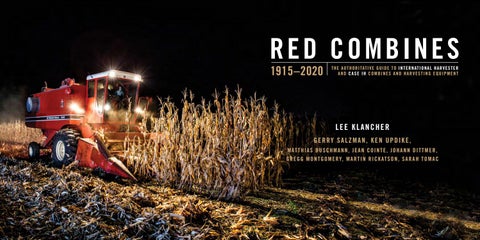
RED COMBINES 1915–2020
T H E A U T H O R I TAT I V E G U I D E T O I N T E R N AT I O N A L H A R V E S T E R AND CASE IH COMBINES AND HARVESTING EQUIPMENT
LEE KLANCHER GERRY SALZMAN, KEN UPDIKE, M AT T H I A S B U S C H M A N N , J E A N C O I N T E , J O H A N N D I T T M E R , G R E G G M O N T G O M E R Y, M A R T I N R I C K AT S O N , S A R A H T O M A C
Contents
The War Horse “Bamfoozled” by the French: 1972 9 Dark Secrets and Deep Pockets: 1973 Logical and Simple: 1974 Introduction A New Name: 1975 Seeds of Innovation by Lee Klancher 11 Who Builds It? 1976 Building Red Combines in Fort Wayne Prologue The East Moline Plant 1920s–1980 Harvesting America by Lee Klancher 13 Building the 300: The Looney Room J. I. Case Threshing Machine Company 22 The Red Demon: 1977 One 1915–1941: The Early Days of Combines 25 Five 1978–1985: The Axial-Flow Debuts J. I. Case Company 1915–1941 44 International Harvester 1440 The Cab Two 1942–1961: The Rise of International Harvester 1460 Self-Propelled Machines 47 Axial-Flow Design and Styling The Small Self-Propelled Combines 64 International Harvester 1480 The Pull-Type Combines 66 Rat Patrol: The 1979 Strike J. I. Case Company 1942–1961 70 International Harvester 1482 Pull-Type Combine Three 1962–1977: The Big Tough Rugged Line 73 International Harvester 1470 03 Series 76 Hillside Combine 15 Series 90 International Harvester 1420 J. I. Case Company 1962–1972 102 How Axial-Flow Separation Works The Probine Four 1954–1977: Development of The Dawn of Case IH the Axial-Flow Combine 105 The Color Red Early Rotary Combine Designs 108 Harvester’s Rotary Separation Experiments 110 112 Six 1986–1994: Winds of Change The IH Rotary is Born 1600 Series Inspired by Corn 114 Going Public The Multi-Pass Combine 118 ProHarvest Support Program The CX-1 120 The Next Generation Prototypes 124 The Surprise 130
Preface The Combine Family by Gerry Salzman
133 134 137 142 146 148 150 154 156 163 167 170 174 176 183 184 188 190 194 198 202 204 210 211 213 216 221 222
Australian Red Combines Seven 1995–2008: The Art of New Machines 229 Red Combines in Central Asia 2100 Series 234 Red Combines in Latin America New Cab for 2100 Series 238 Red Combines in China 2300 Series 240 The Rotary Poster 242 Ten Harvesting Equipment Main Street Tour Program 245 Corn Harvesters AFX Series Development 246 Cotton Harvesters Moving the Midrange Combine 254 Other Harvesters AFX 8010 256 2007 “Red Top” 8010 and new 7010 260 Epilogue The Quadtrac Combine 262 The Future of the Combine 2500 Series 264 30th Anniversary Celebration 266 Acknowledgments The 100 Club 267 Contributors Eight 2009–2020: The Modern Era 269 120 Series 272 Appendix 88 Series 276 Red Combines Model List The Evolution of AFS 278 130 and 230 Series 282 Index Building Red Combines 286 140 and 240 Series 292 150 and 250 Series 300 Custom Harvesting 302 Nine Red Combines International 307 Red Combines in the United Kingdom 310 French Red Combines 316 German Red Combines 328
334 348 352 358 361 362 368 372 375 378 379 380 383
Chapter One
1915–1941 THE EARLY DAYS OF COMBINES By Lee Klancher
“As respects this ingenious machine, it remains only to say that it harvests, cleans, and bags from twenty to thirty acres of heavy wheat, in the course of a single summer’s day!” —James Fenimore Cooper, The Oak-Openings (1848), writing about Hiram Moore’s combine
In 1845, Australians had developed a smaller machine, the stripper-harvester, that stripped grain off standing stalks. The machine worked well in light crops and was reasonably light and economical. By 1887, the big combines were popular out West, and the stripper-harvesters from Australia had migrated elsewhere. Similar developments were being made around the world. While blacksmiths, visionaries, and schemers developed new ways to improve productivity on the farm, Axel Jarlson was fighting to stay alive with his family in Sweden. The winter of 1891 produced deep snow, six months’ worth, and the only way the farmer’s Wartime Production ▲
W
hile Cyrus McCormick was building his reaper empire, two men in Michigan were building the next transformative piece of agricultural technology. In June 1836, Hiram Moore and John Hascall of Kalmazoo patented a machine pulled by 14 horses that harvested, threshed, cleaned, and bagged grain in one pass. By summer 1838, the men were able to bag 1,100 bushels of wheat in one day. They sold several of their combines for $500 each, at least one of which worked for 20 years. The machine was the combine. Their idea spread to California and by 1888 roughly 500 of them were working on the West Coast. Many of these were very large machines that had a 40-foot cut and were hauled by large horse or mule teams. The technology was cutting-edge, as was the $500 price—an entire farm could be purchased at the time for $50 and an annual budget of $200 or so was not uncommon. Combine purchases were suitable only for large, well-funded operations that worked 300 acres or more.
Between 1914 and 1917, gross farm income
skyrocketed . . . increasing 230 percent from 1914 to 1919, as did the demand for agricultural equipment. This photograph shows IHC’s Milwaukee Works in 1914. Wisconsin Historical Society #7601
25
International 1440 Corn is where Axial-Flow technology shone the
▲
brightest early in development. Exceptionally low grain loss and crackage the machine returned in corn, as well as other grains, were strengths of the Axial-Flow models from the very beginning. Wisconsin Historical Society #114834
International 1440 ▲ Creating the Axial-Flow combine took more than a million man hours of research and development. This image is of a 1978 model. Wisconsin Historical Society
172
RED COMBINES
Rice Harvesting
▲
Perfecting rice harvesting with the Axial-Flow
Axial-Flow Combine Sketch While technology was the star of the
▲
was a painstaking process that required a lot of
new Axial-Flow, the design was also
experimentation with different protrusions on the
groundbreaking. Harvester industrial
rotor. Wisconsin Historical Society #117310
designer Jerry McGirk drew a machine with smoother lines and a more integrated, logical layout than anything on the market at the time. Gregg Montgomery Collection
AXIAL-FLOW DESIGN AND STYLING By Gregg Montgomery
The IH 1400 Series Axial-Flow combine had the first rotary threshing system manufactured and brought to full production. While there had been prior attempts to build such a system, none was ever successful on a production basis. A combine with such revolutionary engineering deserved equally revolutionary design and styling. Thanks to the IH Industrial Design Department and lead designer Jerry McGirk, that is exactly what it got. Until the introduction of the first IH Axial-Flow design, all combines were pretty much a series of flat sheetmetal boxes enclosing various components and stacked on one another. There was little or no thought given to the overall appearance or the integration of various components into a singular form that bespoke the machine’s functionality.
After producing numerous concept sketches and scale models for the Axial-Flow design, a quarter-scale production layout of the selected concept was begun. In the 1970s before computer-aided design, this was a chore. The layouts were produced on a 12x8-foot vertical drafting board, a task that was physically as well as mentally taxing. The new combine was given a dynamic profile that reflected the mounting angle of the rotary separator and gave the entire machine a clean and aggressive look. The original Axial-Flow set the design trend for combine aesthetics for the next 40 years. One can still see IH’s engineering and design influence in virtually every combine built today. The Axial-Flow combine was— and is—a truly revolutionary product that has transcended the years both functionally and aesthetically. 1978–1985 THE AXIAL-FLOW DEBUTS
183
130 AND 230 SERIES By Ken Updike The announcement of the new 130 Series midrange Axial-Flow combines in 2012 marked an important milestone in Case IH history. With the new emissions standards, Case IH moved engine production from the Consolidated Diesel Company (CDC) to FPT Industrial. This turned out to be the perfect time to make the move. FPT was part of the entire organization, so it made sense to use its engines. When the new emission regulations came into effect, the time
Case IH 7130 ▲
This 7130 Axial-Flow has a 2608
eight-row 30-inch-spacing corn header attachment. The 7130 is fitted with the new common cab, as evidenced by the cab’s chrome-trimmed headlights. Case IH
282
RED COMBINES
was right to switch. “We were blessed to have FPT’s experience with emissions,” Gerry Salzman said. “So that worked out really well.” The new engines met Tier 4A and 4B standards, and also offered improved efficiency. Three new models were introduced in the series. The 5130 has a 6.7-liter engine rated at 265 hp and a grain tank capacity of 250/300 bushels. The 5130 replaced the 5088. The 6130 replaced the 6088 and has an 8.7-liter engine rated at 320 hp and a 300-bushel grain tank. The largest model in the new series is the 7130, with an 8.7-liter engine rated at 350 hp.
In the feeder house of the combine, chain guides were added to the front feeder chain drum to improve feeder chain performance and extend feeder chain life in all crop conditions. With the use of large (40-foot) draper headers, it became evident that the unloading auger lengths needed to grow. This presented a problem both in Europe and North America. In Europe, adding length to the auger could cause it to strike something while turning in the field or during transport on the roadway. In America, it was an issue with machine storage. Since the auger was extended so far beyond the rear of the machine, it was difficult to park inside a shed without having the auger strike something. A folding auger was devised as a remedy. Case IH experimented and patented several folding unloader augers. The design that was sent to production has the rear section of the auger fold at a 90-degree angle to the machine to tuck behind it. This reduces the overall length of the machine and does not increase its width. The folding unloader auger is optional equipment. To provide additional safety, the unloading auger operation is connected to the operator presence seat switch. If the operator is out of the seat for more than five seconds when the unloading auger is engaged, the auger shuts off automatically. Another new feature on the 130 Series is the folding grain tank cover option. Here, four hinged panels create a grain tank extension that can fold flat for transport or storage via a cab-operated rocker switch. This option is very useful and popular in both Europe and North America. The 230 Series flagship models debuted in 2012. The smallest of these three models was the 7230 that
Case IH 7230 ▲ This 7230 is fitted with optional rubber drive tracks. Its 8.7-liter, 380-hp FPT engine is Tier 4B–rated. This 7230 is marked with 20K decals, indicating it is for the European market. Case IH
Case IH 8230 ▲ An 8230 fitted with a draper header rests after harvesting wheat. The draper head has two reels to reduce the load in tough crop conditions. Case IH
replaced the 7120. This has an 8.7-liter FPT engine rated at 380 hp and a 315-bushel grain bin. The midsized model is the 8230 that replaced the 8120. The 8230 has a 12.9-liter FPT engine rated at 450 hp and a 350-bushel grain bin. The big one is the 9230, which 2009–2020 The Modern Era
283