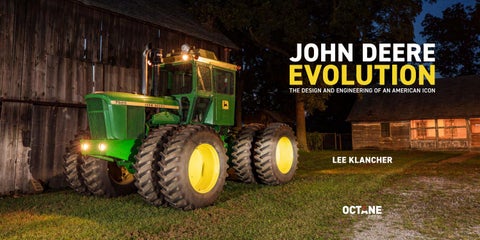
JOHN DEERE
EVOLUTION THE DESIGN AND ENGINEERING OF AN AMERICAN ICON
LEE KLANCHER
2
JOHN DEERE EVOLUTION
3
CONTENTS Preface Ten Years in the Making Introduction A Call to Arms One Blacksmiths and Craftsman The First John Deere Tractors Two The Foundation Letter Series Tractors Three The Art of Refinement Numbered Two-Cylinder Machines
4
JOHN DEERE EVOLUTION
Four The Revolution New Generation Models Five The Four-Wheel Drive Emerges The 8010, Wagner & 7X20 Models Six The Domination Generation II Tractors 1972–1994 Seven The 21st Century Modern Green Tractors
5
T
his book is the result of a decade-long odyssey into the world of John Deere machines. The imagery is the central appeal of this work, and you’ll find a blend of studio and outdoor images of important John Deere machines and archival images of production as well as prototype machines. Making the images, particularly in studio, was one of the most complex photographic endeavors I’ve undertaken, requiring large amounts of equipment, crew, and resources. And finding the images as well as interviewing the engineers and designers who built John Deere tractors required countless hours of research and travel. The first major image creation project of the book was working with Bruce and Walter Keller to build a photo studio to capture some of their rare John Deere tractors. They have more than six hundred machines and, more significantly, a large number of serial number one and rare examples. I returned to the studio in 2019 at the Half Century of Farm Progress Show, where I built another studio in an old hangar on Chanute Air Force Base to capture images of the fantastic machines in the show. We changed techniques a bit, opting for black backgrounds and a natural rather than white floor. The studio creates very pure images. All you have to work with is the machine itself and lush, velvety light. It is a harsh but highly rewarding environment. The challenges in this book were significant. On the way home from the original Keller studio shoot, my Audi’s engine gave out, stranding me in Dallas (where my wife would contend, I should have left that car for dead!). Snow continued to play a role in this book when I planned an upper Midwest book trip in October 2019. High winds, sub-zero weather, and several inches of 8
JOHN DEERE EVOLUTION
snow made the roads impassable and froze my camper’s water systems solid. Once the wind died down and the salt trucks took the edge off the icy roads, I was able to drag the camper out of the snow and point my rig south. The camper and I thawed out in central Arkansas, nursing the pain of lost photo shoots and media appearances. Finding historic imagery for the book also was a significant challenge. I was able to get a handful of key images from the John Deere archives, and needed to turn elsewhere to find fresh images. The Cooper Hewitt Smithsonian Design Museum in New York houses the archives of the Henry Dreyfuss Agency, which designed the exterior of Deere machines from the 1930s to recent times. The agency would maintain a close relationship with Deere leadership for more than seven decades, and their work was critical to the brand’s ascent. Frequent visits to those archives yielded a treasure trove of imagery lost to history for several decades. I spent many exciting days at the facility viewing previously uncatalogued material that had not been seen in thirty years. I also found images in the Library of Congress, Smithsonian Collections, National Archives, Standard Oil Collection of New Jersey, and more. While the images are the star of the show in this book, I was also fortunate to make contact with many people who played significant roles in creating John Deere tractors. Such interviews are always enlightening, and capturing their stories has been one of the most satisfying parts of creating this book.
MODEL 4020
January 2021
The second 4020 built is a piece of history which owner Jack Vinopal (shown) still puts to work on his farm in Missouri. T en Y ears in the M a k in g
9
E
arly in 1953, after years of acrimonious debate, the leaders at John Deere decided to build a tractor engine with more than two cylinders. The two-cylinder had been a mainstay for the line, but everyone from engineering to upper management believed the limits of the technology had been explored and the time had come to change. The decisions were protected with utmost secrecy, so much so that no records exist of the actual decision to build the new engine (and new tractor). John Deere was well positioned for the change—it had been the number two tractor builder in the United States for decades, and had a firm grip on that position. The conservative company had been content with that for decades, but that was beginning to change in the 1950s. For the New Generation tractors to succeed, the new machines needed to make a quantum leap in technology. John Deere’s development cycle is legendarily long to this day, and the New Generation would take roughly seven years from concept to introduction. To be certain this could be done without alerting
the competition, the work needed to be done in secret. Secrets are not easily kept by tractor companies. Manufacturing facilities for competing brands are often located in the same town. The red and green combine plants, for example, were nearly back-to-back in Moline, Illinois, and everyone from managers to line workers would take lunch, smoke breaks, and reconnaissance missions to peer at the nearby plant and see what was shipping out. Employees also would switch companies, and every locale in a small town, from the schools to the bars to the softball fields, was a place where “red” employees and “green” employees, would mingle and swap stories. Like any small town, word about interesting developments had a way of spreading like wildfire. Agricultural sites where the newest machines were tested were also often well known and frequented by lots of different color manufacturers. During harvest or planting season at these locations, company spies would watch for prototype machines in the fields. Actual examples of tractor spy skullduggery included crawling underneath the machines in the wee hours of the morning to scrape off metal samples, disassembling parts of machines hidden under canvas covers, and even management pretending to be dealership owners in order to drive the prototypes. To prevent this type of corporate espionage with the New Generation, John Deere sequestered a small engineering team in the dark corners of a rented Waterloo grocery store known to its denizens as the “butcher shop.” Behind locked doors and blacked-out windows, The 4010 set new standards for the industry and had a clean design that was functional first.
16
JOHN DEERE EVOLUTION
T he N e w Generation
17
MODEL 1020
MODEL 500
The smallest member of the 20 series
The 500 was the industrial version of
was also one of the best-looking.
the 3020.
MODEL 4520 The burly front-wheel-assist version
MODEL 4020
was added later to the line.
One of the most popular models in history, the 4020 is a workhorse.
18
JOHN DEERE EVOLUTION
T he N e w Generation
19
E
lluptur molor am, sam quam quibusda sit ium fugita quunt odi optae nimi, quiam, corem inti re remped qui ut perovit aspidebis dolupta ssimus sum everehe ntemquatur? El ipidi quatia nis ex eos doluptum atur ad et aligendiscia sendant autectorecto endel inulliquam que non re, ium et eume nis
velenda erroria doluptinum, con consequam qui idem endicat. Hiciaeptatis nonseque sunt enis et que vitam faccus, consequi acero cus eatinctumque es evella non re quunt ini a nonsequam estent libus esecearum, venimus reperitet maxim aximod ex eossundi blab ipitem
PROTOTYPE MODEL This model was created in the HDA studios in New York in the late 1980s. Cooper Hewitt Smithsonian Design Museum Collection
MODEL 9620R Contemporary Deere four-wheel-drive tractors like this one feature Cummins fifteen-liter engines and sophisticated systems that drive the tractor and control planting and harvesting equipment. John Deere
MODEL 8960 This 370-horsepower beast is powered by a fourteen-liter Cummins six-cylinder diesel engine. 22
JOHN DEERE EVOLUTION
T he F our - Wheel - D rive E mer g es
23