renewable energy alternative
SIMPLE ENERGY SAVING SOLUTIONS
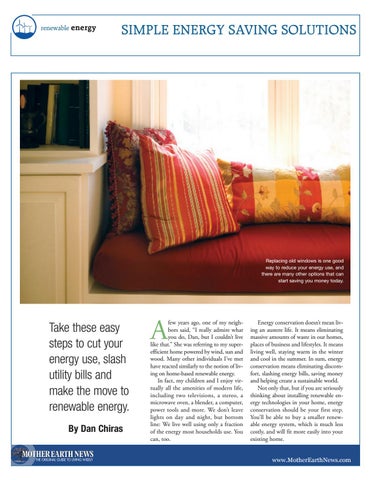
Replacing old windows is one good way to reduce your energy use, and there are many other options that can start saving you money today.
Take these easy steps to cut your energy use, slash utility bills and make the move to renewable energy. By Dan Chiras
A
few years ago, one of my neighbors said, “I really admire what you do, Dan, but I couldn’t live like that.” She was referring to my superefficient home powered by wind, sun and wood. Many other individuals I’ve met have reacted similarly to the notion of living on home-based renewable energy. In fact, my children and I enjoy virtually all the amenities of modern life, including two televisions, a stereo, a microwave oven, a blender, a computer, power tools and more. We don’t leave lights on day and night, but bottom line: We live well using only a fraction of the energy most households use. You can, too.
Energy conservation doesn’t mean living an austere life. It means eliminating massive amounts of waste in our homes, places of business and lifestyles. It means living well, staying warm in the winter and cool in the summer. In sum, energy conservation means eliminating discomfort, slashing energy bills, saving money and helping create a sustainable world. Not only that, but if you are seriously thinking about installing renewable energy technologies in your home, energy conservation should be your first step. You’ll be able to buy a smaller renewable energy system, which is much less costly, and will fit more easily into your existing home. www.MotherEarthNews.com
perform more sophisticated and expensive tests on your home, such as a blower door test, duct leakage tests and comprehensive computer energy analysis. The cost of the complete energy analysis is typically $300 to $400, give or take a little. That may seem like a lot of money, but this analysis is well worth the expense — provided you follow up on the auditor’s recommendations. Home energy auditors provide a written report that lists potential energy improvements. The report includes recommendations for sealing cracks and openings in the building envelope — that is, weatherizing a home. It’s also likely to call for additional Charlie Castillega/NREL; page 26: Istockphoto/Diane Diederich
Then, on a windy day, perform a search and destroy mission for smaller, less obvious leaks. Use incense, a smoke stick or simply your hand to detect drafts (see photo below). If this is more work than you’d like to undertake, or if you are feeling uncertain, you can always hire a qualified professional energy auditor to perform the inspection for you. You’ll find them in the business pages under “Energy Conservation and Management Services” or “Home Inspection.” Professional energy audits. Energy auditors perform simple visual inspections for about $75 to $100, but can also
Infraspection Institute
Energy conservation entails two separate but complementary strategies: frugality and efficiency. Frugality entails behaviors or actions that reduce energy use: turning off lights, televisions and stereos in unoccupied rooms and taking shorter showers to reduce hot water use. The efficiency principle, on the other hand, calls on us to wring as much useful energy as possible from our energy supplies, examples include adding insulation to our attics or purchasing energy-efficient appliances. Some utilities offer financial incentives to customers for energy efficiency measures they undertake. Why? By promoting energy conservation, power companies can reduce their need for additional capacity. As a result of your efforts, and efforts of other citizens like you, local utilities avoid having to purchase additional energy on the “spot” market, which can be costly. Or they may avoid the need to build expensive new power plants. The savings can be quite significant. In North America, homes are huge energy consumers; in fact, they account for about one-fifth of the United States’ total annual energy demand. Heating and cooling the interior of our homes consumes the largest portion of that slice of the energy pie — about 44 percent. Lighting, cooking, and appliances (other than the refrigerator) consume one-third of our energy. Water heating consumes 14 percent and the refrigerator about 9 percent. Although each home is different, this data alerts us to the big energy consumers. In so doing, it can help us target the greatest potential gains.
Shutterstock/Vinicius Tupinamba
Energy Conservation at Home
Consider an Energy Audit
Retrofitting a home for energy efficiency will save you money, lots of money. However, it will require some effort on your part. You should start with an energy audit. First, do a simple visual inspection to locate the most obvious leaks — gaps between doors and door frames, or large openings in the building envelope that let cold air in when the wind’s blowing and hot air out when the furnace is running. These can be sealed immediately and will often yield enormous benefits.
Above: Sealing air leaks is a sure way to save energy and money. Infrared imaging can pinpoint places where warm air is escaping. Top left: For a low-tech alternative, light an incense stick and walk around your home. The blowing smoke will help you spot drafts. Top right: Technicians also can check your ductwork for leaks.
www.MotherEarthNews.com
insulation in walls, ceilings and perhaps floors, especially over crawl spaces or unheated basements. The report may recommend insulation for hot water lines from the water heater to various faucets in the house; efforts to seal and insulate ducts that transport hot and cold air from heaters and air conditioners to the rooms of a house; and replacement of old, inefficient appliances. Other options for energy audits. Rather than hire a professional to perform tests and retrofit your home, you may want to contact your local utility to see if they can help. Many efficiency-conscious utilities offer free or low-cost energy audits. Another option is to contact nonprofit organizations in your area that offer energy audits and retrofits; many of them focus on the residences of low-income families who can’t afford high utility bills yet are unable to afford professional energy upgrades.
Retrofit for Energy Efficiency
After reviewing the problems identified in your energy audit, you have two options: roll up your sleeves and do the work yourself, or hire an energy retrofitter to perform the necessary work for you. Although hiring a professional will cost substantially more than doing the work yourself, a qualified expert is often worth the extra expense. They perform the work
AP/Rogelio Solis; above: Istockphoto/David lewis
Right: Older homes can be retrofitted with blown-in insulation. Below: Volunteers caulk and paint a home for Habitat for Humanity. Caulking is a simple way to prevent air leaks.
quickly and efficiently with a minimum of mistakes commonly made by homeowners. A professional energy retrofitter can even access high-quality materials that often aren’t sold in local hardware stores or building supply outlets, such as duct mastic, a paste used to seal leaky air ducts in heating and air conditioning systems. High-quality products mean a long-lasting job. Seal cracks. Sealing cracks in the building envelope is one of the easiest and most cost-effective measures a homeowner can take. For those who want to do the work themselves, I strongly recommend that you purchase the best caulk you can find. Don’t skimp on caulk just to save a few bucks per tube. Ask a knowledgeable hardware store employee which products are the best and then spend the extra money. For small gaps, around windows, for example, use a high-quality silicon paintable caulk. Larger gaps can be filled with expandable foam, which comes in spray cans. I use Great Stuff insulating foam sealant (red can) for smaller openings — those too large for silicon caulk — and Great Stuff insulating foam sealant (blue can) for the largest openings. Very large openings can also be filled with backer rod, a flexible material that is stuffed into openings. In your quest to tighten up your home, you will also likely need to seal wall switches and electrical outlets. They can be sealed by installing small foam gaskets available in local hardware stores and building supply stores. To seal a switch or electrical outlet, even on inside walls, remove the cover plate, then insert the foam gasket and screw the cover plate back in place. Install insulation. Another energysaving strategy is to add insulation. As a rule, the older your home, the more insulation you’ll need to add. Professional energy auditors will likely recommend increasing insulation to meet local building codes. Although such changes will increase the energy performance of your home and sharply decrease utility bills, I strongly recommend that homeowners go beyond the insulation standards in most jurisdictions. Even if your local building department has recently upgraded it’s building code, the best energy efficiency is achieved when builders and homeowners go beyond the required levels by at least 30 percent to 40 percent. (That’s what top-notch solar builders are using in
www.MotherEarthNews.com
pane variety, you should consider a complete upgrade. The cheapest and easiest upgrade for energy-wasteful windows is to install storm windows. Storm windows are installed on the outside of existing windows where they perform two vital functions. First, storm windows dramatically reduce air leakage. Second, they create a dead airspace that reduces heat loss. These simple, relatively inexpensive upgrades can dramatically decrease heat loss and increase interior comfort at about a quarter of the price of a complete window upgrade. A more costly option is to tear out existing windows and replace them with high-quality, energy-efficient models widely available throughout North America. Window replacements cost quite a lot — potentially $8,000 to $10,000, or even more for larger homes. The payback period, the time in which this investment pays for itself in energy savings, is typically about 10 to 12 years at current energy costs. Although this upgrade is expensive, remember that a 10 year payback represents a 10 percent financial return on your investment. Moreover, the gains in comfort are immediate, and rising energy bills could help increase your return on investment. In most cases, existing windows should be replaced with double- or triple-pane assemblies. (For
more information on choosing windows see “High Performance Windows,” Page 68.) Another simple solution is to install a second or third pane of glass in the existing window frame. While effective, this method is costly and time-consuming. I’ve devised another option — one that is more aesthetically appealing than sheet plastic and much cheaper than installing additional panes of glass. My solution is to install Plexiglas inserts along the inside surface of existing windows. Plexiglas is a clear, durable polycarbonate plastic. It can cost a tenth of the price of some window glass, and usually won’t yellow in sunlight. It also conducts heat more slowly than glass, which results in a warmer surface and thus less heat loss. More Energy Saving Strategies
Choose efficient appliances. You can achieve huge reductions in energy consumption by replacing energy-consuming appliances and other devices — especially heating and cooling equipment, water heaters, refrigerators and washing machines — with newer, energy-efficient models. The job is made a lot easier by consumer labels required by the U.S. and Canadian governments, which list
Istockphoto/Marcel Pelletier
their homes.) Insulating well above the energy code will cost a few hundred dollars more than merely meeting code, to be sure, but is worth it in the long run. Insulate wall cavities. Many older homes have no insulation at all in their exterior walls. Filling these cavities with insulation is, therefore, vital to achieving comfort and savings. Fortunately, there are several ways to do this. Most often, installers drill large holes in the siding from the outside or in the drywall from the inside, accessing each stud cavity (the space between adjacent studs) individually. They then either blow in cellulose insulation (made from recycled newspapers) or apply a liquid foam product that expands to fill the stud cavity. The holes used to access the interior of the walls are then repaired and repainted. Wall insulation retrofits can be difficult and are often best left to experienced professionals. Insulate ceilings. Ceiling insulation must also be fortified in both old and new homes. Even if your home was built in the 1990s, consider adding more ceiling insulation. Adding insulation is a breeze in homes with attics. You simply climb into the attic through an access hatch usually located in the ceiling of a hallway or a back room. Once in the attic, you can lay down fiberglass batts or blow fiberglass or cellulose over the existing insulation. Be sure to walk on the rafters so as not to fall through the ceiling when moving about in an attic. When retrofitting ceiling or attic insulation, I recommend bringing the R-value well above local building codes — to R 50 or R 60 — in most climates. In really cold climates, you may want to boost insulation even more. If you don’t have an attic, your home was probably built with a closed ceiling design and installing additional insulation can be difficult, if not impossible. But all is not lost. You could, for instance, install additional insulation by framing in a second ceiling with 2-by-4s and adding insulation to the cavities. Or you could apply large sheets of foam insulation. Once the insulation is in place, you’ll need to attach a vapor barrier and new drywall. Upgrade windows. If your windows are old and leaky, were manufactured with aluminum or steel frames, or are the single
New energy-efficient windows can be expensive, but over time this investment will be paid back by lower heating and cooling costs.
www.MotherEarthNews.com
pertinent energy data on each model. Energy Star labels indicate the best choices. Choose efficient lights. One of the easiest ways to reduce energy bills in our homes is by installing compact fluorescent light bulbs (CFLs), which convert about 20 percent of the electricity flowing through them into light. A standard incandescent light bulb converts only 5 percent of the electricity flowing through it into light. CFLs come in several different shapes and sizes, so they fit into a wide variety of light fixtures and lamps. Compact fluorescents are currently the hands-down favorites when it comes to energy efficiency, although they may, in the not too distant future be replaced by more efficient light emitting diode (LED) lights. (See “Bright Ideas for Home Lighting” at www.MotherEarthNews.com.) Save hot water. If your water heater is old and decrepit, replace it with an energy-efficient model. You should give strong consideration to an on-demand or instantaneous water heater. If your water heater still has a few good years left, you can cut fuel bills by making a few adjustments. The first thing you should do is check the water temperature. To do this, turn on the hot water and let it run for a minute or two. Next, hold a thermometer under a faucet. If the temperature is above 120 degrees F, turn the water heater’s temperature down. Studies show that you don’t need water to be hotter than 120 degrees to wash dishes and clothes. This is sufficient to kill bacteria. If you have a gas- or propane-powered water heater, simply turn the dial on the unit to a lower setting, then wait a day or two and check the temperature again. If the temperature is still too high, lower it again. For electric water heaters, you’ll need to remove the top and bottom covers on the side of the unit, one for each heating element, and turn the temperature settings down using a screwdriver. After lowering the water temperature setting, you should install an insulated water heater blanket over the tank. Water heater blankets cost as little as $15, and pay for themselves in less than a year, depending on your family’s hot water consumption. You can also save hot water by installing water-efficient showerheads. Eliminate phantom loads. Phantom loads (also called ghost loads) are the electricity used by appliances and other electronic devices when they’re not in active use. Your instant-on television, for example, consumes electricity even when it’s off. Why? To keep the circuits buzzing, so that when you click the
power button on the remote, the TV hums to life instantly. Other examples include the power transformers for cordless phones, answering machines and keyboards; microwave ovens and coffee makers equipped with LED clocks; stereos, radios, audio receivers, satellite receivers and power strips; even hard-wired smoke detectors and some GFIs (the electrical outlets with built-in circuit breakers). And don’t forget your cell phone charger; it may draw power even when the phone isn’t hooked in or after the phone is fully charged. Your home is full of phantom loads that, although tiny on their own, collectively consume significant amounts of electricity over a year’s time. When I first moved into my solar home, I discovered that there were about 125 watts of cumulative ghost loads. That’s the equivalent of two 60watt light bulbs running 24 hours a day, 365 days a year! I set out to eliminate the ghosts from my life, and so can you. You’ll find them everywhere. Make a note of each ghost load, and then devise a strategy to get rid of them one by one. For example, you can plug televisions, stereos, microwaves and the like into power strips that can be shut off when the electronic device or appliance is not in use.
The Silver Lining
Energy efficiency is vital to each of us and to our collective long-term future. You can do your part to help accelerate our progress down the road to a renewable energy future by energy retrofitting your home. Writer and conservationist Nancy Newhall once wrote that conservation is “humanity caring for the future,” and she was right. Let’s not forget that the future starts tomorrow. Today, it’s time for all of us to get serious about energy conservation. This article was excerpted from The Homeowner’s Guide to Renewable Energy, a Mother Earth News “Book for Wiser Living,” available on Page 96. Dan Chiras is a passive solar home design consultant, a contributing editor to Mother Earth News and the author of numerous books on green building and renewable energy. Visit his Web site at www. danchiras.com.
Resources for Energy Efficiency Organizations
Home-Repair Products
American Council for an Energy-Efficient Economy (202) 429-8873; www.aceee.org Find ways to save energy and learn about U.S. energy policies.
Many hardware stores carry supplies for weatherizing your house and repairing ducts, or try these online retailers:
Energy Star program (888) 782-7937; www.energystar.gov Learn about Energy Star-certified homes, and energy-efficient appliances. Energy Efficiency and Renewable Energy Clearinghouse www.eere.energy.gov Find consumer information, tips for renters and recommendations for how much insulation to use in your climate.
AM Conservation Group (800) 777-5655 www.amconservationgroup.com Energy Federation Inc. (508) 870-2277 www.efi.org
Home Energy Audits Residential Energy Services Network (766) 806-3448 www.natresnet.org/directory Find energy auditors in your area.
Financial Incentives Contact your utility or state energy office to learn more about local incentives. For information on federal tax credits go to www.energytaxincentives.org.
Home Energy Saver hes.lbl.gov Take this Web-based survey to get suggestions for improving efficiency.
www.MotherEarthNews.com