Color profile: Disabled Composite Default screen
Table of Contents
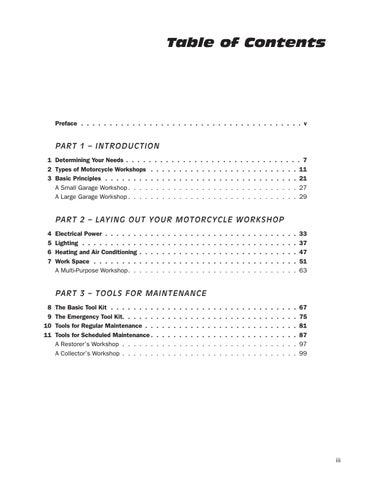
Preface . . . . . . . . . . . . . . . . . . . . . . . . . . . . . . . . . . . . . . . v
PART 1 – INTRODUCTION 1 Determining Your Needs . . . . . . . . . . . . . . . . . . . . . . . . . . . . . . . 7 2 Types of Motorcycle Workshops . . . . . . . . . . . . . . . . . . . . . . . . . . 11 3 Basic Principles . . . . . . . . . . . . . . . . . . . . . . . . . . . . . . . . . . 21 A Small Garage Workshop . . . . . . . . . . . . . . . . . . . . . . . . . . . . . . 27 A Large Garage Workshop . . . . . . . . . . . . . . . . . . . . . . . . . . . . . . 29
PART 2 – LAYING OUT YOUR MOTORCYCLE W ORKSHOP 4 5 6 7
Electrical Power . . . . . . Lighting . . . . . . . . . . Heating and Air Conditioning Work Space . . . . . . . . A Multi-Purpose Workshop. .
. . . . .
. . . . .
. . . . .
. . . . .
. . . . .
. . . . .
. . . . .
. . . . .
. . . . .
. . . . .
. . . . .
. . . . .
. . . . .
. . . . .
. . . . .
. . . . .
. . . . .
. . . . .
. . . . .
. . . . .
. . . . .
. . . . .
. . . . .
. . . . .
. . . . .
. . . . .
. . . . .
. . . . .
33 37 47 51 63
. . . . . .
. . . . . .
. . . . . .
. . . . . .
. . . . . .
. . . . . .
. . . . . .
. . . . . .
. . . . . .
. . . . . .
. . . . . .
. . . . . .
. . . . . .
. . . . . .
. . . . . .
. . . . . .
67 75 81 87 97 99
PART 3 – TOOLS FOR MAINTENANCE 8 9 10 11
The Basic Tool Kit . . . . . . . . The Emergency Tool Kit. . . . . . Tools for Regular Maintenance . . Tools for Scheduled Maintenance . A Restorer’s Workshop . . . . . . A Collector’s Workshop . . . . . .
. . . . . .
. . . . . .
. . . . . .
. . . . . .
. . . . . .
. . . . . .
. . . . . .
. . . . . .
. . . . . .
iii
MASI3-interior.ps C:\MASI3-4P\MASI3-interior\MASI3.vp Wednesday, September 19, 2018 11:45:48 AM
3
Color profile: Disabled Composite Default screen
PART 4 – TOOLS FOR REPAIR WORK 12 13 14 15
Tools for Electrical Work . . . Tools for Motor Work . . . . . Tools for Chassis Work . . . . Whoops! Tools . . . . . . . . A Semi-Professional Workshop . A Professional Workshop . . .
. . . . . .
. . . . . .
. . . . . .
. . . . . .
. . . . . .
. . . . . .
. . . . . .
. . . . . .
. . . . . .
. . . . . .
. . . . . .
. . . . . .
. . . . . .
. . . . . .
. . . . . .
. . . . . .
. . . . . .
. . . . . .
. . . . . .
. . . . . .
. . . . . .
. . . . . .
. . . . . .
. . . . . .
. . . . . .
. . . . . .
103 115 129 137 139 141
. . . . . . . . . . . .
. . . . . . . . . . . .
. . . . . . . . . . . .
. . . . . . . . . . . .
. . . . . . . . . . . .
. . . . . . . . . . . .
. . . . . . . . . . . .
. . . . . . . . . . . .
. . . . . . . . . . . .
. . . . . . . . . . . .
. . . . . . . . . . . .
. . . . . . . . . . . .
. . . . . . . . . . . .
. . . . . . . . . . . .
. . . . . . . . . . . .
. . . . . . . . . . . .
147 151 155 161 165 171 175 183 199 202 203 205
PART 5 – FILLING IN THE CORNERS 16 17 18 19 20 21
Parts and Consumables . . . . . . . Jacks and Lifts . . . . . . . . . . . Welding Equipment . . . . . . . . . Compressed Air . . . . . . . . . . . Painting Equipment . . . . . . . . . Metal Fabrication Equipment . . . . A Race Preparation Workshop . . . . 22 Computers in Your Workshop . . . . Computerizing a Motorcycle Workshop Resource Directory . . . . . . . . . Index . . . . . . . . . . . . . . . . About the Author . . . . . . . . . .
iv
MASI3-interior.ps C:\MASI3-4P\MASI3-interior\MASI3.vp Wednesday, September 19, 2018 11:45:48 AM
4
. . . . . . . . . . . .
. . . . . . . . . . . .
. . . . . . . . . . . .
. . . . . . . . . . . .
. . . . . . . . . . . .
. . . . . . . . . . . .
. . . . . . . . . . . .
Color profile: Disabled Composite Default screen
1 Determining Your Needs
LESSON 1: KEEP YOUR PLANS LOOSE AND EASY TO CHANGE
There is no universal plan for setting up a motorcycle shop. What you need to get out of this book is an understanding of how to figure out—for yourself—what you need for your workshop and how to arrange it, and how to do your planning and arranging in an organized way. Not only is there no universal plan, but a motorcycle shop that will fit your needs today won’t fit them a year from now. So, think about what your needs are right now. For example, the other day I stopped by H&H ycle Works in Needles, California. When I wandered out in the back, there was Tom climbing around on a workbench with boards in his hands. A Skilsaw sat in the middle of the floor atop a pile of sawdust. “What’s going on?” I asked. “We’re making kitty litter,” said Tom’s partner Loyd, pointing to the pile of sawdust. Half seriously, he continued: “You know, kitty litter is the best thing you can use to sop up oil spills. At least it used to be until the price went up. “The difference between kitty litter and the commercial clean-up-your-oil-spill stuff is that kitty litter has chemicals in it to deodorize the you-know-what, and it used to be a lot cheaper. Now the price has gone up, though. Sawdust is almost as good, so we’re making some of that.” “No, no. I’m putting up some more shelves,” Tom said, sliding a pair of enormous leather saddle bags onto the shelf he’d just nailed in place.
Loyd and Tom have been at this location for several years. Yet, Tom had just then felt the need of added storage space right in that corner of the shop. Those saddle bags had been sitting on that workbench for several months since Tom had pulled them off a bike he was rebuilding. It had been his personal bike and they were his personal bags, so he didn’t want them to go into the regular stock of used parts and get sold out from under him. Yet, he’d rebuilt the bike and sold it months ago. So, the bags were just hanging around taking up bench space. He needed that space for working on his current project—building a new bike from the frame out. Hence, he felt a sudden need for more shelves. This planning method is called bottom-up design. With bottom-up design, you futz around with whatever it is that you’re making until some aspect or feature proves to be inconvenient. Then you live with it a little longer until you figure out something that would be more convenient. Then you make the change. Bottom-Up Design Strategy Futz around with what you're doing
Find something that's inconvenient
Live with it 'til you think of an improvement
Make the improvement
7
MASI3-interior.ps C:\MASI3-4P\MASI3-interior\MASI3.vp Wednesday, September 19, 2018 11:45:48 AM
7
Color profile: Disabled Composite Default screen
How to Set Up Your Motorcycle Workshop Top-Down Design Strategy
Conceive of what you want
List everything you want
Figure out how much space you'll need
Diagram your space
Arrange everything you want in your space diagram
LESSON 2: DETERMINE YOUR NEEDS
Create the physical space
Buy all the stuff
Set up all the stuff
Live happily ever after
Despite seeming very haphazard, bottom-up design is actually the most efficient way to expand or improve something. It only works, however, on something that already exists and that you can use. If you’re starting from scratch, you have to use the top-down design method. Top-down design is the darling of detail-oriented management consultants. To use it, you pretend you know everything (that’s what management consultants do best!), make a list of all your needs (down to the last spare cotter pin), draw all the plans, buy all the bits, set everything up, and live happily ever after. What happens if you believe in this method is that you do everything but the “live happily ever after” part. You will find that you (like everybody else) aren’t really very smart: You left out more than you put in. Even worse, most of what
8
MASI3-interior.ps C:\MASI3-4P\MASI3-interior\MASI3.vp Wednesday, September 19, 2018 11:45:48 AM
you did put in turns out to be most inconveniently laid out. So, you can’t use bottom-up design until your shop is laid out. But, only a pathological personality expects top-down design to work. What’s a body to do? The answer, as any Zen Master worth his sandals could tell you (but wouldn’t), is to start with top-down design and expect it not to work! Go through the top-down process, but don’t get too fancy. Expect to modify it along the way. Expect to rearrange it almost as soon as it’s done. And, don’t ever expect it to be really finished. It has to change as your needs change. What I’m going to try to do in this book is to help you get started with that top-down design and get a feel for when and how to modify it.
8
What you need is predicated on what you’re going to do in the future. Since you don’t have a crystal ball with which to predict the future, you’re stuck again. You can predict that the future will be something like the past, plus a little room for personal growth and the biker’s motto: “Shit Happens.” For example, if you’ve reached the stage where you do your own oil changes, it’s a good bet that you’ll continue to do oil changes and soon start doing other things, like replacing clutch cables, that require actually taking the bike apart. So, though you may have done all your motorcycle work out in the driveway so far, you should start thinking about setting up an area where you can leave the motorcycle in pieces overnight. What you will need also depends on what you have for a bike. If you’ve got a brand-new high-tech BMW, expect to have the dealer do most of your maintenance. State-of-the-art motorcycle technology, like automobile technology, has reached the point where even a talented amateur mechanic is likely to do more harm than good whenever he picks up a wrench. If, on the other hand, you have the ultimate restored 1967 Norton Commando, plan on a lot of wrenching. Competent Norton mechanics are scarce. The odds are that there won’t be one anywhere conveniently near you.
Color profile: Disabled Composite Default screen
3 Basic Principles
THE IMPORTANCE OF A GOOD FLOOR
Substrate is a word engineers use to denote a solid, nominally immovable, usually flat surface that they build everything on. When you’re building a house, it’s the foundation. If you’re building a semiconductor chip, it’s a single crystal of silicon. If you’re working on a motorcycle, it’s the workshop floor. In the film Monty Python and the Holy Grail, one of the characters describes the tribulations he had in building his castle. The problem was that he chose to build it in a swamp. Everyone told him he was crazy to build his castle in the swamp, but that’s where he wanted to build it, so build it there he did. Predictably, it sank into the swamp. He built a second castle on the same site. That one fell over and sank into the swamp. The third one burned, fell over, and sank into the swamp. But the fourth one stayed up! Why would the fourth one stay up? It stayed up because it used the first three as a substrate. The quality of the substrate determines the quality of your workshop. That is true of every workshop, from a temporary shop by the side of the road to the largest, most established dealership’s maintenance area. There are five characteristics that make (or break) the workshop floor’s quality: It must be hard. You’re going to bring in a motorcycle weighing several hundred pounds and lean it on its kickstand on the floor. Then you’re going to jack that bike up, shake it, rattle it, and roll it using wrenches, hammers, and other implements of destruction. Then you’re going to drop things on the floor. Then you’re going to rest heavy parts such as
generators and engine blocks on it. If that floor isn’t hard, you’ll be constantly dealing with sinking kickstands, wobbling jacks, material gouged out of the floor getting all over and into the bike’s innards, not to mention a badly damaged floor. It must be flat. Slopes make it hard to position the bike so it’s stable. Certain operations, such as changing the oil and adjusting the steering damper, require you to set the bike level. That’s very hard to do on a sloping floor. Bumps and hollows make jacks wobble, stools tilt, frontends flop, and bikes roll. Adjusting a drive chain or belt is dicey at best on an uneven floor. It must be strong. Weak floors bounce. You don’t want your floor bouncing while, for example, the bike is up on a jack, or you’re trying to perform a delicate operation. Even indelicate operations, such as connecting a rear-brake re-
If you work on a concrete floor a lot, be sure to get yourself a stool. Your knees will hate you if you don’t!
21
MASI3-interior.ps C:\MASI3-4P\MASI3-interior\MASI3.vp Wednesday, September 19, 2018 11:45:55 AM
21
Color profile: Disabled Composite Default screen
How to Set Up Your Motorcycle Workshop A workshop substrate must be hard, flat and strong. Concrete is the best.
turn spring, are ten times harder if the floor is bouncy. Of course, with all that activity around a heavy motorcycle, a weak floor is eventually going to fail. It must be clean. Cleanliness is next to a wellmaintained motorcycle. The dirtier the floor, the more crap you’ll get into your motorcycle’s guts. Crap destroys motorcycle guts. It should be a light, even color. Who cares what color the floor is? You will the first time you drop a carburetor float spring. No matter who you are or what you do, the only way to keep from dropping tiny, difficult-to-replace motorcycle bits is to never work on a motorcycle. Once that irreplaceable part hits the floor, you have to see it to find it. Motorcycle bits are almost always black, brown, or silver in color. The best color for the floor is beige. It contrasts with almost everything small enough to get lost. Absolutely the very best floor for a motorcycle workshop is a concrete floor at least four inches thick painted with a light beige, non-slip floor paint. Second best is an unpainted concrete floor. It is hard, flat, strong, and the light grey color typical of cement contrasts decently with the darker parts that land on it. The problem is that bare concrete cannot be thoroughly cleaned. Yes, you can shovel off the trash you’ve dropped, but you can’t get it dirt free the way you can a painted concrete floor. Try sweeping a concrete floor clean. It doesn’t work. Every stroke of the broom pulls up microscopic bits of the concrete, making amazing amounts of gritty dust. The very act of sweeping up the dust creates more dust that you then have to sweep up, creating more dust in a cycle that ends only when you wear through the concrete or give up and paint the floor. My father, in an effort to clean his concrete garage floor without making dust, once tried wetting the floor down before sweeping it. He didn’t make dust, he made mud—which later dried into dust. Most motorcycle workshop floors are of the unpainted concrete variety. Most folks are more willing to put up with the dust than go to the trouble and expense of painting the floor. You have to move absolutely everything off the floor,
Asphalt pavement also makes a good workshop substrate.
Gravel and dirt are often the best you can do for a temporary workshop floor. Unfortunately, kickstands sink in and dropped parts have lots of good places to hide.
22
MASI3-interior.ps C:\MASI3-4P\MASI3-interior\MASI3.vp Wednesday, September 19, 2018 11:45:58 AM
22
Color profile: Disabled Composite Default screen
About the Author
C.G. Masi, or “Charlie” to those who have to put up with him on a daily basis, was not born in a log cabin to poor immigrant farmers. He was born in Franklin, Massachusetts, to middle-class professional parents—both were school teachers. He was a middling student in high school, where he claims to have majored in “cars and girls.” After a brief stint as an English major at Boston University’s School of Education, where he says he really majored in “drugs”—it was, after all, the late 1960s—he quit to tour the country and has been a gypsy ever since. He and his wife, Bonnie, have set up residence at over 20 locations in six states. They have two grown children, who live on opposite sides of the country. Along the way, Charlie picked up a Bachelor’s degree in Physics, a Master of Science degree in Astrophysics, and a Master’s in Business Administration, and studied fluid dynamics at Arizona State University. He has worked as a college professor, scientist, engineer, and journalist.
His journalistic credentials include well over 200 articles published in scholarly, trade, and consumer publications, and launches of four successful magazines: Test & Measurement Europe, Motorcycle Tour & Travel, R&D Magazine’s Micro/Nano Newsletter, and Cal Lab. Charlie has written articles for numerous science and technology publications, including Vision Systems Design, Drug Discovery and Development, Control Engineering, R&D, and others. In between, he has taught Physics, Mathematics, and Astronomy at UMass/Boston, Rensselaer Polytechnic Institute, and Mohave Community College. All this activity has started to cut into Charlie’s motorcycling time. “I’ve had to limit myself to two bikes, a chopped Harley, and a Suzuki tricked out for touring,” he admits. “It just takes too much time to keep up with the weekly maintenance on any more of them!”
205
MASI3-interior.ps C:\MASI3-4P\MASI3-interior\MASI3.vp Wednesday, September 19, 2018 11:48:01 AM
205