CLASSIC
Classic Icicle Pickles
Fire and Ice Pickles
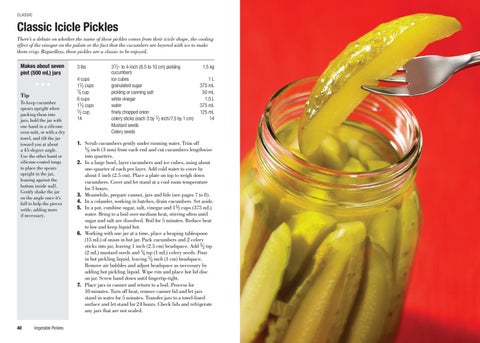
There’s a debate on whether the name of these pickles comes from their icicle shape, the cooling effect of the vinegar on the palate or the fact that the cucumbers are layered with ice to make them crisp. Regardless, these pickles are a classic to be enjoyed.
The cooling tang of classic icicle pickles, a touch of sweetness and a hit of heat add up to exhilaration in these pickle spears.
Makes about seven pint (500 mL) jars
••• Tip To keep cucumber spears upright when packing them into jars, hold the jar with one hand in a silicone oven mitt, or with a dry towel, and tilt the jar toward you at about a 45-degree angle. Use the other hand or silicone-coated tongs to place the spears upright in the jar, leaning against the bottom inside wall. Gently shake the jar on the angle once it’s full to help the pieces settle, adding more if necessary.
40
Vegetable Pickles
31⁄2- to 4-inch (8.5 to 10 cm) pickling
3 lbs 1.5 kg cucumbers 4 cups ice cubes 1L granulated sugar 375 mL 11⁄2 cups 1⁄ cup pickling or canning salt 50 mL 4 6 cups white vinegar 1.5 L 1 ⁄ water 375 mL 1 2 cups 1⁄ cup finely chopped onion 125 mL 2 1 ⁄ 14 14 celery sticks (each 3 by 2 inch/7.5 by 1 cm) Mustard seeds Celery seeds
1. Scrub cucumbers gently under running water. Trim off 1⁄ inch (3 mm) from each end and cut cucumbers lengthwise 8 into quarters. 2. In a large bowl, layer cucumbers and ice cubes, using about one-quarter of each per layer. Add cold water to cover by about 1 inch (2.5 cm). Place a plate on top to weigh down cucumbers. Cover and let stand at a cool room temperature for 3 hours. 3. Meanwhile, prepare canner, jars and lids (see pages 7 to 8). 4. In a colander, working in batches, drain cucumbers. Set aside. 5. In a pot, combine sugar, salt, vinegar and 11⁄2 cups (375 mL) water. Bring to a boil over medium heat, stirring often until sugar and salt are dissolved. Boil for 5 minutes. Reduce heat to low and keep liquid hot. 6. Working with one jar at a time, place a heaping tablespoon (15 mL) of onion in hot jar. Pack cucumbers and 2 celery sticks into jar, leaving 1 inch (2.5 cm) headspace. Add 1⁄2 tsp (2 mL) mustard seeds and 1⁄4 tsp (1 mL) celery seeds. Pour in hot pickling liquid, leaving 1⁄2 inch (1 cm) headspace. Remove air bubbles and adjust headspace as necessary by adding hot pickling liquid. Wipe rim and place hot lid disc on jar. Screw band down until fingertip-tight. 7. Place jars in canner and return to a boil. Process for 10 minutes. Turn off heat, remove canner lid and let jars stand in water for 5 minutes. Transfer jars to a towel-lined surface and let stand for 24 hours. Check lids and refrigerate any jars that are not sealed.
Makes about seven pint (500 mL) jars
••• Tip Fresh chile peppers can vary in heat, so taste a tiny piece (or a bigger piece if you’re brave) to make sure your hot peppers are indeed hot.
3 lbs 31⁄2- to 4-inch (8.5 to 10 cm) pickling cucumbers 4 cups ice cubes granulated sugar 11⁄2 cups 1⁄ cup pickling or canning salt 4 5 cups white vinegar water 21⁄2 cups 7 long hot red chile peppers, seeded and cut lengthwise into 6 strips Mustard seeds
1.5 kg 1L 375 mL 50 mL 1.25 L 625 mL 7
1. Scrub cucumbers gently under running water. Trim off 1⁄ inch (3 mm) from each end and cut cucumbers lengthwise 8 into quarters. 2. In a large bowl, layer cucumbers and ice cubes, using about one-quarter of each per layer. Add cold water to cover by about 1 inch (2.5 cm). Place a plate on top to weigh down cucumbers. Cover and let stand at a cool room temperature for 3 hours. 3. Meanwhile, prepare canner, jars and lids (see pages 7 to 8). 4. In a colander, working in batches, drain cucumbers. Set aside. 5. In a pot, combine sugar, salt, vinegar and 21⁄2 cups (625 mL) water. Bring to a boil over medium heat, stirring often until sugar and salt are dissolved. Boil for 5 minutes. Reduce heat to low and keep liquid hot. 6. Working with one jar at a time, pack cucumbers and 6 hot pepper strips into each hot jar, leaving 1 inch (2.5 cm) headspace. Add 1⁄2 tsp (2 mL) mustard seeds. Pour in hot pickling liquid, leaving 1⁄2 inch (1 cm) headspace. Remove air bubbles and adjust headspace as necessary by adding hot pickling liquid. Wipe rim and place hot lid disc on jar. Screw band down until fingertip-tight. 7. Place jars in canner and return to a boil. Process for 10 minutes. Turn off heat, remove canner lid and let jars stand in water for 5 minutes. Transfer jars to a towel-lined surface and let stand for 24 hours. Check lids and refrigerate any jars that are not sealed.
Vegetable Pickles
41
CLASSIC • MULTI-DAY
Classic Sauerkraut Making your own sauerkraut does take time, but, amazingly, with just two ingredients, some water and natural fermentation, you can create a unique flavor that can’t be beat.
Makes five to six pint (500 mL) jars
••• Tips If you want to make a larger batch of sauerkraut, feel free to multiply the recipe in batches of 5 lbs (2.5 kg), up to 5 times. Just make sure you have a container large enough to allow for plenty of liquid and bubbling action above the cabbage during fermentation. The rawpack method is best for larger batches; fill jars in batches that will fit into the canner. To weigh down the plate, you can use sterilized glass jars with tight-fitting lids full of water or a large, heavy-duty sealable plastic bag filled with cooled extra brine (don’t use water, just in case it leaks, because water would dilute the brine and ruin the fermentation). Use a cotton apron instead of a towel to cover the crock — use the ties on the apron to wrap around the crock and secure the apron. 58
Vegetable Pickles
6 tbsp 8 cups 5 lbs
pickling or canning salt, divided water green cabbage (about 1 large)
90 mL 2L 2.5 kg
Day 1 1. In a pot, combine 3 tbsp (45 mL) of the salt and the water. Bring to a boil over medium-high heat, stirring often until salt is dissolved. Boil for 1 minute. Let cool to room temperature. 2. Meanwhile, cut cabbage lengthwise into 6 or 8 wedges. Cut out core. Cut each wedge crosswise into very thin slices. You should have about 28 cups (7 L). 3. In a large crock, glass bowl or other non-reactive container, combine cabbage and the remaining salt; let stand for about 15 minutes or until wilted. 4. Pour brine over wilted cabbage, pressing to immerse cabbage. The liquid should cover the cabbage by at least 1 inch (2.5 cm). Add extra brine (see tip, page 60), if necessary. Place a plate on top to weigh down cabbage. Fill a couple of glass jars with water (see tip, at left) and place on plate to keep it weighted. Cover with a lint-free towel or several layers of cheesecloth. Let stand at room temperature (70°F to 75°F/21°C to 23°C) for 3 to 6 weeks. During Fermentation 1. Check every few days to make sure cabbage is fermenting. You should see bubbles form, and the aroma will change. Skim off any scum that forms and add extra brine (see tip, page 60) if necessary to make sure cabbage is covered. If there are any signs of mold or a foul aroma, discard cabbage and liquid. Let ferment until bubbles stop and sauerkraut is well flavored. Final Day 1. Prepare canner, jars and lids (see pages 7 to 8).
Raw Pack
1. Pack sauerkraut and brine into hot jars, packing sauerkraut lightly but ensuring that there is enough brine to keep it moist, leaving 1⁄2 inch (1 cm) headspace. Add extra brine (see tip, page 60) if necessary to fill jars. Remove air bubbles and adjust headspace as necessary by adding brine. Wipe rim and place hot lid disc on jar. Screw band down until fingertip-tight.
2. Place jars in canner and return to a boil. Process for 20 minutes. Turn off heat, remove canner lid and let jars stand in water for 5 minutes. Transfer jars to a towel-lined surface and let stand for 24 hours. Check lids and refrigerate any jars that are not sealed.
Hot Pack
1. In a large pot, heat sauerkraut and brine over medium-high heat, stirring often, just until brine starts to simmer. Do not boil. Remove from heat. 2. Pack hot sauerkraut and brine into hot jars, packing sauerkraut lightly but ensuring that there is enough brine to keep it moist, leaving 1⁄2 inch (1 cm) headspace. Add heated extra brine (see tip, page 60) if necessary to fill jars. Remove air bubbles and adjust headspace as necessary by adding hot brine. Wipe rim and place hot lid disc on jar. Screw band down until fingertip-tight. 3. Place jars in canner and return to a boil. Process for 10 minutes. Turn off heat, remove canner lid and let jars stand in water for 5 minutes. Transfer jars to a towel-lined surface and let stand for 24 hours. Check lids and refrigerate any jars that are not sealed.
Tip Successful fermentation requires the correct air temperature. If the air is too cool, fermentation will be very slow or may not occur at all, which can allow mold to form. If the air is too warm, the sauerkraut can become over-fermented and have a soft, unpleasant texture and flavor. Place a thermometer next to the crock and check it often, relocating the sauerkraut if necessary.
Variation Hot Pepper Sauerkraut: On the final day, trim stems from 6 long hot red chile peppers and cut in half lengthwise. Remove core and seeds. Cut peppers crosswise into thin slices. Stir into sauerkraut until evenly distributed. Proceed with filling and processing jars. Let sauerkraut stand for 1 week before serving to allow hot pepper flavor to blend.
Vegetable Pickles
59
Pickled Pineapple Spears
Hot and Sweet Pickled Pineapple
Just a touch of spice accents pineapple spears nicely and makes these sweet and tangy pickles very versatile.
Tang, spice and zing make these pickles just the thing to serve with a Thai or Indian meal.
Makes four to five pint (500 mL) jars
••• Variations Rum-Spiked Pineapple Spears: Add 2 tbsp (25 mL) heated dark rum to each jar before adding the pineapple. Spiced Pickled Pineapple: Tie the cinnamon sticks in a spice bag with 1⁄2 tsp (2 mL) each whole allspice and cloves and a 1⁄4 -inch (0.5 cm) piece whole nutmeg.
Serving Suggestions Chop drained pineapple and add diced bell and hot chile peppers for a quick salsa. Serve with a Caribbean curry or, sliced, on roti or other wraps. Gently heat pineapple and some of the pickling liquid in a saucepan and serve over ice cream.
128
Fruit Pickles
2 2 3 cups 1⁄ tsp 2 3 cups 1 cup
pineapples (about 8 lbs/4 kg) 2 sticks cinnamon (each 3 inches/7.5 cm long) 2 granulated sugar 750 mL pickling or kosher salt 2 mL cider vinegar 750 mL water 250 mL
1. Prepare canner, jars and lids (see pages 7 to 8). 2. Twist off leaves from pineapples. Using a serrated knife, trim off top and bottom. Place flat side down on cutting board and, using a sawing motion, cut off peel in strips. Using a small paring knife, cut out any eyes that remain in fruit. Cut in half lengthwise, then cut each half lengthwise into quarters. Cut off core and discard. Cut pineapple into wedge-shaped spears, each about 2 by 1 by 1 inch (5 by 2.5 by 2.5 cm). 3. In a large pot, combine cinnamon sticks, sugar, salt, vinegar and water. Bring to a boil over medium heat, stirring often until sugar and salt are dissolved. Reduce heat to low, cover and simmer for about 5 minutes or until liquid is flavorful. Increase heat to medium-high, add pineapple and heat just until mixture returns to a boil and pineapple is heated through. Remove from heat. Discard cinnamon sticks. 4. Using a slotted spoon, pack pineapple into hot jars, leaving room for liquid and leaving 1 inch (2.5 cm) headspace. Pour in hot pickling liquid, leaving 1⁄2 inch (1 cm) headspace. Remove air bubbles and adjust headspace as necessary by adding hot pickling liquid. Wipe rim and place hot lid disc on jar. Screw band down until fingertip-tight. 5. Place jars in canner and return to a boil. Process for 10 minutes. Turn off heat, remove canner lid and let jars stand in water for 5 minutes. Transfer jars to a towel-lined surface and let stand for 24 hours. Check lids and refrigerate any jars that are not sealed.
Makes four to five pint (500 mL) jars
••• Tips Peeled, cored pineapples are often available and save a lot of time. Just be sure the pineapple is very fresh and that the entire core was removed. Trim off any tough core that may be left, as it makes for stringy pickles. You may not have enough pineapple to fill the fifth pint jar, depending on how it packs down. Prepare an 8-ounce (250 mL) jar just in case. Alternatively, refrigerate the partially filled jar for 1 week to blend the flavors and use it first.
Serving Suggestions Thread pineapple onto skewers with fresh mint leaves to serve as appetizers. Dice drained pineapple and toss with shredded carrots and sliced green onions for a quick salad. Whisk a little of the pickling liquid with vegetable oil for the dressing.
2 6 5 2 cups 2 tsp 1⁄ tsp 2 2 cups 1 cup 11⁄2 cups
pineapples (about 8 lbs/4 kg) thin slices gingerroot small dried hot red chile peppers, crumbled granulated sugar pickling or kosher salt ground cumin white vinegar rice vinegar water
2 6 5 500 mL 10 mL 2 mL 500 mL 250 mL 375 mL
1. Prepare canner, jars and lids (see pages 7 to 8). 2. Twist off leaves from pineapples. Using a serrated knife, trim off top and bottom. Place flat side down on cutting board and, using a sawing motion, cut off peel in strips. Using a small paring knife, cut out any eyes that remain in fruit. Cut in half lengthwise, then cut each half lengthwise into quarters. Cut off core and discard. Cut pineapple into about 11⁄4 -inch (3 cm) chunks. You should have about 10 cups (2.5 L). 3. In a large pot, combine ginger, chile peppers, sugar, salt, cumin, white vinegar, rice vinegar and water. Bring to a boil over medium heat, stirring often until sugar and salt are dissolved. Increase heat to medium-high, add pineapple and heat just until mixture returns to a boil and pineapple is heated through. Remove from heat. 4. Using a slotted spoon, pack pineapple into hot jars, leaving room for liquid and leaving 1 inch (2.5 cm) headspace. Pour in hot pickling liquid, leaving 1⁄2 inch (1 cm) headspace and dividing spices as evenly as possible. Remove air bubbles and adjust headspace as necessary by adding hot pickling liquid. Wipe rim and place hot lid disc on jar. Screw band down until fingertip-tight. 5. Place jars in canner and return to a boil. Process for 10 minutes. Turn off heat, remove canner lid and let jars stand in water for 5 minutes. Transfer jars to a towel-lined surface and let stand for 24 hours. Check lids and refrigerate any jars that are not sealed.
Fruit Pickles
129
CLASSIC
Grilled Tomatillo and Jalapeño Salsa
Tomatillo and Lime Salsa Verde
This salsa combines slightly charred tart green tomatillos and ripe red tomatoes, with a punch of jalapeño peppers. Serve it as a dip with tortilla chips, as garnish on fajitas or tacos or on a grilled steak.
Traditional Mexican flavors abound in this tart and perky salsa. In Mexico, salsa verde is usually made fresh, but having a cooked and canned version means you can enjoy it all year long, not just when tomatillos are in season.
Makes about eight 8-ounce (250 mL) or four pint (500 mL) jars
••• Tips Tomatillos are related to tomatoes but are distinguished by their papery husk. Use firm, green tomatillos with a tightly closed husk. They’re available at farmers’ markets, specialty produce stores and Latin American markets. To avoid burns, wear disposable rubber gloves when handling hot peppers and be sure to wash all utensils and the cutting board well after preparing the peppers.
Serving Suggestion Add some diced avocado to this salsa just before serving to make it even more fabulous.
164
• Preheat broiler or preheat barbecue grill to medium-high • Rimmed baking sheet (if using broiler) 2 lbs 4 cups 11⁄2 cups 1⁄ cup 2 2 tbsp 2 tbsp 2 tsp 1 tsp 1 cup 2 tbsp
tomatillos chopped peeled plum (Roma) tomatoes chopped onions finely chopped seeded jalapeño peppers finely chopped garlic granulated sugar pickling or canning salt ground cumin white vinegar chopped fresh oregano
1 kg 1L 375 mL 125 mL 25 mL 25 mL 10 mL 5 mL 250 mL 25 mL
1. Peel husks from tomatillos, rinse under running water and pat dry. If using broiler, place on baking sheet. Broil or grill, turning often, for about 10 minutes or until charred on all sides and slightly softened. Transfer to a shallow dish and let cool. Coarsely chop and measure 5 cups (1.25 L). 2. Meanwhile, prepare canner, jars and lids (see pages 7 to 8). 3. In a large pot, combine tomatillos, tomatoes, onions, jalapeños, garlic, sugar, salt, cumin and vinegar. Bring to a boil over medium-high heat, stirring often. Reduce heat and boil gently, stirring often, for about 45 minutes or until salsa is thick enough to mound on a spoon. Stir in oregano. 4. Ladle hot salsa into hot jars, leaving 1⁄2 inch (1 cm) headspace. Remove air bubbles and adjust headspace as necessary by adding hot salsa. Wipe rim and place hot lid disc on jar. Screw band down until fingertip-tight. 5. Place jars in canner and return to a boil. Process for 20 minutes. Turn off heat and remove canner lid. Let jars stand in water for 5 minutes. Transfer jars to a towel-lined surface and let stand for 24 hours. Check lids and refrigerate any jars that are not sealed.
Chili Sauces, Salsas and Other Sauces
Makes about ten 8-ounce (250 mL) or five pint (500 mL) jars
••• Tips You’ll need about 4 lbs (2 kg) tomatillos to get 12 cups (3 L) chopped. Peel the husks from tomatillos and rinse under running water to remove the slight stickiness before chopping them. If you use 8-ounce (250 mL) jars, they may not all fit in your canner at once. Let extra jars cool, then refrigerate them and use them up first. To avoid this problem, I like to pack some in pint (500 mL) jars and some in 8-ounce (250 mL) jars. That way, I also have different sizes and can open the size I know I’ll use up within a few weeks.
12 cups 3 cups 1⁄ cup 2 1⁄ cup 4 1⁄ cup 4 4 tsp 1 cup 1 tsp 1⁄ cup 2 1⁄ cup 4
chopped tomatillos chopped onions finely chopped seeded serrano or long hot green chile peppers finely chopped seeded jalapeño peppers finely chopped garlic (about 12 cloves) pickling or canning salt white vinegar grated lime zest freshly squeezed lime juice chopped fresh cilantro
3L 750 mL 125 mL 50 mL 50 mL 20 mL 250 mL 5 mL 125 mL 50 mL
1. Prepare canner, jars and lids (see pages 7 to 8). 2. In a large pot, combine tomatillos, onions, serranos, jalapeños, garlic, salt, vinegar and lime juice. Bring to a boil over medium-high heat, stirring often. Reduce heat and boil gently, stirring often, for about 20 minutes or until tomatillos and onions are tender and salsa is slightly thickened. Stir in lime zest and cilantro. 3. Ladle hot salsa into hot jars, leaving 1⁄2 inch (1 cm) headspace. Remove air bubbles and adjust headspace as necessary by adding hot salsa. Wipe rim and place hot lid disc on jar. Screw band down until fingertip-tight. 4. Place jars in canner and return to a boil. Process for 15 minutes. Turn off heat and remove canner lid. Let jars stand in water for 5 minutes. Transfer jars to a towel-lined surface and let stand for 24 hours. Check lids and refrigerate any jars that are not sealed.
Variation If you want a fiery salsa verde, increase the jalapeños to 1⁄2 cup (125 mL) or add hot pepper sauce to taste with the cilantro. Chili Sauces, Salsas and Other Sauces
165
Tomato and Olive Antipasto With jars of this antipasto in your pantry, you can have appetizers ready in mere minutes. The tangy, savory flavors are a delight on their own or when served with rich cheeses or cured meats.
Makes about eight 8-ounce (250 mL) or four pint (500 mL) jars
••• Tip Use black olives that have been cured and preserved in brine (not oil) to make sure they are high in acid. Drain and rinse well. To cut slivers, place olives narrow end down on a cutting board and, using a sharp paring knife, cut the flesh away from the pit in about 4 slices. Place slices flat side down on board and cut into 1⁄ -inch (0.5 cm) 8 slivers. You’ll need about 15 large olives.
Serving Suggestions Spread on toasted baguette slices or crackers. Serve on top of grilled fish or poultry.
10 cups chopped peeled plum (Roma) tomatoes, divided finely chopped onions 11⁄2 cups 1 diced red bell peppers 1 ⁄2 cups 1 cup diced green bell pepper 1 cup diced celery 2 tbsp minced garlic 2 bay leaves 1 cup granulated sugar 1 tbsp pickling or canning salt 1 tbsp dried basil 2 tsp dried oregano 1⁄ tsp freshly ground black pepper 2 red wine vinegar or white wine vinegar 11⁄2 cups 1⁄ cup drained rinsed brine-cured black olives, 2 slivered (see tip, at left)
2.5 L 375 mL 375 mL 250 mL 250 mL 25 mL 2 250 mL 15 mL 15 mL 10 mL 2 mL 375 mL 125 mL
1. In a food processor or blender, purée 2 cups (500 mL) of the tomatoes until smooth. 2. In a large pot, combine puréed and chopped tomatoes, onions, red and green peppers, celery, garlic, bay leaves, sugar, salt, basil, oregano, pepper and vinegar. Bring to a boil over medium-high heat, stirring often. Reduce heat and boil gently, stirring often, for about 2 hours or until antipasto is reduced by about half and is thick enough to mound on a spoon. 3. Meanwhile, prepare canner, jars and lids (see pages 7 to 8). 4. Stir olives into antipasto and boil gently, stirring often, for 5 minutes to blend the flavors. Discard bay leaves. 5. Ladle hot antipasto into hot jars, leaving 1⁄2 inch (1 cm) headspace. Remove air bubbles and adjust headspace as necessary by adding hot antipasto. Wipe rim and place hot lid disc on jar. Screw band down until fingertip-tight. 6. Place jars in canner and return to a boil. Process for 20 minutes. Turn off heat and remove canner lid. Let jars stand in water for 5 minutes. Transfer jars to a towel-lined surface and let stand for 24 hours. Check lids and refrigerate any jars that are not sealed.
Chutneys Chutney Basics. . . . . . . . . . . . . . . . . . . . . . . . . . . . . . . . . . . . . . . . . . . . . . . . 187 Chutney Pointers . . . . . . . . . . . . . . . . . . . . . . . . . . . . . . . . . . . . . . . . . . . . . . 188 Apple Plum Chutney. . . . . . . . . . . . . . . . . . . . . . . . . . . . . . . . . . . . . . . . . . . . 189 Apple Raisin Chutney . . . . . . . . . . . . . . . . . . . . . . . . . . . . . . . . . . . . . . . . . . 190 Apple, Onion and Sage Chutney. . . . . . . . . . . . . . . . . . . . . . . . . . . . . . . . . . . 191 Apple Pear Chutney. . . . . . . . . . . . . . . . . . . . . . . . . . . . . . . . . . . . . . . . . . . . 192 Apple Walnut Chutney. . . . . . . . . . . . . . . . . . . . . . . . . . . . . . . . . . . . . . . . . . 193 Apricot Ginger Chutney. . . . . . . . . . . . . . . . . . . . . . . . . . . . . . . . . . . . . . . . . 194 Apricot, Date and Raisin Chutney . . . . . . . . . . . . . . . . . . . . . . . . . . . . . . . . . 195 Beet and Orange Chutney. . . . . . . . . . . . . . . . . . . . . . . . . . . . . . . . . . . . . . . . 196 Black Currant and Apple Chutney . . . . . . . . . . . . . . . . . . . . . . . . . . . . . . . . . 197 Blueberry Peach Chutney. . . . . . . . . . . . . . . . . . . . . . . . . . . . . . . . . . . . . . . . 198 Blueberry, Tart Apple and Onion Chutney . . . . . . . . . . . . . . . . . . . . . . . . . . . 199 Sour Cherry Chutney . . . . . . . . . . . . . . . . . . . . . . . . . . . . . . . . . . . . . . . . . . . 200 Sweet Cherry and Onion Chutney. . . . . . . . . . . . . . . . . . . . . . . . . . . . . . . . . . 201 Red Currant, Apple and Sage Chutney. . . . . . . . . . . . . . . . . . . . . . . . . . . . . . 202 Lemon, Lime and Grapefruit Chutney. . . . . . . . . . . . . . . . . . . . . . . . . . . . . . . 203 Sangria Citrus Chutney . . . . . . . . . . . . . . . . . . . . . . . . . . . . . . . . . . . . . . . . . 204 Clementine Pear Chutney. . . . . . . . . . . . . . . . . . . . . . . . . . . . . . . . . . . . . . . . 205 Spiced Cranberry Apple Chutney. . . . . . . . . . . . . . . . . . . . . . . . . . . . . . . . . . 206 Classic Cranberry Chutney. . . . . . . . . . . . . . . . . . . . . . . . . . . . . . . . . . . . . . . 207 Cranberry Pear Chutney. . . . . . . . . . . . . . . . . . . . . . . . . . . . . . . . . . . . . . . . . 208 Warmly Spiced Cranberry Chutney . . . . . . . . . . . . . . . . . . . . . . . . . . . . . . . . 209 Fig, Date and Lemon Chutney . . . . . . . . . . . . . . . . . . . . . . . . . . . . . . . . . . . . 210 Sweet Mango Chutney. . . . . . . . . . . . . . . . . . . . . . . . . . . . . . . . . . . . . . . . . . . 211 Major Grey Mango Chutney . . . . . . . . . . . . . . . . . . . . . . . . . . . . . . . . . . . . . . 212 Mango Banana Chutney. . . . . . . . . . . . . . . . . . . . . . . . . . . . . . . . . . . . . . . . . 213 Mango, Papaya and Ginger Chutney with Lime. . . . . . . . . . . . . . . . . . . . . . . . 214 Orange, Date and Onion Chutney. . . . . . . . . . . . . . . . . . . . . . . . . . . . . . . . . . 215 Red Onion and Raisin Chutney . . . . . . . . . . . . . . . . . . . . . . . . . . . . . . . . . . . 216 Classic Peach Chutney. . . . . . . . . . . . . . . . . . . . . . . . . . . . . . . . . . . . . . . . . . 217 Peach and Sweet Pepper Chutney. . . . . . . . . . . . . . . . . . . . . . . . . . . . . . . . . . 218 continued on next page
••• 184
Chili Sauces, Salsas and Other Sauces
Blueberry Peach Chutney
Blueberry, Tart Apple and Onion Chutney
Blueberries and peaches are one of my favorite fruit combinations, so I created this zesty chutney to capture the terrific taste in a jar.
This chutney started out as a small batch of filling for phyllo pastry appetizers, which my husband, Jay, and I love to make for the holidays. We always found ourselves sneaking spoonfuls of the chutney before it made it into the pastry, so we decided to turn it into a big batch to enjoy the rest of the year.
Makes about five 8-ounce (250 mL) jars
••• Tips This recipe works equally well with fresh or frozen blueberries. If using frozen blueberries, let them thaw, saving the juices, before adding to the pot. For instructions on peeling peaches, see page 16. This chutney thickens quite a bit upon cooling, so stop the cooking when it’s thinner than you want the final texture to be.
Serving Suggestion Serve with curries, as a dip for chicken or pork satays or simply spooned on top of slices of crusty bread.
198
Chutneys
6 cups 2 cups 1 cup 2 tbsp 1 1 11⁄2 cups 1 tsp 1 cup
chopped peeled peaches blueberries (preferably wild) finely chopped red onion minced gingerroot jalapeño or hot banana pepper, seeded and minced clove garlic, minced packed brown sugar pickling or canning salt cider vinegar
1.5 L 500 mL 250 mL 25 mL 1 1 375 mL 5 mL 250 mL
1. Prepare canner, jars and lids (see pages 7 to 8). 2. In a large pot, combine peaches, blueberries, onion, ginger, jalapeño, garlic, brown sugar, salt and vinegar. Bring to a boil over medium heat, stirring often. Reduce heat and boil gently, stirring occasionally, for about 35 minutes or until onions are translucent and mixture is thickened to a thin jammy consistency. 3. Ladle hot chutney into hot jars, leaving 1⁄2 inch (1 cm) headspace. Remove air bubbles and adjust headspace as necessary by adding hot chutney. Wipe rim and place hot lid disc on jar. Screw band down until fingertip-tight. 4. Place jars in canner and return to a boil. Process for 10 minutes. Turn off heat and remove canner lid. Let jars stand in water for 5 minutes. Transfer jars to a towel-lined surface and let stand for 24 hours. Check lids and refrigerate any jars that aren’t sealed.
Makes about six 8-ounce (250 mL) jars
••• Tip This recipe works equally well with fresh or frozen blueberries. If using frozen blueberries, let them thaw, saving the juices, before adding to the pot.
Serving Suggestions Wrap into phyllo triangles with a small piece of Brie cheese and bake in a 425°F (220°C) oven for a succulent appetizer. Spread onto ham or smoked turkey sandwiches.
4 cups 4 cups 2 cups 3 11⁄2 cups 1 tsp 1 tsp 1⁄ tsp 2 1 cup 1 tsp 1⁄ cup 4
diced peeled tart cooking apples blueberries finely chopped onions cloves garlic, minced granulated sugar ground ginger pickling or canning salt freshly ground black pepper white vinegar grated lemon zest freshly squeezed lemon juice
1L 1L 500 mL 3 375 mL 5 mL 5 mL 2 mL 250 mL 5 mL 50 mL
1. Prepare canner, jars and lids (see pages 7 to 8). 2. In a large pot, combine apples, blueberries, onions, garlic, sugar, ginger, salt, pepper and vinegar. Bring to a boil over medium heat, stirring often. Reduce heat and boil gently, stirring occasionally, for about 40 minutes or until onions are translucent and mixture is thickened to a jammy consistency. Stir in lemon zest and juice. 3. Ladle hot chutney into hot jars, leaving 1⁄2 inch (1 cm) headspace. Remove air bubbles and adjust headspace as necessary by adding hot chutney. Wipe rim and place hot lid disc on jar. Screw band down until fingertip-tight. 4. Place jars in canner and return to a boil. Process for 10 minutes. Turn off heat and remove canner lid. Let jars stand in water for 5 minutes. Transfer jars to a towel-lined surface and let stand for 24 hours. Check lids and refrigerate any jars that aren’t sealed.
Chutneys
199