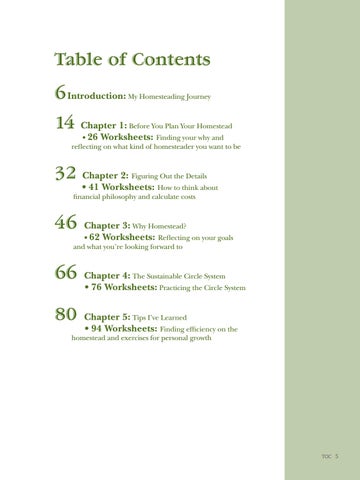
Table of Contents 6 Introduction: My Homesteading Journey 14
reflecting on what kind of homesteader you want to be
32
Chapter 2: Figuring Out the Details • 41 Worksheets: How to think about
financial philosophy and calculate costs
46
Chapter 3: Why Homestead? • 62 Worksheets: Reflecting on your goals
and what you’re looking forward to
66
80
Chapter 1: Before You Plan Your Homestead • 26 Worksheets: Finding your why and
Chapter 4: The Sustainable Circle System • 76 Worksheets: Practicing the Circle System Chapter 5: Tips I’ve Learned • 94 Worksheets: Finding efficiency on the
homestead and exercises for personal growth
TOC 5
CHAPTER 1
Before You Plan Your
HOMESTEAD
•
Before we get into the nitty-gritty of planning a homestead, I think it’s important to ask yourself a few questions. First, how do we define the terms homestead and farm? I often use the terms interchangeably, but to me, they actually have very different meanings. HOMESTEAD: Wherever homesteading takes place. According to 21st Century Homesteading from the editors of Mother Earth News, “These days, we’re using the phrase ‘21st century homesteading,’ which is all about self-sufficiency (or self-reliance)— wherever you live. It’s about using less energy, eating wholesome local food, involving your family in the life of the community, and making wiser choices that will improve the quality of life for your family, your community, and the environment around you.” FARM: This can simply be defined as an area of land and its buildings used for growing crops and rearing animals, typically under the control of a single owner or manager. So in essence, my lifestyle of homesteading takes place on a farm, instead of happening in a subdivision or off-grid out in the wilderness. When we lived in the Seattle area, our homesteading happened in a neighborhood with homes so close to each other, you could reach out the window and almost touch the next house, or so it seemed. At that time, I would have been considered an urban homesteader. Homesteading is a lifestyle—a mind14 Simplify Your Homestead Plan
set—and it can begin anywhere and change places and locations. In fact, I’ve had people stop by my farm and tell me they want to be a homesteader and have a place just like mine, doing all the same things. I gently remind them our place hasn’t always looked like it does today. It’s a journey, not an instant poof and you’ve arrived. There have been a lot of tears, prayers, sweat, and even more work to make our farm look like it does. It’s been 20-plus years in the making. I started working on homesteading long before we arrived in Georgia. I’ve simplified the term homesteading. For me, it’s anything you do at HOME inSTEAD of going to the store. So if you make your own bread at home instead of buying it somewhere else as part of your journey toward self-reliance, you can consider yourself a homesteader. Remember, no one wakes up one day as a full-fledged homesteader with all the knowledge and needed skills. It’s a process and a journey. It’s a mindset and a feeling in your heart that will give you the necessary determination and grit to keep going even when it feels like Mother Nature herself is completely against you! In a nutshell, I am a homesteader, choosing to practice my homesteading lifestyle on a farm.
Self-Reliant or Self-Sufficient? These are two other terms I’ve heard tossed around a lot in conversations.
Heidi our Gulf Coast sheep
failed or didn’t last for the long haul, but each one got me closer to my intended result. I do OK with problem-solving—in fact, I love to problem solve. It’s a good skill to have when farming—there are a lot of opportunities to use it. I’m also a visionary. I had, and still have, such grand visions for my 6.69 acres! Oh, those dreams … and each day I get a little closer to fulfilling them. And then there’s what I’m not: I’m terrible with keeping track of data. I always think I’ll remember a certain outcome, and then I don’t. I’m not content just with maintenance—I always want to be creating something new! I constantly have projects that are almost finished. I realized a couple of years ago, when I was frustrated with the amount of maintenance that needed to be done, that the first part of the word is MAIN tenance. It needed to be my MAIN focus. I kept fun creative projects on a list, and I was able to choose from that list as soon as the maintenance was finished.
Instead of doing the projects first (because let’s face it, they’re much more fun than always fixing fences), the projects became my incentive for getting the maintenance finished first. And I can tell you this, when the upkeep of the your farm, animals, plants, machinery, and so on becomes foundational and first on the list each day, the amount of daily time needed for it becomes less and less. Which means there’s more time for projects! … For creating more stuff that will need to be maintained! Sorry—it’s the truth. your personal strengths, Byharsh considering you can tailor your homesteading plans around what you do best. Here are some common strengths: Visionary Financial Skills Nurturer Working with your hands Analytical Planner Chapter 1 19
CHAPTER 2
Figuring Out the
DETAILS
•
Now that you’ve spent some time
reflecting on who you are and what you want out of homesteading, it’s time to get down to the nitty-gritty. Asking questions beforehand about the details, financial or otherwise, will help you make successful plans.
How Much Money Will You Invest? This is a big one. We started homesteading without a budget. We decided to not
32 Simplify Your Homestead Plan
buy the 10 acres next to us because it would have maxed our available funds. I wanted to be sure we had enough money for equipment. What good was the extra land if we couldn’t do anything with it? We slowly started accumulating animals. And then we needed to build shelters for them … and feed them. Pretty soon, our homesteading lifestyle was costing us quite a bit. My husband finally came to me and said, “You need to see if you can start making this hobby pay for itself. There’s not an endless supply of money.”
2006, Tigger, Nala and Rascal our new kittens for the farm.
tuary, and my therapist. The sounds of birds and animals are my choir. And the whisper of the winds, my prayer. Homesteading creates a place to be in touch with the wonders of nature and provides the silence to really hear what’s going on inside. It’s an expanse for the kind of spiritual healing not found within four walls. Then, of course, there’s the obvious health benefits from the food we produce and consume. We’ve grown a lot of our food on our land!
Education Homesteading gives opportunity after opportunity for education! This is actually an understatement. Homesteading is like attending a daily—no, hourly—classroom, and Mother Nature is the relentless teacher. There are so many questions, and I often feel that the answers only led to more questions! It dawned on me one day recently while I was doing research: Google was not even an available tool when we moved to Georgia and started homesteading on a
farm. How did we ever make it this far? Books! You should see our homesteading library in the classroom. I often wish I could obtain all that knowledge through osmosis. Sometimes I just like to stand and stare at the books, running my hands over them. But then again, I’m a bit of a book nerd. You know the whole movement back to minimalism? I’m good with pretty much every aspect of downsizing until you get to our books. Don’t touch the books! Just to show you how important books have been in our journey: We actually learned how to eviscerate and process a rooster from a book! No lie. We had too many roosters from our very first batch of chicks. I needed to get rid of them, therefore, I needed to learn how to butcher. I was on a quest to find a teacher and ran into dead end after dead end. Finally, a friend said she thought she could remember how to do it. I was so excited to finally learn this skill. She taught us what I called the Laura Ingalls Wilder way: Roll out the wooden stump; put the Chapter 3 51
Simplify Your H WORKSHEETS Sustainable Circle System Practice Page • Manure for the garden • Leftover plants for the chickens to eat • Bugs and grubs for the chickens to eat
• Herbs help bring pollinators to the vegetables • Both gardens use the same tools • Herbs and vegetables can be sold for income
HERB GARDEN
CHICKENS
VEGETABLE GARDEN
• Manure for the garden • Leftover plants for the chickens to eat • Bugs and grubs for the chickens to eat
76 Simplify Your Homestead Plan
CHAPTER 4
The Sustainable
CIRCLE SYSTEM
•
Let’s Start Planning
I know it’s taken us a hot minute to
finally get to this part of the book, but trust me, all your previous work will be worth it when you sit down to plan your work and then work your plan. By now, you should have a pretty good idea about what you will bring to the table with your passions, skills, interests, and tools. If you are just now starting your plan on a blank piece of paper, I’m so excited for you! Your plan will be perfect, because there’s nothing to compare it to, and no mistakes have been made. For anyone who has been attempting to homestead—and is feeling overwhelmed— this exercise will give you the opportunity to recreate and reassess your
goals and dreams for your homestead in a more efficient manner. Before we actually put pen to paper, I want to introduce you to a system I created after a couple of years of wandering around the homesteading lifestyle without any direction. I was all-in on any subject or aspect of homesteading that looked fun or interesting—how else do you think I got into beekeeping? A friend asked me if I wanted to try it with her, so I said yes, not knowing anything! It was a subject nowhere close to my homestead radar. And once I purchased my bees and brought them back to the farm, she promptly moved out of state, leaving me with thousands of bees and the fear of being killed!
our driveway to the homestead
70 Simplify Your Homestead Plan
Simplify Your H WORKSHEETS 1. Remember that homesteading is a journey; where are you homesteading currently? In an apartment? In a neighborhood? On acreage?
2. Is your goal to be self-sufficient or self-reliant?
26 Simplify Your Homestead Plan