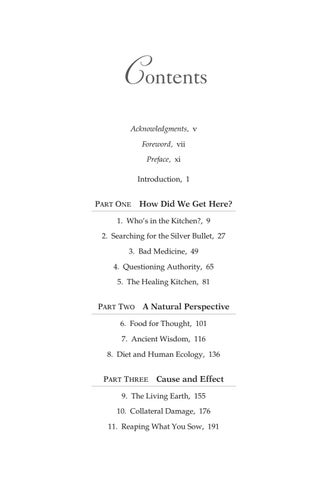
Contents Acknowledgments, v Foreword, vii Preface, xi Introduction, 1
Part One How Did We Get Here? 1. Who’s in the Kitchen?, 9 2. Searching for the Silver Bullet, 27 3. Bad Medicine, 49 4. Questioning Authority, 65 5. The Healing Kitchen, 81
Part Two A Natural Perspective 6. Food for Thought, 101 7. Ancient Wisdom, 116 8. Diet and Human Ecology, 136
Part Three Cause and Effect 9. The Living Earth, 155 10. Collateral Damage, 176 11. Reaping What You Sow, 191
Part Four The Road Ahead 12. The Human Ecology Diet—What We Need, 215 13. Human Ecology Diet—Where We Get What We Need, 230 14. Creating a Food Ethic, 257 Conclusion, 274 References, 277 About the Author, 295 Index, 296
Preface The very real crisis created by our food choices needs resolution and needs it quickly. The research has been done and the positive steps to a healthy diet have been identified, and yet the powerful machine that governs the food system grinds on with little sign of significant change. One fact is stunningly apparent: the modern diet is killing us and we are not acting to make the changes necessary. Part of the problem is that nutrition is not simply an issue of the chemical features of our foods. Cultural and emotional factors often seem to outweigh logic and ethics. A modern vision of nutrition needs to take into account the social and environmental costs of what we eat as well as the price we pay at the market. Vested interests are so deeply embedded in the political, medical, agricultural, and food manufacturing sectors that powerful forces can be called into play when challenges are made to the status quo. The internet has provided a perfect growing medium for fanciful nutritional theories, magical supplements, and direct attacks on any ideas that challenge cultural dietary traditions. There is no greater battlefield in the nutrition wars than the entrenched ideas we have about the use of animal sourced foods. It is time for a new understanding of our historical relationship to what we eat. From our ancient origins, human life has migrated to almost every location on the planet. We have settled in deep jungles, arctic tundra, deserts, and forests. Our primary concern has always been to find food. It is a matter of life or death. We did not have to concern ourselves with eating locally or in season; that was a given. We ate what was available. The forces of nature were in charge. If there was an abundance of nutritious plants, that was where we focused; if not, we used animals. We discovered over time that out of
xi
xii
How to Eat Right & Save the Planet
the 391,000 species of plants there are a fairly small number that are safe for us to eat and we focused on those. These were not decisions we made in a conference hall. Decisions were made through human experience. They were pragmatic actions aimed at staying alive and creating homeostasis, that life-producing relationship with nature that governs all life. That was then, this is now. Nature is still in control. It is nature that supplies our air, water, and food—a simple truth we seem to have forgotten. When we look at the modern food chain, we see that we have made every attempt to break down that relationship. This is a futile and childish struggle to dominate rather than adapt and it has produced chaos. This struggle between humankind and nature lies at the root of much of the confusion and endless arguments about nutrition as well as ecology. The modern diet produces disease and death, not only for humans but non-humans as well. Our food choices are the main cause of death from degenerative disease, creates environmental chaos, the senseless slaughter of billions of sentient creatures, and supports an economic system that makes regional self-sufficiency and food security impossible. Yet we march on. We fixate on fantasy stories about magical properties of the newest “super-food,� the power of reducing the sugar content in soft drinks or avoiding meat one day a week. None of these stop-gap measures are effective or timely. There is still time for us to make the easiest and most important contribution we can to creating a healthy world for all life on planet Earth. It is important that a new conversation about the food we eat is engaged in and that action is taken. We can change what we eat, right now, today and then move to more complicated issues.
Introduction
T
here are powerful mythologies that drive our understanding of the foods we eat. Our knowledge of nutrition is not simply an issue of understanding the chemical structure of food, it is influenced by our culture, senses, emotion, economy, and environment. Our understanding into how these issues blend and affect each other has been slowly growing over the past decades. It has not been a smooth journey and it is not over. The revolution in nutrition has been driven by laboratory scientists, epidemiological analysts, grass roots activists, environmentalists, and moral philosophers. This dedicated band has been engaged with the powerful forces of political lobbyists with multi-million dollar gifts to dispense, food industry giants who buy “scientific” research, and a medical brotherhood often locked in its own self-interests. If all this reminds you of the battles for the truth about the dangers of smoking or climate change, it should. It is the same game and it is killing us. The issue is simple: our modern diet not only creates disease, it endangers all life on the planet—and yes, that includes us. Scientists are uncertain how many animals inhabit planet Earth. According to a recent study published in the journal PLoS Biology, there are 8.7 million species of animal life on our planet—and every year, new species are discovered. Every one of these species knows intuitively what to eat—except one. Only one creature knowingly and stubbornly eats food that causes it to get sick. Guess which? The grim paradox is that the more information we have about what to eat, the more we seem to be confused. We are exposed to a daily tide of opinion, science, and advertising about what to eat, much of which is contradictory.
1
2
How to Eat Right & Save the Planet
Partly in response to the growing epidemic of obesity, diet has become an emotional and controversial subject. A report from the US Food and Drug Administration states that Americans spend an estimated $40 billion a year on weight loss related products and health-related food, beverages, and services. Around 180 million people—that’s more than half our population—are on a weight-loss diet at any given time and most of them will try four diets a year. Weight loss is big business. I was raised in slightly less complicated times. Like most people, I never thought much about food unless I was hungry. There were certain foods I liked and others I didn’t. When I was hungry, I ate—and sometimes I ate when I wasn’t hungry. Sometimes I ate out of boredom and sometimes it was because there was something tasty close at hand. That all changed for me in the sixties. When I was twenty-four years old, I was a devoted hippie living in San Francisco, and the Summer of Love was just around the corner. My roommate came home one day and told me he had just been “turned on” to a great book by a Japanese philosopher. The book explained how you could cure diseases and improve your consciousness at the same time by eating a special diet. He wanted to give it a try since he suffered from asthma. Our shared interest in Eastern philosophy and our “try anything one time” attitude launched us both in an unexpected direction. We searched for the foods listed in the book and entered new territory. We started eating whole grains, beans, vegetables, and a variety of Japanese condiments. It was a 360-degree change. We discovered that there was a small but growing army of folks who were giving this a try. There were even some famous teachers right in the USA. After a rocky start—having to eat our mistakes—we got into the rhythm of our new way of eating. The results, for me, were unexpected and impressive. Without even trying, I started to lose excess weight and to feel more energetic than I had in years. But the big bonus was not the size of my stomach but what was happening inside it. Two years previously, the pains that I often experienced after eating started to intensify, until I finally went to see a doctor. Tests revealed that I had advanced ulceration in both stomach and duodenum—the passageway between the stomach and the small intestine. I was shocked and a little frightened. I associated ulcers with stressed-out middle-aged
5
The Healing Kitchen
T
he cabal that consists of the pharmaceutical industry and medicine also includes those who grow and manufacture the food that starts the ball rolling. A handful of corporations dominate the world food supply that creates sickness and inequity. We need to escape this cycle of toxic causes that feed toxic treatment with only profit as a goal. Sickness is costly. Finding a solution will take looking in some unexpected places. Both the ancient past and the avant-garde of modern nutrition offer practical solutions. Many of these solutions have been gathering attention over the last few decades and providing practical solutions that could not only reverse the tide of NCD’s but also save money in the process. According to the Integrated Benefits Institute, which represents major US employers and business coalitions, poor health costs the US economy $576 billion a year. About 39 percent of this (that’s $227 billion) is from “lost productivity” due to absenteeism, or to poor performance from employees who are unwell. Over the past decade, the issue of healthcare has been a political nightmare. There are accusations of socialist conspiracies and arguments about death panels for the elderly or the relative benefits of government healthcare as opposed to a free market. Regardless of how we deal with it, the cost of treating preventable disease is moving us toward financial disaster. A 2009 study in the American Journal of Medicine revealed that medical expenses caused 62.1 percent of all bankruptcies in 2007. The strain
81
82
How to Eat Right & Save the Planet
on businesses is no different than on governments—everyone pays, directly or indirectly. Earlier I outlined some major diseases that are directly linked to diet. According to the Centers for Disease Control (CDC), seven of every ten American deaths are due to a chronic disease, and these diseases cost 75 percent of the nation’s $2 trillion expense. Out of the CDC budget of $8.8 billion, only 9 percent goes to chronic disease prevention and health promotion. Of that 9 percent, less than 5 percent goes to areas of nutrition, physical activity, and obesity. Although we know about rising health costs and outdated health infrastructures, we are curiously reluctant to act. The elephant in the room is prevention, which would eventually lead to questions of responsibility. So who do we name and shame for the rise of preventable food-caused disease? It seems that nobody is responsible for nutrition. They are just “doing their job”: from the medical profession cleaning up the traffic crash to the food companies who just make the tasty treats the public wants to the politicians focused on the health of the stock market. Nutritionists are not even in the building—they are on chat shows telling people to “be moderate” and only eat 15 potato chips (the actual recommended serving) at a sitting. That leaves only the consumer, looking for guidance, lost at sea, bouncing from fad to fad or simply giving up and sinking in an ocean of junk food. When many people share a habit, it becomes normalized. When smoking was common, very few people complained about smoke. In the 1950s, it was acceptable to smoke in almost every situation. Just look at movies from the 1940s and ‘50s; everyone was puffing away. It was even seen to be elegant. There were no consequences for driving after drinking—unless you caused an accident or were seen to be driving dangerously. Those behaviors were eventually acknowledged to be harmful, and social, economic, and government pressures were applied to curtail them. Our resistance to changing unhealthy behavior is exacerbated by the illusion that if we experience pain or get sick, we can be patched up. This often involves drugs to make living in our damaged body more bearable. The 2015 Time magazine cover story on painkillers pointed out that 9.4 million Americans take opioids for long-term pain, and the National