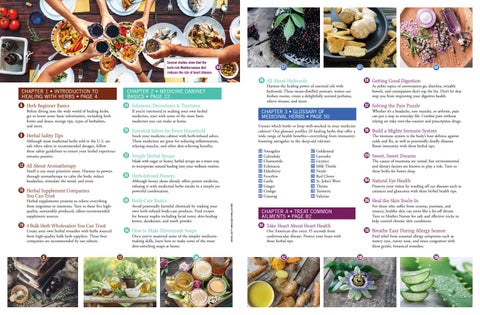
Several studies show that the herb-rich Mediterranean diet reduces the risk of heart disease.
84
57
61
46 All About Hydrosols CHAPTER 1 • INTRODUCTION TO HEALING WITH HERBS • PAGE 4
6 Herb Beginner Basics
24 Infusions, Decoctions & Tinctures
Before diving into the wide world of healing herbs, get to know some basic information, including herb forms and doses, storage tips, types of herbalism, and more.
Stock your medicine cabinet with herb-infused salves. These medicines are great for reducing inflammation, relaxing muscles, and other skin-relieving benefits. Made with sugar or honey, herbal syrups are a sweet way to incorporate natural healing into your wellness routine.
Smell is our most primitive sense. Harness its powers through aromatherapy to calm the body, reduce headaches, stimulate the mind, and more.
36 Herb-Infused Honeys
40 Body-Care Basics
Herbal supplements promise to relieve everything from migraines to insomnia. Turn to these five highquality, sustainably produced, editor-recommended supplement sources.
Avoid potentially harmful chemicals by making your own herb-infused body-care products. Find recipes for beauty staples including facial toner, skin-healing lotion, deodorant, and tooth powder.
19 4 Bulk Herb Wholesalers You Can Trust
44 How to Make Homemade Soaps
Create your own herbal remedies with herbs sourced from high-quality bulk herb suppliers. These four companies are recommended by our editors.
Once you’ve mastered some of the simpler medicinemaking skills, learn how to make some of the most skin-enriching soaps at home.
12
36
COVER: GETTY IMAGES/CHAMILLEWHITE
Although honey alone already offers potent medicine, infusing it with medicinal herbs results in a simple yet powerful combination.
16 Herbal Supplement Companies You Can Trust
6
52 Astragalus 53 Calendula 54 Chamomile 56 Echinacea 57 Elderberry 58 Feverfew 59 Garlic 61 Ginger 64 Ginkgo 65 Ginseng
32 Simple Herbal Syrups
12 All About Aromatherapy
92 Solving the Pain Puzzle
Whether it’s a headache, sore muscles, or arthritis, pain can put a stop to everyday life. Combat pain without relying on risky over-the-counter and prescription drugs.
Unsure which herbs to keep well-stocked in your medicine cabinet? Our glossary profiles 20 healing herbs that offer a wide range of health benefits—everything from immunityboosting astragalus to the sleep-aid valerian.
28 Essential Salves for Every Household
Although most medicinal herbs sold in the U.S. are safe when taken in recommended dosages, follow these safety guidelines to ensure your herbal experience remains positive.
As polite topics of conversation go, diarrhea, irritable bowels, and constipation don’t top the list. Don’t let that stop you from improving your digestive health.
CHAPTER 3 • GLOSSARY OF MEDICINAL HERBS • PAGE 50
If you’re interested in making your own herbal medicines, start with some of the most basic medicines you can make at home.
8 Herbal Safety Tips
88 Getting Good Digestion
Harness the healing power of essential oils with hydrosols. These steam-distilled aromatic waters can freshen rooms, create a delightfully scented perfume, relieve sinuses, and more.
CHAPTER 2 • MEDICINE CABINET BASICS • PAGE 22
96 Build a Mighty Immune System
The immune system is the body’s best defense against colds and flu, as well as potentially deadly diseases. Boost immunity with these herbal tips.
67 Goldenseal 68 Lavender 69 Licorice 71 Milk Thistle 72 Nettle 73 Red Clover 74 St. John’s Wort 76 Thyme 78 Turmeric 80 Valerian
100 Sweet, Sweet Dreams
The causes of insomnia are varied, but environmental and dietary factors are known to play a role. Turn to these herbs for better sleep.
104 Natural Eye Health
Preserve your vision by warding off eye diseases such as cataracts and glaucoma with these herbal health tips.
106 Heal the Skin You’re In
For those who suffer from eczema, psoriasis, and rosacea, healthy skin can seem like a far-off dream. Turn to Mother Nature for safe and effective tricks to help control chronic skin conditions.
CHAPTER 4 • TREAT COMMON AILMENTS • PAGE 82
84 Take Heart About Heart Health
110 Breathe Easy During Allergy Season
One American dies every 35 seconds from cardiovascular disease. Protect your heart with these herbal tips.
92
68
Find relief from seasonal allergy symptoms such as watery eyes, runny nose, and sinus congestion with these gentle, botanical remedies.
100
106
Herb Beginner Basics By The Herb Companion Editors
Before
we dive into the wide world of healing herbs, it’s important to understand a few beginner basics.
Herb Forms and Doses
The chart at left gives the generally recommended dose for seven herb forms, based on herbs that are fairly mild and have a long history of safe use such as chamomile, lemon balm, or ginger. When first trying an herb or herb combination, start with less than the recommended dose. Take more only after you’re familiar with the herb or if your health-care provider recommends it. Follow the directions on the product label if the dosage differs from this chart.
How to Store Herbs
FORM
DOSE
Fresh herbs Dry herbs Teas Powdered herbs
1 to 2 medium-size leaves a day Up to 1 gram a day 1 cup to 1 quart a day 2 to 4 capsules, two to three times a day 1 to 3 droppersful, two to three times a day 1 to 2 tablets, two to three times a day 1 tablet, two to three times a day
Liquid extracts Powdered extracts Standardized extracts
*Source: Handbook for Herbal Healing by Christopher Hobbs (Interweave Press, 1991)
6
Introduction
to
Healing
with
Herbs
Herbs are organic materials, so they’re vulnerable to the elements, even when they come in capsules or tablets. Exposure to light, heat, or oxygen can reduce an herb’s potency. Store herbs in a cool, dark place such as a pantry. Some of the best herb protectors are colored glass bottles, particularly amber or cobalt-blue ones. Many commercial products are packaged in these to block out direct light, which causes oxidation and reduces effectiveness. If you buy bulk herbs, make sure your supplier stores the products as carefully as you would at home. Andrew Chevallier, author of The Encyclopedia of Medicinal Plants, recommends that you: ✽ Avoid herbs stored in clear containers. ✽ Smell the herbs. Good-quality herbs should have a distinct scent and taste. ✽ Check for signs of adulteration (dried grass or other non-medicinal material mixed with the herbs) and mold. ✽ Look for bright material (herbs lose color as they age). If you’re storing bulk material, fill your containers as full as possible and move the herbs to smaller containers as you use them to minimize contact with air.
Educate Yourself
If you want to increase your knowledge of herbal medicine, there are an abundance of home study courses to choose from. Selecting a reputable school or instructor and a course that suits your needs in this diverse and unregu-
lated academic field requires some preliminary study, but it doesn’t have to be overwhelming. These guidelines can help you make informed choices. Home study courses are for individual learning, not for professional certification. Determine your interests and what you hope to gain from the course. Some courses give a general overview of many herbal disciplines; others focus on specific topics such as aromatherapy, native remedies, or making herbal preparations. You may find that several reasonably priced short courses fit your interests better than one longer, more comprehensive, more expensive course. Ask independent sources about the reputation of the business or school and the quality of its courses. Ask the chamber of commerce or Better Business Bureau in the city where the school is located whether any complaints have been filed against it, and check with professional herb associations. Check with any herb professionals you may know. Finally, ask the school for the names of students whom you may call to discuss their experience with the course. Email for catalogs and course descriptions from any programs that interest you. Read them carefully and compare courses. How long has the school been in business, and how many students has it had? Who is the instructor or author of the course, and what are his/her qualifications? How many lessons are there? What is covered in each lesson? Are sample lessons available? How long will it take to complete? How much does the course cost? Talk to a school representative or the instructor. Reading about the course won’t answer all your questions, and getting a feel for the people who conduct it can be an important factor in determining whether it’s right for you. Ask the person to explain more fully the school’s approach to herbalism and its teaching methods.
Find an Herbalist
If you’re new to herbal medicine, you may not know where to go for good care. Here are some tips for getting off to a good start. Look online and ask a lot of questions. If you can’t find a listing for herbalists, try related categories such as “holistic practitioners,” “chiropractors,” and “naturopaths.” Ask your friends. Sometimes nothing is better than word of mouth. Don’t forget to inquire at your local health-food store. Ask your doctor. Don’t assume your physician will laugh when you ask about alternative medicine. More than ever before, medical doctors are asking questions, taking classes, and networking with alternative practitioners.
The Three Pillars of Herbalism
Although most cultures have their own herbal remedies, three major systems of healing have had the most widespread influence. Ayurveda: Pronounced “eye-ur-VAY-da,” this holistic science from India is more than 6,000 years old. Health is seen as a balance between the emotional, physical, and spiritual. Treatments include yoga, meditation, exposure to spe-
cific sights and smells, changes in diet, and herbs. Representative herbs include turmeric, ashwagandha, mustard, triphala, black pepper, and ginger.
Traditional Chinese Medicine (TCM): The earliest written records
of TCM date to about 3,500 years ago. The underlying worldview of TCM is Taoism, which conceives of everything in the universe as interdependent. Healers evaluate the whole person, including constitution, living habits, and environmental conditions. Remedies may involve herbs, acupuncture, and diet. Representative herbs include ginseng, angelica, peony, magnolia, and dong quai.
Traditional European Medicine: This began with the
Egyptians and traveled through the Greeks, Romans, Persians, medieval Europeans, and up to modern-day practitioners. Now the European Community combines traditional knowledge and modern science. This tradition is still a major influence in countries such as Germany and France.
Healing with Herbs 7
lizing properties). Finally, pour cooled syrup into the bottle, shake to combine, and label with a detailed description of the herbs used and the date. ✽ Note: Unless a recipe provides specific dosage information, I follow Susun Weed’s herbal syrup dosage suggestions (go to susunweed.com/herbal_ ezine/July07/wisewoman.htm). Begin by making “simples”—single herb syrups. This allows you to discover if you have an allergy or other unwanted reaction to any herb. Then you can begin making combination syrups such as the recipes included in this article.
Herbal Syrup Recipes
The following recipes each yield roughly 2 cups. If you desire more, double or triple the recommended ingredient amounts. Always measure herbal concentrates before adding sweetener as you may find you need a bit more or less than the amount listed. ✽ Note: Take these medicinal syrups for up to five consecutive days, but do consult an herbalist or medical professional when in doubt.
Tummy Troubles
1 cup fresh ginger root 6 whole cinnamon sticks 2 cups water 1 cup sugar or honey Optional: Brandy or ginger tincture (1⁄4 of bottle space)
Herb Concentrate Method Decoction
Medicinal Potential Ginger: Assists in alleviating
nausea and stimulates the digestive system Cinnamon: Acts as a digestive aid; alleviates stomach upset and discomfort; and helps balance blood sugar
Notes
Ginger and cinnamon should be used in moderation; considered “hot” herbs, according to Traditional Chinese Medicine, high doses may cause irritation. Ginger should be avoided by anyone who suffers from stomach ulcers. Cinnamon has blood-thinning effects. Use precaution and speak with your doctor before using it in conjunction with blood-thinning drugs
Happy Heart This heart tonic is especially beneficial during times of emotional transition, distress, loss, and grief. Physically, it may assist in strengthening the overall workings of the cardiovascular system. ⁄2 cup hawthorn leaves and flowers ⁄2 cup rose petals 1 cup water 1 cup sugar or honey Optional: Vodka or motherwort tincture (1⁄4 of bottle space) 1 1
Herb Concentrate Method Tea
34
Medicine Cabinet Basics
people will take small doses daily as a preventive measure during the cold and flu season. It should be noted, though, that elderberry can cause nausea and vomiting when used excessively. Never ingest raw berries— always cook them. Yarrow shouldn’t be taken in conjunction with heart medicines, blood thinners, or antacids. Not intended to be used long-term. Best to avoid in combination with coffee or alcohol. Use with caution if a ragweed allergy exists, and stop taking at least two weeks prior to surgery.
This blend is excellent for those experiencing indigestion, nausea and other gastrointestinal distresses. It’s beneficial taken before or after meals to assist in digestion.
The Energizer Medicinal Potential Hawthorn: Heart tonic, relaxant,
possible diuretic; may improve circulation; may help dilate arteries; may decrease blood pressure; antioxidant Rose: Long associated with the Heart Chakra, according to Ayurveda, it may promote emotional healing, decrease stress and tension, alleviate depression, and act as a mild aphrodisiac Motherwort: Used to calm the heart, ease palpitations and grief; said to make one feel as if they are being enveloped in the loving embrace of a mother
Notes
Hawthorn is not recommended alongside heart medications. Rose is not recommended for those with diabetes or anemia. Motherwort should be avoided by those with clotting disorders and those taking treatment for a heart condition. Stop taking motherwort at least two weeks before any surgery.
Throat & Nose Remedy An overall flu, cold, and cough remedy, this blend may provide protection against spread of infection within the body.
1 cup elderberries 1 ⁄2 cup plantain leaf 11⁄2 cups water 1 cup sugar or honey Optional: Vodka or yarrow tincture (1⁄4 of bottle space)
Herb Concentrate Method
This recipe requires the berries and leaves to be cooked separately—use the decoction method for the berries, and the tea method for the leaves. Then combine the two herbal concentrates before adding sweetener and thickening.
Medicinal Potential Elderberry: Acts as an overall
cold, flu, and cough remedy; has antiviral properties; excellent for sore throats, breaking up phlegm, and preventing the spread of infection to other areas of the body Plantain: Used to assist in fighting colds, sinusitis, throat and ear infections; calm the respiratory system; reduce inflammation; and unclog phlegm Yarrow: Highly astringent; suggested to fight infections, fever, and congestion
Notes
Elderberry is quite potent, and more is not necessarily better. Some
This tonic is an energy- and immunitybooster during times of stress or transition. It’s especially beneficial when one begins to feel ragged and worn out from daily activities (non-illnessrelated). ⁄2 cup schisandra berry ⁄4 cup bilberry 3 ⁄4 cup acai berry 2 cups water 1 cup sugar or honey Optional: Vodka or American skullcap tincture (1⁄4 of bottle space) 1 3
Herb Concentrate Method Decoction
Medicinal Potential Schisandra berry: As an adapto-
gen, possible aphrodisiac, and energy tonic, it can help the body resist stress while improving energy and endurance; promotes overall balanced body systems Bilberry: Contains anthocyanins (a flavonoid which assists in keeping body cells healthy); may improve blood circulation Acai: Contains antioxidants and anthocyanins; may help suppress inflammation; has been used as a gentle aphrodisiac, brain and energy booster American skullcap: Used as an antiviral, gentle relaxant, helps calm nerves; may be beneficial in alleviat-
ing symptoms of withdrawal due to its calming effects
Notes
Never start using an adaptogen while ill. Consult a medical professional before integrating any tonic into your daily regime. Schisandra berry may cause stomach upset and can decrease appetite. Bilberry is contraindicated for insulin-dependent diabetes.
Sleepy Time Promote better sleep by relaxing the whole body, including tempering one’s emotional state. ⁄4 cup chamomile flowers ⁄4 cup spearmint 1 cup water 1 cup sugar or honey Optional: Brandy or passionflower tincture (1⁄4 of bottle space) 3 1
Herb Concentrate Method Tea
Medicinal Potential Chamomile: Creates a whole-body
sense of calm; relieves a variety of aches and pains; relaxes the digestive system; German chamomile more often recommended for medicinal uses Spearmint: Promotes digestive wellbeing; reduces anxiety; alleviates stress Passionflower: Used to calm nerves, mild sedative, “dream enhancer;” promotes better sleep and alleviates insomnia by lessening anxiety
Notes
Chamomile should be used with caution by anyone with a ragweed allergy.
Healing with Herbs 35
Facial Toner
Commercial Culprit: Acetone
It’s easy to make a facial toner with yarrow that cleanses the skin, tightens the pores, and alleviates oily patches, while also helping minimize the appearance of wrinkles.
Superior Herbal Ingredient: Yarrow
1 cup water 2 teaspoons dried yarrow 1 tablespoon witch hazel
According to the International Journal of Cosmetic Science, an extract of yarrow applied to the skin significantly reduced the visibility of wrinkles and pores, compared with a placebo and glycolic acid products. Glycolic acid is a substance frequently added to antiwrinkle creams to help remove dead skin cells and give skin a fresher look. Don’t be surprised if you start seeing yarrow extracts used in the cosmetics industry in the future.
Body-Care Basics By Michelle Schoffro Cook
The
huge array of everyday body-care products found on pharmacy and grocery store shelves contains thousands of chemicals—some of them known carcinogens, others potent endocrine disruptors, and most entirely untested—and many of these chemicals can be absorbed into our bodies through our skin and mouth. The good news is that these potentially harmful chemicals leave our bodies quickly. In one recent study by California researchers, girls between 14 and 18 had lower urinary concentrations of some chemicals (including triclosan, some types of parabens, and phthalates) after just three days without using cosmetics containing these substances. Although many safer options exist (to find them, consult the Environmental Working Group’s Skin Deep Database, ewg.org/skindeep), making our own body-care products is a surefire way to eliminate these sources of unwanted toxins. And making our own cosmetics offers an added bonus: It’s a great way to add more healing herbs into our lives. Fortunately, making our own products with natural ingredients is much easier than you might think. Although most commercial body-care products contain a slew of ingredients, homemade versions can often be made with just a handful of natural items. In this article, I’ve highlighted some of the worst chemicals to avoid, and simple ways to make your own luxurious, pleasurable replacements. 40
Medicine Cabinet Basics
Yarrow Facial Toner
This harsh ingredient is commonly found in facial toners even though it can irritate the skin and may be linked with neurotoxicity.
1. Boil water and pour it over yarrow. Let steep for at least 15 minutes, then let cool. 2. Add witch hazel and pour mixture into a spray bottle. Spritz toner on skin, or pour a small amount onto a cotton ball and apply to skin. The toner will last for up to one month in the refrigerator.
Yarrow Antiwrinkle Skin Refresher Cream Some people experience skin irritation from yarrow, so it’s a good idea to test this cream on an inconspicuous area, such as the inside of your wrist, and wait at least 48 hours before using on your face. 1 cup water 2 teaspoons dried yarrow flowers and leaves, or 4 teaspoons fresh yarrow flowers and leaves ¾ cup sweet almond oil or apricot kernel oil 2 tablespoons shaved beeswax 1. Boil water and pour it over yarrow. Cover mixture and let brew for 10 to 20 minutes. Strain out yarrow, reserving yarrow-infused water. Set aside. 2. Pour oil into a glass measuring cup and add beeswax. Set measuring cup in a saucepan of water that reaches about halfway up the side of the measuring cup. Heat mixture until beeswax melts, then immediately remove measuring cup from heat. Allow to cool for a minute or two, but not any longer, as the beeswax will begin to harden. 3. Pour yarrow-infused water into a blender, cover, and begin blending on high speed. With blender running, slowly pour beeswax mixture through the hole in the blender lid. The mixture will begin to thicken after about threequarters of the beeswax has been incorporated. 4. Once beeswax is fully blended, immediately pour cream into a 16-ounce glass jar or two 8-ounce glass jars. Use a spatula to remove any remaining cream from the blender. The cream lasts about three months and is best kept in the refrigerator.
Healing with Herbs 41
The pleasures of a garden full of lavender transcend its scent. Lavender essential oil is a popular tool in aromatherapy. Its calming aroma is used to improve sleep and reduce stress in the body. The oil is also used to lower blood pressure, open sinuses, soothe insect bites and burns, and relieve headaches. Essential oils are what gives a flower, herb, spice, or fruit its characteristic scent. Lavender essential oil is distilled from the flowers of the lavender plant. The oils are highly concentrated with potent medicinal properties that can be effective at easing a variety of physical and psychological disorders. When inhaled or applied to the skin, the aromatic molecules enter the bloodstream and are circulated throughout the body. One study, cited in the peer-reviewed journal Evidence-Based Complementary and Alternative Medicine, looked at the effects of lavender on 221 patients with anxiety disorder. Researchers found an oral lavender preparation (80 mg a day) significantly improved the quality and duration of sleep, and improved measures of mental and physical health, compared with placebo. Other studies have found similar effects on sleep and anxiety when lavender oil is used in aromatherapy. One study in particular studied lavender’s effect on patients who suffered a heart attack. After giving them lavender essential oil to inhale (twice-daily inhalation for 20 minutes, for two days), patients showed improvement in anxiety. After 15 days, patients also showed improvements in sleep. The lavender grown commercially for its fragrant oil comes mainly from Europe, particularly England and France, where lavender fields and farms spread over thousands of acres. To provide a comfortable spot for lavender in your home garden, be sure to give it full sun, a neutral to slightly alkaline soil, excellent drainage, good air circulation, and sufficient water. You should also prune old wood hard in spring to stimulate new growth. Lavender is an ingredient of the classic blend herbes de Provence, a classic seasoning blend used often to flavor grilled meats, fish, and vegetables. Lavender also adds an unforgettable perfume and flavor to pastries and whipped cream. The secret to cooking with lavender is to use a light touch: start with a little bit and don’t steep or marinate too long. —Mother Earth Living Editors
Dosage: To promote relaxation, apply lavender essential oil “neat” (applied
directly to the skin without diluting) on each palm, and massage into your temples; use lavender essential oil in an inhaler or diffuser (to reduce anxiety, inhale it for five to 20 minutes); or include it an aromatherapy bath.
For
Lavender Lavandula spp.
IN SHORT: Lavender essential oil is calming; it encourages sleep and reduces stress in the body. 68
Glossary
of
Medicinal Herbs
By
itself, a lavender plant doesn’t look like much. Its foliage is skimpy and gray; its flower stalks lanky; its growth habit unremarkable. The flowers themselves, at least on the common English varieties, are so understated that you have to watch closely to see when buds become blooms. But stand among a host of lavenders on a sunny day in June and let yourself be transported. Breathe deeply and envision purple fields in Provence; a cottage garden in the Cotswolds; cupboards stacked with fragrant sun-dried linens. Native to the Mediterranean region, but cultivated in many other parts of the world, lavender’s penetrating, clean fragrance can make any crusty old gardener think sweet thoughts.
most of us, the first thing that comes to mind when we hear the word “licorice” likely isn’t the root of the Glycyrrhiza glabra plant, nor its history of medicinal use and health benefits. Instead, our first thought is probably of candy. So it may come as a surprise that most commercial brands of licorice confections today contain none of this sweet medicinal root. But licorice’s medicinal and culinary history does include candy—the root’s compound glycyrrhizin is 50 times sweeter than sugar and has been used to make confections designed to aid digestion and soothe sore throats. It’s also useful in treating ulcers and other digestive complains. Licorice comprises about 20 species of sticky, sometimes hairy, perennial herbs with creeping rootstalk. One of the most common types used medicinally is G. glabra. It’s native to dry scrubland or damp ditches in the Mediterranean region and southwestern Asia. Three to 5 feet tall, licorice plants can be identi-
5 Ways to Use Lavender 1. Use salt and dried lavender buds to exfoliate dry or troubled skin. Make a salt scrub by combining 1 cup kosher salt, 1 cup almond or olive oil, 5 to 10 drops lavender essential oil, and 1⁄4 cup dried lavender buds. 2. Pour dried lavender buds into a pretty, shallow bowl, and let the aroma waft through your home. 3. Make a countertop cleaner by adding 4 cups water, 4 tablespoons castile soap, and 10 drops lavender essential oil to a spray bottle. The antiseptic and antifungal properties of lavender essential oil will help clean and disinfect. 4. Add 10 drops lavender essential oil to a hot bath. Lavender is antispasmodic, so the soothing, aromatic water can ease headaches and mild muscle pain. 5. Make an easy sachet for your sock drawer with dried lavender buds. Buy a reusable muslin tea bag from the bulk section of your grocery store, and fill it with lavender. Tighten the strings, tie the end off, and toss it in with tights, socks, and slips.
Licorice
Glycyrrhiza glabra
IN SHORT: Fifty times sweeter than sugar, licorice is used to aid digestion and soothe sore throats.
Healing with Herbs 69
fish consumption and heart attack risk of 84,700 women for 16 years. Compared with those who rarely ate fish (less than once a month), women who ate more had a significantly lower risk of heart disease. For those who ate fish two to four times a week, risk declined 34 percent. Recently some fish—tuna, swordfish, mackerel, and shark—have been found to be high in toxic mercury. Fortunately, other omega-3-rich fish and seafood are still safe to eat—salmon, shrimp, trout, and catfish. Fish oil supplements are also an excellent substitute. Nuts—specifically almonds, hazelnuts, pecans, pistachios, and walnuts—are another heart-healthy food. South African researchers reviewed 23 studies. Their conclusion: Nuts consistently and significantly lower cholesterol.
Choose the Best Supplements
Alcohol: Plus or Minus? Should you drink alcohol to prevent heart disease? And if so, is red wine best? A great deal of research shows that moderate alcohol intake—no more than two drinks a day for men and one for women—reduces risk of heart attack. The most beneficial alcoholic beverage is red wine, in part because of its alcohol content, but also significantly because it begins as purple grape juice. The pigments that give dark and brightly colored fruits and vegetables their color are rich in antioxidants. Drink alcohol (in moderation) if you like. But you can get almost as much benefit by drinking purple grape juice. Recent studies show that purple grape juice lowers cholesterol, improves arterial function, and inhibits the formation of the internal blood clots that trigger heart attack and most strokes.
86
Treat Common Ailments
Many studies show that hawthorn safely stimulates weak hearts to beat more normally and efficiently. German researchers tested fatigue and shortness of breath in 952 people with heart failure, then gave them one of three treatments: conventional drugs, drugs plus hawthorn, or just hawthorn. Two years later, all three groups improved, but the hawthorn groups improved more than those who took just drugs. Other studies support this one. Several studies also have shown that hawthorn helps reduce blood pressure. Heart failure isn’t something to try to treat on your own; you must have professional medical care if you are suffering from heart failure or coronary artery disease. If you want to supplement your medications with hawthorn, follow supplement label directions, or take 160 to 900 mg of a standardized extract in two to three divided doses a day.
Eat as Though It Matters
The diet mantra for a healthy heart is familiar to all of us: Less animal fat; no trans fats; more fruits, vegetables, beans, whole grains, and nuts; more lowmercury fish. Avoid meats, whole milk, dairy foods, and processed foods (potato chips, baked goods, etc.) that are high in saturated fat, cholesterol, or trans fats. Eat plant foods that are high in fiber and antioxidants. Fish contains a special type of fat (omega-3 fatty acids) that protects the heart and is a part of the hearthealthy diet. You don’t have to be a vegetarian to gain these benefits. The Mediterranean diet is rich in plant foods and fish but also contains olive oil (high in monounsaturated fat) and modest amounts of meat and dairy products. Several studies show that the Mediterranean diet protects the heart, reduces the risk of heart disease and aids recovery from heart attack. It’s no wonder that the American Heart Association urges Americans to eat more salmon and other fish high in omega-3 fatty acids: Studies show that as fish consumption increases, heart disease risk falls. Harvard researchers followed the
Two major heart supplements are fish oil and coenzyme Q10. If you don’t care for fish, fish oil supplements provide the same benefits. Clinical nutritionist Shari Lieberman, Ph.D., recommends four to six fish oil capsules a day containing 180 to 400 mg of eicosapentaenoic acid (EPA) plus 120 to 300 mg of docosahexaenoic acid (DHA). Coenzyme Q10 is a catalyst for many chemical reactions in the body, especially in the heart, where it boosts energy production and the heart’s pumping efficiency. It’s also an antioxidant. Many studies show that CoQ10 strengthens the heart. Indian researchers report that it reduces risk of heart attack. University of Connecticut researchers have shown that it strengthens the hearts of patients suffering from heart failure. Lieberman recommends 50 to 300 mg a day.
Get Your Body Moving
Dozens of studies show that regular, moderate exercise improves fitness, sleep, and mood, and helps control weight and prevents heart disease. You don’t have to sweat buckets to gain the health benefits of exercise; brisk walking for 30 to 60 minutes a day is sufficient. Harvard researchers tracked the exercise habits of 73,700 postmenopausal women. Any exercise reduced their heart disease risk— the more the better. The good news? The heart benefits of brisk walking were almost as great as the benefits of intense workouts. You’ve probably heard of Type A behavior. It’s characterized by impatience, hostility, anger, and aggression. Thirty years ago, researchers demonstrated that being Type A increases the risk of heart attack. More recent studies support this hypothesis. British researchers cataloged the number of Type A traits in 2,884 men. As the number increased, so did the men’s risk of having a heart attack unusually early in life. In addition, any emotional stress can reduce blood flow through the heart and contribute to heart attack. Fortunately, stress management diminishes the ravages of stress on the heart. In 2005, Duke researchers enrolled 134 people with heart disease in a program involving one of three treatments: routine medical care, routine care plus exercise, or routine care plus a stress management class. Compared with usual care, both exercise and stress management improved participants’ heart function. Among the various stress management regimens, yoga and Transcendental Meditation have been shown to be heart savers. All the approaches in this article help the heart. Mix and match the ones that best fit into your life and the lives of those you love.
“Heart disease is the No. 1 killer in the U.S. for men and women, claiming more lives than the next four leading causes combined.”
Healing with Herbs 87