ROAD
MAP
NICK CEDAR
JEFF BARGER
10
10 16 22
28
ALONE IN A CROWD: 1977 HONDA CB550K Throughout the 1970s, many manufacturers offered mid-liter bikes. The category was, in fact, crowded. Then came the CB550K.
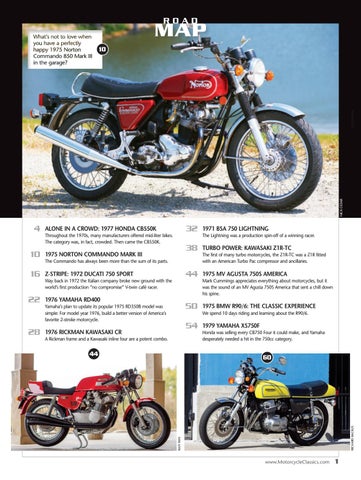
1975 NORTON COMMANDO MARK III
32
1971 BSA 750 LIGHTNING
38
TURBO POWER: KAWASAKI Z1R-TC
44
1975 MV AGUSTA 750S AMERICA
The Commando has always been more than the sum of its parts.
Z-STRIPE: 1972 DUCATI 750 SPORT Way back in 1972 the Italian company broke new ground with the world’s first production “no compromise” V-twin café racer.
1976 YAMAHA RD400
50
Yamaha’s plan to update its popular 1975 RD350B model was simple: For model year 1976, build a better version of America’s favorite 2-stroke motorcycle.
54
1976 RICKMAN KAWASAKI CR A Rickman frame and a Kawasaki inline four are a potent combo.
44
The Lightning was a production spin-off of a winning racer.
The first of many turbo motorcycles, the Z1R-TC was a Z1R fitted with an American Turbo Pac compressor and ancillaries.
Mark Cummings appreciates everything about motorcycles, but it was the sound of an MV Agusta 750S America that sent a chill down his spine.
1975 BMW R90/6: THE CLASSIC EXPERIENCE We spend 10 days riding and learning about the R90/6.
1979 YAMAHA XS750F Honda was selling every CB750 Four it could make, and Yamaha desperately needed a hit in the 750cc category.
60
RICHARD BACKUS
4
RASY RAN
www.MotorcycleClassics. www.MotorcycleClassics.com
1
®
Oscar H. Will III, Editorial Director Landon Hall, Group Editor, Collectibles lhall@motorcycleclassics.com
66
60 66 72
MATT CROSSICK
Arthur Hur, Associate Editor/Online Richard Backus, Founding Editor Keith Fellenstein, Tech Editor
1976 HONDA CB750SS
CONTRIBUTORS Phil Aynsley • Jeff Barger • Adam Bolton Nick Cedar • Stephen Clark • Hamish Cooper Matt Crossick • Dain Gingerelli Corey Levenson • Rasy Ran • Ken Richardson Erick Runyon • Margie Siegal • Robert Smith Phillip Tooth • Greg Williams ART DIRECTION AND PREPRESS Matthew T. Stallbaumer, Asst. Group Art Director Terry Price, Prepress CONVERGENT MEDIA Brenda Escalante; bescalante@ogdenpubs.com
It could be argued that the forefather of the 1970s Superbikes was the 4-cylinder Honda CB750.
1979 MOTO GUZZI T3 CALIFORNIA
WEB AND DIGITAL CONTENT Tonya Olson, Web Content Manager
“It was big, with loads of presence and dripping with style, and it had an exhaust note that caught your ear.”
(800) 678-5779; adinfo@ogdenpubs.com
DISPLAY ADVERTISING CLASSIFIED ADVERTISING
1979 TRIUMPH T140D BONNEVILLE SPECIAL
(866) 848-5346; classifieds@motorcycleclassics.com
In 1979, desperate for U.S. sales, Triumph introduced the T140D Special.
NEWSSTAND Melissa Geiken, (785) 274-4344
78 1976 HERCULES W-2000
CUSTOMER CARE
When Ron Schavrien got into motorcycling, he approached it from a different perspective than most. “The Hercules was so different from anything I’d ever seen before.”
84
1977 HARLEY-DAVIDSON XLCR
90
1975 RICKMAN HONDA CR750
96
PARTING SHOTS: THE ONLY 750CC Z-1
(800) 880-7567
The XLCR looks too heavy, too long and too big to be anything better than a hog dressed up as a greyhound. Bill Uhler, Publisher Oscar H. Will III, Editorial Director Cherilyn Olmsted, Circulation & Marketing Director Bob Cucciniello, Newsstand & Production Director Bob Legault, Sales Director Carolyn Lang, Group Art Director Andrew Perkins Director of Events & Business Development Tim Swietek, Information Technology Director Ross Hammond, Finance & Accounting Director
Some folks are lucky enough to have an American Pickers moment of their own. In 2008, Keith Lee had his.
Working on the west coast in the ’80s, Jeff Krause ended up with a photo of the fabled 750cc prototype of Kawasaki’s Z-1.
90
Motorcycle Classics (ISSN 1556-0880) Ogden Publications, Inc., 1503 SW 42nd St., Topeka, KS 66609-1265 For subscription inquiries call: (800) 880-7567 Outside the U.S. and Canada: Phone (785) 274-4360 • Fax (785) 274-4305
JEFF BARGER
©2019 Ogden Publications Inc. Printed in the U.S.A.
®
www.MotorcycleClassics.com
3
To simultaneously reduce intake noise and increase incoming It helped, too, that the RD400C’s Yokohama rubber was air volume for better performance, Yamaha reconfigured the mounted on solid cast aluminum wheels as opposed to the 400’s frame to accept a larger air box, in the process movRD350B’s laced-spoke steel rims that most certainly generated ing the engine forward 20mm. Shifting the engine forward a degree of spoke flex during full lean. These were among the improved steering input and overall handling, too, as the first cast wheels offered on a production motorcycle, and even added weight up front helped the RD400C’s front tire stick though the 400C’s seven-spoke hoops looked massive combetter than the 350’s while cornering. RD riders and road pared to the 350B’s more conventional spoked wheels, they racers from that era are especially familiar with how quickly the perky little oil-burner could steer. And once in the corner at speed it took a steady throttle and full concentration to maintain the line so the bike wouldn’t twitch left and right. Seasoned RD racers knew this was one of the 350’s quirks, the price paid for a quick-steering motorcycle, and generally the solution was for the rider to shift his weight forward to compensate for more traction while tracking through a turn. The RD400C retained that mongoose-like agility exhibited by the RD350B into and out of corners, but with less drama when its 3.25 x 18-inch front tire fought for traction. The 399cc air-cooled 2-stroke twin made just more than 35 horsepower on the Cycle dyno. www.MotorcycleClassics.com
25
was building. The 650cc engine had redesigned rocker boxes and pushrod tubes, and a 5-speed transmission became an option midway through the model year. The frame was lowered for 1972 to bring the seat height down from a toestretching 34 inches to a more reasonable 32 inches, and 1973 brought yet a further redesign that much improved the frame, along with other upgrades. The 650cc engine was enlarged to 724cc and then 744cc, the 5-speed gearbox became standard, and a Lockheed disc brake found its way
to the front wheel. A factory strike in September 1973 stopped production, but a few bikes, basically similar to the 1973 version, were released during the 18-month workers’ blockade. A few more bikes were built after the settlement to 1975 specs, and production then ramped up for the 1976 version of the twin. The Co-op that rose from the ashes of Triumph tried hard to make good bikes with good quality control and an excellent finish, but was hampered by an almost complete lack of money for R&D or machine tooling. Even so,
issues with oil leaks were addressed and the Bonneville was upgraded to meet new U.S. environmental regulations and left-side shift requirements. New models were announced, and better quality and enthusiastic magazine write-ups led to a modest sales bump by 1978. The August 1978 issue of Motorcyclist pitted the Bonneville against its archrival, the Harley Sportster, and the Triumph edged the Sportster out with better handling and better quartermile times. Unfortunately, the pound was strengthening during this period,
The distinctive 2-into-1 exhaust. The T140D uses 10-inch disc brakes front and rear. www.MotorcycleClassics.com
75
“Harley’s café racer looks heavier than it is. With a half tank of fuel, the XLCR weighs in at 515 pounds.”
him I was going to ride it the 500 miles home he told me my genitals would never survive the journey!” Joel enjoys a challenge as much as anyone, but even he has a limit. “It turned out the seller was referring to a serious conflict between the seat pad and the rear fuel tank mount,” Joel explains. “The oversized tank mount intruded into the thin seat at the worst possible anatomical location, and the rearset footrests and flat handlebars made sure I knew all about it. Fortunately, I found that my heavy winter gloves could serve as extra padding, and I made it home with cold hands but all my important parts intact.” With the bike back home in his workshop, reworking the seat and rear fuel tank mount was easy. He also upgraded the shocks to Works Performance units, added modern lights, tires, brake pads — the original material was too hard — and new chains. He also rebuilt the top end of the engine and the front forks, and had the exhaust system ceramic-coated. “Even with weather-worn original paint, this bike turns heads,” Joel says as he throws me the key.
On the road Harley’s café racer looks heavier than it is. With a half tank of fuel, the XLCR weighs in at 515 pounds, making it lighter than a Ducati 860 GTS or Laverda Jota, and a lot lighter than a Kawasaki Z1000; but at a standstill the top-heavy iron engine makes this hog feel anchored to the ground. Pull on the choke lever, twist the throttle a couple of times so the pumper carb primes a cylinder, switch on the ignition and hit the button. There’s no mistaking the “potato-potato” sound of a Harley exhaust as we hit the road. Once the oil is warm we step up
Why park outside when the lovely lady behind the counter will let you bring your bike inside? www.MotorcycleClassics.com
87