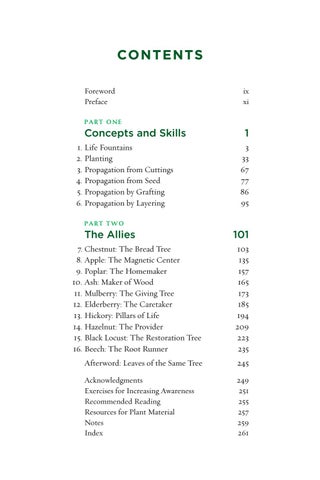
CO N T EN TS Foreword ix Preface xi PART ONE
Concepts and Skills
1. Life Fountains 2. Planting 3. Propagation from Cuttings 4. Propagation from Seed 5. Propagation by Grafting 6. Propagation by Layering
1 3 33 67 77 86 95
PART TWO
The Allies
101
7. Chestnut: The Bread Tree 8. Apple: The Magnetic Center 9. Poplar: The Homemaker 10. Ash: Maker of Wood 11. Mulberry: The Giving Tree 12. Elderberry: The Caretaker 13. Hickory: Pillars of Life 14. Hazelnut: The Provider 15. Black Locust: The Restoration Tree 16. Beech: The Root Runner
103 135 157 165 173 185 194 209 223 235
Afterword: Leaves of the Same Tree
245
Acknowledgments 249 Exercises for Increasing Awareness 251 Recommended Reading 255 Resources for Plant Material 257 Notes 259 Index 261
CHAPTER THIRTEEN
Hickory Pillars of Life
H
ickory trees are special. They have tremendous character. From the sprouted nut they will dive down 3 feet before the top is 6 inches tall. Hickory silhouettes in winter will give anyone good reason to pause and look at the sky. There is nothing like the shape of their branches zigzagging back and forth toward the radiant veil of infinity. I cannot count the fall days I have spent gathering hickory nuts with friends, with family, and by myself. It is one of my favorite activities in all the world. Sometimes there are more nuts than ground showing. Among the diverse genus of the hickories you will find some trees that bear great big thin-shelled nuts, and others with the most delicious nut on Earth locked in a thick shell. There are hickory nuts that are best used for milk, and others that are going to be known as the oilnut. The trees all have tremendously strong wood and live much longer than people.
Species There are several species of hickory and significant variation within each species. Many species hybridize with each other in the wild and under cultivation. I am only describing the few species that I am familiar with (here in the northeastern US). There are several others in different parts of the country and a handful in Southeast Asia.
Shagbark Hickory (Carya ovata) This is the tree with the classic hickory bark that looks like it is peeling off in great vertical strips. Shagbarks are native to the eastern half of the
Hickory United States. They are fairly common, growing well alongside oaks and maples. You can find shagbark hickory along the side of the road, on the edges of swamps, on ridgelines and hillsides. It is a very adaptable species. Shagbark nuts have prominent ridgelines. The buds are large and blunt, shaped like a jester’s crown. When they open in the spring, the unfurling leaves are as striking as any flower. I have found shagbark nuts of many shapes and sizes. Flavor can vary from tree to tree; all are The bark of mature shagbark great, but some are exceptional. Shagbark hickory nuts are hickory. considered to be the bestflavored of all the hickories by everyone who has tasted them. The flavor is without parallel. These nuts can be as small as a marble or as big as a golf ball. The shells are very thick. Many attempts at breeding larger shagbark nuts with thinner shells have been made. The primary focus of these attempts involved hybridizing them with thinner-shelled species like pecan and bitternut. I think maybe the focus should be shifted away from breeding the right tree toward processing the enormous wild crop that already exists. Someone with some good mechanical hands should be able to figure out how to crack and separate hickory nuts efficiently. The raw kernels by themselves are the greatest product any nut grower could offer. Millions of pounds fall to the ground uncollected in my county alone. It is very strange that a food so delicious could be so ignored.
Shellbark Hickory (Carya lacinosa) Very similar in appearance and growth habits to shagbark. Normally has bigger nuts, usually accompanied by a thicker shell. Shellbark is typically found in rich bottomlands. 195
Trees of Power Oilnut, aka Bitternut (Carya cordiformis) I believe an entire book will be written about this tree one day. Virtually all literature considers C. cordiformis to be an inferior species. The nuts are horribly bitter when eaten raw. I always thought of them as a joke to play on people by offering a taste. However, I have since learned from Sam Thayer that the bitterness is water-soluble. This is a very big deal for people interested in tree crops. The shells of bitternut are very thin, similar to the shell of an acorn. The nuts are packed full of meat that has an oil content of 75 to 80 percent. The shells are so thin that whole nuts can be run through a commercial oil press. The oil that comes out contains none of the water-soluble bitter tannins. The flavor is the same as shagbark hickory. Everyone I have offered a taste of the oil to looks up at me in surprise and says something like “Wow” or “Oh my God.” Here is a hickory tree that we don’t have to shell to enjoy. Here is vegetable oil raining down from the sky in enormous quantities. A 5-gallon bucket of nuts in the shell will yield ¾ gallon of oil. I have filled 5-gallon buckets of bitternuts in as little as 30 minutes. This tree is offering a tremendous gift, if we only can see it. When a million gallons of high-quality vegetable oil fall on the ground and we ignore it and plow up the earth to grow rapeseed (for canola oil), there is a disconnect. The soil suffers, wildlife suffers, and we do, too. The time is here for us to use hickory oil. Obviously everyone does not need to have their own oil press, but could we not take a lesson from our great-grandparents, who lived at a time when every town had a mill or a press? If there were just one or two oilnut presses set up in states where these trees are abundant, then people could bring nuts in from all over to collection points. High school kids, retired folks, inspired people of all ages can be a part of this. It seems that we would need machinery to compete with established oils like canola and sunflower, but it’s possible that this could be much simpler. This past year I collected enough nuts for 7 gallons of oil in only two days of harvesting. Bitternuts have smooth bark with a lace pattern. Their buds are flattened and a yellow mustard color. The trees generally grow in rich bottomlands, but can also be found on hillsides and ridges. They often have a striking and beautiful root flare, as the bark is even smoother 196
Hickory
Bitternut hickory nuts have a “tail� and no ridges along the sides.
Left, Bitternut hickory buds are mustard-colored and their bark is smooth, making them easy to differentiate from other hickories. Pignuts can also have smooth bark, but it’s usually more ridged, and they do not have yellow buds like these. Right, Bitternut hickory nuts are packed with nutmeat and have very thin shells.
197