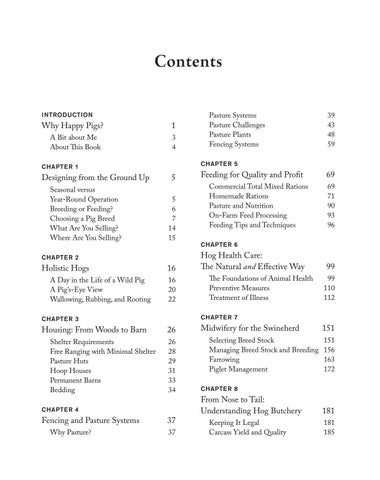
Contents I NTRODUCTION
Why Happy Pigs? A Bit about Me About This Book
1
3 4
Seasonal versus Year-Round Operation Breeding or Feeding? Choosing a Pig Breed What Are You Selling? Where Are You Selling?
5 5 6 7 14 15
CHAPTE R 2
Holistic Hogs
A Day in the Life of a Wild Pig A Pig’s-Eye View Wallowing, Rubbing, and Rooting
16
16 20 22
Shelter Requirements Free Ranging with Minimal Shelter Pasture Huts Hoop Houses Permanent Barns Bedding
26
26 28 29 31 33 34
CHAPTE R 4
Fencing and Pasture Systems Why Pasture?
HappyPigs_finalpages.indd 7
Feeding for Quality and Profit
Commercial Total Mixed Rations Homemade Rations Pasture and Nutrition On-Farm Feed Processing Feeding Tips and Techniques
69
69 71 90 93 96
CHAPTE R 6
Hog Health Care: The Natural and Effective Way
99
The Foundations of Animal Health 99 Preventive Measures 110 Treatment of Illness 112
CHAPTE R 7
CHAPTE R 3
Housing: From Woods to Barn
39 43 48 59
CHAPTE R 5
CHAPTE R 1
Designing from the Ground Up
Pasture Systems Pasture Challenges Pasture Plants Fencing Systems
37
37
Midwifery for the Swineherd
151
Selecting Breed Stock 151 Managing Breed Stock and Breeding 156 Farrowing 163 Piglet Management 172
CHAPTE R 8
From Nose to Tail: Understanding Hog Butchery Keeping It Legal Carcass Yield and Quality
181
181 185
4/30/19 2:19 PM
Slaughtering Pork Cuts Charcuterie
189 191 196
CHAPTE R 9
Pigs and Piggy Banks: Managing and Marketing Your Business Financial Planning Organic Certification Marketing Distribution
199
199 205 209 211
CONCLUS ION
So You Want to Be a Pig Farmer? 215
HappyPigs_finalpages.indd 8
Basic Nutrient Requirements of Swine
217
Nutritional Content of Common Organic Feedstuffs
219
Sample Record-Keeping Forms
223
APPE N DIX A:
APPE N DIX B:
APPE N DIX C:
Glossary 234 Recommended Resources
237
Notes 241 Index 246
4/30/19 2:19 PM
INTRODUCTION
Why Happy Pigs? Pigs and humans have been together for a long time—well over ten thousand years! The history of the two species likely first joined in southwestern Turkey, though new evidence based on DNA sequencing suggests that wild boars may have been domesticated independently in thirteen other regions, ranging from central Europe to the Indian subcontinent to central China and Oceania.1 In the millennia that followed, domesticated swine spread to practically every corner of the globe. Christopher Columbus brought pigs to Cuba, while Hernando de Soto brought them to the North American mainland. They arrived in Australia with the First Fleet in 1788 and in New Zealand with whalers in the early nineteenth century. All around the world, pigs’ hardiness, versatility, and tastiness have made them desirable companions for humans. In North America the pig quickly naturalized in southern regions and was brought west by European colonists traveling from the eastern seaboard. For pioneers on the move or living in crude conditions, pigs were easier to care for than sheep or cattle and provided a valuable source of cooking fat. Their appeal to settlers was further enhanced by the fact that their meat could be easily preserved by salting or brining before the invention of refrigeration. In the early days of pig production, swineherds moving pigs to urban markets only expected to
travel 10 miles (16 km) per day, so operations were generally small and local, with each farm keeping a small number of swine for consumption by the family and neighbors.2 The advent of rail travel facilitated the movement of grain to pigs and pigs to market, allowing the size of operations to increase. With the invention of modern grain harvesting machinery, traditional methods of feeding hogs by ranging them on wild land or in cornfields lost popularity, and by the 1950s the development of modern intensive swine production was well under way. The physiology of the pig changed in tandem with production methods: With easy access to cheap vegetable oil and widespread adoption of refrigeration, demand for lard and salt pork fell while demand for lean meat rose. Early American settlers would scarcely recognize a post–World War II hog farm. Instead of a handful of short-coupled fat hogs rooting in the woods for grubs, they would see hundreds or thousands of long, lean animals packed into indoor facilities and eating grain. Efficiency became the name of the game. Farmers and researchers made enormous strides in swine productivity in the second half of the twentieth century by breeding for reproductive capacity (the average litter size increased from 7.5 pigs to 11 pigs, and the average number of pigs weaned per sow per year nearly doubled), feed
—1—
HappyPigs_finalpages.indd 1
4/30/19 2:19 PM
Happy Pigs Taste Better efficiency (the average feed-to-gain ratio shrank by more than 20 percent), and phenotypes that increased marketable yield (average lean yields increased by 30 percent).3 Improved knowledge of swine nutrition, the ability to accurately measure the nutritional content of feedstuffs, and the development of certain feed additives contributed to the improvements in feed efficiency and reduced the excretion of nitrogen and phosphorus in swine effluent. In and of themselves, these developments had the capacity to improve farm profits, benefit consumers with lower grocery prices, and ease the strain on the natural environment by reducing the land base required to produce the US pork crop and reducing the threat to water quality. Unfortunately, things did not work out that way. The new efficiencies required scale and heavy capital investments to fully realize, which impeded entry to the market by smaller producers. Today, just four large meatpacking operations process nearly two-thirds of the hogs produced in the United States.4 These operations have extensive control over market pricing and, understandably, prefer to work with larger producers who can provide high volumes of meat and afford to run on slimmer margins. While per capita annual pork consumption has fluctuated between 45 and 60 pounds (20.4 and 27.2 kg) for half a century, the American population has more than doubled since 1950, resulting in an increase in overall pork consumption that significantly outpaces the gains we have made in feed efficiency.5 And despite small farmers’ complaints about the modern consumer’s expectations for cheap food, even the consumer hasn’t benefited: The inflation-adjusted price for bacon at the grocery store rose by 6 percent between 1950 and 2016.6 The biggest beneficiaries of modern pork production techniques are wealthy middlemen, not farmers, eaters, or the earth.
Meanwhile, the biggest losers are the hogs themselves. The modern pig lives a very different life from that of its ancestors a century ago. Instead of roaming the woods, foraging, or living in a sty with an outdoor yard and eating scraps, it lives indoors from birth to death and eats a scientifically balanced but very homogeneous diet. A well-run confinement grower facility is not necessarily injurious to hog comfort—the best facilities are climate controlled, well lit, well ventilated, and impeccably clean—but producers in the singleminded pursuit of efficiency cut corners in these departments all too often. It is not difficult to find the sort of operation featured in exposés by animal rights organizations: crowded, dirty, damp, dark, stinky, and staffed by overworked and undertrained handlers. Even in the better facilities, the incentive is always there to produce more animals in less space and less time. By the late 1960s most sows were confined to farrowing crates for birthing and lactation—cages so small that the animals could not turn around, let alone move freely. Later, crating was extended to gestating sows as well. Meanwhile, the average age of weaning dropped by about half, which required the development of highly refined, protein-rich diets based on animal products such as dried blood plasma. Growing hogs stressed by overcrowding resorted to cannibalism, leading producers, in turn, to begin the practice of routinely docking tails. Farms chasing ever greater feed efficiency use synthetic feed additives such as ractopamine, which is certainly effective but increases stress response to aggressive handling and increases the number of nonambulatory pigs.7 Selecting for ultralean, heavily muscled body types has encouraged the proliferation of the halothane gene, which can cause sudden death in stressed animals. As long as reducing production costs is the only way for the producer to succeed, the animals will continue to be the losers.
—2—
HappyPigs_finalpages.indd 2
4/30/19 2:19 PM
Introduction Fortunately for the pigs, many consumers care about them. Few Americans have a direct connection to how their food is produced anymore, or think much about where their BLT came from, but most are sentimental to some degree about animals and want them to be treated well. Most also want their great-grandchildren to have water to drink, food to eat, and air to breathe. When confronted with the negative impact of the modern livestock industry on the environment and animal welfare, some consumers will absolutely go into ostrich mode rather than change their buying habits, and some will decide to avoid meat entirely. Others, though, learn about alternative ways of getting meat to the table and decide either to raise their own meat or to support producers who are dedicated to environmental protection and animal welfare—and they understand that those principles come at additional financial cost. This demand creates a genuine opportunity to start creating a better system. Alternative methods of hog production (including certified organic, pasture-based, and other extensive methods) on homesteads and family-scale farms benefit the farmer, the hog, the environment, and the consumer. High-welfare hog production benefits the farmer because the product distinguishes itself on the market. Competing in the mainstream markets as a small producer is most likely a nonstarting proposition, and definitely a losing game, especially if you are committed to maximizing animal welfare (the margins in mainstream production are too slim to allow this commitment). As a niche producer, however, you can exercise some control over your scale, your markets, and your profitability. The pig obviously benefits because it is allowed to be a pig (and a happy pig, at that!) instead of just a production unit. Like its ancestors, it gets to experience sunshine and free movement and exercise its natu-
ral instincts. The environment benefits because small-scale farms are well adapted to composting manure instead of handling it as liquid effluent, turning farm “waste” into a resource rather than a contaminant. If you grow or purchase organic feed, the environment benefits doubly because your farm supports crop production practices that conserve soil quality and avoid toxic synthetic materials. Consumers benefit from the satisfaction of a connection with the source of their food, the comfort of knowing that their bacon habit doesn’t come at the expense of animal welfare, and above all an improved dining experience—happy pigs really do taste better! Fully realizing all these benefits at a sustainable price requires informed decision-making by both farmer and eater—and that is where you and this book come into play.
A Bit about Me I was born and raised on a small dairy goat farm in Whitefield, Maine. Every summer my father raised a couple of pigs in the backyard in a ramshackle little pen that we moved daily so that the pigs could enjoy fresh grass. My parents wouldn’t buy me a horse, so I spent a lot of time playing in the pigpen—one of the first things I learned about pigs is that they won’t cooperate with a rider! My childhood on the farm led to an abiding interest in crops and animals alike. My high school advisor urged against pursuing an agricultural degree because I was a “good student,” so I enrolled at Colby College in Waterville, Maine, in their environmental studies program. At the time I was a strict vegetarian. My eating habits were the result of concerns about the living conditions of livestock on large confinement farms—having grown up eating happy
—3—
HappyPigs_finalpages.indd 3
4/30/19 2:19 PM
Happy Pigs Taste Better animals, I couldn’t bring myself to buy grocery store meat. However, I met my husband-to-be during the summer before college, and he was adamantly against such rabbitlike tomfoolery. So we compromised: I would add meat to our shared diet if we raised it ourselves in a way that we could feel good about. I commuted an hour each way between the world of academics and the world of agriculture. At school I made every attempt to turn my environmental studies major into a degree in sustainable agriculture by focusing all my projects and papers on farm-related subjects. At home we bought our first three pigs, and I fed them each morning before driving to my first lecture at 8:00 a.m. In 2005, within a matter of a few months, I graduated from Colby, married, and started a fledgling farm operation with a litter of purchased piglets. Our farm grew and diversified rapidly; it seems as though we experimented with nearly every species of livestock and crop over the years, but hogs were a constant. Over the span of a decade, we tried a number of approaches to raising and marketing hogs, including most of the techniques described in this book. With every change we learned something new about how to manage hogs for maximum animal welfare, productivity, and profit. By 2009 we were running the largest certified organic hog operation in Maine, and by 2011 the farm was our family’s primary source of income. We built our business on the slogan and principle that “Happy Pigs Taste Better,” producing meat of gourmet quality with unimpeachable ethics: certified organic, pasture raised, fed locally grown feed, and humanely handled and slaughtered. When we started out on this venture, we had little to go on beyond my father-in-law’s experience running a conventional confinement hog operation and my childhood memories of raising a couple of pigs each summer in the backyard. We made all
the mistakes you can possibly imagine, but as it turns out, perseverance, energy, and flexibility can earn you a degree in organic hog husbandry at the school of hard knocks (which remains the only university to offer such a degree). In 2015 our family decided to take a hiatus from farming for an undetermined period of time, for personal reasons and off-farm opportunities. While I miss having pigs around, this finally gave me the opportunity to write the book about organic hog farming that I wish I’d had on my shelf when I purchased my first litter of piglets.
About This Book This book offers a comprehensive guide to highwelfare hog production, from conception to pork chop, as well as a more cursory overview of the marketing and financial management skills required to successfully operate a small business and an introduction to the agronomy of crops commonly raised to feed or pasture pigs. If you are serious about raising pigs on pasture commercially, I recommend reading the book in its entirety. Of course, there is more to hog farming than any one book can cover: If you wish to grow your own feed, you may need to seek additional information, and anyone attempting to start a business should make a deeper study of marketing, financial management, and legal regulations. Homesteaders may skip the sections about marketing, but I would still advise them to study the sections on financial management. Drylot producers (who do not intend to pasture their animals) may skip most of chapter 4. The book should prove useful to producers on any scale common in the world of niche pork production, though the largest producers can take advantage of automated systems that are not within the scope of this volume.
—4—
HappyPigs_finalpages.indd 4
4/30/19 2:19 PM