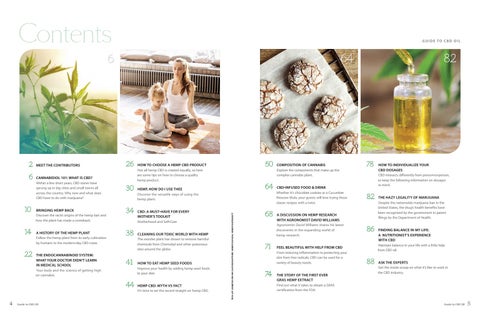
Contents
GUIDE TO CBD OIL
6
6
CANNABIDIOL 101: WHAT IS CBD?
Within a few short years, CBD stores have sprung up in big cities and small towns all across the country. Why now and what does CBD have to do with marijuana?
10 BRINGING HEMP BACK Discover the racist origins of the hemp ban and how the plant has made a comeback.
14
A HISTORY OF THE HEMP PLANT
Follow the hemp plant from its early cultivation by humans to the modern-day CBD craze.
22
THE ENDOCANNABINOID SYSTEM: WHAT YOUR DOCTOR DIDN’T LEARN IN MEDICAL SCHOOL
26 HOW TO CHOOSE A HEMP CBD PRODUCT 30
64
HEMP, HOW DO I USE THEE
34
CBD: A MUST-HAVE FOR EVERY MOTHER’S TOOLKIT Motherhood and Self-Care
38
CLEANING OUR TOXIC WORLD WITH HEMP The wonder plant has shown to remove harmful chemicals from Chernobyl and other poisonous sites around the globe.
41
HOW TO EAT HEMP SEED FOODS Improve your health by adding hemp seed foods to your diet.
HEMP CBD: MYTH VS FACT It’s time to set the record straight on hemp CBD.
COMPOSITION OF CANNABIS Explore the components that make up the complex cannabis plant.
82
78 HOW TO INDIVIDUALIZE YOUR CBD DOSAGES
CBD interacts differently from person-to-person, so keep the following information on dosages in mind.
CBD-INFUSED FOOD & DRINK Whether it’s chocolate cookies or a Cucumber Moscow Mule, your guests will love trying these classic recipes with a twist.
Discover the versatile ways of using the hemp plant.
44 Guide to CBD Oil
50
Not all hemp CBD is created equally, so here are some tips on how to choose a quality hemp product.
Your body and the science of getting high on cannabis.
4
64
From left: AdobeStock/iSAvirA; Shutterstock/PH888; AdobeStock/mizina; AdobeStock/HQUALITY
2 MEET THE CONTRIBUTORS
34
82
68
A DISCUSSION ON HEMP RESEARCH WITH AGRONOMIST DAVID WILLIAMS Agronomist David Williams shares his latest discoveries in the expanding world of hemp research.
71
86
FINDING BALANCE IN MY LIFE: A NUTRITIONIST’S EXPERIENCE WITH CBD Maintain balance in your life with a little help from CBD oil.
FEEL BEAUTIFUL WITH HELP FROM CBD From reducing inflammation to protecting your skin from free radicals, CBD can be used for a variety of beauty needs.
74
THE STORY OF THE FIRST EVER GRAS HEMP EXTRACT
THE HAZY LEGALITY OF MARIJUANA Despite the nationwide marijuana ban in the United States, the drug’s health benefits have been recognized by the government in patent filings by the Department of Health.
88
ASK THE EXPERTS Get the inside scoop on what it’s like to work in the CBD industry.
Find out what it takes to obtain a GRAS certification from the FDA.
Guide to CBD Oil
5
CANNABIDIOL
6
Guide to CBD Oil
Human cannabis use and current legal status Humans probably first encountered the hemp plant somewhere in the steppes of Central Asia. It became one of our first domesticated plants because of its usefulness as a fiber, its seeds as a food, and its psychoactive properties that brought communities together for enjoyment and mysticism. Researchers estimate that the cannabinoid content back then may have been 1% CBD and 1% THC.
Adobe Stock/isavira
BY L E X P E LG E R
here’s a good reason that cannabidiol, or CBD, has been taking the world by storm. It harnesses the healing power of the cannabis plant without the high. CBD interacts with our own endocannabinoid system (see The Endocannabinoid System on page 22) to promote homeostasis and balance. From baby boomers looking to combat the effects of aging to millennials seeking to reduce stress and anxiety, the science and history of CBD explains why everyone seems to be talking about it. So, what are the basics of this fascinating and ancient molecule? Dr. Roger Adams first isolated cannabidiol from Indian hemp, as cannabis was sometimes called, in 1940. He figured out most of the molecular structure, but it wasn’t until 1963 when the lab of Dr. Raphael Mechoulam finally synthesized the molecule from scratch. Being a lipid made CBD harder to study than alkaloids like morphine because it didn’t dissolve in water, but its nature as a lipid also seemed to make its actions more nuanced around the body. One advantage of CBD being a fatty lipid is that it readily absorbs into the body. It can be inhaled through smoking, placed under the tongue, or absorbed through the skin. Because of this adaptability, CBD lends itself well to being used in a wide variety of products, from basic oils to food and beverages. And this is only the start of the ingenuity that we’ll see as the market for this cannabinoid spreads.
Adobe Stock/exvanesko
Within a few short years, CBD stores have sprung up in big cities and small towns all across the country. Why now and what does CBD have to do with marijuana?
T
Cannabis followed humans around the world, and by the 19th century it could be found in pharmacies worldwide. With hundreds of cannabis products on the shelves in the United States, chemists began to wrestle with the components of the plant to try and figure how cannabis provoked such a wide array of effects in people. From the 1930s to the 1960s, prohibition and the racist Reefer Madness propaganda campaign turned the public and the authorities against ‘marihuana’ (the term originally used to describe the psychoactive varieties of cannabis which had been bred to produce more of the resin containing the cannabinoids). This ‘marihuana’ type of cannabis is quite different than the ‘hemp’ type of cannabis that is bred for fiber and food, but despite this, all varieties of cannabis were vilified under the same broad net. With the Marihuana Tax Act of 1937, which was snuck into law by the Federal Bureau of Narcotics head Harry Anslinger, the possession or growing of cannabis was criminalized unless one obtained a tax stamp for it. However, no such stamp was ever issued, thus deeming the plant practically illegal. The freezing effect on cannabis science research spread around the world. Few labs took the trouble to navigate the tremendously laborious paperwork it took to obtain hemp to study. Some work continued at the chemical level to examine individual molecules, but the more relevant clinical studies that could have been done in humans and animal models dwindled. In the 1950s, punishments for cannabis possession and use at the federal level reached their peak. Texas put a law in place that carried the death penalty. A racist enforcement pattern focused on Latinos, African Americans, and ‘low whites.’ Harry Anslinger spouted views so regressive and used language so backwards in his War on Marijuana that it was an embarrassment even in 1950s America.
A hemp plant.
Guide to CBD Oil
7
A History of the
Hemp Plant I N T R O D U C T I O N BY L E X P E LG E R
A
ccording to revered scientists like Dr. Carl Sagan and Dr. Richard Schultes, the father of ethnobotany, if cannabis was not the first plant cultivated by humans, it was certainly one of the first. Archeological evidence for hemp use by early humans goes back almost 10,000 years. This bushy shrub, likely first encountered in Central Asia, would have grown well in the trash pits of early settlements. Its highly nutritious seeds alone would have endeared it to our ancestors, but once they discovered that burning it in a fire caused psychoactive effects and that it could be used as a fiber, the cannabis plant spread around the world.
500 BCE
Cannabis described in the Avesta, the sacred text of the Zoroastrians of Persia, one of the earliest monotheisms.
440 BCE
Cannabis lent itself especially well to plant breeding by early farmers because of its genetic complexity. Hemp could be made to grow long and thin, optimal for rope making, or it could be made to produce more of the resin containing the cannabinoids that were used for medical and spiritual purposes. The plant adapted to what society needed, and that adaptability allowed for it to become one of the most widespread plants in human history.
Herodotus, “The Father of History,” famously describes the Scythians on the Eurasian steppes who threw cannabis onto the fire for funerals, dancing around in the smoke and weeping for their loved one. Though, what few of the joyful pot historians point out is that the rest of Herodotus’ account describes a people of breathtaking savagery, even by the standards of the ancient world.
The hemp plant.
Famed ethnobotanist Richard Schultes has stated that cannabis is “one of the most ancient of cultivated plants [and] is native probably to Central Asia.”
Archaeological evidence of humans eating hemp seeds in what is now modern day Japan.
5000 BCE
Earliest hemp seeds found in European settlements.
4000 BCE
Egyptians use hemp to build and outfit the first sailing ships.
3300 BCE
Indus Valley culture ends and cannabis biotypes are introduced, becoming widely used across South Asia.
2800 BCE
First written record of cannabis in the pharmacopoeia of Shen Nung, the legendary founder of Chinese medicine, where he calls it one of the Superior Elixirs of Immortality.
14
Guide to CBD Oil
2700 BCE
Well-preserved cannabis stash of flowers, seeds, stems, and leaves in the burial tomb of a Yanghai shaman in western China.
2200 BCE
As civilization rises in the Yellow River region of China, the many uses of cannabis become integral to their empire and lead to China eventually being known as “The Land of Mulberry and Hemp.” Phoenicians pioneer the first sea trade routes across the Mediterranean and Red Sea. Because of its resistance to the harshness of salt water, hemp was used for their rope and sails. This trend continued in most of the navies throughout world history.
600 CE
Papermaking spreads to Korea.
1519
Magellan circles the world in hemprigged ships.
868
1564
The world’s first known printed book created with woodblock technology: The Diamond Sutra printed on hemp.
1000
Dioscorides records the medical properties of cannabis.
The Papal Bull of Pope Innocent VIII villifies cannabis as an unholy sacrament of Satan.
1533
Legend says that at the Battle of Talas, the Arabs capture of two Chinese prisoners leads to the first paper mills of the Islamic world.
150 BCE
70 BCE
1484
751
950
Chinese begin making the world’s first paper out of hemp (As Joseph Needham pointed out, most of the major technological innovations occurred in China, and many of them involved hemp.)
600 BCE
The Quran of Islam forbids alcohol but tolerates the use of cannabis. The Sufis, the mystical branch of Muslims, spread its use across the Arab world. In the poems of Rumi’s teacher Attar, cannabis is symbolized as a green parrot.
420 BCE
Hemp seed offerings left in Scythian tombs.
Adobe Stock (2)
The earth begins to warm in the Holocene era after the last ice age and allows plants and humans to spread out from their temperate refuges.
8000 BCE
Adobe Stock
12000 BCE
640
Papermaking comes to Spain through North Africa. ‘Hempe’ first listed in an English dictionary.
1160
Hildegard of Bingen, an abbess considered the founder of scientific natural history in Germany, writes of the medicinal uses of cannabis in her Physica.
1275
Marco Polo leaves for his grand trip to China, where he’ll see hemp fiber used for paper making, the caulking of ships, and vast fields of it growing in the oases of Turkestan.
Left: Hildegard of Binge, considered the founder of scientific natural history in Germany. Right: The Chinese began making paper out of hemp around 150BCE.
Henry VIII passes an act compelling all farmers to cultivate 1⁄4 of an acre of hemp for strategic purposes or to face fines. King Phillip orders hemp to be grown throughout the Spanish Empire stretching from Argentina to Oregon. Early explorers soon finds a land filled with hemp. Jacques Cartier wrote that it was “frill of hempe which groweth of itselfe, which is as good as possibly may be scene, and as strong.”
1606
Hemp first planted in Canada by French botanist Louis Hevert. Soon, the government offers bonuses to hemp planters and distributes free seeds to the settlers.
1619
Virginia becomes the first colony to mandate the growing of hemp.
1753
The famous Swedish botanist and inventor of the modern classification system of species christens the hemp plant as Cannabis sativa L. Guide to CBD Oil
15
Cleaning
Our Toxic World With
HEMP The wonder plant has shown to remove harmful chemicals from Chernobyl and other poisonous sites around the globe. BY L E X P E LG E R
The Ilva steel plant in Taranto, Italy.
hytoremediation. It’s the idea of using plants to clean the soil that we’ve polluted with heavy metals or radioactive material. The U.N. declared phytoremediation to be a “low cost, solar energy driven cleanup technique” and “useful for treating a wide variety of environmental contaminants.” For cleansing the soil, hemp makes an excellent choice because of its high biomass, long roots, and short life cycle. Ilya Raskin, one of the early pioneers of phytoremediation (in fact, he coined the term in his 1991 Superfund application), used hemp in some of his earliest work. With the Ukrainian Academy of Agricultural Sciences and his firm Phytotech, Raskin planted hemp around Chernobyl to remove caesium-137 from the radioactive soil. This early effort led to a host of research around the world to study how hemp decontaminated soil. In 2001, a German team of researchers found that hemp grew just fine in soil containing the poisonous heavy metal cadmium. When the hemp plants matured, the highest concentrations of cadmium were found to have accumulated in the leaves,
38
Guide to CBD Oil
Wikimedia commons/mafe de baggis
P
and the plants could then be burned in a controlled manner to safely remove the contaminant. This represented a potentially more cost-effective option for low-level contamination sites than the usual pricey process of digging all of the soil out of the ground and hauling it off. The next year saw a group in Hawaii demonstrate the ability of hemp plants to remove two polycyclic aromatic hydrocarbons (PAHs), chrysene and benzo[a]pyrene, from the soil. In 2004, a Bulgarian team planted hemp at various distances from the the Non-Ferrous-Metal Works (NFMW) near Plovdiv. They found the plants acted as bioaccumulators that sucked up the heavy metals. The highest concentrations were found in the roots, followed by the stems, leaves, and seeds. When a Czech group looked at 28 different plant species in 2004 for potential radiophytoremediation use, they planted them in an old uranium mill tailings waste depot. At the conclusion of the study, the researchers found hemp to possess the best radioactive uptake. More recently, groups in China found similar results for zinc and cadmium. In a Guide to CBD Oil
39
Cannabinoids Cannabigerol (CBG)
We know that the cannabis plant can produce more than 120 different cannabinoids. We still don’t know why the plant evolved to produce these complex molecules, but we do know that these cannabinoids cause a wide range of effects in humans. The best studied cannabinoids like THC and CBD have thousands of research papers looking into their chemistry, how they bind in the body, and what effects they cause in mammalian systems. There are also the minor cannabinoids. However, they aren’t called minor cannabinoids due to minor effects. For instance, CBG is a potent activator that some people use instead of coffee. They’re named as such because marijuana prohibition made it difficult to study these cannabinoids from the plant, and so, for some of them, there are only a few dozen research papers published about their effects. When people say that cannabis needs more research, it’s especially true of minor cannabinoids. But, as you’ll see, what we already know of their effects is that they are quite potent. Apart from the aforementioned cannabinoids, there are over 100 cannabinoids that have only been cataloged in scientific literature. We know that they exist, but we don’t know how they work or what they do. Each of these cannabinoid variants represents a potential new path for modulating our endocannabinoid system.
Adobe Stock/basica
Cannabigerol is often referred to as the “mother molecule.” It is the primary biosynthetic precursor on the pathway to becoming THC, CBD, and CBC (cannabichromene). It’s like the “stem-cell” of cannabinoids. Only found in trace amounts in the plant, CBG has not been particularly well-studied since its isolation. However, researchers have already found an intriguing number of medical uses. Compared to the greatly psychoactive THC, CBG only binds slightly to the CB1 receptors spread across much of the top areas of the brain — roughly with the same affinity as CBD. It also appears to interact with the CB2 receptors of the body and immune system, but whether it functions as an agonist or antagonist is still unclear. A more potent painkiller than THC according to some measures and a powerful antibiotic against MRSA, CBG is also considered by some to be the strongest phytocannabinoid to fight against breast cancer after CBD. In addition, it is known to be effective against highly-resistant carcinoma cells in prostate cancer. With antiinflammatory properties and many reports of anecdotal use, some scientists believe that CBG helps in animal models with bladder issues and inflammatory bowel disorders. Like THC, it also appears to be effective in lowering high eye pressure caused by glaucoma. CBG inhibits GABA (gamma-Aminobutyric acid) uptake more effectively than both THC and CBD, and since GABA is the main inhibitory neurotransmitter of the brain, this might explain the anti-anxiety effects found for CBG. It’s an intriguing cannabinoid in many ways and most certainly worthy of greater study.
52
Guide to CBD Oil
Guide to CBD Oil
53