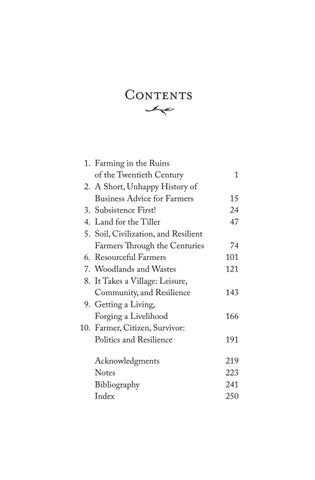
Contents
C 1. Farming in the Ruins of the Twentieth Century 2. A Short, Unhappy History of Business Advice for Farmers 3. Subsistence First! 4. Land for the Tiller 5. Soil, Civilization, and Resilient Farmers Through the Centuries 6. Resourceful Farmers 7. Woodlands and Wastes 8. It Takes a Village: Leisure, Community, and Resilience 9. Getting a Living, Forging a Livelihood 10. Farmer, Citizen, Survivor: Politics and Resilience
1 15 24 47 74 101 121 143 166 191
Acknowledgments 219 Notes 223 Bibliography 241 Index 250
FarmingfortheLongHaul_finalpgcx.indd 5
12/6/18 1:23 PM
Chapter 1
C Farming in the Ruins of the Twentieth Century
T
his is a book about farming today with an eye to our uncertain future. It is about building a viable small farm economy that can withstand the economic, political, and climatic shock waves that the twenty-first century portends. Uncertainty and periodic disruptions have always been part of the background as humans worked to bring the fruits of nature to the table. In the twentieth century the economics of a growing urban, industrial society wrecked the dream of a smallholder society on which Thomas Jefferson bet his hopes for a democratic America. Economic hardship and the years of drought that ended in the Dust Bowl wrecked the dreams of millions who thought to live off the land, sustaining their own livelihoods while supplying the burgeoning cities of an industrializing giant. And they continue to take their toll on hard-nosed agribusiness people and idealistic young farmers alike as we make our shaky way into the twenty-first century. The shocks of the coming decades arguably will be greater—unprecedented in the short history of industrial agriculture but familiar enough in the history of descent of other civilizations.1 The next chapter recalls some of our recent history, but we will not dwell on a critique of the industrial model of agriculture as it developed over the last hundred years in this country. That
51%
FarmingfortheLongHaul_finalpgcx.indd 1
12/6/18 1:23 PM
FARMING FOR THE LONG HAUL
has been done ably by many before me.2 The road to the present impasse is part of a recent past that should inform our decisions about how we farm and what we can expect from farming today. In fact, too much of the farming advice that new farmers are receiving today ignores that sorry history and repeats its mistaken assumptions. It ignores as well the real perils farming faces in the wake of the ruin that twentieth-century agriculture, and the fossil fuel economy that supported it, has wrought. And too often missing in our thinking about the future of farming is an awareness of the long history of resilience and adaptation that other farming cultures brought to bear as they faced other disasters, persisted, and found new and better ways to secure a livelihood and live sustainably upon the land. This book looks cautiously forward toward the challenging prospects of the next several decades, trying to suggest ways to prepare a farming future that can survive the transition to a future very different from the present. And it will do so drawing on a still-deeper past, recalling examples from the vast history of agriculture and the endless array of agricultural adaptations that farmers have devised, gleaning lessons from more resilient agricultures, ones that withstood not just the vagaries of the modern capitalist market, but environmental and social shocks of the past that rival what lies ahead. Successful farming societies—and there have been many of them throughout the history of agriculture—have never been driven by the profit motive, though profit has played a part in some societies, at least where farmers were free and markets significant. Instead, they have been governed by principles of resilience—by the effort, to put it simply, to survive and to do so well under uncertain conditions. Those principles include: a dedication to their own subsistence, above all; sophisticated approaches to management of the natural resources on which farming depends; and dependence upon a vibrant local community as a first line of defense against calamity.
5
FarmingfortheLongHaul_finalpgcx.indd 2
2
%
12/6/18 1:23 PM
Farming in the Ruins
Contemporary efforts to teach the latest generation of farmers the business skills necessary to turning a profit fly in the face of this history, just as they ignore the short, sorry history of profit-oriented farming best on display in the United States. Often these efforts are based on a misunderstanding, a subtle morphing of two disparate notions. “You can’t farm sustainably,” many say, “unless you’re economically sustainable.” True enough. But then comes the subtle wrong turn: economic sustainability = profitability. Economic sustainability in the historical record, however, relies more on resilience than on profitability. In fact, the quest for profitability can be the enemy of resilience, as when American farmers cut the woodlot, eliminated the milk cow, the hogs, and the chickens, and took down the barn—the better to farm fencerow-to-fencerow in the quest for profits in markets fixed against them. Resilient farmers know the difference between short-term profitability and long-term economic sustainability. Farmers condemned by debt and bad advice to constantly track the bottom line generally do not.
Millennia of Examples
Farming societies—tribal, peasant, yeoman farmer—have often been prosperous. Why, then, the prejudice that farming is a losing game, peasants forever condemned to misery and ignorance, tribal societies a dead end? No doubt the reasons are many. History remembers disaster better than success, and military prowess over the everyday persistence of ordinary people. Peasants don’t easily raise armies and thus are easily overrun by marauders on horseback, who combine military advantage with terror, slaughtering men, women, and children, burning crops in the field, driving off the livestock. And when peasants do raise armies, they are often defeated, if not by their enemies then by the likes of the communist cadres who assumed leadership in twentieth-century peasant revolts around the world and who reshaped peasant life and society in the wake of victory.
5
FarmingfortheLongHaul_finalpgcx.indd 3
3
%
12/6/18 1:23 PM
FARMING FOR THE LONG HAUL
But Weren’t the Lives of  Traditional Farmers Nasty, Brutish, and Short? In a word, no. A misleading version of history tells us that before the twentieth century, the average life expectancy was somewhere between thirtyfive and forty-five years, depending upon where and when you lived. But those are averages. They include the large proportion of the population who died before their tenth, or even fifth, year. Both historical records and studies of hunter-gatherer cultures show an infant and child mortality rate of about 50 percent around the world. So if the average life expectancy of a society is forty years, then the life expectancy for an adult who survived childhood would be in the seventies. In fact the life span of adult hunter-gatherers studied in the twentieth century was sixty-eight to seventy-eight years, similar to the post-childhood life span of an adult in eighteenth-century Sweden.3 Infant and child mortality was reduced drastically starting in the late nineteenth century with public health measures around clean water and sanitation, and over the twentieth century these efforts, combined with inoculations against common infectious diseases, spread around the world, increasing life expectancy everywhere. But life expectancy in traditional cultures was relatively robust for those who lived to age ten or twelve, and a few traditional societies saw large numbers of people living to a hundred years or more.
5
FarmingfortheLongHaul_finalpgcx.indd 4
4
%
12/6/18 1:23 PM
Farming in the Ruins
We also tend to remember the recent conquest and absorption of so-called primitive societies by the West rather than their persistence over hundreds and thousands of years. Tribal societies for the most part could not compete with colonial newcomers, neither militarily nor culturally. Traditionalists like Tecumseh or Crazy Horse found themselves fighting losing cultural battles against the majority of their own people enthralled by the stuff the industrial-based intruders had to offer. The success of these societies in getting a subsistence and building a rich culture over millennia came to look, from this perspective, like backwardness. Since the dawn of the republic, moreover, American farmers have been forced to sell on a market manipulated by governments and speculators, railroads and multinational corporations. They are “price-takers,” as the economists put it, not price-makers. We remember the revolt of farmers over the terms of that market in the post–Civil War era but not the prosperity of the rural economy that followed, the age that built the lovely towns that dotted our countryside in its aftermath. We see only the ruins of those towns in the wake of the seventy-year advance of the industrial model. We remember the struggles of homesteaders unsuited to the task of learning to farm a new terrain or condemned to failure by the attempt to bring traditional farming methods to the arid West. And we know that farm country has grown increasingly deserted over the last seventy years. But we don’t recognize the achievements of the settled agriculture of the nineteenth and early twentieth centuries in many parts of this country, and we ignore the undermining of those achievements through government policy, expert advice, and growing monopoly power in the marketplace.4 Too often, and too persistently, we blame the victim. We have much to learn from the social organization, farming skills, ecological wisdom, and political resistance of the farming societies of the past. In place of peasants and farmers, economists and policy makers have elevated the agribusinessman. But agribusiness as we know it is unsustainable even for many agribusinessmen,
55%
FarmingfortheLongHaul_finalpgcx.indd 5
12/6/18 1:23 PM
FARMING FOR THE LONG HAUL
and certainly for the soil and our food system. The few who succeed in that losing game are scarcely models for the agriculture of the future. In seventy years of ruinous farming practice, industrial farming has exhausted our soils, poisoned groundwater and a large portion of the Gulf of Mexico, and provided the basis for a food culture that is making most of our population sick. To go forward we will have to look back and attempt to recover, with the wisdom of hindsight, the lessons that traditional agricultural societies have to teach about subsistence, stewardship, social organization, and economic and political resilience. Food systems are not just about the production, distribution, and processing of foods. They represent distributions of land and power, wealth and poverty, plenty and famine. As farmers we can buy into the food system we are born to and try to rise to the top in a usually losing game, or we can try to change the system and the practice of farming itself. The contemporary sustainable agriculture movement is an attempt to change one very complex and powerful food system. But we will fight against odds of our own making, and not just those devised by that system, if we accept its premises, if we suppose there are no alternatives to struggling to make it in the market economy. And there is a third option: We can return to the norm of the successful agricultural societies of past centuries that were based on a strategy of subsistence first, resilience in the face of both natural and human-made challenges, and continuing invention, and grounded in the reciprocity and fellow feeling of living communities. Understanding the alternatives that human societies have devised in the past is essential to enlarging our vision of farming for the long haul.
Who Are We?
Farming is a vocation, Wendell Berry insists, not a job. Starting there is already a step toward resilience, because it means we recognize that we are in this for the long haul and that it will take a great deal to drive us out. I knew farmers in southern Maryland who clung
5
FarmingfortheLongHaul_finalpgcx.indd 6
6
%
12/6/18 1:23 PM
Farming in the Ruins
so desperately to farming that they carried on even when it made no money and little sense, renting land so they could run tractors on it and plant, spray, and harvest corn and soy on weekends while the rest of their lives were taken up with the nine-to-five jobs that paid the bills. Only the Commodity Credit Corporation kept their hobby from bankruptcy. To one degree or another most farmers in the country are like those farmers. And even those who farm more sustainably and with less reliance on government handouts do so out of their dedication to farming as a vocation. Farmers, moreover, may or may not have much of the entrepreneur in them, but even if they do it is not the mentality of the entrepreneur whose happiness is building a company, no matter what its product, and squeezing a profit out of it. No, a farmer builds a farm for the sheer pleasure of working the land and working with animals. The business of farming may or may not be of interest to farmers, as much as it has to be attended to in any case. Farming is not first of all a business, as our business advisers like to insist. It is a way of living. Either it satisfies a passion in us, a deep need, or we will pretty quickly give it up. Those facts guarantee a sort of personal resilience, but they don’t guarantee that anyone with the requisite passion will be able to continue to farm. Nor do they guarantee that the style of farming adopted will be one that has a future. Those outcomes depend on skills and attitudes and strategies that will be the topic of further chapters. We can learn a lot about ourselves and the tasks we face by recognizing that we farm because we love to. What that means concretely will vary from farmer to farmer. But any open discussion among farmers reveals some near constants: a passion for nurturing animal and plant life; a love of working outdoors; an appreciation for the mysteries of nature; a commitment to feeding people; a talent for troubleshooting; a fierce independence. Each of these tells us something about how farmers go about their work as opposed to, say, engineers or manufacturers. We nourish, we don’t
57%
FarmingfortheLongHaul_finalpgcx.indd 7
12/6/18 1:23 PM
FARMING FOR THE LONG HAUL
make. Even as plant or animal breeders, we bow to the mysteries and the intransigence of nature. We shape our environment, but if we are wise we don’t overturn it. We depend upon nature and natural processes and must work with them. We are multifaceted doers, as capable of rigging an irrigation system as managing a thousand transplants or moving a herd of goats. And we want to do it ourselves, even as we recognize the need to work cooperatively with others. These generalities may apply more to small, alternative farmers than to midwestern corn and soy farmers, but to one degree or another they likely apply to all. These characteristics in themselves add up to a lot of farm resilience. And that resilience explains how many farmers and their farms survive year after year, even under the present, very unfavorable circumstances. It takes very bad advice, and very bad investments, to put a farm under. That fact speaks to the enormity of the bad advice that has been doled out to farmers over the last century. The pages that follow attempt to correct that bad advice, not with new advice about how to farm, what to grow, or how to market it—there is plenty of good advice out there on such topics—but with strategies for farming in both hard times and good, in market economies and outside them, and reflections on the social context for farming well and over the long haul.
What Will the Long Haul Look Like?
The chances that the next fifty years will not bring enormous, not to say cataclysmic, disruptions to our way of life are nil. World oil reserves will be exhausted in as little as fifty years.5 Ditto natural gas. As will the lithium that powers today’s most sophisticated batteries. As this suggests, transportation is equally imperiled. If the world doubled the number of electric vehicles on the roads every year, it would take until 2035 to surpass the total number of gas guzzlers on US highways alone; currently
5
FarmingfortheLongHaul_finalpgcx.indd 8
8
%
12/6/18 1:23 PM