Contents
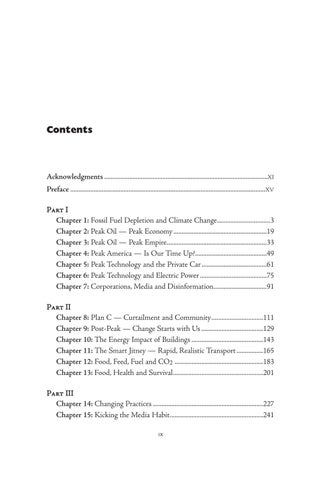
Acknowledgments ..................................................................................................XI Preface .....................................................................................................................XV Part I Chapter 1: Fossil Fuel Depletion and Climate Change................................3 Chapter 2: Peak Oil — Peak Economy ........................................................19 Chapter 3: Peak Oil — Peak Empire............................................................33 Chapter 4: Peak America — Is Our Time Up?...........................................49 Chapter 5: Peak Technology and the Private Car .......................................61 Chapter 6: Peak Technology and Electric Power ........................................75 Chapter 7: Corporations, Media and Disinformation................................91 Part II Chapter 8: Plan C — Curtailment and Community...............................111 Chapter 9: Post-Peak — Change Starts with Us .....................................129 Chapter 10: The Energy Impact of Buildings ...........................................143 Chapter 11: The Smart Jitney — Rapid, Realistic Transport................165 Chapter 12: Food, Feed, Fuel and CO2 .....................................................183 Chapter 13: Food, Health and Survival......................................................201 Part III Chapter 14: Changing Practices ..................................................................227 Chapter 15: Kicking the Media Habit........................................................241 IX
X
| P LAN C
Chapter 16: Localization...............................................................................249 Chapter 17: Reviving and Renewing Community....................................257 Conclusion.............................................................................................................271 Endnotes................................................................................................................273 Index.......................................................................................................................305 About the Author ................................................................................................317
Preface
e are facing multiple grave world crises — peak oil, climate change, inequity and species extinction to name just a few. When I began this book our situation was very serious — now it is life threatening. The survival of industrial society as we know it today is in doubt. Twenty years of so-called sustainability conversations have led nowhere, and green has degenerated into a marketing term. The time for scientific and technological solutions to problems caused by science and engineering is long past. Survival requires that we begin to see that energy technology is the root cause of many serious world problems. As William Jevons pointed out decades ago, ever more efficient machines designed by scientists and engineers means ever-increasing consumption of fossil fuels and more generation of CO2. Our problem is cultural, not technical. It is a character issue, not a scientific one. We have never bothered to ask or answer the question “What is energy for?” We have allowed cheap fossil fuels to change us from citizens into mere consumers. We in the modern world have become addicted to consuming energy. In the past, our spiritual traditions warned us against materialism — an older name for our current addictive consumerism. But contemporary religions seem to concede that humanity’s main purpose is to consume the products of a fossil fuel-based, perpetual-growth economy. As Wendell Berry says:
W
The churches generally sit and watch and even approve while our society hurries brainlessly on with the industrialization of child-raising, education, medicine, all the pleasures and all the XV
XVI
| P LAN C
practical arts. And perhaps this is because religion itself is increasingly industrialized: concerned with quantity, “growth,” fashionable thought and an inane sort of expert piety. From where I’m looking, it seems necessary for Christians to recognize that the industrial economy is not just a part of a quasi-rational system of specializations, granting the needs of the body to the corporations and the needs of the spirit to the churches, but is in fact an opposing religion, assigning to technological progress and “the market” the same omnipotence, omniscience, unquestionability, even the same beneficence, that the Christian teachings assign to God.1 Plan C offers an alternative perspective to the ever more frantic technical proposals for continuing our soul destroying and life endangering way of living. This book opens with a few chapters intended to “make a searching and fearless moral inventory of ourselves,” a starting point for many 12 step programs. In Part I, I take that moral inventory, describing the morally central core issues of fossil fuel depletion, human-caused climate change and global inequity. I relate peak oil to our economy — a word which, together with free market, defines us principally as self-centered consumers rather than as caring citizens. The growth economy has been based on the principle “greed is good,” and the results are disastrous. I review the history of imperialism, especially in the West, and the greed and violence it displays towards the planet’s human and non-human inhabitants. I show that US imperialism has its own history of greed, aggression and cruelty, extending within as well as beyond the national borders. The automobile — possibly the most destructive machine ever built, both of the physical world and of human communities — is addressed along with the electricity generating power plant, the fixed counterpoint to the automobile. The automobile and power plant are the key technologies that produce the CO2 that is so dangerously altering the planet’s climate. Finally I summarize the two institutions, the corporation and the media, that deliberately foster the delusion that the pursuit of personal satisfaction will advance the social good, which keeps us in a trance that all will be well. Part II is solution focused and covers strategies and action plans. Curtailment and community define the underlying philosophy of this book,
Preface |
XVII
with curtailment being the action and community the context. Curtailment accepts the facts that we have squandered our children’s birthright, and so must now radically reduce our consumption of fossil fuels. Community is the core aspect of a new set of values and a new consciousness that must replace the consumer driven mentality. Next I define some of the expertise and abilities we need to develop to live in a low energy world. This brings abstract national problems down to the personal level so we can recognize our own culpability for our personal day-to-day choices and habits. It also describes the major areas for individual energy reduction in the household sector — our cars, our homes and our food. I devote four chapters to the household economy — that part of the GNP under personal direct control. The problems and solutions for buildings, for cars and for our food are described in detail. All of us must in fact regain a set of skills and knowledge which atrophied while we put our trust in corporate producers. These are not tips chapters but rather explanations of what we must know in order to make good decisions and to determine which skills we will need for the new world economy. In Part III, I discuss the new cultural context that we must create to survive. I emphasize the personal steps we must take, in particular breaking our addiction to machines that use fossil fuels. I discuss the media and emphasize our need to break free from this second addiction, one that allows society to be controlled by powerful corporations. I also cover the current focus on localization — an effort to counter the destructive trend toward globalization. This analysis emphasizes the need to avoid concentrating on government and corporate action, since that might keep us from making far more significant personal changes. Finally I close the book with thoughts on community revival and renewal, as these represent the heart and soul of the post fossil fuel society. I envision a society based on cooperation and care of the planet rather than competition and exploitation of planetary resources. I describe a new world view, with community as the new context for living, and I identify some key elements of community. The most important element, relationships, is the essence of community and, as such, offers a challenge to our current societal celebration of individual material pursuits. The difference between the current culture and this new one are covered in detail, and the core values of the two options are compared. This is definitely a numbers book. It is focused on analysis and shows by such analysis the tremendous risks we are taking as we attempt to perpetuate,
XVIII
| P LAN C
by dubious technological means, the fossil fuel-based society and growth oriented economy. It is also historical. It challenges the authority of our scientific and technological communities and exposes our poor collective record when it comes to managing fossil fuels and CO2 responsibly. And it also challenges Americans’ view of themselves by taking a close look at our violent history. It is my belief that if we cannot penetrate the distortions that obscure our true political and social history and the hype that offers us techno-fixes, then life in the future will be very difficult indeed. My thesis is that the best of American culture has been seriously degraded since becoming addicted to oil. We used to have fewer material goods but better relationships. The country was less violent. Our citizens sought to avoid entanglement in foreign affairs. The United States had cleaner water, healthier ecosystems, and more caring human relationships. It had neighborhood schools and unlocked doors. It had community in the best sense of that word. Much of this has been lost. We have gained wealth but we are losing our souls. The national soul desperately needs rework. Our best examples of community-focused living, and the sustaining relationships it fosters, show us exactly what to strive for. But the time remaining is limited, and the urgency of engaging ourselves in this work can not be overstated.