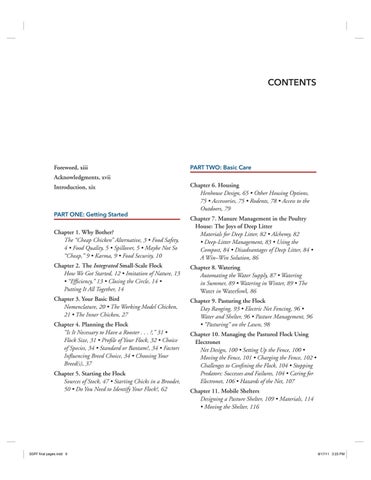
CONTENTS
Foreword, xiii
PART TWO: Basic Care
Acknowledgments, xvii Introduction, xix
PART ONE: Getting Started
Chapter 1. Why Bother?
Chapter 2. The Integrated Small-Scale Flock
Chapter 6. Housing
Chapter 7. Manure Management in the Poultry House: The Joys of Deep Litter
Chapter 8. Watering
Water in Waterfowl Chapter 3. Your Basic Bird
Chapter 9. Pasturing the Flock
Chapter 4. Planning the Flock Chapter 10. Managing the Pastured Flock Using Electronet
Chapter 5. Starting the Flock Chapter 11. Mobile Shelters
SSPF final pages.indd 9
8/17/11 2:23 PM
PART THREE: Working Partners
PART FIVE: Other Management Issues
Chapter 12. Putting the Flock to Work
Chapter 20. One Big Happy Family
Chapter 13. Chickens in the Garden
Chapter 21. Protecting the Flock from Predators
Chapter 14. A Question of Balance Chapter 22. Helping the Flock Stay Healthy
PART FOUR: Feeding the Small-Scale Flock
Chapter 15. Thoughts on Feeding
Gallus gallus domesticus Chapter 23. Managing the Winter Flock
Chapter 24. Other Domestic Fowl Chapter 16. Purchased Feeds
Chapter 17. Making Our Own Feeds
PART SIX: Breeding the Small-Scale Flock
Chapter 25. Breeding for Conservation and Breed Improvement Chapter 18. Feeding the Flock from Home Resources Chapter 26. Managing the Breeding Season
Chapter 19. Cultivating Recomposers for Poultry Feed
SSPF final pages.indd 10
Chapter 27. Working with Broody Hens
8/17/11 2:23 PM
PART SEVEN: Poultry for the Table
APPENDICES
Chapter 28. Butchering Poultry
Appendix A: Making Trap Nests, 331 Appendix B: Making a Dustbox, 337
Chapter 29. Poultry in the Kitchen
Appendix C: Making a Mobile A-Frame Shelter, 339 Appendix D: Duck Confit, Convenience Food Extraordinaire, 346 Appendix E: A Feed Formulation Spreadsheet, 350
Chapter 30. Serving Small Local Markets
Appendix F: Spreadsheets for Tracking Egg and Broiler Costs and Profits, 354 Appendix G: Natural Eggs and Industrial Eggs Compared, 357 Appendix H: Resources, 358 Glossary, 365
Epilogue: The Big Picture, 327
Endnotes, 370 Index, 383 About the Author, 395
SSPF final pages.indd 11
8/17/11 2:23 PM
Foreword “But can you feed the world?” This is by far the most common question I am asked everywhere I speak around the world. As much as the groundswell of locavores and biological farming advocates desire a localized and non-industrial food system, most still wonder if such systems can actually feed the world. After all, if this fundamental question cannot be answered positively, then we should all jump on the Monsanto bandwagon for the health and prosperity of our fellow man. Most people in our culture still believe the industrial Green Revolution and the advent of factory farming saved us from certain starvation. This is why most people think chemical-petroleum farming, transgenic modification, and concentrated mono-species production are wonderful and righteous food production methods—together with increased globalization and food miles, and ever-growing, ever-more-centralized, industrial-sized production and processing facilities to achieve assumed economies of scale. The endorsement stems directly from the assumption that such farming techniques are necessary to feed us all. Wading into this malaise of misperception is equivalent to venturing into enemy territory. Many people, and especially today’s experts, think that an alternative to these assumed food trajectories does not exist. Any suggestion that localized, compost-driven, carbon-sequestering, biological food production systems are a credible alternative is met with derision, laughed to scorn by credentialed experts who assume they know better. Those of us who espouse such thoughts are treated condescendingly with a puppy-dog pat to the head and told to trot back to our play-farms that don’t really count. Or we are accused of spreading a cult, a false hope, and jeopardizing real progress, like modern
Luddites. Or even criminalized with accusations that our pastured livestock and nonvaccinated, non-medicated animals threaten science-based feedlots and factory farms, thereby threatening the planet’s food supply. Well now, wait just a minute. Let’s zero in on just one monument to industrial food production: the factory chicken house. While your mind’s eye zooms in on that football-field-sized monolith containing twenty thousand chickens or more, realize what is not in the picture. First, the hundreds of acres of grain that are plowed, chemicalized, harvested, dried, and trucked to the house. It does not stand alone; it has a support land base spreading out from it that is enormous. And then consider the manure disposal. Not being near the grain-producing land that could benefit from the manure, this historically normal blessing becomes a modern-day curse. Indeed, the manure is fed to cattle, spread excessively on hundreds of acres of land nearby, dehydrated and pelletized for lawn fertilizers, and even converted to biodiesel, all processes that use an excess of energy and fossil fuels, and create more waste and pollution down the line. The point is that these amazing factory houses stand on the shoulders of countless acres, tax-subsidized disposal networks, corporate welfarism, and cheap fuel. If all these chickens were grown on pasture, however, fed locally produced grain, supplemented with bugs, worms, and kitchen scraps, dropping their manure out on the same fields that are their salad bar, they would nest into the local ecology on a lot less energy and be a blessing on all points without requiring one acre of additional land. And lest you think we are running out of land, consider that America has 35 million acres of lawn. And 36 million acres housing and growing feed for recreational horses. Last time I checked, 71 million acres is actually enough to almost feed every
American without any farms—and we haven’t even talked about golf courses. We send our young men and women to war around the world to ensure cheap energy to make fertilizer to grow more grass to mow with more petroleum to send carbonaceous grass clippings into landfills. This is insane. Why not fill our yards with food production, from vegetables to pasture to poultry? Looked at in this light, the local and biological food tsunami moving across America represents a credible alternative to industrial fare. I was ten years old, in 1967, when my first fifty as-hatched, heavy-breed-special chicks arrived in the mail. A cardboard-box brooder in the basement provided ample protection and housing for the chicks until they moved into our backyard. Although this first foray into poultry yielded thirty-two roosters and only eighteen hens, it was enough to start a fledgling egg enterprise. The cockerels provided an early immersion into the art of poultry processing, and the concomitant ecstasy of delectable dining on transparently grown fowl. This early love affair with poultry morphed into a serious pastured egg business during my teen years, providing me with spending money and entrepreneurial savvy. The poultry became a natural centerpiece of our pasture-based livestock farm in the early 1980s and remain so to this day. Both broilers and egg layers grace our pastures in portable structures, providing exceptional taste and nutritional integrity to thousands. But in my perfect world, I don’t think we should be growing all this poultry for sale. Except for perhaps the rabbit, I cannot think of another more compatible, more nutrient-dense food opportunity this close to a home. And rabbits don’t lay eggs—despite what you may have heard about the Easter bunny. In reality, if every single kitchen, both commercial and domestic, had enough laying hens attached to it to eat and recycle the
scraps and inedibles generated therein, the entire commercial egg industry would be obsolete. Who says we can’t feed the world? In a time when people fear for their food security, what is more secure— centralized egg factories inventorying and trucking millions of eggs a year to retailers 1,000 miles away, or millions of backyard and condominium-housed flocks generating eggs and meat a few feet away from the kitchen? Lest anyone recoil in horror that this would usher in a new age of poultry-induced disease and pathogens, I urge them to realize that we have many pieces of knowledge and infrastructure that did not exist from 1900 to 1950, when the early crowding and the industrialization of farming were instituted, without the necessary protocols or infrastructure. In those times we didn’t even have electricity, much less lightweight and portable predator-proof electrified poultry netting to permit easy movement and control. We didn’t have refrigeration, stainless steel, or on-demand hot water. And we didn’t understand a lot of principles surrounding hygiene and sanitation. We didn’t have shredders for generating cheap carbonaceous “diaper bedding,” or simple extruded steel arches and fifteen-yearstabilized laminated plastic for building warm winter hoophouses. Utilizing all of this technological infrastructure and knowledge, Harvey Ussery has spent a lifetime developing and showcasing a truly viable home-scale poultry model that is ultimately carbon-sequestering, hygienic, neighbor-friendly, and food-secure. The answer to the abuses, both animal and environmental, in the factory poultry industry will not come from railing against governmental regulations. Instead, it is for thousands and even millions of people around the globe to catch Harvey’s vision and bring to their own lives, in their own living space, the joys of poultry.
Unlike larger livestock like cows or sheep or llamas, chickens require only lightweight infrastructure. They can get your children off the TV and video games because their real-life antics will entertain far better than Hollywood. Bringing food responsibility and relationship to your doorstep can have profound character-building and spiritual consequences. Viscerally participating in the dance of death and regeneration, the sacrifice required to give life sustenance, can bring awe and reverence to the family that will yield a new generation of sensible leaders. Perhaps the thing I appreciate most about this book is Harvey’s gift, both to the home-scale poultry enthusiast and the small-scale producer like myself, of an incredibly practical, can-do attitude. These are not pets, although every flock has its individuals who endear themselves to the flockster in one way or another. But rather, this book is about a call to heritage, to the wisest of wise traditions in food security and relationships. Today’s modern tools and knowledge revolutionize negative associations with poultry—the dirty, dusty drudgery of yesteryear—and Harvey brings the latest tools and practices within the grasp of any aspiring flockster. It is this functional spirit that will make this book a classic in the small-scale poultry rearing genre. I know you’ll find it as insightful and helpful as I did. Joel Salatin Polyface Farm, Swoope, Virginia December 2010
2 | THE INTEGRATED SMALL-SCALE FLOCK
The poultry husbandry suggested in this book is based on allowing the flock to live as closely as possible to the way Ms. Natural Chicken would live on her own in the wild. And on the observation that, if we do so, the birds in return can help us improve the homestead or farm and make it more productive. One reason those ideas sound so good to me now is because that’s not exactly how we started out.
How We Got Started Ellen and I met in a Zen monastery (bet you weren’t expecting that one!). True love blossomed when we discovered we shared a passion for—compost. After we married and lived for a couple of years far too close to Washington, DC, we followed the call of the compost westward and ended up in a two-hundred-year-old house on 3 acres in a crossroads rural village in northern Virginia—we called our new home “Boxwood” after the prominent border of mature boxwood out front. Though, as said, compost was foremost in our minds, my daughter Heather, who was living with us at the time, was thinking Chickens. We approved her project and, not long after our move (in the spring of 1984), we ordered twenty-five New Hampshire chicks through the mail. (Later that summer we ordered a mixed batch of bantams as well. Even at that early date, we were enamored with the idea of breeding our own chickens naturally, and we had read that bantams make great mothers. See chapter 4 for more about bantams.)
SSPF final pages.indd 12
We brooded the chicks in a cardboard appliance carton and at four weeks moved them to a small shed that was on our place when we moved in. Though we lost most of that first group to a weasel and had to start over, it was not long before we had a busy flock in a wire run off the coop. After supper we would take dessert out on the grass by the run, enjoying the show. Our neighbors probably thought us peculiar— but we found the chooks a lot better ’n television. And not so long after that we had the thrill of every beginning flockster: our first egg. But I was troubled by our project. Within two weeks of being allowed onto the grass in their wireenclosed run, our scampering young chooks had voraciously eaten every last blade of grass. They didn’t look quite so pretty against a patch of bare dirt festering with chicken poops—nor did they seem happy with the change. Each time I threw in a cricket, or grubs from the garden, or lettuce and cabbage trimmings, their obvious hunger for these foods made the dry stuff from the feed bag look ever more lifeless in comparison. Memories of my grandmother’s flock, which she allowed to range freely over a 100-acre farm in the North Carolina piedmont, made my chicken run seem more and more a prison—or more accurately, a concentration camp. Then Ellen told me she’d heard about a farmer in the Shenandoah Valley named Joel Salatin who was raising his chickens on pasture—growing meat birds in movable pens, following beef cattle with laying chickens eating fly maggots out of the cowpies.
8/17/11 2:23 PM
T H E I N T E G R AT E D S M A L L- S C A L E F LO C K
Knowing that somebody was managing to “do chickens” somewhat as Granny had once done excited me—and crazy stuff like chickens eating out of cow poops appealed to the kid in me. I had to give this guy a call! I did so, clueless how much I was imposing on the time of a busy farmer and prolific writer, but Joel was both gracious and encouraging. He urged me to explore options for the Great Liberation—the exodus of the flock out of the dead-zone chicken run. He was pleased with my obvious enthusiasm for giving my birds a more natural life on grass. “There aren’t many of us out there,” he said, “but we know there’s a better way.” I built a 10-by-12-foot Polyface-style mobile pen (Polyface being the name of Joel’s farm) and began raising batches of broilers on our acre or so of pasture. Dinner guests remarked in astonishment, “Man, chicken was never like this!” Before long I discovered electric net fencing; its use allowed me to do what Granny did with her free-ranging flock, but within the limits imposed by close neighbors on either side. Poultry husbandry ever since has been, for me, about giving the flock the most natural, happiest lives possible; and discovering all they can give as partners in return. Some key ideas have guided our progress.
Imitation of Nature The great mistake of modern agriculture is assuming we can control the processes of growth and yield, and that problems or needs that arise can be dealt with using one-for-one solutions—most likely needing to be purchased. Preventing disease in flocks? Antibiotics. Soil fertility? Easily applied supercharger chemical salts. Crop-damaging insects? Blast those guys with pesticides. Runoff pollution? Not my department. We have lost the intuitive understanding that natural systems are highly diverse and interconnected, one species supporting others and benefiting from them in return; and therefore the practice of agriculture must see “the whole problem of health in soil, plant,
SSPF final pages.indd 13
13
animal, and man as one great subject.”1 The key to success with the homestead flock is a return to that vision. The setting for the flock is not our backyard, but its total ecology—another way of saying that, if Gallus gallus domesticus evolved to a state of nearperfect health ranging the landscape and eating live, self-foraged foods, the key to success is a life as open and unconfined as our situation allows, with access to as wide an array of natural feeds as possible. Imitation of nature means most of all fitting flock husbandry into the great cycles of reproduction and growth, death, decay, and renewal—in which nothing is squandered; no spillover from one sphere of activity poisons the whole; the vigorous pushing of a species’ own agenda places necessary limits on the excesses of others; and the potential of the underlying foundation, the soil, to support ever more robust, abundant life increases with each round of growth and death.
“Efficiency” Modern agriculture is said to be more efficient, as proved by the immense quantities of dressed broilers and eggs produced in its factories. But it’s a peculiar notion of efficiency that touts production of 1 calorie of food energy for 10 calories of energy input—in contrast with a model in which much of the energy to produce eggs and dressed poultry comes directly from the nearest star. And a system that produces $1.29-per-pound chicken while polluting waterways is hardly a model for efficiently providing for human needs. Biological efficiency offers itself anytime we’re inclined to make use of it. Getting in one operation free fertilization of the garden, control of slugs, tillage of weeds, waste management control, with a dozen eggs thrown in as a bonus—what could be more efficient than that! The key is to avoid sticking the flock in some isolated corner all to themselves, and to make them happy by giving them good work to do.
8/17/11 2:23 PM
P O U LT R Y I N T H E K I T C H E N
303
Broth Is Beautiful Recipe contributed by Ellen Ussery The best use for old hens declining in productivity is the making of broth. Chicken broth is not only a delicious base upon which to build a flavorful soup or sauce— it is an extremely nourishing food in its own right. Properly prepared, it is an excellent source of minerals, including calcium, magnesium, and potassium. It is rich in gelatin, an extraordinary digestive aid that, although not a complete protein, helps the body more fully utilize protein from other foods—in effect, you do not need to eat as much protein. And modern research has confirmed traditional wisdom: Chicken broth does indeed help prevent and moderate colds and flu. What follows is not so much a recipe as some guidelines about how I make chicken broth now, based on my own experimentation and requirements. I will also tell you how I used to make it, and why I made the changes. Once you understand the possibilities, experiment with your own chickens in the context of your own lifestyle—if you can find a method that fits comfortably into your schedule, you will be more likely to make it on a regular basis. But let me say up front that it is almost impossible to make a failed chicken broth. Once I added too much water relative to the amount of chicken parts I was using. But even this was still usable as a soup base. I just had to add more flavoring ingredients to the final soup. Of course, the quality of your chickens is of primary importance—if you raise them yourself, you are off to the best possible start. When slaughtering your chickens, be sure to clean and save the feet, which contribute a lot of collagen, the source
of that all-important gelatin—a component as well of the bones, muscles, skin, and tendons. If you don’t save them for your dog to eat raw, you can use other spare parts as well—necks, hearts, gizzards, even the heads. If you cut chickens into serving pieces and do not want to eat the backs, reserve them as well for making broth. In addition, the carcasses of cooked birds (from a roast chicken, for example) can be saved. I hold all these ingredients in the freezer wrapped tightly in plastic until ready to make broth. I usually start with a whole stewing hen, the older the better—an older hen has more collagen and more flavor. I surround it in the pot with as many of the other parts as I have on hand, then cover—just barely—with water. Occasionally I use mostly feet, along with recycled bones of previously cooked birds. But in either case I use a pruning shears to cut open all the long bones, as the enhanced extraction makes a good gel. I then add 2 tablespoons of vinegar (or lemon juice) per gallon of water and let sit for an hour. This soak in the acidulated water helps to extract the minerals. I then bring it to a boil and skim off the scum that rises to the surface. After that I reduce the heat for the gentlest possible simmer, and cook until a poke with a fork indicates that the meat will easily come off the bone. The length of time this takes will vary, depending on the age of your chicken. The older, more flavorful chickens may take six to ten hours or more, whereas a young bird might be ready in an hour or two. At this point I take out the stewing hen, or whatever fresh chicken parts I started with, let them cool slightly, and remove the meat, which I reserve for later use. Note that Continued on following page
SSPF final pages.indd 303
8/17/11 2:25 PM
304
P O U LT R Y F O R T H E TA B L E
Continued from previous page
you need to be careful that no tiny bones stay with the meat. At this point I should say that I used to cook the broth in a huge stockpot. But recently I have been using a 2-gallon slow cooker. This way I have no worries about the flame going out on my gas stove during the long cooking. Other benefits are the slow cooker’s timer and easier meal preparation when I don’t have to contend with a crowded stovetop. If you have a woodstove, that’s another great option. After you have removed the meat from the bones, put them and the skin back into the pot. I used to then simmer the broth another fifteen to twenty hours. However, the firmness of the gelatin, once the broth was fully chilled, varied considerably. Recently I have come to understand that, once gelatin is extracted, too much additional cooking will break it down; so what I do now is just let everything sit in the pot until the next day for a period of passive extraction. Then I bring it to a boil and simmer it for about an hour just to make sure it is sterilized. To be honest, I am not sure that this passive method actually does extract more minerals, nor do I know that overcooked (broken-down) gelatin is less valuable, nutritionally, than when more firmly gelled. I hope that someday these questions will be experimentally tested in a lab. In the meantime I am happy to speculate and take my clues from traditional wisdom.
Stock Parts Feet, heads, necks, and skin from around the necks can be saved for the stockpot. Dry thoroughly, and freeze in appropriate-sized packages. If you cut up a carcass, the bonier parts such as the back can also be reserved for the stockpot. In addition, we always
SSPF final pages.indd 304
Some broth makers are not comfortable with letting the pot sit out at room temperature and therefore put it in the fridge for the passive extraction. Others go through several more cycles of cooking and resting that can last for three days, and still others just stop completely at this point. Frankly, I would err on the side of caution with a bird that I did not know with certainty to be raised with the highest standards and butchered with utmost care. Whenever you decide to stop cooking, strain out the solids, cool, and refrigerate the broth. I usually put mine into half-gallon canning jars. After a day in the fridge I have a solid gel and a layer of fat on the top. The fat seals the broth and protects it from spoilage, so it is always ready in the fridge. We usually consume broth within the week, but I have kept it this way for six weeks. If you like, you can always freeze it. I noticed when I started using my passive method that the fat smelled and tasted fresher. When I cooked it for twenty-four hours I used to throw the fat out after I “unsealed” the broth—it did not pass the smell test. Now I’m quite comfortable using it as a cooking fat when I have run out of my precious duck and goose fats. If you are not getting a firm gel, consider the age of the birds you’re using—experiment with shorter cooking times for younger birds and longer times for older ones. The breed of the bird and feeding may also come into play here. There
freeze the bony carcasses from roasted fowl until ready to make stock. Giblets If you’ve never liked chicken livers, this is your chance to appreciate real livers, not the dull yellow-brown,
8/17/11 2:25 PM
P O U LT R Y I N T H E K I T C H E N
are no hard-and-fast rules for the exact amount of time to cook the perfect broth. You may have noticed that there is nothing but chicken in this broth. Keeping the initial broth simple gives me total flexibility later. You could, however, add salt and some aromatic vegetables for flavor—carrot, onion, parsley, celery—and some seaweed for more minerals. Use of the reserved meat depends on how much flavor has been removed. Add it to soup along with rice, pasta, or potatoes and/or carrots plus some green vegetables for a one-dish meal. Make potted chicken by putting it in the food processor along with some seasonings and one-half to three-quarters of its weight in rendered poultry fat or softened butter. This will keep in the fridge for two weeks in a glass jar topped with a good layer of fat. If most of the flavor has been extracted, you could feed it to the dog or back to the chickens. We often start a meal with a cup of broth. Many times I just heat it up and stir in some flavorful miso, such as the red pepper and garlic miso from South River Miso Company. Otherwise I add salt and drink as is, or simmer with any of the following: a pressed or minced garlic clove and chopped parsley, trimmed shiitake mushroom stems that I have frozen, shredded spinach, or coconut cream concentrate and fresh ginger. The possibilities are endless.
tired-looking livers your mother may have bought at the supermarket. Livers from your younger poultry should be dark red, plump, and glistening. Cook them as a first-day treat, and freeze extra livers in small packets for later use. For a fancy hors d’oeuvre, try Bridget’s Chicken Liver Pâté.
SSPF final pages.indd 305
305
Fig. 29.1 Cutting up ducks provides breast fillets for gourmet meals, bits and pieces for a variety of interesting dishes, plus additions to the stockpot.
The hearts and gizzards can be sautéed and added to soups, sauces, or stir-fries. Or they can be added to the stock parts. Processing the gizzard is complicated by its structure—a mass of lean muscle around an inner pouch with a tough lining, containing bits of stone the bird uses to grind its food. You can cut through the muscle just to the pouch lining, then peel the muscle back with your fingers to free it from the pouch, leaving a butterfly-shaped cleaned gizzard. It can be tricky peeling off the muscle without rupturing the pouch—sometimes it helps to chill the gizzards a little before peeling them. Another option is to place the gizzard on a cutting board and slice off bite-sized
8/17/11 2:25 PM