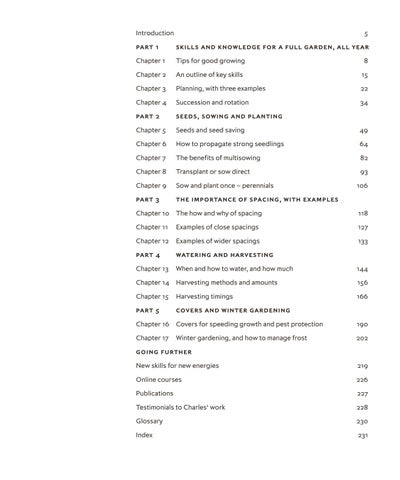
Introduction
5
part 1
skills and knowledge for a full garden, all year
Chapter 1
Tips for good growing
8
Chapter 2
An outline of key skills
15
Chapter 3
Planning, with three examples
22
Chapter 4
Succession and rotation
34
part 2
seeds, sowing and planting
Chapter 5
Seeds and seed saving
49
Chapter 6
How to propagate strong seedlings
64
Chapter 7
The benefits of multisowing
82
Chapter 8
Transplant or sow direct
93
Chapter 9
Sow and plant once – perennials
part 3
the importance of spacing, with examples
106
Chapter 10 The how and why of spacing
118
Chapter 11
Examples of close spacings
127
Chapter 12
Examples of wider spacings
133
part 4
watering and harvesting
Chapter 13
When and how to water, and how much
144
Chapter 14 Harvesting methods and amounts
156
Chapter 15
Harvesting timings
166
part 5
covers and winter gardening
Chapter 16 Covers for speeding growth and pest protection
190
Chapter 17
202
Winter gardening, and how to manage frost
going further New skills for new energies
219
Online courses
226
Publications
227
Testimonials to Charles’ work
228
Glossary
230
Index
231
Part 1
Skills and knowledge for a full garden, all year
Chapter 1
Tips for good growing
Gardening is easier than it is often made out to be, and here I describe three facets of growing healthy plants for less effort. 1 what you need to be able to do
Being skilful is important and saves you time. The information given in this book makes learning easier because it gives only the essential knowledge, in plain language. I want you to actually understand what you are doing, not just perform tasks because I say so.
Eat the rainbow – December harvests include many summer sowings that have maintained cropping
8
Chapter 5
Seeds and seed saving
seed choices It’s incredible to reflect on how much knowledge and growth power is contained in seeds. This chapter explains how you can unlock this potential, both by finding better seeds to buy and by saving seeds yourself. Homesaved seeds have qualities adapted to your soil and conditions, attributes that you can’t find in other seeds. Sourcing seeds As with many things in our fast-changing world, this is less straightforward than it used to be. Since the first Covid lockdowns, seed companies have been meeting unprecedented demand, both from new gardeners and from an expansion of vegetable growing at home. This has even caused many of them to ration their opening hours and restrict purchases. In the UK, the issue is also complicated by Brexit, which is causing a reduction of the imports of seeds. The situation is too fluid for me to recommend suppliers, but I shall mention two in the UK: Real Seeds and the Seed Co-op. The latter are based in an 8 hectare / 20 acre greenhouse in Lincolnshire, where they grow as many seeds as they can. They also import Bingenheimer seeds from Germany and, if you are in Europe, this is a company that I recommend, along with Sativa Seeds.
The ‘Seeds and Varieties’ page of my website, under the ‘Learn’ tab, has more advice on suppliers. Left Shelling seed of broad beans, after I had walked on the crisp pods Below All of these plants were grown from seed of the same packet – Palla Rossa chicory
Choosing seed – this is celeriac of two varieties, Giant Prague on the left and Ibis on the right; the former made a lot of leaves and smaller bulbs
49
skills for growing
Choosing suitable seeds You need to read the small print on seed packets to discover things like harvest time, above all. Broccoli is a good example of this, because the word broccoli covers a multitude of possible results – harvests may occur any time from three to ten months after sowing. Some types, like the later varieties of purple sprouting broccoli, will grow large in autumn and then survive through winter before making their heads. Others are bred to flower before winter, from the same sowing date. Sometimes there are surprises, and you are not to blame: seed is rarely uniform, except for F1 hybrids (see facing page). Age of seeds The photos below show how much difference it makes, whether seed is old or young. It’s not only whether germination happens, but how fast it happens, and whether growth is stronger or weaker. At least with homesaved seed, you know its age.
Homesaved Grenoble Red lettuce seed of different ages – one, two and three years old, with the youngest at the top
The effect of seed age on germination – one-year-old seed is behind and three-year-old seed is in front
I have had many experiences of poor growth from newly bought seed. The problem is that the information given is not about seed age, but when it was packeted! Furthermore, what a seed company calls germination is not necessarily the same as an acceptable level of vigour in plant growth. All of which is extremely poor, because we then waste time, space and resources trying to get old seeds growing, and potentially do not harvest a crop because of losing the early growth time. At least with propagation under cover, you are not suffering big empty spaces in beds, compared to the small spaces of seed and module trays.
50
Chapter 6
How to propagate strong seedlings
The skills you need are not difficult to achieve or complex to understand. I want your success rate to be high, because a lot of good things flow from having strong, healthy seedlings and plants, at their most favourable time. equipment I don’t like ‘stuff’, but some purchases or use of recycled materials will result in better plants. Module trays are a key part of successful propagation. A lack of suitably sized trays, both easy to use and reusable, led me to design a new 60 cell module tray in 2020, the ‘CD60’. We have since split this into half and quarter size trays, with 30 and 15 cells respectively (all available from www.containerwise.co.uk). The tray has smaller cells which need less compost. The cells have smooth sides and a large hole in the bottom of each – this gives good drainage, and allows you to push up the rootball of each plant without damaging roots.
g After each planting, you can reuse the trays without any washing or cleaning, as with all propagation trays. Simply refill them, and resow or prick out again.
g The trays are made of plastic; however, they are so strong that you can reuse them for decades.
From top Lettuce in a CD60 module tray, five weeks since sowing and no feed given; they need to go into the ground now Peas for shoots from a CD60 – four weeks since sowing and ready to transplant Strong growth of radish, multisown 17 days earlier in a CD60 64
part 2 – chapter 6
You can also make your own pots from loo rolls and egg boxes, but these take more space and compost, and require more time than plastic trays. Try a few materials to see which you are most comfortable with. The most important thing is good drainage – nothing grows in soggy compost. choosing the right compost The key qualities you need are:
g Good drainage in limited volumes such as modules, which many proprietary composts do offer.
g Good moisture retention. g A high level of nutrients in proportion to the volume of compost. This is way more important than for composts you spread on soil, which are more about biological stimulation.
I find that my homemade compost does not drain as well as most proprietary composts, and is lower in nutrients. Hence I am happy to buy potting compost, and to use my own on beds. Finding a good compost to buy is not always easy, and the quality of some brands varies year on year. I am therefore reluctant to suggest any one name wholeheartedly, but make these general observations to help you choose:
g Organic composts, with a symbol of approval / certification, are my first port of
call, and most of them grow great plants but are expensive to buy. Worth the price in my experience, for avoidance of poisons and to support organic practice.
g Beware of the description ‘organic’ without any symbol of approval, in which case ‘organic’ means absolutely nothing! Actually it suggests that the compost is not to be trusted, because of the misleading use of that word.
g I find that potting compost is good to use even after 18 months, making it more
worthwhile to buy a pallet (far cheaper) and share it among friends. Mail any company to enquire about prices; a pallet is usually just under a tonne, or perhaps 2000 litres / 440 gallons, in their proprietary sacks.
You can mix your own potting substrate based on homemade compost: 1 Put the compost through a 12 mm / 0.5 in sieve – this only works when the
compost is reasonably dry. 2a Add a quarter to a third by volume of vermiculite or perlite, to hold air and
improve drainage. 2b At the same time, improve the nutrient status with any of wood ash,
vermicompost, volcanic rock dust, or seaweed of any kind, including seaweed meal. Avoid too much undecomposed wood, which grabs nitrogen for its own decomposition and then stunts growth of seedlings. This can be a problem with many wood-based, peat-free composts – growth is slow and leaves are pale green, even yellow.
65
skills for growing
multisowing guide
multisowing guide
g The numbers shown are for medium-sized plants and a high yield.
Vegetable
Seeds per clump
Desired plants per clump
Spacings (cm)
g The desired number of plants
Basil
3–4
1–3
20–30
Beetroot
4
3–5
30–35
Chard to cook or for salad
3
1–2 for cooking, 3–4 for salad
20–30
Chervil, coriander, dill, parsley
3
1–2
22
Fennel – Florence
3
1–2
25–30
Kale for salad
4
3
22
Kale for larger leaves to cook
2–3
1
30–35
Leek
5–6
2–4
25–30
Onion for bulbs
6–7
4–5
30
Onion for salad
8–10
6–10
25
Oriental vegetables for leaves to cook
2
1
25–30
Oriental vegetables for salad
4
3
22
Peas for pods
2–3
1–3
15 x 750*
Peas for shoots
4–5
3–5
22
Radish
5
4–5
15
Rocket – salad and wild
3–4
2–3
22
Spinach for salad
4
3–4
22
Spinach for leaves to cook
2–3
25
1
Turnip
5
3–4
30
in a clump is your choice, according to the size of plant you wish for, and how you like to harvest the leaves.
g The first column shows my
suggestions for how many seeds to sow per module. These numbers are higher than those in the same row’s second column, to allow for some seeds not germinating. Also, some grow weakly and are best removed.
g The second column shows
how many plants per clump can grow to a worthwhile and harvestable size, in my experience. Beetroot and chard are exceptions because their seeds are in clusters, often germinating more than one seedling.
g The spacings shown in the
third column are absolutely not fixed and are just suggestions, based on having ‘average’-sized harvests. Feel free to try slightly closer or slightly wider spacings.
* The first number is space between transplants. The second number is space between each row, which is the necessary layout in order for you to provide support for pea plants. 92
Chapter 8
Transplant or sow direct
Transplanting is about setting rooted plants in the ground. I describe my special methods – how to do it quickly, and successfully. I compare this process with sowing direct. It’s quicker to put 100 seeds in the ground, compared to 100 plants. However, growth starts later and takes longer, and there is often more pest damage, resulting in later harvests and empty spaces. I therefore recommend raising plants for the majority of vegetables. transplanting Method When demonstrating how I transplant module-grown plants during courses at Homeacres, participants’ reactions are often, ‘Wow, that was quick!’, and, ‘You don’t fill in the holes!’ Transplanting can be simple and rapid when your soil is healthy – soft, yet firm – and plants are set in reasonably deep. Having a decent dibber helps – you can make one from an old tool handle. A long-handled dibber enables you to draw straight planting lines along beds, with a better view of the planting pattern and spacing while dibbing holes (see Chapter 10).
From top Before dibbing holes, I use the dibber to mark my rows, in particular along bed edges – straight lines ensure equidistant spacing and make jobs easier, such as watering and covering A planting of Filderkraut cabbage in mid-June, after broad beans had finished and we had cleared their plants A close-up of celery and beetroot, transplanted a week earlier and well buried; this is July and it was very dry – deep planting gives stability and holds moisture 93