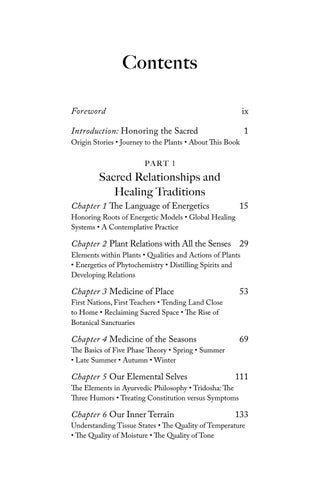
Contents Foreword
ix
Introduction: Honoring the Sacred
1
Origin Stories • Journey to the Plants • About This Book PA R T 1
Sacred Relationships and Healing Traditions Chapter 1 The Language of Energetics
Honoring Roots of Energetic Models • Global Healing Systems • A Contemplative Practice
15
Chapter 2 Plant Relations with All the Senses 29 Elements within Plants • Qualities and Actions of Plants • Energetics of Phytochemistry • Distilling Spirits and Developing Relations
Chapter 3 Medicine of Place
53
Chapter 4 Medicine of the Seasons
69
First Nations, First Teachers • Tending Land Close to Home • Reclaiming Sacred Space • The Rise of Botanical Sanctuaries The Basics of Five Phase Theory • Spring • Summer • Late Summer • Autumn • Winter
Chapter 5 Our Elemental Selves
111
Chapter 6 Our Inner Terrain
133
The Elements in Ayurvedic Philosophy • Tridosha: The Three Humors • Treating Constitution versus Symptoms
Understanding Tissue States • The Quality of Temperature • The Quality of Moisture • The Quality of Tone
EnergeticHerbalism_finalpages.indd 7
9/29/21 2:16 PM
PA R T 2
The Apothecary Chapter 7 The Wheel of the Year
175
Chapter 8 Kitchen Apothecary Practices
183
Chapter 9 The Plants: Materia Medica
217
Epilogue
313
Samhain • Yule/Midwinter/Winter Solstice • Imbolc/ Candlemas • Ostara/Spring Equinox • Bealtaine/ May Day • Litha/Midsummer/Summer Solstice • Lughnasadh/Lammas • Mabon/Autumn Equinox
Kitchen Herbs • Harvesting and Drying Herbs • Water Extractions: Teas, Infusions, Syrups • Alcohol Extractions: Tinctures • Glycerin Extracts • Vinegar Extracts • Oxymel • Powders • Capsules • Standardized Extracts • External Applications Seeing with the Energetic Lens • Agrimony • Ashwagandha • Blue Vervain • Burdock • Calendula • Chickweed • Dandelion • Echinacea • Elder • Goldenrod • Goldenseal • Hawthorn • Lobelia • Marshmallow • Milk Thistle • Motherwort • Mullein • Nettle • Plantain • Prickly Ash • Self-heal • Skullcap • St. John’s Wort • Violet • Yarrow
Acknowledgments
315
Appendix 2: Herbal Actions Glossary
319
Appendix 1: At-Risk Assessment Tool Scoring Sheet 317 Resources
327
Notes
337
Recommended Reading Index
EnergeticHerbalism_finalpages.indd 8
331
349
9/29/21 2:16 PM
EnergeticHerbalism_finalpages.indd 12
9/29/21 2:16 PM
INTRODUCTION
Honoring the Sacred
I
n the late 1980s, I had the honor and pleasure of living with the Shenandoah National Park as my neighbor. I would often end my day with a hike into the mountains to deepen my relationship with the medicinal plants I was learning about. One hot July day, I was particularly excited to head into the woods as I knew the white plume flowers of black cohosh would be in full glory. As I rounded a bend in the trail, I caught sight of the cohosh I had been visiting on my walks. Then, quite unexpectedly, energy leapt from the plant and penetrated my being. I stood there, breathless and in shock. As I gasped for air, I concentrated on calming myself. I began to realize that breath was flowing between this plant and myself. This has been described as “aisthesis—an exchange of soul essence accompanied by a gasp of recognition.”1 My breath was literally taken away—but then returned only to be accompanied by a multitude of sensations that culminated in a wash of profound peace. I could taste the sweet soil that held minerals and biota, life itself. I could smell the sophisticated yet fetid perfume of the cohosh’s flowers. All my senses were heightened as I received an invitation to enter a sacred union. I slowly knelt, weeping in disbelief and awe, knowing that this black cohosh had communed with my being in a way that would change my life forever. My experience with black cohosh was magical, cosmic, and spiritual, but the most vivid quality of the encounter was an exchange of information that I sensed rather than thought. Through my sense of smell, cohosh informed me who pollinates her blossoms. Through my taste buds, I learned what soil conditions are needed to nourish the plant’s medicine. Through my heart, I was moved to understand that this plant would be a significant ally.
EnergeticHerbalism_finalpages.indd 1
9/29/21 2:16 PM
76
Energetic Herbalism
Table 4.1. The Elements and Their Qualities Quality
Wood
Fire
Earth
Metal
Water
Season
Spring
Summer
Late Summer
Autumn
Winter
Liver
Heart and Pericardium
Spleen
Lung
Kidney
Small Intestine and Triple Heater
Stomach
Large Intestine
Bladder
Joy/Over excitement
Sympathy/ Worry
Grief
Fear
Flesh and Muscles
Skin and Body Hair
Bones and Bone Marrow
Yin Organ
Yang Organ Gall Bladder Emotions Tissues
Anger
Muscle, Tendons, and Blood Vessels Ligaments Sour
Bitter
Sweet
Pungent, Spicy
Salty
Time of Day
11 p.m. –3 a.m.
11 a.m.–3 p.m.; 7 p.m.–11 p.m.
7 a.m. –11 a.m.
3 a.m. –7 a.m.
3 p.m. –7 p.m.
Color
Green
Red
Yellow
White
Blue/Black
Climate
Wind
Heat
Dampness
Dryness
Cold
Sound
Shouting
Laughing
Singing
Weeping
Groaning
Sense Organ
Eyes
Tongue
Mouth and Lips
Nose
Ears
Taste
opposite (twelve hours later or earlier) is at its weakest. For example, twelve hours from Liver time is Small Intestine time. Thus, we can understand the detriment of late-night meals or snacking, because the function of the small intestine is at its weakest in the hours just after midnight. This clock is simply a tool to observe patterns and understand our nature in relation to our natural cycles through day and night. The other correspondences will be described with each element.
Spring At the spring equinox, there is an awakening from the depth of winter’s sleep. Usually this season is described as the gentle unfurling of leaves. At
EnergeticHerbalism_finalpages.indd 76
9/29/21 2:16 PM
EnergeticHerbalism_finalpages.indd 28
9/29/21 2:16 PM
CHAPTER 2
Plant Relations with All the Senses
O
ur ancestors experienced the plants through their senses and their dreams, and above all, they listened. Imagine the soundscape that blessed the Earth ten thousand years ago. Amid the cacophony of woodland or jungle sounds, the medicine songs were just coming into being. The composers were Spirit (of many names), Nature, and the new player, humans. Through creation songs and stories, people learned who their relations were and how the mountains, rivers, stones, and forces of weather were part of their family. The same, of course, happened with the plants. Experiencing plants as kin is inherent to Indigenous cultures all over the world, from Celts in Ireland to the Quechua in Peru to the Taino people of Puerto Rico. Today we speak of plants as allies, partners to work with in creating optimal health. I credit the plants as teachers even more than as partners, because their healing abilities are like none I have witnessed before. Think of the spirit of motherwort (Leonurus cardiaca), which had such an immediate effect on my client Maria (see chapter 1). Yes, Leonurus has many beneficial qualities (cooling, relaxing), but the immediacy of the effect was through the spirit of motherwort’s connection to Maria. Through my own relationship with this herb, I have come to feel that the spirit of motherwort is one of unconditional support. This is what enabled Maria to drop so quickly into herself and feel safe enough to allow tears to well up. The energy of motherwort created a pattern in Maria that allowed her to make necessary changes to become more herself.
EnergeticHerbalism_finalpages.indd 29
9/29/21 2:16 PM
Medicine of the Seasons
77
1 A.M. 3 A.M.
11 P.M.
GALLBLADDER
LIVER
TRIPLE HEATER
9 P.M.
LUNG
5 A.M.
LARGE INTESTINE
PERICARDIUM
7 A.M.
7 P.M.
KIDNEY
5 P.M.
STOMACH
BLADDER
SPLEEN
SMALL INTESTINE 3 P.M.
9 A.M.
HEART 11 A.M.
1 P.M.
Figure 4.4. The Chinese body clock.
the same time, this season has a power that is commanded by life as it surges to the surface, breaking through the dormancy and cold of winter. The uprising energy of spring is the indomitable spirit of regeneration that renews life. Emerging from the dreamtime of winter’s hibernation, the quickening of blood and the flowing of juices ignites our vision. Spring is the season to move forward, have plans, create new designs, and make clear decisions. The seeds we plant now are not only in our gardens but in the life we wish to cultivate. The Nei Ching states: “The three months of spring are the period of commencement; Heaven and Earth are born, and all living things are flourishing. Get up early in the morning, walk around in the courtyard, loosen your hair and relax your body. By doing so you will generate mental strength and act in harmony with the qi of spring, thus following the way of nourishing life.”4
EnergeticHerbalism_finalpages.indd 77
9/29/21 2:16 PM