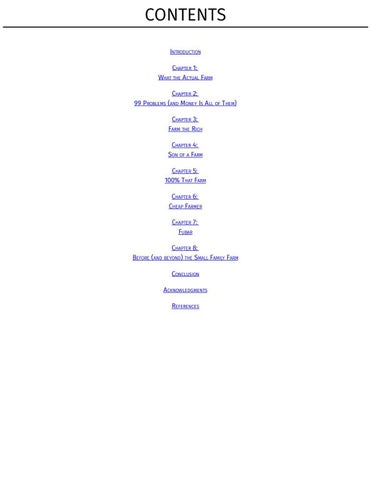
CONTENTS INTRODUCTION CHAPTER 1: WHAT THE ACTUAL FARM CHAPTER 2: 99 PROBLEMS (AND MONEY IS ALL OF THEM) CHAPTER 3: FARM THE RICH CHAPTER 4: SON OF A FARM CHAPTER 5: 100% THAT FARM CHAPTER 6: CHEAP FARMER CHAPTER 7: FUBAR CHAPTER 8: BEFORE (AND BEYOND) THE SMALL FAMILY FARM CONCLUSION ACKNOWLEDGMENTS REFERENCES
INTRODUCTION Standing at the counter with Hannah, we watched a couple and their two small children wander into the shop. “Anything I can help you with?” Hannah asked, as the adults looked around. Two bluetopped bottles were peeking out of the brown bag swinging at the woman’s side. “We’re, uh, just looking,” the woman said. The shop was only about ten by twenty feet inside, and was empty but for the counter, a glass-fronted refrigerator, and three white deep freezers. She pried open the nearest one. “It’s all one hundred percent pasture-raised, heritage breed cattle, lamb, and pork, raised organically less than a mile from here,” Hannah began, launching into her elevator pitch. The woman nodded vaguely as she listens to how the meat was processed and what cuts are available. She smiled with murmured thanks as Hannah ended with, “Let me know if I can recommend something.” The woman reached into the freezer and pulled out a package of paper-wrapped meat, turning to her husband. “Eight dollars a pound for ground beef, can you believe that?” she said in a carrying whisper. She let the meat clatter back into the freezer and closed the lid with a careless thud. “Well, thanks,” she said, too loudly to be kind, and ushered her family out of the shop. As they retreated, Hannah deflated, her shoulder slumping. “You see what I mean?” she said. “It’s hard not to be a little grumpy.” I was at Hannah’s farm-to-table artisanal meats shop about sixty miles from Washington, DC. For a small town, the weekend social scene is lively with urbanites escaping nearby metro areas in search of misty mountain hikes and rustic, wholesome food, and culture experiences. The parking lot beyond the farm store is bustling. A few people came to purchase meat or eggs while I was there, but not many. “You saw those bottles in their bag?” Hannah continued, venting, “They’re from the distillery next door. Those bottles run $100 each. But eight dollars a pound is too much for local, delicious, responsible meat? It’s hard to deal with that on the weekends when you’ve already spent the whole week caring for livestock and running a business.” It feels impossible, almost hopeless, she said, when she knows people are comparing her prices to Whole Foods or Walmart. Banner sales days were few at the store, but for Hannah it was still preferable to the farmers market circuit. That alternative would involve trucking frozen meats to the Washington, DC area in the wee hours of the morning, spending the day in the sweltering heat, and toting most of it back, all for a few hundred dollars’ worth of sales on a good day. “We also tried CSAs [Community Supported Agriculture] and meat drops, but it wasn’t worth it with the amount of effort it took to get people involved. We started with one spot in
the city for pick up, but people complained they had to go too far, so we had to add a few more locations. We’d publish the dates and times, send them out, send reminders, but people would call mad after missing us and say, ‘Well, you didn’t send me an email this week’ or, ‘Can you text me on the day next time?’ or, ‘Why can’t you just bring it to my door?’ It was ridiculous. We had to stop doing it for our sanity.” Plus, selling in the city took away one of the reasons Hannah and her husband got into farming in the first place: the community. They opened the farm store hoping to gain a local foothold, and their rural neighbors supported them in some impressive ways. Hannah told me about filing a last-minute application for a national small business contest, and when the farm unexpectedly made it to the semi-final round, she was discouraged by the fact that finalists would be chosen by online voting. She originally thought they didn’t have a chance. “We told some people about it and asked them to vote for us. But we could never have predicted what happened. There’s no cell service and not very good internet here, so people— strangers—were literally setting alarms on their phones to remember to vote for us when they got somewhere with service.” Despite the low population and lack of connectivity, their neighbors were evangelical, and the farm won the contest and the $50,000 prize. Hannah’s eyes went glassy, and her voice was unsteady remembering it. “We’re not even from here,” she told me, her voice catching. “We haven’t even been here a decade, but people did this amazing thing, and we’re so grateful.” The money couldn’t have come at a better time. Hannah and her husband had just had a child, and with most of their resources sunk into the farm, cash flow was a constant source of stress. In their nine years on the farm, neither of them had ever pulled a salary. When I met Hannah, they had only recently started breaking even. They achieved that by working eighty to ninety hours a week each, between the farm work, the store, and their off-farm jobs. “We sunk all of our savings into this,” she said, tucking a strand of hair behind her ear purposefully, “We don’t have any assets really, since we didn’t inherit land, so we’re leasing land and paying all the operating costs and doing all the marketing, and trying to raise our son.” “And then people come in here complaining about eight-dollar ground beef,” Hannah sighed. By this time, I was awash with righteous indignation, ready to storm after the aforementioned browsers, drag them back into the store, and berate them until they cracked open their wallets. But I was surprised to hear not anger, but sadness, in Hannah’s voice. Shouldn’t food, she asked, cost enough for farmers to live a decent life? “Is earning minimum wage too much to expect?” she continued, a faraway look in her eyes, “Shouldn’t we still be able to go on a vacation every once in a while, or send our son to college? Right now, farming doesn’t allow us to do that. We love it, and we’d love to keep doing it forever. But honestly, I’m not really sure how we could.” A few months after my visit with Hannah, she and her partner decided to shut down the store and the farm and move on. After a decade of pouring their hearts, souls, and sweat into
Virginia soil, they picked up and moved to the Northeast, where her husband now works for another farm.
F#!K Hannah, who requested I not use her name due to ongoing financial issues related to the farm, in many ways exemplifies the ideal of a modern small family farmer. Hannah and her partner are young, well-educated professionals with training in and commitment to ecologically beneficial practices. They are willing and able to make hefty sacrifices and excel at learning on the fly. They understand the importance of selling good food, and even had a caring community and the “good luck” to receive a big chunk of change simply on the inspirational nature of their story. And yet, despite years of effort and investment in their dream, they didn’t make it. How could that happen? The obvious answer to me in the moment was: it’s the consumer’s fault. It’s the brown bagtoting moms of the world who have the money to pay for better food but simply don’t want to. It’s the convenience-obsessed city people of DC who couldn’t be bothered to meet Hannah halfway. It’s communities that won’t invest in their own to help keep the people who are trying to feed them afloat. At the same time, Hannah’s story offers a powerful counterpoint to this conclusion. Sure, Hannah’s community wasn’t showing up every weekend en masse to buy her meats, but they did show up in a big way in another context, one with no direct benefits for them. They mobilized to help the farm win the contest, and not in exchange for meat, but just for the joy of seeing one of their own succeed. At the time, I couldn’t reconcile these two seemingly conflicting pieces of information. All I could see was the farm was over, done, gone, and I wanted to know who to blame. Answering that question is especially important today because we, as a society, desperately want farmers like Hannah to succeed. Not only because her family’s story seems to capture something like the American Dream, but because we’ve decided that farms like Hannah’s are our best hope for a future where we eat, and eat well, without destroying the planet. Hannah’s farm is what many of us would think of as a “Good Farm”; one that’s growing healthy food, led by people going out of their way to do what’s best for the environment while striving to be an important part of their community. We have a lot of ideas about why Good Farms fail, but in general it’s chalked up to a failure of the system. This conclusion tracks with our experiences outside of agriculture, where we’ve become intimately aware of just how deeply many of our systems are failing the people they purport to serve. The conflicting evidence in Hannah’s story was my first indication that our assumptions about how the system is failing are incorrect. It seemed to me not only that the system was not serving Hannah, but the strategies which promised to help her fight the system, from “conscious consumerism” to federal and public support for regenerative practices, weren’t
working either. The people of Hannah’s community showed up but weren’t willing or able to show up in the way the modern food movement promises they would. It was in digging into the why behind this breakdown in our Good Farm support system that I began to wonder: Who’s failing who here? Is it possible that these farms don’t serve communities in the way they should—and would that explain the inconsistent support? At the bottom of this rabbit hole was a question I was shocked to find objectively unanswered. What, exactly, do we mean by a Good Farm? That’s what I aim to figure out in this book—with a combination of anecdotal evidence, hard data, and the suspicion that somewhere there is a flaw in our food systems architecture, so no existing information could be accepted without challenge. Only by understanding what actually makes a farm good, and how to identify one when we see it, can we start to understand how the system is failing the farms we need. To do this work, we can’t take for granted that small family farming is the best form of food production simply because it currently rests on a pedestal. In taking the small family farm out of its privileged station to examine it up close, warts and all, we’ll learn why Hannah’s farm failed, and how we’ll create more resilient farms in the future.
MAKE BELIEVE FARM Setting aside our bias in favor of small family farms is incredibly difficult. I know because I spent years getting to know farms around the country and the world, looking for evidence that my affection for them was justified. I wanted to prove that small family farms are not only the best form of agriculture, but also an elevated form of existence, one that grows and nurtures the best human traits and curtails the worst. I wanted this to be true because I grew up on a small family farm myself, and I wanted not only to be part of this extraordinary agrarian community but also to prove it was every bit as great as we told ourselves it was. I’m not alone in this craving. Exposure to agricultural ideals and characters is common in American culture. Old MacDonald’s farm came with a catchy jingle, and it taught us farm essentials in our very earliest stages of life. Children’s books, TV, games, art, and activities writ large often lean into the primary colors, animals, and simple words of the pastoral setting: a red barn, a green truck, a white sheep, a yellow duck. Very little media for children invites them along to an office, behind the counter at a fast-food restaurant, or down into a mine. In this way, we learn a lot about farms (not real farms, mind, but idealized ones) at a very young age, and this helps us internalize that they are safe, nice, gentle places fit for children to learn and grow, because that’s what they were for all of us. Our collective farm-kid-by-proxy upbringing is just the beginning. As adults, farming becomes an expression of patriotism and an intoxicating symbol of Americana embodied in the people who work the nation’s land to feed the nation’s people. Across the media landscape, we reserve a very special and sacred narrative for farms and farmers. The simplest version of the agrarian idyll goes something like this: a plucky farmer with a pure heart and dirt under their fingernails falls on hard times, usually because of a
manifestation of urban greed. Due to a combination of grit, innovation, blessed-by-the-gods luck, refusal to part with salt-of-the-earth ideals, and community action, the hard time is overcome, the sinners are vanquished, and the farm goes on to flourish. Sound familiar? This would have been Hannah’s story if I had ended it a little sooner. It’s also how we tell the story of America itself, as well as the plot of countless books, films, short stories, radio programs, and tall tales. It’s familiar, even in its specificity. We know and love this story, and we tell it over and over. That’s part of what makes Hannah’s story so unsatisfying. The Good Farm, the ultimate underdog, is supposed to triumph. The tougher pill to swallow is that our “amber waves of grain” love affair with these farms is rooted in hundreds of years of white settler culture. It may seem benign, but the warm, fuzzy feelings we get when we shop at the farmers market or think of Old MacDonald on his farm are irrevocably tied to a version of the American Dream that encouraged white immigrants to take Indigenous land, enslave people to work it, and transform it into cash by whatever means necessary. These are the two faces of America’s agrarian dream, and they cannot be separated. When fantasizing about retiring to a farm one day or fighting to save farms when they seem to be in jeopardy, we may be aiming to serve only the good half of this dream, but in reality, our actions elevate both. The agrarian narrative has a deep psychic hold, not only on farmers, but on all of us, one that intersects our ideas of patriotism, rugged individualism, selfsufficiency, nature, and of course our deep, cultural connection to food. To interrogate this wholesome small family farm ideal will require more than rational persuasion. It’s hard to debate with ideals. For many, myself included, it requires an entire reworking of our mental infrastructure. Not only because our love of small family farms is so pervasive and riddled with complex emotions, but also because this work requires acknowledging that racist atrocities were committed by and on behalf of America’s farmers. My Euro-American ancestors, for hundreds of years, believed the end of small family farming justified the means, and to learn that they were wrong and that we have a responsibility to make it right is no simple admission.
WHO IS A FARMER Throughout the course of this book, you’ll meet many farmers. They live all over the country, grow crops large and small, edible and not, valuable and much less so. What you will not find is a cast of farmers split neatly into good farmers and bad farmers. I’ve gotten the chance to know these people, and I can say with confidence that they are all human beings, united chiefly by their passion, thoughtfulness, pragmatism, and diversity of flaws, chosen because elements of each of their stories illuminate some under-examined piece of the complex puzzle of the American farm system. Perhaps some of these operators will fit the perception you have of the American farmer, perhaps none will. None of them are perfect, and none of them have all the answers. In the modern food and farm movement (though we are not alone in this), we have an unhealthy
affinity for charismatic figureheads. I think it’s safe to say that not one farmer discussed in this book is a universal expert whose practices or teachings deserve absolute deference. The thing about the world not being split into good and bad farmers is, it means they’re all just people, and no person is beyond critique. A final note on the farmers you’re about to meet, you will find some have requested a degree of anonymity, and I have largely obliged. In an ideal world, all farmers would feel comfortable telling the truth about their work and experiences publicly. In my years working in agriculture, I’ve learned it is not an ideal world. When a pseudonym is in use, I note it and explain why, but I will say here that in general it is because the US agricultural industry is very small, and those who asked for anonymity expected to face significant personal and/or professional repercussions for publicly discussing their truth. My intention for this book is not to do harm to the people who were brave enough to speak with me. More importantly, no farmer who requested anonymity has an entirely unique experience. Their stories are representative of their sectors, age groups, regions, and markets, and I am confident that the importance of these farmers’ experience is not lost by not knowing their exact identity. In meeting these farmers, I hope you reach the conclusion that the future of American agriculture is not yet decided. A diabolical pair of ideas are out there, on the one hand, that our only hope is to give up on agriculture altogether, and on the other, that the sector’s many problems are already righting themselves and we just have to wait out the inevitable shift. Neither idea is true. The future of the American farm system is still unwritten. It can and will be guided and transformed by all its participants. As we wade into these stories and that uncertain future, you may find battling out deeply engrained agricultural exceptionalism is no easy feat. It is uncomfortable. One strategy I’ve found helpful is when you read a sentence you don’t like in this book, or one that rubs you wrong way, take a moment to do a brief exercise. Read the sentence again, but replace the words “farm,” “farmer,” etc. with the “owner/operator,” “trade” of your favorite small business (for example, “restauranteur,” “restaurant”). Ask yourself if you would feel differently if we were talking about a small, family-owned restaurant or a Main Street shop, doctor’s office, or bookstore. Some farms are essential providers of goods and services, but as we’ve learned anew during the coronavirus pandemic, they don’t have a monopoly on that claim. Clean air and water, medicine, food access (through restaurants, grocers, et cetera), shelter, clothing, and healthy human connections are also critical to our existence. If you wouldn’t want to provide exceptions to other critical businesses, from whom we expect high-quality, affordable goods and services that don’t harm the community in their creation, we must expect farms do the same without exception or excuse.