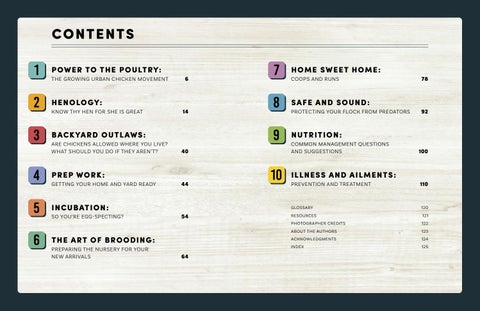
CONTENTS
1
POWER TO THE POULTRY:
2
HENOLOGY:
3
BACKYARD OUTLAWS:
THE GROWING URBAN CHICKEN MOVEMENT
KNOW THY HEN FOR SHE IS GREAT
ARE CHICKENS ALLOWED WHERE YOU LIVE? WHAT SHOULD YOU DO IF THEY AREN’T?
4
PREP WORK:
5
INCUBATION:
6
GETTING YOUR HOME AND YARD READY
SO YOU’RE EGG-SPECTING?
6
14
HOME SWEET HOME:
8
SAFE AND SOUND:
9
NUTRITION:
40
44
10
COOPS AND RUNS
PROTECTING YOUR FLOCK FROM PREDATORS
COMMON MANAGEMENT QUESTIONS AND SUGGESTIONS
ILLNESS AND AILMENTS: PREVENTION AND TREATMENT
78
92
100
110
GLOSSARY 120
54
THE ART OF BROODING: PREPARING THE NURSERY FOR YOUR NEW ARRIVALS
7
RESOURCES
121
PHOTOGRAPHER CREDITS
122
ABOUT THE AUTHORS
123
ACKNOWLEDGMENTS
124
INDEX 125
64
SELECTING A BREED TO SUIT YOUR NEEDS Which breed is right for you? Choosing your chicks may seem as simple as picking out the
LOOK TO THE EARLOBE
breed, one used for both meat and eggs, would
BREEDS WITH BROWNSHELLED EGGS
be an excellent choice. We suggest breeds
To get you started on your backyard chicken
from the American and English classes of the
journey, we present an introduction to each
American Poultry Association if you need calm,
breed, along with a picture to help you decide
cold-hardy birds.
which will enter your flock. Many breeds offer
breed with a mellow disposition. A dual-purpose
Bantams are about one-fifth the size of stan-
multiple varieties, so you still need to do more
cutest one at the feed store, but some people
dard chickens. The benefits are that you can
research to make a final decision. We suggest
want more information. The first question that
fit more of these chickens in a smaller space,
many of the breeds here for their ability to lay
and they eat much less food than their full-size
brown eggs but also their hardiness against the
counterparts. Bantam eggs are about one-third
cold. This list discusses large fowl only, as the
the size of standard eggs. There is one notable
color of eggshells and cold-hardiness of the
concern: They fly better and more readily than
bantam size for each breed can differ signifi-
most larger chickens. Their wings need to be
cantly from their large fowl counterparts.
always comes to mind is eggshell color. Eggs with different-colored shells do not have any nutritional difference from white-shelled eggs; the shell is the only place pigment is added. The contents are exactly the same. The American Poultry Association puts out what’s called the American Standard of Perfection. This publication provides color, type,
Which hens lay brown-shelled eggs? This is always a first question because brownshelled eggs are perceived as fresher, more natural, and if nothing else, at least different from grocery store eggs. The rule of thumb is simple (but not perfect) and has to do with a hen’s earlobe, the fleshy spot just beneath the feather-covered ear. A red earlobe means brown-shelled eggs, and white earlobes mean white-shelled eggs. There are chickens that lay blue-green shelled eggs and dark brown-shelled eggs, but we’ll talk about them later.
clipped or their runs need to be covered to prevent escapes. If you instead choose a laying hen known
u Plymouth Rock When people imagine an at-home flock, they
for its high production levels such as a White
typically think about the now-iconic Plymouth
breeds and is used as a reference by many
Leghorn, understand that it is an extremely
Rock. These are excellent dual-purpose birds
chicken owners.
active breed with high levels of aggression.
in that the males are raised for meat and the
Alternatively, a breed selected for its rapid
hens are kept for eggs. Many people also recall
ronment you can provide and on their behav-
growth and deemed a broiler chicken (one
hearing about Barred Rock chickens. This is an
ioral tendencies. For example, if you have harsh
raised for its meat) typically isn’t aggressive.
abbreviation of the whole name, which is Barred
winters and a small coop, choose a cold-hardy
Breeds developed in warmer regions of the
Plymouth Rock.
and size guidelines for all accepted chicken
Select your chicken breed based on the envi-
world such as the Egyptian Fayoumi may not perform well in cold environments unless you modify the coop to meet their needs through added insulation, for example. Although many people tend to choose chickens based on pretty feathers or eggshell color, keep in mind their behavioral needs as you make your decision. Also, make sure you take into account your city, state, and federal laws, which we discuss in chapter 3. Silver Sebright male and female Single Comb White Leghorn
20
| F I R ST T I M E C H I C K E N K E E P I N G
Barred Plymouth Rock
Henology
| 21
3
BACKYARD OUTLAWS:
ARE CHICKENS ALLOWED WHERE YOU LIVE? WHAT SHOULD YOU DO IF THEY AREN’T?
GETTING LAWS CHANGED If you find out that keeping backyard chickens
THE TRUTH ABOUT NOISE
is not allowed where you live, you have three
The stereotype that a rooster crows early every
choices. Don’t keep backyard chickens, keep
morning (as well as throughout the day) is true.
them under the radar, or work toward trying
Therefore, complaining about a rooster’s noise
to get the laws changed so you can keep
is valid, especially if the bird likes to sound
them legally.
his alarm well before sunrise. But here’s your
Before heading off to that city council meet-
argument: Most urban chicken keepers want
ing to get the backyard chickens laws changed,
backyard chickens for the endless supply of
you need to arm yourself with information.
fresh eggs, not to breed the birds for chicks.
People tend to gripe about problems they think
Guess what? You don’t need a rooster to get
accompany backyard chickens, such as noise,
eggs from hens. In fact, hens tend to lay better
smell, rodents, disease, or decreased property
without a rooster around to disturb their routine.
values. Here’s what you need to know:
And in contrast to their male counterparts, hens are relatively quiet, sleeping soundlessly through the night.
Before starting your backyard flock, make sure chickens are allowed where you live. Start hyperlocally by learning about regulations such as those from your homeowners association, then move outward. Check with city, county, state, and federal laws, too. Also, learn the terminology that applies to your area. Some laws state that only domesticated animals are allowed. Technically, chickens were domesticated at one point in time, some 6,000 to 10,000 years
LAWS TO CONSIDER In addition to whether chickens are allowed in your town, there are other broad requirements you should learn before investing in backyard birds. Here are a few to think about:
ago. Other laws may state that only household pets are allowed. One defini-
Are there height requirements for the coop?
tion of “pet” is an animal kept for companionship and pleasure. Chickens could
Are there distance requirements for the coop (e.g., how far it must be from the nearest occupied dwelling or property line)?
fall into that category. Finally, some laws classify poultry as livestock and apply to it all accompanying livestock regulations.
Is a coop considered an accessory structure? Whether or not it has this title could imply different regulations.
If you are a late sleeper, roosters are not for you. Yes, it’s true. They do cock-a-doodle do!
Backyard Outlaws
| 41
INTRODUCING YOUR CHICKS TO THE BROODER The brooder is finally set up and your chicks are ready to move in. What’s next? 1. Remove the chicks from the transport box (either from bringing them home or moving them from the incubator) one at a time and gently place them in the brooder. As you transfer them, examine each chick for any deformities, lethargy, or feces around their vent area. 2. Once each healthy chick is inside the brooder, gently dip its beak in water. Allow it to throw its head back to swallow and then dip its beak in the feed. 3. Repeat this process with every chick. This is an important time with your chicks
Chicken Keeping Tip Wash your hands before and after handling chicks to prevent contamination. You could inadvertently pass something to your chicks or they could pass something on to you. This is especially important if you already have a flock of chickens.
CONTENDING WITH HEALTH ISSUES IN NEW CHICKS Pasty butt. Some chicks develop what is called “pasty butt,” a collection of fecal matter around the chick’s vent area. If this occurred in nature, a mother hen would clean the chick’s vent. Now it’s your job. Here’s what to do: 1. Fill a cup with warm water. Tear strips of paper towels into 3 × 4-inch (8 × 10 cm) sections. 2. Put on gloves and begin picking up the chicks and looking at their vent areas. If you find a chick with pasty butt, dip a paper towel strip in the warm water and gently rub clean the area. The fecal matter often gets tangled in the chick’s fuzz so you may need to carefully work on it to loosen it. 3. Check chicks daily for this issue because it can block the vent, constipating the chick, and potentially resulting in death. The problem usually goes away by the time the chicks are two to three weeks old, but it can last longer. The good news is that not every chick will have this problem. Usually the chicks that need wiping today are the same ones that need it tomorrow.
because not only are you showing them where to find their feed and water—what a mother hen would do—but you also are looking for any weakness that may cause problems for the chicks in the future.
Weak chicks. Any time we spot a weak or sick chick, we separate it immediately from the other chicks. We always have available a smaller plastic box that we call the ICU (Intensive Care Unit) brooder. The same food, water, bedding, and heat requirements exist for your ICU brooder as with your regular brooder. We separate these chicks for several reasons: Once healthy chicks spy a weak chick, they peck it, push it over, and run over it. In addition, this chick’s problem may be contagious to the healthy chicks. Chicks that need to be separated include those that are lethargic or with runny eyes, diarrhea, or droopy wings. These chicks may not eat or drink. They are most likely quiet and want to sleep all the time. They may try to get as close to the heat source as they can, if they have enough energy to do so. Chicks stay quarantined in this brooder until they are completely well or they succumb to their illness. Poultry vitamins and electrolytes found at your local feed-and-seed store may supply the chick an extra boost. In a pinch, if you can’t get to the feed store, create an 8 percent sugar solution for the chicks (1½ cups [300 g] of sugar per gallon [4 L] of water) or put one dropper’s worth of liquid baby vitamins (without iron) into the waterer base. Dip the chick’s beak in the water tray occasionally throughout the day. Provide fresh water in addition to the treated water. It is a good sign if the chick drinks the water, but when it quits drinking completely, prepare for the worst.
A chick with pasty butt that needs to be wiped and cleaned.
74
| F I R ST T I M E C H I C K E N K E E P I N G
The Art of Brooding
| 75