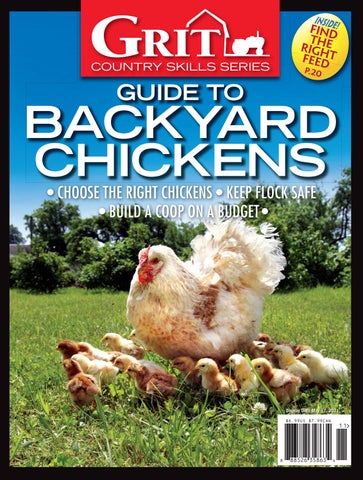
GRIT’S GUIDE TO BACKYARD CHICKENS
insid
COUNTRY SKILLS SERIES
Finde! the Righ Feedt P. 20
GUIDE TO
BACKYARD CHICKENS
EGGS AND MOLTING • HOMESTYLE RECIPES • POULTRY ON PASTURE • DIY DROPPING BOARD • LET CHICKENS ROAM FREE Final Covers.indd 1
• CHOOSE THE RIGHT CHICKENS • KEEP FLOCK SAFE • BUILD A COOP ON A BUDGET •
Display Until May 17, 2021
12/17/20 4:17 PM
50
Chickens Looking a Little Naked?
52
Why You Should Be Letting Your Chickens Out
Don’t worry, it’s a natural process called molt.
The best way to raise chickens is free-ranging them, so if you have ample room, let your chickens out during the day for all the benefits.
54
The Budget Coop Scoop
62
How to Build a Dropping Board
68
Ironclad Coop Defense
52
Inexpensive, easy-to-build chicken coops.
Movable boards for poultry droppings help with cleanup and let you use chicken manure for composting.
Take the time to add measures to protect your flock from any type of predator.
72
Hen Management 101
76
Animal-Assisted Therapy: A Beginner’s Guide
Tips to keep your flock safe and healthy.
68 80
An experienced practitioner helps us learn more about the program and how to start an AAT program with chickens.
80
Caring for Your New Chickens
86
What to Do About Poultry Remorse
88
Stealing From Snakes
90
Winner, Winner, Chicken Dinner
95
Ducks or Gees for Farm Poultry?
Caring for your new baby chicks properly is the key to maintaining a healthy flock.
Avoid this malady by following these five tips from an experienced chicken owner.
Keep your chicks safe and warm in their brooder with these helpful tips.
90
Grill, bake, and fry a bird every which way with these homestyle chicken recipes.
Both are fun birds for the farm, but there are some key differences. www.Grit.com
2-3 TOC.indd 3
3
12/17/20 11:14 AM
Contents › Backyard Chickens 6 Your Readers share their images of their backyard flocks on our various platforms, and we share them with you.
8 The Gut is Key
Learn how a nutritional diet is important to your flock’s digestive health.
14
3 Chicken Ailments and Their Natural Treatments
8 Cover Photograph: iStock/Yuriy Poznukhov
18
Thyme, oregano, a little vodka create herbal treatments to combat bumblefoot, external parasites, and respiratory ailments.
and Preventing Chicken Frostbite 18 Treating Protect your flock from winter freezes with the help
20 24
of these tips.
From Headlines to Fine Print Choose the ideal feed for your chickens.
Feed the Flock
28 34 36 40 44
Whether free-range, forage, or a combination of the two, learn more about what makes an effective diet for your chickens.
Poultry on Pasture
36
Don’t underestimate the nutritional value of the weeds and grasses on your ground.
Seven Safety Tips for Free-Ranging Chickens Follow this experienced chicken owner’s advice to keep your flock happy and healthy as they roam around your yard.
Eggs-cellent Layers Learn more about how to get the best egg production out of your flock.
Choosing Chickens
44
Understand the pros and cons of keeping backyard laying hens.
5 Gentle Chicken Breeds Experienced chicken keeper recommends calm, friendly chicken breeds perfect for children on the autistic spectrum.
Why Raise Heritage Livestock? 48 Such breeds connect us with our past and often can bring a variety of benefits to a farm.
2
Grit's Guide to Backyard Chickens
2-3 TOC.indd 2
12/17/20 11:14 AM
Gut Key
The is
Did
you know a chicken’s “teeth” are inside its body? Or that chickens need bacteria to have a healthy digestive system? Or that feed includes more than just nutrients? Learn more about how your chickens’ diet contributes to their overall health and well-being.
Understanding Digestion
Understanding how a chicken’s digestive tract works can help you maintain a healthy flock. Remember that they’re not mammals, so things work a bit differently than in a human digestive system. A chicken picks up food with its beak. The food mixes with saliva and digestive enzymes as it moves from the mouth to the esophagus. No chewing is
8
involved — the food is simply swallowed. Then it moves into the crop, an expandable pouch, where it can be stored for up to 12 hours. The crop slowly moves the food into the proventriculus (pro-ven-TRIK-yoo-luhs), or true stomach. Here acids and digestive enzymes break down the food. Next, the food moves into the gizzard, or ventriculus (ven-TRIK-yoo-luhs), a mechanical stomach with strong muscles and a thick lining. The gizzard contains grit, small pieces of stone that the bird has swallowed. The grit acts as the chicken’s teeth. When the gizzard contracts, the grit squeezes against the food, grinding it up. From the gizzard, the food passes to the small intestine, where nutrient absorption begins. The upper small intestine, called the duodenum (doo-uh-DEE-num), includes the pancreas. This organ secretes chemicals that aid digestion and regulate sugars. The liver adds bile, stored in the gall bladder, to the food to help with absorption of fats. Some of the material goes into the ceca (SEE-kuh). These are two blind pouches that help absorb water and ferment fibrous material, breaking it down further. The rest of the material moves directly into the large intestine, or colon. This part of the digestive tract absorbs water, drying out the material that is indigestible. A chicken’s digestive tract produces two different kinds of droppings: fecal (FEE-kuhl) matter from the large intestine and cecal (SEE-kuhl) droppings from the ceca. Both kinds of waste leave the body through the vent, or cloaca (klo-AYkuh), an opening below the bird’s tail. Cecal droppings are brownish-orange, pasty, and foul smelling. Fecal matter is greenish-brown and fibrous. It receives a white cap of kidney waste, called urates (YUR-ates).
GRIT’s Guide to Backyard Chickens
08-12 Gut Health_Nutrena.indd 8
12/17/20 11:15 AM
FROM LEFT: ADOBE STOCK/CAROLA SCHUBBEL; ILLUSTRATION COURTESY
By Jennifer Murtoff, Home to Roost LLC in partnership with Nutrena®
CARGILL
Learn how a nutritional diet is important to your flock’s digestive health.
Developing a Healthy System
A healthy digestive system is key to a healthy chicken. It is important to the development of the animal’s immune system and absorption of nutrients. However, newly hatched chicks have no gut bacteria. They develop their gut bacteria by consuming some of their mother’s droppings and absorbing her microflora, which are gut-friendly organisms that include certain kinds of bacteria and yeast. These tiny living things populate the chicks’ digestive systems, aid in digestion, and prevent harmful organisms, such as Salmonella and E. coli bacteria, from flourishing in the gut. However, many chicks are hatched and brooded by humans, rather than a hen, and will require supplemental microflora. A high-quality, commercially formulated feed contains the varied elements necessary for gut health; different communities of microflora live in different areas of the digestive tract. Factors such as the age of the bird, its environment, and diet affect the organisms your chickens carry in their guts.
from left: Adobe Stock/cArolA Schubbel; illuStrAtion courteSy
cArgill
Multiple Benefits
A healthy gut benefits your chickens in several ways. First, a strong, healthy digestive system helps birds efficiently absorb nutrients from the food they eat. Good nourishment contributes to the health and happiness of your birds and also makes for better layers. Second, the immune system is closely linked to the chicken’s digestive system. The beneficial microflora protect the walls of the intestine by shutting out dangerous bacteria and prevent harmful bacteria from producing toxins. Scientists also think the friendly microflora help keep a bird’s body on high alert for disease-causing organisms. Your chickens’ health may be affected by stressors, including changes in weather; presence of children, pets, or predators; overcrowding; or new additions to a flock. A good diet and a healthy microbial balance help prevent your chickens from getting diseases that might otherwise occur because of stress.
Contributions to Gut Health
We’ve seen how microflora affect the gut by providing nutrients, helping the bird digest certain substances, supporting the immune system, aiding in the development of the digestive tract of chicks, and preventing harmful bacteria from colonizing the gut. The most significant contributor to gut health is diet. What goes into a healthy diet, besides the obvious vitamins and nutrients? Let’s take a look at some of the beneficial organisms that populate a healthy digestive system.
Fungal Components
The next time you look at a feed label, check for the words yeast culture. Also called fermentation metabolites, this additive is composed of compounds produced by fermentation of dietary yeast, including Saccharomyces cerevisiae (sak-uh-rohMY-seez sehr-uh-VEE-seeeye). When fermented inside a chicken’s gut, yeast culture supports the immune system and gut microflora. It also contributes to the health and strength of intestinal tissues. Compounds derived from yeast can even latch on to bad bacteria such as E. coli and Salmonella and prevent them from attaching to the cells of the digestive tract. Another fungal product involves the fermentation of Trichoderma reesei (trih-kuh-DER-muh REE-see-eye). This feed component is an enzyme source, and the compounds it produces help break down carbohydrates to make nutrients more available to the chicken.
F
ACT! Chicks that are raised in a germ-free environment develop inferior digestive systems.
www.Grit.com
08-12 Gut Health_Nutrena.indd 9
9
12/17/20 11:16 AM
intestines. The causes may be one or several organisms: worms, protozoa, viruses, bacteria, or overgrowth of yeast. Multiple organisms can be involved, so identifying and treating the underlying cause of gut problems can be challenging, which is all the more reason to provide your chickens with a healthy diet.
from left: Adobe Stock
(2)/Alexxndr, monticellllo; PAge 38: Adobe Stock/monticellllo
Tips for Improving Gut Health
It’s important to know what may affect your birds’ gut health so you can prevent problems and correct them when they do occur. Diet: What your birds eat is, of course, the main factor. Choose a highquality feed that includes the appropriate nutrition, as well as fermented fungal products, probiotics, and prebiotics. Keep your feed dry to prevent mold growth. Molds produce toxins that can have serious effects on your birds’ health. Dietary variations also may www.Grit.com
08-12 Gut Health_Nutrena.indd 11
11
12/17/20 11:16 AM
References
F
cause a temporary change in the microflora, so supplemental probiotics can be helpful. You can also switch feeds slowly, mixing old and new to gradually increase the percentage of new feed. Flock Management: Your birds’ living conditions also affect gut health. If your chickens have enough space and ventilation and are able to free range, they will be happier. Stress from predators, young children, new flock members, and overcrowding can upset the digestive system. A clean coop and run are also essential to digestive health as your birds are continually eating things from these surfaces. Water: This important factor in gut health is often overlooked. Clean water is important year round, especially in the summer. Keep waterers out of direct sunlight and change water daily. If you notice a thin scum of algae on the inside of the waterer, wash it with hot, soapy water, rinse, dry, and refill. Some algae produce a toxin that can kill your flock. Medications: Check in with your avian veterinarian to learn how any medications may affect your birds’ digestive health and what supplements you might need to provide. If a vet prescribes antibiotics, you may want to ask about a probiotic to help repopulate the microflora in the digestive tract. Also remember to ask about withdrawal time, the period during which you should not eat your birds’ eggs if they are on medication. Now you’ve learned about the importance of gut health and how to keep your birds’ digestive systems healthy. When you choose a commercially formulated feed for your flock, remember to look for yeast culture, prebiotics, and probiotics. These important ingredients will help your birds live their best lives.
ACT! Around 70 percent of the bacteria in a chicken’s digestive tract is Lactobacillus strains.
12
Bailey, Richard A. (2019). Gut health in poultry: The world within — update (Aviagen Brief). Global Ag Media. Retrieved from The Poultry Site website, https://www. ThePoultrySite.com/articles/gut-health-in-poultry-theworld-within-1 Bouzaine, T., Dauphin, R.D., Thonart, P., Urdaci, M.C., & Hamdi, M. (2005). Adherence and colonization properties of Lactobacillus rhamnosus TB1, a broiler chicken isolate. Letters in Applied Microbiology, 40 (5), 391–396. https:// DOI.org/10.1111/j.1472-765X.2005.01684.x Damerow, Gail (1994). The Chicken Health Handbook. North Adams, MA: Storey Publishing. Diamond V. (n.d.) Poultry nutrition and health. Retrieved from Diamond V website, https://www.DiamondV.com/ species/poultry-nutrition-and-health Diaz Carrasco, J.M., Casanova, N.A., & Fernández Miyakawa, M.E. (2019). Microbiota, gut health and chicken productivity: What is the connection? Microorganisms, 7 (10), 374. https://DOI.org/10.3390/microorganisms7100374 Jacob, Jacquie. (n.d.) Avian digestive system. Retrieved from Poultry Extension website, https://Poultry.Extension.org/ articles/poultry-anatomy/avian-digestive-system Kogut, M., Yin, X., Yuan, J., & Bloom, L.R. (2017). Gut health in poultry. Cab Reviews: Perspectives in Agriculture, Veterinary Science, Nutrition and Natural Resources, 12. Liu, N., Wang, J., Deng, Q., Gu, K., Wang, J. (2018). Detoxification of aflatoxin B1 by lactic acid bacteria and hydrated sodium calcium aluminosilicate in broiler chickens. Livestock Science, 208, 28–32. https://DOI.org/10.1016/ j.livsci.2017.12.005 Morishita, T., Rutllant-Labeaga, J., & Karcher, D., (2015). Egg Diagnostics. In C. Greenacre & T. Morishita, (Eds.), Backyard Poultry Medicine and Surgery: A Guide for Veterinary Practitioners (pp. 263–274). Ames, IA: John Wiley & Sons. Ricke, S. C. (2018). Impact of prebiotics on poultry production and food safety. The Yale Journal of Biology and Medicine, 91(2), 151–159. Tabashsum, Z., Peng, M., Alvarado-Martinez, Z., Aditya, A., Bhatti, J., Romo, P.B., Young, A., & Biswas, D. (2020). Competitive reduction of poultry-borne enteric bacterial pathogens in chicken gut with bioactive Lactobacillus casei. Scientific Reports, 10 (1), 16259. https://DOI .org/10.1038/s41598-020-73316-5 Vieco-Saiz, N., Belguesmia, Y., Raspoet, R., Auclair, E., Gancel, F., Kempf, I., & Drider, D. (2019). Benefits and inputs from lactic acid bacteria and their bacteriocins as alternatives to antibiotic growth promoters during food-animal production. Frontiers in Microbiology, 10, 57. https://DOI.org/10.3389/fmicb.2019.00057 Zheng, A., Luo, J., Meng, K., Li, J., Bryden, W.L., Chang, W., Zhang, S., Wang, L.X., Liu, G., & Yao, B. (2016). Probiotic (Enterococcus faecium) induced responses of the hepatic proteome improves metabolic efficiency of broiler chickens (Gallus gallus). BMC Genomics, 17, 89. https://DOI.org/ 10.1186/s12864-016-2371-5
Grit’s Guide to Backyard Chickens
08-12 Gut Health_Nutrena.indd 12
12/17/20 11:16 AM
From
HEADLINES to Fine Print
Anyone
new to raising chickens is bound to be confused at the feed store. With such a complex diversity of feeds available at different price points, it can be hard to determine which one to buy. Choosing the right feed so chickens have proper nutrition isn’t as complicated as it might seem. A little time spent reading labels makes that decision a bit easier. Every animal has specific nutritional needs, so the store will likely have bags of goat, calf, pig, catfish, and horse feeds in addition to chicken feed. Complexity doesn’t end when a customer reaches the piles of feed tailored for different kinds of birds at different stages of life. Then there’s medicated and non-medicated chick feed as well as organic and conventional feed. It can be overwhelming. The best way to find the right feed is to read both the headlines and the fine print.
The Headlines
Every feed bag has a headline, the large print often blended with colorful images of chickens. Perhaps more accurately identified as the product purpose statement, this information is an important factor in the buying process. These headlines inform a potential buyer that the bag contains special formulations for chicks, meat birds or layers, or a specialty feed for molting chickens. All have different ingredient blends designed to meet the nutritional needs of a bird in a particular life stage. The front of the bag typically states the type and feed texture. On the back, you will find brief feeding instructions. The label may also provide additional feeding information along with the nutrient guarantees.
20
Baby and growing layer chicks need a high-protein diet to help them develop muscles, bones, and organs. Chick starter typically has 18 percent protein and is in a crumble form, making it small enough for them to eat. Broilers, also called meat birds, are fed a diet that will be eaten from hatch to butcher. These feeds are usually 22 percent protein, though that amount may vary by brand. Sold in a crumble form, these feeds continue to be consumable throughout a chicken’s life. As layers approach maturity, between 16 and 24 weeks old, nutritional needs shift. They don’t need quite as much protein, and they do require plenty of calcium to replace what they will eventually secrete in eggshells. At this time, move your hens to a layer feed of 16 percent protein that includes additional calcium. These feeds are available in both crumble and pellet form. Bantams or smaller birds will do best on crumbles because pellets may be too large for them to consume.
GRIT’s Guide to Backyard Chickens
20-22 Feed Types_Nutrena.indd 20
12/17/20 11:19 AM
CARGILL (3)
By Marion and Rich Patterson, Winding Pathways LLC in partnership with Nutrena®
Choosing the Ideal Feed
FROM LEFT: ADOBE STOCK/THEPOO; COURTESY
Choose the ideal feed for your chickens.
Looking at Feeds
Feeds come in two typical textures: pellets or crumbles. You may also see scratch grains while visiting the poultry feed aisle.
FORM
PELLETS
CRUMBLES
from left: Adobe Stock/thepoo; courteSy
cArgill (3)
SCRATCH AND MIXED GRAINS
ADVANTAGES/DISADVANTAGES
Pellets are small cylinders of compressed feed that include all the nutrients in each piece.
Because the ingredients are ground and blended, pellets contain the right balance of nutrition in each bite, assuring your chickens get the proper nutrition. Spillage is reduced, making feeding time less messy. Pellets are intended for large fowl (standard-size chickens) and are too large for some smaller birds such as chicks and bantams.
Crumbles are pellets that have been crushed to a smaller particle size, so they also contain just the right blend of nutrients in each piece.
Many birds prefer crumbles, and this type of feed is easily consumed by bantams and chicks. The downside to crumbles is more spillage, creating a larger mess.
Scratch and grain mixes are not considered a complete feed. They contain a blend of cracked corn and grains.
Chickens gobble up these mixes like humans do candy. The mixes do not supply the balance of nutrients or protein levels found in pellets and crumbles. Like candy, they should be fed only as a treat and should not exceed more than 10 percent of a chicken’s total diet.
WHAT IT LOOKS LIKE
www.Grit.com
20-22 Feed Types_Nutrena.indd 21
21
12/17/20 11:20 AM
T
IP: Check out Henderson’s Breed Chart (www.SageHen FarmLodi.com/chooks/ chooks.html) online for more information on chicken breeds and their laying abilities.
Checklist for Maximizing Egg Production Feed a high-quality layer ration. Allow free ranging. Provide clean, fresh water all the time. Expect seasonal slow-downs. Support molting hens with higher protein. Choose breeds or hybrids that are proven layers. Reduce stressors in the environment.
Stars, Gold Stars, and Amberlinks. Hens of these breeds offer large numbers of eggs over their lifetimes.
FROM LEFT: ADOBE STOCK
(2)/KENSIA, PINEAPPLE STUDIO
Diet
Many people assume that brown eggs are healthier than white eggs. Shell color, however, makes no difference in the quality of the egg. Your birds’ diet influences the content of their eggs. Laying hens need continual access to a high-quality, high-protein diet. The feed should include carbohydrates, fats, minerals, and vitamins, as well as amino acids. Enzymes, probiotics, and yeast culture are other additives that help keep your birds’ digestive tracts healthy. Don’t skimp on their layer ration. They will thank you —with plenty of fresh, great-tasting eggs. (For more on feeding your hens, turn to Page 20.) If allowed to free range, your chickens will also produce eggs with better nutritional content. They will eat plants, insects, worms, and even mice. Since 1974, scientific studies have shown that the free-range diet produces eggs of better nutritional quality than commercially produced eggs. Studies report higher levels of vitamins A, D, and E and omega-3 fatty acids in backyard eggs. In addition, all the beta carotene from plant matter creates a lovely orange-yellow yolk.
T
FACT O
FIRST BREED
SECON
KEEP ‘
FACT O IF NEE
Water
Eggs are 75 percent water, so having a clean, fresh source available to your birds at all times will help keep them happy, healthy, and laying. Don’t forget to scrub your waterers, especially in summer, to prevent growth of toxic blue-green algae. And have a system in place for winter — cold weather and shorter days provide enough of a challenge for your ladies. They will be grateful for an unfrozen water source.
ALL CH
Seasonal Changes
Your chickens are descended from wild red junglefowl, and despite being domesticated around 4,000 years ago, their egg laying can still recall the traits of their feral ancestors. Your hens lay in response to the photoperiod — the amount of light they get per day. Hens lay their best eggs in May or June, which is the optimal time for rearing young. Because chickens expend more energy keeping themselves warm in cold weather and less in laying eggs, egg production is highest around June 21 and lowest around December 21. Most hens stop laying during the winter, but younger ones may continue. Many commercial farmers add supplemental light to keep their birds in production when there is less daylight.
IP: A good layer ration includes 16 to 18 percent protein, plus calcium, magnesium, and phosphorous, which are necessary to shell and lay the egg.
Molting
After she has been laying for about a year, a hen will undergo her first molt, losing her old feathers and growing new ones. This process usually happens in the fall. Both feathers and eggs require a lot www.Grit.com
36-39 Egg Production_Nutrena.indd 37
THEY W FOURT BEST
37
12/17/20 12:38 PM
from left: courtesy
cargill; adobe stock/olgasalt
F
ACT! A hen’s first eggs may be odd shapes and sizes until her body gets accustomed to the laying process.
38
Grit’s Guide to Backyard Chickens
36-39 Egg Production_Nutrena.indd 38
12/17/20 12:38 PM