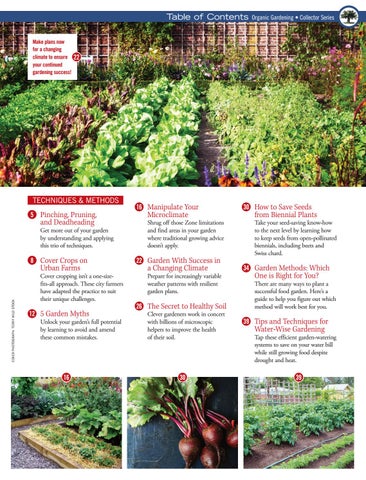
Table of Contents Make plans now for a changing climate to ensure your continued gardening success!
22
TECHNIQUES & METHODS 5 Pinching, Pruning,
and Deadheading
Get more out of your garden by understanding and applying this trio of techniques.
8 Cover Crops on
COVER PHOTOGRAPH: TERRY WILD STOCK
Urban Farms
Cover cropping isn’t a one-sizefits-all approach. These city farmers have adapted the practice to suit their unique challenges.
12 5 Garden Myths
Unlock your garden’s full potential by learning to avoid and amend these common mistakes.
16
1-3 TOC.indd 1
Organic Gardening • Collector Series
16 Manipulate Your
Microclimate
Shrug off those Zone limitations and find areas in your garden where traditional growing advice doesn’t apply.
22 Garden With Success in
a Changing Climate
Prepare for increasingly variable weather patterns with resilient garden plans.
26 The Secret to Healthy Soil Clever gardeners work in concert with billions of microscopic helpers to improve the health of their soil.
30
30 How to Save Seeds
from Biennial Plants
Take your seed-saving know-how to the next level by learning how to keep seeds from open-pollinated biennials, including beets and Swiss chard.
34 Garden Methods: Which
One is Right for You?
There are many ways to plant a successful food garden. Here’s a guide to help you figure out which method will work best for you.
39 Tips and Techniques for
Water-Wise Gardening
Tap these efficient garden-watering systems to save on your water bill while still growing food despite drought and heat.
39
12/9/20 11:34 AM
44 44 Life Cycle Gardening
From colorful cut flowers to edible shoots, roots, and more, maximize your garden’s yield by harvesting during different stages of the plants’ lives.
49 Rig Up a Rainwater
Catchment System
Profit from rainy days with a system that’ll collect and store your rainwater for future use.
DIY PLANS 54 Build an A-Frame
Tomato Trellis
More dependable than cages and other trellis structures, this simple woodworking project will get your vines up off the ground in no time at all.
57 DIY Composters
for Your Garden
Fall into the magic of composting with these three easy DIY composters.
49
1-3 TOC.indd 2
62 62 Grow a Green Roof
Turn your roof into a canopy of lovely plants that will keep your house comfortable year-round.
66 Potting Bench Plans Build a potting bench with everything … and the kitchen sink.
69 DIY Greenhouse for
Winter Growing
Growing food in this solarheated structure will be far more productive than doing so with electric lights indoors. Plus, you can build it with lowcost materials.
SPRING 74 Marvelous Mucilage:
Okra for All Seasons
For devoted fans of the mucilaginous vegetable, canned and pickled okra brings summer to the table all year.
66
84 77 Heat-Tolerant
Eggplant Trials
Years of experimenting have shown an experienced gardener the best cultivars to grow in her steamy climate.
80 ‘Victoria’ Rhubarb
Grown in kitchen gardens throughout the world, this classic heirloom vegetable can add its superior tart flavors to more than just pies.
84 Grow a Bee-Friendly
Organic Garden
Learn four ways to attract pollinators to your garden and help them flourish.
SUMMER 88 Best Vegetables
to Grow in the Shade
Even in shady conditions, you can bask in great garden harvests if you choose the right crops and make a few easy adjustments.
92
12/9/20 11:35 AM
98 92 Abundant Summer
Mulberries
A common sight in rural American landscapes, mulberry trees provide plenty of fruit for snacking.
95 Delightful Dill
A versatile, aromatic herb for the garden and kitchen.
98 Terrific Tomatoes for
Spectacular Sauces and Creative Canning
A tomato connoisseur and organic gardener recommends his favorite cultivars based on flavor, reliability, and years of experience.
102 Grow Great Carrots
Simple soil amendments and careful cultivar selection will boost your roots to their finest form.
FALL 106 Great Garlic Cultivars
Make the most of this foundational culinary ingredient by planting and harvesting more than once a year.
112
1-3 TOC.indd 3
120 109 Gooseberries in
the Market Garden
Start your own small-scale berry market with the flavorful and sought-after gooseberry.
112 Grow Your Own
Shiitake Mushrooms
Take these steps to fruit your own fungi for money, food, and fun.
116 Purple Sweet Potatoes:
The Ancient Superfood
These richly colored tubers shouldn’t be underestimated. Learn about their growing reputation, health benefits, and global history.
120 Sweet Potatoes & Shallots
to Savor in Winter
Easy to grow and store, these roots pair well when tossed into decadent dishes to warm up cold days.
134 produce to keep your garden growing — and the money flowing — through winter.
130 Grow Great
Lettuce in Winter
With a little planning, you can harvest fresh, homegrown greens in the coldest season. Ready to learn more? Lettuce begin!
134 Year-Round Indoor
Salad Gardening
Use this unique technique to grow greens in a limited space, even in winter.
138 3 Rare Root Crops You
Should Be Growing
Experience the unique flavors of crosnes, salsify, and skirret by adding these unsung, underground treasures to your vegetable garden
142 Grow Squash
WINTER 125 Grow a Winter
Market Garden
Find perennial markets for your
130
and Pumpkins
Tips and techniques to prevent the dropping of fruit on your favorite vine crops.
142
12/9/20 11:35 AM
Manipulate Your
Microclimate
Shrug off those Zone limitations and find areas in your garden where traditional growing advice doesn’t apply. By Ann Marie Hendry
W
hen I worked as a commercial gardener, one of the most interesting things I learned about was the influence of microclimates. Even though all the gardens I maintained were within 30 miles of each other, I soon discovered that what grew well in one garden was no sure indicator of what could be persuaded to thrive in another — even when the other garden was right next door! Conventional wisdom states that what a gardener can grow is limited by the USDA Hardiness Zone they’re gardening in, but I’ve found that isn’t the whole truth. Another important factor should also be taken into consideration: every garden’s unique microclimates. Season extenders, such as row covers, are invaluable for warming up soil and protecting crops from the elements, but smart gardeners can deploy many more powerful techniques. By becoming aware of and manipulating the microclimates that make up your plot, you can improve yields and successfully grow crops that are on the borderline of what’s feasible in your region.
First, ask yourself four questions: 1 Where is heat stored in my garden? Heat doesn’t just disappear when the sun goes down. Stone, brick, concrete, and even water absorb heat during the day and release it at night, a phenomenon known as “thermal mass.” 2 Which areas are exposed? Strong winds can chill tender seedlings, flatten plants, snap plant supports, and dry out soil. Wind tunnels — areas where wind
is forced between solid objects, effectively increasing wind speed — can be particularly destructive. 3 Which areas of my garden receive the most sunlight, and how does this vary throughout the seasons? Shadows cast by trees, buildings, and other structures are short in summer and long in winter. What may seem like an unpromising spot in winter can be sun-soaked in summer, and vice versa.
GROWVEG.COM (2)
Identify Your Microclimates To exploit the microclimates in any garden, you’ll first need to learn exactly what they are. This often-overlooked task should not be rushed; it’s best done at several different points during the year to gain a complete picture of how your garden changes throughout the seasons.
A fan-trained fruit tree grows against a wall, a heat sink that provides additional warmth. TECHNIQUES/METHODS • www.MOTHErEarTHNEwS.COM 17
16-21 Microclimate.indd 17
12/9/20 11:44 AM
Keeping Warm
bring them up to the surrounding ground level. Or, go one step further and grow plants on mounds or in raised beds. Frost pours away downhill, so make sure cold air can escape by removing any solid barriers that might impede its progress and cause it to pool in your growing areas. Cold tolerance is a soughtafter trait in plants, so plant breeders make great efforts to select for this when developing new varieties for cooler areas. Choose varieties specifically bred to be hardy in your Zone, which will make a considerable difference to your chances of success.
Remember the gardens I mentioned earlier that were near each other? Both experienced the same chilly winters and cool summers; had clay soil and poor drainage; were Creating Windbreaks surrounded, at a respectful Strong winds can rip plants distance, by trees and hedges and greenhouses to shreds, as that filtered the worst of the I’ve learned at my own cost! wind; and had some areas in My garden sits at the head of full sun for most of the day. a valley that channels the preThey also received the same vailing wind. When the wind annual pruning and regime forces its way between the for soil enrichment. house and garage, it speeds up But one garden grew proand becomes even more powdigious quantities of apples, erful — right before it hits my pears, and currants, while the greenhouse. If only I’d built other struggled to produce a hoop house, whose curved even a light picking of fruit. profile and plastic cover would The difference? Thermal mass. have saved me several trips to Stone walls completely enthe glazier! closed the productive garden. Windbreaks are the obvious Soft fruits grew against the solution to windy situations, walls — even the north-facing but the fix isn’t as straightone — and they thrived. Heat forward as building a wall or absorbed by the walls during putting up a panel fence. The the day was released at night, problem with solid barriers keeping frost at bay and cruFROM TOP: Frosted plant leaves and other gardening problems can like these is that they force be avoided by creating habitable microclimates. Add sawdust mulch cially preventing damage to the wind to divert up and to acid-loving plants. Brassicas love grass mulch for its nitrogen. delicate blossoms in spring, over — and then come crashwhich resulted in generous ing down, potentially smashbumper harvests. the happy result of improving yields to ing your greenhouse or flattening plants. Walls, paving, rocks, and water baralmost match those in the much more Instead, opt for permeable barriers. rels can act as “heat sinks,” or sources sheltered garden next door. These types of barriers slow down wind, of thermal mass, to raise temperatures Another way to minimize frost damage while still enabling it to continue on its by a few precious degrees. With lesis to remove, or at least avoid planting path. Hedges make superb windbreaks sons learned, I transplanted several in, frost pockets. Cold air will sink into for this reason, but even netting securely soft-fruit bushes against the house in dips and hollows in your garden, so if attached to stout posts can help reduce the problematic garden. The move had you need to grow in those, fill them in to the force of wind. You may need to 18 MOTHER EARTH NEWS COLLECTOR SERIES • ORGANIC GARDENING
16-21 Microclimate.indd 18
12/9/20 11:44 AM
FROM LEFT: ANN MARIE HENDRY (3); GROWVEG.COM (2)
4 Where does water pool when it rains? Low spots and areas with heavy soil or poor drainage hold water longer, which can be useful in dry regions, or a plant killer in wetter climates. Once you’ve observed and identified these areas on your property, the next step is to take advantage of them to grow plants that conventional wisdom tells you aren’t possible for your Zone.
How to
Save Seeds
from Biennial Plants W
e save seeds for many reasons: tradition; the idea of seed sovereignty and not being beholden to seed companies; and ensuring that our favorite cultivars don’t disappear. The most obvious reason for seed saving is that we want more plants. And when it comes to saving our favorite vegetable seeds, more plants mean more food. But some vegetables are easier to bring to seed than others. Self-pollinating annuals, such as lettuce and beans, are the easiest from which to save seed. These are followed by other annual crops, such as tomatoes, pumpkins, or peppers, which may require some level of isolation or pollination management, but other than that are grown similarly to how they’re grown for eating.
Biennial crops (varieties that flower, bear fruit, and set seed in their second season before reaching the end of their life-cycle, such as beets, chard, and many brassicas) are more challenging to grow for seed and require a deeper understanding of botany and the processes that bring plants to seed in the first place. Additionally, biennials grown for seed are brought to a state that we aren’t as familiar with, because we typically harvest these plants in their first year.
Basic Seed Saving Some principles of seed saving are universal, no matter which crops are being grown for seed. Seeds are the product of the fertilization of a plant’s flowers, which brings about fruit and seed production. Seeds that are true to type (seeds that bear the traits of their parent) can only be saved from open-pollinated cultivars that
30 MOTHER EARTH NEWS COLLECTOR SERIES • ORGANIC GARDENING
30-33 Save Seeds.indd 30
12/9/20 11:47 AM
BOTTOM ROW: COURTESY SEED SAVERS EXCHANGE (3)
By Lee Buttala
ABOVE AND RIGHT TOP ROW: ISTOCK (3)/SORENDLS, BRANDTBOLDING, FATCAMERA
Take your seed-saving know-how to the next level by learning how to keep seeds from open-pollinated biennials, including beets and Swiss chard.
BOTTOM ROW: COURTESY SEED SAVERS EXCHANGE (3)
ABOVE AND RIGHT TOP ROW: ISTOCK (3)/SORENDLS, BRANDTBOLDING, FATCAMERA
TOP RIGHT: Younger plants, provided they’re of reproductive size (typically having eight or more true leaves), are less susceptible to winter cold and are often set out late in the season to overwinter. BOTTOM RIGHT and CENTER: Beets can be dug up, stored with their tops cut short, and then replanted in spring to flower and go to seed. BOTTOM LEFT: Mature beet plants may reach four to five feet in height and take up a significant amount of space.
are isolated from cross-pollination with other varieties within their species. This can be confusing because some species contain more than one crop type, and the flowers of these plants can cross with one another if they’re in bloom at the same time. Cabbages, collards, cauliflower, European kales, kohlrabi, broccoli, and Brussels sprouts are all members of the same species, Brassica oleracea. Beets and Swiss chard are also forms of the same species, Beta vulgaris. If different varieties of these plants are in flower at the same time, they can easily cross-pollinate and produce seeds that will not be true to type, or characteristic of their variety. Additionally, some of these crops are self-incompatible, meaning that the pollen from a separate, genetically distinct plant of the same variety must fertilize its flowers to produce true-to-type seeds. In this case, more than one plant has to be grown, although growing a larger population of plants is always a good thing because it helps to maintain genetic diversity.
The cole crops of B. oleracea have an added complication in that some of the crop types within the genus are annual and flower in their first season, while others are biennial and flower after overwintering. If growing these for seed, you’ll need to make sure only one variety within the species is in flower at a time to prevent cross-fertilization. Whatever the crop, in order to flower and bear seed, biennial plants must reach a certain size (reproductive growth is typically possible after plants have eight or more true leaves) and then be exposed to a certain amount of cold for a period of time to trigger flowering and subsequent fertilization. This cold treatment is known as “vernalization” and is critical in bringing biennial crops to seed. The difficulty of this process is that the proper vernalization temperatures need to occur for a cumulative (nonconsecutive) length of time without temperatures getting so cold that they damage the crop. In some areas, this is done by creating the necessary conditions in a managed way — by TECHNIQUES/METHODS • www.MOTHErEarTHNEwS.COM 31
30-33 Save Seeds.indd 31
12/9/20 11:48 AM
determine the size and complexity of your system. What are your goals? Gardening. Plants love rainwater. In most situations, it’s better for gardens than groundwater or treated city water. City water typically contains fluoride and chlorine, neither of which are good for plants and soil microbes. In our area, groundwater tends to be too salty, has too high of a pH level, and has too many dissolved solids for continuous agricultural use. These things tend to build up in the soil over time, showing up as white, chalky-looking deposits, and reducing the vitality of the garden. Rainwater (either directly from the sky or from a stored source) is not only better in the short term, but it’s also better in the long term, as it washes accumulated deposits out of the soil, allowing sensitive biota to thrive. Wildfire protection. Wildfire is already a major concern in the western half of
North America, and, as climate change intensifies, so too does the threat of wildfire in more areas. Particularly in rural areas, having a ready supply of water on hand can be a major bonus for firefighters. It’s also useful in wildfire mitigation efforts. Restoration forestry results in significant amounts of material that must be eliminated in some manner, typically by burning it off in slash piles. It’s wise to thoroughly extinguish any burning activity, lest mitigation efforts lead to the very thing you’re seeking to avoid — forest fire. Potable water. Yes, rainwater and snowmelt can be used as potable water. That said, proceed with caution. Numerous waterborne pathogens can cause serious illness if they end up in your cistern. Giardia lamblia, a microscopic parasite that causes giardiasis, or “beaver fever,” in humans, is now common in many surface-water sources. Birds, which can be Giardia carriers,
often perch on roofs, where, lacking any sense of decorum, they poop at will. That can then flow down into your water storage with the next rainfall. Using precipitation for potable water significantly increases the complexity of the system. Multistage filtration, and perhaps chemical treatment, may be required. Control runoff. The water cascading through the downspout during a storm can become problematic in excessive quantity, causing issues from minor erosion to flooded basements. Putting water storage into the system at the home scale is somewhat analogous to installing a dam on a floodprone river. In most cases, storm surges can simply be stored in the available head space. Water can then be directed to a useful purpose while capacity remains. When capacity is reached, water can be diverted to where it can do good — or at least do no harm.
50 MOTHER EARTH NEWS COLLECTOR SERIES • ORGANIC GARDENING
49-53 Rainwater Catchment.indd 50
12/9/20 12:12 PM
A commercial 80-gallon rain barrel (left) with a leaf strainer in the gutter above the downspout, and a 1,600-gallon cistern (right).
The surplus water from this north-side, 500-gallon tank overflows to an asparagus bed. Educational tool. Rainwater catchment is a great way to teach children about the importance of saving — in this case, for a non-rainy day. Unlike a savings account in a bank, which is a rather abstract concept, water storage is real and immediate. Even at 60 years old, I still get excited hearing the cisterns fill up. Conservation. In many places, water is a scarce commodity. This can be especially true in cities, where burgeoning populations and aging water infrastructure combine to stress the water supply. We sometimes seem blithely unaware of water wastage when we turn on a faucet, but when it’s coming out of a rain barrel, we know it’s a finite supply, and we tend to make every drop count. Sustainability. Water, food, and shelter are necessary for survival. Note that water is the first thing on the list. Harvesting precipitation is a core sustainability activity. It
puts us fully into the hydrologic cycle and in control of the most basic requirement for life. Economics. Water wells are expensive and, in our area, somewhat problematic. Many people choose to haul water from municipal taps. By harvesting precipitation, it may be possible to reduce the expense of hauling water, or eliminate the cost of a well.
Legal Issues The federal government has no restrictions on rainwater harvesting, and every state has now legalized rainwater collection, with some even offering incentives. Colorado (where we live) has arguably been the state with the most restrictive laws. The idea that you have no legal right to the water that falls on your roof may sound absurd, but here’s where it comes from: There was previously a concern that harvesting rainwater could interfere with the natural
hydrologic cycle by removing that water from the system. This obviously is not the case, as the water isn’t being permanently sequestered. What would be the point of storing it and not using it? There were also issues surrounding the legal concept of prior appropriation and interstate water compacts. Subsequent scientific studies determined that the collection of rainwater by citizens would have minimal impact on the natural hydrologic cycle, and new legislation began to loosen the regulations. As rural Colorado landowners with a water well, in 2009, we were able to participate in a pilot program that permitted us to collect precipitation for watering up to 1 acre of garden area. In 2016, another law was passed that allows residential homeowners to collect up to 110 gallons of rainwater, but only for landscaping or gardening purposes. Neither law allows for the potable use of catchment water.
Do the Math How much stored rainwater do you need? If you’re served by a municipal water supply, then you can simply read your monthly statement. How much can you expect to harvest from your roof area? Here’s the starting point: 1 inch of water on 1 square foot of roof = 0.623 gallons 10 inches of rain on 1,000 square feet of roof = 6,230 gallons 20 inches of rain on 2,000 square feet of roof = 24,920 gallons TECHNIQUES/METHODS • www.MOTHErEarTHNEwS.COM 51
49-53 Rainwater Catchment.indd 51
12/9/20 12:12 PM
settling on the leaves and freezing. Instead, the moisture settles and freezes on the covers, adding further insulation against the day’s heat attempting to escape from the ground. In the 12-by-50-foot hoop house
I mentioned, you’d spend around $70 for two row covers, and about $100 for a large pack of 76-inch wires, to bend over the plants and hold the covers above their leaves. Frequently, an unexpected warm front will bring us 75-degree weather in mid-January. Dealing with unseasonable heat is even simpler than with cold: Build your hoop house with roll-up sides. Roll-up sides are easy to set up and operate; Johnny’s Seeds (www.JohnnySeeds.com) has some great plans for how to add them. You start with an extra layer of wooden framing on each curved side of the hoop house. Use wiggle wire to anchor the lower edge of the plastic sheeting securely inside a piece of channel lock — a thin strip of U-shaped metal with its sides pointed inward. Attach the channel lock to a length of electrical conduit, attach a crank, and then you’re able to roll the sides up or down to trap or release heat from the hoop house. When it’s fairly windless outside,
Choose Cold-Season Plants After a hoop house, the best kind of cold-weather insurance is genetic: Choose cultivars and species that will grow in winter. This is the season for root crops and leafy greens, so that means tomatoes, cucumbers, squash, and the like are all out of the question. Salad components are some of my most profitable crops anyway, so the fact that they also grow well in winter is a bonus. In addition to the usual spinach and kale, we’ve had great success growing lettuce under cover, and we’ve discovered that lesser-known salad greens, such as mâche (also known as corn salad) and claytonia, with its small, delicate flowers, really spruce up salad when tomatoes and cucumbers aren’t available. At our spot in the Blue Ridge Mountains, temperatures drop to 10 degrees for extended periods of time. I’ve found only one spinach cultivar that grows in such cold conditions: ‘Space.’ This cultivar is relatively cheap, sweet when it’s grown in the cold, a staple salad green, and a decent substitute for kale in recipes. You can direct-sow it in
the garden, and if you have a wheeled seeder, planting a bed or two of spinach only takes a few minutes. I’ve had a moderate amount of luck growing lettuces as well; the red cultivars tend to fare better than the green. Don’t be surprised if an individual plant dies suddenly. But if you lose a significant part of a crop, either it’s the wrong cultivar for your conditions or your insulation was insufficient. The Salanova® pelleted seed mixes by Johnny’s Seeds (www.JohnnySeeds.com) tend to be most successful for me. I blanket the plants with floating row covers every night, and make sure the sun can reach them once the hoop house warms up a bit. Kale grows in any weather, it seems, and quite frankly, I haven’t seen a hardier vegetable in my life. Back when we were stubbornly fighting the wind on our hill without any greenhouses at all, kale was often the only surviving vegetable when the low tunnels blew off the plants. I’ve noticed the demand for kale starting to wane as spinach and chard become more
126 MOTHER EARTH NEWS COLLECTOR SERIES • ORGANIC GARDENING
125-128 Winter Market Garden.indd 126
12/9/20 12:40 PM
CLOCKWISE FROM LOWER LEFT: GETTY IMAGES (2)/BHOFACK2, BRETTCHARLTON; WES SMITH (2); GETTY IMAGES/ISTETIANA
single-layered hoop house will work. Instead of expensive, breakable, and sometimes irreparable glass cloches, a 12-by-50-foot hoop house for less than $1,000 will serve your needs all year long. However, a hoop house alone won’t overcome the winter extremes I mentioned. Fortunately, the fixes are easy to implement as problems arise. There are two major events to watch out for once your plants are safely sequestered in a hoop house: extreme cold and unseasonable warmth. Extreme cold will be more likely, and it’s guaranteed to happen in the northern parts of the United States. A hoop house will protect plants during the day, even at 20 degrees Fahrenheit, but the structure will lose heat fast at night. So, as soon as twilight begins, we pull frost covers, also known as floating row covers, over the plants inside the hoop house. This creates an insulating effect, and prevents much of the moisture of the hoop house air from
Salad greens grow all winter inside the author’s hoop house (left). Knock heavy snow off your hoop houses to let in the wintery light.
an enterprising person can set up an entire hoop house with roll-up sides in a day.
Start a CSA
CLOCKWISE FROM LOWER LEFT: GETTY IMAGES (2)/BHOFACK2, BRETTCHARLTON; WES SMITH (2); GETTY IMAGES/ISTETIANA
Loyal customers are the backbone of a successful market gardening enterprise. If you can consistently deliver the goods, they’ll be with you through
thick and thin. Building a network of customers can be as simple as running a regular stall at your local farmers market. You can collect quite a following just by delivering high-quality produce with a smile. Community-supported agriculture programs (CSAs) are a great way to
acceptable — and more palatable — substitutes, but growing kale in the winter is still better than empty, frozen ground. I’ve had the most success with ‘Darkibor,’ ‘Toscano,’ and ‘Blue Curled Scotch.’ Root crops are the other staple product of a winter farm. Beets, onions, and carrots are obvious choices, and they’ll all thrive in cold weather, especially if grown under the protection of a hoop house. The best time to plant these crops is generally in late fall, so the warmer temperatures can jump-start the seedlings, but you can usually plant them whenever you need to. If you plant all the root crops you’ll need for the entire winter during the fall, you can use the cold ground to store the crops for you, rather than filling a root cellar with them. Beets and carrots work best under cover. Try ‘Red Ace’ for red beets, and ‘Touchstone Gold’ for yellow. This is also a great time of year to sow beets heavily for harvest as salad greens, and ‘Bull’s Blood’ is an excellent cultivar for greens. Carrots can be a bit more finicky with cold weather, so we plant ‘Napoli,’ a somewhat small but delicious carrot that’s reasonably cold-hardy. Radishes are the final tasty root I’ll mention here, and we’ve had success with every variety we’ve tried, so I’m led to believe that pretty
sell to your customers even when your market isn’t in season. Having a winter method of distribution is crucial, especially if you don’t have many restaurants or grocery stores to sell to. You might try collaborating with other farmers in a local, established CSA. But if you’re like my friends at Pear Tree Hill Farm in
much anything will work. Go crazy with them. They’re cheap and quick to grow. Leeks can also be grown in winter, but they require a particular cultivation method. We constantly hill our leeks as they grow. The extra dirt helps protect the plant and keep it warm, and we get about a foot of blanched plant by harvest time.
WINTER • WWW.MoThEREaRThNEWs.coM 127
125-128 Winter Market Garden.indd 127
12/9/20 12:40 PM