tors : 32
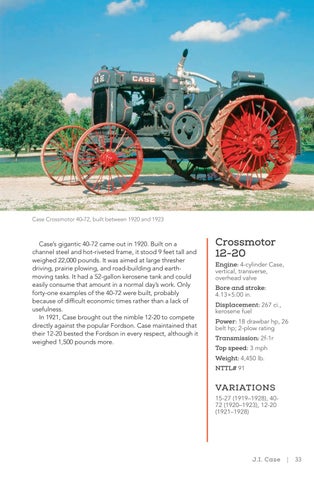
Case Crossmotor 40-72, built between 1920 and 1923
Case’s gigantic 40-72 came out in 1920. Built on a channel steel and hot-riveted frame, it stood 9 feet tall and weighed 22,000 pounds. It was aimed at large thresher driving, prairie plowing, and road-building and earthmoving tasks. It had a 52-gallon kerosene tank and could easily consume that amount in a normal day’s work. Only forty-one examples of the 40-72 were built, probably because of difficult economic times rather than a lack of usefulness. In 1921, Case brought out the nimble 12-20 to compete directly against the popular Fordson. Case maintained that their 12-20 bested the Fordson in every respect, although it weighed 1,500 pounds more.
Crossmotor 12-20 Engine: 4-cylinder Case, vertical, transverse, overhead valve Bore and stroke: 4.13×5.00 in. Displacement: 267 ci., kerosene fuel Power: 18 drawbar hp, 26 belt hp; 2-plow rating Transmission: 2f-1r Top speed: 3 mph Weight: 4,450 lb. NTTL# 91
VARIATIONS 15-27 (1919–1928), 4072 (1920–1923), 12-20 (1921–1928)
J.I. Case
332616 - Field Guide to Classic Farm Tractors_001-256.indd 33 332616 - Field Guide to Classic Farm Tractors_001-256.indd 33
Text
|
33
3/7/20 2:25 PM 3/7/20 2:16 PM
Title: 332616 - Field Guide to Classic Farm Tractors Page: 33
tors : 50
JOHN DEERE
C, GP, AND GPWT In the 1920s, Deere worked on motor cultivators. Although those didn’t pan out, the work done was the basis for an all-purpose experimental tractor, built in 1926. Improved versions led to what became known as the C in 1927. The C was renamed the GP (“general purpose”) in 1928 because “C” and “D” sounded so similar, especially on telephones of the time. The GP used an arched front axle in order to straddle the center of three rows for crop cultivation. In 1930, a tricycle version was introduced, called the GPWT, or GP Wide-Tread—a concession to farmers who didn’t take to the three-row concept. These received engines with a bore diameter increased by 0.25 inches. The engine had lower compression and did not use water injection. Also in 1930, GPWTs were converted to a GP-P (potato) configuration, with a 68-inch rear-wheel tread. The following year, improvements made for the GPWT were incorporated into the rest of the GP line, to which the GPO (orchard) had been added.
SPECIFICATIONS
1928 GP Engine: 2-cylinder, horizontal, side-by-side, side valve (L-head) Bore and stroke: 5.75×6.00 in. Displacement: 312 ci., kerosene fuel Power: 17 drawbar hp, 25 belt hp; 2-plow rating Transmission: 3f-1r Top speed: 4 mph Weight: 3,600 lb. NTTL# 153
1931 GP Engine: 2-cylinder, horizontal, side-by-side, side valve Bore and stroke: 6.00×6.00 in. Displacement: 339 ci., distillate fuel Power: 18.86 drawbar hp, 25.36 belt hp; 3-plow rating Transmission: 3f-1r Top speed: 4.25 mph Weight: 4,925 lb. NTTL# 190
VARIATIONS C, GP, GPWT, GP-P, GPO (all variations 1928–1935)
1928 John Deere GP
John Deere
332616 - Field Guide to Classic Farm Tractors_001-256.indd 51 332616 - Field Guide to Classic Farm Tractors_001-256.indd 51
Text
|
51
3/7/20 2:25 PM 3/7/20 2:16 PM
Title: 332616 - Field Guide to Classic Farm Tractors Page: 51
above
1939 Farmall F-20
opposite top
1942 Farmall H
opposite bottom
1956 Farmall 300
picked up the nickname “Farmall Regular.” There was also a golf-course version called the Fairway instead of Farmall. In 1937, the livery was changed from gray to red. Early Farmalls had cable-operated brakes linked to the steering. Brake pedals replaced the cables in 1939. Later that year, the completely updated Farmall H appeared, styled by famous industrial designer Raymond Loewy. It had a more powerful engine, with 153 cubic inches. The H was produced until 1952, when it became the Super H, with 164 cubic inches. The Super H in turn became the 300 in 1954 (169 cubic inches) and 350 in 1956, the diesel with 193 cubic inches. All variations of the Farmall series used four-cylinder overhead-valve engines. The H received a five-speed transmission, the Super H got hydraulics, and the 300 had an optional Torque Amplifier power shift half-step auxiliary. Gasoline, LPG, and diesel versions of the 350 were available. Continental made the 350’s diesel engine.
International Harvester Farmall H Engine: 4-cylinder, vertical, inline, overhead valve Bore and stroke: 3.38×4.25 in. Displacement: 153 ci., gasoline fuel Power: 20 drawbar hp, 24 belt hp; 2-plow rating Transmission: 5f-1r Top speed: 16 mph Weight: 3,875 lb. NTTL# 333
VARIATIONS
108
|
Regular (1924–1931), Regular and Fairway (1926– 1931), F-20 (1932–1939), H (1939–1952), Super H (1952–1954), 300 (1954– 1956), 350 (1956–1958)
The Big Boys
332616 - Field Guide to Classic Farm Tractors_001-256.indd 108 332616 - Field Guide to Classic Farm Tractors_001-256.indd 108
Text
3/7/20 2:26 PM 3/7/20 2:16 PM
Title: 332616 - Field Guide to Classic Farm Tractors Page: 108
AVERY
RO-TRAK
The Ro-Trak was Avery’s final effort after several reorganizations. The Ro-Trak’s feature was that it was convertible from a narrow-front to a wide-front configuration by simply pulling pins and swinging the front wheel castings from the side to the front, or vice versa. Since there was no axle pivot as on a conventional front end, the vertical tubes contained soft springs to allow the front wheels to go over bumps without frame twist. An unusual result was that when the operator applied the brakes, the front dipped like a soft-sprung car. The Ro-Trak was not tested at the University of Nebraska, but it was rated by the company for two to three 14-inch plows. Production began in 1938 and ended when World War II began.
SPECIFICATIONS
Ro-Trak Engine: Hercules 6-cylinder, L-head Displacement: 212 ci, gasoline fuel Power: 30 belt hp, 2-3 plow rating Transmission: 3f-1r Top speed: 17 mph Weight: 4,000 lb. NTTL# None
1938 Avery Ro-Trak
180
|
Those That Also Ran
332616 - Field Guide to Classic Farm Tractors_001-256.indd 180 332616 - Field Guide to Classic Farm Tractors_001-256.indd 180
Text
3/7/20 2:27 PM 3/7/20 2:16 PM
Title: 332616 - Field Guide to Classic Farm Tractors Page: 180
tors 188
COCKSHUTT
MODELS 40, 50, AND 35 The Cockshutt 40, besides being somewhat larger than the 30, was distinguished by its over-the-engine steering arrangement. It used a Buda 230-cubic-inch six-cylinder engine in gasoline, distillate, and diesel fuel versions. The transmission had six speeds forward and two in reverse. Narrow and wide front ends were available, and live PTO and hydraulics were options. The 40 was sold in the United States as the CO-OP E4.
SPECIFICATIONS
40 Engine: 6-cylinder, vertical, inline, overhead valve Bore and stroke: 3.44×4.13 in. Displacement: 230 ci., gasoline fuel Power: 30 drawbar hp, 41 belt hp; 3-plow rating Transmission: 6f-1r Top speed: 12.0 mph Weight: 5,305 lb. NTTL# 442
1958 Cockshutt 40 Deluxe Gasoline
Cockshutt
332616 - Field Guide to Classic Farm Tractors_001-256.indd 189 332616 - Field Guide to Classic Farm Tractors_001-256.indd 189
Text
|
189
3/7/20 2:27 PM 3/7/20 2:16 PM
Title: 332616 - Field Guide to Classic Farm Tractors Page: 189