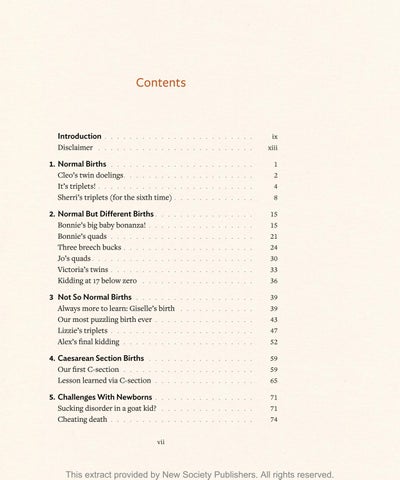
Contents
Introduction . . . . . . . . . . . . . . . . . . . . . . . . Disclaimer . . . . . . . . . . . . . . . . . . . . . . . . .
xiii
1. Normal Births . . . . . . . . . . . . . . . . . . . . . . .
1
Cleo’s twin doelings . . . . . . . . . . . . . . . . . . . . . It’s triplets! . . . . . . . . . . . . . . . . . . . . . . . . . Sherri’s triplets (for the sixth time) . . . . . . . . . . . . .
2
2. Normal But Different Births . . . . . . . . . . . . . . . .
15
Bonnie’s big baby bonanza! Bonnie’s quads . . . . . . Three breech bucks . . . . Jo’s quads . . . . . . . . . Victoria’s twins . . . . . . Kidding at 17 below zero .
. . . . . .
. . . . . .
. . . . . .
. . . . . .
. . . . . .
3 Not So Normal Births . . . . . . . . . . . . . . . . . . .
39
. . . .
. . . . . .
. . . .
. . . . . .
. . . .
. . . . . .
. . . .
. . . . . .
. . . .
. . . . . .
. . . .
. . . . . .
. . . .
. . . . . .
. . . .
. . . . . .
. . . .
. . . . . .
8
15
. . . .
. . . . . .
4
. . . . . .
Always more to learn: Giselle’s birth Our most puzzling birth ever . . . . Lizzie’s triplets . . . . . . . . . . . Alex’s final kidding . . . . . . . . .
. . . . . .
ix
. . . .
21 24 30 33 36
. . . .
39
4. Caesarean Section Births . . . . . . . . . . . . . . . . .
59
Our first C-section . . . . . . . . . . . . . . . . . . . . . Lesson learned via C-section . . . . . . . . . . . . . . . .
59
5. Challenges With Newborns . . . . . . . . . . . . . . . .
71
Sucking disorder in a goat kid? . . . . . . . . . . . . . . . Cheating death . . . . . . . . . . . . . . . . . . . . . . .
71
43 47 52
65
74
vii
This extract provided by New Society Publishers. All rights reserved.
viii
Contents
You save some . . . . . . . . . . . . . A blind kid? . . . . . . . . . . . . . . . Linguine update—the not-so-blind goat . Lessons in neonatal goat care . . . . . .
. . . .
. . . .
. . . .
. . . .
. . . .
. . . .
76
6 Death. . . . . . . . . . . . . . . . . . . . . . . . . . . .
87
Farewell and thank you, Coco . . . . . . . . . . . Our most challenging birth . . .with a happy ending Some decisions just suck . . . . . . . . . . . . . Farewell, Sadie . . . . . . . . . . . . . . . . . .
. . . .
. . . .
. . . .
. . . .
. . . .
. . . .
. . . .
. . . .
77 80 81
. . . .
100
7. Final Thoughts . . . . . . . . . . . . . . . . . . . . . . .
103
Index . . . . . . . . . . . . . . . . . . . . . . . . . . . .
107
About the Author . . . . . . . . . . . . . . . . . . . . .
113
About New Society Publishers . . . . . . . . . . . . . .
114
This extract provided by New Society Publishers. All rights reserved.
89 94 98
1
NORMAL BIRTHS
Although 95 percent of goat births don’t require intervention, you don’t know if your 5 percent will happen after you’ve had fifty or eighty goats give birth or if it will happen when your first goat gives birth. I have one friend who had two or three does for fifteen years before she had to assist in a birth. On the other hand, someone bought two does from me, and the first birth ended with both kids dying when they were about nine hours old because they never nursed and she didn’t know that was a problem. The second birth involved a kid that needed assistance to be born and the doe died a few hours later. But if you have never seen a normal birth, how do you know if the goat in front of you is acting normally? It is fairly common for new goat owners to think that something is wrong when everything is going fine. It seems that if you could just see a birth or two, you wouldn’t worry as much. Right? Chapters “Normal Births” and “Normal But Different Births” tell stories of normal births and how “normal” humans respond. You will see that it is normal for us to wonder if everything is okay, even after having seen quite a few goats give birth. After a few years, my motto became “If the goat is happy, I’m happy,” and even after eighteen years of seeing goats give birth, I still chant that in my head when I start to wonder if everything is okay.
1
This extract provided by New Society Publishers. All rights reserved.
2
Goats Giving Birth
WED APR 14 2010
Cleo’s twin doelings
We had a visit last weekend from Sarah, our apprentice from November. She came back because she wanted to see a goat give birth. Starting on Thursday, Cleo’s ligaments were so soft that I kept thinking she was going to give birth “pretty soon.” When I left for a speaking engagement in Chicago on Thursday, I figured she’d give birth later that night. When I left to pick up pigs on Friday, I figured she’d give birth while I was gone. When I got home with the piglets, however, Mike and Sarah said that Cleo had been waiting for me. I went into the barn and sat down on the straw with her. She gave me more kisses than I’ve ever had from any goat. She licked my face and my neck over and over as I sat with her in the kidding pen. She kept making little two-syllable “ma-a, ma-a” bleats. She kept looking at my lap and pawing at my legs. I could tell she was thinking about crawling into my lap. She would lie down next to me on one side, and then almost immediately, she would get up again, turn around, and lie down on her other side. She was clearly uncomfortable. I went to the walnut grove where Mike and Sarah were finishing repairs on the fence before releasing the piglets into their new home. “Cleo is getting close,” I said to Sarah. “You don’t need to hurry, but I’m not sure if I’ll be able to come get you later.” Sarah came with me, and when we got back to the barn, I could tell that Cleo was very serious about giving birth. She was no longer making the little bleating sounds. Instead, a whispery moan escaped her throat with each push. She lay on her side and pushed her legs out in front of her body. Her big belly almost caused her to roll onto her back, but she jerked and pulled herself upright again. “No matter how many times you see this, you always get to a point where you feel like it’s taking too long,” I said to Sarah. “But really, she’s fine. There’s no sign that anything is wrong.” Finally, a hoof started to peek out, then a second hoof. “This is exactly the way it’s supposed to be,” I said. “First the front hooves,
This extract provided by New Society Publishers. All rights reserved.
Normal Births
3
then the nose.” And as if it were scripted, a nose appeared. “This is a textbook birth.” The whole head appeared, and the body quickly followed. I put the little doe up by Cleo’s face, so she could help me clean it off. While Cleo licked her baby, I wiped it with a towel. The little doe shook her head and sneezed. Within minutes, she was scooting around the straw performing the goat baby equivalent of crawling. Cleo stood up and lay down a couple times. Then she seemed to stare off into the distance as if concentrating on something that none of us could see. I said to the little doe, “Okay, kid, you’re on your own. It’s time for mommy to birth another baby.” And the second kid was born quickly. Two does! Of the sixteen kids born so far this year, twelve are does. When you raise dairy goats, that’s the equivalent of winning the lottery. Of course, we are only halfway through kidding for the year, and things could turn around, but I’m enjoying the dozen little does in the barn at the moment. And yeah, I’m keeping one of these.
Usually Cleo was a very aloof doe. She was not a cuddly goat the rest of the year. But I always knew when she was in labor because she suddenly became the friendliest doe on the farm. This birth occurred after we’d been raising goats for eight years, and, thankfully, I was learning patience by then. It is important that there not be a big audience when a doe is in labor. Over the years, we have had a lot of interns during kidding season, but it has never been more than one at a time, and the goats usually get a chance to know the intern before giving birth. It’s important for goats to feel safe when they are in labor, or their contractions may not be productive. Remember, they are prey animals and are always wondering if a new stranger is going to eat them. Twice we’ve had does go into labor during an open farm day, and in both cases, labor was unusually long and the doe didn’t give birth until almost everyone was gone. In the case of the second doe, I was ready to take her to the university vet clinic and told my husband
This extract provided by New Society Publishers. All rights reserved.
4
Goats Giving Birth
to get a dog crate loaded into my car as soon as the event ended. Luckily, it took him forty-five minutes, because when he came back to tell me it was ready, she was pushing, which saved me a two-hour drive — and the experience of delivering baby goats in my car! So, as tempting as it is to invite guests for your goat births, it’s not a great idea.
•••
Sherri cranes her neck as she begins to push out the second kid while the first kid lies next to her.
The next two births are both with Sherri, the fifth doe that I purchased when starting my herd. She was retired after kidding when she was 10 years old and then enjoyed 6 1/2 more years in the pasture with her daughters before passing away peacefully while napping one afternoon. She never had any kidding problems. The irony, however, is that having seen fewer than a dozen goats give birth by 2005 when she first kidded on our farm, we thought she was having difficulties, which I describe in the first post below. I often think of Sherri’s first birth on our farm when new goat owners are worried about a goat that they think is in labor.
THU FEB 16 2006
Three separate bubbles begin to emerge, and you can see white hooves in the top one.
It’s triplets!
Sorry I haven’t posted in a few days, but I am recovering from four days in bed with the flu. Last night, however, I got a welcome back to the real world gift of three new baby goats! When I went to the bathroom at 1:00 a.m., I heard a goat over the baby monitor. There
This extract provided by New Society Publishers. All rights reserved.
Normal Births
is only one reason a goat makes noise in the middle of the night, so I grabbed my clothes and got dressed as quickly as I could. Sherri was at day 149 as of midnight, and normal gestation is 145–150 days for Nigerian dwarfs. I grabbed a big stack of clean towels and ran out into the unseasonable thunderstorm and headed for the barn. I wasn’t more than twenty steps into the barn when I heard the familiar squeak of a newborn kid. I ran up to Sherri’s stall to see one baby on the ground while mama was working on bringing the second one into the world. I dropped to my knees to start drying the one already born, keeping my eyes on Sherri the whole time. When the big bubble of fluid popped and a head emerged, I placed the first baby under the heat lamp and caught the second baby as it was sliding into the world. In the middle of drying off that one, I realized I didn’t know if they were boys or girls, so I looked between their hind legs, thrilled to discover that both were does! Sherri stood up so casually I wondered if she would be having only two this year, even though she’s always had triplets before. As she licked her two little daughters, the gold and white one started bopping her mama’s chest, stomach, neck, etc., looking for her first meal. After a few minutes, Sherri plopped down again, and I’m not even sure that she made a sound as she easily gave birth to baby number three,
5
The head is out, but the sac is still intact. If it doesn’t break or get broken before the umbilical cord breaks, the kid could suffocate.
I use my fingernails to rip the amniotic sac and pull it off the kid’s face as he is being born. I would have done it a little sooner, but Sherri was pushing him out too fast!
This extract provided by New Society Publishers. All rights reserved.
6
Goats Giving Birth
I’m continuing to pull membranes off the face and wipe off mucus so that the kid’s airway is clear and he can breathe.
I place the second kid near Sherri’s face so she can lick him and start to bond.
a buckling. Within a couple of minutes, she was once again standing and licking her babies. I stayed with them for about an hour until I started to feel weak and dizzy and a little sick to my stomach. I realized that I probably should not be spending too much time in the barn while I’m still recovering from the flu. I went inside and woke up my youngest to go sit with the babies to make sure everyone was nursing. Although the little gold doeling figured out the nursing thing very quickly, the other two were still pretty clueless. Sherri’s birthing this year was so much better than last year, even though 1:00 a.m. births are not my favorite. Her labor went exactly as last year’s, but our reaction was different. Sherri spent two or three days really looking like she was in labor. She’d lie down and push her legs out in front of her, or she’d squat and push. It really looked like she was in labor. Last year, I posted a message on a Yahoo goat group, asking for advice after two days of Sherri’s unusual labor, and most people responded with all sorts of dire possibilities. My daughters were quite worried and convinced we needed to intervene. Finally, we did a vaginal exam to discover that she had not even started to dilate. The next day, however, she gave birth to her babies in the pasture during the fifteen minutes when no one was out there!
This extract provided by New Society Publishers. All rights reserved.
Normal Births
This year, as I was lying in bed sick, the girls gave me reports from the barn regularly. Finally, it occurred to me that Sherri gives birth just like I do. It took me a day or two of labor with each of my three children. My body would putz around having contractions that irritated me and even hurt, but they didn’t do anything to actually get the baby out. But when my body did finally decide it was time to give birth, they each came flying out in record time: I pushed for twenty-five minutes with my first, twenty minutes with my second, and one really big push birthed my third child. That’s what Sherri is like. She putzes around for days, but when her body is ready, the babies come flying into the world. This year, I was determined to honor her unique way of giving birth.
In addition to being a great example of a normal goat birth, this story illustrates how goats will give birth whenever they need to give birth. You may be asleep or in the middle of lunch (as the next story shows), and there will be days when it is not convenient for you. You may even be sick, but the goat is going to give birth if it’s time. Many of us joke that goats purposely give birth at the most inconvenient time. Of course, that’s not true. It sure seems like it, though! Looking back on this now I really wish that I had a video of what I thought was “pushing,”
7
Sherri stands up and continues licking the first two kids while a couple of bubbles hang out of her back end.
Sherri is still standing but kid number three gets closer to making his appearance. You can see him just beginning to present.
This extract provided by New Society Publishers. All rights reserved.
8
Goats Giving Birth
The head is out, and once again Sherri is pushing so
because it clearly was not real pushing. Goats do not push for two days before giving birth to perfectly healthy kids. A goat is not really pushing until it is craning its neck, curling its tail over the back, and either holding its breath or letting out some kind of noise. I often think of Sherri’s first birth on our farm when a new goat person tells me that their goat has been pushing for hours or that it has been in labor for days. I always ask them to explain exactly what they mean by that. Pushing is exhausting, and most does can’t do it for more than a couple of hours. Then they just lie down and give up, and contractions get farther and farther apart until they stop entirely, which you will see in some of the later stories.
fast that I’m not able to break the sac as quickly as I’d like to. THU MAY 13 2010
The kid’s body is out, and I still haven’t been able to break the amniotic sac.
Sherri’s triplets (for the sixth time)
Sherri is 7 years old, and she came to live here as a yearling. Her breeder said not to worry about kidding difficulties. As a yearling, Sherri kidded in the pasture with triplets while her owner was preparing a kidding pen for her. Well, “Don’t worry” is subjective. It kind of depends on what you want to worry about. I do not have to worry that she’ll have any sort of dystocia. Her pelvis is big enough for a Mack truck to go through at top speed. However, there are other things to worry about. As a 2-year-old here, we thought she was in labor for two days, and we kept her
This extract provided by New Society Publishers. All rights reserved.
Normal Births
in the barn. Then I finally decided that we had no clue what was happening, so we let her go out into the pasture. About fifteen minutes later, my son reported that there were three kids in the pasture with her, and one wasn’t looking good. When I got there, I thought it was dead, but my daughter insisted it was alive. We took the tiny doeling into the house and put her in a sink of warm water because she was ice cold and clearly suffering from hypothermia. She finally snapped back into the world, and she grew up to be a fine doeling. I, however, am still traumatized by the experience five years later. Sherri gives birth too efficiently — so easily that she doesn’t have time to clean off the three or four kids that she always births. Every year, Sherri makes me think she’s going to kid any minute now for about two days. This year (as in years past), I thought that I was older, smarter, wiser, and I’d know. Right? Wrong! For two days, I kept thinking that she was going to kid soon. On Saturday, although she didn’t act like she was in labor, her belly was hollowed out between her ribs and hips and her ligaments were so soft that they could be gone any minute. Her udder didn’t look like it was ready to explode, but there’s a little wiggle room in that particular criterion. On Sunday, we had tickets to a Broadway play in Chicago, and I tried to explain the situation to Sherri, but she
9
I finally am able to dig my fingernails into the sac as another bag of amniotic fluid is coming out with the kid.
The toughness of the amniotic sac can vary from birth to birth. Most of them are not difficult to break, although it’s easier to do if you are not wearing gloves. Being able to use your fingernails definitely makes it easier.
This extract provided by New Society Publishers. All rights reserved.
10
Goats Giving Birth
looked at me like I was nuts. “Could you please have your kids now? Within the next hour?” Nope. Katherine stayed home on kid watch. Even though Sherri wasn’t showing signs of labor, she can go from zero to three kids in about twenty seconds. So Katherine waited . . . and watched . . . and waited . . . and watched . . . and you get the idea. Sherri did not kid Sunday while we were at the play. Monday morning, the ligaments were gone, so I knew it would be soon. But the thing about Sherri is that she is the most stoic goat in the world. She makes NO sound until the kid is actually being born — as in, the kid is shooting out at that moment. Logic and science not being on my side, I decided to trigger Murphy’s Law to get Sherri to go into labor. I told Katherine that I was going to make some bran muffins. I figured that I’d be in the
I use my fingers like a squeegee to clean off the kid’s nose so he can breathe.
This extract provided by New Society Publishers. All rights reserved.
Normal Births
11
middle of making muffins when Sherri would start to give birth, because that would be really inconvenient. I peeled and diced an apple, mixed up the muffins, put the muffin batter in the oven, and still no sound from the kidding barn. Fine! I’ll have lunch! I heated up some leftover tamale pie that we’d had for dinner the night before, and I sat down. I took a bite . . . and “Maaaaaaaa!” came over the baby monitor. Katherine looked at me and laughed as I said with a mouthful of food, “ONE bite!” “I’ll check on her.” Katherine said. A moment later, as I was in the middle of my second bite, I heard her scream over the monitor, “Baby!” With my mouth full of tamale pie, I pulled off my reading glasses and dropped them on the table, dashed to the front door,
Then I use a towel to get even more mucus off his nose. Yes, Sherri gave birth standing up. It’s not terribly common, but sometimes goats do it. When I saw the thick umbilical cord to the left of the membranes, I started to think that she might be done and there would be no more kids.
This extract provided by New Society Publishers. All rights reserved.
12
Goats Giving Birth
pulled on my shoes, and ran across the yard towards the barn. (Note: Chewing and running are really not compatible activities. Do NOT try this at home!) I arrived at the kidding barn as I was swallowing my tamale pie, trying not to inhale anything and choke. Katherine was laughing about Sherri’s impeccable timing, and I suggested that she retrieve her brand new camera from the house so that we could get pictures. (She’s been saving her money for months to buy a fancy DSLR camera.) She took my advice and then proceeded to take more than one hundred photographs of the birth. Sherri took an unusually long time between kids this year. For her, that means we were able to get each one dried off before the One of Sherri’s kids finds his first meal within minutes of being born! Unfortunately, the camera snapped before he really had a good latch on the teat. In this photo, he has only about half of it in his mouth, which would be uncomfortable for Sherri if he continued nursing like that. Luckily, most kids realize quickly that they need to have the entire teat in the mouth while nursing. The tongue should cover the lower teeth. You’ll notice that he is not standing up but rather is on his knees to be able to access the teat. Only the tiniest of kids with the tallest of moms would stand up to nurse.
This extract provided by New Society Publishers. All rights reserved.
Normal Births
13
next one was born. It was really fun compared to most years, when she is shooting them out faster than we can dry them or even check the gender of each kid. The first two kids were does, and then she had a buck, which was pretty cool because that is exactly what was reserved from her. So, yes, that means that all these sweet little darlings are going to another farm to live. But that’s okay, because this was a repeat breeding of the one that produced Jo, whom I dearly love. She fed triplets last year as a first freshener, so she’s an awesome little milker. Back at the ranch, uh, house, the timer on the oven was going off. Luckily, Jonathan (my son) was still inside, and he knew it was for the muffins, so he pulled them out of the oven. No one, however, knew that I had put my big tomato plants out on the deck for their hardening off time. When I went back inside an hour later and saw them out there, they were only a little wilted, and I pulled them inside immediately.
Sherri is one of those goats who gave birth here nine times. Her second stage of labor was always faster than average. If we had not understood that every birth is different, there might have been times we would have been worried about her. In fact, when she was 10 years old, she was in labor when I got a call that some of our llamas were at a farm about half a mile away. We had an intern at the time, and I told her that I was going to go get the llamas because I wasn’t worried about Sherri. The intern had already attended several births, so she knew the basics of drying off kids when they were born, and that’s all that likely would be needed with Sherri. I told her that if by chance the kid wound up being in some weird position, it wouldn’t be an emergency situation and that she could just call me and I’d come back. After about half an hour I got a call on my cell. The intern was worried that something was wrong because Sherri was pushing but the kid wasn’t coming out. I told her not to worry, reiterating the goat’s excellent birthing history and that we had plenty of time. It was
This extract provided by New Society Publishers. All rights reserved.
14
Goats Giving Birth
obvious that she was very worried in spite of my attempt to reassure her, so I told her I was on my way back and that she should not do anything to intervene in the meantime. When I arrived, I found the intern toweling off a newborn kid. We named the doeling Sophie Kinsella because all of Sherri’s kids were named after authors. Sophie still lives with us today and has the same excellent birthing ability as her mom. Seeing the birthing ease that Sherri and all of her daughters, granddaughters, and great-granddaughters display is one of the reasons I am so committed to not interfering in every birth. I want to have goats that have the natural ability to give birth easily. I don’t feel like I am doing the breed any favors by routinely doing a vaginal check on every doe, rearranging kids that are still high in the uterus, and then pulling kids. How do you know if a goat gives birth with ease if you never let her try to do it on her own? If you’ve read this far, you know that I want to be at every birth just in case, but if a doe repeatedly needs help birthing her kids, I won’t continue to breed her because I don’t want to perpetuate those genetics.
This extract provided by New Society Publishers. All rights reserved.