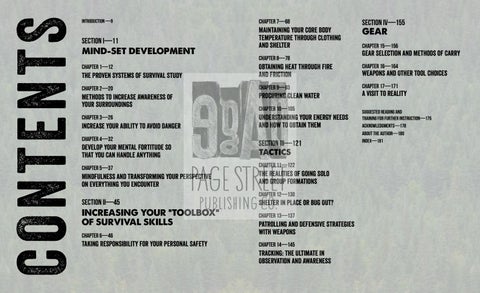
CONTENTS
Introduction —9
Section I—11
MIND-SET DEVELOPMENT
chapter 7—68
Maintaining Your Core Body Temperature through Clothing and Shelter chapter 8—78
section IV—155
GEAR
chapter 15—156
Gear Selection and Methods of Carry chapter 16—164
The Proven Systems of Survival Study
Obtaining Heat through Fire and Friction
chapter 2—20
chapter 9—93
chapter 17—171
chapter 1—12
Methods to Increase Awareness of Your Surroundings chapter 3—26
Increase Your Ability to Avoid Danger chapter 4—32
Procuring Clean Water chapter 10—105
Understanding Your Energy Needs and How to Obtain them
Develop Your Mental Fortitude So That You Can Handle Anything
sECTION III—121 TACTICS
chapter 5—37
chapter 11—122
Mindfulness and Transforming Your Perspective on Everything You Encounter
The Realities of Going Solo and Group Formations chapter 12—130
section ii—45
Shelter in Place or Bug Out?
INCREASING YOUR "TOOLBOX" OF SURVIVAL SKILLS
chapter 13—137
chapter 6—46
Patrolling and Defensive Strategies with Weapons
Taking Responsibility for Your Personal Safety
chapter 14—145
Tracking: The Ultimate in Observation and Awareness
Weapons and Other Tool Choices A Visit to Reality suggested reading and training for further instruction—175 Acknowledgments—178 About the Author—180 Index—181
INTRODUCTION Various studies have proven as irrefutable fact that being in the wilderness is healthy, and not only from a purely physical perspective, either. Many people have found incredible growth in mind, body and spirit by wilderness travel. Challenges and rewards await those who endeavor to spend more time hiking, hunting and otherwise enjoying a rural, wooded environment. I must also note that there are numerous stories of people perishing, being injured or becoming sick in these same types of environments. My goal for you is to spend more time outside and gain the benefits while avoiding the pitfalls that so many ignore and pay dearly for. I have spent the better part of four decades outdoors. I am a wilderness scientist of sorts, constantly studying the effects of wilderness experiences on my own mind-set, skills, tactics and gear. I have spent several weeks in the wilderness with nothing more than a knife, “living off the land.” Each year, I teach outdoor pursuits to hundreds of people of varying skill and age levels and I have experienced much that needs to be shared. In this book, you will have the opportunity to gather insight into what it takes to comfortably make it in the outdoors. I will help you strengthen your mind-set first. It is absolutely critical to your survival. Use this book at home or in the woods as a resource to build your skills and ability to work with others. I will also detail the systems of carry for modern and primitive gear that will make your wilderness stay more comfortable. You will learn from my experiences, and those of others, as I share survival stories from the real world. I will then break each story down and determine what went right and what went wrong. In this manner, you can keep yourself and those you care for out of danger. I will also discuss the many aspects of wilderness survival, including primitive and modern methodology for personal safety, shelter, water and food. At my Nature Reliance School, our motto has always been, “Where practical meets natural.” This book is an extension of that. You will learn what works from old-school primitive means when there is no equipment available alongside more modern methods and gear. My goal is for everyone in the world to be more self-reliant. It brings you power, it brings you comfort and it makes you more prepared. Another favorite mind-set of my school community is, “Come on, join in, let’s learn together.” I thank you for joining me in that endeavor. I am most honored and humbled you have chosen this book to help you.
9
CHAPTER 4
Develop Your Mental Fortitude So That You Can Handle Anything ranger school did not teach me how to be ten feet tall and bulletproof. it taught me how to recognize that I was reaching my limits, both mentally and physically, and then make the appropriate adjustments with myself and my team to accomplish the task at hand. —Paraphrase of comments made by a U.S. Army Special Forces soldier
For many years, Ranger school proved to be some of the most demanding training offered in the United States military. Ranger candidates go through various phases of training to earn the coveted Ranger tab. One such phase often takes place in the swamps of Florida. It was there that tragedy struck for the Rangers. From published accounts of the incident in 1995, it was revealed that several Ranger candidates were nearing the completion of Ranger training. After a morning boat exercise, they had been tasked to enter the water and build some rope bridges. This particular area of water was deeper than it normally had been in the past. For much of this exercise, the candidates were in waist-deep
32
EXTREME WILDERNESS SURVIVAL
(and sometimes chest-deep) water. The 52°F (11°C) water temperature was nearing the bottom threshold of 50°F (10°C) required for training to be cancelled. The air temperature was in the 60s Fahrenheit (in the 10s Celsius), meaning this was a situation where hypothermia was very possible. That is exactly what happened to several candidates that day. Ranger instructors recognized that hypothermia was setting in for some of them. A decision was made to extract several of the candidates showing signs of hypothermia, such as uncontrollable shaking, slurred speech and loss of fine motor skills. Unfortunately for four of them, it was too late and they died of hypothermia-related issues. I would be out of line to second-guess the Ranger instructors on this situation, especially since I hold Ranger instructors in very high regard. With that said, there is one incredibly valuable lesson you can learn from this tragedy. All special operations personnel in the United States military, such as these candidates, are known to have what many would consider superhuman mind and body control. They overcome obstacles that many consider impossible. But the cold, hard facts are that the human body has limits. The key to surviving harsh environments is to recognize when you are in a situation where you are nearing those limits. Better yet, recognize a situation that could lead to those limits being pushed and plan accordingly. Preparing for war is similar to an actual war in that it is an ugly, convoluted mess of exercises that will sometimes lead to someone’s death. For special operations personnel, that is a hazard of the job. For the rest of us, you can stay mentally and physically strong as well. You must recognize your limits and make changes when you are reaching them.
There is no shortage of research that has been done regarding mental strength and resiliency. The United States Army started its own program involving such research and established the Comprehensive Soldier and Family Fitness Program in 2008. While this is specific to the U.S. military, I have had many opportunities to speak to soldiers and their families on this topic. I have listened intently and adapted these practices to our needs in survival. The Army considers five distinct aspects of our lives when assisting soldiers in helping them achieve mental strength: physical, social, family, spiritual and emotional. It is worthy of our consideration to understand these various aspects of our lives and how they play out in our resiliency. To make it easier to understand and directly applicable, I have developed a list of ways to help you both overcome obstacles and increase the strength of your mind: ## Constantly improve yourself ## Recognize and release tension ## Be flexible ## Have a purpose ## Believe you are strong ## Have a sense of humor ## Stay positive ## Be healthy ## Be organized ## Work on your relationships
33
SECTION II
Increasing Your “Toolbox” of Survival Skills everyone has a plan until they get punched in the face. —Mike Tyson
Skills are the fun part of survival training as well as proper living. Everyone enjoys building a good fire, right? In this section, I want to delve into the skills you need to stay alive. I am going to show you the skills in order of importance as they relate to the Rule of Three priority scale, which will continue cementing the Rule of Three into your thought processes. In a world where sporting competitions are a primary source of entertainment, I will focus your attention on skills that consistently work without much technicality. It seems that even in the survival industry, coming up with new and creative ways of doing the most basic of skills is what garners the most attention. I want you to have skills not to impress others but to keep yourself alive. I am sharing the most important skills and the ones that can be duplicated under stress. This stress could be an injury (such as a broken arm) or if you have found yourself without gear. That is why I will show multiple ways of doing things with modern gear as well as primitive skills. In this section, I’ll also show you how to get out and practice these skills so you can make them your own. Be on the lookout for the sections titled “Put it into Practice.” You’ll learn them in such a way that you can combine as many skills as possible to make it realistic training.
45
Water Filtration Systems
A personal filter straw, Sawyer® Mini is shown, is a must-have gear item.
For family units or teams, a water pump, Katadyn® hiker PRO is shown, is a needed gear item.
Seizing upon this same scientific process, other companies manufactured materials into man-made filters that do the same thing.
chemical drops and tablets: There are many makers of
ceramic filter straws:
Similar in makeup to the ceramic straws, pumps are made much larger and use a pump alongside so that you can place one tube into an unknown water source and pump water into your container via the output tube on the other end.
pumps:
iodine drops and tablets: Iodine drops do not remove
the contaminants from a water source. They do, however, make them inert. A two-percent tincture is required to be an effective solution. You must use these sparingly. Only one to two drops are needed for 1 quart (1 L) of water. Any more than that and you could easily cause organ damage for yourself. More is not better with iodine.
102
EXTREME WILDERNESS SURVIVAL
other chemical additives. They work much the same way that iodine does in that they do not remove contaminants, they simply make them inert and they then pass through your digestive track without doing you harm. These are devices that work on batteries and emit UV light. You utilize them by placing the light into the container of water and stirring it around. The UV light does not “kill” the bacteria; rather, it makes them inert.
sterilizing pens:
There is so much information out there when considering these options. Please consider the following table to assist you in understanding the options available. Also note that the Ease of Use Under Stress category considers someone who is lost, making poor decisions and possibly injured. These are attributes of those that are in a real-life survival scenario rather than just training for one or otherwise camping. I graded each of these sections excellent, good, fair or poor.
FILTRATION SYSTEM
EFFECTIVENESS UNDER STRESS
TYPICAL USEFULNESS
EASE OF USE UNDER STRESS
COST (USD)
Stainless steel water bottle
Excellent
Excellent
Fair
10–20
Carbon filter
Good
Fair
Excellent
10–15
Ceramic filter
Good
Good
Excellent
15–20
Pumps
Good
Good
Good
>75
Iodine drops
Poor
Good
Poor
<5
Chemical drops
Poor
Good
Poor
<10
Sterilizing pens
Poor
Poor
Poor
>75
In summary, it would be my opinion that you have a multi-tiered approach, which would include: ## e ach person carrying their own stainless steel water bottle; ## each person carrying their own ceramic filter; and ## one person in a group carrying a water pump. This will allow each individual to carry water with them in the bottle, and when it runs out they can easily filter water on the individual level. When the need arises to set up a base camp, you can then use a pump to gather a large volume of water more easily.
Honorable Mentions When Cleaning Water Besides the methods just discussed, there are additional (albeit more unusual ways) to gather water: plastic bottle: You can boil water in a plastic bottle.
The key is to not put the bottle directly in the flame. The heat will transfer from the bottle to the water due to heat conduction. If there are any bubbles between the flame and the water, they will not conduct heat. You will experience a hole burned through at that location.
PROCURING CLEAN WATER
103
CHAPTER 11
The Realities of Going Solo and Group Formations alone we can do so little, together we can do so much. —Helen Keller
Skiing is a wonderful activity for families and thrill seekers who enjoy the rush of a controlled descent at high rates of speed. It was just such a rush that a nineteen-year-old woman was seeking in the winter of 2009 at a California resort. What exactly happened to this young lady will never be known. The temperature was in the 20s Fahrenheit (in the negative Celsius) with a slight breeze. There was poor visibility due to falling snow. This young lady had just started her day of skiing on that cold February day. Around 10 a.m., she skied down the hill and was separated from the party she was skiing with. Some friends and acquaintances had skied down before; others skied down after she had. After not seeing her at or near the bottom, it was assumed that she had gone skiing on another route. Slightly more than six hours later, she was reported missing at 4:40 p.m. A hasty search was put together by SAR personnel. She was found at 5:30 p.m., which was less than an hour since she had been reported missing.
122
EXTREME WILDERNESS SURVIVAL
She was found only a few feet from the ski runs, but was under approximately 16 inches (40 cm) of snow. She was declared dead at 7 p.m. You will undoubtedly note that from the time this young lady was lost until she was found was approximately seven hours. The time between when she was reported missing until she was found was fifty minutes. In the weather conditions experienced that day, you would be uncomfortable but alive if you were on your own for fifty minutes. It is those hours between when she went missing and when she was reported missing that cost her her life. If you ever come in contact with someone with military training, they can easily tell you about their “battle buddy.” In the military, your battle buddy is the person who goes to the shower when you shower, goes to the bunks when you go to bed, goes to the latrine when you take a poo. I think you get the idea. They go everywhere with you. This is done for safety. From the military perspective, it is too easy to get lost, kidnapped or injured when no one else is around. I am going to borrow that mind-set for this scenario here. The young lady in our tragic story went off alone with no accountability to where she was going. No specific person expected her at any time in particular. She then lost her way and no one was aware she was gone. If she had a “skiing buddy” that buddy would have known she was gone when she did not show up at the bottom of that run. In that situation, that person could have immediately notified SAR personnel. When she was discovered, she only had a thin top on and no boots. There was no apparent trauma. The coroner determined that she had died of hypothermia.
Since she was only a few feet from where others had skied throughout the day, it is evident that she was hard to see. Since she took off her jacket and boots at some point, we can assume she was conscious at the time she got lost. Therefore, she could have also easily used a safety whistle to bring attention to herself. She also could have placed some colorful bandana, portion of jacket or similar item on the outside of a tree she was stranded under to bring attention to that spot. Had she made herself more visible or blown a whistle, and had the authorities been notified sooner, she would be skiing another day. However, by the nature of her going off alone, she was incapable of making others aware of her location. This event illustrates the importance of being in contact with others for adventurous fun or in a survival-related event. In that regard, I want to focus our attention on how to best work with others.
Realities of Going Solo There were many explorers like Daniel Boone, Simon Kenton, Simon Girty and Lewis Wetzel (not to mention the dozens of unaccounted for Native Americans) that went into wilderness settings and lived solo for many months at a time. Please let me break some hard-to-hear news to you: you are not Daniel Boone. This seems to be lost on many in the reenacting, survival and prepping movements. One of the questions I ask new students at the beginning of my wilderness safety and survival classes is, “How many nights have you slept in a wilderness setting on the ground in the last year?” I will get answers ranging from zero to dozens of times. If I were to ask the same question of Boone or similar counterparts he would say, “Over three hundred.” For that day and time, there was a rougher and tougher breed of man. Nearly all had endured hardship to simply stay alive.
123