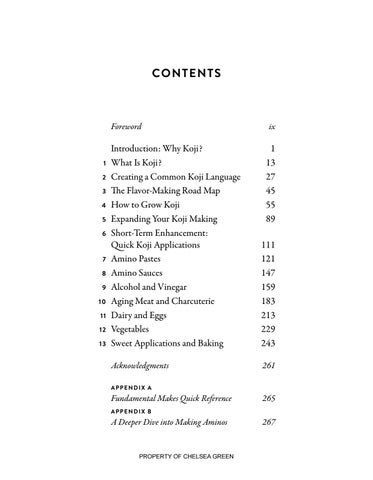
CONTENTS
Foreword ix
Introduction: Why Koji? 1 1 What Is Koji? 13 2 Creating a Common Koji Language 27 3 The Flavor-Making Road Map 45 4 How to Grow Koji 55 5 Expanding Your Koji Making 89 6 Short-Term Enhancement: Quick Koji Applications 111 7 Amino Pastes 121 8 Amino Sauces 147 9 Alcohol and Vinegar 159 10 Aging Meat and Charcuterie 183 1 1 Dairy and Eggs 213 1 2 Vegetables 229 1 3 Sweet Applications and Baking 243 Acknowledgments 261 APPENDIX A
Fundamental Makes Quick Reference
265
APPENDIX B
A Deeper Dive into Making Aminos
PROPERTY OF CHELSEA GREEN
267
APPENDIX C
Visual Charts of Koji Make Relationships
279
APPENDIX D
Food Safety
281
APPENDIX E
Dry-Cured Animal Foods HACCP Plan
287
Resources 311 Notes 315 Index 319
PROPERTY OF CHELSEA GREEN
KOJI ALCHEMY
An assortment of amino pastes in jars. Photo by Peter Larson.
Tamari at the top of a matzo ball amino paste. Photo by Peter Larson.
An assortment of amino sauces. Photo by Peter Larson.
Spent beer grain amino sauce. Photo by Peter Larson. —8—
PROPERTY OF CHELSEA GREEN
KOJI ALCHEMY
Amino paste made from Sub Edge Farm’s sunflower husks, a by-product of making sunflower seed oil. Photo by Andrew Wang.
Umami chili oil using sunflower barley douchi as a base. Photo by Andrew Wang.
Kim Wejendorp’s carrot scrap mirin. Photo by Andrew Wang.
Koji-cultured beet charcuterie. Photo by Peter Larson. —9—
PROPERTY OF CHELSEA GREEN
CHAPTER 1
What Is Koji?
Y
ou’re likely reading this book for one of two related reasons. Either you don’t know what koji is and you want to learn more about it, or you do know what it is and want to learn more about it. We don’t blame you, as we are learning more about it every day. Indeed, koji is an amazingly transformative and seemingly magical ingredient that has bewitched many people over thousands of years. As you’ll discover in this book, one of the many things koji does is turn complex carbohydrates into simple sugars via powerful enzymes it produces in order to feed itself. It is a type of mold used in the production of many foods such as miso, soy sauce, sake, jiang, douchi, amazake, makgeolli, meju, and tapai just to name some. Koji has been used for millennia throughout Asia and most recently, in the past 150 years or so, has been slowly conquering the rest of the world in ways that the people who first domesticated it could hardly conceive. Take the charcuterie that Jeremy makes at Larder Delicatessen & Bakery. After the meat is cured and inoculated with koji, the drying time is cut by as much as 60 percent. Imagine being able to make a prosciutto in six months instead of two years. —1 3 —
PROPERTY OF CHELSEA GREEN
KOJI ALCHEMY
Koji is an extremely powerful organic technology that has not only shaped the foods of various peoples but also ingrained and transformed their very cultures. Actually, virtually every culture that encounters koji or a food made with or from it becomes entranced by its transformative power. The Japanese have declared it their National Mold and have even created comic books in which it is featured as a cartoon character! We feel that in order to truly understand what it is and what it’s capable of, we must know a little about how, where, when, and why it came to be. When investigating these matters, it’s always best to start at the beginning in order to give a complete understanding. That beginning would be koji’s evolution.
The Origins of Aspergillus oryzae (aka Koji) The koji mold, Aspergillus oryzae (or, as we will refer to it going forward, simply koji), has a bit of mystique surrounding its origins. Due to rigorous scientific research, we know that koji evolved when it was domesticated from the highly toxic A. flavus. Dr. John Gibbons at Clark University in Worcester, Massachusetts, is currently leading the way in research related to how koji evolved away from its toxic ancestor, by identifying the traits and genetic changes that accompanied the domestication of A. oryzae. To address this topic he and his team sequence and compare the genomes of A. oryzae and its toxic progenitor species, A. flavus. They then use computational genomics, evolutionary biology, and population genetics to pinpoint genetic differences between domesticated and wild genomes. When the genetic differences are present in genes whose functions are known, they design laboratory experiments to test how these genetic differences change the characteristics of A. oryzae. They’re essentially attempting to use biology to understand the traits that ancient artisans selected for when they domesticated A. oryzae. These findings have evolutionary, cultural, historical, and applied significance, which makes this system so exciting to many of us. Why would an individual decide to conduct research on something so specific as koji? Well, when Dr. Gibbons went to college, he wasn’t fully aware of filamentous molds and their uses. He had always been a big-picture person and applied to graduate school knowing that he wanted —1 4 —
PROPERTY OF CHELSEA GREEN
What Is Koji?
to study genomics, indifferent as to what his specific organism would be. After interviewing with labs that studied fruit flies, humans, yeast, plants, and molds, Gibbons ended up joining Dr. Antonis Rokas’s lab at Vanderbilt University, where one of the major research areas was Aspergillus (the koji genus) genomics. Gibbons was given a stack of papers to read when he started at the Rokas Lab so that he could see which areas would be of most interest for him to research. One paper he read completely blew him away. He had assumed that only plants and animals had been domesticated by humans, but a number of papers called A. oryzae “domesticated.”1 One particular paper detailed how the publishing group used a combination of chemistry and archaeology to determine the contents of a nine-thousandyear-old pottery jar from China. They were able to show that the pottery held a fermented drink composed of rice, honey, and fruit, and that this type of fermentation required a mold that was really good at breaking down starches into sugar. It confirmed that humans have been making rice-based alcohol for nine thousand years through the help of filamentous fungi! The biology and genomics, cultural aspects, and applied side of this topic were exciting for Gibbons. With the promise of potential research ahead, Gibbons dove in on a quest to unlock the how, why, when, and where of koji’s domestication. For more than ten thousand years, humans have been taming plants and animals for particular characteristics. For example, domesticated plants usually produce more fruits or seeds than their wild progenitors thanks to selective breeding. Domestication has a profound impact on the genome of any given organism, and koji is no exception. Specific mutations underlie many of the traits selected for in domestication. For example, a single change in the genetic code of maize (corn) from its progenitor teosinte led to “naked grains” as opposed to the nearly impenetrable kernels of teosinte that are encased with silica and lignin. These mutations were shaped by selective breeding over long periods of time; when you simply compare the phenotype (essentially the way something looks) of teosinte with that of maize, you can easily observe these changes. And while plants and animals primarily shape our collective knowledge of the genomic and phenotypic effects of domestication, a number of bacteria, yeasts, and molds were also domesticated. —1 5 —
PROPERTY OF CHELSEA GREEN
KOJI ALCHEMY
We’ve read some of Dr. Gibbons’s papers about koji and its pathway to domestication, and they are nothing short of fascinating! To understand koji’s impact on various cuisines and cultures, we felt it important to establish an understandable timeline for its evolution and domestication. Dr. Gibbons points out that we define domestication as “the genetic modification of a species by breeding it in isolation from its ancestral population in an effort to enhance its utility to humans.” As we’ve noted, the domestication of koji occurred at least nine thousand years ago. Noncoincidentally, according to Dr. Gibbons, this is roughly the same time rice was domesticated (the two often go hand in hand). It makes sense that as rice was domesticated, the mold that eats it, koji, would follow suit in its new agricultural home. He also points out that people have been selling koji dating back to the thirteenth through the fifteenth centuries in China, a considerable amount of time before Western science even knew what microbes were.2 To put this into relative perspective, it would still be roughly three hundred years before Robert Hooke would first observe dead plant cells under a microscope, followed by others observing living organisms. The exact answers to the questions surrounding koji’s evolution and domestication are yet to be found, and the process is quite puzzling due to the fact that koji and its toxic ancestor, Aspergillus flavus, share 99.5 percent of their genome. But the important point is that koji has been used in food production in China since at least 7000 bce, making it one of the oldest domesticated foods on the planet.
Koji and Clean Water As with the domestication of many grains and fruits, koji can trace part of its pathway to domestication to people’s need for safe drinking water. Humans have been evolving for millions of years, and at some point during the course of our evolution, we lost the ability (one that many other animals retained) to avoid getting sick from ingesting contaminated water. Many pathogenic microbes exist in fresh water that can sicken us severely and in many instances lead to death. And one of the many things that sets us apart from other animals is the amount of waste we —1 6 —
PROPERTY OF CHELSEA GREEN