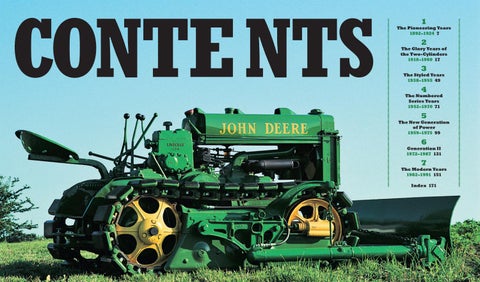
CONTE NTS
1
The Pioneering Years 1892–1924 7
2
The Glory Years of the Two-Cylinders 1918–1960 17
3
The Styled Years 1938–1955 49
4
The Numbered Series Years 1952–1970 71
5
The New Generation of Power 1959–1975 99
6
Generation II 1972–1987 131
7
The Modern Years 1982–1991 151 Index 171
Advertisements in Implement and Tractor, the British farm machinery trade journal, dated from September 1, 1915, to the end of 1918, show the tractor in its various styles from the early right-hand-radiator model to the vertical-fuel-tank Model R versions through to the 1919 Model N two-speed tractor still fitted with chain steering. In 1919, Martin changed the name of his company to Associated Manufacturers’ Company but retained the same Minories address in London and the Overtime Tractor Department. This firm later became importers of J. I. Case farm machinery. ABOVE RIGhT: The earliest known surviving Overtime R model R—and the only one shown in the records with two serial numbers, 1728 and 1747. In the records, under “1728,” it says, “see 1747,” which was shipped to L. J. Martin of London. Owner: The Lackham Museum, part of the Wiltshire Agricultural College, Lacock, Wiltshire, England. RIGhT: An Overtime supplied by Maundrell of Calne, England, at work plowing on Charles Vine’s farm near Calne during World War I. Vines is on the tractor, his wife on the plow. BELOW: A 1916 Overtime. Owners: Walter and Bruce Keller of Kaukauna, Wisconsin. Photograph © Randy Leffingwell
1924 Waterloo Boy N. Ralph W. Sanders/ Motorbooks Archive
10
M, had a 6.50x7.00-inch (162.5x175mm) engine. Strangely, the Model R was fitted with a single forward speed and chain steering, which was seemingly a step backward in progress. The two-speed Model N was introduced in 1917 and finally acquired automotivestyle steering in 1920 together with other modifications, including a higher fuel tank position and a riveted frame. In 1924, concurrent with production of the Deere Model D tractor, ninety-three Model N tractors were built to use up existing parts and numbered from 31320 to 31412.
ThE COMPLETE BOOK OF CL ASSIC JOhN DEE RE TR ACTORS
OVERTIME MODELS R AND N, 1916–1919 Due to the German submarine threat to the food supply of Great Britain during World War I, the Waterloo works sold some 4,000 Model R and chain-steer N tractors to L. J. Martin’s Overtime Farm Tractor Company of London. These machines were shipped in crates, assembled in the British company’s London works, and painted in the firm’s own color scheme of orange wheels, dark green frame and fenders, and gunmetalgray fuel tank, engine, and radiator.
1918 •CHAPTER 2•
THE GLORY
YEARS OF THE TWO-CYLINDERS
1960 ABOVE: A farmer uses all his strength to spin the flywheel and start his Model D tractor. (Library of Congress) OPPOSITE: 1935 Model A. Ralph W. Sanders/Motorbooks Archive
MODEL D, 1923–1925
ABOVE: A 1920 Waterloo Boy Model N Owners: Walter and Bruce Keller of Kaukauna, Wisconsin. Photograph © Andrew Morland
DEERE WATERLOO BOY MODELS A, B, AND C, 1918–1922
BELOW: Waterloo Boy advertisement. Motorbooks Archive
Following Deere’s 1918 purchase of the Waterloo Gasoline Engine Company for $2.1 million, Deere management decided to continue building the Waterloo Boy Model N. The recently purchased company had already been experimenting with an improved N. As
18
ThE COMPLETE BOOK OF CL ASSIC JOhN DEE RE TR ACTORS
they were exposed to dust and mud, the external final drives wore out quickly, so the first priority for a new model was to enclose the drive, but various solutions raised other problems. The first experimental model— known as the “bathtub” tractor—worked well, although the final-drive casing was too weak. Finally, during the 1917–1918 winter, Waterloo Work’s chief engineer, L. W. Witry, enclosed the roller chains in an oil bath, a system that lasted until 1953 on the subsequent Model GP. Seven Model A experimental tractors were built from 1919 to 1920 with the oil-bath final drive and bearing numbers 100–106. With permission from the Ford Motor Company, seven Model Bs, numbers 200–206, were built in 1921 using Fordson-style block-mounted front axles with necessary modifications. A final twelve Model Cs were built in 1922 and used all the improvements made in the first two batches, but retained the original Waterloo Boy 6.50x7.00-inch (162.5x175-mm) engine, now uprated to 800 rpm.
Despite the severe farm economy depression, Deere management decided to build a final Model D prototype in 1923. The Waterloo Boy N Series was approaching serial number 30400, so the new tractor became the Model D, number 30401, the first of the fourth style—and a new era was at hand. The first 50 Model D tractors built in 1923 were distinguished by the ladder sides to the radiators and fabricated front axles. A further 829 tractors with 26-inch (65-cm)-diameter spoked flywheels were built in 1924. Beginning with serial number 31280, shipped to California on October 8, 1924, the Model D was equipped with a 24-inch (60-cm) flywheel that was made thicker so it would weigh the same as the 26-inch (65-cm) flywheel it replaced. Also added were a jointed steering rod to keep the rod farther from the flywheel and a transmission case that would accept an external power takeoff (PTO) option. For the balance of 1924 and all of 1925, the spoked flywheel was retained, the last example being shipped to the San Francisco branch on December 29, 1925. The first D with a solid flywheel left the works on January 2, 1926.
TOP AND LEFT: Fully restored 1924 Model D Spoker. Photographs © John Dietz BELOW: 1925 Spoker Model D. Ralph W. Sanders/ Motorbooks Archive
MODELS D TWO-SPEED, DO, AND D CRAWLER, 1926–1933
RIGhT: Generations of farmers and farm equipment come together in this painting by artist Walter haskell hinton for Deere & Company. Motorbooks Archive BELOW: Two-speed Model D, number 68803. Owner: Derek Mellor of Peakdale, Derbyshire, England.
The two-speed Model D was introduced in 1926 and remained in production for nine years, but various improvements were made along the way. During 1927, the flywheel fitting to the crankshaft was changed from a key to six splines, and, at the same time, the engine bore was increased to 6.75 inches (168.75 mm), as it remained until 1953. By 1928, a decision was made to upgrade the D, and in the fall, a batch of ninetysix experimental “Exhibit A” tractors was built with a three-speed gearbox, steel platform, improved fenders, enclosed PTO, and Model C–type right-hand steering. Although D production doubled in 1929, the Great Depression started that year in
the United States and some of the proposed modifications had to be postponed. Determined to continue with its search for improvements on the D, the company authorized a further batch of fifty experimental “Exhibit B” tractors, and these were built during summer 1930. The engine was beefed up, and its speed was increased from 800 to 900 rpm; both the steering and the PTO position of the first Exhibit A batch were used. By 1931, the agriculture market was improving, and from serial number 109944,
20
ThE COMPLETE BOOK OF CL ASSIC JOhN DEE RE TR ACTORS
most of the Exhibit A and B modifications were adopted, except the three-speed gearbox. The resulting increase in power was recorded by the University of Nebraska, with Test #236 showing 30.74 drawbar and 41.59 belt hp. Following these experiments, other variations and prototype trials included the allocation of a total of ten machines for the addition of crawler half-tracks in place of the rear wheels; a few were supplied as Model DO orchard tractors, and three others were fitted with full tracks by the Lindeman Power Equipment firm of Yakima, Washington.
A 1927 Model D. Owner: Frank Bettencourt of Venalis, California. Photograph © Randy Leffingwell
ThE GLORY YEARS OF ThE TWO-CYLINDE RS, 1918 –1960
21
MODELS A, AN, AW, ANH, AND AWH SIX-SPEED, 1940–1946
RIGHT: Six-speed Model AN, number 550301, complete with fenders. BELOW: A trio of salesmen show off the new styled Deere Model A with the RollO-Matic front end at the Minnesota State Fair in the 1940s. Minnesota State Fair collection BOTTOM: A 1942 sixspeed Model A with a No. 5 mower attached. Owner: Wout Veldman of Zuidwolde, The Netherlands.
52
In September 1940, the A models were given a six-speed transmission with a gate change instead of the earlier gear stick straight from the gearbox. At the same time, rear wheels were changed to 38 inches (95 cm) and decals with black edging replaced the previous silk screening. Due to lack of certain materials during wartime, tractors from 523600 to 542699 were fitted with pressure radiators, but returned to the standard type thereafter. Options included fenders, hydraulic power lift, various alternative wheel equipment, and in 1945, Powr-Trol, allowing accurate positioning of the rockshaft and use of an external cylinder. All these updates brought the A back into the largest-selling category it previously enjoyed and lifted it into the threeplow category in lighter soils.
MODELS A, AN, AW, AND AH SIX-SPEED ELECTRIC, 1947–1952
and balancing fronts. The front columns on these models were split and held with four bolts, so that they became interchangeable. A split column for the A was another option, as was the Roll-OMatic knee-action twin-front wheel. One more change was to come at number 648000: the B had single-stick gear control, so the A was similarly equipped. A host of other detail changes occurred in the last years of production: square rear axle housing, clamshell fenders, distributor ignition, larger fuel tank, and black-face gauges were all added. Finally in 1950, the AH HiCrop was announced, with many parts interchangeable with the GH.
LEFT: The May 1947 brochure covered both updated Model A and B tractors. Motorbooks Archive BELOW: A 1952 Model AW is shown with a 730 Lister planter. Ralph W. Sanders/ Motorbooks Archive
Early in 1947, the A received another upgrade as electric starting and lights became standard. The new frames were pressed steel, and the seat was now an armchair type with the battery moved into a box beneath. At the same time, the starter was moved to its own compartment in the bottom of the main case, allowing the flywheel to be enclosed. The steering column was modernized with both the throttle and the shutter levers included in the design. Serial numbers of the new models started at 584000, but the most significant change was the option of gas-only as well as all-fuel engines. With the extra power generated by these gas engines, 34.14 drawbar and 38.02 belt hp was achieved at Nebraska; thus the A was now a full three-plow tractor in most soils. With the demand for increased power, the A returned to the favorite spot with farmers. The ANH and AWH were dropped, and the AN and AW were offered with either 38- or 42-inch (95- or 105-cm) rear wheels
THE STyLED yEARS, 1938 –1955
53
MODELS B, BN, BW, BNH, BWH, AND BWH-40 FOURAND SIX-SPEED, 1938–1946 The B was the model used for styling experiments, but both the restyled A and B were announced to the public at the same time. In the case of the B, the opportunity was taken to increase its power by adding an extra 0.25 inch (6.25 mm) to both bore and stroke. This increased power on steels from 11.84 to 14.03 drawbar hp and 16.01 to 18.53 belt hp or 16.44 drawbar hp on rubber tires. Twelve-spline rear axles, as fitted to the unstyled BNH and BWH, replaced the tenspline of the earlier models, and the whole back end was strengthened. As with its larger sibling, the B series was offered in 1940 with electric starting and lighting and the resulting long hood. It was also changed from 36- to 38-inch (90- to 95-cm) rear wheels. The 1941 model had an extension to its muffler, and rubber-tired versions received a six-speed transmission like the A. Again, material shortages during the war made the fitting of pressure radiators necessary from numbers 148500 to 166999. The PTO on the B was increased to 13/ 8 inches (84.375 mm) from number 149700 to remain in line with the competition, but war conditions precluded any further changes. The styled B was available as a twin-front B, single-front BN, normal wide-axle BW, BNH and BWH Hi-Crops, and a special BWH-40 with 42-inch (105-cm) rear tread for 40-inch (100-cm) bed crops; only twelve BWH-40 tractors were built. As on the unstyled models, the rear tires were officially 36 inches (90 cm) on standard models and 40 inches (100 cm) on the Hi-Crops, all of which were rubber tired. Powr-Trol was an option from October 1945.
54
THE COMPLETE BOOK OF CL ASSIC JOHN DEE RE TR ACTORS
MODELS B, BN, AND BW ELECTRIC, 1947–1952 The B was introduced in 1947 with all the same alterations announced for the A: pressed-steel frame, electric starting and lights standard, the battery moved under the cushioned seat, modern steering column, and a four-stud split-front column option after number 259371. Most significant with the B Series was the increase in engine size and power. The bore was enlarged from 4.50 to 4.6875 inches (112.5 to 117.1875 mm) and the rated speed from 1,150 to 1,250 rpm at full load. The resulting power figures at Nebraska were 24.62 drawbar and 27.58 belt hp for the gas models and 21.14 drawbar and 23.53 belt hp for the all-fuel, a 15 percent increase in the latter case. The new models started at number 201000 in February 1947. To allow for the cancellation of the BNH and BWH, which never sold in great numbers, the BN and BW were offered with the choice of 38- or 42-inch (95- or 105-cm) rear wheels and equivalent fronts. All other options followed the Model A.
OPPOSITE: 1939 Model BNH. Ralph W. Sanders/ Motorbooks Archive ABOVE: Model B on a January morning. Owner Brock McIntosh, Wellwood, Manitoba, Canada. Photograph © John Dietz
THE STyLED yEARS, 1938 –1955
55
830I AND 840 INDUSTRIAL SERIES, 1958–1960 The largest of the last two-cylinder models required for specialized industrial use, the 830I, had the front mounting plates associated with all the industrials, plus heavier front and
rear axles and drawbar and truck-style front wheels. Only 127 of these were built. An adaption of the 830I, the 840 had an offset operator’s platform situated midway between the front and rear wheels to allow for the gooseneck fitting of the Hancock selfloading scraper. The tractor’s independent PTO delivered full engine power to the scraper, completely independent of the transmission clutch and hydraulic system. Regularly equipped with a heavy-duty swinging drawbar, the 840’s scraper could be detached in twentyfive minutes, allowing the tractor to be hitched to other pull-type equipment.
LANZ AND LANZ-IBERICA MODELS, 1956–1963 When Deere took over the Lanz company in 1956, there were fifteen models in the line. These were soon reduced to eleven. Within a year, two more disappeared, but a new model, ABOVE: A D-4016 heads the Lanz lineup at a vintage show in New Zealand. Some of the later green-andyellow models carried the “John DeereLanz” nameplate. RIGHT: The 40-hp D-4016, number 345967. Owner: The Barker family of Westhorpe, England.
the D-4016, was introduced, taking the place of the old D-3206 and D-3606. One further model, the D-1206, was announced in 1958, this time replacing both the TWN-engined D-1106 Bulli and the D-1306 with similar engine. The new model had the gearbox of the D-1106 with six forward and two reverse speeds; the D-1306 had only one reverse gear. At the end of the German Bulldog era, in 1960, only seven models had survived: the four full-diesel D-1616, D-2016, D-2416, and D-2816 tractors with HE engines and six forward and two reverse speeds; and the three large D-5016, D-6016, and D-6017 models, all with nine forward speeds, but the latter with a 19-mph (30-kph) top speed in place of the standard 12 mph (19 kph). With the acquisition of Lanz, Deere also now owned an interest in Lanz Iberica of Spain with a factory at Getafe, near Madrid. It started production in 1956. Models similar to those from Mannheim were built in Getafe, starting with the D-3606 in 1956 and the D-6006 in 1959. Specialized models for orchard and vineyard work meant the model numbers varied thereafter, with a 30-hp D-3012 narrow vineyard model and the D-4016, called the D-4090 in Spain; largest of all was the D-6516. The final Bulldog from Getafe was built in 1963, when the first Spanish multicylinder models took over.
CHAMBERLAIN SUPER 70 AND SUPER 90; COUNTRYMAN AND CHAMPION SERIES, 1954–1966 On the other side of the world, in Australia, Chamberlain’s GM-engined line was first updated in 1954, when the 60DA became
94
THE COMPLETE BOOK OF CL ASSIC JOHN DEE RE TR ACTORS
the 70DA, or Super 70. This model received a further power boost in 1963, becoming the Super 90. Chamberlain’s use of the GM engine ended in 1966. In the meantime, other developments were taking place. As in the United States, larger tractors were demanded by farmers, and the Countryman Series was the answer. The Mark 1, 2, and 3 Series had a Meadows 4-330 diesel engine imported from the United Kingdom; this was changed to a Perkins 6-354 diesel in 1963. These new models adopted a new cleaner style, but retained the orange color scheme. Having satisfied the large-tractor
ABOVE AND FOLLOWING PAGE: The sole Chamberlain Super 70 is in Ross-on-Wye, Hereford, England. Owner: Den Hitchen of England.
THE NuMBE RED SE RIES yEARS, 1952–1970
95
Finished with an all-green hood, but with yellow panels similar to the black industrial panels of the U.S. 440 Series, and with yellow wheels, they had a smart appearance. Due to trademark problems preventing the use of the normal leaping-deer decal on the nosepiece, all tractors sold in Argentina had a large “JD” in its place. The 445 continued in production until May 1970. The tooling for the 730 was shipped in 1961 from Waterloo to the Deere works in Argentina, where production of the diesel 730 in its three standard, row-crop, and Hi-Crop styles continued until 1970, the true end of Deere horizontal two-cylinder production.
The Rosario-built 730s were all electric start without power steering and had the all-green paint job with an industrial-type “John Deere” plate with yellow background and green letters, similar to the 445. The 730’s medallion had “JD” above, with “John Deere” underneath, in place of the leaping deer symbol. In the late 1950s, Industrias John Deere S.A. of Mexico City imported the 620 and 720 from the United States. The firm later assembled U.S.–made components in its Monterrey factory, constructing the 435, 630, 730, and 830 tractors with finish identical to the U.S. equivalent.
SPECI FICATIONS
requirement, the next model to be introduced was the Champion. The Perkins L4-engined Champion 6G achieved fame as the tractor chosen to follow the Redex Round Australia Car Trial as a rescue and backup vehicle. It was affectionately dubbed “Tail-End Charlie” and was equipped with a canvas-covered cab for the trip. From here on the company decided to stay with Perkins engines, except for the GM-engined line, until its involvement with Deere. In 1958, the 6G was replaced by the Champion 9G with a 4-270D engine instead of the L4. Two further models appeared in 1959: the Canelander, a row-crop version of the Champion, and the Crusader, a derated version for farmers not requiring so much power. Both had the 4-270D engine.
96
THE COMPLETE BOOK OF CL ASSIC JOHN DEE RE TR ACTORS
ARGENTINE 445 AND 730; MEXICAN VARIANTS, 1961–1970 Argentina had always been a large export market for Deere tractors and equipment. The British Agar Cross company had been the importer of Deere equipment since the end of the nineteenth century, so it was no surprise when Deere authorized the construction of a factory in Rosario in 1957. With the demise of the two-cylinder tractors in the United States, tooling was transferred to Argentina. In 1963, an amalgam of the 430 and 435 was announced as the 445, available in five different styles: tricycle, orchard, vineyard, and two row-crop utilities—a regular economy version with no fenders and smaller tires and a deluxe model with shell fenders and larger tires.
Model
50
40
70
720/730
820/830
435
Model years
1952–1956
1954–1955
1953–1956
1956–
1956–
1959–1960
Factory
Waterloo
Dubuque
Waterloo
Waterloo
Waterloo
Dubuque
Type of Tractor
Tricycle
Tricycle
Tricycle
Tricycle
Standard
Standard
Production Run
32,574
18,000
43,000
22,925
7,080
4,626
Street Price
$2,011
$1,500
$2,800
$3,700
7,000
$3,000
Tractor Test
#486
#503
#528
#605
#632
#716
Test Date
1952
1953
1954
1956
1957
1959
Weight w/ Operator (lb)
4,855
3,219
7,137
7,505
8,729
4,101
Engine Size
2 Cyl 4-11/16x51/2
2 Cyl 4x4
2 Cyl 6-1/8x6-1/8
2 Cyl 6x6-1/8
2 Cyl 6-1/8x8
2 Cyl 3.87 x4.50
Rated rpm
1,250
1,850
1,125
1,125
1,125
1,850
Fuel
Gasoline
Gasoline
Diesel
Gasoline
Diesel
Diesel
Drawbar HP
27.07
21.71
45.66
53.41
67.15
27.59
Belt / PTO HP
30.35
24.25
51.49
57.77
72.82
32.13
Gearbox
6-Speed 2WD
4-Speed 2WD
6-Speed 2WD
6-Speed 2WD
6-Speed 2WD
5-Speed 2WD
Maximum Load
3,504
3,022
6,189
6,647
8,667
4,241
Top Speed (mph)
10
12
12.5
11.5
12.5
13.5
THE NuMBE RED SE RIES yEARS, 1952–1970
97