ECONOMIC DEVELOPMENT ECONOMIC DEVELOPMENT PARTNER PARTNER
OFFICIAL CUSTOMS & TRADE OFFICIAL STRATEGIC OFFICIAL CUSTOMS & TRADE INVESTMENTINVESTMENT PROMOTION PARTNER PROMOTION PARTNEROFFICIAL STRATEGIC PARTNER PARTNER SPONSOR SPONSOR FACILITATIONFACILITATION
HOSTED BY HOSTED BY
88-9-9
DECEMBER DECEMBER 2026 2026
O M AO NMCAONN C VO EN V TE I ONNT I O N & EXHIBITION & EXHIBITION CENTRE CENTRE
PIONEERING PIONEERING
OMAN'S OMAN'S PATH PATH GLOBAL GLOBAL TOTO AA
LOGISTIC LOGISTIC HUB HUB
EXHIBITION EXHIBITION CONFERENCE CONFERENCE LOGI LOGI CONNECT CONNECT
STARTUPS STARTUPS DEALS HUB DEALS HUBCEO PANEL CEO PANEL
MEDIA ZONE MEDIA ZONEHACKATHON HACKATHON MASTERCLASS MASTERCLASS
DIAMOND SPONSOR DIAMOND SPONSOR
SILVER SPONSOR SILVER SPONSOR
INNOVATION INNOVATIONSTRATEGIC FLOOR PLAN FLOOR PLAN LOGISTICSLOGISTICS STRATEGIC PARTNER PARTNER PARTNER PARTNER SPONSOR SPONSOR IN AFRICAIN AFRICA
FOR MORE FORDETAILS, MORE DETAILS, PLS CONTANT: PLS CONTANT:
MEDIA PARTNERS MEDIA PARTNERS
www. log www.l istex ogistex .gl ob al .gl ob a
No. 311 September, 2026
EDITOR’S DESK
Beyond boardrooms Most boards are well structured, compliant and meet regularly. Yet when governance blind spots emerge, the problem is not always intent. Often, it is visibility- the ability to challenge assumptions, see risks objectively and recognise when a business needs to change. This is where independent boards can make a meaningful difference, particularly for family-owned businesses.
EDITORIAL Editor-in-chief Said Masoud Almashani Executive Vice President and Group Editor Mayank Singh Editor Oommen John P DESIGN Assistant Art Director Khoula Rashid Al Wahaibi Chief Photographer Rajesh Rajan Cover concept Rakesh Radhakrishnan
MARKETING Associate Advertising Director Shivkumar Gaitonde Business Manager Dhanish Pillai CORPORATE Chief Executive Officer Atulya Sharma Distribution United Media Services LLC Published by United Press & Publishing LLC PO Box 3305, Ruwi, Postal Code - 112 Muscat, Sultanate of Oman Tel: (968) 24700896, Fax: (968) 24707939 Website: www.umsoman.com All rights reserved. No part of this publication may be reproduced without the written permission of the publisher. The publisher does not accept responsibility for any loss occasioned to any person or organisation acting or refraining as a result of material in this publication. OER accepts no responsibility for advertising content.
Hema Energy offers an instructive example. Following a governance transformation that introduced an independent board and empowered professional management, the Omani energy company moved from a difficult financial period to profitability, while accelerating growth. Its experience illustrates how independent oversight can bring greater objectivity, accountability and discipline to strategic decisions. For family-owned businesses in Oman, the benefits extend beyond governance. Independent directors can bring specialised expertise, challenge established thinking and provide an external perspective on capital allocation, risk, succession and diversification. Separating ownership from day-to-day management can also reduce dependence on individuals and build stronger institutions for the next generation. Professional governance does not mean surrendering family ownership or founding values. It provides a framework to preserve that legacy while building businesses capable of adapting, attracting capital and expanding into new markets. Hema’s experience also shows that governance must be matched by execution. Capable management, empowered employees, clear accountability and the discipline to act on board-level insights are equally important. As Oman’s family enterprises navigate succession, diversification and regional expansion, independent boards can provide something increasingly valuable: an objective view of the business and the willingness to challenge it. The real value of governance may not be simply in greater oversight, but in seeing the business more clearly.
OommenJohn
Oommen John
Copyright © 2026 United Press & Publishing LLC Printed by Oman Printers & Stationers Ltd. Co. S.P.C. Correspondence should be sent to: Oman Economic Review United Media Services PO Box 3305, Ruwi 112, Sultanate of Oman Fax: (968)24707939 Website: www.oerlive.com For editorial enquiries: 99884854 For advertising enquiries: 99267159
Sign up for OERLive's daily WhatsApp updates on economy, lifestyle, and technology. Send us a WhatsApp message with the word “OERLIVE” on
91242930
@oerlive
DIGITAL LEAP Your cover story on the BFSI sector in Oman made an interesting read. Oman’s BFSI sector is entering a very defining phase, with digitalisation moving beyond putting traditional services online to fundamentally reshaping how financial institutions operate and serve customers. Driven by Oman Vision 2040 and the National Digital Economy Programme, the sector is seeing rapid adoption of digital onboarding, e-KYC, AI, automation, APIs, cloud platforms and real-time analytics. With banking assets reaching RO48.7bn in 2025, the scale of the opportunity is significant. Customers increasingly expect financial services to be instant, seamless, personalised and accessible anywhere. Open banking and fintech could further accelerate this transformation by enabling greater collaboration among banks, insurers and technology providers. Insurance and Islamic finance, too, can benefit from smarter underwriting, digital claims and more accessible Sharia-compliant services. For Oman’s BFSI sector, the challenge is therefore no longer simply to digitise existing processes. It is to rethink how financial services are designed, delivered and experienced in a digital economy. Peter Machado, MQ
STRENGTHENING DIVERSIFICATION Oman’s industrial development is increasingly moving beyond established economic centres, with new industrial cities set to strengthen investment and diversification across the governorates. As part of the 11th Five-Year Development Plan, Madayn is advancing industrial cities in Al Suwaiq, Al Mudhaibi, Thumrait and Madha. These projects support Oman Vision 2040 priorities around economic diversification, private-sector participation, employment and balanced governorate development. The scale of these developments is significant. Al Suwaiq Industrial City covers around 12.2 million sqm, while Al Mudhaibi spans nearly 9 million sqm. Thumrait Industrial City covers 4 million sqm, and Madha Industrial City 360,000 sqm. Beyond providing industrial land, the projects are being designed as integrated investment ecosystems, incorporating infrastructure, logistics, entrepreneurial and agricultural complexes, utilities and solar-powered lighting. For Oman, the significance extends beyond infrastructure. These industrial hubs can create opportunities for SMEs, attract local and international investment, support manufacturing and logistics, and generate employment closer to where people live. The broader objective is clear: industrial development must contribute to balanced regional growth while creating sustainable platforms for private-sector-led economic diversification. Yusuf Al Rawahi, Seeb
Buckle up. Every journey matters.
2
September 2026
INSIDE
9 COVER STORY
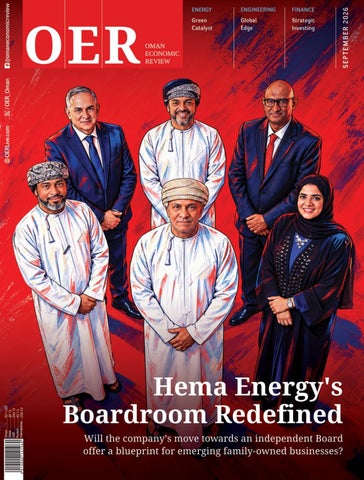
FAMILY ENTERPRISE TO FUTURE-READY BUSINESS As Hema Energy enters its next phase of growth, the company is strengthening its governance framework to build a more resilient and future-ready enterprise. The professionalisation of its Board, with a majority of independent directors, marks a deliberate shift towards greater objectivity, accountability and strategic oversight.
34 ENGINEERING
GLOBAL EDGE India’s rising edge in oil, gas and construction projects driving the Middle East’s next growth orbit
42 FINANCE
STRATEGIC INVESTING Invest it all or invest gradually – Which strategy builds more wealth over time?
8 ENERGY
GREEN CATALYST OQ Alternative Energy and Asyad sign Hydrogen offtake term sheet to advance green mobility in Oman
Editorial ........................ 1
Business Briefs ............ 4
ECONOMY
TECHNOLOGY
LIFESTYLE
LEADERSPEAK
LISTINGS
VIDEO
What the World’s Top 10 Tech CEOs really earn Jewellery ..................... 47
The scale of executive remuneration across the technology industry is extraordinary, yet the figures reveal vastly different approaches to rewarding the people running the world’s most valuable businesses
UAE moves 6G ‘Golden Band’ closer to commercial reality Energy ....................... 48
Automotive ................. 52
The Telecommunications and Digital Government Regulatory Authority (TDRA), e& UAE, Khalifa University of Science and Technology and NYU Abu Dhabi jointly published “The Golden 6 GHz Band,” a white paper presenting engineering evidence that Upper 6 GHz (U6GHz) can carry significantly more traffic than today’s mid-band spectrum using existing cell sites
Gulf Financial Markets post $618B in trading volume Gulf financial markets saw approximately 401.7 billion shares change hands during 2025, surging 19.5 percent compared with 2024, as the value of traded shares reached some $618 billion.
BUSINESS BRIEFS ahlibank named ‘Best Bank in Oman’ for 2026 Reinforcing its position as a leading financial institution in the Sultanate of Oman, ahlibank has been named ‘Best Bank in Oman 2026’ at the Arab Banks Awards and Commendations of Excellence 2026, organised by the World Union of Arab Bankers at Istanbul, Turkey. The award marks another significant milestone in ahlibank’s journey as a ‘Partner in Excellence’, recognising the bank’s strong performance, strategic progress and continued contribution to Oman’s evolving financial landscape. It also reflects ahlibank’s ability to remain resilient and competitive while consistently creating value for its customers, partners and wider stakeholders. The award was received on behalf of ahlibank by Jumana Aflah Al Hashmi, AGM – Head of Marketing and Corporate Communications. The Arab Banks Awards and Commendations of Excellence celebrate institutions that demonstrate leadership, sustained performance and meaningful impact across the banking industry. ahlibank’s recognition reflects the progress it has made in strengthening its business, responding to changing market dynamics and contributing to the continued advancement of Oman’s banking sector. Commenting on the achievement, Jumana Aflah Al Hashmi said, “Being named ‘Best Bank in Oman’ is an important recognition of the progress we continue to make as an organization. Our focus has always extended beyond achieving strong results; it is about building a resilient, futureready bank that can adapt to change, capture new opportunities and deliver sustainable value over the long term. This achievement reflects the clarity of our strategic direction, the trust placed in us by our customers and partners, and, above all, the commitment of our people who continue to drive ahlibank forward.” She added, “As the banking landscape continues to evolve, so must the way we think, operate and create value. Our priorities remain centered on sustainable growth, innovation, operational excellence and delivering an increasingly seamless customer experience. At the same time, we will continue
to strengthen our capabilities and partnerships to ensure that ahlibank remains well positioned to contribute meaningfully to the growth of the financial sector and Oman’s broader economic ambitions.” With a clear focus on long-term value creation, ahlibank continues to evolve its proposition and capabilities in line with the changing needs of customers and the wider market. Its approach combines innovation, service excellence and operational efficiency with a strong commitment to sustainable growth. As it builds on this latest achievement, ahlibank remains focused on strengthening its competitive position, expanding the value it delivers to stakeholders and playing an active role in shaping the continued progress of Oman’s banking sector and national economy.
Instant Credit Cards with Bank Muscat Mobile Banking In line with its vision of delivering a fully digital customer experience, Bank Muscat, the leading financial services provider in the Sultanate of Oman, has announced the launch of its instant credit card issuance service through the Mobile Banking application for the first time in the Sultanate. This service enables customers to apply for a new credit card entirely through their smartphone, with no requirement to visit a branch or complete any physical documentation. This launch marks a significant milestone in Bank Muscat’s ongoing journey towards a comprehensive digital banking experience for customers across Oman. Previously, customers applying through Digital Banking platforms were required to visit a branch in person to sign their documents; the new instant service delivers a fully end-to-end digital journey from eligibility verification through to card activation. It also complements the Bank’s recently introduced instant digital debit card service, with customers being able to apply for a Digital Credit Card, ensuring a seamless, digital only experience. 4
August 2026
The service is designed for maximum simplicity. Customers log into the Bank Muscat Mobile Banking application, navigate to the credit card section and choose from the Bank’s full range of retail credit cards (subject to their eligibility). Upon approval, the digital credit card is issued instantly and customers can view their CVV and expiry date securely in-app for
online purchases, while the card can also be tokenised and added to Apple Pay and Samsung Pay for immediate contactless payments. Commenting on the launch, Abdullah Hamood Al Jufaili, Assistant General Manager - Digital Banking, Bank Muscat, said, “In continuation of our “instant” theme this year, we are proud to launch end-to-end digital credit card. Oman is generally a debit card market, but we have seen an increase in the usage of credit card in the past 2 years. Our intention is to simplify the onboarding journey by empowering the customers to complete the full process on their own and at ease.” The digital credit card carries the same fees and limits as a standard card, with the added flexibility of enabling or disabling international usage directly from the app at any time. Security is built into every layer of the experience through advanced authentication mechanisms and One-Time Passwords (OTP). In addition, if the customer would like to obtain the physical card, they can have it delivered to them with complimentary courier service.
Sohar International and barq Sign agreement to explore new opportunities in digital financial services Reinforcing its commitment to advancing financial innovation and strengthening cross-market connectivity, Sohar International has signed a cooperation agreement with barq, a Saudi financial technology services company, to explore new opportunities at the intersection of banking and digital financial services. The agreement was signed on the sidelines of Money20/20 in Riyadh, bringing together leading fintech companies, financial institutions and investors from across the region and beyond. The agreement was signed on behalf by Khalid Al Guthami, Country Chief Executive Officer of Sohar International’s KSA Branch, and Saad Almuhana, Co-Founder and Deputy CEO of barq, in the presence of Ahmed Mohamed Alenazi, Founder and CEO of barq. Commenting on the agreement, Abdulwahid Mohamed Al Murshidi, Chief Executive Officer of Sohar International, said, “The evolution of financial services across the region is increasingly
being shaped by the convergence of banking, technology and customer-centric innovation. At Sohar International, we are focused on building a globally connected financial platform that enables greater access to opportunities across markets and supports the changing needs of our customers and partners. Our cooperation with barq reflects this approach, bringing together complementary capabilities to explore solutions that can contribute to a more connected and digitally enabled financial ecosystem across Oman, Saudi Arabia and the wider region.” “We are keen to extend barq’s partnerships to financial institutions that share our ambition to improve the customer experience and harness the opportunities created by digital transformation,” said Ahmed Mohamed Alenazi. “Our cooperation with Sohar International gives us the opportunity to explore new areas and work on models that can create lasting value for both parties.”
Alizz Islamic Bank awarded by World Union of Arab Banks ‘Best Transformation in Islamic Banking in Oman 2026’ Alizz Islamic Bank has been awarded the ‘Best Transformation in Islamic Banking in Oman 2026’ award by the World Union of Arab Banks, in recognition of the Bank’s significant transformation journey and the major strides it has made across its business, digital capabilities, customer experience and banking solutions in recent years. The award was received on behalf of Alizz Islamic Bank by Ali Al Mani, CEO, during a ceremony held in Istanbul, Türkiye, attended by prominent banking and financial leaders from across the region. The recognition reflects the Bank’s transformation journey over the past few years, which has focused on redefining the banking
experience to meet evolving customer expectations and the rapidly changing banking landscape, while remaining firmly rooted in the principles and values of Shari’a-compliant banking. Over the course of this transformation journey, Alizz Islamic Bank has accelerated its digital innovation, strengthened its banking ecosystem, expanded its financing solutions and invested in new technologies, while placing people at the heart of its overall strategy. The Bank’s transformation has also extended to double digits in profitability and the first distribution of dividends in the history of the organisation. The evolution period also witnessed the development of new customer value propositions, enhanced operational efficiency, culture and reinforcing commitment to becoming more agile. Guided by a clear strategic vision, Alizz Islamic Bank has been investing in building a trusted brand for sustainable growth within Oman’s Islamic banking industry for the wider economy. Commenting on the recognition, Ali Al Mani, said, “We are proud to receive this recognition, which reflects the transformation journey Alizz Islamic Bank has undertaken over the past few years. This goes beyond celebrating what we have achieved, it simply validates the commitment and dedication towards our belief that change is built through a clear vision, focused execution and a shared commitment to excellence to respond to the evolving needs of our customers and the communities we serve.” Al Mani added: “As we look ahead, we remain committed to embedding sustainability across our business, strengthening responsible practices and creating meaningful long-term value for our stakeholders. We are grateful to all who contributed towards the success of this transformation journey. Sincere appreciation to our Board, management team and every member of Alizz Islamic Bank, customers, partners and stakeholders for the trust they place in us.”
Recognising
trailblazers in the construction & infrastructure sector The best of the best within construction, infrastructure, projects, civil engineering, real estate, design engineering and construction materials industry in Oman will be felicitated at Dossier Construction Awards. Event Key Highlights • • • •
Awards to key industry projects, companies and personalities Presentation on an upcoming large iconic project Attendance of over 200 industry leaders Networking with industry peers
Some of the Award Categories
2025
• Best Construction Safety Initiative • Best MEP Contractor • Best EPC Contractor • Best Construction Contractor • Best Manufacturing Company • Global Omani Company of the Year • Commercial Vehicle of the Year • Excellence in IFM Services • Best MEP Supplier • Best Interior Design • Best Project Design • Best Architect • Best Engineer • Best Engineering Consultant • Best Project Management Consultant • Market Leader of the Year - Paints • Claims Management Consultant of the Year • Real Estate Services Company of the Year • Best Real Estate Project • Best Real Estate Consultant • Best Project Developer of the Year • Best Sustainable Project • Best Renewable Energy Project • Best Industrial Project • CEO of the Year • Business Leader of the Year • Business Icon of the Year
14
th
Edition
20 26
Date: September 30, 2026 Venue: Sheraton Oman Hotel
ST R AT EG I C PA RT NE R S
AS S O C I ATE PA RTN E R S
COM M E R C I A L VE HI C L E PA RT N E R
CONS U LTA NT PA RT NE R
M E D I A PA RTN E R S
D I G I TA L PA RT N E R
OR G A NI S E R
digital
For more information, contact SHIVKUMAR on 99267159, shivkumar@umsoman.com OR DHANISH on 92637189, dhanish@umsoman.com
ENERGY
GREEN CATALYST OQ Alternative Energy and Asyad sign Hydrogen offtake term sheet to advance green mobility in Oman OQ Alternative Energy (OQAE) and Asyad Group have signed an offtake term sheet to advance the deployment of green hydrogen for mobility applications in Oman, marking an important step in connecting the country’s emerging green hydrogen capabilities with low-carbon transport solutions. Under the term sheet, Asyad will explore the use of green hydrogen produced through OQAE’s green hydrogen deployment project in Duqm, supporting the development of hydrogen-powered mobility applications and contributing to the foundations of a hydrogen mobility ecosystem in Oman. The collaboration brings together two strategic national players with a shared objective: translating Oman’s growing renewable energy and green hydrogen capabilities into tangible applications that can support the decarbonisation of transport and other hard-to-abate sectors while creating a pathway towards wider commercial adoption. “The next phase of Oman’s hydrogen journey is about moving from potential to practical application. This partnership with Asyad is an important step in that direction, connecting green hydrogen production with a real mobility use case and creating an opportunity to build experience across the full value chain,” said Salim Al Kamyani, CEO, OQ Alternative Energy. “At OQ Alternative Energy, we see demonstration projects such as this as essential to building the capabilities, infrastructure and market confidence required for the hydrogen economy to scale. By working with strategic partners such as Asyad, we can experience technologies and business models in real operating environments, generate local knowledge and identify the conditions needed for broader adoption. He explained, “Oman has significant potential to become a competitive producer and exporter of renewable energy and green hydrogen. At the same time, developing a strong domestic market is critical to building a resilient hydrogen ecosystem. Our ambition is to help create an environment where Oman’s hydrogen potential can translate into competitive projects, new industries and sustainable value for the nation.” Ahmed Al Bulushi, CEO, Asyad Drydock and Infrastructure Services, said, “Decarbonising transport requires practical solutions that can be deployed at scale and supported by a reliable energy ecosystem. Our collaboration with OQAE provides an opportunity to explore green hydrogen as part of that transition and to translate Oman’s emerging hydrogen capabilities into applications across the logistics and mobility value chain. Asyad is committed to supporting the development of more sustainable logistics solutions and to strengthening Oman’s position as a globally connected logistics hub. By participating in the development of hydrogen mobility solutions, we are helping build the operational experience, 8
September 2026
partnerships and infrastructure needed to support the next generation of low-carbon transport in the Sultanate.” This represents OQAE’s first end-to-end green hydrogen deployment project, designed to build practical capabilities across the value chain and lay the foundation for future implementation at scale. It includes renewable power integration, hydrogen production, operations, certification, handling and commercialisation, and is expected to produce up to 400 kilograms of green hydrogen per day, with the potential to expand through a dedicated hydrogen refuelling station in Duqm. Located within the Special Economic Zone at Duqm, the project provides a platform to explore the integration of renewable energy, hydrogen production and end-use applications within a single industrial and logistics ecosystem. It supports Oman’s broader ambition to establish a competitive and sustainable hydrogen sector in line with Oman Vision 2040 and Oman’s net-zero targets. The project is designed to deliver value beyond hydrogen production. By connecting production with end use, it will generate practical insights into operations, certification, infrastructure, safety, demand and support the development of Oman’s broader hydrogen economy. The signing marks the next phase of collaboration between OQAE and Asyad as the two organisations work to translate the term sheet into a deployment framework. By connecting green hydrogen production with mobility applications, the partnership will build the technical, operational and commercial experience needed to support future projects and strengthen the foundations of Oman’s emerging hydrogen economy.
Family Enterprise to Future-Ready Business As Hema Energy enters its next phase of growth, the company is strengthening its governance framework to build a more resilient and future-ready enterprise. The professionalisation of its Board, with a majority of independent directors, marks a deliberate shift towards greater objectivity, accountability and strategic oversight. The new structure brings together diverse expertise and perspectives while preserving the entrepreneurial agility that has shaped the company’s growth. OER’s cover story takes an in-depth look at the transformation, Hema Energy’s ambition to create sustainable long-term value and lessons for other family owned companies.
COVER STORY
GOVERNANCE-DRIVEN GROWTH
Dr. Ali Al Gheithy, Chairman of the Board, Hema Energy, discusses the company’s journey towards professionalising its governance, strengthening accountability and preparing the business for its next phase of growth in an interview with Mayank Singh Hema Energy’s decision to induct independent directors marked a significant milestone in its evolution. From the Chairman’s perspective, what strategic objectives was the Board seeking to achieve through this transformation?
Hema Energy has a strong history and a well-established position in the market, but the company recognised that bringing greater professionalism to its governance would strengthen its credibility and support its next phase of growth. The objective was not simply to change the composition of the Board, but to introduce a greater degree of independence, objectivity and external perspective into decision-making. In a family-owned business, there can naturally be internal relationships and a degree of peer pressure when decisions are discussed among family members. An independent Board provides a mechanism for decisions to be challenged constructively and evaluated on their merits. The transformation was therefore intended to strengthen the company’s governance framework, introduce stronger checks and balances, enhance compliance and bring a wider range of experience to the strategic direction of the business. It also gives external stakeholders greater confidence that Hema Energy is being guided by an experienced and independent body. I believe this is already making a difference. The credibility that comes with a professional Board is increasingly evident in our 10
September 2026
relationships with partners and financial institutions. Banks, for example, have become more comfortable extending facilities to the company because they can see the governance structure and the oversight behind the business. Having served on the boards of both multinational and publicly listed companies, what governance practices have you introduced at Hema Energy that are helping shape its next phase of growth?
My experience across different organisations has reinforced the importance of having clear oversight, effective controls and accountability. A Board should not only set strategy; it must also monitor performance, ensure that appropriate controls are in place and make sure that compliance requirements are consistently followed. At Hema Energy, one of the important changes has been to bring greater transparency to the performance of the different business verticals. We have sought to understand each part of the business through its own profit-and-loss performance and cash flow. This allows us to identify where value is being created, where a business may be underperforming and where there may be opportunities to expand. We now have a structured annual strategy meeting where we review each business vertical and assess its performance and prospects. Following this, management develops business plans for each vertical, which are subsequently presented to the Board. This creates a
disciplined process in which decisions are based on financial performance, cash flow and future opportunities rather than emotion or assumptions. The Board also provides a framework for management to take calculated risks while ensuring that key milestones are established and regularly monitored. This gives management the freedom to pursue opportunities while providing the Board with the visibility required to intervene or change course when circumstances change. The Board now comprises a majority of independent professionals. How has this changed the quality of strategic discussions, decisionmaking and accountability within the organisation?
I believe it has had a positive impact. When management has developed a project or proposal itself, there can naturally be a degree of built-in bias when it subsequently seeks approval for that proposal. An independent director brings a different perspective and is more likely to ask difficult or fundamental questions. That process is valuable because management must explain and defend its assumptions, demonstrate that different scenarios have been considered and show that the risks have been properly assessed. If the proposal withstands that scrutiny, it gives the Board greater confidence in the decision. The diversity of experience around the Board also adds depth to strategic discussions. We now have professionals who bring different
COVER STORY
perspectives and expertise across the key areas of the business. The Board’s role is therefore not merely to approve decisions, but to challenge, guide and strengthen them. At the same time, we recognise that Hema Energy is an entrepreneurial company and that agility is one of its strengths. Our governance approach is designed to preserve that agility. We have built flexibility into the process so that important decisions can be discussed and approved electronically when necessary, rather than waiting for a formal Board meeting. The objective is to provide strong oversight without slowing down the company.
What do you see as the Board’s most important role in preparing Hema Energy for future opportunities in an energy sector that is being reshaped by the energy transition, digitalisation and evolving customer expectations?
The Board’s role is to help management look beyond the immediate business while ensuring that the company does not lose sight of what it already does well. Hema Energy has built its reputation through its existing capabilities, and we need to protect and strengthen that foundation as we explore new opportunities. The energy sector is changing, and we are therefore looking at opportunities beyond our traditional activities. Water treatment and reuse, for example, is an area where new technologies can create significant value. Hema Energy has already undertaken a pilot initiative in this field, working with partners and the university community, and we are now looking at expanding the pilot towards practical application. We are also not shying away from renewable energy and sustainability-related opportunities. However, our approach is measured. We want to build on our existing strengths and enter new areas where we believe we can create genuine value. Digitalisation and technological change will similarly influence how the company operates and delivers services. The Board’s responsibility is to ensure that management is considering these developments, assessing
12
September 2026
the opportunities and risks, and positioning Hema Energy to adapt as the market evolves.
As Chairman, what strategic priorities have you set for Hema Energy over the next three to five years, and how will the Board support the company’s long-term growth ambitions?
Our immediate priority is to consolidate the progress that Hema Energy has made while selectively expanding into areas where we see strong potential. The foundation of the business is stronger today, particularly in terms of cash flow, financial controls, banking relationships and internal capabilities. We need to protect those gains as we grow. Geographical expansion is one important area. Hema Energy has established capabilities and a strong history in Oman, and we see an opportunity to replicate some of these services and products in other GCC markets, particularly Saudi Arabia and Abu Dhabi. We have already begun establishing a presence in these markets and are taking a measured approach to building them. We are also reviewing each of our existing business verticals carefully. The annual strategy process allows us to determine which activities are creating value, which require improvement and where the company should invest further. This helps ensure that diversification is disciplined rather than opportunistic. My role as Chairman is not to become involved in the day-to-day management of the company. We have an energetic and capable management team, and they need room to execute. My role, together with the Board, is to ask the right questions, provide perspective, establish appropriate oversight and ensure that management has clear, measurable milestones. At the same time, the Board must remain accessible. If an urgent strategic decision is required, management should not have to wait for the next formal meeting. We have the flexibility to engage quickly and support management when needed. Drawing on your experience across Shell, PDO and other board
appointments, what advice would you give family-owned businesses in Oman that are considering professionalising their boards to build more resilient and futureready organisations?
My experience has convinced me that an independent Board can bring significant value to a family-owned business. It brings integrity and objectivity to the decision-making process and helps ensure that the company operates within an appropriate framework of governance, controls and accountability. Professionalisation does not mean taking control away from the family. Rather, it creates a stronger structure through which the family’s interests and the company’s long-term interests can be protected. Independent directors can challenge management constructively, introduce different perspectives and help the business make better-informed decisions. I have seen the consequences of inadequate governance in other organisations. In one case, I was appointed to an independent Board at a time when the company was experiencing serious financial difficulties. The Board’s role was to review the company’s structure, support its turnaround and strengthen its internal controls. The experience demonstrated to me how important it is to have the right mix of skills and independence on a Board, particularly when a company is under pressure. For family businesses considering this transition, I would therefore encourage them to see professionalisation as an investment in the future rather than as a loss of family influence. A strong independent Board can improve credibility with banks, partners and other stakeholders, strengthen financial reporting and internal controls, and create a more robust platform for future growth. It can also position a company much more effectively if it eventually considers an IPO or another significant capital-market transaction. Investors need confidence not only in the business itself, but also in the governance, reporting and oversight supporting it. Ultimately, professional governance gives a family business the resilience to grow beyond its founders and prepare the organisation for the opportunities and challenges ahead.
GOVERNING FOR GENERATIONAL GROWTH Eyhab Al Haj, Board Member, Hema Energy, says professionalising the company’s Board was driven by its growth, evolving family structure and the need to build a business capable of thriving across generations in an interview with Mayank Singh
Hema Energy’s decision to induct independent directors in 2025 marked a significant shift in its evolution. What prompted the company to professionalise its Board at this stage of its growth?
Governance has always been very important to me. From the beginning, we focused on having clear policies and procedures because I believe that when something is repetitive, it should be governed by a policy. Policies drive governance, and governance ultimately shapes how decisions are made. However, the decision to professionalise the Board in 2025 was the result of several factors coming together. Personally, the passing of my brother, Loay Al-Haj, in 2023 had a profound impact. He was not only my brother but also my business partner and the person who complemented me technically. I am more commercially oriented, while he was technically stronger, and that combination was one of the reasons we built Hema Energy together. His passing created both a personal and a business void. We brought in Azzan Moghrob Asmi, Group Managing Director, Hema Energy, who had worked closely with my brother and understood the technical side of the business. He quickly proved himself, and I made the decision to give him my previous position while I moved into the Executive Director role. For me, that was about doing what was best for the company and its shareholders rather than protecting my own position. My mother’s passing subsequently made
COVER STORY
me think even more deeply about the future of the business and the family. As the family and inheritance structure became more complex, I realised that if we wanted Hema Energy to survive and grow across generations, we needed to move from a purely family-governed business towards a professionally governed enterprise. Another important factor was Azzan’s growth of the business. He was not simply increasing revenues; he was strengthening the team and systems from within. I felt it was not fair to him to have a situation where he would come to me with an important question and I would simply say yes because I trusted him. He needed to be challenged — not negatively, but constructively — so that he could see the complete picture. That was the point at which I told him that it was not fair for him to operate without a proper Board with the strength required for the growth he was delivering. That became a major driver for bringing independent expertise onto the Board. As a founder, how did you approach the transition from a family-led decision-making model to one with a majority of independent Board members?
I never viewed professionalisation as giving up control. I viewed it as creating a stronger framework for exercising that control responsibly.
could provide a grounded perspective. My personality is entrepreneurial, and new ideas excite me, so I wanted someone who could challenge that enthusiasm and ensure that ideas were properly evaluated. We then added legal and governance expertise, followed by Dr. Lamya Al Haj as the family’s representative. Although she is a family member, she was selected because of her qualifications and extensive Board experience, as well as her expertise in sustainable energy, which is increasingly relevant to our business. Similarly, Fadelallah Suliman’s contribution to the company’s restructuring and governance demonstrated the value and perspective he brings to the Board. His extensive banking and legal experience made him a natural fit as both a Board member and our General Counsel. We subsequently brought in commercial expertise through Fouad H. Eid. His over three decades of international leadership experience made him an ideal choice to serve as an independent Board Member for the Hema Group. We took our time because we did not want to disrupt the chemistry that had developed within the Board. Every Board member needed to add something different and complementary.
When we started selecting Board members, the most important criteria were integrity and whether their primary agenda was to serve the company’s interest. We wanted people who would ask, ‘What is best for Hema Energy?’ rather than, ‘What is best for me?’ or ‘What is best for the family?’
Today, more than 70% of the Board is independent. I do not believe there is one universal formula for the percentage of independent directors. It depends on the company, its maturity and what it is trying to achieve. What matters is why you are making the change and whether the structure genuinely improves decision-making.
A family business can work very well, but over generations, there is a risk that Board and management positions may be based on family relationships rather than qualifications. Decisions can become subjective and influenced by emotions, favours or disagreements. I wanted to build a system that protected the company from that happening.
I also had to learn to speak less and listen more. During the first few Board meetings, I deliberately held back to give the new members space to contribute. If you give people responsibility but do not empower them, you have not really given them responsibility. You are effectively asking someone to run while giving them only one shoe.
The Board was therefore built progressively. We first brought in a strong Chairman who
One year into the new governance structure, what measurable
14
September 2026
impact has the Board had on Hema Energy’s strategic direction, business performance and organisational culture?
It is difficult to reduce the impact to a single number because the benefits have been much broader than financial performance. However, if I had to identify three major areas, they would be decision-making and reporting, growth, and the reduction of the personal burden of decision-making. First, our reporting and decision-making systems are now much more aligned. Operations meetings take place weekly, management meetings monthly and Board meetings quarterly. Previously, these processes were not sufficiently synchronised. Today, information moves through the organisation in a much more structured way: the Board provides direction to management, management translates that into action, operations executes, and information and KPIs flow back up through management to the Board. That has significantly improved the quality of decision-making because we are making decisions based on timely and reliable information. Second, management now feels that it has much stronger backing. Azzan has been growing the business rapidly, in terms of both portfolio and revenues, and he now knows that the challenges he receives from the Board are constructive. Once a decision is made, it is a collective Board decision. That gives management greater confidence to execute. Third, there is a very personal benefit for me. Previously, I carried a significant burden because I felt responsible for every decision affecting the family, the shareholders and the company. I was constantly thinking about whether a decision might be questioned years later by another member of the family. Today, responsibility is collective, including with the family’s representative on the Board. Overall, I would say that every quarter I see a different company — more solid, clearer and more defined. Every challenge becomes an opportunity to improve something. How have the independent
directors challenged the leadership team’s thinking, and can you share an example where their insights led to a better business outcome?
One example stands out because it was relatively simple but had a significant impact on how we understood the business. As entrepreneurs, we naturally get excited about new opportunities. I would come to the team with a new idea and ask them to pursue it. Because the existing team was performing so well, we sometimes hesitated to create additional teams for these new initiatives. As a result, people were being spread across the core business and several growth projects. The Board challenged us to look at this more systematically. When we examined the numbers, we discovered that the profitability of the core company appeared to be low. That initially made us question the business model itself. However, when we looked more carefully at the accounting, we realised that employees were spending significant portions of their time working on other group companies and growth initiatives, while their costs were being charged to the core company. Once we allocated those costs correctly, the underlying profitability of the core business was more than ten times what we had initially believed. That was a major lesson. If the information coming up through the organisation is wrong, you can make the wrong decision even when you are following a perfectly logical decision-making process. As a result, we introduced much clearer criteria for investing resources in new businesses and projects. If someone spends 50% of their time on another company, that portion of their cost should be treated appropriately as an investment in that company. We also introduced milestones for new initiatives so that promising ideas can be developed without allowing them to consume resources indefinitely. The Board’s challenge therefore did much more than identify an accounting issue. It changed the way we think about portfolio management, resource allocation and growth.
Your portfolio spans upstream oil and gas, concession management, operational excellence and emerging green initiatives. How is the Board helping Hema Energy balance growth opportunities with innovation, sustainability and long-term value creation?
The first step is to make sure that growth is disciplined. We now look at opportunities through a portfolio-management lens, considering the amount of effort and investment required, the risks involved and when we can reasonably expect a return. Net present value is an important part of that process because it allows us to consider the time value of money. We also assess risk because a potential return has little value if the assumptions behind it are unrealistic. At the same time, we did not want to kill the entrepreneurial spirit of Hema Energy. There was a tension between people saying, ‘Grow, and others saying, ‘Focus on creating value from what you already have.’ Our solution was to establish six strategic verticals: concessions, consultancy, technologies, services, manufacturing and sustainable energy. Within these verticals, we can continue to pursue growth and innovation, but opportunities have to fit within our broader mission and vision. This gives the entrepreneurial side of the business room to develop while ensuring that we remain disciplined about where we deploy resources. Sustainable energy is one of these important growth areas. We are exploring opportunities in emerging green technologies while applying the same commercial discipline we use across the rest of the portfolio. Ultimately, the objective is to create a business that is sustainable in every sense — commercially viable, strategically focused and capable of creating longterm value. We are also putting in place the governance and organisational systems required to prepare the company for a potential IPO in the future. As a founder who has successfully scaled a family business into a professionally governed enterprise, what advice would
you offer other entrepreneurial and family-owned businesses considering a similar transformation?
My advice would be to start with one fundamental question: why? I was fortunate to work with people who taught me to always ask why we are doing something. If the ‘why’ is strong enough, the ‘how’ becomes much easier. I would therefore not tell every family business that it must immediately introduce an independent Board. There is no single structure that is right for every company. Instead, ask yourself: Why do I want to do this? What are the three most important reasons? Is this genuinely the best structure for the company, or are you simply doing it because you have seen another business do it? For Hema Energy, the decision evolved from our circumstances, our growth, the need for stronger governance, the changing family structure and our desire to build something that can survive beyond one generation. I also believe family businesses need to think about succession before it becomes an issue. As families grow and generations change, it becomes increasingly difficult to ensure that every person who becomes part of the business has the qualifications and experience required. Professional governance creates a framework where decisions can remain objective and focused on the company’s interests. For me, professionalisation does not mean losing control. My influence and responsibility are still there, but they operate within a better framework and alongside other perspectives. Finally, think about the legacy you want to leave. Life is short, and I began asking myself what I wanted to leave behind. I did not want to leave a situation where future generations were arguing over the business. I wanted to create something properly structured, resilient and capable of making a positive contribution to society. Therefore, my strongest advice is - understand your ‘why’, ask yourself honest questions, and then build the governance structure that best serves that purpose. If you can identify three clear and honest reasons, you are ready to begin.
COVER STORY
BEYOND FAMILY GOVERNANCE
Dr. Lamya Al Haj, Board Member, Hema Energy & Associate Professor, Sultan Qaboos University, shares her views on how professionalisation of the Board can bring greater diversity of expertise, independent perspectives and stronger governance to the family-owned business
As an academic, scientist and entrepreneur, what motivated you to join Hema Energy’s Board, and what opportunities did you see in the company’s transformation journey?
My decision to join the Hema Energy Board was initially driven by the inheritance process following the sudden passing of my brother, Loai Al Haj. As the family’s ownership was divided among five beneficiaries, it was important to ensure representation for the different branches of the family, and I was asked to join the Board as a family representative. My previous experience serving on the boards of various companies was also an asset, as it enabled me to bring a different perspective to the business. My academic background has been equally valuable. A PhD teaches you more than subject knowledge; it develops your ability to think critically, solve problems, analyse situations and deal with failure. These skills are highly relevant in a boardroom. At the same time, Hema Energy was beginning an important transition from a family-owned business towards greater professionalisation. I saw an opportunity to contribute to that transformation while bringing my scientific and sustainability expertise to a company operating in the energy sector. Hema Energy’s Board today brings together expertise from industry, 16
September 2026
academia and business. How does this diversity of perspectives strengthen strategic decisionmaking and corporate governance?
The greatest strength of the Board is that every member brings something different. When a project or investment opportunity is presented, we assess it from different perspectives based on our individual expertise and experience. I bring a scientific perspective, looking at whether an idea is technically feasible and sustainable, whether we are moving too quickly towards a pilot, whether we have the right partners and whether the underlying assumptions are sound. My own research has involved taking ideas from the laboratory through to the pilot stage, including pioneering the world’s first bus running on biodiesel produced from date-seed pits. That experience has given me an understanding of how an idea can progress from research to a product and, ultimately, attract investors. Other Board members bring legal, technical, financial, strategic and business expertise. Together, these perspectives create a more complete picture and support better decision-making. I see it almost as a jigsaw puzzle, with each person contributing a piece. It is also a continuous learning process: you contribute your own expertise while learning from the people around the table.
Importantly, professional Board members can challenge assumptions and provide an objective perspective, reducing the potential bias that can arise when a family business is governed entirely by family members. Decisions can therefore be assessed more objectively on what is best for the business, rather than purely through a family lens. I would strongly encourage other family businesses to consider this model. A diverse Board creates greater balance, distributes responsibility for important decisions and can help reduce tensions within the family. You have a dual role as a Board member and as a bridge between the family and the Board. How do you balance the two roles?
I am very conscious of these dual responsibilities. As a Board member, I have a responsibility to safeguard the family’s interests and preserve its inheritance. At the same time, I have a responsibility to the business and its long-term growth. My approach is therefore measured and analytical. I prefer decisions to be based on a clear understanding of the assumptions, risks and broader implications. At the same time, Hema Energy is an ambitious business, and growth inevitably involves calculated risk. My role is to facilitate constructive dialogue in both directions. I communicate the Board’s perspectives and decisions to
COVER STORY
the family, while ensuring that the Board understands the family’s expectations and considerations. I do not tell family members what decisions to make; rather, I explain the options, risks and implications so they can make informed decisions. I believe we have also found a healthy balance through the different perspectives within the leadership team. Eyhab Al Haj, the founder is highly entrepreneurial and comfortable taking calculated risks in pursuit of growth. My approach as an academic and scientist is more analytical and conservative, ensuring that the fundamentals are sound and the broader implications have been considered. That balance is valuable to the company. Your research has focused extensively on renewable energy and sustainability. How can companies like Hema Energy balance today’s commercial priorities with the longerterm energy transition and sustainability agenda?
The transition towards cleaner energy is essential, but it must also work as a business model. Hema Energy recognised this early. While the company has traditionally operated in oil and gas, it is now developing an alternative energy arm, in which I am closely involved. The focus includes waste utilisation, the circular economy, sustainability and reducing carbon emissions. I have also recommended establishing an ESG committee. Even as a relatively small company, Hema Energy needs to build these capabilities early and begin considering Scope 1 and Scope 2 emissions alongside broader ESG priorities. For me, sustainability has to satisfy what I call the three Ps: people, planet and profit. The third is often the most challenging because clean-energy technologies can remain more expensive than conventional alternatives. Technologies such as biodiesel, for example, can have higher production costs, making commercialisation difficult. The challenge is to develop financially viable models that allow promising technologies to 18
September 2026
move beyond research and pilot stages.
with the right experience and qualifications.
Stronger legislative support, mandates and, where appropriate, subsidies can accelerate adoption. Many countries have introduced blending mandates such as B10 and B20, creating demand for biofuels. Oman does not yet have similar mandates, so the commercial incentive remains more limited.
Ultimately, diversity strengthens a Board when it is combined with competence, independence of thought and a willingness to challenge the status quo. Robust discussions are healthy when they lead to better decisions. At Hema Energy, we challenge one another’s perspectives, assess the opportunities and risks, and often arrive at a position somewhere between different viewpoints. That balance between entrepreneurial ambition and disciplined risk assessment is particularly valuable as the company seeks to grow sustainably while protecting the family’s interests.
Nevertheless, Hema Energy continues to explore opportunities. We recently signed an MOU with NAMA to explore using wastewater to cultivate a crop with potential applications in renewable energy. Some of my students are also working on its economic feasibility. It is promising, but ultimately the commercial equation has to work. How important is diversity including gender, professional background and experience - in improving Board effectiveness and business performance?
Diversity is extremely important on a Board, and it goes beyond gender to include professional expertise, experience and different ways of thinking. Bringing these perspectives together creates a stronger and more complementary decision-making process. When it comes to women on Boards, I believe representation should ultimately be based on merit. Quotas can have a role in challenging the status quo and establishing a culture in which women are accepted in leadership positions, but once that culture is established, gender should not determine an appointment. I would be disappointed to know that I was appointed simply because I am a woman. Women have much more to contribute than their gender. At the same time, having both men and women around the table can create valuable complementarity through different perspectives and approaches. Women also need to be more proactive in demonstrating what they can contribute. Building a professional profile, participating in credible forums, communicating expertise and making achievements visible are important. At the same time, organisations and male colleagues have an important role to play in creating opportunities for women
One year after the Board’s professionalisation, what changes have impressed you most in the way the company approaches strategy, governance and organisational development?
It is still too early to assess the full impact of professionalisation, but there are already encouraging signs. One of the most positive is the strong synergy between the Board and management. The executive team, CEO, C-suite and senior management are working effectively with the Board, while the diversity of perspectives means management receives more balanced feedback and is less exposed to family bias. This can support faster execution. There is also a much clearer distinction between governance and day-to-day management. A particularly good example is Eyhab, who previously combined the roles of Board member, owner and executive. He took the bold step of giving his larger office to the CEO and moving into a smaller office as a symbolic reminder that he needed to step back from daily operations and focus more on Board-level strategic thinking. The decision impressed me because professionalisation requires a willingness to let go of what you believe is best and create space for what may ultimately be better for the organisation. We have several exciting projects in the pipeline, although it is too early to share details. Overall, I am very optimistic about the direction in which Hema Energy is moving.
COVER STORY
NEXT HORIZON Hema Energy is strengthening governance, building talent and diversifying its business as it prepares for regional expansion and a potential IPO by 2030, says Azzan Maghrob Al Asmi, Group Managing Director, in an interview with Oommen John Hema Energy has achieved significant growth in recent years. What are the key priorities now to strengthen the foundation and position the company for its next phase of expansion?
Our immediate priority is to build a stronger, more empowered organisation. We have given our employees greater autonomy, accountability and authority to make decisions and move faster. We consider our employees as our most valuable asset, so we have invested in welfare, learning and development, structured education support and greater workplace flexibility, including remote working every Thursday without compromising operational continuity. Governance has also been a major focus. Hema has evolved from a predominantly family-led business to one guided by an independent board, bringing greater objectivity, discipline and speed to decision-making. We are now completing the organisational cycle by strengthening commercial console and expanding our footprint in Oman, across the GCC and beyond. When I joined as a non-family executive in November 2023, reducing family involvement in day-to-day operations was an important move. Today, independent management and an independent board provide greater transparency and evidence-based decisionmaking. This transformation has enabled us to reorganise the business under clear verticals, consolidate operations and prepare for more ambitious growth, including a potential IPO. Localisation is another long-term investment. We are developing Omani engineers by recruiting junior talent and preparing them for management roles over the next three to five years, supported by senior management and
20
September 2026
board oversight. Our continuous internship programme typically accommodates three to five interns at a time, allowing us to identify high performers and develop them into future employees. We also partner with international experts, initially virtually and later on the ground as projects scale. Today our strength is particularly in heavy oil and oil-well technologies. Our next priority is to deepen our presence in gas fields, especially in northern Oman. Hema already operates through branches in Oman, Abu Dhabi, Al Khobar and China. Kuwait and Bahrain are targeted for 2027–2028, while Qatar could follow around 2029-2030 as we build the technology capabilities required for its predominantly gas-driven market. We are an Omani company with a proud 15-year history, but our ambition is much bigger. We are targeting an IPO by 2030 and aim to become a benchmark integrated energy & alternative energy partner, recognised for speed, disciplined governance and tangible sustainability outcomes. In Oman, we expect to reach at least 300 employees, potentially 300– 500 depending on which business verticals are activated prior to the IPO timeline. Technology, sustainability and manufacturing are already active, while consultancy and E&P remain largely passive. Services was launched this year and is now part of our growth platform.
What has been the toughest challenge in building Hema Energy, and how did it reshape your leadership?
The toughest challenge was overcoming the financial and technical pressures the company faced while unlocking the capabilities that already existed within the organisation. Hema was known as a solution provider, but the
employees had not always been given the autonomy to demonstrate their full potential. When I joined, I deliberately moved away from micromanagement and gave employees the freedom to run operations with appropriate guidance. I also made it clear that mistakes can be part of learning. The impact was significant. People who had previously worked within limited roles began leading technical activities and tenders. Not every outcome was perfect, but the bigger achievement was the growth in confidence, ownership and capability. At a broader industry level, two challenges remain important. The first is the reluctance to test proven technologies. Solutions that have worked successfully elsewhere can sometimes face regulatory barriers or require exemptions before they can be deployed locally. The second is the economics of manufacturing and the need for greater investor certainty. Manufacturers carry significantly higher overheads than suppliers, making simple price comparisons misleading. Investors also need greater clarity when committing capital to large facilities, particularly around contracts and future demand. The answer is not to remove regulation, but to make implementation more practical. Clearer contractual frameworks, stronger support mechanisms and greater visibility on demand can make investments more viable. Oman has the potential to become a regional hub, particularly given its free trade arrangements, but execution pathways must match that ambition.
As global energy markets evolve, where do you see Hema Energy’s biggest competitive advantage over the next five years?
Although Hema is recognised as an oil and
COVER STORY
gas company, our competitive advantage lies in integrating sustainability into our core business rather than treating it as a separate renewables’ narrative. Our sustainability platform focuses on practical challenges in Oman, particularly produced water and flare gas. For produced water, we are developing an integrated value chain that links treatment with agriculture, oil crops, oil extraction and biofuels. The objective is to create commercial value while addressing environmental challenges and reducing technical costs. We completed a pilot with Ara Petroleum and presented the results in May 2026 in OPES. We are now moving into a second scale-up pilot with NAMA, scheduled to begin at the end of this August in Barka, focused on “renewed water”. Agility is another differentiator. When we identify a solution, we move quickly to deliver it to the customer. If we cannot solve a problem, we communicate that quickly and return with a better approach rather than leaving the customer awaiting.
How are you balancing profitability today with investments in energy transition, innovation and futureready businesses?
Profitability is non-negotiable. We maintain this discipline through quarterly reviews with auditors, structured commercial filters and a defined approval process involving engineering, business development, finance and leadership according to the size of each deal. Each vertical is expected to stand on its own financially. We avoid prolonged crosssubsidisation between businesses and restructure units that consistently weigh on group performance. We have already taken the difficult decision to release companies that were not contributing adequately. At the same time, innovation requires investment. Our approach is to work closely with strategic partners, conduct R&D jointly, test technologies ourselves and scale solutions only when we have confidence in their commercial potential. Do you believe moving from a familyowned model to an independent board works for energy companies?
Absolutely. In our experience, it has worked extremely well. Independent governance 22
September 2026
separates business decisions from emotional considerations and creates the space for disciplined execution. It also strengthens transparency. Some family businesses may hesitate to introduce independent boards because they fear greater scrutiny. But transparency can become a competitive advantage when roles are clearly defined and leadership is accountable. For Hema, the results are tangible. Following a difficult period, the company moved from losses to profitability, while growth accelerated across 2024, 2025 and 2026. The governance transformation has been an important part of that turnaround.
Oman Vision 2040 places strong emphasis on diversification and sustainability. How is Hema Energy positioning itself to contribute to the national agenda?
Oman Vision 2040 is central to Hema’s strategy. Diversification is embedded in our structure, with six verticals covering distinct business lines. This allows us to build multiple growth engines without one business having to carry another. We are already developing sustainability projects focused on emissions and CO2 reduction, while investing in manufacturing capabilities within Oman. In technology, we focus on specialised solutions where the
market needs new approaches. One example is the chemical technology that we introduced to address sand production in southern oil fields, supporting both environmental performance and operational stability. Looking ahead, what would define success for Hema Energy—a larger footprint, new business verticals, regional expansion or becoming a benchmark for integrated energy companies?
For us, success is ultimately about becoming the solution partner to our customers and to be the first in their contact list when they face a challenge. In manufacturing, that means becoming one of Oman’s leading manufacturers, moving beyond assembly towards producing components and solutions locally wherever possible. In sustainability, we want Hema to be recognised for practical produced-water solutions that support agriculture. Geographically, our ambition is to establish a presence across every GCC country, with further expansion into markets such as Syria and Iraq subject to execution readiness. Across our business verticals, the goal is to build a broad energy platform covering the sector comprehensively, while maintaining the discipline to enter new areas only when the opportunity and capabilities are right.
Today our strength is particularly in heavy oil and oil-well technologies. Our next priority is to deepen our presence in gas fields, especially in northern Oman. Hema already operates through branches in Oman, Abu Dhabi, Al Khobar and China
اﻟــﺪورة
An initiative presented by
2026
THE FUTURE OF GROWTH
How Can the Private Sector Lead the Next Phase in a Changing World? In a world of accelerated change and shifting competitive dynamics, new questions are emerging about the future of growth, opportunities ahead, and how businesses can scale, boost productivity, and strengthen their competitiveness. Oman Forum 2026 brings together leading business leaders and experts for a forward-looking dialogue on the drivers of growth, economic and technological shifts reshaping the business landscape, and opportunities for the private sector to capitalise in the next phase. Leadership & Corporate Transformation | Innovation, AI & Productivity | Finance & Governance | Skills & Human Capital | Competitiveness & Expansion | Trade & Partnerships
Register now
BE PART OF THE CONVERSATION
Date: 23rd September 2026 Venue: Sheraton Oman Hotel Strategic Banking Partner
Official Insurance Partner
Digital Support Partner
Associate Partners
Media Partners
Automotive Partner
Organised By
alamaliktisaad
For more information, contact: Shaikh Ahmed on 98049369, shaikh.ahmed@umsoman.com Fareeda Al Balushi 99458958, fareeda@umsoman.com
COVER STORY
GOVERNANCE EDGE
Strong governance can be a competitive advantage as Hema Energy scales and navigates a changing energy landscape. A high-performing Board must combine strategic insight, independent challenge and disciplined risk oversight, says Fadelallah Suliman, Independent Board Member, in an interview with Oommen John As Hema Energy enters its next phase of growth, what does an effective, high-performing Board look like, and what capabilities are essential to build it?
An effective Board is one that goes beyond its statutory oversight role and functions as a strategic partner in creating sustainable long-term value. As Hema Energy enters its next phase of growth, particularly within the context of the global energy transition, the Board must possess the ability to anticipate change, challenge management constructively, and provide strategic guidance while maintaining its independence. A high-performing Board should comprise individuals with diverse yet complementary expertise spanning energy, finance, law, corporate governance, technology, sustainability, risk management, and capital markets. Equally important is diversity of thought, professional experience, and perspective, which enriches decisionmaking and strengthens oversight. From a governance perspective, the Board must cultivate a culture of accountability, transparency, ethical leadership, and informed decision-making. Effective Boards are characterized by rigorous debate, evidence-based decisions, and a willingness to ask difficult questions while maintaining a constructive relationship with management. Ultimately, an effective Board is one that continuously evaluates its own performance, invests in director development, and remains agile enough to respond to emerging opportunities and risks while safeguarding the company’s long-term interests.
24
September 2026
With your background in corporate governance and legal commercial advisory, what governance practices distinguish highperforming Boards from merely compliant ones?
Compliance establishes the minimum standard; governance excellence creates sustainable value. The distinction between a compliant Board and a high-performing Board lies in mindset rather than regulation. Compliant Boards ensure that legal obligations, regulatory requirements, and reporting standards are satisfied. Highperforming Boards, however, view governance as a strategic enabler rather than a regulatory obligation. They proactively shape corporate culture, oversee long-term strategy, and ensure that governance principles are embedded throughout the organization. In my experience advising corporations on governance matters, several practices consistently distinguish exceptional Boards. First is the quality of Board discussions. Effective Boards devote more time to strategic issues than operational matters and encourage robust, independent, and constructive debate. Second is a disciplined approach to Board evaluation and continuous improvement. High-performing Boards regularly assess their effectiveness, refresh their skills matrix, and ensure succession planning for both directors and executive leadership. Third is the integration of risk governance into strategic decision-making. Rather than treating risk as a compliance exercise, leading Boards incorporate enterprise risk management into every significant business decision, ensuring that opportunities and risks are evaluated together. Finally, governance is fundamentally about culture. Boards that foster integrity, accountability, transparency, and ethical leadership throughout the organization consistently outperform those that focus solely on regulatory compliance. Good governance is therefore not simply about adhering to rules, it is about building institutional trust and
creating enduring corporate value. In today’s evolving business environment, how can Boards ensure M&A delivers long-term shareholder value rather than short-term growth?
Successful mergers and acquisitions begin long before negotiations commence and continue well after the transaction closes. Boards have a critical responsibility to ensure that acquisitions are driven by strategic rationale rather than the pursuit of scale or short-term financial performance. The Board should first determine whether a proposed acquisition aligns with the company’s long-term strategy, core competencies, and future market positioning. In today’s energy landscape, this includes assessing how an acquisition supports resilience, innovation, and the transition toward a more sustainable energy future. Equally important is rigorous due diligence extending beyond financial analysis. Boards should scrutinize legal, regulatory, governance, environmental, operational, cybersecurity, and cultural risks. Experience has shown that many transactions fail not because of valuation, but because of inadequate integration planning, governance weaknesses, or cultural incompatibility. The Board should also establish clear post-acquisition performance metrics and integration milestones. Value creation should be measured over the medium and long term through operational efficiencies, strategic synergies, governance improvements, innovation, and sustainable financial performance, rather than solely by immediate earnings accretion. From a governance standpoint, disciplined capital allocation remains paramount. Directors have fiduciary duties to ensure that every transaction advances the company’s long-term objective and serves the best interests of shareholders and other stakeholders. Sustainable value creation— not transactional activity, should remain the ultimate measure of M&A success. Given your experience in strategic
negotiations and regulatory compliance, how can the Board balance entrepreneurial decisionmaking with robust governance and risk management?
Innovation and governance should never be viewed as competing priorities. Effective governance provides the framework within which responsible innovation and calculated risk-taking can flourish. Boards must establish a clear risk appetite aligned with the company’s strategic objectives. Within that framework, management should have the confidence to pursue innovation, investment opportunities, and commercial growth while operating within well-defined governance parameters. As a legal and governance practitioner, I believe one of the Board’s most important responsibilities is ensuring that governance enables sound decision-making rather than creating unnecessary bureaucracy. Governance should facilitate informed commercial judgement, supported by appropriate controls, transparent reporting, and effective oversight. This balance is achieved through strong internal controls, clearly delegated authority, timely and reliable management information, and an enterprise-wide risk management framework that identifies, monitors, and mitigates material risks without discouraging innovation. For a company operating in the oil and gas sector, regulatory compliance is indispensable. However, true governance extends beyond compliance to fostering ethical leadership, integrity, and a culture of accountability. When these principles are embedded throughout the organisation, entrepreneurial decision-making becomes both responsible and sustainable. Ultimately, the Board’s role is to create an environment where strategic ambition is matched by disciplined governance. That balance strengthens stakeholder confidence, protects corporate reputation, and positions the company for sustainable growth in an increasingly dynamic and regulated business environment.
COVER STORY
MARGIN MATTERS Sustainable value, not revenue growth alone, should define Hema Energy’s next chapter, says Fouad H. Eid, Independent Board Member. He outlines how margin discipline, execution culture and productionfocused services can strengthen the company through different market cycles As Hema Energy embarks on its next growth phase, what turnaround lessons from your career do you consider will create the greatest value at the Board level?
The most important lesson from every turnaround I have been part of is this: Sustainable value is created at the margin, not at the top line. The temptation in any growth phase is to chase revenue — to say yes to every opportunity regardless of whether it fits your capabilities or your margin profile. The Board’s discipline must be to say no to the wrong opportunities as confidently as it says yes to the right ones. At Hema, that means focusing the business on high-margin, niche services where there is limited competition and where the value, we deliver is measurable and repeatable for the customer. Businesses that require heavy capital deployment to win low-margin contracts are a trap — they consume management bandwidth and balance sheet capacity without building durable competitive advantage. The second lesson is execution culture. The best strategy in the world fails without a trained, motivated team that understands its role in the outcome. I would focus the Board on building an Omani team with a genuine continuous improvement mindset — people who take ownership of efficiency, safety, and quality not because they are told to, but because they understand how their contribution connects to the company’s success and to the customer’s satisfaction. You have led several business transformations throughout your career. Which achievement stands out most, and how does that experience influence the value you bring as an Independent Director at 26
September 2026
Hema Energy?
The achievement I am most proud of is not a single turnaround, but a pattern that has repeated across several businesses: taking a team that was underperforming —sometimes demoralised, sometimes simply directionless and building it into a cohesive group that grew both revenue and margin simultaneously. What I learned is that the financial transformation is almost always downstream of a cultural one. You cannot fix a P&L without first fixing accountability, clarity of purpose, and individual ownership. When people understand what they are responsible for, and when they believe the leadership will support them in executing well, performance follows. As an Independent Board Member at Hema, that experience translates directly. My role is not to run the business — that is management’s job. My role is to ask the right questions: Is the team structured to execute the strategy? Are the right people in the right seats? Does management have the tools, the budget, and the mandate to deliver? I have sat on both sides of that table, and I know what good answers to those questions look like — and when the answers are insufficient. From a Board perspective, what are the early warning signs that a business needs restructuring rather than incremental improvement?
There are a few signals I watch closely. The first is customer concentration and repeat business. If a company is winning new customers but struggling to retain them, that is not a sales problem — it is an execution problem, and it is serious. Revenue without customer longevity is a treadmill, not a business. The second signal is margin erosion in the absence of volume decline. If a business
is maintaining or growing its top line but its margins are compressing, something structural is wrong — whether in pricing discipline, cost control, or the mix of work being taken on. Incremental improvement cannot fix a structural problem. The third, and perhaps most telling, is team behaviour. When talented people start leaving, when middle management stops raising issues, or when the team loses confidence in the direction of the business, those are signs that the problems run deeper than operational tweaking can address. The distinction I draw between restructuring and incremental improvement is fundamentally about whether the current model, if executed better, would produce the right outcome — or whether the model itself needs to change. That assessment requires looking honestly at the business’s competitive position, its cost structure, its customer relationships, and its team — not just its financial statements. What strategic priorities should Hema Energy’s Board focus on to ensure sustainable growth while remaining resilient through market cycles?
The oil and gas services industry has changed fundamentally over the past decade. Our clients — the operators — are under sustained pressure to do more with less: to maximise production from existing assets rather than develop new ones, and to reduce their cost per barrel in a world where the energy transition adds long-term uncertainty to their capital allocation. That shift creates a clear strategic opportunity for a company like Hema. The services businesses that will be most resilient through market cycles are not the ones tied to greenfield exploration and development
CAPEX— those are the first budgets to be cut in a downturn. They are the businesses that support production — asset integrity, produced water management, operational efficiency, and the deployment of digital and AI-enabled technologies that help operators get more from what they already have. Production-related services generate recurring, lower-cyclicality revenue because operators cannot afford to stop producing even when prices fall. It will be important to focus on rebalancing Hema’s portfolio toward production-phase services and away from CAPEX-dependent work. Second, developing or acquiring digital and technology capabilities that differentiate Hema from pure labour and equipment providers — this is where the margin premium will be in the next decade. Third, ensuring the Company’s Omani identity and ICV credentials are treated as a genuine competitive asset, not merely a compliance box — because in the current regulatory environment, being local, qualified, and trusted by our clients is a durable advantage that international competitors cannot easily replicate.
COLUMN
BEYOND DISCLOSURE From Compliance to Core Strategy: Navigating Oman’s New Era of Mandated ESG Disclosures
S
ustainability has entered a new chapter in Oman.
What once lived largely within corporate communications and CSR is moving into disclosure, accountability and boardroom decision-making. For years, sustainability appeared in annual reports through environmental initiatives, community programmes and philanthropy, often separate from core business decisions.
By Chhavi Sharma
IICA Certified Independent Director | Certified in ESG & Governance
That model is changing. In Oman, Environmental, Social and Governance (ESG) is moving decisively from voluntary narrative towards structured disclosure, accountability and governance. The Muscat Stock Exchange (MSX) has established a framework covering 30 ESG metrics, with ESG disclosure now mandatory for companies within its reporting framework. The Financial Services Authority (FSA) is also advancing Oman’s sustainability disclosure landscape through the phased adoption of IFRS S1 and IFRS S2, with mandatory implementation beginning in 2029. The FSA has highlighted the importance of strengthening governance, data management and internal controls as organisations prepare for this transition. Together, these developments signal a broader shift: ESG is moving from voluntary reporting towards more structured, accountable and increasingly decision-useful disclosure. This represents a fundamental shift in how Omani businesses will need to understand, measure and govern long-term value. From Storytelling to Evidence The real transformation in ESG is the movement from claims to evidence. It is no longer sufficient for a
28
September 2026
company to say that it is reducing its environmental impact. Increasingly, the questions will be: By how much? Against what baseline? Who owns the data? What methodology has been used? Can the numbers be consistently reproduced and verified? The MSX framework makes this shift tangible. Its metrics span areas including emissions, energy, water, workforce, diversity, health and safety, human rights, governance, ethics and data privacy. For Omani listed companies, this brings ESG further into the realm of corporate accountability, where sustainability information needs to be supported by data that management can monitor and boards can oversee. The principle is simple: What gets measured can be governed. What gets governed can be improved. The Compliance Trap When regulation changes, the easiest response is often another checklist: assign the ESG metrics, gather the data, prepare the report and file it. But compliance alone does not make a business more sustainable or resilient. It can also create fertile ground for greenwashing—where sustainability claims look impressive on paper but are not supported by meaningful data, action or measurable outcomes. Energy data should drive efficiency. Workforce metrics should inform talent strategy. Climate risks should influence investment and risk decisions. ESG therefore needs to become part of finance, risk, procurement, HR, operations and strategic decisionmaking—not another reporting silo. The real measure of ESG is not the quality of the report, but the quality of the decisions it informs. The Boardroom Must Move First This is where the board’s role becomes
critical. ESG cannot sit within one department because its dimensions have direct implications for Omani businesses: environmental factors such as energy, water, waste and resource efficiency; social priorities including talent development, health and safety; and governance issues such as accountability, transparency, risk oversight and board effectiveness. The board should therefore move beyond overseeing whether an ESG report has been completed. Its responsibility is to understand which ESG issues are material to the business, who owns them, whether the underlying data is reliable, and how they influence strategic decisions. For Oman, these are not simply reporting considerations. They are increasingly connected to operational resilience, workforce capability, corporate governance and long-term value creation. And that brings us to data. Data Will Become the New ESG Currency Perhaps the greatest challenge for many organisations will not be ESG strategy but data readiness. Traditional enterprise systems were primarily designed to capture financial transactions, inventory, sales and operational costs. They were not necessarily designed to capture consistent sustainability information across facilities, suppliers and business functions.
processes. The objective should not simply be to prepare another report, but to build the capability to generate reliable information that supports better business decisions. But data readiness is not an end in itself. Its significance lies in how effectively companies connect ESG performance with Oman’s wider economic transformation and the ambitions of Oman Vision 2040. ESG and Oman Vision 2040 Oman Vision 2040 provides the broader economic context in which ESG is becoming increasingly relevant to business. Its ambition for a more diversified, competitive and sustainable economy places greater importance on how companies manage resources, develop people, strengthen governance and create long-term value. For Omani businesses, this means connecting sustainability with the realities of the local economy— from efficient use of energy and water and responsible resource management, to developing talent, strengthening governance and building greater transparency. As Oman continues to diversify its economy and deepen its engagement with regional and global markets, credible sustainability practices can increasingly support business resilience, transparency and long-term value creation.
Oman Vision 2040 sets the direction; ESG helps translate that direction into measurable corporate action. The Opportunity Beyond Compliance The opportunity now is to use ESG information as a management tool—not simply as a disclosure requirement. For Omani companies, the value lies in turning sustainability data into insight that strengthens resilience, informs investment and improves business performance. Three questions should now be central to the Omani boardroom: 1. What are our ESG metrics telling us about the risks, resources and resilience of our business? 2. How are those insights influencing the way we invest, operate and grow in Oman? 3. Can we demonstrate that the information we disclose is reliable, consistent and decision-useful? The answers should extend beyond the annual ESG report. They should find their way into business plans, risk discussions, capital decisions, operational priorities and board oversight. That is where disclosure becomes strategic intelligence—and where ESG begins to influence how Omani companies are actually run. The future of ESG in Oman is not better reporting. It is better business.
Companies therefore need to establish a clear ESG data architecture: • Who owns each metric? • Where does the data originate? • What methodology is being applied? • Can the information withstand scrutiny? These are fundamentally governance questions. The MSX framework provides a structured basis for ESG disclosure, while the move towards IFRS S1 and S2 signals a further shift towards internationally aligned sustainabilityrelated financial information. The transition ahead allows Omani companies to strengthen their governance, data and internal
ESG is moving from voluntary reporting towards more structured, accountable and increasingly decision-useful disclosure. This represents a fundamental shift in how Omani businesses will need to understand, measure and govern long-term value
COLUMN
TRUST FRAMEWORK Code of Conduct for Insurance Companies: Proposed framework for fairness, transparency and sustainability in Arab Insurance Markets and equitably, without exploiting their lack of technical or legal knowledge of insurance terms and conditions.
Article 6: Separation of the Roles of the Insurance Company and the Loss Adjuster
Article 2: Clarity of Insurance Policies
The role of the Loss Adjuster shall be to inspect, investigate and technically assess the loss and quantify the damage within the scope of the appointment and authority granted to the Loss Adjuster. The final insurance decision concerning coverage, liability, acceptance or rejection of a claim shall remain the responsibility of the insurance company. The respective roles and responsibilities shall be clearly communicated to the policyholder to prevent conflicts of interest or the transfer of an insurance decision to a Loss Adjuster.
Insurance policies, terms and conditions, exclusions, limits of liability and coverage shall be presented in clear and understandable language. Ambiguous or unnecessarily complex wording shall not be used in a manner that may unfairly prejudice the rights of the policyholder. Article 3: Underwriting Responsibility
By Murtadha M J Ibrahim Al Jamalani Insurance Expert and Economic Researcher
I
nsurance market practices across the Arab world are increasingly under scrutiny, particularly as insurance consumers become more knowledgeable and aware of their rights and obligations. This growing awareness is driven by increasing exposure to climate-related risks, road accidents, diseases, natural disasters, war risks, civil and professional liabilities, and other emerging risks. Accordingly, the development of the insurance industry requires continuous review of insurance companies’ practices, particularly underwriting policies, risk pricing, net retention, reinsurance arrangements, claims handling and settlement, timely payment of claims, and protection of policyholders’ rights. This Code aims to strengthen trust between the policyholder, the insurance company and the regulatory authority, and to establish the principle that an insurance company does not merely sell a policy; it provides a financial and contractual commitment to indemnify the insured when an insured event occurs. Article 1: Utmost Good Faith and Fair Treatment An insurance company shall observe the principle of utmost good faith throughout the insurance relationship, from the quotation and issuance of the policy, throughout its validity, and until the final settlement of any claim. Policyholders shall be treated fairly 30
September 2026
The insurance company shall retain full technical responsibility for underwriting, including: Risk assessment. Determination of coverage terms. Determination of limits of liability. Technical pricing. Determination of an appropriate net retention. Arrangement of adequate reinsurance protection. Risks shall not be accepted solely for the purpose of increasing premium income or market share without due consideration of the company’s technical and financial capacity. Article 4: Prohibition of Cash-Flow Underwriting Insurance companies shall not adopt Cash-Flow Underwriting, whereby new risks are accepted or inadequately priced primarily to generate shortterm cash flows to finance existing obligations. Sustainable insurance results shall be based on sound technical underwriting, appropriate pricing, risk management, adequate reserves and sufficient capital, rather than short-term cash-flow considerations. Article 5: Responsibility for Policy Interpretation and Claims Decisions The interpretation of the insurance policy, determination of coverage, and the final decision to accept, partially accept or reject a claim and settle it shall remain the responsibility of the insurance company. Such responsibility shall not be transferred to any technical consultant or other external party.
Article 7: Claims Settlement and Payment Insurance companies shall handle claims promptly, efficiently, fairly and transparently, and shall pay amounts properly due as soon as the required documentation and procedures have been completed. No unjustified delay in the payment of valid claims shall be permitted. A delay in paying an amount properly due to a policyholder shall not be treated as an additional surplus of the insurance company, nor shall it be used as a means of improving its financial results or cash flow. Article 8: Rejection of Claims Where a claim is rejected, either wholly or partially, the insurance company shall: Issue a written decision. Clearly state the reasons for the rejection. Identify the relevant policy term or condition upon which the decision is based. Inform the policyholder of the right to appeal or complain. Maintain all documents and records supporting the decision. A rejection shall be based on the policy terms, applicable law and established facts. Article 9: Net Retention The insurance law or its implementing regulations should contain clear provisions governing Net Retention, so that the level of
retention is proportionate to: The company’s capital. Shareholders’ funds. Free reserves. Financial strength and solvency. The nature and size of the risk. It is proposed that net retention should generally fall within a range of 1% to 5% of the sum insured, depending on the nature of the risk and the company’s financial capacity, with the possibility of different limits being prescribed for different classes of risk by the regulatory authority. Net retention shall not be determined solely as a commercial decision without considering the company’s financial and technical capacity. Article 10: Reduction or Waiver of Net Retention Where an insurance company decides not to retain any portion of a risk, or to reduce its prescribed retention level, it shall document the technical and financial reasons and notify the regulatory authority. The regulatory authority shall have the right to review the reasons and approve, reject or require modification of the decision, taking into consideration the company’s financial capacity, the nature of the risk and the stability of the insurance market. Article 11: Reinsurance Reinsurance arrangements shall be appropriate to the nature of the risks, the company’s net retention and its financial capacity. Reinsurance shall not be used as a means of circumventing requirements relating to capital, solvency or net retention. Article 12: Prevention of Market Concentration and Monopoly Subject to applicable competition and anti-monopoly laws and regulations, the proportion of business or premiums underwritten from a single source or a group of related entities should not exceed the percentage prescribed by law, referred to herein as 33 per cent where such statutory limit applies. Where this threshold is reached or exceeded, the regulatory authority shall have the right to question the insurance company and require technical and financial justification, and may take appropriate regulatory action in accordance with the law. Artificial concentration achieved by distributing business among entities that are economically or financially related shall also be prevented. Article 13: Rejected Claims Bordereaux
Insurance companies shall submit a Rejected Claims Bordereaux every 90 days to the competent regulatory authority. Subject to applicable confidentiality and data-protection requirements, the bordereaux should include: Claim number and date. Class of insurance. Claim amount. Decision taken. Reasons for rejection. Relevant policy clause or condition. Time taken to assess the claim. Any objection or complaint submitted by the policyholder. Action taken in response to the objection or complaint. This requirement shall enable the regulatory authority to analyse patterns of rejected claims, identify unusual practices and monitor the fairness of claims-handling procedures. Article 14: Governance and Accountability Boards of Directors and executive management shall be responsible for establishing and monitoring policies relating to: Underwriting. Claims. Reinsurance. Risk retention. Capital management. Reserves. Risk management. Clear Key Performance Indicators (KPIs) shall be established, particularly for: claims settlement time, payment time, rejected-claims ratio, reasons for rejection, underwriting quality, adequacy of reserves and solvency. Article 15: Training, Qualification and Empowerment Insurance companies shall be responsible for the training, qualification and empowerment of their employees, particularly those involved in underwriting, claims, risk management and other technical functions. The company shall remain responsible for developing its human resources, while the regulatory authority shall perform its supervisory and oversight role in accordance with governance requirements. Article 16: Policyholder Complaints Insurance companies shall maintain an effective and transparent system for receiving and handling policyholder complaints, with clearly defined timeframes for responses
and decisions. Policyholders shall have the right to appeal or submit complaints to the competent authority in accordance with applicable law. Article 17: Transparency and Disclosure Insurance companies shall maintain transparency regarding: Policy terms and conditions. Exclusions. Premiums and pricing. Claims procedures. Reasons for rejection. Financial obligations. Material information affecting the rights and obligations of policyholders. Article 18: Fair Competition and Market Stability Insurance companies shall compete fairly and shall not engage in practices that result in: Unlawful harm to competitors. Unfair treatment of policyholders. Non-technical or unsustainable pricing. Excessive concentration of risks or business. Weakening of the financial solvency of the insurance market. Article 19: Role of the Regulatory Authority The regulatory authority shall establish the regulatory framework and supervise insurance companies to ensure: financial solvency, sound governance, prudent underwriting, adequate reserves, fair claims settlement, protection of policyholders and the stability of the insurance market. The regulatory role shall not relieve the Boards of Directors or executive management of insurance companies from their legal and professional responsibilities. Fundamental Principle An insurance company does not merely sell an insurance policy; it sells a financial and contractual promise to perform when the insured risk occurs. Accordingly, the strength of an insurance company should not be measured solely by the volume of premiums or profits, but also by its ability to achieve: sound underwriting, fair pricing, effective risk management, appropriate retention, adequate reinsurance, sufficient capital and reserves, and the fair, prompt and transparent settlement of legitimate claims. Building trust between the policyholder, the insurance company and the regulatory authority is the true foundation for the development and sustainability of the insurance industry across the Arab world.
Is Your Business on the Brink of Extinction? E NDO R SE D B Y
CHIEF GUEST
His Excellency Eng. Badr bin Salem Al-Maamari Chairman of the Projects Tenders and Local Content Authority
For more information, contact SHIVKUMAR on 99367159, shivkumar@umsoman.com OR DHANISH on 92637189, dhanish@umsoman.com
KEY FOCUS AREAS Artificial Intelligence Computing Core Banking Cybersecurity Big Data
OMAN
Super Apps Internet of Things
The Digital Transformation Conference
Digital Governance
13 October 2026
Intercity Hotel,Al Khuwair
SECTORS IN FOCUS Oil & Gas Banking & Finance ICT Companies Healthcare Ai & Computing Manufacturing Logistics
Construction
STRATEGIC PARTN ERS
AS S OCIATE PARTN ER
STR ATE G IC PA RT NE R S
A R A B IC ME DIA PA RTNE R
DIGITAL PARTN ER
digital
AUTOMOTIV E PARTN ER
ORGAN IS ED BY
ENGINEERING
GLOBAL EDGE India’s rising edge in oil, gas and construction projects driving the Middle East’s next growth orbit India is emerging as a global EPC and engineering powerhouse, combining technical excellence, cost competitiveness, digital innovation and trusted execution. Rising infrastructure and energy investments across the Middle East, coupled with deep India–Gulf strategic partnerships, position Indian firms to secure a larger share of global oil, gas and construction projects while driving sustainable regional growth. India’s global economic footprint is no longer defined solely by information technology and pharmaceuticals. Over the past two decades, Indian companies have steadily emerged as trusted partners in delivering largescale engineering, procurement, construction (EPC), oil and gas, and infrastructure projects worldwide. Today, India’s engineering capabilities are increasingly shaping refineries, petrochemical complexes, gas pipelines, offshore facilities, power plants, airports, metro systems, and industrial infrastructure, particularly in the Middle East. A new era of Indian Engineering leadership The evolving global business landscape has further strengthened India’s position. Rising infrastructure investment in the Gulf Cooperation Council (GCC) countries, coupled with economic diversification programmes such as Saudi Arabia’s Vision 2030, the UAE’s industrial expansion strategy, Qatar’s infrastructure modernisation, and Oman and Kuwait’s energy diversification initiatives, has significantly increased demand for efficient, cost-effective and technologically advanced project execution. Indian engineering firms are uniquely positioned to meet this 34
September 2026
demand by combining technical excellence, competitive pricing, strong project management skills and deep familiarity with the region. India emerges as a preferred EPC destination India has emerged as a global EPC powerhouse, underpinned by a vast pool of engineering talent and advanced digital capabilities. Indian firms deliver end-to-end solutions for oil, gas and infrastructure projects, leveraging AI, BIM and international quality standards to execute complex projects with precision, efficiency and compliance with global standards. India’s Engineering, Procurement and Construction (EPC) sector has evolved into a globally competitive industry, delivering multi-billiondollar projects across the energy, infrastructure and industrial sectors. Backed by strong engineering expertise, diversified project experience and robust domestic manufacturing under initiatives such as Make in India, Indian EPC firms deliver world-class quality, cost efficiency and on-time execution. Oil and gas continue to offer immense opportunities Despite the global energy transition, oil and natural gas remain central to energy security, driving major investments in refineries, petrochemicals, LNG terminals, hydrogen, carbon capture and pipeline infrastructure, particularly in the Middle East. With decades of expertise in refinery expansion, offshore engineering and integrated EPC execution, Indian companies provide technically advanced, cost-effective and timely solutions, making them preferred partners for global energy projects.
ENGINEERING
Construction boom across the Middle East creates historic opportunities The Middle East is experiencing an unprecedented infrastructure boom, with substantial investment in smart cities, industrial zones, transport networks, tourism, logistics and clean energy. Saudi Arabia, the UAE, Qatar, Oman, Bahrain and Kuwait are driving demand for world-class EPC services to deliver complex projects efficiently and cost-effectively. Backed by proven expertise, engineering excellence and reliable execution, Indian EPC companies have emerged as trusted partners, consistently delivering high-quality infrastructure projects across the region, even in challenging conditions. India’s cost competitiveness becomes its biggest strategic advantage India’s greatest competitive advantage is delivering world-class engineering solutions at highly competitive costs, enabled by skilled talent, efficient project management and a robust domestic supply chain.
Compared with European firms, Indian companies offer comparable quality at significantly lower costs. Unlike China, India combines competitive pricing with transparent business practices, flexible partnerships and strong contractual frameworks. Its English-speaking workforce, internationally recognised engineering standards and reliable project execution make Indian EPC firms trusted long-term partners for clients seeking cost-effective, highquality infrastructure solutions. India enjoys a clear cost advantage across nearly all major parameters in engineering, oil and gas, and construction. Lead engineering labour costs in India are USD 10.5–16 per hour, compared with USD 15–50 per hour in China and USD 78 per hour in Europe. Onshore drilling costs are USD 350–500 per metre, far below the USD 1,400–2,800 in China. Similarly, pipeline laying costs are USD 524,833 per km, significantly lower than USD 830,000 in China and USD 3.94 million in Europe, underscoring India’s strong global cost competitiveness.
Technology, innovation and sustainability strengthen India’s position The future of engineering is increasingly shaped by digital technologies, automation and sustainability. Indian companies are rapidly adopting advanced technologies, including digital twins, artificial intelligence, drone-based site inspections, predictive maintenance, Internet of Things-enabled monitoring systems and cloud-based project management platforms. At the same time, Indian engineering firms are building capabilities in emerging sectors such as green hydrogen, carbon capture, offshore wind infrastructure, renewable energy integration and sustainable industrial development. These competencies align closely with the Middle East’s transition to cleaner energy systems while maintaining leadership in conventional hydrocarbons. As countries across the Gulf diversify their economies, demand is rising for engineering partners capable
Engineering, Oil and gas exploration and Construction projects capabilities comparison of India, China and Europe S.No.
Parameter
India
China
European countries
1.
Labour cost per man-hour (Lead Engineers)
10.5-16 USD per hour
15-50 USD per hour
78 USD per hour (Average)
2.
Engineering and Design Costs
0.5-10% of total project cost
4-8% of total capital cost
5-15% of total capital cost
3.
Procurement Costs
50-70% of total capital expenditure
50-70% of total capital expenditure
40-70% of total capital expenditure
4.
Project Management and Overheads Costs
8-20% of total direct costs
10-20% of total direct costs
10-25% of total direct costs
5.
Feasibility Costs
0.1-1.5% of total capital expenditure
1-3% of total capital expenditure
3-8% of total capital expenditure
6.
Cost per meter drilled (Onshore) for exploratory well
350-500 USD per meter
1400-2800 USD per meter
500-700 USD per meter
7.
Pipeline Laying Cost
524,833 USD per km
830,000 USD per km
3,941,225 USD per km
8.
Skilled technical manpower cost (Petroleum engineers)
52000 USD annually
68000 USD annually
85000 USD (Average)
9.
Material Costs for Construction projects
50-60% of total expenses
50-60% of total expenses
40-60% of total expenses
Source: Labor cost – Scientific centre of Innovative research, Procurement costs – Global Infrastructure Hub, Project management and overheads costs – ScienceDirect Feasibility costs – IMARC, Cost per meter drilled – Research Gate , Pipeline laying cost – EIL, Global energy monitor, Skilled technical manpower cost – UPES Material costs – Research Gate 36
September 2026
industry’s global capabilities. At the same time, Indian privatesector companies continue to invest in research and development, advanced manufacturing, international certifications, workforce training, and strategic global partnerships. Their growing presence in overseas markets has enhanced India’s reputation as a dependable engineering destination capable of delivering projects to the highest international standards. The combination of supportive public policy and entrepreneurial dynamism in the private sector has created a strong foundation for sustained expansion into global infrastructure markets.
of integrating traditional energy infrastructure with next-generation clean technologies. India’s expanding expertise positions it well to contribute to this transformation. India and the Middle East share strong strategic complementarities The India-Middle East relationship extends far beyond commercial transactions. Energy security, trade, investment, logistics, technology collaboration and human capital have created deep strategic interdependence between the two regions. India remains one of the largest importers of crude oil and LNG from Gulf countries, while the Middle East views India as a rapidly growing market, an investment destination and a trusted development partner. Over several decades, millions of skilled Indian professionals, including engineers, architects, project managers, technicians and construction specialists, have made significant contributions to the region’s economic development. These long-standing people-to-people connections have fostered high
levels of mutual trust and cultural familiarity. Indian professionals understand regional business practices, regulatory environments and project execution requirements, enabling smoother implementation of complex infrastructure programmes.
India poised to become a global engineering powerhouse The coming decade is expected to see unprecedented investments in energy infrastructure, industrial development, and urban construction across the Middle East. Simultaneously, the global transition towards cleaner energy systems will require enormous investments in both conventional and emerging energy infrastructure.
Furthermore, initiatives such as the India-Middle East-Europe Economic Corridor (IMEC) could deepen economic integration by strengthening connectivity, logistics networks, industrial cooperation and cross-border investment. Such initiatives could further enhance opportunities for Indian EPC companies across transport, energy, logistics and industrial infrastructure.
India has virtually all the ingredients to become one of the world’s leading engineering and EPC destinations: abundant technical talent, internationally competitive project management, strong manufacturing capabilities, cost-efficient execution, digital innovation, and deep strategic partnerships with the Middle East. As Gulf economies diversify and modernise, Indian companies are well placed to play a transformative role in delivering the region’s next generation of infrastructure.
Government support and private sector dynamism create a winning combination India’s policy environment has increasingly supported the internationalisation of engineering companies. Government initiatives to promote exports of engineering goods, infrastructure financing, digitalisation, manufacturing competitiveness and ease of doing business have strengthened the
India’s competitive advantage is no longer based solely on lower costs. It increasingly rests on a powerful combination of engineering excellence, technological sophistication, execution reliability and collaborative partnerships. Backed by decades of trusted engagement in the Middle East, Indian EPC firms are well-placed to capture a significantly larger share of global oil, gas and construction projects.
AVIATION
STRATEGIC LEAP Beyond Rafale: Could India become a partner in the world’s next sixth-generation fighter programme? The future of air combat is already taking shape. Across the world’s leading aerospace powers, the race to develop sixth-generation fighter aircraft has moved from concept studies to advanced research, prototype development and strategic partnerships. Artificial intelligence, stealth, autonomous drones, directed-energy weapons and digital warfare are redefining what tomorrow’s combat aircraft will look like. Against this backdrop, recent developments in the India-France strategic partnership have prompted growing discussion over whether New Delhi could become a participant in one of the world’s next major sixth-generation fighter programmes. Although no formal decision has been announced, the defence discussions between India’s Prime Minister Narendra Modi and French President Emmanuel Macron in Nice in June 2026 have significantly strengthened the possibility of deeper cooperation in future combat aviation. The emphasis placed on co-design, co-development, coproduction and co-manufacturing reflects a broader strategic vision that extends well beyond current defence acquisitions and points towards collaboration on next-generation technologies. With France reassessing the future direction of its Future Combat Air System (FCAS) following reported differences with Germany, analysts increasingly view India as a country whose operational requirements, industrial ambitions and strategic outlook could complement France’s long-term aerospace objectives. Strategic partnership enters a new 38
September 2026
phase The India-France defence relationship has evolved steadily over several decades, supported by cooperation on platforms such as the Mirage 2000 and Rafale fighter aircraft, submarine technologies, helicopter engines and space programmes. The latest summit between Prime Minister Modi and President Macron elevated bilateral ties to a Special Global Strategic Partnership, reinforcing technology as a central pillar of future cooperation. Following the discussions, Indian Foreign Secretary Vikram Misri emphasised that India’s approach to future defence programmes would continue to prioritise co-development, co-design, co-production and maximum local manufacturing. This policy direction aligns closely with India’s broader objective of strengthening domestic aerospace capabilities while expanding indigenous research, manufacturing and technology development. Rather than focusing solely on procurement, India is increasingly seeking partnerships that enable knowledge transfer, industrial collaboration and long-term technological capability. Emerging opportunity around FCAS France has been one of the principal partners in the Future Combat Air System (FCAS), Europe’s ambitious programme to develop a sixth-generation fighter aircraft alongside advanced unmanned systems and integrated combat networks. Recent reports indicating differences between France and Germany regarding certain operational requirements have generated discussions about possible future collaboration models.
Within this evolving landscape, India has emerged as a country whose operational doctrine shares several important characteristics with French defence planning. Unlike some other potential partners, both India and France operate aircraft carriers and maintain strategic requirements that demand highly versatile combat aircraft capable of operating across diverse environments. Such similarities naturally strengthen conversations about possible future technological cooperation, even though no official announcement has been made regarding India’s participation in the FCAS programme. The growing strategic convergence nevertheless reflects expanding trust between two countries that have consistently deepened defence collaboration over recent decades. Sixth-gen fighters represent a new technological era The significance of potential cooperation becomes clearer when viewed against the technological transformation represented by sixth-generation combat aircraft. Unlike fifth-generation fighters, which primarily introduced stealth and sensor fusion, sixth-generation platforms are expected to function as intelligent combat ecosystems. Artificial intelligence will assist pilots with decision-making, mission planning and battlefield awareness. Advanced digital engineering techniques will enable faster development and continuous software upgrades throughout an aircraft’s operational life. Variablecycle engines are expected to improve both range and fuel efficiency, while next-generation radar systems using
gallium nitride technology will provide greater detection capability and electronic warfare performance. Future aircraft are also expected to operate alongside autonomous “loyal wingman” drones capable of reconnaissance, electronic warfare and precision strike missions. Directed-energy technologies, advanced cyber capabilities and highly networked communications are anticipated to become integral components of future air operations. For countries seeking to remain at the forefront of aerospace capability over the coming decades, participation in such programmes represents far more than acquiring a new aircraft. It involves access to some of the world’s most advanced defence technologies. India’s aerospace ambitions continue to expand India’s own aerospace ambitions have grown significantly over recent years. The country has strengthened indigenous aircraft development through programmes such as the Light Combat Aircraft Tejas, while simultaneously advancing the Advanced Medium Combat Aircraft (AMCA), India’s indigenous fifth-generation fighter project. Alongside these national programmes, the Indian Air Force has consistently emphasised the importance of acquiring emerging technologies through international partnerships where appropriate. Indian Air Chief Marshal A. P. Singh’s visit to France earlier this year reflected this strategic direction. During the visit, he met General Jérôme Bellanger, Chief of Staff of the French Air and Space Force, and held discussions with leading French aerospace companies including Dassault Aviation, Safran, Thales and MBDA. The engagements focused on advanced aerospace technologies and future capabilities, underlining India’s serious interest in understanding next-generation combat aviation developments. These interactions complement India’s broader objective of strengthening domestic capability through collaborative research and industrial partnerships. Industrial collaboration at the core One of the defining characteristics of recent India-France defence discussions has been the emphasis on industrial
cooperation rather than conventional buyer-seller relationships. Prime Minister Modi and President Macron reaffirmed their commitment to expanding collaboration through co-development, co-design, coproduction and co-manufacturing. This approach aligns with India’s broader manufacturing strategy, which encourages increasing domestic production and deeper participation by Indian industry in global defence supply chains. Participation in an advanced aerospace programme would create opportunities across multiple industrial sectors, including propulsion systems, avionics, advanced materials, artificial intelligence, sensors, software engineering, cybersecurity and precision manufacturing. The technological benefits would extend well beyond defence, supporting innovation across civil aerospace, electronics, advanced manufacturing and research institutions. A foundation built on trust and technology The possibility of future collaboration is reinforced by a defence relationship that has consistently demonstrated long-term stability. India’s successful operation of Mirage 2000 aircraft for decades, followed by the induction of Rafale fighters, has established a strong record of operational cooperation between the two countries. IAF’s Retired Air Marshal G. S. Bedi recently described India-France cooperation as representing a convergence of trust, technology and reliability, highlighting how previous defence programmes have strengthened confidence for future collaboration. This history provides an important foundation for discussions involving highly advanced technologies that require sustained industrial cooperation and long-term strategic alignment. A global aerospace landscape in transition The international race to develop sixth-generation combat aircraft is accelerating. The United States continues work on its Next Generation Air Dominance programme and the F/A-XX initiative for the US Navy.
China has reportedly progressed with advanced prototype testing, while several European nations continue investing in future combat aviation technologies. Against this backdrop, partnerships increasingly play a central role in reducing development timelines, sharing technological expertise and expanding industrial capability. India’s growing technological base, expanding aerospace manufacturing ecosystem and large pool of engineering talent position it as an increasingly attractive partner for collaborative defence innovation. The emphasis on indigenous manufacturing alongside international cooperation reflects a balanced approach that seeks both technological advancement and industrial self-reliance. Vision for next generation While no formal agreement currently exists regarding India’s participation in a sixth-generation fighter programme with France, recent strategic developments have undoubtedly expanded the scope of future possibilities. The elevation of bilateral relations to a Special Global Strategic Partnership, combined with growing emphasis on joint research, codevelopment and advanced technology collaboration, provides a favourable framework for deeper aerospace engagement. As sixth-generation technologies increasingly define the future of military aviation, India and France appear well positioned to explore opportunities that combine their respective strengths in engineering, manufacturing, operational experience and strategic vision. Whether through the Future Combat Air System or another collaborative framework, the evolving partnership reflects a broader transformation in India’s defence strategy—from acquiring advanced platforms to participating in their design and development. If this trajectory continues, the next chapter of IndiaFrance defence cooperation may be written not only in the skies but also in research laboratories, manufacturing facilities and innovation centres where the technologies of future air power are being created. Such a partnership would represent another milestone in India’s expanding role as a contributor to the global aerospace and defence ecosystem.
EVENT
DIGITAL IMPERATIVE OERLive DX 2026 to put AI, Digital Transformation and the Intelligent Enterprise in Focus
O
ERLive DX 2026, one of the Sultanate of Oman’s leading platforms for digital transformation, technology and enterprise innovation, will return on October 13, 2026 at IntercityHotel Muscat, Al Khuwair, bringing together senior government officials, business leaders, regulators, financial institutions, technology companies and digital innovators to examine how organisations can remain competitive in an era of accelerating technological disruption. Built around the theme “The Intelligent Enterprise: Technology, Talent & Trust,” this year’s edition will move beyond conventional digitalisation to examine how artificial intelligence, automation, data, cloud infrastructure, cybersecurity and human capability can be translated into measurable
40
September 2026
business and economic value. The event comes as Oman enters a more advanced phase of its digital economy journey. The Sultanate aims to increase the digital economy’s contribution to GDP from around 2 per cent to 10 per cent by 2040. More than 2,277 government services and permits have been digitised, annual government digital transactions have surpassed 29 million, and over 2.26 billion data records have been exchanged through the national electronic integration platform. Artificial intelligence will be central to the discussions. Oman’s investment in AI and advanced digital technologies has already exceeded RO79mn, while around 22 specialised AI startups have emerged as the country works to develop domestic capabilities
alongside imported technologies. Oman has also introduced a national policy for the safe and ethical use of AI, bringing questions around governance, accountability, privacy and human oversight increasingly into the enterprise conversation. The impact on talent will be equally important. IMF analysis published in 2026 estimates that around 26 per cent of jobs in Oman have some exposure to AI, rising to approximately 70 per cent among Omani workers. Rather than suggesting widespread job replacement, the figures underline the scale at which AI could reshape professional roles, productivity requirements and skills, making workforce readiness a central component of the intelligent enterprise. Oman is also strengthening its wider
innovation ecosystem. The Sultanate ranked 69th among 139 economies in the Global Innovation Index 2025, while placing 15th globally for ICT access and 12th for the share of graduates in science and engineering, creating a strong foundation from which emerging digital businesses and technologies can develop. Against this backdrop, one of the principal discussions at OERLive DX 2026 will focus on e-Governance: Digital Adoption & Intelligent Transformation, examining how organisations can move beyond implementing technology towards generating measurable outcomes. Discussions will cover AI and automation as productivity engines, digital governance, cybersecurity, cloud and data infrastructure, integrated government services, digital identity and the development of trusted AI-enabled systems aligned with Oman Vision 2040. Banking, insurance and fintech will form another major component of the programme through the discussion “Financial Services & Financial Infrastructure: Building the Digital Rails for Oman’s Next Economy.” The session will examine open finance, embedded payments, SME digital lending, alternative credit scoring, financial inclusion, digital identity, RegTech and the role of financial institutions in enabling e-commerce, startups and digital trade. The conversation comes as Oman’s payments infrastructure continues to scale rapidly. During 2025, the OmanNet system processed approximately 596.9 million transactions worth RO8.72bn, while the Automated Clearing House processed around 34.1 million transactions worth RO17.89bn. Open banking, digital onboarding, cloud computing and fintech experimentation are consequently moving from policy discussions towards infrastructure capable of supporting new financial products and business models. Cybersecurity will also feature
prominently as both a business risk and an emerging economic opportunity. MTCIT’s Oman Cybersecurity Market and Investment Report 2026 projects Oman’s cybersecurity market to grow from approximately $135mn in 2025 to more than $214mn by 2031. The number of local cybersecurity companies has increased from 16 to 48, while 17 national cybersecurity products have been developed, creating opportunities for Oman to move from being primarily a consumer of cybersecurity technology towards developing locally built and potentially exportable solutions. Industrial transformation will extend the discussion into oil and gas, manufacturing, logistics and utilities. Predictive maintenance, digital twins, the Internet of Things, remote operations and AI-assisted asset optimisation are increasingly connecting physical infrastructure with enterprise data. Petroleum Development Oman’s enterprise-scale AI-powered digital twin initiative with Kongsberg Digital provides one local example of how these technologies are moving from experimental projects into operational environments. OERLive DX 2026 will also move from discussion to practical implementation through a dedicated workshop titled “From AI to Action: Building AI-Powered & Agentic Solutions for Business Transformation.” Led by Amardeep Bajpai, Founder of Training Globe, and Gourav Singh, CEO of Webisdom, the workshop will focus on real-world enterprise use cases, AI-led
workflows, automation opportunities and how organisations can identify and implement AI solutions capable of creating measurable business impact. The programme will additionally host the OERLive DX Technology Excellence Awards, recognising organisations and leaders contributing to Oman’s digital ecosystem across areas including AI integration, smart government, 5G, oil and gas digitalisation, fintech, digital banking, cybersecurity, cloud technology, data management and e-government solutions. OERLive DX 2026 is endorsed by the Oman Chamber of Commerce and Industry, Oman Insurance Association and Oman Information Technology Society. Strategic Partners include BankDhofar, Liva Insurance, Taageer Finance, Dhofar Insurance Company, Business Gateways International and United Securities. Oman Qatar Insurance Company (OQIC) joins as Associate Partner, while DEEPAL is the Automotive Partner. Alam AlIktisaad is the Arabic Media Partner, UMS Digital is the Digital Partner, and the event is organised by UMS Group. By bringing together policymakers, CEOs, technology leaders, financial institutions, regulators and innovators, OERLive DX 2026 will focus on the increasingly important question facing businesses across Oman: how to convert technology investment into productivity, resilience and competitive advantage. As AI, automation and connected systems reshape industries at accelerating speed, the conference will examine what organisations must do today to remain relevant tomorrow.
FINANCE
STRATEGIC INVESTING
Invest it all or invest gradually – Which strategy builds more wealth over time? Investing everything immediately has historically produced stronger returns more often. Yet spreading an investment over time can protect investors from another serious risk – their own reaction to a badly timed market fall. Imagine receiving an OMR 12,000 bonus, inheritance or maturity payment. Should the entire amount be invested immediately, or divided into OMR 1,000 monthly investments over the next year? This is the central question behind the debate between lump-sum investing and dollar-cost averaging, commonly known as DCA. The mathematical answer is relatively straightforward: if markets are expected to rise over time, investing earlier gives capital more time to compound. The practical answer is more complicated because markets do not rise smoothly – and investors do not always behave rationally when their savings fall sharply. The best strategy is therefore not necessarily the one with the highest theoretical return. It is the one that combines return potential, risk capacity, liquidity needs and the investor’s ability to remain invested. What exactly is DCA? Dollar-cost averaging means investing equal amounts at regular intervals, regardless of market conditions. An investor placing OMR 100 into an exchange-traded fund every month will purchase more units when prices are low and fewer when they are high. The strategy should not be confused with waiting indefinitely for a “better entry point”. DCA follows a predetermined schedule; market timing relies on predicting
42
September 2026
what prices will do next.
investible money outside the market.
There is also an important distinction between two situations:
The underlying principle is simple: markets have an upward long-term bias because profitable businesses grow, economies expand and shareholders receive dividends. The S&P 500, for example, has produced an annualised total return of approximately 10% since its 1957 launch, although the journey included recessions, crashes and extended periods of disappointing performance. S&P Dow Jones Indices also notes that its historical bear markets involved an average peak-totrough fall of approximately 33%.
• A salaried investor placing part of each monthly income into the market is investing money as it becomes available. • An investor holding OMR 12,000 in cash and deliberately investing it over 12 months is temporarily delaying market exposure. Only the second investor faces a genuine lump-sum-versus-DCA decision. Why the numbers favour lump-sum investing Markets have historically delivered positive returns over sufficiently long periods. Consequently, capital invested today generally has a higher expected return than capital waiting in cash.
Past returns should never be treated as a promise. They do, however, explain why “time in the market” generally has a higher expected value than waiting in cash.
Vanguard examined rolling one-year periods across several markets between 1976 and 2022. Its research found that immediate lump-sum investing beat cost averaging approximately 61.6% to 73.7% of the time, depending on the market studied. Longer deployment periods increased the historical advantage of investing immediately.
Consider an investor with OMR 12,000 and two choices:
Vanguard’s research does not guarantee that lump-sum investing will win in any particular year, but it illustrates the opportunity cost created by holding
An OMR 12,000 example
1. Invest all OMR 12,000 at the beginning of the year. 2. Invest OMR 1,000 at the beginning of every month for 12 months. The following simplified scenarios assume the market moves steadily through the year. They exclude transaction costs, taxes and any interest earned on uninvested cash.
Market outcome after one year
Lump sum
12-month DCA
Better result
Market rises 12%
OMR 13,440
Approximately OMR 12,766
Lump sum by OMR 674
Market remains flat
OMR 12,000
OMR 12,000
Equal
Market falls 20%
OMR 9,600
Approximately OMR 10,656
DCA by OMR 1,056
FINANCE
At an illustrative 8% return, OMR 10,000 grows to approximately OMR 31,722 without additional contributions. Regular saving can be even more powerful. Investing OMR 100 every month for 15 years at an illustrative 8% annual return would produce approximately OMR 33,978, despite total contributions being only OMR 18,000. These figures are nominal and exclude inflation, fees and taxes. At 3% annual inflation, OMR 31,722 received in 15 years would have purchasing power equivalent to roughly OMR 20,350 today. Growing the account balance is therefore only part of the objective; the investment must also grow faster than the investor’s costs and inflation. When the market rises, the lump sum benefits because the full amount participates in the increase. When the market falls, DCA performs better because much of the capital enters at progressively lower prices. The dilemma is that investors know the outcome only after it happens. Cash interest can narrow the difference while the uninvested portion waits, but it does not change the basic trade-off: lump-sum investing maximises market exposure, while DCA reduces the risk of committing everything immediately before a fall. The psychological case for DCA DCA is frequently presented as a return-enhancing strategy. More accurately, it is a risk-management and behavioural tool. Suppose an investor places OMR 12,000 into an equity ETF and the market falls 25% within three months. The account would temporarily decline to approximately OMR 9,000. Even if the investment later recovers, the investor may panic, sell and permanently convert the paper loss into a real one. An investor using DCA would still experience losses on the amounts already invested, but would also continue buying at lower prices. That can make market volatility feel productive rather than catastrophic. 44
September 2026
DCA therefore makes sense when it prevents a larger behavioural mistake. Giving up some expected return may be worthwhile if the alternative is remaining entirely in cash, continually delaying the decision or selling during the first correction.
Where should the money be invested? The choice between lump sum and DCA should come only after deciding what the money is for. A sum required for a home deposit next year should not be invested like retirement capital that will remain untouched for 20 years.
However, DCA works only if the schedule is followed. Suspending contributions after prices fall removes one of the strategy’s main advantages.
The US Securities and Exchange Commission’s investor guidance emphasises that asset allocation should reflect both an investor’s time horizon and capacity to tolerate losses. Longer horizons can generally accommodate more volatility, while shorter horizons call for more stable and liquid assets.
What compounding can do Timing the initial investment matters, but asset allocation, fees and the length of the holding period will normally have a much greater effect on long-term wealth. Consider OMR 10,000 invested for 15 years. These are hypothetical constant-return scenarios, not forecasts for specific products:
Assumed annual return
Value after 15 years
4%
OMR 18,009
5%
OMR 20,789
6%
OMR 23,966
8%
OMR 31,722
10%
OMR 41,772
Fixed deposits and cash Fixed deposits can be appropriate for emergency reserves, nearterm expenses and investors who cannot accept capital losses. Their strengths are predictability and simplicity. Their weaknesses, however, are inflation risk, reinvestment risk when the deposit matures and the possibility that early withdrawal will reduce the return. An investor should compare the effective annual rate, deposit period, early-withdrawal terms and the financial institution’s regulatory status – not only the advertised headline rate. Cash is not necessarily a poor asset; it is simply an asset designed primarily
for liquidity and stability, rather than maximum long-term growth. Bonds and sukuk Government bonds, investmentgrade corporate bonds and sukuk can provide income and reduce portfolio volatility. They may suit mediumterm goals or form the defensive component of a diversified portfolio. However, bonds are not risk-free either: their market prices can fall when interest rates rise, longer-maturity securities are generally more ratesensitive, and corporate issuers can default. Investors comparing bonds should look at yield to maturity, credit quality, maturity and liquidity rather than the coupon alone. Oman-based investors can also examine bonds, sukuk and funds listed through the Muscat Stock Exchange, alongside appropriately regulated international fixed-income products. Broad-market ETFs
For long-term wealth accumulation, a low-cost diversified equity ETF can provide a simpler foundation than selecting multiple individual companies. An S&P 500 ETF offers exposure to 500 leading US companies representing approximately 80% of the available US market capitalisation. It is diversified across many businesses, but it is still concentrated in one country, weighted heavily towards its largest companies and influenced by the performance of major technology groups. Alternatives include: • A total-US-market ETF containing large-, mid- and small-cap companies. • A developed-markets ETF adding Europe, Japan and other advanced economies. • An emerging-markets ETF providing exposure to faster-growing but more volatile economies. • A global or all-world ETF combining
US and non-US markets in one fund. • Bond ETFs for diversified fixed-income exposure. The case for passive ETFs is strengthened by the difficulty of consistently selecting winning shares or fund managers. In 2025, 79% of actively managed US large-cap equity funds underperformed the S&P 500, according to the SPIVA US Scorecard. Individual stocks Individual shares can generate exceptional returns, but they also introduce company-specific risk. A diversified ETF can survive the decline of an individual constituent; a concentrated portfolio may not. Investors who enjoy researching businesses could use a broad-market ETF as the core of the portfolio and maintain a smaller “satellite” allocation for selected companies. That approach preserves room for conviction while limiting the damage
FINANCE
one failed investment can cause. The analysis should cover revenue growth, profitability, cash flow, debt, valuation, competitive advantage and management quality and not simply whether the company’s products are popular. Investing abroad from Oman International markets can give Omanbased investors access to sectors and companies not represented locally. They also introduce operational, regulatory, tax and currency considerations. The Omani rial has maintained a fixed parity of approximately USD 2.6008 per OMR since 1986, according to the Central Bank of Oman. This reduces direct OMR–USD exchange-rate volatility for US-dollar investments, although it does not remove market risk or the currency exposures of multinational companies and non-US assets. Before transferring money, an investor should examine: • Which legal entity actually operates the brokerage account. • The regulator supervising that entity. • Whether client securities are segregated from the broker’s own assets. • Whether the investor owns the underlying shares or only a derivative or synthetic claim. • Trading commissions, custody charges, inactivity fees and foreign-exchange spreads. • Whether the broker permits asset transfers to another institution. • The ETF’s domicile, expense ratio, distribution policy and tax treatment. The domicile of an ETF can matter as much as the exchange on which it trades. For example, CSPX is an Ireland-domiciled, accumulating UCITS ETF tracking the S&P 500 with a stated annual expense ratio of 0.07%. This is an illustration rather than a recommendation. 46
September 2026
Oman-based investors purchasing USdomiciled securities should also obtain tax advice. The US generally withholds 30% from US-source dividends paid to non-resident aliens unless a lower treaty rate applies. US-situated assets can also create estate-tax filing considerations for non-US citizens and residents; the IRS states that Form 706-NA may be required when such assets exceed USD 60,000 at death. IRS dividend guidance and IRS estate-tax guidance should be considered alongside professional advice on the investor’s residence, nationality and the fund’s structure. Investors should also verify firms through the Oman Financial Services Authority’s Investor Protection Portal, particularly when dealing with platforms marketing foreign securities. So, what is a practical decision framework? Lump-sum investing may be more suitable when: • The money will not be needed for at least seven to ten years. • The investor already has an emergency fund. • The chosen portfolio is diversified. • The investor can tolerate a substantial temporary decline. • The money is genuinely available now.
DCA may be more suitable when: • A sharp loss immediately after investing could cause panic selling. • The investor is moving from cash into volatile assets for the first time. • The amount is psychologically large relative to existing wealth. • A written, automatic investment schedule can be maintained. • The cost of each trade and currency conversion is sufficiently low. A hybrid strategy can bridge the two. An investor might place 50% into the target portfolio immediately and invest the balance automatically over three to six months. With OMR 12,000, that could mean OMR 6,000 invested now and OMR 1,000 monthly over the following six months. The hybrid approach will not mathematically optimise every possible market outcome. Its advantage is that the investor gains meaningful exposure immediately while reducing the regret associated with committing everything on a single date. (This article is for general educational purposes and does not constitute personalised investment, legal or tax advice. Investment values can rise or fall, and historical returns do not guarantee future performance).
JEWELLERY
EXPANDING HORIZONS Omani brand AMTUR Gold and Diamonds expands to Qatar with opening of 14th branch Leading Oman-based jewelry and bullion brand, AMTUR Gold & Diamonds, has marked another important milestone in its growth journey with the opening of its 14th branch in Qatar on September 6, 2026. The expansion into the Qatari market represents an important step in AMTUR’s international growth strategy, reflecting the company’s ambition to take a jewelry brand proudly built in the Sultanate of Oman to customers across the GCC and beyond. Rooted in expert craftsmanship, exceptional quality and exquisite design, AMTUR is building on its Omani heritage to establish a distinctive presence in regional and international markets. From its beginnings in Oman, AMTUR Gold & Diamonds has continued to expand its presence through gold and diamond jewelry showrooms, bullion outlets, and related precious-metal activities. The company has focused on building customer confidence through quality, transparency, competitive pricing, and professional service. Commenting on the occasion, Sameer Khan, Managing Director of AMTUR Gold & Diamonds, said: “This is a truly proud moment for the entire AMTUR family. The opening of our 14th branch in Qatar marks more than another landmark in our growth journey; it represents a significant step in taking an Omani brand onto the international stage. We are immensely grateful to Oman for providing us with the foundation, opportunities and confidence to build, grow and pursue our ambitions. As we expand into new markets, we remain committed to carrying the spirit of Omani enterprise with us and building a global brand that can proudly compete on the international stage.” The company expressed its
appreciation to its customers, employees, partners, and wellwishers who have supported AMTUR throughout its journey. The new Qatar branch will strengthen AMTUR’s presence in the GCC and serve customers looking for gold, jewelry, and bullion products, backed by the brand’s commitment to trust and service. AMTUR remains committed
to pursuing new avenues for growth and expanding into new markets, while proudly carrying its Omani identity and heritage with it. From Oman to Qatar—and onward to the world—AMTUR Gold & Diamonds brings together timeless gold creations and contemporary diamond design, carrying excellence to new markets.
ENERGY
POWER SHIFT OERLive analysis finds that electric cars remain exceptionally cheap to run when charged at home in Oman. But once drivers become dependent on the fastest public chargers, the calculation becomes considerably more complicated From October 1, 2026, charging an electric vehicle at public charging stations in Oman will no longer have one simple cost. The Ministry of Transport, Communications and Information Technology (MTCIT), in coordination with the Authority for Public Services Regulation (APSR) and Oman Net Zero Centre, has approved three charging bands: 50 Baisa per kilowatt-hour for chargers of 90kW or below, 90 Baisa for chargers between 91kW and 180kW, and 120 Baisa for chargers rated at 181kW or higher. The official study underpinning the tariffs concluded that charging EVs at service stations remains cheaper than operating gasoline-powered vehicles. But how does that claim translate into actual kilometres driven – especially in a country like Oman where petrol itself remains relatively inexpensive? OERLive ran the numbers… and the answer is clear at home, but considerably more nuanced on the road. The Short Answer If you can regularly charge an EV at home, the EV is overwhelmingly cheaper to run than a comparable petrol car in Oman. At the lowest standard residential electricity tariff of 14 Baisa/kWh, a representative EV consuming 18kWh per 100km costs only around OMR0.25 to travel 100km. Even at the highest 32 Baisa residential slab, that rises to only around OMR0.58 per 100km. By comparison, a petrol vehicle consuming 8 litres per 100km costs approximately OMR1.91 per 100km using M95 petrol at September 2026 prices. But public fast charging changes the equation: 48
September 2026
• At 50 Baisa/kWh, the same EV costs approximately OMR0.90 per 100km. • At 90 Baisa/kWh, it rises to OMR1.62. • And at 120 Baisa/kWh, electricity costs approximately OMR2.16 per 100km, which is enough for some efficient petrol cars to become cheaper on energy cost alone. What Does Petrol Currently Cost in Oman? As of September 2026, Oman Oil Marketing Company lists: Fuel
Price
M91 petrol
229 Baisa/litre
M95 petrol
239 Baisa/litre
Diesel
258 Baisa/litre
These prices are important because Oman remains a market where the cost of running an efficient combustionengine vehicle is relatively low when compared with the rest of the world. But for this analysis, OERLive primarily uses M95 at OMR0.239 per litre, while also looking at highly efficient petrol vehicles to avoid unfairly comparing an EV only with large SUVs. The OERLive Running-Cost Test To make the comparison understandable, we use a representative EV consuming: 18kWh per 100km. That is deliberately more conservative than the laboratory consumption figures of some highly efficient electric sedans. For example, Tesla lists official consumption of just 13.0kWh/100km for the rear-wheel-drive Model 3 in the UAE market. Real-life consumption can be higher because of speed, acceleration, tyre size, road conditions, humidity, and
importantly in Oman, air-conditioning. Research from the US National Renewable Energy Laboratory has established that cabin climate control is one of the largest auxiliary power loads in an EV and that air-conditioning negatively affects range in warm weather. Using 18kWh/100km therefore gives us a more conservative Oman-oriented working assumption rather than relying solely on an ideal laboratory figure. EV Cost per 100km in Oman Oman’s current APSR residential electricity structure charges primary residential accounts 14bz/kWh for the first 4,000kWh per month, 18bz from 4,001–6,000kWh and 32bz above 6,000kWh. Additional residential accounts are charged 22bz, 26bz and 32bz across the corresponding slabs. Eligible Omani citizen accounts receiving National Subsidy System support can have still lower electricity tariffs, including 10bz/ kWh on the first consumption tier. This means the difference between charging at home and charging at a high-speed public station can approach an order of magnitude. How Much Would It Actually Cost to Charge an EV at Home? Consider an EV with a 60kWh usable battery. At the standard residential tariffs, 60kWh of electricity itself costs: • 14bz/kWh: OMR0.84 • 18bz/kWh: OMR1.08 • 22bz/kWh: OMR1.32 • 26bz/kWh: OMR1.56 • 32bz/kWh: OMR1.92
Using the new charging tariffs: Where the EV is charged
Electricity price
Cost per 100km at 18kWh/100km
required electrical upgrades are separate capital expenses and are not included in these figures.
Home: primary account, first slab
14bz/kWh
OMR0.25
Now Compare That With Petrol
Home: primary account, second slab
18bz/kWh
OMR0.32
Home: additional account, first slab
22bz/kWh
OMR0.40
Home: additional account, second slab
26bz/kWh
OMR0.47
At M95 prices: 6 × OMR0.239 = OMR1.43 per 100km
Home: highest residential slab
32bz/kWh
OMR0.58
2) Typical petrol car: 8L/100km
Public charger ≤90kW
50bz/kWh
OMR0.90
At M95 prices: 8 × OMR0.239 = OMR1.91 per 100km
Public charger 91–180kW
90bz/kWh
OMR1.62
3) Larger SUV: 10L/100km
Public charger ≥181kW
120bz/kWh
OMR2.16
At M95 prices: 10 × OMR0.239 = OMR2.39 per 100km
There is, however, a small difference between electricity measured at the household meter and the energy that actually enters the battery. Recent ADAC testing of multiple electric vehicles found charging losses at an 11kW or 22kW home wallbox generally ranging from approximately 5.1% to 7%, which still is considerably better than charging through a normal household socket. Allowing approximately 7% for wallbox losses, putting roughly 60kWh into the battery would therefore require about 64-65kWh from the grid. That
puts a near-full 60kWh home charge at approximately: OMR0.90 at 14bz/ kWh to around OMR2.06 at 32bz/kWh. A larger 75kWh battery would cost roughly OMR1.13 to OMR2.58 across the same tariffs, allowing for similar charging losses. And for an owner who can charge overnight at home, electricity expenditure is therefore unlikely to be the major operating expense of the vehicle. Keep in mind that the installation price of a home wallbox and any
Let’s take three petrol-car scenarios: 1) Efficient petrol sedan: 6L/100km
The efficient-car case is not theoretical. A 2026 GCC-market Toyota Camry 2.5-litre, for example, is officially rated in Saudi Arabia at 17.2km/litre, equivalent to approximately 5.8L/100km. The Oman-market Camry uses the corresponding 2.5-litre 201hp engine and eight-speed automatic configuration. At 5.8L/100km and OMR0.239 per litre, fuel costs approximately: OMR1.39 per 100km. And this is where the public-charging comparison becomes interesting. At 50bz/kWh, the EV Wins Easily
ENERGY
A representative 18kWh/100km EV costs: OMR0.90 per 100km at a ≤90kW public charger. Against this sits: • Efficient petrol sedan: ~OMR1.39 • 8L/100km petrol car: OMR1.91 • 10L/100km SUV: OMR2.39 At this charging tier, the EV has a clear operating-energy advantage. It costs roughly 35% less in energy than the highly efficient petrol benchmark and more than 50% less than an 8L/100km petrol vehicle. But at 90bz/kWh, the Race Gets Much Closer The same EV now costs: OMR1.62 per 100km. That remains cheaper than an 8L/100km petrol car at OMR1.91, but it is now more expensive on energy than an exceptionally efficient petrol car using around 5.8-6L/100km.
finding of the government’s economic study, which assessed the market under its own assumptions. It does, however, demonstrate why there cannot be one universal answer for every driver and every vehicle. An exceptionally efficient EV consuming 13kWh/100km would cost just OMR1.56 per 100km even at 120bz/kWh, for example. What Happens Over 20,000km a Year? The gap becomes easier to understand when annualised. For an EV averaging 18kWh/100km and travelling 20,000km annually: Charging method Approx. annual electricity cost Charging method
Approx. annual electricity cost
Home at 14bz/kWh
OMR50
Home at 18bz/kWh
OMR65
Home at 22bz/kWh
OMR79
Home at 26bz/kWh
OMR94
Home at 32bz/kWh
OMR115
A petrol car using less than that can beat the EV on energy cost, but a petrol car using more than that still loses.
Public at 50bz/kWh
OMR180
Public at 90bz/kWh
OMR324
And at 120bz/kWh, Petrol Can Win
Public at 120bz/ kWh
OMR432
This gives us a useful break-even point. At M95 costing OMR0.239/litre, an EV consuming 18kWh/100km and paying 90bz/kWh costs the same per kilometre as a petrol vehicle consuming approximately: 6.8 litres per 100km.
At the fastest public charging tariff: 18kWh × OMR0.120 = OMR2.16 per 100km, that is: • More expensive than the efficient petrol sedan at ~OMR1.39
For comparison, at M95 prices: Petrol consumption
Approx. annual fuel cost at 20,000km
5.8L/100km
OMR278
• More expensive than an 8L/100km vehicle at OMR1.91
6L/100km
OMR287
• Still cheaper than a 10L/100km vehicle at OMR2.39
8L/100km
OMR382
10L/100km
OMR478
The break-even petrol consumption is approximately: 9.0L/100km In other words, when our representative EV relies entirely on a ≥181kW charger costing 120bz/kWh, any comparable petrol vehicle consuming less than approximately 9L/100km would use less money on energy.
This produces perhaps the most important conclusion of the entire analysis. An EV owner charging at home could spend only around OMR50-115 a year on electricity for 20,000km of driving but an EV owner using predominantly 120bz/kWh public charging could spend around OMR432.
This does not contradict the broader
There Is Another EV Advantage:
50
September 2026
Maintenance Fuel or electricity is only one element of vehicle running costs. Battery-electric vehicles also generally require less scheduled mechanical maintenance than conventional vehicles. The US Department of Energy’s Alternative Fuels Data Center notes that all-electric cars require less maintenance because the battery, motor and power electronics require little regular servicing, there are fewer fluids to replace, regenerative braking reduces brake wear and there are substantially fewer moving components than in an internal-combustion drivetrain. An EV does not require conventional: • Engine oil changes • Engine oil filters • Spark plugs • Engine belts • Many engine-related gaskets and seals • Conventional engine servicing That does not make an EV maintenancefree. Tyres, suspension components, air-conditioning, cabin filters, coolant systems, 12V batteries and other wear components still require attention. Battery health and thermal management also become particularly important over long ownership periods. Oman’s Climate Needs to Be Factored In Laboratory range and consumption figures should not be treated as guaranteed Oman driving figures. High ambient temperatures increase air-conditioning demand, while battery thermal-management systems may also consume energy to maintain suitable cell temperatures. Research by NREL highlights the significant effect of cabin cooling on electric-vehicle energy consumption and range in warm conditions. The same principle applies to petrol vehicles: hard acceleration, high cruising speeds and intensive air-conditioning can raise fuel consumption. For that reason, OERLive’s 18kWh/100km EV scenario should
be seen as an analytical benchmark rather than a promise that every EV will achieve the same figure. Does That Mean an EV Is Cheaper Overall? Not necessarily. Running cost and total ownership cost are different calculations, and this analysis deliberately excludes: • Purchase price • Financing cost • Insurance • Depreciation • Resale value • Home charger installation • Potential battery repairs outside warranty • Differences in tyre replacement costs A vehicle that saves OMR200 or OMR300 annually in energy could still be more expensive over five years if its purchase price is several thousand rials higher or if depreciation is substantially greater. Conversely, an EV purchased at a competitive price and predominantly charged at home could compound its energy and maintenance savings over several years. The correct buying decision therefore requires looking at total cost of ownership, not simply the price displayed at the petrol pump or charging station. Oman Is Building the Market Around This Transition The charging tariff arrives as Oman’s EV ecosystem expands. MTCIT’s current green-mobility information shows 2,200 electric vehicles and around 160 charging stations in 2025, alongside plans to expand the national charging network. The ministry describes EV adoption as part of Oman’s broader transition toward a low-carbon transport system and its 2050 net-zero objectives. The new national Charger App is intended to consolidate charger locations, availability, power ratings, operating times and approved fees from
different providers into one interface. That transparency will become increasingly important because charger speed will now directly affect the economics of a journey. OERLive Verdict: Which Is Cheaper to Run in Oman? • Home charging: EV wins by a very large margin. At standard residential electricity rates of 14–32bz/kWh, an EV can cost roughly OMR0.25-0.58 per 100km in our representative scenario. • Public charging at 50bz/kWh: EV still wins comfortably. At around OMR0.90 per 100km, it remains substantially cheaper than most petrol alternatives. • Public charging at 90bz/kWh: it depends. An EV still beats many conventional petrol vehicles, but a very efficient petrol sedan or hybrid can be cheaper. • Public charging at 120bz/kWh: petrol can win. At OMR2.16 per 100km for an EV consuming 18kWh/100km, efficient and moderately efficient combustion cars can cost less to fuel. But over normal ownership, EV maintenance remains an important
advantage. For Omani drivers considering an electric vehicle, the most important question may therefore no longer be simply: “How much does an EV cost?” It may be: “Can I charge it at home?” For a driver with reliable home charging, Oman’s electricity tariffs make the economic argument for an EV remarkably strong. But for a driver living in an apartment without private charging and relying almost exclusively on high-speed public chargers, the calculation is much closer – and at the highest charging tariff, cheap petrol can sometimes come out ahead. (Methodology note: OERLive calculations use September 2026 M95 petrol at OMR0.239/litre, the EV charging tariffs announced for October 1, 2026, and a representative EV consumption assumption of 18kWh/100km. Actual vehicle consumption varies. The published charging-tariff announcement does not state in its text whether separate VAT, parking or session charges may apply; calculations therefore use the announced per-kWh prices directly).
AUTOMOTIVE
ELECTRIC REINVENTION The All-New BMW iX3 brings the Neue Klasse to Oman
Al Jenaibi International Automobiles, the official importer for BMW in Muscat, Oman unveiled the all-new BMW iX3, the first series-production model of the Neue Klasse, a new car architecture that will underpin the next generations of BMW models. The name is intentional: in 1962, the original Neue Klasse defined the modern sports sedan and shaped BMW’s identity for the next six decades. Today, the all-new BMW iX3, a fully electric Sports Activity Vehicle (SAV), opens a new chapter of Sheer Driving Pleasure with a distinctive new design language that reflects the technological progress of the Neue Klasse. Built on sixth-generation BMW eDrive technology, the iX3 offers up to approximately 805 km of range (WLTP) and a peak charging rate of 400 kW, roughly ten minutes of charging is enough for a further 300–370 km. A new electronic architecture built around four high-performance “superbrain” computers processes data up to 20 times faster than before, while the all-new BMW Panoramic iDrive projects key information across the base of the windscreen for every occupant. 52
September 2026
“The iX3 represents far more than one single model,” said Rachid Zamani, Managing Director of Al Jenaibi International Automobiles. “It marks the beginning of a new era, and a reminder that reinvention, for BMW, is earned. BMW built the Neue Klasse before. For our customers in Oman, that means the excitement of something genuinely new, with the confidence of a brand whose promises have lasted decades.” Sustainability is engineered in rather than added on: the iX3 is made up of around one-third secondary (recycled) materials, part of BMW’s circular-design approach across the vehicle’s life cycle. On the road, the new “Heart of Joy” control unit and BMW Symbiotic Drive bring more than a century of drivingdynamics expertise into the electric era. The Heart of Joy looks after drivetrain and driving dynamics management. This high-performance control unit is responsible for the drivetrain, brakes, energy recuperation and steering subfunctions, and processes information up to ten times faster than conventional control units. In this way, the potential of electric mobility in terms of instantaneous power delivery,
smooth power transfer, agility, stability and efficiency is utilized to the full. Together with the BMW Dynamic Performance Control software stack developed fully in-house, the Heart of Joy calculates all the driving dynamics parameters with a new level of speed and precision. Here, the decades of experience of BMW in the field of driving dynamics control come to the fore. The driver and passengers in the new BMW iX3 experience a uniquely harmonious and BMWtypical driving feeling whatever the situation and speed. Every movement of the accelerator, brake pedal and steering is executed directly and with assurance and precision. Supreme traction and – thanks to the unique Soft Stop function – the smoothest stopping process ever achieved by a BMW are among its other attributes. In addition, the efficiency of the new BMW iX3 is optimized by the integrated management of drivetrain, braking system and energy recuperation. In everyday driving, 98 per cent of braking maneuvers are carried out using recuperation only, i.e. without application of the friction brakes.
CO M PL E X I T Y S I M PLI F I E D
54
September 2026