INTERVIEW
Growth Capital
Islam Abdul Karim Regional Head, Yango Group Middle East
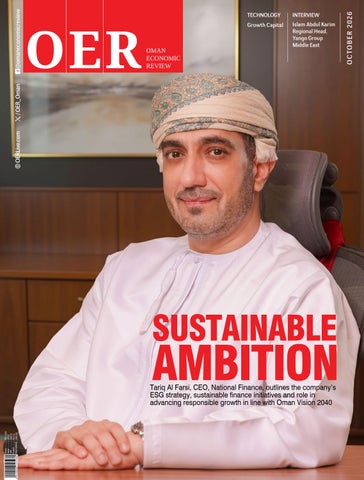
SUSTAINABLE
AMBITION
Tariq Al Farsi, CEO, National Finance, outlines the company’s ESG strategy, sustainable finance initiatives and role in advancing responsible growth in line with Oman Vision 2040
O C TO B E R 2 0 2 6
TECHNOLOGY
No. 312 October, 2026
EDITOR’S DESK
Sustainability imperative Over the past few years, Environmental, Social and Governance (ESG) principles have become an important part of the corporate agenda, influencing business decisions, investments and growth strategies. In Oman, the focus on sustainability is gaining ground as the country pursues economic diversification and long-term development under Oman Vision 2040.
EDITORIAL Editor-in-chief Said Masoud Almashani Executive Vice President and Group Editor Mayank Singh Editor Oommen John P DESIGN Assistant Art Director Khoula Rashid Al Wahaibi Chief Photographer Rajesh Rajan Cover concept Rakesh Radhakrishnan
MARKETING Associate Advertising Director Shivkumar Gaitonde Business Manager Dhanish Pillai CORPORATE Chief Executive Officer Atulya Sharma Distribution United Media Services LLC
ESG covers much more than reducing carbon emissions or investing in renewable energy. It also looks at how companies are governed, how they manage resources, treat employees, develop local talent and engage with the communities in which they operate. Omanisation, skills development and sound corporate governance are all part of this wider responsibility. For businesses, putting these principles into practice is not always straightforward. It requires clear goals, regular monitoring and transparent reporting. ESG also makes business sense. Better resource management can help reduce costs, while sound governance and responsible practices can strengthen investor confidence and improve a company’s standing in the market. Sustainable finance and changing disclosure requirements are also pushing businesses to pay closer attention to their ESG performance. The pace of adoption, however, varies across sectors. Larger companies may have the resources to put formal ESG frameworks in place, while smaller businesses often struggle with the cost and demands of implementation and reporting. As Oman moves towards Vision 2040, the focus must be on making ESG part of the way businesses operate rather than treating it as a separate corporate initiative. How effectively companies put these principles into practice will influence both their competitiveness and the country’s wider development.
OommenJohn
Oommen John
Published by United Press & Publishing LLC PO Box 3305, Ruwi, Postal Code - 112 Muscat, Sultanate of Oman Tel: (+968) 24700896, Fax: (+968) 24707939 Website: www.umsoman.com
Sign up for OERLive's daily WhatsApp updates on economy, lifestyle, and technology. Send us a WhatsApp message with the word “OERLIVE” on
All rights reserved. No part of this publication may be reproduced without the written permission of the publisher. The publisher does not accept responsibility for any loss occasioned to any person or organisation acting or refraining as a result of material in this publication. OER accepts no responsibility for advertising content. Copyright © 2026 United Press & Publishing LLC Printed by Oman Printers & Stationers Ltd. Co. S.P.C. Correspondence should be sent to: Oman Economic Review United Media Services PO Box 3305, Ruwi 112, Sultanate of Oman Fax: (+968)24707939 Website: www.oerlive.com For editorial enquiries: 99884854 For advertising enquiries: 99267159
91242930
@oerlive
BEYOND COMPLIANCE Your cover story was an insightful read. Most boards are well structured, compliant and meet regularly. Yet governance blind spots can persist, not necessarily because of a lack of intent, but because of limited visibility. This is where independent boards can make a meaningful difference, particularly for family-owned enterprises. For family-owned businesses in Oman, the benefits go beyond compliance. Independent directors bring specialised expertise, challenge conventional thinking and offer an external perspective on capital allocation, risk, succession and diversification. Separating ownership from dayto-day management can also reduce dependence on individuals and help build institutions that endure across generations. Professional governance does not mean relinquishing family ownership or founding values. Rather, it provides a framework to preserve that legacy while building businesses capable of adapting, attracting capital and expanding into new markets. However, governance must be matched by execution. Capable management, empowered employees, clear accountability and the willingness to act on board-level insights are equally important.As Oman’s family enterprises navigate succession, diversification and regional expansion, independent boards can offer something increasingly valuable: the objectivity to see the business as it is, and the courage to challenge it to become better. Ultimately, the real value of governance lies not simply in greater oversight, but in betterinformed decisions and stronger businesses. Moosa Al Lawati, Seeb
ENGINEERING EDGE India’s global economic footprint is no longer defined solely by information technology and pharmaceuticals. Over the past two decades, Indian engineering and construction companies have steadily established themselves as trusted partners in delivering large-scale oil and gas, infrastructure and industrial projects worldwide, particularly across the Middle East. The region’s growing investments in energy, infrastructure, transport, industrial development and urban expansion present significant opportunities for Indian engineering, procurement and construction (EPC) companies. From Saudi Arabia’s Vision 2030 and the UAE’s industrial expansion to Oman’s economic diversification initiatives, the demand for technically advanced, cost-effective and reliable project execution continues to grow. India is well positioned to capitalise on this opportunity. It’s strengths lie in a large pool of skilled engineering talent, competitive costs, established project management capabilities and an increasingly sophisticated domestic manufacturing base. Indian companies are also embracing digital technologies such as artificial intelligence and Building Information Modelling (BIM), enhancing efficiency, precision and project delivery. As the Middle East accelerates its economic transformation, the partnership with India has the potential to move beyond traditional contracting towards deeper industrial cooperation, technology transfer and shared capabilities. India’s rising engineering credentials could make it an increasingly important partner in shaping the region’s next phase of growth. Christopher Mark, MQ
Every drop counts. Save water.
2
October 2026
INSIDE
9 COVER STORY
STRATEGIC IMPERATIVE
26
As Oman advances Vision 2040, ESG is evolving from a corporate responsibility agenda into a strategic business priority. Companies are translating sustainability commitments into measurable action, spanning decarbonisation, renewable energy, responsible governance, talent development and sustainable finance
URBAN DEVELOPMENT
ELEVATED AMBITIONS Musstir Heights is attracting strong investor interest, says Harith Al Brashdi, CEO, Musstir, after over 25 per cent of Phase 1 units were reserved during Urban October 2026
56 TECHNOLOGY
52 INTERVIEW
DIGITAL MOBILITY Islam Abdul Karim, Regional Head, Yango Group Middle East, outlines the company’s expanding digital services and technology-led mobility solutions in Oman, the opportunities presented by Oman Vision 2040 and the potential of AI to drive inclusive growth
GROWTH CAPITAL Phaze Ventures announces a global venture platform of more than $75mn to back the next generation of AI and deeptech companies worldwide while supporting exceptional founders building at home
Editorial . ...................... 1
Business Briefs . .......... 4
ECONOMY Trade .......................... 20
In the news . ............... 33
Event .......................... 34
TECHNOLOGY
LIFESTYLE
LEADERSPEAK
LISTINGS
VIDEO
A decade of investing: Tech portfolio returned 1,342 per cent versus Nasdaq-100’s 636 per cent New analysis from trading and investing platform etoro shows that investors who focused on the technology and gaming themes driving long-term market growth achieved significantly higher returns than the Nasdaq-100 over the past decade
Luxury watches that could appreciate over the next decade [2026 Auction Buyer Guide] From F.P. Journe to a Patek Philippe, OERLive examines nine watches whose scarcity, history and collector momentum could make them particularly interesting to own through 2036
Automotive . ............... 54
Billboard . ................... 58
The hidden price of convenience: What people in Oman spend on food delivery, coffee & subscriptions A morning coffee, dinner delivered after work and a handful of digital subscriptions can quietly add up to hundreds of rials a year
BUSINESS BRIEFS Bank Muscat posts net profit of RO209.18mn for the nine months ended September 30, 2026 Bank Muscat announced its preliminary unaudited results for the nine months period ended September 30, 2026. The Bank posted a net profit of RO209.18mn for the period compared to RO191.57mn reported during the same period in 2025, an increase of 9.2 per cent. The key highlights of the results for the period are as follows: Net Interest Income from Conventional Banking and Net Income from Islamic Financing stood at RO321.4mn for the nine months period ended September 30, 2026 compared to RO310.9mn for the same period in 2025, an increase of 3.4 per cent; Non-interest income was RO131.63mn for the nine months period ended September 30, 2026 as compared to RO123.57mn for the same period in 2025, an increase of 6.5 per cent, mainly due to growth in business volumes; Operating expenses for the nine months period ended September 30, 2026 was RO172.27mn as
compared to RO162.82mn for the same period in 2025, an increase of 5.8 per cent; Net impairment losses on financial assets for the nine months period ended September 30, 2026 was RO32.76mn as against RO43.63mn for the same period in 2025; Net Loans and advances including Islamic financing receivables increased by 7.9 per cent to RO11,552mn as against RO10,704mn as at September 30, 2025;
Customer deposits including Islamic customer deposits increased by 8.1 per cent to RO10,919mn as against RO10,099mn as at September 30, 2025. The full results for the nine months period ended September 30, 2026 along with the complete set of unaudited financial statements will be released following the approval of the Board of Directors of the Bank at its meeting scheduled later during October 2026.
OAB strengthens cooperation with the Embassy of Jordan to foster bilateral investment relations Oman Arab Bank (OAB) is strengthening its cooperation with the Embassy of the Hashemite Kingdom of Jordan in the Sultanate of Oman, reaffirming its commitment to meeting the Embassy’s banking requirements and supporting Jordanian investors in Oman. Building on the longstanding ties between the two countries, the Bank aims to develop a lasting banking relationship that facilitates institutional activities and helps investors navigate their financial requirements as they pursue opportunities in the Sultanate. The cooperation follows a meeting held on October 12, 2026 with His Excellency Zeid Abdelkarim AbuHassan, Ambassador of the Hashemite Kingdom of Jordan to the Sultanate of Oman, recognising OAB’s assistance in facilitating the Embassy’s financial transactions. For the Bank, this recognition provides a foundation for continued engagement, with a focus on
4
October 2026
understanding the Embassy’s evolving needs and maintaining effective coordination. It
also creates scope for dialogue on how banking services can support the wider economic relationship between Oman and Jordan. Sulaiman Al Hinai, Chief Wholesale Banking Officer at Oman Arab Bank, said, “Our relationship with the Jordanian Embassy reflects our belief that meaningful partnerships are built through trust, continuity and a clear understanding of shared priorities. We value the Embassy’s confidence in OAB and look forward to developing this cooperation over the long term. By supporting Jordanian investors in Oman and helping them address their banking needs, we seek to make a practical contribution to stronger economic ties between our two countries. Banking cooperation plays an essential role in enabling businesses to move from identifying opportunities to pursuing them with greater confidence.”
Sohar International receives dual recognition for Oman’s $1bn Sukuk and Asyad Shipping IPO Sohar International has received two prestigious recognitions at the Islamic Finance News (IFN) Awards 2026, reaffirming its growing role in advancing Oman’s capital markets and facilitating transactions that contribute to the Sultanate’s economic development and international investment appeal. The Bank was recognised for its involvement in two landmark transactions: the Sultanate of Oman’s $1 billion Sukuk, which was named IFN Oman Deal of the Year 2025, and Asyad Shipping Company’s RO640.5mn Initial Public Offering (IPO), which received the IFN IPO Deal of the Year 2025 award. The recognitions highlight Sohar International’s ability to support strategic funding and capitalraising initiatives, combining market expertise, institutional relationships and execution capabilities to connect issuers with investment opportunities. They also reflect the Bank’s
contribution to the continued development of Oman’s financial ecosystem, supporting greater market participation, diversification of funding sources and access to regional and international capital. Commenting on the recognition, Abdulwahid Mohamed Al Murshidi, CEO, Sohar International, said, “As Oman advances its economic ambitions, the ability to mobilise capital, attract investment and connect institutions with financial
markets will become increasingly important to sustaining long-term growth. At Sohar International, we see our role extending beyond the successful execution of individual transactions to helping build a more dynamic, competitive and internationally connected financial ecosystem. These landmark transactions demonstrate the strength of Oman’s investment proposition and the growing sophistication of its capital markets, while reflecting our ability to bring together institutional expertise, market access and execution capabilities to deliver outcomes of national significance. Our ambition is to continue strengthening Sohar International’s position as a trusted financial partner, enabling capital to flow towards strategic opportunities, supporting the growth of key economic sectors and contributing to Oman’s broader economic transformation in line with Oman Vision 2040.”
ahlibank launches ahli tamkeen SME Academy to empower SMEs for sustainable growth Reaffirming its commitment to a stronger and more dynamic SME sector, ahlibank has officially launched the first edition of ahli tamkeen SME Academy, a comprehensive capacity-building program designed to advance the capabilities of Omani entrepreneurs and SME leaders. The three-month program brings together 25 participants from a range of vital economic sectors and combines practical learning, specialized knowledge and personalized guidance to help entrepreneurs strengthen their business preparedness, respond effectively to changing market conditions and unlock opportunities for future growth. The program covers several key areas, including financial management, access to finance, marketing and digital transformation, and is delivered by Protiviti. Participants were selected from SME owners who registered their interest in the program, through one-to-one interviews with both Riyada Card holders and non-holders, to understand their needs and the challenges they face in the market and in growing their
businesses. The initiative reflects ahlibank’s belief that the long-term success of SMEs depends not only on financial resources, but also on the capabilities, knowledge and confidence required to make prudent business decisions. Through a combination of focused workshops and one-to-one guidance, the Academy gives participants the opportunity to examine key areas of their businesses, sharpen their decisionmaking and identify new opportunities. The program also encourages knowledgesharing among participating entrepreneurs, creating an environment conducive to learning and continued development.
As an important contributor to the nation’s economic diversification and private-sector development, the SME sector plays a vital role in overall socio-economic progress. Recognising this role, ahlibank’s investment in the Academy reflects its broader commitment to responsible and purposeful growth of SMEs. The initiative also reinforces the bank’s alignment with the objectives of Oman Vision 2040 and its emphasis on entrepreneurship and private-sector development, supporting homegrown enterprises in raising business standards, pursuing excellence and innovation, and creating value that extends to the communities in which they operate.
Celebrating Visionary Excellence in Corporate Leadership
With over 26 years of setting new standards in business and financial journalism, Oman Economic Review now proudly presents the OER Corporate Excellence Awards, honouring the visionaries at the helm of Oman's business landscape. This prestigious event will celebrate the corporate leaders and MSX-listed companies in the Large, Mid, and Small-cap categories, who have demonstrated unmatched foresight and excellence, setting bold benchmarks in an ever-evolving market. These awards are more than recognition; they are a testament to the enduring spirit of innovation that drives Oman’s economy forward. From groundbreaking strategies to transformative leadership, the OER Corporate Excellence Awards recognize those who redefine the boundaries of success. This year OER Corporate Excellence Awards turns into a case study driven,nomination based awards platform where corporates and individuals showcase real,proven business impact through innovation, resilience and excellence.
For more information, contact SHIVKUMAR on 99267159, shivkumar@umsoman.com OR DHANISH on 92637189, dhanish@umsoman.com
Share the stage as we shine a spotlight on the leaders who are unlocking the full potential of tomorrow’s Oman.
SPECIAL FOCUS Leadership Insights CEO panel discussion:
2026
Topic: ‘An innovative approach for Sustainable Business Growth and Diversification’
DATE : NOVEMBER 18 VENUE : SHERATON OMAN HOTEL
Exclusive presentations from C-suite leaders
OER Corporate Excellence Award Categories:
2026
• • • • • • • • • • • • •
Bank of the Year • Insurance Company of the Year • Finance Company of the Year • Technology Company of the Year • Manufacturing Company of the Year • Energy Company of the Year • Healthcare Company of the Year • Real Estate Company of the Year • Innovative Company of the Year • Business Leader of the Year • Young Business Leader of the Year • CEO of the Year • Innovative Leader of the Year
Transformation Leader of the Year ICV Initiative of the Year CSR Initiative of the Year Sustainability Initiative of the Year Branding of the Year Lifetime Achievement Award Sustainability & ESG Customer Experience Talent Development & Workplace Culture Crisis Management & Resilience Digital Transformation Growth & Profitability
STRATEGIC PARTNERS
ASSOCIATE PARTNERS
AUTOMOTIVE PARTNER
KNOWLEDGE PARTNER
MEDIA PARTNER
SUPPORT PARTNER
ONLINE MEDIA PARTNER
ORGANIZER
INDUSTRY
EMERGING HUB
Madayn organises 2nd Investor Meet to spotlight opportunities in Al Suwaiq Industrial City The Public Establishment for Industrial Estates “Madayn” organised the Second Investor Meet to highlight investment opportunities at Al Suwaiq Industrial City. Bringing together a number of investors and business owners, the meeting spotlighted the competitive advantages and infrastructure readiness of one of Madayn’s latest industrial hubs in North Al Batinah Governorate. Al Suwaiq Industrial City forms a key pillar in Madayn’s strategy to strengthen Oman’s investment appeal and drive economic diversification in line with Oman Vision 2040. Speaking at the event, Mundhir bin Ali Al Nasseri, Acting Director General of Al Suwaiq Industrial City, noted that the city successfully attracted new projects worth over RO1.4mn during the current year across leased areas totalling more than 80,000 sqm. “This brings the city’s total cumulative investment to over RO2mn, with the combined leased areas surpassing 90,000 sqm. The newly attracted projects span a range of vital industrial activities, including polyethylene production, industrial oil refining, polymer modified bitumen, and ceramic tile manufacturing,” Al Nasseri pointed out. He added that the city is currently evaluating a pipeline of investment applications across several promising sectors – including the manufacturing of multipurpose electric motors and generators, soft drinks, cosmetics, and hand and foot care products – reflecting growing investor interest in the industrial city. On his part, Eng. Abdullah bin Mohamed Al Farsi emphasised that Madayn is collaborating closely with relevant public and private bodies to accelerate the provision of essential services, streamline procedures for investors, and intensify marketing efforts. These initiatives aim
8
October 2026
to attract quality industrial projects, diversify manufacturing activities, create sustainable opportunities for the SMEs, and strengthen supply chains. Al Farsi added that Al Suwaiq Industrial City enjoys a prime geographic location, offering seamless access to major transport networks, regional consumer markets, and export gateways, thereby significantly enhancing supply chain efficiency, facilitating commercial operations, and driving growth across the industrial sector. Covering a total area of 12.2 million sqm, Al Suwaiq Industrial City serves
as a major addition to Oman’s industrial landscape. Madayn has developed studies to identify investment opportunities aligned with the economic diversification strategy and Oman Vision 2040. Targeted sectors include petrochemicals, food industries and modern agriculture, energy and supporting technologies, recycling and environmental industries, light and medium industries, pharmaceuticals, technology and innovation, heavy industries, and logistics. Backed by competitive incentives and advanced infrastructure, the city is positioned to generate direct and indirect jobs for nationals while boosting local entrepreneurial growth.
ESG: THE CORPORATE IMPERATIVE
ESG is rapidly evolving from a corporate responsibility agenda into a strategic business priority. As Oman advances Vision 2040, companies across sectors are increasingly integrating environmental sustainability, social impact and strong governance into their business strategies. The OER cover story explores how Oman’s leading companies are turning ESG commitments into measurable action- from decarbonisation and renewable energy to responsible governance, Omanisation, talent development, community impact and sustainable finance
COVER STORY
STRATEGIC IMPERATIVE
As Oman advances Vision 2040, ESG is evolving from a corporate responsibility agenda into a strategic business priority. Companies are translating sustainability commitments into measurable action, spanning decarbonisation, renewable energy, responsible governance, talent development and sustainable finance Environmental, Social and Governance (ESG) considerations are increasingly influencing the way businesses operate, attract investment and plan for long-term growth. In Oman, interest in ESG is growing as the country pursues economic diversification under Oman Vision 2040 and works towards its long-term ambition of achieving net-zero emissions by 2050. Sustainability is becoming an important consideration in business
10
October 2026
resilience, transparency and competitiveness. Oman’s ESG framework has developed through a series of regulatory and institutional initiatives. The Muscat Stock Exchange (MSX), which joined the United Nations Sustainable Stock Exchanges initiative in March 2022, introduced ESG disclosure guidelines for listed companies in September 2023. These guidelines have
provided a framework for companies to progressively incorporate sustainabilityrelated information into their reporting. In March 2026, the Financial Services Authority (FSA) adopted IFRS S1 and IFRS S2, bringing Oman’s sustainability reporting framework closer to international standards. These standards provide guidance on disclosing material sustainability-
related risks and opportunities, including those associated with climate change. The Oman Investment Authority (OIA) has also introduced ESG guidelines for its portfolio entities, encouraging the integration of sustainability considerations into corporate strategies, risk management and governance structures. The guidelines cover areas such as board oversight, ESG committees, risk assessments, mitigation plans and sustainability reporting. Environmental priorities are particularly relevant to Oman, given its industrial base and natural-resource considerations. Oil and gas, petrochemicals, steel, aluminium and cement companies are exploring ways to improve energy efficiency and manage emissions. Investments in solar and wind energy, green hydrogen, carbon management and cleaner industrial technologies are among the areas that could support the country’s long-term development.
Responsible water use, wastewater treatment, recycling and waste reduction are also important in an arid environment. The Oman Net Zero Centre contributes to national efforts to coordinate and monitor progress towards climate-related objectives. The social dimension of ESG extends beyond corporate philanthropy. Workforce development, Omanisation, occupational health and safety, fair employment practices and employee welfare are important aspects of responsible business operations. Companies can contribute to developing Omani talent, supporting local suppliers and promoting community development through education, skills training and entrepreneurship. In-Country Value (ICV) initiatives provide a link between corporate activity and wider economic development. Strong corporate governance is another important element of ESG. Board oversight, transparent decision-making, ethical business
practices and effective risk management contribute to sound corporate practices and stakeholder confidence. Cybersecurity, data privacy and responsible supply-chain management are also receiving greater attention. The business case for ESG is gaining importance as investors, lenders and international customers increasingly consider sustainability performance in their decisions. A well-developed ESG approach can help companies improve access to capital, build business partnerships, enhance resource efficiency and identify opportunities in emerging sectors. Sustainable finance is also creating avenues for investment in renewable energy, cleaner infrastructure and other projects with environmental and social benefits. The adoption of ESG practices can, however, involve practical challenges. Limited access to specialised expertise, reporting costs and difficulties in establishing measurable targets may affect the pace of implementation, particularly among smaller companies. Clear reporting standards, reliable data and transparent communication are important in addressing these challenges and building confidence in corporate disclosures. As sustainability reporting develops, independent ESG assurance can play a useful role in enhancing the credibility of corporate disclosures. External verification can improve confidence in reported information, identify gaps in data collection and support greater accountability. Companies can strengthen their reporting processes through appropriate internal controls, documented methodologies and reliable supporting evidence. For Oman, ESG represents an evolving business priority as well as an opportunity to support long-term economic development. Companies that incorporate sustainability considerations into their investment decisions, operations and corporate strategies can be better placed to respond to changing market expectations, manage emerging risks and identify new opportunities. Ultimately, progress will be reflected in how effectively businesses translate their sustainability objectives into measurable outcomes and lasting value.
COVER STORY
SUSTAINABLE AMBITION
National Finance is integrating ESG principles into its business strategy, from sustainable finance and responsible lending to financial inclusion and governance. Tariq Sulaiman Al Farsi, CEO, outlines the company’s approach and its contribution to Oman Vision 2040. An OER Report How is ESG shaping National Finance’s business strategy and long-term growth?
At National Finance, ESG is far more than a buzzword; it is a meaningful extension of our commitment to sustainability, one that is deeply ingrained in the fabric of our business philosophy and operational ethos. We recognise that responsible business practices and sustainable growth go hand in hand, shaping how we operate, the value we create and the positive impact we make on the communities we serve. The introduction of our Sustainability Strategic Framework marked a significant milestone in translating this commitment into a structured, organisation-wide approach. The framework provides a clear roadmap for embedding ESG principles across our operations, decision-making and business priorities. Through its implementation, we are advancing initiatives that reduce our environmental footprint, support youth empowerment, develop national talent, promote inclusivity and expand sustainable finance products and services. Aligned with the objectives of Oman Vision 2040, these efforts reinforce our ability to respond to evolving stakeholder expectations, strengthen our business resilience and pursue growth that delivers enduring economic, social and environmental value. How is the company promoting sustainable finance and responsible lending?
At National Finance, our sustainable finance offering is designed to meet the evolving needs of customers seeking to embrace environmentally conscious technologies and practices, while advancing the nation’s climate action agenda. Our
12
October 2026
portfolio spans financing for electric and hybrid vehicles, residential solar solutions and smart-home systems, alongside financing for sustainability-linked ventures and projects of national significance that support the Sultanate of Oman’s sustainability priorities. Through these solutions, we aim to deliver meaningful value, encourage innovation, accelerate the transition towards clean mobility and empower individuals and enterprises to contribute to Oman’s green transformation.
choices more accessible to customers.
Underpinning these efforts is our commitment to responsible lending, which remains central to our approach to sustainable growth. By aligning financing solutions with customer needs and promoting sound financial decisionmaking, we strive to create exceptional value for the communities we serve while supporting the Sultanate’s broader economic and sustainability ambitions.
How is the company promoting financial inclusion, talent development and community impact?
What measurable progress has National Finance made in environmental sustainability?
National Finance continues to make meaningful progress in advancing environmental sustainability, with a growing focus on enabling the transition towards lower-emission mobility and expanding access to cleaner energy solutions. A significant indicator of this progress is the substantial growth in financing for electric and hybrid vehicles, which reached RO6.86mn by the end of September 2026, compared to RO1.89mn for the full year 2025, representing an increase of approximately 264 per cent. This growth underscores the increasing role of sustainable financing in making cleaner mobility
Beyond vehicle financing, our strategic collaborations with like-minded organisations are helping expand access to financing for residential solar power solutions and renewable energy technologies. Through these efforts, we are translating our sustainability commitments into practical solutions that encourage more responsible consumption and accelerate the adoption of cleaner technologies.
At National Finance, we believe meaningful progress is built on creating opportunities, strengthening capabilities and empowering individuals and communities to contribute to the nation’s development. This belief underpins our approach to financial inclusion, talent development and community investment, shaping how we design our financing solutions, nurture our people and deliver social impact across the Sultanate of Oman. Developing national talent remains a strategic priority. Earlier this year, we launched the ‘Miras’ Graduate Program to bridge the gap between academic learning and professional employment. The inaugural cohort of 10 Omani graduates embarked on a structured 12-month journey encompassing seven development modules, spanning technical training, practical workplace experience, mentorship and professional development. Complementing this initiative, our focus on continuous learning and career advancement is reinforced by ‘Irtiqaa’, our Women’s Leadership Development Program,
COVER STORY
designed to strengthen the leadership capabilities of female managers and support their progression into senior roles. Beyond our organisation, community empowerment remains central to our social responsibility agenda through ‘Imtidad’, supported by our ‘Himmah’ volunteer team and partnerships with organizations dedicated to social welfare, youth development and environmental conservation. Over the years, we have significantly increased our annual social investments, reflecting our commitment to social ventures and community development. This commitment enables National Finance to expand opportunities, uplift communities, nurture future talent and create lasting impact nationwide, contributing tangibly to the Sultanate of Oman’s sustainable development. How is National Finance strengthening corporate governance, transparency and accountability?
Strong corporate governance, transparency and accountability are fundamental to
14
October 2026
building trust, safeguarding stakeholder interests and ensuring sustainable, longterm growth. Our approach is rooted in upholding the highest standards of ethical conduct, regulatory compliance and responsible decision-making, with robust governance practices embedded across our operations and business priorities. We remain committed to strengthening the frameworks, controls and oversight mechanisms that promote accountability, support effective risk management and ensure transparency in our engagement with our customers. By fostering a culture of integrity, responsibility and continuous improvement, National Finance seeks to reinforce confidence in our business practices and maintain the institutional resilience necessary to support the nation’s evolving financial landscape. What are National Finance’s ESG priorities in supporting Oman Vision 2040?
At National Finance, we see our ESG priorities as an extension of our responsibility to the people, communities
and economy we serve. Oman Vision 2040 provides a clear direction for the nation’s future, and we recognise our role in contributing to its ambitions through responsible financing, investment in people and a sustained commitment to environmental and social progress. Our focus is on driving progress where we can make a meaningful difference: expanding access to sustainable financing and supporting the adoption of cleaner technologies, developing Omani talent and creating opportunities for future generations, investing in community wellbeing, and upholding the highest standards of governance and accountability all in alignment with our Partner for Growth promise. For us, ESG is ultimately about looking beyond immediate business outcomes to consider the lasting impact of our decisions. By aligning our growth with the nation’s wider aspiratiowns, we aim to contribute to a more resilient economy, a more empowered society and a more sustainable future for the Sultanate of Oman.
COVER STORY
ENGINEERING OMAN’S NEXT PHASE OF GROWTH
From marine infrastructure and industrial development to sustainable solutions and Omani talent, Khimji Ramdas Infrastructure is building capabilities for the Sultanate’s next growth cycle. Hitesh Akarte, Chief Operating Officer, Khimji Ramdas Infrastructure, discusses the company’s evolving business model, its contribution to Oman’s infrastructure ambitions and why responsible growth is becoming a business imperative
16
October 2026
Oman’s infrastructure landscape is changing. Industrial expansion, urban development, logistics investment and the transition towards more sustainable economic activity are creating demand for businesses that can offer more than products and conventional contracting. They require engineering expertise, local capabilities and solutions that deliver value well beyond project completion. Khimji Ramdas Infrastructure is positioning itself for this shift, evolving from its traditional trading roots into a solutionsdriven business with capabilities spanning commercial construction, marine infrastructure, HVAC, electrical systems, IT, premium office furniture and water and wastewater treatment. “The market today demands much more than conventional trading. Local value addition and a solutionsbased approach are central to our strategy. Across our infrastructure businesses, we have developed local competencies that enable us to deliver solutions rather than simply supply products,” says Hitesh Akarte. The strategy reflects the opportunities emerging under Oman Vision 2040, where infrastructure investment supports not only physical development but also industrial competitiveness, economic diversification and the creation of long-term value. “Our growth is closely aligned with Oman’s infrastructure development. The opportunities extend beyond construction into energy and several other infrastructurerelated sectors. Realising Oman Vision 2040 will require investment across these areas, and we see considerable potential over the next five years,” he says. Sustainability becomes a business imperative
For infrastructure businesses, sustainability is increasingly connected to operational efficiency, product selection, resource management and the long-term performance of assets. The challenge is to translate environmental priorities into practical solutions that meet project requirements while remaining commercially viable. Khimji Ramdas Infrastructure is aligning its engineering capabilities and product portfolio with this changing demand, including in HVAC, electrical systems, construction, marine engineering and
water and wastewater treatment. “We draw inspiration from the direction set by Oman Vision 2040. Sustainability, green energy and renewable energy are important themes, and we align our products and solutions accordingly. We also train our people to deliver the solutions that clients increasingly require for their projects,” Akarte says. One example is the company’s involvement in developing a jetty for the Jindal green steel project. The project illustrates how marine infrastructure can support industrial development and provide the physical foundations for Oman’s evolving industrial ecosystem. Sustainability also influences the products businesses choose for their workplaces. Through its premium office furniture portfolio, Khimji Ramdas represents Herman Miller, whose Aeron Chair demonstrates how material innovation, durability and performance can intersect in a commercial product. The current Aeron Chair incorporates more than 50 per cent recycled material, including ocean-bound plastic. Its significance lies in bringing sustainability into a product used in everyday business environments, while retaining a focus on ergonomics, comfort and performance. The example reinforces a wider point: responsible product selection need not mean compromising functionality or quality. Material composition, durability and the potential environmental impact over a product’s life are increasingly relevant considerations alongside design and cost. “For us, it is not merely about luxury. The solution has to be functional and perform well. The design and every aspect of the solution must meet the client’s requirements. That is what matters,” Akarte says. Across its wider portfolio, the opportunity is to help clients select solutions suited to their operational needs while responding to growing expectations around efficiency and sustainability. Demonstrating progress will increasingly depend on translating these priorities into measurable outcomes, including resource efficiency, responsible sourcing and environmental performance. Marine Infrastructure: Enabling economic activity
With its extensive coastline and strategic position in regional trade, Oman has
significant opportunities to develop infrastructure that supports industrial growth, maritime activity and coastal communities. Marine construction is a key part of Khimji Ramdas Infrastructure’s capabilities. The division undertakes engineering, procurement and construction (EPC) projects, with work in locations including Duqm and Sur, as well as a fishing harbour Masirah Island. “Infrastructure needs to be created wherever it is required, whether on land or along the coast. The government’s plans are aimed at creating facilities for people living in Oman, while investment in infrastructure also supports economic activity,” Akarte says. The value of marine infrastructure extends beyond the structures themselves. Ports, jetties and harbours can enable industrial operations, strengthen connectivity and create opportunities for businesses and surrounding communities. Their contribution is particularly relevant as Oman continues to develop its industrial zones, logistics capabilities and coastal destinations. The company’s commercial construction business complements this expertise, undertaking procurement and construction based on designs provided by clients and consultants. “We are present across these projects, and I am confident that their completion will benefit the local communities they serve,” Akarte says. For infrastructure providers, the challenge is to deliver projects that meet immediate technical requirements while supporting wider economic objectives. Reliability, execution capability and an understanding of local conditions remain essential to achieving that balance. Omanisation as a strategic investment
Infrastructure development depends on more than capital and technology. It requires experienced professionals, specialised technical knowledge and a pipeline of local talent capable of taking on increasingly complex responsibilities. Khimji Ramdas Infrastructure places workforce development at the centre of this requirement. The company recruits Omani graduates, provides on-the-job training across departments and offers
COVER STORY
additional learning opportunities, including international exposure in countries such as India and Malaysia. “Our people have always been our core strength. The projects we deliver require experienced professionals who can meet customer expectations. At the same time, we have made a concerted effort to bring young Omani talent into the business and develop their capabilities,” Akarte says. Omani employees contribute across design, office operations and on-site project delivery. The objective is to develop practical expertise and create pathways for employees to progress into positions of greater responsibility. “We take pride in maintaining Omani representation across our businesses at levels above the industry standard. You will find local employees involved in design, office operations and on-site project delivery,” he says. This investment has significance beyond workforce requirements. Developing national expertise supports knowledge transfer, strengthens local delivery capabilities and helps build the professional talent base needed for Oman’s long-term economic development. As infrastructure projects become more specialised, the ability to recruit, develop and retain skilled Omani professionals will remain an important factor in business resilience and competitiveness. Innovation, governance and longterm value
For Khimji Ramdas Infrastructure, innovation extends beyond adopting new technologies. It also means improving the processes through which projects are planned, procured, executed and supported. “We continuously innovate in the way we manage our businesses so that we can deliver better outcomes for our clients. At the same time, innovation must contribute to the commercial performance of the business,” Akarte says. Improvements across engineering, procurement, construction and aftersales support can strengthen project coordination, improve service delivery and help businesses manage operational complexity. Strong governance underpins this approach. Effective compliance, procurement controls, workplace safety and
18
October 2026
project oversight are essential to managing risk, protecting delivery standards and maintaining stakeholder confidence. Environmental responsibility, social development and governance are therefore closely connected to commercial performance. Better resource efficiency can help manage operating costs; skilled local teams can strengthen execution; and disciplined risk management can support reliable delivery and enduring customer relationships. For businesses across Oman’s infrastructure sector, the next opportunity is to make these commitments increasingly measurable through appropriate performance indicators, transparent accountability and systematic evaluation of outcomes. This would help connect responsible business practices with demonstrable operational and economic value. Positioned for Oman’s next growth cycle
Over the next five years, Khimji Ramdas Infrastructure expects to build on its commercial and marine construction capabilities while pursuing opportunities across its broader engineering portfolio. Its offerings include air utility solutions, hydraulic lifting systems, water and wastewater treatment, HVAC, IT and electrical solutions, alongside ship repair, yacht repair and onboard maintenance services. “Across commercial and marine construction,
we have developed competencies that enable us to participate in Oman’s infrastructure growth. Our focus is on leveraging these capabilities while continuing to align ourselves with the country’s evolving requirements,” Akarte says. The company’s next phase will depend on its ability to build on these strengths, respond to emerging project requirements and continue developing local expertise. The emphasis remains on aligning business growth with the needs of Oman’s changing infrastructure landscape. “We see significant potential across our business segments. The way forward is to maintain our pace with Oman’s infrastructure growth, build on the competencies we have developed and continue aligning ourselves with the country’s development priorities,” he says. For Khimji Ramdas Infrastructure, the opportunity is to create value at several levels: delivering critical infrastructure, enabling industrial and commercial activity, developing Omani talent and offering solutions that respond to increasingly important sustainability considerations. As Oman advances towards Vision 2040, infrastructure businesses will play a significant role in translating national ambitions into economic opportunity. Khimji Ramdas Infrastructure’s focus on engineering capabilities, marine development, local talent and responsible business reflects its approach to participating in that next phase of growth.
Over the next five years, Khimji Ramdas Infrastructure expects to build on its commercial and marine construction capabilities while pursuing opportunities across its broader engineering portfolio
Port of Duqm
Your Green Multipurpose Hub in the Middle-East Special Economic Zone of Duqm
Business-friendly environment
Tax benefits
Providing attractive incentives
Streamlined processes
Port of Duqm Multipurpose hub
Dynamic Multi- Purpose & Break-Bulk Terminal
Versatile Container Terminal
Navy Terminal
Specialized dry Bulk Terminal
Efficient Ro-Ro Terminal
Green Hub
Renewable Energy Cluster Hydrogen
Green steel and Ferrous industry
Green Bunkering
Marine Services
Offshore Services
Dockside (Lay-by) Services
commercial@portofduqm.om
Maintenance facilities
+968 2546 8666
Ship Chandling and STS (Ship to Ship)
www.portofduqm.om
TRADE
SHIFTING POWER
BRICS 2026 marks the beginning of the New World Economic Order
The XVIII BRICS Summit in New Delhi on September 12 and 13, 2026 could be remembered as an important milestone in the evolution of the global economic order. What began two decades ago as a group of four emerging economies has since developed into a much broader platform representing an extraordinary concentration of population, economic
20
October 2026
output, trade, natural resources, technology and political influence. The message from New Delhi is that the Global South is no longer content to merely participate in institutions created in an earlier era; it increasingly seeks a greater role in shaping the rules, institutions, and priorities of the global economy.
The BRICS New Delhi Declaration, adopted under India’s 2026 chairmanship, provides an important roadmap for this transition. Its emphasis extends well beyond conventional trade. It encompasses reform of global governance, including the United Nations, the IMF, the World Bank and the WTO; greater use of national currencies; crossborder payment connectivity; resilient
scale is perhaps the strongest argument for its growing influence. BRICS now represents around 50 per cent of the world’s population, approximately 40 per cent of global GDP and more than 26 per cent of global trade. Its combined economic strength has expanded dramatically, with BRICS GDP increasing by around 4.5 times, compared with about 2.5 times globally over the last 20 years. The transformation is also evident in trade. BRICS exports rose from about $1 trillion in 2003 to $6 trillion in recent years, raising the grouping’s share of global exports to around 24 per cent. Intra-BRICS trade has likewise grown from $84 billion in 2003 to nearly $1.2 trillion in recent years. These numbers demonstrate why BRICS can no longer be viewed simply as a political forum. It is becoming an increasingly important component of global production, consumption, trade, investment and supply chains. The expanded BRICS family also reflects the grouping’s growing appeal. The ten partner countries, namely Belarus, Bolivia, Kazakhstan, Cuba, Malaysia, Nigeria, Thailand, Uganda, Uzbekistan and Vietnam, add further geographic and economic depth to the platform. India at the Centre of the Transformation
supply chains; critical minerals; artificial intelligence; digital public infrastructure; energy security; food security; climate action; healthcare; industrialisation and sustainable development. BRICS: A New Economic Weight in the World
The expansion of BRICS’s economic
For India, the 2026 BRICS chairmanship has offered an opportunity to translate the country’s growing economic weight into institutional and policy leadership. India’s BRICS theme “Building for Resilience, Innovation, Cooperation and Sustainability” captures the grouping’s evolving character. The objective is not merely to increase trade but to build resilient economic relations capable of withstanding geopolitical disruptions, protectionism, supply-chain shocks and technological change. India’s economic relationship with BRICS illustrates the opportunity. India’s total trade with BRICS has more than doubled, from $203 billion in 2020–21 to about $417 billion in 2025–26. More significantly, industry estimates suggest India’s exports to BRICS, currently around $96 billion,
could reach $200 billion by 2030. India’s opportunity spans engineering goods, pharmaceuticals, chemicals, textiles, automobiles, electronics, minerals and metals, gems and jewellery, agriculture, renewable energy, healthcare and digital services. The objective should therefore be to move from export relations to deeper participation in BRICS production networks, global value chains, technology partnerships and investment flows. Prime Minister Narendra Modi’s actionoriented agenda announced during the BRICS Business Forum 2026 reinforces this approach. India proposed identifying the top ten trade barriers, supporting 100 BRICS startups annually to enter other BRICS markets, and facilitating 1,000 new business partnerships. Such proposals could transform BRICS from a policy dialogue into a platform that delivers measurable commercial outcomes. The New Delhi Declaration: A Blueprint for a New Global Order
The summit’s most significant outcome is the BRICS New Delhi Declaration. The Declaration calls for a global system that is more representative, inclusive, transparent, effective and responsive to contemporary economic realities. It explicitly supports greater participation by emerging markets and developing economies in global decision-making. It also reiterates the need for comprehensive reform of the UN Security Council and for greater representation of developing countries from Africa, Asia and Latin America. Its significance becomes even clearer in relation to the Bretton Woods institutions. BRICS has called for reforms to the IMF and the World Bank so that their governance structures better reflect the changed distribution of global economic power. The Declaration argues that the voice and representation of emerging and developing economies should reflect their relative position in the world economy. The Strategic Convergence of Major Powers
One of the most significant aspects of the New Delhi outcome is the degree
of strategic concord among major BRICS powers on the need for a more representative international system. Particularly important is the explicit support from China and Russia, both permanent members of the UN Security Council, for India and Brazil’s aspirations to play a greater role in the United Nations, including the Security Council. This is an important political signal. India, China and Russia do not necessarily share identical positions on every geopolitical or economic issue. Yet the New Delhi Declaration shows they can converge on a broader proposition: the global institutional architecture must evolve with the changing distribution of economic and political power. Towards a New Architecture of Global Finance
Perhaps the most transformative economic dimension of BRICS cooperation is the emergence of an alternative financial ecosystem. The New Delhi Declaration supports greater use of national currencies and interoperable cross-border payment systems to make transactions faster, cheaper, more transparent and more secure. India’s UPI, accepted in 11 countries and processing over 250 billion transactions annually, offers a potential model for digital payment connectivity, while India and Russia are exploring CBDC-based trade settlements. The objective is not to replace the US dollar immediately, but to diversify and build resilience. The New Development Bank further strengthens this architecture through local-currency financing, infrastructure investment and expanded membership. Supply Chains, Critical Minerals and Industrialisation
BRICS’ next phase will be increasingly shaped by control over production and supply chains. The New Delhi Declaration prioritises resilient, diversified supply chains for critical minerals, energy, advanced technologies and industrial inputs, and promotes developing economies’ move towards higher-value manufacturing. For India, this offers significant opportunities to attract diversified production and to access resources, technology, capital and markets. Initiatives such as the BRICS Incubator Network, Startup Innovation
22
October 2026
Fund, SME cooperation and industrial competency centres can strengthen innovation and global value chains. AI and Digital Public Infrastructure: The New Frontier
The New Delhi Summit shows that BRICS is evolving beyond a trade grouping into a broader development platform spanning health, agriculture, food security, energy, climate resilience, education, skills, space, AI, digital transformation and industrialisation. By fostering cooperation among emerging economies, BRICS addresses shared Global South challenges, including financing and infrastructure gaps, access to technology, energy and food security, and climate vulnerability. Initiatives such as the Jaipur Consensus, BRICS Connect and digital trade mechanisms can help bridge the estimated $2.5 trillion global trade-finance gap, particularly benefiting MSMEs. The Road Ahead: From Declaration to Delivery
The true test of the New Delhi Declaration will be its implementation. BRICS must translate its ambitious vision into measurable outcomes, including higher intra-BRICS trade, fewer non-tariff barriers, interoperable payments, stronger supply chains, greater investment, MSME participation, technology partnerships and improved development finance. For Indian industry, deeper market access, simplified customs, harmonised standards, digital documentation and
mutual recognition of certifications can significantly reduce business costs. The BRICS Business Forum and Business Council can turn policy commitments into concrete partnerships. India’s goal of raising exports to BRICS to $200 billion by 2030 should therefore support deeper integration of Indian companies into emerging global value chains. A New Chapter for the Global South
In conclusion, BRICS 2026 marks an important transition. Two decades after its institutionalisation, BRICS has achieved the economic scale and political relevance to shape global debates on trade, finance, technology, development and governance. Representing around half of the world’s population, 40 per cent of global GDP and over a quarter of global trade, it offers a powerful platform for the Global South. The New Delhi Declaration links this economic weight to an agenda for global governance reform, stronger multilateralism, greater representation of developing countries, resilient supply chains, local-currency payments, digital transformation and inclusive growth. Support from major powers, particularly China and Russia, for India’s and Brazil’s greater roles in the UN adds strategic significance. These commitments are expected to translate into stronger trade, financial and technological cooperation. BRICS 2026 mark the beginning of a new world economic order in which the Global South increasingly shapes global policy.
URBAN DEVELOPMENT
BUILDING OMAN’S URBAN FUTURE
Urban October 2026 brought Oman’s housing and urban development ambitions into sharper focus, with agreements exceeding RO1bn, new residential communities and an international dialogue on the relationship between investment, inclusion and quality of life Oman’s urban transformation gained fresh momentum during Urban October 2026, as policymakers, developers, investors and urban specialists gathered in Muscat to examine how the Sultanate’s next generation of communities could take shape. The programme brought together the commercial opportunities of real estate development and the wider responsibilities of city building, placing housing, infrastructure and public services within a shared development agenda. Held at the Oman Convention and Exhibition Centre from October 5 to 8, the exhibition and conference formed part of the Ministry of Housing and Urban Planning’s collaboration with
the United Nations Human Settlements Programme, UN-Habitat. Its opening coincided with World Habitat Day, held under the theme “Adequate Housing for All”. The ceremony took place under the auspices of His Excellency Sheikh Abdulmalik bin Abdullah Al Khalili, Chairman of the State Council, with the participation of Anacláudia Rossbach, UN Under-Secretary-General and Executive Director of UN-Habitat. The opening delivered a substantial investment announcement: 20 partnership, development and tenderaward agreements with a combined project value exceeding RO1 billion. The package encompassed residential neighbourhoods, social infrastructure and tourism developments,
illustrating the breadth of Oman’s urban investment programme. The significance of the programme extended beyond the headline figure. Viewed collectively, the announcements suggested an approach that connected property development with economic activity, community wellbeing and the distribution of growth across governorates. They also brought the practical requirements of implementation— financing, infrastructure, professional expertise and coordinated planning—into the discussion. Communities beyond the capital The Sorouh integrated residential neighbourhoods programme
URBAN DEVELOPMENT
provided one of the clearest examples of this wider geographical reach. Eight agreements, valued at approximately RO186.6 million, covered developments across around 1.74 million square metres. The announced provision encompassed 2,443 residential units and plots, with the Ministry’s subsequent explanation identifying approximately 1,850 homes and nearly 600 residential plots within the package. The projects extended across Bidbid, Bahla, Nizwa, Al Buraimi, Rustaq, Sohar, Bousher and Taqah. Among them were a RO57 million development in Falaj Al Sham, Bousher, comprising 430 housing units, and a RO47 million project in Taqah comprising 580 units. Other agreements included a RO20.86 million development in Bidbid and a RO28.83 million project in Nizwa. This distribution gave the programme a broader economic relevance. It presented opportunities for developers and contractors across several local markets, while reinforcing the importance of matching residential growth with the circumstances of individual locations. For businesses assessing the pipeline, the range of projects pointed towards demand for design, construction, materials and neighbourhood services beyond Muscat. Investment in everyday life Sultan Haitham City’s announcements demonstrated the different layers involved in establishing a functioning urban community. A construction tender exceeding RO12 million covered a rehabilitation complex for persons with disabilities and an elderly care home. A separate package exceeding RO14 million covered wadi diversion works, while an agreement with Aflaj Group supported the development of a sports and health trail. These investments illustrated how social care, resilience and recreation had entered the same development framework. Their inclusion strengthened the programme’s emphasis on the
24
October 2026
everyday experience of residents. A community’s value depended on the accessibility of its services, the safety of its infrastructure and the availability of spaces that supported health and social interaction. Al Thuraya City also moved forward through agreements spanning both planning and residential development. Zawaya Group signed a RO45 million agreement for Neighbourhood 5C, comprising 220 homes. Al Namaa Real Estate signed a RO55 million agreement for Neighbourhoods 5A and 5B, comprising 265 homes. A further RO4.5 million consultancy award covered the detailed master plan for the city’s third phase. Together, the agreements showed how master planning and individual development packages had progressed alongside one another. For investors, that relationship mattered because the appeal of a residential project rested partly on the quality and delivery of the wider urban environment. Connecting housing with economic activity The programme also highlighted the relationship between residential provision and employment centres. An agreement with Mada Group covered a RO50 million integrated residential neighbourhood in Khazaen Economic City. In Musandam, two tenders with a combined value of RO5 million covered a government school and health centre within the Kumzar residential scheme. The two announcements addressed different development needs, but both reinforced the importance of services and location. Housing linked to an economic city had implications for workforce accommodation, commuting and the growth of surrounding businesses. Educational and healthcare facilities, meanwhile, strengthened the foundations of a residential community. Tourism featured through agreements associated with the Sultan Qaboos Port Waterfront, Al Bandar and Yenkit Hills. These
projects added another dimension to the investment programme by connecting urban development with destinations for visitors, residents and commercial activity. From a business perspective, the combination of housing, tourism and public facilities pointed towards a diverse development pipeline. It also underlined the need for careful sequencing: the economic promise of a district depended on the timely arrival of infrastructure and services alongside its buildings. Planning for the next two decades The policy discussion provided context for the project announcements. Speaking alongside the event, His Excellency Dr Khalfan bin Said Al Shueili, Minister of Housing and Urban Planning, said structural plans had been prepared for around 70 per cent of Oman’s cities over the preceding three to four years. He described them as a framework for urban development over the following 20 years. That planning horizon carried clear implications for investment. Greater visibility over future development patterns offered businesses a stronger basis for assessing locations, identifying service gaps and considering longterm commitments. It also placed greater weight on coordination between housing, infrastructure and economic development. The minister highlighted water security and network efficiency, reflecting the practical constraints of development in Oman’s climate. Rossbach similarly emphasised the integration of housing with transport, land, finance, services and employment. Her comments placed implementation and the expansion of effective solutions at the centre of the urban challenge. The discussion therefore framed urban competitiveness in broader terms. The quality of a city’s services, its use of resources and the connections between homes and livelihoods all formed part of its appeal to residents and investors.
Design and international exchange Urban October’s professional programme added an architectural dimension to the investment agenda. The Royal Institute of British Architects’ programme, developed with the Ministry of Housing and Urban Planning and the Oman Society of Architects, set out opportunities for engagement between Omani and international practices. Its published agenda covered the Greater Muscat Structure Plan, the Muscat View Corridor Policy and collaboration with local consultancies. A design hackathon was framed around reimagining overlooked spaces within Omani cities. The emphasis on these spaces broadened the discussion beyond major developments. Streets, gaps between buildings and underused public areas also influenced the quality of urban life. Their inclusion in the professional agenda suggested scope for design interventions that complemented larger capital projects. For Oman’s architecture and consultancy sector, the planned exchanges offered a route towards new relationships and shared expertise. They also raised the importance of interpreting international experience through local environmental conditions, cultural identity and patterns of use. Financing the development pipeline Corporate announcements provided a more immediate view of how developers had pursued growth. During Urban October, Al Ahly Sabbour announced Zaha Residence within its Wadi Zaha development in Sultan Haitham City and signed a RO10 million financing agreement with Bank Dhofar. According to the company’s announcement, approximately 350 units were under construction, while buyers represented 48 nationalities. The developer also reported that it had achieved approximately 70 per cent of its RO33 million sales target for 2026.
The example connected the wider urban agenda with the commercial requirements of project delivery. Access to finance, buyer demand and construction progress remained central to converting master plans into occupied communities. It also illustrated the importance of distinguishing announced investment from expenditure already undertaken and homes already delivered. The co-located expo featured more than 200 exhibitors from 50 countries, over 65 real estate developers, more than 100 urban planning experts and leaders, and more than 20 SMEs. The four-day programme focused on emerging and fast-growing cities, adequate housing, homeownership, urban regeneration, public spaces and the development of inclusive, connected and liveable communities. The programme also included international experiences from cities including Seoul, Medellín and Rotterdam, alongside discussions on Muscat’s urban development, public transport and future housing needs. A stronger foundation for delivery Urban October followed an earlier round of sector activity at the Oman Real Estate, Design & Build Exhibition and Conference in May. That event had included agreements
for residential neighbourhoods in Sultan Haitham City, infrastructure packages and further developments under Sorouh, providing background to the momentum visible in October. The October programme brought that momentum into a wider conversation about the purpose and performance of cities. Its agreements expanded the development pipeline, while its policy and professional discussions examined the conditions required for those investments to create lasting value. For Oman’s business community, the opportunity extended across construction, engineering, finance, materials and urban services. The corresponding challenge lay in execution: coordinating development phases, maintaining quality, responding to demand and ensuring that community facilities progressed alongside residential construction. Urban October 2026 ultimately presented a substantial statement of intent. It brought capital commitments, planning priorities and social needs into the same forum, and established a clearer basis for assessing the next stage of Oman’s urban transformation. The test that followed rested in the delivery of communities that translated those commitments into better places to live, work and invest.
URBAN DEVELOPMENT
ELEVATED AMBITIONS Musstir Heights is attracting strong investor interest, says Harith Al Brashdi, CEO, Musstir, in an interview with Oommen John, after over 25 per cent of Phase 1 units were reserved during Urban October 2026 Musstir, the real estate development arm of the Mohammed Al Barwani Group, has announced an overwhelming booking response for units in the first phase of Musstir Heights at Al Jabal Al Aali in the Wilayat of Al Jabal Al Akhdar. This came during Musstir’s participation in Urban October 2026, organised by the Ministry of Housing and Urban Planning from October 5 to 8, 2026 at the Oman Convention and Exhibition Centre. The strong response from local and international investors highlights the attractiveness of Oman’s real estate sector and the high investment value offered by premium development projects. The sales came just days after Musstir announced the opening of pre-bookings for the first phase of Musstir Heights, a luxury residential community at Al Jabal Al Aali in Al Jabal Al Akhdar. Set at an elevation of 2,400 metres above sea level, is one of the highest residential
26
October 2026
development in the Sultanate of Oman and one of the highest luxury developments in the region. The first phase of Musstir Heights is expected to be delivered in the fourth quarter of 2030. The development offers freehold ownership to all nationalities and comprises 106 residential units, including 42 Chalets with 3 bedrooms plus maid’s room, 36 Deluxe Villas, consisting of 3 to 4 bedrooms plus maid’s room, and 28 Twin Villas with 2 bedrooms and 2 bedrooms plus maid’s room. Harith Al Brashdi, CEO of Musstir, said, “This strong response demonstrates investors’ confidence in ‘Musstir Heights’, and the opportunities offered by the Al Jabal Al Aali masterplan, one of the Ministry of Housing and Urban Planning’s strategic initiatives to develop smart and sustainable cities. This further strengthens our commitment to delivering a luxury and sustainable destination that meets the expectations of local and international investors, contributes to achieving the objectives of Oman Vision 2040, and reinforces the Sultanate’s position as a preferred destination for quality real estate investment, modern living, and tourism.” Al Brashdi added, “The high demand for Musstir Heights reflects the project’s ability to respond to the evolving trends and preferences of investors who are increasingly focused on high-quality real estate assets, long-term investments value, and integrated residential communities. We would like to thank the Ministry of Housing and Urban Planning for organising Urban October, which provided an important platform for engaging with investors, buyers, developers, government entities and real estate experts from more than 44 countries around the world, while highlighting the role of urban
planning in supporting inclusive and sustainable development. We reaffirm our commitment to delivering ‘Musstir Heights’ in accordance with the highest standards and specifications, creating a luxury destination that brings together wellbeing, sustainability and modern lifestyles, while drawing on our experience in developing high-value and sustainable projects in Oman and international markets.” Market response began during the Urban October event, where over 25 per cent of Phase 1’s 106 units were reserved within three days, primarily by Omani buyers along with international buyers from the US and GCC region. Official sales are set to launch in early 2027, with Phase 1 handovers targeted for 2030. The full project spans nine phases released roughly six months apart over a six-year timeline. Initial villa prices start at RO240,000, with premium units reaching above RO4mn. As an Integrated Tourism Complex (ITC), Musstir Heights provides freehold ownership to all nationalities. Strong early demand
for higher-end units is expected to drive property value appreciation for investors. Jabal Akhdar sits at least 15°C cooler than lower-lying urban areas, offering an escape from city heat and daily stress. The development integrates directly into the local ecosystem by replanting 10,000 to 20,000 indigenous trees, including olive, fig, peach, and apple trees. Rather than visiting only during peak summer months, residents can cultivate herb gardens, fruit trees, and seasonal rose bushes to enjoy across all four seasons. With total investments of RO500mn, Musstir Heights will feature more than 800 premium residential units, a resort and spa, a retail boulevard, an F&B promenade, and a range of curated wellness experiences. Residences will also incorporate dedicated work-from-home spaces, supporting a seamless live-workplay environment. The development spans more than 1.6 million square metres at an elevation of 2,400 metres above sea level, giving it a distinctive climate characterised by mild weather and cooler temperatures throughout the year.
As an Integrated Tourism Complex (ITC), Musstir Heights provides freehold ownership to all nationalities. Strong early demand for higher-end units is expected to drive property value appreciation for investors
ﻣﻨﺘﺪى وﺟﻮاﺋﺰ ُﻋﻤﺎن
ﻟﻠﻤﺴﺆوﻟﻴﺔ اﻻﺟﺘﻤﺎﻋﻴﺔ ﻟﻠﺸﺮﻛﺎت
14 December
If your CSR Disappeared Tomorrow, Would Anyone Notice? Don't Tell Us You Care Show Us Nominate Your Organization
SUPPORT PARTNER
MEDIA PARTNERS
AUTOMOTIVE PARTNER
DIGITAL PARTNER
digital
ORGANISED BY
Award Categories Best CSR Initiative
Best Sustainability Initiative
Community Development
Environmental Impact
Employee Engagement
Innovation in CSR
CSR Leader of the Year
CSR Campaign
Corporate–Nonprofit Partnership
Education Impact
Health & Well-being
Technology in CSR
Diversity & Inclusion
Youth Empowerment
International CSR Excellence
Social Responsibility
Excellence in Governance
Register online.
TO ENTER
Submit your project with supporting evidence. Independent experts assess every submission. Final results are evaluated, verified, and scored by an international assurance partner before being announced at the Oman CSR Awards Gala.
Note: One project may be entered into multiple categories. Submit your nomination today.
ARTS AND CULTURE
LEGACY UNFOLDS Royal Opera House Muscat opens landmark 15th anniversary season with its acclaimed production of Zeffirelli’s Rigoletto The Royal Opera House Muscat (ROHM) opened its milestone 15th Anniversary Season with its own acclaimed production of Giuseppe Verdi’s Rigoletto. Marking a defining moment in the House’s history, the season’s opening performances took place on October 1 and 3. This season celebrated “15 years of inspiration,” reflecting ROHM’s continuing journey as a beacon of artistic excellence and cultural dialogue between Oman and the world. Under the baton of acclaimed conductor Evelino Pidò, the Orchestra Teatro Regio Torino and Camerata Musicale di Parma
30
October 2026
joined an exceptional international cast led by Franco Vassallo as Rigoletto, Maria Kokareva as Gilda and Enea Scala as the Duke of Mantua. The production also featured the participation of the Omani Opera Choir, bringing an important Omani presence to the international ensemble on the ROHM stage. Zeffirelli’s distinctive staging, together with Maurizio Millenotti’s sumptuous costumes, brought Verdi’s enduring masterpiece to life once again. The production holds a special place
in the history of Royal Opera House Muscat. Zeffirelli’s Turandot inaugurated ROHM in 2011, while his Rigoletto, which first premiered at ROHM in 2022, marked his final operatic staging. Its return was therefore a fitting opening to a season celebrating 15 years of artistic excellence and cultural exchange. As the curtain fell on an unforgettable opening night, the performance marked more than the return of a masterpiece. It opened a new chapter in ROHM’s 15-year journey, continuing its role as a meeting point for exceptional international artistry and meaningful cultural dialogue between Oman and the world. Investing in the Omani Creative Community
A core pillar of ROHM’s enduring legacy is its profound impact on the local creative economy and talent development. This production of Rigoletto proudly integrated Omani artists as an essential part of the artistic fabric on stage. The esteemed Omani Opera Choir performed alongside international artists, further supported by the vital on-stage presence
of 30 Omani extras, showcasing the institution’s dedication to nurturing and elevating Oman’s creative community. The Production and Performances
Set to Giuseppe Verdi’s powerful score, the production featured a distinguished international assembly. Conductor Evelino Pidò lead the Orchestra del Teatro Regio di Torino and the Camerata Musicale di Parma Choir. The principal cast stars acclaimed baritone Franco Vassallo in the title role, Enea Scala as the Duke of Mantua, and rising soprano Maria Kokareva as Gilda. The performance was further enriched by the special participation of the Leoncello Historical Dance Group, presenting a meticulously crafted, original reconstruction of period dances. Adding to the opening week’s grandeur, renowned conductor Karel Mark Chichon led the Orchestra del Teatro Regio di Torino in an exclusive concert featuring star mezzo-soprano Elīna Garanča on October 2, perfectly bridging the two monumental opera nights.
ARTS AND CULTURE
Season Highlights Marking Fifteen Years
The sweeping anniversary programme features 28 unique shows across 43 performance nights spanning October 2026 to May 2027, encompassing opera, Arab music, concerts, ballet, jazz, world music, and family productions. Upcoming highlights include:
• Sindbad: The Omani Sailor, an original Arabic Grand Opera production bringing Oman’s maritime heritage to the operatic stage, featuring music by Hisham Gabr. • The Opera!, A modern reinterpretation of the myth of Orpheus and Eurydice in the form of an immersive opera -musical, returning on stage with works by Gluck, Verdi, Bellini, Mendelssohn, and Puccini. • Don Quixote, Ballet by Rudolf Nureyev, performed by the illustrious Teatro alla Scala Ballet. • Harry Potter and the Chamber of
32
October 2026
Secrets™ in Concert with the Armenian State Symphony Orchestra. • Cameron Carpenter, making his highly anticipated Oman debut highlighting a spectacular Pipe Organ Concert. • Homage to the Qanun, bringing Omani qanun artist Wahab Al Dhanki together with Omani and international orchestral forces. • The annual return of Military Music: Oman and the World.
• Other Arabic shows include Nabeel Shuail, Nawal, Aseel Abu Bakr to name a few. Beyond the stage, the anniversary will be commemorated through 15 Years of Stage and Splendour, an exclusive exhibition tracing ROHM’s artistic journey through original costumes, production artefacts, archive materials, and immersive installations from landmark productions including Turandot, Lakmé, Rigoletto, and Sindbad.
IN THE NEWS
VISIONARY LEADERSHIP National Finance’s CEO recognised for leadership excellence & strategic vision In recognition of the distinguished leadership and strategic vision that have contributed to cementing National Finance’s position as the leading finance and leasing company in the Sultanate of Oman, the company’s Chief Executive Officer, Tariq Sulaiman Al Farsi, has been honoured with the prestigious ‘CEO of the Year’ award under The Business Leader of the Year programme, organised by the World HRD Congress. The programme recognises exemplary leadership and business excellence, with a focus on strategic foresight, innovation, sustainable growth, corporate social responsibility and enduring impact on business and society. The award was received by Younis Al Nasri, Head of Retail at National Finance. The recognition reflects Al Farsi’s transformative leadership and his instrumental role in advancing National Finance’s position as a trusted and progressive financial institution. Under his stewardship, the company has sustained its growth momentum, strengthened its market leadership and continued to evolve its proposition in response to the changing needs of individuals, businesses and the wider economy. His leadership is characterised by a strong emphasis on customer-centric innovation, operational excellence, responsible finance and sustainable value creation, alongside a people-focused culture that empowers talent and enables the organization to respond with agility to an evolving financial landscape. Commenting on the recognition, Tariq Sulaiman Al Farsi stated, “I am deeply honoured to receive this distinguished recognition, which I regard not as an individual achievement, but as a reflection of the collective ambition, commitment and excellence of the
National Finance team, and the enduring trust placed in us by our customers and stakeholders. Our journey has always been anchored in a clear purpose to be a true Partner for Growth, creating meaningful opportunities and driving progress for individuals, businesses and the communities, as part of the fabric of their development. Looking ahead, we remain focused on building on this trajectory by advancing our capabilities, accelerating innovation and championing responsible growth. We are committed to strengthening our contribution to the Sultanate of Oman’s economic development and supporting the nation’s aspirations for a prosperous and sustainable future.” With more than two decades of distinguished experience across the financial and entrepreneurial sectors, Tariq Sulaiman Al Farsi has played a pivotal role in shaping the Sultanate of Oman’s financial landscape and contributing to the development of the wider GCC banking and finance sector.
Having held prominent leadership positions across the private sector and key government institutions, he brings a wealth of experience spanning financial services, institutional development and entrepreneurship, alongside notable contributions to the establishment and growth of Islamic banking in Oman and the region. His leadership at National Finance has been underpinned by a strong focus on developing talent, empowering emerging leaders and fostering a culture of excellence. Through his strategic outlook and commitment to long-term value creation, he continues to contribute to the advancement of the financial services sector while supporting National Finance’s role in enabling sustainable economic and social progress. This recognition by the World HRD Congress places Tariq Al Farsi among leaders whose contributions reflect the evolving standards of business excellence and responsible leadership across the globe.
EVENT
DIGITAL COMPETITIVENESS
OERLive DX 2026 brought government and industry together to advance Oman’s digital transformation. The conference connected digital government, industrial transformation and financial services, while recognising achievement through the OERLive Digital Excellence Awards Government representatives, business leaders and technology specialists gathered at IntercityHotel Muscat for OERLive DX 2026 – The Digital Transformation Conference, bringing together perspectives on the digital transformation of public services, industry and financial institutions in the Sultanate of Oman. Organised by United Media Services through Oman Economic Review and OERLive, the conference was held under the auspices of His Excellency Eng. Badr bin Salem Al-Maamari, Chairman of the Projects, Tenders and Local Content Authority, Oman, in the presence of His Excellency Sheikh Salim bin Mustahail Al Mashani. The programme combined keynote addresses, panel discussions, a fireside chat and the OERLive Digital Excellence Awards 2026. Its focus connected the ambitions of Oman Vision 2040 with the practical challenges of
34
October 2026
delivering accessible services, strengthening organisational capabilities and building a more competitive digital economy.
Development Unit at the Financial Services Authority; and Lieutenant Colonel Khalid Al Abri of the Royal Oman Police.
Firas Al Lawati, Deputy CTO for Digital Transformation at the Central Bank of Oman and Head of the National FinTech Strategy Working Group, served as the conference chairperson.
Their participation brought together experience from technology consulting, institutional development, the energy sector and public service, reflecting the breadth of organisations contributing to Oman’s digital transformation.
Following the welcome address by Atulya Sharma, CEO, United Media Services, Al Lawati delivered the chairperson’s keynote, “The Power of Ecosystems – Rethinking Digital Transformation.” The address placed collaboration across institutions at the centre of the conference’s examination of digital progress.
The opening panel, “e-Governance – Digital Adoption & Intelligent Transformation,” brought government and regulatory perspectives into a shared discussion on digital adoption and public-sector transformation.
The keynote programme featured Nayaz Mohammed, Partner at PwC; Abdullah Al Rabiei, Director General of the Institutional
Moderated by Eng. Ibrahim Al Hosni, Board Member and Chairman of the Digital Economy Committee at the Oman Chamber of Commerce and Industry, the panel featured Firas Al Lawati; Ibrahim Al Wardi,
Director-General of Digital Transformation & Sector Empowerment at the Ministry of Transport, Communications and Information Technology; Idrees Al Rashdi, Project Manager – e-Invoicing, Fawtara, at the Oman Tax Authority; Mahmood Al Kalbani, Deputy Head of Digital Transformation at the Financial Services Authority, Oman; and Turki Al Hasani, Director General of Statistics & Information Systems at the Projects, Tenders and Local Content Authority, Oman. The session brought together expertise spanning digital government, financial technology, taxation, regulatory systems and public-sector IT, providing a crossinstitutional perspective on the development of connected public services. Following the awards ceremony and networking break, Dr. Naveen Narayanan, Co-founder and Group Managing Director of SSA Consulting Group, delivered a presentation drawing on his experience in digital transformation, strategy execution and business process excellence. The programme then moved to “Digital Adoption for Smarter Industry,” a fireside chat led by Oommen John, Editor, Oman Economic Review, placing industrial operations and business competitiveness within the wider digital transformation conversation. The transition from digital adoption to intelligent industry was the focus of a fireside chat featuring Azzan Al Asmi, Group Managing Director, Hema Energy Group and Himansu Mohapatra, Group General Manager- Investment, Muscat Overseas Group. The session examined the ways in which businesses can move beyond deploying digital tools to embedding intelligence into industrial processes and strategic decisionmaking. It also discussed the potential of artificial intelligence, automation and data analytics to enhance operational efficiency, strengthen productivity and create new avenues for business growth. As Oman advances its economic diversification agenda under Oman Vision 2040, the shift towards intelligent industry presents opportunities for businesses to improve competitiveness, build resilience and unlock sustainable growth. The final panel, “Building Digital Rails for Oman’s Future Economy,” brought banking, insurance and finance leaders together to
examine the digital foundations supporting businesses and consumers. Moderated by Alvin Thomas, Assistant Editor at OERLive, the panel featured Archan Gupta, Director – Operations Strategy & Digital Transformation at Liva Insurance; Asaad Al Shabibi, Head of Information Technology at Sohar International; Aurangzeb Khan, Head of Information Technology at Taageer Finance; Gunasundaram Gnanamuthu, Senior Manager – IT & Digital Transformation at Dhofar Insurance; and Mohammed Issa Al Balushi, Head of Alternative Delivery Channels at BankDhofar. The session connected experience in digital banking, lending platforms, insurance technology and alternative delivery channels, reflecting the role of financial services in supporting Oman’s wider economic transformation. A highlight of the conference was the OERLive Digital Excellence Awards 2026, recognising organisations for achievements across digital banking, finance, insurance, investment services, mobility and business ecosystems. BankDhofar received the Digital Banking Leadership Award 2026, while Taageer Finance was recognised for Digital Transformation Leadership in Finance & Leasing. Sohar International received National Excellence in Digital First Banking, and Dhofar Insurance was honoured for Excellence in Future-Ready Insurance. United Securities received Excellence in Digital Investment Services – 2026, while Oman Qatar Insurance Company was recognised for Digital Transformation of the Retail Insurance Experience. The New Energy Vehicle of the Year – 2026 award went to DEEPAL – Changan Group. Liva Insurance received National Leadership in Insurance Innovation & Digital Transformation, and Business Gateways International was honoured for National Digital Ecosystem Leadership. The honours recognised initiatives ranging from digital onboarding, payments and mobile financial services to online investment platforms, digital insurance experiences, connected mobility and procurement ecosystems.
EVENT
WINNERS OF OERLive DX 2026 AWARDS 1. Digital Banking Leadership Award 2026 BankDhofar 2. Digital Transformation Leadership in Finance & Leasing Taageer Finance 3. National Excellence in Digital First Banking Sohar International
Special presentations acknowledged Firas Al Lawati for his valuable guidance and contribution as conference chairperson, Eng. Ibrahim Al Hosni for his contribution to OERLive DX 2026, and the Oman Insurance Association for its support as an Endorsing Partner. The awards were presented by His Excellency Eng. Badr bin Salem Al-Maamari, joined by Atulya Sharma and Said Al Mashani, Deputy CEO, United Media Services. His Excellency Sheikh Salim bin Mustahail Al Mashani joined the recipients and
36
October 2026
dignitaries for the group photograph. OERLive DX 2026 was supported by the Oman Chamber of Commerce and Industry, Oman Insurance Association and Oman Information Technology Society as Endorsing Partners. The Strategic Partners were BankDhofar, Liva Insurance, Taageer Finance, Dhofar Insurance Company, Business Gateways International and United Securities. Oman Qatar Insurance Company supported the conference as Associate Partner, with DEEPAL as Automotive Partner, Alam Al-Iktisaad as Arabic Media
4. Excellence in Future-Ready Insurance Dhofar Insurance 5. Excellence in Digital Investment Services – 2026 United Securities 6. Digital Transformation of the Retail Insurance Experience Oman Qatar Insurance Company 7. New Energy Vehicle of the Year – 2026 DEEPAL – Changan Group 8. National Leadership in Insurance Innovation & Digital Transformation Liva Insurance 9. National Digital Ecosystem Leadership Business Gateways International
Partner and UMS Digital as Digital Partner. The conference concluded with networking over lunch, giving delegates an opportunity to continue conversations across sectors and explore areas of shared interest. By bringing policy, technology and business perspectives into one forum, OERLive DX 2026 provided a platform for organisations to exchange experience and strengthen connections as Oman advances its digital economy.
COLUMN
SUSTAINABLE COMPETITIVENESS Can Sustainability become a competitive advantage for business in Oman? What if the biggest risk to businesses in Oman is not market volatility or shifting consumer trends, but the assumption that sustainability erodes the bottom line? Once viewed primarily as a cost or compliance obligation, sustainability is increasingly linked to commercial performance. From reducing operating expenses to protecting market access, it can influence how businesses manage risk, attract investment and compete for growth.
By Chhavi Sharma
IICA Certified Independent Director | Certified in ESG & Governance
For Oman, the opportunity is to translate national ambitions into business value. As the Sultanate diversifies its economy and pursues net zero emissions by 2050, the transition towards more sustainable business practices is becoming relevant across industries. The question for business leaders is how to turn this transition into measurable commercial advantage. From National Ambition to Business Opportunity Oman’s economic diversification agenda is creating opportunities in manufacturing, logistics, renewable energy and emerging industries. Investments in solar and wind power, alongside green hydrogen development, point to new sources of economic activity and the potential to build industrial capabilities around cleaner energy. They may also create opportunities for local suppliers, service providers and businesses supporting these emerging ecosystems. For individual companies, the commercial implications are more immediate: changing resource conditions, technologies and market expectations can influence costs, investment choices and competitiveness. The transition may also reshape demand for industrial services and equipment, making it relevant even to firms that do not produce energy themselves.
38
October 2026
Four areas offer particular relevance to Omani businesses: operational efficiency, access to capital, export competitiveness, and the trust and talent that sustain long-term growth. 1. Operational Efficiency and Resource Resilience Energy and water consumption have direct cost implications for Oman’s manufacturers, hotels, commercial buildings and logistics operators. Across industrial and logistics hubs such as Sohar, Duqm and Salalah, resource efficiency can influence operating margins and business resilience. The opportunities vary by sector. Manufacturers can reduce energy consumption and material waste, hotels can improve cooling efficiency and water management, and logistics operators can optimise fuel use and transport routes. Such measures can lower recurring expenses while limiting exposure to resource constraints and cost volatility. The wider energy transition also creates opportunities to reconsider how power is sourced and consumed. Greater use of renewable electricity, where technically and commercially feasible, can help manage energy costs and emissions. Oman’s developing green hydrogen sector may also create future opportunities for businesses involved in engineering, equipment, maintenance, transport and industrial services. The commercial case is straightforward: better resource productivity can lower costs while making operations less exposed to resource constraints. 2. Strengthening Access to Capital and Investment Investors and lenders assess more than a company’s immediate financial results. Climate exposure, resource
dependence, workforce practices and governance weaknesses can affect long-term prospects. A company’s ability to understand and manage these issues therefore forms part of the wider assessment of resilience and investment potential. The Muscat Stock Exchange’s ESG disclosure framework establishes 30 metrics for reporting by listed companies within its scope. The broader movement towards international sustainability disclosure standards reinforces the importance of reliable information, transparency and accountability. For businesses engaging with investors and commercial partners, credible data and sound governance can help demonstrate that material risks are understood and managed. This is particularly important when companies are seeking funding for expansion, modernisation or projects that depend on long-term resource availability. For companies seeking finance, these practices can also support discussions about green loans or sustainabilitylinked financing where relevant. More broadly, clear information on risks, governance and business priorities can make a company easier for potential investors and lenders to assess. Sustainability reporting is most valuable when it reflects how the business is managed, rather than operating as a separate exercise. 3. Protecting Export Competitiveness Oman’s non-oil exports reached approximately RO 3.6 billion by the end of June 2026, an increase of 11.4% over the same period in 2025. As domestic producers expand their international reach, maintaining competitiveness will require attention to evolving buyer expectations and market requirements. International trade increasingly illustrates how environmental performance can influence commercial relationships. The European Union’s Carbon Border Adjustment Mechanism (CBAM) entered its definitive phase on 1 January 2026. It covers specified imports in six sectors: cement, iron
and steel, aluminium, fertilisers, electricity and hydrogen. For Omani producers supplying covered goods to the EU, embedded emissions and related reporting requirements are commercially relevant. CBAM does not apply to all exports, but it demonstrates how environmental considerations can affect the conditions of competition in particular markets. Beyond regulation, international buyers may consider supply-chain emissions, material traceability, labour practices and the reliability of sustainability information when selecting suppliers. Resource-efficient production, credible environmental data and responsible employment practices can help businesses respond to these expectations. For Omani exporters, the opportunity is to combine established commercial strengths with the ability to meet changing customer and market requirements. Preparing for these expectations can also reveal opportunities to improve processes and use resources more efficiently. For smaller suppliers, understanding the information requested by larger buyers can help identify gaps early and strengthen readiness for future commercial requirements. 4. Building Trust, Talent and Brand Value A company’s reputation is shaped by how it operates, not simply by what it communicates. Its treatment of employees, environmental practices and standards of business conduct influence the confidence of customers, investors and commercial partners. For consumer-facing businesses, credible sustainability practices can help differentiate brands in markets where customers scrutinise product claims and sourcing. In business-tobusiness relationships, transparency and responsible supply-chain practices can strengthen trust and support longer-term partnerships. Investment in employee skills, fair employment practices and workforce development can support retention
and organisational capability while contributing to Oman’s In-Country Value objectives. Businesses that develop local talent and strengthen supplier capabilities can build relationships and skills that support longer-term performance. These advantages depend on credibility. When sustainability commitments are reflected in actual practices rather than unsupported claims, they can strengthen stakeholder trust and business relationships. Turning Sustainability into Business Performance The commercial case for sustainability is not that every initiative will generate immediate returns. Some measures may reduce costs quickly; others may protect market access, strengthen stakeholder confidence or build capabilities whose value emerges over time. The opportunity is to focus on the issues that matter most to a company’s operations, markets and long-term prospects. As Oman advances its economic diversification and net zero ambitions, sustainability can help businesses respond to changing resource conditions, investor expectations and international market requirements. Companies that combine operational discipline and product quality with credible environmental and social performance may be better positioned to navigate uncertainty and pursue new opportunities. Ultimately, sustainability becomes a competitive advantage when it improves the quality of business decisions: how resources are used, risks are managed, capital is allocated and relationships are built. For Omani business leaders, two questions deserve attention: Where can sustainability make the greatest difference to our costs, resilience and ability to compete? And are we making today’s business decisions with tomorrow’s resource constraints and market expectations in mind? The answers will help determine whether sustainability remains an aspiration or becomes a practical driver of stronger, more resilient and competitive businesses in Oman.
EVENT
CELEBRATING EXCELLENCE
The 14th edition of the Dossier Construction Awards & Summit 2026 brought together industry leaders, government representatives and engineering specialists recognising corporate achievement, project excellence and leadership.
The 14th edition of the Dossier Construction Awards & Summit 2026 recognised organisations, projects and business leaders contributing to Oman’s construction, infrastructure, real estate, design and engineering sectors. Combining expert presentations with an awards ceremony, the event highlighted the capabilities and innovation supporting the Sultanate’s development and the ambitions of Oman Vision 2040.
Instituted by Dossier magazine, published by United Media Services (UMS), part of Muscat Overseas Group, the annual platform celebrates achievement across the industries shaping Oman’s built environment. Launched in 2007, Dossier is Oman’s first business-tobusiness publication dedicated to construction, infrastructure, real estate, design and engineering.
The event was graced by the Chief Guest, His Excellency Dr. Mohammed Ali Al Mutawa, Undersecretary at the Ministry of Housing and Urban Planning, in the presence of His Excellency Sheikh Salim bin Mustahail Al Mashani and Honourable Dr. Hussain Sulaiman Mohamed Al Salmi, alongside senior executives, industry professionals and distinguished guests.
Atulya Sharma, CEO, United Media Services, delivered the welcome address. The programme brought together perspectives on urban development, architectural innovation and business leadership, reflecting the importance of collaboration between government and industry in delivering Oman’s next generation of buildings and infrastructure.
40
October 2026
Eng. Al Hasan Al Shukairi, Assistant Project Manager and Architectural Engineer at the Sultan Haitham City Project Management Office, Ministry of Housing and Urban Planning, delivered the keynote presentation. His contribution focused on the development of a sustainable, smart, accessible and people-centred city, drawing on his involvement in the planning, design, coordination and delivery of urban and architectural projects. The speaker programme also featured Eng. Mohammed Al Mufargi, Architectural Engineer at the Ministry of Housing and Urban Planning, whose professional interests encompass architectural design, sustainability and innovative approaches to improving the built environment;
and Eng. Kamil Hamood Al-Zadjali, Managing Director of Fatahill Trading, whose business activities span manufacturing, construction and technical engineering services. The awards recognised performance across contracting, engineering consultancy, project design, sustainability, building systems, real estate and construction support services. His Excellency Dr. Mohammed Ali Al Mutawa presented the awards. Larsen & Toubro Oman received three awards: Best Construction Contractor, Best EPC Contractor and Best HSE Initiative. The safety recognition highlighted its “Vision Know Harm – Back to Basics” programme, which helped achieve 5.6 million safe man-hours without a Lost Time Injury at its Muscat Hills project. Galfar Engineering and Contracting won Best Marine Contractor and Construction Brand of the Nation, while its CEO, Dr. Hamoud Rashid Al Tobi, received the CEO of the Year – Contracting award. SAH received Best Project Design for the Sayyid Tarik Bin Taimur Cultural Complex, while Sojan Varghese, CEO, SAH, was named Business Leader of the Year – Construction. Set within a 400,000-square-metre site in Muscat, the cultural complex brings together the National Theatre, National Library and National Archives, combining Oman’s cultural identity with specialised technical and engineering requirements. The German University of Technology in Oman (GUtech) received three
honours: Best Renewable Energy Project for its Hydrogen Lab – H2-Center, Best Sustainable Project for the H2 Lab Building, and Best Architect. The project integrates 3D-printed construction with renewable energy and green-hydrogen systems, demonstrating the potential for buildings to function as platforms for research and technological innovation. Design Group Engineering Consultants won Exemplary Multidisciplinary Engineering and Design Excellence in Supporting Oman’s Knowledge Economy for Sultan Qaboos University’s Emerging Technologies Unit Project. Renardet S.A. & Partners Consulting Engineers received Best Engineering Consultant and Best Design Consultancy. Bahwan Engineering Company was recognised as Best MEP Contractor and Best MEP Supplier, while OTIS from Bahwan Engineering Company received Best Vertical & Horizontal Transportation Systems. Other winners included Al Hajiry Projects, which received Excellence in Commercial & Residential Project Delivery for the construction of the Financial Services Authority Headquarters in Airport Heights, Muscat; Jotun Paints, named Market Leader of the Year in the Paints Category; and Khimji Ramdas Construction, recognised for Quality & Excellence in Construction. Fatahill Trading received Integrated Security Solutions Provider of the Year – Communication & Civil Infrastructure, while Sharikah Fanniyah Omaniyah won Corporate Legacy Brand in Construction. Atlantic Construction was recognised for Excellence in Industrial
Construction, Best Infrastructure Developers for Excellence in Infrastructure Project Delivery, and Al Arkan Construction for Excellence in Construction Project Delivery. In real estate, Al-Mukhatat Real Estate Company received Best Real Estate Development 2026, Al Nama Real Estate was named Best Luxury Project Developer of the Year, and Qais Omani Establishment received Advancing Oman’s Economic Growth through Real Estate. International Heavy Equipment won Excellence in Heavy Equipment, while Foton Aumark, supported in Oman by Gulf Great Sands, received Commercial Vehicle of the Year. The event was supported by strategic partners Larsen & Toubro Oman, Jotun Paints, SAH, Galfar Engineering and Contracting, Carrier from Bahwan Engineering Company, Al Hajiry Group, Khimji Ramdas Construction Solutions, Sharikah Fanniyah Omaniyah, Atlantic Construction, Best Infrastructure Developers, Fatahill Trading, International Heavy Equipment, Al Nama Real Estate, Design Group Engineering Consultants and Al Arkan Construction. Associate partners were AlMukhatat Real Estate Company, Muscat Overseas Group and OTIS from Bahwan Engineering Company. Renardet Consulting Engineers was the Consultant Partner and Foton the Commercial Vehicle Partner. Oman Economic Review and Alam Al Iktisaad were the Media Partners, with UMS Digital as the Digital Partner.
EVENT
42
October 2026
EVENT
44
October 2026
EVENT
46
October 2026
EVENT
48
October 2026
COLUMN
DEBT DYNAMICS “Impossible is not French” is a phrase traditionally attributed to French Emperor Napoleon Bonaparte. Smart money recognises that, at certain points in financial history, the emperor has no clothes. Or, to borrow from legendary US Fidelity fund manager Peter Lynch, “50,000 Frenchmen can be wrong.”
Rainer Michael Preiss Partner & Portfolio Strategist at Das Family Office in Singapore
France today faces a challenge that cannot be resolved by political determination alone: the arithmetic of public debt. For international private clients, family offices and globally diversified investors, France’s fiscal difficulties deserve attention far beyond the French government bond market. They raise questions about sovereign creditworthiness, European fiscal integration, the resilience or even survival of the euro, taxation of private wealth and capital preservation. France is not an emerging-market economy struggling with foreign-currency liabilities France’s public finances have deteriorated to levels that are difficult to reconcile with sustained low economic growth. INSEE reported public debt of approximately €3.60 trillion, or 119.0 per cent of GDP, in the second quarter of 2026. The European Commission’s May 2026 forecast projected a generalgovernment deficit of approximately 5.1 per cent of GDP and real GDP growth of 0.8 per cent in 2026. The government’s planned bond issuance for 2027 has been reported at around €340 billion, reflecting both refinancing and new funding needs. The debt ratio alone does not determine whether a country faces a crisis. Japan, for example, has carried considerably higher government debt relative to GDP. Debt composition, investor base, maturity structure, monetary institutions and fiscal-policy credibility all matter. France’s problem is the
50
October 2026
combination of large continuing deficits, modest growth and increasingly expensive refinancing. The European sovereign debt crisis of 2010–2012 showed that eurozone membership does not eliminate sovereign risk. France today differs substantially from Greece in 2010: it has a much larger and more diversified economy, deeper capital markets, a broader tax base and a central role in European institutions. It also hosts internationally competitive companies in luxury goods, aerospace, defense, energy, infrastructure and financial services. Its systemic importance, however, makes a severe French sovereign crisis harder for European institutions to contain than a crisis in a smaller member state. The European Central Bank has instruments to address disorderly markets and threats to monetarypolicy transmission, but these instruments have conditions and do not provide an unconditional guarantee against losses on French government bonds. Centralbank liquidity support is not the same as permanent financing of unsustainable government spending. Investors should distinguish between a budget announcement and an implementable fiscal programme. A government can publish ambitious deficit targets; bond investors must judge whether the underlying measures are detailed, politically feasible and durable. France is experiencing serious fiscal and market pressure, but outright sovereign default or eurozone breakup should not be presented as an established outcome. The consequences extend beyond direct French sovereign bond holdings. French public debt is held across banks, insurers, investment funds and other
institutional portfolios. Falling sovereign bond prices can affect financial-sector balance sheets and funding conditions. Private clients should understand which legal entity holds their assets, how securities are segregated, where deposits are booked and whether portfolios contain concentrated sovereign exposure. Currency diversification also matters. The euro remains a major reserve currency, but it is not immune to political or fiscal risk. French equities must not be confused with French sovereign debt. A multinational headquartered in France may earn most of its revenue abroad. Its investment outlook can differ materially from that of the French government. Investors should examine earnings exposure, balance-sheet strength, valuation and sensitivity to domestic taxation rather than indiscriminately reducing French equity holdings. Fiscal consolidation may increase pressure for changes in personal
and corporate taxation, capitalgains rules and the treatment of substantial private wealth. Families with French residences, businesses or succession exposure should review tax-residency and inheritance planning with qualified advisers, without assuming that proposals will necessarily become law. Finally, a private bank’s house view is no substitute for independent risk assessment. A client may hold French sovereign exposure directly, through discretionary mandates, euro bond funds and insurance structures. The exposures need to be consolidated before portfolio decisions are made. A disciplined review begins with identifying direct and indirect French sovereign exposure across banks, mandates, funds and insurance policies. The next step is to stress-test fixed-income holdings against further yield increases of 100 to 200 basis points and assess whether currency allocations genuinely match future spending commitments. Families should
distinguish segregated custody assets from bank deposits and unsecured counterparty claims. They should also ensure that near-term liquidity needs can be met without forced selling in volatile markets. The appropriate response is not necessarily to abandon France or Europe. It is to recognise that assumptions embedded in traditional asset allocation deserve renewed scrutiny. The investment response should be disciplined rather than alarmist. Diversification across currencies, jurisdictions, counterparties and asset classes remains important, but it must be genuine and based on an understanding of underlying risks. France’s debt problem may be resolved through growth, fiscal adjustment and institutional compromise; it may also require years of uncomfortable market pressure before a durable solution emerges. Impossible may not be French. But neither is unlimited borrowing without consequences.
INTERVIEW
DIGITAL MOBILITY
Islam Abdul Karim, Regional Head, Yango Group Middle East, outlines the company’s expanding digital services and technology-led mobility solutions in Oman, the opportunities presented by Oman Vision 2040 and the potential of AI to drive inclusive growth. An OER Report Yango has been expanding its presence across Oman as demand for convenient and technology-enabled mobility continues to grow. What opportunities do you see in Oman’s evolving mobility landscape, and how
52
October 2026
might the market develop over the next few years? Oman’s mobility needs differ across communities and cities. We see an opportunity for technology to make journeys more convenient and help
passengers, drivers, and mobility providers connect more efficiently. Our work with OTaxi is one example of how Yango’s technology can support an established local mobility service. It reflects our view that
mobility should be shaped around local needs rather than built on a single model. Over the next few years, we expect digital services to play a growing role in how people access mobility. Our focus is on listening to users and local partners, and developing services that respond to what they need.
can help services work more effectively and create new ways for people to participate in the economy. Oman Vision 2040 sets priorities for digital transformation, economic diversification, and human capital development. We see an opportunity to contribute by building services in collaboration with local stakeholders.
Yango’s presence in Oman extends beyond ride-hailing. How is the company developing its broader range of digital services to meet consumers’ changing needs? We look at technology in terms of the everyday needs it can address. In Oman, our services include Yango Play for entertainment and Yasmina AI, a voice-based AI experience designed for Arabicspeaking users. Across our wider business, we also work in areas such as navigation, logistics, food delivery, and enterprise services.
What have you learned from the initiative exploring women-only transportation and onboarding female drivers? How can technology support more inclusive mobility for women in Oman? The initiative has highlighted that access to a digital platform is only one part of creating more inclusive mobility. Training, support, and an understanding of local needs also matter.
Each service needs to be useful in its own right and relevant to the people who use it. That means bringing experience and technology from different markets while adapting services to local preferences and needs. We will continue to explore where our capabilities can offer practical value to consumers and businesses in Oman. As Oman advances its digital transformation agenda under Vision 2040, how is Yango working with local institutions and communities to contribute? Technology is most useful when it responds to the needs of the people and institutions it serves. In Oman, we aim to work with local partners to understand those needs and identify practical ways our technology can help. Our work with OTaxi brings Yango’s technology together with an established local mobility service. We have also worked with the Ministry of Social Development on a pilot involving female drivers. These initiatives reflect our approach to digital transformation: technology
We have been working with the Ministry of Social Development to explore how technology might support women as passengers and as potential partner drivers. For those who choose to become partner drivers, digital platforms can offer another way to participate in the mobility sector, with flexibility in how they work. We are continuing to learn from the experiences of participants. Their feedback can help inform how services develop in Oman. Ultimately, we aim to support greater choice in ways that reflect local needs. What role could AI play in Omani households, and how is Yasmina AI being adapted for local users? For AI to be useful in everyday life, people need to be able to interact with it naturally. For Arabicspeaking users, that includes understanding the language and the context in which people use it. Yasmina AI is designed as a voicebased experience for Arabic-speaking users. We see potential uses ranging from asking questions and having
conversations to support with everyday routines and entertainment. AI is still evolving, and user feedback can help us understand what people find useful and where the experience can improve. We aim to make the technology accessible and relevant to people in Oman. How is Yango approaching safety, data protection, and responsible technology as its services grow? Trust depends on people feeling confident in the services they use. In mobility, our platforms include features intended to support users during a journey, such as trip information sharing, digital trip records, and access to support. We also take the handling and protection of user information seriously. As our services develop, we believe responsible technology must account for both what a service can do and how it affects the people who use it. Safety, privacy, and user confidence are part of building services that people can rely on over time. Where do you see the greatest potential for new technology-driven services in Oman, and which needs may be underserved? We see potential where technology can make everyday services easier to access and help businesses operate more efficiently. Mobility and logistics are areas where better coordination can improve the experience for both consumers and service providers. We also see opportunities to make AI experiences more useful for Arabic-speaking users. The opportunity is not limited to individual services. Technology can also help businesses, institutions, and consumers work together more effectively. The right opportunities will depend on understanding local needs and working with the people and organisations closest to them. Our approach is to focus on practical value and adapt what we offer to Oman, as the country continues its digital transformation.
AUTOMOTIVE
PREMIUM MOBILITY
DEEPAL unveils new flagship model S09 family SUV in Oman, redefining intelligent luxury and comfort Range extended Electric vehicle
DEEPAL BRAND, Changan Automobile’s dedicated new energy vehicle brand, officially launched the all-new DEEPAL S09 at a grand event held in Muscat. Hosted by Arabian Gulf Automobiles and Equipment (AGAE), the event marked the arrival of the brand’s flagship six-seater luxury 4WD SUV in Oman. Combining advanced hybrid performance for Range Extender, intelligent technology and exceptional comfort, it’s positioned at the forefront of DEEPAL’s expanding line-up. The S09 brings together luxurious interiors, refined driving dynamics new generation intelligent features designed to make everyday family journeys feel premium. Its arrival marks another milestone for DEEPAL in Oman, following the introduction of the S05, S07 and G318 earlier this year. The DEEPAL-S09 offers a
54
October 2026
comprehensive range of advanced technologies: Advanced hybrid performance: A 1.5-litre turbocharged range extender works with an intelligent dual-motor four-wheel-drive system to deliver responsive performance and confident handling. Under suitable conditions, fast-charging capability enables the battery to charge from 30 to 80 per cent in approximately 15 minutes. • Refined driving comfort: DEEPAL’s Magic Carpet suspension combines adaptive damping and air suspension, to automatically respond to changing road conditions to provide a smooth and comfortable driving experience. • First-class cabin experience: The spacious six-seater cabin features second-row zero-gravity seats with 16-way power adjustment, heating, ventilation and massage
functions. The third row provides generous space and electrically adjustable backrests, extending comfort to every passenger. • Intelligent entertainment and connectivity: The S09 features dual 15.6-inch front displays, a 43-inch augmented reality head-up display, a 21.4-inch rear entertainment screen and a premium 20-speaker sound system. DEEPAL OS 4.0, smartphone Bluetooth key functionality and a 10-litre cooling and heating compartment further enhance convenience. • Advanced safety and driver assistance: DEEPAL AD PRO brings together adaptive cruise control, lane-centering assistance, automatic parking and intelligent reversing assistance. Eight airbags, extended side-curtain protection and a reinforced body structure
provide additional peace of mind. Commenting on the launch, Cecelia, Sales Director, Changan Automobile Middle East and Africa, said, “The DEEPAL S09 reflects our vision of making advanced mobility technology more accessible to modern families. With its intelligent performance, exceptional comfort and comprehensive safety features, this flagship SUV represents another important step in our commitment to delivering innovative vehicles for customers in Oman and across the region.” A spokesperson for Arabian Gulf Automobiles and Equipment (AGAE) said: “The S09 brings together everything families look for in a Luxury 4WD SUV. From its spacious interior and advanced entertainment features to its intelligent driving technologies, every detail has been designed around comfort, convenience and confidence. We are delighted to introduce this exceptional vehicle to customers in Oman.” With the addition of the S09, DEEPAL continues to strengthen its presence in Oman, offering customers an expanding range of intelligent new energy vehicles supported by AGAE’s nationwide sales and service network.
The DEEPAL S09 is a full-size, 6-seater Range Extended EV (REEV) flagship SUV co-developed with Huawei. Key Specifications • Dimensions: 5,205 mm (length) × 1,996 mm (width) × 1,800 mm (height) with a 3,105 mm wheelbase • Seating Capacity: 6-seater configuration in a 2+2+2 layout. • Powertrain Type: ExtendedRange Electric Vehicle (REEV) featuring a 1.5-liter turbocharged range extender engine paired with electric motors. Drivetrain & Performance: o AWD Variant: Dual-motor setup producing up to 362 kW (approx. 492 hp / 485 hp) and 637 Nm of torque (0–100 km/h in 5.9s). • Battery & Range: 40.18 kWh or larger CATL LFP battery packs, offering a pure electric range of 210–220 km (CLTC) and a total combined range of up to 1,210 km. • Charging: Supports fast charging (30% to 80% in about 10–15 minutes). • Suspension: Air suspension system with Active Magic Carpet technology and Continuous Damping Control (CDC). Key Features • Technology & Displays: o Huawei HarmonySpace Cockpit and Huawei Qiankun / ADS
intelligent driving suite. o 43-inch augmented reality head-up display (AR-HUD). o Dual 15.6-inch 2.5K OLED center and front-passenger touchscreens. o 21.4-inch 3K flip-down ceilingmounted entertainment screen for second-row passengers. o 20-speaker audio system with a 2,232-watt amplifier. • Comfort & Interior: o Second-row “Zero Gravity” captain chairs featuring 14-way power adjustment, 121-degree recline, heating, ventilation, and massage functions. o Built-in 10-liter center console refrigerator with a temperature range of -6°C to 50°C. o Heated, ventilated, and massaging seats for the first and second rows (with heating across all three rows). o Sliding center console and integrated foldable tray tables. o Acoustic double-glazed glass and multi-color ambient lighting. • Safety & Driver Assistance: o 8 airbags, including a class-long 2,700 mm side curtain airbag. o Huawei all-around collision avoidance system and 540-degree panoramic camera system. o Intelligent Adaptive Cruise Control (IACC), Automatic Emergency Braking (AEB), and APA automatic parking.
TECHNOLOGY
GROWTH CAPITAL
Phaze Ventures announces a global venture platform of more than $75mn to back the next generation of AI and deeptech companies worldwide while supporting exceptional founders building at home
Oman-headquartered Phaze Ventures has announced the launch of two new venture funds targeting over $75mn. Phaze Ventures Fund II, anchored by ITHCA Group (a subsidiary of Oman Investment Authority), Ominvest and Oman
56
October 2026
LNG Development Foundation, continues the firm’s global AI and deeptech investment mandate, while Phaze Ventures Oman Fund, anchored by Future Fund Oman, establishes a dedicated capital pool for homegrown
AI-enabled businesses. Together, the two-fund venture platform has already secured over $40mn in investor commitments, with ongoing discussions to grow the funds to $75mn.
The announcement comes as Oman builds the International Financial Centre of Oman, a new hub for international companies and investors. “AI is the most disruptive technology shift of our generation. Oman and the Gulf can’t afford to be a spectator, and our participation can’t be limited to playing catchup through investments in hyperscalers, data centers and public market offerings. We need to invest in the founders disrupting industries at home and across the globe, and we need to be a part of that disruption early,” said Abdullah Al Shaksy, Co-founder and CEO of Phaze Ventures. The new funds’ first 10 investments include Arabic.AI, Sully.ai, Andromeda Surgical, Boardy.ai and Metal, with co-investors including a16z, 8VC, Standard Capital, Y Combinator and Baidu Ventures. “We back founders who combine domain expertise with strong engineering and learn from every real-world deployment,” said Masoud Al Rawahi, Co-founder and Partner at Phaze Ventures. Nour Al Hassan, Founder and CEO of Arabic.AI, said, “Getting to know the Phaze Ventures team convinced me they were the right partners. They shared our ambition to build AI our region can own and our long-term commitment to make it happen.” Arabic.AI develops Arabic-language enterprise AI, supported by investment from Saudi Arabia’s HUMAIN and a partnership with Qualcomm Technologies. Ahmed Omar, Co-founder and CEO of Sully.ai, said, “Phaze Ventures understood early how Sully could leverage AI to bring more capacity and real returns to the global healthcare system. They backed us every step of the way as we scaled globally, and were able to connect us with healthcare
providers who could put our product to work.” This year, NVIDIA highlighted Sully.ai in a case study showing a 90 per cent reduction in inference costs and a 65 per cent improvement in response times for medical workflows. That early conviction extends to Andromeda Surgical, which Phaze Ventures backed before its $15 million Series A led by Standard Capital. Nick Damiano, Co-founder and CEO of Andromeda Surgical, said, “Phaze Ventures didn’t shy away from a frontier problem like building the autonomous AI-guided future of robotic surgery. They recognised our team’s rare combination of medical and autonomy expertise, backed us early, and have been proactive in opening doors through their regional network.” The new fund platform has also backed key players in the capital markets ecosystem, including Metal and Boardy.ai. Phaze Ventures invested in Metal’s seed round alongside Y Combinator and a16z. Metal’s AI fundraising platform helps hundreds of founders manage their capital raise, while 8VC-backed Boardy.ai uses AI to connect founders with
investors, customers and talent. Usman Gul, Founder and CEO of Metal, said, “In today’s venture landscape, slow capital is expensive. I’ve raised from some of the world’s leading venture firms, and Phaze Ventures brings the same speed and foresight. They moved quickly to back us early and became committed partners as we rapidly scaled Metal’s AI-driven operating system for founders raising venture rounds.” A two-time founder, Usman previously raised $120mn from investors including First Round Capital and 20VC. Phaze Ventures has grown from its base in Oman into a broader GCC investment platform, with team members in Muscat, Dubai and Riyadh. The firm manages capital for over 50 investors, including sovereign entities, listed companies, corporates, family offices and business families across Oman, Saudi Arabia, Bahrain, India and beyond. “Investors across Oman and the Gulf want a stake in the next generation of AI companies while they are still taking shape. This platform is our answer,” said Mohammed Al Wahaibi, Cofounder and Partner at Phaze Ventures.
Phaze Ventures has grown from its base in Oman into a broader GCC investment platform, with team members in Muscat, Dubai and Riyadh. The firm manages capital for over 50 investors, including sovereign entities and others.
BILLBOARD Kreston Menon Al Dohh forays into Oman Kreston Menon Al Dohh announced its plans to foray into Oman offering a bouquet of powerful professional services brand in Oman, bringing together the established market presence and relationships of Ali Al Dohh & Co. The collaboration creates a comprehensive assurance and advisory platform for businesses operating in Oman, international investors entering the Sultanate and Omani enterprises pursuing opportunities in overseas markets with the multidisciplinary capabilities of Kreston Menon and the international connectivity of Kreston Global. Established in 2009, Ali Al Dohh & Co. has built extensive experience in Oman through its audit, accounting, tax and advisory services. Its clients include international companies, SMEs, family businesses, industrial groups and regulated entities across manufacturing, shipping and logistics, retail and distribution, construction,
education, healthcare and other key sectors. Kreston Menon, founded in Dubai in 1994, has grown into one of the region’s prominent audit and business advisory firms, with more than 500 professionals and a presence across the UAE, India and the wider GCC. Raju Menon, Chairman, Kreston Menon, said, “Oman has tremendous potential as an investment destination and as a base for businesses with regional and international ambitions. The coming together of Ali Al Dohh & Co. and Kreston Menon combines an established
Omani practice with more than three decades of regional experience. Kreston Menon Al Dohh will work alongside businesses as they respond to change, evaluate new opportunities and pursue sustainable growth, whether within the Sultanate or beyond its borders.” Mohammed Al Dohh, Director, Kreston Menon Al Dohh, said, “Over the years, we have worked closely with businesses across important sectors of the Omani economy and developed a strong understanding of their requirements and the market in which they operate.”
OTE Group and SINOPEC Lubricant Company partner to expand lubricants business in Oman OTE Group and Sinopec Lubricant Company formalised a strategic partnership through the signing of an exclusive distribution agreement, marking the official entry of Sinopec Lubricants into Oman. The agreement was signed in the presence of Salim Saad Bahwan, Director of OTE Group and Jinhu Ma, Regional Manager, MENA, Sinopec Lubricant. The agreement appoints OTE Group as the official distributor of Sinopec Lubricants in Oman, enabling the introduction of one of the world’s leading lubricant brands to the local market. The partnership represents an important milestone for both organisations and reflects a shared commitment to delivering high-quality lubrication solutions that support the evolving needs of customers across the
58
October 2026
automotive, industrial, commercial and transportation sectors. As one of the largest lubricant manufacturers globally, Sinopec Lubricant Company brings decades of expertise in lubricant research, development and production, serving customers across numerous international markets. Through its advanced product portfolio and technical capabilities, the
company has established a strong reputation for delivering products designed to enhance equipment performance, operational efficiency and reliability. The partnership will provide customers in Oman with access to a comprehensive range of premium lubricant products developed to meet the requirements of modern vehicles, industrial machinery and commercial fleets.
Vodafone Oman’s Connected Futures Forum brings global industry experience to Oman As digital adoption advances across Oman’s economic sectors, the focus for businesses is increasingly on how technology improves the way they operate. In sectors where safety, operational continuity and coordination are critical, this is raising the requirements placed on connectivity as more field activities, assets, applications and operational systems become connected. Vodafone Oman put these requirements at the centre of its “Connected Futures” forum, bringing together senior representatives from energy, transport and logistics, infrastructure and public safety with global technology specialists Airbus, Celona and RugGear. Held under the patronage of H.E. Dr. Ali Al Shidhani, Undersecretary of the Ministry of Transport, Communications and
Information Technology for ICT, the forum examined private 5G, IoT and mission-critical communications against the realities of the environments in which they are expected to operate. As connectivity becomes more closely tied to safety, control and real-time decisionmaking, network design is no longer a standalone technology consideration; it increasingly forms part of the wider operational architecture. Eng. Bader
Al Zidi, CEO, Vodafone Oman, said, “The value of advanced connectivity will increasingly be seen in what it enables across the sectors that drive growth and diversification, from greater productivity and resilience to stronger competitiveness. For the telecommunications sector, that means our contribution cannot be measured only by the networks we build, but by how effectively those networks enable the wider economy.”
STI Engineering Oman appointed for the Oman SAT-1 Project STI Engineering Oman has been appointed by Space Communication Technologies SPC (SCT) to provide engineering consultancy services for the Oman SAT-1 Project. The team will deliver multidisciplinary design and construction supervision for the project’s facilities: Main Headquarters – Muscat; Backup Building – Dhofar Governorate. This milestone reflects the growing role of local engineering expertise in strategic and highly specialised projects in the Sultanate, while supporting knowledge transfer, national capability development, and Oman Vision 2040. Commenting on the appointment, Muatasim Al Kindi, CEO, STI Engineering Oman, said, “We are proud to be entrusted by Space Communication Technologies to support the Oman SAT-1 Project,
an important national project that reflects Oman’s ambition to develop advanced capabilities in the space and satellite communications sector. We are particularly pleased to contribute to a national project led by Omani talent, demonstrating the growing confidence, capability, and leadership of Omanis in strategic and highly specialised sectors. Our Oman-based
team will combine its local knowledge with the wider technical experience and international network of STI Corporate, including our colleagues in Italy, to support the delivery of facilities that are robust, efficient, and fit for the future.” We look forward to working closely with SCT and all project stakeholders to deliver Oman SAT-1 successfully.
TRANSPORT
SAFETY DRIVE
IHE and Eicher Trucks and Buses promote school bus safety awareness among students in Oman International Heavy Equipment (IHE), the authorised distributor of Eicher Trucks & Buses, a business division of VE Commercial Vehicles Ltd. (VECV), in Oman, organised the Eicher School Bus Safety Initiative to raise awareness among young students about responsible and safe school bus travel. As part of the initiative, the team organised interactive awareness sessions for Class 4 students at Firq School in Nizwa and Seeh Al Barakat School in Manah. Through engaging activities and discussions, students learned essential practices that support safer, more responsible school bus journeys. The sessions encouraged positive travel behaviour, including following instructions, remaining seated while the bus is in motion, using safety equipment appropriately, and acting responsibly throughout the journey.
60
October 2026
Students also took part in a colouring competition to reinforce key learnings, with 12 students recognised for their creativity and participation. As a symbol of their commitment to responsible travel, students took a School Bus Safety Pledge, reinforcing the importance of shared responsibility in ensuring safe journeys for all. Commenting on the initiative, Sohraab Hasnain, General Manager of IHE, said, “We believe that safety awareness begins at an early age. Through the Eicher School Bus Safety Initiative, we aim to equip students with the knowledge and habits that can help make every school journey safer. We are proud to extend this initiative beyond major cities to regional communities across Oman, working together with schools, educators and students to build a stronger culture of road and school bus safety.”
The initiative reflects Eicher Trucks and Buses’ ongoing commitment to supporting safe and reliable student transportation through product innovation and community engagement programmes. In Oman, Eicher’s school bus portfolio includes the Eicher Skyline Pro 3008 H (35-seater) and Eicher Skyline 20.15 (57–65-seater), equipped with advanced safety technologies designed to meet the transportation requirements of educational institutions across the Sultanate. International Heavy Equipment has extended its appreciation to Firq School and Seeh Al Barakat School, as well as the Directorate General of Education, for their support in delivering the initiative and their continued commitment to promoting responsible school transportation practices.
Scan to Explore More kfd.myworkplace@kr.om
Authorised Distributor: