Two honours. One Shared Achievement. United Finance proudly celebrates two prestigious recognitions at the International Finance Awards 2026: Best Auto Finance Company – Oman 2026, and our CEO, Nasser Al Rashdi, being named Best CEO – Retail Finance, Oman 2026.
No. 310 August, 2026
EDITOR’S DESK
Digital pathway Oman’s BFSI sector is moving into a defining phase. Digitalisation is no longer about putting traditional banking and insurance services online; it is about fundamentally reshaping how financial institutions operate, compete and create value. The transformation is being reinforced by Oman Vision 2040 and the National Digital Economy Programme. Oman’s Banking, Financial Services, and Insurance (BFSI) sector expanded significantly, with total banking assets reaching RO48.7bn in 2025 according to the Central Bank of Oman’s annual report.
EDITORIAL Editor-in-chief Said Masoud Almashani Executive Vice President and Group Editor Mayank Singh Editor Oommen John P DESIGN Assistant Art Director Khoula Rashid Al Wahaibi Chief Photographer Rajesh Rajan Cover concept Rakesh Radhakrishnan
MARKETING Associate Advertising Director Shivkumar Gaitonde Business Manager Dhanish Pillai CORPORATE Chief Executive Officer Atulya Sharma Distribution United Media Services LLC Published by United Press & Publishing LLC PO Box 3305, Ruwi, Postal Code - 112 Muscat, Sultanate of Oman Tel: (968) 24700896, Fax: (968) 24707939 Website: www.umsoman.com
Banks, insurers, fintechs and investment firms are facing customers who expect financial services to be instant, seamless, personalised and available anywhere. Digital onboarding, e-KYC, artificial intelligence, automation, APIs, cloud platforms and real-time analytics are consequently moving from competitive advantages to strategic necessities. Open banking could accelerate this shift further, creating an ecosystem where banks, fintechs and technology providers collaborate around customers rather than operating in isolation. Meanwhile, Fintech, is moving beyond payments into embedded finance, banking-as-a-service, digital identity and automated compliance. Insurance and Islamic finance are also poised to benefit, from smarter underwriting and digital claims to more accessible Sharia-compliant financial services. With the core and direct digital economy contributing around RO800mn in 2023, digital activity is becoming an increasingly important engine of growth. For BFSI, the opportunity is particularly significant. The real test for Oman’s BFSI sector is therefore not how quickly it can digitise existing processes, but how boldly it can redesign the financial enterprise for a digital economy.
OommenJohn
Oommen John Sign up for OERLive's daily WhatsApp updates on economy, lifestyle, and technology. Send us a WhatsApp message with the word “OERLIVE” on
All rights reserved. No part of this publication may be reproduced without the written permission of the publisher. The publisher does not accept responsibility for any loss occasioned to any person or organisation acting or refraining as a result of material in this publication. OER accepts no responsibility for advertising content. Copyright © 2026 United Press & Publishing LLC Printed by Oman Printers & Stationers Ltd. Co. S.P.C. Correspondence should be sent to: Oman Economic Review United Media Services PO Box 3305, Ruwi 112, Sultanate of Oman Fax: (968)24707939 Website: www.oerlive.com For editorial enquiries: 99884854 For advertising enquiries: 99267159
91242930
@oerlive
SHAPING BUSINESS Your cover story on the Most Influential People in Business made for an exciting read. Leadership today is being tested by rapid technological change, evolving consumer expectations and rising demands for responsible, sustainable growth. The most effective leaders recognise that there is no single formula for success. They know when to be strategic, decisive, transformational or empowering—providing clarity, embracing innovation and bringing people together around a shared vision. Adaptability has become a defining leadership advantage. Whether navigating disruption, accelerating growth, managing uncertainty or driving digital transformation, influential leaders understand that changing circumstances demand different approaches. At the same time, the definition of business success is evolving. Strong financial performance must increasingly be matched by ethical governance, employee engagement, sustainability, community impact and stakeholder trust. Ultimately, influence is not measured only by revenues, market share or balance sheets. It is measured by the industries transformed, opportunities created and people inspired. These are the leaders helping shape what comes next. Gregory Alex, MQ
INDUSTRIAL MOMENTUM Ibri Industrial City’s RO25mn investment milestone is a positive indicator of the growing industrial potential of Al Dhahirah Governorate. With 17 signed investment contracts covering more than 250,000 sqm, the city is attracting projects across oil and gas, food, manufacturing and light industries-sectors that can strengthen local value chains and diversify the regional economy. More encouraging is the focus on new investment opportunities. The launch of 11 opportunities in food manufacturing and organic fertiliser production through the Tharawat platform demonstrates how targeted initiatives can connect investors with projects that leverage local resources and market demand. The planned development projects under Oman’s 11th FiveYear Development Plan, including the Madayn Entrepreneurial Complex, expanded green spaces and improved security and infrastructure, should further enhance the city’s investment proposition. The involvement of the SMEs Development Authority is particularly important in creating pathways for smaller businesses to participate in industrial growth. Ibri’s strategic location, proximity to Saudi Arabia and the UAE, and access to key trade routes add another layer of competitiveness. With 10 million sqm of total area and more than 2.6 million sqm already developed, the city has considerable room for expansion. The priority now should be to convert investment interest into sustainable businesses, skilled jobs and stronger local economic linkages—turning Ibri into a regional hub for industrial growth. Ameer Al Ajmi, Sinaw
Keep Oman's coasts clean. Cut plastic.
2
August 2026
INSIDE
8 COVER STORY
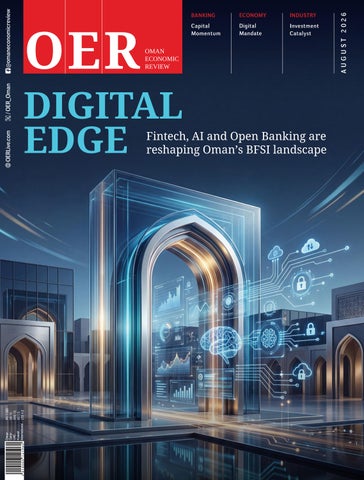
DIGITAL SHIFT Oman’s banking, financial services and insurance sector is entering a new phase as digitalisation, fintech, open banking, artificial intelligence and regulatory reform reshape business models and customer experiences
30 INDUSTRY
INVESTMENT CATALYST Madayn begins development of four industrial cities under the 11th FiveYear Development Plan
22 BANKING
CAPITAL MOMENTUM Bank Muscat’s Capital Market Leadership reaffirmed with the overwhelming success of OMIFCO IPO
38 ECONOMY
DIGITAL MANDATE Here’s everything you need to know about e-invoicing for businesses in Oman
Editorial . ...................... 1
Business Briefs . .......... 4
In The News ............... 33
ECONOMY
TECHNOLOGY
LIFESTYLE
LEADERSPEAK
LISTINGS
VIDEO
Wi-Fi at 35,000 feet: The real economics of installing Starlink on an airline An OERLive investigation examines whether Starlink’s speed justifies its cost, revealing how airlines recover investments through loyalty, premium demand, commerce and operational efficiency at 35,000 feet
Automotive . ............... 48
How AI is redefining work in the GCC The way we work is changing faster than our organisations are changing to support it Event .......................... 50
Top 10 mathematical problems AI has solved or transformed Billboard . ................... 52
From overturning an 80-year-old conjecture to discovering faster algorithms, artificial intelligence is beginning to move beyond answering textbook questions and contribute to original mathematical research
BUSINESS BRIEFS Bank Muscat strengthens its regional presence with a financial markets seminar in Saudi Arabia As part of its growing portfolio of initiatives aimed at strengthening engagement with its customers across the region’s various markets, Bank Muscat, organised a dedicated seminar for a group of officials representing various institutions and companies in Al Riyadh in the Kingdom of Saudi Arabia, shedding light on the latest developments in global financial markets and their impact on the business environment. This event builds on a series of seminars recently held by the Bank in the Sultanate of Oman, reflecting its commitment to deepening ties with its customers wherever they are based. Such events provide a valuable platform for discussing the dynamics of global markets and their direct implications for day-today business operations, thereby strengthening customers’ ability to make clearer and more informed financial decisions. Through this seminar, Bank Muscat sought to provide attendees with in-depth insights into the evolving global economic landscape, highlighting the key shifts,
emerging opportunities and mounting challenges shaping the world economy. Discussions covered a wide range of topics centered on the latest regional and global developments, economic transformations and future outlooks for international financial markets. The seminar also served as an engaging platform for the Bank’s customers and counterparts in the Kingdom to understand and analyse the economic implications of recent geopolitical events, supporting well-informed decision-making across their respective business
fields. In keeping with its commitment to delivering an exceptional banking experience to customers across the region, Bank Muscat continues to develop its products and services in line with the latest trends in the banking sector and the evolving expectations of its customers. These sustained efforts, spanning four decades of service, have cultivated a growing customer base and firmly established trust across Oman, which continues to gradually extend into promising regional markets, including the Kingdom of Saudi Arabia.
Sohar International and Omantel sign strategic collaboration to advance innovation and Oman’s digital economy Reinforcing their shared commitment to innovation, digital advancement and sustainable economic growth, Sohar International and Omantel have signed a strategic collaboration programme, establishing a framework for collaboration across a range of business, technology, innovation, people and investment opportunities. The program was signed by Abdulwahid Mohamed Al Murshidi, CEO, Sohar International, and Eng. Aladdin bin Abdullah Baitfadhil, CEO, Omantel, on behalf of their respective organisations. This partnership unites the complementary strengths of two leading Omani organisations, bringing together Sohar International’s financial expertise and banking capabilities with Omantel’s advanced digital capabilities, technology infrastructure, and ecosystem reach. Through this collaboration, the two organisations will explore opportunities to develop innovative solutions that enhance customer and business experiences, drive digital innovation, and unlock sustainable long-term value. The collaboration reflects a broader shared ambition to contribute to an increasingly connected and digitally enabled economy. By leveraging their respective expertise, Sohar 4
August 2026
International and Omantel aim to explore opportunities that can benefit customers and businesses, strengthen the wider innovation ecosystem, support the development of national capabilities and contribute to the objectives of Oman Vision 2040. Commenting on the signing, Abdulwahid Mohamed Al Murshidi, CEO, Sohar International, said, “At Sohar International, we believe meaningful innovation is accelerated
when leading organisations come together around a shared ambition to create lasting value. Our partnership with Omantel brings together complementary capabilities across banking, technology and digital enablement, providing a strong platform from which we can explore new possibilities for our customers, businesses and the wider economy. More importantly, this collaboration reflects our shared belief in the role that strong national institutions can play in supporting Oman’s continued economic and digital advancement. We look forward to translating this partnership into meaningful opportunities that contribute to a more connected, innovative and future-ready economy.” Eng. Aladdin bin Abdullah Baitfadhil, CEO, Omantel, said, “Trust and security are the foundation on which digital economies are built, and our partnership with Sohar International puts that principle into action. Together, we are committed to harnessing advanced technologies, from sovereign cloud and artificial intelligence to cybersecurity and data analytics, to shape an integrated, future financial and technology ecosystem.”
ً ﺗﻮاﺻﻞ ﺷﺮﻛﺔ ﻇﻔﺎر ﻟﻠﺘﺄﻣﻴﻦ رﻳﺎدﺗﻬﺎ،ﻋﺎﻣﺎ ٣٥ ﻣﻨﺬ أﻛﺜﺮ ﻣﻦ ﻓﻲ ﺗﻘﺪﻳﻢ ﺣﻠﻮل ﺗﺄﻣﻴﻨﻴﺔ ﻣﺒﺘﻜﺮة For more than 35 years, Dhofar Insurance Company has continued its leadership in providing innovative insurance solutions ﺣﻠﻮل ﺗﺄﻣﻴﻨﻴﺔ ﻟﻸﻓﺮاد Personal Insurance Solutions
ﺣﻠﻮل ﺗﺄﻣﻴﻨﻴﺔ ﻟﻠﺸﺮﻛﺎت Corporate Insurance Solutions
ﺗﺄﻣﻴﻦ اﻟﻤﺮﻛﺒﺎت Motor Insurance
ﺗﺄﻣﻴﻦ ﺗﻌﻮﻳﺾ اﻟﻌﻤﺎل Workmen's Compensation
اﻟﺘﺄﻣﻴﻦ اﻟﺼﺤﻲ Medical Insurance
اﻟﺘﺄﻣﻴﻦ اﻟﻬﻨﺪﺳﻲ واﻟﺼﻨﺎﻋﻲ Engineering & Industrial
ﺗﺄﻣﻴﻦ اﻟﺴﻔﺮ Travel Insurance
اﻟﺘﺄﻣﻴﻦ اﻟﺒﺤﺮي واﻟﻄﻴﺮان Marine & Aviation
ﺗﺄﻣﻴﻦ اﻟﻤﻨﺎزل Home Insurance
ﺗﺄﻣﻴﻦ اﻟﻤﺴﺆوﻟﻴﺔ اﻟﻤﺪﻧﻴﺔ Liability Insurance
Recognising
trailblazers in the construction & infrastructure sector The best of the best within construction, infrastructure, projects, civil engineering, real estate, design engineering and construction materials industry in Oman will be felicitated at Dossier Construction Awards. Event Key Highlights • • • •
Awards to key industry projects, companies and personalities Presentation on an upcoming large iconic project Attendance of over 200 industry leaders Networking with industry peers
Some of the Award Categories
2025
• Best Construction Safety Initiative • Best MEP Contractor • Best EPC Contractor • Best Construction Contractor • Best Manufacturing Company • Global Omani Company of the Year • Commercial Vehicle of the Year • Excellence in IFM Services • Best MEP Supplier • Best Interior Design • Best Project Design • Best Architect • Best Engineer • Best Engineering Consultant • Best Project Management Consultant • Market Leader of the Year - Paints • Claims Management Consultant of the Year • Real Estate Services Company of the Year • Best Real Estate Project • Best Real Estate Consultant • Best Project Developer of the Year • Best Sustainable Project • Best Renewable Energy Project • Best Industrial Project • CEO of the Year • Business Leader of the Year • Business Icon of the Year
14
th
Edition
20 26
Date: September 30, 2026 Venue: Sheraton Oman Hotel
ST R AT EG I C PA RT NE R S
AS S O CI ATE PA RTN E R S
COM M E R C I A L VE HI C L E PA RT N E R
CONS U LTA NT PA RT NE R
M E D I A PA RTNE R S
D I G I TA L PA RT N E R
OR G A NI S E R
digital
For more information, contact SHIVKUMAR on 99267159, shivkumar@umsoman.com OR DHANISH on 92637189, dhanish@umsoman.com
COVER STORY
DIGITAL SHIFT Oman’s banking, financial services and insurance sector is entering a new phase as digitalisation, fintech, open banking, artificial intelligence and regulatory reform reshape business models and customer experiences. An OER Report Oman’s BFSI sector is entering a new era. Technology is reshaping how financial institutions operate, serve customers, manage risk and unlock growth, while digital-first models are redefining the competitive landscape. Driven by Oman Vision 2040 and the National Digital Economy Programme, the sector is moving beyond basic digital adoption towards a more agile, connected and innovation-led financial ecosystem. The Ministry of Transport, Communications and Information Technology’s report, Harvesting the Digital Economy in the Sultanate of Oman: From Foundation to Empowerment, highlights the progress made between 2021 and 2025. According to the report, the contribution of the core and direct digital economy reached approximately RO800mn in 2023, underlining the growing importance of digital activity as an engine of economic growth. The National Digital Economy Programme has focused on strengthening digital infrastructure, accelerating transformation, encouraging innovation and advanced technologies, increasing private-sector participation and building national capabilities. For BFSI institutions, this creates a significant opportunity. Banks, finance companies, insurers, investment firms and fintechs are increasingly expected to deliver services that are immediate, seamless, personalised and accessible through digital channels. The transition is therefore moving beyond putting existing services online towards redesigning financial businesses around technology, data and changing customer expectations.
8
August 2026
Banking remains the largest component of Oman’s financial sector, but the traditional branch-led model is steadily evolving. The first wave of digital banking focused on mobile and internet channels, allowing customers to check balances, transfer funds, pay bills and access basic services remotely. The next phase is more fundamental, encompassing digital onboarding, electronic KYC, automated credit decisions, straight-through processing, real-time fraud detection, API integration, artificial intelligence and personalised financial services. Cybersecurity has emerged as an equally important component of this transformation. Bank Muscat, for example, has adopted a digital governance framework aimed at strengthening its readiness to address evolving cyber risks. The bank has also invested in automation and technology to improve operational efficiency, while deploying security controls, encryption, risk assessments, employee awareness programmes and incident-response capabilities to protect customer data and financial transactions. Such measures highlight how digitalisation is increasingly inseparable from resilience, trust and regulatory compliance. Sohar International has similarly pursued a multi-year Digital-First strategy, positioning technology as a core element of its banking model. Its strategic collaboration with Omantel brings together banking expertise and digital infrastructure to explore opportunities across technology, innovation, investment and customer solutions. Such partnerships point to a broader trend: financial institutions are
increasingly working with technology companies and ecosystem partners to develop new services rather than relying solely on in-house capabilities. Market estimates indicate that Oman’s digital banking platforms market could grow from around $86mn in 2025 to approximately $168mn by 2031, representing annual growth of around 11.8 per cent. Expansion is expected to be supported by open banking, digital-bank licensing, cloud adoption, cybersecurity, digital onboarding and rising transaction volumes. Technology investment is also becoming more sophisticated, with financial institutions likely to place greater emphasis on cloudnative platforms, API management, customer identity, real-time fraud controls and corporate digital banking. Open banking could become one of the most significant catalysts for this transformation. The Central Bank of Oman’s Open Banking Regulatory Framework provides a foundation for authorised third-party providers to access customer account information and initiate payments with customer consent. This creates the basis for a more interconnected financial ecosystem in which banks, fintechs and other providers can collaborate around the customer. For banks, open banking brings both opportunity and competitive pressure. Banks can evolve into platforms that enable new products and partnerships, while fintech companies can capture elements of the customer experience traditionally controlled by banks. The result could be a shift from a conventional one-bank-to-one-
COVER STORY
customer relationship towards an ecosystem in which multiple providers interact around the same customer. Fintech is consequently moving from experimentation towards becoming part of the financial infrastructure. Oman’s regulatory environment has been evolving to support this development through initiatives covering fintech, regulatory sandboxes, digital onboarding and e-KYC, payment service providers, cloud computing, cybersecurity and operational resilience. The next generation of fintech is likely to extend beyond wallets and payments into APIs, embedded finance, bankingas-a-service, automated compliance, digital identity, AI-powered credit and real-time financial services.. Islamic banking provides another important dimension to Oman’s financial transformation. Digital onboarding, automated Shariacompliant transactions, Islamic SME finance, digital investment platforms,
10
August 2026
wealth management and sukuk distribution can make Islamic financial services more accessible and scalable. The modernisation of Oman’s banking legislation, including provisions covering Islamic and digital banking, provides an important regulatory foundation for this evolution. Insurance is undergoing a parallel transformation. Oman’s insurance industry recorded total insurance revenue of approximately RO501.6mn in 2025, compared with RO483mn in 2024, according to the Financial Services Authority. For insurers, the growth opportunity increasingly lies in digital distribution, data and automation across the value chain. Technology can improve customer acquisition and onboarding, strengthen underwriting and risk assessment, streamline claims and make renewals more efficient. Data analytics can support more accurate risk assessment, while artificial intelligence can assist with fraud detection, claims assessment
and customer service. Digital claims platforms can reduce processing times and make settlements faster and more transparent. Together, these capabilities can help insurers improve both efficiency and customer experience. As financial institutions become more digitally connected, cybersecurity and operational resilience will remain strategic priorities. Cloud infrastructure, APIs, mobile applications and thirdparty technology partnerships can expand the digital attack surface. The direction of Oman’s BFSI sector is therefore clear: the challenge is no longer simply how quickly financial institutions can digitise existing services, but how effectively they can redesign their businesses for a digital economy. A more digital, connected and competitive BFSI sector can support SMEs, investment, entrepreneurship and wider economic diversification — strengthening the financial system’s role in delivering the ambitions of Oman Vision 2040.
اﻟــﺪورة
An initiative presented by
2026
THE FUTURE OF GROWTH
How Can the Private Sector Lead the Next Phase in a Changing World? In a world of accelerated change and shifting competitive dynamics, new questions are emerging about the future of growth, opportunities ahead, and how businesses can scale, boost productivity, and strengthen their competitiveness. Oman Forum 2026 brings together leading business leaders and experts for a forward-looking dialogue on the drivers of growth, economic and technological shifts reshaping the business landscape, and opportunities for the private sector to capitalise in the next phase. Leadership & Corporate Transformation | Innovation, AI & Productivity | Finance & Governance | Skills & Human Capital | Competitiveness & Expansion | Trade & Partnerships
Register now
BE PART OF THE CONVERSATION
Date: 23rd September 2026 Venue: Sheraton Oman Hotel Strategic Banking Partner
Official Insurance Partner
Digital Support Partner
Associate Partners
Media Partners
Automotive Partner
Organised By
alamaliktisaad
For more information, contact: Shaikh Ahmed on 98049369, shaikh.ahmed@umsoman.com Fareeda Al Balushi 99458958, fareeda@umsoman.com
COVER STORY
SCALING UP United Finance Company’s next phase is about disciplined growth, digital innovation and stronger customer value. The company is targeting portfolio growth while maintaining asset quality and operational efficiency, says CEO, Nasser Al Rashdi in an interview with Oommen John What are United Finance Company’s key strategic priorities over the next three years, and which performance indicators will define the company’s success in achieving its growth objectives? Over the next three years, UFC’s strategic focus will be centered on sustainable growth with asset quality, portfolio 12
August 2026
diversification, digital transformation, operational excellence, and enhanced customer engagement. The company aims to strengthen and improve its position in key market segments while maintaining prudent risk management and delivering long-term value to stakeholders.
As we all know, success will be measured through a combination of financial and operational indicators such as growth in the financing portfolio and assets under management; sustainable profitability and return on equity (ROE); improvement in cost-toincome ratio and operational efficiency; asset quality indicators, including non-
performing assets (NPA) levels; customer acquisition, retention, and satisfaction metrics and digital adoption rates and process automation achievements. Our goal is to achieve balanced growth while maintaining strong governance, risk management, and financial resilience. Following its positive Q2 2026 financial performance, what key business drivers have contributed to growth, and what factors are expected to shape UFC’s future performance? The positive performance reported in Q2 2026 was driven by several factors, including healthy growth in financing assets, improved focus on customer acquisition, improvements in operational efficiency & control over cost-to-income ratio, and disciplined portfolio management. The Key contributors are Increased financing activity across consumer and commercial segments and Improved collection performance and credit quality. Looking ahead, UFC expects future performance to be focused on economic growth and business activity within Oman; demand for financing from individuals, SMEs and corporate customers; digital innovation and customer experience. The company remains optimistic about growth opportunities while continuing to focus on prudent risk management and sustainable profitability, while leveraging on process automation. How is UFC advancing its digital transformation agenda, particularly in areas such as digital lending, customer experience, and operational efficiency, to strengthen its position in the evolving financial services landscape? Digital transformation remains a key strategic priority for UFC. The company has made significant investments in technology and process modernisation to enhance customer experience, improve operational efficiency, and strengthen its competitive position
in the evolving financial services landscape. A major milestone in this journey has been the successful implementation of a state-of-the-art core banking system, providing a scalable and flexible platform to support future growth. In addition, UFC has fully automated its loan origination process, enabling faster turnaround times, improved operational efficiency, and a more seamless customer experience. The company has also enhanced customer onboarding and financing application processes through digital platforms, while increasing automation across operational and backoffice functions. Key initiatives include: Expansion of digital financing channels and online customer services; utilisation of data analytics to enhance decision-making, portfolio management, and customer insights; strengthening cybersecurity and information security frameworks to support a secure and resilient digital environment. These initiatives will further enable UFC to provide customers with faster, more convenient, and efficient services while improving productivity, reducing processing times, and enhancing overall customer experience. Going forward, UFC will continue to leverage technology and digital innovation to drive sustainable growth, improve operational effectiveness, and deliver enhanced customer experience across all touchpoints. As UFC continues to expand its financing activities, particularly in sectors such as construction and SMEs, how does the company ensure sustainable growth while maintaining strong credit risk management practices? UFC expands its financing activities, particularly in sectors such as oil and gas, infrastructure project allied business, SMEs, and other productive industries, maintaining strong credit discipline remains a
fundamental priority. The company ensures sustainable growth through: • Comprehensive credit assessment and underwriting standards. • Sector-specific risk evaluation and portfolio monitoring. • Regular stress testing and portfolio quality reviews. • Robust early warning and collection mechanisms. • Adherence to regulatory requirements and internal risk appetite limits. By balancing growth opportunities with prudent risk management practices, UFC aims to maintain portfolio quality and support long-term financial stability. How does UFC see the future of Oman’s financing sector evolving, and what role does the company aim to play in supporting economic growth and business development? The outlook for Oman’s financing sector remains positive, supported by economic diversification initiatives, infrastructure development, SME growth, and increasing adoption of digital financial services. We expect the sector to evolve through: • Greater digitalization of financial products and services. • Increasing demand for SME financing. • Enhanced focus on customer-centric and technology-driven solutions. • Stronger emphasis on risk management, governance, and sustainability. UFC aims to play a leading role in this evolving landscape by providing accessible and innovative financing solutions that support businesses, entrepreneurs, and individuals. We remain committed to contributing to Oman’s economic development agenda, promoting financial inclusion, and supporting the growth of key sectors that drive sustainable economic progress.
COVER STORY
SMART TRANSFORMATION Dhofar Insurance is accelerating its digital transformation to simplify insurance, strengthen efficiency and deepen customer engagement. Technology, data and AI are shaping the insurer’s next phase of growth, says CEO, Sunil Kohli in an interview
14
August 2026
How is digitisation shaping Dhofar Insurance’s business strategy and customer experience? At Dhofar Insurance, digitisation is not simply a technology programme; it is our strategy and increasingly becoming part of how we design our services and serve our customers. Our focus is to make insurance simpler, faster and more accessible across the customer lifecycle – from discovering and purchasing the right protection to servicing policy, submitting a claim and receiving support. We are continuously enhancing our digital channels and modernising the technology platforms behind them, while continuing the human support that remains important in insurance. For us the objective is not only about digitisation; it is about reducing friction, improving transparency and giving customers greater choice in how and when they interact with Dhofar Insurance. Ultimately, we want technology to make insurance easier to understand, access and trust. Where is technology delivering the greatest gains in operational efficiency and business growth? We see significant opportunities where technology connects the customer journey seamlessly with our core operations. Digitising our customer facing and operational processes helped us to reduce manual intervention, eliminate repetitive activities and improve turnaround times. We continue to enhance our digital capabilities across customer service, claims, intermediary and partner journeys and integration between our distribution channels and enterprise platforms. From a growth perspective, technology gives us the ability to serve our customers at greater scale without proportionately increasing operational complexity through modern technology platforms. It also creates opportunities to
focus on offering more products accessible digitally and collaborate more effectively with our intermediaries and eco system partners through integrated digital services. The real value comes when technology improves both sides of the equation: a better customer experience and a more efficient operating model. How are AI, data analytics and automation changing insurance underwriting, claims and risk management? AI, analytics and automation have the potential to fundamentally improve how insurers underwrite, manage claims and risks. In underwriting, data analytics supports more informed risk assessment, pricing and portfolio management. In claims, automation and AI helps with document processing, validations, workflow orchestration and identifying cases that require specialist attention. Data analytics provides better and earlier visibility into emerging claim patterns, portfolio trends and potential anomalies. Our approach is to apply these technologies to augment professional judgement. Insurance decisions can have significant consequences for customers, so the right governance and oversight remain important. As digital adoption accelerates, how is Dhofar Insurance balancing innovation with cybersecurity, data privacy and customer trust? Trust is fundamental to insurance, and digitisation makes protecting the trust even more important. As we expand our digital capabilities, we incorporate cyber security and data privacy into the design of digital services rather than treating them as reactive controls. Technologies including AI and data analytics become more sophisticated; our focus is on the building technology resilience and governance among such emerging
technologies. Innovation and security should not be competing priorities. Sustainable digital transformation requires both. Customers should be able to benefit from greater digital convenience while remaining confident that their information and transactions are appropriately protected. What does the future of digital insurance in Oman look like, and where does Dhofar Insurance see its next growth opportunities? The future is digital, and it’s arriving faster than many expected — digital insurance premiums in Oman rose 35.5 per cent in 2025 alone. We believe that the next phase of insurance in Oman will be increasingly digital, connected and personalised, while remaining strongly grounded in trust and local market understanding. Customers will increasingly expect insurance to be available when they need it, through the channel they prefer, with simpler journey and greater transparency. At the same time emerging technologies and the adoption will create opportunities for insurers to operate more efficiently and develop more relevant customer propositions. We see opportunities in expanding digital insurance to unserved customer segments, enhancing customer experiences across self-service channels and claims processes, enabling expansion of digital partnerships and using data more effectively to understand customer needs and risk. There is a great potential to move beyond transactional towards building longer-term customer relationships. Dhofar Insurance has built its position through decades of serving Oman. Our ambition for the next chapter is to combine that experience and trust with modern digital capabilities – being ready for the expectations of the next generation of customers.
COVER STORY
DIGITAL EDGE
Digitalisation is making insurance more service-led, data-driven and accessible. The biggest opportunity is scaling retail and SME business through lower costs and smarter technology, says Girish Gopinath, Head of Technology and Digital Transformation, Arabia Falcon Insurance Company, Oman in an interview
16
August 2026
How is digitalisation transforming Arabia Falcon’s business model and where do you see the biggest opportunities for growth? The shift is from a distributionled model to a service-led one. An insurer’s value is no longer defined simply by where it can place a policy, but increasingly by how quickly, seamlessly and transparently it serves customers after the sale. Three things change concretely. Issuance moves from an assisted process to self-service, with assisted channels reserved for cases that genuinely need judgement. Underwriting moves from document review to data review, because vehicle, identity and claimshistory data can be pulled from authoritative national sources at the point of quotation. And the customer relationship becomes continuous rather than annual, because the portal is somewhere a customer visits for a claim or a certificate, not only at renewal. The biggest growth opportunity is retail and SME business that has historically been uneconomic to serve. When acquisition and servicing cost falls, small-ticket business becomes viable at scale. How is the company leveraging technology and data to improve efficiency, reduce costs and enhance profitability? Efficiency here is mainly about removing rekeying and removing waiting. Every time a value is entered twice, we pay for it in staff time and in error correction. The priority has therefore been integration: connecting policy administration to the finance ledger, to national vehicle and identity sources, and to the payment gateway, so a transaction flows end to end without manual intervention. Cost reduction follows from consolidation rather than headcount.
A single consolidated infrastructure architecture reduces licence duplication, simplifies the security perimeter and makes capacity planning predictable. On profitability, the material lever is data quality. Better data at quotation means fewer mispriced risks. Better structured claims data lets us see leakage, identify recurring loss patterns by segment and price the next renewal on evidence. That is a slower return than automation, and a more durable one. Which digital investments are generating the strongest business returns? Three categories, ranked honestly. Strongest returns have come from straight-through processing on high volume, standardised lines, principally motor. Clean data and simple products are where automation pays back fastest, measured in issuance time and cost per policy. Second, integration with authoritative national data sources. This is unglamorous plumbing, but it removes an entire category of manual verification and reduces fraud exposure at the same time. Third, the digital channel itself, which returns value twice: lower servicing cost, and behavioural data we did not previously hold. I would be equally candid about slower returns. Core system replacement is a multi-year investment whose return is largely optionality. It does not pay back in year one, and any insurer claiming otherwise is describing a business case rather than an outcome. How can digitalisation help Arabia Falcon expand its customer base, create new revenue streams and strengthen its market position in Oman? Customer base expansion comes from cost-to-serve. A digital channel lets us profitably serve segments a
branch-and-broker model cannot reach economically, particularly younger customers and micro and small enterprises. New revenue comes from two directions. One is packaging: bundling multiple covers into a single proposition for a single customer, which raises products per customer without a proportional rise in acquisition cost. The other is emerging risk classes that are digital in nature, cyber cover being the clearest example. Omani businesses are digitising quickly, and their exposure is moving faster than the market’s capacity to underwrite it. On market position, price is easy to copy and will not differentiate anyone for long in a market of our size. Service reliability will: whether a customer can complete a claim without a phone call, and whether the system stays up. That is harder to replicate, and it is where we choose to compete. What is Arabia Falcon’s digital roadmap for the next three years, and what competitive advantages do you aim to build through it? Three horizons rather than three fixed years. The first is foundation: completing core system modernisation and the consolidated infrastructure architecture, with data residency in Oman as a design requirement rather than an afterthought. Nothing sophisticated is stable if this layer is not. The second is channel and product: a unified digital portal as the single front door for customers, intermediaries and staff, and packaged multi-product propositions delivered through it. The tåhird is intelligence: analytics and AI applied to underwriting, pricing and claims triage, with explainability built in from the start, so decisions can be justified to a customer, an auditor and a regulator. The advantage we intend to build is compounding rather than singular. Clean data funds better pricing, better pricing funds better service, better service produces more data.
COVER STORY
TALENT SHIFT
Job Souq is J M International SPC’s digital talent platform, connecting organisations with talent and professionals with opportunities. Initially focused on Oman and the wider region, it aims to bridge skills, opportunities and workforce needs, says Jessy Mathew, Managing Director, J M International SPC, in an interview with Oommen John
Over the past two decades, what strategic decisions have been most instrumental in establishing J M International SPC as a trusted partner for businesses across Oman, the GCC, and the UK? Although J M International SPC was established in 2022, the experience behind the company has been shaped by more than 24 years of my professional journey in human resources, talent acquisition, learning and development, and organisational development, largely in Oman. Over the years, I have had the opportunity to work with organisations and professionals from many different backgrounds. One thing this experience has taught me is that clients are not simply looking for service providers. They are looking for trusted partners who understand their business, as well as the challenges they face. That thinking became an important part of J M International SPC. From the beginning, we have focused on relationships built on integrity, responsiveness, compliance and accountability. As the company has grown, we have expanded our capabilities across talent acquisition and executive search, human capital advisory, workforce outsourcing and secondment, learning and development, business advisory and international trade. Our relationships across Oman and the GCC, together with our association with JJ2 Consultancy UK Ltd, enable us to combine strong regional understanding with an international perspective. For me, 18
August 2026
trust is not created through marketing; it is earned through consistent delivery. Whatever the size of an assignment, clients should know that we will take ownership, communicate openly and remain committed to delivering what we have promised. As businesses navigate economic shifts and technological disruption, what qualities do you believe define resilient organisations and effective leadership today? I believe resilience begins with the willingness to adapt. During my career, I have seen the workplace evolve enormously, from traditional personnel management to strategic human capital management, digitalisation, analytics, automation and now artificial intelligence. The pace of change is only becoming faster. But despite all these developments, one thing remains constant: people are at the heart of every successful organisation. Leadership today is not about one person having all the answers. It is about creating capable teams, listening to different perspectives, making timely decisions and giving people the confidence and opportunity to take responsibility. It is also about recognising potential. Organisations need experienced professionals, but they also need to create opportunities for the next generation. In Oman, this includes developing national talent and giving young professionals meaningful exposure, mentoring and structured career pathways, while also benefiting from international expertise, global best practices and knowledge transfer. I believe the strongest organisations are those that successfully bring these strengths together. Technology will continue to transform the workplace, but empathy, judgement, relationships and leadership remain fundamentally human. The future belongs to
leaders who can combine technology and data with adaptability and human judgement. J M International SPC operates across talent solutions, HR consultancy, outsourcing, and international trade. How do you identify new growth opportunities while maintaining excellence across such diverse business verticals? Most of our growth has come from listening carefully to our clients and understanding their evolving business needs. A conversation may begin with a talent requirement but develop into a much broader discussion around workforce solutions, HR policies, organisational structure, job evaluation and grading, workforce planning, learning and development, or specialist human capital advisory. By understanding the broader business challenge rather than looking at an individual assignment in isolation, we can identify where we can genuinely create value. I believe growth should be purposeful rather than opportunistic. Not every opportunity is necessarily the right opportunity. As a business grows, it becomes increasingly important to understand what you do well, where you can create value and where specialist expertise or strategic partnerships may be required. Although our activities are diverse, the principles behind them remain consistent: strong relationships, market understanding, compliance, professional execution and trust. We also remain focused on quality. Growth should never come at the expense of service excellence. Our ambition is not simply to become bigger. We want to become more valuable to every organisation we serve. As AI and digital transformation reshape talent acquisition, how is J M International SPC redefining talent and human capital consulting to stay ahead of the curve?
AI is transforming the way organisations identify, assess, engage and develop talent, and I see this as a significant opportunity. Technology enables us to access wider talent pools, identify critical skills faster, improve talent matching, analyse workforce information and make talent decisions more efficient and informed. At J M International SPC, our focus is on evolving beyond conventional hiring support towards technologyenabled talent solutions and strategic human capital advisory. We want to help organisations not only identify the right professionals for today’s requirements, but also understand and build the capabilities they will require for the future. As part of this journey, we are preparing to introduce Job Souq, a new digital talent platform being developed under the J M International vision. Job Souq represents an exciting next step for us. The idea is simple: to create a more accessible connection between talent and opportunity, initially with a strong understanding of the workforce needs and aspirations of Oman and the wider region. We see Job Souq as more than a place to view opportunities. Our longerterm vision is to develop a talent ecosystem where organisations can discover potential and professionals can increase their visibility, explore career opportunities and become better connected to the changing world of work. It is also closely connected to something I strongly believe in: creating greater visibility and meaningful opportunities for Omani talent, particularly graduates and young professionals preparing for the industries of the future. At the same time, technology should never remove the human dimension from talent decisions. Technology can assess qualifications, experience
COVER STORY
and technical competencies, but understanding a person’s attitude, ambition, integrity, adaptability, leadership potential and organisational fit still requires experience and human judgement. Our philosophy is therefore to use technology for intelligence and efficiency while keeping people at the centre of judgement and relationships. Job Souq is a natural extension of that philosophy, combining our human capital experience with our ambition to build technology-enabled solutions for the future. Our responsibility is to connect talent with opportunity and help build the capabilities organisations will need tomorrow. What emerging trends in Oman and the GCC present the greatest opportunities for businesses, and how should leaders prepare to capitalize on them? I am very optimistic about the opportunities developing across Oman and the wider GCC. Economic diversification, artificial intelligence, digital transformation, renewable and clean energy, logistics, tourism, manufacturing, financial services, infrastructure and entrepreneurship are creating new possibilities for businesses and professionals. In Oman, Oman Vision 2040 provides an important direction for economic diversification, private-sector development, innovation and human capital development. One of the biggest opportunities, in my view, is ensuring that workforce capability develops alongside economic growth. For Oman, this naturally includes creating meaningful opportunities for Omani professionals and preparing national talent for technical, professional, managerial and leadership positions. At the same time, international expertise continues to play an important role, particularly in specialist areas and in facilitating knowledge and skills transfer. I therefore see national talent development as a strategic partnership rather than simply a
20
August 2026
target. Omanisation should be about capability as much as numbers, creating opportunities, developing skills and building sustainable career pathways. Hiring is only the beginning. What follows is equally important: structured learning, mentoring, professional qualifications, leadership development, succession planning and genuine exposure to responsibility. Businesses should be asking themselves not only, “What talent do we need today?” but also, “What capabilities will our organisation need three or five years from now?” When organisations combine experienced professionals with emerging national talent and create an environment for genuine knowledge transfer, they build stronger and more sustainable teams. The organisations that prepare their people today will be better positioned to lead tomorrow. Looking ahead, what advice would you offer to business leaders seeking to build future-ready, highperforming organizations in Oman and the wider GCC? My advice would be: invest in people, embrace change, remain ethical and keep learning. Future-ready organisations do not wait until a critical position becomes vacant before thinking about talent. They identify potential early, develop succession plans, transfer knowledge and prepare people for responsibilities that may still be several years ahead. For organisations in Oman, developing national talent should be an important part of that strategy. But I believe this is most effective when approached through capability building, mentoring, meaningful responsibility and genuine career progression, rather than simply meeting a numerical requirement. At the same time, diverse and international workforces bring valuable experience, specialist capabilities and global perspectives. When organisations combine this expertise with structured
knowledge transfer and national talent development, both the organisation and the wider economy benefit. I believe high-performing organisations are ultimately built by bringing together the right people with the right capabilities, and the right opportunities. Technology will continue to change the way we work, and leaders should embrace it. But technology must have a purpose. It should improve productivity, decisionmaking, customer experience, workforce capability or overall organisational performance. For entrepreneurs and young professionals, my advice is equally simple: don’t wait until everything is perfect before taking the first step. You don’t need to know everything before you begin. You need purpose, courage, the willingness to learn and the determination to continue. My own professional and entrepreneurial journey has reinforced the importance of reputation. Markets change, technologies evolve and business models transform, but integrity, relationships and trust remain timeless. Looking ahead, my vision for J M International SPC is to continue growing as an Omani company with an international outlook, providing strategic talent and human capital solutions, connecting people with opportunities, supporting organisations through transformation and contributing positively to Oman and the wider GCC. Job Souq is part of that future, using technology to widen access to opportunity while keeping people and their development at the centre. Ultimately, after more than two decades of working with people and organisations, one belief continues to guide me: When we invest in people, national and international, we invest in stronger organisations and a stronger future.
BANKING
CAPITAL MOMENTUM Bank Muscat’s Capital Market Leadership reaffirmed with the overwhelming success of OMIFCO IPO Bank Muscat, the leading financial services provider in the Sultanate of Oman, has successfully advised on the landmark IPO of Oman India Fertiliser Company (OMIFCO), one of Oman’s largest industrial enterprises and a leading regional producer of urea and ammonia. Bank Muscat played a pivotal role in the transaction, acting as the sole Issue Manager and Joint Global Coordinator alongside another international bank as well as a collecting bank alongside Meethaq Islamic Banking. The offering comprised the sale of 1.672 billion shares representing 25 per cent of OMIFCO’s total share capital, raising approximately RO260.9mn ($678mn). That made the transaction one of the largest public offerings on the Muscat Stock Exchange in recent years and the region’s largest IPO of the year 2026 so far amidst heightened geopolitical volatility. OMIFCO’s IPO is the only IPO of scale in GCC year-to-date and notably it received strong participation from marquee institutional investors from across the regional and international markets which is a further testament to the ongoing resurgence of the Sultanate’s capital market. The subscription period, which ran from June 16 to 25, 2026, generated overwhelming demand from both institutional and retail investors across Oman and internationally. Total subscription reached 18 times the shares on offer, with aggregate subscriptions of approximately RO4.7bn ($12.2bn), the highest subscription ever recorded for an IPO on the Muscat Stock Exchange. The institutional tranche alone was covered 27.4 times. Shares were priced at the top of the marketed range and surged more than 20 per cent on first day of its 22
August 2026
trading debut, reflecting the strength of investor conviction in the offering. The robust performance of the IPO reinstated the confidence of investors in Oman’s capital markets, paving the way for future divestment transactions from OIA which are in the pipeline. Bank Muscat’s Investment Banking team, as the sole Issue Manager and Joint Global Coordinator, played a pivotal role across every stage of the transaction lifecycle, from transaction structuring, stakeholder management, regulatory coordination, close investor engagement, issuance pricing and managing subscriptions
and settlements. The Bank worked closely with OMIFCO’s shareholders, including OQ SAOC, IFFCO and KRIBHCO, to craft a compelling equity story anchored in OMIFCO’s position as the largest fertiliser complex in Oman and among the top five in the GCC, its long- standing offtake relationships, and its strategic relevance to global food security amid shifting trade flows. The Bank also took lead in developing an attractive dividend policy which reflects the robust business profile and provides a compelling investment proposition for the investors. The Bank’s transaction structuring expertise, combined with
its deep engagement with institutional investors, was instrumental in creating a strong interest amongst institutional investors, consequently achieving a Shari’a-compliant offering that met the highest professional and regulatory standards, maximising value for selling shareholders while simultaneously provide investors with a high-quality investment option in the industrial sector in the Sultanate. Beyond its role as Issue Manager, Bank Muscat also committed its collective institutional strength across spectrum maximising subscriptions from institutions and retail investors which is reflected in Bank Muscat together with Meethaq Islamic Banking accounting for a majority of collections for the IPO. With the successful listing of OMIFCO, in which OQ SAOC held a 50 per cent stake alongside IFFCO and KRIBHCO, Bank Muscat has led three consecutive successful public offerings connected to Oman’s OQ Group, having previously served as Issue Manager and Joint Global Coordinator on the landmark OQ Gas Networks (OQGN) IPO in 2023, the largest in the Sultanate’s history
at the time, and as Issue Manager and Joint Global Coordinator on the OQ Base Industries (OQBI) offering in 2024. Across each of these transactions, Bank Muscat has taken a leading structuring and execution role, consistently translating complex privatisation mandates into world-class listings that command deep institutional and retail confidence. This track record cements the Bank’s position as the partner of choice for advancement of the Sultanate’s privatization programme and capital markets development agenda under Oman Vision 2040. Each successive mandate has allowed Bank Muscat’s Investment Banking team to deepen its sector knowledge, refine its distribution reach across investor pools, and build repeatable, best-in-class execution playbooks, capabilities that were on full display in the record-breaking demand generated for OMIFCO. Commenting on the success of the IPO and Bank Muscat’s contribution, Khalifa Abdullah Al Hatmi, Deputy General Manager of Investment Banking and Capital Markets at Bank
Muscat said, “We are proud to have played a central role in what stands as one of the most successful IPOs in the history of the Muscat Stock Exchange. The OMIFCO IPO stands as a testament to the depth of investor confidence in the Sultanate of Oman’s capital markets and industrial champions. This marks the third time Bank Muscat has led a successful public offering for the OQ Group in recent times, and each mandate has reinforced our position as the execution ‘partner of choice’. The overwhelming subscription levels we witnessed —18 times, with institutional demand covered 27 times followed by a ‘blockbuster’ listing — are a clear endorsement of the equity story we built around OMIFCO’s strategic positioning, and of the rigor and discipline our team brought to every stage of this transaction. The Bank will continue its trajectory of advancing Oman’s capital markets agenda, widening the investor base, and creating new investment avenues for individuals and institutions alike, in line with the Sultanate’s broader privatisation and economic diversification objectives.”
TRADE
GLOBAL SCALE India’s export engine accelerates: Is manufacturing finally finding its global scale?
There are moments when a country’s manufacturing ambitions become visible not in factories or policy announcements, but in the cargo moving through its ports. India’s latest export numbers offer one such glimpse. In July, merchandise exports rose sharply, led by electronics, engineering products and petroleum shipments, signalling that Indian production 24
August 2026
is increasingly finding customers beyond the domestic market. India’s goods exports climbed 19.5 percent year-on-year to $44.2bn in July 2026, marking their strongest growth in more than four years. Imports also expanded, rising 17.4 percent to $76.2bn, leaving a merchandise trade deficit of about
$32bn. The export performance was nevertheless notable for the breadth of sectors contributing to the increase. The numbers matter because they reveal something larger than one month’s trade performance. Electronics exports reached $5.9bn, engineering goods exports rose to $12.2bn, while petroleum product exports climbed to $6.9bn. Together, these three categories
accounted for close to 57 percent of merchandise exports during the month. Manufacturing finds export momentum For years, India’s manufacturing ambitions have been measured against the country’s ability to move from a large domestic market to a major production and export base. The latest figures suggest that this transition is gathering momentum in selected sectors. Engineering goods remain one of India’s most important merchandise export categories. According to the Department of Commerce’s trade analytics platform, engineering exports during JanuaryJune 2026 reached $65.38bn, representing 12.24 percent growth over the corresponding period. The July performance strengthens that trend. Engineering exports increased 17.7 percent year-on-year to $12.2 billion, demonstrating the continued international demand for Indian machinery, industrial products, transport equipment and other manufactured goods. This matters because engineering exports tend to reflect a broad industrial ecosystem rather than a single product. Their growth is connected to manufacturing capacity, supplier networks, industrial technology and India’s ability to meet specifications required by overseas buyers. Electronics become a flagship Perhaps the clearest sign of India’s changing export profile is electronics.
capacity for mobile devices, supported by global companies and domestic suppliers. This has progressively changed the country’s position from primarily importing finished electronics towards producing and exporting increasingly sophisticated devices.
after the regional conflict, while improved port availability supported trade flows. Exports to China also increased strongly, rising nearly 65 percent to $2.2bn. Shipments to the United States reached $9bn, 13 percent higher than in July 2025.
The growth in electronics imports is also revealing. Imports of electronic goods rose sharply to $14.4bn in July. That does not necessarily represent a reversal of the manufacturing trend. A substantial portion of imported electronics consists of components and intermediate goods used by domestic manufacturers. In other words, rising imports of components can accompany rising exports of finished or assembled products as manufacturing networks deepen.
The United States remains one of India’s most important export markets. Between April and July 2026, however, growth in merchandise exports to the US was comparatively modest, while exports to the European Union also recorded measured growth.
Petroleum still drives trade Petroleum products remain a major pillar of India’s export performance.
Commerce Secretary Agrawal has described the diversification of India’s export basket as a development that can support the country’s longer-term trade position. The trend is visible both in the composition of goods and in the geography of markets.
Exports of petroleum products jumped 67.6 percent in July to $6.9bn, helped by demand from Asian markets and higher global prices. Indian refineries supplied fuel to countries including Sri Lanka and Singapore during a period when parts of the region faced supply shortages. India’s refining capacity gives the country a distinctive position in global trade. It imports crude oil, processes it in large refineries and exports a portion of the resulting petroleum products. The trade combines India’s energy-import dependence with its industrial refining capability.
Electronic goods exports surged 57 percent in July to $5.9bn. The increase builds on a much longer expansion.
The July numbers demonstrate how this established strength continues to support merchandise exports even as newer manufacturing sectors expand.
Government trade data have repeatedly shown electronics among India’s fastest-growing merchandise export categories, with mobile phones and other electronic products becoming increasingly important contributors.
Trade partners are diversifying Another important feature of the July figures is the geographical spread of India’s export growth. Exports to West Asia recovered, increasing 8.6 percent to $5.7bn.
The transformation is particularly visible in smartphones. India has developed substantial manufacturing
Indian Commerce Secretary Rajesh Agrawal described this as a turnaround following the steep decline recorded
This wider distribution of export destinations is important because manufacturing scale depends not only on producing more but also on accessing several large markets.
Imports reveal manufacturing depth India’s import figures provide another perspective on the manufacturing story. Crude oil imports increased 17.6 percent to $18.3bn in July, while electronics imports rose 46 percent to $14.4bn. Fertiliser imports increased to nearly $2.5bn and coal imports climbed to around $3bn. For an expanding manufacturing economy, imports are not confined to consumer goods. Industrial production requires energy, machinery, components, raw materials and specialised inputs. The sharp increase in electronics imports is particularly relevant because many components feed India’s expanding electronics manufacturing ecosystem. The relationship between imports and exports becomes more complex as domestic production becomes integrated with international supply chains. The growth of manufacturing can
consequently be seen not simply through a reduction in imports, but through the changing relationship between imported inputs and exported finished products. Global supply chains take shape India’s export expansion is unfolding as companies worldwide reassess their manufacturing and sourcing strategies. The country offers a combination of a large domestic market, expanding industrial capacity, a growing pool of engineering talent and an increasingly developed supplier ecosystem. Electronics, automobiles, pharmaceuticals, engineering goods and chemicals have all become important parts of this broader manufacturing landscape. The government’s trade data show that engineering exports were already growing at a double-digit rate during the first half of 2026. This suggests that India’s export story is becoming broader than traditional strengths such as petroleum products, gems and jewellery, textiles and agricultural commodities.
26
August 2026
Services strengthen export base India’s export economy also benefits from the continued strength of services. The country’s combined merchandise and services exports were estimated at $80.14bn in July 2026, according to the Ministry of Commerce and Industry, representing 13.31 percent growth from July 2025. Combined imports were estimated at $95.16bn. This combination gives India an unusual trade structure in which a rapidly expanding services economy operates alongside an increasingly export-oriented manufacturing base. The growth of merchandise exports does not replace India’s established services advantage. Instead, the two increasingly form complementary pillars of India’s engagement with the global economy. A new export architecture The July figures do not by themselves establish that India has become a global manufacturing powerhouse. However, they do show that several important pieces of that transformation are moving in the same direction. Electronics are expanding rapidly.
Engineering exports are gaining strength. Petroleum refining continues to provide a major export platform. New markets are absorbing Indian products, while global supply chains are creating demand for Indianmade goods and components. The pattern also shows why the headline export number deserves to be examined alongside its composition. A $44.2bn month is significant, but the more consequential story lies in what is being exported. India’s manufacturing journey is increasingly visible in the products leaving its ports: electronics assembled and produced in growing volumes, sophisticated engineering goods shipped to international markets and industrial products moving through increasingly diverse trade corridors. According to experts, if that pattern continues, India’s export story could increasingly become a story not merely of selling more to the world, but of producing a wider range of what the world buys, and that is the more significant transformation underway in India’s trade architecture.
OMAN OMAN The Digital Transformation Conference
1 3 TheODigital c tTransformation o b e rConference 2026 1 3 O cHotel,Al t o b e r 2 0Khuwair 26 Intercity
Intercity Hotel,Al Khuwair
Is Your Business on the Brink of Extinction? Ignore change, and your business is already obsolete.
KEY FOCUS AREAS
SECTORS IN FOCUS
Artificial Intelligence
Oil & Gas
Computing
Banking & Finance
Core Banking
ICT Companies
Cybersecurity
Healthcare
Big Data
Ai & Computing
Super Apps
Manufacturing
At OERLive DX Oman, discover the technologies and strategies that keep you alive in the age of disruption.
Internet of Things
It’s time to be ahead or become history; the choice is yours.
Logistics
Digital Governance
Construction
E N D ORS ED BY
ST RATEGI C PARTN ERS
ST R AT EG I C PART NE R S
A RAB IC ME DIA PART NE R
AS S O CI ATE PARTN ER
D I GI TAL PARTN ER
AUTO M OTIVE PARTNE R
O RGAN I S ED BY
digital
For more information, contact SHIVKUMAR on 99367159, shivkumar@umsoman.com OR DHANISH on 92637189, dhanish@umsoman.com
COLUMN
BEYOND RESILIENCE Antifragility and leadership: The innate nexus between human nature and leadership excellence in the new era
T By Dr. Mughees Shaukat Executive Advisor, IIRA, Bahrain, Oman; Lead Islamic Investment and Fund Management, GCC, CIS & Asia; Managing Director, Panacea Consulting, Bahrain and Director Shariah Structuring and Strategic relations, Carbon CX, Canada
he concept of antifragility, popularised in contemporary thought as the ability not merely to withstand shocks but to benefit and grow from them, is perhaps one of the most profound frameworks for understanding leadership in the twenty-first century. While the term itself may be modern, the essence of antifragility is deeply embedded within the very nature of human creation. Human beings were not created as static, fragile entities designed for certainty and comfort; rather, they were endowed with the remarkable capacity to learn, adapt, evolve, recover, innovate, and thrive through adversity. Leadership and antifragility therefore share an innate and inseparable nexus. The most effective leaders throughout history have not been those who merely avoided uncertainty, but those who transformed uncertainty into opportunity, setbacks into lessons, and crises into platforms for growth. This reality is becoming increasingly relevant in a world characterized by technological disruption, geopolitical volatility, climate concerns, economic uncertainty, and unprecedented rates of change. The Human Being as an Antifragile Creation A deeper examination of human existence reveals that antifragility is embedded within our very design. Human development itself is a continuous process of adaptation. A child learns through trial and error. Muscles strengthen through resistance. Knowledge develops through questioning. Wisdom emerges from experience. Character is refined through hardship. Every significant dimension of human growth requires interaction with
28
August 2026
challenge and uncertainty. This natural architecture demonstrates that the human being was designed not for permanent stability but for continual adaptation. Challenges do not merely test human potential; they reveal and strengthen it. The human being is therefore not simply resilient. Resilience implies returning to a previous state after disruption. Antifragility goes further. It implies becoming stronger, wiser, and more capable because of disruption. This distinction is critical for leadership. The Synchronisation of Heart, Mind, and Spirit The antifragile nature of human beings emerges from the unique interaction between three essential dimensions of human existence: the heart, the mind, and the spirit. The heart serves as the center of values, empathy, courage, ethics, and emotional intelligence. It enables leaders to connect with people, inspire trust, and navigate human complexity. The mind provides analytical capacity, strategic thinking, problemsolving ability, innovation, and rational judgment. It allows leaders to understand systems, evaluate risks, and identify opportunities. The spirit provides purpose, meaning, conviction, perseverance, and vision. It sustains leaders during periods of uncertainty and provides the moral compass necessary to navigate difficult decisions. When these three dimensions operate in harmony, they create a powerful antifragile system. A challenge may test the mind intellectually, the heart emotionally, and the spirit morally.
Yet through this integrated response, the individual often emerges stronger than before. This synchronization explains why true leadership cannot be reduced to technical competence alone. Leadership is fundamentally a holistic human endeavor requiring emotional maturity, intellectual agility, and spiritual grounding. Leadership as the Application of Human Antifragility Leadership is essentially the conscious application of antifragility. Every leadership role involves uncertainty. Leaders make decisions with incomplete information. They manage competing interests. They navigate ambiguity. They face
criticism, setbacks, failures, and unexpected disruptions. The difference between ordinary managers and exceptional leaders often lies in their relationship with uncertainty. • Fragile leaders fear uncertainty. • Robust leaders tolerate uncertainty. • Antifragile leaders leverage uncertainty. Rather than attempting to eliminate every risk, antifragile leaders build adaptive systems capable of learning and improving through volatility. They recognize that growth often emerges from experimentation, diversity of perspectives, calculated risk-taking, and continuous learning.
This mindset transforms adversity from an obstacle into a strategic asset. Recognition, Understanding, and Internalisation The journey toward antifragile leadership begins with recognition. Many individuals possess antifragile potential without consciously understanding it. Leadership development therefore requires recognition of one’s innate capacity for growth. The second stage is understanding. Leaders must understand how adversity contributes to development. Failure, criticism, market disruptions, and institutional challenges should not automatically be viewed as
INDUSTRY
INVESTMENT CATALYST
Madayn begins development of four industrial cities under the 11th Five-Year Development Plan
As part of the 11th Five-Year Development Plan (2026-2030), the Public Establishment for Industrial Estates “Madayn” is advancing the development of new industrial cities across Musandam, North Al Batinah, North Al Sharqiyah and Dhofar Governorates. The projects align with the priorities of Oman Vision 2040 related to ‘Economy and Development,’ including Development of Governorates and Sustainable Cities; The Private Sector, Investment and International Cooperation; Economic Diversification and Fiscal Sustainability; Labour Market and Employment; and Economic Leadership and Management. In developing these industrial hubs, Madayn is guided by its commitment to promoting balanced governorates’ growth, empowering the private sector to play an active role in driving the 30
August 2026
national economy, developing sectors that drive economic diversification alongside complementary industries, strengthening a labour market that attracts national talent and specialised skills, and promoting the sustainable use of natural resources while advancing the adoption of renewable energy. Khalid Al Salehi, Director General of Marketing and Commercial Affairs and Official Spokesperson for Madayn, stated that Madayn is executing a suite of strategic projects across several governorates as part of its efforts to elevate Oman’s investment environment and support sustainable economic development. “The projects involve the development of fully integrated industrial cities equipped with advanced infrastructure and logistics services. Establishing
new industrial cities in Al Suwaiq, Al Mudhaibi, Thumrait and Madha aims to strengthen Oman’s industrial infrastructure, support economic diversification, attract local and foreign investments, support SMEs, and generate job opportunities.” Al Salehi highlighted Al Suwaiq Industrial City as one of Madayn’s promising development projects in North Al Batinah Governorate. The city covers a total area of approximately 12.2 million sqm, with around 1.3 million sqm to be developed during Phase 1. “The city will feature Madayn Entrepreneurial Complex, Madayn Agricultural Complex, facility building, water and sewage networks, firefighting networks, internal roads, solar-powered lighting, and other integrated infrastructure and utility services. Al Suwaiq Industrial City aims to stimulate industrial,
agricultural and service activities in North Al Batinah Governorate while providing an integrated investment environment that meets investor requirements,” he said. Moreover, Al Mudhaibi Industrial City in North Al Sharqiyah Governorate spans nearly 9 million sqm, with approximately 1.3 million sqm allocated for Phase 1 development. Al Salehi stated that development works are already underway at an estimated cost of RO17mn, with the project recording a 7 per cent completion rate. Upon completion, the project will feature dedicated entrepreneurial and agricultural complexes along alongside fully integrated infrastructure and utility networks. The city is expected to support economic activity in North Al Sharqiyah Governorate and create new investment opportunities across the industrial, agricultural and logistics sectors. “In Dhofar Governorate, Madayn is implementing Thumrait Industrial City across 4 million sqm area. The project includes Madayn Entrepreneurial Complex, facility building, internal roads, solar lighting systems, and essential infrastructure and utility services designed to advance economic development in Dhofar Governorate, attract industrial and service investments, and strengthen commercial and logistics activities,” Al Salehi further noted. Covering a total area of 360,000 sqm,
Khalid Al Salehi
Madha Industrial City in Musandam Governorate will comprise Madayn Entrepreneurial Complex backed by advanced infrastructure and utility networks such as water, sewage and firefighting networks, in addition to internal roads and solar-powered lighting, hence providing a competitive business environment tailored for investors and entrepreneurs. Al Salehi affirmed that these projects reflect Madayn’s commitment to developing modern industrial
cities supported by integrated and sustainable infrastructure, including solar-powered lighting systems and advanced utility networks that enhance operational efficiency and environmental sustainability. He added that the projects demonstrate Madayn’s strategic direction towards expanding the network of its industrial cities across the Sultanate of Oman to achieve balanced governorate development, boost the manufacturing sector’s contribution to the GDP, and support the objectives of Oman Vision 2040.
INDUSTRY
negative events. Properly managed, they become mechanisms for learning and refinement.
trust while driving transformation. This balancing act represents the essence of antifragile leadership.
The third stage is internalisation. At this stage, leaders develop confidence in their ability to navigate uncertainty. They no longer depend solely on predictable conditions for success. Instead, they become comfortable operating within dynamic environments.
Vision 2040 and the Need for Antifragile Leaders
Finally comes application. Antifragility becomes visible when leaders consistently transform challenges into opportunities, develop adaptive teams, encourage innovation, and build organizations capable of thriving amid change.
The ambitions embodied within Oman Vision 2040 further reinforce the importance of antifragile leadership. Vision 2040 seeks to diversify the economy, strengthen private sector participation, enhance sustainability, foster innovation, expand digital transformation, and position Oman as a globally competitive economy. These objectives cannot be achieved through conventional leadership approaches alone.
• Global inflationary pressures.
Economic diversification requires experimentation; Innovation requires calculated risk-taking; Entrepreneurship requires tolerance for failure; Digital transformation requires continuous adaptation; International competitiveness requires institutional agility. All of these characteristics are manifestations of antifragility. Leaders responsible for implementing Vision 2040 must therefore cultivate organizations capable of learning, evolving, and thriving under changing conditions.
• Geopolitical realignments.
Digitalisation and Antifragility
• Technological disruption.
The ongoing digital revolution offers another compelling example. Artificial intelligence, blockchain, cloud computing, big data, and digital finance are fundamentally reshaping economic and social systems. Many organizations view digital disruption as a threat. Antifragile leaders view it as an opportunity. They understand that technological change cannot be resisted indefinitely. Instead, it must be understood, embraced, and leveraged strategically. Organizations led by antifragile leaders are more likely to experiment with emerging technologies, invest in workforce capabilities, embrace innovation ecosystems, and develop future-ready operating models. Consequently, they are better positioned to benefit from technological transformation rather than becoming victims of it.
Antifragile Leadership in the Financial Sector Few sectors illustrate the need for antifragile leadership more clearly than the financial sector. Banks, investment institutions, capital markets, fintech firms, insurance companies, and development finance institutions now operate within a rapidly evolving environment characterized by multiple layers of uncertainty.
• Artificial intelligence. • Digital assets. • Climate finance. • Cybersecurity threats. • Regulatory transformation. • Changing customer expectations. These developments require a fundamentally different leadership paradigm. Traditional financial leadership often focused on stability, efficiency, and risk minimisation. While these remain important, they are no longer sufficient. Modern financial leaders must combine prudence with adaptability. They must maintain institutional stability while simultaneously embracing innovation. They must manage risk while pursuing opportunity. They must preserve 32
August 2026
Geopolitics and the New Normal
Today’s geopolitical landscape further underscores the value of antifragility. The emergence of multipolar economic systems, evolving trade relationships, regional conflicts, sanctions regimes, supply chain disruptions, and shifting investment flows have created an environment of heightened uncertainty. In such conditions, rigid leadership models become increasingly vulnerable. Antifragile leaders, however, diversify relationships, build strategic partnerships, develop alternative pathways, and maintain flexibility. They recognize that uncertainty is no longer an exception to be managed occasionally. It has become a permanent feature of the global operating environment. The organisations that thrive in this new normal will not necessarily be the largest or oldest. They will be the most adaptive. Conclusion Antifragility is not merely a management concept; it reflects human nature itself. Human beings were created with an extraordinary capacity to learn, adapt, grow, and flourish through challenge. The synchronisation of heart, mind, and spirit forms the foundation of this capability. Leadership represents the highest expression of this antifragile potential. Great leaders do not simply survive uncertainty—they transform it into opportunity. They cultivate adaptability, foster innovation, and inspire confidence amidst complexity. As the financial sector navigates an era defined by Vision 2040 ambitions, digital transformation, sustainability imperatives, and geopolitical realignments, the need for antifragile leadership has never been greater. The future will belong not to those who seek perfect stability, but to those who understand the deeper truth of human potential: that growth often emerges from challenge, strength from adversity, and leadership from the courageous embrace of uncertainty. In this sense, antifragility is not merely a leadership competency. It is the realisation of the very purpose and potential embedded within human creation itself.
IN THE NEWS
POWER CAPITAL
Sohar International and National Bank of Oman jointly leads $720mn refinancing facility for Phoenix Power
Reinforcing its commitment to supporting Oman’s strategic infrastructure and economic development priorities, Sohar International and National Bank of Oman (NBO), signed the financing documents for the $720mn syndicated refinancing facility for Phoenix Power Company SAOG (PPC), following the 15-year extension of its Power Purchase Agreement (PPA) with Oman Power and Water Procurement Company (OPWP). The financing documents were signed by Abdulwahid Mohammed Al Murshidi, CEO, Sohar International, Abdullah Al Hinai, CEO, NBO and Ahmed Al Abri, Chief Financial Officer of PPC, establishing a framework for collaboration towards financing the company’s continued operations and supporting the reliability and resilience of Oman’s power infrastructure. Commenting on the signing, Abdulwahid Mohammed Al Murshidi, CEO, Sohar International, said, “At Sohar International, we see our role extending beyond providing financial solutions to actively enabling the projects and partnerships that contribute to Oman’s long-term economic resilience. Financing of Phoenix Power reflects our commitment to mobilising capital towards strategic assets that are integral to the Sultanate’s development. By supporting the continued operation of a major power generation facility, we are contributing to the strength of Oman’s energy ecosystem while advancing our broader commitment to the ambitions of Oman Vision 2040.” Commenting on the agreement, Pullattu Radhakrishnan Anil Kumar, General Manager and Chief Corporate Banking Officer at NBO said: “Transactions of this scale demonstrate the important role Oman’s banking sector can play in financing the infrastructure that underpins the country’s growth. The $720mn refinancing of Phoenix Power reflects the capabilities of local banks to structure and deliver significant financing for strategic assets. Together with Sohar International, we are pleased to support an asset that strengthens energy security and contributes to long-term economic value for Oman.” Ahmed Al Abri, Chief Financial Officer of Phoenix Power Company SAOG said, “The successful refinancing represents an important milestone for Phoenix Power. We value the support and expertise of both National Bank of Oman and Sohar International throughout the transaction. The refinancing provides a strong financial foundation as we continue to operate a critical power generation asset and
contribute to the reliable supply of electricity across Oman.” Phoenix Power operates one of Oman’s largest power generation facilities, making its continued operations an important contributor to the Sultanate’s electricity infrastructure. The 15-year PPA extension provides a long-term framework for the facility’s operations, while the proposed syndicated financing will support the company’s financial requirements following the extension. Through its role as joint lead alongside NBO, Sohar International is further strengthening its engagement with strategic players across Oman’s economy and demonstrating its corporate and institutional banking capabilities in facilitating financing solutions for projects with long-term national significance. The partnership also highlights the value of collaboration between financial institutions and key industry stakeholders in advancing Oman’s economic priorities. By facilitating access to capital for strategically important projects, Sohar International continues to support the development of a resilient economic ecosystem while creating sustainable value for businesses and the wider community. The MoU forms part of Sohar International’s broader commitment to supporting the objectives of Oman Vision 2040 through strategic partnerships, responsible capital mobilization and solutions tailored to the evolving needs of Oman’s key sectors. As the Sultanate continues to strengthen the foundations of a diversified and resilient economy, the Bank remains committed to enabling opportunities that contribute to sustainable growth and Oman’s long-term prosperity.
ARTS AND CULTURE
CREATIVE LEGACY Royal Opera House Muscat unveils landmark 2026-2027 15th anniversary season. Twenty-eight unique shows across 43 performance nights mark fifteen years of growth, as ROHM has evolved from a landmark venue into an internationally respected producing house Royal Opera House Muscat (ROHM) has announced its 2026-2027 15th Anniversary Season, celebrating a landmark chapter in its journey as Oman’s flagship performing arts institution and the first opera house in the GCC. With 28 unique shows across 43 performance nights from October 2026 to May 2027, the new season opens with Verdi’s Rigoletto, and spans opera, Arab music, concerts, ballet, jazz, world music and family shows, as well as an anniversary exhibition, and an extensive Education and Community Outreach programme. Since opening its doors, the Royal Opera House Muscat has remained guided by a visionary mission to bridge cultures, foster international dialogue and contribute to the development of the performing arts in Oman and beyond. Over fifteen years, the Royal Opera House Muscat has evolved from a landmark cultural institution into an
internationally respected producing house, combining artistic stewardship with cultural diplomacy and creative exchange. Its journey has extended beyond presenting acclaimed international artists and companies to commissioning and producing original work, championing Omani heritage, nurturing local talent and creating meaningful opportunities for audiences and communities to engage with the performing arts. The anniversary season reflects this evolution, featuring acclaimed ROHM productions, international artists and companies, original commissions, Arab and Omani music, exhibitions, education and community initiatives. Together, these programmes celebrate fifteen years of artistic achievement while reaffirming the institution’s commitment to cultural exchange, artistic excellence and inspiring future generations. OPERA As part of its anniversary celebrations,
34
August 2026
the Royal Opera House Muscat will present a selection of its own opera productions this season. This reaffirms its mission not only as a leading venue for international artistic companies, but also as a contributor to the global creative landscape through the development and presentation of distinctive, signature productions. The operatic season opens with Giuseppe Verdi’s Rigoletto, presented in ROHM’s acclaimed co-production with the Lithuanian Opera and Ballet Theatre. The production marks the final operatic vision of legendary director Franco Zeffirelli, with costumes by Maurizio Millenotti.
Conducted by Evelino Pidò, it features Franco Vassallo, Enea Scala and rising soprano Maria Kokareva. A defining expression of the ROHM’s growing creative stewardship is its original opera Sindbad: The Omani Sailor, with music by Hisham Gabr, libretto by Nader Salah El Din and direction by Csaba Káel. Produced in collaboration with Müpa Budapest, the opera brings together artists from across the Arab world and the Hungarian Radio Symphony Orchestra in a contemporary work inspired by Oman’s rich maritime heritage. As one of the ROHM’s flagship original productions, Sindbad: the Omani Sailor represents a significant milestone in the institution’s evolution as a producing house. By transforming an important element of Oman’s maritime heritage into an international operatic work, the production carries Omani cultural identity and storytelling onto the global stage, demonstrating how local cultural equity can become part of the international creative landscape. Returning as a hallmark of the
institution’s innovative theatrical vision, The Opera! presents celebrated works by Verdi, Mozart, Bellini, Mendelssohn and Puccini in a distinctive theatrical experience. Directed by Davide Livermore and conducted by Francesco Lanzillotta, the production is inspired by the myth of Orpheus and Eurydice and has become one of the Royal Opera House Muscat’s signature productions. Young audiences are invited to experience The Magic Flute: Defeating the Monsters, the Royal Opera House Muscat’s adaptation of Mozart’s masterpiece. Directed by Stefano Simone Pintor and conducted by Pietro Mianiti, the production features the Muscat Royal Philharmonic Orchestra, Orchestra dell’Accademia della Scala and the Royal Opera House Muscat Children’s Choir, introducing a new generation to opera through an imaginative family production. Arab Music Arab music remains central to the anniversary season, celebrating renowned artists and the musical traditions of Oman and the Arab world. The programme reflects the Royal Opera House Muscat’s role as a platform for artistic dialogue across generations, cultures and musical traditions.
The programme opens with the annual Omani Women’s Day Concert, featuring the Royal Oman Symphony Orchestra and the Muscat Royal Philharmonic Orchestra Ladies’ Ensemble in celebration of the achievements of women in music and society, with the participation of Egyptian singer Marwa Nagy. The programme continues with a Kulthumiyat evening featuring Marwa Nagy and Yosra Mahnouch, celebrating the enduring repertoire and legacy of Umm Kulthum. Gulf icon Nawal returns with a programme spanning defining moments from her distinguished career, while legendary Kuwaiti artist Nabeel Shuail presents an evening dedicated to the enduring traditions of Khaleeji music. During Ramadan, Evenings of Sufi and Inshaad bring together ensembles from Oman and Syria for a series of reflective performances inspired by sacred musical traditions. This creates a space for musical dialogue and shared cultural expression. One of Arabic music’s greatest voices is honoured in A Tribute to the Nightingale, where Medhat Saleh and Mohammed Assaf celebrate the enduring legacy of Abdel Halim Hafez over two distinctive evenings. The Arab Music programme concludes with acclaimed artist Aseel Abu Bakr,
ARTS AND CULTURE
whose career has contributed to the evolution and continued appreciation of Khaleeji and Arab musical heritage. Concerts The concert programme showcases internationally acclaimed artists, distinguished orchestras and collaborations that place Omani musicians at the heart of international artistic exchange.
virtuoso Wahab Al Dhanki, the Royal Oman Symphony Orchestra, the Armenian State Symphony Orchestra and conductor Sergey Smbatyan. Featuring Khachatur Avetisyan’s Concerto No. 2 for Qanun and Orchestra alongside traditional Omani and Armenian music, the concert creates a synthesis of musical traditions while placing Omani musicianship within an international artistic dialogue.
Mezzo-soprano Elīna Garanča makes her Oman debut with the Orchestra of Teatro Regio of Turin under Karel Mark Chichon, while accordion virtuoso Ksenija Sidorova performs with the European Philharmonia Orchestra conducted by Walter Proost.
Ballet The anniversary season welcomes Rudolf Nureyev’s celebrated Don Quixote, performed by the worldrenowned Teatro alla Scala Ballet and accompanied by the Hankyung Arte Philharmonic under Simon Hewett.
The season also presents a Grand Opera Gala, featuring acclaimed soloists and the Bolshoi Theatre of Belarus Symphony Orchestra under the baton of Artem Makarov. The programme brings together celebrated arias, duets and orchestral favourites from European, Russian and Belarusian repertoire, offering audiences a rich synthesis of operatic traditions.
Renowned for its virtuoso choreography and theatrical brilliance, the production remains one of Nureyev’s defining interpretations and one of classical ballet’s enduring masterworks.
The annual Pipe Organ Concert once again celebrates one of the world’s most remarkable concert organs, reinforcing the Royal Opera House Muscat’s commitment to expanding appreciation of the instrument through performance and education. This year’s programme features a Pipe Organ recital by Cameron Carpenter, one of today’s most distinctive organists, whose virtuosity and imaginative programming have broadened audiences’ perceptions of the pipe organ. His performance offers fresh perspectives on the instrument’s expressive possibilities while contributing to the ROHM’s focus on organ performance and learning. The programme also includes Harry Potter and the Chamber of Secrets™ in Concert, with the Armenian State Symphony Orchestra performing John Williams’ iconic score live alongside a screening of the film. A major expression of artistic collaboration is Homage to the Qanun bringing together Omani qanun 36
August 2026
Jazz The anniversary season celebrates The Golden Age of Jazz, honouring one of the world’s most influential musical traditions. Internationally acclaimed vocalist Stephen Triffitt joins the New York Swing Orchestra and special guest Mark Adams for an evening honouring the timeless music of the Great American Songbook. World Music The World Music series reflects the Royal Opera House Muscat’s commitment to cultural dialogue through performances that bring diverse musical traditions into conversation with one another. Italy’s Milagro Acustico Ensemble presents Sicilia Araba: Songs from the Island of Light, tracing the rich cultural influences that have shaped Sicilian music across the centuries. A Breeze from Lisbon introduces the distinctive sound of Portuguese Fado to Muscat through performances by Miguel Ramos and Beatriz Felício under the artistic direction of Pedro Jóia. Shows The annual Military Music: Oman
and the World returns to the Royal Opera House Muscat Maidan, uniting Omani military and police bands with distinguished international ensembles in one of Oman’s most anticipated cultural celebrations. The Folk Music Festival showcases Oman’s rich musical traditions alongside performances from Bolivia, Botswana and Russia, celebrating the diversity of folk music and the connections between cultures. The festive season ushers in The Nutcracker on Ice, where the Imperial Ice Stars combine worldclass skating with Tchaikovsky’s beloved story in a spectacular production for audiences of all ages. The Butterfly Lovers, performed by the Guangzhou Acrobatic Arts Theatre, reimagines one of China’s best-loved legends through contemporary acrobatics, theatre, and music. Beyond the stage As the Royal Opera House Muscat celebrates its fifteenth anniversary, its mission extends well beyond the stage. Education, community engagement, audience development and exhibitions represent strategic investments in the cultural capacity of Oman, creating opportunities for young people, families, educators and communities to participate in and connect with the performing arts. Education, Community and Audience Development Education and community engagement remain central to the Royal Opera House Muscat’s long-term vision, with a year-round programme investing in youth development, cultural participation and audience growth. Utopia: Possible Horizons anchors this work through encompassing talks, workshops and participatory events, including Let’s Read, Lunch Music and Opera Talks, the expanded Backstage Pass, and The Best Within Us, which invites leading Omani figures from literature, the arts, film and sport to inspire new generations. Young people remain at the heart of
this mission. Opera Baby introduces music and creative play to children and families from the earliest years, while Opera Education continues its collaboration with schools, culminating in performances of The Magic Flute: Defeating the Monsters. The Royal Opera House Muscat Children’s Choir plays an expanded role across the season, and BEATS (Birth and Early Age Tonal Stimulation) extends the benefits of music into early childhood development. Through Open Doors, music and theatre continue to reach hospitals, care centres, and social institutions across Oman. International collaboration remains central through Joint Orchestra, bringing Omani musicians together with leading world orchestras, and Emerging Talents, where young musicians perform alongside established artists, exemplified by Homage to the Qanun. Pipe Organ Factory returns for a second year, reinforcing Oman’s ambition to become a regional hub for organ performance and education. The season concludes with the Royal Opera House Muscat Summer Camp, where more than one hundred young participants join professional artists in a new adaptation of Pinocchio. Accessibility remains a defining
principle throughout, with Omani Sign Language interpretation extending access to education and community activities across Oman. Exhibitions and Music Library The anniversary exhibition, 15 Years of Stage and Splendour, traces the Royal Opera House Muscat’s artistic journey from its opening to its position today as an internationally respected performing arts institution. Original costumes, production artefacts, archive material and immersive installations reveal the creative process behind landmark productions including Turandot, Lakmé, Rigoletto and Sindbad. Alongside it, Oman and the World: A Musical Journey explores music as a universal language, presenting Oman’s musical traditions alongside those of other cultures through film, sound installations, and interactive displays. The permanent exhibition reflects the Royal Opera House Muscat’s founding commitment to cultural exchange and its role in connecting Oman with the wider world through the arts. The Royal Opera House Muscat Music Library supports students, researchers, and music enthusiasts through resources including the Naxos Music Library, rare facsimiles of original scores, performance archives, and
an expanding collection dedicated to music and the performing arts. Looking ahead Fifteen years after opening its doors, the Royal Opera House Muscat continues to shape the future of the performing arts in Oman. Its journey has been defined not only by the artists and productions it has presented, but by its stewardship of culture, investment in people, commitment to artistic creation and ability to create dialogue between Oman and the world. Through original productions, international partnerships, education, community engagement and cultural exchange, the Royal Opera House Muscat has established itself as both a national cultural institution and a respected voice within the global performing arts community. The 2026–2027 Anniversary Season celebrates this remarkable journey while looking confidently towards the future. From acclaimed international artists and masterworks of the global repertoire to original Royal Opera House Muscat productions, Omani artistic collaborations, Arab music and initiatives that invest in the next generation, the season reflects the vision that has shaped the institution over the past fifteen years.
ECONOMY
DIGITAL MANDATE Here’s everything you need to know about e-invoicing for businesses in Oman
O
man has moved e-invoicing from policy discussion to law. Under Tax Authority Decision No. 189/2026, VAT taxable persons will have to issue tax invoices in an approved, secure electronic format – first from April 1, 2027 for businesses with annual supplies above OMR5 million, and from October 1, 2027 for those at or below that threshold. A voluntary pilot involving 100 selected companies is due to begin at the end of August 2026. This article is intended to be a practical guide to Decision 189/2026, the rollout dates, the Peppol five-corner model and the work companies must begin now. What is E-Invoicing? E-invoicing is not simply emailing a PDF or replacing a printed invoice with a scanned copy. It is the creation, validation, exchange and storage of invoice data in a structured digital format that computer systems can read automatically. Under Fawtara, the supplier’s system sends the invoice through an accredited service provider; the buyer receives it through its own provider; and specified tax data is transmitted to the Oman Tax Authority (OTA) in parallel. The reform is a major change to the plumbing of business in Oman. It will affect finance teams, tax departments, point-of-sale systems, ERP platforms, procurement workflows, customer master data, cybersecurity controls and relationships with suppliers and buyers. Its promise is faster processing and cleaner data. Its risk, for businesses that treat it as a last-minute accounting update, is operational disruption at the point where sales are billed and VAT evidence is created. First, a crucial correction: it is not yet a mandate for literally every company. 38
August 2026
Public discussion has often shortened the rule to “all companies must use Fawtara”. The legally accurate formulation is narrower: Decision 189/2026 applies to taxable persons under Oman’s VAT regime. The OTA’s latest FAQ also states that non-VATregistered sellers are not required to join the Fawtara network. Once all rollouts are complete, all VATregistered taxpayers fall within the e-invoicing framework; a business that is outside VAT registration is not brought into Fawtara merely because it holds a commercial registration. There are no general industry exemptions in the OTA’s current guidance. The dividing line for the two mandatory dates is annual supplies – not employee count, legal form, profit or the popular SME classification. Businesses should therefore confirm both their VAT status and the correct calculation of annual supplies instead of assuming their deadline from size labels alone. Why some published timelines differ: Earlier project material described a four-stage roadmap beginning with large taxpayers and later extending to SMEs and government entities. Decision 189/2026, published in Official Gazette No. 1660 on 9 August 2026, is the controlling legal timetable for VAT taxable persons and sets the two mandatory dates above. The August 2026 exercise is a voluntary pilot, not the general legal deadline. What Decision 189/2026 changes The decision amends the Executive Regulations of the VAT Law issued under Decision 53/2021. Its revised Article 143 requires a taxable person to issue a tax invoice in an approved and secure electronic format that preserves its integrity, storage and a unique number for each invoice. The obligation arises when making
supplies – including supplies to a non-taxable person or private-use supplies by a taxable person – when making deemed supplies, when receiving full or partial payment before the supply date, and in other cases covered by the regulations. The invoice must generally be issued no later than 15 days from the relevant event. It must also remain possible to verify the authenticity of its source and content and to read it throughout the retention period. The decision also applies the Article 143 timing to simplified tax invoices and allows the OTA to specify additional required data. New provisions place continuity and security duties directly on the taxpayer, wherein companies must use an electronic system, protect it from intrusion and unauthorised access, prepare for emergencies and technical failures, and maintain mechanisms for restoring lost information so the system continues to operate efficiently. OTA may grant a time-limited exception on a supported application and for reasons accepted by the Authority. That is not a blanket optout: the applicant must continue filing VAT returns correctly and on time and paying tax when due. Businesses should not build their implementation plan around receiving an exception. What qualifies as an e-invoice… and what does not? The machine-readable record is the legal and operational core. The OTA requires XML as the mandatory structured format, mapped to Oman’s PINT specifications. A PDF may be a human-readable representation, but it is not by itself an e-invoice. Nor is a Word document, image, scan, spreadsheet or manually prepared invoice that is uploaded after the event. The OTA FAQ is explicit that
The binding timetable
Stage
Date
Voluntary pilot
End of August 2026
Mandatory phase 1
1 April 2027
VAT taxable persons whose annual supplies exceed OMR5 million.
Mandatory phase 2
1 October 2027
VAT taxable persons whose annual supplies do not exceed OMR5 million.
invoices must be issued electronically in the prescribed format rather than created manually and entered later. A useful way to understand the difference is to compare a photograph of a table with the data inside a spreadsheet. A person can read both, but software cannot reliably validate, route and reconcile the photograph. Structured XML labels each field – supplier, buyer, VAT number, invoice number, dates, line items, tax category, taxable amount, VAT amount and totals – so different systems can process it consistently. How Fawtara’s five-corner model works Oman is implementing a Peppolbased five-corner model. Peppol is not a single invoicing app; it is an interoperability network and rule framework. Oman’s PINT specification provides the local business and tax rules, while accredited providers act as secure access points. 1. Corner 1 – Supplier: The seller creates the invoice from its ERP, accounting, billing
Who it covers 100 companies selected by the OTA to test readiness and the operating model.
or point-of-sale system in the required structured format.
into accounts payable, matching and reconciliation processes.
2. Corner 2 – Supplier’s accredited service provider: The provider checks the invoice against the required format and business-rule validations, then routes it securely.
5. Corner 5 – Oman Tax Authority: Specified tax data is reported to the OTA in parallel, creating near-realtime visibility without making the OTA the business’s invoice archive.
3. Corner 3 – Buyer’s accredited service provider: For network participants, the buyer’s provider receives and exchanges the validated invoice.
For exports, where the overseas customer and its provider are outside the Oman network flow, the OTA’s FAQ describes a C1-to-C2-to-C5 path: the Omani supplier uses its provider to report the tax data, while the invoice
4. Corner 4 – Buyer: The buyer receives invoice data that can flow
ECONOMY
is shared with the foreign customer under the existing commercial process. For imports, current guidance points to self-billing for reporting. B2B, B2C and B2G: the practical differences For business-to-business (B2B) transactions, the structured invoice moves through the two accredited providers and is reported in real time. For business-to-consumer (B2C) transactions, the buyer normally has no access point. The seller still submits the invoice to its provider for reporting to the OTA, while the customer can receive a compliant human-readable version through the existing channel, including paper or PDF. The OTA’s 30 June 2026 FAQ states a 24-hour B2C submission window and requires a separate e-invoice for every B2C invoice; consolidated B2C invoices are not allowed. The human-readable B2C invoice must carry the prescribed QR code. The OTA says the taxpayer generates the QR code, and that it is intended to support future authenticity checks through a mobile application. The structured XML itself does not display the QR code. For B2G transactions, the same Fawtara framework is designed to support exchanges with government bodies, although organisations should continue watching for any transaction-
specific onboarding instructions.
weaknesses that PDFs often hide.
How can a company can become compliant?
4. Assess the current system. Determine whether the ERP, accounting package or POS can generate the required Oman PINT XML, receive invoices, preserve unique numbering, produce a compliant human-readable view and manage acknowledgements and rejected documents. The OTA says an existing ERP may be retained if the provider can integrate it.
The work begins with process discovery. Companies need to understand where invoice data originates, who approves it, how credit notes are created, how customer identities are maintained and what happens when systems or connectivity fail. A practical programme can be organised into the following steps: 1. Confirm scope and deadline. Verify VAT registration, annual supplies and the rollout period using the OTA’s VATIN rollout checker. Review all entities in a VAT group; current guidance requires group members sharing one VAT number to follow the procedures and use the same provider. 2. Map every invoice journey. Catalogue B2B, B2C, B2G, export, import/self-billing, advance-payment, deemed-supply, full, simplified, creditnote and debit-note scenarios. Include branches, e-commerce channels and high-volume POS environments. 3. Audit master data. Validate VATINs, legal names, addresses, item descriptions, tax categories, exemption and zero-rating reasons, currencies, units, payment terms and buyer identifiers. Structured validation exposes data
5. Select an accredited service provider. Use only providers shown as accredited by the OTA. Compare integration approach, implementation support, security, service levels, data location, archiving, dashboard and reconciliation functions, outage handling, portability and pricing. OTA does not set provider charges; providers may use subscription or transaction-based models. 6. Link through Fawtara. Request association with the chosen provider through the Fawtara portal. Current guidance allows a taxpayer to connect to one provider at a time, disconnect and switch, subject to the portal process. 7. Build and test. Map source fields to PINT Oman, test business and Schematron rules, validate tax calculations and exercise end-to-end exchange with realistic volumes. Test Arabic and English outputs, rounding, discounts, credit notes, duplicates, late invoices and incorrect buyer data. 8. Design controls and continuity. Set ownership for rejection queues, exception resolution, access permissions, change management, certificate management, backups, disaster recovery and audit logs. Prepare a documented fallback that complies with future OTA outage guidance. 9. Train users and trading partners. Finance, sales, procurement, tax, IT, internal audit and customer-service teams need role-based training. Buyers and suppliers should be told which identifiers and electronic channels will be required. 10.
40
August 2026
Go live early enough to stabilise.
Run parallel reconciliations between sales ledgers, invoice XML, provider acknowledgements, customer receipts and VAT returns. Do not wait for the statutory date to discover rejected invoices or incomplete master data. What to ask a service provider • Is your accreditation live and visible on the OTA’s official list, and which Oman PINT release do you support? • Can you integrate with our exact ERP/POS version without replacing it, and who owns the connector? • How do you price implementation, subscriptions, invoice volumes, storage, support and future changes? • What are your uptime commitment, disaster-recovery targets and process during network or customer-system outages? • Where is data processed and stored, how is it encrypted, and what access and audit logs are available? • How are rejected invoices,
acknowledgements, duplicates, cancellations, credit notes and debit notes handled? • Can we export our full archive and audit trail in a usable format if we change provider? • What testing, training, sandbox access and go-live support are included? Compliance responsibility does not move to the provider The accredited provider validates format and defined business rules, but it does not decide whether the underlying commercial transaction or tax treatment is correct. The OTA’s FAQ says responsibility for invoice compliance remains with the taxpayer. A technically valid XML invoice can still contain the wrong VAT rate, an unjustified exemption, an incorrect supply date or inaccurate customer data. Tax policy, approval controls and reconciliation therefore remain essential.
Once issued, an invoice is not simply deleted or overwritten. Adjustments are made through an electronic credit note or debit note. If an invoice is sent to the wrong buyer or VAT number, current OTA guidance is to issue a credit note to reverse it and then create a new invoice for the correct buyer. Historical invoices do not need to be uploaded merely because the company joins Fawtara. Archiving: Fawtara is not your filing cabinet. The OTA will receive tax data, but it will not act as the taxpayer’s invoice repository. The Authority states that taxpayers must store their own e-invoice records and make them available under VAT law. Oman’s VAT Law generally requires tax invoices, accounting records and books to be retained for 10 years following the end of the relevant tax year; longer periods can apply to capital assets and real-estaterelated records, reaching 15 years.
ECONOMY
An archive must preserve more than a visual PDF. Businesses should retain the authoritative structured invoice, its human-readable representation where used, validation outcome, delivery acknowledgements, correction documents and a reliable audit trail. Retrieval, readability, integrity and access throughout the legal period matter as much as storage capacity. Cybersecurity and operational resilience become tax controls. Decision 189/2026 expressly requires protection against hacking and unauthorised access, emergency measures, data recovery and continuity. That language has practical consequences. Access to invoice creation and master-data changes should follow least-privilege principles; integrations and credentials should be monitored; sensitive invoice data should be encrypted; and backups must be tested rather than assumed (as it often isn’t in day-to-day operations). The greatest operational risk may not be an obvious cyberattack. It may
42
August 2026
be an expired certificate, failed API, incorrect configuration, duplicated numbering sequence or unmonitored rejection queue that stops legally valid invoices from reaching customers. Finance and IT teams should jointly define incident ownership, escalation times and evidence needed to prove what occurred. Why Oman is moving to e-invoicing? For the government, structured invoice data can improve VAT compliance, identify suspicious patterns, reduce fraudulent or fabricated invoices and give policymakers more timely economic information. It also narrows the gap between a transaction taking place and tax data becoming visible. That supports a more transparent and efficient tax system without relying only on later returns and audits. For businesses in the Sultanate of Oman, the long-term value can be broader than compliance: automated invoice capture, fewer manual keying errors, faster matching between purchase orders, goods receipts and
invoices, shorter approval cycles, better cash-flow forecasting, easier audits and more reliable inventory and customer data. The benefits will be strongest where companies redesign processes rather than recreate paper habits in digital form. For consumers, a verifiable invoice improves confidence that VAT details and the seller’s identity are authentic further reducing scam invoices. For the wider economy, a common standard reduces friction between different accounting systems and can support digital procurement, trade finance and cross-border interoperability over time. The Peppol model gives Oman a framework already used internationally rather than a closed format that works only inside one vendor ecosystem. The cost and complexity question Large groups with multiple ERPs, shared-service centres and thousands of daily invoices may face substantial integration and testing work. Smaller businesses may need a simpler cloud
or portal-based product, but they will still need accurate data, trained users, archiving and continuity controls. The OTA does not charge taxpayers for the service-provider layer and does not prescribe provider prices; commercial fees are set by the providers. The most visible cost may be software, but hidden costs often arise from cleaning customer records, redesigning approvals, connecting legacy systems, training branches and resolving rejected documents. Conversely, a narrowly chosen solution that only “sends XML” may miss savings in receivables, payables, audit and reconciliation. Procurement decisions should therefore compare total implementation and operating cost with process value and switching risk. Questions that remain and why companies must keep checking The legal dates and core obligation are now clear, but operational guidance can continue to evolve. The OTA regularly updates its FAQs, PINT Oman specifications, provider accreditation information and portal manuals. Businesses should watch for final or revised instructions on exceptional outages, B2C handling, sector-specific scenarios, government transactions, technical versions, QR-code verification and enforcement practice. Where older web pages conflict with newer documents, companies should use the latest official legislation and dated OTA guidance. For example, an
earlier service-provider FAQ said the B2C reporting timeframe remained under discussion, while the newer 30 June 2026 FAQ specifies 24 hours. Version control should therefore be part of the compliance programme: record which specification, FAQ and provider documentation underpinned each design decision. What business leaders should do now The April 2027 deadline may appear distant, but system integrations compete for technical resources and depend on clean data and coordinated testing. Companies above OMR5 million in annual supplies should already have an executive sponsor, accountable project owner, confirmed scope, provider-selection process and test plan. Those in the October 2027 phase should use the additional six months to avoid a compressed implementation – not as a reason to postpone discovery. Boards and senior management should ask for a readiness dashboard covering legal scope, entities, invoice volumes, system interfaces, masterdata quality, provider status, test results, rejection rates, cybersecurity, business continuity and archival evidence. The go-live criterion should not be “the system generated an XML file”. It should be that every material invoice scenario can be issued, validated, delivered, corrected, reconciled and retrieved reliably.
A change to the operating system of commerce Fawtara is sometimes described as a tax-reporting project, but that understates its reach. An invoice sits at the junction of a sale, the customer relationship, revenue recognition, payment, VAT, inventory and audit. Standardising that document changes how data travels across the organisation and between trading partners. Handled well, the mandate can turn a compliance obligation into faster processing, stronger controls and better information. Handled late, it can expose weak master data, fragmented systems and unclear ownership at the moment a company needs to bill its customers. Oman has now fixed the legal destination and the dates. The strategic question for businesses is whether they approach Fawtara as a deadline or use it as a catalyst to modernise the financial processes on which their cash flow depends.
Editorial note: This is a general explanatory article, not legal or tax advice. Definitions, technical releases and implementation instructions may be updated by the Oman Tax Authority. All images in this article are AIgenerated and are not intended to bear resemblance to any individual – either living or otherwise.
Law
Tax Authority Decision No. 189/2026, amending the Executive Regulations of the VAT Law.
Pilot
100 selected companies; voluntary pilot scheduled for the end of August 2026.
Phase 1
1 April 2027: taxable persons with annual supplies above OMR5 million.
Phase 2
1 October 2027: taxable persons with annual supplies at or below OMR5 million.
Core format
Structured XML conforming to Oman’s prescribed PINT/Peppol rules; a PDF alone is not an e-invoice.
Provider
Taxpayer connects to one OTA-accredited service provider at a time through the Fawtara portal.
Reporting
Current OTA FAQ: B2B in real time; B2C within 24 hours.
Retention
Generally 10 years under VAT law; longer periods may apply to certain capital assets/real estate.
Official support
fawtara@taxoman.gov.om; businesses should also use the OTA rollout checker and current portal guidance.
PORTS
GATEWAY
GROWS
Sohar Port records 52 per cent increase in port handling volume
Sohar Port recorded stable operational performance across its various handling activities during the first half of 2026, supported by continued growth in transshipment operations, which reached 24.38 million metric tons. Container handling also increased by 40 percent to reach 545,000 standard containers, while general cargo handling doubled to reach 1.24 million metric tons. During the first half of this year, the port received approximately 1,555 ships, reflecting the efficiency
44
August 2026
of its operational system despite the decline in handling dry bulk cargo. Existing projects and expansion projects in Sohar Port and Free Zone continued to progress according to the implementation plans, with total investments amounting to RO2.62bn, which contributes to strengthening the infrastructure, expanding the industrial base, upgrading logistical capabilities, and supporting the competitiveness of the system and the
sustainability of its long-term growth. Emile Hoogsteden, CEO, Sohar Port, confirmed that these results reflect the ability of Sohar Port and Freezone to keep pace with the requirements of regional and international trade and to continue supporting supply chains through an integrated system that combines the port, the freezone and the industrial and logistics sectors. He said that Sohar Port and Freezone
continued to attract quality investments during the first half of 2026, in conjunction with the expansion of its industrial base and the confirmation of its position as a regional gateway for investment. It witnessed the signing of 5 new investment agreements worth RO226.47mn, which translates the confidence of investors in the free zone. The areas of leased warehouses also increased by 19 percent to reach about 37,000 square meters, driven by the growing demand for industrial and logistical facilities. Eng. Raid Al Rubaiey, CEO, Sohar Free Zone and Deputy CEO of Sohar Port, affirmed that the zone, through its integrated system, seeks to create sustainable economic value through value-added industrial projects, thereby enhancing its position as an ideal destination for attracting quality investments. He affirmed that Sohar Port and Free Zone continues to focus on attracting quality industries to the Sultanate of Oman, deepening local and regional value chains, and supporting the path of economic growth. During the first half of this year, Sohar Port and Freezone implemented 9 social responsibility initiatives that benefited more than 37,450 people, including health, community, education and youth programs.
continues to invest in developing its infrastructure, enhancing shipping connectivity and raising its operational efficiency to ensure the continued creation of long-term value for customers, partners and the national economy, noting that this investment enhances the readiness of the integrated system for future growth and expansion and consolidates the Sultanate of Oman’s position as a center connected to global markets. For its part, the Sohar Free Zone
TECHNOLOGY
SAFER RIDES Grave traffic violations drop by 31 per cent across Yango Ride’s markets, new Safety Report finds
Y
ango Ride, a ride-hailing service and part of the global tech company Yango Group, published its Safety Report, documenting the technology, support systems, and community programmes
46
August 2026
that make mobility experience safer for passengers and partner drivers across more than 25 countries in MENA, Africa, Latin America and South Asia. Key results: 2024–2025 Reported grave traffic violations decreased globally by 31 per cent —
from 9.83 to 6.76 per million trips. Reported reckless driving incidents declined in every reporting region: by 38 per cent in Africa, 24 per cent in Latin America, and 47 per cent in the Middle East and South Asia. Across global operations, an incident or near miss is reported on average once per 64,000 kilometres — roughly the distance of two round trips between Yango Ride’s geographically distant markets, Peru and Pakistan.
In the markets where Yango Ride rolled out privacy-protecting call technologies, post-trip contacts — a key indicator of off-platform disputes — decreased by 81 per cent in Peru, 78 per cent in Colombia, and 31 per cent in Pakistan, as early data from 2026 demonstrates. During 2024–2025, the service’s antifraud systems identified signs of possible fraud and blocked 17,275 passenger accounts globally — protecting partner drivers from potentially fraudulent or harmful interactions. Urgent support operates 24/7 across all markets. In 90 per cent of urgent cases globally, a trained specialist targets to make first contact within 5 minutes. Technology across every stage of the ride These results reflect a safety framework that operates before, during, and after each trip. Before a ride begins, identity and document verification — including driver’s licence checks, recurring selfie controls, and anti-fraud systems — determines who can access the service. During the ride, passengers and partner drivers can access a Safety Center with an option to share route details with trusted contacts, contact urgent support in case of a conflict and use the SOS-button to contact local emergency services. The driving style analysis and GPS speed monitoring identify repeated unsafe behaviour and trigger proportionate action, from warnings to removal from the platform after the ride.
After each trip a partner driver and a passenger have an option to fulfill the form and give feedback on each other that influences their rating. In-app calling and number masking keep communication within protected channels, so neither side needs to share a personal phone number. The reductions in posttrip contacts seen in 2026 in Peru, Colombia, and Pakistan reflect the direct effect of these technologies on unwanted contact after a ride. “Yango Ride is a technology service built to make every connection between a passenger and a partner driver safer and more accountable. The results from 2024–2025 show that consistently applied technology — supported by human expertise and local knowledge — can deliver measurable improvements. Reported grave traffic violations dropped by 31% globally. Post-trip contacts decreased sharply in markets where we rolled out protected communication. These are not isolated results: they reflect a framework that operates before, during, and after every ride, across every market where we work. We will keep investing in prevention, detection, and support — because safety is a
continuous responsibility, not a fixed set of features,” comments Roman Karlash, Chief Executive of Yango Ride. Beyond the app: partnerships and community programmes Yango Ride’s safety results are not produced by technology alone. Across its markets, the service works with public institutions, road safety organisations, and local communities to extend the reach of its safety framework. In Pakistan, an integration with the Punjab Safe Cities Authority automatically transmits trip information and location data to police when a user contacts emergency services through the app, supporting a faster response on the ground. In Angola, a Memorandum of Understanding with the Integrated Public Security Center provides a structured channel for cooperation on relevant incidents. In Zambia, the Safer Journeys to School initiative — developed with the Zambia Road Safety Trust — introduced physical road improvements and safety education at five schools in Lusaka, reaching approximately 8,000 learners.
AUTOMOTIVE
POWER SHIFT
DEEPAL brings intelligent new energy vehicles to Oman
For drivers who want the quiet confidence of electric mobility without the worry of range, DEEPAL, Changan Automobile’s dedicated new energy vehicle brand, brings a new driving experience to Oman. With range extended electric vehicle (REEV) technology, intelligent design and advanced comfort features, the DEEPAL line-up is built for modern motorists seeking efficiency, performance and everyday practicality. Available through Arabian Gulf Automobiles and Equipment (AGAE), the DEEPAL range in Oman includes the S05, S07 and G318 — three intelligent new energy vehicles, each designed around a distinct driving lifestyle. S05: Stylish and intelligent SUV Powered by a 1.5-litre naturally aspirated range extender and 27.28 kWh LFP battery, the S05 offers a 48
August 2026
pure electric range of 160 km (WLTC) and combined REEV range over 1,000 km, with 214 hp and 320 Nm torque. Highlights include 20-inch alloy wheels, 540-degree panoramic imaging with transparent chassis, a panoramic glass roof, AR head-up display, 15.4-inch infotainment screen, wireless charging, and Apple CarPlay/Android Auto. S07 brings refined comfort The larger, more premium S07 pairs a 1.5-litre range extender with a 31.74 kWh battery for a 160 km WLTP electric range and 950 km combined range. It features a 15.6-inch rotating touchscreen, AR head-up display, 14-speaker audio, heated/ventilated front seats, adaptive cruise control and 360-degree surround view. G318 is about bold adventure This all-wheel-drive SUV combines a 1.5-litre turbo range extender, dual
motors and a 35.07 kWh battery, delivering 430 hp, 575 Nm torque, a 138 km WLTC electric range and 848 km combined range. With 210 mm ground clearance, a rear axle differential lock, off-road crawling and 540-degree panoramic imaging, it’s built for capability with comfort. An AGAE spokesperson said, “The DEEPAL range gives Omani customers confidence to embrace new energy mobility without compromising performance, comfort or practicality — whether through the intelligent S05, premium S07 or adventureready G318.” Customers can experience DEEPAL at showrooms in Al Qurum, Sohar and Salalah, backed by sales centres nationwide and 13 service centres, including the main hub in Azaiba, Muscat. Visit www.deepaloman.com to book test drives or explore offers.
COLUMN
GROWTH FRONTIER Uzbekistan: Central Asia’s bullish opportunity
T
he search for new investment opportunities is becoming increasingly difficult. Developed markets continue to trade at elevated valuations, while many emerging markets face slower growth, geopolitical uncertainty, or structural challenges. Against this backdrop, Uzbekistan is quietly emerging as one of the most compelling frontier market investment stories. Often overshadowed by larger emerging economies, Uzbekistan is undergoing one of the most ambitious economic transformation programmes in Central Asia. Since launching wide-ranging reforms in 2017, the country has liberalised its foreign exchange regime, encouraged private enterprise, modernised financial markets, and accelerated the privatisation of state-owned assets. These reforms are steadily attracting international institutional investors and increasing global interest in the country’s capital markets. With a population approaching 40 million, a young workforce, abundant natural resources, and one of the fastest-growing economies in the region, Uzbekistan offers investors exposure to a structural growth story that remains underrepresented in global portfolios. Few frontier markets have demonstrated the pace of reform seen in Uzbekistan over recent years. The government’s commitment to market liberalisation, fiscal discipline, and attracting foreign investment has strengthened investor confidence while laying the foundations for long-term economic growth. The successful international listing of the Uzbekistan National Investment Fund (UzNIF) marked another milestone in the country’s capital market development, providing international investors with improved access to a diversified portfolio of leading Uzbek
companies. Uzbekistan benefits from a diversified economic base supported by gold, copper, uranium, natural gas, agriculture, manufacturing, and a rapidly expanding consumer sector. Urbanisation, rising household incomes, increasing banking penetration, and infrastructure investment are creating powerful long-term growth drivers. Unlike many resource-dependent economies, Uzbekistan is steadily broadening its industrial and service sectors while fostering entrepreneurship and private-sector participation. The Uzbek equity market offers exposure to several attractive investment themes. The banking sector continues to benefit from financial liberalisation and expanding consumer credit. Industrial companies stand to gain from sustained infrastructure investment, while cement producers and constructionrelated businesses are well positioned as urban development accelerates. Consumer-oriented companies may also benefit from favourable demographic trends, rising disposable incomes, and increasing domestic consumption. For income-oriented investors, several listed companies have historically distributed attractive dividends, although liquidity remains lower than in more developed equity markets. Investors should recognise that Uzbekistan remains a frontier market. Trading volumes are relatively modest, corporate governance standards continue to evolve, and the Uzbekistani som can experience periods of volatility. However, these risks are often accompanied by opportunities that may not exist in more mature markets. Frontier markets have historically rewarded patient investors willing to accept shorter-term volatility in exchange for long-term structural growth. Rather than viewing Uzbekistan
Rainer Michael Preiss Partner & Portfolio Strategist at Das Family Office in Singapore as a tactical trade, investors should consider it as a strategic allocation within a diversified global portfolio. For most private clients, Uzbekistan should represent a modest satellite allocation within a broader frontier market strategy. An allocation of approximately 0.5 per cent to 2 per cent of a globally diversified portfolio may provide exposure to the country’s long-term growth potential while maintaining prudent risk management. As always, diversification across countries, sectors, and asset classes remains the cornerstone of successful long-term investing. Today’s Uzbekistan increasingly resembles other successful frontier markets before they gained broader international recognition. Economic reform, privatisation, favourable demographics, abundant natural resources, and expanding capital markets create a compelling longterm investment case. The country’s equity market is still relatively small and developing, but this is precisely where early opportunities often emerge before broader international investor participation drives greater market depth and valuation expansion. For patient investors seeking exposure beyond traditional developed and emerging markets, Uzbekistan deserves a place on the investment radar. As reforms continue and the market matures, the country has the potential to become one of Central Asia’s most attractive longterm investment destinations.
EVENT
TECH HORIZON OERLive DX 2026 to put AI, Digital Transformation and the Intelligent Enterprise in Focus
O
ERLive DX 2026, one of the Sultanate of Oman’s leading platforms for digital transformation, technology and enterprise innovation, will return on October 13, 2026 at IntercityHotel Muscat, Al Khuwair, bringing together senior government officials, business leaders, regulators, financial institutions, technology companies and digital innovators to examine how organisations can remain competitive in an era of accelerating technological disruption. Built around the theme “The Intelligent Enterprise: Technology, Talent & Trust,” this year’s edition will move beyond conventional digitalisation to examine how artificial intelligence, automation, data, cloud infrastructure, cybersecurity and human capability can be translated into measurable
50
August 2026
business and economic value. The event comes as Oman enters a more advanced phase of its digital economy journey. The Sultanate aims to increase the digital economy’s contribution to GDP from around 2 per cent to 10 per cent by 2040. More than 2,277 government services and permits have been digitised, annual government digital transactions have surpassed 29 million, and over 2.26 billion data records have been exchanged through the national electronic integration platform. Artificial intelligence will be central to the discussions. Oman’s investment in AI and advanced digital technologies has already exceeded RO79mn, while around 22 specialised AI startups have emerged as the country works to develop domestic capabilities
alongside imported technologies. Oman has also introduced a national policy for the safe and ethical use of AI, bringing questions around governance, accountability, privacy and human oversight increasingly into the enterprise conversation. The impact on talent will be equally important. IMF analysis published in 2026 estimates that around 26 per cent of jobs in Oman have some exposure to AI, rising to approximately 70 per cent among Omani workers. Rather than suggesting widespread job replacement, the figures underline the scale at which AI could reshape professional roles, productivity requirements and skills, making workforce readiness a central component of the intelligent enterprise. Oman is also strengthening its wider
innovation ecosystem. The Sultanate ranked 69th among 139 economies in the Global Innovation Index 2025, while placing 15th globally for ICT access and 12th for the share of graduates in science and engineering, creating a strong foundation from which emerging digital businesses and technologies can develop. Against this backdrop, one of the principal discussions at OERLive DX 2026 will focus on e-Governance: Digital Adoption & Intelligent Transformation, examining how organisations can move beyond implementing technology towards generating measurable outcomes. Discussions will cover AI and automation as productivity engines, digital governance, cybersecurity, cloud and data infrastructure, integrated government services, digital identity and the development of trusted AI-enabled systems aligned with Oman Vision 2040. Banking, insurance and fintech will form another major component of the programme through the discussion “Financial Services & Financial Infrastructure: Building the Digital Rails for Oman’s Next Economy.” The session will examine open finance, embedded payments, SME digital lending, alternative credit scoring, financial inclusion, digital identity, RegTech and the role of financial institutions in enabling e-commerce, startups and digital trade. The conversation comes as Oman’s payments infrastructure continues to scale rapidly. During 2025, the OmanNet system processed approximately 596.9 million transactions worth RO8.72bn, while the Automated Clearing House processed around 34.1 million transactions worth RO17.89bn. Open banking, digital onboarding, cloud computing and fintech experimentation are consequently moving from policy discussions towards infrastructure capable of supporting new financial products and business models. Cybersecurity will also feature
prominently as both a business risk and an emerging economic opportunity. MTCIT’s Oman Cybersecurity Market and Investment Report 2026 projects Oman’s cybersecurity market to grow from approximately $135mn in 2025 to more than $214mn by 2031. The number of local cybersecurity companies has increased from 16 to 48, while 17 national cybersecurity products have been developed, creating opportunities for Oman to move from being primarily a consumer of cybersecurity technology towards developing locally built and potentially exportable solutions. Industrial transformation will extend the discussion into oil and gas, manufacturing, logistics and utilities. Predictive maintenance, digital twins, the Internet of Things, remote operations and AI-assisted asset optimisation are increasingly connecting physical infrastructure with enterprise data. Petroleum Development Oman’s enterprise-scale AI-powered digital twin initiative with Kongsberg Digital provides one local example of how these technologies are moving from experimental projects into operational environments. OERLive DX 2026 will also move from discussion to practical implementation through a dedicated workshop titled “From AI to Action: Building AI-Powered & Agentic Solutions for Business Transformation.” Led by Amardeep Bajpai, Founder of Training Globe, and Gourav Singh, CEO of Webisdom, the workshop will focus on real-world enterprise use cases, AI-led
workflows, automation opportunities and how organisations can identify and implement AI solutions capable of creating measurable business impact. The programme will additionally host the OERLive DX Technology Excellence Awards, recognising organisations and leaders contributing to Oman’s digital ecosystem across areas including AI integration, smart government, 5G, oil and gas digitalisation, fintech, digital banking, cybersecurity, cloud technology, data management and e-government solutions. OERLive DX 2026 is endorsed by the Oman Chamber of Commerce and Industry, Oman Insurance Association and Oman Information Technology Society. Strategic Partners include BankDhofar, Liva Insurance, Taageer Finance, Dhofar Insurance Company, Business Gateways International and United Securities. Oman Qatar Insurance Company (OQIC) joins as Associate Partner, while DEEPAL is the Automotive Partner. Alam AlIktisaad is the Arabic Media Partner, UMS Digital is the Digital Partner, and the event is organised by UMS Group. By bringing together policymakers, CEOs, technology leaders, financial institutions, regulators and innovators, OERLive DX 2026 will focus on the increasingly important question facing businesses across Oman: how to convert technology investment into productivity, resilience and competitive advantage. As AI, automation and connected systems reshape industries at accelerating speed, the conference will examine what organisations must do today to remain relevant tomorrow.
BILLBOARD ahlibank doubles reach of Back-to-School Program, supporting more than 5,000 children across Oman Demonstrating a strong commitment to responsible corporate citizenship and community wellbeing, ahlibank has successfully concluded its Back-to-School Initiative for the 2026/2027 academic year. Marking the bank’s largest Back-to-School initiative to date, the initiative supported more than 5,000 children from low-income and underprivileged families across the Sultanate of Oman. Implemented in strategic partnership with Al Rahma Association for Motherhood and Childhood, the initiative doubled the number of beneficiaries compared to previous years, making it the third-largest annual community initiative undertaken by the bank. Building on its commitment to ensuring children feel prepared and supported for the new academic year, the initiative aimed to instill greater confidence among beneficiaries by providing school uniforms and essential school supplies tailored to the needs of beneficiary families. Distribution drives were conducted across five Wilayats – Muttrah, Sur, Al Musannah, Barka and Sohar – extending meaningful support to families in need across the Sultanate. A key highlight of this year’s initiative was the
pivotal role played by ahlibank’s extensive branch network in significantly expanding the initiative’s geographical reach beyond the communities surrounding individual branches. With families from neighboring Wilayas arriving at distribution hubs to access the initiative’s support, the bank was able to positively impact a wider cross-section of communities. Commenting on the initiative, Jumana Aflah Al Hashmi, AGM – Head of Marketing & Corporate Communications at ahlibank, stated, “Responsibility is a core value at the heart of our corporate ethos, shaping how we engage with and contribute
to the communities around us. Our Back-toSchool initiative is a meaningful expression of this commitment. By providing young students with essential school supplies to help them begin the new academic year with confidence, we reaffirm our belief in the transformative power of education and the importance of creating equal opportunities for all children, regardless of their circumstances. The support we provide today represents an investment in the aspirations and capabilities of tomorrow’s leaders, helping lay the foundations for a brighter and more prosperous future for the nation.”
Bahar launches advanced detergent formula for unmatched brightness Reinforcing its commitment to innovation and evolving consumer needs, Bahar, the flagship brand of National Detergent Company (NDC), has entered a new era of Unmatched Brightness with the launch of its upgraded detergent powder, featuring refreshed packaging and a 100 per cent Improved Advanced Duo Brightness Formula. The upgraded product represents a significant evolution for the brand, combining Bahar’s trusted heritage with modern detergent technology to deliver enhanced cleaning while helping garments maintain their brightness and vibrancy for longer. At the core of the upgraded Bahar is its Advanced Duo Brightness mechanism, a technology-driven approach that combines powerful cleaning with care and brightness. Its robust enzyme-backed detergent system works to remove soil and stains from their roots, while the formula’s whitenessenhancing system helps fabrics achieve a cleaner, brighter appearance. Complementing this, the brightness-retention system helps both coloured and white garments preserve 52
August 2026
their original vibrancy and shine through repeated washes, helping clothes look newer for longer. Murali Sundar, CEO, National Detergent Company, said, “The launch of the upgraded Bahar marks an important milestone in the brand’s evolution. We wanted to build on the trust Bahar has earned while responding to what consumers increasingly expect from their laundry products—effective cleaning combined with care for the appearance of their clothes over time. Our 100 per cent Improved Advanced Duo Brightness Formula brings these priorities together through modern washing technology, helping deliver powerful stain removal while
enhancing and retaining brightness. This is the next chapter for Bahar and reflects our ambition to make advanced washing science meaningful in the everyday lives of consumers.” Anish Kumar, the head of sales and marketing added that the new formula and the new design was the culmination of months of research based on the consumer’s feedback and expectations. The upgraded formula takes a comprehensive approach to laundry care by combining stain removal, whiteness enhancement and brightness retention within one detergent system. Rather than focusing solely on removing visible dirt, the technology is designed to support the overall appearance of garments across repeated washes. Reflecting this evolution, Bahar has also introduced refreshed, modern packaging that gives the brand a contemporary visual identity while retaining the familiarity of its established presence. The upgraded detergent is available in Fresh Blossom and Fresh Flowers fragrances and catering to different washing preferences and household needs.
ECONOMIC DEVELOPMENT ECONOMIC DEVELOPMENT PARTNER PARTNER
OFFICIAL STRATEGIC OFFICIAL CUSTOMS & TRADE OFFICIAL CUSTOMS & TRADE PROMOTION PARTNEROFFICIAL STRATEGIC INVESTMENTINVESTMENT PROMOTION PARTNER PARTNER PARTNER SPONSOR SPONSOR FACILITATIONFACILITATION
HOSTED BY HOSTED BY
88-9-9
DECEMBER 2026 DECEMBER 2026
O M AO NMCAONN C VO EN V TE I ONNT I O N & EXHIBITION CENTRE & EXHIBITION CENTRE
PIONEERING PIONEERING
OMAN'S PATH OMAN'S PATH GLOBAL GLOBAL TOTO AA
LOGISTIC HUB LOGISTIC HUB
EXHIBITION CONFERENCE LOGI LOGI EXHIBITION CONFERENCE CONNECT CONNECT
STARTUPS DEALS HUB DEALS HUBCEO PANEL CEO PANEL STARTUPS
MEDIA ZONEHACKATHON HACKATHON MASTERCLASS MEDIA ZONE MASTERCLASS
DIAMOND SPONSOR DIAMOND SPONSOR
SILVER SPONSOR SILVER SPONSOR
INNOVATIONSTRATEGIC FLOOR PLAN LOGISTICSLOGISTICS STRATEGIC INNOVATION FLOOR PLAN PARTNER PARTNER PARTNER PARTNER SPONSOR SPONSOR IN AFRICAIN AFRICA
FORDETAILS, MORE DETAILS, FOR MORE PLS CONTANT: PLS CONTANT:
MEDIA PARTNERS MEDIA PARTNERS
www.l ogistex .gl ob www. log istex .gl ob al
Apply for a Personal Loan in Minutes, Digitally Starting from
p.a.
• Secure with OTP verification • No documents, signatures or branch visits • Instant approval • Amount credited to your account in minutes
Exclusively for government and quasi-government employees Bank Muscat. Better Everyday. Valid until 30 September 2026. Terms and conditions apply.
Apply Now