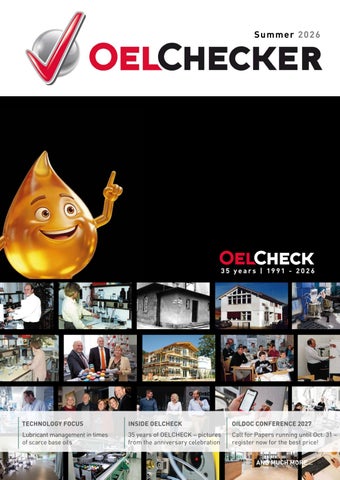
Summer 2 026
3 5 y e a r s | 19 91 - 2 0 2 6
TECHNOLOGY FOCUS
INSIDE OELCHECK
OILDOC CONFERENCE 2027
Lubricant management in times of scarce base oils
35 years of OELCHECK – pictures from the anniversary celebration
Call for Papers running until Oct. 31 – register now for the best price! AND MUCH MORE...
“
CHECK-UP
More than 80 issues of OELCHECKER – the magazine for those in the know
Since 1998, we’ve been informing, explaining and sharing stories – in a way that’s easy to understand, practical, and always focused on real-world benefits. When the first issue of OELCHECKER was published in the summer of 1998, the idea was clear: We didn’t want to create a scientific journal, but rather a “magazine for those who see the big picture” – especially for practitioners. A magazine that explains complex topics in lubricant analysis and tribology in an understandable way and shows the concrete benefits of oil analysis in everyday use. 82 issues later, that’s still exactly what we aim to do.
Over the years, we’ve had the privilege of sharing countless success stories from our customers across a wide range of industries and countries. Stories that demonstrate how lubricant and operating fluid analyses help to detect damage early, prevent downtime, optimize oil change intervals, and thereby save time, money, and valuable resources. In addition, our tribologists and laboratory experts have explained analysis methods, clarified technical terms of lubrication, analytics and tribology and answered our readers' questions in the "Q&A" section. And of course, we have regularly kept you informed about new test procedures, technologies and developments in our laboratory as well as news from the OELCHECK team. One person has shaped the OELCHECKER in a very significant way right from the first issue: Astrid Hackländer. She has supported us editorially since 1998 – from the initial concept, to maintaining a consistent thread throughout the issues, to the magazine’s continuous development. Above all, however, with her flair for language, she ensured that even complex technical topics were presented in a clear, understandable and engaging way.
Ms. Hackländer is now enjoying her well-deserved retirement. Dear Astrid, thank you very much for your decades of consistently constructive, reliable and friendly collaboration. At the same time, we are very pleased to welcome Jörg Schwieder as a new addition to our editorial team. Together, we want to continue developing the OELCHECKER – while preserving what has defined it since 1998: well-founded information, presented in an understandable way and offering real practical value. And you are called upon to participate! Do you have a question for our "Q&A" section? Would you like to share a success story with us about the successful use of oil and lubricant analysis in your company? Or do you have suggestions, topic requests, or feedback on the OELCHECKER? We look forward to hearing from you – and to bringing you many more exciting issues of our magazine for those in the know! Best regards Paul Weismann
Petra Bots
CONTENTS ■ TECHNOLOGY FOCUS Smart Lubricant Management ..........................................................................................4-5 ■ OELCHECK INSIDE New IC Device Now in Use – Increased Capacity in Coolant Analysis................................ 6 High-Performance Microscope for Wear and Particle Analysis ........................................ 6 Oil Aging in Fast Motion – OELCHECK introduces the “TOPP Test” as a New Testing Method.. 7 Meet Us – OELCHECK at the Autumn Trade Fair Season...................................................11 TURBINE OELCHECK Takes Off! ......................................................................................... 13 A Celebration for Everyone – 35th Anniversary Festival with Open House Day...............14 ■ OELCHECK PARTNER FORUM OptiOil – Analytics is the foundation of every action............................................................ 8-9 DS Automotion GmbH – Mobile robotics as a comprehensive solution..........................12-13
2
Published by: OELCHECK GmbH Kerschelweg 28 · 83098 Brannenburg · Germany info@oelcheck.de · www.oelcheck.de Concept and text: OELCHECK GmbH · Jörg Schwieder Typesetting and design:
■ Q&A Particle counting in practice: Implementation, benefits – and comparability ............10-11
Petra Bots
■ OILDOC NEWS OilDoc Conference & Exhibition 2027: Call for Papers & Extra Early Bird................. 15-16 Practical Knowledge in Expert Mode – New OilDoc Workshops.......................................17 From Practitioner to Lubricant Professional – New Series Starts in November ............17 Current OilDoc Seminar Program ...................................................................................... 18
OELCHECK GmbH · OilDoc GmbH · OptiOil GmbH ·
Image rights: DS Automotion GmbH · Fluitec · Siemens AG · AdobeStock © 2026 OELCHECK GmbH All rights reserved. Reproduction only permitted after approval!
X
OELCHECK E PRESSO When every liter counts – Smart lubricant management Shortages of base oils, rising prices, and uncertain supply chains: Lubricants are becoming a strategic resource. Knowing their condition allows you to extend change intervals in a targeted manner. This not only saves oil and costs, but also reduces CO2 emissions – while helping to detect potential machine damage early on. Technology Focus | Pages 4-5
Same sample, different result? The same oil sample, two laboratories – and different purity classes. How is that possible? Sample preparation, measurement methods and sensor technology all influence particle counts. We’ll show why discrepancies aren’t necessarily measurement errors, what matters when comparing results – and why trends often reveal more than a single value. Q&A | Pages 10-11
35 Years of OELCHECK – what a celebration! More than 1,500 guests, fully booked laboratory tours, spectacular experiments and plenty of smiling faces: Our open house day for our 35th anniversary was a huge success. We look back on a special day in Brannenburg – and let the pictures tell the story! OELCHECK Inside | Page 14
The lubricants industry gathers in Rosenheim More than 70 technical presentations, around 50 exhibitors and 400 visitors: From June 15 to 17, 2027, Rosenheim will once again become the hub for lubrication, lubricants and condition monitoring. Practical knowledge, fresh ideas and plenty of networking opportunities are all included. Get in early to secure the Extra Early Bird rate by December 31, 2026! OilDoc Academy | Pages 15-16
3
© Adobe Stock – Corona Borealis
SMART LUBRICANT MANAGEMENT AVOID SHORTAGES, REDUCE COSTS AND CO2 EMISSIONS
Since spring 2026, high-performance lubricants have become noticeably scarcer. War-related damage to the Pearl-GTL plant in Qatar has severely impacted the supply of API Group III base oils, an indispensable raw material for modern synthetic and high-performance lubricants. South Korean refineries, which secure around 30 percent of global Group III supply, cannot – or will not – close this gap. The production of diesel fuel currently promises significantly higher margins. At the same time, API Group II base oils, which have so far frequently been used as an alternative, are increasingly coming under pressure for the same reasons. The consequences are clearly felt throughout the entire value chain: rising procurement costs, longer delivery times, and limited availability of lubricants. Market figures also confirm this trend: In summer of 2025, base oil prices in Northwestern Europe (FCA basis, U.S. dollars per metric ton) were still around 900 U.S. dollars per metric ton for API Group I base oils. By the end of April 2026, they had risen to over 2,000 U.S. dollars per metric ton. For API Group III base oils, prices even reached around 3,000 U.S. dollars per metric ton in early summer 2026. The sharp price increase began in March 2026 – coinciding with the attack on the Pearl-GTL plant. The following chart illustrates the approximate trend in global base oil prices (average across Groups I, II, and III in U.S. dollars per metric ton):
4
© Adobe Stock – ART BY SAIFUL
What began with the escalation of the Middle East confl ict in 2023 has now reached the lubricant shelves – at the latest since the massive military strikes and the blockade of the Strait of Hormuz in early 2026: Geopolitical tensions are severely disrupting the supply of base oils. The resulting supply bottlenecks and, in some cases, drastic price increases for lubricants are prompting a shift in thinking across all industries. Proactive oil and lubricant monitoring is thus no longer merely a matter of cost efficiency or CO2 savings – it has become a decisive factor in ensuring the operational capability and supply security of machines and systems in industry and manufacturing.
Lubricants are machine components The current supply shortage is not a temporary, isolated phenomenon. It highlights what maintenance professionals have known for a long time: Oils and lubricants are not consumables that are replaced at fixed intervals. Rather, they should be viewed as an integral part of the machine. Those who continuously monitor the condition of the machinery can make objective, data-driven decisions about whether and when a change is actually necessary. This is precisely where professional lubricant analyses come into play.
More than just oil analyses A professional analysis considers not only the condition of the lubricant, but always the condition of the machine as well. This is because wear metals, contaminants, additive degradation, or changes in the lubricant’s physical properties provide valuable insights into the technical condition of components and enable the early detection of damage. OELCHECK is based precisely on this holistic approach. Laboratory results are not evaluated in isolation but are interpreted by experienced tribologists in the context of the machine, its application, and operating conditions. The analysis data yields concrete, practical recommendations for action – ranging from extending oil change intervals and implementing targeted maintenance measures to the early detection of incipient machine damage.
TECHNOLOGY FOCUS Condition-based maintenance instead of rigid replacement intervals This holistic approach opens up new possibilities for maintenance personnel when it comes to managing lubricants. Condition-based maintenance replaces oil changes based on fixed operating hours or rigid calendar intervals. An oil change is performed only when the analysis actually indicates it is necessary – or even sooner, if the first signs of incipient damage appear. Lubricant analysis thus serves a dual purpose: it prevents unnecessary oil changes while simultaneously identifying critical developments before they lead to costly machine damage. The basis for this is a precise picture of the condition of the lubricant and the machine. Which additives are still effective? Has the viscosity changed? Are there signs of oxidation, water ingress, contaminants, or metallic wear as indicators of incipient wear? Only the totality of this information provides a reliable basis for well-informed maintenance decisions.
Why oil change intervals might often be longer The oil change intervals recommended by machine or lubricant manufacturers are generally conservative. They must take into account a wide variety of operating conditions, loads, and safety margins and therefore cannot reflect the specific condition of an individual machine. Professional trend analyses provide the necessary transparency here. They document the lubricant’s performance over an extended period and make it possible to adjust oil change intervals reliably and transparently to the actual operating conditions. Modern synthetic oils often have significantly greater performance reserves than rigid change intervals would suggest – provided their condition is continuously monitored and documented. In many applications, such trend analyses are also a prerequisite for machine or lubricant manufacturers to approve extended oil change intervals. This applies, for example, to wind turbines, commercial vehicles, or industrial production facilities. Without this evidence, the only option is often a precautionary oil change – and thus the waste of valuable resources.
What an oil change really costs The example of a 3-MW wind turbine illustrates the economic potential of condition-based lubricant management. An oil change in the main gearbox costs approximately € 15,600 – including all direct and indirect costs. This includes about € 10,500 for roughly 1,100 liters of synthetic oil, € 1,500 for the external service technician and € 3,600 in lost production during the turbine shutdown. In contrast, the costs for regular condition monitoring are as follows: An OELCHECK lubricant analysis for wind turbines costs approximately € 80. Including sample collection by a service technician (approx. € 160), the total cost every 5,000 operating hours is only € 240. Practical experience shows that, with continuous monitoring, main gearboxes can often be operated significantly longer than the manufacturer’s recommended 30,000 operating hours – in many cases, 60,000 operating hours or more. If the oil change interval is doubled in this way, one complete oil change – valued at € 15,600 – is eliminated. This is offset by only twelve analyses, including sampling, at a total cost of € 2,880.
The savings thus amount to approximately € 12,720 per oil change cycle, while also providing greater operational reliability.
Sustainability starts with an oil change In addition to cost-effectiveness, the carbon footprint of lubricants is increasingly coming into focus. Over its entire life cycle – from raw material extraction through manufacturing to disposal – one liter of synthetic oil generates an average of about 3.8 kg of CO2*. Taking a 3-MW wind turbine with an oil volume of 1,100 liters as an example, this means that every oil change avoided saves approximately 4,180 kg of CO2. If the oil change interval is doubled, this corresponds to the annual CO2 sequestration capacity of about 334 trees. If the interval is tripled, this savings figure doubles accordingly. Anyone who wants to calculate the specific impact of their lubricants on their carbon footprint can use the free OELCHECK CO2 calculator.
Detect damage before it occurs However, extending oil change intervals is only one side of the coin. Equally important is the ability to detect incipient damage at an early stage. Lubricants continuously convey information directly from a machine’s heavily loaded friction points. Changes in wear metals, viscosity, additives or contaminants often provide valuable clues about critical developments long before a failure occurs. What matters here is not a single analysis, but rather observing trends over time. Only trend analyses reveal gradual changes and make it possible to plan maintenance measures in a targeted manner before unplanned downtime or costly consequential damage occurs.
Conclusion: Lubricant management is becoming a competitive factor The tight supply of base oil in 2026 is far more than a temporary market disruption. It makes it clear that lubricants are now a strategic resource – both economically and environmentally. Companies that consistently monitor the condition of their lubricants avoid unnecessary oil changes, reduce costs and CO2 emissions, and detect incipient machine damage at an early stage. At the same time, they establish the data foundation for informed maintenance decisions and – where necessary – for OEM approvals of extended oil change intervals. Smart oil and lubricant management today, therefore, no longer means simply using the right lubricant. It means knowing its actual condition and, based on that, making the right decisions at the right time. Especially in times of scarce resources and increasing demands for cost-effectiveness and sustainability, this approach is becoming a decisive competitive factor.
* The calculation factor of 3.8 consists of 1.22 kg of CO2 for the fresh oil and its production and transport, plus 2.58 kg of CO2 for the disposal and recycling of the used oil.
5
NEW IC DEVICE IS NOW IN USE!
What ion chromatography reveals Just like the three existing devices, IC 4 will also be used to analyze anions in the coolant. These negatively charged particles can originate from make-up water, be present as coolant additives, or be formed during glycol degradation. The diluted sample is introduced into a separation column for analysis. Due to different retention times of individual ions within the column, they elute sequentially at the outlet, where a detector records them and determines their respective concentrations in mg/l. The analysis is based on test standard ASTM D5827. The analysis covers a wide spectrum of anions: fluoride, chloride, bromide, nitrite, nitrate, sulfate, and phosphate, as well as anionic glycol degradation products such as glycolate, acetate, formate, adipate, and oxalate.
ULTRA
PREMIUM
The coolant analysis department at the OELCHECK laboratory has further expanded its testing capacity: A fourth ion chromatography (IC 4) instrument has been in operation since April 2026.
ADVANCED
INCREASED CAPACITY IN COOLANT ANALYSIS
Ion chromatography is a standard component of the test program for OELCHECK coolant and antifreeze sets ADVANCED, PREMIUM, and ULTRA. The measured values deliver valuable information regarding make-up water quality, specific additive content, and coolant degradation processes.
More capacity to handle increasing sample volumes The existing IC capacity has become increasingly stretched due to rising sample volumes, despite ongoing method improvements. The commissioning of IC 4 now provides additional measurement capacity, enabling efficient processing of higher sample throughput while maintaining our standard of fast and dependable analyses. The newly commissioned instrument is seamlessly integrated into the established laboratory workflow and complements the three existing IC systems in performing routine coolant analytical procedures.
HIGH-PERFORMANCE MICROSCOPE FOR WEAR AND PARTICLE ANALYSIS The OELCHECK laboratory now utilizes a state-of-the-art Keyence microscope that merges two measurement capabilities previously performed by two independent instruments: wear scar analysis from Brugger and VKA tests plus microscopic particle counting.
Here's how counting works under a microscope Particle counting quantifies the number and size distribution of solid contaminants within a sample. Microscopic examination provides detailed visualization: an accurately measured sample aliquot is vacuum-drawn through a fine-pore membrane. While the lubricant base fluid passes through, solid particles are retained on the membrane surface. This approach ensures detection of only genuinely solid particles. An automated motorized stage subsequently traverses the membrane in sequential fields. High-performance optics and a high-resolution camera system acquire images of individual particles, which are then quantified and dimensionally analyzed by image processing software – with reliable detection capability from 2 µm onwards.
Where the microscope is used
6
The new microscope system is particularly utilized in applications that exceed the capabilities of laser particle counting: water-based hydraulic fluids, heavily soiled metalworking fluid samples, and examination of filter cakes and sedimentary deposits."
The new Keyence VHX-X1F microscope in use: Chemical laboratory technician Genoveva Habl conducting microscopic particle analysis.
A key advantage is that particles undergo not only quantitative and dimensional analysis but also optical characterization. Metallic particles, translucent dust particles and fibrous contaminants can be selectively differentiated and classified. Their distinct optical and morphological properties furnish critical diagnostic information regarding contamination sources." The new instrument delivers enhanced stability and reliability for microscopic particle counting, while its image analysis software expands evaluation capabilities. Customers continue receiving membrane microscope images along with graphical particle count analysis in their laboratory reports.
INSIDE OELCHECK
RAPID OIL OXIDATION SIMULATION OELCHECK DEPLOYS NEW "TOPP TEST" METHODOLOGY How can turbine oil oxidation be reliably predicted prior to operational deployment? OELCHECK addressed this challenge by implementing a novel test methodology in June 2026: the TOPP Test. Technical foundation for this innovation was established through presentations by Dr. Ludger Quick (Dr. Quick Schmierstoffberatung) and Jo Ameye (Fluitec) delivered at the OilDoc Varnish Symposium.
© Siemens AG
The practical reality: Modern gas turbines now operate at substantially higher power densities and efficiency levels than their predecessors from just decades ago.
Siemens' SGT-9000 HL high-performance gas turbine produces 593 MW in simple cycle and 880 MW in combined cycle mode, with efficiency exceeding 64%.
This consequently increases bearing temperatures and pressures, elevating the thermal and oxidative burden on turbine oils in service. While established test methods such as TOST and RPVOT deliver valuable data on oil oxidation stability, they provide only limited insights into the oil's propensity for varnish formation.
Tracking aging and varnish formation potential The TOPP Test (Turbine Oil Performance Prediction) addresses this gap. Four fresh oil samples are artificially aged at 120 °C under constant air flow for 3, 6, 9, and 12 weeks, then compared to the fresh oil baseline. Each sample undergoes analysis of viscosity, acid number, RPVOT, MPC, and RULER. This comprehensive stress profile reveals both aging resistance and varnish potential.
In addition, deposits that form on the inner walls of the TOST glass vessels during the aging process can be visually assessed and evaluated. The test standard for the TOPP Test along with comprehensive evaluation criteria are presently in the development phase. Upon completion and adoption of the standard, ASTM International will release additional technical documentation and guidance. Complete test execution with fresh oil and four aged samples requires 2.5 liters total. Direct comparison of all fi ve samples reveals the turbine oil's performance and aging behavior over the entire test period. Results are clearly presented in a single laboratory report. The dedicated TOST test equipment procured for TOPP Test implementation is now operational at OELCHECK.
One week of TOPP Test corresponds to approximately one year in operation The practical relevance of this procedure is demonstrated through comparison with field data: According to Dr. Ludger Quick, one week in the TOPP test – depending on the specific operating conditions and stress levels – is equivalent to approximately one year of gas turbine service. Fluitec has already validated this correlation using hundreds of used oil samples collected from field operations. "A substantial quantity of TOPP test results exhibits excellent correlation with the performance characteristics of these products under operational conditions." Dr. Ludger Quick
Incidentally: Also of interest for oils in ongoing operation The TOPP test not only provides additional possibilities in the selection of new turbine oils. It can also deliver valuable insights for oil charges already in operational service. For example, if the service life of a turbine oil is to be extended through the targeted addition of antioxidants, the suitability of such an additive treatment can be verified using the TOPP test. In this manner, the impact of the measure on the subsequent aging behavior and performance characteristics of the oil can be assessed prior to application. Varnish deposit formation on TOST glass apparatus over 12-week test duration (© Fluitec)
All-inclusive analysis packages for your oil and operating fluid analyses ERck.de ORD che & e ON es@o l
TAT04I7-250 •psoarlt/shop QUO -9 .re 8034 //lab 49
+ Tel.
s:
http
7
As long as a lubricant fulfills its function, it attracts little attention. However, when temperatures rise, filters clog or valves stick, the question quickly arises whether an oil change is necessary – or whether alternative solutions exist. Thousands of liters of turbine oil represent not only a cost factor but also a matter of market availability. OptiOil GmbH from Cloppenburg services industrial oil systems. OELCHECK provides the analytical foundation for its work. Lubricant preservation instead of replacement
Varnish – a topic requiring further clarification
OptiOil, a company of the NEF GROUP, supports industrial enterprises throughout Germany in increasing the availability and service life of turbines, compressors, gearboxes and hydraulic systems, reducing maintenance and operating costs and extending the service intervals of lubricants in use. This is based on comprehensive fluid management. The analysis, maintenance and optimization of lubricants reduce wear and enable early identification of failure risks. The portfolio ranges from lubricant analysis, filtration and drying, through varnish removal, tank cleaning and overhaul support, to online monitoring and CO2 assessment.
A focal point of OptiOil’s work addresses a phenomenon known as varnish, which is unfamiliar to many plant operators. Varnish refers to lacquer-like deposits that originate from undissolved, inherent oil components and primarily accumulate on metallic surfaces within the system. These consist predominantly of polar constituents from the oil itself, which, due to chemical incompatibility or lubricant degradation, no longer remain in solution, precipitate from the oil and ultimately form lacquer-like coatings on machine components. This phenomenon occurs primarily in quiescent zones with low volumetric flow rates or during oil cooling, such as during machine shutdown. In contrast to sludge-like deposits, varnish cannot simply be wiped away with a cloth and is barely removable even with solvents. The consequences are significant: On valve internal surfaces, the deposits increase friction and cause valves to stick in their seats. In bearings, they elevate temperature and wear rates. A distinction is made between Cold Varnish, which originates from oxidation and Hot Varnish, which is caused by shear stress.
OELCHECK analyses as the analytical basis This reflects a clear corporate philosophy: “We aim to preserve the lubricant rather than sell it,” as Burkhard vor dem Brocke, Managing Director and founder of OptiOil, succinctly states. Approximately 25 employees form the core team, organized in multiple service units operating nationwide – in power plants as well as in the c hemical industry. The focus is not limited to major aggregates alone. While the turbine is the centerpiece in a power plant, boiler feed water pumps, drives, gearboxes and hydraulic systems operate alongside it – all lubricated with oil. During facility inspections, OptiOil systematically records which lubricant and filter are in use at each location. From this inventory assessment, a machine overview is generated that enables the maintenance manager to determine the condition of his fluids at any time – and also serves as documentation for audits.
8
“We have nearly 100 percent of our analyses performed by OELCHECK,” states Justus Kathmann, Managing Director of OptiOil. The analyses provide documented decision-making foundations and enable comparison over extended trend periods. Most importantly, however, they demonstrate which measure is appropriate: filtration when particles compromise cleanliness levels, drying in case of water ingress – or comprehensive oil system cleaning including the tank when deposits have formed. Three methods are decisive for varnish detection: The RULER test and FTIR spectrum determine the depletion of antioxidants contained in the lubricant. The MPC test identifies the resulting deposit tendency of the oil. OptiOil operates its own measuring equipment and conducts particle measurements and water testing on-site. However, the laboratory report from OELCHECK with its more than 40 individual parameters serves another purpose as
© Adobe Stock – Светлана Волынкина
OPTIOIL: ANALYTICS IS THE FOUNDATION OF EVERY MEASURE
PARTNER FORUM well: “With this, I have something that the customer can incorporate into his machine history as documentation,” vor dem Brocke explains the distinction between rapid testing and reliable findings from the OELCHECK laboratory. Kathmann emphasizes an additional advantage: Since the company serves customers throughout Germany, OptiOil relies on OELCHECK analysis packages as an efficient supplement to its service offerings. This enables samples to be collected on schedule and immediately integrated into condition monitoring. OptiOil assumes responsibility for professional evaluation of the analysis data and accompanies the customer through all subsequent steps. In this manner, continuous monitoring of lubricants and systems is ensured at all times.
Case study 2: recovery of a turbine oil charge The second case illustrates the procedure for sustainable regeneration of turbine oil. Prior to a scheduled turbine overhaul, analysis of an approximately 7,000-liter oil charge revealed reduced antioxidant content, an elevated MPC value and altered foam behavior. The remaining parameters were within normal range – sufficient reason to evaluate oil regeneration as an alternative to oil change. Analytics accompanied the entire process: Laboratory analyses from OELCHECK and on-site measurements documented the condition before, during and after treatment. DECON™ AO, a solvency improver that supplies additional antioxidants to the oil, was deployed. The addition was monitored via online analysis. In parallel, varnish filtration removed dissolved aging products from the circulation.
Two practical examples demonstrate the working procedure:
Case study 1: deposits in the turbocompressor At an operator of air separation plants, anomalies accumulated in an air turbo-compressor with approximately 5,000 liters tank capacity: The oil temperature in the return line rose to over 70 °C, bearing temperature increased correspondingly, vibrations occurred in the high-pressure section and gearbox – until the compressor switched to emergency operation. Inspection revealed severe deposits on gear pinions and plain bearings. The causal chain could be reconstructed: Insufficient cooling capacity allowed oil temperature to rise, thermal stress accelerated aging and the resulting deposits coated the gears with varnish – whose buildup in turn caused the vibrations. The OELCHECK analysis confirmed this causal chain: Antioxidants were severely depleted, the oil showed signs of rapid progressive aging and the slightly elevated MPC value indicated increased deposit tendency. A simple oil change would therefore be insufficient – the system itself required cleaning prior to refilling.
The results of the laboratory analyses confirmed the approach: Oxidation protection was restored, the cleanliness class achieved the specification-compliant value, the MPC value decreased to normal level. All relevant parameters of the final examination again corresponded to the required standard. The oil charge remained in the system – eliminating the otherwise necessary flushing, new procurement and waste oil disposal. Regeneration cost only half as much as a complete oil change and OptiOil quantifies the CO2 savings compared to new filling at approximately 80 percent.
Supply capability as a new argument What began in both cases as technical and economic optimization has meanwhile acquired an additional dimension: The supply situation for lubricants is generally constrained. Vor dem Brocke reports on turbine oils that are difficult to procure despite conventional formulation and on inquiry volumes not seen in previous years. For operators of critical systems, continued use has thus gained new significance: It is no longer solely a matter of economic viability but also serves operational planning security and uninterrupted longterm system operation. Here the circle closes to analytics. Those who understand the condition of their lubricant can reliably extend service intervals rather than estimate them. The assessment by OELCHECK tribologists transforms measurement data into a decision-making foundation and converts an oil charge that would have been changed previously into a resource that remains in the system.
Turbocompressor before and after application of solvency improver and varnish removal filter
Prior to the oil change, OptiOil deployed the solvency improver DECON™ from partner Fluitec and supplemented the treatment with a varnish removal filter. The benefits became apparent in multiple ways: Production continued during the pre-cleaning phase, the customary system flushing with flush oil was eliminated, downtime was reduced and mechanical cleaning of components became unnecessary. Before filling the new lubricant, the system was optimally clean – the prerequisite for extended service intervals.
OptiOil GmbH Headquartered in Cloppenburg, OptiOil supports industrial enterprises throughout Germany in sustainably improving the performance and availability of their machinery and systems. The foundation is comprehensive fluid management: analysis, maintenance and optimization of lubricants and operating fluids. With the OptiOil®SAVE approach, the company pursues the objective of utilizing existing resources optimally and extending their service life. As a company of the NEF GROUP, OptiOil is part of a network specializing in CO2-optimized solutions and sustainable value creation. www.optioil.de
9
PARTICLE COUNTING IN FIELD APPLICATION: PROCEDURE, BENEFITS – AND REPRODUCIBILITY During a routine examination of our hydraulic oil, an unexpectedly poor cleanliness class was determined. To verify the result, we sent the same sample to a second laboratory – and received a different cleanliness class there. How is it possible that two laboratories arrive at different results from the same oil sample? One value, two norms Some users may have already observed the following: OELCHECK reports a cleanliness class for a sample and provides a recommendation for oil maintenance. It can occasionally occur that the user's own particle counter (or other laboratory findings) shows a deviating value for samples from the same system. Such observations can almost always be explained. Although cleanliness classes are reported according to a uniform standard, multiple permissible variants exist for the counting method. Particle count per 100 ml More than to inclusive 250.000.000 130.000.000 250.000.000 64.000.000 130.000.000 32.000.000 64.000.000 16.000.000 32.000.000 8.000.000 16.000.000 4.000.000 8.000.000 4.000.000 2.000.000 1.000.000 2.000.000 500.000 1.000.000 250.000 500.000 130.000 250.000 64.000 130.000 32.000 64.000 16.000 32.000 8.000 16.000 4.000 8.000 2.000 4.000 1.000 2.000 500 1.000 250 500 130 250 64 130 32 64 16 32 8 16 4 8 2 4 1 2 0 1
Code value > 28 28 27 26 25 24 23 22 21 20 19 18 17 16 15 14 13 12 11 10 9 8 7 6 5 4 3 2 1 0
ISO 4406 Classification Table
10
The most widely applied classifi cation worldwide is ISO 4406. It consolidates counted particles into three size ranges – greater than 4 µm(c), greater than 6 µm(c), and greater than 14 µm(c). The result is presented as a three-part code, for example 19/17/14.
ISO 11500 permits several solvents for this purpose – ranging from mineral oil to gasoline fractions to iso-propanol and toluene – which differ in their polarity and thus in their effect.
This is precisely where the expertise of the OELCHECK laboratory comes into play. For many years, a procedure has been employed that ASTM D7647 describes as "water-masking": a mixture of 25 percent iso-propanol and 75 percent toluene. It dissolves the finest water droplets as well as a substantial portion of aging products – those soft constituents referred to as "soft contaminants" or varnish.
A cleanliness class of ISO 19/17/14 means that in 100 ml of sample fluid: • 250,000 to 500,000 particles ≥ 4 μm • 64,000 to 130,000 particles ≥ 6 μm • 8,000 to 16,000 particles ≥ 14 μm are present.
This conversion has proven effective: Measurement values are processed into classes using statistical methods, thereby becoming more comparable and easier to interpret. The division of responsibility between two standards is important here: ISO 4406 specifies how a result is presented; ISO 11500 in turn governs how measurement is conducted. This counting standard deliberately provides laboratories with discretion in sample preparation, which each laboratory utilizes according to its specific task.
The contribution of sensor technology A second influencing factor is the measurement technology. Modern laboratories operate with laser light sensors. OELCHECK operates multiple instruments in parallel. Occasionally, older white light sensors are still in use in the industry, whose lower light intensity produces less distinct images of fine particles. In practice, this can amount to two to three cleanliness classes. A deviating value can thus simply originate from a different instrument generation. By contrast, calibration is clearly regulated: For automatic counters, ISO 11171 applies with NIST-traceable test dust ISO MTD. A rule of thumb has become established for evaluating deviations: Two measurement results are in good agreement when they deviate from each other by no more than ±1 class per channel. OELCHECK performs three measurements per sample and compares them – an internal control that ensures high reproducibility. If we remain within ±1 class across laboratories, this represents an excellent result.
Reasons for sample dilution
Two procedures, distinct advantages
Ideally, a sample is measured undiluted. However, this requires a largely "clear view." In laboratory practice, however, turbid used lubricants predominate, which contain reaction products, moisture, or finest air bubbles. High viscosity or a dark sample also indicate dilution.
From this systematic approach, it becomes clear why OELCHECK maintains two procedures for its customers. The standard method is laser particle counting: The diluted sample is passed through a fl ow cell. When particles block the laser
Q&A beam, the sensor registers the shadowing, which is electronically evaluated and compared against the calibration dust. This method is highly automatable, extraordinarily stable and is the method of choice for hydraulic, turbine, and insulating oils. High-viscosity gear oils can likewise be measured with appropriate dilution.
Gaining certainty for users This results in a recommendation for OELCHECK customers that is easy to implement: Plant operators should monitor the development at their own facility over a certain period of time. With consistent analytical procedures, the trend derived from this provides the most reliable insights. Who regularly submits samples reliably recognizes how fluid cleanliness develops – and obtains answers to two central questions: 1. Is the filtration operating as intended? 2. Are new particles continuously entering the system?
For certain media, an alternative approach is recommended: In aqueous hydraulics with emulsion constituents, ultrafine droplets are generated; in cutting oils, very high particle loads are to be expected. Here, microscopic particle counting according to ISO 4407 demonstrates its strengths: The sample is filtered through a filter membrane with 1.2 µm pore size, the dried membrane is scanned under an automated microscope and evaluated by image analysis software. Exclusively solid particles are detected. Additionally, there is a knowledge gain that no other method offers: Under the microscope, it becomes visible whether metallically lustrous particles indicate wear or whether dust particles and/or soft deposits are present. Even fibers can be classified – occasionally they do not originate from the system at all. On the filter images, one frequently observes fibers that presumably were introduced during sample collection. This is an indication of how much careful sampling contributes to the reliability of results. Microscopic counting is offered as a special examination with an additional laboratory report page; OELCHECK has recently acquired a state-of-the-art microscope for this purpose (further details on page 6 of this issue).
Equally informative is precisely determining the cause of elevated values: Are these hard particles – or merely aging products that have agglomerated to such an extent that they are detected as particles in the test? This differentiation leads to different measures: In the case of advanced oil aging, more intensive filtration is not the method of choice, because additives can also be removed in the process. The numerical code itself provides an initial indication. A classification such as 22/20/12, whose last figure drops significantly compared to the elevated preceding values, for example, suggests water, sludge or varnish rather than hard particles.
The parameters in interaction This names the core issue: Particle counting is a meaningful parameter – and unfolds its full significance in combination with additional results. Only together with water content, elemental analysis, FTIR spectrum, neutralization number and depending on the specific question, the MPC test, does a reliable picture emerge. Which cleanliness class is required depends on the application: Servo valve technology, for example, places higher demands than an industrial gearbox. It is becoming apparent that sample preparation will be further standardized in the future – work is underway at ASTM and FVA. Until then, the following applies: An OELCHECK laboratory report contains more than mere numerical sequences. Our tribologists classify every result in the context of the respective machine – and are available at any time for follow-up questions.
OELCHECK answers your questions on the topics of lubricant and operating fluid analyses as well as tribology. Contact us by email (info@oelcheck.de)!
MEET US! We are represented at trade fairs, congresses and events. Take the opportunity to meet us in person, learn about the latest developments in lubricant analysis and discuss your questions directly with our experts. We look forward to personal exchange with you! You are welcome to contact us in advance by email or through our social media channels and arrange a meeting time.
15-17/09/2026 | Düsseldorf
22-25/09/2026 | Berlin
22-25/09/2026 | Hamburg
30/09 - 02/10/2026 | Amsterdam
14-15/10/2026 | Munich
10-13/11/2026 | Hannover
11
DS AUTOMOTION GMBH MOBILE ROBOTICS AS A COMPLETE SOLUTION They operate quietly, lift heavy loads several meters high – and work around the clock: mobile robots that transport material from A to B in factory halls, warehouses and hospitals. DS Automotion GmbH, based in Linz, is among the world's leading technology companies in this market and has been developing mobile robots along with their associated fleet management systems for 40 years. When unclear damage patterns occur in the hydraulic systems of the vehicles, the company relies on lubricant analyses from OELCHECK. Mobile robotics as an umbrella term In the market, a distinction is frequently made between FTS (driverless transport systems, AGV) and AMR (autonomous mobile robots). DS Automotion GmbH deliberately uses the umbrella term mobile robotics. “The umbrella term is mobile robotics itself,” explains Ronald Lengyel, Marketing Manager at DS Automotion GmbH. This is because the company combines both technologies in one: In certain areas, the vehicle moves completely autonomously and independently determines its route. In other zones, a cycled, virtually track-bound driving mode makes sense for efficiency reasons. Both operating modes are intelligently combined by the vehicle software ARCOS.
Core competencies In-House A key success factor for the company is to retain core competencies and key technologies in-house and continuously develop them further. Over 60 software experts work on solutions such as the fleet management system NAVIOS and the navigation and control software ARCOS. Those who develop the technology themselves remain independent and retain full control over further development: “We do purchase components, but the technology behind them is developed in-house by us,” says Lengyel. “That is the advantage of being a complete systems provider.” The company's roots lie in special machinery manufacturing. Forty years ago, the vehicles still operated on magnetic track guidance – for example, in the automotive industry, where vehicle chassis were transported between galvanizing, painting, and other manufacturing stations. Over the years, this has evolved into a broad product portfolio with vehicles such as AMADEUS, ARNY, or OSCAR. The focus is always on the complete solution. “We create solutions for systems at customer facilities and consider every project
12
holistically,” emphasizes Lengyel. Mechanical and electrical designs are carried out entirely in-house and can respond to customer-specific requirements at any time. This is because not every project starts from scratch: Existing production environments are also taken into account – for example, regarding floor conditions, existing load carriers or other structural conditions.
Hydraulics in lifting vehicles Hydraulic systems are used strategically at DS Automotion GmbH where high lifting heights are required. The AMADEUS model achieves lifting heights of up to 2.8 meters and moves loads of up to two tons. Its counterpart ARNY lifts 1.5 tons to heights of up to 10.8 meters. For the remaining vehicles, the company primarily relies on electric spindle lifting systems. The hydraulic units come from a specialized German manufacturer. Tank, drive and pump are supplied as a pre-assembled unit. The vehicles themselves are developed and designed in Linz, then assembled and wired by a partner company in the Czech Republic, and subsequently returned to Linz for commissioning. There, the software is installed, test drives are performed and the material handling is verified.
PARTNER FORUM An unusual damage pattern – how DS Automotion GmbH found OELCHECK
Analyses on specific occasions
Approximately three years ago, during such a commissioning process, a damage pattern occurred whose cause was initially unclear: metal chips in the hydraulic circuit. This was an entirely new damage pattern. Since the vehicles had already undergone several production and transport routes before commissioning, multiple sources of contamination were possible – from the piping to the hydraulic unit itself to possible contamination in-house. “We examined this through a process of elimination,” describes Christoph Molnar, responsible for quality assurance and quality management, the procedure. Through an internet search, he eventually came across OELCHECK. The OELCHECK analyses provided a clear result: The metal chips were already present in the empty tank before the hydraulic system was even filled. Since the tank is supplied as a purchased component, normally no one opens it to check for contamination. The significance of the discovery was considerable for DS Automotion GmbH, because hydraulic units are procured in larger quantities and with a globally active customer base, every hour counts: The faster the cause is identified, the more precisely it can be determined which vehicles might be affected.
DS Automotion GmbH DS Automotion GmbH is a globally leading technology company for mobile robotics in intralogistics and assembly. For over 40 years, the company has developed and manufactured mobile robots as well as the associated fleet management systems for driverless transport systems (FTS) and autonomous mobile robots (AMR). With flexible products, innovative solutions and comprehensive services, DS Automotion GmbH supports its customers in sustainably increasing efficiency and competitiveness. The company is headquartered in Linz (Austria) and has its own locations in Germany, France, and the USA. Worldwide, DS Automotion GmbH employs more than 300 employees and operates as an independent company within the SSI Schäfer Group. www.ds-automotion.com
DS Automotion GmbH strategically employs lubricant analyses where they provide the greatest insight: in cases of anomalies whose cause must be clarified. And such cases occur repeatedly. For example, a service technician reported that his hydraulic oil had turned completely black after only three to four months. DS Automotion sent a sample to OELCHECK and investigated the cause. In the case described, the cause lay in the specific operating environment at a customer from the food industry: The propellant caused the oil to react and showed a chemical reaction. In other cases, it turned out that an oil with incorrect viscosity was used, no lubricant was filled in at all, or cleaning agents had entered the circuit. For a company that is responsible for complete solutions, this cause identification is decisive. Because from the customer's perspective, it is irrelevant which supplier a component comes from. The responsibility of a complete systems provider also applies in the case of purchased components. After approximately three years of cooperation, the balance is clear. Particularly valued is the uncomplicated handling of the OELCHECK analysis kits: They are procured in stock, have no limited shelf life and can be used at any time as soon as a specific case arises. The comprehensibility of OELCHECK laboratory reports is also explicitly praised. Even those who are not certified hydraulics specialists can understand and interpret the results and recommendations of OELCHECK tribologists as technicians. Equally a plus point is the rapid processing at OELCHECK: After sending in an oil sample, a detailed laboratory report is available after only three days. The conclusion is correspondingly clear: “From our perspective, it really cannot be better.”
TURBINE OELCHECK TAKES OFF! Sports at TURBINE OELCHECK have been active in recent months: Our team demonstrated at two regional events that it pushes forward together not only in everyday work but also in sports. For the third time, TURBINE OELCHECK participated in the traditional Hasenöhrl company run in Bayrischzell. Approximately 800 runners from 177 teams competed on the 5.7-kilometer course. With five teams and a total of 17 participants, TURBINE OELCHECK was well represented. Particularly successful: Kilian Crämer, Jonas Frank, and Johanna Baumann ran together to an outstanding 17th place in the overall standings. However, the remaining teams also achieved strong placements.
RUNNING AND ALSO ...
TURBINE OELCHECK also fielded its own team at the large soccer championship in Brannenburg. The weather made it anything but easy for the players with rain, lightning and thunder. However, the team was not discouraged by this: commitment, fair play and above all shared enjoyment were at the center. Supported by Klaus van Hasselt and Sebastian Gruber, TURBINE OELCHECK once again demonstrated: A strong team makes a good impression not only at work!
... ON THE SOCCER FIELD
13
A PARTY FOR EVERYONE
3 5 y e a r s | 19 91 - 2 0 2 6
CELEBRATION OF THE 35 TH ANNIVERSARY WITH OPEN HOUSE DAY On the occasion of its 35th anniversary, OELCHECK opened its doors to the general public for the first time – and more than 1,500 visitors took the opportunity to take a look behind the scenes of the laboratory at Kerschelweg in Brannenburg. What does a modern laboratory for lubricant and operating fluid analyses actually look like? What happens to an oil sample after it arrives at OELCHECK? At the open house day, guests were able to get to know OELCHECK and the work in the laboratory up close. The tours through the modern analysis departments were fully booked within a very short time, and the company presentations also attracted great interest. The spectacular science show by the "PHYSIKANTEN" provided excellent entertainment, filling the festival tent to capacity with their experiments. There was also much to discover for the youngest guests: At a rally with various interactive stations, they could experiment in the "slime laboratory," test their skills on a course and meet robot dog "Checky."
Food trucks, live music, and comfortable seating areas around the laboratory offered an opportunity to linger, exchange ideas and celebrate together "We are overwhelmed by the great response and the positive atmosphere on this day," says Petra Bots, Managing Director and co-owner of OELCHECK GmbH. "It was truly important to us to show what we accomplish here in Brannenburg every day – and to celebrate our anniversary at the same time with the people from the region." In the evening, the celebration continued: At a festive gala evening, employees celebrated 35 years of OELCHECK together with their companions. Thus, the 35th anniversary became a celebration for everyone – and the open house day at the same time became a sign of OELCHECK's connection with Brannenburg and the entire region.
14
Main Topics
Make sure you get the best price!
Condition Monitoring & Maintenance 4.0
EXTRA EARLY BIRD
Gearboxes • Turbines and turbomachinery • Engines • Hydraulic systems • Rolling and plain bearings • Special applications
€880 plus VAT
Oil Monitoring – Online • On-site • Offline Sampling • Oil sensors • On-site measurement • Troubleshooting & case studies • Artificial intelligence & data mining
valid until Dec. 31, 2026
Laboratory Analytics – Methods, Application Areas, Automation
OilDoc Conference and Exhibition Since 2011, the OilDoc Conference has been the leading event in Europe for sustainable lubrication, maintenance, and condition monitoring. The three-day event will take place in Rosenheim from 15 to 17 June 2027! Benefit from practical knowledge, valuable contacts and inspiring insights for your daily work. For the upcoming OilDoc Conference, we expect again around 400 participants, approximately 50 exhibitors and more than 70 highquality technical presentations. Stay up to date – Get first-hand insights into the latest developments in research and practice. Build your expertise – Prepare yourself for future challenges and opportunities. Meet the industry’s best – Network with leading scientists and application experts. Expand your network – Take advantage of unique opportunities for valuable exchange. Experience Bavarian hospitality – enjoy two exclusive evening events in a relaxed atmosphere.
New analytical methods for oils, greases, and engine coolants • Laboratory automation • Interpretation of analysis results • Artificial intelligence in evaluation
Fluid Management – Innovative and Sustainable Sustainability and cost-effectiveness • Lubrication and asset management • Lubrication plans & programs • Concepts for professional oil maintenance • Storage, transport, and handling of lubricants • Circular economy and extended oil change intervals • Lubrication methods, devices, and systems
Lubricants – Current Developments Base oils • Additives • Greases, lubricating pastes • Solid lubricants • Anti-friction coatings • Dry lubrication
Tribology – Research with Practical Focus Friction and wear • Materials, contact mechanisms, surfaces • Tribometry • Hydrodynamics and EHD, minimum quantity and dry lubrication • Tribology of machine elements and assemblies
Lubricants – Design to Application Engines • Landfill gas, sewage gas, biogas, and wood gas engines • Gearboxes • Hydraulic systems • Bearings • Turbines • Wind turbines • Compressors • Energy-efficient lubrication • Sustainability
Electromobility and Lubrication Lubricants for electric vehicles • Drivetrain • Bearings • Engine coolants • Concepts & solutions • Energy efficiency
% EXTRA EARLY BIRD FEE
Lubrication in Metalworking
Don’t miss the next OilDoc conference and exhibition in beginning summer of 2027! Take advantage of the Extra Early Bird Rate: Register until Dec. 31, 2026 Extra Early Bird Fee: just €880 plus VAT (Standard registration fee: €1,090 plus VAT)
Water-based and non-water-based fluids • Multifunctional fluids • Minimum quantity lubrication and dry machining • Modular systems
Lubrication under Special Conditions Environmental and health aspects • Lubricants for the food and pharmaceutical industries • Fire-resistant fluids • High-/low-temperature applications • Vacuum
Register now!
Supportet by:
Functional Fluids – Everything Except Lubrication Insulating oils • Heat transfer fluids • Engine coolants • Cleaners • Corrosion protection agents
Media Partner:
15
Become a Speaker! First, select a topic/technology/project from the list of topics or choose your own industry-related subject that is relevant and informative for professionals in the field. Submit a compelling one-page summary (abstract) of your proposed presentation by October 31, 2026 via https://oildoc.wetransfer.com or info@oildoc.com. Please ensure that it meets the formal requirements and addresses all key points. Your abstract will be published in the conference proceedings. We will inform you by the end of December 2026 whether the program committee has accepted your presentation and invited you as a speaker. Please send us your fully developed manuscript, along with a short biography and a portrait photo, no later than April 15, 2027. Submit your complete presentation slides in due time. Please note: The official language of our international conference is English. The presentation, abstract and PowerPoint slides must be written in English. Please use our file templates and follow the formal guidelines. The presentation duration is 20 minutes, followed by a discussion of up to 10 minutes. Download templates: https://conference.oildoc.com/en/call-for-papers/guidelines/
Promotion, Sponsorship and Exhibition At the OilDoc Conference 2027, you will meet the key decision-makers in your industry — gathered in one place. There are few more efficient ways to reach your target audience directly. Alongside the conference, an international exhibition featuring around 50 exhibitors will take place. Secure your booth early — space is limited and typically sells out quickly. For maximum visibility, OilDoc offers a premium sponsorship system as well as a wide range of traditional and creative advertising opportunities to suit almost any budget. Request our sponsorship brochure — our marketing experts will be happy to provide you with tailored advice. Become a premium sponsor now: Your logo will appear on all future promotional materials for the OilDoc Conference 2027, ensuring early visibility among your target audience.
Evening Events and Networking Even in the digital age, personal contacts and networks are indispensable — perhaps even more important than ever. The OilDoc Conference has been known for years in the lubricants industry for its excellent networking opportunities — set in an environment that is both professionally grounded and personally engaging. Get-together standing reception on June 15, 2027 Bavaria meets Cuba – Alpine beats & Caribbean rhythms on June 16, 2027 Workshops and excursion on June 17, 2027 Snack and lunch breaks for productive conversations Exclusive meeting rooms available for booking
Venue KU‘KO Event Center, Kufsteiner Straße 4 83022 Rosenheim, Bavaria, Germany www.kuko.de 50 km from Munich, 70 km from Salzburg Rosenheim is located halfway between Munich and Salzburg and has a lot to offer. Enjoy your stay in one of the most beautiful cities in Bavaria. 16
Contact Rüdiger Krethe, Dipl.-Ing. – Program-Committee OilDoc GmbH Kerschelweg 29 • 83098 Brannenburg • Germany Tel.: +49 8034 9047-700 info@oildoc.com • www.oildoc.com More Information: www.oildoc-conference.com
OILDOC ACADEMY
PRACTICAL KNOWLEDGE IN EXPERT MODE NEW OILDOC WORKSHOPS FOCUS ON PRACTICE, REAL DATA AND KNOWLEDGE EXCHANGE Authentic analytical data, specific problem statements and intensive exchange among specialists: With a new workshop format, OilDoc Academy is expanding its continuing education offerings in 2027. The focus is not on imparting foundational knowledge, but on collaborative work on real cases from practice. How can a laboratory report be correctly interpreted? What correlations exist between individual analytical values? And what measures can be derived from this for practical application? This is precisely where the new OilDoc Workshops come in. Practice instead of theory Work is conducted using, among other things, original laboratory reports from OELCHECK. Participants analyze real results, discuss anomalies and collaboratively develop possible conclusions with experts. Rather than generic textbook examples, the focus is on questions that actually occur in daily work practice. A key component of the concept is experience exchange. The workshops are conducted as full-day in-person events at OilDoc Academy and are limited to a maximum of 15 participants. This ensures sufficient time for individual questions, discussions, practical exercises, and exchange with professional colleagues. The workshops are designed for participants with solid technical foundational knowledge who wish to delve deeper into selected topics. Depending on the event, additional knowledge or practical
experience regarding lubricants, oil monitoring, and maintenance is required.
The first dates in 2027 The kickoff features workshops in February on insulating fluids and their monitoring (02/17), oil monitoring via online sensors (02/18) and hydraulic fluids – laboratory reports in expert mode (02/25). In July, an entire workshop week follows with additional "Expert Mode" topics. Events are planned covering additives, turbine and turbocompressor oils, hydraulic fluids, gear oils in industrial applications and gas engine oils. All dates at a glance on the following page!
FROM PRACTITIONER TO LUBRICANT PROFESSIONAL NEW SERIES STARTS AGAIN IN NOVEMBER Lorem ipsu
In November 2026, the OilDoc certification series for lubricant technician and expert will enter the next round – with two qualification levels for different tasks and requirements. Modules 1 and 2 prepare for the examination for "Certified Lubricant Technician" and provide sound, practice-oriented knowledge. With additional modules 3 and 4, the path continues to "Certified Lubricant Expert" – for those who want to deepen their expertise and take on greater responsibility in lubricant management. Stay flexible: Each of the four modules is self-contained in terms of content and can be booked individually. This allows continuing education to be individually adapted to tasks, prior knowledge, and personal goals.
ZERTIFIKAT Hier könnte Ihr Name stehen! ERFOLGREICHE ABSCHLUSSPRÜFUNG UND TEILNAHME AM OILDOC-ZERTIFIKATSKURS "SCHMIERSTOFF-EXPERTE" MODUL 1 | XX MODUL 2 | XX
• Schmierstoff-Anwendungstechnik und -auswahl • Technische Expertise in Ölen und Schmierfetten • Filtration und Reinheitsstandard • Nachhaltige Lösungsansätze
MODUL 3 | XX MODUL 4 | XX
• Schmierstoff-Management und Dokumentation • Ölüberwachung und Qualitätssicherung • Schadensanalyse und Problemlösung • Filtration und Präventionsstrategien
Please note: Right now this training series is only available in German language! Rüdiger Krethe Geschäftsführer OilDoc GmbH Brannenburg, tt.mm.jjjj
17
OILDOC ACADEMY
OILDOC SEMINAR PROGRAM UPCOMING DATES 22.-24.09.26
Schmierung und Ölüberwachung für Hydrauliken
29.-30.09.26
Praxisprobleme lösen – Schäden vermeiden Modul IV der Reihe „Zertifizierter Schmierstoff-Experte“. Einzeln buchbar. Schmierfette – Eigenschaften, Auswahl und Überwachung
06.-07.10.26 08.-09.10.26 13.10.26
Infrarot-Spektroskopie in der Praxis – IR-Spektren verstehen & interpretieren Kühlmittel – das unterschätzte Betriebsfluid
14.-15.10.26
Schmierung und Ölüberwachung für stationäre Gasmotoren
Professionelles Schmierstoff-Management Modul III der Reihe „Zertifizierter Schmierstoff-Experte“. Einzeln buchbar. 09.-12.11.26 Maschinenüberwachung durch Ölanalysen für Fortgeschrittene *MLA II-Zertifikatskurs* 16.-19.11.26 Expertenwissen für Schmierstoff-Profis *CLS-Zertifikatskurs – Deutsch* 24.-26.11.26 Grundlagen der Schmierstoffanwendung I Modul I der Reihe „Zertifizierter Schmierstoff-Experte“. Einzeln buchbar. 30.11.-03.12. Expert knowledge for lubricant professionals * CLS Certified Lubrication Specialist – Englisch* 19.-21.01.27 Schmierung und Ölüberwachung für Getriebe
Your contact for further training: OilDoc GmbH Kerschelweg 29 83098 Brannenburg Tel. +49 8034 9047700 info@oildoc.de You can find current dates, detailed seminar content and terms of participation, as well as links to our easy online registration process, on our website:
en.oildoc.com/training/
20.-21.10.26.
02.-03.02.27 17.02.27
Praxisprobleme lösen – Schäden vermeiden Modul IV der Reihe „Zertifizierter Schmierstoff-Experte“. Einzeln buchbar. *NEU* Workshop: Isolierflüssigkeiten – Typen und Ölüberwachung
18.02.27
*NEU* Workshop: Ölüberwachung durch Online-Sensoren
23.-24.02.27
Zertifizierter Hydrauliköl-Spezialist OilDoc-Zertifikatskurs *NEU* Workshop: Hydraulikflüssigkeiten – Laborberichte im Expertenmodus
25.02.27
Kühlmittel – das unterschätzte Betriebsfluid Schmierung und Ölüberwachung für stationäre Gasmotoren Maschinenüberwachung durch Ölanalysen für Einsteiger *MLA/MLT I-Zertifikatskurs* 16.-17.03.27 Grundlagen der Schmierstoffanwendung II Modul II der Reihe „Zertifizierter Schmierstoff-Experte“. Einzeln buchbar. 05.-08.04.27 Expertenwissen für Schmierstoff-Profis *CLS-Zertifikatskurs – Deutsch* 13.-15.04.27 Grundlagen der Schmierstoffanwendung I Modul I der Reihe „Zertifizierter Schmierstoff-Experte“. Einzeln buchbar. 27.-29.04.27 Schmierung und Ölüberwachung für Turbinen und Turbokompressoren 01.-02.06.27. Professionelles Schmierstoff-Management Modul III der Reihe „Zertifizierter Schmierstoff-Experte“. Einzeln buchbar. 15.-17.06.27 OilDoc Konferenz & Ausstellung 28.06.-01.07. Maschinenüberwachung durch Ölanalysen für Fortgeschrittene *MLA II-Zertifikatskurs* 06.-07.07.27 Grundlagen der Schmierstoffanwendung II Modul II der Reihe „Zertifizierter Schmierstoff-Experte“. Einzeln buchbar. 12.07.27 *NEU* Workshop: Additive für Schmierstoffe – Laborberichte im Expertenmodus 13.07.27 *NEU* Workshop: Öle in Turbinen und Turbokompressoren – Laborberichte im Expertenmodus 14.07.27 *NEU* Workshop: Hydraulikflüssigkeiten – Laborberichte im Expertenmodus 15.07.27 *NEU* Getriebeöle in industriellen Anwendungen –
The OilDoc team is ready to help!
02.03.27 03.-04.03.27 09.-11.03.27
Rüdiger Krethe Managing Director and Seminar Leader He is your point of contact for all questions regarding seminar content, the design of customized in-house seminars and expert opinions. The OilDoc back office team From left to right: Stefanie Komma, Carmen Gratzl, Susanne Stadler
Laborberichte im Expertenmodus
16.07.27 22.-23.09.27 28.-30.09.27 05.-07.10.27 12.-13.10.27 14.-15.10.27 19.10.27 20.-21.10.27 26.-27.10.27 15.-18.11.27 23.-25.11.27
18
06.-09.12.27
*NEU* Workshop: Gasmotorenöle – Laborberichte im Expertenmodus Praxisprobleme lösen – Schäden vermeiden Modul IV der Reihe „Zertifizierter Schmierstoff-Experte“. Einzeln buchbar. Schmierung und Ölüberwachung für Hydrauliken Schmierung und Ölüberwachung für Turbinen und Turbokompressoren Schmierfette – Eigenschaften, Auswahl und Überwachung Infrarot-Spektroskopie in der Praxis – IR-Spektren verstehen & interpretieren Kühlmittel – das unterschätzte Betriebsfluid Schmierung und Ölüberwachung für stationäre Gasmotoren Professionelles Schmierstoff-Management Modul III der Reihe „Zertifizierter Schmierstoff-Experte“. Einzeln buchbar. Expertenwissen für Schmierstoff-Profis *CLS-Zertifikatskurs – Deutsch* Grundlagen der Schmierstoffanwendung I Modul I der Reihe „Zertifizierter Schmierstoff-Experte“. Einzeln buchbar. Expert knowledge for lubricant professionals * CLS Certified Lubrication Specialist – Englisch*
Whether it's registration, organization, logistics or billing questions – our back office team makes sure everything runs smoothly.