Approaching safety and sustainability questions on Advanced Materials
NANOCARRIERS SYNOPSIS
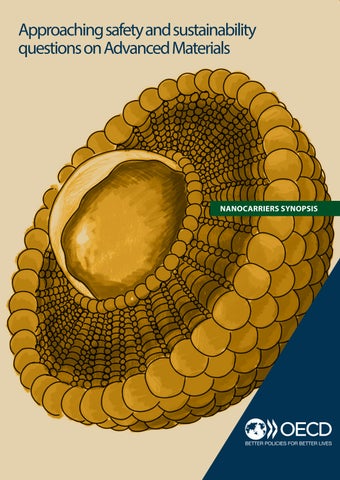
NanoCarriers can be understood as carrier systems for active ingredients whose external dimensions are smaller than 1000 nm in at least one dimension . A nanocarrier system consists of an active ingredient that is transported through the nanocarrier, and the carrier structure itself. Nanocarrier systems also include surface modifications, e.g., for stabilization. NanoCarriers are used, among other things, for protection, targeted transport to the site of action and sustained release of an active ingredient. NanoCarriers are applied and investigated for their use in different sectors such as medicine, agriculture, cosmetics, food, food supplements, household products, textiles, and electronics/electrical engineering. The diverse applications of NanoCarriers are also reflected in their diversity and complex composition, examples and more details can be found in the report by Gressler et al (2024) . NanoCarriers promise benefits for various fields of applications, based on new concepts in terms of their structural, and material properties. Many different types of NanoCarriers are currently being researched, so it is expected that the number of NanoCarriers in use will grow rapidly in the coming years. NanoCarriers promise many benefits, including better targeting of the active ingredient, so that less active ingredient is needed. To profit from the benefits that are promised by NanoCarriers for humans and the environment in the best feasible way, regulation needs to be prepared for these developments. In addition, Safe(r)-and-Sustainable-by-Design concepts should be implemented and implementable within the innovation process. Therefore, knowledge, methods and strategies must be available to be able to identify, prevent and mitigate potential risks, but also to minimise environmental footprint associated with the use of NanoCarriers throughout their whole life cycle as early as possible.
The OECD Working Party on Manufactured Nanomaterials (WPMN) is a subsidiary body of the OECD Chemicals and Biotechnology Committee. This programme concentrates on human health and environmental safety and sustainability implications of manufactured nanomaterials and advanced materials and aims to ensure that the approach to hazard, exposure and risk assessment is of a high, science-based, and internationally harmonised standard. It promotes international co-operation on the human health and environmental safety and sustainability of manufactured nanomaterials and advanced materials involving the safety testing and risk assessment of manufactured nanomaterials. The WPMN plays an important role in developing the guidelines and frameworks that are necessary for their responsible assessment, ensuring that advancements in material innovation are accompanied by a thorough understanding of their potential impact and/ or benefits on health and the environment.
APPROACHING SAFETY AND SUSTAINABILITY QUESTIONS ON ADVANCED MATERIALS . 3
Regulatory Preparedness and NanoCarriers There is strong evidence that the specific functionalities and characteristics of a NanoCarrier can affect persistence, interactions with organism, and fate in the environment of the carrier itself as well as of the transported active ingredient. The OECD WPMN held a Workshop on NanoCarriers on 14-15 June 2023. During this event, experts used the OECD Early Awareness and Action System for Advanced Materials (Early4AdMa), which helped in this case identifying signals concerning the safety and sustainability of NanoCarriers applied in the selected sectors of cosmetics, medicine, and plant protection. This included knowledge gaps regarding their potential risks to health and the environment, e.g., on toxic potential and fate of the carrier, change in fate/effect of the active substance due to the carrier. Only a few regulatory frameworks within OECD countries consider the specificities of NanoCarriers within their information requirements. Furthermore, there is insufficient guidance on how to assess them. Importantly, there is a need for appropriate test methods to be able to investigate and evaluate the influence the fate and effect of (already well studied) active substances. In turn, this also implies the development of analytical methods that allow identification and characterisation of NanoCarriers in complex matrices. With respect to sustainability, there is limited knowledge concerning, for example, the energy, water, and land demand for raw material extraction; or during manufacturing, production, transport, use or consumption of NanoCarriers. The possibility for recycling of raw material or waste arising during production is an area where knowledge is insufficient. With this in mind, a number of actions are anticipated by different stakeholders as follows.
4 . APPROACHING SAFETY AND SUSTAINABILITY QUESTIONS ON ADVANCED MATERIALS
•
Regulation/Policy to review affected regulatory frameworks and guidance for possible adaptation needs to appropriately cover NanoCarriers and amend them if necessary. Funding should be provided to close information gaps and to facilitate method development and harmonisation by research projects.
•
Industry to contribute with their knowledge and expertise to: - close data gaps of various aspects: e.g., structure and functionality of NanoCarriers, behaviour - and safety of the NanoCarriers entirety as well as the contribution of the carrier to it, further sustainability issues (e.g., resource demand and waste generation during production, saving of active substance during use). - support method development and harmonisation.
•
Academia to carry out research that provides answers to open questions, in particular to facilitate appropriate risk assessment of NanoCarriers and to help to assess the sustainability of their whole life cycle. Furthermore, academia should participate in method development and harmonisation.
Recommendations on the next steps Regarding the signals and open questions identified for NanoCarriers, it was recommended that the WPMN: •
obtains an overview about ongoing research activities and reviews that can fill data gaps and/or substantiate the identified signals.
•
prioritises which application area, questions and signals are of interest from a regulatory perspective.
•
further discuss safety and sustainability of NanoCarriers and their applications to identify common signals and give joint guidance for similar carrier structures and similar active substance modes of action.
•
promote closing information gaps, method development and harmonisation, establishment of assessment guidance; initiate collaboration with other OECD committees depending on expertise and competence.
SYNOPSIS
Actions anticipated by stakeholders
Approaching safety and sustainability questions on Advanced Materials Synopsis on NanoCarriers
READ THE FULL REPORT
oecd.org/en/publications/advanced-materials-casestudy-on-nanocarriers-workshop-report_b25d8c0cen.html
OECD WORK ON NANOMATERIALS AND ADVANCED MATERIALS
oecd.org/en/topics/nanomaterials-and-advancedmaterials.html
CONTACTS Bob Diderich: bob.diderich@oecd.org Mar Gonzalez: mar.gonzalez@oecd.org Image credits: All images courtesy of Shutterstock.com. December 2025 © OECD.