Approaching safety and sustainability questions on Advanced Materials
MXENES SYNOPSIS
The OECD Working Party on Manufactured Nanomaterials (WPMN) is a subsidiary body of the OECD Chemicals and Biotechnology Committee. This programme concentrates on human health and environmental safety and sustainability implications of manufactured nanomaterials and advanced materials and aims to ensure that the approach to hazard, exposure and risk assessment is of a high, science-based, and internationally harmonised standard. It promotes international co-operation on the human health and environmental safety and sustainability of manufactured nanomaterials and advanced materials involving the safety testing and risk assessment of manufactured nanomaterials. The WPMN plays an important role in developing the guidelines and frameworks that are necessary for their responsible assessment, ensuring that advancements in material innovation are accompanied by a thorough understanding of their potential impact and/ or benefits on health and the environment.
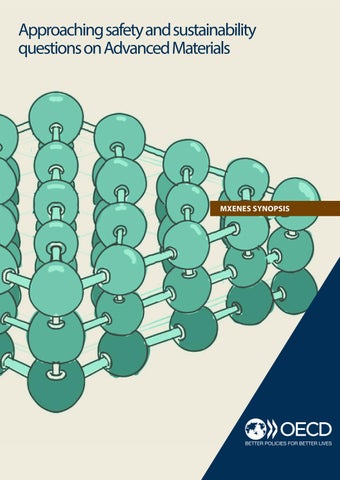
What are MXenes? MXenes (pronounced maxenes) are a family of two-dimensional transition metal carbides and nitrides. The general formula of a MXene is Mn+1XnTx. Here, the M represents an early transition metal from groups 3 to 6 of the periodic table; X is either carbon or nitrogen (nonmetal atom) and T stands for the surface termination groups which are bonded to the outer transition metal layers. The surface terminations are inherent to the chosen synthesis procedure and can be uniform or mixed. Various groups can occupy the T-sites including -O, -OH, -F, -Cl, -NH, -Br, -S, -Se and -Te. To date, more than 50 MXene compositions have been experimentally realized and even more have been theoretically predicted. However, the vast majority of MXene research has been focused on the first discovered titanium carbide with the formula Ti3C2Tx.
Why is a closer look on MXenes important? Materials with enhanced complexities, structures and functionalities are increasingly being developed. These advanced materials may provide economic opportunities and may contribute solutions to key societal challenges. It is crucial that these new materials are safe and sustainable, and that existing chemicals regulation is prepared to deal with their special properties. To prevent adverse impacts of advanced materials, it is key to identify potential issues that may arise as early as possible and act on those issues when needed. Two-dimensional (2D) materials are advanced materials that have a thickness of just a few atomic layers, making them virtually two-dimensional in nature. These materials exhibit unique physical, chemical, and electronic properties that are not found in their bulk counterparts, due to the much larger surface area to volume ratio and tuneable electronic properties. Furthermore, their high strength and stiffness, scalable synthesis, tuneable surface groups, and (assumed) biocompatibility makes them suitable for a number of applications including in energy storage, catalysis, biomedical and environmental applications. As MXenes are currently intensively researched for different application areas, the number and uses of MXenes is expected to grow in the next years. However, this requires the identification of potential safety and sustainability implications and a review whether regulation will be prepared to also address this kind of 2D materials.
APPROACHING SAFETY AND SUSTAINABILITY QUESTIONS ON ADVANCED MATERIALS . 3
Framing of the issue Within the OECD WPMN Steering Group on Advanced Materials a case study was conducted on titanium carbide MXenes, as these are the most intensively studied and closest to market as first steps towards commercialisation have been taken. With the OECD Early Awareness and Action System for Advanced Materials (Early4AdMa) potential issues were identified concerning the safety and sustainability of titanium carbide MXenes. The results of the case study were presented during an online international OECD WPMN workshop on the 28th of May 2024, where additional input and perspectives on the findings were gathered. Details of the case study and workshop findings have been provided in an OECD report. Some of the issues identified for titanium carbide MXenes may also apply to other MXenes and 2D materials. The main issues are: 1. While there is no definitive evidence to suggest that titanium carbide MXenes are highly acutely toxic, significant information gaps together with limited quality of available studies prevent conclusive assessment of their safety and sustainability. Critical information for a comprehensive risk assessment is lacking, including details on pulmonary hazards, genotoxicity potential, long-term effects on human health and the environment, kinetics within the human body, environmental fate, transformation products, life cycle impacts at production volumes larger than laboratory scale, and recyclability and re-useability. 2. The quality of experimental studies and reporting on titanium carbide MXenes is currently insufficient and requires significant improvement to inform risk assessment, regulatory actions and policy decisions. Notable issues include deficiencies in sample preparation, characterisation of materials in the respective test systems, and the use of benchmark materials. 3. There are concerns that existing legislation and risk assessment tools may not be fitfor-purpose for titanium carbide MXenes in ensuring the relevance and completeness of information requirements and addressing toxic mechanisms related to their unique properties.
4 . APPROACHING SAFETY AND SUSTAINABILITY QUESTIONS ON ADVANCED MATERIALS
•
Regulation/Policy should: i. Evaluate the need for adapting and developing OECD test methods to appropriately investigate MXenes, and amend, develop and validate these methods as necessary. This at least includes consideration on the applicability of the OECD Guidance on Sample Preparation and Dosimetry for 2D materials such as MXenes. ii. Assess whether key physical-chemical properties of MXenes (e.g., lateral size, number of layers, terminal end groups) demand additional information requirements in regulations or could be covered by regulatory guidance.
•
Industry should: i. Close data gaps regarding the risk of MXenes, including the fate and effects of their transformation products due to concerns about chronic toxicity stemming from the persistence. ii. Improve the knowledge base on sustainability and the circular economy, while also exploring safer and more energy-efficient production methods.
•
Academia should conduct additional studies to address key knowledge gaps as described above and participate in method development as necessary, for example by providing the scientific basis for guidance on sample preparation.
Collaboration between stakeholders in a trusted environment is recommended to address these issues together, including raising awareness about the need to improve the quality of experimental studies and their reporting. This encompasses better documentation of dispersion methods and conditions and improved material characterisations during testing.
Recommendations on the next steps Regarding the signals and open questions identified for titanium carbide MXenes during the OECD WPMN Workshop , it is recommended that WPMN: •
keeps track of ongoing research activities and reviews that can fill data gaps and/or substantiate the identified signals.
•
prioritises follow-up actions for MXenes and 2D materials in general, including if and how considerations on sample preparation and dosimetry for 2D materials such as MXenes can be taken onboard.
•
promotes addressing the key follow-up actions by e.g., closing information gaps, method development and harmonisation, and establishment of assessment guidance.
SYNOPSIS
What is needed by whom?
Approaching safety and sustainability questions on Advanced Materials Synopsis on MXenes
READ THE FULL REPORT
2D Titanium Carbide MXenes Case Study Report on Advanced Materials OECD WORK ON NANOMATERIALS AND ADVANCED MATERIALS
Nanomaterials and advanced materials CONTACTS Bob Diderich: bob.diderich@oecd.org Mar Gonzalez: mar.gonzalez@oecd.org Image credits: All images courtesy of Shutterstock.com. December 2025 © OECD.