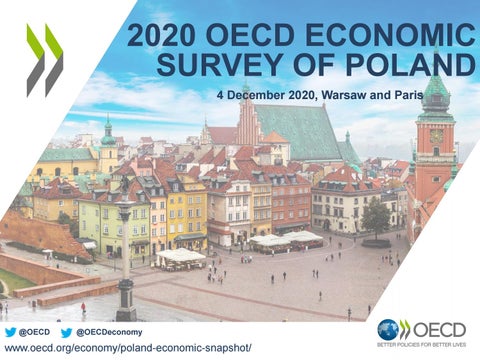
2020 OECD ECONOMIC SURVEY OF POLAND 4 December 2020, Warsaw and Paris
@OECD
@OECDeconomy
www.oecd.org/economy/poland-economic-snapshot/
Key messages The COVID-19 crisis has hit growth prospects. Fiscal and monetary support are key to foster an inclusive and sustainable recovery.
• Target short-term support on the most affected households; • Support viable firms, training and foster digitalisation; • Accelerate green investments.
Ageing and environmental challenges are high. • Raise employment opportunities and health of older workers; • Ease the transition to a greener economy.
SMEs’ productivity and internationalisation gaps are large. • Continue to improve infrastructure and regulations; • Boost skills and firm collaboration.
2
Convergence has been impressive Convergence in GDP per capita Current PPPs, Index OECD=100
1. EA4 is the average of Germany, France, Italy and Spain. 2. CEEC is the average of Hungary and the Czech and Slovak Republics. Source: OECD (2020), OECD National Accounts database.
3
Poverty is historically low Poverty rate % of the population, 2017 or latest year available1
1. At 50% of households’ median equivalised disposable income. 2. CEEC is the average of Hungary and the Czech and Slovak Republics. Source: OECD (2020), OECD Income Distribution and Poverty Statistics (database).
4
MOVING TO A SUSTAINABLE RECOVERY
5
The initial impact of the COVID-19 crisis has been relatively contained Real GDP change, 2019Q4 to 2020Q2 %, s.a
1. CEEC is the average of Hungary and the Czech and Slovak Republics. Source: OECD (2020), OECD National Accounts database
6
Fiscal support has been significant General-government deficit % of GDP
Source: OECD (2020), OECD Economic Outlook: Statistics and Projections (database).
7
Monetary policy has reacted forcefully Reference rate and Central Bank’s domestic assets
Source: NBP (2020), Balance sheet of the National Bank of Poland – Assets - stocks in PLN million ; Central bank interest rates; OECD (2020), Monthly Monetary and Financial Statistics (MEI) dataset.
8
Unemployment remains low Unemployment rate % of the active population, 2020Q2
1. CEEC is the average of Hungary and the Czech and Slovak Republics. Source: OECD (2020), OECD National Accounts database
9
Weaker regions have been most affected Regional employment growth September 2020, % yoy
Regions are ranked according to their pre-crisis (2011-19) employment growth. Source: OECD calculations based on Statistics Poland (2020), Average paid employment in enterprise sector (short-term data).
10
COVID-19 cases have increased again tilting to new restrictions New cases and tests’ positivity rate
Source: Our World in Data, ourworldindata.org (accessed: 19 November 2020); OECD calculations based on John Hopkins University Center for Systems Science and Engineering (JHU CCSE) database; and Statistics Poland (2020), Population Statistics.
11
The crisis has dented economic prospects Real GDP, Index 2019-Q4=100
Source: OECD (2019 and 2020), OECD Economic Outlook: Statistics and Projections (databases).
12
Temporary workers could be highly affected Share of self-employed and temporary workers % of non-farm employment, 2019
Source: Eurostat (2019), "Employment, Labour Force Statistics series", Eurostat Database.
13
More training will be needed Participation in training for secondary educated adults with weak literacy skills % of population, 25-65 year-olds, 2012-15
Low-skilled adults are defined as those with a score of less than 2 on the scales of written comprehension. The data are based solely on Flanders for Belgium and England for the United Kingdom. Source: OECD (2016), Skills Matter - Further Results from the Survey of Adult Skills, OECD Publishing, Paris.
14
Main recommendations for an inclusive and sustainable recovery • If economic conditions weaken rapidly, ease fiscal and monetary policies further. • Expand intensive care capacity and ensure a successful testing, tracing and isolation strategy. • Bring forward green and digital investment to kick-start the recovery. • Strengthen lifelong learning opportunities notably for lowskilled workers, with a special focus on developing digital skills. • Envisage an income-tax-credit and/or subsidise social security contributions for low-income workers. 15
FACING MEDIUM-TERM CHALLENGES AND INVESTMENT NEEDS
16
Health expenditure should be increased Health expenditure per capita EUR PPP, 2019 (or nearest year)
1. CEEC is the average of Hungary and the Czech and Slovak Republics. Source: OECD/European Union (2020), Health at a Glance: Europe 2020: State of Health in the EU Cycle, OECD Publishing, Paris
17
The carbon intensity of the economy remains high CO2 intensity of the economy Kg/USD, 2010 PPPs
1. CEEC is the average of Hungary and the Czech and Slovak Republics. Source: OECD (2020), OECD Green Growth Indicators (database).
18
Air pollution weighs on health outcomes Mean population exposure to air pollution (PM2.5) Micrograms per cubic metre, 2017
1. CEEC is the average of Hungary and the Czech and Slovak Republics. Source: OECD (2020), OECD Green Growth Indicators (database).
19
Investments are needed to improve the quality of infrastructure Percentage of SMEs who identified the following areas as their top priority for investment¹, 2016
1. The question is formulated as “From your business’ perspective, if you had to prioritise one area of public investment for the next 3 years, which one would it be?” Source: EIB (2017), Investment Survey, European Investment Bank, Luxembourg; OECD (2019), Transport infrastructure investment and maintenance spending (database).
20
Demographic challenges are rising rapidly Ratio of 65 and over to 15-64 population, %
1. CEEC is the average of Hungary and the Czech and Slovak Republics. Source: Eurostat (2019), Baseline population projections.
21
The effective retirement age is low, notably for women Women effective retirement age, 2018
The average effective age of retirement is calculated as a weighted average of (net) withdrawals from the labour market at different ages over a 5-year period for workers initially aged 40 and over. Source: OECD (2019), Pensions at a Glance 2019: OECD and G20 Indicator
22
Pension replacement rates will decline Pension gross replacement rate 2016 and projections to 2050
The gross replacement rate at retirement corresponds to the average very first public pension benefits of those who retire over an (economy-wide) average wage at retirement. Source: European Commission (2018), "The 2018 Ageing Report - Economic and budgetary projections for the 28 EU Member States (2016-2070)", Directorate-General for Economic and Financial Affairs.
23
Public debt will increase further Illustrative simulations of gross government debt % of GDP, Maastricht definition
Source: OECD calculations.
24
Main recommendations to face medium-term challenges Facing health and ageing challenges. • Use the planned increase in health spending to strengthen primary care and prevention. • Progressively align male and female statutory retirement ages and increase it in line with life expectancy gains in good health. • Continue to expand the supply of childcare and long-term care facilities.
Boosting greener growth. • Implement stable climate-change policies aligned with European and international objectives • Increase road pricing and introduce CO2-based vehicle taxation, together with redistribution targeted towards poorer households. 25
Main recommendations to face medium-term challenges Ensuring long-term fiscal sustainability.
• When the recovery is firmly underway, pursue fiscal consolidation to decrease the public debt-to-GDP ratio. • Limit the use of reduced VAT rates and exemptions over the medium term. Raising investor confidence.
• Amend the disciplinary procedures applicable to judges, in particular by excluding the possibility for the executive to intervene in these proceedings 26
BOOSTING SMEs INTERNATIONALISATION
27
Poland’s internationalisation has been remarkable Goods internationalisation
Exports and imports over GDP, 1995=100
Services internationalisation
Exports and imports over GDP, 1995=100
1. Internationalisation is proxied by the share of exports and imports divided by GDP. 2. CEEC is the unweighted average of Hungary and the Czech and Slovak Republics. 3. The OECD average is the unweighted average of OECD countries. Source: OECD (2020), National account database
28
Small and medium-sized enterprises are lagging % of goods and services directly exported by SMEs 2017 or latest
Source: OECD (2019), Structural Business Statistics, Trade by Enterprises Characteristics and National account databases
29
Small firms are less productive Productivity gap by firm size large firm=100, 2017 or latest available year
1. CEEC is the unweighted average of Hungary and the Czech and Slovak Republics. 2. Average of available years. Young firms are those less than two years old. Source: OECD calculations based on OECD (2019), Structural Business Statistics, Trade by Enterprises Characteristics and National account databases; Eurostat (2019), “Structural Business Statistics�, Eurostat Database.
30
Young firms struggle to grow Average employment growth of young firms Percentage growth, 2011-15²
1. CEEC is the unweighted average of Hungary and the Czech and Slovak Republics. 2. Average of available years. Young firms are those less than two years old. Source: OECD calculations based on OECD (2019), Structural Business Statistics, Trade by Enterprises Characteristics and National account databases; Eurostat (2019), “Structural Business Statistics”, Eurostat Database.
31
Some administrative procedures remain burdensome Burden on new firmsยน scale 0-6 from least to most restrictive, 2018
1. Administrative requirements to set up limited liability companies and personally-owned enterprises. 2. CEEC is the unweighted average of Hungary and the Czech and Slovak Republics. Source: OECD (2019), OECD 2018 PMR database.
32
Tax compliance costs are elevated Time spent on paying taxesš Hours per year, 2019
1. The time to comply with tax laws measures the time taken to prepare, ďŹ le and pay three major types of taxes and contributions: the corporate income tax, value added or sales tax and labour taxes, including payroll taxes and social contributions. 2. CEEC is the unweighted average of Hungary and the Czech and Slovak Republics. Source: World Bank (2019), Doing Business 2020.
33
Collaboration between firms is weak Perceived state of cluster development 7=best, 2019
Source: WEF (2019), The Global Competitiveness Report 2019, World Economic Forum. 34
Barriers to digitalisation remain high Digital Services Trade Restrictiveness Index, 2018 Index from 0 (completely open) to 1 (completely closed)
Source: OECD (2019), Digital Services Trade Restrictiveness Index (database).
35
Small firms make less use of training Small enterprises using continuous vocational training Percentage of firms, 2016
Source: Eurostat (2019), Continuing vocational training in enterprises database.
36
Small firms offer little ICT training Businesses providing ICT training to their employees Percentage of small firms (10-49 employees), 2018
Source: OECD (2019), ICT Access and Usage by Businesses (database).
37
Recommendations to increase the internationalisation of SMEs Improve the business environment and infrastructure • Further involve stakeholders in the design of regulations through early consultation procedures. • Conduct systematic ex-ante evaluations of regulation. • Develop data hubs providing companies and public services with access to large databases, notably in the healthcare sector, while ensuring digital security and privacy. • Strengthen the role of ex ante cost-benefit analyses in transport infrastructure project selection, for instance by establishing an independent evaluation body.
38
Recommendations to increase the internationalisation of SMEs Raise skills and cooperation across firms • Strengthen lifelong learning opportunities for low-skilled workers and towards the development of digital skills. • Scale-up existing programmes for SMEs with a focus on training and showcase best practices based on thorough impact analyses. • Provide financial support to develop workplace-based lifelong learning and training consortia by SMEs.
39
For more information
@OECD @OECDeconomy
www.oecd.org/economy/poland-economic-snapshot/
40