National Security & Competition in 5G Mobile Markets

Strand Consult Prepared for OECD 23 June 2026
Underlying materials and data provided upon request
Agenda
• How competition and national security complement each other
• Why national security matters in 5G: Digital Distribution
• Approaches and challenges across the OECD


Competition and national security rely on similar regulatory logic. Both manage risk, whether threat of anticompetitive practices or intrusion
Competition
• Goal: welfare, efficiency, low prices, protection from anticompetitive practices
• Tools: investigation, adjudication, remedies.
• 5G relevance: licensing, mergers, standards, rollout conditions.
National security
• Goal: protect citizens, institutions, and critical systems.
• Tools: identification, investigation, decision, mitigation, enforcement.
• 5G relevance: critical infrastructure risk, coercion risk, secure communications.
Shared point
• Both are rule-bound, evidence-based, and focused on managing risk in critical systems.

Classical Antitrust vs. Security
Antitrust / Industrial Organization
Firms as independent actors
Goal: efficiency, consumer welfare, innovation
Geopolitics / State Power
Firms inside state strategy
Goal: sovereignty, power, technological leadership
Tools: competition law, merger control, market definition
Tools: industrial policy, standard, subsidies, trade controls, security screens
Assumption: markets are separable from politics
Assumption: markets are embedded in state strategy
Classic competition policy alone does not ensure state capacity, supply-chain security, technological sovereignty, and reduced risk.
Everything is becoming connected — and thus exposed.
Telecom is a not just a sector; it’s the foundation of the digital economy.
+500,000 mobile sites in EU

Connected systems: cars, homes, factories, logistics, health, government










Network equipment can a distribution channel to the tech stack.
Equipment choice can create lock-in effects.
• Just like smartphones with embedded apps, network equipment can demonstrate integration bias. Standards/interfaces can be configured with pre-determined preferences and preferred install partners.
• From 2015, China’s State Council has published plans for export of “national champions”, “integrated service ecosystems” “network power”, and “Internet Plus” productization of traditional industries (smart city, transport, manufacturing, health/pharma)
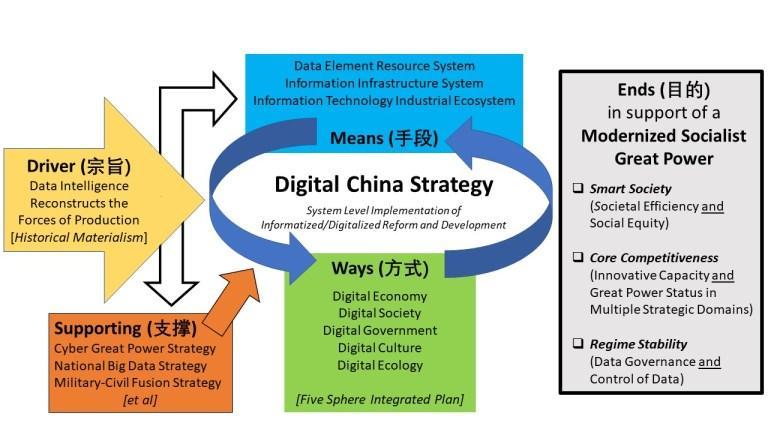
• China’s disruption strategy has been documented in PCs, LEDs, solar, wind, shipbuilding, and now robotics. China’s ends, ways and means relies on Information Infrastructure (信息基础设施), Integrated Infrastructure (融合基础设施], and Innovative Infrastructure (创新基础设施) https://digitalchinawinsthefuture.com/digital-chinasstrategic-framework-ends-ways-and-means/
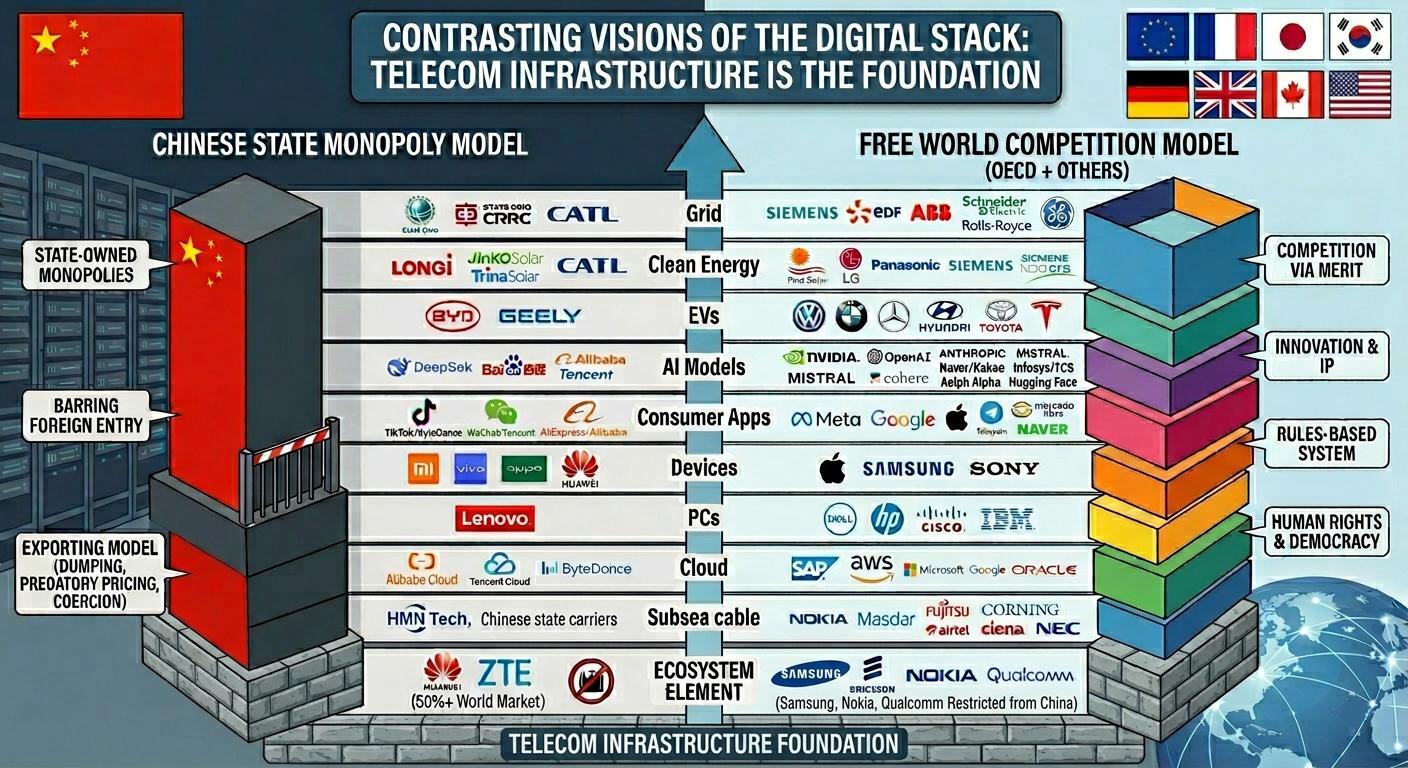
Merging of Mobile Network Equipment Market
From 20 providers to (3 + 2) + long tail
• Competing network standards: GSM, DAMPS, CDMA, analog. Shift from 1G (analog) to 2G (digital) eliminated many. GSM won.
• Mobile operators spent €110B on 3G spectrum auction. Monthly ARPU dropped from €37 in 2000; €15 today (60% price drop).
• Operators squeeze equipment providers to reduce cost. Operators prefer to manage fewer vendors.
• Policy forces free roaming and restricts mobile operators’ ability to recover investment (OTTs enjoy free/discounted access), so competing only on price, operators must race to the bottom.
• Huawei and ZTE enjoy 100% market share in China; est. 40% abroad.
China’s 5G market is larger than EU, India and USA combined.
Untrusted vendors create not one risk, but a cluster of operational, security, dependency, and political vulnerabilities.
1. Critical infrastructure exposure
2. Supply chain and operational disruption 3. Strategic dependency 4. Privacy and data exploitation risk 5. Political leverage and coercion 6. Supplier autonomy and state influence
Counterintelligence risk
Lawfare and chilling effects on critics
For more information: https://strandconsult.dk/eight-risks-for-the-5g-supply-chain-from-suppliers-under-the-influenceof-adversarial-countries-like-china/
Categories of national security regulation for mobile networks
5 Eyes Based Intelligence
Explicit restrictions on country/company
Sector specific, designed to protect against litigation
Australia Canada
New
United
United
EU 5G Toolbox and DSA2
Technical assessment, industrial standards
Can extend to all critical infrastructure
Operator liability
Border Restrictions
Limited Nat Sec Controls