Where are research and innovation careers heading?
Introducing the Research and Innovation Careers Observatory


Key messages
• Our shared future hinges on effectively nurturing research and innovation (R&I) talent and enabling productive careers for people from all backgrounds. Their creativity and ingenuity are necessary to address society’s major challenges with new knowledge and solutions, but those entertaining the possibility of embarking on R&I careers or continuing them face considerable challenges.
• Boosted by government investment and the expansion in higher education, the share of workforce with formal advanced research qualifications at PhD level has risen fast in OECD countries. The R&D professional workforce has also rapidly expanded, particularly beyond academia, boosting the emergence of new knowledge-intensive industries and occupations.
• However, policy makers harbour increasing concerns and uncertainty about the apparent deterioration of working conditions of many researchers, lack of diversity, opportunities for career advancement, and the capacity of R&I systems to retain and attract talent
• Identifying and implementing policies appropriate for ensuring a resilient and adaptable R&I workforce in today’s world requires a fit-for-purpose evidence base that is integrated in decision making process and has a long-term perspective. Governments should invest in such evidence base and build the necessary domestic and international partnerships to sustain it.
• Science and innovation ministers and the EU met at the OECD in Paris on 23-24 April 2024, and issued the Declaration on Transformative Science, Technology and Innovation Policies for a Sustainable and Inclusive Future. It acknowledges the critical role of R&I professionals for scientific breakthroughs and societal development and endorses the development of a Research and Innovation Careers Observatory (ReICO).
• ReICO aims to drive concerted and sustained action among decision makers and data providers towards bridging the evidence gap in R&I careers. It will monitor all aspects of talent development, labour market conditions and outcomes, and talent circulation across multiple dimensions. Implemented by the OECD with support from the European Union over an initial sixyear-term, ReICO will build on long-standing OECD policy and measurement work on the R&I workforce, showcasing best practices within member and partner countries.
• ReICO will address the need to improve the future of R&I careers through better monitoring by working closely with governmental National Contact Points, the project’s Expert Group and the “Friends of ReICO” community, aiming towards an initial Beta launch of the observatory’s new platform in the second quarter of 2025
Our science and technology future hinges on effectively nurturing research and innovation talent today and enabling productive careers, but what do we know about those?
Science and innovation ministers from OECD countries and partners meeting in 2016 in Daejeon, Korea, declared that “science advances thanks to the curiosity and creativity of researchers, which needs to be encouraged”. The quality and relevance of research and the impact of work on developing and applying new solutions to address the global challenges that we face as a society depend on the expertise, skills and dedication of talented individuals, as well as the conditions in which they operate.
Nurturing talent for research and innovation (R&I) requires opening opportunities and addressing biases from early formative years. For example, data on enrolment and graduation at tertiary and doctoral education level by gender shows clear patterns of women’s under- and over-representation in R&I fields and sectors that reflect stereotypes, and social expectations. In some countries, high women participation can be a sign of low pay rather than inclusion and opportunity.
Considerable public resources are being dedicated around the world to the professional development of R&I talent, for example through PhD programmes. Governments are under pressure to demonstrate the value of this investment in mobile R&I talent. Although not the sole path to R&I careers, doctoral education provides specialised training in research competences Doctorate holders now make a significant part of the workforce. Following a steady increase in the number of graduates with master's and doctoral degrees, signalling the professionalisation of R&D careers, the share of doctorate holders in the working-age population rose from 0.9% in 2014 to 1.3% by 2022, a 41% increase (Figure 1).
Figure 1. Share of doctorate holders in the working age population, 2014-2022
Percent of 25-64 year-olds, 2014-2022 or closest available years
Source: Education at a Glance: Educational attainment and labour-force status; NEAC survey (Last updated: September 2023).
Questions abound about the sustainability and suitability of current incentives and systems in place for nurturing and helping deploy a new generation of talent that is sufficiently motivated and equipped to develop and implement solutions to society’s key challenges. Research careers are not the sole preserve of academia. The diversification of research careers and the promotion of flexible career trajectories are perceived to help promote better-quality research and innovation across different economic and social sectors. The number of researchers in the OECD has surged from 3.2 million in 2000 to over 5.5 million in 2021, with a significant shift towards employment in the business sector a trend on the rise across most OECD countries (Figure 2), but with a high degree of domain and sector specificity (see also Box 1)
Figure 2. Researcher workforce trends, 2000-2021
In full time-equivalents, as per thousand of total employment
Source: OECD Main Science and Technology Indicators (September 2023), https://www.oecd.org/sti/msti.htm
Box 1. What do we mean by researchers and R&I talent?
“Researcher” is the term “effectively” used in the OECD Frascati Manual (OECD, 2015) to refer to the professionals of research and experimental development (R&D), working together with assistant professionals (technicians in the Manual’s jargon) and other auxiliary personnel to define the ensemble of R&D personnel. Researchers, as measured in official statistics, are not only those that carry out “creative and systematic work undertaken to increase the stock of knowledge” but also those who develop brand new applications of knowledge, and in doing that also expand its boundaries.
In addition to those engaged in R&D, there is a manifest need for mapping out roles contributing to innovation activities more broadly, an area still requiring conceptual development and consolidated measurement to reflect, for example, the professionalisation of R&D management. Qualifications, skills, competences and related frameworks connect R&I functions with development pathways that are particularly important for policy makers, and also illustrate the extent to which R&I talent and capabilities are put to effective use. Common terms used to describe R&I talent also need practical adaptation to different contexts, data sources and practical uses, especially as traditional functions, roles and job titles rapidly evolve with the emergence of new industries and technologies, including those with the potential like AI to deeply transform the very fabric of research and innovation.
Policy makers have been harbouring increasing concerns and uncertainty about the apparent deterioration of working conditions of many researchers, lack of diversity in terms of gender and representation of different groups in society, unequal opportunities in access and advancement in careers, and declining capacity of several research and innovation systems to retain and attract talent. The exploratory OECD International Survey of Science sheds some light on the realities faced by scientists worldwide, particularly regarding employment conditions. The evolving research landscape, coupled with heightened competition for secure academic positions, has led to a precarious employment situation for many young researchers Scientists on fixed-term contracts are more likely to earn less than other authors, even after controlling for personal and job characteristics (Figure 3). However, among those with indefinite contracts, those with higher job security obtain lower salaries. ISSA results also indicate that scientific authors on fixed-term contracts are more likely to live in a country different from the one where they obtained their doctorate degree. They are also three times more likely to be planning to move abroad.
Figure 3. Reported job security among scientific authors not in business, by age group, 2018
Note: Weighted estimates adjusted for nonresponse. Under Indefinite highly protected contracts, the respondent can only be dismissed by the employer for gross misconduct. Other indefinite contracts are open-ended. Fixed-term positions have a set duration.
Source: Insights from the OECD International Survey of Scientific Authors Calculations based on the OECD International Survey of Scientific Authors, 2018 (June 2020) https://www.oecd.org/sti/science-technology-innovation-outlook/research-precariat/insightsfromtheoecdissa.htm
The long-standing tension between “brain gain/ drain” and “brain circulation” paradigms – namely different views as to whether talent mobility is a zero-sum game or yields broad-based benefits – appears to be amplified by the current geo-strategic context of competition for talent, especially in “high-stakes” areas perceived to be crucial for resilience, security and economic competitiveness. The international circulation of talent is highly visible in OECD statistics on international students as well as several national workforce related statistics. In the United States, for example, 45% of workers with a doctorate in science and engineering occupations are foreign-born.
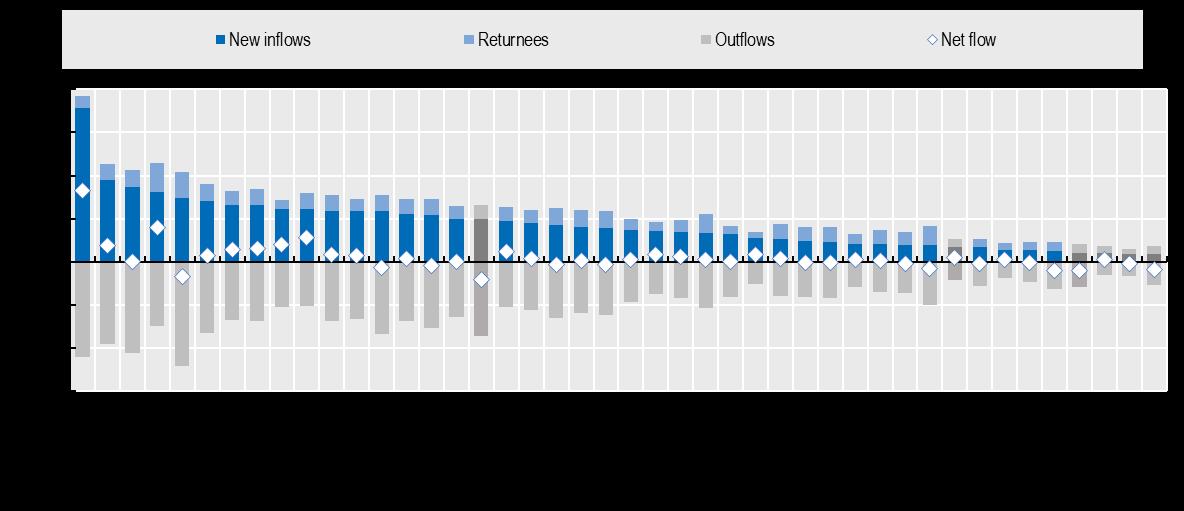
Talent circulation is challenging to measure in a coherent fashion because official statistics are constrained to national jurisdictions while R&I workforce mobility transcends national boundaries. The evidence from proxy measures for OECD countries and other major economies, such as the trace of declared affiliations in scientific publications, is more consistent with the circulation paradigm because net flows are very small compared to gross flows (Figure 4). Besides, internationally mobile scientists display a “better” publication record than their “sedentary” peers. However, some countries are more successful at attracting the “best” among internationally mobile talent.
Figure 4. International mobility of scientific authors, 2021
As a percentage of authors, by last main recorded affiliation in 2021
Source: OECD calculations based on Scopus Custom Data, Elsevier, Version 1.2023, March 2023.
Bridging the decision-making
and evidence
gap in research and innovation careers requires concerted action both within and across countries
Despite the long-standing work on data and information on human resources in R&D, there are still a number of shortcomings in the evidence base, in terms of the need for more comprehensive definition of common measurement standards and guidelines and international comparability, statistics that go beyond national borders, more granular data on socio-demographic characteristics, better coverage of research performing sectors beyond academia, labour market outcomes of individuals, among others.
Information on R&I careers, especially statistics, is a vital tool for governments, institutions, and individuals to support their decision making, but it is not always at the reach of those who need it most.
Information on R&I careers can help inform the design, implementation and evaluation of a wide range of government policies. Several lines of government policy, not just education and research, can shape the future R&I workforce. International benchmarking is a powerful driver of policy assessment, learning and improvement
Information can also guide managerial policies and practices within R&D and innovation performing and funding institutions, including businesses, universities and institutes, guiding approaches to improve equity, diversity and inclusion and professional development among staff and/or students.
Individuals, their families and related collectives, also have the right to understand the potential implications of their own formative and career decisions. Suitable data can allow individuals to re-assess which alternatives are available and reduce excessive dependence on supervisors, helping researchers channel career aspirations through actionable and meaningful pathways.
Taking action to increase access to comprehensive and reliable sources of evidence requires sustained investment and focused coordinated action. Governments collect, analyse and publish information on researchers and research careers. They draw on data initially intended for administrative purposes, such as accreditation, as well as dedicated statistical surveys conducted by official statistical bodies Sources of information that cover the wider population or are specifically targeted to the R&I talent group of interest entail both advantages and disadvantages. Coordination is essential both within countries, as this subject might get lost across different silos, and internationally, when adopting common standards and approaches even when national priorities might not always align
Joining forces to place talent at the centre of science and innovation policy and monitoring efforts
ReICO is a new initiative, co-funded by the European Union, that aims to be the premier source for trustworthy data and information on R&I careers. Reflecting high-level consensus among OECD and EU members to put talent at the very heart of science and innovation policy and evidence action, ReICO will serve as a comprehensive access point for international statistics, analytical tools, and resources focused on R&I careers, providing a focal point for debate.
Leveraging the long-standing expertise of the OECD Committee for Scientific and Technological Policy (CSTP) in international statistics and policy analysis in R&I, particularly through its Working Party of National Experts in Science and Technology (NESTI), ReICO will bridge knowledge gaps by enhancing the supply, understanding and application of data and statistics in R&I careers to inform decision-making
Over its initial term (2024-2029), and in collaboration with national governments and various stakeholders, ReICO will not only provide a comprehensive synthesis of available resources, but also drive the development of new methodologies, indicators, and insights for the benefit of policymakers, R&I funding bodies, and the principal actors of R&I careers, the individuals themselves
From concept to action
The ReICO initiative is in line with the Declaration on Transformative Science, Technology and Innovation Policies for a Sustainable and Inclusive Future issued at the 2024 CSTP ministerial week following months of preparatory work, consultations and consensus building with the EU and OECD members and partners and key stakeholders. The unique momentum for action on R&I careers provides an ideal trigger for realising the ReICO vision to leverage the extensive knowledge and insights gained over decades of dedicated work conducted at OECD, the EU and their respective member countries to address today’s priorities For example, from the perspective of the European Union, which co-finances the work, ReICO contributes to the monitoring of the implementation of the EU’s Council Recommendation on a European framework to attract and retain research, innovation, and entrepreneurial talents in Europe, and to provide evidence on the effectiveness of measures aiming at strengthening the attractiveness of research careers and balanced talent circulation. Similar motivations underpin the positive response from national contact points from OECD members and partners to this new initiative, who have already shared detailed information on what data they can contribute to this initiative, also highlighting potential domestic challenges that ReICO should help address.
What will ReICO do?
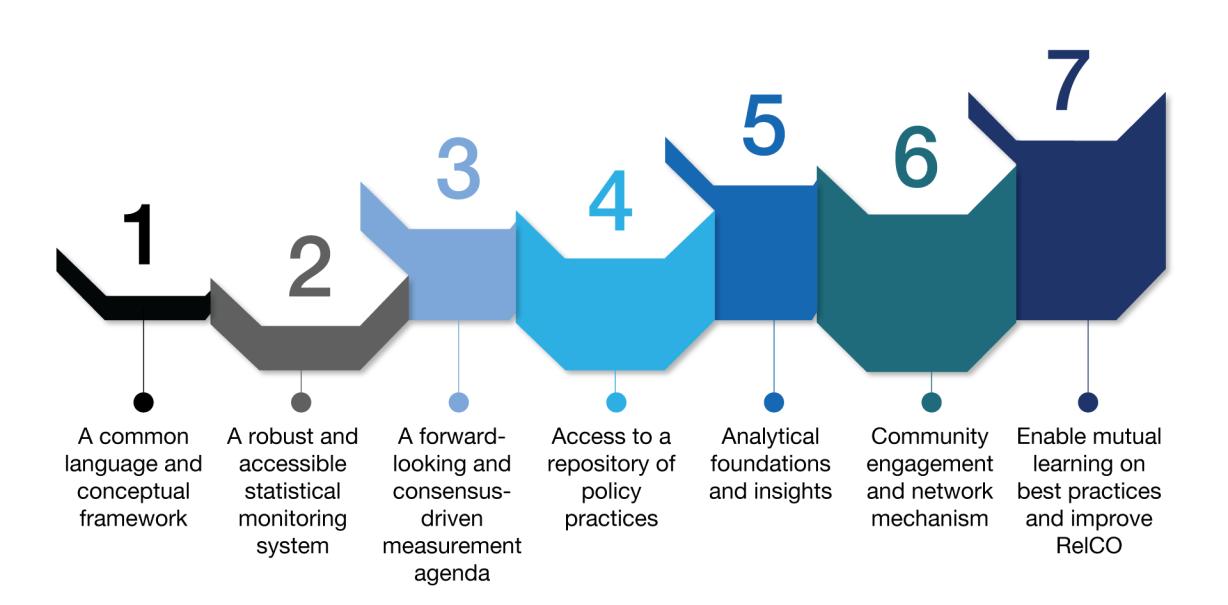
ReICO will contribute to national capabilities and international cooperation on R&I careers by (Figure 5):
Developing a tailored conceptual framework, drawing on and complementing existing frameworks, to provide a common language and basis for structuring the evidence (1).
Creating dashboards with standardised statistical indicators, covering three main R&I career pillars (talent development, the labour market for talent, and talent circulation). The ReICO dashboard will be launched on a Beta version in early 2025 (2).
Developing and progressively implementing a cooperative R&I Talent and Careers Data and Statistics Action Plan, addressing existing gaps in evidence and data (3).
Providing access to OECD and EU repositories of R&I talent and career policies (4) as well as support for data analysis and insights (5).
Providing a multi-level forum of engagement with multiple actors with an interest in R&I careers and their monitoring (6), enabling peer learning and improvement of ReICO (7).
Figure 5: Planned output and activity components of ReICO
Through its annual release and review planning cycle, the design and content of ReICO will be revised and adapted to meet the needs of its target users.
What comes next? And how to engage with ReICO?
The announcement of the ReICO initiative at the CSTP Ministerial meeting 2024 in Paris and the signature of the funding agreement on 19 September 2024 during a European Research Area conference kicks off the initial phase of the project, that will conclude with the launch of the Beta platform in the second quarter of 2025.
Three main networks will provide vehicles for engagement and participation in ReICO.
Network of ReICO National Contact Points: ReICO relies on the contribution of national leads with formal responsibilities on monitoring R&I careers, nominated as such by their respective countries. They are key for assessing a common ground for data availability and organising coordinated data collection and reporting. This group is also a mechanism for sharing national experiences and best practices, with a view to identifying opportunities for scaling up promising approaches already tested at national levels. ReICO Expert Group. The OECD and the EU are working to appoint a select group of leading experts that can help guide and inform the work of ReICO from its inception throughout its six-year initial spell, providing insights on key gaps, options for producing new indicators and developing new data sources, as well as on improving the usability and relevance of the ReICO platform and products.
The “Friends of ReICO” community will be the basis for broad-based engagement in the activities of the observatory. Open and managed via self-registration process, “Friends of ReICO” will allow all interested parties to receive ReICO newsletters and other timely updates, as well as enable other forms of participation, e.g. sharing crowdsourcing campaigns and contributing potential content to the platform. This will allow to showcase, for example, relevant academic studies analysing multiple aspects of R&I talent development, careers and circulation.
Explore further
Auriol, L., M. Schaaper and B. Felix (2012), "Mapping Careers and Mobility of Doctorate Holders: Draft Guidelines, Model Questionnaire and Indicators – Third Edition", OECD Science, Technology and Industry Working Papers, No. 2012/07, OECD Publishing, Paris, https://doi.org/10.1787/5k4dnq2h4n5cen
Bello, M. and F. Galindo-Rueda (2020), "The 2018 OECD International Survey of Scientific Authors", OECD Science, Technology and Industry Working Papers, No. 2020/04, OECD Publishing, Paris, https://doi.org/10.1787/18d3bf19-en
Council of the European Union (2023). Council Recommendation of 18 December 2023 on a European framework to attract and retain research, innovation and entrepreneurial talents in Europe. C/2023/1640 Official Journal of the European Union. https://eur-lex.europa.eu/legalcontent/EN/ALL/?uri=CELEX:32023H01640
National Science Board (2021). The STEM Labor Force of Today: Scientists, Engineers, and Skilled Technical Workers. Science & Engineering Indicators 2022 https://ncses.nsf.gov/pubs/nsb20212
OECD (2015), "Measurement of R&D personnel: Persons employed and external contributors", in Frascati Manual 2015: Guidelines for Collecting and Reporting Data on Research and Experimental Development, OECD Publishing, Paris, https://doi.org/10.1787/9789264239012-7-en
OECD (2018), "Blue Sky perspectives towards the next generation of data and indicators on science and innovation", in OECD Science, Technology and Innovation Outlook 2018: Adapting to Technological and Societal Disruption, OECD Publishing, Paris, https://doi.org/10.1787/sti_in_outlook-2018-19-en
OECD (2021), "Challenges and new demands on the academic research workforce", in OECD Science, Technology and Innovation Outlook 2021: Times of Crisis and Opportunity, OECD Publishing, Paris, https://doi.org/10.1787/72f6f879-en
OECD (2021), "Reducing the precarity of academic research careers", OECD Science, Technology and Industry Policy Papers, No. 113, OECD Publishing, Paris, https://doi.org/10.1787/0f8bd468-en
OECD (2023), "Promoting diverse career pathways for doctoral and postdoctoral researchers", OECD Science, Technology and Industry Policy Papers, No. 158, OECD Publishing, Paris, https://doi.org/10.1787/dc21227a-en
OECD (2024), Declaration on Transformative Science, Technology and Innovation Policies for a Sustainable and Inclusive Future, OECD/LEGAL/0501
OECD/Eurostat (1995), Measurement of Scientific and Technological Activities: Manual on the Measurement of Human Resources Devoted to S&T - Canberra Manual, The Measurement of Scientific and Technological Activities, OECD Publishing, Paris, https://doi.org/10.1787/9789264065581-en
Contact
ReICO@OECD.org